DIGITAL TRANSFORMATION IN HIGHER EDUCATION FROM A BLENDED LEARNING PERSPECTIVE
THE SIS PRESENTED AS
PARTIAL REQUIREMENT FOR DOCTORAL PROGRAM IN SCIENCE, TECHNOLOGY, AND SOCIETY
BY
ROBIN ALBERTO CASTRO GIL
TRANSFORMATION NUMÉRIQUE DANS L'ENSEIGNEMENT SUPÉRIEUR À PAR TIR D'UNE PERSPECTIVE D'APPRENTISSAGE MIXTE
THÈSE PRÉSENTÉE
COMME EXIGENCE PARTIELLE
DU DOCTORAT EN SCIENCE, TECHNOLOGIE, ET SOCIÉTÉ
PAR
ROBIN ALBERTO CASTRO GIL
Avertissement
La diffusion de cette thèse se fait dans le respect des droits de son auteur, qui a signé le
formulaire Autorisation de reproduire et de diffuser un travail de recherche de cycles
supérieurs (SDU-522 - Rév.1 0-2015). Cette autorisation stipule que «conformément à
l'article 11 du Règlement no 8 des études de cycles supérieurs, [l'auteur] concède à
l'Université du Québec à Montréal une licence non exclusive d'utilisation et de publication de la totalité ou d'une partie importante de [son] travail de recherche pour
des fins pédagogiques et non commerciales. Plus précisément, [l'auteur] autorise
l'Université du Québec à Montréal à reproduire, diffuser, prêter, distribuer ou vendre des
copies de [son] travail de recherche à des fins non commerciales sur quelque support
que ce soit, y compris l'Internet. Cette licence et cette autorisation n'entraînent pas une
renonciation de [la] part [de l'auteur] à [ses] droits moraux ni à [ses] droits de propriété
intellectuelle. Sauf entente contraire, [l'auteur] conserve la liberté de diffuser et de commercialiser ou non ce travail dont [il] possède un exemplaire.»
1 would like to thank my supervisors, Prof. Majlinda Zhegu and Prof. Xavier Olleros, for their support and invaluable ad vice during my the sis and Ph.D. studies. They continuously provided encouragement throughout my development as researcher and challenged me to expand my knowledge, not only within my own field, but also in a breadth of subjects. 1 also would like to highlight their kindness and insightfulness during our discussions as weil as their permanently positive disposition when guiding me through academie and administrative challenges. Finally, 1 would like to express my deepest gratitude for ali of the time and dedication they offered to me during this endeavor.
This dissertation is dedicated to Diego, my dear husband, who continuously provided encouragement and support during this academie journey.
LIST OF FIGURES ... xv
LIST OF TABLES ... xvii
LIST OF ABREVIATIONS ... xix
RÉSUMÉ ... xxi
ABSTRACT ... xxiii
CHAPTERI INTRODUCTION ... 1
1.1 Background ... 1
1.2 Objective, rationale and research questions ... 5
1.3 Method ... 6
1.3 .1 Research design ... 6
1.3 .2 Data collection strate gy ... 8
1.4 Structure of the thesis ... 10
CHAPTERII DIGITAL TECHNOLOGIES, BLENDED LEARNING, AND HIGHER EDUCATION ... 13
2.1 Introduction ... 14
2.2 Method ... 20
2.2.1 Literature search strate gy ... 22
2.2.2 Study selection criteria and procedures ... 23
2.2.3 Quality assessment ... 24
2.2.4 Data extraction strategy ... 25
2.3 Findings an.d results ... 28
2.3 .1 What digital technologies are deployed in the context of blended learning in higher education? ... 31
2.3.2 What are the current practices an.d context of use of these technologies reported in selected literature? ... 35
2.3 .3 What dimensions are proposed in selected literature for mapping and measuring the trajectory of digitalization in higher education institutions? ... 40
2.3.4 Integrating the model ... 44
2.4 Discussion ... 4 7 2.5 Limitations, contributions, an.d implications ... 50
2.5.1 Limitations ... 50
2.5.2 Implications an.d recommendations for future research ... 51
2.5.3 Implications for practice an.d po licy ... 52
2.6 Conclusions ... 52
CHAPTERIII BLENDED LEARNING IN HIGHER EDUCATION: TRENDS AND CAPABILITIES ... 55
3.1 Introduction ... 56
3.2 Conceptual framework ... 61
3.3 Method ... 62
3.4 Findings an.d results ... 63
3.4.1 Research trends in selected literature about digital technologies in blended learning for higher education ... 63
3 .4.2 Conceptual model of educational technology capabilities ... 71
3.4.3 Educational technology capabilities ... 73
3.5 Discussion ... 82
3.6 Policy implications ... 86
3.7 Conclusions ... 86
3.8 Limitations an.d future research directions ... 88
CHAPTERIV TRANSP ARENCY IN PREVIOUS LITERA TURE REVIEWS ABOUT BLENDED LEARNING IN HIGHER EDUCATION ... 91
4.1 Abstract ... 91
4.2 Introduction ... 92
4.3 Background, purpose, and research questions ... 95
4.4 Method ... 99
4.4.1 Planning the review ... 99
4.4.2 Search strate gy ... 100
4.4.3 Study selection ... 103
4.4.4 Quality assessment ... 104
4.4.5 Data extraction strate gy ... 105
4.4.6 Analysis and interpretation strate gy ... 107
4.5 Trends in standalone review types and main themes ... 108
4.6 Lev el of methodological transparency and current practices ... 113
4.6.1 Developing a review plan ... 115
4.6.2 Searching the literature ... 117
4.6.3 Selecting studies ... 119
4.6.4 Assessing quality ... 120
4.6.5 Extracting data or key aspects from included studies ... 121
4.6.6 Synthesizing and interpreting data, and formulating conclusions ... 121
4.7 Discussion ... 122
4.8 Conclusions ... 126
4.9 Contributions ... 127
4.1 0 Limitations and future work ... 128
CONCLUSIONS ... 131
5. 1 Main findings ... 131
5.1.1 Chapter 2: Digital technologies, blended learning and higher education ... ... 131
5 .1.2 Chapter 3: Blended learning in higher education: trends and capabilities .. ... 132
5.1.3 Chapter 4: Transparency in previous literature reviews about blended learning in higher education ... 133
5.2 Theoretical contributions ... 134
5.3 Empirical contributions ... 136
5.5 Implications for practice ... 139 5.6 Policy implications ... 140 5.7 Implications for future research ... 141
APPENDIX A PROFILE OF ARTICLES SELECTED FOR CHAPTER III
ORDERED BY AUTHORS ... 143
APPENDIX B TECHNOLOGY PORTRAIT OF BLENDED LEARNING IN HIGHER EDUCATION ... 147 APPENDIX C LIST OF ARTICLES FOR ANAL YSIS IN CHAPTER 4 ... 149
APPENDIX D PROFILE OF ARTICLES INCLUDED IN CHAPTER 5 ... 153 APPENDIX E LIST OF EXCLUDED STUDIES FROM CHAPTER 5 ORDERED BY REASON OF EXCLUSION AND AUTHORS ... 159 APPENDIX F TRANSPARENCY ASSESSMENT RESULTS SHEET ... 161
Figure Page
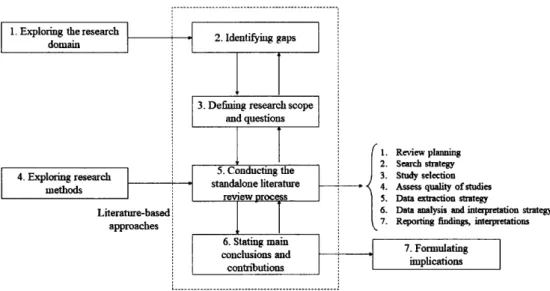
1.1 Research process for the study . .. . .. . . ... . . . .. . . .. . . . .. .. . . . .. . .. ... . .. . . ... .. . . .. 7
2.1 Flow diagram of the search, study selection, and quality assessment strategies. . . .. . .. . .. . . .. ... . . . .. . . .. ... .. . . .. .. . . .. . . .. . . .. . . .. . . .. . . . 21
2.2 Perspectives of analysis and implementation levels of blended learning .... 30
2.3 Driving forces and digital technologies... 32
2.4 Dimensions for mapping and measuring the trajectory of digitalization in higher education institutions... 41
2.5 Conceptual model for explaining the transformational potential ofblended learning in higher education... 45
2.6 Framework for mapping and measuring the transformational level of digital technologies... 46
3.1 Conceptual mo del of technology capabilities... .. . . 73
4.1 Research process for standalone literature reviews. ... 99
Table Page
1.1 Categories and keywords and search terms . . . .. . . .. . . .. . . 9
1.2 Chapters and sources for data collection . .. . . ... . . .. . . .. . . .. . . .. . . 9
1.3 Thesis chapters. ... . . .. . . .. . . .. . .. . . .. . . .. . . . .. . . . .. . .. . . .. . . 12
2.1 Keywords... 22
2.2 Exclusion criteria for the study selection... 23
2.3 Coding sheet for abstracts... 26
2.4 Coding sheet for full-text articles. ... 27
2.5 Literature characterization ordered by total selected citations. ... 29
2.6 Criteria for specifie digital technologies classification. ... 31
2.7 Educational technology enablers. ... 33
2.8 Portrait of technological enablers, digital technology categories and specifie digital technologies. .. . .. . . ... . . 34
2.9 Dimensions and frameworks identified from the literature for mapping the trajectory of digitalization in higher education institutions... 44
3.2 Identified research trends in selected litera ture . . . .. . .. . . .. . .. . . ... . 64
3.3 Educational technology capabilities . . . .. . . .. . . .. . .. 7 4 4.1 Literature review typology classified by the contribution to theory... 96
4.2 Key characteristics of standalone review types. ... 97
4.3 Categories and keywords and search terms. ... 101
4.4 Exclusion criteria... 1 03 4.5 Bibliometric and methodological coding schema... 105
4.6 Assessment form for transparency in literature reviews articles. ... 106
4.7 Included reviews classified by type and year (2007-2017). ... 109
4.8 Studies included by type ofliterature review and main themes. ... 110
4.9 Studies included by type of literature review and quartiles... 114
4.10 Studies fulfilling the transparency assessment items. ... ... ... 115
AR Augmented reality ARS Audience response system BYOD Bring your own deviee DET Digital educational technology ETC Educational technology capability IVS Immersive virtual simulators LMS Leaming management system MOOC Massive open online courses OER Open educational resources RFDI Radio-frequency identification RS Recommender system
VLCS Virtuallearning companion system VR V irtual reality
L'apprentissage mixte ou hybride (blended learning) est une approche d'apprentissage fondée sur la technologie qui combine des activités en ligne et en face à face, des théories d'apprentissage et des pratiques pédagogiques intégrées dans un contexte dynamique de mise en œuvre à plusieurs niveaux (p. Ex. En classe, institutionnel, écosystème) et multidimensionnel ( à savoir les aspects pédagogiques, technologiques, organisationnels et individuels de la performance). Cette méthode peut offrir des avantages et éviter les pièges de ces approches appliquées individuellement. Malgré des recherches scientifiques approfondies sur 1' apprentissage mixte, 1' étude de son potentiel de transformation en est encore à ses débuts. Dans le présent travail, certaines lacunes identifiées dans la littérature constituent la base d'un triple objectif de recherche analysant l'apprentissage mixte pour l'enseignement supérieur en tant qu'approche innovante fondée sur la technologie. Cet objectif comprend la découverte du potentiel de transformation des technologies éducatives numériques ; tendances et capacités conduisant à des transformations structurelles ; et les pratiques de recherche actuelles en matière de divulgation des choix méthodologiques dans ce domaine de recherche quand les chercheurs utilisent comme méthode de recherche une approche de revue de la littérature. En utilisant des approches d'analyse de contenu et de revue de la littérature, cette étude a collecté et analysé des données issues de chapitres de livres, études primaires et articles de revue de la littérature pertinents pour répondre aux questions de recherche. Les contributions théoriques et empiriques comprennent un cadre d'analyse du potentiel de transformation des technologies éducatives numériques et des pratiques d'apprentissage mixte; l'analyse du concept de capacités technologiques éducatives et de sa typologie associée ; et des données relatives aux pratiques de recherche actuelles dans les revues de littérature autonomes concernant la divulgation des choix méthodologiques.
Mots clés: apprentissage mixte, revue de la littérature, capacités, technologies numériques, enseignement supérieur, méthodes de recherche, évaluation de la transparence, tendances.
Blended learning is a technology-enabled learning approach that combines online and face-to-face delivery modes, learning theories and pedagogical practices embedded in a dynamic multi-level (i.e., classroom, institutional, ecosystem) and multi-dimensional context of implementation (i.e., pedagogical, technological, organizational, and individual aspects of performance). Therefore, blended learning can have the potential to pro vide advantages and avoid the pitfalls of each of these approaches when applied separately. Despite the extensive scientific research on blended learning, the investigation of its transformational potential is still in an earl y stage. In the present study, gaps were identified in the literature that pro vide the basis for the three research objectives related to analyzing blended leaming in higher education. These objectives include: 1) uncovering the potential for transformation of digital educational technologies; 2) identifying trends and capabilities leading to structural transformations; and 3) evaluating the current practices of researchers with regard to the disclosure of methodological choices when conducting literature reviews in this field. By using content analysis and literature review approaches, this study collected and analyzed data from relevant book chapters, primary studies, and review papers to answer the research questions. Theoretical and empirical contributions include: a framework for analyzing the potential for transformation of digital educational technologies and blended learning practices; an analysis of the concept of educational technology capabilities and its associated typology; and a compilation of data related to current research practices, specifically focusing on the disclosure of methodological choices when conducting standalone literature reviews in the field of blended learning in higher education.
Keywords: blended leaming, capabilities, digital technologies, higher education, literature review, research methods, transparency assessment, trends.
INTRODUCTION
1.1 Background
The higher education system has been facing criticisms related to its high cost, its content, the quality of courses, and the degree of relevance of their graduates' competencies for industry. Despite ongoing criticisms, higher education is going through deep transformations. Along with democratization and standardization, digitization is a foremost component of the se transformations.
The first tendency, democratization, is driven by the steadily growing global demand for higher education (OECD, 2014, pp. 46-47). The United Nations Educational, Scientific and Cultural Organization (UNESCO) has identified education as a main societal priority, while acknowledging serious problems still not solved, especially in developing countries. UNESCO associates access to quality education with highly positive impacts in terms of income distribution and the creation and distribution of human prosperity. UNESCO proclaimed three principles within the framework Education 2030. The first principle restates the right to an education as a fundamental human right, as weil as an enabling right. The second principle reaffirms education as a public good. Finally, the third principle prioritizes gender equality and inclusion in education as a global initiative for future years (UNESCO, 2016). Social, economie,
political, and cultural contexts represent both barriers and enablers that go beyond technological solutions as the only transformative elements in the education system.
Despite ali efforts, most societies and education systems have failed in both elements of the first principle. In this context, technology is promoted as an effective mechanism for reducing inequality in education (S. Graham, 2002, as cited in Selwyn, 2011, p. 97). Graham, S. (2002) identified three ways in which people see technology as a facilitator of inclusion and equality in education: 1) increasing the diversity of mechanisms and modes in education; 2) decreasing barriers to education as a democratization mechanism; and 3) enhancing individual control over one's own education in terms of content, delivery mode, and pace of leaming. These promises have not yet been fulfilled despite massive investments in content production and educational technologies such as Open Educational Resources (OERs) and Massive Open Online Courses (MOOCs ).
The second tendency, standardization, is the outcome of the intemationalization of the higher education system. The increase in university exchanges, the growing student mobility, and the rise of online formai academie courses have propelled the harmonization of university programs, mostly through the process of accreditation and international agreements (e.g., The Bologna process). Currently, worldwide demand for higher education is increasing despite frequent critiques related to high costs, accessibility barriers, dropout rates, and the quality of courses (OECD, 2014, pp. 46-4 7). Furthermore, educational institutions often face challenges related to the overall relevance of their programs to graduates' continuing education or post-graduate employment (Christensen et al., 2011); and to the actual educational credentials in the higher education system (Collins, 2011). Sorne ofthese challenges include: improving multicultural integration, reducing dropout rates, facilitating fluid transitions from educational programs to first jobs, and implementing flexible and relevant lifelong
learning processes. To confront these challenges, Redecker et al. (2013) as cited in Scott (20 15), suggest that institutions require innovative structural transformations. However, these challenges must first be investigated through broader, multidisciplinary, multi-level research that addresses the social, pedagogical, economie, demographie, and financial aspects of education (Geels, 2005). In this regard, approaches such as blended learning may provide alternative opportunities for higher education institutions to deal with these challenges and respond to extemal pressures to effectively deploy technological innovations in the classroom.
A third major tendency, digitization, is the result of digital innovations massively applied to higher education. Digital innovations refer to a broad range of digital deviees, platforms or infrastructural technologies. Olleros & Zhegu (2016, p. 6) defined digitization as:
the full range of software-driven processes-all the way from datafication and computation to prediction, display, communication, and action-that allow increasingly smart machines to intervene in the world.
However, the history of technology and education presents "plenty of evidence to suggest that the implementation of technology in education is rarely a predictable or even a controllable process" (Selwyn, 2011, p. 60). Questioning the impact of digitization is necessary, especially in a context of high volume and velocity of educational digital innovation development. Digitization is far from being a "silver bullet" to solve the systemic problems of higher education. Often poorly embedded in complex educational contexts, digitization is showing its limits.
The scientific literature shows technology as a complex element operating in a variety of educational settings. Using different methods, researchers analyze, describe, and
explain potential transformations in the education sector from multiple perspectives ( e.g., social, organizational, technological, pedagogical), employing various educational approaches ( e.g., digital technologies supporting traditional instruction, online learning, blended learning).
Research about these transformations often involves performing analyses of future technological trends, which typically require different periods of time to develop a potential impact analysis (Selwyn, 2011, pp. 166-167). The short- and medium-term analyses concem a detailed state-of-the-art description, while the long-term analyses correspond more closely to speculative forecasting. In education, this type of analysis might involve specifie groups of learners in the classrooms, specifie institutions, or the entire educational ecosystem.
In particular, blended leaming, a technology-enabled leaming approach that combines both face-to-face and online leaming practices, seems to represent the most promising compromise between these two extreme delivery modalities. Definitions from literature show the mix of content media and instructional delivery methods as the key elements for this educational approach (Garrison & Kanuka, 2004). These definitions also come with different labels such as hybrid courses, flexible leaming, and mixed mode learning (Dzakiria et al., 20 12). From a more pedagogical perspective, the literature presents blended learning as a shift from teacher-content to student-experience. This shift may offer "the right balance of pedagogy and technology to the right leamer in the right moment" (Oliver & Trigwell, 2005).
Researchers in this field are still developing more refined definitions of blended leaming as their understanding of this phenomenon improves (Picciano, 2009; Tshabalala et al., 2014). According to Fernandes et al. (2016), blended learning orb-leaming is a:
mixed leaming model that integrates online leaming with face-to-face leaming theories and practices, materialized in a flexible, multimodal, and multi -linear redesign,
whereby multi-linear leaming refers to a self-paced and individualized leaming processes. N evertheless, despite extensive scientific research on blended learning, the investigation of its transformational potential is still in its initial stages. However, for the purpose of this study, the author defines blended learning as a technology-enabled leaming approach that combines online and face-to-face delivery modes, leaming theories and pedagogical practices embedded in a dynamic multi-level (i.e., classroom, institutional, ecosystem) and multi-dimensional context of implementation (i.e., pedagogical, technological, organizational, and individual aspects of performance).
1.2 Objective, rationale and research questions
Using a standalone literature review approach, including multiple perspectives and focusing on blended learning in higher education, the present work aims at: 1) uncovering the potential for transformation of digital educational technologies; 2) identifying trends and capabilities leading to structural transformations; and 3) evaluating current practices of researchers with regard to the disclosure of methodological choices and research activities in previous standalone literature reviews. An iterative and comprehensive literature search and analysis allowed the author to identify and refine the research objective and research questions presented in chapters 2, 3, and 4. Typically, these types of knowledge syntheses are conducted as standalone literature reviews. This kind of research works are subject to criticism, in sorne cases, with regard to the soundness of their research process, and in particular characteristics such as systematicity, transparency, and scientific rigor (Paré et al., 2016).
Chapter 2
1. What digital technologies are deployed in the context of blended learning in higher education?
2. What are the current practices and context of use of these technologies? 3. How transformative are digital technologies used in blended learning contexts
for higher education? Chapter 3
1. What are the emerging trends in blended learning implementations in higher education?
2. What are the current capabilities in the educational technology used in these blended learning implementations in higher education?
3. How are these educational technology capabilities used in blended learning implementations in higher education?
Chapter 4
1. What trends exist in these types of literature reviews, what are their main themes, and how transparent are they?
2. What practices do the selected reviews use to ensure transparency?
1.3 Method
1.3 .1 Research design
The design chosen for this research work includes seven stages (Figure 1.1). The first stage served to explore a more specifie research domain regarding digital technologies and education. After this stage, the author identified 1) blended leaming in higher education as a valuable and suitable area for further development and 2) the adoption, diffusion, and innovative technology-enabled leaming approach as a context with high potential impact in this research domain.
4. Exploring research methods
Lrt:~ed~
l ___________________________________________________ J Review plliiUÙng Search strategy Study selectionAssess quality of studies
Data extraction strategy
Data analysis and interpretation strategy Reporting findings, interpretations
7. Formulating implications
Figure 1.1 -Research process for the study
In the second and third stages, based on a highly iterative process, the author identified gaps in previous research, defined the scope, and elaborated a set of initial research questions refined during the process. In the fourth stage, based on the research questions, the author explored potential approaches for answering the research questions. This exploration provided the author with valuable insights on the existing literature re garding primary studies ( e.g., conceptual papers, quantitative studies, qualitative studies) and standalone literature reviews. As a result, the author identified the literature-based approach as the most sui table for this research process.
During the fifth stage, the author identified and selected a theoretical review type as the most sui table research design for chapter 2. This type of review in tends to pro vide models, frameworks or theories to explain a particular phenomenon based on previous empirical or theoretical works (Paré et al., 20 15). The author draws a portrait of digital
technologies and their context of usage, and makes an analysis of how transformative blended learning practices are in higher education contexts.
From this initial work, findings and results showed sorne common themes in the analysis of technological implementations. These elues led the author to identify and define the concept of educational technology capabilities (ETC), and provide sorne explanation for the potential relationship between ETC and learning purposes in formai educational contexts. This time, the author selected a narrative literature review type to conduct this research and present the results in chapter 3.
Finally, while conducting these two previous stages of research, the author identified sorne limitations due to the lack of explicit data in the sources, mainly in literature reviews. These limitations revealed sorne elues about how researchers reported their work. Based on these insights, the author conducted an analysis of previous literature reviews regarding their level of transparency and current practices of reporting methodological decisions and activities for this kind of scientific work. The author selected a descriptive review type as being the most suitable for chapter 4.
The final stages of the research process include the analysis and interpretation of findings for stating conclusions, identifying contributions, and formulating implication for the scientific and practitioners' communities.
1.3 .2 Data collection strate gy
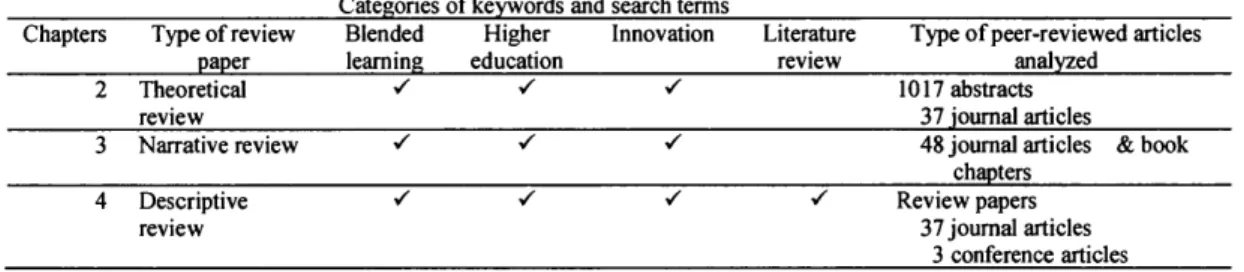
Since the research method selected is a literature-based approach, all data collection is based on the scientific literature. This research selected articles based on four categories ofkeywords and search terms as presented in Table 1.1.
Category
Table 1.1- Categories and keywords and search terms
Keywords and search tenns
"blended learning" OR "blended education" OR "hybrid learning" OR "mixed-mode instruction". "higher education" OR universit* OR college.
Blended learning Higher education
Innovation adopt* OR barrier* OR challenge* OR change* OR diffusion* OR disruption* OR driver* OR factor* OR impact* OR improvement* OR innovati* OR invention* OR pattern* OR radical OR reinvention* OR sustainable OR transfonn*.
Literature review review OR state-of-art OR "state of the art" OR "state of art" OR "meta-analysis" OR "meta analysis" OR "meta analytic study" OR "mapping stud*" OR overview.
The author selected EBSCO, ERIC, SCOPUS, and Web of Science as the most suitable resources for the literature search. For each one of these scientific online electronic databases providers and citation indexes, the author used these keywords and search terms to build specifie queries. This search resulted in three sets of peer-reviewed articles as sources for data collection as presented in Table 1.2.
Table 1.2- Chapters and sources for data collection
Chapters Type of review paper 2 Theoretical review 3 Narrative review 4 Descriptive review
Categories ofkeywords and search tenns Blended Higher Innovation learning education
Literature review
Type of peer-reviewed articles analyzed
10 1 7 abstracts 37 journal articles 48 journal articles & book
ch ters
The data collection process comprised severa! steps. First, based on the research questions, the author elaborated sorne coding schemas for the data extraction procedure. This data was analyzed, discussed, and adjusted during the agreement sessions when required. Ail the gathered data was consolidated in board tables for further analysis. Additionally, the author used a note-taking process during the detailed analysis of the articles to obtain a better insight into the selected literature.
1.4 Structure of the the sis
Chapter 1 is the introduction and presents general aspects of the thesis. This chapter includes the background of blended leaming as concept and research domain. Subsequently, it presents the objective and the research questions. It is followed by sections discussing the method, the specifie contributions of this research, the structure of the thesis described chapter by chapter, and the conceptual frameworks used for this work.
Chapter 2 discusses the digitalization of higher education. Particularly, it presents a portrait of digital technologies and the context of their use, and an analysis of how transformative blended leaming practices are in the higher education context. This chapter acts as an independent manuscript and it is included as originally submitted for publication. It comprises the abstract and introduction, and a definitions section. lt is followed by sections describing the conceptual frameworks and the research questions, the method, and findings and results. Finally, it includes the discussion, conclusions, limitations, and future work sections.
Chapter 3 identifies sorne of the most promtstng trends in blended leaming implementations in higher education, the capabilities provided by technology ( e.g., datafication), and the contexts of use of these capabilities. This chapter acts as an independent manuscript and it is included as originally submitted for publication. This chapter is divided into seven sections: The first section presents concepts related to educational technologies, their capabilities, and their use in blended leaming implementations. The second section presents the conceptual framework and research questions. It is followed by sections dealing with the research method and the finding and results. Finally, the chapter presents a discussion section, sorne policy implications
for the educational sector, conclusions, limitations of the current analysis, and suggestions for future research work.
Chapter 4 presents an assessment of previous literature review about blended learning in higher education. This assessment intends to reveal the main themes discussed, the level of transparency, and current practices in reporting methodological choices in these review papers. This chapter acts as an independent unpublished manuscript. This paper is divided into the following sections: the background; the objective and research questions; the research method; the findings and results; a discussion section; and sorne conclusions. Finally, the last sections present the limitations of this research and future work.
Chapter 5 presents a synthesis of the articles, the general conclusions, and the main implications for researchers and practitioners.
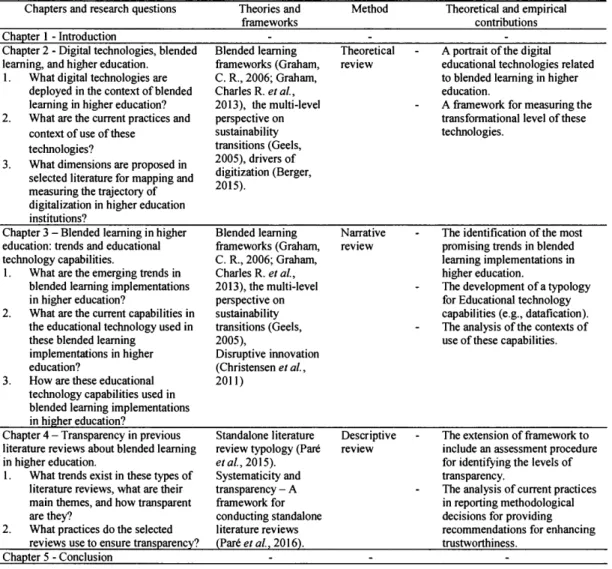
Finally, Table 1.3 presents the list of chapters, the research questions, main theories and frameworks used in this research, the research method applied for each chapter, and the main contributions.
Chapters and research questions
Chapter 1 - Introduction
Chapter 2 - Digital technologies, blended learning, and higher education. 1. What digital technologies are
deployed in the context ofblended learning in higher education? 2. What are the current practices and
context of use of these technologies?
3. What dimensions are proposed in selected literature for mapping and measuring the trajectory of digitalization in higher education institutions?
Chapter 3 - Blended learning in higher education: trends and educational technology capabilities.
1. What are the emerging trends in blended learning implementations in higher education?
2. What are the current capabilities in the educational technology used in these blended learning
implementations in higher education?
3. How are these educational technology capabilities used in blended learning implementations in higher education?
Chapter 4 - Transparency in previous literature reviews about blended learning in higher education.
1. What trends exist in these types of literature reviews, what are their main themes, and how transparent are they?
2. What practices do the selected reviews use to ensure transparency? Chapter 5 - Conclusion
Table 1.3- Thesis chapters
Theories and frameworks Blended learning frameworks (Graham, C. R., 2006; Graham, Charles R. et al., 2013), the multi-level perspective on sustainability transitions (Geels, 2005), drivers of digitization (Berger, 2015). Blended learning frameworks (Graham, C. R., 2006; Graham, Charles R. et al., 2013), the multi-level perspective on sustainability transitions (Geels, 2005), Disruptive innovation (Christensen et al., 2011) Standalone literature review typology (Paré
et al., 2015). Systematicity and transparency - A framework for conducting standalone literature reviews (Paré et al., 2016). Method Theoretical review Narrative review Descriptive review
Theoretical and empirical contributions
A portrait of the digital educational technologies related to blended learning in higher education.
A framework for measuring the transformationallevel ofthese technologies.
The identification of the most promising trends in blended learning implementations in higher education.
The development of a typology for Educational technology capabilities (e.g., datafication). The analysis of the contexts of use ofthese capabilities.
The extension of framework to include an assessment procedure for identifying the levels of transparency.
The analysis of current practices in reporting methodological decisions for providing recommendations for enhancing trustworthiness.
DIGITAL TECHNOLOGIES, BLENDED LEARNING, AND HIGHER EDUCATION
Robin Castroa, Majlinda Zhegub
a Universidad Icesi, Departamento de estudios sociales, Calle 18 No.l22-135, Cali, Colombia Centre interuniversitaire de recherche sur la science et la technologie (CIRST), Université du Québec à Montréal (UQAM), Canada. [email protected]. orcid.org/0000-000 1-7029-724X.
b Université du Québec à Montréal (UQAM), École des sciences de la gestion (ESG-UQAM), Département de management et technologie, PO Box 6192, succursale Centre-ville H3C 4R2. Centre interuniversitaire de recherche sur la science et la technologie. (CIRST), Canada. [email protected].
Abstract
Blended learning is a technology-enabled learning approach that combines online and face-to-face delivery modes, learning theories and pedagogical practices embedded in a complex context of implementation. This combination can potentially retain the individual advantages of these approaches while avoiding their respective pitfalls. Based on previous academie literature, this theoretical review aims to propose a framework for explaining the transformational potential of blended learning in higher education. By coding and analyzing the selected literature that comprise 1,017 abstracts and 3 7 journal articles, we in tend to : 1) portray the digital educational technologies reported in the selected sources; 2) analyze the current practices and contexts of use of
these technologies; and 3) identify what dimensions are proposed for mapping and measuring the trajectory of digital technologies in higher education institutions. Our findings show that the technological choice is not enough to create successful transformations of the teaching-leaming process. Instead, a level and multi-dimensional perspectives that aligns the pedagogical, motivational, technological, and institutional dimensions of these implementations are necessary. This integrated model may provide practitioners and policy-makers conceptual support and better insights for understanding the complexity associated to blended learning to improve their implementations and policy-making process. For researchers, this model may offer sorne elues for further exploration of blended learning as a dynamic and integrated technology-enabled learning approach not constrained only by classroom settings and organizational decisions.
Keywords: blended learning, digital technology, higher education, innovation,
theoreticalliterature review.
2.1 Introduction
The first pillar of this study relates to the concept ofblended learning. Blended learning is a multidimensional concept and, therefore, difficult to encompass fully within one definition. Nevertheless, for the purpose of this study, the authors define blended learning as a technology-enabled leaming approach that combines online and face-to-face delivery modes, learning theories and pedagogical practices embedded in a complex context of implementation. Previous academie literature have used "hybrid courses," "flexible leaming", and "mixed-mode learning" as synonyms for blended learning (Dzakiria et al., 20 12). This proliferation of denominations has contributed to the ambiguity of blended learning as a concept (Picciano, 2009; Tshabalala et al., 2014). Despite this definition issue, researchers have produced abundant and insightful
academie literature in this field. In this scenario, current academie literature has
analyzed blended leaming from multiple perspectives such as pedagogical (Francis &
Shannon, 2013; Hutchings & Quinney, 2015), organizational (Graham, Charles R. et
al., 2013; Porter & Graham, 2016), technological (Martin & Whitmer, 2016; Suhail &
Lubega, 2011), and social (Crawford, N. & McKenzie, 2011; Selwyn, 2017).
Notwithstanding this abundant and diverse academie literature, a comprehensive portrait of digital educational technologies and an integrated framework for explaining the transformational potential of blended leaming in higher education are missing. Additional to this gap in literature, general assumptions about blended leaming oversimplifying the complexity of the technology-education relationship may limit our understanding of this phenomenon. One main assumption relates to the disruptive potential of digital technologies in most industries (Christensen & Raynor, 2013). However, although recent studies have shown improvements in the learning-teaching
process regarding the outcomes performance (Bernard, R. et al., 2014), to the best of
our knowledge no disruptive transformations of the education system as an entire sector have been reported in literature. In fact, the understanding of what this new concept (i.e., disruptive transformations) means in this complex context of implementation may provide new insights about real transformations in different levels of the education system (e.g., classroom, institutions, local or national territories).
As a technology-enabled learning approach, blended learning requires a common playground where researchers and practitioners may continue the discussion about technology, education and their relationship. The history oftechnology and education provides multiple examples that suggest "that the implementation of technology in education is rarely a predictable or even controllable process" (Selwyn, 2011, p. 60). Nonetheless, questioning the transformative nature and potential impacts oftechnology is necessary. This is especially true given that the unprecedented volume and rate of
developments in digital technologies for education have generated significant anticipation of improvements to the core processes of education.
To this regard, Lievrouw & Livingstone (2002) offer a broad definition oftechnology. They state that the understanding of technology and its impacts builds on three levels of analysis: 1) what artifacts and deviees are deployed in a specifie sector or activity; 2) the activities and practices enabled by the use of such technologies; and 3) the context of the social and institutional aspects and structures encompassing the use of these technologies. This definition shows the complexity of technological innovations and may pro vide sorne elues for a better understanding of the technology -education relationship in the context of blended learning. In particular, higher education is currently undergoing significant transformations in terms of democratization, standardization, and perhaps most importantly for the purposes of this study, digitalization.
Democratization is largely driven by steady growth in the global demand for higher education (UNESCO, 20 18). The democratization of the education as a primary goal is still a problem to solve in many societies, despite global agreements prioritizing this goal. For achieving democratization of education as UNESCO (20 16) proposes national initiatives require not only higher levels of accessibility, but higher levels of quality. In this context, digital technologies are presented as enabling and disrupting forces (Acemoglu et al., 2014; Christensen et al., 2011). On the other hand, standardization as a product of the intemationalization of higher education systems is due in part to the rapid development of university exchange programs and overall increase in students' mobility. These standardization trends have propelled the coordination of university programs, mostly through the process of accreditation and international agreements ( e.g., The Bologna Process ). These transformations in the higher education ecosystem Digital technologies may provide the required tools for
boosting not only standardization, but also curriculum change (Gonzalez et al., 2013; VanDerLinden, 2014).
Digitalization, as the result of the application of digital innovations, includes a broad range of digital deviees, platforms, and infrastructural technologies. The intent of digitalization in higher education in most cases is to increase the scalability of educational processes, establish flexibility in learners' access to instruction, and reduce the costs of instruction (Taplin et al., 2013). The digitization process is also defined as all software-driven process comprising datafication and automation "that allow increasingly smart machines to intervene in the world" (Olleros & Zhegu, 2016, p. 6). The convergence of datafication and automation technologies has resulted in "a huge rethink of processes involving dynamic decision-making, pattern recognition and advisory services as machine intelligence optimizes those processes and feedback loops" (King et al., 2017). Diamandis & Kotler (2016) refer to technologies derived from the combination of datafication and automation as "exponential technologies". According to Olleros & Zhegu (2016, p. 6), digitization in the information age is a:
"push toward process efficiency, such as the early mainframes, and further automation in the factory and production space. Internet went further and disrupted distribution mechanics ... ".
In "Augmented life in the smart lane," King et al. (20 17) extend this definition situating digitization as a dynamic process in time by distinguishing it in different technological ages such as the digital age, automation age, and augmented age. However, according to this author, it is in the augmented age that it has reached the highest disruptive level. Nevertheless, digitalization, as an amalgam of transformational forces, is far from being a "silver bullet" for the systemic problems of higher education. Largely because
it is often poorly embedded in complex educational contexts, digitalization is showing its limits.
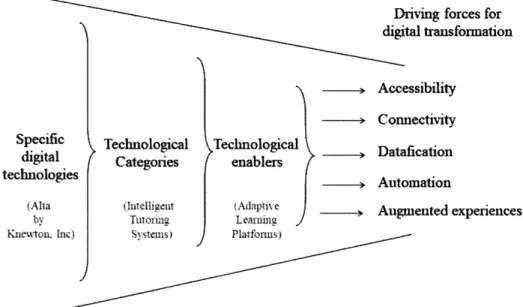
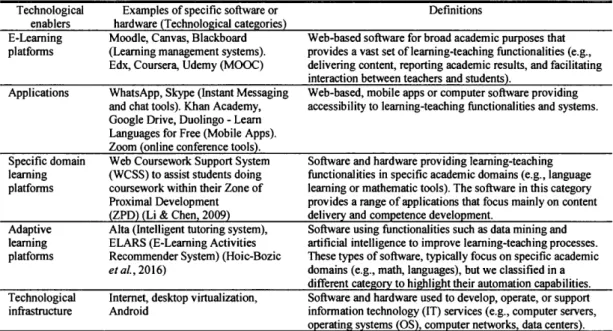
The unprecedented level of accessibility to digital technology has fueled a massive rise in connectivity among humans, as weil as between humans and machines, and machines and machines. Datafication, or the digitization of the information, is a natural product of digital accessibility and connectivity. Automation as a result from advancements in artificial intelligence ( e.g., algorithms and deep machine learning) constitutes another force or driver of digital transformation. These forces or drivers build on a handful technological enablers ( e.g., e-learning platforms, applications, technological infrastructure). These driving forces are a construct for illustrating the potential of transformation of specifie technologies. Berger (20 15) operationalized the digital transformational process as an ensemble of four driving forces (i.e., accessibility, connectivity, datafication, automation) enabled by a small number of technologies whose convergence generates multiple technological proposais (i.e., specifie digital technologies such as Moodle, Blackboard, and Canvas ).
Aside from these extemal transformative influences, sorne internai imperatives also exert transformative pressures that threaten the survival ofhigher education institutions. In sorne cases, these pressures are caused by financial restrictions, while in others they may be the result of: programs that are disconnected from job markets, growing competition, the emergence of disruptive business models, and the flattening of the higher education wage premium (Valletta, 2015).
As main limitation, the authors identified the complexity of the education system as Fisher & Newton (2014, p. 919) expressed,
"The more we learn about the interrelationships between teaching, leaming, technology, physical and virtuallearning environments, the more we realize we need to continue to deeply research this complex topic further."
In this context, the authors propose the use of cumulative knowledge synthesis processes through comprehensive literature reviews as an effective way to surpass this limitation based on the abundant, diverse and insightful of primary qualitative and quantitative studies (Finfgeld-Connett, 2010; Greenhalgh et al., 2005; Pawson et al., 2005). In particular, this theoretical literature review aims to propose an integrated framework for explaining the transformational potential of blended learning in higher education. For this purpose, we intend to answer the following research questions based on a set of previous academie literature comprising 1,017 abstracts and 37 journal articles: 1) what digital technologies are deployed in the context ofblended learning in higher education? 2) what are the current practices and context of use of these technologies? And 3) what dimensions are proposedfor mapping and measuring the trajectory of digitalization in higher education institutions? These research questions lead to identify, analyze, and evaluate different elements and aspects of the learning-teaching process in the context of blended leaming. Answering them may provide relevant information not only for creating the foundational building blocks for the proposed framework, but also for allowing further research works to extend it.
In the following sections we present the research questions and the methodological approach of the research as well as discuss the findings. The final section discusses the implications of this study for practice and future research.
2.2 Method
Based on existing frameworks and guidelines for conducting standalone literature reviews (Paré et al., 2016; Templier & Paré, 2015), this theoreticalliterature review was conducted as a systematic, iterative, and reflexive process. This kind of reviews, as Paré et al. (20 15) claim, "brings together diverse streams of work and uses various structured approaches such as classification systems, taxonomies and frameworks to organize prior research effectively, examine their interrelationships, and discover patterns or communalities that will facilitate the development of new theories." We used a comprehensive search strategy that allowed us to describe and contextualize a set of concepts and their relationships in order to provide sorne explanations about the potential levels of transformation in higher education institutions due to blended learning implementations. Additionally, sorne gray literature sources were used to provide examples and complement the background presented in the introduction and background sections.
The following sections sequentially detail the stages of this review which included: 1) definition of the searching strategy; 2) study selection procedures; 3) quality assessment of articles; 4) data extraction from the selected articles; and 5) data analysis and synthesis. Figure 2.1 displays the detailed workflow and outcomes of the first three stages.
EBSCO 2000-2017 1091 Citations ERIC 2000-2017 1185 Citations SC OPUS 2000-2017 578 Citations Web ofScience 2000-2017 290 Citation 1015 Citations duplicated
1006 Articles excluded after title/abstract screen
2: Not in English
31: Notapeerreview journal article
144: Notfocusedon blendedleaming
142: Not focused on lùgber education
687: Not focused on specifie
technologies
I
l 017 Articles retrieved as 1 source for abstract coding
3144 Citations
2129 Citations non-duplicated screened
50 Articles retrieved
1073 Articles excluded after title/a bsti·act screen Not focused on technology as a
transfonnative driver
1 Articles excluded after fui text screen 1: Not a\'llilable as full-text document
6 AI1icles excluded after data extraction
2: Not focused on blended leaming
1: Not focusedohlùgher education 3: Not focusedon analyzing inno'\'-ation experiences.
6 Articles excluded after qnaHty critelia procedure
Figure 2.1- Flow diagram of the search, study selection, and quality assessment strategies.
2.2.1 Literature search strategy
A first iteration was performed in order to evaluate the comprehensiveness of the search strate gy, the process, and the relevance of the keywords. As a result, we identified a more precise set of keywords and search terms that were then grouped into three categories (Table 2.1 ). We further requested two independent librarians to validate the search strategy procedure and the online scientific-citation indexes and electronic databases to ensure the relevance of the citations obtained. Ali the information coliected and coded is presented in the Mendeley Datasets repository (Castro & Zhegu, 2018).
Categories Blended learning
+ Higher education
+ Innovation adoption and diffusion
Table 2.1 - Keywords.
Keywords and strings of terms
"Blended learning," "blended education," "hybrid learning," "mixed-mode instruction."
"Higher education," universit*, college.
Adopt*, barrier*, challenge*, change*, diffusion*, disruption *, driver*, factor*, impact*, improvement*, innovati *, invention*, pattern*, radical*, redeftning, reinvention, restructuring, sustainable, transforrn *.
References 8,340
5,184 3,144
In total, 3,144 citations were obtained by searching for these keywords in the title, abstract, and keyword fields from EBSCO, ERIC, SCOPUS, and the Web of Science. After the deduplication of articles based on the title, author, year, and DOl, 2,129 citations remained in the database. For managing citations, we selected EndNote and include in the reference section ali the citations including those presented in the appendices. Additionaliy, we developed a specifie set offunctionalities using a MySQL database engine in order to facilitate citation deduplication, traceability of activities, and the generation of summarized tables for further analyses.
2.2.2 Study selection criteria and procedures
Table 2.2 presents the exclusion criteria for the study selection procedure. In order to
valida te the quality of the screening process, we organized regular meetings in which all differences were discussed and reconciled according to the inclusion and exclusion criteria. We applied criteria one to five during the screening of the title, keywords, and abstracts of 2,129 references. Of those, the 1 ,017 that discussed specifie digital technologies deployed in a context of blended learning in higher education were retained and used to map the current digital technologies adopted in higher education.
Table 2.2 - Exclusion criteria for the study selection.
Criteria
Not in English language Not a peer review journal article Not focused on blended leaming Not focused on higher education Not focused on specifie technologies
Not focused on technology as a transformative driver Not available as a full-text document
Description of the exclusion criteria Articles not written in English.
Articles not classified as peer-reviewed scientific journal articles ( e.g., book chapters, editorials, or conference papers).
Articles focused exclusively on e-leaming, face-to-face leaming, or other pedagogical approaches such as flipped leaming, but not in the context ofblended leaming. Articles not focused on higher education.
Articles that do not refer to a specifie educational technology but that discuss digital technologies from a general perspective.
Articles that discuss technology without pedagogical considerations or as a support for traditional practices.
Articles not available as a full-text documents.
We applied cri teri on six to these 1,017 citations to identify articles focusing on technology as a transformative driver. This criterion allowed us to excluded 1,073 citations that discuss technology without pedagogical considerations or present technology only as a support for traditionallearning-teaching practices. As a result, we obtained a set of 50 articles for further screening, coding and analysis. Thereafter, we performed the full text screening procedure and applied the seven criterion (Table 2.2) on the 50 articles, resulting in a final set of 43 articles. We did not perform backwards and forwards search procedures.
2.2.3 Quality assessment
Most methodological studies argue that quality assessment of primary studies are appropriated mainly for theory-testing reviews (i.e., meta-analysis, systematic
literature reviews) (Paré et al., 20 15). In regard to this topic, the se quality appraisals
are also a generally accepted practice for realist reviews as one specifie type of
theory-building review (Greenhalgh et al., 2011; Paré et al., 2015). Although this is not the
case for theoreticalliterature reviews, we decided to perform a appraisal of the quality of the selected articles in three categories: purpose, sources, and methods. After the initial iterations on our sample, we identified sorne issues related to the explicitness of information re garding these categories in several articles. W e did not perform a formai assessment as proposed in existing guidelines and checklist of items ( e.g., PRISMA)
for reporting relevant information in theory-testing reviews (Greenhalgh et al., 2011).
Instead, for each category we defined a criterion and it was evaluated using a rating of high, medium, or low to which values of 1, 0.5, and 0, were assigned respectively. For the purpose category we assessed whether the research objective, purpose, questions, propositions or hypothesis were clearly stated. W e also evaluated the explicitness of the primary studies sources. For the last category we assessed whether the research design, research method, data collection instruments, and type of the article clearly stated. The main goal of this activity was to provide sorne level of reliability and consistency of selected articles for our analysis. Through this process, we excluded six articles that did not achieve the minimum required score (2.0). We performed the quality assessment during the first phase of the full-text article coding process. In total, 3 7 articles were selected for this literature review after the quality assessment
2.2.4 Data extraction strategy
The data extraction and data analysis protocols were designed in iterative and interrelated phases in order to facilitate the synthesis and reporting activities in the earl y stages of the research process. This allowed for validation of the consistency of the outcomes. We used a direct content analysis approach (Hsieh, H.-F. & Shannon, 2005) using ATLAS. ti (a computer-assisted qualitative analysis tool). For the purpose of this work, regarding the academie literature, we propose three terms for better understanding our search strategy and study selection procedures. First, we named selected citations to the 1,017 citations resulted after the title and abstract screening procedure. Second, we named selected articles to the 37 articles resulted after the full-text screening procedure. Finally, we named selected literature to both set of sources.
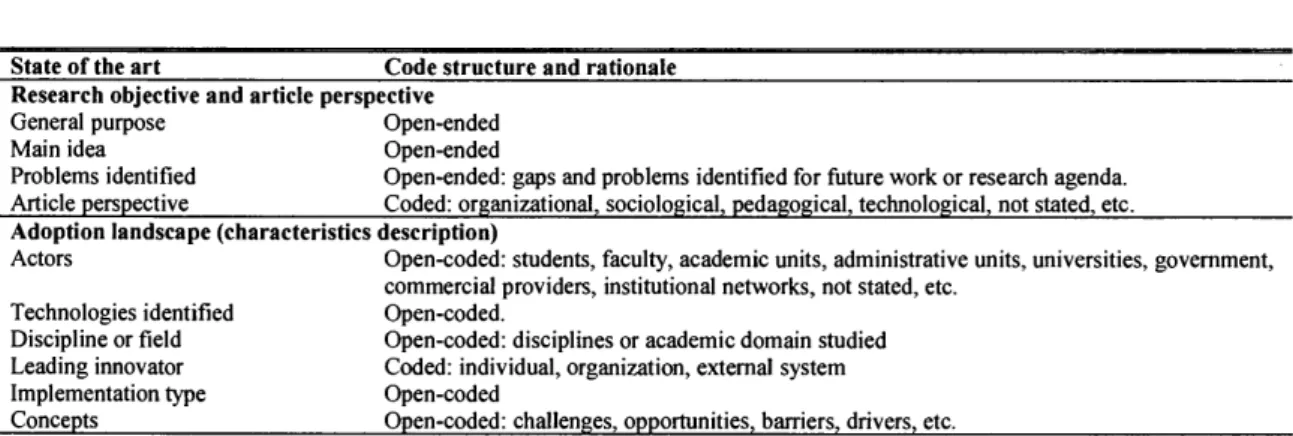
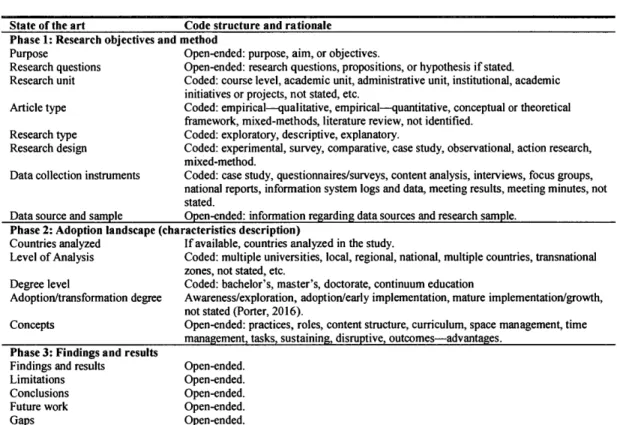
W e coded in Ex cel the article titles and abstracts of the 1, 017 selected citations as a way to identify the state of the art analyzing information about research objectives, article perspectives, and adoption characteristics described. This information helped to map patterns, trends, and trajectories in scientific research on digital educational technologies and their impacts on teaching and leaming outcomes. The characteristics analyzed included the article's general purpose, main ideas, problems identified, and perspectives ( e.g., organizational, sociological, pedagogical, technological) (Table 2.3).
Table 2.3 - Coding sheet for abstracts.
State of the art Code structure and rationale Research objective and article perspective
General purpose Open-ended
Main idea Open-ended
Problems identified Open-ended: gaps and problems identified for future work or research agenda. Article perspective Coded: organizational, sociological, pedagogical, technological, not stated, etc. Adoption landscape (characteristics description)
Actors Open-coded: students, faculty, academie units, administrative units, universities, govemment,
Technologies identified Discipline or field Leading innovator Implementation type Concepts
commercial providers, institutional networks, not stated, etc. Open-coded.
Open-coded: disciplines or academie domain studied Coded: individual, organization, externat system Open-coded
Open-coded: challenges, opportunities, barriers, drivers, etc.
Based on the full-text coding sheet (Table 2.4), we further extracted information from the 3 7 selected articles using A TLAS.ti. As repositories of the data collected, we used ATLAS.ti for the coding process, and Excel and the database engine MySQL as tools for the consolidation of the information as a table board. This allowed for the elaboration of conceptual maps and summarized tables as intermediary tools for data analysis and synthesis.
Table 2.4-Coding sheet for full-text articles.
State of the art Code structure and rationale Phase 1: Research objectives and method
Purpose Open-ended: purpose, aim, or objectives.
Research questions Open-ended: research questions, propositions, or hypothesis if stated. Research unit Coded: course level, academie unit, administrative unit, institutional, academie
Article type
Research type Research design
initiatives or projects, not stated, etc.
Coded: empirical--qualitative, empirical--quantitative, conceptual or theoretical framework, mixed-methods, literature review, not identified.
Coded: exploratory, descriptive, explanatory.
Coded: experimental, survey, comparative, case study, observational, action research, mixed-method.
Data collection instruments Coded: case study, questionnaires/surveys, content analysis, interviews, focus groups, national reports, information system logs and data, meeting results, meeting minutes, not stated.
Data source and sample Open-ended: information regarding data sources and research sample. Phase 2: Adoption landscape (characteristics description)
Countries analyzed Level of Analysis
Degree level
Adoption/transformation degree
Concepts
Phase 3: Findings and results Findings and results
Limitations Conclusions Future work Gaps
If available, countries analyzed in the study.
Coded: multiple universities, local, regional, national, multiple countries, transnational zones, not stated, etc.
Coded: bachelor's, master's, doctorate, continuum education
Awareness/exploration, adoptionlearly implementation, mature implementationlgrowth, not stated (Porter, 2016).
Open-ended: practices, rotes, content structure, curriculum, space management, time management, tasks, sustaining, disruptive, outcomes-advantages.
Open-ended. Open-ended. Open-ended. Open-ended. Open-ended.
2.2.5 Analysis and synthesis strategy
We analyzed the collected data through an iterative process. In each step we: 1) evaluated whether the question could be answered with the data collected to ad just the data collection process when needed; 2) updated the descriptive statistics tables previously defined according to a structured thematic analysis based on the academie literature; 3) identified commonalities and divergences among authors and theories with respect to the transformative potential of digital technologies; and 4) interpreted and synthesized the analyzed information.
Based on the coding results, we elaborated criteria for classifying specifie digital technologies and three descriptive statistics tables. These tables comprise: 1) a literature characterization regarding the perspective of analysis whether explicitly stated or interpreted by us and the main actors analyzed in the analyzed; 2) a portrait of specifie digital technologies used in blended learning implementations for higher education based on the aforementioned criteria and a classification of educational technology enablers; and 3) sorne dimensions proposed in literature for mapping and measuring the trajectory of digital technologies in higher education institutions.
2.3 Findings and results
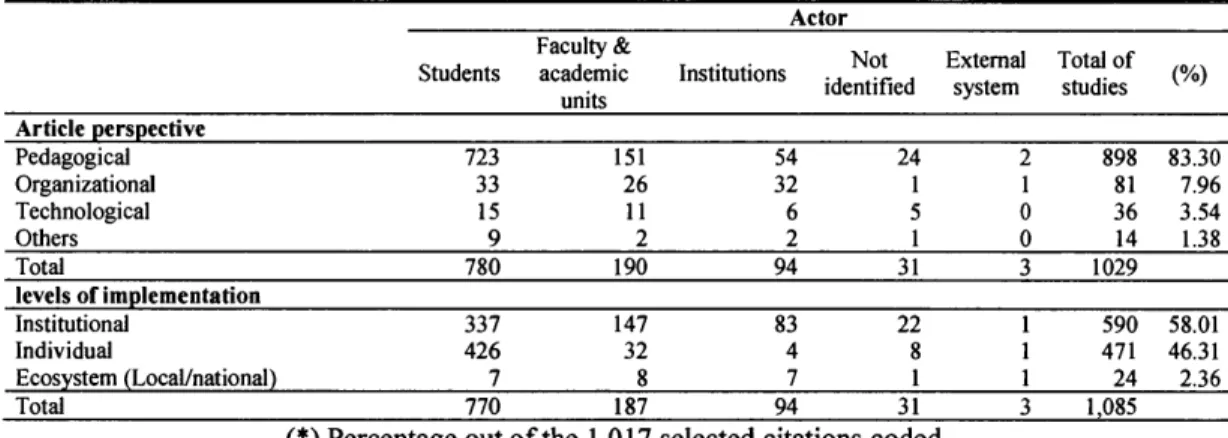
The information extracted from the analysis of the 1,017 abstracts is presented in Table 2.5. This information is organized according to: 1) the perspective adopted by the article ( e.g., pedagogical, organizational, technological, other); 2) the research unit of the analyzed papers (e.g., student, academie units, institutions, etc.); and 3) the leader and/or promoter of the implementation (e.g., individual, institutional, ecosystem).
Table 2.5 - Literature characterization ordered by total selected citations.
Ac tor Faculty &
Not Extemal Total of Students academie Institutions
identified system studies (%) units Article ~ers~ective Pedagogical 723 151 54 24 2 898 83.30 Organizational 33 26 32 1 1 81 7.96 Technological 15 11 6 5 0 36 3.54 Others 9 2 2 1 0 14 1.38 Total 780 190 94 31 3 1029 levels of im~lementation Institutional 337 147 83 22 1 590 58.01 Individual 426 32 4 8 1 471 46.31 Ecosystem {Local/national} 7 8 7 1 1 24 2.36 Total 770 187 94 31 3 1,085
(*) Percentage out of the 1 ,0 17 selected citations coded.
The vast majority of these studies (n = 723) adopt the pedagogical perspective of
blended learning and analyze the effects of digital technologies on students' learning outcomes. A number of other studies (n = 33) focus on organizational issues and
pro vide important insights into the ongoing digitalization of universities and colleges. Fewer papers (n = 15) focus on the technological perspective of blended learning
practices. Disproportionality also exists with respect to the research unit of the analyzed papers. The bulk of the studies (n = 780) targeted students as their research unit. This seems to reflect the emerging consensus from these papers about the progressive shift in focus from teacher-centered to student-centered. The next most popular research unit was faculty and academie units (n
=
190) as active agents of institutional change, followed by institutions (n = 94). Regarding the leve! of implementation, fifty-eightpercent of papers discuss organizational (faculty- or university-lead) experiences of digitalization. Papers in this category include experiences reported for two or more courses with multiple different instructors. Forty-six percent consider individual (professor-lead) experiences; however, in sorne cases, studies also analyzed organizational interventions in the implementation. Finally, this preliminary step of the
literature review revealed insufficient research available on the extemal contexts of digital transformations in universities.
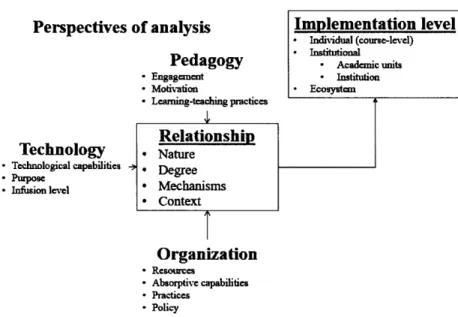
Our findings show three main perspectives of analysis (i.e., pedagogy, technology, organization). In most cases, when previous literature reported their work in any of these perspectives a link or a relationship was described with other elements. For this relationship we identified the nature, degree, mechanisms, and contexts as the main aspects of the relationship between pedagogy-technology-organization. Our finding also identified multiple levels ofblended learning implementations in higher education institutions. Figure 2.2 summarize our finding from the selected citations (Table 2.5.)
and the analysis of the selected articles (Appendix A).
Perspectives ofanalysis
.
lm(!lementation levelIndividual ( course--level) Pedagogy
.
Institutional.
Academie units• Engagement