Towards DisNETPerf: a Distributed Internet Paths
Performance Analyzer
S. Wassermann
†‡, P. Casas
†, B. Donnet
‡†
FTW Vienna,
‡Université de Liège
[email protected]; [email protected]; [email protected]
∗ABSTRACT
For more than 25 years now, traceroute has demon-strated its supremacy for network-path measurement, becoming the most widely used Internet path diagno-sis tool today. A major limitation of traceroute when the destination is not controllable by the user is its in-ability to measure reverse paths, i.e., the path from a destination back to the source. Proposed techniques to address this issue rely on IP address spoofing, which might lead to security concerns. In this paper we intro-duce and evaluate DisNETPerf, a new tool for locating probes that are the closest to a distant server. Those probes are then used to collect data from the server point-of-view to the service user for path performance monitoring and troubleshooting purposes. We propose two techniques for probe location, and demonstrate that the reverse path can be measured with very high accu-racy in certain scenarios.
1.
WHY DISNETPERF?
Internet-scale services such as YouTube and Face-book are provisioned from geo-distributed servers, using large Content Delivery Networks (CDNs). While user-requests are normally redirected to the closet servers (in terms of latency), internal CDN load-balancing policies may select servers which lie at hundreds of milliseconds from customers, potentially impacting their Quality of Experience (QoE). For instance, previous work [1] re-ports a real case study in which a Google load balancing policy results in a drop in the throughput of YouTube flows, impacting the QoE of a large number of cus-tomers watching videos at peak-load times in an opera-∗
This work has been supported by the European Commission through the Seventh Framework Grant Agreements mPlane (FP7-318627).
Permission to make digital or hard copies of all or part of this work for personal or classroom use is granted without fee provided that copies are not made or distributed for profit or commercial advantage and that copies bear this notice and the full citation on the first page. Copyrights for components of this work owned by others than ACM must be honored. Abstracting with credit is permitted. To copy otherwise, or republish, to post on servers or to redistribute to lists, requires prior specific permission and/or a fee. Request permissions from [email protected].
CoNEXT Student Workshop’15, December 01 2015, Heidelberg, Germany. Copyright 2015 ACM. ISBN 978-1-4503-4066-3/15/12 ...$15.00. DOI: http://dx.doi.org/10.1145/2842665.2843570
tional ISP. In this event, the minimum RTT to YouTube servers increases by more than 300%, corresponding to a different load balancing policy selecting servers at much farther locations [2]. The anomaly could be due to ei-ther wrongly dimensioned/faulty YouTube servers, or to the presence of heavy network congestion at peak time in the servers-to-customers paths.
Having a tool that can measure the performance of these paths becomes paramount for the ISP to diag-nose and troubleshoot the detected performance degra-dation [3]. Performing traceroute measurements from the servers towards the monitoring vantage point can-not be done in practice, as YouTube servers are can-not under the control of the ISP. A solution to this prob-lem has been proposed in the past, known as reverse traceroute [4]; however, the proposed approach heav-ily relies on IP spoofing and IP Record Route Option, both being not necessarily allowed everywhere [5, 6] and causing potential security concerns.
In this paper we introduce DisNETPerf, a Distributed Internet Paths Performance Analyzer, that can monitor any Internet path using the RIPE Atlas framework [7] and standard traceroute measurements.
2.
DISNETPERF
Given a certain content server with IP address IPs, and a destination customer with IP address IPd, Dis-NETPerf locates the closest RIPE Atlas probe [7] to IPs, namely IPc, and periodically runs traceroute measurements from IPcto IPd, collecting different path performance metrics such as RTT per hop, end-to-end RTT, etc. This data might then be used to troubleshoot paths from the content server (mimicked by IPc) to the target customer. Fig. 1 depicts the overall idea. It uses a combined topology- and delay-based distance, as probes are located first by AS (BGP routing proxim-ity allowing to select probes in the same AS as IPs) and then by propagation delay (for selecting the closest probe to IPs). Note that DisNETPerf is not strictly tied to RIPE Atlas, but can be used with any other distributed measurement framework such as CAIDA’s Ark [8] or PlanetLab [9].
We evaluate two probe selection approaches for Dis-NETPerf, partially proposed in the literature [10, 11,
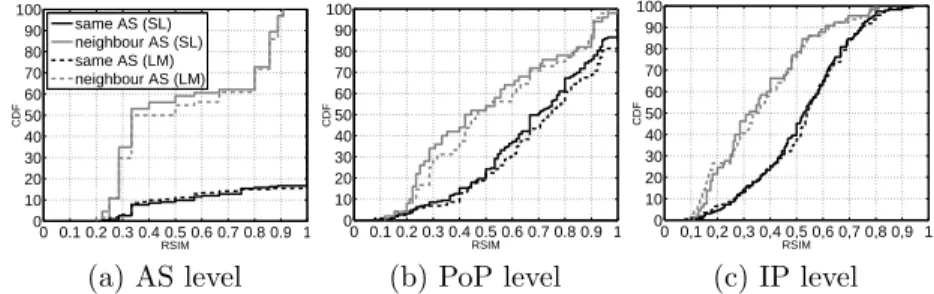
Figure 1: DisNETPerf overview. 0 0.1 0.2 0.3 0.4 0.5 0.6 0.7 0.8 0.9 1 0 10 20 30 40 50 60 70 80 90 100 RSIM CDF same AS (SL) neighbour AS (SL) same AS (LM) neighbour AS (LM) (a) AS level 0 0.1 0.2 0.3 0.4 0.5 0.6 0.7 0.8 0.9 1 0 10 20 30 40 50 60 70 80 90 100 RSIM CDF (b) PoP level 0 0,1 0,2 0,3 0,4 0,5 0,6 0,7 0,8 0,9 1 0 10 20 30 40 50 60 70 80 90 100 RSIM CDF (c) IP level Figure 2: Probe selection evaluation, based on RSIM.
12]: the smallest latency (SL) approach and the land-mark (LM) approach. In both cases, we start by de-termining whether RIPE Atlas probes are located and available in the same AS as the content server IPs. If this is not the case, we look for probes in the neigh-bor ASes of IPs. Neighborhood information is obtained through AS relationships [13]. Once RIPE Atlas probes have been identified, the selection of IPc can start.
In the SL-approach, we run 10 standard ping mea-surements from the probes towards IPs. The probe with the smallest minimum RTT to IPsis then elected as the representative probe of the content server, i.e., IPc. In the LM-approach, we first start by grouping the identified RIPE Atlas probes in two groups: the landmarks and the probes that can be elected as IPc. Landmarks represent a base location reference for all the probes, as inter-probe distances are measured using them as origin. Landmarks are chosen randomly among all the candidate-probes. We then run 10 ping measure-ments from those landmarks towards IPs and all the other identified probes belonging to the other group. For each pinged IP address, we build a feature vector d containing the minimum RTT from each landmark to this IP address. We select IPc as the probe which fea-ture vector is the most similar to the one of IPs, accord-ing to the normalized distance Dij=
1 K
PK
l=1|dil−djl|, where K is the number of landmarks providing a RTT for both IPi and IPj, and dil is the minimum RTT between IPi and landmark l. When Dij is small, we assume that IPiand IPjare close to each other. In the evaluations next, we select 20 landmarks for each IPs.
We say that IPc is a good probe w.r.t. IPs and IPd if the path from IPc to IPdis highly similar to the path from IPs to IPd. Similarly to Hu and Steenkiste [14], we define path similarity as the fraction of common links among both paths, using the Route Similarity in-dex (RSIM), a value in the interval [0, 1], defined as RSIM (IPc, IPs, IPd) = 2 × CT links(IPc, IPs, IPd)
links(IPc, IPs, IPd) , where
Clinks refers to the number of links shared in common
by both paths, and Tlinksto the total number of links. A high RSIM indicates a high similarity between the considered paths. We consider links at the AS level (IP2AS mapping based on Maxmind [15]), PoP level (IP2PoP mapping based on iPlane [16]), and IP level.
Fig. 2 reports evaluation results in terms of path sim-ilarity. We use RIPE Atlas probes as source and desti-nation (i.e., IPsand IPd) so as to compute the real path (i.e., the ground-truth) between servers and customers. We randomly select 300 RIPE Atlas source probes IPsi,
and consider a single fixed destination probe IPd. For each source IPsi we run DisNETPerf to locate the
clos-est probe IPci, obtain both the ground truth path IPsi
→ IPdand the DisNETPerf path IPci → IPd, and
com-pute the RSIM index RSIM (IPci, IPsi, IPd).
We compute RSIM at the AS level, PoP level, and IP level, and plot the resulting CDFs. Results are reported for the two approaches and for two different groups, the first one in which IPci and IPsiare located in the same
AS, and the second one in which IPci is located in a
neighbor AS. At the AS-level, the case of same AS co-location results in near optimal results. Nevertheless, we observe that about 40% of the tests carried out for the SL-approach and 45% of the tests performed for the LM-approach in the non-collocated scenario yield a RSIM index ≥ 0.5. Note that the most relevant segment of the path to monitor for troubleshooting purposes is the one closer to the customer (where problems gener-ally occur), thus a RSIM of 0.5 is actugener-ally very good.
At the PoP-level, the RSIM index computed using both approaches is ≥ 0.5 for about 50% of the tests when IPci and IPsi are in different ASes, and for more
than 80% of the tests when they are in the same AS. At the IP-level, only about 20% of the tests yield an RSIM index ≥ 0.5 when IPci and IPsi are not
co-located in the same AS. However, IP-level paths are generally less relevant, and we plan to evolve to router-based paths [17]. In general, we note that the results for both SL- and LM-approaches are comparable and highly similar. Finally, we observed that probes se-lected by DisNETPerf using the SL-approach generally correspond to paths with the highest similarity to the ground-truth ones: in more than 80% of the performed tests, RSIM (IPci, IPsi, IPd) results in the highest RSIM
index among all the selected candidates when consider-ing the AS-level, which is the most relevant level for our purposes. Indeed, we want to detect which AS on the Internet path from servers to customers might be responsible for the performance degradation, and thus do not take into account the intra-AS routing.
3.
REFERENCES
[1] P. Casas, A. D’Alconzo, P. Fiadino, A. B¨ar, A. Finamore, and T. Zseby, “When YouTube does not work. analysis of QoE-relevant degradation in Google CDN traffic,” IEEE Transactions on Network and Service Management, vol. 11, no. 4, pp. 441–457, December 2014.
[2] P. Fiadino, A. D’Alconzo, A. B¨ar, a. Finamore, and P. Casas, “On the detection of network traffic anomalies in content delivery network services,” in Proc. International Teletraffic Congress (ITC), September 2014.
[3] R. Krishnan, H. V. Madhyastha, S. Srinivasan, S. Jain, A. Krishnamurthy, T. Anderson, and J. Gao, “Moving beyond end-to-end information to optimize CDN performance,” in Proc. ACM Internet Measurement Conference (IMC), November 2009.
[4] E. Katz-Bassett, H. Madhyastha, V. Adhikari, C. Scott, J. Sherry, P. van Wesep,
A. Krishnamurthy, and T. Anderson, “Reverse traceroute,” in Proc. USENIX Symposium on Networked Systems Design and Implementations (NSDI), June 2010.
[5] R. Beverly, A. Berger, Y. Hyun, and k. claffy, “Understanding the efficacy of deployed Internet
source address validation filtering,” in Proc. ACM Internet Measurement Conference (IMC),
November 2010.
[6] R. Fonseca, G. M. Porter, R. H. Katz, S. Shenker, and I. Stoica, “IP options are not an option,” University of California at Berkeley, Technical Report UCB/EECS-2005-24, December 2005. [7] RIPE, “RIPE Atlas distributed active
measurements framework,” September 2015, see https://atlas.ripe.net/.
[8] CAIDA, “Archipelago (ark) measurement infrastructure,” August 2015, see
http://www.caida.org/projects/ark/.
[9] PlanetLab, “PlanetLab, an open platform for developing, deploying, and accessing
planetary-scale services,” August 2015, see https://www.planet-lab.org/.
[10] E. Katz-Bassett, J. P. John, T. Anderson, A. Krishnamurthy, Y. Chawathe, and
D. Wetherall, “Towards IP geolocaiton using delay and topology measurements,” in Proc. ACM Internet Measurement Conference (IMC), October 2006.
[11] V. Padmanabhan and L. Subramanian, “An investigation of geographic mapping techniques for internet hosts,” in Proc. ACM SIGCOMM, August 2001.
[12] Y. Liao, W. Du, and G. Leduc, “A lightweight network proximity service based on neighborhood models,” in Proc. IEEE Symposium on
Communications and Vehicular Technology in the Benelux (SCVT), November 2015.
[13] The CAIDA UCSD, “AS relationships,” June 2015, http://data.caida.org/datasets/
as-relationships/serial-1/20150601.as-rel.txt.bz2. [14] N. Hu and P. Steenkiste, “Quantifying Internet
end-to-end route similarity,” in Proc. Passive and Active Measurement Workshop (PAM), April 2006.
[15] MaxMind, “Geolocation and online fraud prevention from MaxMind,” June 2015, see http://download.maxmind.com/download/geoip/ database/asnum/GeoIPASNum.dat.gz.
[16] H. V. Madhyastha, T. Isdal, M. Piatek, C. Dixon, T. Anderson, A. Krishnamurthy, and
A. Venkataramani, “iPlane: An information plane for distributed services,” in Proc. USENIX Symposium on Operating Systems Design and Implementation (OSDI), November 2006. [17] K. Keys, “Internet-scale IP alias resolution
techniques,” ACM SIGCOMM Computer
Communication Review, vol. 40, no. 1, pp. 50–55, January 2010.