HAL Id: tel-02929326
https://tel.archives-ouvertes.fr/tel-02929326
Submitted on 3 Sep 2020
HAL is a multi-disciplinary open access archive for the deposit and dissemination of sci-entific research documents, whether they are pub-lished or not. The documents may come from teaching and research institutions in France or
L’archive ouverte pluridisciplinaire HAL, est destinée au dépôt et à la diffusion de documents scientifiques de niveau recherche, publiés ou non, émanant des établissements d’enseignement et de recherche français ou étrangers, des laboratoires
Fixed charge network design problem with user-optimal
flows
Ikram Bouras
To cite this version:
Ikram Bouras. Fixed charge network design problem with user-optimal flows. Other [cs.OH]. Univer-sité Montpellier, 2019. English. �NNT : 2019MONTS136�. �tel-02929326�
THÈSE POUR OBTENIR LE GRADE DE DOCTEUR
THÈSE POUR OBTENIR LE GRADE DE DOCTEUR
DE L’UNIVERSITE DE MONTPELLIER
DE L’UNIVERSITE DE MONTPELLIER
En Informatique
École doctorale I2S Information, Structures, Systèmes Unité de recherche LIRMM, UMR 5506
Fixed Charge Network Design Problem with
User-Optimal flows
Fixed Charge Network Design Problem with
User-Optimal flows
Présentée par Ikram Bouras
Le 20/12/2019
Sous la direction de Michael Poss et Rosa Figueiredo
Devant le jury composé de
Dritan Nace, Prof, Heudiasyc, UTC Compiègne Rapporteur Luce Brotcorne, Dr, INRIA, équipe-projet INOCS, Lille Rapporteure
Safia Kedad-Sidhoum, Prof, CNAM-CEDRIC, Bordeaux Examinatrice (Présidente du jury) Boris Detienne, MCF, IMB, Bordeaux Examinateur
Michael Poss, CR CNRS, LIRMM, Montpellier Directeur de thèse Rosa Figueiredo, MCF, LIA, Avignon Co-encadrante
Abstract
This thesis addresses a class of bi-level network design problems. We are interested in investigating applications from different domains and in developing exact algorithms to solve the corresponding bi-level net-work problem. In particular, we study a bi-level netnet-work design prob-lem where the leader selects a part of the network to be activated, then, in the second level, the solution must be optimal for a network flow problem in the selected sub-network. In this thesis, three appli-cations of this problem are studied: hazmats transportation, telecom-munication, and social networks analysis. The second level problem in the first and the last applications is a shortest path problem while a minimum cost flow is required in the second application.
The first studied problem is the fixed charge network design problem with shortest path constraints, which is modeled as a bi-level program and can be applied in hazardous transportation. For this problem, we propose two new binary integer programming (BILP) formulations inspired by path and cycle inequalities. We incorporate these formu-lations in a branch-and-cut algorithm and another cutting-plane based method. Numerical experiments are performed on real instances, and random data sets generated with different criteria to examine the dif-ficulty of the instances. The results show that the proposed cutting plane algorithms can solve up to 19% more instances than the com-pact formulations.
The second studied problem is the energy-aware traffic engineering while using multi-path routing to minimize link capacity utilization in ISP backbone networks. We propose a bi-level optimization model where the upper level represents the energy management function, and the lower one refers to the deployed multi-path routing protocol. Then, we reformulate it as a one-level MILP replacing the second level problem by different sets of flow optimality conditions. We further use these formulations to solve the problem with classical cutting plane and branch-and-cut algorithms. The computational experiments are performed on real instances to compare the proposed algorithms and to evaluate the efficiency of our model against existing single-path and multi-objective models.
Finally, we study the problem of maximization influence in signed so-cial networks. To the best of our knowledge, it is the first time that this problem is modeled as a bi-level programming problem. We re-formulate the problem as one-level MILP models using three different optimality conditions of the shortest path problem appearing in the second level. These formulations are strengthened by adding a set of valid inequalities. Computational experiments are performed using random instances to compare the different proposed formulations. Fi-nally, explicit solutions and bounds are proposed for particular cases of instances.
Keywords— Network design, Bi-level programming, Integer program-ming, Transportation networks, Telecommunication networks, Social net-works
R´
esum´
e
Cette th`ese s’adresse `a la classe des probl`emes de conception de r´eseaux bi-niveaux. Nous nous sommes int´eress´es `a l’´etude des applications dans diff´erents domaines et au d´eveloppement d’algorithmes exacts pour la r´esolution des probl`eme de r´eseaux bi-niveau correspondants. En particulier, nous avons ´etudi´e le probl`eme de conception de r´eseau bi-niveau dans lequel le “leader” s´electionne une partie du r´eseau `
a activer, puis, dans le deuxi`eme niveau, la solution doit ˆetre opti-male pour un probl`eme de flot dans le sous-r´eseau s´electionn´e. Dans cette th`ese, trois applications de ce probl`eme sont ´etudi´ees : le trans-port de mati`eres dangereuses, les r´eseaux de t´el´ecommunication et les r´eseaux sociaux. Les probl`emes de deuxi`eme niveau de la premi`ere et la derni`ere application sont des probl`emes de plus court chemin alors qu’un flot de coˆuts minimum est requis dans la deuxi`eme application.
Le premier probl`eme ´etudi´e est le probl`eme de conception de r´eseau avec coˆut fixe avec contraintes de plus court chemin. Le probl`eme est mod´elis´e comme un programme bi-niveaux qui peut ˆetre appliqu´e dans le transport des mati`eres dangereuses. Pour ce probl`eme, nous proposons deux nouvelles formulations de programmation en nombres entiers (PLNE) inspir´ees par des in´egalit´es de chemin et de cycle. Nous incorporons ces formulations dans des algorithmes de branch-and-cut et de plans coupants. Des tests num´eriques sont effectu´es sur des instances r´eelles et sur un ensembles d’instances al´eatoires
qui sont g´en´er´ees avec diff´erents crit`eres pour examiner la difficult´e de ces instances. Les r´esultats montrent que les algorithmes de plan coupants propos´es peuvent r´esoudre jusqu’`a 19 % d’instances de plus que les formulations compactes.
La deuxi`eme application concerne la gestion de la consommation d’´energie dans les r´eseaux de t´el´ecommunication en utilisant un protocole de routage multi-chemins pour minimiser la capacit´e des liens utilis´ee. Nous proposons un mod`ele d’optimisation bi-niveaux dans lequel le premier niveau repr´esente la fonction de gestion de l’´energie et le deuxi`eme niveau est un protocole de routage multi-chemins. Ensuite, le probl`eme est reformul´e par des formulations PLNE en rempla¸cant le probl`eme du deuxi`eme niveau par ses conditions d’optimalit´e. Ces formulations sont utilis´ees pour r´esoudre le probl`eme avec les al-gorithmes classiques de plans coupants et de branch-and-cut. Les exp´erimentations sont effectu´ees sur des instances r´eelles afin de com-parer les algorithmes propos´es et d’´evaluer l’efficacit´e de notre mod`ele par rapport `a des mod`eles alternatifs propos´es dans la litt´erature.
Enfin, nous ´etudions le probl`eme de la maximisation d’influence dans les r´eseaux sociaux sign´es. A notre connaissance, c’est la premi`ere fois que ce probl`eme est consid´er´e comme un probl`eme de program-mation `a deux niveaux. Nous reformulons le probl`eme en mod`eles PLNE `a un niveau en utilisant trois diff´erentes conditions d’optimalit´e du probl`eme de plus court chemin apparaissant dans le deuxi`eme niveau. Ces formulations sont renforc´ees en ajoutant un ensemble d’in´egalit´es valides. Des tests num´eriques sont effectu´es sur des in-stances al´eatoires pour comparer les diff´erentes formulations propos´ees. Enfin, des solutions optimales en temps polynomial sont propos´ees
pour des cas particuliers des graphes.
Mots cl´es— Conception de r´eseaux, Programmation bi-niveau, PLNE,
Acknowledgements
This thesis becomes a reality with the kind support and help of many individuals. I would like to extend my thanks to all of them.
First and foremost, I would like to express my sincere gratitude to my advisors Michael Poss and Rosa figueiredo for the continuous sup-port of my Ph.D. study and research, for their patience, motivation, immense knowledge, and their advice throughout these three years of research. They brought me a deeper understanding of the different aspects of the subject and the research. I could not have imagined having better advisors and mentors for my Ph.D study.
I would like to thank Fen Zhou for the information he gave me about telecommunication networks and for all the help during my two first years. I am also very grateful to Cristina Requejo for her collaboration on social network problems and for the support during my stay in Aveiro, Portugal.
Besides my supervisors, I would like to thank Prof. Safia Kedad-Sidhoum for her kind acceptance to be the president of my Ph.D. committee, as well as Prof. Dritan Nace and Dr. Luce Brot-corne, who have kindly accepted the invitation to be reviewers of my Ph.D. thesis, for the time they spent reading my manuscript, and for their insightful comments that improved this thesis. My gratitude to Dr. Boris Detienne and Prof. Safia Kedad-Sidhoum for being
the examiner of my thesis and for their kind acceptance to take part in the jury of my Ph.D. defense.
I also want to thank warmly all the professors and colleagues from the MAORE team of Lirmm, University of Montpellier, the univer-sity of Avignon and also from the univeruniver-sity of Aveiro. I also want to thank the administrative staff of Lirmm, in particular, Nico-las Serrurier for the kindness, availability, and efficiency have been an important help for me, allowing me to focus on my research.
This thesis has been financially supported by the Algerian ministry of higher education and scientific research and the consulate of Algeria in Montpellier. I would like to thank them for the funding received during my thesis.
I take this opportunity to thank my friends who helped to make these years such a nice experience. I am grateful that you have always been there whenever I needed you.
Last but not the least, I would like to thank my family: my parents, my brothers, and my sister for the support, encouragement and for believing in me.
R´
esum´
e ´
etendu
Au cours de ces derni`eres ann´ees, Les r´eseaux sont de plus en plus utilis´es dans notre vie quotidienne. Des marchandises, des informa-tions, des donn´ees et aussi des personnes doivent ˆetre transport´ees ou envoy´ees entre des diff´erents endroits rapidement et `a moindre coˆut. Par cons´equent, ces r´eseaux doivent ˆetre con¸cus pour trouver la solution optimale (chemins, flux, sous-r´eseaux), en optimisant une fonction objective d´efinie et en satisfaisant des exigences donn´ees.
La programmation math´ematique est un outil pour trouver la meilleure solution de ces probl`emes de conception de r´eseaux. Essentiellement, la programation math´ematique mod´elise ces probl`emes (i) en d´ecidant les variables de d´ecision, (ii) en d´efinissant la fonction objective `a opti-miser (le but du probl`eme) et (iii) en fixant les contraintes (exigences relatives aux solutions optimales). L’objectif et les contraintes sont caract´eris´es par des fonctions qui peuvent ˆetre lin´eaires, non lin´eaires, convexes ou non convexes. On peut ´egalement envisager d’optimiser une ou plusieurs fonctions objectives. Le probl`eme peut consid´erer un ou plusieurs niveaux d’optimisation. Sur la base de toutes ces pro-pri´et´es, on peut d´eterminer la complexit´e du probl`eme et proposer le meilleur algorithme pour r´esoudre le probl`eme efficacement.
Une classe importante de probl`emes d’optimisation math´ematique concerne les mod`eles de programmation lin´eaire `a nombres entiers
mixtes (MILP), qui sont utilis´es pour r´esoudre la plupart des probl`emes de conception de r´eseaux. Dans cette classe, la fonction objective et les contraintes doivent ˆetre lin´eaires, et les variables du probl`eme peu-vent prendre des valeurs enti`eres, binaires ou continues. En g´en´eral, les m´ethodes d’´enum´eration telles que les algorithmes de branch-and-bound et de branch-and-cut sont utilis´ees pour r´esoudre les probl`emes (MILP).
Dans cette th`ese, nous nous int´eressons `a un cas particulier de la programmation en nombres entiers o`u le probl`eme est d´ecompos´e en deux niveaux de d´ecision. Dans le premier niveau, le “leader” prend une d´ecision en minimisant sa fonction objective. Ensuite, le probl`eme du second niveau consiste `a trouver la solution optimale du “follower” en fonction de la d´ecision du “leader”.
Probl´
ematiques ´
etudi´
ees
La programmation lin´eaire en nombres entiers bi-niveaux a de nom-breuses applications pour les probl`emes de conception de r´eseaux. Dans cette th`ese, trois applications principales sont ´etudi´ees. Pour chacune de ces applications, une mod´elisation math´ematique et des al-gorithmes pr´ecis sont propos´es pour r´esoudre le probl`eme d’optimisation correspondant.
Commen¸cons par pr´esenter les applications ´etudi´ees pour les probl`emes de conception de r´eseaux bi-niveaux dans cette th`ese.
R´
eseaux de transport de mati`
eres dangereuses
Dans ces derni`eres ann´ees, en raison de la croissance de l’industrie, d’´enormes quantit´es de marchandises ont dˆu ˆetre transport´ees dans les centres urbains. Une grande partie de ces marchandises sont des mati`eres dangereuses (Hazmats), qui repr´esentent, par exemple, un envoi sur cinq sur les routes nord-am´ericaines, et il y a au moins 800,000 envois routiers par jour [55]. En d´epit de tous les records de s´ecurit´e pris par l’industrie, des accidents peuvent se produire. Pour r´eduire la possibilit´e et le coˆut des accidents, de nombreuses recherches ont ´et´e men´ees pour concevoir les r´eseaux routiers de mati`eres dan-gereuses.En consid´erant un r´eseau routier, et un ensemble de mati`eres dan-gereuses `a transporter entre les points d’origine et de destination. Le probl`eme de la conception du r´eseau de mati`eres dangereuses con-siste `a trouver une route pour chaque demande afin de minimiser le coˆut du transport. Dans cette th`ese, nous consid´erons un mod`ele bi-niveaux o`u il y a deux agents pour prendre la d´ecision. Au premier niveau, le gouvernement s´electionne un ensemble de routes `a activer en minimisant le risque d’accidents. Ensuite, au second niveau, chaque transporteur choisit une route entre son origine et sa destination pour l’exp´edition de mati`eres dangereuses associ´ee avec un coˆut optimal. Le probl`eme est formul´e sous la forme d’un mod`ele de programmation lin´eaire en nombres entiers `a deux niveaux.
R´
eseaux de t´
el´
ecommunications
En raison de l’augmentation consid´erable du nombre d’appareils con-nect´es aux r´eseaux IP, la consommation d’´energie de ces r´eseaux croˆıt rapidement, avec un rythme de 10 % par an, ce qui repr´esente 1,8 % de la consommation mondiale de l’´electricit´e en 2012 [92]. En outre, on estime que les r´eseaux de communication consommeront jusqu’`a 51 % de l’´electricit´e mondiale dans le pire des cas d’ici 2030 si leur effi-cacit´e ´energ´etique n’est pas suffisamment am´elior´ee. Par cons´equent, le probl`eme de l’efficacit´e ´energ´etique devient critique pour les r´eseaux de t´el´ecommunication d’aujourd’hui.
Afin de r´eduire la consommation d’´energie sur les r´eseaux IP, les r´eseaux durables ont attir´e l’attention des fabricants d’appareils et des fournisseurs de services d’internet (ISP). Dans la litt´erature, un probl`eme d’“energy-aware traffic engineering” est propos´e pour min-imiser la consommation totale d’´energie en ´eteignant les appareils de r´eseau inutilis´es (routeurs et liaisons) tout en garantissant la connec-tivit´e du r´eseau.
Dans cette th`ese, nous avons propos´e un mod`ele d’optimisation `a deux niveaux pour le probl`eme de minimisation de la consomma-tion d’´energie dans les r´eseaux ISP avec un protocole de routage multi-chemins pour minimiser l’utilisation de la capacit´e des liens. Dans ce probl`eme, nous consid´erons un r´eseau ISP mod´elis´e par un graphe bidirectionnel G(V, A), o`u V est l’ensemble des routeurs, et A repr´esente l’ensemble des liens de communication. Dans le premier niveau, nous s´electionnons un sous-ensemble d’appareils r´eseau `a ac-tiver afin de minimiser la fonction de gestion de l’´energie. Ensuite,
au deuxi`eme niveau, chaque demande est envoy´ee sur le r´eseau ac-tiv´e en satisfaisant un protocole de routage multi-chemins entre la paire origine-destination associ´ee et en minimisant l’utilisation de la capacit´e des liens pour ´eviter la congestion dans le r´eseau.
R´
eseaux sociaux
La derni`ere application du probl`eme de conception de r´eseaux bi-niveaux ´etudi´ee dans cette th`ese est le probl`eme de maximisation d’influence dans les r´eseaux sociaux sign´es. Les r´eseaux sociaux peu-vent ˆetre mod´elis´es par des graphes repr´esentant des individus et leurs relations, telles que amiti´e, collaboration ou les relations de recherche de conseils. Ces individus sont fr´equemment influenc´es, explicitement ou implicitement, par leurs contacts sociaux.
Le nombre d’utilisateurs de r´eseaux sociaux a augment´e rapidement ces derni`eres ann´ees (environ 2,4 milliards d’utilisateurs pour Face-book, par exemple). En cons´equence, la propagation de l’influence `a travers les r´eseaux sociaux a une grande importance dans la d´ecision d’adopter les informations (telle qu’une id´ee politique, un nouveau produit ou des innovations technologiques). L’´etude de l’influence et les effets du ”word of mouth” dans les r´eseaux sociaux est motiv´ee par des applications telles que la diffusion d’id´ees ou d’innovations dans un r´eseau et le marketing viral de produits.
Les ´etudes actuelles se concentrent presque sur les r´eseaux sociaux non sign´es qui ne contiennent que des relations positives (par ex-emple, l’amiti´e ou la confiance) entre les utilisateurs. Dans cette th`ese, nous ´etudions le probl`eme de l’influence dans les r´eseaux
so-ciaux sign´es o`u le graphe contient `a la fois des relations positives et n´egatives (par exemple, l’ennemi ou la m´efiance) entre les utilisateurs. Le premier niveau du probl`eme s´electionne les influenceurs, auxquels l’information est fournie directement. L’information est ensuite dif-fus´ee aux autres nœuds du r´eseau en utilisant le plus court chemin (qui est mod´elis´e par le deuxi`eme niveau), ce qui est conforme `a la th´eorie halo effect.
Plan de la th`
ese
Cette th`ese est divis´ee en trois grands chapitres de contributions pr´ec´ed´es d’un chapitre pr´esentant les notions pr´eliminaires. Ce chapitre commence par une pr´esentation des probl`emes de programmation lin´eaire en nombres entiers `a un et `a deux niveaux et une discus-sion des algorithmes utilis´es pour r´esoudre ces probl`emes. Ensuite, deux probl`emes de flot utilis´es dans les autres chapitres (probl`eme du plus court chemin et du flot `a coˆut minimum) sont introduits dans les deux derni`eres sections.
Le chapitre 3 est consacr´e `a ´etudier et r´esoudre le probl`eme de con-ception des r´eseaux `a charges fixes avec des contraintes du plus court chemin par des algorithmes exacts. Nous proposons deux nouvelles formulations BILP bas´ees respectivement sur des in´egalit´es valides de chemin et de cycle utilis´ees pour ´eliminer les solutions non r´ealisables pour le probl`eme bi-niveaux. La formulation du cycle est inspir´ee de la contribution dans [79]. Les relaxations lin´eaires des deux formulations sont compar´ees th´eoriquement.
les formulations de chemin et de cycle dans des algorithmes de Branch-and-cut et des algorithmes it´eratifs des plans s´ecants. Dans ces derniers, `
a chaque it´eration, la formulation avec une partie des contraintes du probl`eme est r´esolue exactement, puis, un ensemble d’in´egalit´es du plus court chemin est ajout´e tant que la solution retourn´ee est non r´ealisable. Ensuite, nous renfor¸cons les formulations propos´ees par un ensemble d’in´egalit´es valides qui s’appliquent dans le cas o`u diff´erents produits ont la mˆeme origine et la mˆeme destination. Enfin, des tests num´eriques sont r´ealis´es sur des ensembles de donn´ees r´eelles ainsi que sur des instances al´eatoires. Ces travaux ont ´et´e publi´es dans la revue de “Computers and Operation Research” [28], et ils sont pr´esent´es dans [24; 26].
Dans le chapitre 4, nous ´etudions le probl`eme de la minimisation de la consommation d’´energie du r´eseau en utilisant un protocole de routage multi-chemins pour r´eduire l’utilisation de la capacit´e des li-aisons.Nous formulons pour la premi`ere fois le probl`eme ´etudi´e comme un probl`eme d’optimisation bi-niveaux. Pour le r´esoudre, la formu-lation bi-niveaux est transform´ee en un mod`ele `a un seul niveau en utilisant les conditions d’optimalit´e de KKT, des in´egalit´es de flot `a coˆut minimum et des conditions d’optimalit´e du graphe r´esiduel. Des m´ethodes it´eratives de “cutting plane” et de “branch-and-cut” sont ensuite propos´ees pour r´esoudre le probl`eme. Ce chapitre est bas´e sur les travaux [25; 27].
Le chapitre 5 ´etudie le probl`eme de maximisation d’influence dans les r´eseaux sociaux sign´es. Pour la premi`ere fois, un mod`ele de program-mation bi-niveaux est propos´e pour mod´eliser ce probl`eme. Nous reformulons le probl`eme en mod`eles MILP en utilisant trois
condi-tions d’optimalit´e diff´erentes pour le probl`eme du deuxi`eme niveau. Ensuite, deux formulations sont propos´ees en utilisant des plus court chemins pr´ecalcul´es pour r´eduire le nombre de variables et de con-traintes dans le mod`ele. Ces formulations `a un niveau sont ren-forc´ees par un ensemble d’in´egalit´es valides. Enfin, des cas partic-uliers de r´eseaux sociaux sont ´etudi´es dans lesquels la solution opti-male ou bornes inf´erieurs de la solution sont faciles `a calculer. Des exp´erimentations sont r´ealis´ees en utilisant des instances al´eatoires pour comparer les diff´erentes formulations propos´ees.
La th`ese se termine par un chapitre de conclusion (chapitre 6), pr´esentant les r´esultats de la th`ese et les perspectives dans ce domaine de recherche.
Contents
1 Introduction 1
1.1 Bi-level network design problem applications . . . 2
1.1.1 Hazmat transportation networks . . . 2
1.1.2 Telecommunication networks . . . 3
1.1.3 Social networks . . . 4
1.2 Outline of the Thesis . . . 5
2 Preliminary Notions 7 2.1 Integer programming . . . 7
2.1.1 Definition of MILP problem . . . 8
2.1.2 Complexity . . . 9
2.1.3 Exact algorithms to solve MILP . . . 9
2.2 Bi-level programming . . . 12
2.2.1 Linear bi-level programming . . . 13
2.2.2 Classes of bi-level programming problems . . . 14
2.2.3 Non-unique follower optimal solution . . . 15
2.2.4 Algorithms to solve LBP . . . 16
2.3 Shortest path problem . . . 18
2.3.1 MILP formulation . . . 18
CONTENTS
2.4 Minimum cost flow problem . . . 23
2.4.1 Definition . . . 24
2.4.2 Optimality conditions . . . 25
2.4.3 Solution methods . . . 26
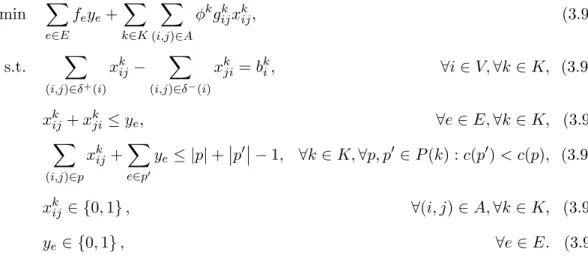
3 Fixed Charge Network Design Problem with Shortest-path con-straints 29 3.1 Introduction . . . 30 3.2 Mathematical models . . . 31 3.2.1 Bi-level formulation . . . 32 3.2.2 One-level formulation . . . 34 3.2.3 Bellman’s Model . . . 35
3.2.4 BILP formulation based on cycle constraints . . . 36
3.2.5 BILP formulation based on path constraints . . . 39
3.3 Theoretical comparison and improvements . . . 39
3.4 Proposed algorithms for FCNDP-SPC . . . 43
3.4.1 Compact formulations . . . 44
3.4.2 Iterative cutting plane algorithms . . . 44
3.4.3 Branch-and-cut algorithm . . . 45 3.4.4 Valid inequalities . . . 46 3.5 Numerical results . . . 47 3.5.1 Random instances . . . 48 3.5.2 Real instances . . . 57 3.5.2.1 Ravenna data . . . 58 3.5.2.2 Albany data . . . 60
4 Fixed Charge Network Design Problem with User Optimal Flows 61 4.1 Introduction . . . 62
CONTENTS
4.2 Problem definition and notation . . . 65 4.3 Mathematical formulations . . . 67 4.3.1 Bi-level formulation . . . 67 4.3.2 One level formulation . . . 69 4.3.3 BILP formulation based on flow constraints . . . 70 4.3.4 Residual network optimality conditions . . . 72 4.3.5 Single path routing . . . 76 4.4 Alternative application: Minimising energy in Data Center Networks 78 4.5 Agorithms . . . 80 4.5.1 Compact formulations . . . 80 4.5.2 Cutting plane algorithm . . . 81 4.5.3 Branch-and-cut algorithm . . . 81 4.5.4 Single path routing . . . 82 4.6 Numerical results . . . 83 4.6.1 Instances set . . . 83 4.6.2 Solution times . . . 84 4.6.3 Single path routing vs multi-path routing . . . 86 4.6.4 Bi-level vs bi-objective model . . . 88
5 Maximum influence in Signed social networks 89 5.1 Introduction . . . 89 5.2 Problem description . . . 92 5.3 Mathematical formulations . . . 94 5.3.1 Bi-level programming formulation . . . 94 5.3.2 One-level formulation . . . 100 5.3.3 Bellman based BILP formulation . . . 102 5.3.4 Shortest path formulations . . . 102 5.3.5 Path-based formulation . . . 104
CONTENTS
5.4 Formulation improvements . . . 106 5.4.1 Valid inequalities . . . 106 5.4.2 Instance pre-processing . . . 108 5.5 Special case instances: balanced graphs . . . 109 5.6 Numerical experiments . . . 113
6 Conclusion and perspectives 117
List of Figures
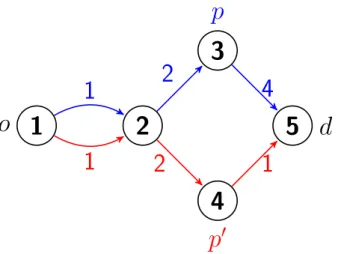
3.1 A restricted graph containing two alternative paths for a commod-ity to be sent from 1 to 5. . . 38 3.2 Additional statistics for the algorithms and formulations . . . 56 3.3 Performance profile comparing the different algorithms for random
instances. . . 57 3.4 Hazmat transportation network of Ravenna, Italy. . . 58 3.5 Hazmat transportation network of Albany, USA. . . 60
4.1 ISP model architecture. . . 65 4.2 The graph representation of the ISP network (Figure ). . . 66 4.3 Example of an unfeasible (feasible) flow violating (satisfying)
neg-ative cycle conditions. All link capacities are equal to 2 with Φ = 3 to be sent from s to d. . . 73 4.4 Examined network topologies: (a) Abilene (b) Polska (c) Geant
[118]. . . 84
5.1 Effect of multiple shortest paths when constraints (5.2a)-(5.2c) are used to define variables πk. . . 98 5.2 Example of a balanced (a) and an unbalanced (b) signed graphs.
List of Tables
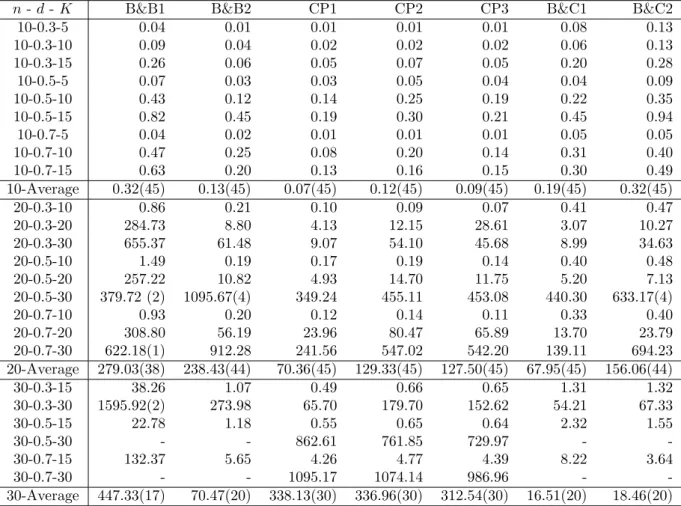
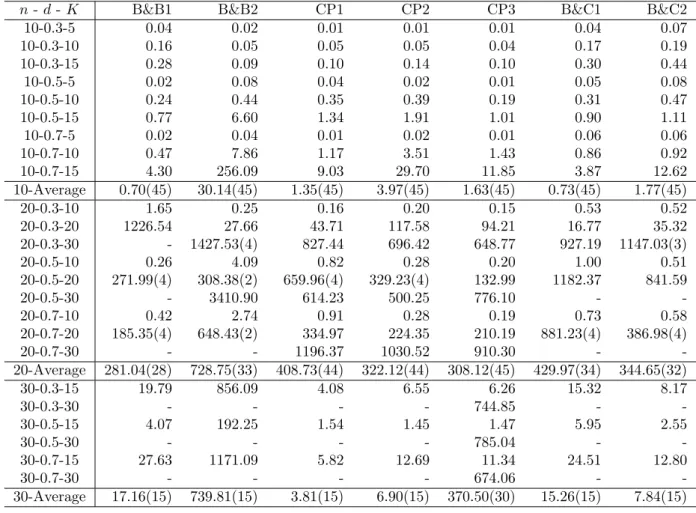
3.1 Number of constraints and binary variables of each formulation . 44 3.2 CPU time in seconds for instances with 0◦ ≤ α ≤ 10◦ . . . 49 3.3 CPU time in seconds for instances with 40◦ ≤ α ≤ 50◦ . . . . 50 3.4 CPU time in seconds for instances with 80◦ ≤ α ≤ 90◦ . . . . 51 3.5 Gap between the optimal solution and the linear relaxation . . . . 52 3.6 % of CPU-SP/CPU-total . . . 53 3.7 Number of cuts generated by the cutting plane and the
Branch-and-Cut algorithms . . . 54 3.8 Number of separation problems solved by the iterative cutting
plane and the Branch-and-Cut algorithms . . . 55 3.9 Number of random instances solved to optimality . . . 57 3.10 Comparison of CPU time in seconds on the Ravenna data . . . . 59 3.11 CPU time in seconds on the Ravenna data with additional valid
inequality . . . 59 3.12 Comparison of CPU time on the Albany data . . . 60
4.1 Router chassis and cards . . . 83 4.2 Network topologies used. . . 84 4.3 Comparison of CPU time on Abilene network. . . 85 4.4 Comparison of CPU time on Geant network. . . 85
LIST OF TABLES
4.5 Comparison of CPU time on Polska network. . . 86 4.6 Comparison of the first level solution of the multi-path and the
single path approaches. . . 86 4.7 Comparison of the second level solution of the multi-path and the
single path approaches. . . 87 4.8 Percentage of the reduction on the first and the second level
ob-jectives using the multi-path model. . . 87 4.9 Table of the differnce between the first and the second level solution 88 4.10 CPU time in seconds of the bi-level and multi-objective models. . 88
5.1 Comparison of CPU time in second on the first set of random instances. . . 115 5.2 Comparison of CPU time in second on second set of random
Chapter 1
Introduction
In the past years, we have been using more and more networks in our daily lives. Commodities, information, data, and people have to be transported or sent between different places quickly and cheaply. Consequently, these networks must be designed to find the best solution (paths, flows, sub-networks), optimizing a defined objective function and satisfying given requirements.
Mathematical optimization is a framework capable of finding the best solution to these network design problems. Essentially, mathematical optimization models the such problems by (i) deciding on which variables to optimize, (ii) defining the objective function to be optimized (the goal of the problem) and (iii) setting the constraints (requirements on the optimal solutions). The objective and the constraints are characterized by functions that can be linear, nonlinear, convex, or non-convex. Also, we can consider to optimize single or multiple objective functions. The problem can consider single or multiple levels of optimization. Based on all the above properties, we can determine the computational complexity of the problem and devise the best algorithm to solve the problem efficiently.
An important class of mathematical optimization problems concerns mixed-integer linear programming models (MILP), which are used to solve most of
1.1 Bi-level network design problem applications
network design problems. In this class, both of the objective function and the constraints are required to be linear, and the variables of the problem can take in-teger, binary, or continuous values. In general, enumeration methods like branch-and-bound and branch-and-cut algorithms are used to solve (MILP) problems.
In this thesis, we are interested in a particular case of integer programming where the problem is decomposed into two levels of decision. In the first level, the “leader” make a decision minimizing her objective function. Then, the second level problem consists in finding the optimal solution of the “follower” based on the decision of the leader.
1.1
Bi-level network design problem applications
Bi-level integer programming has many applications for network design prob-lems. In this thesis, three main applications are studied. For each of these applications, mathematical modeling and exact algorithms are proposed to solve the corresponding optimization problem. Let us start by presenting the studied applications for bi-level network design problem along this thesis.
1.1.1
Hazmat transportation networks
In the last years, because of the growth of industry, huge amounts of commodities have to be transported in urban centers. A big part of these commodities are haz-ardous materials (Hazmats), which represent, for example, one in five shipments on North American highways, and there are at least 800,000 road shipments per day [55]. In spite of all safety records taken on industry, accidents may happen. To reduce the possibility and the costs of accidents, a lot of research has been carried out to design the road networks of hazardous materials.
1.1 Bi-level network design problem applications
origin and destination points. The hazmat network design problem consists in designing a road for each commodity in order to minimize the transportation cost. In this thesis, we consider a bi-level model where there are two agents to make the decision. In the first level, the government selects a set of roads to be activated, minimizing the risk of accidents. Then, in the second level, each carrier selects a route between the origin and the destination for the associated hazmat shipment with an optimum cost. The problem is formulated as a bi-level integer programming model.
1.1.2
Telecommunication networks
Due to the huge growth of the number of devices connected to IP networks, the network energy consumption is inherently growing fast with a rate of 10% per year, which represented a 1.8% of the worldwide electricity consumption in 2012 [92]. Furthermore, communication networks are estimated to consume as much as 51% of the global electricity in the worst case by 2030 if their energy efficiency is not enhanced enough [8]. Therefore, the problem of energy efficiency is becoming critical for nowadays communication networks.
To reduce energy consumption on IP networks, green networking has attracted much attention from device manufacturers and Internet Service Providers (ISP). In the literature, an energy-aware traffic engineering problem is proposed to minimize the total energy consumption by switching off unused network devices (routers and links) while guaranteeing full network connectivity.
In this thesis, we proposed a bi-level optimization model for the problem of energy-aware Traffic Engineering (TE) while using multi-path routing to minimize link capacity utilization in ISP backbone networks. In this problem, we consider an ISP backbone network modeled by the bi-directed graph G(V, A), where V is the set of routers, and A represents the set of communication links. In the first
1.1 Bi-level network design problem applications
level, we select a subset of network devices to be powered on in order to minimize the energy management function. Then, in the second level, each demand is sent on the activated network satisfying a multi-path routing protocol between the associated pair of origin-destination and minimizing the total link capacity utilization to avoid congestion in the network.
1.1.3
Social networks
The last application of the bi-level network design problem studied in this thesis is the maximum influence problem in signed social networks. Social networks can be modeled by graphs representing individuals and their relationships, such as friendships, collaborations, or advice-seeking relationships. These individuals are frequently influenced, explicitly, or implicitly by their social contacts.
The number of social networks users has been increasing rapidly in these last years (about 2.4 billion users for Facebook, for instance). In consequence, influence propagation through social network has a great importance in deciding whether to adopt an innovation (such as a political idea, a new product, or technological innovations). Studying the influence and the effects of the “word of mouth” in the promotion of new products in social networks is motivated by applications like the spread of ideas or innovations in a network and viral marketing of products.
Current studies focus almost on unsigned social networks containing only positive relationships (e.g., friendship or trust) between users. In this thesis, we study the influence problem in signed social networks where the graph contains both positive and negative relationships (e.g., foe or distrust) between users. The first level of the problem selects the influencers, to which the information is provided directly. The information is then spread to the other nodes of the network using shortest path (which is modeled by the second level), which is line
1.2 Outline of the Thesis
with the halo effect theory.
1.2
Outline of the Thesis
This thesis is divided into three main contribution chapters preceded by a chap-ter introducing preliminaries notions. This chapchap-ter starts with a presentation of the one-level and bi-level integer programming problems and a discussion of the algorithms used to solve these problems. Then, two network flow problems used in the other chapters (shortest path and minimum cost flow problems) are introduced in the two last subsections.
Chapter 3 is devoted to studying and solving the fixed-charge network design problem with shortest path constraints by exact algorithms. We propose two new BILP formulations based, respectively, on path and cycle valid inequalities used to eliminate the infeasible bi-level solutions. The cycle formulation is inspired by the contribution in [79]. The linear relaxations of the two BILP formulations are compared theoretically. To solve the studied problem, we propose two ways of integrating the path and cycle formulations in cutting plane algorithms, us-ing either a branch-and-cut or an iterative cuttus-ing-plane strategy. In the second strategy, at each iteration, a partial ILP formulation of FCNDP-SPC is solved exactly, and a set of shortest path inequalities is added while the returned solu-tion is unfeasible. Then, we strengthen our formulasolu-tions through a set of valid inequalities that apply to the case where different commodities have the same origin and the same destination. Finally, numerical experiments are done on real data sets from the literature as well as on random instances. This work has been published in Computers and Operation research journal [28], and it is presented in [24; 26].
con-1.2 Outline of the Thesis
sumption while using multi-path routing to reduce link capacity utilization. To the best of our knowledge, it is the first time that this problem is investigated. From the perspective of optimization techniques, we formulate the studied prob-lem as a bi-level optimization for the first time. To solve it, the bi-level formula-tion is transformed into a one-level optimizaformula-tion using KKT condiformula-tions, minimum flow inequalities or residual network optimality conditions. Iterative cutting plane and branch-and-cut methods are further proposed to solve the problem. This chapter is based on works [25; 27].
Chapter 5 studies the maximum influence problem in signed social networks. For the first time, a bi-level programming model is proposed to model the prob-lem. We reformulate the two-levels problem into one-level MILP models using three different optimality conditions for the second-level problem. Then, two for-mulations are proposed using pre-calculated shortest path distances to reduce the number of variables and constraints in the model. These one-level formulations are strengthened by adding a set of valid inequalities. Finally, special cases of the networks in which the optimal solution or bounds are easy to find are studied. Computational experiments are performed using random and real instances to compare the different proposed formulations.
The thesis ends with a concluding chapter (Chapter 6), presenting the results of the thesis and perspectives in this research field.
Chapter 2
Preliminary Notions
This chapter is devoted to the introduction of the basic optimization problems addressed in this thesis. Precisely, integer and bi-level programming are presented in the first two subsections. In the last two subsections, we present two network flow problems: shortest path and minimum cost flow problem. For each problem, we give the definition, some fundamental theoretical properties, mathematical formulations, and the well-known algorithms used to solve these problems.
2.1
Integer programming
Mixed-integer linear programming (abbreviated MILP in what follows) denotes constrained optimization problems in which the objective function and all con-straints are linear, and some or all decision variables are restricted to be integer. In the later case the terminology ILP is used instead of MILP. MILP can be used to formulate and solve most combinatorial optimization problems, and it has a wide range of applications, such as transportation, scheduling, and telecommuni-cation networks.
2.1 Integer programming
2.1.1
Definition of MILP problem
The integer linear programming problem can be written in the general form as follows [141]: (ILP ) min cx s.t. Ax ≤ b, x ≥ 0, x ∈ Zn,
where A is an integer m × n matrix and b and c are vectors of dimensions m and n, respectively. The optimal solution of ILP is given by the integer vector x = (x1, ..., xn)T. The problem is called a mixed-integer linear program (MILP) if some variables are not required to be integer. This formulation can include equality constraints because each of them can be replaced by two inequality con-straints.
The linear relaxation of ILP is the linear optimization problem obtained by relaxing the integrity constraints x ∈ Zn, and it is given by:
(LP ) min cx s.t. Ax ≤ b, x ≥ 0.
(LP) is an easy optimization problem as it can be solved in polynomial time. As (LP) and (ILP) have a constrictive relation, and since (LP) is easy to solve, (LP) can be used as an attempt to solve the (ILP). If it happens that the optimal solution of linear relaxation (LP) is integral, then (ILP) is easy to solve.
2.1 Integer programming
2.1.2
Complexity
In what follows, we provide a few simple notions of the complexity theory of optimization problems (more detailed in [82; 141]).
Defining the complexity of a combinatorial optimization problem (P ) requires first introducing the associated decision problem (D). Problem (D) ∈ NP if we can check in polynomial time whether a candidate solution provides an answer to (D) (more details about polynomial time complexity in [82]).
If every problem in the classNP can be polynomially reduced to (D), then, (D) is NP-complete, and its associated optimization problem (P) is NP−hard [141]. Moreover, an optimization problem (P ) is polynomially solvable and (P ) ∈ P if there exists an algorithm to solve the worst-case of the problem in polynomial time [122].
The mixed-integer linear programming problems belong to the class of NP-hard problems. This result can be verified by the reduction from NP-hard prob-lems (for example, the vertex cover problem).
2.1.3
Exact algorithms to solve MILP
Developing exact algorithms to solve ILPs and MILPs has been a subject of many studies in the last 50 years. The proposed algorithms belong to three categories of methods depending on the type of the used method to get the optimal solution [66]:
Polyhedral approaches: cutting plane algorithm
Enumerative approaches: branch-and-bound, branch-and-cut, branch-and-price
Relaxation and decomposition techniques: lagrangian relaxation, Benders decomposition.
2.1 Integer programming
In this subsection, we will give the basic ideas for some of the mentioned algo-rithms (the ones used in this thesis).
Branch-and-Bound Branch-and-Bound algorithm is one of the most studied algorithms to solve NP-hard combinatorial optimization algorithms. Generally, these problems have exponential complexity, and solution algorithms need to enumerate a large number of feasible solutions to find the optimal one. The branch-and-bound method was proposed the first time in 1964 by Bertier and Roy [19], and it has been studied by many researchers [3; 12; 93; 123].
Branch-and-bound algorithms start by relaxing the integrity constraints, and solving the linear relaxation of the problem. If the obtained solution is integer, then this solution is optimal for the integer problem. Otherwise, there must exist at least one variable xj with a fractional value α. The idea of the algorithm is to separate the problem into two problems (branching). The first sub-problem contains the constraint xj ≥ dαe and the second includes the constraint xj ≤ dαe − 1. It is clear that this creates a partition of the feasible set of the original integer problem. The process is repeated for each sub-problem.
This procedure is represented as a search tree, where at each level, a partition of the parent vertex is performed according to the rule described above. It is then a question of going through this enumeration tree in order to find the optimal solution. Exploring a tree path can end (bounding) for three reasons:
• The solution of the sub-problem is integer.
• The sub-problem becomes unfeasible.
• The optimal solution of the sub-problem is worst than a feasible solution encountered so far.
2.1 Integer programming
The optimal solution of the initial problem is the best solution reached in the branch-and-bound tree.
Cutting plane The cutting plane algorithm is an exact iterative method to solve mixed-integer programming problems [83]. It has also been used to solve many combinatorial problems including packing problems [77; 116], traveling salesman problem [9; 10; 119] and the vehicle routing problem [45; 129].
The cutting plane algorithm has been proposed for general ILPs for the first time by R.E. Gomory [69; 70]. The basic idea of the algorithm is to solve at each iteration the linear relaxation of the problem. If the obtained solution is integer, then it is optimal for the ILP problem. Otherwise, we add a constraint that eliminates this solution. Then, the basic structure of the cutting plane algorithm is given by Algorithm 1.
Algorithm 1 Cutting plane algorithm
Step 1: Solve the linear relaxation of the initial problem.
Step 2: If the solution of the linear relaxation is integer, then, it is optimal. Step 3: Otherwise, generate a cutting plane (valid inequality) that separates the
obtained solution (continuous) from the convex hull of integral solutions of ILP.
Step 4: Return to step 1.
The efficiency of the cutting plane algorithm depends on the strength of the generated valid inequalities at each iteration. Its limited efficiency at the time of its introduction and in subsequent years explains that this method has been neglected for many years until the development of polyhedral theory in the eight-ies. Nowadays, the cutting plane algorithm is more efficient and used to solve a variety of combinatorial problems.
2.2 Bi-level programming
Branch-and-Cut Since ILPs and MILPs are NP−hard, finding an optimal solution in a reasonable time with the presented algorithms can be improbable. As a consequence, combining many algorithms can improve the solution time.
Branch-and-cut algorithm is an exact method to solve linear integer problems that combines branch-and-bound with the cutting plane algorithm. This method consists in solving the problem using a branch-and-bound procedure and use the cutting plane method to eliminate unfeasible solution in each node of the branch-and-bound tree.
The advantage of this algorithm is to reduce the number of nodes of the branch-and-bound tree by improving the strength of the formulation dynamically in the course of the branch-and-bound tree.
2.2
Bi-level programming
Bi-level programming is a hierarchical mathematical optimization problem where the decision is made by two independent and non-cooperative agents. The first one is called a “leader”, whereas the second one the “follower”. Each of them has her own objective. The agents act and react in a sequential and interdependent way [21; 48; 121]. In our case, the objective of the second level problem is to minimize her objective linear function according to the first level decision. On this assumption, the leader also specifies a decision such that the objective function of the upper-level problem is minimized. The obtained solution applying the above procedure is called an equilibrium solution, which defines the optimal solution of the bi-level optimization problem [18; 20; 32; 108; 117].
From a historical point of view, one of the first applications of two-level pro-gramming was in the economic problem of the Stackelberg game [135]. This ap-plication represents an economical scenario in which the leader and the follower
2.2 Bi-level programming
are two agents (firms or individuals) who operate in the same market. The objec-tive of both of them is to maximize their profits. Several other applications can be found for bi-level optimization, for example in network design, transportation networks or game theory [29; 30; 112; 120].
2.2.1
Linear bi-level programming
The majority of carried out studies on bi-level programming has focused on lin-ear versions. The mathematical formulation of the linlin-ear bi-level programming problem (LBP) is the following:
min x∈X c1x + d1y (2.1a) s.t. A1x + B1y ≤ b1, (2.1b) min y∈Y c2x + d2y (2.1c) s.t. A2x + B2y ≤ b2 (2.1d)
where c1, d1, c2, d2are the objective functions vectors, and A1, B1, A2, B2represent constraints matrices. The variable x is called the “upper level” variable, and y is called the “lower level” variable. Both variables are defined on the feasible regions X and Y respectively.
The linear bi-level problem isNP−hard even if the first and the second level problems are continuous linear problems [44].
To analyze the problem, let us define the following sets [121]:
• The feasible region of (LBP) is:
2.2 Bi-level programming
• The feasible region of the “follower” for a given value of x is:
S(x) = {y ∈ Y : A2x + B2y ≤ b2}
• The inducible region of the bi-level problem is given by:
IR = {(x, y) ∈ S : y = arg min ¯
y∈Y { c2x + d2y,¯ y ∈ S(x)}}¯
• A solution (x∗, y∗) ∈ X × Y is bi-level optimal if, and only if:
c1x∗+ d1y∗ ≤ c1x + d1y, ∀(x, y) ∈ IR.
2.2.2
Classes of bi-level programming problems
There exist three different classes of linear bi-level programming problems ac-cording to the type of decision variables x and y [134]. These classes are defined as:
Continuous linear bi-level programming CLBP: The decision variables of both first and second level problems in this class are continuous x, y ∈ Rn. CLBP is the simplest case of bi-level optimization problem even if it belongs to the class ofNP−hard problems. Many applications can be found for CLBP especially when the two levels problems do not need discrete variables, for instance continuous transportation problems, continuous network design problems and many other applications [40; 58; 136].
Discrete linear bi-level programming DLBP: The decision variables in this class are both discrete x, y ∈ Zn and if the first level variable is continuous this class called continuous-discrete BLBP CDLBP. Therefore, the bi-level model
2.2 Bi-level programming
cannot be solved reformulating into one-level problem. The DLBP and CDLBP classes have many applications in transportation, industry as well as telecommu-nication, and it can be solved only by enumeration approaches [14; 47; 113; 134].
Discrete-Continuous linear bi-level programming DCLBP: In this class, the decision variable of the leader is discrete x ∈ Zn while the second level is a continuous problem y ∈ Rn. This is a generalization of CLBP and can be solved by the same algorithms. DCLBP has appeared in many application (Hazardous transportation, facility location, and network design problems) and many methods are proposed to solve the problem in [5; 21; 22; 28; 73; 84; 110].
2.2.3
Non-unique follower optimal solution
In the definition of the inducible region of LBP, we have seen that the feasible solutions (x, y) depend on the optimal solution of the follower problem reacting to x. Since we have an optimization problem in the second level problem, the follower may have multiple optimal solutions for the same value of the leader variable x.
Note that in bi-level optimization problems, the leader cannot interfere with the follower’s decision to force her to choose one among the multiple solutions. Hence, the leader cannot predict the chosen follower’s optimal solution. Thus, we distinguish two scenarios of LBP depending on the optimal solution of the follower [47]:
The optimistic position: The first scenario is the optimistic position. In this case, we suppose that the follower will take the best solution for the leader from her multiple optimal solutions. Most of the contributions on bi-level programming address this scenario.
2.2 Bi-level programming
The pessimistic position: The optimistic position is not possible for all prob-lems, especially in real-world applications where the cooperation between the leader and the follower is not allowed, or it is not possible to know the decision of the follower. In this case, the problem will be solved with the assumption that follower will choose the worst solution for the leader objective.
In addition to these two scenarios, researchers have also proposed heuristic algorithms that select follower solutions without considering their impact into the leader’s objective, e.g. [132].
2.2.4
Algorithms to solve LBP
In general, three types of algorithms are used to solve linear programming prob-lems [121]:
Solutions enumeration algorithm: Since the inducible region of LBP is de-fined by the finite elements set of bi-level feasible solutions (with the assumption that IR is bounded):
IR = {(x, y) ∈ S : y = arg min ¯
y∈Y {c2x + d2y,¯ y ∈ S(x)}}¯
the optimal solution can obtained by enumerating all feasible solutions and taking the best one for the leader objective function.
KKT approach: In the case of a continuous lower level problem (CLBP and DCLBP), the bi-level problem can be reformulated as a single level MILP problem replacing the second level problem by the associated KKT optimality conditions. Thus, the problem can be solved by any integer programming algorithm.
2.2 Bi-level programming (2.1) presented in Subsection 2.2.1: min x∈Zn c1x + d1y (2.2a) s.t. A1x + B1y ≤ b1, (2.2b) min y∈Rn c2x + d2y (2.2c) s.t. A2x + B2y ≤ b2. (2.2d)
The second level problem can be replaced by the associated KKT optimality condition, then, the problem can be reformulated as:
min x∈Zn c1x + d1y (2.3a) s.t. A1x + B1y ≤ b1, (2.3b) A2x + B2y ≤ b2, (2.3c) hy, (d2+ λTB2)i = 0, (2.3d) hλ, A2x + B2y − b2i = 0, (2.3e) λ ∈ Rm+. (2.3f)
This last formulation contains non-linear constraints (2.3d) and (2.3e) (the symbol h., .i represents the scalar product between two vectors), which can be linearized by adding binary variables and Big-M method to get a MILP problem solvable with integer programming algorithms, presented in Section 2.1.
In this thesis, the studied problems belong to the class of discrete-continuous linear bi-level programming problems, and we consider the optimistic position in the case of multiple optimal solutions of the second level problem.
Penalty approach: The basic idea of this algorithm is to convert the fol-lower problem to an unconstrained minimization problem using a barrier method.
2.3 Shortest path problem
Then, a penalty on the dual gap of the second level problem will be introduced alternatively on the objective function of the leader.
2.3
Shortest path problem
In operations research, the shortest path problem is one of the most fundamen-tal and simplest problems which has many applications in practice and theory. Among these applications, we find telecommunication routing protocols, traffic management, transportation planning, and social networks, and so on. For a given weighted directed or undirected graph G(V, E) with a set of n nodes V , a set of m edges E and a positive cost ce associated to each edge e ∈ E, let A be the set of directed arcs associated to E. The classical shortest path problem looks for a path P with minimum cost between a source node s ∈ V and a destination node d ∈ V [4; 105].
This is the basic version of the shortest path problem. In the literature, many generalizations are studied, for instance:
• The shortest path from one single source node to all the nodes of the graph.
• The shortest path from all the nodes of the graph to one destination node.
• The shortest path between all pairs of vertices in the graph.
2.3.1
MILP formulation
The single-source single-destination shortest path problem can be formulated as a linear programming model. We are given an undirected graph G(V, E) with a cost cij for each arc (i, j) ∈ {(u, v), (v, u) : {u, v} ∈ E}. The problem to find the
2.3 Shortest path problem
shortest path between the two nodes s and d can be formulated as:
min X (i,j)∈A cijxij (2.4a) s.t. X (i,j)∈δ+(i) xij − X (i,j)∈δ−(i) xji= 1, if i = s, −1, if i = d, 0, otherwise. ∀i ∈ V, (2.4b) xij ≥ 0, ∀(i, j) ∈ A. (2.4c)
The objective function (2.4a) minimizes the total length of the path defined by the positive decision variable x which indicates that the arc (i, j) is in the optimal solution if xij = 1. Finally, constraint (2.4b) ensures to find only one path between s and d. This LP formulation has a particular property that its optimal solution is integral.
Theorem 1 (Existence, [89]). The shortest path problem between the two nodes s and d in the graph G(V, E) has a solution if and only if G has no negative cycle.
2.3.2
Algorithms
The shortest path problem is one of the easiest combinatorial optimization prob-lems to solve due to its linear formulation. In this part, we describe some funda-mental algorithms to solve the problem.
Dijkstra algorithm: Dijkstra algorithm is a graph search method that finds the shortest path between nodes in non-negative weighted graphs. This method is proposed by Edsger Dijkstra in 1956 and published three years after [52].
2.3 Shortest path problem
oriented or not-oriented graph the shortest path between a fixed source node s and all graph vertices producing a shortest path tree.
To find a single-source single-destination shortest path, it is sufficient to stop once the length of the shortest path to the destination node is determined by the algorithm.
This algorithm is part of the label setting algorithms family. The main idea of Dijkstra’s original algorithm (more detailed in Algorithm 2) is to select, at each iteration, a vertex u calculate the label’s final value π(u), the length of the shortest path from s to u (see also: [71; 90; 125]).
Algorithm 2 Dijkstra algorithm
Input: Graph G(V,E), source node s and weights ce ≥ 0, ∀e ∈ E. Initialization: π(u) = ∞, for all u ∈ V \{s} and π(s) = 0. Q = ∅. Iterations:
Step 1: Find a vertex u ∈ V \Q such that: π(u) = min v∈V \Q
π(v).
Step 2: Set: Q ← Q ∪ {u}.
Step 3: For all node v ∈ V \Q neighbor of u do: If π(v) ≥ π(u) + cuv then:
set: π(v) ← π(u) + cuv. Step 4: If Q 6= V , then go to step 1.
Output: π(u) is the length of the shortest path between s and u.
Theorem 2 (Dijkstra [52]). DIJKSTRA’S ALGORITHM works correctly.
Proof. See [90].
Theorem 3 (Fredman and Tarjan [64]). The running time of DIJKSTRA’S ALGORITHM implemented with a Fibonacci heap is O(m + n log n).
2.3 Shortest path problem
Bellman-Ford algorithm: Dijkstra algorithm cannot be used in the case of a graph with negative arc weights. For the general case, Richard Bellman and Lester Ford proposed in 1958 a new algorithm, called Bellman-Ford algorithm to solve the shortest path from a source node s to all other nodes in a weighted graph. Moreover, the algorithm indicates if the graph contains a negative-weight cycle, in which case the problem has no solution. This algorithm is based on the optimality conditions recalled below.
Theorem 4 (Bellman’s optimality conditions). z is the length of the shortest path between s and d if, and only if, there exists a value πi for all i ∈ V such that:
• πs = 0.
• πd= z.
• πj ≤ πi+ cij, ∀(i, j) ∈ A.
Proof. See [141].
2.3 Shortest path problem
Algorithm 3 Bellman-Ford algorithm [17; 62]
Input: Graph G(V,E), source node s and weights ce ∈ R, ∀e ∈ E. Initialization: π(u) = ∞, p(u) =Null for all u ∈ V \{s}. π(s) = 0. Iterations:
For i ← 1 to n − 1 do: For each (u, v) ∈ E do:
If: π(v) > π(u) + cuv do: Set: π(v) ← π(u) + cuv.
p(v) ← u. For each edge:(u, v) ∈ E do:
If π(u) + cuv> π(v) :
Error: G contains a negative-weight cycle.
Output: π(u) is the length of the shortest path between s and u and p(u) is the predecessor of u in the shortest path.
Theorem 5 (Bellman [17], Ford [62]). Bellman-Ford ALGORITHM works cor-rectly with the running time O(mn).
Proof. See [90].
All-pairs shortest path problem: Suppose now that we want to solve the shortest path problem between all pair of nodes (s, d) ∈ V in the weighted graph G(V, E) with ce ∈ R, ∀e ∈ E. It is clear that we can use the Bellman-Ford algorithm for each source node s ∈ V . The algorithm will be repeated n times, which give us a running time O(n2m).
In 1962, Robert Floyd and Stephen Warshall proposed an O(n3)-algorithm (Algorithm 4) to find the shortest path between all pairs of nodes in the graph.
2.4 Minimum cost flow problem
Algorithm 4 Floyd-Warshall algorithm [61; 140]
Input: Weighted graph G(V,E) with ce ∈ R, ∀e ∈ E. Initialization: π(u, v) = cuv, for all (u, v) ∈ E
π(u, v) = ∞, for all (u, v) ∈ (V × V )\E, u 6= v. π(u, u) = 0, for all u ∈ V.
p(u, v) = u, for all u, v ∈ V. Iterations:
For v ← 1 to n do:
For u ← 1 to n, if: u 6= v do: For w ← 1 to n, if: w 6= v do:
If: π(u, w) > π(u, v) + π(v, w), then: π(u, w) ← π(u, v) + π(v, w). p(u, w) ← π(v, w).
Output: π(u, v) is the length of the shortest path between the two nodes u and v and (p(u, v), v) are the edges of the shortest paths to j if they exist.
Theorem 6 (Floyd [61], Warshall [140]). The Floyd-Warshall ALGORITHM finds the shortest path between all pairs of nodes in a running time O(n3).
Proof. See [90].
Remark 1. Since the shortest path problem is formulated as a linear program, linear programming methodologies can also be used to solve the problem.
2.4
Minimum cost flow problem
Minimum cost flow is a generalization of the shortest path problem in which the arcs in the network are associated with costs and capacities. The problem
2.4 Minimum cost flow problem
consists in finding the best way to send an amount of flow between a source and a destination nodes in the network while minimizing the total cost. In this subsection, we will give the definition of the one-source one-destination variant, optimality conditions and some algorithms to solve the problem.
2.4.1
Definition
Given a directed network G(V, A) supposed to be connected. We associate to each arc in the graph a cost cij and a capacity Cij. Assuming that we have a flow φ to be sent from a source node s to a destination node d. The optimal solution of the minimum cost problem is a flow between the source and destination vertices, which satisfies the capacity constraint and minimizes the total cost.
The problem can be formulated as a linear program:
min X (i,j)∈A cijxij (2.5a) s.t. X (i,j)∈δ+(i) xij − X (i,j)∈δ−(i) xji= φ, if i = s, −φ, if i = d, 0, otherwise. , ∀i ∈ V, (2.5b) xij ≤ Cij, ∀(i, j) ∈ A, (2.5c) xij ≥ 0, ∀(i, j) ∈ A. (2.5d)
The objective function (2.5a) minimizes the cost of the flow defined by the pos-itive decision variable x (2.4c), which indicates the amount of flow passed through the arc (i, j). Finally, Constraints (2.5b), (2.5c) represent flow conservation and capacity constraints, respectively.
2.4 Minimum cost flow problem
2.4.2
Optimality conditions
In this part, we discuss some theoretical properties of the minimum cost flow problem, in particular the optimality conditions, which will be used in Chapter 4.
We will start by defining the concept of residual networks.
Definition 1 (Residual network). The residual network associated to the flow defined by the variable x ∈ R|A|+ is the graph denoted by G(x) = (V, A(x)) and defined by the set of activated and unsaturated arcs A(x). This set of arcs is defined as the union of the two following sets:
A+(x) = {(i, j) ∈ A : 0 < xij < Cij, xji = 0} A−(x) = {(i, j) ∈ A : xji > 0} .
Each arc of G(x) is associated with a residual cost c0 defined as:
c0ij = cij, if (i, j) ∈ A+, −cij, if (i, j) ∈ A−.
Theorem 7 (Negative cycle optimality condition, [4]). A feasible flow x is opti-mal if and only if the network G(x) has no negative cycles.
Proof. See, [4]
We provide now another form of negative cycle optimality conditions based on reduced costs.
Theorem 8 (Reduced cost optimality condition [4]). A feasible solution x to (2.5) is optimal for the minimum cost flow problem if and only if there exist node
2.4 Minimum cost flow problem
potentials Π that satisfy the reduced cost optimality conditions:
c0ij + Πi− Πj ≥ 0, ∀(i, j) ∈ G(x). (2.6a)
Theorems 7 and 8 are applied on the residual network. In contrast, we present next these conditions for the initial graph G.
Theorem 9 (Complementary slackness optimality conditions [4]). A feasible so-lution x is optimal for the minimum cost flow problem if and only if there ex-ist node potentials Π and reduced costs that satisfy the following complementary slackness optimality conditions:
If c0ij + Πi− Πj > 0, then, xij = 0, (2.7a) If 0 < xij < Cij, then, c0ij + Πi− Πj = 0, (2.7b) If c0ij + Πi− Πj < 0, then, xij = Cij. (2.7c)
We can remark that these conditions are the complementary slackness opti-mality conditions of the linear formulation presented in Subsection 2.4.1.
2.4.3
Solution methods
The minimum cost flow problem can be solved with linear programming algo-rithms using the linear formulation. Besides this, in literature, many combinato-rial algorithms have been proposed to solve the problem based on the optimality conditions presented before, or using a generalized algorithms of other optimiza-tion problems (shortest path, maximum flow,...). In this subsecoptimiza-tion, we present some of these algorithms.
2.4 Minimum cost flow problem
Cycle-canceling algorithm: The negative cycle optimality conditions (The-orem 7) can be used to solve the minimum cost flow problem with an iterative approach. This algorithm preserves a flow x, tries to test the existence of negative cycles in the residual network at each iteration, and eliminates these cycles. The algorithm ends when the residual network G(x) does not contain any negative cycles [4].
Algorithm 5 Cycle-canceling algorithm
Step 0: Make a feasible flow x0.
Step 1: While: G(x0) contains a negative cycle do: • Find a negative cycle Cx0 in G(x0).
• Let r be the minimum residual capacity of an edge on C r = min
(i,j)∈Cx0Cij − x 0 ij.
• Augment r units of flow on the cycle Cx0 to find new value of the solution x0.
• Update the residual network G(x0).
Successive shortest path algorithm: The minimum cost flow problem is a generalization of the shortest path problem, the only difference is the existence of capacity constraint. Thus, the two problems are equivalent in the case of all edge capacities are sufficient to pass the flow φ.
Based on this, the problem can be solved iteratively using shortest path algo-rithm as follows:
2.4 Minimum cost flow problem
Algorithm 6 Successive shortest path algorithm
Initialization: Let Φ = 0. While: Φ < φ do:
• Find the shortest path p between s and d. • Let r be the minimum arc capacity in p. • If r ≥ φ, then, p is the optimal solution • Else: set Φ ← Φ + r.
Chapter 3
Fixed Charge Network Design
Problem with Shortest-path
constraints
In this chapter, we study the fixed charge network design problem with shortest path constraints which is modeled as a bi-level program. We first review three one-level formulations obtained by applying the complementarity slackness theorem, Bellman’s optimality conditions and cycle elimination constraints. We propose two new binary integer programming (BILP) formulations inspired by path and cycle inequalities. The two formulations have exponential numbers of constraints. We incorporate the path and the cycle based formulations in a branch-and-cut algorithm and in another cutting-plane based method. Numerical experiments are performed on real instances, and random data sets generated with different criteria to examine the difficulty of the instances. The results show that the proposed cutting plane algorithms can solve up to 19% more instances than the classic branch-and-bound algorithms.