HAL Id: hal-02420912
https://hal.archives-ouvertes.fr/hal-02420912
Submitted on 20 Dec 2019
HAL is a multi-disciplinary open access
archive for the deposit and dissemination of
sci-entific research documents, whether they are
pub-lished or not. The documents may come from
teaching and research institutions in France or
abroad, or from public or private research centers.
L’archive ouverte pluridisciplinaire HAL, est
destinée au dépôt et à la diffusion de documents
scientifiques de niveau recherche, publiés ou non,
émanant des établissements d’enseignement et de
recherche français ou étrangers, des laboratoires
publics ou privés.
Sarah Ribet, Hazem Wannous, Jean-Philippe Vandeborre
To cite this version:
Sarah Ribet, Hazem Wannous, Jean-Philippe Vandeborre. Survey on Style in 3D Human Body Motion:
Taxonomy, Data, Recognition and its Applications. IEEE Transactions on Affective Computing,
Institute of Electrical and Electronics Engineers, inPress, pp.1-1. �10.1109/TAFFC.2019.2906167�.
�hal-02420912�
Survey on Style in 3D Human Body Motion:
Taxonomy, Data, Recognition and its Applications
Sarah Ribet, Hazem Wannous, Member, IEEE, and Jean-Philippe Vandeborre, Senior, IEEE
Abstract—The meaning of the word style depends on its context. While actions have already been quite studied for a while, style in human body motion is a growing topic of interest. In the context of animation, style is crucial as it brings realism and expressiveness to the motion of a character. Even though it is undoubtedly a key element in motions, its definition and the use of the word style in itself, among research works, lack consensus. Achieving realistic motions is tedious. It requires either a large motion capture dataset or the considerable work of artist animators. The lack of consistent style data is thus a challenge. Stylistic motion generation is quite studied in order to overcome this issue. This paper focuses on the study of style in human body motion from 3D human body skeletal data. It establishes a taxonomy of definitions of style, describes the data that have been used up until now, introduces key notions about motion capture data as well as machine learning, and presents approaches about style recognition, person identification through their style and motion style generation.
Index Terms—style, motion, character animation, motion style generation
I. INTRODUCTION
S
TYLE has various meanings and refers to different fields: someone fashionable wears clothes with style, a painter has a specific style, there are different styles of music, etc. This paper deals with the study of style in human body motion. Indeed, a growing interest in body movement analysis is observed recently. It is due to the reliability of whole body sensing technologies that are now affordable and, more impor-tantly, that are more efficient due to the increased processing power. While many approaches focus on actions, this paper focuses on style in 3D human body motion.The content of this paper has to be seen in the context of animation and its multiple applications such as entertainment (feature films, video games), human computer interaction, education, health, scientific visualization and simulation, video surveillance, etc. [1]–[4]. Moreover, it focuses on approaches dealing with 3D skeletal data of human body. As a result, we focus on papers that are either recognizing style in human body motion or that are generating stylistic motions. We insist on the fact that the whole body has to be involved; papers working on face are out of scope of that paper. According to the taxonomy of definitions of style we establish in Section II, S. Ribet and J.-P. Vandeborre are with IMT Lille Douai, Univ. Lille, CNRS, UMR 9189 - CRIStAL - Centre de Recherche en Informatique Signal et Automatique de Lille, F-59000 Lille, France. e-mail: {sarah.ribet,jean-philippe.vandeborre}@imt-lille-douai.fr
H. Wannous is with Univ. Lille, CNRS, Centrale Lille, IMT Lille Douai, UMR 9189 - CRIStAL - Centre de Recherche en Informatique Signal et Automatique de Lille, F-59000 Lille, France. e-mail: [email protected]
emotions are part of style. However, emotions are already a wide studied subject. To keep the scope of the paper reasonable and to focus solely on style, we take the bias to exclude papers that are dealing with emotions.
Bringing realism and expressiveness to an animated char-acter is one of the main challenges in computer animation [5], [6]. Style is then an added value to the motion and this is crucial in that field [7], [8]. It is especially critical as the human eye is sharp and can easily detect unnatural motions [1], [3], [9]. Moreover, the concept of the uncanny valley [10] also applies to character animation [11]. In order to get out of the uncanny valley, where a human being experiences feelings going from uneasiness to revulsion while looking at, in this case, an animated character that is trying to resemble a human being, the animated character needs to reach a certain level of realism. Style can help in that purpose, surpass the uncanny valley.
Accurate realistic motions can be obtained either by the considerable work of 3D animators who manipulate details [6], [8] or by capturing motions [12]. The animators’ work is time-consuming, expensive and tedious, as they do the animations from scratch by hand most of the time [6], [8], [13]. Capturing motions is also time-consuming and a burden for actors, especially when combinations of actions and styles are needed [2] and should ideally be performed several times [14]. One way of overcoming this is by generating new motions, thus reducing the amount of captures needed in datasets [8], [15] and saving animators time [6], [16]. As a result, generating new stylistic 3D human body motions is studied.
Stylein 3D human body motion is per consequent studied, particularly when it comes to stylistic motion generation. We identify three types of motion style generation: synthesis of stylistic motion, editing of stylistic motion and motion style transfer. It is also studied as a classification problem and can be a tool to identify persons. However, the notion of style is not clearly defined and lacks a formal definition; different trends are observed. Furthermore, style in 3D human body motion is a growing topic of interest that has been less studied than human body motion action. Consequently, the amount and quality of 3D human body data available on style is not comparable to the data used in the study of motion actions.
The rest of the paper is structured as follows. Section II es-tablishes a taxonomy of definitions of style in 3D human body motion, exposing the different trends that can be observed in computer literature. Data used in motion style approaches are described in Section III. Key concepts about motion capture data and some related machine learning techniques are exposed in Section IV. Section V highlights motion style
recognition studies. Section VI provides details about methods performing stylistic 3D human body motion generation. An overwhole discussion about motion style, the data related to it and its applications is conducted in Section VII.
II. TAXONOMY OFSTYLE INBODYMOTION In computer animation literature, the concept of motion style is vaguely defined [17]. Providing a definition of style in body movements is not an easy task; it leads to a lack of consensus [18]. Moreover, the words affective state and body expression also refer to style. We only use style in the rest of this paper. This section aims at introducing a subjective proposition of a taxonomy of definitions of style in body motion, from how style is seen by research authors, and exposes relations between emotions and style.
A. Taxonomy of definitions of style in body motion
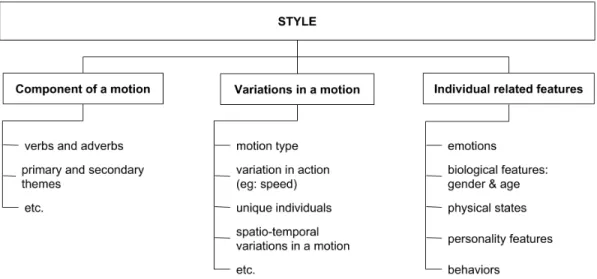
Three common trends can be observed with respect to how body motion style is seen in the literature. Fig. 1 illustrates these trends that are described in this section.
1) Style as a component of a motion: This trend gathers research works that consider style as an add-on to a particular motion.
Some researchers stated that style is one of the components of a motion. Rose et al. [19] introduced the notion of verbs and adverbs. They designated parameterized (stylistic) motions as verbsbeing parameterized by adverbs. For example, walk was a verb and happy and sad were some of its adverbs. Morawetz [20] opted to decompose an emotional motion into primary and secondary movements; an emotion was thus considered as a secondary movement in addition to a primary movement. Etemad and Arya [9], [21] also decomposed a motion into primary and secondary themes, stating that a stylistic motion amounted to a neutral motion to which a style was added.
2) Style as variations in a motion: Stylein body motion is sometimes defined as a variation in a motion. As a result, this trend clusters the differences (variations) that can be observed between motions of the same action.
It can be a variation in the type of motion itself. For example, Brand and Hertzmann [13] claimed that “walking, running, strutting, etc., are all stylistic variations on bipedal locomotion”. Chien et al. [18] referred to “walking, limping, running, jumping, etc.” as being styles of human motion.
It can also be a variation within the same action, considering intuitive features such as the speed of a movement [22].
Style can also represent variations due to the undeniable fact that every human being is different which induces natural variations in our movements [23]. Indeed, each and one of us human being introduces her/his own uniqueness to motions: that is in itself a variation in motions. It is commonly admitted that someone can not perform the same motion in the exact same way twice [3], [22], [24], [25]. Indeed, Lasseter [26] mentioned that “one character would not do a particular action the same way in two different emotional states. [...] No two characters would do the same action in the same way”. Style can thus be seen as being the style of a person.
Finally, style can also simply be seen as spatio-temporal variations in a motion [2], [7], [9], [21].
3) Style as individual-related features: Another trend, less abstract than the previously identified ones, involves individual-related features that can be shown through adjec-tives. They are tangible characteristics of an individual, of a human being. Table I highlights styles of research approaches that are introduced in further details in subsequent sections (see Sections V and VI).
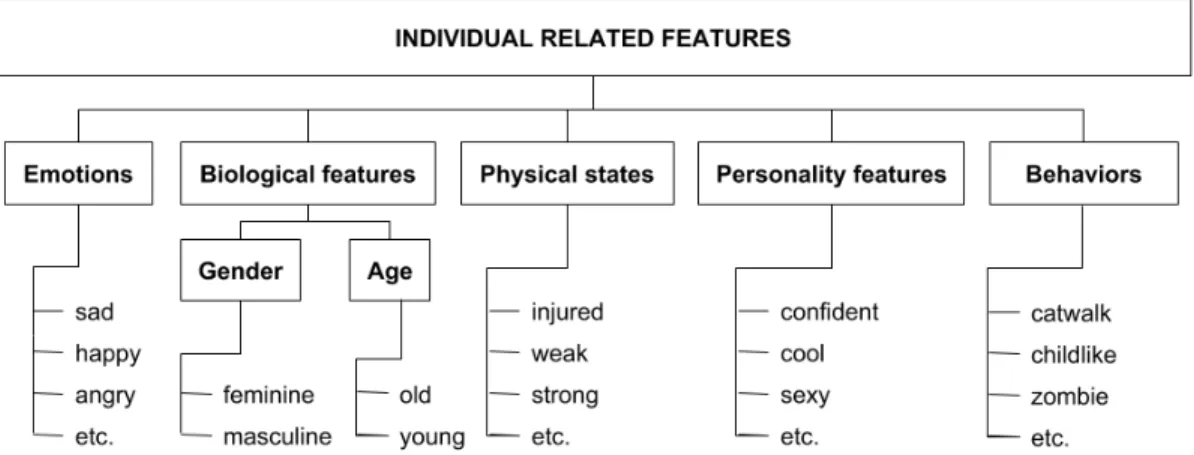
We can notice the heterogeneity in adjectives used. It goes from happy or proud to childlike or zombie, including sexy and old, etc. Still, common characteristics appear such as emotions, gender, age, physical states, personality features and behaviors, that can thus be considered as subsets of style. It is in accordance with the definitions of style from Troje [29] and Abdul-Massih et al. [28], who respectively claimed that stylereferred to “emotions, personality or biological features, such as age or gender” and “your perceived mood, behaviour or physical properties of the motion”. It was confirmed by Etemad and Arya [14] who specified that the style, represented by secondary themes, contained “variations caused by individ-ual characteristics of the actor such as gender, age, emotions, energy, mood, health, and even inherited characteristics”. The second column of Table I allocates the adjectives used in literature to one of the categories identified as subsets. Even though this allocation has been conducted through readings about emotions and behaviors, the reader should be aware that this proposed allocation is subjective. Fig. 2 summarizes the different categories of those adjectives depicting individual-related features that can be found up until now.
According to Table I, research approaches didn’t seem to focus on a specific category of style and rather attempted to tackle several categories at once. Table II presents the adjectives and their occurrences, per category. The behavior category gathers more adjectives than the emotion, personal feature and physical state categories. However, most of those behavior adjectives are referred to once. They were thus not the most used. Note that both biological feature categories only contain two adjectives each, as expected, and the no categorysubset only reports the absence of style represented by the single adjective neutral. The most studied styles were angry, happy, sad, old, proud, depressed and tired. Aside from old, they belong to the emotion category, making it the most studied category. Furthermore, about2/3of the referenced
papers worked with the neutral style, which is actually hard to define or get (either by simulation or with real data). We refer the reader to Section VII-A2 for a further analysis of this style.
B. Emotions and style
Emotions have been defined for quite a while now [1]. Plutchick and Kellerman [30] considered emotions as “envi-ronmental and psychological events influence brain processes that actively modulate clearly observable behaviors”. Six basic – universal – emotions have been identified by Ekman [31]: anger, happiness, sadness, disgust, fear and surprise. Emotion representations have later been introduced; they identified more emotions and measured them according to dimensions. They included the model from Russel [32] for which each
Fig. 1: Common trends (including examples and/or subcategories) of the definition of style as seen in the literature.
TABLE I: Individual-related adjective features seen as style.
In the category column: B= Behavior, BF:A= Biological Feature: Age, BF:G= Biological Feature: Gender, E= Emotion, PF= Personality Feature, PS= Physical State, –= no category. Style Category [1] [2] [5] [27] [24] [25] [3] [14] [7] [28] [4] [9] [15] [8] [16] afraid E X angry E X X X X X X X catwalk B X X X childlike B X X X confident PF X cool PF X crab walking B X crouch B X decided B X depressed E X X X X X drunk PS X X energetic PS X X excited E X fearful E X X feminine BF:G X flap B X frustrated E X goose-step B X happy E X X X X X X X heavy B X in a hurry B X injured PS X X X inverse B X lame walking B X limp B X manly PF X march B X masculine BF:G X mummy B X neutral – X X X X X X X X X X X old BF:A X X X X X X proud PF X X X X X X relaxed E X sad E X X X X X X X X X sexy PF X X X sideways B X sneak B X X strong PF X struggling B X strutting B X X tiptoeing B X tired E X X X X topmodel B X weak PS X young BF:A X zombie B X X
Fig. 2: Classification of style when seen as individual-related features. TABLE II: Occurrences of styles as individual-related features per category.
(a) Behavior
Style Nb. occur. Style Nb. occur. catwalk 3 limp 1 childlike 3 march 1 crab walking 1 mummy 1 crouch 1 sideways 1 decided 1 sneak 2 flap 1 struggling 1 goose-step 1 strutting 2 heavy 1 tiptoeing 1 in a hurry 1 topmodel 1 inverse 1 zombie 1 lame walking 1
(b) Biological Feature: Age
Style Nb. occur. old 6 young 1
(c) Biological Feature: Gender
Style Nb. occur. feminine 1 masculine 1 (d) Emotion Style Nb. occur. afraid 1 angry 7 depressed 5 excited 1 fearful 1 frustrated 1 happy 7 relaxed 1 sad 7 tired 4
(e) Personal feature
Style Nb. occur. confident 1 cool 1 manly 1 proud 6 sexy 3 strong 1 (f) Physical state Style Nb. occur. drunk 2 energetic 2 injured 3 weak 1 (g) No category Style Nb. occur. neutral 11
emotion was a point in the space defined by valence and arousal dimensions which specified if an emotion was positive or negative and its intensity (see Fig. 3). The circumplex model of Plutchik and Conte [33] had a similar configuration. The Pleasant-Arousal-Dominant (PAD) model [34], presented in Fig. 4, proposed a representation measuring how pleasant an emotion was (pleasure dimension), its intensity (arousal dimension) and its dominant nature (dominant dimension). Surveys from Zacharatos et al. [35] and Karg et al. [36] gave more details about the different models of emotions.
Emotions are a subset of style. While it seems natural to include all the emotions, most state-of-the-art approaches on stylefocused only on some of the six basic emotions identified by Ekman [31], as shown in Table I. This is a restriction that induces emotions to be quite simplistic within style. More complex models [32]–[34] prove this wrong.
Emotions are subjective: people can have divergent inter-pretation of an emotion. It can for example depend on culture (see Section VII-A3) or on the fact that each human being is unique. A lot more could be said on this subject, such as the difference between emotions, feelings and mood. However,
Fig. 3: The valence-arousal space. Image reproduced from [35].
Fig. 4: The Pleasant-Arousal-Dominant (PAD) model. Image reproduced from [36].
emotions is a complex topic that can not be fully addressed in this survey.
Liu et al. [5] referred to style as a range of phenomena, such as variations due to emotional state, individual body shape, and functional activity such as walking or running. This definition gathers different trends of the definition of style. As a conclusion, style can be interpreted as representing spatio-temporal variations of a motion that add value to the motion, depending on individuals.
III. DATAUSED INHUMANBODYMOTIONSTYLE APPROACHES
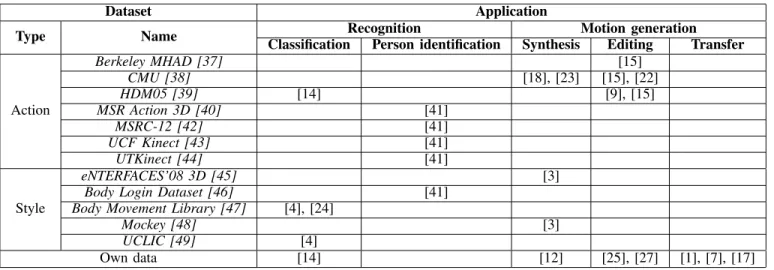
As almost all of the approaches in literature chose one trend of the style definition presented in Section II, data that were used to study style were of various types. Table III presents an overview of the datasets used in motion style approaches. The data came from two main application fields: action and style. Moreover, most of those data have been collected via motion capture (mocap) systems. Mocap is a popular technique to represent human motion from tracked markers corresponding to different regions or joints of the human body. Further details on this technique are provided in Section IV-A.
This section only focuses on the datasets used in the reviewed papers and mentioned in Table III. Thus, this section first presents action specific datasets that were used in motion style methods. Then we introduce specific datasets for style. Finally, we present how they were used for motion style approaches.
A. Action datasets used in motion style approaches
Action datasets are widely used to recognize actions and gestures. We refer the reader to surveys such as the one from Presti [50] to appreciate approaches on action recognition and the data that were used to perform it. Some of them were used in motion style approaches, for the purpose of motion
style recognition, motion style generation (editing/synthesis or transfer) and person identification through their style. Those datasets that were specifically sometimes used in style analysis are introduced.
1) Berkeley Multimodal Human Action Database (MHAD) [37]: The dataset has been made of 11 actions (jumping in place, jumping jacks, bending – hands up all the way down, punching – boxing, waving – two hands, waving – one hand: right, clapping hands, throwing a ball, sit down then stand up, sit down, stand up). A total of 660 action sequences were recorded by 12 subjects (seven males + five females) who performed five repetitions of each action. The optical motion capture system Impulse captured the 3D position of 43 active LED markers on a custom built tight fitting suit. Skeletons of 21 joints have been extracted using MotionBuilder software. The capturing frequency was 480 Hz.
2) Carnegie Mellon University (CMU) Graphics Lab Mo-tion Capture Library [38]: The dataset has been recorded by 12 Vicon infrared MX-40 cameras at 120 Hz. About 144 actors performed motions divided into four categories including the locomotion one with running, walking, jumping and varied (run/leap) actions.
3) HDM05 [39]: The dataset has been made of 2,337 motion sequences divided into 130 gesture groups includ-ing regular, happy and sad walks performed by five non-professional actors. Motion sequences were recorded by an optical marker-based technology (made of a suit with 40-50 retro-reflective markers and 6 to 12 calibrated high resolution cameras). The frame rate was up to 240 Hz. Data were represented by 24 joints.
4) Microsoft Research (MSR) Action 3D Dataset [40]: It was designed to interact with game consoles. The dataset has been made of 20 action types: high arm wave, horizontal arm wave, hammer, hand catch, forward punch, high throw, draw x, draw tick, draw circle, hand clap, two hand wave, side-boxing, bend, forward kick, side kick, jogging, tennis swing, tennis serve, golf swing, pickup & throw. A depth camera (infra-red light) recorded depth maps of resolution 640x240 at 15 frames per second. In total, 567 sequences were captured thanks to 10 subjects who performed two or three times each action. Data were later processed to obtain skeletal data of 20 joints.
5) Microsoft Research Cambridge 12 (MSRC-12) [42]: The dataset has been made of 16 actions split into two categories: iconic gestures (crouch or hide, shoot with a pistol, throw an object such as a grenade, change weapon, kick to attack an enemy, put on night vision goggles to change the game mode) and metaphorical gestures (start music/raise volume, navigate to next menu, wind up the music, take a bow to end the session, protest the music, lay down the tempo of a song). A Microsoft Kinect camera recorded the performance of 30 participants (60% males) at 30 Hz. It resulted in 594 sequences of skeletal data of 20 joints.
6) UCF Kinect [43]: The dataset has been made of 16 actions (balance, climb ladder, climb up, duck, hop, kick, leap, punch, run, step back, step front, step left, step right, twist left, twist right, vault). A Microsoft Kinect sensor was used to capture the 1280 action samples. The OpenNI platform was
TABLE III: Datasets used in motion style approaches and their frequency of use.
Dataset Application
Type Name Recognition Motion generation
Classification Person identification Synthesis Editing Transfer
Action Berkeley MHAD [37] [15] CMU [38] [18], [23] [15], [22] HDM05 [39] [14] [9], [15] MSR Action 3D [40] [41] MSRC-12 [42] [41] UCF Kinect [43] [41] UTKinect [44] [41] Style eNTERFACES’08 3D [45] [3]
Body Login Dataset [46] [41] Body Movement Library [47] [4], [24]
Mockey [48] [3]
UCLIC [49] [4]
Own data [14] [12] [25], [27] [1], [7], [17]
used to estimate skeletons of 15 joints. There were 16 subjects (13 males + 3 females).
7) UTKinect-Action3D Dataset [44]: The dataset has been made of 10 actions (walk, sit down, stand up, pick up, carry, throw, push, pull, wave and clap hands). To collect the dataset, 10 persons (nine males + one female) performed each action twice. There were 200 action samples. RGB images (resolution 480x640) and depth maps (resolution 320x240) were captured with a Kinect at 30 frames per second (fps). The final frame rate was about 15 fps though. Skeletal data (20 joints) were also recorded.
B. Motion style specific datasets
Style specific datasets used in motion style approaches (recognition, generation – editing/synthesis/transfer, person identification) are presented.
1) Body Movement Library [47]: The dataset collected 4,080 movement records split into 1356 motions. Three cate-gories of neutral and emotional (angry, happy, sad, afraid) ac-tions were recorded: walking, arm movements (lifting, knock-ing and throwing) and arm movements separated by walking. Angry, happy and sad styles were chosen because of their easiness of recognition and mapping into actions as well as their duration. Indeed, they contrast with reactive emotions such as surprise and disgust for example that are associated with very specific movements. An attempt was made for the afraid style though, with six actors. The collection of data was conducted with the eight cameras of the Falcon Analog optical motion capture system and a suit to which 35 retro-reflective markers were attached. Non professional actors (15 females + 15 males) were given non-verbal instruction through the following emotion scripts (reproduced from [47]):
Neutral Imagine yourself standing by your kitchen table on a Saturday morning. You are well rested, you just had breakfast and yesterday you and your flatmates tidied the house so you are free to do whatever you want. It is a sunny day and you are thinking about what you are going to do today. There's a bit of paper on the table and you pick it up and throw it to the bin.
Angry Today you slept in, so you had to rush to get ready. Then on the way to work, a policeman flags you down and gives you a speeding ticket, although you were just keeping up with traffic. You finally get to work where a note is waiting for you denying your request for having Friday off; now you are furious. Standing by your desk, you reach for a bit of rubbish and slam it into the bin as your temper flares.
Happy It's Friday evening and you feel great, because earlier you handed in your final year project. Your supervisor was very pleased, he complimented you on it and hinted that you're going to get excellent marks for it. You just talked to your best friend who suggested you go out to celebrate and now you are just waiting for her to arrive. As your excitement mounts you joyously pick up a bit of rubbish on the table in front of you and throw it at the bin.
Sad You are in your flat after just trying to finish dinner. You didn't feel like eating, your stomach is heavy and seems to be bearing all of your body's inner activity and weight. Half an hour ago, you received a telephone call that your best friend had died in a car accident. Deeply grieving, you don't know what to do. Needing to do something you reach for a bit of rubbish and throw it in the bin. 2) Body Login Dataset [46]: This dataset was specifically meant to be used for user authentication. Four Kinect cameras recorded depth image (resolution 640x480) and skeleton joint coordinates (20 joints) from 40 users (27 males + 13 females) at 30 fps. They were asked to perform 20 samples for each of two gesture types: an “S gesture” and a “user-defined gesture” ie. no instruction was given, each user could choose her/his own gesture. Table IV lists all the user-defined gestures.
3) eNTERFACE’08 3D [45]: This dataset was recorded in order to be able to develop 3D statistical models of human gait styles. It was made of 17 walk sequences (rectilign at different speeds and direction changes of various amplitudes) from each of the 40 subjects. The IGS 190 motion capture suit was used to record the motions at 60 fps; it had 19 inertial
TABLE IV: User-defined gestures per subject in Body Login Dataset [46]. Table reproduced from [51].
Subject ID Description Subject ID Description 1 Double armed backstrokes 21 Shoot basketball 2 Y of Y-M-C-A 22 Parallel arms forward 3 Backwards jump-rope 23 Muscular pose 4 Backhand Tennis Swing 24 Wipe away motion 5 X-pose 25 Kamehameha 6 Upper body stretch 26 Upwards pose 7 Upper meditation 27 Salute 8 Halfway spin 28 Rockstar 9 Left arm chopping 29 Double clap 10 Long swimming frontcrawl 30 Stretches 11 Crouch forward swim 31 Taichi pose 12 Left-right body tilt 32 Taichi stretches 13 Arm-to-head stretch 33 Double wave 14 Balance-something 34 Stretch leg up 15 Chopping action 35 Jump pose 16 Dribble 36 Golf swing
17 Assorted poses 37 Shake imaginary maracas 18 Upper stretches 38 Y of Y-M-C-A (duplicate) 19 Upper flutter 39 Slow wave
20 Stretch and bend 40 Double hand stretch left right
sensors (with accelerometer, gyroscope and magnetometer). A skeleton of 20 body segments and 66 DOFs (Degrees Of Freedom) was built.
4) Mockey [48]: This dataset aimed at analyzing the expressiveness of walking sequences. A professional actor performed back and forth walks in 11 styles: proud, decided, sad, cat-walk, drunk, cool, afraid, tiptoeing, heavy, in a hurry and manly. The actor was given instructions on how to act the different styles resulting in exaggerated variations of a plain walk. These styles were chosen arbitrarily as they were recognized to have a noticeable influence on walk (see Fig. 5). A motion capture suit, IGS-190, containing 18 inertial sensors (accelerometers, gyroscopes and magnetometers) collected 247 walk cycles at 30 fps. Data were represented by 18 3D joint angles. Joint positions were discarded as they depend on the walk (displacement + orientation).
Fig. 5: Four example postures taken from the Mockey dataset. Image reproduced from [48].
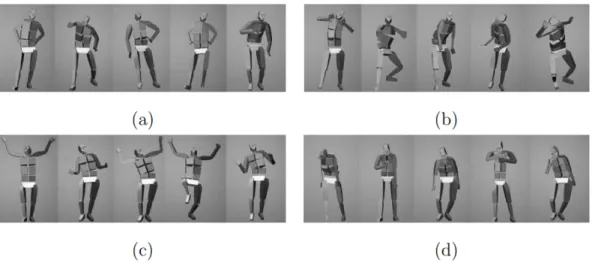
5) UCLIC Affective Body Posture and Motion Database [49]: The dataset has been made of 183 body motions collected from 13 cross-cultural non professional actors (11 actors were Japanese, one was from Sri-Lanka and one was from the United States). The emotions portrayed were anger, fear, happiness and sadness (see Fig. 6). These emotions were chosen as they were part of the basic emotions identified by Ekman [31]. Data were recorded using a Vicon motion capture system of eight cameras. Actors wore a suit with 32 markers. Data were, after being captured, built into avatars.
This aimed at eliminating bias, by creating non-gender nor cultural-specific avatars, and at not affecting people by facial expressions.
C. How the data are used in motion style approaches Datasets used in motion style approaches, as well as the methods using them, are presented in Table III. Three cate-gories of applications are identified: motion style recognition, motion style generation (editing, synthesis and transfer) and person identification through their style. Each of these cate-gories are explored.
1) Motion style recognition: Both action and style datasets were used. Etemad and Arya [14] used a total of 48 segmented sequences from HDM05 [39] of regular and stylistic walks (happy and sad) in addition to their own data. They indeed used a Vicon MX40 to record multiple walks from five actors in four styles (young, old, energetic and tired).
Two style datasets were also used. Bernhardt and Robinson [24] used Body Movement Library [47] and Crenn et al. used both Body Movement Library [47] and UCLIC [49].
2) Motion style generation: The use of action dataset was predominant. Indeed, in synthesis approaches, Wang et al. [23] used six sequences from CMU [38] to illustrate walking, stridingand running sequences. Chien and Liu [18] also used walking, jumping and running sequences from this dataset. Only Tilmanne et al. [3] used style datasets, that they actually created: eNTERFACES’08 3D [45] and Mockey [48]. In editing approaches, Ma et al. [22] used sideways, stepping, walking and running sequences from CMU [38]. Etemad and Arya [9] segmented and extracted 16 2-step neutral walk sequences from HDM05 [39]. Holden et al. [15] used sequences of motions including walk, run, punching and kicking from CMU [38], HDM05 [39] and Berkeley MHAD [37].
The lack of stylistic data thus led several approaches to record their own data. To perform motion style synthesis, Urtasun et al. [12] used a Vicon optical motion capture system to capture walking motions at different speeds from nine people, running motions at different speeds from five persons and jumping at different distances sequences from four people. Editing approaches also created their own data. Wang et al. [27] recorded two walk sequences (regular walk from an actor and cat walk from an actress) with a motion capture device at 33,3 fps. Min et al. [25] recorded walk sequences in 11 styles (neutral, angry, happy, sad, tired, proud, sneaky, goose-step, cat walking, crab walking, lame waking) from 20 persons. Holden et al. [15] added internal captures to the data they got from existing datasets.
The lack of stylistic data was even more present in style transfer approaches, as no specific and known dataset was used and researchers did have to create their own data. Amaya et al. [1] used an Optotrak system to record two actions (“pick up the glass of water, drink from it, and put it back onto the table” and “knock at the door three times”) in 10 emotions (angry, sad, happy, fearful, tired, strong, weak, excited, relaxed as well as neutral). Torresani et al. [17] used 12 dance sequences recorded from professional dancers who performed motions in their own style. Xia et al. [7] decided to create a large
Fig. 6: Examples of the 3D affectively expressive avatars for each emotion category in the UCLIC Affective Body Posture and Motion Database. (a) Angry (b) Fear (c) Happy (d) Sad. Image reproduced from [49].
and heterogeneous human stylistic motion dataset. They thus recorded human actions (walking, running, jumping, kicking, punchingas well as transitions between these actions) in eight styles (neutral, proud, angry, depressed, strutting, childlike, old and sexy). A total of 572 motions were recorded by the Vicon system with 18 cameras at 120 Hz. Their data were in fact reused in several approaches: Crenn et al. [4] used them for style recognition, Holden et al. [15] used them for editing, Yumer and Mitra [8] as well as Holden et al. [16] used them for style transfer.
3) Person identification through their style: Kviatkovsky et al. [41] used four action datasets and one style dataset to perform person authentication. Indeed, they used UTKinect [44], UCF Kinect [43], MSRC-12 [42] and MSRAction 3D [40] action dataset in addition to the style dataset Body Login Dataset [46].
As a summary, action datasets were mostly used for motion style editing or synthesis, when style was considered as being variations in motions, or when neutral motions were required. The style datasets used for recognition focused mainly on emotions. Two style datasets have been recorded for edit-ing/synthesis; however, as far as we know, only creators of the datasets have used them in motion style analysis. The datasets described in Sections III-A and III-B are publicly available online. Researchers faced a lack of style specific data, especially in style transfer; some of them created their own data. Among them, Xia et al. [7] recorded novel data for style transfer; their data have been used for other applications. IV. MOTIONCAPTUREDATA ANDMACHINELEARNING
This section presents key notions related to the represen-tation of motion capture data and exposes key concepts of machine learning, as it is one the medium used to analyze motion capture data. We focus on dimensionality reduction and the modeling of time-series, as these two notions were used in research methods on style in Sections V and VI and they are part of the discussion led in Section VII.
A. Motion data representation
Motion capture (mocap) is a technique that acquires se-quences of 3-dimensional joint positions at high frame rate and enables a large range of applications, from movie special effects to human machine interaction systems. There are different motion capture systems that allow to produce 3D data in real-time: magnetic, mechanic, and optical. Magnetic systems use electromagnetic sensors connected to a computer, which restricts movement due to cabling. Mechanical motion capture systems employ sensors attached to the actor’s body that register the motion of articulation. Optical motion capture systems, which are the most used, employ a set of multiple synchronized cameras to capture markers placed in body parts in order to reconstruct the human body posture in movement. These systems produce data with three degrees of freedom (DOF) for each marker, and rotational information must be inferred from their relative orientation. Human motion is therefore represented as a sequence of human poses, described through body joint positions, or through 3D-joint rotations which are then integrated via forward kinematics. The full-body pose is thus represented as the root position and orien-tation as well as joint relative orienorien-tations.
There are many possible ways to represent a 3D joint angle using a set of numbers, such as Euler angles [52], quaternions [53] and exponential maps [54]. Euler angles are often employed to represent 3D joint angles as rotations around x, y and z axes: three Euler angles are used for three DOFs. Quaternions are complex numbers with a real part and three imaginary parts that represent a rotation in three DOFs. Exponential maps are in general a re-parameterization in R3of a quaternion. For these three types, the representation
format for motion data starts with the Cartesian root joint position, followed by the first frame’s corresponding value (Euler, quaternion or exponential map) of angles of each joint, then the second frame’s, and so on. The storage format for such data is different according to the capture system. It usually consists of a hierarchical skeletal structure and trajectories of
degrees of freedom of joints.
During the last decade, markerless motion capture ap-proaches have developed and gained an increasing interest thanks to efforts made by the computer vision community [55]. These markerless systems do not require subjects to carry special equipment or markers for tracking, so multiple streams of optical input are often analyzed to identify human forms, such as silhouettes or skeletons, to break them down into component parts for tracking.
Imaging technologies have recently shown a rapid advance-ment with the introduction of RGB-D sensors with real-time capabilities, such as the Microsoft Kinect, which have provided an alternative for developing markerless motion capture systems at low cost. Note that a camera such as the Kinect, with compromised accuracy and capture rate, exhibits instability when tracking bodies in fast movements, rotating, or whose parts are occluded.
B. Machine learning
The goal of machine learning generally is to understand the structure of data and fit those data into effective mathematical models, which are often statistical, and thus useful in cases that are difficult to model exactly. An important issue in learning from motion data is how to represent their content. In order to achieve a good representation, 3D configurations derived from the motion capture systems, like the relative positions of joints, their temporal difference and the normalized trajectory of the motion, can be used. Motion capture data are time-series data which often contain much noise and have high dimensionality with unique properties that make them challenging to analyze and model. Hence, there is an interest of reducing the dimen-sionality of time series and extracting relevant information.
1) Dimensionality reduction: Dimensionality reduction techniques can be widely classified as linear and nonlinear techniques. Principal component analysis (PCA) is a linear technique in common use, which aims at finding orthogonal principal directions of a data set by solving an eigenvalue problem, allowing to retain a small number of principal com-ponents on a linear, low-dimensional subspace. Independent Component Analysis (ICA) also produces a linear mapping. It assumes that each sample of data is a mixture of components having independent non-Gaussian distributions and it aims at finding these independent components. ICA can capture higher-order statistics in the data matrix instead of only finding correlations between its components. Instead of working on the original data, Kernel PCA, which is an extension to PCA, works on the linear feature space transformed from a nonlinear feature space using a kernel function [56] to perform a nonlinear dimension reduction. Unlike linear techniques, nonlinear ones do not estimate the parameters of mapping but margin them. Hence, Gaussian Process Latent Variable Mod-els (GPLVM) maximize the posterior probability to reduce dimensionality given prior probability.
2) Time-series modeling: Recognition systems based on traditional learning algorithms can be designed in two ways. First, a whole motion is represented by a single feature matrix and classified by a classifier as a whole [57], [58]. Second, the
motion is decomposed by a sliding window or key features to build a codebook thanks to the learning phase from the whole dataset, and then each motion can be represented as a bag or histogram of words [59]. For an effective representation of motion data, both the spatial and temporal dynamics of human motion must be modeled. The Hidden Markov Model (HMM) is a popular technique for modeling sequential data. The HMM represents the human motion as a succession of states. At each state, local statistics and state transition probabilities are de-termined by the training phase on the dataset. After the recent progress in deep learning techniques, many applications of computer graphic field, including motion data recognition and prediction, have shown a change of paradigm. In particular, Recurrent Neural Networks (RNNs) are capable of preserving states as they pass through a step, hence they are suitable for sequence-based problems. The Long Short Term Memory networks (LSTMs) are a special kind of RNNs, with the main difference lying in the inclusion of memory states and gates, that can learn long-term dependencies in time series problems. They notably solve the problem of vanishing gradient [60], which arises in very deep neural networks, including RNNs.
V. MOTIONSTYLERECOGNITION
While some papers studied categories of style such as emo-tion or gender recogniemo-tion [29], or even person identificaemo-tion [61], this section focuses on style in body motion. We distin-guish two aspects of recognition: motion style classification and person identification through their style.
A. Motion style classification
The recognition of style in body motion remains a rarely studied subject. Some methods identified features and classi-fied styles with machine learning techniques.
Bernhardt and Robinson [24] analyzed non-stylised motions in order to detect the implicitly communicated affect, espe-cially in knocking motions. They segmented motion sequences in order to obtain basic motion primitives and periods with absence of motion. To do so, they computed the motion energy thanks to an objective function and set thresholds (see Fig. 7a). Then, extracted segments of motions were gathered into semantically meaningful clusters (see Fig. 7b). Angles from a 15-joint skeleton were considered; segments were time-normalized and their mean was subtracted to get the relative motion. The normalized segments were finally clustered with the k-means method to represent the motion primitives (see Fig. 7c). Features were afterwards computed. For the example of knocking motions, as the right hand and elbow exhibit the movement information, they computed eight statistical measures: maximum distance of hand from body, average hand speed, average hand acceleration, average hand jerk and simi-lar features for the elbow. Individual movement bias, estimated by the average of all the knocking motions in the dataset, was removed from motions leading to non-stylised motion sequences. They used a Support Vector Machine (SVM) with a polynomial kernel for classification purposes. They conducted their experiments on the 1200 knocking sequences in four styles (neutral, happy, sad, angry) from the Body Movement
Library dataset [47]. They chose the leave one subject out cross validation protocol and obtained recognition rates of 50% and 81% respectively when the features were biased (ie. the individual bias was not removed) and unbiased.
Etemad and Arya [14] decomposed motion trajectories into basic functions through a linear least square method and modeled secondary features of motions, that they considered as style, with three Radial Basis Functions (RBF). Then they aligned the sequences with a Correlation optimized Time Warping (CoTW) method [62]. Finally, they conducted a dimension reduction of the data with a Principal Component Analysis (PCA) that showed that only six principal compo-nents were enough to represent 94% of the sequences. For classification purposes, they used RBF neural networks. The training was led using an orthogonal least square technique. They proposed an ensemble of networks to perform classifica-tion. Indeed, for each style, their system contained one network per DOF and a subsystem, based on majority vote, classified the entire motion sequence. The chosen style was determined as having the minimum distance to all classifiers. They used 48 neutral, happy and sad walk sequences from the HDM05 dataset [39] as well as 75 neutral, young, old, tired and energetic walking sequences that they recorded themselves. They used a 15 fold cross validation protocol for their data and a 16 fold cross validation protocol for data coming from the HDM05 dataset [39]. They reached a recognition rate of 93, 5% in average.
Crenn et al. [4] computed a total of 136 features based on vi-sual cues. Indeed, they first computed 68 low-level descriptors based on the geometry, the motion and the frequency of eight specific body part joints (head, pelvis, elbows, shoulders and hands). Then they computed meta features on those low-level features (ie. mean and standard deviations for each feature, abstracting the time). All the features were scaled within the range [−1, +1]. They used a SVM with a RBF kernel. They tested their method on three datasets: UCLIC [49], the Body Movement Librarydataset [47] and the data from Xia et al. [7] for which they respectively obtained recognition rates of 78%, 57% and 93%. They used a 10 fold cross validation protocol.
B. Person identification through their style
Style can be recognized but it can also, in itself, help recognize persons. It emphasizes that style is really related to persons as it is mentioned in Section II-A2. Thus, Kvi-atkovsky et al. [41] were interested in recognizing a person based on their style.
They used a joint position representation leading to a 57-dimensional vector. Data were temporally normalized using a combination of Dynamic Time Warping (DTW) and Fourier temporal pyramid, and spatially normalized with respect to the root joint. A dimension reduction was made with PCA. To en-hance the discrimination of persons, a linear discriminant anal-ysis was then performed. They used a probabilistic framework based on generative models (see Fig. 8). The classification of the user’s identity was made using a Maximum A Posteriori (MAP) classifier. The relationship between style and content was represented by an application of a 1-nearest neighbor
kernel density estimation. They proved that performing action recognition with a SVM ahead of the user identification was beneficial, as it was shown by the Mahalanobis distance. They conducted their experiments and obtained good results on four action recognition datasets and one person identification dataset: MSR Action 3D [40], MSRC-12 [42], UCF Kinect [43], UTKinect-Action3D [44] and Body Login Dataset [46].
They were the first ones to work on the identification of a person from general actions, ie. not only on locomotion.
Only few methods proposed approaches to recognize style in motions. Features to describe style in motions were per consequent rare and not all the styles mentioned in Section II were actually studied in motion style recognition.
VI. MOTIONSTYLEGENERATION
In animation and video games, large datasets of actions and styles are required. Capturing all the possible combinations is a burden for actors, tedious and time-consuming. One way of solving this issue is to generate motions, avoiding the capture of all combinations of actions and styles.
We distinguish three types of motion style generation: motion style synthesis, motion style editing and motion style transfer. We define motion style editing as a subpart of motion style synthesis that implies the user intervention. Motion style transfer was defined by Hsu et al. [2] as being “the process of transforming an input motion into a new style while preserving its original content”.
This section describes these motion style generation meth-ods, that are discussed in Section VII-D.
A. Motion style synthesis
Some of the motion style synthesis methods in the literature made use of style-content separation process to be able to perform the synthesis. Others focused on motion adaptation to environmental constraints (see Fig. 9).
Grochow et al. [63] used Inverse Kinematics (IK), represented as a maximization of an objective function describing how desirable a pose is, to interpolate motions between styles and perform motion style synthesis. Poses were represented over a probability distribution function which described the likelihood function over poses. This was done using a Scaled Gaussian Process Latent Variable Model (SGPLVM). Each pose was represented by a 42 dimensional vector (joint angles in addition to position and orientation of the root of the kinematic chain where the root orientation was represented as quaternions and joint angles as exponential maps). The SGPLVM learning required the definition of a kernel function that measured the similarity between two points in the input space and the algorithm selected a subset of original poses to keep. Pose synthesis was led through the optimization of the objective function derived from SGPLVM.
Urtasun et al. [12] segmented their data and represented them as vectors of 78 angular DOFs. They proceeded to a PCA decomposition of motions. When a new motion came, it was projected into the PCA space and they computed the
(a) Motion energy.
(b) Semantic meaningful segments: Raise arm, Knock, Retract, Lower arm.
(c) Motion primitives.
Fig. 7: Basic motion primitives extraction example for a knocking motion. Reproduced from Bernhardt and Robinson [24].
Fig. 8: Male (a) and Female (b) users performing a hand wave gesture. (c) Generative models. Image reproduced from [41].
Mahalanobis distance to the motions in their dataset. New motions could be created by extrapolation, as being a weighted average of motions with target characteristics. Given one single example, they could modify the speed, length or body size while preserving the style of an actor.
Tilmanne et al. [3] used a variation of Hidden Markov Model (HMM) called Hidden Semi-Markov Model (HSMM) that took state duration modeling into account. Neutral walk sequences were used to train an average model which was then used for automatic adaptation to a particular style. Style adaptation training was performed with constrained structural Maximum A Posteriori (MAP) linear regression transformation followed by a MAP adaptation that further transformed the models. Synthesis was performed via an algorithm which directly generated the optimal parameter sequence. They represented their data by 54 values corresponding to 3D angles (exponential maps) of 18 joints.
Early work from Tenenbaum and Freeman [64] separated style from content in the context of speech recognition and it inspired researchers to apply it to human body motions style analysis. Thus, Brand and Hertzmann [13] separated structure and style out of dance motions via a state-space representation given by a HMM to which they added a style variable. That variable could be used to vary the HMM parameters, leading to a stylistic HMM called style machine.
Fig. 9: Examples of synthesized motions in various walking and running styles. From top to bottom: 180-degree walking turn, limp walk, descending an incline, walking with a suit-case, running with springy shoes, ascending an incline. Image reproduced from [5].
The separation between structure and style was made through entropy minimization. They represented their motion capture data with an arrangement of 20 markers and only considered joint angles. A PCA showed that only three stylistic DOFs explained 93% of the variations between 10 models: global pose, a DOF controlling balance and gender and a DOF that could be characterized as the amount of swagger and energy in the motion. Then, they made interpolations and extrapolations within the space of HMM to make new styles. It also inspired Wang et al. [23] to apply style-content separation to body motions with a probabilistic latent
variable model. Indeed, they modeled each pose from motion sequences as a combination of 3D vectors standing for three independent factors: the identity of the subject performing the motion denoted s, the gait of locomotion denoted g and the current state of the motion sequence denoted x. The locomotion included walk, run and stride motions. They considered s and g as being the style of the motion and x as being the content. Each pose was represented by a 89 dimensional feature vector (43 angular DOFs, velocities, transitional velocity). Joints were represented as Euler angles except for the joints with three DOFs and the global orientation which were represented as exponential maps. They applied Gaussian Process Latent Variable Model (GPLVM) with a RBF kernel to properly separate style from content and then generate new stylistic motions.
A few approaches focused on motion adaptation and studied how to conserve style and generate new stylistic motions in new environments or when constrained.
Liu et al. [5] represented their data with 29 joint DOFs and 6 root DOFs (rotational joints represented by exponential maps). They considered style parameters based on biomechanical studies and hypotheses on human locomotion. Thus, a person’s style was described by the simplified set of musculoskeletal parameters and muscle preferences. These parameters were automatically estimated by nonlinear inverse optimization. A parameter of 147 dimensions represented the style of an actor. Motion synthesis was conducted by minimizing the muscles usage; constraints on footsteps were imposed. Then, motions of the same style but with actors performing different tasks, with news constraints, were generated (see Fig. 9).
Chien and Liu [18] worked on stylistically similar motion pairs. Each motion sequence was segmented into a set of limb motion segments (based on the interaction of its end effector with the environment), that produced whole body motion segments when fused. Motion data were represented by six rigid DOFs for the root joint and 60 principal components for each limb that touched the environment. Features were extracted providing a 30 dimensional feature vector for the limb segments and a 108 dimensional feature vector for whole body segments. The stylistic similarity of a new motion to an example motion was represented by constraints and objective functions. A similarity region was approximated by one class SVM and Kernel PCA.
B. Motion style editing
We define motion style editing as a subpart of motion style synthesis that implies the user intervention in the synthe-sis process, usually by manipulating a style parameter (see Fig. 10).
Shapiro et al. [65] combined, frame by frame, two mo-tions together to automatically decompose them into style components that represented the style and expressiveness of a motion. Usually three to five style components were enough to represent 95% of the differences in motion data. The decomposition was performed via the unsupervised learning technique Independent Component Analysis (ICA). The user
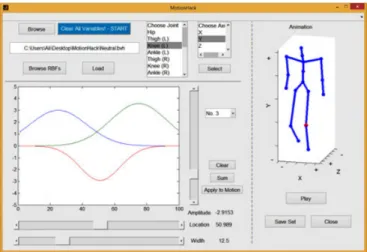
Fig. 10: GUI developed and used to generate the features. Image reproduced from [9].
then selected the components she/he found the most inter-esting. Style components that highlighted the differences in posture, cadence or any other nuance that appeared in one motion but not the other should be preferred. The selected style components were then merged before being transferred in order to create a new motion. The amount of style components could be interpolated. Motion style generation was done with an alignment step DTW on one of the DOF of the character (skeleton) that the user selected according to her/his desired motion. They led their experiments on two kinds of skeleton hierarchies: either 31 joints with 62 DOFs or 26 joints with 84 DOFs represented by Euclidean coordinates.
Wang et al. [27] extended the HMM and created a HMM/Mix-SDTG model, designed to learn a full-body motion under the control of a style variable. They trained a HMM with four hidden states on two walk sequences. Each output density contained a mixture of components Stylized Decomposable Triangular Graphs (SDTG). Each dimension of the style vari-able had a meaning for the user who could give it an arbitrary value to designate the desired style of the new motion. The motion generation was made in two steps. First, a path con-necting two specified hidden states of the HMM was selected to maximize the transition probabilities along the path. Then the mean vector of the output densities along the path were calculated with a given style value and an interpolation was made between the samples. They transformed the positions into 3D rotations parameterized as exponential maps leading to a 120 dimension pose space formed by the global position, global velocity, joint rotations and angular velocities of joints. Ikemoto et al. [6] developed an interactive learning method and controllable system that propagated the edits made by an animator. An artist selected an existing animation clip and edited it. The system automatically generalized and propagated those edits to a new motion clip. The artists could make additional edits, refining the system by providing feedbacks. The process was reiterated until the result was satisfying enough. The system thus incrementally built a model of edits. Their method merged estimations made by a Gaussian process regression. A set of features represented the dynamics and
kinematics of both source and target skeletons as they used four types of features to represent the source and target kinematics and acceleration. The method could generalize to new characters (retargeting), even with different morphologies. Ma et al. [22] had the user specify control parameters (for example, stride length) and a hierarchical model was built. The skeletons were separated into four joint groups (legs, left arm, right arm, rest upper body). For each joint group, a latent variation parameter was automatically selected. A Bayesian network was constructed, automatically learnt from example motions, in order to describe the relationship between user-defined style parameters and the latent variation parameters. Motion synthesis was conducted via a Gaussian process regres-sion (Kriging model) that amounted to a style and variation interpolation to generate partial motions of all group joints that were assembled to synthesize whole body motions. Thus, new motions were generated by the user who interactively controlled the style parameters. They preprocessed their data. Indeed, their example motions were normalized: each pose contained the global 3D position and orientation of the root node and the rotations of all the other joint nodes relative to their parent joint nodes. Note that all rotations were repre-sented by quaternions. They also segmented the motions into short clips, by an automatic key frame extraction according to two body parts: lower body (legs) and upper body (rest of the body). They also established a correspondence with the key frames, both spatially, performing rotations, and temporally, with Iterative Time Warping (ITW).
Min et al. [25] modeled identity and style. They applied dimension reduction (PCA) to their data obtaining a 77 di-mensional vector which could represent 99% of the geometric variations in motions. They established a temporal correspon-dence with warping functions. They annotated their data with environmental constraints and important key events. They applied multilinear analysis techniques to motions and con-structed a generative model that interpreted style and identity variations thus providing parameters. They could synthesize new motions, retarget motions from one actor to another and edit stylistic motions. Editing was made by adjusting the style and identity parameters.
Etemad and Arya [9] constructed secondary features with Gaussian RBFs. Through an interface, animators provided up to three Gaussian RBFs per DOF in cartesian space that converted a neutral base motion into several stylistic variations (see Fig. 10). The RBFs edits were collected and summarized to create a feature set which was applied to neutral walking sequences. Their data were represented by 54 DOFs. They temporally aligned sequences using Correlation optimized Time-Warping (CoTW) [62].
Holden et al. [15] synthesized motions based on high level parameters (trajectory of the character over the terrain and the movement of the end effectors). They learnt a motion man-ifold training a convolutional autoencoder where the motion manifold was represented by hidden units of the autoencoder. They mapped high level parameters to motion manifold (ie. hidden units) with a deep forward neural network stacked on top of the trained autoencoder, that trained on only some of the data that were the most relevant to the task. A user
could specify constraints (eg. drawing a curve over the terrain so that the character could walk along it) that led to the generation of a new motion. It could then be edited in the space of hidden units; motion editing was represented as a minimization problem. Constraints, represented as costs, were applied in hidden space: positional constraints (to fix foot sliding artifacts), bone length constraints (to preserve the rigidity of the body) and trajectory constraints. The costs were defined by two terms, relative to the content and the style of the output motion. They used huge amount of data coming from several sources. They retargeted them all to match to a unique skeleton represented by 3D positions.
C. Motion style transfer
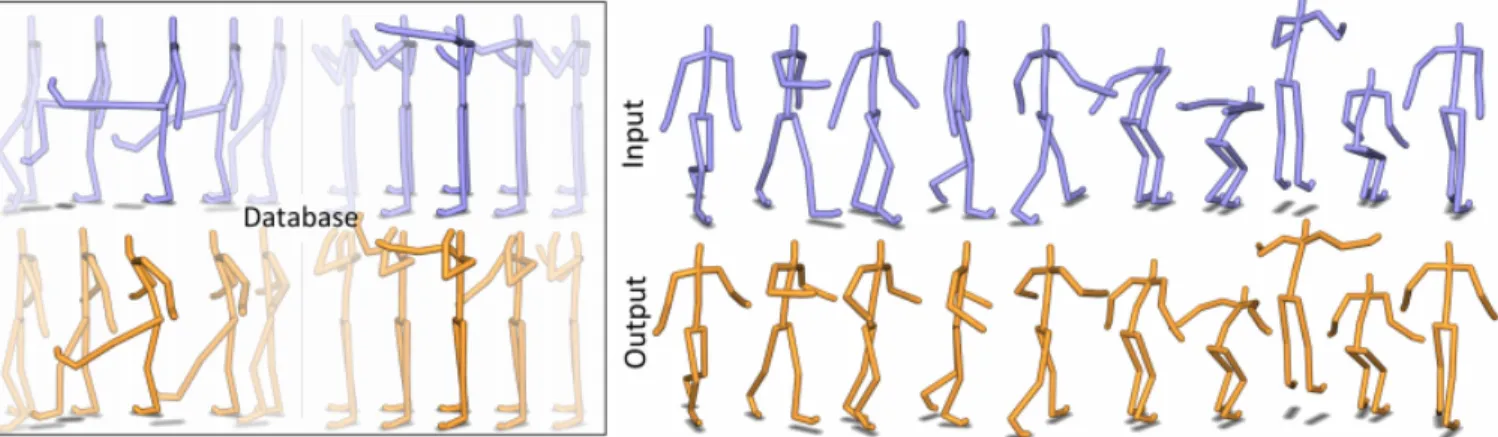
Motion style transfer, or motion style translation, can be defined as the process of transforming an input motion into a new style while preserving its original content [2]. Fig. 11 presents an example.
Amaya et al. [1] decomposed their motion sequences into basic periods. They computed emotional transforms thanks to signal processing techniques. Those transforms established motion differences with respect to speed and spatial ampli-tude components. The speed component was calculated via a nonlinear time warping technique. The spatial amplitude component was calculated via signal amplifying methods.
Hsu et al. [2] used Iterative Time Warping (ITW), inspired by the motion warping of Witkin and Popovic [66], to compute a dense correspondence between motions applying spatial and temporal warps. They then described the relationship between input and output styles using a linear time invariant model. Style transfer was then applied with simple linear transformations.
Torresani et al. [17] based their method on the Laban Movement Analysis (LMA) and more specifically on the LMA-Effort dimension and its factors Flow, Weight and Time. Similar action fragments were matched with DTW. They referred to fragments when each motion sequence was manually segmented by a LMA human expert. They focused on the rotation DOFs, considering joint angles as exponential maps. A space-time interpolation was learnt with a SVM and a Gaussian RBF kernel. Style transfer was done by applying DTW to fragments, computing a distance between the motion blends and concatenating the best approximated fragments.
Abdul-Massih et al. [28] decided to manually split spa-tially the skeletons into groups of body parts. They extracted positional and angular amplitude features. Positional features were represented by joint-specific relative paths on a source character S and were used to transfer the motion from S to a target character T. Angular amplitude features were extracted between stylistic and neutral source motions. They were used to scale and offset angles in the motion of T. Those features created constraints that were taken into account during the transfer for which a space-time approach was used.
Xia et al. [7] developed an online learning algorithm which aimed at approximating the spatio-temporal transformations in frames. This was done by constructing a series of lo-cal regression models. The current pose was then translated
Fig. 11: A neutral heterogeneous walk ⇒ jump motion (top-right) stylized as childlike (bottom-right) using a dataset where only kick and punch actions are available (left). Image reproduced from [8].
through linear transformations. A timing prediction was done by a k-Nearest Neighbor (KNN) algorithm with a gaussian interpolation kernel. Unlabeled data were handled with a prob-abilistic framework mixture of local autoregressive models. They worked on heterogeneous data and converted joint angles to Cartesian parameters with an exponential map parameter-ization. Moreover, they needed to have their data annotated with footplant contact information, in order for their artifact correction classifier to work.
Yumer and Mitra [8] proposed a spectral approach. In a pre-processing step, in order to help differentiate actions, they computed a skeletal representation. They used the translation and rotation DOFs of all the joints except the root joint. Real-time transfer was made by applying a discrete Fourier transform. A sliding window filter was applied in time domain to handle heterogeneous data.
Etemad and Arya [14] used RBF Neural Networks (RBFNNs) to transfer style. They used the features that were extracted with RBFs and the warped motion data with CoTW [62] to generate a set of 5 to 10 RBFNNs for each style.
Holden et al. [16] also proposed a neural approach for motion style transfer. They focused on joint positions in 3D Euclidean space as well as the turning velocity, the forward velocity and the sideways velocity. Their pipeline was com-posed of two networks. A transformation network, performing the style transformation, was a feed forward convolutional autoencoder. A loss network aimed at computing the loss between motion content and style and correcting artifacts except foot sliding output motions. Errors calculated in hidden units were back propagated into the feedforward network.
Methods for motion style generation (synthesis, editing and transfer) have been exposed. Beside their main common goal, ie. motion style generation to enhance datasets and save animators and actors time, they have similarities and divergences that are discussed in Section VII.
VII. DISCUSSION ONAPPLICATIONS OFSTYLE IN MOTION
This section highlights interesting facts resulting from previ-ous sections. We first discuss matters that arise when it comes to the definition of style in human body motion and what it implies. We then focus on data that are used in motion style approaches. An analysis of the methods in motion style recog-nition precedes another analysis of the approaches in motion style generation, where common points and divergences of the methods are discussed.
A. Motion style analysis
The taxonomy of definitions of style in Section II arises several questions about style in motion and how it is defined and seen.
1) Number of styles per motion: For the sake of simplicity, existing approaches usually focused on one style in motion se-quences. For example, combinations of styles such as feminine-sad were discarded in the method of Etemad and Arya [9]. It was not always limited to one style per motion sequence though. Wang et al. [27] generated motions with the combi-nations normal-masculine and catwalk-feminine. Xia et al. [7] interpolated a motion between up to three styles.
2) Neutrality in motion style: Neutral stylewas also named no style, normal or even regular. Out of 15 paper referenced in Section II-A3, 11 considered this style. However, rare methods questioned the neutral aspect of a motion. Even though, while recording a neutral sequence motion, actors were asked to display minimum style in their motion, an absolute neutral motion was impossible to achieve: actors brought their own personal bias in the recorded motions. Etemad and Arya [9] proposed to average several neutral walking sequences in order to minimize if not eliminate that bias.
3) Influence of culture: Etemad and Arya [9] highlighted that style could be influenced by several factors, including the culture. Besides, while basic emotions can be considered as universal in facial expressions, studies showed that when body emotional expressions were taken into account, culture involved divergences in their expression and perception, es-pecially between Americans and Japanese [67], [68]. This
emphasized the lack of consensus on motion style, even when focusing on the subset of emotions. Indeed, for instance, an American and a Japanese have divergent ideas on what a happymotion is. Furthermore, depending on the culture, some stereotypes could be reinforced: how would you define a sexy or manly motion? It could imply a normative view on gender, which is also suggested by the feminine and masculine styles. Besides, Wang et al. [27] had an actress perform the catwalk style, while a male actor performed the neutral walk.
4) Expressiveness of body versus face: Face, speech, body movements, etc. are means of verbal and non-verbal com-munication. More importance is given to facial expressions in affective computing, where it has been studied for several decades already. It can moreover benefit from knowledge in intuitive adjacent domains such as biology, as a face contains a lot of muscles, or theater plays, where actors put on masks or exaggerate their expressions to convey as explicitly as possible an emotion. Still, stylistic motions can sometimes convey more information of affective expressions than the face [69]–[71]. As an example, De Gelder [69] highlighted that in a situation of fear, while the face indicated that there was something scary, the body position indicated what was scary and how the individual intended to deal with it. Ekman and Friesen [72] even suggested that the body was more reliable than the face to convey affective expressions. They concluded that it was easier to deceive people with the face than the body. It emphasized that studying the style of human body motion is proved to be as relevant as studying facial expressions. B. Style data analysis
Section III presents the data used in motion style ap-proaches. It points out the following elements for which a particular attention should be paid to.
1) Need for data: Style datasets that have been presented in Section III-B were designed either for emotion recognition (Body Movement Library [47] and UCLIC [49]), for motion style synthesis (eNTERFACE’08 3D [48] and Mockey [48]) or for person identification (Body Login Dataset [46]). As a result, no publicly available motion style dataset has been created yet to perform motion style recognition specifically, and, for motion style generation purposes, only two datasets were recorded to perform motion style synthesis.
Furthermore, Table III highlights that none of the action as well as style datasets has been used to perform both style recognition, person identification included, and motion style generation (synthesis, editing and transfer). Data from Xia et al. [7] paved the way though. Recorded to perform motion style transfer, their data have been used for motion style recognition and motion style generation. Furthermore, their data were the only ones to consider different categories of style as well as various heterogeneous actions.
Besides, deep learning techniques arise. A lot of data need to be considered, such as in the method of Holden et al. [15]. Moreover, Etemad and Arya [14] pointed out that data used for neural networks needed to be very consistent. Such data are, to the best of our knowledge, missing.
The lack of consistent, publicly available and specifically recorded datasets to perform motion style recognition as well
as motion style generation is consequently obvious. It was more striking when style was considered as being individual-related features than when style was considered as being variations in a motion, where action datasets could suffice. It induces a difficulty in the comparison of results from the different methods that tackled motion style analysis.
2) Motion capture technologies: Data sequences were mostly recorded with motion capture (mocap) systems. Most of the systems used in the mentioned papers were optical infrared systems with markers: Impulse, Vicon, and Falcon Analog. The Microsoft Kinect camera is a markerless optical solution.
Motion capture technologies are affordable now and enable users to have readily realistic data [1], [3], [12], [65]. However, they require specific equipment. They are constrained to a lim-ited space [1], [3], impairing the naturalness of actors’motions. IGS-190 is an exception as it relies on inertial sensors on a suit and has no space constraints. Motion capture technologies also provide highly dimensional data that are usually reduced in the process [3].
3) Motion types: Most of the used datasets were composed of homogeneous motions (ie. one kind of motion per sequence – eg. walking, running, etc. – was considered). Data from Xia et al. [7] contained heterogeneous motions (ie. several kinds of motions were considered per sequence) and it has led to a new kind of motion study. CMU dataset also included heterogeneous motions.
Besides, the used datasets were made of actions of different kinds: locomotion like walking, running, jogging, etc. but also dynamic gestures like jumping, kicking, punching, etc. or even specific actions like draw X. The most frequent action was walking, especially in stylistic data, then running. This makes sense knowing that locomotion is central to human movement [5].
4) Acted and naturalistic motions: Recorded data can be acted or non-acted (ie. naturalistic). Data are “acted” if the person performing the motion expressed the motion purposely. When a motion is expressed naturally, data are “non-acted”. The style specific datasets presented in Section III-B all used acted data. The “user-defined gesture” of the Body Login Dataset[46] could be considered as non-acted though (the “S-gesture” making the dataset acted), as each user could have their own gesture. It is hard to record naturalistic data. Acted data have the advantage of being clearly defined; however, they introduce a bias.
The actors also play a determinant role in the naturalness of the recorded data. Actors can be professional or not. In the datasets presented in Section III-B, most of the actors were non professional. The Mockey dataset [48] recording re-quested professional actors to perform motions. Motions were exaggerated there. Even though the difference in motion is more visible (acted motions), the naturalness of the motions is impaired. One could expect non professional actors to provide more naturalistic motions than professional actors. However, the same observation could be made for the UCLIC dataset [49]: even though actors were non professional, emotions were exaggeratedly portrayed (see Fig. 6). This emphasizes that
![Fig. 4: The Pleasant-Arousal-Dominant (PAD) model. Image reproduced from [36].](https://thumb-eu.123doks.com/thumbv2/123doknet/12430223.334475/6.918.113.416.87.372/fig-pleasant-arousal-dominant-pad-model-image-reproduced.webp)
![TABLE IV: User-defined gestures per subject in Body Login Dataset [46]. Table reproduced from [51].](https://thumb-eu.123doks.com/thumbv2/123doknet/12430223.334475/8.918.74.451.119.360/table-defined-gestures-subject-login-dataset-table-reproduced.webp)
![Fig. 7: Basic motion primitives extraction example for a knocking motion. Reproduced from Bernhardt and Robinson [24].](https://thumb-eu.123doks.com/thumbv2/123doknet/12430223.334475/12.918.86.843.91.279/basic-primitives-extraction-example-knocking-reproduced-bernhardt-robinson.webp)