HAL Id: lirmm-01759945
https://hal-lirmm.ccsd.cnrs.fr/lirmm-01759945
Submitted on 5 Apr 2018
HAL is a multi-disciplinary open access
archive for the deposit and dissemination of
sci-entific research documents, whether they are
pub-lished or not. The documents may come from
teaching and research institutions in France or
L’archive ouverte pluridisciplinaire HAL, est
destinée au dépôt et à la diffusion de documents
scientifiques de niveau recherche, publiés ou non,
émanant des établissements d’enseignement et de
recherche français ou étrangers, des laboratoires
Chart Parsing Multimodal Grammars
Richard Moot
To cite this version:
Richard Moot. Chart Parsing Multimodal Grammars. [Technical Report] LIRMM (UM, CNRS);
Université de Montpellier. 2018. �lirmm-01759945�
Chart Parsing Multimodal Grammars
Richard Moot
University of Montpellier, CNRS (LIRMM)
1
Introduction
The short note describes the chart parser for multimodal categorial grammars which has been developed in conjunction with the type-logical treebank for French, which is described in more detail in (Moot 2010, Moot 2012, Moot 2015b) and which is available at (Moot 2015a). The chart parser itself can be downloaded as a part of Grail light at (Moot 2018).
https://github.com/RichardMoot/GrailLight
The chart parser is an instance of the “deductive parsing” technology of (Shieber, Schabes & Pereira 1995) and the core parsing engine of their im-plementation has been retained in the source coude, with only some minor modifications. I am grateful to the authors for having made their source code available.
The current chart parser was originally introduced as a preprocessing step for a proof net algorithm (Moot 2017). However, this preprocessing step turned out to be so effective that it soon handled a bit under 98% of the complete French Type-Logical Treebank and therefore it made sense to add additional chart rules to handle the remaining few percent as well (these are briefly sketched in Section 2.4, the rest of this paper focuses on the basic rules of the chart parser). This paper presupposes the reader has at least a basic familiarity with multimodal categorial grammars (Moortgat 2010, Moortgat 2011, Moot & Re-tor´e 2012) and with chart parsing (Shieber et al. 1995).
2
Chart rules
In this section, I will dicuss the inference rules used by the chart parser. I will start with the simplest rules and gradually introduce more detail.
2.1
AB rules
The elimination rules /E and \E appear already in (Shieber et al. 1995). For AB grammars, the chart rules are very simple and shown in Figure 1. Chart items are tuples hΓ, F, L, Ri where Γ is an antecedent term, F is a formula, and
hΓ, A/B, I, Ji h∆, B, J, Ki hΓ ◦ ∆, A, I, Ki /E
hΓ, B, I, Ji h∆, B\A, J, Ki hΓ ◦ ∆, A, I, Ki \E Figure 1: AB grammar chart rules
L and R are integers representing the leftmost and rightmost string positions respectively. The meaning of such a tuple is that we have derived a formula F , using the hypotheses in Γ, spanning exactly the positions from L on the left to R on the right.1
With this in mind, the chart rule for /E indicates that if we have derived a a formula A/B spanning string positions I − J and a formula B spanning string positions J − K (that is, A/B and B are adjacent with B immediately to the right of A/B), then we can conclude that we can derive a constituent A from positions I to K (that is, the concatenation of the strings assigned to A/B and B).
Given these rules, proving an AB sequent A1, . . . , An ⊢ B corresponds to
starting from axioms hw1, A1, 0, 1i . . . hwn, An, n − 1, ni and deriving the goal
hΓ, B, 0, N i with yield(Γ) = w1, . . . , wn. To facilitate inspection of the chart
items, Γ will not be a binary tree of formulas, but a binary tree of the cor-responding words. Therefore, a lexical entry for the verb “dort” (sleeps) with formula np\s at position 1-2 will correspond not to the item hnp\s, np\s, 1, 2i but to the item hdort, np\s, 1, 2i.
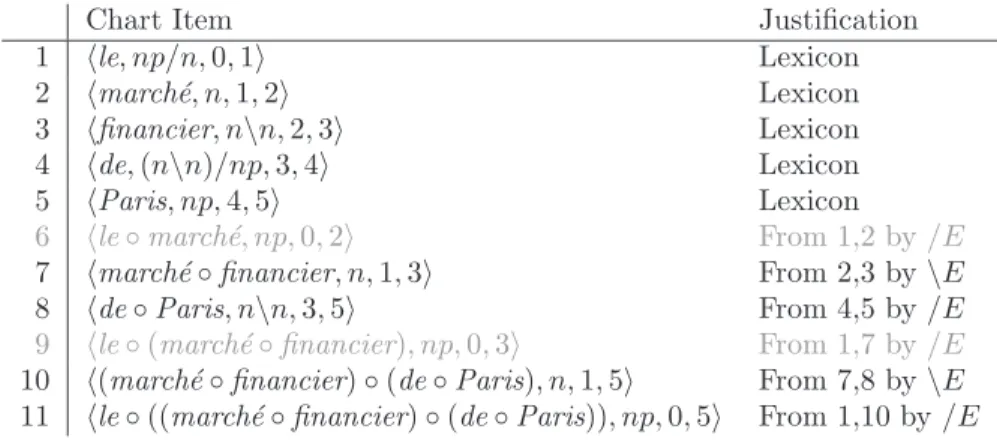
Example As an example, the table below shows how the chart is filled for “Le march´e financier de Paris” (the financial market of Paris).
Chart Item Justification
1 hle, np/n, 0, 1i Lexicon
2 hmarch´e, n, 1, 2i Lexicon
3 hfinancier, n\n, 2, 3i Lexicon
4 hde, (n\n)/np, 3, 4i Lexicon
5 hParis, np, 4, 5i Lexicon
6 hle ◦ march´e, np, 0, 2i From 1,2 by /E
7 hmarch´e ◦ financier, n, 1, 3i From 2,3 by \E 8 hde ◦ Paris, n\n, 3, 5i From 4,5 by /E
9 hle ◦ (march´e ◦ financier), np, 0, 3i From 1,7 by /E
10 h(march´e ◦ financier) ◦ (de ◦ Paris), n, 1, 5i From 7,8 by \E 11 hle ◦ ((march´e ◦ financier) ◦ (de ◦ Paris)), np, 0, 5i From 1,10 by /E The chart items are labeled from 1 to 11 indicating the order they are entered in the chart. We use a general chart parser of the type explained in (Shieber
1The use of pairs of string positions to represent substrings of an input string is widely used
in parsing algorithms; see for example (Pereira & Shieber 1987, Shieber et al. 1995, Jurafsky & Martin 2009).
et al. 1995), so we start with an agenda containing items 1-5 (the lexical lookup for the words in the sentence) and then successively add the items of the agenda to the chart. When we add an item from the agenda to the chart, we compute all consequences according to the rules of the grammar of this item with all items already in the chart. So once item 2 is added to the chart, item 6 is added to the agenda, since it is the combination of item 2 with item 1 (already in the chart) by means of rule /E. Similarly, item 7 is added to the agenda when item 3 is added to the chart and item 8 is added to the agenda when item 5 is added to the chart, etc.
We complete the parse when item 11 is added to the chart. If desired, we can recover the proof by recursively finding the justification of each of the rules, going back from 11 to 1 and 10, from 10 to 7 and 8 (1 is in the lexicon and so an axiom of the proof) until we have reached all the axioms, which are justified by their respective lexical entries. The chart items marked in gray do not contribute to the proof of 11.
Implementation notes The actual implementation keeps track of several types of additional information: it computes the semantics of the derivation and there is also a mechanism for computing the (log-)probabilities of the rules. The implementation also uses an important simplification: once we have computed a chart item for a formula A over span I and J then we will treat this as known and reject any further derivations of this formula A over the same string (if probabilities are used, only the most probably derivation of A is kept). This can throw away alternative semantic readings for a phrase, but reduces the size of the chart. If desired, this behavior can easily by changed by replacing the don’t care variables _ in the predicate subsumes_data by a test for α-equivalence of the lambda-terms.
2.2
Hypothetical Reasoning
Hypothetical reasoning is implemented using a strategy very similar to “gap threading” in the parsing literature. Chart items are now of the form hΓ, F, L, R, ei, where e is a set of pairs of the form P − A, with P a position integer and A a formula; the set e is the set of “extracted” constituents which have been used to compute F . The rules for extraction (hypothetical reasoning) are shown in Figure 2. The /E and \E rules of Figure 1 have been updated to include the new set e of extracted items.
The set union e1∪ e2 of two such sets e1 and e2 is defined only if e1∩ e2 is
empty; this reflects that fact that a hypothesis to be discharged later can only be used once.
The e start rule states that if we have a formula X/(Y /✸1✷1B) with
right-most position K and a formula A/B spanning positions I − J then we can conclude there is a formula A spanning positions I − J depending on an ex-tracted element K − B. The underscores indicate we do note care about this value for the chart item. So for the leftmost premiss of the e start, we do not
hΓ, A/B, I, J, e1i h∆, B, J, K, e2i hΓ ◦ ∆, A, I, K, e1∪ e2i /E hΓ, B, I, J, e1i h∆, B\A, J, K, e2i hΓ ◦ ∆, A, I, K, e1∪ e2i \E h , X/(Y /✸1✷1B), , K, i hΓ, A/B, I, J, ei hΓ, A, I, J, e ∪ {K − B}i e start hΓ, X/(Y /✸1✷1B), I, J, e1i h∆, Y, J, K, e2∪ {J − B}i hΓ ◦ ∆, X, I, K, e1∪ e2i e end
Figure 2: Hypothetical reasoning chart rules
care about the antecedent, about the leftmost position or about the stack of ex-tractions: the formula X/(Y /✸1✷1B) functions as a sort of “trigger” allowing
extraction of a B formula to take place to its right.
The rule e start has as side conditions that K ≤ I and that K − B is not a member of e (this is a general consequence of the disjoint set union used).
The e start rule is a combination of using a B ⊢ B axiom in combination with a previous proof of Γ ⊢ A/B to derive by /E that Γ, B ⊢ A, with the condition that the B ⊢ B hypothesis must be discharged at position K by the formula X/(Y /✸1✷1B) which licensed this rule. This discharge is taken care of
by the e end rule.
The e end rule states that if we have derived a Y using a hypothetical B to the immediate right of a formula X/(Y /✸1✷1B), then we can derive an
X spanning the total positions, removing the formula J − B from the set of extracted elements; the notation e2∪ {J − B} indicates that the Y formula was
derived using the formula B exactly once (plus some additional, possibly empty, set of items e2).
A chart item is coherent, if for all P − A ∈ e, L ≤ P . This is because formulas of the form X/(Y /✸1✷1B) are looking to their right for a constituent
Y missing a B somewhere.
We initialize all lexical entries with the empty set and at the end of a deriva-tion, we require that the set of traces is empty. That is, our lexical entries are now of the form hwi, Ai, i − 1, i, ∅i and our goal is of the form hΓ, C, 0, N, ∅i for
some formula C and with the antecedent term Γ such that yield(Γ) = w1, . . . , wn.
Typical instantiations of the formula X/(Y /✸1✷1B) are (n\n)/(s/✸1✷1np)
(for relativizers) and (np\s)/((np\s)/✸1✷1np) (for clitics).
Example The chart rules for extraction/hypothetical reasoning are perhaps the easiest to understand by seeing them in action. We can derive the sentence fragment “qu’on emprunte” (that we borrow ) to be of type n\n as follows.
Chart Item Justification 1 hqu’, (n\n)/(s/✸1✷1np), 2, 3, ∅i Lex
2 hon, np, 3, 4, ∅i Lex 3 hemprunte, (np\s)/np, 4, 5, ∅i Lex 4 hemprunte, np\s, 4, 5, {3 − np}i 1,3 e start 5 hon ◦ emprunte, s, 3, 5, ∅ ∪ {3 − np}i 2,4 \E 6 hqu’ ◦ (on ◦ emprunte), n\n, 2, 5, ∅i 1,5 e end
Incompleteness of the rules As can be seen from the rules, they are in-complete. The extraction start rule can apply only to formulas of the form X/(Y /✸1✷1B), with a fixed combination of implications (excluding, for
ex-ample (Y /✸1✷1B)\X or X/(Y • ✸1✷1B) and only when the B formula is an
argument, since the extraction start rule is essentially the /E rule applied to a B hypothesis “at a distance”. Another restriction is that each combination of rightmost position and extracted formula R − B can introduce only one hypo-thetical item. We would need additional chart rules if we want to treat these other cases. The treatment of gapping, discussed briefly in Section 2.4, allows the extracted element to be the functor of an elimination rule.
Though this formula restriction and the resulting incompleteness are unfor-tunate, since it requires us to be careful in case the algorithm doesn’t find a proof, this rule captures most of the occurrences of the ✸1✷1 mixed
associativ-ity/commutativity rather nicely.
Implementation notes The actual implementation also keeps track of the rightmost position J used for the e start rule. So the set of items e takes the form triples K − J − B where K is the rightmost position of the licensor formula and J is the rightmost position of the extracted B formula. This allows us to use a single rule schema for a combination of mixed associativity and mixed commutativity — the rules for ✸1✷1shown — and for ✸0✷0which only
allow mixed associativity (or “right-node raising”). The e end rule in this case requires that the rightmost position K of the constituent Y is also the rightmost position of the extracted B formula. This right-node raising analysis also has a rule for formulas of the form (Y /✸0✷0B)\X and can therefore treat lexical
formulas such as ((((np\s)/✸0✷0np)\(np\s)/np))/((np\s)/✸0✷0np), which is
a transitive verb conjunction type but which allows combinations such as the following.
(np\s)/(np\s), (np\s)/np ⊢ (np\s)/✸0✷0np
This is useful for patterns like “has read and might implement (Dijkstra’s al-gorithm” , where both “has read” and “might implement” require the derivation pattern shown above.
2.3
Head wrap
French adverbs can occur at the start of the sentence, at the end of the sen-tence and before the verb (where we can assign them the formulas s/s, s\s and (np\s)/(np\s) respectively.2 In addition, French adverbs can occur directly
after the verb but also between a verb and its arguments. In order to avoid unnecessary duplication in the lexicon, we assign adverbs the type s\1s (or,
in some cases, (np\s)\1(np\s)) and use structural rules to move the verb to a
sentence-final position.
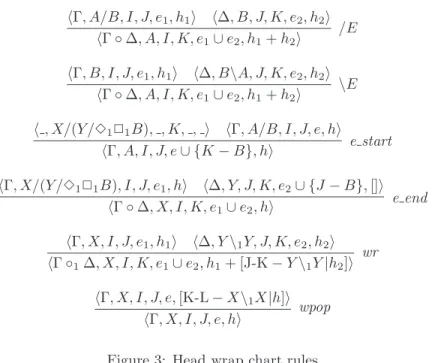
In Figure 3 we see how this idea translates into chart rules. In addition to the set of extracted items, our chart items now contain a stack of head-wrapped elements. We have chosen a stack instead of a set here to avoid generating readings which would correspond to permutations of the adverbs. With few exceptions, adverbs take scope from left to right. In the chart rules, “+” cor-responds to stack concatenation, [H|T ] indicates a stack with first element H and rest of the stack T (which is itself a valid stack) and [] is the empty stack. We both end and start our proof with empty stacks (h = []) and empty sets of traces (e = ∅). That is, our lexical entries are of the form hwi, Ai, i − 1, i, ∅, []i
and the goal is hΓ, B, 0, N, ∅, []i with yield(Γ) = w1, . . . , wn
The wr rule wraps a chart entry with formula X\1X to its correct syntactic
position, but also pushes it onto the stack h2. As can been seen from the rule,
the stack h1 is then prefixed to this new stack, thereby keeping all the stack
elements in the desired order: the elements in h1 before the new item and the
elements in h2 after it.
Finally, the wpop rule simply allows us to pop a stack element X\1X
when-ever the current chart item containing the stack is of type X.
Example The wrapping rules are best illustrated by example. The sentence “il occupera ensuite diverses fonctions” (he will occupy various functions after-wards) is analysed as follows.
Chart Item Just.
1 hil, np, 0, 1, ∅, []i Lex
2 hoccupera, (np\s)/np, 1, 2, ∅, []i Lex
3 hensuite, s\1s, 2, 3, ∅, []i Lex
4 hdiverses, np/n, 3, 4, ∅, []i Lex
5 hfonctions, n, 4, 5, ∅, []i Lex
6 hoccupera ◦1ensuite, (np\s)/np, 1, 3, ∅, [2,3 − s\1s]i 2,3 wr
7 hdiverses ◦ fonctions, np, 3, 5, ∅, []i 4,5 /E 8 h(occupera ◦1ensuite) ◦ (diverses ◦ fonctions), np\s, 1, 5, ∅, [2,3 − s\1s]i 6,7 /E
9 hil ◦ ((occupera ◦1ensuite) ◦ (diverses ◦ fonctions)), s, 0, 5, ∅, [2,3 − s\1s]i 1,8 \E
10 hil ◦ ((occupera ◦1ensuite) ◦ (diverses ◦ fonctions)), s, 0, 5, ∅, []i 9 wpop
2We have chosen an event semantics in the style of Davidson for adverbs, which means
that we can treat many adverbs as sentence modifiers. Some subject-oriented adverbs, such as “ensemble” (together ) need both the subject np and the sentence for their semantics and are assigned (s/(np\s))/np and (np\s)\(np\s) instead.
hΓ, A/B, I, J, e1, h1i h∆, B, J, K, e2, h2i hΓ ◦ ∆, A, I, K, e1∪ e2, h1+ h2i /E hΓ, B, I, J, e1, h1i h∆, B\A, J, K, e2, h2i hΓ ◦ ∆, A, I, K, e1∪ e2, h1+ h2i \E h , X/(Y /✸1✷1B), , K, , i hΓ, A/B, I, J, e, hi hΓ, A, I, J, e ∪ {K − B}, hi e start hΓ, X/(Y /✸1✷1B), I, J, e1, hi h∆, Y, J, K, e2∪ {J − B}, []i hΓ ◦ ∆, X, I, K, e1∪ e2, hi e end hΓ, X, I, J, e1, h1i h∆, Y \1Y, J, K, e2, h2i hΓ ◦1∆, X, I, K, e1∪ e2, h1+ [J-K − Y \1Y |h2]i wr hΓ, X, I, J, e, [K-L − X\1X|h]i hΓ, X, I, J, e, hi wpop Figure 3: Head wrap chart rules
The parse first combines the transitive verb “occupera” (will occupy, chart item 2) with the adverb “ensuite” (afterwards, chart item 3) by pushing the adverb on the stack and by combining the lexical strings, producing chart item 6. We continue the proof with elimination rules until we derive s from positions 0 to 5 but with the adverb still on the stack. Since s and s\1s match the
formulas of a wpop rule, we pop the adverb from the stack and produce the final item 10.
The example below shows the interaction of the head wrap and the extraction rules.
Chart Item Just.
1 hqu’, (n\n)/(s/✸1✷1np), 0, 1, ∅, []i Lex
2 hil, np, 1, 2, ∅, []i Lex
3 hoccupera, (np\s)/np, 2, 3, ∅, []i Lex 4 hensuite, s\1s, 3, 4, ∅, []i Lex
5 hoccupera, np\s, 2, 3, {1 − np}, []i 1,3 e start 6 hoccupera ◦1ensuite, (np\s)/np, 2, 4, ∅, [2,3 − s\1s]i 3,4 wr
7 hil ◦ occupera, s, 1, 3, {1 − np}, []i 2,5 \E 8 hoccupera ◦1ensuite, np\s, 2, 4, {1 − np}, [2,3 − s\1s]i 4,5 wr
9 h(il ◦ occupera) ◦1ensuite, s, 1, 4, {1 − np}, [2,3 − s\1s]i 4,7 wr
10 h(il ◦ occupera) ◦1ensuite, s, 1, 4, {1 − np}, []i 9 wpop
11 hqu’ ◦ ((il ◦ occupera) ◦1ensuite), n\n, 0, 4, ∅, []i 1,10 e end
Using chart items 2 and 8 above, we could have applied the \E rule to pro-duce il ◦ (occupera ◦1ensuite), resulting in a chart item which would otherwise
be identical to item 9. Therefore, according the the implementation note dis-cussed at the end of Section 2.1, this entry is treated as “already known” and not entered in the chart. Other chart items have multiple equivalent derivations (including even the antecedent term): for example, as shown in the table above, chart item 8 has been derived from 4 and 5 using wr but it has an alternative derivation from 1 and 6 using e start : there are two equivalent ways to apply e start and wr to the transitive verb to produce chart item 8.
Since the e end rule requires an empty stack to apply, we cannot apply the e end rule to chart item 9 and need to pop the stack first using wpop, producing chart item 10, which is the proper configuration for an application of e end. Implementation details The implementation allows us to pop s\1s elements
from the stack at the np\s level as well. This allows infinitive arguments to take adverbs of the form s\1s.
2.4
Other chart rules
Quoted speech In newspaper articles, quotes speech is rather frequent. Most frequently, this takes the form of a tag like “said the Prime Minister”, and this does not necessarily occur at the end of a sentence. To complicate matters, we even have sentences like the following.
(1) [sl [sl Les The conservateurs], Conservatives], a has ajout´e added le the premier Prime ministre Minister ..., ..., [sr [sr “ne “ sont are pas not des opportunistes opportunists qui who virevoltent flip-flop d’une from one politique policy `a to l’autre another ] ] In this sentence the quoted sentence is split into two parts (marked sl and sr) and there two parts together are the arguments of the past participle “ajout´e” (added ), which itself is the argument of the auxiliary verb form “a” (has) (and the elided material “...” includes an adverb modifying the past participle).
As a solution, the additional chart rules treat these combinations much like complex adverbs. For example, we can derive “a ajout´e to be for type s\1s as
follows. a (s/np)/(np\sppart) Lex x ⊢ s Hyp ajout´e s\1(np\sppart) Lex x ◦1ajout´e⊢ np\sppart \E a◦ (x ◦1ajout´e) ⊢ s/np /E np ⊢ np (a ◦ (x ◦1ajout´e)) ◦ np ⊢ s /E (x ◦1(a ◦ ajout´e)) ◦ np ⊢ s M C1 x ◦1((a ◦ ajout´e) ◦ np) ⊢ s M A1 (a ◦ ajout´e) ◦ np ⊢ s\1s \I
Gapping Gapping includes cases like those shown below. (2) Le The v´ehicule car pourrait could ˆetre be immobilis´e immobilised et and la carte grise
the registration certificate retenue.
retained
This sentence can be paraphrased along the lines “the car could be immo-bilised and the registration certificate could be retained”, with the verb group “pourrait ˆetre” (could be) occurring only in the first sentence syntactically, but semantically it fills the same role in both sentences. This type of sentences is treated along the lines of (Hendriks 1995), though recast in the framework of (Moortgat 1996). The central idea of this analysis is that the verb group is ex-tracted from both sentences and then infixed (at the place of the original verb group) in the first sentence.
Product rules Some conjunctions have the simplest analysis when we use the product formula. Look, for example, at the following sentence.
(3) augmenter increase [np [np ses its fonds equity propres ] ] [pp [pp de by 90 90 millions million de francs francs ] ] et and [np [np les its quasi-fonds quasi-equity propres ] ] [pp [pp de by 30 30 millions million ] ]
Here the verb “augmenter” (to augment ) takes both an np and a pp argument. We can derive these cases by assigning “et” the following formula.
((np • pp)\(np • ✸0✷0pp))/(np • pp)
The •I rule is easy to add to the chart parser. The implementation is careful to use to product introduction rule only when an adjacent chart item requires a product argument (a naive implementation would concluded A • B from any adjacent chart items A and B).
The elimination rules are more delicate and involve patterns such as the following (these are easy to show valid using associativity of ✸0✷0C).
A/B B • ✸0✷0C
A • ✸0✷0C
prod c (A/C) • ✸0✷0C A prod e
Together, these allow us to combine ((np\s)/pp)/np with np • ✸0✷0pp as
follows.
((np\s)/pp)/np np • ✸0✷0pp
((np\s)/pp) • ✸0✷0pp
prod c np\s prod e
Left-node raising Very rarely, for a total of nine times in the entire corpus, we need left-node raising, the symmetric operation of right-node raising. In the example below, we have a conjunction of two combinations of two noun post-modifiers n\n: “fran¸cais A´erospatiale” and “italien Alenia”.
(4) ... ... des of the groupes groups fran¸cais french A´erospatiale A´erospatiale et and italien italian Alenia Alenia ... ... ... of the french group A´erospatiale and italian (group) Alenia ... By analysing “et” (and) as ((✸0✷0n\n)\(n\n))/(✸0✷0n\n) we can use the
derivability of n\n, n\n ⊢ ✸0✷0n\n as follows. x ⊢ ✸0✷0n Hyp y ⊢ ✷0n Hyp hyi0⊢ n ✷E italien n\n Lex hyi0◦ italien ⊢ n \E Alenia n\n L (hyi0◦ italien) ◦ Alenia ⊢ n \E
hyi0◦ (italien ◦ Alenia) ⊢ n M Al✸0
x ◦ (italien ◦ Alenia) ⊢ n ✸E2 italien◦ Alenia ⊢ ✸0✷0n\n
\I1
Final implementation notes Since the final chart parser has many inference rules which apply only in specific situations (essentially all rules, except for the basic AB rules) and since the chart parser has a fair amount of overhead trying (and failing) to match each of these rules, there is a separate mechanism which verifies if the formulas contain any patterns which trigger rules beyond the AB rules and if so, activate all potentially useful rules. Therefore, the product rules are only active if there is a formula of the form A • B, the wrapping rules only if there is a formula A\1A, etc.
3
Conclusion
We have given a fairly high-level description of the multimodal chart parser which is part of the type-logical treebank for French. The source code, issued under the GNU Lesser General Public License, contains much more detail.
References
Hendriks, P. (1995), Ellipsis and multimodal categorial type logic, in G. Morrill & R. T. Oehrle, eds, ‘Proceedings of Formal Grammar 1995’, Barcelona, Spain, pp. 107–122.
Jurafsky, D. & Martin, J. H. (2009), Speech and Language Processing, 2 edn, Pearson.
Moortgat, M. (1996), In situ binding: A modal analysis, in P. Dekker & M. Stokhof, eds, ‘Proceedings 10th Amsterdam Colloquium’, ILLC, Ams-terdam, pp. 539–549.
Moortgat, M. (2010), ‘Typelogical grammar’, Stan-ford Encyclopedia of Philosophy Website. http://plato.stanford.edu/entries/typelogical-grammar/.
Moortgat, M. (2011), Categorial type logics, in J. van Benthem & A. ter Meulen, eds, ‘Handbook of Logic and Language’, North-Holland Elsevier, Amster-dam, chapter 2, pp. 95–179.
Moot, R. (2010), Semi-automated extraction of a wide-coverage type-logical grammar for French, in ‘Proceedings of Traitement Automatique des Langues Naturelles (TALN)’, Montreal.
Moot, R. (2012), ‘Wide-coverage semantics for spatio-temporal reasoning’, Traitement Automatique des Languages 53(2), 115–142.
Moot, R. (2015a), ‘TLGbank: A type-logical treebank for French’, http://richardmoot.github.io/TLGbank/.
Moot, R. (2015b), ‘A type-logical treebank for french’, Journal of Language Modelling 3(1), 229–264.
Moot, R. (2017), The Grail theorem prover: Type theory for syntax and seman-tics, in Z. Luo & S. Chatzikyriakidis, eds, ‘Modern Perspectives in Type Theoretical Semantics’, Studies in Linguistics and Philosophy, Springer, pp. 247–277.
Moot, R. (2018), ‘Grail light’, https://github.com/RichardMoot/GrailLight. Chart-based parser for type-logical grammars.
Moot, R. & Retor´e, C. (2012), The Logic of Categorial Grammars: A Deduc-tive Account of Natural Language Syntax and Semantics, number 6850 in ‘Lecture Notes in Artificial Intelligence’, Springer.
Pereira, F. & Shieber, S. (1987), Prolog and Natural Language Analysis, CSLI, Stanford.
Shieber, S., Schabes, Y. & Pereira, F. (1995), ‘Principles and implementation of deductive parsing’, Journal of Logic Programming 24(1–2), 3–36.