HAL Id: tel-00715375
https://tel.archives-ouvertes.fr/tel-00715375
Submitted on 11 Jul 2012
HAL is a multi-disciplinary open access
archive for the deposit and dissemination of sci-entific research documents, whether they are pub-lished or not. The documents may come from teaching and research institutions in France or abroad, or from public or private research centers.
L’archive ouverte pluridisciplinaire HAL, est destinée au dépôt et à la diffusion de documents scientifiques de niveau recherche, publiés ou non, émanant des établissements d’enseignement et de recherche français ou étrangers, des laboratoires publics ou privés.
André Lage Freitas
To cite this version:
André Lage Freitas. Autonomous Service Execution Driven by Service-Level Agreements. Distributed, Parallel, and Cluster Computing [cs.DC]. INSA de Rennes, 2012. English. �tel-00715375�
TH`
ESE INSA Rennes
sous le sceau de l’Universit´e Europ´eenne de Bretagne pour obtenir le grade de DOCTEUR DE L’INSA DE RENNES Sp´ecialit´e : Informatiquepr´esent´ee par
Andr´
e Lage Freitas
´
ECOLE DOCTORALE : MATISSE LABORATOIRE : IRISA – UMR6074
Autonomous
Service Execution
Driven by Service-Level
Agreements
Th`ese soutenue le 29 mars 2012
devant le jury compos´e de : Salima BENBERNOU
Professeur `a l’Universit´e Paris Descartes / Pr´esidente Zsolt N´EMETH
Chercheur Senior `a MTA SZTAKI /Rapporteur Christian PEREZ
Directeur de Recherche HDR `a l’INRIA/ Rapporteur Jean-Louis ROCH
Maˆıtre de conf´erence `a l’ENSIMAG/ Examinateur Jean-Louis PAZAT
Professeur `a l’INSA de Rennes/ Directeur de th`ese Nikolaos PARLAVANTZAS
Contents
Introduction 5
On Leveraging Services . . . 5
The Gap . . . 6
Objectives . . . 6
Organization of the Thesis . . . 7
I State of the Art 9 1 Service-Centric Paradigm 11 1.1 Service-Level Agreements . . . 11
1.1.1 Overview . . . 11
1.1.2 SLA Life-Cycle . . . 12
1.1.3 WSLA and WS-Agreement . . . 12
1.2 Quality of Service (QoS) . . . 13
1.2.1 Fault Tolerance . . . 13
1.2.2 Performance . . . 14
1.2.3 Trade-Off Between Performance and Fault Tolerance . . . 14
1.3 Pricing . . . 15 1.3.1 Introduction . . . 15 1.3.2 Accounting Assessment . . . 15 1.3.3 Price Formation . . . 16 1.4 Self-Managed Systems . . . 17 1.4.1 Dynamic Adaptation . . . 17 1.4.2 Autonomic Computing . . . 17 1.5 Web Services . . . 18
1.5.1 Loosely-Coupled Distributed Applications . . . 18
1.5.2 Web Services . . . 18
1.6 Grid Computing . . . 19
1.6.1 Overview . . . 19
1.6.2 Application Programming Interface . . . 20
1.6.3 Grid Platforms . . . 21
1.7 Cloud Computing . . . 22
1.7.1 Overview . . . 22
1.7.2 A Common Layered Architecture . . . 23
1.7.3 Infrastructure, Platform and Software as a Service . . . 23
2 Related Work 25 2.1 Pricing . . . 25 2.2 SLA Management . . . 26 2.2.1 SLA Life-Cycle . . . 26 2.2.2 SLA Translation . . . 26 2.2.3 QoS Assurance . . . 27 2.3 Resource Acquisition . . . 28
2.4 Summary of Related Work . . . 29
2.4.1 Comparison Table . . . 29
2.4.2 The Gap . . . 30
2.4.3 Filling the Gap . . . 31
II Conception 33 3 SLA-driven Service Execution Management 35 3.1 Underlying Concepts . . . 35
3.1.1 Definitions and Assumptions . . . 35
3.1.2 Variables . . . 36
3.1.3 Life-Cycles: Contract, Request and Job . . . 36
3.2 Profit as a Goal . . . 39
3.3 Creation of Contract Templates . . . 40
3.3.1 Contract Template Labels . . . 41
3.3.2 QoS Translation . . . 42
3.3.3 Pricing . . . 43
3.4 QoS Assurance . . . 44
3.4.1 Performance . . . 45
3.4.2 Fault Tolerance . . . 45
3.5 Resource Acquisition and Allocation . . . 48
3.5.1 Contract Proposals . . . 48
3.5.2 Request Arrivals . . . 50
III Implementation 53 4 Qu4DS 55 4.1 Support for Master/Worker Applications . . . 56
4.2 Foundations . . . 56
4.2.1 Separating Resource Acquisition from Job Management . . . 56
4.2.2 Assumptions . . . 60
Contents 3 4.3 Architecture . . . 62 4.4 Implementation . . . 63 4.4.1 Dynamic Adaptation . . . 64 4.4.2 Interfaces . . . 65 4.4.3 Sequence Diagram . . . 67 4.5 Usage . . . 69 IV Validation 73 5 Environment 75 5.1 Case Study: The Flac2Ogg Service Provider . . . 75
5.2 Configuration Parameters . . . 77 5.2.1 Customer Generator . . . 77 5.2.2 Qu4DS . . . 79 5.2.3 Infrastructure . . . 80 5.3 Profiling . . . 81 5.3.1 Constants . . . 81
5.3.2 Response Time Constraints . . . 81
5.3.3 QoS Table . . . 82 6 Evaluation 85 6.1 Scenarios . . . 85 6.2 Results . . . 86 6.2.1 Scenario A . . . 87 6.2.2 Scenario B . . . 88 6.2.3 Scenario C . . . 89 V Conclusion 93 Conclusion 95 Future Work: Short Term . . . 96
Further Perspectives . . . 98
A Request Schedules 101
B Publications and Research Activities 105
Bibliography 118
List of Figures 119
Introduction
On Leveraging Services
Currently, computing systems are built based on the integration of other systems in contrast to earlier systems which were partially integrated or even isolated. This in-tegration is motivated by the Internet along with its high-speed backbones which pro-mote the connection of different computing platforms. As a result, current applications are often built on top of electronic services transparent to users. In order to build service-based applications, new paradigms have been proposed such as Internet of Ser-vices, Cloud Computing and Web 2.0 which enable building high-level applications by using the Internet infrastructure. Examples include Google Maps [Goo04] and Face-book [Fac04] which bring together different kind of services through a common graphical user interface. These platforms include a great number of functionalities whose inter-face abstracts the complexity of the underlying environment. For instance, Google Maps allows customers to uniformly access location services such as maps, satellite and street photos, traffic information, and route planner.
Service providers take advantage of distributed runtime infrastructures such as clouds and grids. Cloud Computing provides resources on-demand by leveraging virtu-alization technologies. Thus, resources can be acquired at runtime in order to deploy service instances according to the customer demand. For instance, Zencoder [Zen10] provides audio and video encoding services on top of resources provided by Amazon EC2 [Ama06a]. Grid Computing enables building services by leveraging batch jobs. By using grids, low-level details concerning resource management are transparent to service developers. For example, the Simple Grid API (SAGA) [GJK+05] integrates various grid platforms by providing a uniform grid programming interface.
The functionalities provided by clouds and grids are useful but taking advantage of them is complex and requires manual effort. Moreover, service execution should be guided by Service-Level Agreements (SLAs) which describe the Quality of Service (QoS) that should be delivered along with the service. In order to meet the agreed QoS properties of an SLA, service execution should address service negotiation, in-stantiation, provisioning and termination driven by SLA constraints. This problem is challenging owing to the need of: (i) translating QoS metrics to system configurations;
(ii) ensuring the agreed QoS; and (iii) managing distributed resources. An orthogonal
but complementary concern with regard to managing service execution is to take into account provider profit interests. Indeed, profit augmentation is a main concern of
service providers. However, it is hard to implement policies that aim at profit aug-mentation since they cover various pricing aspects such as price, costs, and fines. For instance, enforcing SLAs may require using more resources; however, profit augmenta-tion policies may rely on reducing costs on infrastructure. Therefore, it is a challenge to manage the service execution on top of distributed resources while addressing SLA life-cycle and profit augmentation simultaneously.
The Gap
Current work has handled the problem of managing service execution guided by SLA directives in various ways. Regarding pricing aspects, current approaches that rely on pricing models do not focus on describing the penalties owing to SLA violations. For instance, some commercial approaches [Ama06a, Sal99, Zen10] compute penalties based on a limited definition of availability and pay fines by means of service credits.
Other approaches have addressed SLA management concerning SLA life-cycle, QoS assurance and SLA translation. Specification of languages and protocol [ACD+07, LKD+03] were proposed to handle the SLA life-cycle, but these efforts do not implement underlying mechanisms that manage SLAs. The SLA@SOI project [THK+10] also addresses SLA management, but it does not define specific realization mechanisms. With respect to SLA translation [LTH09], approaches either rely on abstract translation schemes [KW10, SS09, HKSW06] or do not consider the distributed nature of the runtime environment [CIL+08]. Most approaches which deal with QoS assurance focus on the underlying infrastructure and do not address pricing aspects. These approaches rely on job replication [DG08], job rescheduling [LZ10, Hue04], extra resources [DFL11, LLJ10] and priority policies [KP11b] in order to improve performance or fault tolerance. Finally, some approaches handle resource acquisition as part of the service execution management. In this context, resource acquisition is proposed to be decoupled from resource utilization [TBB+08, CGP+10, LLJ10] as well as automatic virtual machine deployment [KTKN11]. Moreover, in [GG11], the authors investigate different resource acquisition policies and their impact on performance and infrastructure costs.
The efforts of the aforementioned approaches are incomplete in a sense that they do not address the whole SLA life-cycle, being hence isolated solutions. Moreover, they fail to integrate a pricing model and further economic interests, specifically the augmentation of the service provider profit. Furthermore, current approaches are not automated hence requiring a lot of human effort.
Objectives
The main goal of this thesis is to provide an autonomous solution for managing service
execution under SLA constraints. In addition to guiding the service execution by SLAs,
this thesis also aims at increasing the provider profit. Firstly, the autonomous service execution should be able to negotiate contracts, deploy service instantiates, treat re-quests, and destroy the service instance automatically. Moreover, these tasks should
Introduction 7
be governed by SLA guidelines which include translating QoS metrics to system con-figuration, acquiring resources, and prevent SLA violations owing to QoS degradation. The challenge is then to deliver the service while meeting the agreed quality properties. Secondly, the problem of increasing the provider profit should be addressed in parallel, which brings even more complexity to the service execution management. This leads to investigate pricing aspects which impact the profit such as price, fines, and operational expenses. Further, the dynamic, unpredictable and distributed runtime environment on which services are executed brings complexity to this problem.
Organization of the Thesis
This manuscript is organized as follows. The context of this thesis lies on the service abstraction as a means of building distributed applications. This approach is called the Service-Centric Paradigm (SCP) and is introduced in Chapter 1. The importance of SCP relies on the loosely-coupled way of conceiving modular applications whose interactions are defined by Service-Level Agreements (SLAs). SLAs describe service obligations which include the Quality of Service (QoS) that should be associated with the service. Moreover, Chapter 2 discusses how current work addresses QoS on top of distributed infrastructures.
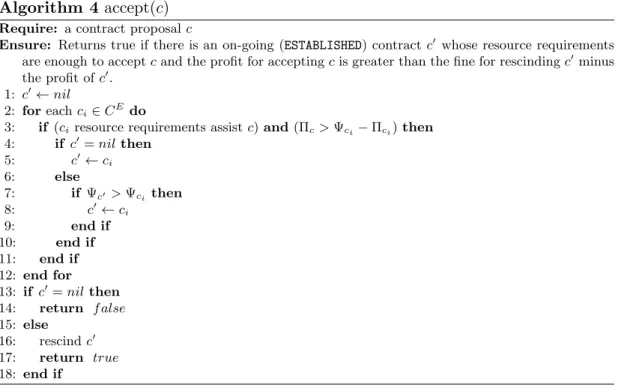
This thesis deals with two problems: service execution management and service
profit augmentation. These problems are discussed in Chapter 3 which presents a
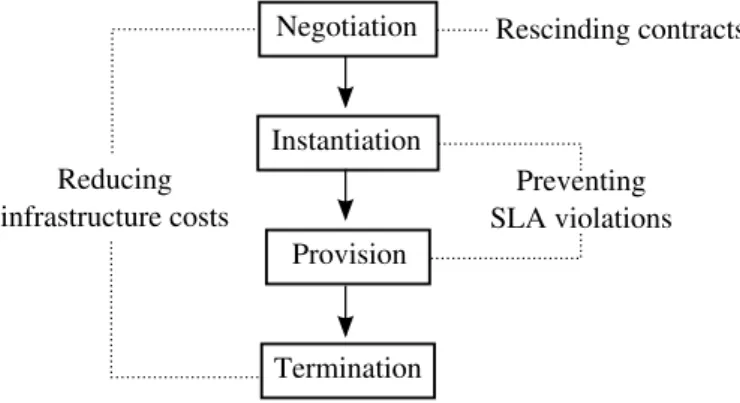
solu-tion that addresses the SLA life-cycle while aiming at increasing the provider profit. In order to handle service execution management, this thesis relies on three contributions. Firstly, Section 3.3 addresses how contract templates are created in order to enable contract negotiation which includes SLA translation and pricing aspects. Secondly, QoS assurance mechanisms are proposed in Section 3.4 which are configured based on the translation of QoS metrics to system-level configurations. Thirdly, Section 3.5 deals with resource acquisition and allocation by reacting to contract proposals and request arrivals. Simultaneous to the service execution management, complementary and or-thogonal actions are in charge of increasing the provider profit. These actions include rescinding contracts, reduction of infrastructure costs, preventing SLA violations, and minimizing fine payments.
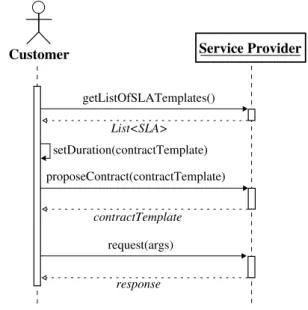
In order to realize the aforementioned conceived solution, the Chapter 4 depicts the design and implementation of the autonomous Qu4DS (Quality Assurance for Dis-tributed Services) framework. Qu4DS transparently manages service executions by providing a higher-level support for services which abstracts over distributed infras-tructures. Qu4DS is in charge of automatizing SLA management tasks based on high-level policies. Furthermore, Qu4DS relies on a modular design which enables employing further policies.
Qu4DS is validated in Chapters 5 and 6. In Chapter 5, the experimental environ-ment is introduced which includes the case study and configuration details. As proof of concept, Qu4DS is used to implement the flac2ogg service provider which compress audio files. Chapter 6 depicts Qu4DS evaluation performed on top of the Grid5000
testbed. Different experimentation scenarios are introduced in Section 6.1 and followed by the results in Section 6.2. The evaluation validates the solution proposed by this thesis and allows analyzing Qu4DS efficiency under different constraints.
Part I
State of the Art
Chapter 1
Service-Centric Paradigm
The Service-Centric Paradigm (SCP) refers to the idea of building distributed applica-tions by leveraging elementary software blocks abstracted as electronic services. Indeed, SCP mostly takes advantage of two important concepts: computing utility and
sepa-ration of concerns. Computing utility dates back to the 60s when computing features
were proposed to be offered as public utilities by leveraging the time-sharing technology as if they were conventional services, e.g., electricity and water. Following that, more recent research has implemented technologies which allow computing utility to be con-ceived in large scale such as early data centers, grid computing and cloud computing. On the other hand, dating back to the 70s, the idea of separation of concerns has been introduced [Dij82, Par72] which is the basis for conceiving modular systems. The basic idea is to separate different concerns and tackle them separately. Technologies which leverage such separation of concerns have been evolved whose examples include Object-Oriented Programming, Aspect-Object-Oriented Programming, and Web Services which rely on hiding implementation and exposing interfaces in order to ease the development, maintenance, and understanding of programs.
Therefore, SCP relies on loosely-coupled services which deliver computing utility capabilities in a distributed environment. The background of this thesis focuses on the SCP and is organized as follows. Firstly, Service-Level Agreements (SLAs) are introduced in Section 1.1. Secondly, Section 1.2 discusses Quality of Services (QoS) offered by SLAs. As services are provisioned under pricing constraints, Section 1.3 exposes some issues with regard to pricing models. Following that, Section 1.4 discusses systems whose management is autonomous. In Sections 1.5, 1.7 and 1.6 three important technologies are introduced in the context of the SCP: Web Services (WS), Cloud Computing, and Grid Computing respectively.
1.1
Service-Level Agreements
1.1.1 Overview
The Service-Level Agreement (SLA) is used to express the relationship between elec-tronic services whose contacts are employed in short-term and highly-dynamic business
scenarios. SLAs mimic conventional contracts where the contracted part refers to the
service provider while the consumer is represented by the service customer1. SLAs define not only how services ought to behave, but also how they should not behave. In addition, SLAs do not ensure any obligation; they only define the rules that may be employed in case of non commitment of such obligations [BLM08, WB12].
1.1.2 SLA Life-Cycle
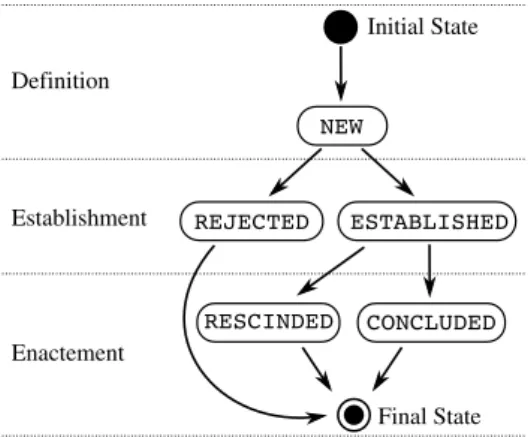
Three phases govern the SLA life-cycle. The first phase refers to the contract
defi-nition when a contract template is generated by describing which quality is offered
– commonly, models, meta-models and ontologies are usually used for representing QoS [UTU+08]. The second phase is the contract establishment when parties negotiate and agree on the contract terms which expose the QoS metrics and their associated values. The third phase comprises the contract enactment when the service is exe-cuted and both functional and non-functional aspects are monitored in order check whether the service is properly delivered under the terms of the agreed QoS. Moreover, monitoring the SLA should be done by a third party as [GFI05] for instance.
1.1.3 WSLA and WS-Agreement
Currently, there is no standard for specifying SLAs. In the literature, WSLA and WS-Agreement are the main specifications being often used and referenced [BLM08] [DMRTV07]. The WSLA (Web Service Level Agreement) [LKD+03] SLA specification aims at pro-viding means for configuring both provider and customer systems in order to provide and supervise their services. The WSLA proposes a formal language based on XML by allowing automatizing agreement actions. Then customer and providers are configured by interpreting the WSLA document. The configuration structure includes: (i) the parties, their roles and action interfaces; (ii) service-level parameters (SLA parame-ters) which are composed of both resource and aggregate metrics; and (iii) service-level objectives (SLOs), composed by guarantee actions that represents the parties’ obliga-tions. The latter SLA specification is the WS-Agreement [ACD+07] specification that proposes a language and a protocol for describing the service capabilities, for creating agreements and for supervising agreement compliance. WS-Agreement assumes that guarantees depend on states based on the idea of stateful Web Services; as proposed by the WS-RF [CFF+04] which wraps resources as stateful Web Services.
WSLA and WS-Agreement provide enough details concerning high-level structures of agreements and how they can be negotiated since they have the same goal: to define how the service will be provide and how it will be supervised. Moreover, both speci-fications rely on the WSDL (Web Service Description Language) in order to describe the service functionalities. On the other hand, WSLA and WS-Agreement differ from the fact that WS-Agreement also proposes a terminology and a protocol for agreement management. Furthermore, WS-Agreement does not offer a robust QoS (Quality of
Quality of Service (QoS) 13
Service) model as WSLA provides which allows combining QoS and exploiting QoS semantics.
1.2
Quality of Service (QoS)
The SLA expresses the terms of the service which are divided in functional and non-functional requirements of the provided service. Functional requirements define the service essential features necessary to meet the service purpose. In contrast, non-functional requirements define further capabilities which are not directly related to the service main purpose such as performance, fault tolerance and data persistence. Moreover, non-functional requirements are also referred as Quality of Services (QoS) as they do qualify the service provider. The QoS has great importance to service providers since service providers can be distinguished based on quality properties. Thereby, QoS are used to offer differentiated services by enabling the service provider to be competitive against further competitor services. For instance, QoS plays an important role in the business model of current technologies such as the Internet of Things, Web 2.0 and clouds.
The next sections discusses fault tolerant and performance properties of services followed by a discussion of the trade-off performance and fault tolerance.
1.2.1 Fault Tolerance
Fault tolerance is a means to ensure that services comply with their specification in the
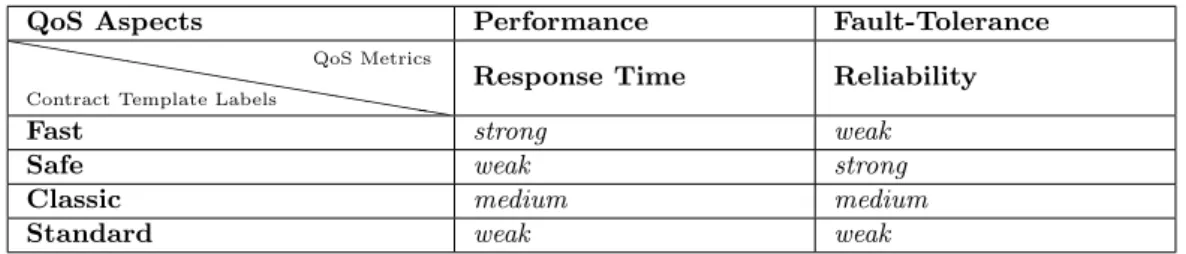
presence of faults [Lap85]. A fault is a representation of a system malfunction which may come from design or execution time. In order to prevent a service failure, i.e., to not disturb the service execution, faults should be handled. In order to measure the degree of fault tolerance, availability and reliability are often employed. Availability measures how often a service is available for responding requests. Availability can be expressed as a ratio of the time which the service was available by the measured time interval. Reliability indicates how much a service is reliable with respect to responding a request. The degree of reliability of a system can be expressed by high-level non-functional constraints such as strong, medium and weak [RFCRJ04].
Most of commercial service providers rely on providing availability2QoS. The avail-ability is often represented by means of percentage, exposing the ratio between the total time that the service could be accessed by the customer and a given time inter-val [WB12, Zen10, Ama06a, Mic08, Goo08]. For instance, Zencoder [Zen10] provides audio and video encoding services whose interfaces are guaranteed to be reachable 99.9% of the time in a month. Amazon EC2 [Ama06a] ensures that virtual machines will be available 99.95% of the time in a year. If Zencoder or Amazon EC2 fail to meet the agreed availability rate, the penalties are computed by means of service credits to customers; while Zencoder is willing to refund customer based on the whole contract
time, Amazon EC2 only refunds ten percent of it. With respect to the monitoring cri-terion, Amazon EC2 defines an unavailable virtual machine as not being accessible for more than five minutes while Zencoder monitoring interval is one minute. Moreover, both service providers rely on ambiguous and weak definitions of availability which exclude fundamental dependability concepts.
1.2.2 Performance
The performance characteristic of a service is related to quality properties involving time metrics. Various measures can be used such as latency, throughput, operational
time, and response time. Latency is mostly used to express the delay of data transfer
with regard to network connections. The throughput metrics is also commonly used in network in order to measure the transfer rate, but it may be used to express the rate of a request treatment as MB/sec for instance. The operational time refers to the time that the service provider takes to make the service operational. Finally, response time typically measures the time to treat a request. While latency and throughput are commonly related to the network-level services, operation time and response time are mostly employed on services at application-level. Specifically, current work ad-dresses the response time metrics by means of trying to decrease the overall response time. Thus, customers might experience performance improvements based on non-accurate metrics which is often expressed as the experimented response time. In this context, examples include approaches which addresses experimented request response time [DG08, Hue04, KP11b] as well as experimented queue waiting time [KMB+12]. Further commercial cloud providers such as [Zen10, Ama06a, Mic08, Goo08] do not specify any performance QoS in their SLAs.
1.2.3 Trade-Off Between Performance and Fault Tolerance
The use of mechanisms which implement fault-tolerant techniques imply operational overhead [Lap85]. For instance, error recovery and redundancy techniques require time to be employed thus increasing the total time of the service request. Therefore, there is a trade-off between performance and fault tolerance when designing a system since it is not practicable to prioritize both aspects concurrently. In other words, it is not possible to implement a system that achieves high-performance with a high fault-tolerance degree.
Because performance QoS metrics are not accurately described by current service provider implementations, approaches that address both fault tolerance and perfor-mance QoS do not deal with the trade-off. On the one hand, current cloud providers are more concerned about delivering the agreed availability thus considering the per-formance assurance a secondary goal. On the other hand, further approaches which implement actual fault-tolerant and performance assurance mechanisms [DG08, LZ10, Hue04, KP11b] do not consider the stated trade-off as they are not interest in meeting specific QoS metrics, but improving response times.
Pricing 15
1.3
Pricing
1.3.1 Introduction
Economic interests in software gained special attention in the 60s when software started to be sold as software licenses. Software licenses represent perpetual rights for using a copy of the software. In this model, the license depends on various factors as the number of machines in which the software could be installed, the number of users that can use the software concurrently and so forth. With the popularization of the Internet and the great investment on high-speed networks over the world, not only software, but computing features as virtual resources trended to be sold as a service. In order to sell computing services, service providers propose to customers to pay according to their usage. Perpetual licenses do not fit this business model as the delivered services are now used from a remote client machine thus the software is not installed in the client’s machine anymore. Thereby, customers pay for a service usage instead of buying perpetual software licenses. The fact of trading software and resources as services leads to define how customers pay for them as well as to redefine the price formation. These issues are explained in Sections 1.3.2 and 1.3.3 respectively.
1.3.2 Accounting Assessment
Accounting assessment defines how the customer will be charged for using the service. In order to enabling the accounting assessment, different accounting metrics are used which may be related to specific provided services. For example, accounting metrics may refer to usage time, input or output metrics (file size, video time, etc.), request frequency, number of users per contract, number of functionalities and so forth.
Two main accounting assessments are employed by service providers. The former accounting assessment is pay-per-use3 which has been popularized and promoted by cloud computing by selling virtual hardware and software as a service. The pay-per-use accounting assessment accounts the service price based on its usage, similar to the way of how taxis and electric energy are paid. For example, the Google App Engine (GAE) [Goo08] does the accounting based on data read/write operations (✩ per number of operations) while Zencoder accounting is based on video output length (✩ per minute of output video). The latter accounting assessment is called subscription which relies on periodical payments which grants access to the service. For example, service providers use hourly, daily, monthly subscriptions along with the specified accounting metrics.
Although the subscription accounting assessment is more profitable for service providers, it is important to also offer the pay-per-use accounting assessment. Charging customers in a pay-per-use fashion is attractive to customers because they pay only for the actual service usage. In contrast, pay-per-use is not interesting for service providers because it negatively influences the provider profit. If the accounting assessment does not depend on the usage, customers tend to pay more than necessary thus increasing the provider profit margin. However, the importance of pay-per-use lies on the
ing reasons: (i) for competition purpose as pay-per-use is widely assumed to be an intrinsic characteristics of service providers; (ii) customers are used to think that this model is fair; and (iii) service providers still have a way of overcoming the pay-per-use disadvantages by setting a higher prices than subscription plans. As a result, most of service providers provides both pay-per-use and subscription plans.
Lastly, subscription accounting assessment can be understood as a customization of a pay-per-use which relies on the time metrics. If this pay-per-use is modified to rely on periodical payments which time metrics is fixed to a minimal interval, it becomes a subscription accounting assessment; which may also limit to a maximum amount of service-specific accounting metrics. Thus, service providers create subscription plans which usually offer tariff reductions as the maximum amount of specific metrics in-creases – for example, by mimicking mobile telephony companies. For instance, Zen-coder’s pay-per-use option accounts 0.05U✩ per minute of video output while its launch subscription plan relies on monthly payments of 40U✩ for a maximum of one-thousand minutes of output4. Moreover, some of these providers even do not provide the pay-per-use option, hence only offering subscription plans such as SalesForce5 [Sal99]. In a brief, the subscription is widely accepted by customers as it is very hard for customers to predict the service usage. Thus, customers do not mind to rely on predefined sub-scription plans which brings the feeling that the service is pay-per-use. More details about these issues can be found in [LB09, LDBK10].
1.3.3 Price Formation
Price formation refers to how to define the price of a service. Basically, price formation may be formed in three ways: cost-based, value-based and competition-oriented [LB09]. Firstly, the cost-based price formation assumes that the price is defined based on its operational costs. These costs are represented by expenses which may include third party services, resource providers, storage providers and software licenses for instance. For instance, the Amazon DevPay [Ama12] provides an integrated billing tool which takes into account the use of Amazon EC2 instances. Thus Amazon EC2 customers can automatically define the price of the service based on the utilization of the under-lying infrastructure in a cost-based fashion. Secondly, the value-based price formation depends on the demand for the service, i.e., how valuable the service is in the current market. Lastly, the price formation can be driven by the price of competitor services. The competition-oriented price formation is then useful for allowing new providers to be competitive or in order to dispute market share to other competitors.
Furthermore, another aspect with regard to the price formation refers to the decision of setting the price. The price can unilaterally be defined by the service provider or it can be set in a flexible manner which includes the price into the negotiation process between customer and providers. However, most of service providers does not allow changing the service price by relying on predefined prices and accounting assessment plans.
4Further minutes cost 0.04U✩ per minute.
Self-Managed Systems 17
1.4
Self-Managed Systems
1.4.1 Dynamic Adaptation
Dynamic adaptation refers to changing the behavior of a system at runtime. Adapt-able capabilities are useful in unpredictAdapt-able scenarios where environment changes or users needs require modifying the system behavior. For instance, resource availabil-ity should be dealt with in order to ensure that the system will be able to execute its tasks. Similarly, faults should be handled in order to ensure that the system will behave as specified. Further adaptation goals include optimization interests where the system adapts itself by aiming at improving performance or reducing resource waste for example [Bui06, UPF+08].
Most approaches that offer support for conceiving self-adaptable systems separate the system functional and non-functional system concerns. Then adaptation interests are dealt with as a non-functional concern which simplifies implementing and main-taining the system as well as promoting reusability. The technologies that enable implementing self-adaptable systems in a modular fashion include Aspect-Oriented Programming, component-based design, Web Services and computational reflection. Furthermore, the adaptive behavior can be implemented either in the application-level or as a utility in the middleware-level. Further discussion about adaptation techniques can be found in [BAP05, KC03, AC03, MSKC04, CFI+09].
1.4.2 Autonomic Computing
Autonomic Computing [Hor01] proposes the idea of developing autonomous systems in order to ease system use and administration. Autonomous systems should then manage themselves in an autonomous fashion, inspired in the human autonomic nervous system which controls some functions as breath rate, pupil dilatation and heart rate. In [KC03], the authors propose the MAPE (Monitoring, Analysis, Planning, Execution) control loop which serves as the cornerstone of an architecture for developing self-managed systems. The MAPE control loop decomposes adaptation in four interests as explained next. The Dynaco adaptation model proposes a similar approach to the MAPE for distributed application by leveraging component-based design [BAP05, Bui06].
Monitoring Monitoring is in charge of gathering information about adaptation inter-ests. Monitoring mechanisms may rely on pull and push flows in order to either keep the system aware about monitoring metrics periodically or to allow specific information to be required.
Analysis During the analysis, it is decided whether an event about the monitored data is relevant enough for triggering an adaptation action. If so, an adaptation strat-egy should be generated in order to change the application behavior to achieve the targeted state.
Planning The adaptation strategy is transformed in an adaptation plan in the plan-ning phase. The plan is a set of instructions detailedly describing the actual
changes to be executed by the system.
Execution The previous plan is then executed in the execution phase. In order to execute the plan, the system execution flow is intercepted and the instructions are applied.
1.5
Web Services
1.5.1 Loosely-Coupled Distributed Applications
The Service-Oriented Computing (SOC) [PG03, PTDL07] proposes a modular and loosely-coupled design for building distributed applications. SOC takes advantage of the service abstraction whose interactions are described by SLAs. Aiming at instan-tiating this view, the Service-Oriented Architecture (SOA) was then proposed as a representation of the SOC. The SOA describes an architecture which enables con-ceiving service-based applications. In a brief, SOA architecture has three layers which respectively address: (i) service discovery and binding; (ii) service composition in which services are combined in order to conceive composite services; and (iii) service man-agement features that are mainly related to service life cycle. Moreover, the SOA has been proposed to rely on Web Services [W3C10] as a mean of integration of different applications and platforms.
From another point of view, the SOA can be understood as a natural evolution of the component-based design [Szy03]. In [CH04, Yan03, PAB11], the authors understand components and SOA as complementary approaches: on the one hand, services are loose-coupling, dynamic and business-oriented, on the other hand, components offer an efficient development model that separates concerns and promotes re-usability. These latter properties simplify the service development. Examples of component approaches based on the SOA include the Service-Component Architecture (SCA) [Ope07], Declar-ative Services [OSG07] and iPOJO [EHL07]. However, both SOC and component point of views about SOA consider the utilization of Web Services for interoperability pur-pose6.
1.5.2 Web Services
Two architectural styles have been used to implement Web Services: one based on WS-* standards, another based on the concept of Representational State Transfer (REST). The former technology relies on the SOAP (Simple Object Access Protocol) protocol as a means for interfacing Web Services [W3C10]. SOAP leverages lower-level communi-cation protocols such as HTTP (Hypertext Transfer Protocol) by exchanging messages formated in XML (Extensible Markup Language) through the service descriptor rep-resented by a WSDL (Web Service Definition Language) interface. The WSDL is an XML file which describes the service functionalities in a RPC-based fashion. In other
6The use of Web Services by Declarative Services and iPOJO are enabled by Distributed
Grid Computing 19
words, services send requests to other services by invoking their operations, then these operations will be executed remotely and the result is sent by means of the request response. This way of building service-based application by leveraging Web Services in an RPC-like manner served as basis for several approaches which address service composition by means of BPEL orchestration or choreographies. In spite of the great advantage of not changing the way of how applications are designed, i.e., by calling operations, it is hard to manage SOAP/WS-* service compositions.
In contrast to the WS-* based architectural style, the second approach for im-plementing Web Services follows the REST style, which allows building service-based applications in a simpler way. Web Services based on the REST architecture are called RESTful Web Services and take advantage of the HTTP protocol as an application protocol, not only a transport protocol. In the REST architecture, services are ex-posed as resources identified by URIs that facilitate the referencing of services on a network of distributed servers. RESTful Web Services are accessible through the use of simple HTTP methods, e.g., GET, PUT, POST, UPDATE. In addition, RESTful Web Services take advantage of content negotiation to provide various data formats such as XML and JSON (JavaScript Object Notation,) which allow them to fit the data format according to the service needs. With respect to the service provider state, the stateless characteristics of RESTful Web Services is suitable for developing inter-domain Web Services in large-scale. On the other hand, RESTful Web Services requires that cus-tomer services understand the semantics of the data formats (media-types) which are exchanged.
1.6
Grid Computing
1.6.1 Overview
Grid computing was firstly used to aggregate clusters from different domains for per-forming high-performance computing in large-scale. Following that, grids addressed the utilization of further heterogeneous and low-cost resources such as desktop computers and mobile devices. In order to manage resource access policies, grids leverage the concept of Virtual Organization (VO) to define and ensure user privileges in each set of resources. Thereby, various organizations participating on a grid can configure the grid usage to suit their local policies [Fos02]. In order to make grids transparent for users and promote interoperability, grids leverage programming abstractions based on open standards that unify the way of how grid resources are used. For instance, grid users may develop distributed applications based on abstractions as GridRPC, batch jobs and files [SNM+02, GJK+08].
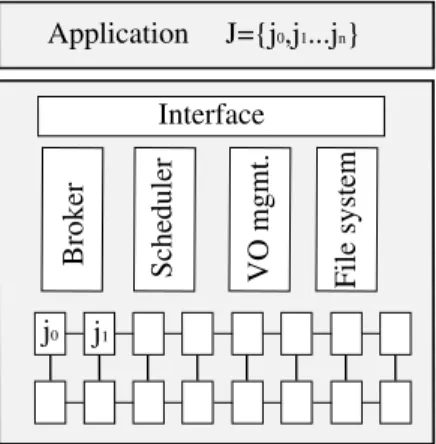
Figure 1.1 illustrates a common grid architecture. Firstly, according to VO policies, grid users reserve a set of resources and submit jobs through the broker. Secondly, jobs are sent to the grid scheduler which allocates jobs on resources given job resource requirements and according to a scheduling algorithm. Finally, when jobs are executed, users are informed. Moreover, distributed file systems [LS90] are widely used in grids in order to store and share data transparently.
Figure 1.1: Applications are executed on top of grid infrastructures by submitting jobs to grid resources.
The main programming abstraction for developing grid applications is the job ab-straction. Jobs can either hold other jobs a parallel program or represent a sequential program as part of a set of jobs. Moreover, jobs contain meta-information which in-cludes their software the resource requirements. By leveraging jobs, various distributed applications can be developed such as BoT (Bag of Tasks) applications [CBC+04] , complex workflows [HWS+06] as well as applications that leverage the generic Mas-ter/Worker pattern.
1.6.2 Application Programming Interface
Grids offer complete Application Programming Interfaces (APIs) which allow grid users to have extensive control of grid resources. However, current grid offer different and complex APIs thus increasing the complexity of application development and mainte-nance. In order to ease the use of grids, to standardize the grid usage and to allow grid applications to be compliant with different grid platforms, the Simple Grid API (SAGA) [GJK+08] proposes a standard grid programming interface. SAGA addresses interoperability and complexity through simple grid programming abstractions and op-erations. SAGA enables grid application development by taking into account a unique interface while it enables the execution of such an application in different grids. For achieving interoperability, SAGA relies on adaptors which enable implementing back-ends for various grids as SSH, Globus, XtreemOS, Condor and so forth.
SAGA compiled the main abstractions for developing distributed applications based on various requirements. Firstly, the file abstracts transparently over a distributed file system an usual local file system. Secondly, the data streaming abstraction eases the uti-lization of remote communications over sockets. Aiming at a higher-level remote com-munications, the RPC abstraction is also provided by SAGA whose specifications are defined based on GridRPC [SNM+02]. The task abstraction encapsulates synchronous and asynchronous operations in order to facilitate the management of distributed calls.
Grid Computing 21
Finally, the job abstraction is supported by SAGA which allows managing jobs based on statical and dynamic information sent through job callbacks. Additionally, jobs can be submitted in both interactive and batch modes.
Furthermore, grid usage can also take advantage of the pilot-job abstraction. The DIRAC (Distributed Infrastructure with Remote Agent Control) [CER04, TBB+08, CGP+10] grid proposes pilot-jobs as an abstraction for improving resource allocation in grids. Before submitting main jobs, meta-jobs called pilot-jobs are submitted to available resources by launching an agent. This agent is responsible for calculating the resource capability of execute main-jobs and send it to the scheduler. The scheduler then matches its job queue received from grid users to available resource capabilities. Thereby, the job scheduling is distributed among the resources by relying on updated resource metrics. Moreover, further grid approaches also takes advantage of the idea of pilot-jobs as SAGA big-job [LLJ10] and Condor [Uni12].
1.6.3 Grid Platforms
Globus The Globus Toolkit [Fos06] is a grid middleware as part of the Globus Al-liance. Globus Toolkit architecture relies on Web Services in order to manage the grid components. It uses the WS-Resource Framework (WSRF) [CFF+04] and wraps grid resources in order to ease the management of the middleware. Globus Toolkit transfers data through the FTP (File Transfer Protocol) protocol adapted for grids and manage data replication to improve data availability. Moreover, Globus Toolkit also provides an execution management environment for specific applications.
XtreemOS The XtreemOS [CFJ+08] project targets providing a transparent grid ex-ecution environment as an usual operating system. Core components of the XtreemOS grid operating system are built as Linux kernel modules in user-space which makes common operating systems grid resources. Thus, the overall overhead of tasks that require detailed information about the system is decreased. Moreover, XtreemOS sup-ports desktop computers, clusters and mobile devices. With respect to its interface, it not only provides an extensions of the SAGA interface, but it also provides a console which supports POSIX-compliant commands.
Grid5000 The Grid5000 aims at offering an integrated distributed environment where researches can deploy their prototypes in large-scale. The Grid5000 currently holds 1,594 nodes, a total of 3,064 processors and 8,700 cores over ten sites in France7 shared among various research institutes. In order to use Grid5000, an operating system image is deployed on reserved nodes. Indeed, Grid5000 is a resource-oriented testbed and can be compared with IaaS clouds in the sense since both provide resource as abstraction for programmers. Although Grid5000 does not offer higher-level abstraction such as jobs, its extensible and flexible tools, e.g., OAR, Kadeploy, Adage, allow grid users to deploy further programming support as Globus Toolkit, XtreemOS, DIET, Nimbus, Apache Hadoop and so forth.
DIET DIET (Distributed Interactive Engineering Tool-box) [CD06] is a grid middle-ware which tackles the development of grid applications by using GridRPC [NMS+05, SNM+02]. GridRPC lies on the RPC (Remote Procedure Call) paradigm with dynamic resource scheduling in an environment composed by different administrative domains. DIET components are in charge of allocating resources when the application remotely calls computation operations through GridRPC calls.
DIET is based on a hierarchical distributed scheduling design. DIET users send the operation to be computed to a DIET entry point (master agent) by means of a GridRPC call. The master agent dispatches the call to hierarchical lower-level entities called SeD (Server Daemon) which are in charge of executing the actual operation. When an SeD receives the call, it checks if it is able to respond to the call by checking dynamic information such as data availability and resource load and scores its ability. Then the SeD forwards the call to its SeD children which also calculate their ability based on the given call. All SeDs answer their upper SeDs which sort capability scores of their children and store in a list. Following that. the master agent sorts the capability lists of its SeD children in a merged list which is forwarded to the user. Finally, the user chooses which SeD is more suitable for executing the call and sends the call to the chosen SeD to be executed.
1.7
Cloud Computing
1.7.1 Overview
Cloud Computing does not have a common definition. At first, most definitions relied on the idea of outsourced service providers which deliver virtual machines on-demand in a pay-per-use accounting assessment. Later, the basic idea of outsourcing resources was extended to a larger and generic set of computing capabilities rather than virtual machines [MG11, Sch10, B´eg08, VRMCL08, KTKN11, JMF09].
Cloud Computing targets adapting the provided services according to environment changes dynamically. This refers to the idea of elasticity which allows clouds to modify non-functional requirements not only according to demand changes, but also for con-solidation purpose. In the context of IaaS clouds, elasticity may refer to either vertical elasticity, whereby virtual machines requirements are modified, or horizontal elasticity, which means changing the amount of virtual machines. For instance, an application which uses a single virtual machine may become overloaded, then it may trigger a ver-tical elasticity in order to accommodate the current load. On the other hand, the cloud provider may suspend, migrate8 or shut down some virtual machines in order to save energy consumption during low demand peak.
In spite of the advantage of acquiring outsourced and elastic services on-demand, clouds main drawbacks lies on privacy, security and dependability [Vie09]. As customer data is stored in clouds, customers do not have control on their own data anymore. This can be used for gathering useful information about cloud customer for business
8Currently, the live migration technology enables migrating virtual machines at runtime without
Cloud Computing 23
purpose. Furthermore, some applications require non-trivial security requirements such as critical applications. The way of how availability is offered by cloud providers are not enough for building dependable applications. For instance, the Amazon EC2 SLA terms exclude Amazon from any availability issue caused by factors outside of Amazon’s reasonable control9.
1.7.2 A Common Layered Architecture
Currently, a common cloud layered-architecture is found in the literature [Sch10, KTKN11, CBP+10, MG11] where computing capabilities are exchanged between service entities. Figure 1.2 illustrates this cloud architecture. The lowest layer refers to the
Infras-tructure as a Service (IaaS) which relies on the resource abstraction. The IaaS layer
leverages virtualization techniques in order to deliver virtual machines as resources. These virtual resources actually are operating system images. The upper layer is called
Platform as a Service (PaaS) which provides a developing support for building final
applications. In the PaaS layer, programming tools and abstractions are offered as external services which play the role of conventional programming libraries. In the highest-level layer, the Software as a Service (SaaS)10 layer provides applications for final users.
Figure 1.2: A common view of Cloud Computing as a layered architecture where layers interact with each other by means of services. Service requests are the primitives which enable the service to be delivered according to the SLA.
1.7.3 Infrastructure, Platform and Software as a Service
IaaS IaaS clouds rely on the virtualization technology in order to deploy virtual machine instances on top of physical resources. Virtualization allows running guest operating systems inside a host operating system. Thereby, virtual machine instances actually are operating system running on a virtual resource. The hypervisors are in charge of managing virtual machines by interacting with the physical machine operat-ing system. Examples of current hypervisors include Xen [CS03], KVM [RH06], and VirtualBox [Ora07]. Moreover, kernel containers can also be used to manage virtual machines as a kernel built-in solution.
9For the full Amazon EC2 SLA terms, see [Ama08]. 10Also referred as Service as a Service.
The first IaaS cloud created was the Amazon EC2 [Ama06a] as a result of Amazon’s data center improvement. Amazon EC2 relies on its proprietary AMI (Amazon Machine Image) virtual machine format and its own API. Following that, open-source IaaS clouds were developed such as Nimbus, Eucalyptus, OpenStack and OpenNebula, all of them supporting the Amazon EC2 API. Moreover, cloud IaaS solutions are commonly used together with storage services, e.g., Amazon S3 [Ama06b].
Aiming at standardizing IaaS cloud interfaces, the Open Grid Forum published the OCCI (Open Cloud Computing Interface) [ME11] specification. OCCI relies on the compute, storage and network abstractions in order to represent cloud IaaS resources. The start, stop, restart and suspend operations govern resources through a RESTful API. Furthermore, proprietary interfaces as Amazon EC2 also relies on these simple operations.
Furthermore, IaaS clouds can be also classified as private, public and hybrid. In order to tackle privacy and security issues, IaaS clouds can be used in an intra-domain scope. This characterizes a private cloud whose virtual instances are managed by the organization which then takes advantage of managing virtual resources instead of physical resources. In contrast, public clouds consist of third parties which provide virtual machines in an outsourced manner. Lastly, clouds can also be classified as
hybrid whose virtual machines are held by both private and public clouds. Hybrid
clouds is a complementary solution for private clouds in a sense that it enables handling unpredicted resource demands in a private cloud.
PaaS and SaaS While the IaaS layer has been established on top of well defined interfaces [Ama06a, ME11], there is a lack of agreement about PaaS and SaaS cloud interfaces. Despite the OCCI effective description of a cloud IaaS interface, it does not tackle neither PaaS nor SaaS cloud interfaces. Indeed, in these latter layers, a huge number of functionalities should be provided which makes it very difficult to define a simple and clean interface. For instance, the PaaS layer aims at providing services which support data base access, authentication, parallelization and domain-specific libraries as SalesForce [Sal99] and the Google Application Engine (GAE) [Goo08]. With respect to the SaaS layer, although SaaS customers needs are more customized rather than developer needs, SaaS interfaces similarly aim at providing specific features. As a consequence, the lack of uniform and standardized PaaS and SaaS interfaces implies the incompatibility of cloud providers; thus subject to vendor lock-in and integration issues.
Chapter 2
Related Work
This chapter presents some current approaches which support the development of ser-vice providers on top of distributed infrastructures. The main focus is on approaches that provide quality guarantees. In order to organize related work, three main groups were defined based on the following aspects: pricing (cf. Section 2.1), SLA man-agement (cf. Section 2.2) and resource acquisition (cf. Section 2.3). Moreover, the SLA management aspect was divided in three subgroups which address SLA life-cycle (cf. Section 2.2.1), SLA translation (cf. Section 2.2.2), and QoS assurance (cf. Sec-tion 2.2.3).
Finally, a comparison table is exposed in Section 2.4 which summarizes the main related work here presented.
2.1
Pricing
In general, the solutions which address pricing aspects do not include in their SLA the penalties in case that the agreed quality is not met. Some of them [Ama06a, Goo08, Sal99, Zen10] are willing to offer service credits if a percentage of availability is not met. However, these approaches rely on a very limited and often not clear definition of SLA violation because service providers are not able to properly ensure the agreed QoS. Thereby, refunding policies would seriously compromise provider profit.
In [MFG10, MG10], Mac´ıas et al. address the maximization of IaaS cloud providers by means of resource over-provisioning and by dynamically setting the service price according to resource usage. Virtual machines are then shut down based on their usage pattern thus enabling to allocate other virtual machines. In case of resource shortage, the approach minimizes losses by considering either violating SLAs or rescinding con-tracts. Even though these approaches consider pricing aspects, the authors only tackles the availability QoS. Moreover, similar to Amazon EC2, these approaches only consider an SLA violation as a virtual machine that has been shut down after a fixed and sig-nificant amount of time. Furthermore, these solutions tackle the IaaS layer thereby not providing higher-level programming abstractions for building SaaS service providers.
2.2
SLA Management
2.2.1 SLA Life-Cycle
The SLA@SOI project [THK+10] proposes a hierarchical and integrated architecture for building service-based applications. The architecture is composed by three SLA managers which address business, software and infrastructure SLA managements in a layered fashion. In the highest-level, business aspects between the provider and its customers are dealt with. The following layers address software and infrastructure wrapped as services. By considering software and resources as service, the SLA@SOI architecture aims at separating service management from SLA management. However, by aiming at a generic approach for supporting arbitrary services, the architecture does not define specific realization mechanisms; it assumes that services dependencies are responsible for meeting service software and resource requirements.
The SOA4ALL project [KLH+10] aims at easing the conception of service-based applications by leveraging the SOA, Web 2.0 and Semantic Web in a context-aware environment. The SOA4ALL proposes a layered architecture which lies on a graphical user interface, an intermediate communication channel and an underlying infrastruc-ture. Moreover, the communication channel enables third party service to be inte-grated. In the highest layer, business processes are conceived and then translated to BPEL (Business Process Execution Language) compositions which are executed in the infrastructure. Thereby, the SOA4ALL approach tackles service composition driven by quality aspects through comprehensive service discovery and bindings based on seman-tics. Nevertheless, the architecture does not specify how resources are acquired nor managed and pricing aspects are not defined. The authors only explain how further technologies might meet these needs. Moreover, actual QoS assurance mechanisms are not proposed; QoS properties are supposed to be met by proper service compositions.
Mac´ıas et al. [MFG10] addresses the negotiation and provisioning of virtual ma-chines driven by economic aspects. The architectural details of this approach is de-scribed in [MG10]. However, it does not tackle performance, relies on a relaxed defini-tion of SLA violadefini-tion based on availability as well as it does not support higher-level programming abstractions; as discussed in Section 2.1.
2.2.2 SLA Translation
The authors of [KW10] model the translation of SLA based to service dependency prop-erties; however they do not tackle how services translate their SLA to infrastructure-level configurations.
In [CIL+08], the authors profile tier applications to know the response time based. SLAs are translated by means of CPU requirements to application servers. However, this work does not provide fault-tolerant mechanisms and it does not tackle distributed applications.
Stantchev and Schr¨opfer [SS09] service replication is used in order to improve and ensure performance and fault-tolerance QoS. The authors translate QoS to infrastructure-level by means of setting the service replication degree. Nevertheless, the authors do
SLA Management 27
not explain how assurance mechanisms work nor how SLA and resources are man-aged. Furthermore, the work does not consider economic aspects such as service price, resource costs and fines owing to SLA violations.
The GridNEXT project [HKSW06] investigate how SLA objectives are translated to infrastructure configurations in order to enable high-performance computing ser-vice providers to meet the agreed QoS. The translation process relies on a knowledge database previously filled. However, the architecture remains conceptual thus not pro-viding enough information about how to implement actual QoS assurance mechanisms. The authors assume that the infrastructure should support QoS assurance mechanisms.
Moreover, further work about SLA translation can be found in [LTH09].
2.2.3 QoS Assurance
The MapReduce programming model [DG10, DG08] addresses data processing in large scale. It leverages the concept of map and reduce primitives of functional languages and considers a data shared space such as a distributed file system. Developers who take advantage of MapReduce should implement the application-specific operations
map and reduce and provide information about the location of input and output data.
The MapReduce Library [DG08] handles worker failures by periodically checking if workers are reachable. If a worker fails, their task are re-scheduled to be executed on another idle worker. Moreover, the MapReduce Library relies on a replicating scheme for the remaining jobs since latest jobs are more susceptible to fail. In order to improve performance, the MapReduce library also relies on replication of remaining jobs by statically configuring the number of map and reduce operations as well as the number of workers. Indeed, the replication of remaining jobs is a solution for improving performance and tolerance qualities. However, more efficient fault-tolerant techniques can be conceived based on dynamic job metrics as job elapsed time and job state. Thereby, malfunctioning jobs can be earlier identified thus triggering repairing actions at this very moment instead of postponing them to the end of the computation. Moreover, MapReduce does not address a complete PaaS solution, i.e., it misses further supports for dealing with the service negotiation and provisioning. Therefore, MapReduce is understood to be an intermediate-level tool that ease the development of PaaS solutions which aim at data-processing in large-scale, while further service higher-level aspects are not tackled.
Clouds resources have been used to improve performance of distributed applications. In [LZ10], the authors propose the RC2 job scheduling algorithm for grids which relies on rescheduling previously queued jobs. The RC2 algorithm replaces grid resources by cloud resources if a grid resource is identified as delaying job executions. Then, the jobs previously assigned to the grid resource are rescheduled to a cloud resource. The argu-ment used by the authors of the RC2algorithm is that cloud resources are more reliable rather than grid resources. In [DFL11], the authors introduce the SpeQuloS framework which aims at providing QoS to desktop grids. The framework adds further resources from clouds in order to decrease the application response time. Moreover, SpeQuloS relies on a credit service which computes the costs of using extra resources from clouds.
Lastly, the SAGA big-job instrumentally used clouds to ensure deadline [LLJ10]. The main drawbacks of these solutions is that they only tackle performance aspects and they do not tackle pricing aspects completely.
The GridWay [Hue04] project proposes an adaptive framework for job execution on grids. Tools for monitoring and analyzing jobs are added to the Globus middleware in order to check if job performance degrades. If so, the framework reschedules the job in order to improve its performance. However, the scheduling policy does not consider further queued jobs belonged to other applications. This issue can be improved by con-sidering distributed scheduling techniques such as work stealing [TGT+10]. Moreover, this work does not support neither SLA management functions nor pricing aspects and exposes low-level resource details to applications.
In [KP11b], the authors propose the CooRM architecture for supporting com-plex high-performance distributed applications with dynamic resource requirements. In CooRM, job scheduling is distributed and employed at the application level thus the central scheduler is in charge of resource discovery and scheduling appliance while applications are in charge of selecting the available resources. In order to improve per-formance, the authors propose to not delay application executions by prioritizing pre-viously submitted applications based on their estimated execution time. Furthermore, in [KP11a], the authors explains how CooRM tackle resource wastage. Nevertheless, fault-tolerance, pricing and SLA management are not addressed.
In [Jos08], the authors propose SLAWs as a flexible architecture for enforcing SLAs. Services are decoupled in order to address non-functional service concerns wrapped in a separated service. However, specific SLA enforcement mechanisms are not described. In [Per05], the author proposes a hierarchical SLA management for SLA enforce-ment. The approach relies on adaptation policies guided by high-level objectives which adjust network traffic based on current QoS values. Nevertheless, this work is limited to low-level network traffic control thus not offering higher-level support for services which builds on distributed infrastructures based on the job abstraction.
Zencoder [Zen10] uses Amazon EC2 virtual machines to encode video and audios. In [Clo11], Zencoder showed to perform faster than some competitors. However, Zen-coder does not publicly explains how the performance is improved and does not include QoS in its public SLA description.
2.3
Resource Acquisition
Pilot-jobs [TBB+08, CGP+10] provides a solution for decoupling resource acquisition from resource utilization in a grid environment. In order to also take advantage of IaaS cloud resources, SAGA [GJK+05] leverages the idea of pilot-job by introducing the big-job [LLJ10] abstraction which acquires cloud resources, deploys virtual machines and submits grid jobs to the booked resources. With regard to fault tolerance, SAGA big-job replaces pilot-jobs which fail to acquire resources from clouds. However, SAGA big-job assumes that it is the developer charge to customize virtual machines and defining their requirements. Moreover, SAGA big-job does not consider resource costs
Summary of Related Work 29
in its pricing model and provide no means for increasing the provider profit.
In [KTKN11], Kecskemeti et al. propose an automatic approach for acquiring and deploying virtual machines in order to aid service developers and decrease the deploy-ment time. The main idea lies on automatic mechanisms which split virtual images and replicate its parts on various repositories. Moreover, the authors complement this approach in [KMB+12] by addressing the automatic management of virtual appliances in different clouds. Nevertheless, the drawback of these solutions is that service devel-opers have to directly deal with the lower-level resource abstraction as well as they still have to manage the life-cycle of virtual machines. In addition, the authors consider virtual machine instantiation driven by customer requests in contrast to instantiating virtual machines driven by contract establishments.
Genaud and Gossa [GG11] investigate various policies for acquiring and releasing resources for grid batch jobs. The idea is to fit job completion time and virtual machine booking in a pay-per-use pricing accounted hourly. Thus, the authors propose policies for meeting the trade-off between infrastructure costs and performance. However, the authors fail in addressing SLA management functionalities and performance is not ensured.
2.4
Summary of Related Work
2.4.1 Comparison Table
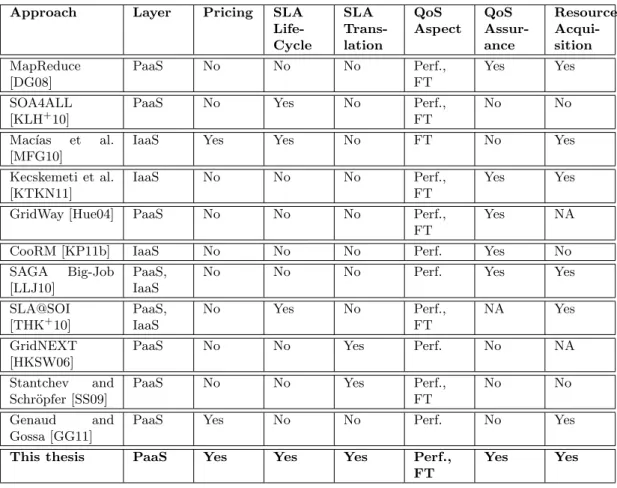
The Table 2.11depicts the comparison of this thesis and main work previously identified in Section 2. The comparing criteria emphasizes the main features for enabling service execution management as explained next.
Layer Refers to the cloud architecture layer tackled by the approach (cf. Section 1.7.2). Approaches which provide resources as abstractions are classified as infrastructure-level (IaaS ) while approaches which provide further higher-infrastructure-level abstractions such as jobs are considered to tackle the platform-level (PaaS ).
Pricing If set yes, means that the approach addresses pricing aspects, e.g., price, costs and fines. Otherwise, no is used.
SLA Life-Cycle This attributed defines whether the approach offer SLA functional-ities which enable addressing the SLA life-cycle. Yes means that the approach covers the SLA life-cycle while no means the contrary.
SLA Translation Refers to translation of SLA high-level properties or QoS metrics to infrastructure-level configuration. If the approach describes how the translation is employed, it is classified as yes, otherwise no is used.
QoS Aspect Expresses which kind of QoS is tackled by the approach. The referred QoS aspects are performance (Perf.) and fault tolerance (FT ).
1Although Amazon provides the Amazon Elastic MapReduce [Ama09], MapReduce [DG08] refers
QoS Assurance If the approach provides QoS assurance mechanisms, yes is used, else it is classified as no.
Resource Acquisition Refers to whether the approach addresses resource acquisi-tion; it may refer to either virtual or physical resources. If so, the approach is classified as yes, otherwise no is applied.
Approach Layer Pricing SLA Life-Cycle SLA Trans-lation QoS Aspect QoS Assur-ance Resource Acqui-sition MapReduce [DG08] PaaS No No No Perf., FT Yes Yes SOA4ALL [KLH+10]
PaaS No Yes No Perf., FT
No No Mac´ıas et al.
[MFG10]
IaaS Yes Yes No FT No Yes Kecskemeti et al.
[KTKN11]
IaaS No No No Perf., FT
Yes Yes GridWay [Hue04] PaaS No No No Perf.,
FT
Yes NA CooRM [KP11b] IaaS No No No Perf. Yes No SAGA Big-Job
[LLJ10]
PaaS, IaaS
No No No Perf. Yes Yes SLA@SOI [THK+10] PaaS, IaaS No Yes No Perf., FT NA Yes GridNEXT [HKSW06]
PaaS No No Yes Perf. No NA Stantchev and
Schr¨opfer [SS09]
PaaS No No Yes Perf., FT
No No Genaud and
Gossa [GG11]
PaaS Yes No No Perf. No Yes This thesis PaaS Yes Yes Yes Perf.,
FT
Yes Yes
Table 2.1: Comparison of main related work according to various criteria.
2.4.2 The Gap
The general observation is that approaches that focus on the infrastructure-level pro-vide actual mechanisms which ensure quality aspects. However, these approaches do not consider higher-level aspects as pricing and SLA management. On the contrary, ap-proaches that address SLA aspects do not specify how QoS properties can be enforced since they focus on high-level SLA management tasks.
Another observation refers to the pricing criterion. Although most approaches enable applying pricing models, they neither define the pricing model nor describe it.
Summary of Related Work 31
In contrast, commercial clouds provide fully information about pricing. Nevertheless, it is not worthy to put these approaches in Table 2.1 because they rely on proprietary solutions which do not described how further criteria are addressed.
With regard to QoS aspect, both performance and fault tolerance are satisfactorily addressed. However, most of solutions rely either on experimented QoS metrics rather than accurate metrics. Regarding resource acquisition, most approaches solve the prob-lem of acquiring resources. Nevertheless, these approaches often exposes resource-level details for final customers.
2.4.3 Filling the Gap
This thesis addresses the required features to build a complete solution for service execution management. The last row of the Table 2.1 shows this thesis addressing all the criteria as a solution in the platform layer. Moreover, it is important to remember that the previous criteria were chosen by aiming at enabling service execution management on top of distributed infrastructures. A summary of how this thesis fills the gap is exposed next.
Pricing This thesis relies on a pricing model whose price formation is based on provider’s costs in a pay-per-use accounting assessment. Penalties for SLA violations are also taken into account whose penalties are computed as monetary terms. More-over, this thesis prioritizes customers which positively contributes for increasing the provider profit.
SLA Life-Cycle This thesis designs and implements a complete set of SLA manage-ment functions which include service negotiation, instantiation, provisioning, and termination. Moreover, this thesis defines how pricing aspects are integrated into its solution.
SLA Translation Based on service profiling, this thesis translates performance and fault-tolerance QoS metrics to lower-level system configurations in order to con-figure the mechanisms responsible for ensuring QoS.
QoS Assurance This thesis provides mechanisms for ensuring both performance and fault-tolerance qualities for distributed services. These mechanisms rely on re-source requirements and dynamic job metrics which enable immediately reacting to job malfunctions.
Resource Acquisition This thesis deals with resource acquisition by transparently acquiring, deploying and releasing resources thus freeing service developers from these time-consuming and error-prone tasks. Moreover, by tackling the whole SLA life-cycle, this thesis assumes that contract negotiation triggers resource acquisition in contrast to current approaches that acquire resources when requests are sent.