HAL Id: tel-02943919
https://tel.archives-ouvertes.fr/tel-02943919
Submitted on 21 Sep 2020HAL is a multi-disciplinary open access archive for the deposit and dissemination of sci-entific research documents, whether they are pub-lished or not. The documents may come from teaching and research institutions in France or abroad, or from public or private research centers.
L’archive ouverte pluridisciplinaire HAL, est destinée au dépôt et à la diffusion de documents scientifiques de niveau recherche, publiés ou non, émanant des établissements d’enseignement et de recherche français ou étrangers, des laboratoires publics ou privés.
Algorithms for a Network Operating
Farah Slim
To cite this version:
Farah Slim. Design and Implementation of Resource Allocation Algorithms for a Network Operating. Networking and Internet Architecture [cs.NI]. Ecole nationale supérieure Mines-Télécom Atlantique, 2018. English. �NNT : 2018IMTA0071�. �tel-02943919�
T
HESE DE DOCTORAT DE
L
’É
COLEN
ATIONALES
UPERIEUREM
INES-T
ELECOMA
TLANTIQUEB
RETAGNEP
AYS DE LAL
OIRE-
IMT
A
TLANTIQUEC
OMUEU
NIVERSITEB
RETAGNEL
OIREECOLE DOCTORALE N°601
Mathématiques et Sciences et Technologies de l'Information et de la Communication Spécialité : Informatique
Par
Farah SLIM
Etude et implémentation d'algorithmes de gestion de ressources
pour un système d'exploitation de réseau
Thèse présentée et soutenue à IMT Atlantique – Campus de Rennes, le 13 mars 2018 Unité de recherche : Irisa
Thèse N° : 2018IMTA0071
Rapporteurs avant soutenance :
Pascal LORENZ Professeur, Université de Haute Alsace André-Luc BEYLOT Professeur, IRIT/ENSEEIHT – Toulouse
Composition du Jury :
Président : Olivier FESTOR Professeur, Université de Lorraine Examinateurs : Pascal LORENZ Professeur, Université de Haute Alsace
André-Luc BEYLOT Professeur, IRIT/ENSEEIHT – Toulouse Christine FRICKER Chargée de recherche, Inria – Paris Hind CASTEL Professeur, Télécom SudParis
Fabrice GUILLEMIN Chef de projet recherche, Orange Labs – Lannion Yassine Hadjadj-Aoul Assistant Professor, Université de Rennes 1 Directeur de thèse : Annie GRAVEY Directeur d’études, IMT Atlantique
Sous le sceau de l’Universit´e Bretagne Loire
IMT Atlantique Bretagne-Pays de la Loire
En accr´editation conjointe avec l’Ecole Doctorale Matisse
Etude et impl´
ementation d’algorithmes de
gestion de ressources pour un syst`
eme
d’exploitation de r´
eseau
Th`
ese de Doctorat
Mention : Informatique Pr´esent´ee par Farah Slim D´epartement : Informatique
Laboratoire : IRISA - Pˆole
Directeur de th`ese : Professeur Annie GRAVEY Soutenance le 15 mars 2018
Jury :
Rapporteurs
Andr´e-Luc Beylot Professeur (ENSEEIHT), Pascal Lorenz Professeur (UHA), Examinateurs
Hind Castel Professeur (IMT Paris Sud) Olivier Festor Directeur de recherche (INRIA) Christine Fricker Charg´ee de Recherche (INRIA) Fabrice Guillemin Ing´enieur de recherche (Orange),
”Alone we can do so little; together we can do so much.” Hellen Keller
I have been accompanied and supported by many people during the last three years, I would never have been able to finish my dissertation without their sup-port. I would like to express my gratitude for all of them.
First and foremost, I would like to express my deepest gratitude to my advisors: Dr.Fabrice Guillemin , D r.Annie Gravey and Dr.Yassine Hadjadj-Aoul for accepting nothing less than excellence from me. I would like to thank them for their excellent guidance, caring, patience, and especially for providing me with an excellent atmosphere for doing research.
I am also grateful to Mr.Ga¨el Fromentoux for giving me the opportunity to live a challenging experience within his team in the Orange Labs and for supporting my work. His support over these three years has been very precious. I would like to thank Mr.Eric Debeau , Mr.Marc Bouillon and Mr.Nicolas Bihannic who were always willing to help and give their best suggestions. Special thanks goes to all ARC team members for help, kindness and support. It was an honor to have the opportunity to work with all of you.
Special thanks goes, as well, to the reading committee for their precious time. Last but not least, my parents Abdallah and Moufida , without whom nothing would have been possible. I would like to thank them for scarifying everything to see me a happy and successful young woman and for supporting me throughout this thesis and my life in general.
I would like to thank my friends Dorra , Maroua and Mariem , my brother Amine and my sister Ghofrane for always supporting me.
Finally, very special thanks goes to you, Dali , my best friend and my everything for always being there cheering me up and standing by me through the good and bad times.
Mots cl´es : Cloud, Infrastructure, Algorithme, Ressources, R´eseaux, Virtuali-sation, Fonction de R´eseaux Virtualis´ee, Blocage
L’un des d´efis majeurs auquel sont confront´es les op´erateurs t´el´ecom aujourd’hui est celui de perdre leur place sur le march´e face `a la multiplication des ser-vices propos´es par les grands acteurs du Web, tels que les GAFA ou Netflix. En esp´erant mieux r´epondre aux besoins de ses clients, le secteur t´el´ecom est d´esormais au cœur d’une transformation digitale. Cette transformation s’appuie sur de nouvelles technologies ´emergentes telles que la virtualisation, les r´eseaux d´efinis par logiciels, et le d´eploiement des services r´eseaux sur le cloud. Ces paradigmes ont ´et´e introduits par diff´erentes initiatives (notamment l’ETSI) qui visent `a virtualiser les fonctions r´eseau en les d´eployant sur le cloud sous le terme virtualisation des fonctions r´eseau (NFV). Cette nouvelle approche sur laquelle s’appuient les op´erateurs t´el´ecom pour acc´el´erer leur transformation num´erique impactera non seulement la mani`ere dont les r´eseaux sont d´efinis mais aussi le rˆole principal de l’op´erateur qui doit d´esormais g´erer les ressources cloud en combinaison avec les ressources r´eseaux.
Un deuxi`eme enjeu technique de cette transformation pour l’op´erateur est celui de r´epondre aux contraintes critiques impos´ees par les fonctions de r´eseaux vir-tualis´ees (NFV) tel que les contraintes temps-r´eel ou latence. En effet, plusieurs fonctions r´eseaux pr´esentent de fortes contraintes en termes de latence et doivent par cons´equent ˆetre d´eploy´ees pr`es de l’utilisateur final. Ces contraintes ont incit´e les op´erateurs t´el´ecom `a revisiter leurs infrastructures pour r´epondre `a ces exi-gences; ceci en distribuant massivement leur data centers pour ˆetre pr´esents dans ce qu’on appelle les Points de Pr´esence (PoP) en bordure du r´eseau. Ceci permet de servir les utilisateurs finaux au plus pr`es et r´epondre aux exigences strictes de certaines fonctions r´eseaux, par exemple les fonctions de Radio Access Network (RAN). Ces data centers diss´emin´es sur la bordure du r´eseaux ont des capacit´es limit´ees en termes de ressources (calcul, stockage et ressources r´eseaux), tout au moins en regard des grands data centers d´eploy´es par les g´eants du cloud tels que Amazon et Google. Le d´efi majeur auquel est confront´e l’op´erateur t´el´ecom
de ressources dans ce contexte.
Dans cette th`ese, on se propose d’analyser les modifications qui vont affecter l’infrastructure de l’op´erateur dans le but d’´etudier l’allocation de ressources dans le contexte de data centers distribu´es en bordure de r´eseau en tenant compte de nouvelles contraintes qui n’ont pas ´et´e consid´er´ees dans les plateformes cloud traditionnelles.
Nous proposons d’abord un mod`ele probabiliste d’estimation de blocage des requˆetes dans les plateformes cloud.
Traditionnellement, les ressources dans les plateformes cloud sont suppos´ees in-finies et le blocage des requˆetes est g´en´eralement ignor´e `a cause de cette hy-poth`ese. Mais avec l’´evolution de l’infrastructure de l’op´erateur vers une infras-tructure massivement distribu´ee et caract´eris´ee par des capacit´es finies, le blocage est une m´etrique cl´e pour ´evaluer les algorithmes d’allocation de ressources dans ce contexte.
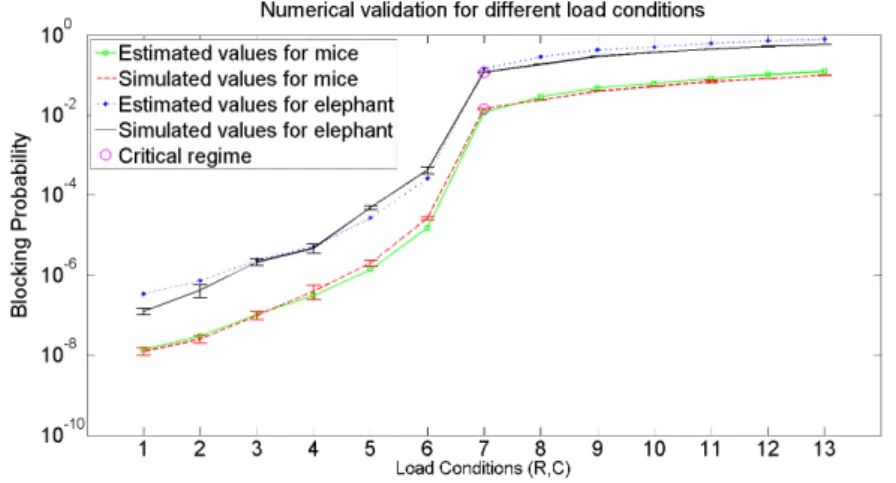
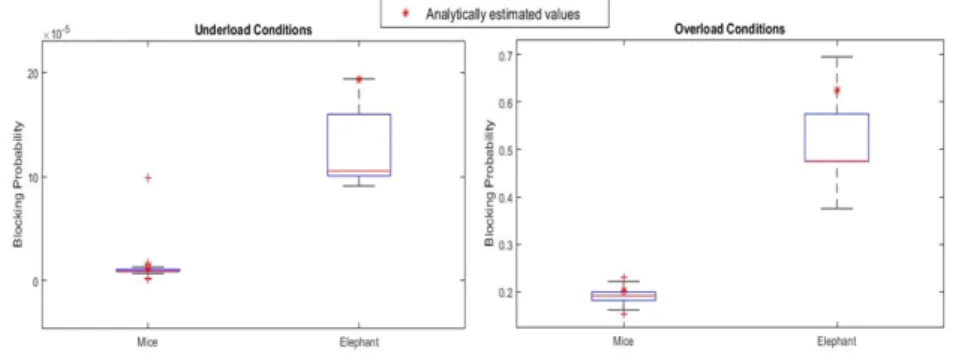
Pour l’analyse de cette m´etrique, nous avons propos´e un mod`ele analytique pour l’analyse de blocage dans un syst`eme cloud multidimensionnel, qui a ´et´e valid´e dans un premier lieu en utilisant un simulateur `a ´ev´enements discrets ´ecrit en Matlab. Par la suite, nous avons effectu´e une analyse comparative des strat´egies d’allocation de ressources utilis´es dans la litt´erature et par la plateforme de gestion populaire Openstack.
Le mod`ele propos´e ainsi que l’´etude comparative, r´ev`elent des r´esultats pratiques sur l’´evaluation de la performance des strat´egies d’allocation de ressources ainsi que le dimensionnement des syst`emes cloud distribu´es avec des capacit´es limit´ees. On propose ´egalement dans ce travail une strat´egie d’allocation de ressources qui facilite la gestion de l’infrastructure pour l’op´erateur et qui pr´esente des performances meilleures que dans l’approche utilis´ee par la plateforme cloud Openstack, fortement recommand´ee dans le contexte NFV.
La strat´egie adopt´ee par le projet Tricircle, la version Openstack d´edi´ee aux d´eploiements multi-sites, ´etant tr`es couteuse en termes d’´echange d’informations entre l’orchestrateur global et l’infrastructure, nous proposons un algorithme d’allocation de ressources nomm´e CLOSE et qui prend en compte les informa-tions locales seulement. Notre strat´egie CLOSE propose ´egalement un m´ecanisme de collaboration entre les plateformes cloud avec des capacit´es limit´ees. Ce
qui respecte la contrainte de latence impos´ee par la requˆete.
Pour le choix de voisin, nous avons consid´er´e 2 variantes de l’algorithme:
• al´eatoirement parmi les premiers voisins de la plateforme qui a re¸cu la requˆete initialement
• en se basant sur un compteur qui enregistre toutes les requˆetes redirig´ees au niveau de chaque plateforme. Ce compteur est une moyenne glissante dans le temps qui refl`ete le niveau de congestion des data centers. L’id´ee, c’est de choisir le data center qui a moins d´efl´echi de requˆetes dans le pass´e. Ce compteur est donc d´efini en se basant sur des informations locales et limite l’´echange d’informations entre l’infrastructure et l’orchestrateur global.
Pour l’´evaluation de performances de notre strat´egie, nous avons d´efini plusieurs sc´enarios de simulations pour comparer la performance de CLOSE contre celle obtenue en utilisant le m´ecanisme propos´e dans la litt´erature, notamment le pro-jet Tricircle d´edi´e pour les d´eploiements multi-sites dans Openstack. Il s’av`ere que l’algorithme propos´e pr´esente des performances meilleures que dans l’approche utilis´ee par la plateforme cloud Openstack, fortement recommand´ee dans le con-texte NFV.
En effet, pour acc´el´erer la transition vers la virtualisation, plusieurs projets ont r´ecemment ´emerg´e pour orchestrer les fonctions r´eseaux au sein de l’infrastructure. Le projet ONAP a ´et´e cr´e´e en fusionnant deux des plus grandes initiatives open source: ECOMP et Open-O.
En prenant des avantages de les deux projets, ONAP repose sur une architecture unifi´ee pour offrir une plate-forme ouverte permettant aux utilisateurs finaux de cr´eer leurs propres fonctions de r´eseaux virtualis´ee. La plateforme vise `a automatiser, orchestrer et g´erer les fonctions virtualis´ees et les services r´eseau. On se propose dans ce travail d’explorer le m´ecanisme d’allocation de ressources adopt´e par la plateforme d’orchestration ONAP, d’identifier les limites de ce m´ecanisme pour proposer par la suite une solution mieux adapt´ee au contexte NFV et qui ne n´ecessite aucune modification au pr´ealable.
Dans l’architecture d’ONAP actuelle, les d´ecisions de placement sont prises d’une mani`ere centralis´ee par le contrˆoleur de l’infrastructure. Bas´e sur un algorithme
Cette mise en œuvre actuelle ne supporte aucune fonctionnalit´e multi-site, puisque l’allocation des ressources est faite sans prise en compte de la situation g´eographique. En effet, une fonction de r´eseau virtualis´ee est en g´en´eral compos´e de plusieurs composants (appel´e ´egalement sous-fonctions ou microservices), qui ex´ecutent des tˆaches situ´es `a diff´erents niveaux fonctionnels du r´eseau, certains faisant partie du plan de donn´ees(data plane), tandis que d’autres font partie du plan de contrˆole du r´eseau(control plane).
Les fonctions de type data plane pr´esentent des contraintes strictes en terme de latence tandis que les fonctions control plane sont plus tol´erents. Partant de cette observation, nous avons propos´e un m´ecanisme d’allocation de ressources qui favorise le placement des fonctions de type data plane au niveau de la bordure du r´eseau en d´epla¸cant les fonctions de type control plane vers d’autres niveaux, ´
etant donn´e qu’elle ne poss`edent pas des contraintes strictes en terme de latence. Pour cela, nous avons propos´e un m´ecanisme de d´eflexion bas´e sur des seuils d’acceptation des fonctions de type control plane au niveau de la bordure du r´eseau. Ces seuils sont dynamiquement ajust´es au cours du temps en se basant sur les conditions de charges du syst`eme.
L’´evaluation de performances de notre stratg´eie propos´ee dans le cadre de la plateforme ONAP a ´et´e r´ealis´ee avec des simulations en comparant les r´esultats par rapport aux r´esultats donn´ees en utilisant l’approche adopt´ee par ONAP, `a savoir la strat´egie d’allocation de ressources dans le projet multi-sites propos´e par Openstack. Il s’av`ere qu’en terme de taux de blocage global, notre strat´egie pr´esente de meilleures performances par rapport aux performances obtenues avec la strat´egie adopt´ee par ONAP.
Finalement, dans le dernier volet de ce manuscrit, on se propose d’´etudier l’ajustement des seuils utilis´es dans la contexte de la plateforme ONAP en se basant sur la technique d’optimisation populaire, `a savoir les algorithmes g´en´etiques. La strat´egie qu’on propose consiste `a d´efinir des seuils d’acceptation de requetes optimaux et qui am´eliorent la collaboration entre les data centers voisins, un m´ecanisme que nous avons utilis´e pour le placement des fonctions de r´eseaux virtualis´ees dans ce travail. Dans plusieurs sc´enarios, nous avons prouv´e avec des simulations que les seuils optimaux donn´ees par l’algorithme g´en´etique qu’on a propos´e am´eliore la collaboration et r´eduit significativement le taux de blocage moyen de notre strat´egie d’allocation de ressources.
Key words : Cloud, Infrastructure, Algorithm, Resource Allocation, Networks, Virtualization, Virtualized Network Function, Blocking
One of the major challenges for network operators is the proliferation of services offered by the Web players (e.g., GAFA, Netflix, etc.). Trying to satisfy the needs of their customers and to keep their footprint in the digital market, net-work operators are rethinking their business models by adopting new emerging technologies such as virtualization, software-defined networks, and the deploy-ment of cloud-based network services. The paradigm of Network Function Vir-tualization (NFV) has been introduced through the initiative by the European Telecommunications Standards Institute (ETSI), which aims at virtualizing net-work functions by deploying them on the cloud. This new approach on which telecom operators rely to accelerate their digital transformation will impact not only the way networks are defined but also the main role of the operator, who now has to manage cloud resources in combination with network resources. A critical point in NFV is raised by the intrinsic constraints of virtualized net-work functions (VNFs) such as real-time or latency. Indeed, several netnet-work functions have high latency constraints and must therefore be deployed close to the end user. These constraints prompted telecom operators to revisit their in-frastructure to meet these requirements, namely by massively distributing data centers in the so-called Points of Presence (PoPs) at the edge of the network. This allows the stringent requirements of certain network functions to be met; this notably the case for virtual Radio Access Network (RAN), which consists of virtualizing base station functionalities. These data centers geographically spread at the edge of the network have rather limited capacity in terms of re-sources (computing, storage and network rere-sources) when compared with the huge data centers deployed by cloud giants such as Amazon. The major chal-lenge for a telecom operator is the infrastructure management that combines cloud and network resources. This requires the implementation of appropriate algorithms for the allocation of resources in this context.
into account new constraints that have not been so far considered in traditional cloud platforms. We first propose a probabilistic model for the estimation of blocking in cloud platforms; this point has not been addressed in the literature, always assuming that cloud resources are infinite. This model, which has been validated by several scenarios, will enable the operator to adequately dimension the resources of its infrastructure. In addition, we evaluate the performance of the most popular resource allocation algorithms that have been adopted in the NFV context as in the traditional cloud based on this model.
We then propose a resource allocation strategy that facilitates the management of the infrastructure by the operator. This strategy yields better performance when compared to the approach adopted by the OpenStack cloud platform, highly recommended in the NFV context. Finally, we analyze the management of re-sources in NFV orchestration platforms by exploring the two basic functions in this process, namely monitoring and scheduling. We also investigate the resource allocation mechanism adopted by the popular ONAP orchestration platform to identify its limits and to propose a solution that is better adapted to the NFV context.
Acknowledgements i
Abstract vi
List of Figures xi
List of Figures xii
List of Tables xiii
Abbreviations xiv
1 Introduction 1
1.1 Telecommunication Network Evolution . . . 1
1.2 Problem Statement . . . 3
1.3 Document Structure . . . 4
2 State Of the Art 6 2.1 Introduction. . . 6
2.2 Motivations . . . 7
2.2.1 Software Defined Network . . . 7
2.2.2 Network Function Virtualization . . . 8
2.3 Virtualization and Cloud Computing . . . 8
2.3.1 Virtualization As a Paradigm . . . 9 2.3.2 Resource virtualization. . . 11 2.3.2.1 CPU virtualization . . . 11 2.3.2.2 Memory virtualization. . . 11 2.3.2.3 Virtual networking. . . 11 2.3.3 Resource overcommitment . . . 11 2.3.4 Benefits of Virtualization . . . 12 2.3.4.1 Resource sharing . . . 12 2.3.4.2 Server Consolidation. . . 12 2.3.4.3 Reducing costs . . . 13 2.3.4.4 Agility . . . 13 2.3.4.5 Faster backup . . . 13
2.3.5 Cloud Management Platforms. . . 13
2.3.5.1 OpenNebula . . . 14
2.3.5.3 Openstack . . . 14
2.4 Centralized vs Distributed Cloud Infrastructure . . . 17
2.5 Related Work on Resource Allocation Strategies . . . 18
2.5.1 Problem Statement. . . 18
2.5.2 Resource Allocation Algorithms . . . 20
2.5.2.1 MILP . . . 20
2.5.2.2 Heuristic-based approaches . . . 21
2.5.2.2.1 FFD-based heuristics . . . 21
2.5.2.2.2 Multidimensional aware heuristics . . . 24
2.6 Testbed Platform . . . 28
2.6.1 Network Topology Discovery . . . 29
2.6.2 Resource Utilization Level Collector . . . 31
2.7 Summary . . . 32
3 Performance Evaluation Of Resource Allocation Algorithms 33 3.1 Introduction. . . 34
3.2 Background . . . 35
3.2.1 Virtual Network Function Placement . . . 35
3.2.2 Analysis of Blocking in Cloud Computing . . . 36
3.3 Resource Allocation Algorithms In Centralized Cloud Platforms. 37 3.3.1 Model Settings . . . 38
3.3.2 Blocking in a grouped data center: One Big Server . . . . 39
3.3.3 Numerical Validation of the proposed model. . . 41
3.3.4 Evaluation of resource allocation algorithms . . . 44
3.3.4.1 Two-Class System . . . 44
3.3.4.2 Four-Class System . . . 47
3.4 Resource Allocation Algorithms In Distributed Cloud Platforms 49 3.4.1 Related Work on resource allocation in Distributed Cloud 49 3.4.2 CLOSE: A Services’ Offloading Algorithm for Distributed Edge Cloud . . . 52
3.4.2.1 Preliminary considerations . . . 52
3.4.2.2 Algorithm principles . . . 53
3.4.3 Performance Evaluation of the CLOSE Algorithm . . . . 56
3.4.3.1 Simulation settings . . . 57
3.4.3.2 Simulation Results . . . 58
3.5 Summary . . . 61
4 Orchestration Platforms For NFV 63 4.1 Introduction. . . 63
4.2 Background . . . 64
4.2.1 MANO: Management and Orchestration for NFV. . . 64
4.2.2 Related Work on Orchestration Platforms . . . 65
4.3 Monitoring feature . . . 66
4.3.1 What is Monitoring ? . . . 66
4.3.2 The impact of monitoring traffic: . . . 68
4.4 Scheduling feature: use case ONAP. . . 69
4.4.2 Resource allocation principle under ONAP . . . 72
4.4.3 Proposal: Dynamic Adaptive Placement for ONAP . . . . 73
4.4.3.1 Preliminary considerations . . . 73
4.4.3.2 Resource allocation scheme . . . 75
4.4.4 Performance Evaluation . . . 77
4.4.4.1 Simulation settings . . . 77
4.4.4.2 Results and Discussion . . . 78
4.4.5 Threshold Optimization by Genetic Algorithm . . . 81
4.4.5.1 Genetic Algorithm . . . 81
4.4.5.2 Optimal Offloading Threshold by Genetic Algo-rithm . . . 83
4.4.5.3 Results and Discussion . . . 86
4.5 Summary . . . 89 5 Conclusion 91 5.1 Main Contributions. . . 91 5.2 Research perspectives . . . 93 5.3 Publications . . . 94 Bibliography 95
2.1 Server Virtualization architecture. . . 9
2.2 Server architecture for BBUs Virtualization [1]. . . 10
2.3 Virtual machine placement. . . 19
2.4 Server state before the placement . . . 24
2.5 Server state after the placement . . . 24
2.6 Normalized Resource Cube . . . 25
2.7 Imbalance degree vector . . . 26
2.8 Grouping PMs for scheduling . . . 27
2.9 Dot product approach . . . 28
2.10 Integrated IT and Network test-bed Platform.. . . 28
2.11 Network topology informations. . . 30
2.12 Network topology informations. . . 30
2.13 Resources utilization level. . . 31
3.1 Model settings . . . 38
3.2 One Big Server Model settings . . . 39
3.3 Numerical Validation Of the Model with two-dimensional system . 42 3.4 Numerical Validation Of the Model with three-dimensional system . 44 3.5 Blocking Rates in an Underloaded System . . . 45
3.6 Blocking Rates under critical load conditions . . . 46
3.7 Blocking Rates in an Overloaded System . . . 47
3.8 Resource requirements of VM classes . . . 47
3.9 Cloud load per VM class . . . 48
3.10 Blocking Rates in an Underloaded System . . . 48
3.11 Blocking Rates in an Overloaded System . . . 49
3.12 Tricircle Architecture . . . 52
3.13 Network topology under consideration. . . 57
3.14 Blocking rates under different load conditions.. . . 58
3.15 CDFs of Latency: CLOSE vs Full Sharing. . . 59
3.16 Per-profile CDFs of Latency for the CLOSE algorithm. . . 60
3.17 Jain’s index for resource utilization level. . . 60
3.18 Algorithm Behavior under different load conditions. . . 61
4.1 NFV Management and Orchestration Architecture . . . 65
4.2 Agent-Based Monitoring . . . 67
4.3 VM-Based Monitoring . . . 68
4.4 ONAP Simplified Architecture. . . 71
4.6 Blocking rates For Control Plane Functions. . . 79
4.7 Blocking rates For Mec Applications. . . 80
4.8 Blocking rates For Data Plane Functions. . . 80
4.9 Adaptive threshold variation according to the current load . . . . 81
4.10 Principle of a basic GA. . . 82
4.11 Methodology of Threshold Optimization by GA . . . 83
4.12 GA for Optimizing Thresholds. . . 84
3.1 Parameter values for underloaded conditions. . . 45
3.2 Parameter values for critical load conditions. . . 45
3.3 Parameter values for overloaded conditions. . . 46
3.4 Notation used in the distributed algorithm. . . 55
4.1 Load Conditions and Optimal Thresholds. . . 87
4.2 Blocking Rates. . . 87
4.3 Load Conditions and Optimal Thresholds. . . 87
4.4 Blocking Rates. . . 87
4.5 Load Conditions and Optimal Thresholds. . . 88
4.6 Blocking Rates. . . 88
4.7 Load Conditions and Optimal Thresholds. . . 88
5G Fifth Generation
AAI Active and Available Inventory API Application Program Interface AWS Amazon Web Services
BBU BroadBand Units
CDN Content delivery network CO Central Office
CCO Core Central Office COTS Commercial Off-The-Shelf
DCAE Data Collection, Analytics and Events
E2E End-To-End
EPC Evolved Packet Core
ETSI European Telecommunications Standards Institute GAFA Google Amazon Facebook Apple
HSS Home Subscriber Server HPC High Performance Computing IT Information Technology IaaS Infrastructure-as-a-Service IP Internet Protocol
MANO Management and Orchestration MEC Mobile Edge computing
MCO Main Central Office
MME Mobility Management Entity MSO Master Service Orchestrator NFV Network Function Virtualization
NIC Network Interface Card NFVI NFV Infrastructure NFVO NFV orchestrator NO Network Operator
ONAP Open Network Automation Platform OTT Over-The-Top
PM Physical Machine PoP Point Of Presence
PDCP Packet Data Convergence Protocol RAN Radio Access Network
RLC Radio Link Control SDN Software Defined Network SDC Service Design and Creation S/PGW Servicing/Packet Gateway Telco Telecom Operator
VM Virtual Machine
VIM Virtual Infrastructure Management VNFM Virtual Network Functions Manager vEPC Virtual EPC
Introduction
Contents
1.1 Telecommunication Network Evolution . . . 1
1.2 Problem Statement . . . 3
1.3 Document Structure. . . 4
1.1
Telecommunication Network Evolution
Technology is changing our lives faster than ever before. Communication, health care or entertainment, our daily life is overwhelmed by the use of technology in almost every field. This is made possible by the emergence of smart devices that are becoming more ingrained in today’s routine.
The Fortinet White paper indicates that more than a million new smart devices are connected to the Internet every day (Fortinet 2017) [2].
At the same time, with this explosion of the Internet of Things (IOT), the network usage is exploding and the mobile data traffic is expected to increase each year. In fact, a Cisco White Paper (Cisco 2016) reports that mobile data is expected to grow by 11 times in the next four years and that 50 billion IOT devices will be connected by 2021 [3].
This growth creates a challenge for telcos (telecom operators) who have to deal with these new waves of demands and spend huge efforts to not only meet cus-tomer demand but also to improve user experience.
Another major challenge facing telcos over the past years and all over the world is the significant growth of Over-The-Top (OTT) providers such as Google, Amazon
and Netflix. Telcos are losing their share of revenue as their primarily role is limited to mere traffic carriers rather than service provisioning. Hence, network operators need to regain their foothold in the market and make major changes in how they build and run their networks, offer new services and interact with customers [4].
As a result, telcos are embracing a new digital transformation that is rethinking their business models by adopting new approaches and emerging technologies such as the Virtualization of Network Functions (NFV).
One of the key initiatives in the communication industry is upgrading networks to virtualization that will free telcos from hardware dependence. NFV aims at decoupling network functions from proprietary hardware appliances so that such functions can run as software on commercial off-the-shelf (COTS) hardware. NFV is changing the way networks are managed, offering more scalability and flexibility, and helping to create programmable networks for tomorrow’s needs. Literally, NFV, this technology developed by the European Telecommunication Standards Institute (ETSI), is a key enabler of the coming 5G infrastructure helping to implement the most discussed concepts for designing 5G networks such as Network Slicing. This concept makes it possible to create several virtual networks on the top of the shared underlying infrastructure [5].
Another technological pillar in the architecture of future 5G mobile networks on which telecom operators rely to accelerate their journey towards virtualization is the Software Defined Network (SDN). SDN provides a programmable interface that controls and orchestrates networks at different levels of abstraction. Thanks to this paradigm, telcos can dynamically reconfigure the network using only software mechanisms. This is the reason why SDN promises to bring more agility and flexibility to the future network.
Network Virtualization is certainly a major revolution that will impact not only the architecture of networks but also the network operators infrastructure. In fact, to meet stringent real-time constraints, some network functions have to be hosted close to end users (e.g. Radio Access Network (RAN) functions, firewalls, deep packet inspection).
These latency requirements incite telcos to massively distribute their cloud in-frastructure in order to be closer to end users. This lead to the development of geographically distributed mini data centers at the edge of the network (i.e. typically at Points of Presence (PoPs) level). Therefore, the network operator
infrastructure is evolving towards a distributed architecture of edge data centers with limited capacities deployed close to the end users.
To sum up, the new digital transformation is driven by the evolution of the net-work operator infrastructure towards a massively distributed architecture cou-pling cloud and network. However, due to this transformation, there are several challenges facing telcos who want to run in-cloud network.
1.2
Problem Statement
As we have said, the telecommunication infrastructure is going through a major transformation involving many radical changes. In fact, the recent emergence of new bandwidth-intensive and time-constrained services notably Virtualized Network Functions (VNFs) [6] is pushing network operators to geographically distribute mini data centers at the edge of the network. These edge data centers have rather small capacities of storage, compute and networking resources when compared to huge centralized data centers deployed, for instance, by Google1 or Amazon.
This groundbreaking transformation raises many new challenges for network op-erators who henceforth have to manage cloud infrastructure in combination with network. The real challenge lies in how to manage cloud platforms in combina-tion with network. In other words, the network resource, namely the bandwidth, must be considered in addition to cloud resources such as storage or compute while instantiating services. In this context, we addressed this issue within cen-tralized cloud platforms as well as massively distributed platforms.
In addition, we evaluated performance of the most popular resource allocation algorithms by paying special attention to the blocking probability metric which has so far not been considered in the cloud literature.
In fact, in the context of telco cloud and given the evolution of the infrastructure that will very likely be composed of small data centers with limited capacities and deployed at the edge of network, blocking is a key performance metric to evaluate algorithms
Another major challenge that telco are facing while moving towards virtual-ized network functions is to deliver end-to-end network services by instantiating
1
VNFs, within the virtualized infrastructure, whilst taking into account their spe-cific requirements. To cope with these challenges, there is a need to have a global orchestration platform, including instantiation logic, life-cycle management, as well as monitoring features. We explored in this thesis the monitoring feature by studying the impact of monitoring traffic and evaluating some monitoring tools that might be useful with regard to resource allocation. Furthermore, we conducted a technical study of the popular orchestration platform, namely the Open Network Automation Platform (ONAP). We finally proposed an appropri-ate resource allocation strappropri-ategy to adopt in this context and then presented to ameliorate it using the Genetic Algorithm approach.
This work was done in the scope of Orange Labs research projects.
1.3
Document Structure
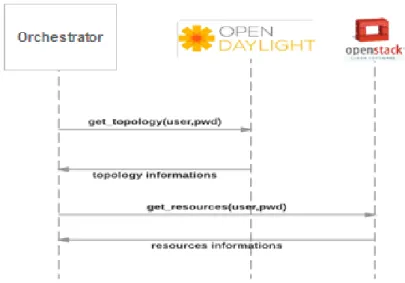
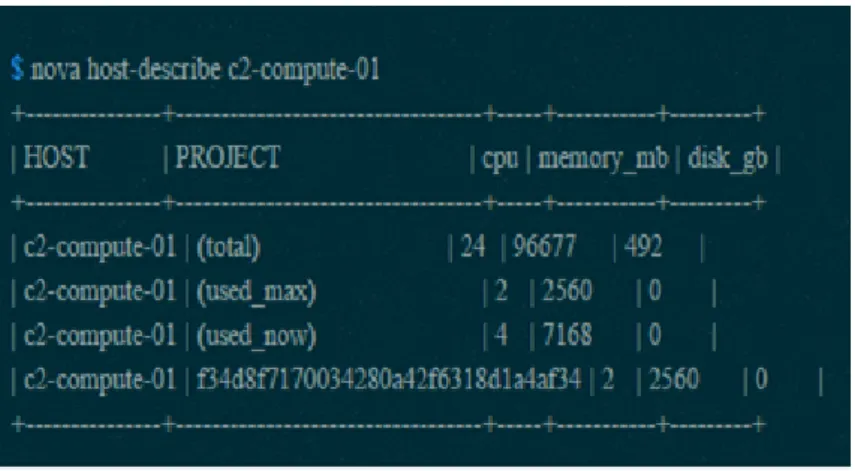
In Chapter 2, we first discuss the motivations that drive network operators towards virtualization. We then review the context of our thesis by providing a state of the art of cloud computing and virtualization. We focus on resource allo-cation strategies and the related existing solutions. Finally, we present a testing platform of a telco infrastructure that we have set up to identify hypotheses in this context. Furthermore, this platform enabled us to explore capabilities of some monitoring tools that may be useful for the resource allocation.
In Chapter 3, we conduct a study in order to evaluate performance of resource allocation strategies under centralized as well as distributed approaches. First, we propose an analytical model for the blocking analysis in multidimensional centralized cloud system. We lead a comparative analysis of the most popular placement’s strategies based on our proposed model. Second, we propose a new strategy for resource allocation in distributed cloud context. We show that our strategy yields better performance when compared to the strategy adopted by the most popular cloud management platform, namely Openstack.
In Chapter 4, we present orchestration platforms for NFV by studying its main features including monitoring and scheduling. We first study the impact of monitoring traffic. We then propose an offloading strategy based on thresholds that can be applicable in the context of ONAP. We finally propose to set the optimal threshold for the offloading strategy based on the Genetic Algorithm techniques.
In Chapter 5, we point out the main contributions of this thesis and give the research perspectives in relation to the ongoing works.
State Of the Art
Contents
2.1 Introduction . . . 6
2.2 Motivations . . . 7
2.2.1 Software Defined Network . . . 7
2.2.2 Network Function Virtualization . . . 8
2.3 Virtualization and Cloud Computing . . . 8
2.3.1 Virtualization As a Paradigm . . . 9
2.3.2 Resource virtualization. . . 11
2.3.3 Resource overcommitment . . . 11
2.3.4 Benefits of Virtualization . . . 12
2.3.5 Cloud Management Platforms. . . 13
2.4 Centralized vs Distributed Cloud Infrastructure. . . 17
2.5 Related Work on Resource Allocation Strategies . . 18
2.5.1 Problem Statement. . . 18
2.5.2 Resource Allocation Algorithms . . . 20
2.6 Testbed Platform . . . 28
2.6.1 Network Topology Discovery . . . 29
2.6.2 Resource Utilization Level Collector . . . 31
2.7 Summary . . . 32
2.1
Introduction
During the last decade, carrier grade virtualization technologies have been very successful in offering on-line services via on-demand computing and storage ca-pacities in the cloud (cf. EC2 by Amazon, Azure by Microsoft, etc.). While cloud
resources were so far used to run applications owned by end users (residential or business customers), various initiatives in the design of 5G networks, including ETSI NFV and SDN, explore the virtualization of network. There is hence a clear need for carry out a study aiming at understanding keys technologies notably virtualization and cloud computing to diagnose the new challenges leveraged by the emergence of network virtualization in the context of telco cloud.
In this chapter, we first discuss motivations for this work within Section2.2. Sec-tion 2.3 explores the background of the virtualization technology as well as the cloud computing concept, then some prevalent data centers management tools such as Openstack are presented. The main differences between centralized and distributed cloud are discussed in Section 2.4. In Section 2.5, we present an overview for resource allocation techniques in cloud computing with the corre-sponding related works. An overview of a testbed platform set up to assimilate the context in real case scenarios is presented in Section 2.6. Section 2.7 con-cludes this chapter.
2.2
Motivations
The convergence of IT and Telecom is a fundamental transformation that will deeply modify the way network operators conceive, produce and operate their services. This transformation incites telcos to redefine their business model by taking inspiration from IT cloud approaches in the manner of major actors such as OTT players. This revolution is now made possible by the emergence of new technological paradigms such as Network Function Virtualization (NFV), Software Defined Network (SDN) and service orchestration. With reference to 5G networks, the complementary relation between these technologies is described in [7].
2.2.1 Software Defined Network
As any new technology, there is no single definition of Software Defined Network. Over the last two years, most definitions have emphasized decoupling control logic from the forwarding hardware. In fact, the network intelligence is logically centralized in software-based controllers so called the control plane, and network devices become simple packet forwarding devices (the data plane) that can be programmed via an open interface [8].
The emerging definition of SDN is focusing less on decoupling control logic and more on the ability to provide programming interfaces within network equip-ments [9]. The main idea is to permit network operators to rely on network resources in the same easy manner as they do on storage and computing re-sources.
SDN promises to bring to the network what virtualization has brought to the server domains during these last years; better use of network resources, simplifi-cation and automation of network provisioning through the use of programmable interfaces and a global abstraction of hardware resources [10].
2.2.2 Network Function Virtualization
In the recent few years, cloud and virtualization have enabled the emergence of virtualization of network functions allowing network operators to decouple net-work functions from proprietary hardware appliances so that such functions can run in software. The ETSI Industry Specification Group for Network Functions Virtualization (ETSI NFV) is the group charged with designing architecture and developing requirements for various functions for telco networks.
NFV promises telco to deliver agility and flexibility by quickly scale up or down services to address variation of demands and to support innovation by enabling networking services to be running only via software on any industry-standard hardware [11].
Reducing operator CAPEX and OPEX costs is also one of the major benefits of NFV. In fact, NFV reduces equipment costs and power consumption due to the freedom to choose and build the hardware in the most efficient way that suit telcos needs and requirements [12]. It’s clear that NFV can address the key trends confronting operators. Therefore, NFV is considered as one of the key technologies on which telcos rely in their digital transformation.
2.3
Virtualization and Cloud Computing
Generally speaking, data centers offer the possibility to residential as well as busi-ness customers to run applications by reserving computing and storage (CPU,RAM and Disk storage). However, customers workloads have a dynamic aspect. In fact, resource requirements vary continuously over the time, or are one resource centric which means that they need one resource more than the others (CPU
intensive or memory intensive). In such cases, most of the resources in the phys-ical infrastructure of data centers are vastly underused especially if applications are hosted on dedicated servers which is the case of traditional data centers.
2.3.1 Virtualization As a Paradigm
The revolution of the virtual technology has made possible the virtualization of physical infrastructure in data centers enabling more efficient resource utilization by pooling resources of storage, networking and computing from several formerly siloed data centers to create a central, flexible pool of resources that could be reallocated based on needs [13].
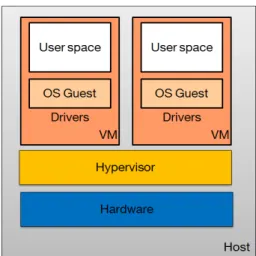
Virtualization allows multiple instances of different Operating Systems (OS) such as Linux or windows to run simultaneously on a single physical host. Each OS is running on a virtual machine and operates as if it was dedicated to a physical computer. The guest OS accesses the hardware architecture underlying via a lightweight system called Hypervisor kernel. The hypervisor acts as a referee between the guest systems; it time-slices the physical processors and resources to each VMs and ensures confinement of guests in their own space [14]. The virtualization technology is a key enabler of cloud computing where applications are not hosted on dedicated servers anymore, but instead in a number of running virtual machines (VMs) and sharing physical resources of the physical machines (PMs) behind [15].
Figure2.1shows the server virtualization architecture with the two components core,notably the hypervisor and the VM.
• Hypervisor An hypervisor or VM monitor is a system virtualization soft-ware that is running within the operating system of the host. It recreates, through software, a complete runtime environment for a program or a guest system called virtual machine. The hypervisor manages and multiplexes access to the physical resources maintaining isolation between all guests at all time. All guest operations are intercepted and translated to be executed by the host environment, which consumes hardware resources.
• Virtual machine The VM is the component core of the virtualization architecture. It can be defined as a software implementation of a computer that runs an operating system and executes programs just like a physical computer. Virtual machine or guest uses virtual hardware resources offered by the physical machine : virtual CPU, memory, hard disk and network interface cards. Guest Operating system sees ordinary hardware devices and is not aware that these devices are virtual.
Virtualization technology is a key enabler of Network Function Virtualization that reveals practical insights into VNFs deployments. Several VNFs could for example run on the top of the guest OS of one physical server. In the context of the use case Cloud RAN, the virtualization intervenes at the BBU level. Figure 2.2illustrates BBUs running on virtual machines on the top of COTS server. It is clear that virtualization has many benefits, including reduced communication time between BBUs and scalability since that VMs are much easier to turn off or up than PMs [16].
2.3.2 Resource virtualization
2.3.2.1 CPU virtualization
When many VMs are running on the same host, hypervisor time-slices the phys-ical processors across all of them so each VM runs as if it has its own number of virtual processors. This feature allows to run different OS in the same server.
2.3.2.2 Memory virtualization
When a VM starts to run, virtualization layer creates a contiguous addressable memory space as the allocated memory for the VM. This allows the hypervisor to run multiple VMs simultaneously while protecting memory of each VM from being accessed by others.
2.3.2.3 Virtual networking
The key virtual components in the virtual networking are virtual Ethernet adapters and virtual switches :
• A virtual machine can be configured with one or more virtual Ethernet adapters.
• A host can contain multiple virtual switches which act just like any physi-cal Ethernet switch and forwards frames at the data link layer. The virtual switch enables VMs on the same host to communicate with each other using the same protocols used over physical switches without the need for addi-tional hardware. It also connects to the external network through physical Ethernet adapters. The virtual switch is capable of binding multiple vir-tual network cards together, offering greater availability and bandwidth to the VM.
2.3.3 Resource overcommitment
Resource overcommitment is a process ensured by the hypervisor which enables the allocation of more resource for VMs than the host physically has. For exam-ple, a host with 6GB of memory available can runs 5 VMs with 2GB for each one, so we can say that the host’s machine memory is overcommited. This is
possible because hypervisor is aware of the resource utilization of each VM which mostly don’t use its full allocated memory. This comes with benefits especially for platforms developed for cloud computing where latency can be tolerated [17]. However, for latency-sensitive applications such as network functions, overcom-mitment may affect performance of running VNFs.
Among best practices for performance of NFV recommended by VMWare, over-commitment has to be disabled [18].
2.3.4 Benefits of Virtualization
Virtualization techniques provide several advantages for cloud computing [19], notably:
2.3.4.1 Resource sharing
The major advantage of virtualization is resource sharing. Physical resources of hosts are sharing among the virtual machines. Thus, running on the same host, for each virtual machine is allocated a portion of it’s physical resources: CPUs, physical network cards, disk controller and a region of memory. This virtualization feature improves the resource utilization of servers counter to the traditional approach which dedicates a server for each application.
Resource sharing can reduce communication time between VNF sub-functions by deploying them in multiple VMs on top of the same physical host.
2.3.4.2 Server Consolidation
In traditional data centers, each application runs on a dedicated server,so most of the resources in the physical infrastructure are vastly underused. But with virtualization, multiple applications can run on a single server, which reduces the number of servers.
Consequently, energy consumption is significantly reduced which is very advan-tageous for Network operators looking to save network energy and to build green network which became a critical requirement with the expanding of the network size [20].
2.3.4.3 Reducing costs
For the cloud provider, hardware is always the most expensive component in the datacenter. Because virtualization reduces the number of servers, cost also goes down.
As a matter of fact, Capex and Opex also go down for Network Operators which is line with NFV goals.
2.3.4.4 Agility
One of the greatest advantage offered by virtualization and not available on traditional data centers is live migration which enables to easily move a virtual machine from one host to another for several needs. This feature makes the infrastructure more agile and improves the resource utilization in the data center. Virtualization offers great opportunities for telcos by ensuring agility, the big promise of NFV.
2.3.4.5 Faster backup
Thanks to what we call a snapshot of a virtual machine which can provide informations about the state of several machines at a single point in time, full backup of what is running in the infrastructure can be created easily.
This feature eases the monitoring for the infrastructure management which is considered as a critical requirement for NFV [21].
2.3.5 Cloud Management Platforms
In order to extend the server virtualization environment with an Infrastructure-as-a-Service (IaaS) cloud, there is a need for cloud management platforms. These deployment platforms are in charge of setting up virtual infrastructure and the virtual management on top of that infrastructure.
There are many cloud deployment solutions that include all many components necessary for the the management and the control of a virtualized infrastructure: deployment, resource orchestration and application monitoring. Goals of these platforms are the same, but architecture and strategies differ from a solution to another.
2.3.5.1 OpenNebula
OpenNebula is an open-source Cloud Management tool that enables several fea-tures like security, virtualization, storage, and network solutions deployed in the data center. These features also facilitate its integration with any product and service in the cloud ecosystem, and management tool in the data center. Open-Nebula provides an abstraction layer independent from underlying services to support all these features.
2.3.5.2 Eucalyptus
Eucalyptus is an open-source software for deploying private and public cloud. Due to its distributed architecture, Eucalyptus is scalable and compatible with other technologies like Amazon Web Services (AWS). The architecture of this software is made out of 6 components grouped into 3 layers:
• The first layer consists of the cloud controller and the storage service Wal-rus. The cloud controller offers a web interface which is the management tool that performs the resource scheduling. The Walrus component man-ages storage for all VMs in the cloud environment.
• The second layer consists of the cluster controller, the storage controller, and the VMWARE broker. The cluster controller acts as an intermediate communicator between a cluster and the other controllers. It handles the execution of the VMs. The storage controller manages storage within a cluster. Furthermore, the VMWARE broker transforms Eucalyptus images to VMWARE disks allowing an AWS compatible interface for VMWARE environments.
• The last layer holds the node controller that in turn hosts the VMs. It acts as a networking manager as well.
2.3.5.3 Openstack
“Network Functions Virtualization (NFV) is now synonymous with OpenStack. When people say NFV, there is an implication that they are talking about Open-Stack.”1
1“Dimensioning OpenStack Neutron for NFV Systems”, Mark Lambe, SDx Central,
Both ETSI and the Linux Foundation collaboration project, namely OPNFV, have defined reference platforms for NFV that include Openstack as the Virtual-ization Infrastructure Manager (VIM). This motivates our choice of Openstack as a benchmark in this work.
An architectural as well as conceptual overview of this platform was presented in [22] where authors enumerated the benefits of this platform. Openstack2 is a set of open-source software for cloud management. This platform is based on a modular architecture composed of several separate projects where each project implements necessary functions needed to build an IaaS cloud. Multiple services that Openstack components offer are reachable through API-requests exposed as RESTFUL web services. Thus, Openstack is the most commonly used solution in data centers because of the flexible and scalable properties it offers.
Architecture : The different components of the Openstack architecture are:
• Dashboard(Horizon): This is the web portal serving to control the vir-tualized infrastructure. It allows users to manage VM instances and related resources. Horizon is a web-based graphical interface where users specify their needs in terms of VMs by communicating through Openstack API.
• Identity(Keystone): This is the manager of authentication and access rights. Keystone provides a token-based authentication and high level au-thorization. Users specify login and password in order to get a valid token that allows them to fetch a specific resource for a time period.
• Image service(Glance): Provides services for discovering, registering and retrieving VM images. Glance stores images that could be used as template to launch instances.
• Compute(Nova): Nova compute is the core component of the Openstack project. It is the manager of instances that is to say the creation, mod-ification or removal of VMs. To ensure this function, NOVA is based on three tools:
1. NOVA- API : It supports API calls from the user. It initiates the boot of VMs and verifies that certain rules are respected.
2. NOVA- COMPUTE : It runs on the host servers and manages the life-cycle of VMs via the API hypervisor.
3. NOVA- SCHEDULER: It receives the VMs requests creation from the queue and determines on which machine host the VM will be placed.
• Object storage(Swift): Swift contains cluster of servers to store large amount of data. Every time a new node is added, the cluster scales hori-zontally and in case of a node failure, Openstack works by moving content to other active nodes.
• Block storage(Cinder): Cinder’s feature are to create more volume for images.
• Networking(Neutron): Provides Network As A Service between device interfaces managed by other Openstack services. Neutron relies on key-stone for authentication and authorization for all API requests. When creating a new instance, nova-compute communicates with the neutron API to plug each virtual network interface card (NIC) on the instance into a particular neutron network through the use of a virtual switch: Open-Vswitch.
• Orchestration(Heat): This service implements an orchestration engine for managing the entire lifecycle of resources within the infrastructure.
Basic Request flow in OpenStack: Figure ?? illustrates the request flow when creating a VM in OpenStack. The required steps are described below:
1. The Dashboard is the access point of the request flow, it gets the credentials of the connected user and, through a REST call, it gets an authentication token from Keystone.
2. Horizon uses the token in order to connect to Nova.
4. The VM creation request is sent to the message queue and the status of the request is updated.
5. Nova uses a two-steps algorithms to find the best compute node to host the instance.
6. The compute node asks Nova for information to prepare the creation of the VM.
7. The compute node fetches the image to start the instance by interacting with Glance.
8. Glance fetches the image stored in Swift and transmits it to the compute node.
9. The node asks neutron to create the virtual interfaces of the instance and establish the connectivity.
10. If the user wants a persistent storage, the node will ask Cinder to attach a storage volume to the instance.
11. The compute node interconnects all previous informations, transmits it to the hypervisor and start the instance.
2.4
Centralized vs Distributed Cloud Infrastructure
This section analyses cloud computing systems from a design perspective. A comparison between centralized and distributed cloud data centers topologies has been made in [23]. Based on locations, authors have distinguished two types of data center topologies:
• Centralized cloud data center topology defined as a topology with one big datacenter to service all clients requests around the globe [24].
• Distributed cloud infrastructure defined as multiple small data centers spread across a large geographical area and interconnected with high ca-pacity WAN leased lines [25].
Hence, in distributed cloud systems, requests can be serviced from locations closet to them. Being closer to user has many advantages; this reduces the need
for network capacity especially for high bandwidth applications and improves access latency.
Extend datacenters across geographical locations became common nowadays for cloud service providers. For example, Google3 has invested significantly in con-structing largescale datacenters across the world, to host their services. The company has deployed at least 15 datacenters across 3 continents. Another ex-ample is VSP.NET, a leading cloud services provider that is offering today cloud hosting to over 10, 000 clients, in more than 180 different countries with 22 de-ployed datacenters across 5 continents4.
Amazon Web Service (AWS) uses at least 13 locations all over the world with 35 availability zone spread over 13 locations all over the world.5
This will very likely be the case of network operators who plan to deploy data centers at the points of presence of their network. Indeed, depending on the geographical span of a network, several hundreds of PoPs could be deployed by a medium-size network operator.
2.5
Related Work on Resource Allocation Strategies
Resource allocation is one of the most challenging problem in virtualized in-frastructure management. In the recent few years, many research works have addressed this problem considering the large number of possible optimization criteria and different formulations that could be studied.
2.5.1 Problem Statement
It is an important decision where to allocate resources, in other words, where to place required virtual machines of user request in cloud computing system. Several works in the existing literature have addressed virtual machine placement issue.
In this operation, first a set of virtual machines is given with some resource requirements like CPU, memory, disk, etc. There are two keys approaches for defining VM requirements based on taking provider-defined and user-defined views:
3https://www.google.com/about/datacenters/inside/locations/index.html 4
https://www.vps.net/cloud-datacenter-locations
• In the provider-defined view, cloud providers like Amazon EC2 predefine limited number of types of VM configuration of resources requirements for cloud users6.
• In the user-defined view, cloud providers such as IC cloud allow their cloud users to define VM configuration based on their needs [26].
Then, a set of physical machines (PM) is given with different resources capacities (CPU, memory and disk) on which those VMs are to be placed [27].
The placement process is to decide on which PM to place the different VMs based on one of two goals :
• Load balancing: Placing the new VM in such a manner that it helps in load balancing of resource utilization within the PM.
• Server Consolidation: Placing the new VM such that it helps in server consolidation and that means favoring the PM with high load.
Basically, the problem of VM placement can be illustrated as in Figure2.3where we have a set of virtual machines arriving at the scheduler that must make the decision of where to fill the placement among 2 PMs.
interne Orange 1
VM
Occupied volume Occupied volume
Scheduler
VM VM VM VM VM
Physical machine 1 Physical machine 2
Figure 2.3: Virtual machine placement.
Due to the multidimensional characteristics of both VMs and PMs, the map-ping VM-to-PM is an NP-hard problem which has been extensively studied in cloud computing literature [28]. The problem is traditionally described as a Bin Packing Problem where different size items are to be packed in bins of fixed size. Although, here the problem translates into a Vector Packing Problem where PMs are bins and VMs are items to be placed. Dimensions of vectors are the number of resource required like CPU and memory.
In the following, we review algorithms for virtual machine placement.
6
2.5.2 Resource Allocation Algorithms
Several works have addressed virtual machine placement problem, but most methods focus on resource allocation mechanisms in centralized cloud platforms. In this approach, the placement is fulfilled in centralized fashion and the possible traffic that can be considered is only between VMs inside the same data center. In such a context, a popular approach is to adopt an optimization formulation: Given a demand for resources in terms of storage and computing, the problem is to find the optimal request placement. This leads in general to Mixed Integer Linear Programming (MILP) problems.
2.5.2.1 MILP
The problem is classically posed as a Mixed Integer Linear Programming problem where objective function aims to reduce the number of physical hosts used or costs due to different placement, hosts capacities with other restriction like power consumption are specified as constraints.
Authors in [29] defined two constraints that need to be satisfied during the placement process:
• Capacity constraint: For each dimension of a given PM, the sum of the resource requirements of all VMs placed on it should be less than or equal to the total available capacity.
• Placement Guarantee constraint: All VMs should be placed. • Objective Function: Aims to minimize the number of PMs.
Using a linear programming tool, a solution of VM-to-PM mapping is generated. Authors conducted some experiments which revealed that the time required to generate a placement plan for 20 VMs reached more than 8.5 hours which is undesirable in a practical scenario.
To achieve optimal resource placement, an exact formulation that aims at finding the best placement of resources by maximizing the revenue and minimizing the corresponding costs is proposed in [30]. The authors have also noted that the ILP formulation suffers from scalability problems.
A similar approach was adopted in [31] to resolve the VNF orchestration problem by providing a MILP formulation. Although the authors have proved that the
time needed to evaluate the model increases more or less linearly with the number of service to be placed, this approach requires all requests to be known in advance and seems to be unable to manage rapid fluctuations of demand.
Thus, although the MILP formulation gives an exact placement plan, it does not scale well with the increase in the number of virtual or physical machines. Optimization approaches can be very time consuming, several works addressing resource allocation in cloud systems proposed alternative approaches providing solutions in more reasonable time.
2.5.2.2 Heuristic-based approaches
To reduce time complexity, several heuristics are introduced to give placement plan that is close to the optimal solution.
2.5.2.2.1 FFD-based heuristics The typical approach for one-dimensional bin packing problem is FFD (First Fit Decreasing). The principle is to order the items and the bins by size. Starting with the first bin, it iterates over the items placing any item it can into it. Once the first bin is filled, it proceeds to the second bin from the ordered list, repeating the same process [32].
If the problem is constrained by a single resource CPU for example, then FFD can be applied where the size of items is the number of required Cores by the VM and the size of bins is the remaining Cores in the PM. But, generally the placement problem is constrained by more than a single resource (CPU, memory, disk). Thus, a generalization of the FFD is needed. Classically, to generalize FFD to a multidimensional scenario,the multidimensional vector of PM capacities is mapping into a single scalar called metric, then FFD for single resource can be performed based in this metric. In existing literature, this approach has been well explored but it stills not clear what formula to use to generate this metric so that one-dimensional FFD can be performed. In what follows, we will investigate some of existing methods in literature that calculate this scalar so-called metric for FFD multidimensional problem .
a) Weighted sum : OpenStack scheduler7
The main role of the OpenStack scheduler called Nova-scheduler is to make decision on where a new instance should be created according to its resources re-quirements. The algorithm of nova scheduler only consider CPU speed, memory capacity and hard drive capacity when scheduling an instance. During its work, the scheduler iterates over all physical servers evaluating them with a metric called score calculated thanks to a two-phases algorithm. Based on this score, the one-dimensional FFD can then be performed [33]. First, a filtering process is used to determine which hosts are eligible for consideration and an eligible host list is created. Many filters are available for this end so that users can specify which filters to use when performing the scheduling. Some of available filters:
• RAM filter: Ensures that only nodes with sufficient RAM are selected for the eligible hots list. If the RAM is not used, the nova scheduler may over-provision a node with insufficient RAM resources. By default, the filter is set to allow over-commitment on RAM by 50 percent.
• Core filter: Ensures that only nodes with sufficient CPU cores are chosen for the eligible host list. If the core filter is not used, the nova scheduler may over-provision a node with insufficient physical cores. BY default the filter is set to allow over-commitment based on a ratio of 16 virtual cores to one physical core.
Then, a second process is applied against the list to determine which host is optimal for fulfilling the request. It applies one or more cost function to get numerical score for each host. The score is a way to select the suitable host and is calculated this way:
scorehost= (wmultiplier1 ∗ norm(w1)) + (wmultiplier2 ∗ norm(w2)) + ... + (wmultipliern ∗
norm(wn))
where wnis the normalized value of the amount of the resource n, and wmultipliern
is the weight associated to it. Multipliers can be negative or positive. If multi-pliers are negative then we are favoring the host with largest available resource. With the nova scheduler, client can make its own filters and specify with which type of resource calculate the score. Thus, we can say that this scheduler is flex-ible and can be adapted to the user needs. But, this single metric calculated for different resources is not aware about the availability of each type of resource. We can imagine a very loaded host in terms of memory capacity will be chosen for the placement because of its large number of available cores. Hence, we can
say that resources all over the cluster are non used in a balanced manner, and even after this placement, the situation will be worst.
b) Volume approach : Sandpiper
Another metric, referred to as sandvolume is defined in [34] as:
sandvolume = 1 1 − wcpu . 1 1 − wmem . 1 1 − wnet , φt= α.n + (1 − α).φt−1, α = 0.14 Cv = σ ¯ ρ,
wresrepresents the corresponding normalized utilization ratio of the resource res.
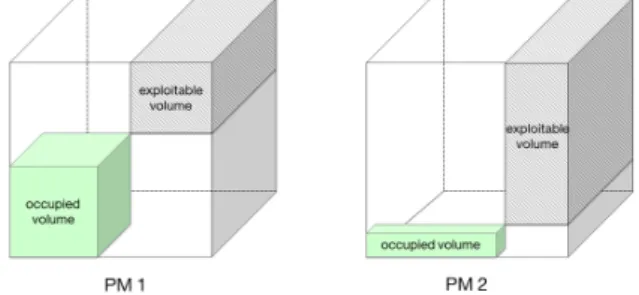
Let’s consider a 3D unit cube where each dimension represents the normalized capacity of each type of resource offered by the PM. The total capacity of the server is then obtained with the volume of the unit cube, this metric provides informations about the exploitable volume of a PM.
If the problem were constrained by one dimension, then comparing PMs by using the above metric is the natural choice for the FFD algorithm since its value is inversely proportional to the amount of available resources. However, in the case of multidimensional resource allocation, this algorithm may have some shortcomings. In fact, the volume does not completely reflect the amount of resources on each dimension.
As an illustration, consider two PMs with three types of resources (RAM, CPU and Disk). Respective normalized utilization ratio as illustrated in Figure2.4:
• P M 1 has (0.4CP U, 0.45RAM, 0.5Disk) • P M 2 has (0.2CP U, 0.7RAM, 0.2Disk)
The sandvolume metrics of the two PMS are :
• sandvolume(PM1) = 6.06 • sandvolume(PM2) = 5.20
Figure 2.4: Server state before the placement
With sandpiper approach, P M 2 which has the highest exploitable volume (the lowest metric) will be chosen as a target for placing any VM request regardless of its resources requirements.
Figure 2.5: Server state after the placement
If we consider a VM requiring (0.1CP U, 0.2RAM, 0.1Disk), the remaining ca-pacities of both PM after the placement of this VM are illustrated in Figure2.5 and given by :
• P M 1 = (0.5CP U, 0.35RAM, 0.4Disk) • P M 2 = (0.7CP U, 0.1RAM, 0.7Disk)
It is clear as illustrated in Figure 2.5 that after the placement of the VM on P M 2 which is recommended by the sandpiper approach, resources of P M 2 are not utilized in a balanced manner and the exploitable volume left is less than that when it is placed on P M 1. This may lead to blocking of further requests.
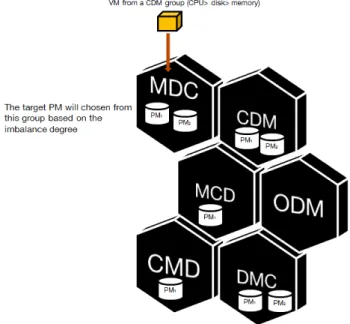
2.5.2.2.2 Multidimensional aware heuristics We just proved that in-formation about resource utilization may be lost with a single metric. Another set of heuristics was proposed in the existing literature to achieve a better host
utilization. These heuristics are called multidimensional-aware heuristics. The basic idea is to represent various resources as a d-dimensional vector. As each VM demand is a combination of different type of resources for example CPU, memory and disk, it is represented by a 3-dimensional vector where each dimen-sion represents a single type of resources. Let’ s call this vector ~Ri which is the
Figure 2.6: Normalized Resource Cube
vector of normalized resources required by the V Mi.
The same representation is adopted to represent the PM resources capacities. A 3-dimensional vector ~Cj of normalized resources capacities is generated for
each P Mj. Finally, resource utilization of a P Mj is also represented by a
three-dimensional resources vector ~Lj. Thus, all resources are normalized and all
information are defined as vectors. The typical approach proposed in many re-lated works [35][36] consists on representing all these information vectors within a unit cube called Normalized Resource Cube (NRC) as shown in Figure2.6. a) Imbalance heuristic
Imbalance is a metric that calculates how much the utilization of resources of a single PM is imbalanced. This metric is calculating by defining a new vector ~I which is the vector difference between the projection of the resource utilization vector ~L and on the resource capacities vector ~C and ~L.
If ~C of a PM is exactly aligned with the imbalance vector ~I, thus we can say that resources of this PM are utilized in a balanced manner.
Admit that the resource capacities vector ~C is defined by ~C = ~i + ~j + ~k where ~i,~j, ~k are the unit vectors along the three resources CPU, memory and disk.
The resource utilization of a PM is given by : ~L = c ∗~i + m ∗~j + d ∗ ~k where c,m and d are the normalized values of CPU, memory and disk utilized in this PM. Hence, the projection of the utilization vector ~L on the principal diagonal of the NRC is given by: