HAL Id: tel-02988169
https://tel.archives-ouvertes.fr/tel-02988169
Submitted on 4 Nov 2020HAL is a multi-disciplinary open access archive for the deposit and dissemination of sci-entific research documents, whether they are pub-lished or not. The documents may come from teaching and research institutions in France or abroad, or from public or private research centers.
L’archive ouverte pluridisciplinaire HAL, est destinée au dépôt et à la diffusion de documents scientifiques de niveau recherche, publiés ou non, émanant des établissements d’enseignement et de recherche français ou étrangers, des laboratoires publics ou privés.
Toward auto-configuration in software networks
Wassim Sellil Atoui
To cite this version:
Wassim Sellil Atoui. Toward auto-configuration in software networks. Networking and Internet Archi-tecture [cs.NI]. Institut Polytechnique de Paris, 2020. English. �NNT : 2020IPPAS015�. �tel-02988169�
ED 626
NNT
:
2020IPP
AS015
networks
Th `ese de doctorat de l’Institut Polytechnique de Paris pr ´epar ´ee `a TELECOM SudParis ´
Ecole doctorale n◦ED 626 Ecole Doctorale de l’Institut Polytechnique de Paris (ED IP Paris) Sp ´ecialit ´e de doctorat : Informatique
Th `ese pr ´esent ´ee et soutenue `a Chatillon, le 21 septembre 2020, par
W
ASSIMS
ELLILA
TOUIComposition du Jury :
Walid Gaaloul
Professeur, TELECOM SudParis, France Directeur de th `ese
Imen Grida Ben Yahia
Ph.D., Orange Labs, Chatillon, France Encadrante de th `ese Filip De Turck
Professeur,Universit ´e de Ghent, Ghent, Belgique Rapporteur Panagiotis Demesticha
Professeur, Universit ´e du Pir ´ee, Pir ´ee, Gr `ece Rapporteur Laura Galluccio
Professeur, Universit ´e de Catane, Catane, Italie Examinatrice Noel Crespi
Professeur, TELECOM SudParis, France Pr ´esident du jury Nour Assy
1
To my mother, to my father, to my loving family for their unconditional love and support.
Acknowledgment
G
Foremost, I would like to express my sincere gratitude to both of my thesis supervi-sors, Dr. Imen Grida BenYahia and Pr. Walid Gaaloul for giving me this opportunity to pursue a Ph.D. at both Orange labs and Institut Polytechnique de Paris. Their guidance and devotion helped me achieve this work. It was a great honor and a pleasure to have them both as supervisors.
I would like to thank Dr. Nour Assy for collaborating with me on various aspects of this work.
A special thanks to Pr. Panagiotis Demestichas and Pr. Philip De Turck who evaluated and reviewed my manuscript.
I thank also Dr. Bertrand Decocq, the manager of team BRAINS at Orange Labs, for his guidance, kindness, and time. He was always available at times of need. It was an honor to work with him.
I am grateful to all my co-workers at Orange Labs and Telecom SudParis who helped me to integrate and made this experience memorable. Thanks also to all of my friends in France and Algeria for their support.
Last but not least, I am extremely grateful to my father, L’hadi, my mother, Moufida, my sister, Randa, and my brother, Amine, for their unconditional love and support throughout the last 29 years.
R´
esum´
e
Les r´eseaux logiciels ont le potentiel de porter l’infrastructure r´eseau `a un niveau plus avanc´e, un niveau qui peut rendre la configuration autonome. Cette capacit´e peut surmonter la complexit´e croissante des r´eseaux actuels et permettre aux entit´es de gestion d’activer un comportement efficace dans le r´eseau pour une am´elioration globale des performances sans aucune intervention humaine. Les param`etres de con-figuration peuvent ˆetre s´electionn´es automatiquement pour les ressources r´eseau afin de faire face `a diverses situations que les r´eseaux rencontrent, comme les erreurs et la d´egradation des performances. Malheureusement, certains d´efis doivent ˆetre relev´es pour atteindre ce niveau avanc´e de r´eseaux. Actuellement, la configuration est encore souvent g´en´er´ee manuellement par des experts du domaine dans d’´enormes fichiers semi-structur´es ´ecrits en XML, JSON et YAML. C’est une tˆache complexe, sujette aux erreurs et fastidieuse `a accomplir par les humains. De plus, il n’y a pas de strat´egie formelle, `a part l’exp´erience et les meilleures pratiques des experts du do-maine pour concevoir les fichiers de configuration. Diff´erents experts peuvent choisir une configuration diff´erente pour le mˆeme objectif de performances. Cette situa-tion rend plus difficile l’extracsitua-tion des foncsitua-tionnalit´es des fichiers de configuration et l’apprentissage des mod`eles susceptibles de g´en´erer ou de recommander automatique-ment la configuration. De plus, il n’y a toujours pas de consensus sur un mod`ele de donn´ees de configuration commun dans les r´eseaux logiciels, qui a abouti `a des solutions h´et´erog`enes, telles que: TOSCA, YANG, Hot, etc. qui rendent la gestion de r´eseau de bout en bout difficile. Dans cette th`ese, nous pr´esentons nos contributions qui abordent les d´efis susmentionn´es li´es `a l’automatisation de la configuration dans les r´eseaux logiciels. Pour aborder le probl`eme de l’h´et´erog´en´eit´e entre les fichiers de configuration, nous proposons un cadre s´emantique bas´e sur des ontologies qui peuvent f´ed´erer des ´el´ements communs `a partir de diff´erents fichiers de configuration. Pour le d´efi de g´en´eration automatique de la configuration, nous proposons deux contribu-tions, une contribution qui consid`ere les r´eseaux de neurones profonds pour apprendre des mod`eles de fichiers de configuration pour recommander la configuration et une autre contribution bas´ee sur une approche bas´ee sur un mod`ele configurable pour aider automatiquement la conception de la configuration des fichiers de description.
Abstract
Software networks have the potential to move the network management to a more advanced level, a level where the network can automatically configure itself. This ability can overcome the rapidly growing complexity of current networks, and allow management entities to enable an effective behavior in the network for overall per-formance improvement, with less human intervention Configuration parameters can be automatically selected for network resources to cope with various situations that networks encounter like errors and performance degradation. Unfortunately, some challenges need to be tackled to reach that advanced level of networks. Currently, the configuration is still often generated manually by domain experts in huge semi-structured files written in XML, JSON, and YAML. This is certainly a complex, error-prone, and tedious task to do by humans. Also, there is no formal strategy except experience and best practices of domain experts to design the configuration files. Different experts may choose the different configurations for the same perfor-mance goal. This situation makes it harder to extract features from the configuration files and learn models that could automatically generate and recommend configura-tions. Moreover, there is still no consensus on a common configuration data model in software networks, which resulted in heterogeneous solutions, such as TOSCA, YANG, Hot, etc. that making the end-to-end network management difficult. In this thesis, we address the problem of automating the configuration in software networks. We propose two main contributions for tackling the aforementioned challenges. To address the problem of heterogeneity between the configuration files we propose a semantic-based framework that automatically maps configuration elements from het-erogeneous data models. The framework extracts ontologies from the configuration files and builds a common configuration view by mapping similar elements from the ontologies using our proposed algorithms. Regarding the problem of configuration generation, we propose two contributions to assist the service providers to design the configuration files and automate their generation. We propose a contribution that is based on deep neural networks and another one that is model-driven. The deep neural network contribution is an approach that learns from previously made configuration file models that recommend and complete the files with configurations. The model-driven approach assists service providers to design and generate config-uration files. The approach is a configurable model that merges similar component elements from different configuration files into a single model. This model captures and learns configuration variabilities from the files. The model is a tree-structured graph that represents the component elements that appear in the descriptors along with configurable connectors that capture variable structures of configurations
Table of contents
1 General Introduction 17
1.1 Research context: Software Networks . . . 17
1.2 Research problem: automatic configuration . . . 18
1.2.1 Heterogeneity between configuration data models . . . 19
1.2.2 Configuration generation . . . 20
1.2.3 Configuration propagation . . . 20
1.3 Research contributions . . . 20
1.4 Research publications . . . 23
1.5 Thesis outline . . . 24
2 Background on Software Networks 25 2.1 Introduction . . . 25
2.2 Software Defined Networks (SDN) . . . 26
2.2.1 SDN Architecure . . . 26
2.2.1.1 Infrastructure layer . . . 26
2.2.1.2 Control layer . . . 26
2.2.1.3 Application layer . . . 27
2.2.2 Communication between SDN layers . . . 28
2.2.3 SDN controller abstractions . . . 30
2.2.4 Benefits of the SDN paradigm . . . 30
2.2.5 SDN issues and challenges . . . 31
2.3 Network Function Virtualization (NFV) . . . 32
2.3.1 NFV Architecture . . . 32
2.3.2 Communication between the NFV components . . . 34
2.3.3 Benefits of the NFV paradigm . . . 35
2.3.4 NFV challenges . . . 36
2.4 Conclusion . . . 37
3 State of The Art 39 3.1 Introduction . . . 39
3.2 Heterogeneity between the configuration data models . . . 40
3.2.1 Multiple SDN controllers Architecture . . . 40
3.2.2 Semantic approaches in SDN . . . 43
3.2.3 Handling the heterogeneity between information structures in the literature . . . 43 3.2.3.1 Similarity measures . . . 44 3.2.3.2 Information fusion . . . 45 3.2.3.3 information clustering . . . 46 3.2.3.4 Information classification . . . 48 9
3.2.3.5 Link prediction . . . 49
3.2.3.6 Ranking . . . 49
3.3 Automating the configuration generation . . . 49
3.3.1 Deployment descriptors generation in NFV . . . 50
3.3.2 Automatic configuration in software engineering . . . 53
3.3.2.1 Configuration prediction . . . 53
3.3.2.2 Interpretability of configurable systems . . . 54
3.3.2.3 Configuration optimization . . . 54
3.3.2.4 Dynamic Configuration . . . 55
3.3.2.5 Configuration constraints mining . . . 55
3.4 Conclusion . . . 56
4 Handling the heterogeneity between configuration data models 59 4.1 Introduction . . . 60
4.2 Use case: Multi-controllers SDN architecture . . . 61
4.2.0.1 Distributed vs Centralized control plane . . . 62
4.2.0.2 Flat Architecture vs Hierarchical Architecture . . . . 63
4.2.0.3 Dynamic Architecture versus Static Architecture . . . 63
4.2.0.4 Existing SDN platforms . . . 64
4.2.0.5 Platform architectures . . . 64
4.3 Semantic-based framework for global network view construction . . . . 65
4.3.1 Exemplified Problem Statement . . . 66
4.3.2 Centralized global network view construction . . . 66
4.3.2.1 Global ontology model . . . 69
4.3.2.2 Extracting local ontologies form the controllers . . . . 70
4.3.2.3 Mapping the local ontologies with the global ontology 71 4.3.2.4 Interacting with the global network view . . . 73
4.3.3 Distributed global network view construction . . . 73
4.3.3.1 Mapping local ontologies . . . 74
4.4 Evaluation . . . 76
4.4.1 Evaluation environment . . . 76
4.4.2 ontology extraction from JSON files . . . 76
4.4.3 Ontology mapping . . . 78
4.4.4 Interaction with the global network view . . . 79
4.5 Conclusion . . . 79
5 Deep Learning for automatic configuration generation 81 5.1 Introduction . . . 82
5.2 Background information on Deep learning approaches . . . 83
5.2.1 Convolutional Neural Networks (CNN) . . . 85
5.2.2 Long short-term memory (LSTM) . . . 86
Table of contents 11
5.4 Deep learning framework for configuration recommendation and
com-pletion . . . 90 5.4.1 Overview . . . 90 5.4.2 Preparation phase . . . 94 5.4.3 Tokenization step . . . 95 5.4.4 Vectorization step . . . 95 5.4.4.1 Appearance-based vectorization . . . 95 5.4.4.2 Token embedding . . . 96 5.4.5 Training phase . . . 99
5.4.5.1 Recommendation model for VNFDs . . . 99
5.4.6 Completion model for VNFDs . . . 102
5.4.7 Execution phase . . . 102
5.5 Evaluation and Results . . . 104
5.5.1 Data set and experimental Setup . . . 105
5.5.2 CNN for VNFD recommendation . . . 105
5.5.3 LSTM for VNFD completion . . . 108
5.6 Conclusion . . . 110
6 Model-driven approach for configuration generation 113 6.1 Introduction . . . 114
6.2 VNFD representation . . . 115
6.2.1 Formal Definition of a VNFD . . . 118
6.3 Configurable Deployment Descriptor Model . . . 119
6.3.1 Configurable component instances . . . 119
6.3.2 Configurable gateways . . . 121
6.3.3 Formal definition of a configurable VNFD . . . 122
6.4 Learning the configurable model . . . 123
6.4.1 Transforming the VNFD files into a tree-like structure . . . 123
6.4.2 Federating common nodes in the set of VNFD instances . . . . 123
6.4.2.1 Similarity metrics between the nodes . . . 123
6.4.2.2 Nodes clustering algorithm . . . 126
6.4.3 Constructing the configurable VNFD model . . . 127
6.5 Application of the configurable model: Configuration Guidance Model 128 6.5.1 Configuration guidance model . . . 128
6.5.2 Dynamic guidance model extraction . . . 132
6.5.2.1 Step 1: Configuration choices extraction . . . 132
6.5.2.2 Step 2: Guidelines derivation . . . 133
6.5.2.3 Step 3: Tree-like structure extraction . . . 134
6.5.2.4 Step 4: Guidelines dependencies formalization . . . . 134
6.6 Other applications of the VNFD Configurable model . . . 135
6.6.1 Deployment descriptor variant generation . . . 135
6.6.3 Uniform representation of the deployment descriptors . . . 139
6.7 Evaluation and results . . . 140
6.7.1 Environment settings . . . 140
6.7.2 Complexity of the configurable deployment description model . 140 6.7.3 Learning the configurable model . . . 142
6.7.4 Configuration guidance model . . . 145
6.7.4.1 Quality of configuration guidelines . . . 145
6.7.4.2 Accuracy of configuration guidelines . . . 146
6.8 Conclusion . . . 147
7 Conclusion 149 References . . . 152
List of Tables
3.1 Comparison between multiple SDN controllers solutions . . . 42
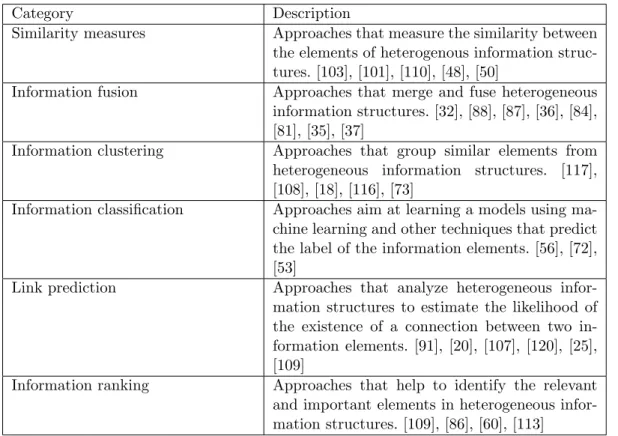
3.2 Categories of approaches that handled the heterogeneity between in-formation structures . . . 44
3.3 Performance factors for information fusion approaches . . . 47
3.4 Illustration of the contributions made for automating the generation of deployment descriptors . . . 51
3.5 Categories of contributions related to the configuration automation in software engineering . . . 53
4.1 Execution time of ontology extraction . . . 77
4.2 Interaction with the RDF triplestore . . . 79
5.1 Parameters of the CNN model . . . 105
5.2 Evaluation of the CNN recommendation model for VNFD files with respect to the CNN input size . . . 106
5.3 Evaluation of the CNN recommendation model for VNFD files with respect to the CNN number of filters . . . 106
5.4 Evaluation of the CNN recommendation model for VNFD categories with respect to the CNN input size . . . 107
5.5 Evaluation of the CNN recommendation categories for VNFD files with respect to the CNN number of filters . . . 107
5.6 Parameters of the LSTM model . . . 108
5.7 Experiments on the LSTM model using different input sequence length 109 5.8 Experiments on the LSTM model using different output length . . . . 109
5.9 Experiments on the CNN model combined with LSTM using different input sizes . . . 109
6.1 Configurable elements and their possible configurations . . . 121
6.2 A sample of guidelines extracted from the configurable deployment descriptor model presented in Figure6.4 . . . 129
6.3 Definition of the variation factors . . . 136 6.4 Structural Complexity metrics for the two considered representation . 141
List of Figures
2.1 Overview of a typical SDN architecture [4] . . . 27
2.2 OpenFlow Flow table fields [5] . . . 29
2.3 Overview of a typical NFV architecture [6] . . . 33
4.1 Multi-Controllers SDN architecture . . . 62
4.2 The heterogeneity of network data representation between ODL con-troller and ONOS concon-troller . . . 67
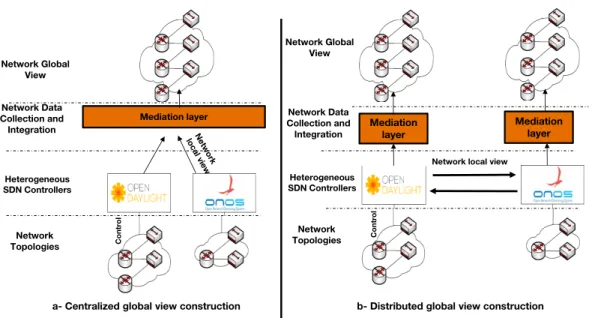
4.3 Different contexts for constructing the global network view . . . 67
4.4 Mediation for the central global view scenario . . . 68
4.5 Brief representation of the global ontology . . . 69
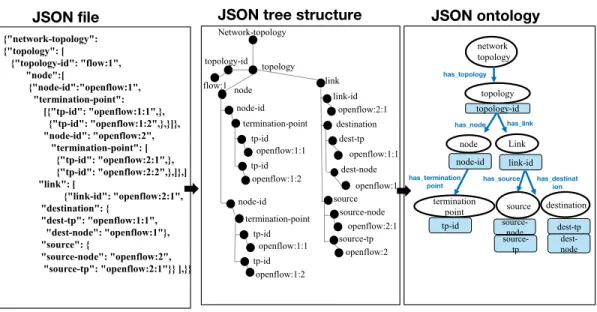
4.6 Extracting the local ontology from a JSON file . . . 70
4.7 Exmaple of a scope of two areas around the entity ”networkElment” . 72 4.8 Mediation for the distributed global view scenario . . . 74
4.9 Average execution time of the mapping algorithms in distributed and centralized scenarios . . . 77
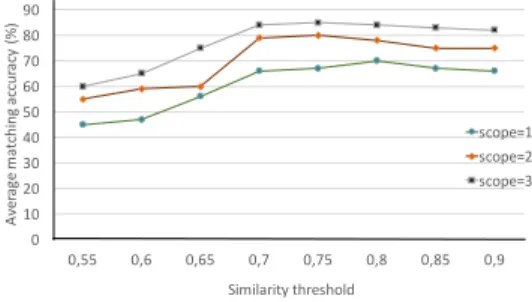
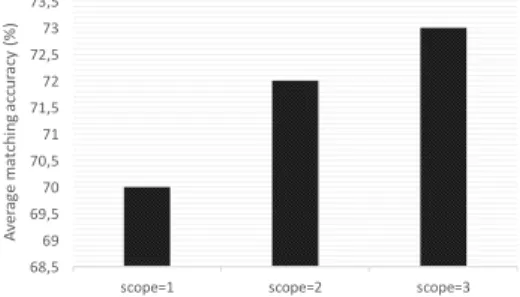
4.10 Average matching accuracy of the mapping algorithm in the centralized scenario . . . 77
4.11 Average matching accuracy of the mapping algorithm in the distributed scenario . . . 78
5.1 A basic multi-layer artificial neural network . . . 83
5.2 Activation function of neural cell . . . 84
5.3 General overview of a CNN architecture . . . 85
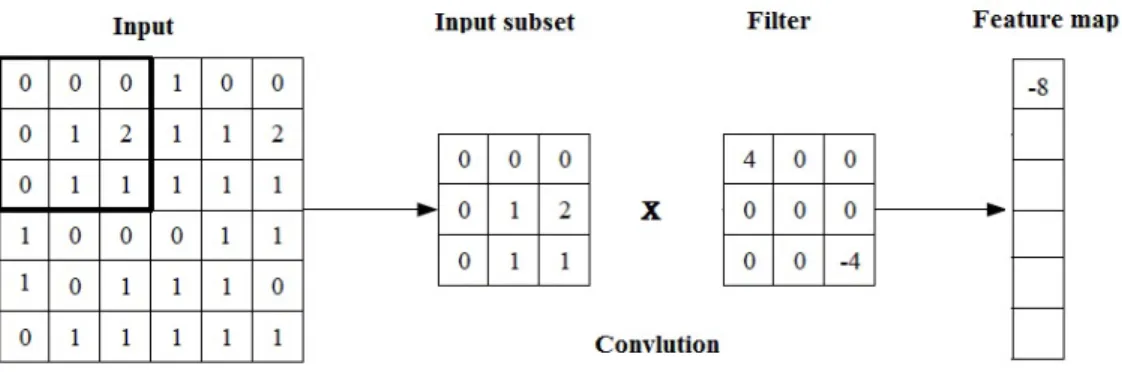
5.4 Convolution operation between the input and the filter . . . 85
5.5 Architecture of recurrent networks . . . 86
5.6 Long short-term memory cell architecture . . . 87
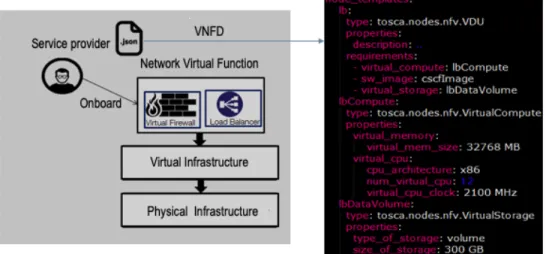
5.7 Example of a deployment descriptor onboarded by a service provider with a VNF . . . 90
5.8 A high-level representation of a VNFD structure [38] . . . 91
5.9 Composition of Virtual deployment unit in a VNFD [38] . . . 92
5.10 Overview of a NSD architecture . . . 92
5.11 Overview of the deep neural network framework . . . 93
5.12 DNN-based framework for VNF deployment descriptors mining . . . . 94
5.13 Example of tokenization using a deployment descriptor file . . . 95
5.14 Projection of VNFD token embedings in a 3D vector space . . . 97
5.15 Convolutional Neural Network Architecture for learning a VNFDs rec-ommendation model . . . 100
5.16 Using the LSTM method for deployment description completion . . . 103 5.17 Using the CNN method for deployment description recommendation . 104
6.1 (a) graphical representation of the elements used in a VNFD model and (b) graphical representation of the configurable elements in a con-figurable VNFD model . . . 116 6.2 An example of a vFireWall VNFD represented graphically as a tree-like
structure . . . 117 6.3 An example of a graphical representation of a vCPE VNFD that is
described briefly in Figure5.7 . . . 117 6.4 An example of a configurable deployment descriptor model that
com-bines the VNFDs in Figs. 6.2 and 6.3 . . . 120 6.5 A VNFD model that shows the different relational levels between node
v1 and the other nodes . . . 125
6.6 Representation of a configuration guidance model that is derived from the configurable deployment descriptor model in Figure6.4 . . . 130 6.7 A Petri net example that illustrates the dependencies between the
con-figuration guidelines in 6.2 . . . 131 6.8 An example of a variable VNFD generated from the vFirewall VNFD
that is defined in Fig.6.2 . . . 137 6.9 An excerpt of the configurable descriptor model that annotate the
com-ponent instances with their corresponding VNFDs . . . 138 6.10 Inter-cluster and Intra-cluster mean similarity distance in terms of
dif-ferent cluster numbers, VDU nodes . . . 142 6.11 Intra-cluster mean similarity distance per iteration, VDU nodes, k=200 143 6.12 Intra-cluster mean similarity distance in terms of different relation
weights . . . 144 6.13 Number of guidelines, number of configurations per guideline and per
element for different minimum support thresholds and a minimum con-fidence threshold C = 0:8 . . . 145 6.14 Accuracy of the generated guidelines for different support and
Chapter 1
General Introduction
1.1
Research context: Software Networks
Software networks (or Software-driven networks) emerged as the next level in the evolution of computer networks. The evolution was necessary to cope with the chal-lenges related to the new technology ecosystem, e.g. cloud computing and internet of things, in which traditional networks have struggled to keep up with the transition.
Traditional networks (legacy networks) are an impediment to today’s technology era for many reasons. One of the main reasons is that the infrastructure of traditional networks is rigid. Any new changes added to the network would take time to be applied, requires human interventions, and in a lot of cases needs a physical hardware installation. Another reason is that traditional networks are dependent on closed and proprietary hardware that inhibits network users from exploiting alternative best-of-breed technologies. Moreover, the hardware in traditional networks is designed with a combined integration of the control plane and the data plane. The configuration of the hardware in this case is usually done manually in a box-by-box fashion.
Software networks provide answers to the traditional network limitations [58]. The network design is redefined by new paradigms that build the networks at a lower cost and with a greater scope for innovation in network services. Software networks offer new opportunities to transform the economics of business network while at the same time accelerating the ability to design and deploy new service capabilities independently of the operated network (fixed, mobile, long-distance, etc.) and the offered service (data, voice, content delivery, etc.) [66].
The main paradigms in software networks are Software-defined network (SDN) and [63] and Network function virtualization (NFV) [77]. On one hand, SDN enables network programmability by offering the capacity to initialize, control, change, and manage network behavior dynamically via open interfaces. On the other hand, NFV decouples network functions from proprietary hardware appliances and run them as software in virtual machines (VMs). The emergence these new paradigms in has created new hopes for the progress of network management. With software networks, networks will likely be upgraded with self-management capabilities that allow them to be autonomic. Autonomic networks could overcome the rapidly growing complexity of current networks, and adopt an optimal management behavior for overall performance
improvement in a fully autonomous way, without any human intervention [118]. Other benefits of autonomic networks are the following:
• Operation and maintenance costs will be reduced significantly, and human re-sources could be deployed to handle higher-value activities.
• Quality and efficiency will be improved given that human errors are reduced. Configuration parameters will be automatically selected for network resources that need to be configured.
• The parameters are adapted to new or unexpected situations like errors, failures, security threats, performance degradation, etc. [79].
Autonomic networks need to ensure self-configuration. A capability allows the network to adapt with less human interventions to new changes in the network by configuring new components seamlessly or modifying the parameters in the network according to the overall global state. In this thesis, we aim to investigate new ap-proaches that contribute toward enabling auto-configuration in software networks.
1.2
Research problem: automatic configuration
In this section, we present the main challenges related to automatic configuration in software networks. Before that, we explain briefly how the configuration is cur-rently made to motivate the direction of our contributions toward enabling automatic configuratio (auto-configuration) in software networks.
The key feature of software networks is their ability to be completely programmable. This means that theoretically, it is possible to write a piece of software that could manage automatically the entire network. The main enablers for programmability are application programming interfaces (APIs). They allow network components to expose their functionalities and be managed by other entities in the network. The APIs simplify the configuration of network components and enhance their agility. A set of complicated configuration operations, for example enforcing policies, could be specified in a single file and transmitted to the network device. The APIs in the SDN paradigm is situated between the abstraction planes (described in chapter 2). While in NFV, the programming interfaces are located between the management components (described in chapter 2).
The configuration in software networks is model-driven. It is specified in semi-structured files like JSON and YAML, following a predefined data model such as YANG, TOSCA, etc. The data model that is used has to be also the same used by the network components that are configured. Otherwise, the APIs would not be able to execute the operations that are expected.
automatic configuration in software networks will take advantage of the pro-grammability of the network to automate the configuration. New network compo-nents could be configured using their APIs seamlessly without human intervention,
Research problem: automatic configuration 19
in a plug and play fashion. Likewise, the behavior of the network could be adapted to unexpected situations while maintaining the required performance by doing adequate configuration in the network.
To ensure automatic configuration in software networks, it is necessary to account for the APIs used by network components. Any generated configuration should be interpretable by the APIs of network components. We have identified three challenges that are important to be tackled to move toward automatic configuration. The chal-lenges are namely, (i) the heterogeneity between configuration data models, (ii) the configuration generation, and (iii) the configuration propagation. We describe next each of these three challenges.
1.2.1 Heterogeneity between configuration data models
There are constantly new proposals and solutions that are emerging in software net-works from different vendors, providers, open-source organizations, etc.. The network is a heterogeneous environment where components from different vendors cooperate and share information. It is important therefore to account for the data model that is used by the components when making the configuration, otherwise, it cannot be interpreted and processed correctly.
Unfortunately, there is still no consensus on a common data model used to make the configuration by network components from all the competition. There is cur-rently a plethora of data models based on languages like TOSCA (Topology and Orchestration Specification for Cloud Application) [2] or YANG (Yet Another Next Generation).
To enable automatic configuration, it is important to automate the interpretation of configuration that is issued from heterogeneous data models and also to generate configurations with adequate data models. The reason is that, in the absence of a common data model, it is not possible to construct a global network view, to which the automatic configuration module can reason on or analyze to trigger configuration actions. It is also necessary that the generated configurations follow the same data model as the configured network components.
This situation raises two research questions:
• RQ1: How to automatically interpret configurations from heterogeneous sources? • RQ2: How to automatically generate configurations to a targeted data model? Note that a solution that is based on a static translation between heterogeneous data models is not viable in an environment that is constantly evolving. Keeping the translation updated to all the data models is a tedious task. We investigate in this thesis approaches that provide some insights on penitential solutions to overcome this challenge.
1.2.2 Configuration generation
To automatically configure network components without human intervention, auto-configuration should help generate and recommend auto-configurations that are adequate with the expectation of network users. The problem is that there is no formal strategy on how to choose the best configuration for each given situation. The configuration files in software networks are often designed and created manually. Which is a highly complex, time-consuming, and tedious task.
This challenge raises the following research question:
• RQ3: How to automatically generate coherent configurations in software net-works?
We investigate in thesis model-driven approaches that ease the generation of con-figurations by assisting service providers in designing configuration files. Also, we investigate approaches based on deep learning that automate the generation of con-figuration in an unsupervised manner.
1.2.3 Configuration propagation
automatic configuration could generate a configuration that triggers a chain reaction of other changes in network components so that the system remains in a coherent state. For example, changing the network interfaces of virtual functions in NFV will impact the network service in which this virtual function is implemented, and also the virtual functions that are linked to it. It is therefore important to identify the configuration relations between network components and also the order of changes. Formalizing the dependencies between configurations helps to create constraints that ensure that the system remains coherent. The relations could be used for root cause analysis to ensure the recoverability of the system by undoing previous changes, in case of failures.
The problem is that software networks are an environment where multiple network components cooperate. It is a complex task for a human to identify the dependencies between the configuration. This situation raises the following research question:
• RQ4 : How to identify automatically the dependencies between configurations in software networks?
1.3
Research contributions
In this thesis, we investigate solutions that are in the scope of answering the ques-tions made in the previous section. We propose approaches that contribute toward enabling automatic configuration in software networks. To study new solutions to the aforementioned challenges, we have to focus our attention to specific uses cases. For
Research contributions 21
that reason, we choose two use cases, one in SDN and another one in NFV, as they are the main paradigms in software networks Our contributions could be generalized and adapted to software networks.
Our first contribution is related to the problem of heterogeneity between config-uration data models. To investigate a solution, we focus our attention on an SDN architecture where multiple controllers are deployed. SDN controllers have to cooper-ate to share a global network view that allows them to localize network devices. The problem is that the SDN controllers may expose their functionalities (via APIs) using different data models. The difference could be in the structure of the data, the syn-tactical representation of the data, or the semantics of the data. The cooperation, in this case, becomes not possible as the SDN controllers could not process each other’s data.
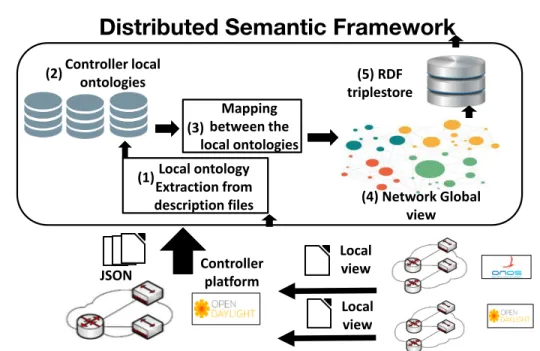
To address this problem, we propose a semantic-based framework that automati-cally maps configuration elements from heterogeneous data models. This contribution is in the scope of answering the RQ1 and RQ2. The framework builds an ontology from configurations of the SDN controller, referred to as local ontology, to represent the SDN controller concepts and the relation between them. The local ontologies are automatically extracted from the configuration files using our method. The global network view is constructed by mapping similar elements from the ontologies using our proposed algorithms. More concretely, our contributions can be summarized as follows:
• We propose a semantic-based framework that encompasses an approach that extracts a local ontology from each controller and incorporates algorithms that map the ontologies together to form the overall network view.
• We define a central global ontology model that represents the domain knowledge of SDN with OWL. The global ontology describes the concepts that constitute an SDN architecture.
• We adapt our framework to two scenarios:
– A centralized scenario where the SDN controllers expose their network views to a centralized entity that builds the network view
– A distributed scenario, where SDN controllers exchange in peer to peer their local network views and build locally the global view.
• We establish two ontology mapping algorithms. One for the centralized scenario, to map the controller’s local ontologies to the global ontology and one for the distributed scenario to map the local ontologies of the SDN controllers.
• We propose an ontology extraction method from the SDN controller configura-tion files that are described in JSON format.
• We evaluate the performance of our framework, in both distributed and central-ized scenarios, in terms of the matching accuracy of our mapping algorithms and the execution time. We test the performance over different network topologies in a heterogenous multi-controller SDN architecture composed by controllers like ODL and ONOS.
Regarding the problem of configuration generation, we propose two contributions to assist the service providers to design the configuration files and automate their generation. The first contribution is based on deep neural networks and the second one is a model-driven approach. These contributions are in the scope of anwsering the RQ3.
We consider an NFV architecture to implement and test our proposed solutions. In NFV, service providers have to associate with their virtual network functionalities description files before the onboarding of the VNFs. The description files indicate the deployment and operational behavior of the functionalities in terms of connectiv-ity and resource requirements. The descriptor files are large files that are designed manually by the service providers, which is complex, tedious, and error-prone. More-over, the descriptor files contain the configuration of numerous components that are dependent on each other, and there is no formal strategy to select the best configura-tion. This scenario is therefore adequate for our investigating solution to assist and automate the generation of configurations.
We propose at one hand approaches based on deep neural networks that learn from previously made descriptor file models that recommend and complete configurations. These contributions are briefly summarized as follows:
• We propose a learning framework based on neural network architectures that is divided into three phases: the preparation phase, learning phase, and model tuning phase.
• In the preparation phase, we process the descriptors files into a format that is suited for the neural network architectures. We use a word embedding approach to representing the data that is extracted from the descriptor files based on its semantics.
• In the learning phase: we propose two neural network architectures:
– Convolutional neural network architecture to learn a recommendation model for the descriptors
– Long short term memory architecture to learn a completion model for the descriptors
• We evaluate afterward the generated models (recommendation and completion) in terms of their accuracy of prediction.
Research publications 23
On the other hand, we propose a model-driven approach that assists service providers to design and generate descriptor files. We propose a configurable model that merges similar component elements from different descriptor files into a single model. This model captures and learns all the configuration variabilities from the descriptors. The model is a tree-structured graph that represents the component ele-ments that appear in the descriptors along with configurable connectors that capture variable structures of configurations. This approach is also in the scope of answering the RQ3. The model-driven contributions can be briefly summarized as follows:
• We formalize a configurable deployment descriptor model that capitalizes on a catalog of descriptors
• We propose an algorithm based on machine learning (K-medoids) to search and cluster similar elements from different descriptors and construct the configurable model.
• We propose an approach that extracts useful and implicit knowledge from the configurable model. The approach derives configuration guidelines by mining the configurable deployment descriptor model and a repository of VNFD mod-els. The guidelines capture the dependencies and the relations between the configuration of VNFD elements.
1.4
Research publications
We have published our contributions in several scientific venues:
• J2: Wassim Sellil Atoui, Nour Assy, Walid Gaaloul, Imen Grida Ben Yahia: As-sisting deployment descriptor design in NFV. International Journal of Network Management, 2020 (invited to submit an extended version from a conference paper)
• J1: Wassim Sellil Atoui, Nour Assy, Walid Gaaloul, Imen Grida Ben Yahia: Configurable Deployment Descriptor Model in NFV. Journal of Network and Systems Management 28, 693–718, 2020
• C5: Wassim Sellil Atoui, Imen Grida Ben Yahia, Walid Gaaloul: Token em-bedding for deployment descriptors in NFV. IFIP Networking, 2020
• C4: Wassim Sellil Atoui, Nour Assy, Walid Gaaloul, Imen Grida Ben Yahia: Learning a Configurable Deployment Descriptors Model in NFV. IEEE/IFIP Network Operations and Management Symposium, 2020
• C3: Wassim Sellil Atoui, Imen Grida Ben Yahia, Walid Gaaloul: Virtual Net-work Function Descriptors Mining Embeddings and Deep Neural NetNet-works. IFIP/IEEE International Symposium on Integrated Network Management, 2019: 515-520
• C2: Wassim Sellil Atoui, Imen Grida Ben Yahia, Walid Gaaloul: Using Deep Learning for Recommending and Completing Deployment Descriptors in NFV. IEEE Conference on Network Softwarization, 2019: 233-2352
• C1: Wassim Sellil Atoui, Imen Grida Ben Yahia, Walid Gaaloul: Semantic-Based Global Network View Construction in Software-Defined Networks with Multiple Controllers. IEEE Conference on Network Softwarization, 2018: 252-256
1.5
Thesis outline
This doctoral thesis is organized in seven chapters:
• Chapter 2: Background Information on Software Networks introduces the basic concepts related to our research and needed to understand the rest of the work. In this chapter, we present two of the main paradigms in software networks. The first paradigm is Software-defined networks and the second one in network function virtualization. We present their architecture, their benefits, and the challenges that they need to overcome.
• Chapter 3: State of The Art provides an exploration and a thorough analy-sis of the state of the art around the two challenges that we are tackling in this thesis. Mainly we discuss the contributions related to : (i) handling automati-cally the heterogeneity between configurations and (ii) Generating automatiautomati-cally configurations.
• Chapter 4: Handling the heterogeneity between configuration data models presents our approach to handle the heterogeneity in software networks. More precisely, we focus on a use case in SDN and propose a framework that enables heterogeneous multi-controllers SDN platforms to construct a global network view.
• Chapter 5: Deep Learning for automatic configuration generation introduces our approach based on deep neural networks that learns from a set of configurations a model that could recommend or complete the additional configuration.
• Chapter 6: Model-driven automatic configuration generation intro-duces our model-driven approach that assists service providers in designing and generating deployment descriptors in NFV.
• Chapter 7: Conclusion and Future Work summarizes the proposed con-tributions and presents an outlook on the potential perspectives that we intend to tackle in the short-medium term.
Chapter 2
Background on Software
Networks
Contents
2.1 Introduction . . . 25 2.2 Software Defined Networks (SDN) . . . 26 2.2.1 SDN Architecure . . . 26 2.2.1.1 Infrastructure layer . . . 26 2.2.1.2 Control layer . . . 26 2.2.1.3 Application layer . . . 27 2.2.2 Communication between SDN layers . . . 28 2.2.3 SDN controller abstractions . . . 30 2.2.4 Benefits of the SDN paradigm . . . 30 2.2.5 SDN issues and challenges . . . 31 2.3 Network Function Virtualization (NFV) . . . 32 2.3.1 NFV Architecture . . . 32 2.3.2 Communication between the NFV components . . . 34 2.3.3 Benefits of the NFV paradigm . . . 35 2.3.4 NFV challenges . . . 36 2.4 Conclusion . . . 37
2.1
Introduction
Software networks are new paradigms that enable the network programmability through a set of tools used to deploy, manage, and troubleshoot network devices. Compared to traditional networks, software networks accelerate service deployment and delivery, reduce the IT costs, increase resource flexibility, and provide greater cloud integration.
The term software in software networks refers to the possibility that intelligent software can be designed to manage and deal with a single node in the network or the
entire network as a unified single element. This is possible with the help of APIs that are used by the software to gather data or to run configurations and management operations. In this chapter, we present an overview of the two main paradigms of software networks, SDN, and NFV.
2.2
Software Defined Networks (SDN)
SDN is a paradigm inspired by cloud computing that overcomes the shortcomings of traditional network management and improves its performance [63]. In traditional networks, switches are manually set up by domain experts following a specific vendor CLI language. This becomes a very complicated and error-prone task for companies running strongly virtualized environments along with large networks. SDN decouples the vertical integration by separating the control plane from the data plane. The switches in the infrastructure are just forwarding devices freed from any vendor lock-down and the control logic of the devices is centralized in a single entity in the network called the controller. The controller is responsible for policy enforcement, network configuration, topology management, link discovery, flow table, etc..
2.2.1 SDN Architecure
The architecture of this paradigm is typically divided into three layers: infrastructure layer, control layer and application layer, and two interfaces: southbound interface and northbound interface. Figure 2.1 shows a simplified SDN architecture.
2.2.1.1 Infrastructure layer
This layer contains physical and virtual forwarding devices. The infrastructure layer support basic operations that are exposed to the SDN controller like packet for-warding, caching, transcoding, and monitoring [63]. The SDN controller dynamically installs packet processing rules onto the devices.
2.2.1.2 Control layer
The control layer is responsible for managing the infrastructure devices and making decisions on how packets should be forwarded by the devices. This layer could be composed of one or multiple controllers. Each controller is responsible for a set of network devices in the network infrastructure and communicates with these devices using the southbound APIs to get the state of the traffic or to push decisions about the traffic flow. Essentially it is a centralized set of software-based SDN controllers that combined together have an abstract view of the whole network infrastructure, enabling the management entities to customize policies across the infrastructure devices.
The control layer provides a set of functionalities to the application layer using the northbound APIs. These functionalities could be of the following [63]:
Software Defined Networks (SDN) 27
Figure 2.1: Overview of a typical SDN architecture [4]
• Topology discovery and maintenance • Packet route selection and instantiation • Path failover mechanisms
• Install of the forwarding rules on the forwarding tables based on the requested performance from the applications and the network security policy
• collect status information about the infrastructure layer.
2.2.1.3 Application layer
The application layer contains application and services that dictates the network behavior. The applications interact with the controller to achieve a specific network performance and fulfill the requirements of service providers. For this purpose, the SDN controller provides an abstracted view of the network and a set of functionalities via the northbound APIs that applications use in order to specify the desired network behavior.
2.2.2 Communication between SDN layers
The communication between the SDN layers is achieved through a set of APIs. There are typically two types: the northbound APIs and the southbound APIs.
Southbound APIs are communication interfaces used to connect the infrastruc-ture layer to the control layer. Their main goal is to provide functionalities that enable communication between the SDN controllers and the infrastructure devices, in order to discover the network topology, push the flow table, and implement the control policies. The OpenFlow protocol [40] is one of the popular southbound API for SDN.
Northbound APIs are communication interfaces that connect the control layer to the application layer. Their goal is to enable applications to easily manage network resources and capabilities. Compared to the southbound APIs, northbound APIs do not have a standard specification. This situation created a plethora of solutions, each with diverse features that make it difficult to federate multiple SDN controllers together in the network.
Additionally to these two interfaces East-West interface could exist when mul-tiple SDN controllers are employed in the network [119]. They ensure communication between the controller in a horizontal manner. The cooperation, in this case, is direct between the controllers, as opposed to the cooperation via a mediation entity in the application layer.
OpenFlow: communication protocol between the controller and network devices
OpenFlow [40]is a communication protocol that is used to connect the SDN controller to the infrastructure devices via the southbound interface. This protocol exposes a set of basic functionalities used for handling the forwarding flow between the infras-tructure devices and managing them. The controllers send the forwarding plane in a flow table to the devices and the devices keep the controller updated about the network state, i.e. if the links are down or when receiving a packet for which there is no forwarding instruction. The OpenFlow communication can be either on a se-cure connection like the Transport Layer Security (TLS) or on an unprotected TCP connection.
The Forwarding tables in OpenFlow are defined by the controller to instruct in-frastructure devices on how packets are forwarded. The devices, called OpenFlow switches could have one or more flow tables and a group table. The devices check the flow tables to make a decision on how to forward the packets. These Flow tables contain a list of flow entries, each of which determines how packets belonging to a flow will be forwarded. Flow entries consist of: a rule, an action, and a statistic, as shown in Figure 2.2:
Rule: is a header used to match incoming packets. There are several supported Ethernet headers that are specified in OpenFlow specification, custom headers can
Software Defined Networks (SDN) 29
Figure 2.2: OpenFlow Flow table fields [5]
be additionally defined. The header contains either a specific value against which the corresponding parameter is compared or a value indicating that the entry that is not included.
Action: Define an action to take when a rule is matched with the packet traffic. There are several actions already defined in OpenFlow specifications. Examples of actions could be: forward to one or more ports, forward to the controller, drop the frame, and modify frame fields.
Statistics: This is a counter that is updated each time when a flow rule is matched with the packet traffic. It is to indicate the popularity of a specific flow. There are counters for every table, each flow, all the ports, and every queue. Also, a timer of the last activity and an initial set of the flow is maintained.
In OpenFlow , an OpenFlow Controller is a software server that interacts with the OpenFlow switch using the OpenFlow protocol. The protocol connects controller software to network devices so that controllers can configure network devices and inform where to forward packets. The interface to which the OpenFlow controller and the infrastructure switches communicate is called the OpenFlow channel. Through this interface, the controllers configure and manage the switches, receive events from the switches, and send packets out the switches (to add, update, and delete flow entries in flow tables). The OpenFlow channel is usually instantiated as a single network connection (using TCP or Encrypted connection).
2.2.3 SDN controller abstractions
The SDN controller enables three types of abstractions in the network, which consti-tute its major feature.
• Network state abstraction: SDN controllers provide a global network view to applications and services.
• Forwarding abstraction: The forwarding of packets in the network is handled indirectly by the controller. The network devices are executing instructions from the controller on how to forward the packets. This way, the infrastructure hardware is abstracted by the controller.
• Network operation abstraction: The controller allows a network application to express the desired behavior of the network without been responsible for implementing it.
2.2.4 Benefits of the SDN paradigm
SDN has improved a lot of aspects from traditional networks. For example:
• Centralized network management: The centralized view of the entire network eases the management and provisioning of new service in large networks. • Control and data planes abstraction: This abstraction accelerates service
deliv-ery and provides more agility in provisioning both virtual and physical network devices from a central location.
• Holistic management: The management for physical and virtual devices can be elaborated in SDN through a single set of APIs, which is more accommodable for domain experts.
• Lower operating costs: SDN brings more efficiency in administrating the net-work. Network routines can be centralized and automated, which solves many administration issues and saves a lot of time.
• Reduced capital expenditures: in SDN, the infrastructure devices could easily be optimized and commoditized. They are repurposed easily by the controller. Therefore less expensive devices can be deployed for broader utilization since all the intelligence is centered at the controller.
• Easier content delivery: SDN provides the ability to shape and control data traffic is and makes it easier to implement quality of services (QoS) and ensure flawless user experience.
Software Defined Networks (SDN) 31
2.2.5 SDN issues and challenges
There are still open challenges regarding SDN that are actively tackled by the scientific community. Here are some of the considered topics:
• Reliability and fault tolerance: It is important that SDN stays available even in case failures in the controller [94]. An automatic solution should be triggered in that case to ensure the reliability of the system and the users should be informed about the coherent network state at any moment.
• Scalability: SDN have to handle the growing amount of traffic load and have to support new applications without impacting the level of service delivered to the users [82]. This capability needs to account for performance degrada-tion caused by resource constraints, processing demands, and communicadegrada-tion overhead.
• Flexibility: SDN should be designed in such a way that it could adapt its behavior to new changes and dynamic variations occurring in the network [52]. The network must be flexible enough to adapt and accommodate future devel-opments and the needs of the network designers.
• Elasticity: SDN needs to be capable of ensuring the availability of its resources at every moment independently of the network load [52]. It needs to dynamically adapt to the workload changes inside the network. During higher demands, the maximum resources could be allocated to ensure a quality of service, while during lower demand, SDN should be able to reduce the resources to preserve the energy and lower the maintenance cost
• Data model heterogeneity: There are a plethora of data models used to define the northbound APIs like TOSCA, YANG, etc That makes it difficult to operate and federate different SDN controllers in the same architecture. This is could be the case for example when different controllers are dedicated to different specific domains. The controller has to cooperate to provide a coherent global view of the users and maintain a centralized abstraction of the network. Our first contribution is in the scope of this challenge. We study approaches that handle the heterogeneity between data models of SDN controllers.
• Control abstraction: SDN should be able to translate effectively the inten-tion of the user or applicainten-tion to program the network. The programming inter-face of the framework of the SDN must coordinate the multiple asynchronous events at the switches to perform even simple tasks.
• Performance and Security: Security treats exists also in SDN. Network attacks could reduce the performance of the SDN. For example, a simple D-DOS attack may down the working of networks [29]. SDN should ensure the
integrity and the coherency of the managed resources and prevent the attacker from taking control in the network.
We listed here all the important challenges but we are addressing in this thesis scope only the heterogeneity.
2.3
Network Function Virtualization (NFV)
NFV is a software network paradigm that aims to transform the way that network operators manage networks. It is based on virtualization technologies that virtualize network functionalities and consolidate different network equipment into industry-standard high-volume servers and data center or at end-customer premises. NFV replaces custom-designed network equipment (vendor locked in ) that dominated tra-ditional network to off the shelf hardware that is used to deliver virtualized network functionalities. For example, what was in traditional networks router equipment can be in NFV virtual routing functionality that could be deployed on any hardware. The network functionalities in NFV can be chained together to form a network service, like an Intrusion detection system.
2.3.1 NFV Architecture
The architecture of NFV aims to add more agility and automation methods to deploy and manage widely distributed network infrastructure and resources. It includes three major components: the virtualized network functions (VNFs), NFV Infrastructure (NFVI) and NFV management and orchestration (MANO), as depicted in Figure 2.3.
Network Functions Virtualization Infrastructure
The NVFI includes at the bottom a physical layer that contains the computing hard-ware. This layer delivers the physical resources like the compute, storage, and network and software on which the VNFs are deployed and managed. Just above the physical layer sits a virtual layer that abstracts the hardware resources. It contains hypervisors and virtual machines and enables them to logically partition and provision the hard-ware resources in order to support VNFs. The virtualization of the resources has also the advantage of abstracting the type and localization of the hardware. The network resources could be therefore distributed across different locations in a transparent way to the user.
Virtual Network Functions
VNFs are virtual software that could run in one or multiple virtual machines on top of VNFI component. VNFs could be vRouters, vSwitches, vLoad Balancers, vFirewalls,
Network Function Virtualization (NFV) 33
etc. That could be chained together to form NSs like for example a virtual intrusion detection system or a virtual voice over IP. NFV enables the VNFs to be deployed on-demand without any delays. Preventing the need or on-site technical skills like in traditional networks. This component provides therefore the agility needed to respond and anticipate dynamic network performance or growing demands.
NFV Management and Network Orchestration
MANO is a framework developed and proposed by the ETSI working group [39]. The NFV MANO coordinates all resources of NFV (i.e the NFVI and the VNFs) running in a virtualized platform like a data center. It also defines the template to which service providers are using to describe the appropriate NFVI resources need for deploying the VNFs. The NFV MANO framework is mainly comprised of three functional areas:
• NFV Orchestrator handles VNF onboarding, lifecycle management, global source management, and validation and authorization of NFVI resource re-quests.
• VNF Manager controls the VNF lifecycle management of instances, providing a coordination and adaptation role for NFVI and Element/Network Management Systems configuration and event reporting.
• Virtual Infrastructure Manager controls and manages the NFVI compute, stor-age, and network resources.
2.3.2 Communication between the NFV components
In NFV, the programming interfaces are located between the components of the NFV architecture, as illustrated in Figure 2.3. They are called reference points in the ETSI terminology. The reference points expose different functionalities that allow the NFV components to collaborate with each other. We summarize briefly in following the functionalities of the main reference points [39].
• Or-Vnfm: Defines the communication between the orchestrator and the VNFM. It specifies functionalities to configure VNFs and pass specific service data. • Or-Vi : Defines the communication between the orchestrator and the VIM. It
specifies functionalities to configure the NFVI.
• Vi-Vnfm: Defines the communication between the VNFM and the VIM. It also specifies functionalities that allow the VNFM to configure the NFVI.
• Ve-Vnfm: Defines the communication between the VNFM and the NFV. Spec-ifies functionalities to onboard, deploy, and configure the VNFs, and also to manage their operational life cycle.
Network Function Virtualization (NFV) 35
• Nf-Vi: Defines the communication between the VIM and the NFVI. Specifies functionalities to configure the physical hardware.
2.3.3 Benefits of the NFV paradigm
Like SDN, NFV also improves many aspects of traditional networks [58]. We describe in the following the main benefits of this paradigm.
• Cost effective: In NFV, lower-cost off the shelf hardware can be used to implement network functionalities. This one of the most important advantages in NFV.
• Flexibility: In NFV, the network operator can utilize off the shelf hardware instead of vendor-centric hardware. This adds flexibility in choosing the most efficient solution that suits the needs of the operator and its requirement. Also, the virtualization technology in NFV allows to allocate and remove dynam-ically resources on demand in the network. This improves dramatdynam-ically the network management form traditional networks, where any improvement in the resources leads to the implementation of dedicated vendor locked-in hardware. This is very costly, time-consuming, and needs special skills from network ad-ministrators.
• Rapid Network service deployment: NFV allows the rapid deployment of network function and services compared to traditional networks. In tradi-tional networks, the network functradi-tionalities are dependent on the hardware on which they are installed. Adding or deleting the functionalities will require a physical on-site intervention from network administrators, which is costly and time-consuming. NFV overcome this problem by virtualizing the functionali-ties. VNFs and NSs could be created and removed from the network on the fly and on-demand. Dedicated software can automate their deployment in the network and remove them when they are not utilized to free up resources. The deployment of VNFs and NSs can, therefore, be elaborated as fast as pushing a button and in a transparent way to the users.
• Scalability and Elasticity: NFV allow the dynamic change of resources ca-pabilities. It can automatically augment and reduce the resources used by the VNFs in the network. For instance, if VNFs require additional CPU or storage resources, it can be requested from the VIM and allocated to the VNF. This was very costly in traditional networks where any changes in the resources require an upgrade of the physical hardware.
• Rich Eco System: NFV can integrate a wide variety of eco-systems and encouraging openness. It opens the virtual appliance to small players, nonprofit organizations, and academia. This encourages more innovation to bring new services and new revenue streams quickly at a much lower risk.
• Operational Efficiency and Agility: In NFV, the physical infrastructure could be shared by various VNFs. This centralized the tasks and eases their management. It centralizes the tasks associated with running the same man-agement domain like for example the inventory and core business activity. This reduces operational overhead and maintenance costs.
2.3.4 NFV challenges
The challenges that the NFV paradigm faces is mainly related to the requirements that NFV is aiming to satisfy. We describe in the following some of the main requirements [77]:
• Deployment descriptor design and automation: deployment descriptors have to be defined for the network functionalities before onboarding them in the NFV platforms. They are designed by service providers manually and without any formal strategy, which is cumbersome and time consuming. Moreover, these descriptors have to be adapted for each NFV platform. In this thesis, we focus on this challenge and propose approaches that automate the design and generation of the deployment descriptors.
• Interoperability and Compatibility: One of the main goals of NFV is to provide an environment in which various solutions from different vendors could co-exist. It is therefore important to ensure that these solutions could communicate with each other. The design of standard interfaces is important to only ensure the communication between virtual appliances but also between the virtualized im-plementations and the legacy equipment.
• Reliability and Stability: Similar to SDN, reliability is also an important re-quirement for NFV. Network operators should guaranty the services that they are offering services and maintain the performance that they are promoting (e.g., voice call and video on demand).
• Security Resilience: NFV should ensure that the network functionalities are not affected by treats and architectural vulnerabilities. Also, NFV is expected to im-prove network resilience and availability by allowing NVFs to be re-instantiated to the coherent state after a failure.
• Manageability: NFV needs to dynamically instantiate VNFs in the right lo-cations at the right time, allocate and scale hardware resources for them and interconnect them to achieve service chaining.
Conclusion 37
2.4
Conclusion
We presented in this chapter two of the main paradigms in software networks. The first paradigm is SDN, a paradigm inspired by cloud computing that decou-ples the control plane of infrastructure devices from the data plane. The devices in SDN are just forwarding devices freed from any vendor lock-down and the control logic of the devices is centralized in a single entity in the network called the controller. We showed that SDN has improved the performance form tradi-tional networks and can lower operating costs and reduce capital expenditures. The second paradigm in software networks showed in this chapter is network function virtualization. It is a paradigm that aims to transform the way that network operators manage networks. It is based on virtualization technolo-gies that virtualize network functionalities and consolidates different network equipment into industry-standard high-volume servers and data center or at end-customer premises. We described the architecture of this paradigm and showed that it has many benefits like the rapid deployment of network service, the cost-effectiveness of operation, flexibility, the scalability, and the elasticity of management.
In the next chapter, we will present the related work made in the literature to position our contributions and shed light on what has already been done.
Chapter 3
State of The Art
Contents
3.1 Introduction . . . 39 3.2 Heterogeneity between the configuration data models . . . 40 3.2.1 Multiple SDN controllers Architecture . . . 40 3.2.2 Semantic approaches in SDN . . . 43 3.2.3 Handling the heterogeneity between information structures in the
literature . . . 43 3.2.3.1 Similarity measures . . . 44 3.2.3.2 Information fusion . . . 45 3.2.3.3 information clustering . . . 46 3.2.3.4 Information classification . . . 48 3.2.3.5 Link prediction . . . 49 3.2.3.6 Ranking . . . 49 3.3 Automating the configuration generation . . . 49 3.3.1 Deployment descriptors generation in NFV . . . 50 3.3.2 Automatic configuration in software engineering . . . 53 3.3.2.1 Configuration prediction . . . 53 3.3.2.2 Interpretability of configurable systems . . . 54 3.3.2.3 Configuration optimization . . . 54 3.3.2.4 Dynamic Configuration . . . 55 3.3.2.5 Configuration constraints mining . . . 55 3.4 Conclusion . . . 56
3.1
Introduction
In this chapter, we review the works related to the context of our study. We highlight both the broader picture of the studied problem as well as a more focused picture on the use cases that are considered in this thesis. We start by examining the works related to the problem of heterogeneity between the configuration data models and
focus our attention on the use case of the cooperation between SDN controllers in a multi-controller architecture. Afterward, we analyze the works related to the problem of automating the configuration generation with a special focus on the use case of automating the design and generation of deployment descriptors in NFV.
3.2
Heterogeneity between the configuration data
mod-els
There are a plethora of data models in software networks that are used to define the configuration structure, syntax, and semantics. The diversity of data models creates a heterogeneity problem that prevents the end-to-end management of network compo-nents. We focus in this thesis on an SDN use case of a multi-controller architecture to study solutions for the heterogeneity problem. SDN controllers have to communicate to share information. It is therefore important to handle the heterogeneity between the controller’s data models to enable them to interpret each other messages. We start in section 3.2.1 by examining the efforts made in SDN to enable multiple SDN controllers architecture. We aim at understanding the current situation in SDN on how the controllers cooperate and if heterogeneous controllers are considered in this architecture. Afterward, we investigate in section 3.2.3 the contributions in SDN that considered the use of semantic-based approaches. Finally, in section 3.2.3, we discuss the category of works related to handling the heterogeneity between data structures crosses multiple research areas. This gives us a better understanding of how this problem is treated in the literature and allows us to understand this problem and to position our contribution to the literature.
3.2.1 Multiple SDN controllers Architecture
SDN controllers must cooperate and share their local network views to construct a global network view. The global network view abstracts the underneath network infrastructure and offers a coherent view to the users. When the controllers in the network have heterogeneous data models, the cooperation becomes difficult in that case as the controllers could not interpret each other data. Despite some efforts to standardize the communication between the SDN controllers, to the best of our knowledge, there is no accepted standard to this date for the communication between the SDN controllers. The Internet engineering task force (IETF) proposed a draft on an SDN protocol, called SDNi, used for exchanging information between SDN con-trollers [114]. The protocol is proposed for the east/west interfaces of the concon-trollers. It is responsible for coordinating behaviors between SDN controllers and exchange control and application information across multiple SDN domains. This work has not yet been finalized and implemented. It is therefore difficult to assess its benefits. The authors in [67], proposed an east/west interface, called EWBridge that allows heterogeneous SDN controllers to exchange their views in the network. EWBridge
![Figure 2.3: Overview of a typical NFV architecture [6]](https://thumb-eu.123doks.com/thumbv2/123doknet/11377272.286419/35.918.197.854.331.813/figure-overview-typical-nfv-architecture.webp)