Thanasis Georgakopoulos & Stéphane Polis
(National Research University, Higher School of Economics, Moscow &
University of Liège / F.R.S.-FNRS)
Computer-assisted approaches to semantic maps
Outline of the talk
Ø (Classical) semantic maps o Basic principles
Outline of the talk
Ø (Classical) semantic maps o Basic principles
o Inferring semantic maps from co-expression matrices
Ø Tool: pros and cons
o Can we do better? (case-study: indefinites) o Unsolvable inferences (case-study: perception)
Outline of the talk
Ø (Classical) semantic maps o Basic principles
o Inferring semantic maps from co-expression matrices Ø Tool: pros and cons
o Can we do better? (case-study: indefinites) o Unsolvable inferences (case-study: perception)
Ø Datasets: what do we need? o Size (case-study: emotions)
Outline of the talk
Ø (Classical) semantic maps o Basic principles
o Inferring semantic maps from co-expression matrices Ø Tool: pros and cons
o Can we do better? (case-study: indefinites) o Unsolvable inferences (case-study: perception) Ø Datasets: what do we need?
o Size (case-study: emotion)
o Structure (case-study: allative markers)
Ø Method: can we open the black box? o Lattices (case-study: indefinites)
Outline of the talk
Ø (Classical) semantic maps o Basic principles
o Inferring semantic maps from co-expression matrices Ø Tool: pros and cons
o Can we do better? (case-study: indefinites) o Unsolvable inferences (case-study: perception) Ø Datasets: what do we need?
o Size (case-study: emotion) o Structure (case-study: allative) Ø Method: can we open the black box?
o Lattices (case-study: indefinites)
Ø Conclusions
Inferring semantic maps
• ‘A semantic map is a geometrical representation of functions (…) that are linked by connecting lines and thus constitute a network’
(Haspelmath 2003)
• A semantic map is a method for visually representing cross-linguistic regularity in semantic structure based on patterns of co-expression
(Georgakopoulos & Polis 2018)
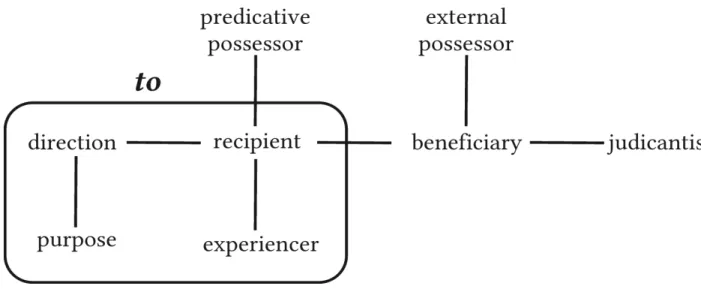
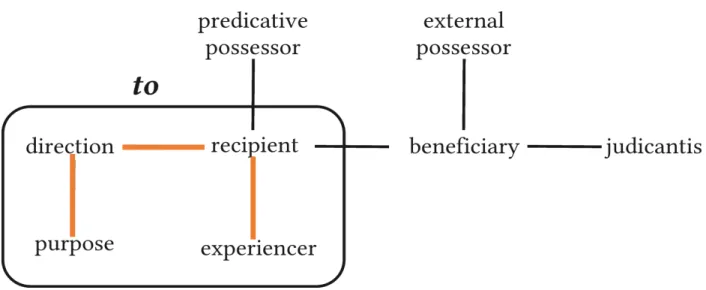
FIGURE 1. A semantic map of typical dative functions /
Inferring semantic maps
• ‘A semantic map is a geometrical representation of functions (…) that are linked by connecting lines and thus constitute a network’
(Haspelmath 2003)
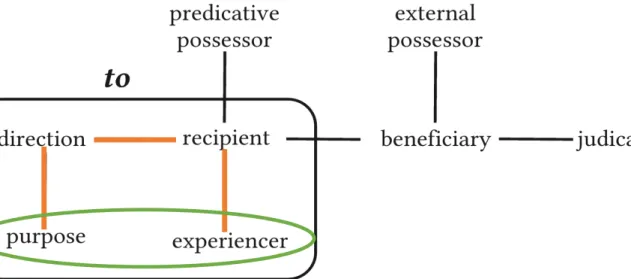
FIGURE 1. A semantic map of typical dative functions /
the boundaries of English to (based on Haspelmath 2003: 213)
Connectivity hypothesis
• A semantic map is a method for visually representing cross-linguistic regularity in semantic structure based on patterns of co-expression
Inferring semantic maps
• ‘A semantic map is a geometrical representation of functions (…) that are linked by connecting lines and thus constitute a network’
(Haspelmath 2003)
FIGURE 1. A semantic map of typical dative functions /
the boundaries of English to (based on Haspelmath 2003: 213)
Connectivity hypothesis
Economy principle
• A semantic map is a method for visually representing cross-linguistic regularity in semantic structure based on patterns of co-expression
Inferring semantic maps
“ideally (…) it should be possible to generate
semantic maps automatically on the basis of a
given set of data”
Inferring semantic maps
Limitation of the (classical) semantic map method: practically, it is
impossible to handle large-scale crosslinguistic datasets manually
“not mathematically well-defined or computationally
tractable, making it impossible to use with large and highly
variable crosslinguistic datasets”
Inferring semantic maps
o Dimensionality reduction
• Points = meanings (or contexts) • Proximity = similarity between
meanings (or contexts)
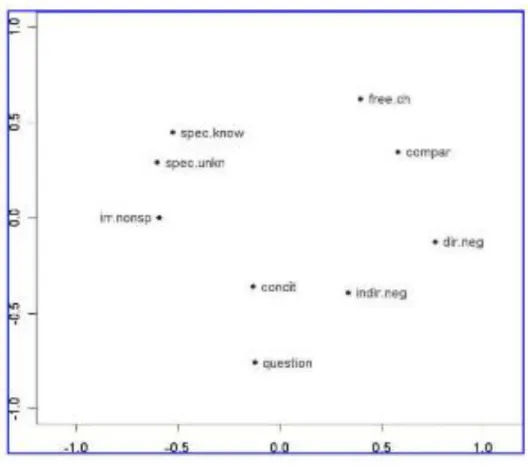
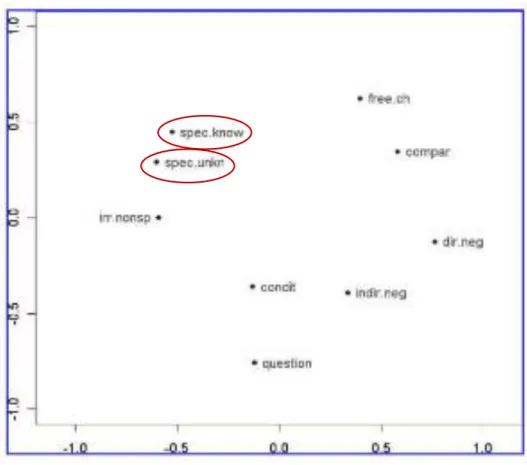
FIGURE 2. MDS analysis of Haspelmath’s (1997) data
on indefinite pronouns
Inferring semantic maps
o Dimensionality reduction
• Points = meanings (or contexts) • Proximity = similarity between
meanings (or contexts)
FIGURE 2. MDS analysis of Haspelmath’s (1997) data
on indefinite pronouns
(Croft & Poole 2008: 15)
1. Specific known
Somebody called you, guess who 2. Specific unknown:
Graphs vs feature projections
Graphs vs feature projections
Regier, Khetarpal, and Majid showed that the semantic map inference
problem is “formally identical to another problem that superficially
appears unrelated: inferring a social network from outbreaks of disease
in a population”
(Regier et al. 2013: 91)
• What’s the idea?
• Consider a group of social agents (represented by the nodes of a potential graph)
• What’s the idea?
• If one observes the same disease for five of these agents (technically called a constraint on the nodes of the graph)
• What’s the idea?
• One can postulate that all the agents met, so that all the nodes of the graph are connected (10 edges between the 5 nodes)
• What’s the idea?
• This is neither a very likely, nor a very economic explanation
• What’s the idea?
• But this is precisely what a colexification network does
Inferring semantic maps
• What’s the idea?
• But this is precisely what a colexification network does
Inferring semantic maps
• What’s the idea?
• The goal would be to find a more economical solution and to have all the social agents connected with as few edges as possible, but still accounting for all the observations
• What’s the idea?
• The goal would be to find a more economical solution and to have all the social agents connected with as few edges as possible, but still accounting for all the observations
• How does it transfer to semantic maps?
Inferring semantic maps
• How does it transfer to semantic maps?
• Nodes are meanings
Inferring semantic maps
Meaning 1 Meaning 2 Meaning 5 Meaning 4 Meaning 3 Meaning 1 2 3 4 5
• How does it transfer to semantic maps?
• Nodes are meanings
• Constraints are patterns of co-expression (connectivity hypothesis)
Inferring semantic maps
Meaning 1 Meaning 2 Meaning 5 Meaning 4 Meaning 3 Meaning 1 2 3 4 5 Polysemic item A √ √ Polysemic item B √ √ √ Polysemic item C √ √ √
• How does it transfer to semantic maps?
• Nodes are meanings
• Constraints are patterns of co-expression (connectivity hypothesis)
• One connects the nodes economically based on these constraints (economy principle)
Inferring semantic maps
Meaning 1 Meaning 2 Meaning 5 Meaning 4 Meaning 3 Meaning 1 2 3 4 5 Polysemic item A √ √ Polysemic item B √ √ √ Polysemic item C √ √ √
• How does it transfer to semantic maps?
• Nodes are meanings
• Constraints are patterns of co-expression (connectivity hypothesis)
• One connects the nodes economically based on these constraints, starting with the edge(s) that accounts for the most frequent constraint(s)
Inferring semantic maps
Meaning 1 Meaning 2 Meaning 5 Meaning 4 Meaning 3 Meaning 1 2 3 4 5 Polysemic item A √ √ Polysemic item B √ √ √ Polysemic item C √ √ √
• How does it transfer to semantic maps?
• Nodes are meanings
• Constraints are patterns of co-expression (connectivity hypothesis)
• One connects the nodes economically based on these constraints, starting with the edge(s) that accounts for the most frequent constraint(s), and then going down the scale
Inferring semantic maps
Meaning 1 Meaning 2 Meaning 5 Meaning 4 Meaning 3 Meaning 1 2 3 4 5 Polysemic item A √ √ Polysemic item B √ √ √ Polysemic item C √ √ √
• How does it transfer to semantic maps?
• Nodes are meanings
• Constraints are patterns of co-expression (connectivity hypothesis)
• One connects the nodes economically based on these constraints, starting with the edge(s) that accounts for the most frequent constraint(s), and then going down the scale
Inferring semantic maps
Meaning 1 Meaning 2 Meaning 5 Meaning 4 Meaning 3 Meaning 1 2 3 4 5 Polysemic item A √ √ Polysemic item B √ √ √ Polysemic item C √ √ √
• How does it transfer to semantic maps?
• Nodes are meanings
• Constraints are patterns of co-expression (connectivity hypothesis)
• One connects the nodes economically based on these constraints, starting with the edge(s) that accounts for the most frequent constraint(s), and then going down the scale
Inferring semantic maps
Meaning 1 Meaning 2 Meaning 5 Meaning 4 Meaning 3 Meaning 1 2 3 4 5 Polysemic item A √ √ Polysemic item B √ √ √ Polysemic item C √ √ √
• Regier et al. (2013) observed that the approximations produced by this algorithm (Angluin et al. 2010) are of high quality
• Tested on the crosslinguistic data of Haspelmath (1997) and Levinson et al. (2003)
Inferring semantic maps
Figure. Haspelmath’s (1997: 4) original semantic map of the indefinite pronouns functions
Inferring semantic maps
INPUT
Inferring semantic maps
INPUT
(lexical matrix)
ALGORITHM
Inferring semantic maps
INPUT (lexical matrix) ALGORITHM (python script) RESULT (semantic map)Tool:
pros & cons
Tool: pros and cons
RESULT
Tool: pros and cons
RESULT
(semantic map)
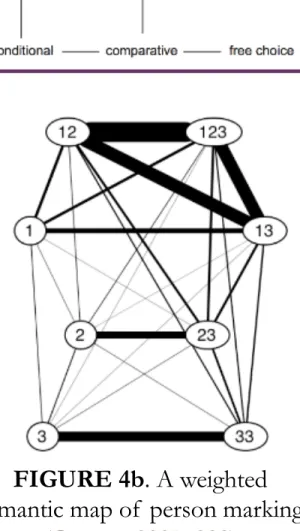
FIGURE 4a. A simple semantic map of person marking
(Cysouw 2007: 231)
FIGURE 4b. A weighted semantic map of person marking
• Generate the map with a modified version of the algorithm of
Regier et al. (2013)
• PRINCIPLE: for each edge that is being added between two meanings
of the map, we know the number of constraints that it satisfy
(max_score in the #main loop), which can be used directly as weight for the edge.
G.add_edge(*max_edge, weight=max_score)
Tool: pros and cons
Tool: pros and cons
Towards weighted semantic maps
Automatically plotted semantic maps: non-weighted vs. weighted (data from Haspelmath 1997)
The graph is visualized in Gephi®with the Force Atlas
Tool: pros and cons
Towards weighted semantic maps
Automatically plotted semantic maps: non-weighted vs. weighted (data from Haspelmath 1997)
The graph is visualized in Gephi®with the Force Atlas
Tool: pros and cons
Towards weighted semantic maps
Automatically plotted semantic maps: non-weighted vs. weighted (data from Haspelmath 1997)
The graph is visualized in Gephi®with the Force Atlas
algorithm and modularity analysis (Lambiotte et al. 2009)
Tool: pros and cons
Unsolvable inferences
Meaning 1 2 3
Polysemic item A √ √ √
Tool: pros and cons
Unsolvable inferences
Meaning 1 Meaning 2 Meaning 3
Meaning 1 2 3
Polysemic item A √ √ √
Polysemic item B √ √ √
Meaning 2 Meaning 3 Meaning 1
Tool: pros and cons
Unsolvable inferences
Meaning 1 Meaning 2 Meaning 3
Meaning 1
Wood Tree2 Forest3
Polysemic item A √ √ √
Polysemic item B √ √ √
Meaning 2 Meaning 3 Meaning 1
Meaning 3 Forest Meaning 1 Wood Meaning 2 Tree
Tool: pros and cons
Unsolvable inferences
Meaning 1 Meaning 2 Meaning 3
Meaning 1
Wood Tree2 Forest3
Polysemic item A √ √ √
Polysemic item B √ √ √
Meaning 2 Meaning 3 Meaning 1
Meaning 3 Forest Meaning 1 Wood Meaning 2 Tree
Ø Qualitative semantic analysis Ø More typological data
Tool: pros and cons
Tool: pros and cons
Unsolvable inferences
smell hear
Tool: pros and cons
Unsolvable inferences
smell hear 11 listen 3Tool: pros and cons
Unsolvable inferences
smell hear 11 listen 3 3? ?
3Tool: pros and cons
Unsolvable inferences
smell hear 11 listen 3 3 3 see?
?
?
?
Tool: pros and cons
Unsolvable inferences
smell hear 11 listen 3 3 3 see?
?
?
?
?
? ?
Ø More typological data ⇒ more constraints
Tool: pros and cons
Unsolvable inferences
Datasets:
what do we need?
Datasets: what do we need?
Size
Cf. Joshua Conrad Jackson, Joseph Watts, Teague Henry, Johann-Mattis List, Robert Forkel, Simon Greenhill, Russell Gray, Kristen Lindquist, Variability and Universality in Human Emotion Across 1156 Languages,
Datasets: what do we need?
Size
Emotions (properties) in CLICS
2(colexifications in 1220 languages)
AMAZING ANGRY ASHAMED ASTONISHED BAD BEAUTIFUL BORING BRAVE CLEVER CONTEMPTIBLE CORRECT (RIGHT) CRUEL CUNNING DEAR DILIGENT DREADFUL EVIL EXACT FAITHFUL GENTLE GLOOMY GOOD GREEDY HAPPY HONEST IMPORTANT INSOLENT KEEN KIND OR POLITE LOVELY MERRY PASSIONATE PROUD RUDE SAD SHY SORROWFUL SURPRISED TRUE UGLY UNPLEASANT VULGAR WRONG Concepticon (https://concepticon.clld.org)
43
Emotions (properties) in CLICS
2(colexifications in 1220 languages)
AMAZING ANGRY ASHAMED ASTONISHED BAD BEAUTIFUL BORING BRAVE CLEVER CONTEMPTIBLE CORRECT (RIGHT) CRUEL CUNNING DEAR DILIGENT DREADFUL EVIL EXACT FAITHFUL GENTLE GLOOMY GOOD GREEDY HAPPY HONEST IMPORTANT INSOLENT KEEN KIND OR POLITE LOVELY MERRY PASSIONATE PROUD RUDE SAD SHY SORROWFUL SURPRISED TRUE UGLY UNPLEASANT VULGAR WRONG Concepticon (https://concepticon.clld.org) ANGRY ASHAMED BAD BEAUTIFUL BRAVE CLEVER CORRECT (RIGHT) CUNNING DEAR DILIGENT EVIL FAITHFUL GENTLE GOOD GREEDY HAPPY HONEST MERRY PROUD SAD SHY SURPRISED TRUE UGLY WRONG43
25 (attested)
Clics2(https://clics.clld.org)Datasets: what do we need?
Emotions (properties) in CLICS
2(colexifications in 1220 languages)
AMAZING ANGRY ASHAMED ASTONISHED BAD BEAUTIFUL BORING BRAVE CLEVER CONTEMPTIBLE CORRECT (RIGHT) CRUEL CUNNING DEAR DILIGENT DREADFUL EVIL EXACT FAITHFUL GENTLE GLOOMY GOOD GREEDY HAPPY HONEST IMPORTANT INSOLENT KEEN KIND OR POLITE LOVELY MERRY PASSIONATE PROUD RUDE SAD SHY SORROWFUL SURPRISED TRUE UGLY UNPLEASANT VULGAR WRONG Concepticon (https://concepticon.clld.org) ANGRY ASHAMED BAD BEAUTIFUL BRAVE CLEVER CORRECT (RIGHT) CUNNING DEAR DILIGENT EVIL FAITHFUL GENTLE GOOD GREEDY HAPPY HONEST MERRY PROUD SAD SHY SURPRISED TRUE UGLY WRONG43
25 (attested)
ANGRY BAD BEAUTIFUL BRAVE CLEVER CORRECT (RIGHT) DEAR DILIGENT EVIL FAITHFUL GENTLE GOOD HAPPY MERRY PROUD SAD SURPRISED TRUE UGLY WRONG Clics2(https://clics.clld.org)20 (colexified)
Clics2(https://clics.clld.org)Datasets: what do we need?
Emotions (properties) in CLICS
2(colexifications in 1220 languages)
ANGRY BAD BEAUTIFUL BRAVE CLEVER CORRECT (RIGHT) DEAR DILIGENT EVIL FAITHFUL GENTLE GOOD HAPPY MERRY PROUD SAD SURPRISED TRUE UGLY WRONG20 (colexified)
Clics2(https://clics.clld.org) 8415, 96% 366, 4% Lexifications vs. colexifications Lexifications ColexificationsDatasets: what do we need?
Emotions (properties) in CLICS
2(colexifications in 1220 languages)
ANGRY BAD BEAUTIFUL BRAVE CLEVER CORRECT (RIGHT) DEAR DILIGENT EVIL FAITHFUL GENTLE GOOD HAPPY MERRY PROUD SAD SURPRISED TRUE UGLY WRONG20 (colexified)
Clics2(https://clics.clld.org) 8415, 96% 366, 4% Lexifications vs. colexifications Lexifications Colexifications 20 meanings 366 constraints 31 edgesDatasets: what do we need?
Emotions (properties) in CLICS
2(colexifications in 1220 languages)
Datasets: what do we need?
Emotions (properties) in CLICS
2(colexifications in 1220 languages)
Datasets: what do we need?
Emotions (properties) in CLICS
2(colexifications in 1220 languages)
/sʊu͡ɔhtɑs/ in Lule Sami (Uralic) [traurig] and [lusag]
(northeuralex.org)
?Neutral valence and high arousal?
Datasets: what do we need?
Emotions (properties) in CLICS
2(colexifications in 1220 languages)
Datasets: what do we need?
Size
/sʊu͡ɔhtɑs/ in Lule Sami (Uralic) [traurig] and [lusag]
(northeuralex.org)
Emotions (properties) in CLICS
2(colexifications in 1220 languages)
Carapana (Tucanoan ; Amazonia)
Datasets: what do we need?
Size
Emotions (properties) in CLICS
2(colexifications in 1220 languages)
Semantic map based on colexification patterns attested in more than 1 language variety
Datasets: what do we need?
Allative markers (based on Rice & Kabata 2007)
Datasets: what do we need?
Allative markers (based on Rice & Kabata 2007)
Datasets: what do we need?
Structure
Ø 34 meanings Ø 33 edges
Allative markers (based on Rice & Kabata 2007)
Datasets: what do we need?
Allative markers (based on Rice & Kabata 2007)
Datasets: what do we need?
Structure
Data should be structured around several
Method:
can we open the blackbox?
Formal Concept Lattices (hierarchical graphs)
Method: can we open the black-box?
Method: can we open the black-box?
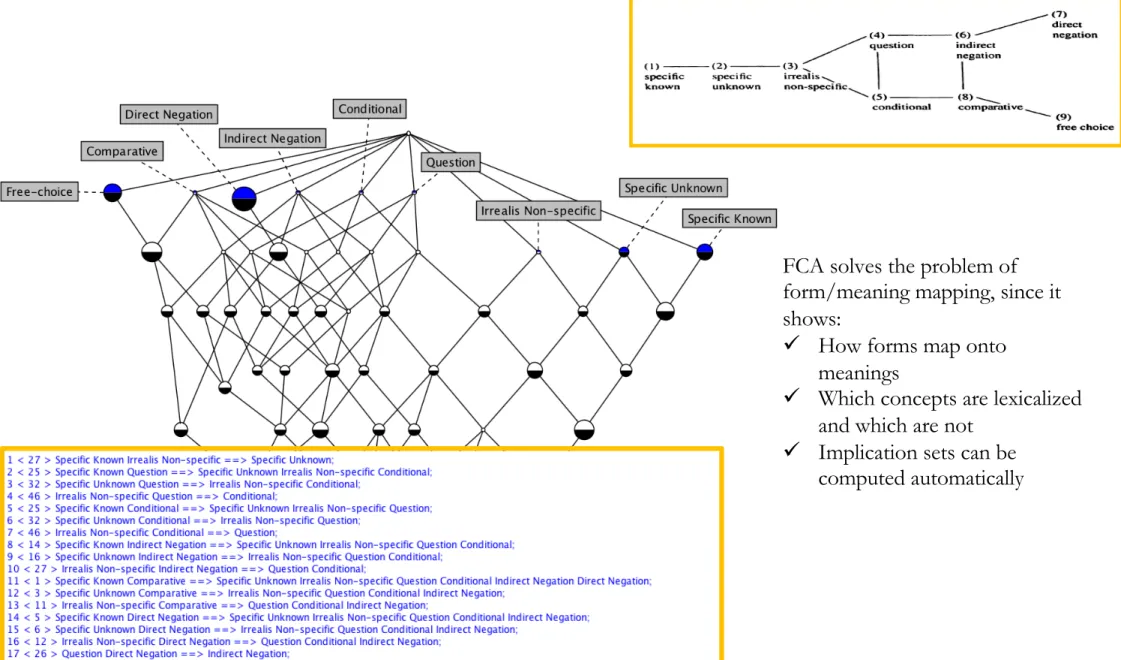
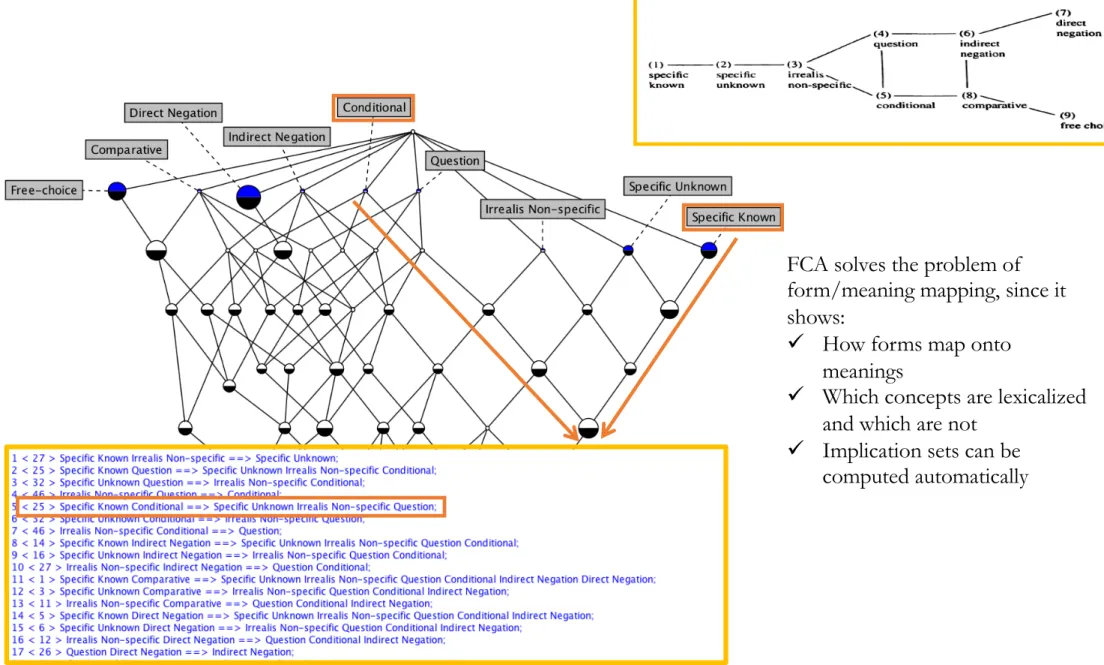
FCA analysis of Haspelmath’s (1997) data
FCA solves the problem of form/meaning mapping
Method: can we open the black-box?
FCA solves the problem of form/meaning mapping, since it shows:
ü How forms map onto meanings
FCA analysis of Haspelmath’s (1997) data
Method: can we open the black-box?
FCA solves the problem of form/meaning mapping, since it shows:
ü How forms map onto meanings
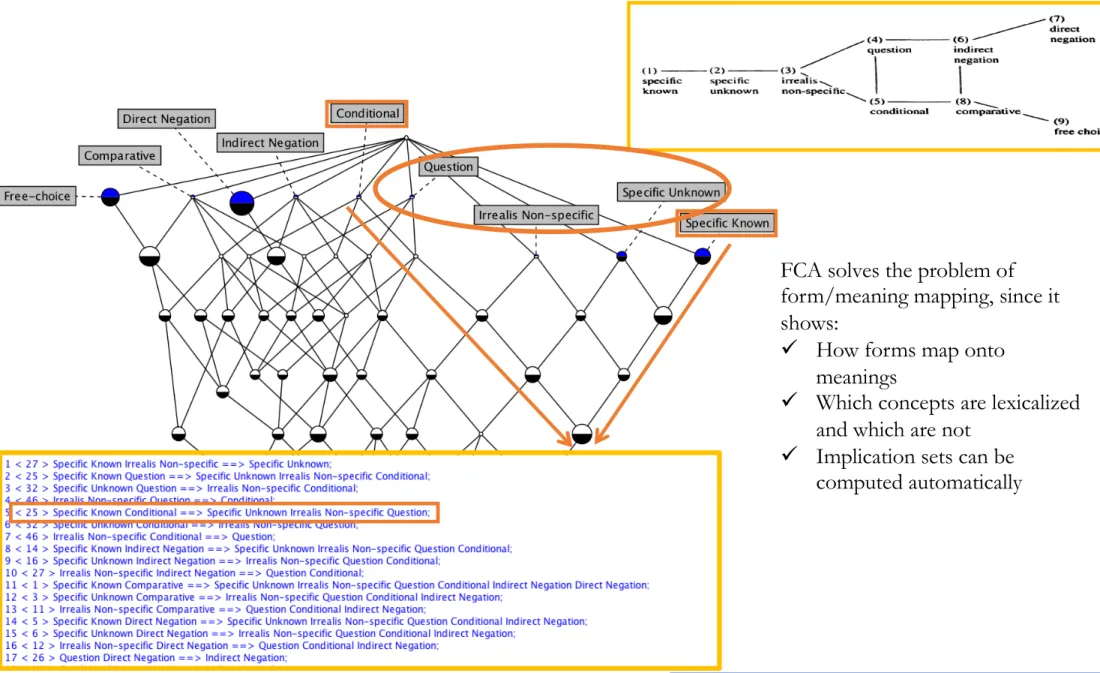
ü Which concepts are lexicalized and which are not
FCA analysis of Haspelmath’s (1997) data
Method: can we open the black-box?
Figure 3. FCA analysis of
Haspelmath’s (1997) data
FCA solves the problem of form/meaning mapping, since it shows:
ü How forms map onto meanings
ü Which concepts are lexicalized and which are not
ü Implication sets can be computed automatically
Method: can we open the black-box?
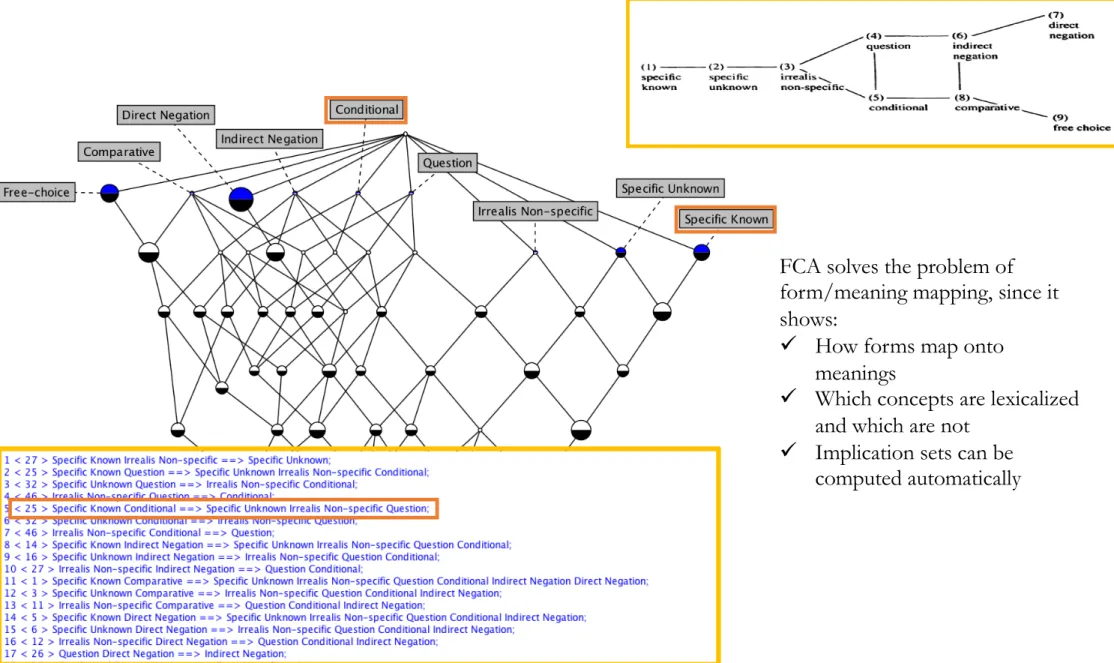
Figure 3. FCA analysis of
Haspelmath’s (1997) data
FCA solves the problem of form/meaning mapping, since it shows:
ü How forms map onto meanings
ü Which concepts are lexicalized and which are not
ü Implication sets can be computed automatically
Method: can we open the black-box?
Figure 3. FCA analysis of
Haspelmath’s (1997) data
FCA solves the problem of form/meaning mapping, since it shows:
ü How forms map onto meanings
ü Which concepts are lexicalized and which are not
ü Implication sets can be computed automatically
Method: can we open the black-box?
Figure 3. FCA analysis of
Haspelmath’s (1997) data
FCA solves the problem of form/meaning mapping, since it shows:
ü How forms map onto meanings
ü Which concepts are lexicalized and which are not
ü Implication sets can be computed automatically
Method: can we open the black-box?
Figure 3. FCA analysis of
Haspelmath’s (1997) data
FCA solves the problem of form/meaning mapping, since it shows:
ü How forms map onto meanings
ü Which concepts are lexicalized and which are not
ü Implication sets can be computed automatically u But, less ‘reader-friendly’
(especially with many meanings = attributes)
Semantic maps
Figure 3. FCA analysis of
Haspelmath’s (1997) data
FCA solves the problem of form/meaning mapping, since it shows:
ü How forms map onto meanings
ü Which concepts are lexicalized and which are not
ü Implication sets can be computed automatically u But, less ‘reader-friendly’
(especially with many meanings = attributes)
Semantic maps
FCA solves the problem of form/meaning mapping, since it shows:
ü How forms map onto meanings
ü Which concepts are lexicalized and which are not
ü Implication sets can be computed automatically u But, less ‘reader-friendly’
(especially with many meanings = attributes)
u Complementarity between the two approaches
FCA analysis of time-related lexemes (588 objects = words; 221 attributes = meanings)
FCA analysis of Haspelmath’s (1997) data
Conclusions:
co-expression vs. semantic similarity
Conclusions
Ø Co-expression ⇎ semantic similarity (e.g., Malchukov 2010) o No relation o Homonyms o Symmetrical relations o Auto-antonyms (Klégr 2013) o Hierarchical relations o Auto-hyponyms o Auto-meronyms o Etc.