HAL Id: hal-01446292
https://hal.archives-ouvertes.fr/hal-01446292
Submitted on 25 Jan 2017
HAL is a multi-disciplinary open access
archive for the deposit and dissemination of
sci-entific research documents, whether they are
pub-lished or not. The documents may come from
teaching and research institutions in France or
abroad, or from public or private research centers.
L’archive ouverte pluridisciplinaire HAL, est
destinée au dépôt et à la diffusion de documents
scientifiques de niveau recherche, publiés ou non,
émanant des établissements d’enseignement et de
recherche français ou étrangers, des laboratoires
publics ou privés.
Adaptive physical resource block design for enhancing
voice capacity over LTE network in PMR context
Manh Cuong Nguyen, Hang Nguyen, Eric Georgeaux, Philippe Mège, Laurent
Martinod
To cite this version:
Manh Cuong Nguyen, Hang Nguyen, Eric Georgeaux, Philippe Mège, Laurent Martinod. Adaptive
physical resource block design for enhancing voice capacity over LTE network in PMR context. PIMRC
2016 : 27th International Symposium on Personal, Indoor and Mobile Radio Communications, Sep
2016, Valencia, Spain. pp.1 - 5, �10.1109/PIMRC.2016.7794632�. �hal-01446292�
Adaptive Physical Resource Block Design for
Enhancing Voice Capacity over LTE in PMR
Context
Manh-Cuong Nguyen and Hang Nguyen
1Eric Georgeaux, Philippe Mege and Laurent Martinod
2Abstract—In this paper, we introduce a new Adaptive Physical Resource Block Design for Enhancing Voice Capacity over Long-Term Evolution (LTE) Downlink in Professional Mobile Radio (PMR) Context. In this method, we reorganize the structure of the Physical Resource Block (PRB) to optimize the voice capacity of LTE downlink in the PMR Context. Available PRBs in each subframe is reorganized into a number Sub Physical Resource Blocks. The number of control symbols can be selected flexibility. The proposed method allows reducing both data overhead and control overhead issues for Voice over LTE downlink in PMR context. On average, the voice capacity gain were shown to have about 117.2% in comparison with the standard LTE.
Index Terms—Adaptive PRB, control symbol, voice capacity, control overhead, data overhead, LTE, PMR
I. INTRODUCTION
The current Professional Mobile Radio (PMR) systems which are used for public safety, such as TETRA, APCO25 suffer from slow data transfer [11], [9]. Long Term Evolu-tion (LTE) technology takes its place as the choice for the broadband PMR to satisfy the user demands of public safety in the future. In the public safety systems, the performance in terms of voice capacity is one of the strict requirements. However, LTE is not yet optimal for low bit rate voice communication in PMR context because of the data overhead and control overhead issues [5]. Therefore, the voice capacity is not increased as expected of the PMR service providers. In order to deploy LTE as the solution for the next generation of PMR network, some adaptations have to be considered to reduce both data and control overhead.
Factors thought to be influencing voice capacity of VoLTE have been explored in several studies. The current solutions on data overhead of voice over LTE pays particular attention to reduce the size of header protocols (e.g. [4], [12]). However, in the PMR context the difference between the LTE packet size and the PMR voice payload is the main factor that causes the data overhead. Our research shows that the average size of the LTE packet is about three times greater than the PMR voice payload. In addition, state-of-the-art methods expose many
1Institut Mines-Telecom, Telecom SudParis
Samovar Laboratory, UMR 5157, CNRS, Evry, France {manh cuong.nguyen, hang.nguyen}@it-sudparis.eu
2Department of Security and Communication Solutions
CASSIDIAN (an EADS Company), Elancourt, France
{eric.georgeaux, philippe.mege, laurent.martinod}@cassidian.com
This work was accomplished in the framework of the collaborative project SOAPS.2, labeled by the Systematic PARIS-REGION Cluster
difficulties to obtain the improvement of the Voice over LTE (VoLTE) capacity in PMR context. The solutions for reducing data overhead do not take into account the signal overhead whenever evaluating the system performance and on the other hand, the existing researches on control overhead such as Semi-persistent scheduling (SPS) [8], TTI-bundling [6], packet bundling [10] do not take into account the data overhead. Therefore, we propose a new Adaptive Physical Resource Block Design for Enhancing Voice Capacity over Long-Term Evolution (LTE) Donwlink in Private Mobile Radio (PMR) Context. In this method, we reorganize the structure of the Physical Resource Block (PRB) to optimize the voice capacity of LTE downlink in the PMR Context. The available PRBs in each subframe is reorganized into a number Sub Physical Resource Blocks (subPRBs). The number of control symbols can be selected flexibility. The proposed method allows re-ducing both data overhead and control overhead issues for VoLTE downlink in PMR context. The details of this method is presented in section II. The performance of our method is evaluated in section III. Section IV will give the conclusion and some perspectives.
II. PROPOSEDADAPTIVEPHYSICALRESOURCEDESIGN
A. Proposed Sub Physical Resource structure
In LTE [3], [7], [2], [1] one pair of Physical Resource Blocks (PRBs) is the smallest User Assignment Unit. How-ever, the smallest LTE packet size is still too large in case that low bit rate voice communication is transmitted in high Modulation and Coding Scheme (MCS). This is the main factor that affects the data overhead of VoLTE in PMR context. Therefore, the main idea of the proposed method is to reorganize the structure of the PRB of LTE to optimize the voice capacity of VoLTE in case of PMR context but not affect the operations of the system.
In order to ensure the integrity of processing for control signals such as Reference Signal (RS), Primary Synchro-nization Channel (PSS), Secondary SynchroSynchro-nization Channel (SSS)...These control signals are organized in the same way with LTE standards. It means that one radio frame still includes 10 subframes of 1ms. Each subframe consists of two slots. Each slot in turn consists seven (normal cyclic prefix) or six symbols (extended cyclic prefix). The number and location of control channels such as PSS, SSS, RS.. are unchanged. The difference is that in the new design, the available REs for data in each subframe is reorganized into a number Sub Physical
Fig. 1. REG structure
k REGs4 REGs
Fig. 2. Adaptive Phycical Resource Block
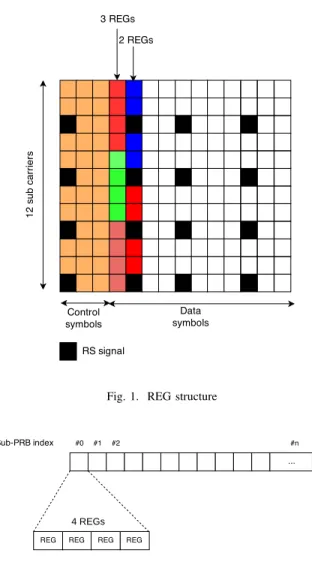
Resource Blocks (SubPRBs). Each SubPRB consists of four Resource Element Group (REG). Each Resource Element Group (REG) contains four consecutive Resource Elements (RE) or four REs separated by a cell-specific Reference Signal (RS). The structure of SubPRB is similar to the structure of Control Channel Element (CCE) for the control channel with adaptations. SubPRB structure is illustrated in Figure 1.
In addition, in the new design, instead of limiting the number of symbols for control channels from 1 to 3 symbols, the new design allows a flexible choice of the number of symbols so that the system can obtain the maximum voice capacity. Figure 3 illustrates the model of our proposed system. There is a slight change in the last step. The symbols after passing the Layer mapping/precoding are mapped into subPRBs instead of PRBs. Therefore, the major issues to be considered is how to determine the size of SubPRB and the number of symbols used for control channel to maximize the voice capacity. In LTE, the base scheduler is Fully Dynamic (FD) scheduler. In the FD scheduler, each data packet needs to associate with a Layer 1 (L1) control signaling (a Physical Downlink Control Channel). LTE uses Physical Downlink
Control Channel (PDCCH) to carry all allocation information for both downlink and uplink shared channels. These symbols for control channels are organized in Resource Element Group and Control Channel Element (CCE). One REG consists of four consecutive REs or four REs separated by one Refer-ence Signal. One CCE comprises nine REGs. To build the PDCCH, LTE uses a number of consecutive CCEs called CCE aggregation level. The CCE aggregation level can be one, two, four or eight. The aggregation level depends on the DCI size and the effective coding rate. There are four PDCCH formats (PDCCH format 0, PDCCH format 1, PDCCH format 2, PDCCH format 3) that correspond to four aggregation levels. PDCCH carries Downlink Control Information (DCI). We know that the number of control channels depends on the size of the DCI and the code rate. The size of DCI in turn depends on the number of available PRBs (in case of LTE) or available SubPRB (in our case). Therefore, the choice of size SubPRB influences the number of available control channels. If the size of SubPRB is too small, the number of bits need to be used for resource allocation in the corresponding DCI is increased. However, if the size of SubPRB is too big, the gap between LTE packet size and the PMR voice payload will be increased. In case of PMR with voice target codec 2450 bps, the optimal value of subPRB size is about four REGs. Therefore, in the proposed SubPRB design, we propose that the one SubPRB can consist of four REGs (see Figure 2). The number of symbols for control channel are chosen to optimize the voice capacity of VoLTE in PMR context.
B. System Model
We consider the number of available control channel (NC)
is a function of the number of allowed resource blocks of
a defined bandwidth NBW, the number of symbols used for
PDCCH channels nc, number of active UEs in the cell with
the aggregation level Aij that is need to be used to transmit
PDCCH for U Ei at jthTTI, voice payload of UE Sp,
NC= f (NBW, nc, Sp, [Aij]) (1)
We consider the number of available data channels (ND) is
a function of NBW, nc, Sp number of active UEs in the cell
with Modulation and Coding Scheme assigned M CSij
ND= f (NBW, nc, Sp, CP, [M CSij]) (2)
The voice capacity NV at the jthTTI is defined as:
NV = min(NC, ND) (3)
At the jthTTI, choose nc so that:
argmax f (nc)
nc,nk
= {nc|∀x : f (x) ≤ f (nc)} (4)
The voice capacity in a period {t1, t2} is defined as:
V oicecapacity = t2 X
t1
Fig. 3. SubPRB mapping
The number of OFDM symbols in a sub-frame is indicated by the Physical Control Format Indicator Channel (PCFICH) like in case of LTE standard. In order to determine the size of subPRB, the UEs have to read the field SRBS (Size of SubPRB) in new Adaptive DCI structure. The structure of Adaptive DCI structure is presented in table I. In this case, the field SRBA (Sub Physical Resource Block assignment) is used in stead of RBA ( Physical Resource Block assignment) in LTE standard.
TABLE I ADAPTIVEDCISTRUCTURE
Field Name Length (bits) Comment SRBA
8 (1.4 MHz) 10 (3 MHz) 12 (5 MHz)
SubPRB assignment
MCS 5 Modulation and Coding Scheme
III. PERFORMANCE EVALUATION
A. Simulation Parameters
In this section we will present simulation results of our proposed method. In our simulation, we use the target codec of PMR context AMBE with code rate 2450 bps for three lower bandwidths 1.4 MHz, 3MHz, 5 MHz. UEs take random values MCS and Aggregation level for PDCCH channel. The other parameters for simulation are presented in table II. B. Simulation Results
Table III compares the average voice capacity obtained from Physical Resource Block design (standard LTE) and from Adaptive Physical Resource Block design (our method) for
TABLE II SIMULATION PARAMETERS Parameter Value Bandwidth 1.4 MHz, 3MHz, 5 MHz LTE Type 1 FDD Codec AMBE 2450 bps Ng 1 CRC 24 bits
Cyclic Prefix Normal Number of antenna 2 2 4 6 8 10 12 14 0 50 100 150 200 250 300 350 400 450 500
Voice capacity of the proposed method (1.4MHz bandwidth and 20 ms)
Number of control symbols
Average voice capacity of the proposed method
Average # of supported PDCCHs Average # of supported PDSCHs Average voice capacity
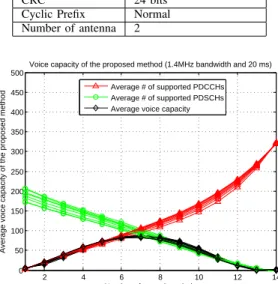
Fig. 4. Control capacity of the proposed method (1.4 MHz bandwidth and 20ms)
1.4 MHz bandwidth in 20 ms simulation. As Table III shows, there is a significant voice capacity gain (54 for standard LTE and 91 for the proposed method) between the two methods. Comparing the two results, it can be seen that the proposed method allows a more flexible and optimal LTE packet size than the existent standard LTE. The standard LTE is not optimal the packet size in case of PMR context. This leads to a decrease number of available data packets and control packets. Meanwhile, the proposed method allows a choice packet size and the number of symbols for control channel more flexible so that the proposed method can chose an optimal value for improving voice capacity.
Table IV and Table V present the voice capacity gain for the case of 3 MHz, 5 MHz bandwidths. For the 3 MHz bandwidth, the voice capacity gain is about 134.7% and for the 5 MHz bandwidth the voice capacity gain is about 133.3%.
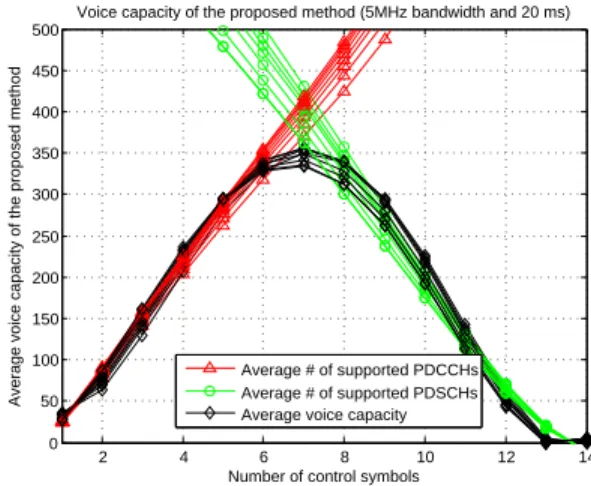
In our simulation, we also apply several SubPRB sizes (from one to eight REGs) get the optimal value of SubPRB size for the PMR voice codec of 2450 bps. Figures 4, 5 and 6 show the relation between the number of symbols for control channel with the number of average supported data packets average supported control packets and the voice capacity for the three corresponding 1.4 MHz, 3 MHz, 5 MHz bandwidths for different SubPRB sizes. The results show that the optimal value number of symbols for control channel is about 5 to 7 symbols and the SubPRB contains about four REGs.
TABLE III
VOICE CAPACITY GAIN OF THE PROPOSED METHOD FOR1.4 MHZ IN20MS
Number of control symbols 1 2 3 4 5 6 7 8 9 10 11 12 13 14
Average supported control packets of FD 7 31 54 X X X X X X X X X X X
Average supported data packets of FD 84 84 84 X X X X X X X X X X X
Average supported control packets of new method 6 26 46 67 87 107 127 148 168 188 208 229 249 269 Average supported data packets of new method 169 157 140 129 115 99 86 72 57 44 28 14 7 0
Average voice capacity of FD 54
Average voice capacity of new method 99
Gain 83.5%
X: Standard LTE not support
TABLE IV
VOICE CAPACITY GAIN OF THE PROPOSED METHOD FOR3 MHZ IN20MS
Number of control symbols 1 2 3 4 5 6 7 8 9 10 11 12 13 14
Average supported control packets of FD 16 54 92 X X X X X X X X X X X
Average supported data packets of FD 208 208 208 X X X X X X X X X X X
Average supported control packets of new method 13 46 79 112 146 181 216 253 290 331 375 431 631 681 Average supported data packets of new method 481 446 397 360 325 279 241 201 159 120 80 41 0 0
Average voice capacity of FD 92
Average voice capacity of new method 216
Gain 134.7%
X: Standard LTE not support
TABLE V
VOICE CAPACITY GAIN OF THE PROPOSED METHOD FOR5 MHZ IN20MS
Number of control symbols 1 2 3 4 5 6 7 8 9 10 11 12 13 14
Average supported control packets of FD 27 88 150 X X X X X X X X X X X
Average supported data packets of FD 347 347 347 X X X X X X X X X X X
Average supported control packets of new method 23 75 129 182 237 293 350 410 470 536 608 695 1052 1137 Average supported data packets of new method 805 737 672 597 535 470 403 337 269 202 134 69 0 0
Average voice capacity of FD 150
Average voice capacity of new method 350
Gain 133.3%
X: Standard LTE not support
2 4 6 8 10 12 14 0 50 100 150 200 250 300 350 400 450 500
Voice capacity of the proposed method (3MHz bandwidth and 20 ms)
Number of control symbols
Average voice capacity of the proposed method
Average # of supported PDCCHs Average # of supported PDSCHs Average voice capacity
Fig. 5. Control capacity of the proposed method (3 MHz bandwidth and 20ms)
IV. CONCLUSION
In this paper, we proposed a new Adaptive Physical Re-source Design for improving control capacity of LTE Down-link in the PMR context. In this design, the available PRBs in each subframe is reorganized into a number of subPRBs.
2 4 6 8 10 12 14 0 50 100 150 200 250 300 350 400 450 500
Voice capacity of the proposed method (5MHz bandwidth and 20 ms)
Number of control symbols
Average voice capacity of the proposed method
Average # of supported PDCCHs Average # of supported PDSCHs Average voice capacity
Fig. 6. Control capacity of the proposed method (5 MHz bandwidth and 20ms)
In addition, the number of symbols for control channel are chosen flexibility to maximize the voice capacity. On average, the voice capacity gain were shown to have about 117.2% in comparison with the standard LTE. Finally, a number of important limitations need to be considered. First, the
complexity assessment and the energy consumption issue of the new design has not been studied. Second, an assessment of the of Bit Error Rate (BER) should also be considered when the number of supported voice calls is increased.
REFERENCES
[1] Evolved Universal Terrestrial Radio Access (E-UTRA); Physical layer procedures, 3GPP TS. 36.213 V9.0.1, Dec. 2009.
[2] Evolved Universal Terrestrial Radio Access (E-UTRA); User Equipment (UE) radio transmission and reception, 3GPP TS. 36.101 V9.2.0, Dec. 2009.
[3] D Ast´ely, E Dahlman, A Furuskar, Y Jading, M Lindstrom, and S Parkvall. LTE: the evolution of mobile broadband. Communications Magazine, IEEE, 2009.
[4] C Bormann, C Burmeister, M Degermark, H Fukushima, H Hannu, LE Jonsson, R Hakenberg, T Koren, K Le, Z Liu, et al. RObust Header Compression (ROHC): Framework and four profiles: RTP, UDP, ESP, and uncompressed. Technical report, RFC 3095, July, 2001.
[5] AA Florea, L Martinod, P Mege, and H Nguyen. Multi-layer Realistic Voice Capacity Evaluation in LTE Rel. 9 and Performance Comparison with PMR and GSM. In World Telecommunications Congress (WTC), 2012.
[6] J Han and H Wang. Principle and performance of TTI bundling for VoIP in LTE FDD mode. In Wireless Communications and Networking Conference (WCNC), 2009.
[7] Telesystem Innovations Inc. LTE in a Nutshell: The Physical Layer. 2010.
[8] D Jiang, H Wang, E Malkamaki, and E Tuomaala. Principle and performance of semi-persistent scheduling for VoIP in LTE system. In Wireless Communications, Networking and Mobile Computing (WiCom), 2007.
[9] Xavier Pons Masbernat, Christophe Gruet, Fr´ed´eric Fraysse, Serge Contal, and Lirida Naviner. Green solutions for future lte pmr networks. In Computer Aided Modeling and Design of Communication Links and Networks (CAMAD), 2012 IEEE 17th International Workshop on, pages 165–167. IEEE, 2012.
[10] J Puttonen, T Henttonen, N Kolehmainen, K Aschan, M Moisio, and P Kela. Voice-over-IP performance in UTRA Long Term Evolution downlink. In Vehicular Technology Conference (VTC), 2008.
[11] M Simic. Feasibility of long term evolution (lte) as technology for public safety. In Telecommunications Forum (TELFOR), pages 158–161, 2012. [12] ER Vale, MA Grivet, and JC Brandao. Reducing the VoIP packet overhead in UMTS air interface. In Adaptive Science & Technology (ICAST), 2009.