Analysis of the flexibility of Belgian residential buildings equipped
with Heat Pumps and Thermal Energy Storages
E. Georges1*, P. Garsoux1, G. Masy2, G. De Maere D’Aertrycke3, V. Lemort1
1Energy Systems, Thermodynamics Laboratory, University of Liège, Liège, Belgium. 2Haute Ecole de la Province de Liège, Liège, Belgium.
3Centre d’expertise en Études et Modélisations Économiques (CEEME), Engie, Brussels, Belgium.
Abstract
This paper presents a study of the potential of demand side management offered by a residential building stock with a percentage of houses equipped with heat pumps and thermal storage for both space heating and domestic hot water. The method is based on control strategies of the systems in response to dynamic electricity pricing. Two configurations of the storage tanks are compared: the parallel hydraulic integration by four-pipe connection and the parallel hydraulic integration by two-pipe connection. It is illustrated by a case study applied to the Belgian residential building stock for a scenario at the horizon 2030.
The parallel hydraulic integration by two-pipe connection provides a suitable solution with cost savings for the consumer reaching up to 5.8% in average and an average flexibility increase of 10%. Peak demand increase and ramping issues are observed with large penetration rate of heat pumps. A coordination mechanism between consumers allows to reduce peak demand increase by 19% without significantly impacting the cost savings for the end-users.
Keywords – demand-side management, heat pumps, sensible thermal storage, building stock.
1. Introduction
New policies to integrate renewable energy sources in the energy mix have entailed the need for a shift from the "supply following demand" model to a "demand following supply" model by mean of flexible loads [1]. As the building sector accounts for approximately 40% of the total energy demand in Europe, there is therefore a large potential to control, adapt and enhance space heating (SH) and domestic hot water (DHW) demand. Moreover, in the coming years, a substantial electrification of this sector is expected with increased use of electric/plug-in vehicles and HVAC systems such as high efficiency heat pumps [2]. In particular, residential buildings equipped with heat pumps and load shifting enabling equipment such as sensible thermal energy storages (TES) can provide a significant flexibility potential [3] and
help electricity grid management. In the frame of this study, only sensible thermal energy storages are considered. Several studies have focused on the potential of using the building thermal mass for load shifting. Results have shown that overheating the room temperature during off-peak hours can considerably reduce (by up to 20% [4]) the heating needs for the following peak hours. However, this leads to significant overconsumption [5] and doesn’t reduce peak demand amplitude but shifts in time [6]. The use of DHW water tanks for demand response programs has also been investigated, for example, to reduce curtailing losses from PV panels in NZEBs neighborhood [7]. The use of an extra water tank for space heating needs is less widespread in practice so far, but has been the interest of the several studies. Studies [8] and [9] focused on control strategies, and showed a possible reduction of up to 1.5% per every 10% TES penetration of the overall power system’s operation costs [9]. Floss et al. [10] studied the impact on the system performance of several hydraulic integrations (see Section 3.1) of SH thermal storages in heat pump driven heating systems.
This study presents a framework to evaluate the potential of load shifting of electricity consumption for space heating and domestic hot water from peak to off-peak hours in response to dynamic electricity tariffs in residential housing (Section 2). Water tanks are used as storage systems for both domestic hot water and space heating and different configurations are investigated (Section 3.1). The potential is characterized in terms of volume shifted from peak to off peak periods, cost for the end-user and peak power demand. The method is illustrated first by a case-study on a single house (Section 4.1) and then extended to the Belgian residential building stock for a scenario at the horizon 2030 (Section 4.2).
2. Methodology
2.1. Dynamic electricity retail tarif
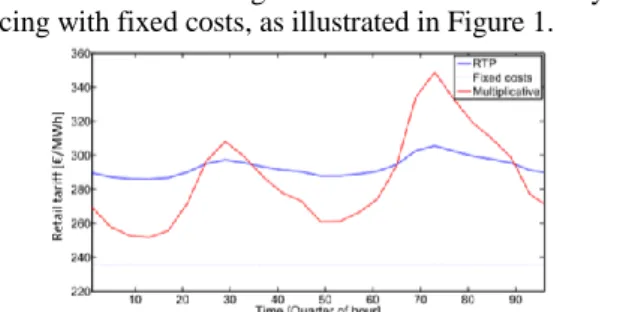
Residential consumers are currently exposed to retail tariffs that have a very low time-varying character. In Belgium, the most variable tariff follows a day-night time-of-use structure. In order to support demand participation and efficient use of distributed energy resources, it is recommended to move away from fixed rates by making them more time varying [11]. Real-Time Pricing (RTP) [12] tariff design aligned on the wholesale market reflects the current conditions and provides the best available signal of the marginal value of electricity. Retail tariffs however, are not only based on spot prices as they also cover some important fixed “residual network costs”. In this work, a multiplicative dynamic tariff structure [13] is used, assuming that “residual network costs” are, on the one hand, still recovered on a volumetric basis, and, on the other hand, also aligned on the wholesale electricity prices.
This gives a retail tariff with a great incentive for flexibility compared to real-time pricing with fixed costs, as illustrated in Figure 1.
Fig. 1 Retail tariff: comparison of real time pricing (RTP) and multiplicative dynamic tariff.
2.2. Control strategy
Two types of control methods can be distinguished: optimal predictive control and rule-based control. The first method consists in solving a constrained optimization problem to derive the electricity consumption profile that minimizes the cost for the end-user over a prediction horizon and subjected to comfort requirements:
t t elec t totP
, ,min
(1)where
P
tot,tis the sum of the modulable heat pump consumption and the exogenous consumption of appliances and lighting. Such optimization scheme is computationally expensive and requires the linearization of the embedded system model. The optimal trajectory can also be approximated by tuned rule-based control strategies. Indeed, the objective function (1) can be translated into the definition of lower and upper price thresholds to trigger load shifting based on two adjustable parameters, p1 and p2:)
(
max min 1 min elec elec elec low
p
(2))
(
max min 2 max elec elec elec high
p
(3)Parameters p1 and p2 can be adjusted to approximate the optimal solution based on the optimal control simulation results. The rule-based control strategy consists in storing energy when the electricity retail price is below the lower threshold πlow and to avoid consuming electricity from the grid when it reaches the upper threshold πhigh. Constraints and models are detailed in Section 3.
2.3. Aggregation of single-cases results
Electricity use profiles obtained for each house can be aggregated to derive average load profiles representative of the demand for a set of buildings. The aggregation is performed as follows:
- let xi be the share of house of type i in the building stock and
Papp&light,i the electric load profile for appliances and lighting, - let yi be the share of houses with electricity as energy source for
space heating and PSH,i the associated electricity use profile, - let zi be the share of houses with electricity as energy source for
DHW and PDHW,i the associated electricity use profile, For each time period t, the aggregated electricity demand is given by
)
(
& ,, ,, ,, , i SHit i DHWit I i t i light app i t aggx
P
y
P
z
P
P
(4) 3. Modeling3.1. Water Storage Tanks Configuration and Modeling
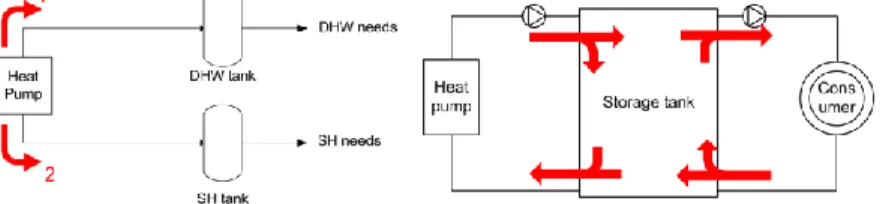
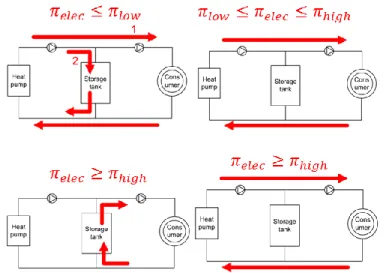
Both storage tanks for space heating and domestic hot water are installed in parallel, and the heat pump can only supply one of them at a time. Priority is always given to the DHW tank, as illustrated in Figure 2 (left). For the space heating tank, two configurations are investigated [10]: the parallel four-pipe configuration (Figure 2 – right) and the parallel two-pipe configuration. The control strategy for the two-pipe configuration is presented in Figure 3.
Stratification in the DHW tank is taken into account by a two-node model with homogeneous water temperature in each zone. The heat exchanger of the heat pump is assumed to be located at the bottom part of the tank. In the space heating tank, contrariwise, stratification is neglected due, on the one hand, to the pipes location, which emphasize mixing and, on the other hand, due to the limited capacity of the tank compared the space heating needs of the house, which causes frequent discharges of the tank.
Fig. 2 Left: Hydraulic scheme for DHW and SH water storage. Right: Parallel four-pipe configuration for SH water storage.
Fig. 3 Parallel two-pipe configuration for SH water tank. Top left: Electricity price below the low threshold, the heat pump is used to supply the house directly if needed or to store heat in the storage tank. Top right: Electricity price between the low and high thresholds, the heat pump is used to meet the house heating needs only. Bottom left: Electricity price above the high threshold, the storage tank, if charged enough, is used to supply the house. Bottom right: Electricity price above the high threshold, the storage tank charge level is too low to supply the
house, and the heat pump is used to supply the house directly.
3.2 Building and heat pump
The extension of the simulations to an entire national building stock while maintaining reasonable computational resources requires compromises regarding the level of details of the building model. In this study, an equivalent RC thermal network is used. The chosen model is a modification of the ISO13790 [15] model with the introduction of two additional lumped capacities to take into account respectively the non-homogeneous air distribution in the zone and the thermal capacity of the internal walls (Figure 4). Fig. 4 Modified RC thermal network
The heat pump model is based on “ConsoClim” method [11], which expresses the heat pump coefficient of performance (COP) as function of the
ambient temperature, Tamb, the water supply temperature, Tw,su and the part-load ratio, PLR, through polynomial laws
)
,
,
(
T
T
,PLR
f
COP
amb wsu (5)The regression coefficients are identified based on performance curve from manufacturer data. Two types of heat pump technologies are considered: inverter heat pump, for parallel 2-pipe configuration, and ON/OFF heat pump, for parallel 4-pipe configuration. Performance degradation due to cycling is modeled as proposed in [14].
The emitters installed in the building are conventional radiators. The emitted power is modeled with an empirical emission law function of the difference between the average water temperature in the emitter and the room temperature. The water supply temperature is adapted to the house insulation level and adjusted throughout the year following a heating curve.
3.4 Heat pump control and temperature constraints
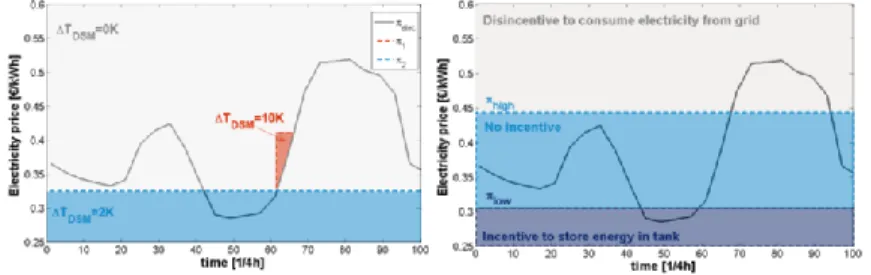
Two types of rule-based controls are compared. The base control refers to the control of the heat pump implemented in the absence of incentive to increase the flexibility. The flexibility mode control, contrariwise, adapts the heat pump control to respond to the price incentive. Price threshold have been obtained based on optimal control results, and are illustrated in Figure 5 for the average winter tariff. For the two-pipe configuration, the control scheme is exactly limited by the thresholds as defined by (2) and (3). For the four-pipe configuration, the optimal results have shown that, additionally to the low price threshold (π2 in Figure 5 - left), there is an additional time frame where the price is below π1 where the incentive to store energy is even stronger, which translates by a set point increase, ΔTDSM, of 10K. Temperature set point modifications are summarized in Table 1.
Fig. 5 Electricity retail price thresholds to trigger system flexibility with SH tank: left: parallel four-pipe configuration, right: parallel two-pipe configuration.
4. Results
The proposed method is first applied to a single case study. It is a typical freestanding Belgian house built in the years 2000s. The overall U value is 0.46 W/m²K and the heated volume is 457m³. The house is equipped with an air-to-water heat pump supplying two water tanks:
- a domestic hot water tank of 200 liters,
- for the four-pipe configuration, optimal results were obtained for a space heating tank volume of 450 liters,
- for the two-pipe configuration, optimal results were obtained for a space heating tank volume of 350 liters.
Table 1 Set point temperature in water tanks.
Set point Upper limit (°C) Lower limit(°C) Base control
DHW 57 50
SH four-pipe: min(Theating curve+5,Tmax)
two-pipe: Theating curve Tupper limit -5
Flexibility mode control
DHW πlow ≤ πelec : 57 πelec ≤ πlow: 65 50
SH
four pipe: min(Theating curve +ΔTDSM,Tmax ) two-pipe: πelec ≤ πlow: min(Theating curve +5,Tmax )
πlow < πelec ≤ πhigh: Theating curve (direct supply) πelec > πhigh: Theating curve (direct supply) or unload tank
Tupper limit -5
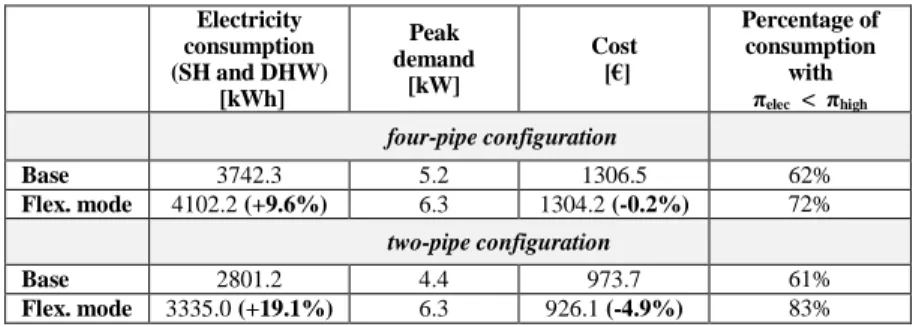
Simulation results for both hydraulic schemes are compared in Table 2. Compared to the parallel four-pipe configuration, the parallel two-pipe hydraulic scheme allows for a significantly larger cost reduction (4.9 versus 0.2% reduction) and to shift an additional 11% of the consumed volume to off-peak hours. The overconsumption is 9.5% larger with the two-pipe scheme, but the absolute consumption is 23% less than with the four-pipe scheme. This is due to the use of an inverter heat pump and to the lower set points required to provide flexibility with the space heating tank in this case.
Table 2 Comparison of four-pipe and two-pipe configurations for a single house.
Electricity consumption (SH and DHW) [kWh] Peak demand [kW] Cost [€] Percentage of consumption with πelec < πhigh four-pipe configuration Base 3742.3 5.2 1306.5 62% Flex. mode 4102.2 (+9.6%) 6.3 1304.2 (-0.2%) 72% two-pipe configuration Base 2801.2 4.4 973.7 61% Flex. mode 3335.0 (+19.1%) 6.3 926.1 (-4.9%) 83%
In the two-pipe configuration, the space heating water tank temperature is sometimes inferior to the heating curve temperature, which prevents the tank to be unloaded to supply the house directly. In such case, and as long as the water temperature is superior to the return temperature from the house, a possible improvement consists in reheating the return water with the tank before entering the heat pump heat exchanger. This is investigated in Section 4.2 and referred to as the improved parallel two-pipe hydraulic scheme.
4.2 At the National Residential Building Stock Level
To apply the methodology at the residential building stock level, the description of the Belgian residential building stock proposed in [16] is used. The simulation tool previously presented in [17] is further developed to include the aforementioned load management strategies and hydraulic configurations. When imposing a maximum heat pump capacity of 8.6kW in design conditions (-10°C ambient temperature) and imposing minimum requirements in terms of envelope insulation, a maximum penetration rate of heat pumps of 58% is determined based on [16]. Similar results to those presented in Section 4.1 can be obtained for all types of houses (freestanding, semi-detached, terraced, apartment), for different construction time periods (~1900 to 2030), different insulation levels and renovation rates.
In this section, all houses are supposed to be equipped with a domestic hot water tank of 150 liters, and a space heating storage tank of 450 liters. The heat pump water supply temperature in space heating mode is adjusted to the building insulation level with a low-temperature (A7W35), medium-temperature (A7W45) or high-medium-temperature (A7W65) heat pump technology.
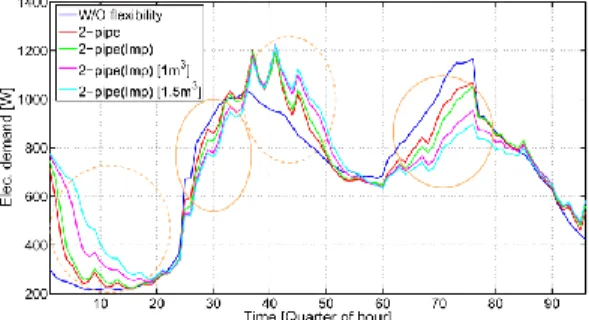
At the scale of the building stock, the modification of the load profile per average dwelling entailed by the parallel two-pipe configuration and its improved version is illustrated in Figure 6 for an average day with a penetration rate of 58% of heat pumps. Three storage capacities for the space heating water tank are considered: 0.45, 1 and 1.5 m³. As expected, load shifting from peak to off-peak hours occurs. An increase of the consumption is observed between 0am and 5am, as well as between 9:30am and 1pm. Such increase in consumption compared to the reference case without flexibility enables to reduce the consumption at critical periods, i.e. between 6am and 8am and between 4pm and 9pm. Peak consumption decrease is slightly improved by the second configuration. Increasing the tank volume from 450 liters to 1m³ emphasizes the decrease of peak consumption. The reduction is less significant when increasing the capacity from 1m³ to 1.5m³. Ideally, the SH water tank volume should be optimized for each house. However, loading the tanks between 9:30 am and 1 pm increases thermal losses and reduces heat pump performance, which entails a non-negligible overconsumption and a rise in the maximum power demand by up to 31%.
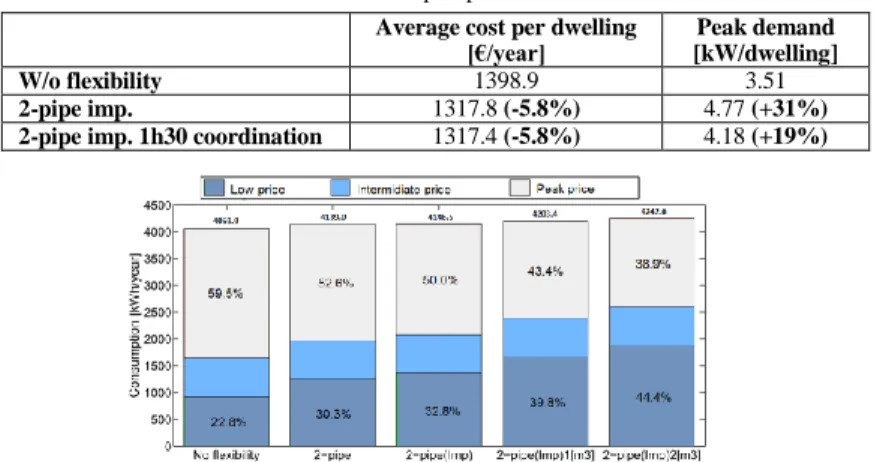
Although shifted in time, this increase in peak demand can put additional burden on the electricity grid. This phenomenon is caused by two factors: first, the absence of coordination between consumers causes a simultaneous activation of the heat pumps in response to low cost signals. Secondly, the larger the storage tank, the larger the peak demand. Besides the peak demand increase, the flexibility strategies lead to a more "aggressive" profile with rapid fluctuations which might cause ramping issues. The ramping is a metric defined as the sum of the absolute difference of two consecutive power demands. It is used to characterize the adjustment of power production plants. A solution would be to introduce a coordination mechanism between consumers. This can be achieved by sending different cost signals to all of them, based on a time-shift of the initial cost signal. This is illustrated in Figure 7 in terms of peak demand increase and ramping as a function of the penetration rate of heat pumps in the building stock. A coordination time of maximum 1.5 hour between consumers allows to reduce the peak increase from 31% to 19% and the ramping from 3% to 14% for 58% penetration rate of heat pumps. The cost savings per average end-consumer remain unchanged (Table 3).
Fig. 6 Modification of the average load profile per average dwelling entailed by the different storage configurations for an average day with 58% of heat pumps.
Fig. 7 Coordination mechanism: comparison of the peak demand and ramping for the configuration without flexibility, the improved two-pipe configuration without coordination
and with coordination during a maximum of 1.5 hour.
With 58% penetration of heat pump in the building stock in 2030, the average annual electricity consumption per dwelling increases from 3550 kWh to 4060kWh with the use of non-price-responsive heat pumps and to
4242kWh with price-responsive heat pumps combined to thermal storages (Figure 8). The latter allows to reduce the percentage of electricity consumed during peak periods (πelec > πhigh) by 9.5 to 20.6%. It should be noted that the relatively small impact on the average electricity consumption per dwelling of introducing 58% of heat pumps is due to the assumption that heat pumps should be installed on well-insulated houses or after envelope retrofit [16]. Therefore, old and uninsulated houses, which represent the biggest share of energy consumption of the sector, are not considered amongst the 58%.
Table 3 Impact of coordination mechanism on peak demand mitigation for 58% penetration of heat pumps.
Average cost per dwelling
[€/year] [kW/dwelling] Peak demand W/o flexibility 1398.9 3.51
2-pipe imp. 1317.8 (-5.8%) 4.77 (+31%)
2-pipe imp. 1h30 coordination 1317.4 (-5.8%) 4.18 (+19%)
Fig. 8 Evolution of the annual consumption per average dwelling with and without flexibility and with different SH tank volumes.
5. Conclusions
This paper presents a framework to evaluate the potential of load shifting with heat pumps coupled to TES in response to dynamic pricing at the scale of a residential building stock. First, two hydraulic configurations are compared for a single dwelling: the parallel four-pipe and parallel two-pipe integration. Results show that the Parallel hydraulic integration by four-pipe connection leads to a substantial overconsumption which is hardly compensated financially by the use of dynamic tariffs. Contrariwise, the parallel two-pipe configuration offers the largest cost savings for the consumer and load shifting potential. This second configuration is then used for a case-study for the Belgian residential building stock for a scenario at the horizon 2030. Price responsive heat pumps coupled to TES of 150 liters for domestic hot water and 450 liters for space heating allows to reduce the energy cost for the end-user by 5.8% in average and to shift about 10% of the electricity consumption from peak to off-peak hours. This however entails an
increase in maximum power demand by 31%. The introduction of a coordination mechanism between consumers reduces this increase to 19%.
Acknowledgment
The authors would like to acknowledge to collaborative work with CEEME, center of expertise of ENGIE (GDF SUEZ). The authors would like to thank P. Garsoux for his major contribution to this work.
References
[1] D. Six, J. Desmedt, J. Van Bael, and D. Vanhoudt. Exploring the flexibility potential of residential heat pumps combined with thermal energy storage for smart grids. In Cired 21st International Conference on Electricity Distribution, 2011.
[2] A. Arteconi, N.J. Hewitt, and F. Polonara. Domestic demand-side management: Role of heat pumps and thermal energy storage systems. Applied Thermal Engineering 51(1-2) (2013) 155–165.
[3] A. Arteconi, N.J. Hewitt, and F. Polonara. State of the art of thermal storage for demand-side management. Applied Energy 93 (2012) 371-389.
[4] H. Wolisz, H. Harb, P. Matthes, R. Streblow, and D. Müller. Dynamic simulation of thermal capacity and charging/discharging performance for sensible heat storage in building wall mass. In Proceedings of 13th Conference of International Building Performance Simulation Association, Chambéry, France, August 26-28 2013.
[5] G. Reynders, T. Nuytten, and D. Saelens. Potential of structural thermal mass for demand-side management in dwellings. Building and Environment 64 (2013) 187–199.
[6] G. Masy, E. Georges, C. Verhelst, V. Lemort, P. André P. Smart grid energy flexible buildings through the use of heat pumps and building thermal mass as energy storage in the Belgian context. Science and Technology for the Built Environment 21(6) (2015): 800-811. [7] R. De Coninck, R. Baetens, D. Saelens, A. Woyte, and L. Helsen. Rule-based demand-side management of domestic hot water production with heat pumps in zero energy neighbourhoods. Journal of building performance simulation 7(4) (2014) 271–288.
[8] M. Miara, D. Guenther, Z. L. Leitner, and J. Wapler. Simulation of an air-to-water heat pump system to evaluate the impact of demand-side-management measures on efficiency and load-shifting potential. Energy technology 2(1) (2014) 90–99.
[9] S. Naranjo Palacio, K.F. Valentine, M. Wong, and K.M. Zhang. Reducing power system costs with thermal energy storage. Applied Energy 129 (2014) 228–237.
[10] A. Floss and S. Hofmann. Optimized integration of storage tanks in heat pump systems and adapted control strategies. Energy and Buildings 100 (2015) 10–15.
[11] A. Faruqui, R. Hledik, and J. Palmer. Time-Varying and Dynamic Rate Design. Global Power Best Practice Series (2012).
[12] W. Hogan. Time of Use Rates and Real Time Prices (2014).
[13] P. Stratmann. Ways to trigger demand side flexibility - a case example for dynamic pricing (bundesnetzagentur). European Sustainable Energy Week, Brussels, 26.06.2014. [14] P. Rivière. Performances saisonnières des groupes de production d’eau glacée. PhD Dissertation, pp. 74–91, 2004.
[15] ISO 13790:2007. Energy performance of buildings – Calculation of energy use for space heating and cooling. International Standard Organization, Geneve, Suisse.
[16] S. Gendebien, E. Georges, S. Bertagnolio and V. Lemort. Methodology to characterize a residential building stock using a bottom-up approach: a case study applied to belgium. International Journal of Sustainable Energy Planning and Management 4 (2015) 71-88. [17] E. Georges, S. Gendebien, S. Bertagnolio and V. Lemort. Modeling and simulation of the domestic energy use in Belgium, In Proceedings of CLIMA2013 Conference, Prague, Czech Republic, June 16 – 19, 2013.