HAL Id: hal-02910244
https://hal.archives-ouvertes.fr/hal-02910244
Submitted on 1 Aug 2020
HAL is a multi-disciplinary open access
archive for the deposit and dissemination of sci-entific research documents, whether they are pub-lished or not. The documents may come from teaching and research institutions in France or abroad, or from public or private research centers.
L’archive ouverte pluridisciplinaire HAL, est destinée au dépôt et à la diffusion de documents scientifiques de niveau recherche, publiés ou non, émanant des établissements d’enseignement et de recherche français ou étrangers, des laboratoires publics ou privés.
Distributed under a Creative Commons Attribution - NonCommercial - ShareAlike| 4.0 International License
The LETUCA protocol, Operational manual
Damien l’Haridon, Anne-Lise Marchand, Laurent Chaudron, Yves Gourinat
To cite this version:
Damien l’Haridon, Anne-Lise Marchand, Laurent Chaudron, Yves Gourinat. The LETUCA protocol, Operational manual. [Other] Centre de Recherche de l’École de l’Air. 2020. �hal-02910244�
THE LETUCA PROTOCOL
OPERATIONAL MANUAL
Damien L’Haridon (1), Anne-Lise Marchand (1), Laurent Chaudron (1, 2), Yves Gourinat (3, 4, 5)
(1) Centre de Recherche de l’École de l’Air (CReA BA701) (2) Theorik-Lab (France)
(3) Université de Toulouse
(4) Institut Supérieur de l’Aéronautique et de l’Espace (ISAE-SUPAERO) (5) Institut Clément Ader (UMR CNRS 5312 ICA)
2
F
OREWORD
This report is linked to the completion of the thesis of Damien L’Haridon (2019) dealing with optimized collective decisions in extreme and operational environments and their application to unknown situations during human space flights. Laurent CHAUDRON, Yves GOURINAT (ISAE-SUPAERO) and Anne-Lise MARCHAND (CReA) directed the work of Damien L’Haridon (2019). In order to test the hypotheses about teamwork and to gather data, a protocol including an operational performance measurement method was created. This protocol is called LETUCA for Longitudinal Evaluation of Teams via Unknown and Collective Activities. It is composed of twelve exercises submitted to participants organized in a team so as to make them interact.
This report presents the twelve exercises with all the elements and details of the protocol LETUCA necessary for a free use in other works.
Being directly linked with the doctorate of L’Haridon (2019), the present report employs numerous elements without citing each time the PhD dissertation. The goal is to facilitate the reading of this document, please read L’Haridon (2019) for further details and the progress achieved thanks to the protocol LETUCA.
3
A
BSTRACT OF THE DOCTORATE OF L’HARIDON (2019)
Unknown situations, i.e. neither expected nor experienced, may happen during aerospace missions; notably, like in the case of the Apollo 13 mission. Then, the crew of the first manned flight to Mars will probably treat unknown situations (Orasanu, 2005) in this potentially constrained, volatile, and extreme environment whilst being isolated from ground control support due to communication delays. Yet, a crew cannot be trained to treat all situations, including the unknown situations (Noe, Dachner, Saxton et Keeton, 2011). The present research work deals with the improvement of the operational and collective performance while
coping with an unknown situation during a manned space flight toward Mars.
The studied literature (McLennan, Holgate, Omodei et Wearing, 2006; Noe et al., 2011) indicates that a team sharing experiences increases its skill. However, either this literature is focused on a precise activity or it does not discriminate the different types of experience. Moreover, the training of a team to react to an unknown situation is not discussed in this literature. Potentially influenced by experience sharing at collective level, the metacognition is a recognized lever to improve performance during problem resolutions. Metacognition is defined as cognition about cognition (Flavell, 1979) and is modeled into different reasoning steps during problem resolutions. Nonetheless, no link is established between on one side the follow-up of these steps or their possible mixture (i.e. metacognitive clearness) and, on the other side, the increase of the collective operational performance during problem resolutions.
To deal with these problematics, a specific protocol (LETUCA) was build and applied for twenty months. Three stable teams coped with twelve problems designed for this study or adapted from the literature. The first one shared a maximum of experiences; the second one was formed with teammates living the same experiences, but mainly separately from each other. The third team did not live specific experience. These three teams are characterized according to the lived experiences’ qualities relative to a fictive training to the unknown. These qualities are determined by professionals that may face collectively unknown situations.
The obtained results support the existence of a relation between the sharing of quality and diversity experiences and the collective operational performance during unknown problem resolutions. The study of metacognition enables to specify this relation: no link is established between the operational performance and the tracking or not of the selected metacognitive model. However, a relation is confirmed between high metacognitive clearness values and the increase of the operational performance. Finally, the results enable the construction of an empirical model of collective metacognition during problem resolution.
4
S
UMMARY
FIGURES ... 9 TABLES ... 10 GLOSSARY ... 11 GENERAL INTRODUCTION ... 12PART I: THE PROTOCOL LETUCA ... 15
Introduction ... 16
Chapter 1: Generalities of the LETUCA protocol ... 17
1. LETUCA: a protocol designed to make teams solve unknown problems ... 18
2. One function per teammate ... 18
3. Limited duration of the exercises ... 19
4. Experiences organized in a laboratory ... 20
5. Low-fidelity exercises ... 20
6. Flowchart of the creation of the LETUCA protocol ... 21
Conclusion ... 22
Chapter 2: Operational performance measurement ... 23
1. First step of the measurement of the operational performance ... 24
1.1. Operational performance measurement described in the guidelines ... 24
1.2. Open versus closed performance ... 24
1.3. The proportionate point method ... 25
1.3.1. Employment rules ... 25
1.3.2. Employment method ... 26
1.4. Method of the integrals ... 28
1.4.1. Employment rules of the method of the integrals ... 28
1.4.2. Employment of the method of the integrals ... 28
1.4.3. The method of the integrals applied to one exercise ... 29
2. Second step of the measurement of the operational performance ... 29
Conclusion ... 31
PART II: EXPERIENCES DESCRIPTION ... 32
Introduction ... 33
Chapter 1: Lunar survival ... 34
1. Context ... 34
2. Interest & specificities ... 34
3. Organization of the teammates ... 34
5
4.1. Text read to the teams ... 35
4.2. Written instructions ... 35
5. Operational performance measurement ... 36
Chapter 2: Mercury 21 ... 38
1. Context ... 38
2. Interest & specificities ... 38
3. Organization of the teammates ... 38
4. Elements presented to the participants ... 39
4.1. Text read to the teams ... 39
4.2. Basic simulation interface ... 40
5. Operational performance measurement ... 40
Chapter 3: Missionaries and cannibals ... 43
1. Context ... 43
2. Interest & specificities ... 43
3. Organization of the teammates ... 43
4. Elements presented to the participants ... 44
4.1. Text read to the teams ... 44
4.2. Guidelines presented to the participants ... 44
5. Operational performance measurement ... 44
Chapter 4: Bag and Euro ... 47
1. Context ... 47
2. Interest & specificities ... 47
3. Organization of the teammates ... 47
4. Elements presented to the participants ... 48
4.1. Text read to the teams ... 48
4.2. Guidelines presented to the participants ... 48
5. Operational performance measurement ... 49
Chapter 5: Untangle ... 50
1. Context ... 50
2. Interest & specificities ... 51
3. Organization of the teammates ... 52
4. Elements presented to the participants ... 52
4.1. Text read to the teams ... 52
4.2. Guidelines presented to the participants ... 53
5. Operational performance measurement ... 53
Chapter 6: Fire procedure ... 55
6
2. Interest & specificities ... 55
3. Organization of the teammates ... 56
4. Elements presented to the participants ... 56
4.1. Text read to the teams ... 56
4.2. Guidelines presented to the participants ... 57
5. Operational performance measurement ... 58
Chapter 7: Electrical system reproduction ... 61
1. Context ... 61
2. Interests & specificities ... 61
3. Organization of the teammates ... 61
4. Elements presented to the participants ... 62
4.1. Text read to the teams ... 62
4.2. Guidelines presented to the participants ... 63
5. Operational performance measurement ... 63
Chapter 8: Mars failure report ... 64
1. Context ... 64
2. Interests & specificities ... 64
3. Organization of the teammates ... 65
4. Elements presented to the participants ... 65
4.1. Text read to the teams ... 65
4.2. Guidelines presented to the participants ... 66
5. Operational performance measurement ... 66
Chapter 9: Asteroid avoidance ... 69
1. Context ... 69
2. Interests & specificities ... 69
3. Organization of the teammates ... 72
4. Elements presented to the participants ... 72
4.1. Text read to the teams ... 72
4.2. Guidelines presented to the participants ... 73
5. Operational performance measurement ... 73
Chapter 10: Mars Drone pilot skills and knowledge ... 75
1. Context ... 75
2. Interests & specificities ... 75
3. Organization of the teammates ... 76
4. Elements presented to the participants ... 77
4.1. Text read to the teams ... 77
7
5. Operational performance measurement ... 77
Chapter 11: Docking port relocation ... 80
1. Context ... 80
2. Interests & specificities ... 81
3. Organization of the teammates ... 81
4. Elements presented to the participants ... 82
4.1. Text read to the teams ... 82
4.2. Guidelines presented to the participants ... 83
5. Operational performance measurement ... 83
Chapter 12: Monument Valley ... 85
1. Context ... 85
2. Interests & specificities ... 86
3. Organization of the teammates ... 86
4. Elements presented to the participants ... 87
4.1. Text read to the teams ... 87
4.2. Guidelines presented to the participants ... 88
5. Operational performance measurement ... 88
Chapter 13: construction and gathering exercises ... 89
Conclusion ... 91
GENERAL CONCLUSION ... 92
REFERENCES ... 95
ANNEX 1: FAILURES INTERFACE ... 102
ANNEX 2: TECHNICAL MANUAL EXTRACTION, MERCURY 21 MISSION ... 109
ANNEX 3: GUIDELINES OF THE MISSIONARIES AND THE CANNIBALS ... 114
ANNEX 4: THE BAG AND THE EURO ... 119
ANNEX 5: MIXED LIST OF THE ACTIONS OF THE FIRE PROCEDURE ... 122
ANNEX 6: REDUCED TECHNICAL MANUAL ... 154
ANNEX 7: ANSWER SHEET OF THE REPRODUCTION OF THE ELECTRICAL SYSTEM OF THE AIRBUS A340 ... 159
ANNEX 8: ELECTRICAL SYSTEM OF THE AIRBUS A340 ... 161
ANNEX 9: CHRONOLOGY OF THE FATIGUE FAILURE OF THE GENERATOR N°3 ... 163
ANNEX 10: TECHNICAL MANUAL ... 164
ANNEX 11: SPECIALIZED REPORTS ... 166
ANNEX 12: TRAJECTORIES DATA ... 176
ANNEX 13: CURVES OF THE TRAJECTORIES ... 178
ANNEX 14: TECHNICAL MANUAL EXTRACTION ... 182
8
ANNEX 16: CONTEXT PRESENTATION ... 187
ANNEX 17: DETAILS OF THE WEIGHTING ... 190
ANNEX 18: GUIDELINES OF THE DOCKING PORT RELOCATION EXERCISE ... 193
ANNEX 19: CONFIGURATION OF THE SOYUZ SIMULATOR ... 195
9
F
IGURES
Figure 1. exercise creation flowchart ... 21
Figure 2. results of L'Haridon (2019) thanks to the Mercury 21 exercise ... 29
Figure 3. organization of the exercise Lunar survival ... 35
Figure 4. organization of the exercise Mercury 21 ... 39
Figure 5. solution of the problem ENG1 (Énigme-facile) ... 41
Figure 6. solution of the problem ELEC2 (Énigme-facile) ... 41
Figure 7. organization of the exercise Missionaries and cannibals ... 44
Figure 8. organization of the exercise Bag and dollar ... 48
Figure 9. randomly distributed points of the Untangle software ... 50
Figure 10. start situation of the Untangle exercise ... 51
Figure 11. organization of the exercise Untangle ... 52
Figure 12. organization of the exercise Fire procedure ... 56
Figure 13. organization of the exercise Electrical system reproduction ... 62
Figure 14. electrical system of the Airbus A340 (Airbus, 2017) ... 63
Figure 15. organization of the exercise Mars failure report ... 65
Figure 16 trajectories of the spaceship and the asteroid ... 71
Figure 17. organization of the exercise Asteroid avoidance ... 72
Figure 18. aerial view of the team distribution ... 75
Figure 19. organization of the exercise Drone pilot’s skills ... 76
Figure 20. performance levels of the Drone pilot’s skills exercise ... 78
Figure 21. view from the simulator of the Soyuz ... 80
Figure 22. organization of the exercise Docking port relocation ... 82
Figure 23. one of the used platforms of Monument Valley (Ustwo, 2014) ... 85
10
T
ABLES
Table 1. synthesis of the exercises of the LETUCA protocol ... 22
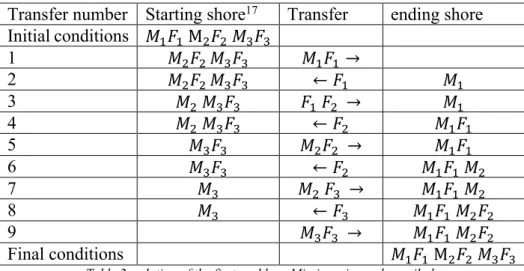
Table 2. solution of the first problem, Missionaries and cannibals ... 45
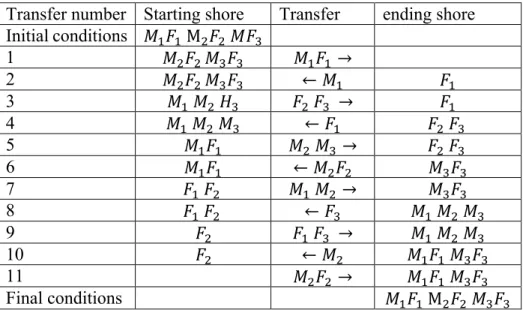
Table 3. solution of the third problem, Missionaries and cannibals ... 45
Table 4. solution of the fourth problem, Missionaries and cannibals ... 46
Table 5. second performance level items for "to execute a mission" ... 190
Table 6. second performance level items for "to guarantee the persons’ safety” ... 191
Table 7. second performance level items for "to guarantee the preservation of the equipment” ... 191
11
G
LOSSARY
CERP’AIR: Psychological studies and research center (in French, Centre études et de recherches psychologiques Air)
ISS: International Space Station
12
13 The present protocol is called LETUCA for: Longitudinal Evaluation of Teams via Unknown and Collective Activities. Twelve collective exercises accessible for non-specialized participants compose the LETUCA protocol. One is directly integrated from the literature, seven are adapted from the literature, and four are created for the LETUCA protocol. This protocol is designed by L’Haridon (2019) in order to collect data in the framework of his PhD, performed under the supervision of the ISAE-SUPAERO, the ONERA and the Research Center of the French air force Academy. The goal of this PhD is to study the evolutions and to enhance the teams’ operational performance (L’Haridon, 2019) while coping with unknown failures1 in
the context of human space flights and more specifically toward Mars. Nonetheless, the LETUCA protocol can be reused beyond this work and particularly for researches founded on the Grounded Theory method (Strauss and Glaser, 1967) which aim for “gathering and analyzing data to generate middle-range theory” (Charmaz and Henwood, 2008). Moreover, few exercises in the literature deal with performance measurements. Then, the goal of this method is to provide the research community with all the necessary elements to reproduce the LETUCA protocol or make it evolve.
According to the goal of the PhD of L’Haridon (2019), the LETUCA protocol is designed to trigger situations for which participants can work like space crews and more broadly like operational teams. However, potential participants are not requested to follow any space training; then, they can only have a low level of knowledge and skills about space flight exploration. Thus, the LETUCA protocol is designed to be a low-fidelity simulation. Nonetheless, in keeping with Weaver and al. (2010), the low-fidelity simulations “can be high in cognitive fidelity” for initial trainings of an activity. So, despite this low-fidelity simulation, numerous characteristics of human space flights and operational contexts can be integrated into the LETUCA protocol, even if the scenario of an exercise is not space-related. Particularly, the exercises of the LETUCA protocol demand, of the participating teammates, skills needed to solve problems, the respect of assigned functions and the treatment of information given to each function.
The working environment is set as identical as possible for all the teams. Then, all the participants base their interactions and in fine their decision on a common initial state. Thus, the operational performance results should only differ according to each teamwork. To obtain identical working environment for all the teams during problem resolutions, the LETUCA protocol can be organized in laboratory environments so that the researcher can control a maximum number of parameters.
As defined, the LETUCA protocol must enable the measurement of the operational performance of participating teams. Once these operational performance data are gathered, they need to be treated. Indeed, the data can be measured with different natures, in fine time, points or the two in a single exercise. Then, mathematical treatments must be defined. In addition, the LETUCA protocol was designed to enable a comparison of all the operational performances one another. Thus, despite the specificities of each exercise, a complete comparison must be executed thanks to a last mathematical treatment, called the “General relativity”.
Nonetheless, the interest of the LETUCA protocol is not limited to the operational performance measurement. Indeed, video and audio recordings can be performed during the problem 1 An unknown situation is defined as previously neither expected nor experienced (L Haridon, Chaudron, Marchand, and Gourinat, 2017).
14 resolutions. While teammates are working on exercises, the interactions can be used to study verbal and nonverbal exchanges.
15
16 Introduction
Teams are ubiquitous. Whether we are talking about software development, Olympic hockey, disease outbreak response, or urban warfare, teams represent the critical unit that ‘‘gets things done’’ in today’s world. (Marks, 2006, p.1)
Several definitions of teams exist in the literature (for instance Salas, Dickinson, Converse, and Tannenbaum, 1992; Katzenbach and Smith, 1993; Anzieu and Martin, 1968). Dealing with space flight crews performing a mission toward Mars, the definition of L’Haridon (2019) is selected for the design of the protocol LETUCA and is based on:
- A restrained ensemble of two persons or more,
- That can feel emotional, affective and solidary attachments, that can become intensive among the members,
- That interact dynamically, interdependently, and with resilience, - Via norms, beliefs, and signals that may become specific to this team, - Toward a common goal, and
- All teammates have been assigned specific purpose or functions - In order to be performant.
Researches about teamwork can demand the observation of teams while they are solving problems (for instance: L Haridon, Chaudron, Marchand, and Gourinat, 2017). In operational environments, unknown problems might happen, they are defined as neither expected nor experienced (L Haridon et al., 2017). These events could threaten the safety of an operational mission because of the lack of knowledge or solutions to solve them. L’Haridon (2019) provides a list of thirteen operational events and one probable considered as unknown. The protocol LETUCA, for Longitudinal Evaluation of Teams via Unknown and Collective Activities (L’Haridon, 2019), provides tools to complete researches about teamwork and especially about unknown problems resolutions. Twelve collective exercises compose the protocol LETUCA and seven of which are unknown problems. The twelve exercises
- last less than thirty minutes
- are executed without any training previously performed by the participants - necessitate office equipment2.
The measurement of the capacity of teams to solve or not a problem enables to evaluate the quality of the related training, relevance of methods, equipment, and select teammates for operational missions. This capacity of teams to solve or not a problem can be measured via the operational performance. Defined by L’Haridon (2019), the operational performance measures the achievement degree according to an assigned task. To test the hypotheses of L’Haridon (2019), each exercise of the protocol LETUCA is designed to measure the operational performance.
17 Chapter 1: Generalities of the LETUCA protocol
The LETUCA protocol and its twelve exercises were designed and used within the framework of the PhD of L’Haridon (2019). They were employed to test the performance and the metacognition of three stable teams for twenty months. During this period, the teammates of each team lived together or not diverse and quality experiences. Thus, the LETUCA protocol enabled to measure the evolution of the performance and the metacognition depending on common or individual experiences. Over this twenty-month period, one exercise was organized every fifty days in the order presented in the Part II of this method. Nonetheless, the LETUCA protocol can be considered as twelve independent collective exercises. One exercise every fifty days over a twenty-month period were sufficient to test the retained hypotheses (L’Haridon, 2019); so, the number of exercises composing the protocol LETUCA was limited to twelve. This number also permitted to maintain diversified enough scenarios; then, the possibilities to transfer resolution methods from on exercise to another were limited. Indeed, no standardized ways to treat two or more problems were produced, each exercise having its single method of treatment. Familiarization and lack of surprise were avoided from the conception and/or selection of the exercises: the performance measurement, the context, the reasoning, etc. vary. In addition to a single treatment method per exercise, the exercises of the LETUCA protocol are divided into two categories as suggested by Baiwir and Delhez (2004) and Breuker (1994). Indeed, these authors suggested a parameter to distinguish problems, they “can be characterized by their (minimal) solutions, i.e. their generic conclusions.” (Breuker, 1994). The exercises of the LETUCA protocol have different goals; thus, it is possible to discriminate one problem from another. Some have goals consisting in gathering results without any relationship among one another. They are called gathering exercises. Other problems demand the construction of one or several interdependent results. This second category is called construction exercises. Moreover, due to environmental constraints3 needed to execute the protocol LETUCA, all the
exercises had to meet the following specificities and were designed accordingly: - exercises duration below thirty minutes,
- difficulty level high enough so as to spread out performance results all along the associated scale,
- difficulty level low enough so as not to create too much difficult exercises for non-specialists,
- no initial knowledge is demanded.
Three different origins were needed to design twelve diversified enough exercises meeting the previous constraints:
- four exercises were completely created for the LETUCA protocol,
- seven exercises were adapted to meet the specificities of the LETUCA protocol, and - one was directly extracted from the literature.
The order presented in the Part II of the LETUCA protocol method was designed to alternate difficulties, unknown problems, interfaces, types of scenario, etc. in order to test the hypotheses of L’Haridon (2019). This order should be adapted according to future research problems.
3 The participants to the PhD of L’Haridon (2019) had busy schedules, an absence of space training, and diversified backgrounds.
18 1. LETUCA: a protocol designed to make teams solve unknown problems
As already used by Prichard, Bizo, and Stratford (2011), problem solving, decision making, and planning highlight team skills during collective exercises. The definition of the problem to solve, the way a team might find out a solution, and the selection of relevant information are examples of tasks demanded by the LETUCA protocol.
Since the LETUCA protocol is designed to make teams cope with unknown problems, L Haridon et al. (2017) analyzed unknown problems lived in real and operational conditions. These authors (2017) defined an unknown situation as “neither expected nor experienced”. It also means that a crew facing an unknown problem knows the context but has no procedure to solve this abnormal event initially. Indeed, operational crews are aware of their position, the status of the vehicle (aircraft, spacecraft for instance), the remaining time to complete the mission, the available equipment, etc. However, as soon as an unknown problem happens, crews have nothing to follow because the problem is “neither expected nor experienced” (L Haridon et al., 2017). The translation of this situation into the LETUCA protocol consists to inform the teams of a context but without any guidelines. So, the participants in the LETUCA protocol do not know initially how to proceed.
Nonetheless, to make teams work on problems without giving any guidelines includes a risk: the teams might not understand the problem to solve and could not proceed as expected by the researcher. In that case, the experience is not as valuable as a good understanding of the task to perform. Indeed, the goal of the LETUCA protocol is to discriminate performance levels according to a common task. If one team works on the prepared problem and another one on an off-topic problem, the performance scale will respectively present a high score and a low one. In this case, the performance measurements exclusively representant the initial orientation of the teams’ thinking and not the whole problem treatments. A protocol centered on the initial understanding of problems can only analyze the performance on the initial treatment step and does not need the teams to complete a full problem resolution. On the contrary, the LETUCA protocol aims to reproduce teamworks while coping with complete problem resolutions; hence, the need to gather data relative to complete treatments and to avoid misunderstandings of problems. The unknown exercises of the LETUCA protocol are designed to be easy enough so as to decrease risks of misunderstandings by teams.
Unfortunately, opportunities to create a problem without any guidelines and with a context easy enough to decrease risks of misunderstandings are rare. So, five in twelve exercises do not meet the unknown qualification4.
2. One function per teammate
The initial goal of the LETUCA protocol is to test the hypotheses of L’Haridon (2019) linked to space flights; so, this research (L’Haridon, 2019) observes the teamwork in a space flight context. It implies that the participants in the LETUCA protocol must act according to distributed functions or roles like in real operations; e.g. a real commercial flight crew is composed of a captain and a copilot. More broadly, several advantages of role plays used for teamwork training were highlighted by Beaubien and Baker (2004). The interests are minimal resource investment needed especially on large scales, well received role plays by trainees (Beaubien & Baker, 2004), and then poor participant’s reactions might be avoided.
19 Each teammate receives a function at the beginning of an experience of the LETUCA protocol. All these functions are most of the time a captain, a copilot and two astronauts5. The distribution
of these functions among participants enables:
- The organization of a maximized turnover in order to take into account the constraints of the participants if a longitudinal research is conducted. Indeed, it is possible to balance the number of times each teammate holds each position. Moreover, the teammates develop less habits when holding a specific function and need a continuous adaptation all along their participation to the LETUCA protocol. This adaptation to the functions is relevant with an unknown situation requiring to cope with a failure neither expected nor experienced (L Haridon et al., 2017).
- To limit the teammates’ mental projection that could be performed to optimize a specific function. Indeed, since the teammates receive their function few seconds before the beginning of an experience, the participants only have these few seconds to adapt themselves. This distribution of the functions without any notice takes part in the surprise effect.
3. Limited duration of the exercises
Like in real operations, time can be a part of a problem solution. For instance, if pilots experience an aboard fire during a flight, they must land the aircraft as soon as possible; the time is a key factor to solve the problem. Prichard, Bizo, and Stratford (2011) highlight the time management as a team skill. Thus, the LETUCA protocol supplies unknown problems with time constraints (L’Haridon, 2019). Moreover, despite the teammates participate voluntarily to the LETUCA protocol, their respective schedules are dense and so, must not be excessively impacted due to a too long duration of the exercises. At the opposite, in the context of team trainings, Prichard, Stratford, and Hardy (2004) insist on the need of long enough training: “the length of training is likely to be important because new skill proficiency will clearly be related to the opportunities a person has to practise new skills.” Thus, a trade-off between a too long time and a too short time to trigger teamwork was established according to the literature dealing with teamwork experiences:
- Baker, Gustafson, Beaubien, Salas, and Barach (2005) made surgical teams work on anesthesia crisis resources management with forty-five-minute scenarios,
- Cooke, Gorman, Duran, and Taylor (2007) and Gorman, Cooke, and Amazeen (2010) studied the work of teams for forty-five minutes while performing a reconnaissance mission with a drone simulator (pictures acquisition),
- Gurtner, Tschan, Semmer, and Nägele (2007) studied the “reflexivity intervention on the team process and on performance in hierarchically structured (…) on a simulated team-based military air-surveillance task” during sessions of fifteen minutes,
- Prichard, Stratford, and Bizo (2006) asked teams to establish a twenty-eight-question list dealing with schizophrenia for fifty minutes; afterwards these questions enable a performance measurement.
Thus, the selected maximum duration for the exercises of the LETUCA protocol is thirty minutes.
20 4. Experiences organized in a laboratory
The LETUCA protocol is designed to enable the comparison of teams’ performance during experiences. So, teams must work in environments as identical as possible between each other. The environmental characteristics that should be kept identical by the researcher are the experience time, equipment, data, workspace configuration, introduced constraints, and the presence and location of the researcher (L’Haridon, 2019). The laboratory and its environment can fulfill these conditions. Nonetheless, laboratory environments are not real contexts and provide a reduced specter of choices (Debanne, 2013). Indeed, if working conditions vary, results will probably be different. For instance, Baiwir and Delhez (2004) highlight that “precise experiences have shown that the only presence of observers modifies behaviors of participants, and so the group performance” (our translation). The presence of the researcher is mandatory so as to execute the experiences according to the experimental constraints; however, no other persons should be welcomed during experiences. More broadly, the respect of identical conditions should enable to limit the introduction of bias during the LETUCA protocol (L’Haridon, 2019).
Accordingly, the LETUCA protocol is not designed to apply an ecological approach that “translates the attention to the environmental awareness in order to understand the behaviors a person develops to adapt him•herself” (our translation, Valot, 1998).
5. Low-fidelity exercises
The LETUCA protocol was not designed to fully reproduced space flight problems with realistic technical facts (L’Haridon, 2019). “After all, effective training is clearly not synonymous with full mission simulation” (Beaubien & Baker, 2004). Certainly, Beaubien and Baker (2004) discuss about trainings in this quote in comparison with the LETUCA protocol focused on task executions. Nonetheless, the LETUCA protocol makes teams work in a context similar to team training (gathering of the teams, execution of a nonreal task, and performance demand for instance). Moreover, participants do not have the skills and knowledge to treat an actual space flight scenario; hence, the elaboration of simplified problems. The Lunar Survival exercise (Hall & Watson, 1970) is famous and representants this dynamic. The scenario of Lunar Survival can be understood by the largest number of participants, enables a collective thinking and a performance measurement. Weaver and al. (2010) argue that low-fidelity simulations used for team training programs in health care “can be high in cognitive fidelity; (…) they stimulate trainees to engage in the same cognitive processes necessary when transferring and generalizing new skills into their daily work environment”. As remarked by Beaubien and Baker (2004), “psychological fidelity is the most important for teamwork skills training” compared to equipment fidelity and environment fidelity. Cannon-Bowers and Bowers (2010) formulate the quote of Weaver and al. (2010) differently but sustain it: a simulation can deal with the structure of the task of a problem and the involved cognitive processes without any physical aspects. This low-fidelity is highlighted “to maximize the initial learning of teamwork skills” (Beaubien & Baker, 2004); thus, this initial learning is also relevant for space flight crews at the beginning of their training. Sundar and al. (2007) support these words of Beaubien and Baker (2004) and suggest possible types of exercises “such as case studies and role plays” (Sundar et al., 2007). Taking into account the potentially low experience of space flights among participants of the LETUCA protocol, if the participants took part in a human space flight training, they will begin it at the initial learning steps, in consistence with Beaubien and Baker (2004).
21 Beyond the relationship with the experience of space flights participants might have, “low-fidelity simulation tasks are recommended over high-“low-fidelity simulations to support objectivity and reliability because it mitigates confounding effects stemming from task familiarity” (Landon, Rokholt, Slack, and Pecena, 2017). Then, low-fidelity simulations diminish the familiarity linked to known situations. Thus, a participant should encounter a higher difficulty to extract a useful familiar experience for an exercise, hence a stimulation to find new solutions specific to an unknown situation.
Low-fidelity simulations can also “isolate competencies of interest” (Landon, et al., 2017). As presented by L Haridon et al. (2017), an unknown situation was neither expected nor experienced. Thus, when encountering such a situation, teammates should find a solution to a new problem and then they should adapt themselves. Then, low-fidelity simulations could isolate the adaptation competency.
Finally, low-fidelity simulations are relevant to study teamwork while coping with unknown situations.
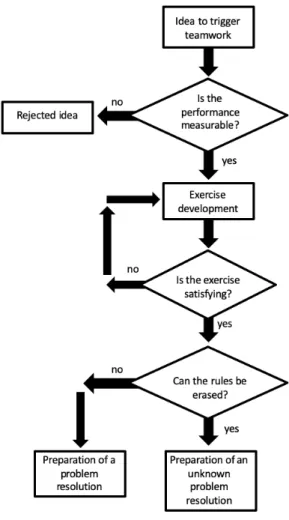
6. Flowchart of the creation of the LETUCA protocol
The following flowchart (cf. figure 1) presents the method to create the exercises of the LETUCA protocol in order to apply the above necessary specificities (L’Haridon, 2019).
22 Conclusion
The LETUCA protocol supplies twelve problems mainly dealing with space flight and unknown situations so as to spark teamwork (L’Haridon, 2019). These problems are simple enough to be solved by non-specialists and are organized with affordable equipment. Some problems are fully designed for the LETUCA protocol, some others are adapted from the literature, and one is implemented from the literature without any modification. These adaptations or the complete creations enable to design exercises diversified enough in order to preserve as much as possible the surprise effect and the unknown character of the exercises. Then, potential transfers of solutions from one problem to another are diminished.
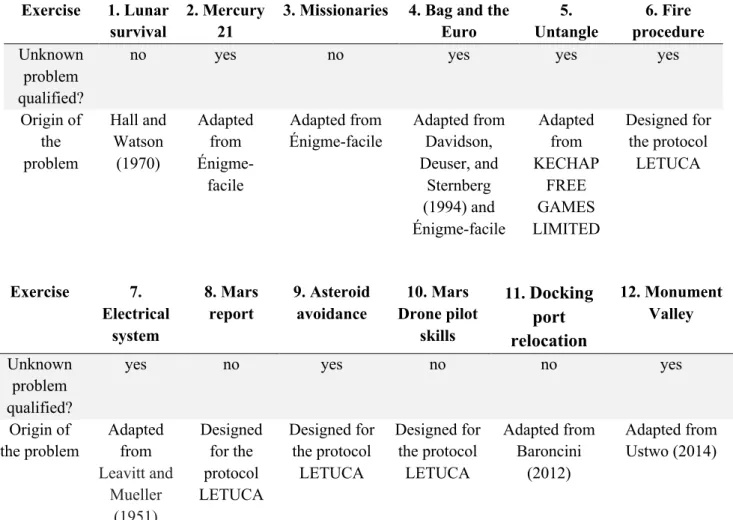
The table 1 synthesizes the qualification of unknown and the origin of each problem.
Exercise 1. Lunar survival
2. Mercury 21
3. Missionaries 4. Bag and the Euro 5. Untangle 6. Fire procedure Unknown problem qualified?
no yes no yes yes yes
Origin of the problem Hall and Watson (1970) Adapted from Énigme-facile Adapted from Énigme-facile Adapted from Davidson, Deuser, and Sternberg (1994) and Énigme-facile Adapted from KECHAP FREE GAMES LIMITED Designed for the protocol LETUCA Exercise 7. Electrical system 8. Mars report 9. Asteroid avoidance 10. Mars Drone pilot skills 11. Docking port relocation 12. Monument Valley Unknown problem qualified?
yes no yes no no yes
Origin of the problem Adapted from Leavitt and Mueller (1951) Designed for the protocol LETUCA Designed for the protocol LETUCA Designed for the protocol LETUCA Adapted from Baroncini (2012) Adapted from Ustwo (2014)
23 Chapter 2: Operational performance measurement
The LETUCA protocol provides exercises to make teams work, the outcomes of which supply an operational performance. This operational performance measures the achievement degree of an assigned task (L’Haridon, 2019). According to the diversity of exercises, operational performances can be based on one or several steps of a single exercise and measured on various dimensions. These dimensions can be a time (as suggested by Noe, Dachner, Saxton, and Keeton, 2011), a number of points or a combination of these two types of data. Then, depending on their composition, these operational performances could be incomparable. Thus, an initial treatment of the result(s) per exercise can be needed to extract one operational performance result of the participating teams. Except for the exercise of Hall and Watson (1970), directly integrated in the LETUCA protocol, no performance measurement methods relevant for the present exercises were found in the literature to initially treat the results. So, performance measurement methods for each problem were designed in the LETUCA protocol. Linked to a specific problem, this is the first step of the measurement of the operational performance. Despite the various dimensions of the operational performance and the existence of one operational performance result per exercise, the protocol must enable the comparison of the teams’ results all along the LETUCA protocol6. Thus, a second step of the measurement of the
operational performance is needed in order to cancel the dimensions of the operational performances, so the results of the teams during each exercise can be compared to another one.
24 1. First step of the measurement of the operational performance
An operational performance measurement is built for each exercise of the LETUCA protocol (L’Haridon, 2019). Indeed, the operational performance are based on three units, i.e. a time, a sum of points or composition of times and points. The nature of the measurements being different, it is not possible to create a unique formula to calculate all operational performances. Specific technics are needed to quantify the operational performance of some exercises, e.g. the open performance and the proportionate point method. Then, a first step of the measurement is needed to extract the operational performance of each exercise. Thanks to this step, the operational performance results can be calculated systematically and compared to one another for a single experience.
1.1. Operational performance measurement described in the guidelines
The protocol LETUCA is designed to correspond to real unknown failure cases, then, the teams must be aware of the operational performance measurement. Indeed, an actual and expert crew experiencing an unknown failure should be familiar with the way he could be performant or more precisely, get a high operational performance. The elements of the context and the environment orientate the potential outcomes of the situation. According to the degree of risks on human lives and equipment, a satisfying result could be focused on the initial mission and/or on the mere survival of the crew. For example, following the explosion aboard the Apollo 13 vehicle, the crew and all the ground staff focused on an operational performance depending on the survival of the crew and only then on the completion of the initial mission. If this explosion belonged to the LETUCA protocol, the operational performance would be measured on the effective survival of the crew. Since the teams of the protocol LETUCA are not space experts, they are trained and do not know neither the context nor the environment before the exercise. Thus, the teammates need informing of the operational performance to reach a closer level of operational awareness. So, the organizer describes the operational performance measurement without giving any specific details (L’Haridon, 2019). For example, for UNTANGLE exercise of the LETUCA protocol, the participants must complete the problem with a minimum time.
1.2. Open versus closed performance
In specific exercises, it is not possible to anticipate all the possible answers. According to the established guidelines7, the specter of possible responses is too wide to be exhaustively
anticipated. Thus, an anticipated8 list of possible answers can exist, but it remains
non-exhaustive. Indeed, supplementary answers can be found by the participants while they respect the guidelines of the related exercise. Then, these new answers have to be included in the operational performance measurement. So, the final operational performance result of a team exclusively depends on the total validated responses and not only on the anticipated list. Finally, two cases exist:
- If a team only thinks about the answers included in the anticipated list, no performance updates will be highlighted,
- If a team chooses an answer not included in the anticipated list, the researcher will study this answer so as to evaluate its concordance or not to the guidelines. If the answer 7 The guidelines must be precise enough, so no doubt is possible among potential answers.
25 matches the guidelines, the team will score one point; if it does not, this answer will be rejected.
For example, teams can find as many functions of an object as they can9. The researcher can
anticipate a list with possible answers; however, it is time-consuming, useless for the operational performance measurement, and probably impossible. Without expecting the answers, the researcher only checks if the answers match with the constraints established in the guidelines. So, the results come from the functions found by the teams.
The performance of these exercises is called open performance (L’Haridon, 2019). The researcher determines guidelines and rules to evaluate the answers and could anticipates some of the potential responses. If new answers are selected by participants, these answers will be analyzed by the researcher regarding the established guidelines. Finally, these new answers can be added or not to the previous anticipated list.
1.3. The proportionate point method 1.3.1. Employment rules
The method of the proportionate point (L’Haridon, 2019) is used to compare the operational performances of teams while they are treating a problem:
- with at least two steps and
- at least one step of which might not be finished by at least one of the participating teams. This technique is based on the mathematical ratio between two operational performance results for each step. Moreover, this method enables teams to progress according to their own pace, to finish different numbers of steps10 and finally to perform a calculation of the teams’ operational
performances. To measure each step operational performance, the proportionate point method necessitates a first constraint:
(1) The lower the value of a result is, the higher the associated operational performance is. For instance, a team must solve a problem with the minimum time. Two other constraints are needed:
(2) The teams have to execute all the steps of the problem in the same order.
(3) The teams move from one step to the next one only when the previous one is completed. If these rules are not respected, teams could treat different steps and obtain results coming from various subproblems; thus, these operational performances based on different problems are not comparable. For instance, with an exercise composed of ten subproblems and with instructions without any standard order of completion; one team could work on the first five subproblems while another team could work on the last five ones. In this instance, the results are based on different sub-problems and are not comparable one another. So, it is necessary to force the teams to follow a standard order so as to compare the results.
9 e.g. the exercise Bag and the Euro of the LETUCA protocol 10 One team could finish more steps than another one.
26 1.3.2. Employment method
The raw performances are the results directly measured during the execution of each step of an exercise; no mathematical treatments are performed to determinate the raw data. A raw performance can be a time, a number of points. The raw performances of all the steps of a problem are real numbers and are the input data of the proportionate point method.
Set N, the number of steps included in the complete problem providing an operational performance measurement thanks to the proportionate point method, where N ∈ ℕ∗. For the
step called n, where n ϵ ⟦1, N⟧, for a total of m + 1 teams, where m ∈ ℕ∗, the best raw
performance for the step n is considered to be the reference for this step and is called Ω". The raw performance of the other teams are called: Ω",$ for the team number 1, Ω",%, for the team number 2, Ω",&, for the team number 3 … Ω",' for the team number m, so that Ω" ≥ Ω",$ ≥ Ω",% ≥ Ω",& … Ω",'. Then, the numbering of the teams varies according to the measured raw performances of the considered step. The result of a specific team calculated via the proportionate point method is the division of the best raw performance by the raw performance of this specific team of the same step n:
The team (called M) with the best performance for the step n: P",( = ))!
!
So, for the best team M: P",( = 1
For the team number 1, the proportionate result is: P",$ = ))!
!,#
With P",$ ≤ 1, for the team number 1.
For the team number 2, the proportionate result is: P",% = )!
)!,$
With P",% ≤ P",$, for the team number 2.
For the team number 3, the proportionate result is: P",& = )!
)!,%
With P",& ≤ P",%, for the team number 3.
Etc.
For the team number m, the proportionate result is: P",' = )!
)!,&
With P",' ≤ P",'*$, for the team number m.
If a team called m does not solve the step called n, then the associated raw performance Ω",' is not measured. Nonetheless, this failure of the team m has to be considered to value the operational performance of the other teams that succeeded this step n. So, a fictive Ω",' must
27 be integrated at the lowest raw performances, then, with the highest values (whatever the dimension of the measure)11. To do so, the result of the step n is defined by:
P",' = Ω" Ω",'
Then, a failure of the team m to the step n implies that Ω",' tends to the highest values: lim
)!,&→,-P",' = lim)!,&
→,-Ω" Ω",'
And so:
lim
)!,&→,-P",' = 0
Thus, when the team m does not solve the step n:
- Ω",' tends to infinity, meaning a low operational performance and
- The operational performance is forced to: P",' = 0
Finally, for the team called i, where i ∈ ℕ∗, for a complete problem, the operational performance
is called P. and the result of the step n is called P",.. Two cases exist:
(1) If one or more n exist(s) such as Ω",. = +∞ (step not completed), so: For each n with Ω",. ≠ +∞, in other words, for the succeeded step(s):
P",.= Ω" Ω",.
For each n with Ω",. = +∞, in other words, for the step(s) unsolved: P/,. = 0
(2) If for all the n, we have Ω",. ≠ +∞, in other words, all the steps are succeeded, so:
P",.= Ω" Ω",. Finally, for the two cases:
P. = 6 P",.
0 "12
To sum up, the proportionate point method consists in establishing a division between the best raw performance by the raw performance of a specific team for a single step of a common problem and then, to sum these divisions for all the steps performed by this specific team. This method demands the three following conditions:
- The lower the value of a result is, the higher the associated operational performance is, - The teams have to execute all the steps of the problem in the same order,
28 - The teams move from one step to the next one only when the previous one is completed. 1.4. Method of the integrals
1.4.1. Employment rules of the method of the integrals
The method of the integrals is used in the LETUCA protocol to calculate an operational performance based on two measures of different natures of an exercise composed with several steps (L’Haridon, 2019). Three rules characterize the method of the integrals.
(1) The teams can execute the steps of the exercise in the order they want.
(2) The steps do not have the same weight for the operational performance calculation. So, the resolution of a step can give a higher quantity of points than another step depending on their influence on the complete treatment. For example, during a human space flight, a major oxygen failure is more vital than a breakdown of an entertainment system; thus, the complete treatment of the major oxygen failure is underlined with an increased weight.
(3) Furthermore, in specific cases, the time to solve a failure also determine the operational performance. Indeed, a failure might have to be treated before other failures depending on their influence on the complete treatment. For instance, during an operational human space flight, a major and vital oxygen failure should be treated before a breakdown of an entertainment system. Then, the operational performance measurement must take into account the times of the resolution of the different steps so as to discriminate the prioritizations established by the participants.
1.4.2. Employment of the method of the integrals
The two elements employed to calculate the operational performance via the method of the integrals are the weights, i.e. this quantity of points, and the time needed to complete the treatment of each step. Thanks to these two parameters, a curve per team is built with along the abscissa axis the time and along the ordinate axis the evolution of the number of points. As soon as a team completes the resolution of a failure, the associated curve rises of the number of points granted for this failure (ordinate axis) at the time of the resolution (abscissa axis). Thus: - The faster a team solves the failures of decreasing importance, the higher and the faster
is the value of the curve, and
- The slower a team solves the failures of increasing importance, the lower and the slower is the value of the curve.
Beyond the visual analyze of the teams’ operational performances, the integral of each curve is calculated12. Then, the value obtained corresponds to the measured operational performance.
So, a high result is expected if a team treats the steps of the complete problem in the order of decreasing importance and as fast as possible. Thus, the differences among teams are observable.
Finally, the method of the integrals:
- Enables to calculate an operational performance regardless of the processing order of the steps of a problem,
12 In practice, the integrals are calculated on the base of the sum of the areas of the rectangles and triangles placed between the abscissa axis and the corresponding curve.
29 - Necessitates to establish a weighting for each step,
- Necessitates to take into account the resolution time of each step,
- Enables to compare operational performances with two dimensions via a single indicator.
1.4.3. The method of the integrals applied to one exercise
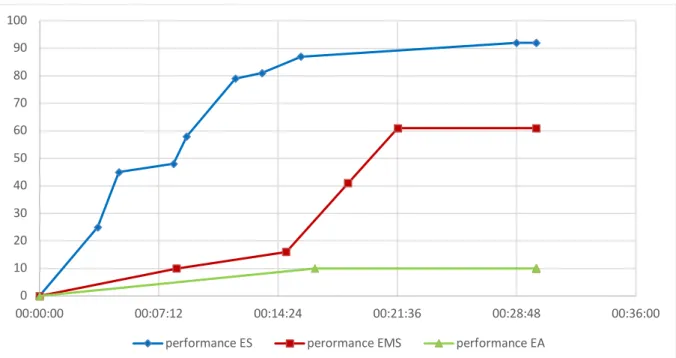
The exercise Mercury 21 (L’Haridon, 2019) meets the specificities of the method of the integrals, hence its use. For instance, the figure 2 highlights the three curves13 obtained by
L’Haridon (2019) during the execution of three Mercury 21 experiences.
Figure 2. results of L'Haridon (2019) thanks to the Mercury 21 exercise
2. Second step of the measurement of the operational performance
The nature of the operational performances of the exercises of the LETUCA protocol (i.e., time, points or a combination of the two units) and the range of the obtained values do not permit their direct comparison between each exercise. For example, an exercise measuring the teams’ capacity to solve a problem as fast as possible is not comparable to another exercise measuring a number of scored points. Nonetheless, the results of the teams are comparable one another for a single exercise. So, the results are compared per exercise and not between each exercise (first step of the measurement of the operational performance). This relativity of the results per exercise is the basis of the tracking of the discrepancies among teams throughout the protocol LETUCA. Indeed, the result of each team is divided by the one of a team used as a reference14
for the complete protocol, both results belonging to the same exercise. Thanks to this division, 13 In the figure 2, one curve presents the results of the team called ES, one for the team called EMS, and one for the team called EA.
14 The selection of a specific team compared to another cannot modify the relativity of the final operational performances. Nonetheless, it might be advised to use the less performant team as the reference in order to obtain positive values (located above the abscissa axis) of the final operational performance.
0 10 20 30 40 50 60 70 80 90 100 00:00:00 00:07:12 00:14:24 00:21:36 00:28:48 00:36:00 performance ES perormance EMS performance EA
30 there is no more unit (a time divided by time has no unit for instance) and all the performance results are dimensionally homogeneous. Then, all the teams obtain final results relative to a single team used as a reference (L’Haridon, 2019), hence the name of this method: the “General relativity”. The General relativity is the second step of the measurement of the operational performance. In fine, the construction of a curve of operational performances per team is built to highlight the evolutions relatively to the other teams.
The General relativity is calculated for each team thanks to the following formula. We set the figures:
- E. : the experience i, where i ∈ ⟦1, N⟧, with N the total number of experiences, N ∈ ℕ∗
- 𝒻. : the function giving the result of the teams for the experience i
- P.,3 : the result of the team j for the experience i, where j ∈ ⟦1, M⟧, with M the total
number of teams participating to the LETUCA protocol, M ∈ ℕ∗
- The team selected as a reference is called: j = Ref. The function of the General relativity 𝒻. is defined on ℜ by:
𝒻.?𝑷𝒊,𝒋A = 𝐏𝐢,𝐣 𝐏𝐢,89: − 𝟏
Then, the team selected as a reference (Ref) is constantly on the abscissa axis. For a given exercise, if a team has a better operational performance than the reference team, the associated result is placed above the abscissa axis, in other words, above the reference team. For a given exercise, if a team has a worse operational performance than the reference team, the associated result is placed below the abscissa axis.
To sum up, the General relativity necessitates to measure operational performances for a single experience and then, to calculate the relative results of teams compared to a reference one. Throughout the LETUCA protocol, the General relativity formula executes this calculation and then enables the analyze of the evolutions of the teams’ operational performance despite the variety of the exercises.
31 Conclusion
The LETUCA protocol is designed to make teams work on unknown problems so as to generate and compare the related operational performance measurements. In order to meet as far as possible the specificities of an operational context, in fine a human space flight, different characteristics are introduced in the protocol. Indeed, all the participants have functions to follow so they are organized as a team (L’Haridon, 2019) and they have a limited time to solve the exercises. Moreover, the participants could not be specialized in human space flight exploration. Then, to compensate this possible lack of space flight knowledge among participants, low-fidelity exercises are designed so as not to require any previous space flight training.
In order to compare all the operational performances among participating teams, the resolutions of the different problems demand identical experimental conditions. Then, the laboratory environment is selected to perform the LETUCA protocol.
Despite the various dimensions of the results, this comparison of all the operational performances is also achieved thanks to a two-step treatment of the performance data. The first step deals the performance data of each exercise taken into account individually. This step depends on the specificities of a single exercise and enables to calculate a single operational performance per team for a complete exercise. The second step divides all the results of the teams by the result of a reference team so as to obtain a relativity of the operational performances. Finally, all the operational performances of the teams can be analyzed in relation to one another along the LETUCA protocol.
32
33 Introduction
Based on a limited time, the assignment of functions to the teammates, the calculation of an operational performance, and the feasibility for non-specialized participants in human space flights, twelve problems are designed and compose the LETUCA protocol (L’Haridon, 2019). One exercise is directly extracted of the literature, seven are adapted of the literature, and four are completely designed for the LETUCA protocol. Despite the various origins of the operational performance, in fine a time, a number of points, and a combination of these two dimensions, an operational performance measurement is available for each exercise.
In order to reproduce the LETUCA protocol, the present Part II presents all the details needed to organize the exercises or to modify them so as to meet new researches specificities. A few exercises are linked with annexes added to supply slides accessible to the participants or elements about the construction of the exercises.
34 Chapter 1: Lunar survival
Lunar survival is the single exercise directly extracted from the literature without adaptation to the particularities of the LETUCA protocol. Indeed, the required characteristics are included in the Lunar survival exercise of the literature. In an “unpublished dissertation” of Hall in 1963, this author presented the exercise “Lunar survival”, then published by Hall and Watson (1970). 1. Context
A crew has survived a crash of its space vehicle on the Moon surface. So, the astronauts must live through the consequences of the accident by ranging a three-hundred-kilometer distance to the main Moon base. To succeed, the crew has fifteen available objects in order to execute this trip. The required task is to rank these objects in order of decreasing importance according to the context. Two main goals may help this classification establishment, to survive on the Moon and to reach the main base.
2. Interest & specificities
Dealing with space exploration, the Lunar survival exercise enables to begin the LETUCA protocol with a space flight context. A major difficulty of this exercise is to begin the treatment of the problem by defining the two goals of the crew, i.e. to survive on the Moon and to reach the main base. Then, this metacognitive step (L’Haridon, 2019) permits to mentally represent the situation of the crew and the challenges the teammates must cope with. Thus, thanks to this reasoning, the teams can obtain practical elements so as to anticipate the hazards of such a situation. Finally, thanks to this mental representation, the teams can set priorities among objects, hence the establishment of the requested list of decreasing importance.
The specificities of Lunar survival are the need to precise the instruction of the problem into the two goals of the crew in order to mentally represent the execution of the mission.
3. Organization of the teammates
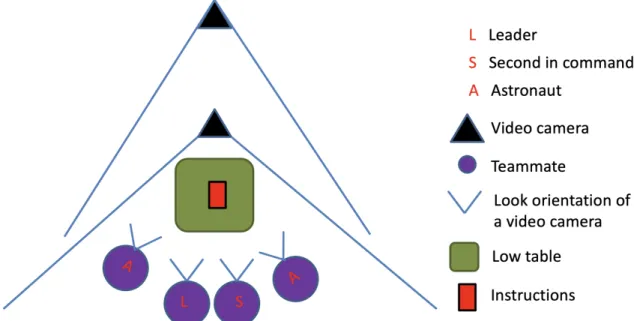
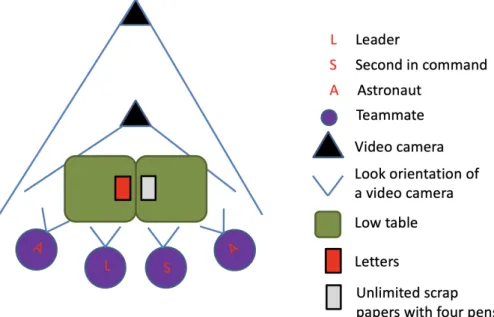
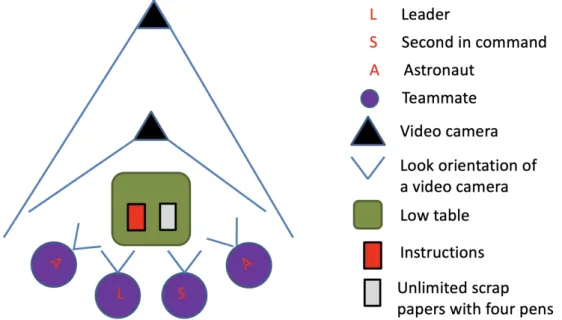
The experience is organized according to the figure 3. The needed equipment is:
- Two Video Cameras, - A Tripod for one camera, - Unlimited Scrap Paper, - Four pens.
35
Figure 3. organization of the exercise Lunar survival
4. Elements presented to the participants 4.1. Text read to the teams
The first part of the read text is common with the other exercises of the LETUCA protocol: “I will not speak during the experience except to guarantee the rigor of the protocol. I will not comment your work to permit your own reflection. Please, turn off your cell phones in order not to be disturbed.
All the teams have identical guidelines; what I am reading currently. Please, stay seated while you are filmed so as not to leave the camera range.
The captain of the team is X, the second in command is Y, and you are astronauts (the organizer shows the two last teammates). The decision belongs to the captain. The captain of your team announces a “top” and simultaneously, launches the chronometer and takes the guidelines.” The second part of the read text is specific to the present exercise:
“After thirty minutes of work, the exercise stops and you shall not touch the answer sheet anymore. Your result will be compared to the official one. You can use the scrap paper.”
4.2. Written instructions
“Scenario:
You are members of a spaceship scheduled to rendezvous with your mother ship on the lighted surface of the moon. Due to mechanical failures, you were forced to land your ship on a spot 320Km from the initial rendezvous point. It is vital for your crew to join the mother ship. During the landing, most of the equipment aboard was damaged except 15 items, listed below.
36 Your task is to rank the items in order of necessity. Place the number 1 near the most important item, the number 2 near the second most important and so on, through number 15 for the least important.
List of the items to rank: - Box of matches - Food concentrate - 15m of nylon rope - Parachute silk - Portable heating unit - Two .45 caliber pistols - One case of dehydrated milk - Two 50Kg tanks of oxygen - Stellar map
- Self-inflating life raft - Magnetic compass - 20 liters of water - Signal flares
- First aid kit, containing injection needles - Solar-powered FM receiver-transmitter” 5. Operational performance measurement
The lists established by teams are compared to the one of Hall and Watson (1970). This reference was composed by a single expert of the “Crew Equipment Research Section of the NASA Manned Spacecraft Center in Houston, Texas” (Hall & Watson, 1970). This comparison of the teams’ results to a reference performance established by an expert corresponds to the works of Barnett and Koslowski (2002). Barnett and Koslowski (2002) retained the combination of two “super-experts” results that were experienced in the studied activity. For Lunar survival, if the position of an item set by a team is different of the position selected by the reference expert (Hall & Watson, 1970), then the absolute value of the difference of the two ranks is memorized (the rank of the team and the one of the expert). All the absolute values of all the items are added, this final sum represents the final performance. The goal is to minimize this final sum, so a low value translates a high correspondence to the reference classification. For instance, if the bottles of oxygen are ranked fifth by a team and the reference result indicates the first position, then the final sum is incremented of the difference of the absolute value, i.e. four points.
The answer established by Hall and Watson (1970) is: 1. Two 50Kg tanks of oxygen
2. 20 liters of water 3. Stellar map 4. Food concentrate
5. Solar-powered FM receiver-transmitter 6. 15m of nylon rope
37 7. First aid kit, containing injection needles
8. Parachute silk
9. Self-inflating life raft 10. Signal flares
11. Two .45 caliber pistols 12. One case of dehydrated milk 13. Portable heating unit
14. Magnetic compass 15. Box of matches
38 Chapter 2: Mercury 21
1. Context
The space crew of the mission Mercury 2115 is approaching the Moon. The crew experiences
an explosion aboard its vehicle like Apollo 13. The crews must react to multiple problems in order to preserve its life, the vehicle and the mission.
The cognitive problems are extracted from the internet website: Enigme-facile (our translation: Easy-enigma). As soon as an enigma is extracted from this website, the associated guidelines are adapted to comply with a space context. One of the enigmas has no relation with the context so as to force the teams to adapt themselves during the whole treatment.
2. Interest & specificities
Only the context is given to the teams, so, this experience is classified as unknown situation. According to the aboard explosion and this space flight toward the Moon, the mental representation of the context has a remarkable importance. Indeed, since different systems are impacted because of the explosion, the teams must evaluate the priority of these problems so as to survive. I.e., the teams must treat the most urgent and serious failure, then the second one and so on until the last problem. In other words, the problems must be treated via a logical thinking. This diversity of the failures also implies mental flexibility, creativity, and perseverance to complete the whole exercise.
Moreover, the teammates can be physically divided in two duos. One lies in the forward position and the second one in the aft one. Then, the teams can organize themselves in order to react more efficiently. Thus, two groups can be set to solve simultaneously more problems. The specificities of Mercury 21 are an unknown exercise coupled with the prioritization of logical problems.
3. Organization of the teammates
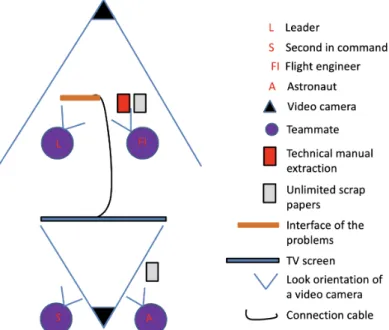
The experience is organized according to the figure 4. The needed equipment is:
- Two video cameras (one to record the four teammates and one for the treatment interface of the problems),
- A tripod for one camera,
- A computer for the treatment interface of the problems (cf. annex 1), - The technical manual extraction printed on sheets of paper (cf. annex 2), - A TV screen,
- A connection cable to display the interface of the problems on the TV screen,
15 Astronaut of the Mercury program of the NASA and first American to orbit the Earth, John Glenn (1921-2016) died a few days before the organization of this exercise within the framework of the LETUCA protocol executed by L’Haridon (2019), hence the name Mercury 21.