HAL Id: hal-01609017
https://hal.archives-ouvertes.fr/hal-01609017
Submitted on 6 Nov 2018
HAL is a multi-disciplinary open access
archive for the deposit and dissemination of
sci-entific research documents, whether they are
pub-lished or not. The documents may come from
teaching and research institutions in France or
abroad, or from public or private research centers.
L’archive ouverte pluridisciplinaire HAL, est
destinée au dépôt et à la diffusion de documents
scientifiques de niveau recherche, publiés ou non,
émanant des établissements d’enseignement et de
recherche français ou étrangers, des laboratoires
publics ou privés.
Modeling a Generalized Resource Constrained Multi
Project Scheduling Problem Integrated with a
Forward-Backward Supply Chain Planning
Shadan Gholizadeh Tayyar, Lionel Dupont, Jacques Lamothe, M. Falcon
To cite this version:
Shadan Gholizadeh Tayyar, Lionel Dupont, Jacques Lamothe, M. Falcon. Modeling a Generalized
Resource Constrained Multi Project Scheduling Problem Integrated with a Forward-Backward Supply
Chain Planning. MIM 2016 - 8th IFAC Conference on Manufacturing Modelling, Management and
Control, Jun 2016, Troyes, France. p. 1283-1288, �10.1016/j.ifacol.2016.07.700�. �hal-01609017�
Modeling a Generalized Resource Constrained Multi Project Scheduling Problem
Integrated with a Forward-Backward Supply Chain Planning
S.Gholizadeh-Tayyar*, L.Dupont*, J.Lamothe*, M.Falcon**
*Toulouse University, Ecole des Mines d’Albi-Carmaux, Industrial Engineering Department, Albi,France (e-mail :[email protected], [email protected], [email protected])
**TBC Générateur d’Innovation, Colomiers, France (e-mail: [email protected])
Abstract: Generalized Resource Constrained Multi Project Scheduling Problem, GRCMPSP, is issue of determining a scheduling plan for executing projects’ acti ities under satisfaction of precedence relationship between activities and availability of resources. This paper focuses on the resources’ availability. To deal with feeding nonrenewable recourses over periods they are demanded and to define a production-transportation plan for them, our proposed mixed integer programming model integrates GRCMPSP with Supply Chain Planning model. Also, to establish a plan for assigning required amounts of renewable resources, it supposes possibility of renting supplementary quantities. This assumption leads the model to define an optimum assignment under considering rent cost of additional resources and penalty cost may originate from lateness of the activities. The results are shown from applying the model on a project called CRIBA, which is defined to reduce energy consumption level of buildings in France.
Keywords: Generalized Resource Constrained Multi Project Scheduling Problem, Supply Chain
Planning, Mixed Integer Programming.
1. INTRODUCTION
In this paper we deal with a Generalized Resource Constrained Multi Project Scheduling Problem, GRCMPSP. The model is an extension of Generalized Resource Constrained Project Scheduling Problem, GRCPSP, where it expands the GRCPSP from scheduling one single project to scheduling of multiple projects. The objective of the problem, as it is introduced for the first time in (Elmaghraby, S.E., et al ,1992) is to schedule a number of activities subject to (i) generalized precedence relation between the activities and (ii) availability of the required resources. In term of (i), four possible types of relation comprising Finish-To-Start, Start-To-Start, Start-To-Finish and Finish-To-Finish are determined. A minimum (maximum) lag, that defines a minimum (maximum) time interval to spend between start (finish) of source activity and finish (start) of the target activity in a supposed precedence relation, is considered. In term of (ii), the execution of an activity quietly depends on the availability of the resources. Generally, two types of the resources including renewable and non-renewable resources are regarded in project scheduling problems, (Shirzadeh Chaleshtarti, A. et al,2014).
Project scheduling with renewable resources has been widely studied in the literature, (Pritsker, A.A.B., et al, 1969) as the first research study, (Kellenbrink, C., et al, 2015) and (Ranjbar, M., et al, 2013) as the recent ones in single project scheduling and (Krüger, D., et al, 2009) in multi project scheduling. In most of the researches, it is assumed that the availability of the resources is a constant value over different planning periods, (Khoshjahan, Y., et al, 2013). A modified approach of this hypothesis is regarded in Time Constrained Project Scheduling Problem, TCPSP, where the availability
of the renewable resources can increase temporarily by adding new capacities, to meet totally deadline that is defined for project completion, (Hurink, J.L., et al, 2011) and (Klein, R., 1999). In our model, we take the advantage of TCPSP. The aim is to avoid paying surplus cost for completion of the activities whose penalty cost is significantly greater than the rent cost of additional capacities of the resources.
Interning non-renewable resources in project scheduling is initially investigated in (Aquilano, N.J., et al,1980), where it considers time windows for ordering and acquisition of the resources in order to execution of the activities. (Dodin, B., et al, 2001) considers rewards (penalties) and order discounts for reception of the resources. (Smith-Daniels, D.E., et al, 1987) proposes a mixed integer programming model that deals with ordering quantity of the resources over the periods. (Fu, F., 2014). extends the previous work by considering the possibility of executing the activities in different manners (multi-mode problems). To the best of our knowledge, all the previous researches define only a transportation plan to order the non-renewable resources. Our study moves beyond while it is defining a production-transportation plan by considering supply chain network, which supplies the resources in the projects’ sites.
Considering the state of art in scheduling of the project(s), we classify the objectives into five groups: (i) Time-based objectives, in which the problem minimizes objectives such as completion time, earliness, tardiness and lateness; (ii) Quality-based objectives that are presented to deal with maximizing the projects’ execution ualit (iii) ost-based objectives which approach minimization of total cost of executing the project like as execution costs, material costs, inventory holding costs, costs related to tardiness or earliness of the project; (iv) Net present value, to maximize the present
June 28-30, 2016. Troyes, France
Modeling a Generalized Resource Constrained Multi Project Scheduling Problem
Integrated with a Forward-Backward Supply Chain Planning
S.Gholizadeh-Tayyar*, L.Dupont*, J.Lamothe*, M.Falcon**
*Toulouse University, Ecole des Mines d’Albi-Carmaux, Industrial Engineering Department, Albi,France (e-mail :[email protected], [email protected], [email protected])
**TBC Générateur d’Innovation, Colomiers, France (e-mail: [email protected])
Abstract: Generalized Resource Constrained Multi Project Scheduling Problem, GRCMPSP, is issue of determining a scheduling plan for executing projects’ acti ities under satisfaction of precedence relationship between activities and availability of resources. This paper focuses on the resources’ availability. To deal with feeding nonrenewable recourses over periods they are demanded and to define a production-transportation plan for them, our proposed mixed integer programming model integrates GRCMPSP with Supply Chain Planning model. Also, to establish a plan for assigning required amounts of renewable resources, it supposes possibility of renting supplementary quantities. This assumption leads the model to define an optimum assignment under considering rent cost of additional resources and penalty cost may originate from lateness of the activities. The results are shown from applying the model on a project called CRIBA, which is defined to reduce energy consumption level of buildings in France.
Keywords: Generalized Resource Constrained Multi Project Scheduling Problem, Supply Chain
Planning, Mixed Integer Programming.
1. INTRODUCTION
In this paper we deal with a Generalized Resource Constrained Multi Project Scheduling Problem, GRCMPSP. The model is an extension of Generalized Resource Constrained Project Scheduling Problem, GRCPSP, where it expands the GRCPSP from scheduling one single project to scheduling of multiple projects. The objective of the problem, as it is introduced for the first time in (Elmaghraby, S.E., et al ,1992) is to schedule a number of activities subject to (i) generalized precedence relation between the activities and (ii) availability of the required resources. In term of (i), four possible types of relation comprising Finish-To-Start, Start-To-Start, Start-To-Finish and Finish-To-Finish are determined. A minimum (maximum) lag, that defines a minimum (maximum) time interval to spend between start (finish) of source activity and finish (start) of the target activity in a supposed precedence relation, is considered. In term of (ii), the execution of an activity quietly depends on the availability of the resources. Generally, two types of the resources including renewable and non-renewable resources are regarded in project scheduling problems, (Shirzadeh Chaleshtarti, A. et al,2014).
Project scheduling with renewable resources has been widely studied in the literature, (Pritsker, A.A.B., et al, 1969) as the first research study, (Kellenbrink, C., et al, 2015) and (Ranjbar, M., et al, 2013) as the recent ones in single project scheduling and (Krüger, D., et al, 2009) in multi project scheduling. In most of the researches, it is assumed that the availability of the resources is a constant value over different planning periods, (Khoshjahan, Y., et al, 2013). A modified approach of this hypothesis is regarded in Time Constrained Project Scheduling Problem, TCPSP, where the availability
of the renewable resources can increase temporarily by adding new capacities, to meet totally deadline that is defined for project completion, (Hurink, J.L., et al, 2011) and (Klein, R., 1999). In our model, we take the advantage of TCPSP. The aim is to avoid paying surplus cost for completion of the activities whose penalty cost is significantly greater than the rent cost of additional capacities of the resources.
Interning non-renewable resources in project scheduling is initially investigated in (Aquilano, N.J., et al,1980), where it considers time windows for ordering and acquisition of the resources in order to execution of the activities. (Dodin, B., et al, 2001) considers rewards (penalties) and order discounts for reception of the resources. (Smith-Daniels, D.E., et al, 1987) proposes a mixed integer programming model that deals with ordering quantity of the resources over the periods. (Fu, F., 2014). extends the previous work by considering the possibility of executing the activities in different manners (multi-mode problems). To the best of our knowledge, all the previous researches define only a transportation plan to order the non-renewable resources. Our study moves beyond while it is defining a production-transportation plan by considering supply chain network, which supplies the resources in the projects’ sites.
Considering the state of art in scheduling of the project(s), we classify the objectives into five groups: (i) Time-based objectives, in which the problem minimizes objectives such as completion time, earliness, tardiness and lateness; (ii) Quality-based objectives that are presented to deal with maximizing the projects’ execution ualit (iii) ost-based objectives which approach minimization of total cost of executing the project like as execution costs, material costs, inventory holding costs, costs related to tardiness or earliness of the project; (iv) Net present value, to maximize the present
Modeling a Generalized Resource Constrained Multi Project Scheduling Problem
Integrated with a Forward-Backward Supply Chain Planning
S.Gholizadeh-Tayyar*, L.Dupont*, J.Lamothe*, M.Falcon**
*Toulouse University, Ecole des Mines d’Albi-Carmaux, Industrial Engineering Department, Albi,France (e-mail :[email protected], [email protected], [email protected])
**TBC Générateur d’Innovation, Colomiers, France (e-mail: [email protected])
Abstract: Generalized Resource Constrained Multi Project Scheduling Problem, GRCMPSP, is issue of determining a scheduling plan for executing projects’ acti ities under satisfaction of precedence relationship between activities and availability of resources. This paper focuses on the resources’ availability. To deal with feeding nonrenewable recourses over periods they are demanded and to define a production-transportation plan for them, our proposed mixed integer programming model integrates GRCMPSP with Supply Chain Planning model. Also, to establish a plan for assigning required amounts of renewable resources, it supposes possibility of renting supplementary quantities. This assumption leads the model to define an optimum assignment under considering rent cost of additional resources and penalty cost may originate from lateness of the activities. The results are shown from applying the model on a project called CRIBA, which is defined to reduce energy consumption level of buildings in France.
Keywords: Generalized Resource Constrained Multi Project Scheduling Problem, Supply Chain
Planning, Mixed Integer Programming.
1. INTRODUCTION
In this paper we deal with a Generalized Resource Constrained Multi Project Scheduling Problem, GRCMPSP. The model is an extension of Generalized Resource Constrained Project Scheduling Problem, GRCPSP, where it expands the GRCPSP from scheduling one single project to scheduling of multiple projects. The objective of the problem, as it is introduced for the first time in (Elmaghraby, S.E., et al ,1992) is to schedule a number of activities subject to (i) generalized precedence relation between the activities and (ii) availability of the required resources. In term of (i), four possible types of relation comprising Finish-To-Start, Start-To-Start, Start-To-Finish and Finish-To-Finish are determined. A minimum (maximum) lag, that defines a minimum (maximum) time interval to spend between start (finish) of source activity and finish (start) of the target activity in a supposed precedence relation, is considered. In term of (ii), the execution of an activity quietly depends on the availability of the resources. Generally, two types of the resources including renewable and non-renewable resources are regarded in project scheduling problems, (Shirzadeh Chaleshtarti, A. et al,2014).
Project scheduling with renewable resources has been widely studied in the literature, (Pritsker, A.A.B., et al, 1969) as the first research study, (Kellenbrink, C., et al, 2015) and (Ranjbar, M., et al, 2013) as the recent ones in single project scheduling and (Krüger, D., et al, 2009) in multi project scheduling. In most of the researches, it is assumed that the availability of the resources is a constant value over different planning periods, (Khoshjahan, Y., et al, 2013). A modified approach of this hypothesis is regarded in Time Constrained Project Scheduling Problem, TCPSP, where the availability
of the renewable resources can increase temporarily by adding new capacities, to meet totally deadline that is defined for project completion, (Hurink, J.L., et al, 2011) and (Klein, R., 1999). In our model, we take the advantage of TCPSP. The aim is to avoid paying surplus cost for completion of the activities whose penalty cost is significantly greater than the rent cost of additional capacities of the resources.
Interning non-renewable resources in project scheduling is initially investigated in (Aquilano, N.J., et al,1980), where it considers time windows for ordering and acquisition of the resources in order to execution of the activities. (Dodin, B., et al, 2001) considers rewards (penalties) and order discounts for reception of the resources. (Smith-Daniels, D.E., et al, 1987) proposes a mixed integer programming model that deals with ordering quantity of the resources over the periods. (Fu, F., 2014). extends the previous work by considering the possibility of executing the activities in different manners (multi-mode problems). To the best of our knowledge, all the previous researches define only a transportation plan to order the non-renewable resources. Our study moves beyond while it is defining a production-transportation plan by considering supply chain network, which supplies the resources in the projects’ sites.
Considering the state of art in scheduling of the project(s), we classify the objectives into five groups: (i) Time-based objectives, in which the problem minimizes objectives such as completion time, earliness, tardiness and lateness; (ii) Quality-based objectives that are presented to deal with maximizing the projects’ execution ualit (iii) ost-based objectives which approach minimization of total cost of executing the project like as execution costs, material costs, inventory holding costs, costs related to tardiness or earliness of the project; (iv) Net present value, to maximize the present
Modeling a Generalized Resource Constrained Multi Project Scheduling Problem
Integrated with a Forward-Backward Supply Chain Planning
S.Gholizadeh-Tayyar*, L.Dupont*, J.Lamothe*, M.Falcon**
*Toulouse University, Ecole des Mines d’Albi-Carmaux, Industrial Engineering Department, Albi,France (e-mail :[email protected], [email protected], [email protected])
**TBC Générateur d’Innovation, Colomiers, France (e-mail: [email protected])
Abstract: Generalized Resource Constrained Multi Project Scheduling Problem, GRCMPSP, is issue of determining a scheduling plan for executing projects’ acti ities under satisfaction of precedence relationship between activities and availability of resources. This paper focuses on the resources’ availability. To deal with feeding nonrenewable recourses over periods they are demanded and to define a production-transportation plan for them, our proposed mixed integer programming model integrates GRCMPSP with Supply Chain Planning model. Also, to establish a plan for assigning required amounts of renewable resources, it supposes possibility of renting supplementary quantities. This assumption leads the model to define an optimum assignment under considering rent cost of additional resources and penalty cost may originate from lateness of the activities. The results are shown from applying the model on a project called CRIBA, which is defined to reduce energy consumption level of buildings in France.
Keywords: Generalized Resource Constrained Multi Project Scheduling Problem, Supply Chain
Planning, Mixed Integer Programming.
1. INTRODUCTION
In this paper we deal with a Generalized Resource Constrained Multi Project Scheduling Problem, GRCMPSP. The model is an extension of Generalized Resource Constrained Project Scheduling Problem, GRCPSP, where it expands the GRCPSP from scheduling one single project to scheduling of multiple projects. The objective of the problem, as it is introduced for the first time in (Elmaghraby, S.E., et al ,1992) is to schedule a number of activities subject to (i) generalized precedence relation between the activities and (ii) availability of the required resources. In term of (i), four possible types of relation comprising Finish-To-Start, Start-To-Start, Start-To-Finish and Finish-To-Finish are determined. A minimum (maximum) lag, that defines a minimum (maximum) time interval to spend between start (finish) of source activity and finish (start) of the target activity in a supposed precedence relation, is considered. In term of (ii), the execution of an activity quietly depends on the availability of the resources. Generally, two types of the resources including renewable and non-renewable resources are regarded in project scheduling problems, (Shirzadeh Chaleshtarti, A. et al,2014).
Project scheduling with renewable resources has been widely studied in the literature, (Pritsker, A.A.B., et al, 1969) as the first research study, (Kellenbrink, C., et al, 2015) and (Ranjbar, M., et al, 2013) as the recent ones in single project scheduling and (Krüger, D., et al, 2009) in multi project scheduling. In most of the researches, it is assumed that the availability of the resources is a constant value over different planning periods, (Khoshjahan, Y., et al, 2013). A modified approach of this hypothesis is regarded in Time Constrained Project Scheduling Problem, TCPSP, where the availability
of the renewable resources can increase temporarily by adding new capacities, to meet totally deadline that is defined for project completion, (Hurink, J.L., et al, 2011) and (Klein, R., 1999). In our model, we take the advantage of TCPSP. The aim is to avoid paying surplus cost for completion of the activities whose penalty cost is significantly greater than the rent cost of additional capacities of the resources.
Interning non-renewable resources in project scheduling is initially investigated in (Aquilano, N.J., et al,1980), where it considers time windows for ordering and acquisition of the resources in order to execution of the activities. (Dodin, B., et al, 2001) considers rewards (penalties) and order discounts for reception of the resources. (Smith-Daniels, D.E., et al, 1987) proposes a mixed integer programming model that deals with ordering quantity of the resources over the periods. (Fu, F., 2014). extends the previous work by considering the possibility of executing the activities in different manners (multi-mode problems). To the best of our knowledge, all the previous researches define only a transportation plan to order the non-renewable resources. Our study moves beyond while it is defining a production-transportation plan by considering supply chain network, which supplies the resources in the projects’ sites.
Considering the state of art in scheduling of the project(s), we classify the objectives into five groups: (i) Time-based objectives, in which the problem minimizes objectives such as completion time, earliness, tardiness and lateness; (ii) Quality-based objectives that are presented to deal with maximizing the projects’ execution ualit (iii) ost-based objectives which approach minimization of total cost of executing the project like as execution costs, material costs, inventory holding costs, costs related to tardiness or earliness of the project; (iv) Net present value, to maximize the present
Modeling a Generalized Resource Constrained Multi Project Scheduling Problem
Integrated with a Forward-Backward Supply Chain Planning
S.Gholizadeh-Tayyar*, L.Dupont*, J.Lamothe*, M.Falcon**
*Toulouse University, Ecole des Mines d’Albi-Carmaux, Industrial Engineering Department, Albi,France (e-mail :[email protected], [email protected], [email protected])
**TBC Générateur d’Innovation, Colomiers, France (e-mail: [email protected])
Abstract: Generalized Resource Constrained Multi Project Scheduling Problem, GRCMPSP, is issue of determining a scheduling plan for executing projects’ acti ities under satisfaction of precedence relationship between activities and availability of resources. This paper focuses on the resources’ availability. To deal with feeding nonrenewable recourses over periods they are demanded and to define a production-transportation plan for them, our proposed mixed integer programming model integrates GRCMPSP with Supply Chain Planning model. Also, to establish a plan for assigning required amounts of renewable resources, it supposes possibility of renting supplementary quantities. This assumption leads the model to define an optimum assignment under considering rent cost of additional resources and penalty cost may originate from lateness of the activities. The results are shown from applying the model on a project called CRIBA, which is defined to reduce energy consumption level of buildings in France.
Keywords: Generalized Resource Constrained Multi Project Scheduling Problem, Supply Chain
Planning, Mixed Integer Programming.
1. INTRODUCTION
In this paper we deal with a Generalized Resource Constrained Multi Project Scheduling Problem, GRCMPSP. The model is an extension of Generalized Resource Constrained Project Scheduling Problem, GRCPSP, where it expands the GRCPSP from scheduling one single project to scheduling of multiple projects. The objective of the problem, as it is introduced for the first time in (Elmaghraby, S.E., et al ,1992) is to schedule a number of activities subject to (i) generalized precedence relation between the activities and (ii) availability of the required resources. In term of (i), four possible types of relation comprising Finish-To-Start, Start-To-Start, Start-To-Finish and Finish-To-Finish are determined. A minimum (maximum) lag, that defines a minimum (maximum) time interval to spend between start (finish) of source activity and finish (start) of the target activity in a supposed precedence relation, is considered. In term of (ii), the execution of an activity quietly depends on the availability of the resources. Generally, two types of the resources including renewable and non-renewable resources are regarded in project scheduling problems, (Shirzadeh Chaleshtarti, A. et al,2014).
Project scheduling with renewable resources has been widely studied in the literature, (Pritsker, A.A.B., et al, 1969) as the first research study, (Kellenbrink, C., et al, 2015) and (Ranjbar, M., et al, 2013) as the recent ones in single project scheduling and (Krüger, D., et al, 2009) in multi project scheduling. In most of the researches, it is assumed that the availability of the resources is a constant value over different planning periods, (Khoshjahan, Y., et al, 2013). A modified approach of this hypothesis is regarded in Time Constrained Project Scheduling Problem, TCPSP, where the availability
of the renewable resources can increase temporarily by adding new capacities, to meet totally deadline that is defined for project completion, (Hurink, J.L., et al, 2011) and (Klein, R., 1999). In our model, we take the advantage of TCPSP. The aim is to avoid paying surplus cost for completion of the activities whose penalty cost is significantly greater than the rent cost of additional capacities of the resources.
Interning non-renewable resources in project scheduling is initially investigated in (Aquilano, N.J., et al,1980), where it considers time windows for ordering and acquisition of the resources in order to execution of the activities. (Dodin, B., et al, 2001) considers rewards (penalties) and order discounts for reception of the resources. (Smith-Daniels, D.E., et al, 1987) proposes a mixed integer programming model that deals with ordering quantity of the resources over the periods. (Fu, F., 2014). extends the previous work by considering the possibility of executing the activities in different manners (multi-mode problems). To the best of our knowledge, all the previous researches define only a transportation plan to order the non-renewable resources. Our study moves beyond while it is defining a production-transportation plan by considering supply chain network, which supplies the resources in the projects’ sites.
Considering the state of art in scheduling of the project(s), we classify the objectives into five groups: (i) Time-based objectives, in which the problem minimizes objectives such as completion time, earliness, tardiness and lateness; (ii) Quality-based objectives that are presented to deal with maximizing the projects’ execution ualit (iii) ost-based objectives which approach minimization of total cost of executing the project like as execution costs, material costs, inventory holding costs, costs related to tardiness or earliness of the project; (iv) Net present value, to maximize the present
value of money in project scheduling; and, (v) multi objective models that consider simultaneously two or more of the conflicting objectives mentioned above. In this study, our objective is to minimize the total cost.
It is notable to mention that two main approaches are regarded in network modeling of the project scheduling problems: 1- Single project approach, wherein all the multiple projects are joined together to make a single super-project. Herein, a single critical path is regarded in the scheduling of the projects. For the research works and their different extension we refer the reader to following references, (Węglarz, J., et al, 2011),( Hartmann, S., et al 2010) and (Klein, R., 1999). 2- Multi projects approach, in which the parallel separated projects are treated simultaneously while they use a common pool of renewable resources. In this approach each of the project networks can maintain their own critical path to make shorten, (Browning, T.R., et al, 2010) chooses this approach while they are justifying this approach is more realistic and it has a great opportunity for improving. In our modelling framework, we employ the multi project approach.
Dealing with projects planning in both of single-project and multi-project engages the researchers with NP-hard problems (Blazewicz, J., et al, 1983). In term of computation time of the models, treating with small size of these problems is reasonable by the commercial soft-wares in the condition that the number of activities is less than 50 activities (Fatemi Ghomi, S.M.T. et al ,2002) For large size problems implementation of the heuristics and meta-heuristics is proposed in the literature.
Regarding to the supply chain network, the model defines production-transportation plan of the stakeholders of the supply chain network. It also takes into consideration the sustainability deals by adding backward flows of produced wastes from the projects worksites to the recycling units, which are located either in manufacturing centers or in individual recycling centers.
2. PROBLEM DEFINITION
2.1 Mathematical Formulation
The following notation is used for presentation of the mathematical model.
Indices
i : index of activities. t: index of time periods. w: index of projects’ worksites.
: index of manufacturing centers. : index of recycling centers.
u: index to show all units of the network, including the worksites, w, manufacturing centers, m, collection-recycling centers, c, and suppliers of raw materials.
nr: index of products used at the worksites (projects’ non-renewable resources).
g: index of wastes types generated at the worksites.
p : index of network’s product items, including of the products used at the worksites, nr, wastes generated at the worksites, g, composing elements/ raw materials used at the manufacturing centers and products produced at the manufacturing centers .
r: index of renewable resources used at the worksites. r : index of renewable resources used at the worksites with high rent costs, r є R.
f(o,d,p) : index of flows which present the shipment of product p from origin o to destination d, o є U, d є U, p є P. in(d,p): index of pairs which show reception of product p at destination d, d є U, p є P.
out(o,p) : index of pairs which show shipment of product p from origin o, o є U, p є P.
l: index of lines, including lp as production lines and lc as recycling lines.
pro(l,u,p) : index which identifies line type l at unit u which is dedicated to produce/recycle product p.
(p, p ) : index to present linkage between composing element p and made product p .
Sets
Capital letters of following indices i, t, w, m, c, u, nr, g, p, r, r , f(o,d,p), in(d,p), out(o,p), l, pro(l,u,p) and (p, p ) are used to present related set notation.
Iw : set of activities that belong to worksite, (Iw I). SSpr : start to start precedence of activity j by pairs (i, j). SFpr : start to finish precedence of activity j by pairs (i, j). FSpr : finish to start precedence of activity j by pairs (i, j). FFpr : finish to finish precedence of activity j by pairs (i, j).
owait pr : 1 if activity j of precedence SSpr starts immediately after activity i has started, 0 otherwise.
owait pr : 1 if activity j of precedence SFpr finishes immediately after activity i has started, 0 otherwise.
owait pr : 1 if successor activity j of precedence pre starts immediately after finishing the predecessor activity i, 0 otherwise.
owait pr : 1 if successor activity j of precedence pre finishes immediately after finishing the predecessor activity i, 0 otherwise.
w : linkage (i, j) presents beginning activity of worksite w
by i and ending one by j.
r w : linkage (i, j) presents beginning activity of worksite w
which uses renewable resource r by i and the ending activity by j.
Parameters
i: earliest start of activity i .
li: latest start of activity i .
DDi: due date of activity i.
Dui: duration of activity i.
Dnri,nr: demand of activity i for nonrenewable resource nr.
Drir: demand of activity i for renewable resource r.
FSi : minimum time lag between the finish of activity i and the start of activity j.
IFAC MIM 2016
June 28-30, 2016. Troyes, France
value of money in project scheduling; and, (v) multi objective models that consider simultaneously two or more of the conflicting objectives mentioned above. In this study, our objective is to minimize the total cost.
It is notable to mention that two main approaches are regarded in network modeling of the project scheduling problems: 1- Single project approach, wherein all the multiple projects are joined together to make a single super-project. Herein, a single critical path is regarded in the scheduling of the projects. For the research works and their different extension we refer the reader to following references, (Węglarz, J., et al, 2011),( Hartmann, S., et al 2010) and (Klein, R., 1999). 2- Multi projects approach, in which the parallel separated projects are treated simultaneously while they use a common pool of renewable resources. In this approach each of the project networks can maintain their own critical path to make shorten, (Browning, T.R., et al, 2010) chooses this approach while they are justifying this approach is more realistic and it has a great opportunity for improving. In our modelling framework, we employ the multi project approach.
Dealing with projects planning in both of single-project and multi-project engages the researchers with NP-hard problems (Blazewicz, J., et al, 1983). In term of computation time of the models, treating with small size of these problems is reasonable by the commercial soft-wares in the condition that the number of activities is less than 50 activities (Fatemi Ghomi, S.M.T. et al ,2002) For large size problems implementation of the heuristics and meta-heuristics is proposed in the literature.
Regarding to the supply chain network, the model defines production-transportation plan of the stakeholders of the supply chain network. It also takes into consideration the sustainability deals by adding backward flows of produced wastes from the projects worksites to the recycling units, which are located either in manufacturing centers or in individual recycling centers.
2. PROBLEM DEFINITION
2.1 Mathematical Formulation
The following notation is used for presentation of the mathematical model.
Indices
i : index of activities. t: index of time periods. w: index of projects’ worksites.
: index of manufacturing centers. : index of recycling centers.
u: index to show all units of the network, including the worksites, w, manufacturing centers, m, collection-recycling centers, c, and suppliers of raw materials.
nr: index of products used at the worksites (projects’ non-renewable resources).
g: index of wastes types generated at the worksites.
p : index of network’s product items, including of the products used at the worksites, nr, wastes generated at the worksites, g, composing elements/ raw materials used at the manufacturing centers and products produced at the manufacturing centers .
r: index of renewable resources used at the worksites. r : index of renewable resources used at the worksites with high rent costs,r є R.
f(o,d,p) : index of flows which present the shipment of product p from origin o to destination d, o є U, d є U, p є P. in(d,p): index of pairs which show reception of product p at destination d, d є U, p є P.
out(o,p) : index of pairs which show shipment of product p from origin o, o є U, p є P.
l: index of lines, including lp as production lines and lc as recycling lines.
pro(l,u,p) : index which identifies line type l at unit u which is dedicated to produce/recycle product p.
(p, p ) : index to present linkage between composing element p and made productp .
Sets
Capital letters of following indices i, t, w, m, c, u, nr, g, p, r, r , f(o,d,p), in(d,p), out(o,p), l, pro(l,u,p) and (p, p ) are used to present related set notation.
Iw: set of activities that belong to worksite, (Iw I). SSpr : start to start precedence of activity j by pairs (i, j). SFpr : start to finish precedence of activity j by pairs (i, j). FSpr : finish to start precedence of activity j by pairs (i, j). FFpr : finish to finish precedence of activity j by pairs (i, j).
owait pr : 1 if activity j of precedence SSpr starts immediately after activity i has started, 0 otherwise.
owait pr : 1 if activity j of precedence SFpr finishes immediately after activity i has started, 0 otherwise.
owait pr : 1 if successor activity j of precedence pre starts immediately after finishing the predecessor activity i, 0 otherwise.
owait pr : 1 if successor activity j of precedence pre finishes immediately after finishing the predecessor activity i, 0 otherwise.
w: linkage (i, j) presents beginning activity of worksite w
by i and ending one by j.
r w: linkage (i, j) presents beginning activity of worksite w
which uses renewable resource r by i and the ending activity by j.
Parameters
i: earliest start of activity i .
li: latest start of activity i .
DDi: due date of activity i.
Dui: duration of activity i.
Dnri,nr: demand of activity i for nonrenewable resource nr.
Drir: demand of activity i for renewable resource r.
FSi : minimum time lag between the finish of activity i and the start of activity j.
SSi : minimum time lag between the start of activity i and the start of activity j.
SFi : minimum time lag between the start of activity i and the finish of activity j.
FFi : minimum time lag between the finish of activity i and the finish of activity j.
Arr: availability of renewable resource r.
Maxr: maximum add value for resource r.
P w per period cost of running worksite w.
C r w per period cost of using renewable resource r at worksite w .
R rt: rent cost of renewable resource r at time period t.
P n i: penalty cost for one-period delay of activity i.
StinCapu : capacity for stocking the products which are using
at unit u.
StoutCapu : capacity for stocking the products which are
produced at unit u.
SupCapu : supply capacity of raw material supplier u.
LAvCaplt : production capacity of line l at time period t.
MaxAddl : maximum add capacity in line l.
AddCostl : cost for adding one unit of production/recycling
capacity to line l.
Wlp : workload of product p.
T f(o,d,p) : cost for shipping one unit of product p from origin
o to destination d.
Tlf(o,d,p) : lead-time for shipping one unit of product p from
origin o to destination d.
Plpro(l,m,p) : production time of product p at line l of
manufacturing center m.
StinCp : stocking cost for one unit of used product p.
StoutCp : stocking cost for one unit of produced product p.
ProdCp :production/recycling cost of product p.
AddCLl :cost for adding one unit of capacity to line l. (p,p ) : value of composing element in final product.
Gpgi : waste type g generated by activity i.
Decision ariables
Zit: 1 if activity i starts at time t, 0 otherwise.
Uit: 1 if activity i is processing over time t, 0 otherwise.
Ltnsi: lateness of activity i.
Si: start date of activity i.
Rrt: Added quantity of renewable resource r over time period
t.
TQf(o,d,p),t : transported quantity of product p from origin 0o
to destination d at time t.
Stinin(d,p),t : stock of product type p that is received at
destination d at time t.
Stoutout(o,p),t : stock of product type p that are sent from
origin o at time t.
ProdQpro(l,u,p),t : produced/recycled quantity of product p on
line l of unit u at time t.
AddLlt : quantity of added capacity to line l at time t.
Objective function: Min Z =
∑ ∑w (i, )є w (S +Du Si)P w +
∑ ∑ ∑(i, ) є (S +
r w Du Si)C r w r
w + ∑ Ltnsi iP n i+
∑ ∑ Rr t rtR r + ∑f(o,d,p)∑ TQt f(o,d,p),t TCf(o,d,p),t+
∑in(d,p)∑ Stint in(d,p),t StinCp+
∑out(o,p)∑ Stoutt out(o,p),t SoutCp+
∑pro(l,u,p)∑ ProdQt pro(l,u,p),t ProdCp+
∑ ∑ AddLl t lt AddCLl (1)
The objective of the model is to minimize total cost of the system. Generally, it includes two major types of the cost: -
Project planning costs (terms including in the first bracket),
which are respectively total periodic cost of running the projects, costs related to the renewable resources whose rent cost is high( The aim is to minimize the period that these resources are maintained at the worksites.), total penalty cost and total cost of adding supplementary renewable resources.-
Supply chain planning cost (terms in the second bracket),
including the total transportation cost for shipping products, stock cost of the products that are received at the destinations, stock cost of the products that are sent from an origin, production/recycling cost and the cost related to add of new production/recycling capacities in the related lines.
Subject to ∑lt Zit= 1 ∀i є I (2) ∑ Uit= Dui ∀i є I (3) S Si + Dui+FSi ∀(i, )є FSpr , owait pr 0 (4) S = Si + Dui+FSi ∀(i, )є FSpr , owait pr 1 (5) S Si +SSi ∀(i, )є SSpr , owait pr 0 (6) S = Si+SSi ∀(i, )є SSpr , owait pr 1 (7)
S +Du Si +SFi ∀(i, )є SFpr , owait pr 0 (8)
S + Du = Si +SFi ∀(i, )є SFpr , owait pr 1 (9) S + Du Si + Dui+ FFi ∀(i, )є FFpr , owait pr 0 (10) S + Du = Si + Dui+ FFi ∀(i, )є FFpr , owait pr 1 (11) ∑t−1t u Ui Dui Zit∀i є I, t є { i, , li} (12) Si= ∑lt t Zit ∀i є I (13) Ltnsi ≥ Si+ Dui - DDi ∀i є I (14) ∑iє I DrirUit ≤ Arr+ Rrt ∀r є R, ∀t є { i, , LFi 1} (15) Rrt ≤ Maxr ∀r є R, t є T (16) Stinin(m,p), t−1 +
∑ TQf f(o,d,p| d,p є In(m,p)), t−Tlf(o,d,p|d,p є In(m,p))
Stinin(m,p), t+
∑ (p,p )| p є In(m,p)∑proProdQpro(lp,m,p )| p є (p,p ),t (p,p )
Stinin(d,g),t−1+ ∑ TQf f(o,d,p| d,p є In(d,g)),t−Tlf(o,d,p|d,p є In(d,g))=
Stinin(d,g), t+∑proProdQpro(lc,u,p)|u,pє In(d,g), t∀in(d,p) є
IN(d,g) ,t є T (18) Stinin(w,nr),t−1+∑fTQf(o,d,p|p є In(w,nr)), t−Tlf(o,d,p|d,p є In(w,nr))=
∑iє Iw ZitDnri,nr|nr є In(w,nr)+ Stinin(w,nr), t
∀in(d,p) є (w, nr) ,tєT, nr є R (19) Stoutout(m,p), t−1+
∑ ProdQpro(lp,u,p|u,p є OUT(m,p)), t−Pl
pro(lp,u,p|u,p є OUT(m,p))
pro =
∑ TQf f(o,d,p|o,p є OUT(m,p)),t+ Stoutout(m,p), t
∀out(o,p) є U (m,p) ,t єT (20) Stoutout(w,p), t−1+ ∑i є Iw ZitGpg|g є OUT(w,p), i =
∑ TQf f(o,d,p|o,p є OUT(w,p)), t+ Stoutout(w,p), t
∀out(o,p) є U (w,p) ,pєG,tєT (21) ProdQpro(l,m,p),t Wlp ≤ LAvCaplt +AddLlt
∀pro(l, u, p)є PR (l,m,p),tєT (22) AddLlt ≤ MaxAddl ∀lє L, t єT (23)
∑ Stinp in(d,p)|dєu,t ≤ StinCapu ∀uє U, t єT (24)
∑ Stoutp out(o,p)|oєu,t ≤ StoutCapu
∀u є U, t єT (25) TQf(o,d,p)|oєu,t≤ SupCapu
∀u є U, f(o,d,p) єF(o,d,p), tєT (26) Stinin(d,p),t= 0
∀in(d, p) є IN(d,p), t=0,T (27) Stoutout(o,p),t = 0
∀out(o, p) є OUT(o,p), t =0,T (28) Zit, Uit є {0,1} ∀i є I , t є T (29)
Ltnsi, Si, Rrt, TQf(o,d,p),t, Stinin(d,p),t, Stoutout(o,p),t,
ProdQpro(l,u,p),t , AddLlt ≥ 0
∀f(o, d, p)є F(o, d, p), in(d, p) є In(d, p), out(o, p)є OUT(o, p), pro(l, u, p)є PRO(l, u, p), l єL, i є I,r є R, tє T (30)
Constraints (2)-(13) define start time of the activities, regarding to earliest, latest start time, latest finish time and precedence relationships. Constraint (14) deals with the lateness may occur in executing the activities. Constraint (15) presents that the demand of activities for renewable resources can be satisfied by the initial available quantity and quantity could be added over time periods. Constraint (16) limits the quantity that can be added into the initial availability of renewable resources. Equations (17), (18) and (19) deal with balance of flows for stock of the products that are used at the destinations. Constraints (20) and (21) present the same concept for stock of the products that are sent from an origin. Constraint (22) imposes that the production/recycling of the products cannot exceed the available capacities plus the capacities could be added. Constraint (23) defines a limit for added capacities. Constraints (24) and (25) present the limited stock capacity respectively for the used products in a destination and sent products from an origin. Constraint (26) deals with limited supply capacity. Equations (27) and (28) present initial and final states of the stocked products. Constraints (29) and (30) present the variable types of the model.
2.2 Use Case and Numerical Results
The use case of the study relies on CRIBA ( Construction Industrialisée Bois et Acier) project, which is defined to reduce energy consumption level of buildings in France. For that purpose, insulating panels integrated with insulating carpentries are shipped to the projects’ worksites to e installed on external facades of the buildings. Besides the insulating carpentries, the other composing elements of the panels are wooden frames, insulation material types and external coating product types. Each of the elements is procured by corresponding suppliers/ manufacturers. For performing the installation activities, several renewable resources such as labor-works, trucks and cranes should be present at the worksites. After posing the panels, former carpentries of buildings should be removed. In order to respect the sustainability concerns regarded in the environmental engagements, the produced wastes in the worksites should be shipped to recycling centers.
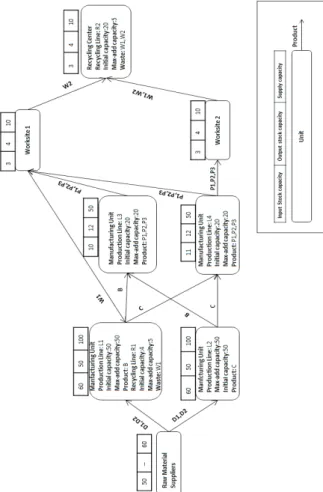
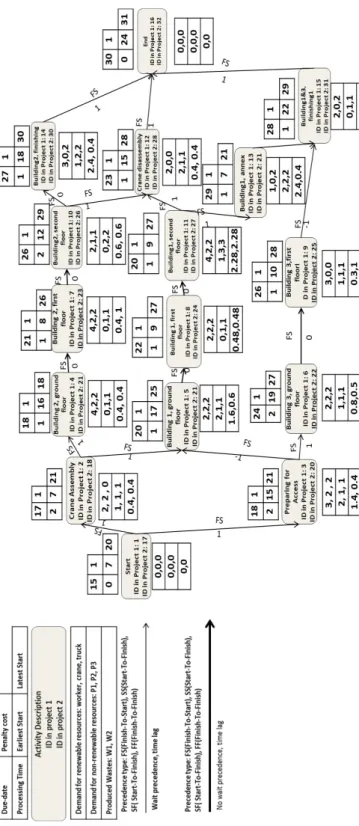
Fig. 1 and Fig. 2 present the dimension of the applied use case. It encompasses a supply chain network followed by two identical projects running in worksite1 and worksite2. The results are obtained by using CPLEX-Studio IBM on a notebook with 2.20 GHz processor, Intel® Core i7 and 64-bit of exploiting system. It is worth noting that the solution time was 12 seconds and 24 hundredth of a second.
Figure 1- Presentation of the system framework dedicated to use case.
IFAC MIM 2016
June 28-30, 2016. Troyes, France
Stinin(d,g),t−1+ ∑fTQf(o,d,p| d,p є In(d,g)),t−Tlf(o,d,p|d,p є In(d,g))=
Stinin(d,g), t+∑proProdQpro(lc,u,p)|u,pє In(d,g), t∀in(d,p) є
IN(d,g) ,t є T (18) Stinin(w,nr),t−1+∑fTQf(o,d,p|p є In(w,nr)), t−Tlf(o,d,p|d,p є In(w,nr))=
∑iє Iw ZitDnri,nr|nr є In(w,nr)+Stinin(w,nr), t
∀in(d,p) є (w, nr) ,tєT, nr є R (19) Stoutout(m,p), t−1+
∑ ProdQpro(lp,u,p|u,p є OUT(m,p)), t−Pl
pro(lp,u,p|u,p є OUT(m,p))
pro =
∑ TQf f(o,d,p|o,p є OUT(m,p)),t+ Stoutout(m,p), t
∀out(o,p) є U (m,p) ,t єT (20) Stoutout(w,p), t−1+ ∑i є Iw ZitGpg|g є OUT(w,p), i=
∑ TQf f(o,d,p|o,p є OUT(w,p)), t+ Stoutout(w,p), t
∀out(o,p) є U (w,p) ,pєG,tєT (21) ProdQpro(l,m,p),tWlp ≤ LAvCaplt+AddLlt
∀pro(l, u, p)є PR (l,m,p),tєT (22) AddLlt ≤ MaxAddl ∀lє L, t єT (23)
∑ Stinp in(d,p)|dєu,t≤ StinCapu ∀uє U, t єT (24)
∑ Stoutp out(o,p)|oєu,t≤ StoutCapu
∀u є U, t єT (25) TQf(o,d,p)|oєu,t≤ SupCapu
∀u є U, f(o,d,p) єF(o,d,p), tєT (26) Stinin(d,p),t= 0
∀in(d, p) є IN(d,p), t=0,T (27) Stoutout(o,p),t= 0
∀out(o, p) є OUT(o,p), t =0,T (28) Zit, Uitє {0,1} ∀i є I , t є T (29)
Ltnsi,Si, Rrt, TQf(o,d,p),t, Stinin(d,p),t,Stoutout(o,p),t,
ProdQpro(l,u,p),t, AddLlt ≥ 0
∀f(o, d, p)є F(o, d, p), in(d, p) є In(d, p), out(o, p)є OUT(o, p), pro(l, u, p)є PRO(l, u, p), l єL, i є I,r є R, tє T (30)
Constraints (2)-(13) define start time of the activities, regarding to earliest, latest start time, latest finish time and precedence relationships. Constraint (14) deals with the lateness may occur in executing the activities. Constraint (15) presents that the demand of activities for renewable resources can be satisfied by the initial available quantity and quantity could be added over time periods. Constraint (16) limits the quantity that can be added into the initial availability of renewable resources. Equations (17), (18) and (19) deal with balance of flows for stock of the products that are used at the destinations. Constraints (20) and (21) present the same concept for stock of the products that are sent from an origin. Constraint (22) imposes that the production/recycling of the products cannot exceed the available capacities plus the capacities could be added. Constraint (23) defines a limit for added capacities. Constraints (24) and (25) present the limited stock capacity respectively for the used products in a destination and sent products from an origin. Constraint (26) deals with limited supply capacity. Equations (27) and (28) present initial and final states of the stocked products. Constraints (29) and (30) present the variable types of the model.
2.2 Use Case and Numerical Results
The use case of the study relies on CRIBA ( Construction Industrialisée Bois et Acier) project, which is defined to reduce energy consumption level of buildings in France. For that purpose, insulating panels integrated with insulating carpentries are shipped to the projects’ worksites to e installed on external facades of the buildings. Besides the insulating carpentries, the other composing elements of the panels are wooden frames, insulation material types and external coating product types. Each of the elements is procured by corresponding suppliers/ manufacturers. For performing the installation activities, several renewable resources such as labor-works, trucks and cranes should be present at the worksites. After posing the panels, former carpentries of buildings should be removed. In order to respect the sustainability concerns regarded in the environmental engagements, the produced wastes in the worksites should be shipped to recycling centers.
Fig. 1 and Fig. 2 present the dimension of the applied use case. It encompasses a supply chain network followed by two identical projects running in worksite1 and worksite2. The results are obtained by using CPLEX-Studio IBM on a notebook with 2.20 GHz processor, Intel® Core i7 and 64-bit of exploiting system. It is worth noting that the solution time was 12 seconds and 24 hundredth of a second.
Figure 1- Presentation of the system framework dedicated to use case.
Considering the results, one could stand out some points. Both of the projects have the same structure and data setting nevertheless staring date of dummy activities of the projects as well as non-dummy activities are not the same. This matter originates from feeding up the non-renewable resources by the supply chain for starting the activities and also by the issue of assigning the renewable resources to activities to make them able to be started on a time between their earliest and latest start time.
Figure 2- Activity-on-Node presentation for projects dedicated to the use case.
Figure 3- Results for transported, produced/recycled quantities and starting date of activities.
From the view point of feeding up the non-renewable resources, the supply chain attempts to supply the resources to the projects’ worksites ased on its limited capacit of
production, transportation and stock. Furthermore, the procurement of the resources quietly depends on the performing time windows of the activities (earliest and latest start time). Then, taking into account the supply chain capacity and performing possibility of the activities, the model associates different start dates for each of the activities in the same projects.
From the view point of assigning the renewable resources, the model associates the start dates to the activities based on the initial availability of the resources and probable rented quantities. In this context, for defining the rent of the renewable resources, it regards the rent cost of the resources as well as the penalty cost for lateness of the activities. The optimality defines, either to rent additional resources and avoid paying high penalty costs, or to pay low penalty cost in order to not to pay for high additional renewable resources.
3. CONCLUSIONS
An integrated mixed integer programming model of scheduling GRCMPSP with forward-backward SCP model is proposed in this work. The model defines a transportation-production plan for supplying the non-renewable resources at the projects’ worksites and for shipping the wastes to the recycling centers. Also it defines a plan for assignment of the renewable resources to the activities. Possibility of renting additional capacity of renewable resources makes the model able to propose results that are optimum in term of either paying for penalty cost or paying for rent costs. For the future work, the authors are interested in applying a proper metaheuristic algorithm to treat with problems in large sizes. It will be interested to reduce the total number of the binary variables Zit , that is equal to ∑f (li i), by a heuristics
which limits liand ito make tighten [ i li].
ACKNOWLEDGMENT
The authors gratefully acknowledge Agence d’ n irronnement et a trise de l’ nergie for founding this research study and IBM for its support in providing CPLEX solver.
REFERENCES
Aquilano, N.J., Smith, D.E., (1980). A formal set of algorithms for project scheduling with critical path scheduling/material requirements planning. Journal
of Operations Management 1, 57 67.
Blazewicz, J., Lenstra, J.K., Kan, A.H.G.R., (1983). Scheduling subject to resource constraints: classification and complexity. Discrete Applied
Mathematics 5, 11 24.
Browning, T.R., Yassine, A.A., (2010). Resource-constrained multi-project scheduling: Priority rule performance revisited. International Journal of Production
Economics 126, 212 228.
Dodin, B., Elimam, A.A., (2001). Integrated Project Scheduling and Material Planning with Variable Activity Duration and Rewards. IIE Transactions 33, 1005 1018.
Elmaghraby, S.E., Kamburowski, J., (1992). The Analysis of Activity Networks Under Generalized Precedence Relations (GPRs). Management Science 38, 1245 1263. Fu, F., (2014). Integrated scheduling and batch ordering for
construction project. Applied Mathematical Modelling 38, 784 797.
Fatemi Ghomi, S.M.T., Ashjari, B. (2002): A simulation model for multi-project resource allocation.
International Journal of Project Management. 20, 127
130
Hartmann, S., Briskorn, D., (2010). A survey of variants and extensions of the resource-constrained project scheduling problem. European Journal of Operational
Research 207, 1 14.
Hurink, J.L., Kok, A.L., Paulus, J.J., Schutten, J.M.J., (2011). Time-constrained project scheduling with adjacent resources. Computers & Operations Research, Project
Management and Scheduling 38, 310 319.
Kellenbrink, C., Helber, S., (2015). Scheduling resource-constrained projects with a flexible project structure.
European Journal of Operational Research 246, 379
391.
Khoshjahan, Y., Najafi, A.A., Afshar-Nadjafi, B., (2013). Resource constrained project scheduling problem with discounted earliness tardiness penalties: Mathematical modeling and solving procedure. Computers &
Industrial Engineering 66, 293 300.
Klein, R. (1999).Schedulung of resource constrained
projects. Spring Science & Business
Krüger, D., Scholl, A., (2009). A heuristic solution framework for the resource constrained (multi-)project scheduling problem with sequence-dependent transfer times. European Journal of Operational Research 197, 492 508.
Pritsker, A.A.B., Waiters, L.J., Wolfe, P.M., (1969). Multiproject Scheduling with Limited Resources: A Zero-One Programming Approach. Management
Science 16, 93 108. doi:10.1287/mnsc.16.1.93
Ranjbar, M., Hosseinabadi, S., Abasian, F., (2013). Minimizing total weighted late work in the resource-constrained project scheduling problem. Applied
Mathematical Modelling 37, 9776 9785.
Ranjbar, M., Khalilzadeh, M., Kianfar, F., Etminani, K., (2012). An optimal procedure for minimizing total weighted resource tardiness penalty costs in the resource-constrained project scheduling problem.
Computers & Industrial Engineering 62, 264 270.
Shirzadeh Chaleshtarti, A., Shadrokh, S., Fathi, Y., Shirzadeh Chaleshtarti, A., Shadrokh, S., Fathi, Y., 2014. Branch and Bound Algorithms for Resource Constrained Project Scheduling Problem Subject to Nonrenewable Resources with Prescheduled Procurement,
Mathematical Problems in Engineering, e634649.
Smith-Daniels, D.E., Smith-Daniels, V.L., (1987). Optimal Project Scheduling with Materials Ordering. IIE
Transactions 19, 122 129.
Węglarz, J., J zefowska, J., ika, ., Walig ra, ., (2011a). Project scheduling with finite or infinite number of activity processing modes A survey. European
Journal of Operational Research 208, 177 205.
IFAC MIM 2016
June 28-30, 2016. Troyes, France