1
Modeling multilayered wire strands, a strategy based on 3D finite element
beam-to-1beam contacts - Part I: Model formulation and validation
23
Sébastien Lalondea, Raynald Guilbaultb, Frédéric Légeronc 4
a
Université de Sherbrooke, Faculty of Engineering, Department of Civil Engineering, Sherbrooke, Canada 5
b École de technologie supérieure, Department of Mechanical Engineering, Montreal, Canada 6
c Parsons Corporation, Abu Dhabi, United Arab Emirates 7
8
Abstract
9
This paper proposes a FE modeling strategy for multilayered strands subjected to multiaxial loads. The approach takes 10
advantage of beam elements and incorporates 3D inter-wire contacts. While reducing mesh sizes, it handles any strand 11
configuration. Comparisons with experimental results validate its precision. The analysis shows that friction forces control 12
the hysteresis and the bending stiffness. The paper develops a multi-level friction coefficient better representing the stick 13
and slip zones, and to account for indentation, the model incorporates a friction orthogonality concept; the axial direction is 14
controlled by adhesion, while the orthogonal direction is associated with adhesion and deformation contributions. 15
Keywords: Multilayered wire strands, Finite element modeling, Bending loads, Inter-wire contact, Beam-to-beam contact, Frictional contact 16
17
1. Introduction
18
Multilayered helical strands are key components in many engineering structures, such as suspension and cable-stayed 19
bridges, guyed towers, and power transmission lines. Mainly designed to support high axial static forces, strands are also 20
subjected to dynamic transverse loads (such as wind-induced vibrations) generating free cyclic bending. Near restrained 21
terminations, cyclic bending may induce critical fretting damage at inter-wire contact interfaces, consequently affecting cable 22
service life [1,2]. Characterizing and understanding the mechanical behavior of helical strands under multiaxial loading is thus 23
critical for the structural integrity assessment of engineering structures. This paper develops an efficient modeling strategy 24
for multilayered strands submitted to combined axial and bending loads. Although not restricted to, the proposed modeling 25
approach is oriented to the analysis of overhead conductors. 26
Due to contact interactions between wires, multilayered strands (Fig. 1a) exhibit a variable bending stiffness (EI); as the 27
strand curvature (κ) increases, the wires progressively start to slip on each other, resulting in a significant reduction of the 28
bending stiffness. Therefore, particularly as a result of the anti-symmetricity of the problem [3], formulating a mechanical 29
model of helical strands submitted to multiaxial loads, including bending moments, represents a difficult task. 30
Several models in the literature address the bending of helical strands. Based on the strand load/deformation 31
configuration in Fig. 1a, different theoretical approaches are proposed using various kinematic assumptions [3]. For example, 32
2 Raoof and Hobbs [4] idealized the strand as a series of concentric orthotropic cylinders, each associated with a specific layer 33
and its corresponding mechanical properties. Lanteigne [5] presented a modeling approach in which the strand response is 34
mainly defined from wire axial forces and independent wire bending. Leclair and Costello [6] applied the Love curved rod 35
equilibrium equations to each wire to derive a mechanical model. 36
The literature also proposes analytical models focusing on local wire aspects. For example, Argatov [7] analyzed the 37
influence of transverse modifications of the wire section associated with Poisson ratio effects and inter-wire contact 38
flattening. The study revealed that for larger lay angles the contact flattening effects dominate the influence of the Poisson 39
ratio. Later Frikha et al. [8] used an asymptotic expansion approach and exploited the translational invariance of single wires 40
to reduce the dimension of the elastic problem brought in by helical strands. They were therefore able to describe the micro 41
stresses resulting from macroscopic loadings. Although, the analytical models developed in these studies provide detailed 42
descriptions of strand response, the presented analyses remained limited to axial loads and neglected inter-wire friction 43
forces. 44
Some researchers introduced wire slippage by means of the Coulomb friction law, considering interlayer pressure and 45
axial tension difference in contacting wires at given strand curvatures. This procedure results in a stepwise variation of the 46
bending stiffness between two extremes: EImax (no slip, eq. (1.1)) and EImin (full slip, eq. (1.2)) [9]. In eqs. 1.1 and 1.2, Ej, Aj, γj
47
and Rj stand for wire j elastic modulus, cross-section area, angular position and corresponding layer radius, respectively,
48
while I0j is the wire moment of inertia (relative to its own axis):
49
2 2
max j 0j j j j EI =
E I + A R sin γ (1.1) 50 min j 0j EI =
E I (1.2) 51The EImax assumption considers that all strand wires act together as a solid beam, while EImin supposes independent
52
responses of the wires. In other words EImin supposes that each wire bends about its own axis. Therefore, under this second
53
assumption, straight strands involving no inter-wire slip have a bending stiffness equivalent to that resulting from EImax. On
54
the other hand, with bending deformations, the strand curvature generates inter-wire slippage causing bending stiffness 55
reductions. The EImin condition is reached when the induced curvature produces slipping conditions at all wire contacts.
56
In the late ‘90s, Papailiou [10] presented a model in which the friction was also defined by the wire axial tension. The 57
model accounts for the distance from the strand neutral axis, thus leading to a smooth bending stiffness variation between 58
EImax and EImin. To incorporate EI variations along the strand under free bending conditions, the approach was implemented
3 into a finite element analysis. Comparisons with experimental measures showed good correlations [10]. Subsequently, Hong 60
et al. [11] reconsidered certain hypotheses related to pressure transmission between layers, while Paradis and Legeron [12] 61
extended the representation to include the effects of tangential compliance at contact interfaces. 62
Despite the good performances more recent models have shown in predicting strand-free bending response, their 63
analytical formulations involve significant simplifications [13]. For instance, contacts between adjacent wires on the same 64
layer are neglected, while contact points of superposed layers are replaced by contact lines. Moreover, under no-slip 65
conditions (EImax), strand cross-sections remain plane after bending (Euler-Bernouilli hypothesis) [11]. The wire torsional
66
stiffness is also neglected. These hypotheses are acceptable for global analyses of strand located far from restrained 67
terminations. However, they may induce significant deviations when evaluating wire stresses close to positions where fatigue 68
damage is a primary concern. Moreover, due to the inherent limitations of closed-form analytic models, considering the 69
effects of restraining fixtures (suspension clamps) and analyses beyond the material linear elastic limits are practically 70
impossible. 71
To overcome the limitations of analytical models, and mostly as a result of recent advances in numerical methods and 72
computer performance, several authors have proposed full 3D finite element modeling [14–17]. In these numerical studies, 73
each wire of the multilayered strand is discretized with 3D solid elements, where surface-to-surface contact elements 74
simulate all inter-wire contact types. In some cases, the model accounts for plastic deformations by means of nonlinear 75
hardening laws [14,15]. With the ability to characterize local wire stresses without losing the global strand kinematics, 3D FE 76
models appear to be very useful. However, the full 3D solid modelling approaches inevitably generate models leading to high 77
computational cost [14,18]. This in part explains why 3D FE strand models are almost exclusively limited to short-strand-78
length, and axi-symmetrical loads (axial tension and torsion). Although Zhang et al. [19] successfully analyzed strand bending 79
stiffness using a solid 3D FE model, their study was considering a single layer cable of one pitch length. 80
In reality, to minimize boundary effects, multilayered strand analysis under free bending conditions would require a 81
model capable of supporting long spans of few pitch length. Unfortunately, current FE models still appear to be inadequate 82
when it comes to efficiently analyzing the free bending of multilayered strands. 83
This paper develops an intermediate FE modeling approach. The objective is to obtain a precise model eliminating most 84
of the simplifying hypotheses of theoretical models, while remaining computationally affordable. The proposed approach 85
4 uses 3D one-dimensional elements known as beam elements, combined to a beam-to-beam contact algorithm to describe 86
wire geometry and contact interactions. 87
The beam elements strategy has recently been evaluated in some papers [20,21]. Zhou and Tian [21] used beam elements 88
to model a single-layered strand, where the wire contact interactions were managed through coupling equations between 89
correspondent nodes. Inter-wire slippages were therefore not considered, and even though the model was applied to 90
analyses of strands submitted to bending loads, this approach remains limited to single-layered strands under small 91
deflection. In Beleznai et al.’s [20] paper, each inter-wire contact is simulated by spring elements presenting a stiffness 92
derived from Hertz contact theory. Although the accuracy of the approach was demonstrated, the authors acknowledge that 93
it remains limited to one- or two-layered strands submitted to small displacements. 94
The present paper extends the beam modeling approach to multilayered strands undergoing large deformations and 95
displacements. Although the developed procedure is general and appropriate for any finite element (FE) software, this work 96
uses Ansys®. 97
98 99
2. Finite element modeling approach
100
2.1. Multilayered wire strand geometry 101
Generally, wire strands are composed of N helical layers wrapped around a straight central core. Adjacent layers are usually 102
wound in opposite directions to minimize internal moments due to winding effects (Fig. 1b). Each layer i is characterized by 103
the number of wires (ni), the wire diameter (dj), its lay angle (αi) and its layer radius (Ri) given by eq. (2.1):
104 k=i-1 core i i k k=1
d
d
R =
+ +
d
2
2
(2.1) 105Since, in the proposed approach, the 3D beam element nodes are located on the wire axis, the whole strand geometry is 106
completely defined by the wire centerlines. For straight cable segments, the wire centerlines are helix curves (Fig. 1c). 107
Following an approach similar to Stanova et al. [16], the helix curve of wire j in a layer i is generated from parameterized 108
equations (eq. (2.2)):, 109
5
i i i i i i i i 2π j - 1 x = R cos γ + + qtθ n 2π j - 1 y = R sin γ + + qtθ n z = Lt (2.2) 110 111where t ϵ [0,1], L is the strand length, q determines the right hand (q = 1) or left hand (q = -1) lay direction, and θi is the total
112
rotation i given by θi = tan(i)L/Ri. Finally, γi is the wire starting angular position (Fig. 1b).
113 114
2.2. Geometry discretization 115
Each wire centerline is discretized using one-dimensional 3D beam elements (Fig. 1c). The BEAM189 elements in Ansys® 116
are composed of three nodes with 6 degrees of freedom (DOF), and use second-order shape functions. The beam element 117
stiffness matrices are defined in the linear elastic domain via the wire radius (r), the material Young modulus (E) and Poisson 118
ratio (υ). In reality, the present work does not integrate the υ effects on the transverse contractions of the wire sections; 119
indeed, Ghoreishi et al. [22] demonstrated that for lay angles (α) below 15° these deformations only have a negligible 120
influence on the global strand behavior. Kumar and Botsis [23] also concluded that υ induces no significant alteration of the 121
contact stress distributions in multilayered strands. 122
As illustrated in Fig. 1c, the beam elements reduce the mesh size by 2 orders as compared to 3D solid modeling. 123
Obviously, this approach cannot account for local form deviations. However, based on St-Venant principle, it may be 124
considered that these local effects should not affect the macroscopic behavior of the global wire strand. 125 126 T, ε Mt, φ Mb, κ ρ Ri i Core Layer i y x γi a) b) wire central helix curves 3 nodes beam element x y z c) 127
Fig. 1 – Wire strand load/deformation configuration (a), geometric configuration (b) and FE model using beam elements (c)
128 129
6 2.3. Inter-wire contact modeling
130
Interactions between wires represent one of the key aspects of wire strand characterization. Two types of contacts can 131
be found in a strand: 1- Lateral contacts (Fig. 2a) correspond to the interactions between wires of the same layer, while 2- 132
Radial contacts associate wires of adjacent layers (Fig. 2b). Contacts between the central core and adjacent layers belong to 133
the Lateral contact category. 134
αi
αi -1
Δx
radial contacts distribution strand axis b) αi+ αi -1 x2 x1 a) ri-1 ri l master elem. (elem. targe170) slave nodes (elem. conta176) n ri ri lj lk li master elem. (elem. targe170) slave nodes (elem. conta176) 135
Fig. 2 – (a) Lateral contact line and (b) radial contact point with 3D beam-to-beam contact configuration
136
A line-to-line contact approach using one-dimensional 3D master/slave element contact pairs, mapped onto beam elements 137
(Fig. 2) is employed for both inter-wire contact types. In Ansys®, contact elements CONTA176 and TARGE170 constitute the 138
slave and master elements, respectively. For radial contacts, CONTA176 elements are mapped onto beams of the inner layer, 139
while TARGE170 elements are associated with the elements of the second layer. The occurrence of contact between two 140
beam elements is determined using a gap function (gn) (eq. (2.3)); contact interactions are established when gn ≤ 0:
141
n i i+1
g = l - r +r (2.3)
142
In eq. (2.3), I represents the normal distance between the centerline of contacting beam elements (Fig. 2(a)). Moreover, 143
since the line-to-line contact algorithm integrated in the present solution neglects the wire flattening and radial contraction 144
contributions, the wire cross-sections are assumed to have constant radii ri and ri+1.
145
For parallel wires (Lateral contact), contact conditions (open or closed) are verified at each contact node, while for crossing 146
wires (Radial contact), the conditions are evaluated all along the length of the beam elements. In the present model, each 147
inter-wire contact is individually defined by a set of master/slave element pairs. For lateral contact, all the beam elements 148
associated with the considered wires are included in the contact pair. On the other hand, for radial contacts, only elements 149
near the contact point are examined. To select the proper beam elements, the location of each radial contact point 150
(illustrated in Fig. 2b) is estimated using the relation defined by eq. (2.4) [24]: 151
7
ct
i-1 i-1 i i-1cos α
2πR
x
n
sin α +α
(2.4) 152where Rct is the contact radius between layers i and i-1, given by Rct = Ri - di/2 = Ri-1 + di-1/2.
153
The proposed model also accounts for friction at inter-wire contacts. Based on Coulomb frictional law, when juxtaposing 154
normal (P) and tangential (Q) inter-wire contact forces obtained from the FE solution, the wires are assumed to be under 155
stick conditions when |Q| ≤ μP and to start slipping when |Q| reaches μP. Thus, under the sticking condition no relative 156
tangential wire displacement is allowed at the contact interface. On the other hand, under the sliding condition the 157
contacting wires slide on each other and |Q| is set to μP. 158
While various contact algorithms are available for modeling contact pairs, the penalty method is preferred because of the 159
large number of inter-wire contacts involved, and because it does not add any DOF to the equation system. The penalty 160
algorithm uses a normal (Kn) and tangential (Kt) contact stiffnesses in order to minimize the penetration (δn) and prevent
161
relative sliding (δt) in stick conditions at the contact and interface. Ansys® defines these parameters with the following
semi-162
empirical expressions (eq. (2.5) and eq. (2.6)): 163 n n K n
K = f
E d ξ
(2.5) 164 t 2 K t tf
μ E d ξ
K =
h
(2.6) 165where in eq.(2.5) fKn is a normal stiffness factor, d the beam element diameter, and ξn a multiplying factor whose default
166
value is set to 10. In eq. (2.6) fKt is a tangential stiffness factor, h the contact element size, and ξt a multiplying factor set to
167
3.75 by default. Values of 1.0 and 50.0 for fKn and fKt respectively, have proven to give results comparable to the Lagrangian
168
contact algorithm commonly considered as theoretically exact. 169
170
2.4. Boundary conditions and loading application 171
In order to prevent any wire unwinding displacement, the ends of the strand are considered as rigid planes. Thus, all 172
nodes located at one strand extremity are fully coupled to the node located at the central core by constraint equations. The 173
end boundary conditions (traction force, imposed extension or displacement constraints) are thus applied only at the central 174
core nodes. 175
8 2.5. Model solution
177
The wire strand model solution makes use of a direct sparse solver, combined to a Newton-Raphson algorithm to deal 178
with large displacements, contacts and material nonlinearities. Force and moment equilibrium are verified at each solving 179
iteration where convergence is assumed when the L2 norm residual is less than 0.5%. All simulations presented in this paper 180
were realized on a 2.9 GHz quad-core CPU with 12 GB of RAM. 181
182
3. Model validation
183
This section establishes the precision of the proposed approach. Results of published studies are compared to values 184
obtained from the present model. 185
3.1. Wire strand analysis under axial loading 186
Fig. 3 shows the first examined configuration, where the wire strand is submitted to an axial tension load T. 187
L T
188
Fig. 3 - Wire strand cable under axial loading
189
This first analysis considers the 7-wire single layer strand studied experimentally by Utting and Jones [25]. Table 1 presents 190
the geometric and mechanical properties of the strand. Judge et al. [14] recently modeled the same configuration using a full 191
3D FE model made of linear solid elements. The following comparison includes the results of both publications. 192
Table 1 - Properties of 7-wire strand
193
Layer ni di (mm) E (GPa) υ Et (GPa) σy (MPa) αi (⁰)
Core 1 3.94 188 0.3 24.6 1540 -
1 6 3.73 188 0.3 24.6 1540 11.8
194
In the present case, the strand is loaded beyond its elastic limit. The material plasticity is introduced with a bilinear 195
kinematic hardening law using the material yield point (σy) and tangent modulus (Et) given in Table 1. As proposed by Judge
196
et al. [14] the cable model integrates a strand length (L) of 200 mm. The constituent wires are discretized with beam 197
elements with an average length of 10 mm. Preparatory simulations not included here showed good convergence/CPU time 198
ratios with this mesh definition for the wire diameter (dj) ranging between 3 and 5 mm. This element size is thus used for all
199
following simulations. The 7-wire single layer strand mesh includes 168 beam elements, 288 contact pairs and 343 nodes. 200
9 Compared to the 147,000 solid elements and 163,212 nodes of the full 3D reference model [14], the proposed approach 201
offers an obvious mesh size reduction. Although not specified in the work of Utting and Jones [25], Judge et al. [14] applied a 202
friction coefficient μ of 0.115 to all contact points. The present simulation uses the same coefficient value. 203
The strand analysis integrates fixed and free end boundary conditions. The fixed end condition only admits axial 204
extensions, while the free end one also permits rotation about the strand axis. Fig. 4 compares the calculated axial 205
load/deformation results to the published experimental and numerical values. 206 207 0 30 60 90 120 150 0,000 0,003 0,006 0,009 0,012 0,015 A xi al lo ad (kN )
Strand axial strain
Exp. fixed end [25] Full 3D model fixed end [14] Present model fixed end Exp. free end [25] Full 3D model free end [14] Present model free end
208
Fig. 4 - Axial strain vs. axial load for the 7-wire strand
209
Fig. 4 shows the high correspondence between the results established with the proposed modeling strategy and those 210
published in the references. 211
The same case study was also modeled by Jiang and Henshall [26]. Exploiting the cyclic symmetry of the strand, the 212
authors developed a refined 3D FE model including only one wire and the contacting core sector. This approach produced 213
detailed information on the contact stresses. Table 2 compares the inter-wire contact forces per unit of length (p) extracted 214
from the present model to those presented by Jiang and Henshall [26]. The table indicates that the overall correspondence is 215
higher than 93%. 216
Table 2 – Core-wire contact force comparison
217 Axial Strain (ε) p (N/mm) Ref. [26] p (N/mm)
Present model Diff. (%)
0.002 40.3 43.0 6.6 0.004 80.8 85.9 6.2 0.006 120.8 127.9 5.9 0.008 160.4 169.9 5.9 0.010 178.7 185.3 3.7 0.012 184.7 189.9 2.8 218
In addition to the 7-wire strand, Judge et al. [14] also examined a 120-wire multilayered steel strand. Table 3 gives the 219
120-wire strand properties taken from the reference paper. The authors of the paper established the tangent modulus Et
220
from the wire axial stress/deformation chart [27]. 221
10 Fig. 5a shows the stress distribution established with the present model, while Fig. 5b compares the axial
222
load/deformation results to the values published by Judge et al. [14]. The graph in Fig. 5b also includes experimental data 223
measured on a 6m cable specimen [14]. The reference document [27] indicates that the model solution lasted 12 hours on a 224
desktop computer equipped with quad-core CPU and 32 GB of RAM. 225
Table 3 - Properties of 120-wire multilayered strand
226
Layer ni di (mm) E (GPa) υ Et (GPa) σy (MPa) αi (⁰)
Core 1 5.8 188 0.3 5.5 1540 - 1 7 4.3 188 0.3 5.5 1540 11.94 2 17 3.2 188 0.3 5.5 1540 14.75 3 14 5.3 188 0.3 5.5 1540 14.37 4 21 5.0 188 0.3 5.5 1540 15.23 5 27 5.0 188 0.3 5.5 1540 15.66 6 33 5.0 188 0.3 5.5 1540 15.95 227
The full 3D model required 2,520,000 solid elements and 2,797,920 nodes for a length L equal to 200 mm [14]. On the other 228
hand, the present approach led to a mesh size of 2640 beam elements, 5869 contact pairs, 5400 nodes and a 62-minute 229 solution. 230 231 1300 (MPa) 750 200 475 1025 a) 0 1 000 2 000 3 000 4 000 0,00 0,01 0,02 0,03 0,04 0,05 0,06 0,07 Ax ia l Lo a d ( kN )
Strand axial strain (εa)
b)
Nominal axial stiffness Exp. [14] Full 3D model [14] Present model
232
Fig. 5 - 120-wire strand partial view of Von Mises stress (σVM) distribution at (a) εa = 0.0056 and (b) axial strain (εa) vs. axial load
233 234
Although the numerical solutions significantly deviate from the experimental measures for the elastic domain part, Fig. 5b 235
shows that both models produce valuable and similar predictions of the theoretical cable stiffness. Judge et al. did not 236
explain the experimental/numerical differences. 237
These first results show that, while considerably reducing the mesh size, the proposed beam modeling strategy offers 238
descriptions of the global behavior of axially loaded strand cables with a precision equivalent to that provided by significantly 239
more sophisticated models, and even extends beyond the elastic limit. 240
241 242
11 3.2. Strand response under combined axial/bending loads
243 244
This second series of validation analyses combines bending forces and axial loadings. Fig. 6 illustrates the cable load 245
arrangement. This configuration corresponds to the experimental bending tests conducted by Papailiou [10,28], where a 246
transverse load V varying between 0 and Vmax is applied at the midspan position (z = 0 mm), while the wire strand is
247
maintained at a specified tension value T, using rigid clamps. These clamps virtually prevented any cable slippage at both 248 ends. 249 T T V L z y x 250
Fig. 6 - Wire strand cable under axial and bending loading
251
In his work, Papailiou [28] analyzed two multilayered strands: 1- a S32 steel cable (Table 4) and 2- a ACSR Cardinal electrical 252
conductor (Table 5). ACSR strands consist of a steel core and layers of aluminum wires. Both cable specimens were 1.0 m 253
long. 254
Table 4 - Properties of S32 cable
255
Layer Nb. Wire Nb. Wire dj (mm) E (GPa) υ α (⁰)
Core 1 3.72 200 0.3 - 1 6 3.54 180 0.3 14.22 2 12 3.54 180 0.3 13.69 3 18 3.54 180 0.3 13.99 4 24 3.54 180 0.3 13.97 256
Table 5 - Properties of Cardinal ACSR conductor
257
Layer Nb. Wire Nb. Wire dj (mm) E (GPa) υ α (⁰)
Core 1 3.34 210 0.3 - 1 6 3.34 180 0.3 6.06 2 12 3.32 65 0.33 11.99 3 18 3.32 65 0.33 11.80 4 24 3.32 65 0.33 13.10 258
The following section examines the S32 cable. The present analysis assumes a linear elastic behavior, and imposes a constant 259
coefficient of friction a equal to 0.3 for all inter-wire contacts. This value is derived from friction force measurements
260
published by Papailiou [28]. The DOF of both cable ends are constrained and only admit displacements in the axial direction. 261
In addition, to prevent any rigid body movement, one core node located at the cable midspan (z = 0 mm) is axially 262
constrained. The modeled cable length is L = 1000 mm. This length corresponds to the reference experimental test setup 263
[10]. 264
12 During the first load steps, the tension force T is applied in 20-load increments, and thereafter maintained for the rest of 265
the simulation. After that, the transversal load V is also incrementally applied. After reaching the Vmax value, the transversal
266
load is gradually brought back to 0 following the inverse 20-load steps. This load sequence was repeated for a few load 267
cycles, with T = 280 kN and Vmax = 40 kN.
268
The numerical tests indicated that, using this load configuration, the cable load/deflection hysteresis reaches a steady-269
state regime at the second load cycle. 270
Fig. 7a shows the strand deformation and corresponding von Mises stress distributions after two load cycles, while Fig. 7b 271
presents the resulting midspan load-deflection curve. The graph of Fig. 7b also includes Papailiou's experimental 272
measurements and the theoretical evaluations made with eq. (3.1), considering EImax and EImin.
273
In eq. 3.1, k = (EI/T)½ and s = L/4. Integrating the S32 cable properties given in Table 4 into eqs. 1.1 and 1.2 leads to 6357.8 274
Nm² and 82.7 Nm² for EImax and EImin, respectively.
275
The experimental and theoretical evaluations presented in Fig. 7 have been shifted to have their origins correspond to the 276
x-intercept of the steady-state hysteresis. 277 -L 2k max -L 2k Vk L 1- e y = -T 4k 1+ e (3.1) 278
While the chart shows a good correlation between the model predictions and the experimental data, the large hysteresis 279
areas indicate that the simulations overestimate the friction losses. 280 0 8000 16000 24000 32000 40000 0 8 16 24 32 40 V ( N ) Deflection (mm) Exp. [28] Present Model EImin EImax b)
Deformed mesh at V = 0 after 2 load cycles Undeformed mesh
4750 (MPa) 2375
0 1188 3563
a)
Deformed mesh at V = Vmaxafter 2 load cycles
281
Fig. 7 - S32 cable (T = 280 kN and Vmax = 40 kN), Von Mises stress (σVM) distributions after (a) 2 load cycles and (b) 5 cycle load-deflection
282
hysteresis curve at the cable center (Z = 0 mm), V variation between 0 and Vmax
283 284
The following simulations consider four load configurations (T;Vmax) given in kN: Case 1 (40;5), Case 2 (80;10), Case 3
285
(140;20) and Case 4 (280;40). Fig. 8 compares the cable deflection over a 150 mm distance to the experimental results 286
13 presented by Papailiou for V = Vmax. The numerical deflection values are evaluated at the nodes defining the central core
287
wire. Moreover, in order to illustrate the wire slippage effect, the graph of Fig. 8 also includes the theoretical cable deflection 288
curves calculated with eq. 3.2 [29], considering the EImax and EImin assumptions.
289
Vk x x s xy x = sinh - -tanh cosh - 1
2T k k k k (3.2) 290 291 0 1 2 3 4 0 30 60 90 120 150 D e fle ct io n (m m ) 0 1 2 3 4 0 30 60 90 120 150 D e fle ct io n (m m ) Exp. [28] Present Model a) b) EImax EImin EImax EImin 0 2 4 6 8 0 30 60 90 120 150 D e fle ct ion (m m ) Axial position (mm) 0 1 2 3 4 0 30 60 90 120 150 D e fle ct ion (m m ) c) d) EImax EImin EImax EImin 292
Fig. 8 - S32 cable deflection a) Case 1, b) Case 2, c) Case 3 and d) Case 4
293
The numerical solutions presented in Fig. 8 demonstrate a perfect correspondence with the experimental data. Fig. 8 also 294
illustrates the imprecision associated with the theoretical expression (eq. 3.2). The inaccuracy associated with eqs. 1.1 and 295
1.2 is also visible in Fig. 7b) with ymax.
296
The following analyses examine the ACSR Cardinal conductor described in Table 5. Compared to the previous simulation, 297
the friction coefficient is changed to μa = 0.5 to describe the aluminum-aluminum and steel-aluminum contacts, while μa =
298
0.3 remains at the steel-steel wire contacts. 299
The simulations only include one load case: T = 40 kN and Vmax = 4.3 kN. Fig. 9a) and b) present the cable deflection at
300
Vmax and the midspan (z = 0 mm) load-deflection response, respectively. For clarity, the simulation results established for the
301
first transversal load application have been removed from Fig. 9b), while the remaining part is moved to have its x-intercept 302
at x = 0. Both graphs also include the Papailiou experimental data and the theoretical curves established with EImax = 1800.4
303
Nm² and EImin = 28.3 Nm² (eqs. 1.1 and 1.2).
14 0,0 0,5 1,0 1,5 2,0 0 30 60 90 120 150 D ef lec ti o n (mm) Axial position (mm) EImax EImin Exp. [28] Present Model 0 750 1500 2250 3000 3750 4500 0 5 10 15 20 25 V (N ) Deflection (mm) Exp. [28] Present Model EImax EImin b) a) 305
Fig. 9 - ACSR cardinal (T = 40 kN and Vmax = 4.3 kN), (a) deflection and (b) load-deflection curve at the cable center (Z = 0 mm), V
306
variations between 0 and Vmax
307 308
The Vmax deflection comparison once again shows good agreement between the numerical results and the experimental
309
values (Fig. 9a), while the predicted hysteresis area remains larger than the measured response (Fig. 9b). 310
Despite the differences noted, the simulation results show that the proposed modeling approach is adapted to 311
multilayered strand simulation; the model accurately reproduces the nonlinear cable response, which is largely controlled by 312
friction forces at the inter-wire contacts. 313
314
4. Analysis of the wire strand under combined axial/bending loads
315
Although the model capacity to simulate strands submitted to complex loadings was confirmed in the previous section, 316
the differences revealed for the ACSR Cardinal case require additional attention. The following reconsiders the ACSR Cardinal 317
response, and presents a deeper analysis of the Section 3.2 simulation results. 318
319
4.1 Distribution of inter-layer contact interaction 320
Levesque et al. [30] conducted vibration tests on an ASCR Bersfort conductor clamped with fixtures similar to those 321
considered in Papailiou’s research. The tests were conducted with induced vibrations producing deflection amplitudes (Δy) of 322
0.3 mm at 89 mm (3.5 in) from the clamp edge. The authors reported contact point statuses from the first 250mm conductor 323
segment outside the clamp (-500 to -250mm) at layer interfaces 2-3 and 3-4 (see Fig. 12). They mapped the contact 324
conditions according to three statuses: A - Sticking, B – Sliding, and C - Slipping (partial relative displacements). Fig. 10 325
schematically reproduces the reference observations mapped onto the strand. 326
15 0 72 144 216 288 360 -500 -450 -400 -350 -300 -250 -200 -150 A ng ul ar po si ti on (° ) Axial position (mm) TOP BOTTOM NEUTRAL AXIS C A A A A A A A A C A A B B B B B b) 0 72 144 216 288 360 -500 -450 -400 -350 -300 -250 -200 -150 A n gu la r p o si ti o n (° ) TOP BOTTOM NEUTRAL AXIS A A A A A C C C B B B B a) Sticking Sliding Slipping A B C CLAMP EDGE CLAMP EDGE Axial position (mm) 327
Fig. 10 - ACSR Bersfort conductor, mapping of contact points status between (a) layers 2 and 3 and (b) between layers 3 and 4
328
(reproduced from Levesque et al. [30] )
329 330
To assess the validity of the inter-wire contact description obtained from the present model, Fig. 11 presents the model 331
predictions obtained for the ACSR Cardinal conductor defined in Table 5, using a similar mapping approach. In order to have 332
deflection amplitudes comparable to the Levesque et al. [30] test conditions, the tests were conducted with V = 0.4Vmax
333
(Vmax = 4.3 kN).
334
The reference results [30] also revealed slipping marks at the conductor/clamp interface from the clamp edge, up to 22 335
mm inside the clamped zone. In the present model, the node coupling at the conductor ends (equivalent to clamping edges) 336
prevents any relative motion, and can be considered as the limit point of contact slip observed in the reference [30]. Hence, 337
the contact point statuses predicted by the model are mapped in Fig. 11, considering the clamp edge positioned at -478mm 338
(22 mm from the restrained end). Finally, since the model formulation only detects sticking and sliding conditions, and 339
cannot directly describe partial slip, slipping condition occurrences are identified at contact points experiencing a contact 340
status change from sticking to sliding during the V loading process from 0 to 0.4.Vmax.
341 0 72 144 216 288 360 -478 -428 -378 -328 -278 -228 -178 -128 A n gu la r p o si ti o n (° ) Axial position (mm) TOP BOTTOM NEUTRAL AXIS b) 0 72 144 216 288 360 -478 -428 -378 -328 -278 -228 -178 -128 A n gu la r p o si ti o n (° ) Axial position (mm) Sticking Sliding Slipping TOP BOTTOM NEUTRAL AXIS a) CLAMP EDGE CLAMP EDGE 342
Fig. 11 - ACSR Cardinal at V = 0.4Vmax, mapping of contact points status (a) between layers 2 and 3 and (b) between layers 3 and 4
16 A comparison of the numerical results (Fig. 11) to the experimental measures (Fig. 10) shows close similarities, despite 344
the differences between the configurations. Indeed, as indicated in the reference descriptions, the predicted contact 345
mappings show that a majority of the points are under sliding conditions, while sticking and slipping zones tend to 346
concentrate close to the evaluation zone limit (axial position -250 mm) and the clamp edge (axial position -500 mm), 347
respectively. The model produces more slipping points at the layer 2-3 contact interface. However, considering the numerical 348
slipping criterion, some of these contact points would probably have been considered under sliding conditions in the 349
experimental description. Globally, the model establishes interlayer contact interactions which are representative of 350
published experimental observations. 351
352
4.2 - Wire axial force analysis 353
The simulation results presented in Fig. 9 (strand deflection and hysteresis) may also be interpreted through wire axial 354
force (F) distributions. Fig. 13 presents the axial force (F) calculated for the nodes of layers 2 to 4 when V = Vmax
355
(Vmax = 4.3 kN). Fig. 13 also includes the axial force variation (ΔF) established between V = 0 and V = Vmax. Moreover, for
356
clarity, the graphs only include the predictions made for the more descriptive nodes. These nodes are in the regions near the 357
vertical (top and bottom) and horizontal planes shown in Fig. 12. In addition, since the predictions are symmetrical with 358
respect to the central axial position (z = 0 in Fig. 6), the graph only includes the conductor half-length results. The charts also 359
incorporate the deflection curve established when V = Vmax. For all cases, T was fixed at 40 kN.
360 165° - 195° 345° - 15° 75° - 105° (top) 255° - 285° (bottom)
y
x
(neutral axis) Layer 2 Layer 3 Layer 4 included regions 361Fig. 12 – Analyzed conductor layers near vertical and horizontal planes (grayed zones)
17 -500 -400 -300 -200 -100 0 0 3 6 9 12 -500 -400 -300 -200 -100 0 De lf e cti o n (mm) 0 300 600 900 1200 -500 -400 -300 -200 -100 0 F (N ) 0 300 600 900 1200 -500 -400 -300 -200 -100 0 Δ F (N ) -500 -400 -300 -200 -100 0 0 3 6 9 12 -500 -400 -300 -200 -100 0 De lf e cti o n (mm)
Layer 2 Layer 3 Layer 4
a) 75 - 105° 255 - 285° Deflection 0 300 600 900 1200 -500 -400 -300 -200 -100 0 F (N ) -500 -400 -300 -200 -100 0 0 3 6 9 12 -500 -400 -300 -200 -100 0 De lf e cti o n (mm) 0 300 600 900 1200 -500 -400 -300 -200 -100 0 Δ F (N )
Axial position (mm) -500 -400Axial position (mm)-300 -200 -100 0
0 3 6 9 12 -500 -400 -300 -200 -100 0 De lf e cti o n (mm) Axial position (mm)
Layer 2 Layer 3 Layer 4
b)
165 - 195° 345 - 15° Deflection
363
Fig. 13 - Distributions of Fwhen V=Vmax and ΔF for wires of layers 2, 3 and 4 located near the (a) vertical and (b) horizontal planes
364 365
Fig. 13(a) shows that the wires close to the vertical plane experience their maximum F and ΔF values at the V load 366
application points (z = 0mm) and at the clamped end points (z = -500 mm). The charts also indicate that the inner layers 367
support the highest values. F and ΔF are at their minimum amplitude in the straight cable portion (between -150 and -350 368
mm). On the other hand, the wires close to the horizontal plane (Fig. 13b) mainly sustain the axial force peaks in areas 369
between 50 and 100 mm from the mid (z = 0mm) and end (z = 500mm) cable positions. However, the maximum force values 370
remain significantly lower than those close to the vertical plane. Regarding ΔF, the horizontal plane presents a more uniform 371
distribution, although the maximum variations of ΔF remain located at the positions of the force maxima. 372
Because of the strand structure (Fig. 1b), an axial tension provokes tightening displacements of the wires, increasing the 373
contact pressure transmitted to underlying layers. Therefore, the high values of F revealed in Fig. 13a explain in part the 374
sticking statuses observed in Fig. 11 close to the clamp edge location at the top and bottom angular positions (90 and 270 375
degrees). On the other hand, comparing the axial force distribution in the horizontal plane zone angular positions to the 376
contact mappings of Fig. 11 (0-360 and 180 degrees) shows that the highest F/ΔF values are also associated with sticking 377
conditions: between -400 and -128 mm for layer 2-3 contacts and between -328 and -128 mm for layer 3-4 contacts. 378
379
4.2 Inter-wire force analysis 380
The friction wear at a given contact position depends on the local normal force and on the associated sliding distance. 381
This section analyzes the normal force (P), the tangential force (Q) and the slip distance (δ) at selected contact points for the 382
1-2, 2-3 and 3-4 layer combinations. Fig. 14 presents the simulation results at the positions close to the vertical and 383
horizontal planes shown in Fig. 12. The plots of Fig. 14 also include evaluations made between V = 0 and V = Vmax. Once
384
again, Vmax was 4.3 kN, while the axial tension was kept constant at T = 40 kN.
18 -500 -400 -300 -200 -100 0 0 3 6 9 12 -500 -400 -300 -200 -100 0 D e fle ct io n (m m ) 0 100 200 300 400 -500 -400 -300 -200 -100 0 Pma x (N) 0.00 0.12 0.24 0.36 0.48 -500 -400 -300 -200 -100 0 Δδ (m m ) Axial position (mm) 0.00 0.12 0.24 0.36 0.48 -500 -400 -300 -200 -100 0 δma x (m m ) -500 -400 -300 -200 -100 0 Layers 1-2 0 3 6 9 12 -500 -400 -300 -200 -100 0 D e fle ct io n (m m ) -500 -400 -300 -200 -100 0 Axial position (mm) 0 3 6 9 12 -500 -400 -300 -200 -100 0 D e fle ct io n (m m ) Axial position (mm) Layers 2-3 Layers 3-4 0 100 200 300 400 -500 -400 -300 -200 -100 0 Δ P (N) -500 -400 -300 -200 -100 0 0 3 6 9 12 -500 -400 -300 -200 -100 0 D e fle ct io n (m m ) 0 50 100 150 200 -500 -400 -300 -200 -100 0 Qma x (N) -500 -400 -300 -200 -100 0 0 3 6 9 12 -500 -400 -300 -200 -100 0 D e fle ct io n (m m ) 0 50 100 150 200 -500 -400 -300 -200 -100 0 Δ Q ( N) -500 -400 -300 -200 -100 0 0 3 6 9 12 -500 -400 -300 -200 -100 0 D e fle ct io n (m m ) 75 - 105° 255 - 285° Deflection
Layers 1-2 Layers 2-3 Layers 3-4
-500 -400 -300 -200 -100 0 0.00 0.12 0.24 0.36 0.48 -500 -400 -300 -200 -100 0 δma x (m m ) 0 3 6 9 12 -500 -400 -300 -200 -100 0 D e fle ction ( m m ) 0.00 0.12 0.24 0.36 0.48 -500 -400 -300 -200 -100 0 Δδ (m m ) Axial position (mm) -500 -400 -300 -200 -100 0 Axial position (mm) 0 3 6 9 12 -500 -400 -300 -200 -100 0 D e fle ct io n (m m ) Axial position (mm) 0 100 200 300 400 -500 -400 -300 -200 -100 0 Pma x (N) 0 3 6 9 12 -500 -400 -300 -200 -100 0 D e fle ct io n (m m ) -500 -400 -300 -200 -100 0 0 100 200 300 400 -500 -400 -300 -200 -100 0 Δ P (N) -500 -400 -300 -200 -100 0 0 3 6 9 12 -500 -400 -300 -200 -100 0 D e fle ct io n (m m ) 0 50 100 150 200 -500 -400 -300 -200 -100 0 Qm ax (N ) -500 -400 -300 -200 -100 0 0 3 6 9 12 -500 -400 -300 -200 -100 0 D e fle ct io n (m m ) 0 50 100 150 200 -500 -400 -300 -200 -100 0 Δ Q (N) -500 -400 -300 -200 -100 0 0 3 6 9 12 -500 -400 -300 -200 -100 0 D e fle ct io n (m m ) 165 - 195° 345 - 15° Deflection
a)
b)
386Fig. 14 - Distributions of P when V=Vmax, ΔP, Q when V=Vmax, ΔQ, δ when V=Vmax and Δδ for contact points located near the vertical (a)
387
and horizontal (b) planes at layer interfaces 1-2, 2-3 and 3-4
388 389
Fig. 14a) and b) show that, regardless of the horizontal or vertical region considered, the normal (P, ΔP) and tangential (Q, 390
ΔQ) forces are higher at inter-layer 1-2 than at interlayer 2-3 or 3-4. 391
The normal/tangential force combinations generate almost inversely proportional slip displacement δ. For example, Fig. 392
14a shows, for all inter-layer combinations, that the δ predictions remain at low amplitudes for the first 100 mm from the V 393
application point (z = 0 mm) and from the clamp edge position (z = 500 mm). On the other hand, the maximum δ values 394
appear in the 100 to 400 mm portion of the strand; the external layer combination 3-4 show its maximum sliding 395
displacement at 250 mm, which correspond to an inflection point in the conductor deflection curve. 396
The displacement results presented in Fig. 14b for the horizontal plane region show that δ is also minimal at the clamped 397
end, but significant at the V load position. The maximum slip amplitudes are located in the 50-100 mm and 400-450 mm 398
regions, for all three analyzed inter-layers. Globally, compared to the Fig. 14a results, the δ evaluations presented in Fig. 14b 399
19 demonstrate practically inverse amplitude distributions along the strand. Based on the force F, P and Q evaluations, as well 400
as on the slip displacement δ predictions, it may logically be concluded that the wire bulk stress and contact conditions 401
present significant fluctuations along the strand, and that the internal layers are submitted to more severe loading 402
conditions. 403
In addition to the surface wear, the normal force P may also cause immediate plastic contact deformations, and influence 404
the coefficient of friction; normal force augmentation increases real contact areas and, consequently, the associated 405
adhesion coefficient of friction (μa) as well. The tangential force Q and the slip displacement δ also influence the real contact
406
areas and the adhesion coefficient of friction. Therefore, the significant P, Q and δ variations are good indications that the 407
coefficients of friction are not uniform and constant as assumed within the previous simulations. The next section further 408
investigates how the coefficient of friction influences the simulation results. 409
410
5. Friction coefficient influence evaluation
411
Following the previous observations, this section evaluates the effect of different friction modeling approaches. 412
413
5.1 Friction coefficient magnitude effect 414
The influence of μa is first analyzed considering three values for μa at the wire aluminum-aluminum contacts: 0.5, 0.7 and
415
0.9. These coefficients remain similar to the Wharton et al. [31] and Papailiou [10] observations made during experimental 416
fretting/friction tests on aluminum alloy specimens. The contacts involving steel wires remain unchanged and fixed to the 417
values indicated in Section 3.2: μa = 0.3 and 0.5 for the steel-steel and steel-aluminum contacts, respectively. Fig. 15
418
compares the results, and illustrates the influence of μa on the calculated bending deflection.
419
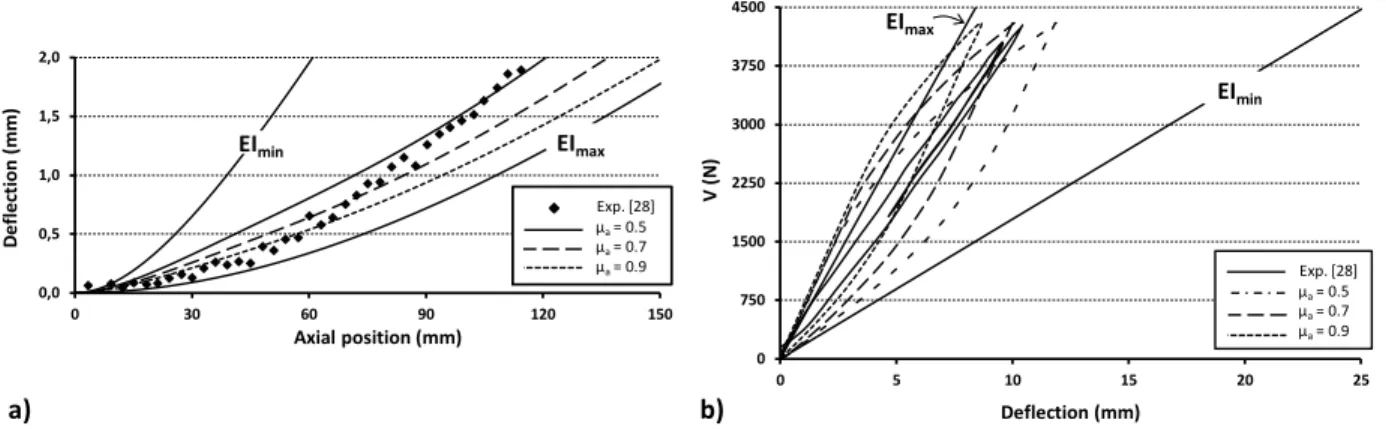
Fig. 15a) particularly shows that increasing μa reduces the deflection slope. Fig. 15b) shows that the high μa and low V
420
combinations lead to higher bending rigidities (EI) than the theoretical upper limit EImax. In reality, the same response may
421
have been produced with the introduction of a higher tangential stiffness (Kt). In other words, a change in the inter-layer
422
friction coefficient may generate a corresponding effect on the bending stiffness. 423
20 0,0 0,5 1,0 1,5 2,0 0 30 60 90 120 150 D e fle ct ion ( mm ) Axial position (mm) Exp. [28] μa= 0.5 μa= 0.7 μa= 0.9 EImax EImin 0 750 1500 2250 3000 3750 4500 0 5 10 15 20 25 V (N ) Deflection (mm) Exp. [28] μa= 0.5 μa= 0.7 μa= 0.9 EImax EImin b) a) 424
Fig. 15 - ACSR Cardinal (T = 40 kN and Vmax = 4.3 kN), (a) deflection and (b) load-deflection curve at the cable center (z = 0 mm) V
425
variations between 0 and Vmax with different values of μa
426 427
The experimental deflection curve shows that close to the V application point (z = 0 mm), the strand deformation 428
presents a lower gradient than at more distant points, suggesting therefore a reduction of the friction coefficient with an 429
augmentation of the distance from the V application point; for z between 0 and 60 mm, the response obtained with μa = 0.9
430
is closer to the measurements, whereas for the remaining part (z between 60 and 120 mm), μa = 0.5 offers a better
431
correspondence. Actually, the experimental result trend remains close to the theoretical approximation EImax up to a distance
432
of 45 mm from the V application point. On the other hand, at greater distances, the experimental deflection never reaches 433
the EImin prediction. In other words, the Papailiou results suggest that the friction behavior remains close to a no-slip
434
condition around the transversal load application point, and progresses toward sliding conditions, while never attaining a full 435
slip state. Since this behavior does dominate the response in the graphs of Fig. 8 (S32 steel cable), it may be assumed that it 436
is mainly controlled by a combination of elastic and plastic localized deformations of the aluminum wires. 437
The hysteresis curves in Fig. 15b indicate that higher values of μa lead to slightly reduced friction losses since more
438
contact points remain under stick conditions. This observation also advocates for high values of μa in the vicinity of the V
439
application. 440
Finally, this analysis indicates that the model should offer an improved precision with friction coefficients better reflecting 441
the variable inter-wire relative displacements along the strand axial position. 442
443
5.2 Variable adhesion friction coefficient effect 444
Considering the mechanical properties of ACSR aluminum wire, it may reasonably be assumed that the loads (P, Q) shown 445
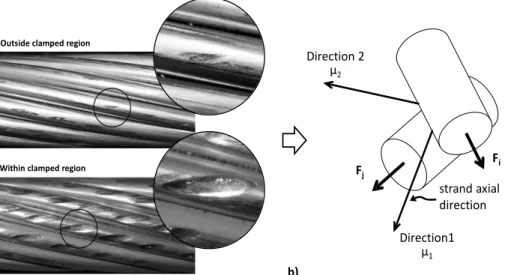
in Section 4 can generate wear and plastic deformations. Fig. 18a shows indentation marks observed on experimental 446
specimens of 19/54 ACSR Géant conductor, similar observations are reported by Azevedo et al. [32]. Altered wire surface 447
21 conditions have a direct effect on inter-wire contact. The influence of wire surface changes may be integrated into variable 448
friction coefficient values. However, predicting the complete distribution of μ along the strand remains an impractical 449
endeavor. The following section examines the response quality improvement resulting from a multi-level adhesion 450
coefficient of friction. 451
In order to force the quasi no-slip condition noted in the V load application point neighborhood and near the clamped 452
ends, a μa value of 0.7, equivalent to a static coefficient, is imposed at aluminum-aluminum and aluminum-steel radial
453
contacts over 100 mm (Lstick) from the V application point (z = 0 mm) and from the strand fixed extremities (z = 500 mm). On
454
the other hand, slip conditions are promoted with a value equivalent to a dynamic coefficient of friction μa = 0.3. This
455
coefficient is applied at the aluminum-aluminum and aluminum-steel radial contacts over four 50 mm strand segments (Lslip)
456
next to the no-slip zone. Fig. 16 shows the proposed μa variations zones. Unaffected strand zones maintain the original
457
coefficient of friction configuration (μa = 0.5 for aluminum-aluminum and aluminum-steel contacts). The steel-steel contact
458
coefficients of friction are fixed at μa = 0.3 throughout.
459 T T V L z y 2Lstick
Lslip Lslip Lslip Lstick
Lslip
Lstick
x
460
Fig. 16 - Two-level coefficient of friction model configuration
461 462
In addition, in order to extend the description of the multi-level coefficient concept, extreme values for μa of 0.9 and 0.1
463
are also evaluated in the stick and sliding zones of the aluminum-aluminum and aluminum-steel contacts. Fig. 17 reproduces 464
the result of Fig. 9 and adds the deflection and hysteresis predictions established for the two aforementioned configurations, 465 introducing variable μa. 466 b) 0,0 0,5 1,0 1,5 2,0 0 30 60 90 120 150 D ef le ct io n ( m m ) Axial position (mm) a) EImax EImin Exp. [28] μa= 0.5 μa= 0.5, μa,stick= 0.7, μa,slip= 0.3 μa= 0.5, μa,stick= 0.9, μa,slip= 0.1 0 750 1500 2250 3000 3750 4500 0 5 10 15 20 25 V ( N ) Deflection (mm) Exp. [28] μa= 0.5 μa= 0.5, μa,stick= 0.7, μa,slip= 0.3 μa= 0.5, μa,stick= 0.9, μa,slip= 0.1 EImax EImin 467
Fig. 17 - ACSR Cardinal (T = 40 kN and Vmax = 4.3 kN), (a) deflection and (b) load-deflection curve at the cable center (z = 0 mm) V
468
variation between 0 and Vmax considering multi-level μa
469 470
22 The curves in the chart of Fig. 17a) show some precision gains realized with the multi-level adhesion coefficient of 471
friction; the predicted deflection better represents experimental data. However, the approach does not significantly 472
influence the friction dissipation; even with the overemphasis brought in with the 0.9 and 0.1 coefficient values, the 473
numerical hysteresis curves presented in Fig. 17b) remain practically unchanged. Therefore, it must be concluded that the 474
multi-zone adhesion coefficient of friction shown in Fig. 16 is not sufficient to explain the experimental observations. 475
476
5.3 Orthogonal friction coefficient effect 477
The previous evaluations only considered the adhesion contribution to friction or μ = μa. The obtained results tend to
478
indicate that this approach is too simplistic, and that a more realistic formulation should incorporate the deformation 479
process. The coefficient of friction (μ) should hence be written as: μ = μa + μd, where μd represents the deformation
480
contribution. Fig. 18(a) shows typical local alterations of wire surfaces caused by contact loads. In addition to adhesion 481
phenomena described by μa, this type of plastic deformation may mechanically constrain the relative displacements of the
482
wires. However, since the proposed FE model does not account for wire cross-section alterations, the deformation 483
contribution cannot be directly integrated. On the other hand, the above μ formulation can easily compensate for this aspect 484
and embody this additional constraint via μd. In reality, the indentation marks generated at the contact points plausibly
485
promote inter-wire slip in a preferred direction. 486
The friction may be defined in orthogonal directions corresponding to the strand axial direction (Direction 1) and the 487
direction (Direction 2) resulting from the cross product between Direction 1 and the normal to the radial contact point (Fig. 488
18b). Direction 1 and Direction 2 do not aim at defining an exact representation of the local indentation mark orientation, 489
but rather, it is to provide a global representation of the strand assembly. The coefficients of friction μ1 and μ2 represent
490
Directions 1 and 2, respectively. These coefficients are expressed as μi = μai + μdi.
491
The expression of the coefficient of friction may be reduced to a unique function of μa: μi = μai(1+cdi), where the constant
492
cdi represents the deformation contribution. Moreover, considering μa2 = μa1, the relation between μ1 and μ2 may be defined
493
by the ratio μ2/μ1 = (1+cd2)/(1+cd1). As well, assuming that Direction 1 is controlled by adhesive bonds, cd1 may be set to zero.
494
The μ2/μ1 value is then reduced to (1 + cd2).
495
In the model, μ1 and μ2 are independent parameters. Hence, setting μ2 to zero would isolate the adhesion contribution,
496
whereas setting μ1 to zero would emphasize the friction caused by the deformations.
23 To illustrate the influence of the orthogonal friction concept, the following section re-evaluates the ACSR Cardinal
498
response when cd2 is set to 0, 4, 9 and 14, which leads to the corresponding μ2/μ1 ratios 1, 5, 10 and 15, respectively. Fig. 19
499
presents the simulation results established for these ratios when the aluminum-aluminum μa values are 0.5, 0.7 and 0.9. The
500
coefficients of friction at the steel-steel and steel-aluminum contacts were maintained at 0.3 and 0.5, respectively. 501 502 Fi Fj Direction 2 μ2 Direction1 μ1 strand axial direction Outside clamped region
a)
Within clamped region
b)
503
Fig. 18 - (a) Indentation marks at inter-wire contact interfaces between layers 3 and 4 of a 19/54 ACSR Géant after being submitted to an
504
axial tension of 20% RTS and (b) their interpretation with orthogonal friction coefficient concept
505 506
24 0 750 1500 2250 3000 3750 4500 0 5 10 15 20 25 V ( N ) Deflection (mm) 0,0 0,5 1,0 1,5 2,0 0 30 60 90 120 150 De fl e ct io n ( m m ) Axial position (mm) EImax EImin 0,0 0,5 1,0 1,5 2,0 0 30 60 90 120 150 D e fle ct io n (m m ) EImax EImin 0,0 0,5 1,0 1,5 2,0 0 30 60 90 120 150 D e fle ct io n (m m ) Exp. [28] μ2/μ1= 1 μ2/μ1= 5 μ2/μ1= 10 μ2/μ1= 15 EImax EImin 0 750 1500 2250 3000 3750 4500 0 5 10 15 20 25 V ( N) c) 0 750 1500 2250 3000 3750 4500 0 5 10 15 20 25 V ( N) Exp. [28] μ2/μ1= 5 μ2/μ1= 10 μ2/μ1= 15 a) b) EImin EImax EImin EImax EImin EImax 507
Fig. 19 - ACSR Cardinal (T = 40 kN and Vmax = 4.3kN), deflection (left) and load-deflection curves at the cable center (z = 0 mm) (right),
508
considering orthogonal friction coefficients with a) μa = 0.5, b) μa = 0.7 and c) μa = 0.9
509 510
The results shown in Fig. 19 indicate that the orthogonal concept influences the deflection behavior. Fig. 19b (μa = 0.7)
511
presents the best predictions. On the other hand, the hysteresis curves also given in Fig. 19 support the hypothesis of a 512
preferred inter-wire slip direction. Indeed, the introduction of an orthogonal friction model considerably reduces the 513
load/deflection hysteresis area, and the numerical results better compare with the reported experimental values. 514
The graphs in Fig. 19 show that the effects of the orthogonal model improve with μa augmentations: while Fig. 19(a) still
515
displays hysteresis areas larger and rigidities lower than measurements, Fig. 19(b) and (c) show responses closer to the 516
experimental data. 517
The results of Fig. 19 may be summarized as follows: 518
1. Increasing μa (or μ1) increases the Bending Stiffness (EI), and decreases the Hysteresis Area (HA);