0099-2240/10/$12.00
doi:10.1128/AEM.02864-09
Copyright © 2010, American Society for Microbiology. All Rights Reserved.
Vertical Distribution of Ammonia-Oxidizing Crenarchaeota and
Methanogens in the Epipelagic Waters of Lake Kivu
(Rwanda-Democratic Republic of the Congo)
䌤
†
Marc Lliro
´s,
1Frederic Gich,
1Anna Plasencia,
1Jean-Christophe Auguet,
3Franc
¸ois Darchambeau,
2‡
Emilio O. Casamayor,
3Jean-Pierre Descy,
2and Carles Borrego
1*
Group of Molecular Microbial Ecology, Institute of Aquatic Ecology, University of Girona, Campus Montilivi, E-17071 Girona,
Spain
1; Laboratory of Freshwater Ecology-URBO, Faculte
´s Universitaires Notre-Dame de la Paix, University of Namur,
B-5000 Namur, Belgium
2; and Group of Limnology, Department of Continental Ecology, Centre d’Estudis Avanc
¸ats de
Blanes-CSIC, Acce
´s Cala Sant Francesc 14, E-17300 Blanes, Spain
3Received 27 November 2009/Accepted 17 August 2010
Four stratified basins in Lake Kivu (Rwanda-Democratic Republic of the Congo) were sampled in March
2007 to investigate the abundance, distribution, and potential biogeochemical role of planktonic archaea. We
used fluorescence in situ hybridization with catalyzed-reported deposition microscopic counts (CARD-FISH),
denaturing gradient gel electrophoresis (DGGE) fingerprinting, and quantitative PCR (qPCR) of signature
genes for ammonia-oxidizing archaea (16S rRNA for marine Crenarchaeota group 1.1a [MCG1] and ammonia
monooxygenase subunit A [amoA]). Abundance of archaea ranged from 1 to 4.5% of total DAPI (4
ⴕ,6-diamidino-2-phenylindole) counts with maximal concentrations at the oxic-anoxic transition zone (
⬃50-m
depth). Phylogenetic analysis of the archaeal planktonic community revealed a higher level of richness of
crenarchaeal 16S rRNA gene sequences (21 of the 28 operational taxonomic units [OTUs] identified [75%])
over euryarchaeotal ones (7 OTUs). Sequences affiliated with the kingdom Euryarchaeota were mainly
recov-ered from the anoxic water compartment and mostly grouped into methanogenic lineages (Methanosarcinales
and Methanocellales). In turn, crenarchaeal phylotypes were recovered throughout the sampled epipelagic
waters (0- to 100-m depth), with clear phylogenetic segregation along the transition from oxic to anoxic water
masses. Thus, whereas in the anoxic hypolimnion crenarchaeotal OTUs were mainly assigned to the
miscel-laneous crenarchaeotic group, the OTUs from the oxic-anoxic transition and above belonged to Crenarchaeota
groups 1.1a and 1.1b, two lineages containing most of the ammonia-oxidizing representatives known so far. The
concomitant vertical distribution of both nitrite and nitrate maxima and the copy numbers of both MCG1
16S rRNA and amoA genes suggest the potential implication of Crenarchaeota in nitrification processes
occurring in the epilimnetic waters of the lake.
Lake Kivu is a meromictic lake located in the volcanic region
between Rwanda and the Democratic Republic of the Congo
and is the smallest of the African Great Rift Lakes. The
mon-imolimnion of the lake contains a large amount of dissolved
CO
2and methane (300 km
3and 60 km
3, respectively) as a
result of geological and biological activity (24, 73, 85). This
massive accumulation converts Lake Kivu into one of the
larg-est methane reservoirs in the world and into a unique
ecosys-tem for geomicrobiologists interested in the methane cycle and
in risk assessment and management (34, 71, 72, 85).
Compre-hensive studies on the diversity and activity of planktonic
pop-ulations of both large and small eukaryotes and their trophic
interplay operating in the epilimnetic waters of the lake are
available (33, 39, 49). Recent surveys have also provided a
deeper insight into the seasonal variations of photosynthetic
and heterotrophic picoplankton (67, 68), although very few
data exist on the composition, diversity, and spatial distribution
of bacterial and archaeal communities. In this regard, the
stud-ies conducted so far of the bacterial/archaeal ecology in Lake
Kivu have been mostly focused on the implications on the
methane cycle (34, 73), but none have addressed the presence
and distribution of additional archaeal populations in the lake.
During the last few years, microbial ecology studies carried
out in a wide variety of habitats have provided compelling
evidence of the ubiquity and abundance of mesophilic archaea
(4, 10, 13, 19). Moreover, the discovery of genes encoding
enzymes related to nitrification and denitrification in archaeal
metagenomes from soil and marine waters (29, 86, 88) and the
isolation of the first autotrophic archaeal nitrifier (40)
demon-strated that some archaeal groups actively participate in the
carbon and nitrogen cycles (56, 64, 69). In relation to aquatic
environments, genetic markers of ammonia-oxidizing archaea
(AOA) of the marine Crenarchaeota group 1.1a (MCG1) have
consistently been found in water masses of several oceanic
regions (6, 14, 17, 26, 28, 30, 37, 42, 51, 52, 89), estuaries (5, 9,
26, 53), coastal aquifers (26, 66), and stratified marine basins
(15, 41, 44). Although less information is available for
fresh-water habitats, recent studies carried out in oligotrophic
high-* Corresponding author. Mailing address: Group of Molecular
Mi-crobial Ecology, Institute of Aquatic Ecology, University of Girona,
Campus Montilivi, E-17071 Girona, Spain. Phone: 34 972 418177. Fax:
34 972 418150. E-mail: [email protected].
‡ Present address: Chemical Oceanography Unit, De
´partement
d’Astrophysique, Ge
´ophysique et Oce
´anographie, Universite
´ de Lie
`ge,
Alle
´e du 6 Aou
ˆt, 17, B-4000 Lie
`ge, Belgium.
† Supplemental material for this article may be found at http://aem
.asm.org/.
䌤
Published ahead of print on 27 August 2010.
mountain and arctic lakes showed an important contribution of
AOA in both the planktonic and the neustonic microbial
as-semblages (4, 61, 89).
The oligotrophic nature of Lake Kivu and the presence of a
well-defined redoxcline may provide an optimal niche for the
development of autotrophic AOA populations. Unfortunately,
no studies of the involvement of microbial planktonic
popula-tions in cycling nitrogen in the lake exist, and only data on the
distribution of dissolved inorganic nitrogen species in relation
to phytoplankton ecology (67, 68) and nutrient loading are
available (54, 58). Our goals here were to ascertain whether or
not archaeal populations other than methane-related lineages
were relevant components of the planktonic microbial
commu-nity and to determine whether the redox gradient imposed by
the oxic-anoxic interphase acts as a threshold for their vertical
distribution in epipelagic waters (0- to 100-m depth). To
fur-ther explore the presence and potential activity of nitrifying
archaeal populations in Lake Kivu, samples were analyzed for
the abundance and vertical distribution of signature genes for
these microorganisms, i.e., the 16S rRNA of MCG1 and the
ammonia monooxygenase subunit A (amoA) gene by
quanti-tative PCR.
MATERIALS AND METHODS
Study site, sampling, and chemical analysis.Lake Kivu is located between
Rwanda and the Democratic Republic of the Congo (2°S, 29°E; Fig. 1) at 1,463
m above sea level. It has a surface area of 2,370 km2
and a total volume of 580
km3. The lake is a deep (maximum depth, 489 m) meromictic and oligotrophic
body of water with step increases in temperature and salinity gradients. Further details on the hydrology, physicochemistry, and biology of the lake are published elsewhere (33, 67, 68).
Water samples were collected during a sampling campaign conducted during the rainy season (March 2007). The sampling cruise tried to cover the spatial variability within the lake, and four sites were sampled: northern (NB), eastern (EB), and southern (SB) basins and Bukavu Bay (BB) (see Fig. 1 for the exact locations of the sampling sites). Temperature, conductivity, pH, and oxygen were measured in situ with a YSI 6600 V2 multiparametric sonde (Yellow Spring Instruments). Water samples for physicochemical and biological analyses were collected using a 5-liter vertical VanDorn bottle and stored in 4-liter plastic containers that were stored at 4°C in a portable icebox until further processing. Ammonia concentrations were determined using the dichloroisocyanurate-salic-ylate-nitroprussiate colorimetric method (76). Nitrite concentrations were deter-mined by the sulfanilamide coloration method (2). Nitrate concentrations were determined after cadmium reduction to nitrite and quantified under this form following the nitrite determination procedure (2, 35). The detection limits for
these methods were 0.3, 0.03, and 0.15M for NH4⫹, NO2⫺, and NO3⫺,
respec-tively.
Prokaryotic cell counts.Water samples (100 ml) were fixed in situ with
para-formaldehyde (PFA) (final concentration, 2% [wt/vol]) and stored overnight at 4°C in the dark. Water samples were passed through white 0.22-m-pore-size polycarbonate filters (25-mm filter diameter; Millipore, Eschborn, Germany), washed twice with phosphate-buffered saline (PBS) buffer (pH 7.6), dried, and
stored at⫺20°C until analysis. Total cell numbers were determined by
epifluo-rescence counting after staining with 4⬘,6-diamidino-2-phenylindole (DAPI) as previously described (60). Bacteria and Archaea were enumerated by fluores-cence in situ hybridization with catalyzed-reported deposition (CARD-FISH) using specific probes EUB338 and ARCH915 (Table 1), using a modification of the protocol described by Teira and coworkers (82) to improve cell wall perme-abilization. Cell losses during permeabilization and filter processing were mini-mized by dipping the filters in low-gelling-point agarose (0.1% [wt/vol], in Milli-Q water) and drying them upside down on a glass petri dish at 37°C. The filters were subsequently dehydrated in 95% ethanol (vol/vol) and allowed to air dry. To inhibit potentially present intracellular peroxidases, filters were incu-bated with 0.01 M HCl at room temperature (RT) for 20 min, washed with 1⫻ PBS buffer and Milli-Q water, and dried. For cell wall permeabilization, filters
were incubated with lysozyme solution (10 mg ml⫺1in 0.05 M EDTA, and 0.1 M
Tris-HCl at pH 8.0; Fluka) for 30 min at 37°C and, afterwards, gently rinsed with
Milli-Q water and absolute ethanol. Filters were then incubated with proteinase
K (0.25 U mg⫺1, concentration, 0.25 mg ml⫺1in 0.05 M EDTA and 0.1 M
Tris-HCl [pH 8.0]; Roche) for 5 min at 50°C and washed with Milli-Q water. Subsequently, the filters were incubated with 4% PFA (wt/vol, final concentra-tion) for 5 min at room temperature, washed with Milli-Q water, dehydrated with absolute ethanol, and air dried. Probe hybridization, washing, signal amplifica-tion, and filter preparation were performed as described previously (82), except that 55% (vol/vol) formamide was used for both probes (Table 1). Finally, filter sections were air dried, embedded in Citifluor antifading solution (Citifluor Ltd., London, United Kingdom), and examined under an Axioskop epifluorescence microscope (Zeiss, Germany) equipped with a 50-W Hg bulb and appropriate filter sets for DAPI and Alexa-Fluor 488. Triplicate filters were processed inde-pendently for each depth. At least 40 microscopic fields were randomly selected to count DAPI-stained and probe-hybridized cells.
DNA extraction, PCR amplification, and DGGE fingerprinting.Water
sam-ples (0.5 to 1.0 l) for DNA extraction were first passed through 5.0-m-pore-size, 47-mm-diameter polycarbonate filters (ISOPORE, Millipore, MA) to remove particulate debris as well as large protozoa, which are potential hosts for endo-symbiotic archaea (i.e., methanogens) (11). Eluents were then passed through 0.22-m-pore-size, 47-mm-diameter polycarbonate filters (ISOPORE, Millipore, MA) to retain free-living prokaryotes. Total nucleic acids were extracted using a combination of enzymatic cell lysis and cetyltrimethyl ammonium bromide (CTAB) extraction protocol as previously described (45). Dry DNA pellets were
finally rehydrated in 50l of 10 mM Tris-HCl buffer (pH 7.4) and further
purified using Centricon cleaning columns (Millipore, MA). DNA concentration and purity were then determined in a Nanodrop ND-1000 UV-Vis
spectropho-tometer (Nanodrop, DE). Purified DNA extracts were stored at⫺80°C until use.
Amplification of archaeal 16S rRNA gene (ca. 600 bp) was performed using the universal primer combination 21F-958R (19) followed by nested reactions using two primer pair combinations specifically targeting the domain Archaea and the kingdom Crenarchaeota (Table 1). Amplification of the amoA gene,
FIG. 1. Geographical location of Lake Kivu and the four sampling
stations: northern (NB), southern (SB), eastern (EB) and Bukavu Bay
(BB) basins. The geographical GPS (global positioning system)
coor-dinates for each sampling site are indicated. Basins are named as by
Sarmento et al. (67, 68).
which encodes the archaeal ammonium monooxygenase subunit A, was per-formed as described by Francis and coworkers (26). PCR conditions used for amplification of both genes are listed in Table 1. Fingerprinting analyses of the archaea and crenarchaeota planktonic assemblages, as well as of the archaeal
amoA gene fragments, were carried out by denaturing gradient gel
electrophore-sis (DGGE) (55) in an INGENY phorU-2 DGGE system (Ingeny International BV, Netherlands). Between 500 and 1,000 ng of PCR product was loaded onto
6.0% polyacrylamide gels and run with 1⫻ TAE buffer using 20 to 80% (16S
rRNA) and 20 to 70% (amoA) linear gradients of urea and formamide (100% denaturant agent contains 7 M urea and 40% deionized formamide). A DGGE ladder composed of a mixture of known small-subunit (SSU) rRNA gene frag-ments was loaded in all gels to allow intergel comparison of band migration. Electrophoreses were performed at 60°C and at a constant voltage of 120 V for 17 h. After electrophoresis, gels were stained for 30 min with 1⫻ SYBR gold
nucleic acid stain (Molecular Probes Inc.) in 1⫻ TAE buffer, rinsed, and
visu-alized under UV radiation using a GelPrinter system (TDI, Spain). Discrete and
clear bands were excised from the gels and rehydrated overnight in 50l of 10
mM Tris-HCl buffer (pH 7.4). DNA was eluted after incubation at 65°C for 3 h and amplified using the corresponding primer pairs (without GC clamp) and PCR conditions as cited above (Table 1), but the number of PCR cycles was decreased to 20. PCR products without further treatment were sequenced on both strands using external facilities (Macrogen Inc., Seoul, South Korea).
Gel image analysis.Digital images of acrylamide gels were analyzed using the
GELCompar II v.5.1 software package (Applied Maths BVBA, Sint-Martens-Latem, Belgium). Lanes were manually defined, and band positions were iden-tified from corrected intensity plots. Comparison between samples loaded on different DGGE gels was completed using normalized values derived from known standards. A binary matrix showing the presence/absence of identified bands was constructed for all gel lanes. Further, a similarity matrix based on the Dice coefficient was calculated, and samples were clustered according to the unweighted-pair group average linkage method (UPGMA) algorithm using a tolerance position value of 2%.
Phylogenetic analysis.All representative archaeal 16S rRNA sequences from
Lake Kivu (84 in total) were analyzed for the presence of chimeras using the Bellerophon tool available at the GreenGenes website (http://greengenes.lbl .gov/) (22). Sequences were then aligned in mothur (http://www.mothur.org) (70) using the SILVA archaeal database as reference alignment. The same program was used to calculate a neighbor-joining (NJ) (65) distance matrix using the Jukes-Cantor (JC) correction, which was then used to assign sequences to op-erational taxonomic units (OTUs) defined at a 97% cutoff using the furthest-neighbor algorithm. Representative sequences for each OTU were identified using the implemented tool in mothur.
The phylogenetic tree was constructed after importing the alignment into the ARB software package (48) loaded with the SILVA 16S rRNA-ARB-compatible database (SSURef-102, February 2010; http://www.arb-silva.de) and checked manually. An archaeal backbone tree was built with reference sequences of at least 900 bp in length using the NJ algorithm and JC-corrected distances. The aligned sequences from Lake Kivu were then added to this tree using the “parsimony quick add marked” tool, thereby maintaining the overall tree topol-ogy. Bootstrap support (1,000 replicates) was calculated in PHYLIP (25) using JC evolutionary distances and the NJ method. Cluster names and grouping used in this study were based on the cluster definitions for Euryarchaeota and
Cren-archaeota proposed by Takai and Horikoshi (77) and DeLong (20), respectively.
Environmental sequences of archaeal amoA genes were obtained from public databases and aligned with those retrieved in DGGE gels from Lake Kivu using MEGA4 (80). The phylogenetic analysis was inferred using the NJ method, and evolutionary distances were computed by JC with 1,000 bootstrap replicates.
Quantitative PCR (qPCR).Gene copy numbers of 16S rRNA from MCG1 and
the archaeal amoA gene were determined by quantitative real-time PCR ampli-fication from DNA extracts obtained from samples collected at the eastern and southern basins of Lake Kivu. All qPCR assays were performed in a 7500 real-time PCR system (Applied Biosystems) using the primers and conditions listed in Table 1. All reactions were carried out in MicroAmp optical 96-well reaction plates covered with optical caps (Applied Biosystems). The reaction
mixture (20l) contained 10 l of iQ SYBR green supermix (Bio-Rad, Hercules,
CA), 10M corresponding primers (Table 1), molecular biology-grade water
(Eppendorf), and 9l of template DNA (36 ng). Data were collected and
analyzed with the 7500 SDS system software version 1.4 (Applied Biosystems). All qPCRs consisted of an initial denaturing step for 4 min at 95°C, followed by 60 cycles of the appropriate quantitative PCR program (Table 1). The fluores-cence signal was read in each cycle after the elongation step at 78°C over a period of 32 s to ensure stringent product quantification. All reactions were performed
in triplicate, with standard curves spanning from 101
to 107 and from 102 to 108
TABLE
1.
PCR
and
qPCR
conditions,
archaeal
primers,
and
CARD-FISH
probes
used
in
this
work
Process Target Primer pair a CARD-FISH probe PCR conditions b Final probe concn (ng/ l) Reference(s) Cycles Denaturation Annealing Elongation °C min °C min °C min Endpoint PCR 16S rRNA gene First round Universal Archaea 21f/958r 30 94 1 5 6 1 72 2 1 9 Second round (nested) General Archaea PAIR a (ARC344f/ARC915r) 16 ⫹ 10 94 1 6 8 c /60 1 7 2 1.5 11 Freshwater Crenarchaeota PAIR b (ARC337f/ARC915r) 25 94 1 5 8 1 72 1.5 45 Functional gene Archaeal amoA Arch amoAf/amoAr 35 94 0.75 55 1 7 2 1 26 qPCR 16S rRNA gene Marine Crenarchaeota group 1 MCGI-391f/MCGI-554r 60 94 0.5 61 0.66 72 0.66 79 Functional gene Archaeal amoA AOA-amoA-f/AOA-amoA-r 60 94 0.5 59 0.66 72 0.66 89 CARD-FISH Eubacteria HRP-EUB338 0.28 1, 16 Archaea HRP-ARC915 0.84 75 a A GC-rich clamp was attached to the 5⬘ end of each forward primer used in all amplification reactions used to generate amplicons for DGGE analysis. b For endpoint PCR, the temperature was held at 94°C for 4 min before each run of cycles and kept at 72°C for 30 min after all cycles were completed to allow fin al template elongation. The CARD-FISH conditions were 55% formamide and 3 m M NaCl. c The program consisted of a touchdown protocol where the initial annealing temperature decreased 0.5°C each cycle during the first 16 cycles.for 16S rRNA and amoA genes, respectively. Standard curves were generated from serial dilutions of previously titrated suspensions of the desired genes (16S rRNA and amoA) amplified by conventional PCR from environmental clones (FN691587 for 16S rRNA and FN773417 for crenarchaeal amoA), purified (QIAquick; Qiagen), and quantified. Overall, average efficiencies for all quanti-fication reactions ranged from 84% for MCG1 to 88% for archaeal amoA with
R2values of⬎0.99. The specificity of reactions was confirmed by melting curve
analyses and by separating the obtained amplicons by agarose gel electrophoresis to identify unspecific PCR products such as primer dimers or gene fragments of unexpected length (data not shown).
Nucleotide sequence accession numbers.The 16S rRNA sequences obtained
in this study were deposited in the GenBank database under accession numbers EU921487 to EU921548 and FJ536696 to FJ536719. The amoA gene sequences were deposited under accession numbers EU921473 to EU921486 and FJ536694 to FJ536695.
RESULTS
Physicochemical characterization of the sampling stations.
The physicochemical depth profiles of the four sampled
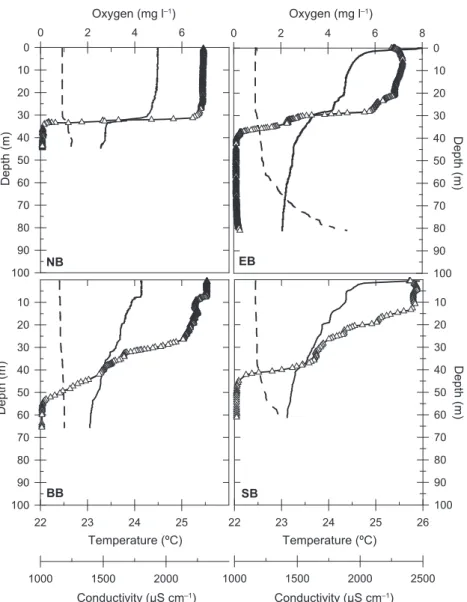
stations (Fig. 2) showed downward, stepwise oxic and
ther-mal stratification patterns characteristic of the rainy season
(67). The low-level mixing conditions during this season
allowed the establishment of a temporary stratification in
the epilimnion, which expands from the surface to a 35- to
65-m depth depending on the station. Below a 65-m depth,
permanently anoxic waters extend to the bottom of the lake
(489 m at its maximal depth). Two well-defined oxycline
patterns can be clearly distinguished between stations
lo-cated at the main basin of the lake (northern [NB] and
eastern [EB] basins) and those located at the southern,
more wind-protected, side of the lake (southern basin [SB]
and Bukavu Bay [BB]). Whereas the former basins (NB and
EB) showed a steep oxycline between 30 and 40 m depth,
the oxygen concentration profiles in the latter basins (SB
and BB) decreased more smoothly, with an oxycline
extend-ing from 10 to 50 to 60 m depth. The fact that deep waters
of BB are isolated from SB by the presence of a shallow sill
(Fig. 1) and the lack of any chemical stratification and its
shallower depth (90 m) lead to less gas accumulation in
Bukavu Bay than in other basins (81).
FIG. 2. Depth profiles of temperature (solid line), conductivity (dashed line), and dissolved oxygen (open triangles) in the different basins on
the day of sampling.
Prokaryotic community composition determined by
CARD-FISH.
Total cell numbers determined by DAPI staining ranged
from (1.80
⫾ 0.39) ⫻ 10
5to (9.26
⫾ 5.80) ⫻ 10
5cells ml
⫺1and
from (8.90
⫾ 0.58) ⫻ 10
5to (2.57
⫾ 0.77) ⫻ 10
6cells ml
⫺1in
NB and BB, respectively (Fig. 3, right panels). These
abun-dances are within the same range of those previously reported
in the lake by Sarmento and coworkers using flow cytometry
(68).
The specific contribution of members of the Bacteria and the
Archaea to the microbial planktonic community was estimated
using specific CARD-FISH probes for both domains (Table 1).
The sum of abundances of positive hybridized cells (Bacteria
plus Archaea) ranged from 52% to 96% and from 64% to 94%
of total cell numbers determined by DAPI staining in NB and
BB, respectively. These values agree with those reported for
other environments (3, 82). In both basins, Bacteria were
dom-inant, with relative abundances ranging from 51.4
⫾ 15.8% to
95.7
⫾ 3.5% and from 63.1 ⫾ 10.1% to 93.2 ⫾ 9.5% of total
DAPI-stained cells in NB and BB, respectively (Fig. 3, left
panels). The relative contribution of archaea to total cell
num-bers ranged from 0.3
⫾ 0.1% to 4.3 ⫾ 2.2% and from 0.6 ⫾
0.1% to 4.5
⫾ 1.7% in NB and BB, respectively, with higher
values at the oxic-anoxic boundary layer (
⬃40-m depth).
Richness and phylogenetic diversity of the archaeal
plank-tonic community.
To recover the maximal archaeal richness,
two primer combinations that allowed amplification of
mem-bers of the domain Archaea (PAIRa) and the kingdom
Cren-archaeota (PAIRb) were applied (Table 1). Despite the
selec-tivity of both primer combinations and the use of previously
optimized PCR protocols (45), amplicons suitable to further
DGGE analyses were obtained only after nested reactions.
DGGE fingerprints of these PCR products showed great
sim-ilarities for all basins regardless of the primer pair applied (see
Fig. S1 and S2 in the supplemental material). The use of an
internal DGGE ladder allowed the correction of minor
differ-ences in band migration and the proper comparison of
finger-prints from the different basins.
The phylogenetic identification of the recovered sequences
revealed remarkable aspects of the structure of the planktonic
archaeal assemblage. Most of the sequences retrieved from all
basins and sampling depths were detected using both primer
combinations. This result indicated that no substantial biases
were introduced by the primer pair used and that the
differ-ences in the archaeal assemblage above and below the
oxic-anoxic transition were consistent throughout the lake. Some
bands that halted at different positions in the gels resulted in
almost identical sequences (
ⱖ98% similarity, e.g., aK1
[EU921507] [see Table S1 in the supplemental material for
band codes and accession numbers], aK2 [EU921487], and
aK9 [EU921491] in Fig. S1 in the supplemental material or
bK1 [EU921497], bK2 [EU921512], bK3 [EU921498] and bK4
[EU921499] in Fig. S2 in the supplemental material), and they
were accordingly ascribed to the same OTU (based on a 97%
cutoff). This anomaly has previously been observed by other
authors when profiling microbial communities by DGGE and
is related to either variable melting behaviors or multiple
ri-bosomal gene copies in a single organism (12).
From all samples, we recovered 28 unique OTUs from 84
16S rRNA gene sequences. Five out of the seven OTUs
aligned to Euryarchaeota were assigned to methanogenic
lin-eages (Methanosarcinales [OTUs 1 to 4] and Methanocellales
[OTU-5]) (Fig. 4). Some sequences within these OTUs were
unexpectedly recovered from oxic layers (see Fig. S1 and Table
S1 in the supplemental material). The remaining two OTUs
were assigned to Thermoplasmata (OTU-6) and to deep
hy-drothermal vent euryarchaeotic group II (DHVE-5) (OTU-7)
(77).
OTUs belonging to Crenarchaeota (21 in total) were
as-signed to different lineages with a clear segregation above and
below the oxic-anoxic transition. Sequences recovered from
the epilimnion and the oxic-anoxic interphase mainly belonged
to Crenarchaeota group 1.1a and grouped into a single OTU
(OTU-8). The 37 sequences within this OTU showed
similarities ranging from 94.9% to 96.2% to “Candidatus
Ni-trosopumilus maritimus,” the unique member of marine AOA
isolated to date (40). The rest of the sequences recovered from
the oxic water compartment affiliated with Crenarchaeota
group 1.1.b and were distributed into 11 OTUs (OTUs 9 to 19).
The remaining sequences belonged to crenarchaeal lineages
containing mesophilic representatives from diverse origins,
such as group 1.2 (also named C3 by DeLong and Pace [21];
OTU-20 and -21), group 1.3 (also referred to as the
miscella-neous crenarchaeotic group [MCG] by Inagaki and coworkers
FIG. 3. Relative abundances of Bacteria and Archaea obtained
af-ter CARD-FISH counts (left) and total cell numbers (DAPI staining,
right) in northern basin (NB) and Bukavu Bay (BB). Error bars show
the standard deviations from results for triplicate filters (see Materials
and Methods for details).
[32]; OTUs 22 to 27), and the terrestrial MCG (OTU-28 [78])
(Fig. 4 and Tables S1 and S2 in the supplemental material).
Vertical distribution and abundance of ammonia-oxidizing
crenarchaeota and diversity of amoA genes.
DGGE
finger-printing of the archaeal amoA gene was carried out to resolve
its phylogenetic richness along the vertical profile of the
sam-pled stations. Identical fingerprints were obtained for samples
from all basins; these fingerprints revealed a four-band pattern
that was especially intense at those depths where distinct
max-ima of nitrite, nitrate, MCG1 16S rRNA, and amoA genes were
measured (Fig. 5). The comparison of amoA nucleotide
se-quences obtained from all bands revealed a high similarity
between them (99.9 to 100% of sequence identity). Similar
banding patterns and similarity indices for amoA archaeal
se-FIG. 4. Neighbor-joining phylogenetic tree generated by the ARB software package showing the affiliation of the OTUs retrieved from Lake
Kivu (in bold). Bootstrap support values of
⬎50% (1,000 replicates) are shown. The scale bar indicates 10% estimated sequence divergence. OTU
identification numbers (OTU ID) correspond to the same numbers shown in Tables 1 and 2 in the supplemental material. Sequences after OTU
ID correspond to the representative sequence for each OTU obtained with mothur (see Materials and Methods for details). Sequences are named
according to the primer used (a or b for primer PAIRa or PAIRb, respectively), the basin (K for Kibuye [eastern basin], I for Ishungu [southern
basin], G for Goma [northern basin], and B for Bukavu [Bukavu Bay]), and the band number for each basin (see Fig. S1 and S2 in the supplemental
material).
quences were found by Herfort et al. (30) in the North Sea.
Further comparison with amoA genes from cultivated AOA
representatives gave similarity values that ranged from 71%
(for both “Candidatus Nitrososphaera gargensis” and
“Candi-datus Nitrosocaldus yellowstonii”) to 88.3% (“Candi“Candi-datus
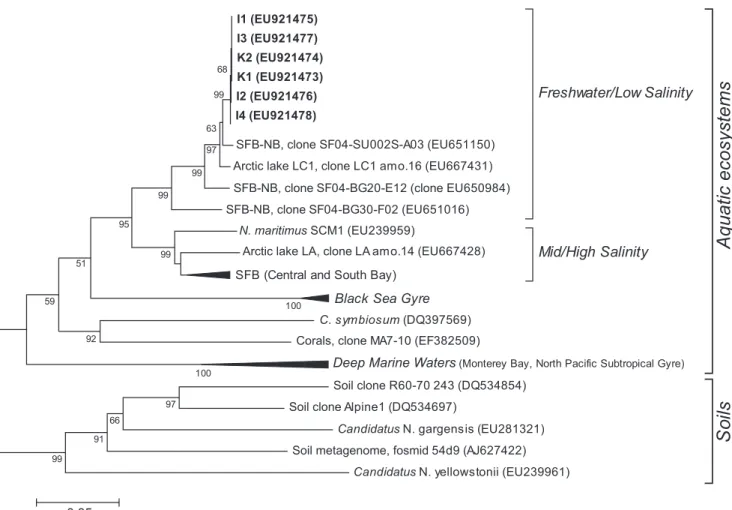
Ni-trosopumilus maritimus”). The phylogenetic analysis carried
out using the amoA sequences from Lake Kivu and others from
public databases grouped the former in a distinct subcluster
within the freshwater clade previously defined by Francis and
coworkers (26) and clearly separated the Lake Kivu samples
from sequences from both marine and terrestrial environments
(Fig. 6).
After the identification of signature genes for AOA in
DGGE profiles, qPCR was used to determine gene copy
num-bers of 16S rRNA-MCG1 and archaeal amoA to resolve their
vertical distribution and abundance in relation to nitrite and
FIG. 5. Vertical distribution of ammonium, nitrate, and nitrite (left panels), gene abundance (MCG1 16S rRNA and crenarchaeal amoA)
(middle panels), and DGGE fingerprints of amoA gene fragments (right panels) in the water column of eastern (EB, upper) and southern (SB,
bottom) basins of Lake Kivu. Identical amoA fingerprints were obtained with samples collected from NB and BB stations (data not shown). Bands
were named using the code for the corresponding basin (K for Kibuye [eastern basin, EB] and I for Ishungu [southern basin, SB]) and numbered
sequentially from top to bottom of the gradient. *, unspecific products. Nitrite was undetectable in all depths from the eastern basin.
nitrate profiles available for stations EB and SB. The
quanti-tative distribution of both genes varied with depth and with
highest copy numbers in the oxycline (from 30 to 50 m in
station EB and from 40 to 50 m in station SB) (Fig. 5). This
distribution was concomitant with that found for nitrite and
nitrate, which showed distinct maxima at these depths (Fig. 5).
DISCUSSION
The contribution of archaea to planktonic microbial
assem-blages in stratified freshwater lakes is variable, but reported
values are usually lower than those measured for marine
en-vironments (10). Although obtained by a different
method-ological approach, archaeal abundance in neighboring Lake
Victoria reached 5.9% of the total nucleic acids (38). Similar
values (between 1 and 7% of DAPI-stained cells) were
ob-tained by FISH and CARD-FISH in different freshwater lakes
(36, 59), although recent studies carried out in high mountain
lakes reported abundances of up to 22% in Crater Lake (87)
and 37% in Lake Llebreta (4). In stratified marine
environ-ments such as the Cariaco Basin and the Black Sea, the
ar-chaeal planktonic fraction ranged from 1% to 9% and from
10% to 30% of total DAPI counts, respectively, showing
imal abundances at the redoxcline coinciding with depth
max-ima of nitrite and nitrate (15, 41, 44). Similar distribution
patterns have also been reported by Pouliot and coworkers
(61) in two meromictic arctic lakes. Based on this prior
re-search, the distribution and relative abundance (0.3% to 4.5%
of total DAPI counts) of planktonic archaea in Lake Kivu
agree with data available for other freshwater environments. It
should be noted, however, that extensive studies are needed to
ascertain if variations in environmental conditions between the
rainy and dry seasons may affect the distribution and
abun-dance of the planktonic archaeal community, as has been
de-scribed for other microbial populations thriving in Lake Kivu
(23, 67, 68).
The phylogenetic structure of the archaeal assemblage in
Lake Kivu was fairly homogeneous in all sampling basins, with
a clear phylogenetic segregation imposed by the oxic-anoxic
transition (see Fig. S3 in the supplemental material).
Se-quences from the anoxic water compartment mainly affiliated
with the highly diverse miscellaneous crenarchaeotic group
(MCG) (32) and with methanogenic lineages. The MCG
ar-chaea are considered cosmopolitan (83) but are frequently
found in anoxic habitats such as deep subsurface marine
sed-iments (7) and hypolimnetic waters of sulfurous mesotrophic
lakes (45). Current evidence suggests that some members of
Freshwater/Low Salinity
N. maritimus SCM1 (EU239959)
Mid/High Salinity
C. symbiosum (DQ397569)
Corals, clone MA7-10 (EF382509)
Soil clone R60-70 243 (DQ534854)
Soil clone Alpine1 (DQ534697)
Candidatus N. gargensis (EU281321)
Soil metagenome, fosmid 54d9 (AJ627422)
S
o
ils
Candidatus N. yellowstonii (EU239961)
I1 (EU921475)
I3 (EU921477)
K2 (EU921474)
K1 (EU921473)
I2 (EU921476)
I4 (EU921478)
SFB-NB, clone SF04-SU002S-A03 (EU651150)
Arctic lake LC1, clone LC1 amo.16 (EU667431)
SFB-NB, clone SF04-BG20-E12 (clone EU650984)
SFB-NB, clone SF04-BG30-F02 (EU651016)
Arctic lake LA, clone LA amo.14 (EU667428)
SFB (Central and South Bay)
Black Sea Gyre
Deep Marine Waters
(Monterey Bay, North Pacific Subtropical Gyre)100 97 100 66 91 99 92 59 51 99 95 99 99 97 63 99 68
0.05
Aquatic ecosystems
FIG. 6. Neighbor-joining phylogenetic tree for amoA sequences constructed using Tamura-Nei-corrected distances with a bootstrap value of
1,000. Bootstrap values higher than 50% are shown. Wedge sizes are proportional to sequences condensed on them. Brackets highlight
environmental clusters. The scale bar indicates a 5% sequence dissimilarity.
the MCG lineage may obtain energy from the anaerobic
oxi-dation of methane (7, 83), a hypothesis that fits with the
prev-alent physicochemical conditions in the monimolimnion of
Lake Kivu. OTUs assigned to methanogenic lineages grouped
with either acetoclastic (identity values of 97.4% and 95.8%
with Methanosaeta concilii [OTU-1 and OTU-2, respectively]
and uncultured Methanosarcinales [OTU-3 and OUT-4]) or
hydrogenotrophic (95.9% identity of OTU-5 to Methanocellula
paludicola) representatives, agreeing both with the biological
origin of methane in the lake and with the methanogenic
ar-chaeal groups commonly found in other stratified lakes (43).
The recovery of a few sequences related to methanogens from
oxygenated water layers (bands aK3, aI3, and aB1 in Fig. S1 in
the supplemental material) is, however, not in accordance with
the strictly anaerobic metabolism assumed for these
microor-ganisms. The oxygen tolerance of some members of the
Meth-anosaeta cluster (31) or the occurrence of water-mixing
pro-cesses that transported microorganisms from the upper part of
the monimolimnion to shallow depths might explain these
find-ings.
At the oxic-anoxic interphase and above, almost all the
re-covered sequences grouped within archaeal lineages
contain-ing ammonia-oxidizcontain-ing representatives, i.e., Crenarchaeota
group 1.1a and group 1.1b (64). Whereas all sequences
affili-ated to the former were assigned to a single OTU (OTU-8)
related to the nitrifying marine archaeon “Candidatus
Ni-trosopumilus maritimus” (Fig. 4), those related to group 1.1b
were distributed in 11 OTUs. Since this lineage is mainly
com-posed of crenarchaeal phylotypes recovered from soil (8, 57),
the high level of richness found in Lake Kivu for group 1.1b
raises the question of whether these phylotypes were
indige-nous from the plankton or were introduced to the lake by
surface runoff. The fact that most of the group 1.1b-related
sequences were recovered from the southern basin and
partic-ularly Bukavu Bay, which are basins partly isolated from the
main lake by sills of different depths (18, 81) and receive high
water inflows by rivers and subaquatic sources (18, 54, 72),
points to a terrestrial origin of the detected phylotypes. On the
other hand, the close affiliation of some of the OTUs within
Crenarchaeota group 1.1b with archaeal sequences potentially
involved in ammonia oxidation in soils (e.g., 98.8% identity of
OTU-16 to fosmid soil clone 54d9 [86]) is relevant. In any case,
all archaeal amoA sequences recovered from Lake Kivu
com-posed a homogeneous subcluster within the freshwater clade
(Fig. 6) (26) and clearly separated from marine and terrestrial
sequences. This result suggests either that the phylotypes
as-signed to group 1.1b recovered from Lake Kivu are actually not
able to oxidize ammonia or that the amoA primers used (see
Table 1) (26) present some bias toward marine amoA
se-quences. The use of different primer pairs for amoA
finger-printing (26) and qPCR (89) and the different sensitivity of
both techniques toward less abundant phylotypes hinder the
proper comparison of the data. Thus, further investigation is
needed to resolve the actual nitrification capacity of the
soil-related phylotypes found in the water column of Lake Kivu,
especially considering that the most frequent phylotypes
re-trieved affiliated with the marine clade.
The increase in archaeal cell numbers at the oxycline (30 to
50 m depth) and the concomitant vertical distribution of
mo-lecular signatures of marine ammonia-oxidizing crenarchaeota
(MCG1 16S rRNA and amoA genes) and nitrate and nitrite
maxima at these depths agree with results found in other
aquatic environments (15, 41, 42, 52). Unfortunately, logistic
problems during field sampling did not permit the preservation
of the samples in such a way to allow further analysis of amoA
transcripts. Caution must therefore be exercised when
consid-ering the potential role of nitrifying crenarchaeota in Lake
Kivu. Recent studies demonstrate that “Candidatus
Ni-trosopumilus maritimus” strain SCM1 is adapted to extreme
nutrient limitation (50). According to these authors,
Nitros-opumilus-like AOA may benefit from this adaptation to
com-pete for nitrogen sources with ammonia-oxidizing bacteria,
heterotrophic bacterioplankton, and phytoplankton. Although
it is far from being resolved whether all the marine AOA are
specialized oligophiles like strain SCM1, the low ammonia
concentrations found in the epilimnetic waters of Lake Kivu
(
⬍0.1 M) (58) may provide an optimal niche for their growth.
In this regard, the low level of diversity of archaeal phylotypes
in the oxycline and the low level of richness of amoA genes
found suggest that freshwater members of the Crenarchaeota
group 1.1a compose a distinct population at these depths. The
identity values between the phylotype found in Lake Kivu
samples and the reference strain “Candidatus Nitrosopumilus
maritimus” (94.9% to 96.2%) point to a weak phylogenetic
relation probably linked to its freshwater origin. The
homoge-neous clustering of amoA sequences recovered from Lake Kivu
samples into the same freshwater clade provides further
sup-port to this hypothesis and to the idea of sequence clustering
according to habitat (6, 26, 61). In this regard, several authors
have recently shown that salinity is a major driver affecting
ar-chaeal distribution either at a local or at a global scale (4, 47, 53).
As stated above, the actual role of nitrifying crenarchaeota
in the nitrogen cycle of Lake Kivu is, however, far from being
resolved. Further activity and expression measurements are
needed to confirm the significance of autotrophic archaeal
nitrification in the lake and to determine the specific
contri-bution of Crenarchaeota group 1.1a and 1.1b in comparison to
bacterial nitrifiers. This topic is of special interest, especially
considering the small contribution of archaeal cells in the total
microbial planktonic assemblage measured in this work.
Al-though recent reports on the deep marine subsurface
bio-sphere highlighted that some important microbial activities can
be performed by a small, but very active, subset of community
members (27), further studies covering spatial and temporal
variations of AOA populations in Lake Kivu should be
ad-dressed to ascertain their dynamics and seasonal abundance.
Finally, the oligotrophic nature of neighboring lakes
Tangan-yika and Malawi offers potential habitats for the development
of AOA. The finding of crenarchaeotal membrane lipids in
sediments from these and other African lakes (62, 63, 74, 84)
supports this assumption. Further surveys focused on these
aspects will provide a better picture of the processes and
play-ers beneath the microbial cycling of nitrogen in large
oligotro-phic African lakes.
ACKNOWLEDGMENTS
We thank A. V. Borges and B. Delille from the University of Lie
`ge,
B. Leporcq from the University of Namur, and the local research
teams from the National University of Rwanda (Rwanda) and the
Institut Supe
´rieur Pe
´dagogique at Bukavu (Democratic Republic of
the Congo) for their helpful assistance during field sampling. We also
thank M. Lo
´pez, S. Heras, and L. Ban
˜eras from the University of
Girona for their help in molecular analyses and the critical reading of
the manuscript.
This study was funded through grant ARKI (CGL2007-29823-E) to
C. Borrego, coordinated project CRENYC (CGL2006-12058) to C.
Borrego and E. O. Casamayor from the Spanish Ministerio de Ciencia
e Innovacio
´n (MICINN), and project FNRS-CAKI to F.
Darcham-beau and J.-P. Descy. M. Lliro
´s and A. Plasencia are recipients of
Ph.D. student fellowships from the Spanish MEC and the Generalitat
de Catalunya, respectively, and J.-C. Auguet is a Juan de la Cierva
fellow of MICINN. F. Darchambeau has a postdoctoral research
po-sition at the Belgian National Fund for Scientific Research (FNRS).
REFERENCES
1. Amann, R. I., B. J. Binder, R. J. Olson, S. W. Chisholm, R. Devereux, and
D. A. Stahl. 1990. Combination of 16S rRNA-targeted oligonucleotide
probes with flow cytometry for analyzing mixed microbial populations. Appl. Environ. Microbiol. 56:1919–1925.
2. American Public Health Association. 1998. Standard methods for the exam-ination of water and wastewater, 20th ed. APHA, Washington, DC. 3. Auguet, J. C., A. Barberan, and E. O. Casamayor. 2010. Global ecological
patterns in uncultured Archaea. ISME J. 4:182–190.
4. Auguet, J. C., and E. O. Casamayor. 2008. A hotspot for cold crenarchaeota in the neuston of high mountain lakes. Environ. Microbiol. 10:1080–1086. 5. Beman, J. M., and C. A. Francis. 2006. Diversity of ammonia-oxidizing
archaea and bacteria in the sediment of a hypernutrified subtropical estuary:
Bahía del To´bari, Mexico. Appl. Environ. Microbiol. 72:7767–7777.
6. Beman, J. M., B. N. Popp, and C. A. Francis. 2008. Molecular and biogeo-chemical evidence for ammonia oxidation by marine Crenarchaeota in the Gulf of California. ISME J. 2:429–441.
7. Biddle, J. F., J. S. Lipp, M. A. Lever, K. G. Lloyd, K. B. Sorensen, R. Anderson, H. F. Fredricks, M. Elvert, T. J. Kelly, D. P. Schrag, M. L. Sogin,
J. E. Brenchley, A. Teske, C. H. House, and K.-W. Hinrichs.2006.
Hetero-trophic Archaea dominate sedimentary subsurface ecosystems of Peru. Proc. Natl. Acad. Sci. U. S. A. 103:3846–3851.
8. Bintrim, S. B., T. J. Donohue, J. Handelsman, G. P. Roberts, and R. M.
Goodman.1997. Molecular phylogeny of Archaea from soil. Proc. Natl.
Acad. Sci. U. S. A. 94:277–282.
9. Caffrey, J. M., N. Bano, K. Kalanetra, and J. T. Hollibaugh. 2007. Ammonia oxidation and ammonia-oxidizing bacteria and archaea from estuaries with differing histories of hypoxia. ISME J. 1:660–662.
10. Casamayor, E. O., and C. M. Borrego. 2009. Archaea, p. 167–181. In G. E. Likens (ed.), Encyclopedia of inland waters, vol. 3. Elsevier, Oxford, United Kingdom.
11. Casamayor, E. O., G. Muyzer, and C. Pedro´s-Alio´.2001. Composition and
temporal dynamics of planktonic archaeal assemblages from anaerobic sul-furous environments studied by 16S rDNA denaturing gradient gel electro-phoresis and sequencing. Aquat. Microb. Ecol. 25:237–246.
12. Casamayor, E. O., H. Scha¨fer, L. Ban˜eras, C. Pedro´s-Alio´, and G. Muyzer.
2000. Identification of and spatio-temporal differences between microbial assemblages from two neighboring sulfurous lakes: comparison by micros-copy and denaturing gradient gel electrophoresis. Appl. Environ. Microbiol.
66:499–508.
13. Chaban, B., S. Y. M. Ng, and K. F. Jarrell. 2006. Archaeal habitats—from the extreme to the ordinary. Can. J. Microbiol. 52:73–116.
14. Church, M. J., B. Wai, D. M. Karl, and E. F. DeLong. 2010. Abundances of crenarchaeal amoA genes and transcripts in the Pacific Ocean. Environ. Microbiol. 12:679–688.
15. Coolen, M. J. L., B. Abbas, J. van Blejiswijk, E. C. Hopmans, M. M. M.
Kuypers, S. G. Wakeham, and J. S. Sinninghe Damste´.2007. Putative
am-monia-oxidizing Crenarchaeota in suboxic waters of the Black Sea: a basin-wide ecological study using 16S ribosomal and functional genes and mem-brane lipids. Environ. Microbiol. 9:1001–1016.
16. Daims, H., A. Bruhl, R. Amann, K. H. Schleifer, and M. Wagner. 1999. The domain-specific probe EUB338 is insufficient for the detection of all
Bacte-ria: development and evaluation of a more comprehensive probe set. Syst.
Appl. Microbiol. 15:593–600.
17. De Corte, D., T. Yokokawa, M. M. Varela, H. Agogue´, and G. J. Herndl.2009.
Spatial distribution of Bacteria and Archaea and amoA gene copy numbers throughout the water column of the Eastern Mediterranean Sea. ISME J.
3:147–158.
18. Degens, E., R. P. Herzen, H.-K. Wong, W. G. Deuser, and H. W. Jannasch. 1973. Lake Kivu: structure, chemistry and biology of an East African Rift Lake. Geol. Rundsch. 62:245–277.
19. DeLong, E. F. 1992. Archaea in coastal marine environments. Proc. Natl. Acad. Sci. U. S. A. 89:5685–5689.
20. DeLong, E. F. 1998. Everything in moderation: Archaea as “non-extremo-philes.” Curr. Opin. Genet. Dev. 8:649–654.
21. DeLong, E. F., and N. R. Pace. 2001. Environmental diversity of Bacteria and Archaea. Syst. Biol. 50:470–478.
22. DeSantis, T. Z., P. Hugenholtz, N. Larsen, M. Rojas, E. L. Brodie, K. Keller,
T. Huber, D. Dalevi, P. Hu, and G. L. Andersen. 2006. Greengenes, a
chimera-checked 16S rRNA gene database and workbench compatible with ARB. Appl. Environ. Microbiol. 72:5069–5072.
23. Descy, J.-P., and H. Sarmento. 2008. Microorganisms of the East African Great Lakes and their response to environmental changes. Freshwater Rev.
1:59–73.
24. Deuser, W. G., E. T. Degens, and G. R. Harvey. 1973. Methane in Lake Kivu: new data bearing its origin. Science 181:51–54.
25. Felsenstein, J. 2007. PHYLIP (Phylogeny Inference Package) version 3.67. Distributed by the author. Department of Genetics, University of Washing-ton, Seattle, WA.
26. Francis, C. A., K. J. Roberts, J. M. Beman, A. E. Santoro, and B. B. Oakley. 2005. Ubiquity and diversity of ammonia-oxidizing archaea in water columns and sediments of the ocean. Proc. Natl. Acad. Sci. U. S. A. 102:14683–14688. 27. Fry, J. C., R. J. Parkes, B. A. Cragg, A. J. Weightman, and A. Webster. 2008. Prokaryotic biodiversity and activity in the deep subseafloor biosphere. FEMS Microbiol. Ecol. 66:181–196.
28. Galand, P. E., C. Lovejoy, A. K. Hamilton, R. Grant Ingram, E. Pedneault,
and E. C. Carmack. 2009. Archaeal diversity and a gene for ammonia
oxidation are coupled to oceanic circulation. Environ. Microbiol. 11:971– 980.
29. Hallam, S. J., T. J. Mincer, C. Schleper, C. M. Preston, K. Roberts, P. M.
Richardson, and E. F. DeLong.2006. Pathways of carbon assimilation and
ammonia oxidation suggested by environmental genomic analyses of marine
Crenarchaeota. PLoS Biol. 4(4):520–536.
30. Herfort, L., S. Schouten, B. Abbas, M. J. W. Veldhuis, M. J. L. Coolen, C.
Wuchter, J. P. Boon, G. J. Herndl, and J. S. Sinninghe Damste´.2007.
Variations in spatial and temporal distribution of Archaea in the North Sea in relation to environmental variables. FEMS Microbiol. Ecol. 62:242–257. 31. Hirasawa, J. S., A. Sarti, N. K. S. Del Aguila, and M. B. A. Varesche. 2008. Application of molecular techniques to evaluate the methanogenic archaea and anaerobic bacteria in the presence of oxygen with different COD:sulfate ratios in a UASB reactor. Anaerobe 14:209–218.
32. Inagaki, F., M. Suzuki, K. Takai, H. Oida, T. Sakamoto, K. Aoki, K. H.
Nealson, and K. Horikoshi.2003. Microbial communities associated with
geological horizons in coastal subseafloor sediments from the sea of Okhotsk. Appl. Environ. Microbiol. 69:7224–7235.
33. Isumbisho, M., H. Sarmento, B. Kaningini, J. C. Micha, and J.-P. Descy. 2006. Zooplankton of Lake Kivu, East Africa, half a century after the Tan-ganyika sardine introduction. J. Plankton Res. 28:971–989.
34. Jannasch, H. W. 1975. Methane oxidation in Lake Kivu (Central Africa). Limnol. Oceanogr. 80:860–864.
35. Jones, M. N. 1984. Nitrate reduction by shaking with cadmium alternative to cadmium columns. Water Res. 18:643–646.
36. Jurgens, G., F. O. Glo¨ckner, R. Amann, A. Saano, L. Montonen, M.
Liko-lammi, and U. Mu¨nster.2000. Identification of novel archaea in
bacterio-plankton of a boreal forest lake by phylogenetic analysis and fluorescent in situ hybridization. FEMS Microbiol. Ecol. 34:45–56.
37. Kalanetra, K. M., N. Bano, and J. T. Hollibaugh. 2009. Ammonia-oxidizing Archaea in the Arctic Ocean and Antarctic coastal waters. Environ. Micro-biol. 11:2434–2445.
38. Keough, B. P., T. M. Schmidt, and R. E. Hicks. 2003. Archaeal nucleic acids in picoplankton from great lakes on three continents. Microb. Ecol. 46:238– 248.
39. Kilham, P., S. S. Kilham, and R. E. Hecky. 1986. Hypothesized resource relationships among African planktonic diatoms. Limnol. Oceanogr. 31: 1169–1181.
40. Ko¨nneke, M., A. E. Bernhard, J. R. de la Torre, C. B. Walker, J. B.
Water-bury, and D. A. Stahl.2005. Isolation of an autotrophic ammonia-oxidizing
marine archaeon. Nat. Lett. 437:543–546.
41. Lam, P., M. M. Jensen, G. Lavik, D. F. McGinnis, B. Mu¨ller, C. J. Schubert,
R. Amann, B. Thamdrup, and M. M. M. Kuypers.2007. Linking
crenar-chaeal and bacterial nitrification to anammox in the Black Sea. Proc. Natl. Acad. Sci. U. S. A. 104:7104–7109.
42. Lam, P., G. Lavik, M. M. Jensen, J. van de Vossenberg, M. Schmid, D.
Woebken, D. Gutie´rrez, R. Amann, M. S. Jetten, and M. M. Kuypers.2009.
Revising the nitrogen cycle in the Peruvian oxygen minimum zone. Proc. Natl. Acad. Sci. U. S. A. 106:4752–4757.
43. Lehours, A. C., P. Evans, C. Bardot, K. Joblin, and F. Ge´rard.2007.
Phy-logenetic diversity of Archaea and Bacteria in the anoxic zone of a meromic-tic lake (Lake Pavin, France). Appl. Environ. Microbiol. 73:2016–2019. 44. Lin, X., S. G. Wakeham, I. F. Putnam, Y. M. Astor, M. I. Scranton, A. Y.
Chistoserdov, and G. T. Taylor.2006. Comparison of vertical distributions of
prokaryotic assemblages in the anoxic Cariaco Basin and Black Sea by use of fluorescence in situ hybridization. Appl. Environ. Microbiol. 72:2679–2690.
45. Lliro´s, M., E. O. Casamayor, and C. M. Borrego. 2008. High archaeal
richness in the water column of a freshwater sulfurous karstic lake along an inter-annual study. FEMS Microbiol. Ecol. 66:331–342.
47. Logares, R., J. Brate, S. Bertilsson, J. L. Clasen, K. Shalchian-Tabrizi, and
K. Rengefors.2009. Infrequent marine-freshwater transitions in the
micro-bial world. Trends Microbiol. 17:414–422.
48. Ludwig, W., O. Strunk, R. Westram, L. Richter, H. Meier, Yadhukumar, A.
Buchner, T. Lai, S. Steppi, G. Jobb, W. Fo¨rster, I. Brettske, S. Gerber, A. W.
Ginhart, O. Gross, S. Grumann, S. Hermann, R. Jost, A. Ko¨nig, T. Liss, R.
Lu¨ssmann, M. May, B. Nonhoff, B. Reichel, R. Strenhlow, A. Stamatakis, N.
Stuckmann, A. Vilbig, M. Lenke, T. Ludwig, A. Bode, and K.-K. Schleifer. 2004. ARB: a software environment for sequence data. Nucleic Acids Res.
32:1363–1371.
49. Marshall, B. E. 1991. Seasonal and annual variations in the abundance of the clupeid Limnothrissa miodon in Lake Kivu. J. Fish Biol. 39:641–648. 50. Martens-Habbena, W., P. M. Berube, H. Urakawa, J. R. de la Torre, and
D. A. Stahl.2009. Ammonia oxidizing kinetics determine niche separation of
nitrifying Archaea and Bacteria. Nature 461:976–981.
51. Mincer, T. J., M. J. Church, L. T. Taylor, C. Preston, D. M. Karl, and E. F.
DeLong.2007. Quantitative distribution of presumptive archaeal and
bacte-rial nitrifiers in Monterey Bay and the North Pacific Subtropical Gyre. Environ. Microbiol. 9:1162–1175.
52. Molina, V., L. Belmar, and O. Ulloa. 2010. High diversity of ammonia-oxidizing archaea in permanent and seasonal oxygen-deficient waters of the eastern South Pacific. Environ. Microbiol. doi:10.1111/j.1462–2920.2010.02218.x.
53. Mosier, A. C., and C. A. Francis. 2008. Relative abundance and diversity of ammonia-oxidizing archaea and bacteria in the San Francisco Bay estuary. Environ. Microbiol. 10:3002–3016.
54. Muvundja, F. A., N. Pasche, F. W. B. Bugenyi, M. Isumbisho, B. Muller, J. N.
Namugize, P. Rita, M. Schmid, R. Stierli, and A. Wu¨est.2009. Balancing
nutrient inputs to Lake Kivu. J. Great Lakes Res. 35:406–418.
55. Muyzer, G., E. C. de Waal, and A. G. Uitterlinden. 1993. Profiling of complex microbial populations by denaturing gradient gel electrophoresis analysis of polymerase chain reaction-amplified genes coding for 16S rRNA. Appl. Environ. Microbiol. 59:695–700.
56. Nicol, G. W., and C. Schleper. 2006. Ammonia-oxidising Crenarchaeota: important players in the nitrogen cycle? Trends Microbiol. 14:207–212. 57. Ochsenreiter, T., D. Selezi, A. Quaiser, L. Bonch-Osmolovskaya, and C.
Schleper.2003. Diversity and abundance of Crenarchaeota in terrestrial
habitats studied by 16S RNA surveys and real time PCR. Environ. Microbiol.
5:787–797.
58. Pasche, N., C. Dinkel, B. Mu¨ller, M. Schmid, A. Wu¨est, and B. Wehrli.2009.
Physical and biogeochemical limits to internal loading of meromictic Lake Kivu. Limnol. Oceanogr. 54:1863–1873.
59. Pernthaler, J., F. O. Glo¨ckner, S. Unterholzner, A. Alfreider, R. Psenner,
and R. Amann.1998. Seasonal community and population dynamics of
pelagic bacteria and archaea in a high mountain lake. Appl. Environ. Mi-crobiol. 64:4299–4306.
60. Porter, K. G., and Y. S. Feig. 1980. The use of DAPI for identifying and counting aquatic microflora. Limnol. Oceanogr. 25:943–948.
61. Pouliot, J., P. Galand, C. Lovejoy, and W. F. Vincent. 2009. Vertical structure of archaeal communities and the distribution of ammonia monooxygenase A gene variants in two meromictic High Arctic lakes. Environ. Microbiol.
11:687–699.
62. Powers, L. A., J. P. Werne, T. C. Johnson, E. C. Hopmans, J. S. Sinninghe
Damste´, and S. Schouten.2004. Crenarchaeotal membrane lipids in lake
sediments: a new paleotemperature proxy for continental paleoclimate re-construction? Geology 32:613–616.
63. Powers, L. A., T. C. Johnson, J. P. Werne, I. S. Castan˜eda, E. C. Hopmans,
J. S. Sinninghe Damste´, and S. Schouten.2005. Large temperature
variabil-ity in the southern African tropics since the Last Glacial Maximum. Geo-phys. Res. Lett. 32:L08706, doi:10.1029/2004GL022014.
64. Prosser, J. I., and G. W. Nicol. 2008. Relative contributions of archaea and bacteria to aerobic ammonia oxidation in the environment. Environ. Micro-biol. 10:2931–2941.
65. Saitou, N., and M. Nei. 1987. The neighbor-joining method: a new method for reconstructing phylogenetic trees. Mol. Biol. Evol. 4:406–425. 66. Santoro, A. E., C. A. Francis, N. R. de Sieyes, and A. B. Boehm. 2008. Shifts
in the relative abundance of ammonia-oxidizing bacteria and archaea across physicochemical gradients in a subterranean estuary. Environ. Microbiol.
10:1068–1079.
67. Sarmento, H., M. Isumbisho, and J.-P. Descy. 2006. Phytoplankton ecology of Lake Kivu. J. Plankton Res. 28:815–829.
68. Sarmento, H., F. Unrein, M. Isumbisho, S. Stenuite, J. M. Gasol, and J.-P.
Descy.2008. Abundance and distribution of picoplankton in tropical,
oligo-trophic Lake Kivu, eastern Africa. Freshw. Biol. 53:756–771.
69. Schleper, C., G. Jurgens, and M. Jonuscheit. 2005. Genomic studies of uncultivated archaea. Nat. Rev. Microbiol. 3:479–489.
70. Schloss, P. D., S. L. Wescott, T. Ryabin, J. R. Hall, M. Hartmann, E. B. Hollister, R. A. Lesniewski, B. B. Okley, D. H. Parks, C. J. Robinson, J. W.
Sahl, B. Stres, G. G. Thallinger, D. J. van Horn, and C. F. Weber.2009.
Introducing mothur: open-source, platform-independent, community-sup-ported software for describing and comparing microbial communities. Appl. Environ. Microbiol. 75:7537–7541.
71. Schmid, M., K. Tietze, M. Halbwachs, A. Lorke, D. McGinnis, and A. Wu¨est.
2002. How hazardous is the gas accumulation in Lake Kivu? Arguments for a risk assessment in light of the Nyiragongo volcano eruption of 2002. Acta Vulcanologica 14/15:115–122.
72. Schmid, M., M. Halbwachs, B. Wehrli, and A. Wu¨est.2005. Weak mixing in
Lake Kivu: new insights indicate increasing risk of uncontrolled gas eruption. Geochem. Geophys. Geosyst. 6:1–11.
73. Scho¨ell, M., K. Tietze, and S. M. Schoberth.1988. Origin of methane in Lake
Kivu (east-central Africa). Chem. Geol. 71:257–265.
74. Sinninghe Damste´, J. P., J. Ossebaar, B. Abbas, S. Schouten, and D.
Vers-churen.2009. Fluxes and distribution of tetraether lipids in an equatorial
African lake: constraints on the application of the TEX86 palaeothermom-eter and BIT index in lacustrine settings. Geochim. Cosmochim. Acta 73: 4232–4249.
75. Stahl, D. A., and R. Amann. 1991. Development and application of nucleic acid probes, p. 205–248. In E. Stackebrandt and M. Goodfellow (ed.), Nu-cleic acid techniques in bacterial systematics. John Wiley, Chichester, United Kingdom.
76. Standing Committee of Analysts. 1981. Methods for the examination of waters and associated materials. Ammonia in waters. HMSO, London, United Kingdom.
77. Takai, K., and H. Horikoshi. 1999. Genetic diversity of Archaea in deep-sea hydrothermal vent environments. Genetics 152:1285–1297.
78. Takai, K., T. Komatsu, F. Inagaki, and K. Horikoshi. 2001. Distribution of archaea in a black smoker chimney structure. Appl. Environ. Microbiol.
67:3618–3629.
79. Takai, K., H. Oida, Y. Suzuki, H. Hirayama, S. Nakagawa, T. Nunoura, F.
Inagaki, K. H. Nealson, and K. Horikoshil.2004. Spatial distribution of
marine crenarchaeota group I in the vicinity of deep-sea hydrothermal sys-tems. Appl. Environ. Microbiol. 70:2404–2413.
80. Tamura, K., J. Dudley, M. Nei, and S. Kumar. 2007. MEGA4: Molecular Evolutionary Genetics Analysis (MEGA) software version 4.0. Mol. Biol. Evol. 24:1596–1599.
81. Tassi, F., O. Vaselli, D. Tedesco, G. Montegrossi, T. Darrah, E. Cuosco,
M. Y. Mapendano, R. Poreda, and A. Delgado Huertas.2009. Water and gas
chemistry at Lake Kivu (DRC): geochemical evidence of vertical and hori-zontal heterogeneities in a multibasin structure. Geochem. Geophys. Geo-syst. 10:Q02005, doi:10.1029/2008GC002191.
82. Teira, E., T. Reinthaler, A. Pernthaler, J. Pernthaler, and G. J. Herndl. 2004. Combining catalyzed reporter deposition-fluorescence in situ hybridization and microautoradiography to detect substrate utilization by bacteria and archaea in the deep ocean. Appl. Environ. Microbiol. 70:4411–4414. 83. Teske, A., and K. B. Sorensen. 2008. Uncultured archaea in deep marine
subsurface sediments: have we caught them all? ISME J. 1:1–16.
84. Tierney, J. E., J. M. Russell, Y. Huang, J. S. Sinninghe Damste´, E. C.
Hopmans, and A. S. Cohen.2008. Northern hemisphere controls on tropical
Southeast African climate during the past 60,000 years. Science 322:252–255.
85. Tietze, K., M. Geyh, H. Mu¨ller, L. Schro¨der, W. Stahl, and H. Wehner.1980.
The genesis of methane in lake Kivu (central Africa). Geol. Rundsch. 69: 452–472.
86. Treusch, A. H., S. Leininger, A. Kletzin, S. C. Schuster, H. P. Klenk, and C.
Schleper.2005. Novel genes for nitrite reductase and Amo-related proteins
indicate a role of uncultivated mesophilic crenarchaeota in nitrogen cycling. Environ. Microbiol. 7:1985–1995.
87. Urbach, E., K. L. Vergin, G. L. Larson, and S. J. Giovannoni. 2007. Bacte-rioplankton communities of Crater Lake, OR: dynamic changes with eu-photic zone food web structure and stable deep water populations. Hydro-biologia 574:161–177.
88. Venter, J. C., K. Remington, J. F. Heidelberg, A. L. Halpern, D. Rusch, J. A. Elsen, D. Wu, I. Paulsen, K. E. Nelson, W. Nelson, D. E. Fouts, S. Levy, A. H. Knap, M. W. Lomas, K. Nealson, O. White, J. Peterson, J. Hoffman, R. Parsons, H. Baden-Tillson, C. Pfannkoch, Y. H. Rogers, and H. O. Smith. 2004. Environmental genome shotgun sequencing of the Sargasso Sea. Sci-ence 304:66–74.
89. Wuchter, C., B. Abbas, M. J. L. Coolen, L. Herfort, J. van Bleijswijk, P. Timmers, M. Strous, E. Teira, G. J. Herndl, J. J. Middelburg, S. Schouten,
and J. S. Sinninghe Damste´.2006. Archaeal nitrification in the ocean. Proc.