WASP-167b/KELT-13b
1
WASP-167b/KELT-13b: Joint discovery of a hot Jupiter
transiting a rapidly-rotating F1V star
L.Y. Temple,
1
?
C. Hellier
1
, M. D. Albrow
2
,
D.R. Anderson
1
, D. Bayliss
3
, T. G. Beatty
4,5
, A. Bieryla
6
,
D.J.A. Brown
7
, P. A. Cargile
6
, A. Collier Cameron
8
, K. A. Collins
9
, K. D. Col´
on
10,11
,
I. A. Curtis
12
, G. D’Ago
13,14
, L. Delrez
15,16
, J. Eastman
6
,
B. S. Gaudi
17
, M. Gillon
15
, J. Gregorio
18
, D. James
19
,
E. Jehin
15
, M. D. Joner
20
, J. F. Kielkopf
21
, R. B. Kuhn
22,23
,
J. Labadie-Bartz
11
, D. W. Latham
6
, M. Lendl
24,25
, M. B. Lund
9
,
A. L. Malpas
2
, P.F.L. Maxted
1
, G. Myers
26
, T. E. Oberst
27
,
F. Pepe
25
, J. Pepper
11
, D. Pollacco
7
, D. Queloz
16
,
J. E. Rodriguez
6
, D. S´
egransan
25
, R. J. Siverd
28
, B. Smalley
1
, K. G. Stassun
9,29
,
D. J. Stevens
17
, C. Stockdale
30
, T.G. Tan
31
, A.H.M.J. Triaud
25,32
,
S. Udry
25
, S. Villanueva Jr.
17
, R.G. West
7
, G. Zhou
6
1Astrophysics Group, Keele University, Staffordshire, ST5 5BG, UK
2Department of Physics and Astronomy, University of Canterbury, Private Bag 4800, Christchurch, New Zealand 3Observatoire Astronomique de l’Universit´e de Gen`eve, 51, Chemin des Maillettes, 1290 Versoix, Switzerland
4Department of Astronomy & Astrophysics, The Pennsylvania State University, 525 Davey Lab, University Park, PA 16802, USA 5Center for Exoplanets and Habitable Worlds, The Pennsylvania State University, 525 Davey Lab, University Park, PA 16802, USA 6Harvard-Smithsonian Center for Astrophysics, 60 Garden Street, Cambridge, MA 02138, USA
7Department of Physics, University of Warwick, Gibbet Hill Road, Coventry, CV4 7AL, UK
8SUPA, School of Physics and Astronomy, University of St. Andrews, North Haugh, Fife, KY16 9SS, UK 9Department of Physics and Astronomy, Vanderbilt University, Nashville, TN 37235, USA
10NASA Goddard Space Flight Center, Greenbelt, MD 20771, USA
11Department of Physics, Lehigh University, 16 Memorial Drive East, Bethlehem, PA, 18015, USA 12ICO, Adelaide, Australia
13Istituto Internazionale per gli Alti Studi Scientifici (IIASS), Via G. Pellegrino 19, 84019 Vietri sul Mare (SA), Italy 14INAF-Observatory of Capodimonte, Salita Moiariello, 16, 80131, Naples, Italy
15Institut d’Astrophysique et de G´eophysique, Universit´e de Li`ege, All´ee du 6 Aoˆut, 17, Bat. B5C, Li`ege 1, Belgium 16Cavendish Laboratory, J J Thomson Avenue, Cambridge, CB3 0HE, UK
17Department of Astronomy, The Ohio State University, 140 W. 18th Avenue, Columbus, OH 43210, USA 18Atalaia Group & CROW Observatory, Portalegre, Portugal
19Astronomy Department, University of Washington, Box 351580, Seattle, WA 98195, USA 20Department of Physics and Astronomy, Brigham Young University, Provo, UT 84602, USA 21Department of Physics and Astronomy, University of Louisville, Louisville, KY 40292 USA 22South African Astronomical Observatory, PO Box 9, Observatory, 7935 Cape Town, South Africa 23Southern African Large Telescope, PO Box 9, Observatory, 7935 Cape Town, South Africa 24Space Research Institute, Austrian Academy of Sciences, Schmiedlstr. 6, 80 42, Graz, Austria
25Observatoire astronomique de l’Universit´e de Gen`eve 51 ch. des Maillettes, 1290 Sauverny, Switzerland 26AAVSO, 49 Bay State Rd. Cambridge, MA 02138
27Department of Physics, Westminster College, New Wilmington, PA 16172
28Las Cumbres Observatory Global Telescope Network, 6740 Cortona Dr., Ste 102, Goleta, CA 93117, USA 29Department of Physics, Fisk University, 1000 17th Ave. N., Nashville, TN 37208, USA
30Hazelwood Observatory, Churchill, Victoria, Australia 31Perth Exoplanet Survey Telescope, Perth, Australia
32Institute of Astronomy, University of Cambridge, Cambridge, CB3 0HA, UK
Accepted XXX. Received YYY; in original form ZZZ
MNRAS 000,1–10(2017)
ABSTRACT
We report the joint WASP/KELT discovery of WASP-167b/KELT-13b, a transiting hot Jupiter with a 2.02-d orbit around a V = 10.5, F1V star with [Fe/H] = 0.1 ± 0.1. The 1.5 RJup planet was confirmed by Doppler tomography of the stellar line profiles
during transit. We place a limit of< 8 MJup on its mass. The planet is in a retrograde
orbit with a sky-projected spin–orbit angle ofλ = −165◦±5◦. This is in agreement with
the known tendency for orbits around hotter stars to be more likely to be misaligned. WASP-167/KELT-13 is one of the few systems where the stellar rotation period is less than the planetary orbital period. We find evidence of non-radial stellar pulsations in the host star, making it a δ-Scuti or γ-Dor variable. The similarity to WASP-33, a previously known hot-Jupiter host with pulsations, adds to the suggestion that close-in planets might be able to excite stellar pulsations.
Key words: techniques: spectroscopic – techniques: photometric – planetary systems – planets and satellites: individual – stars: individual – stars: rotation.
1 INTRODUCTION
There are far fewer hot-Jupiter exoplanets known to transit hot stars with Teff > 6700 K than those transiting later-type
stars. This is partially a selection effect given that plan-ets transiting very hot or fast-rotating stars are harder to validate, since the lack of spectral lines makes it harder to obtain accurate velocity measurements. Thus, radial-velocity surveys have tended to avoid hotter stars, while transit searches such as the Wide Angle Search for Plan-ets (WASP) have, in the past, paid less attention to such candidates.
Hot Jupiters are often in orbits that are not aligned with the stellar rotation axis. One explanation is that hot Jupiters migrate within a disc which is itself tilted with re-spect to the stellar rotation axis, possibly due to a compan-ion (Crida & Batygin 2014;Fielding et al. 2015). Another is that hot Jupiters arrive at their current orbits through high-eccentricity migration, owing to perturbations by third bodies (e.g. Dong et al. 2014), which leads to a range of orbital obliquities.
The planets that have been found around hotter stars have a greater tendency to be in misaligned orbits, com-pared to planets orbiting later-type stars (Winn et al. 2010;
Albrecht et al. 2012), suggesting a systematic difference in
their dynamical history. In addition there appears to be a dearth of hot Jupiters orbiting very fast rotators, such that the star rotates faster than the planetary orbit (e.g.Wu &
Murray 2003;Fabrycky & Tremaine 2007;McQuillan et al.
2013), though this may again be partially a selection ef-fect. In such stars the usual tidal decay of a hot Jupiter or-bit would be reversed, provided the oror-bit is prograde, again changing the dynamical history.
For such reasons the WASP (Pollacco et al. 2006;Hellier
et al. 2011) and KELT (Kilodegree Extremely Little
Tele-scope: Pepper et al. 2007, 2012) transit-search teams are now giving more attention to hotter candidates. The first hot Jupiter found to transit an A-type star was WASP-33b, where the planet was validated, not by radial-velocity mea-surements, but by the detection of the shadow of the planet seen through tomography of the stellar line profiles during
? E-mail: [email protected]
transit (Collier Cameron et al. 2010b). This technique re-quires a higher signal-to-noise ratio than radial-velocity mea-surements, and thus a bigger telescope for a given host-star magnitude.
Tomographic methods have since led to the detection of the hot Jupiters KELT-17b (Zhou et al. 2016), HAT-P-57b (Hartman et al. 2015), XO-6b (Crouzet et al. 2016) and HAT-P-67b (Zhou et al. 2017), as well as the warm Jupiter Kepler-448b (Bourrier et al. 2015). The hot Jupiter Kepler-13 Ab has also been detected tomographically (
John-son et al. 2014), though in that case the planet’s existence
had previously been confirmed using the orbital phase curve
(Shporer et al. 2011;Mazeh et al. 2012).
In this work we present the joint WASP/KELT discov-ery of a transiting hot Jupiter dubbed WASP-167b/KELT-13b. The planet host star is a 7000 K, rapidly rotating (v sin i?≈ 50 km s−1) F1V star.
2 DATA AND OBSERVATIONS
WASP-167b/KELT-13b was observed with WASP-South from 2006 May–2012 June and with KELT-South from 2010 March–2013 August. WASP-South is an eight-camera array using 200-mm f/1.8 lenses, covering a 7.8◦×7.8◦field of view. Typically eight fields per night were observed with a broad-band filter (400–700nm) using 30-s exposures and typically 10-minute cadence. Details of the data reduction and pro-cessing are given by Collier Cameron et al.(2006) and an explanation of the process for selecting candidates is given
byCollier Cameron et al.(2007).
The KELT-South site consists of a single 80-mm f/1.9 camera with a 26◦× 26◦field of view and a pixel scale of 23”. Survey observations use 150-s exposures and a cadence of 10–20 minutes per field. Further details of KELT-South are given inPepper et al.(2012). Details of the data reduction, processing and candidate selection procedures are given by
Siverd et al.(2012) andKuhn et al.(2016).
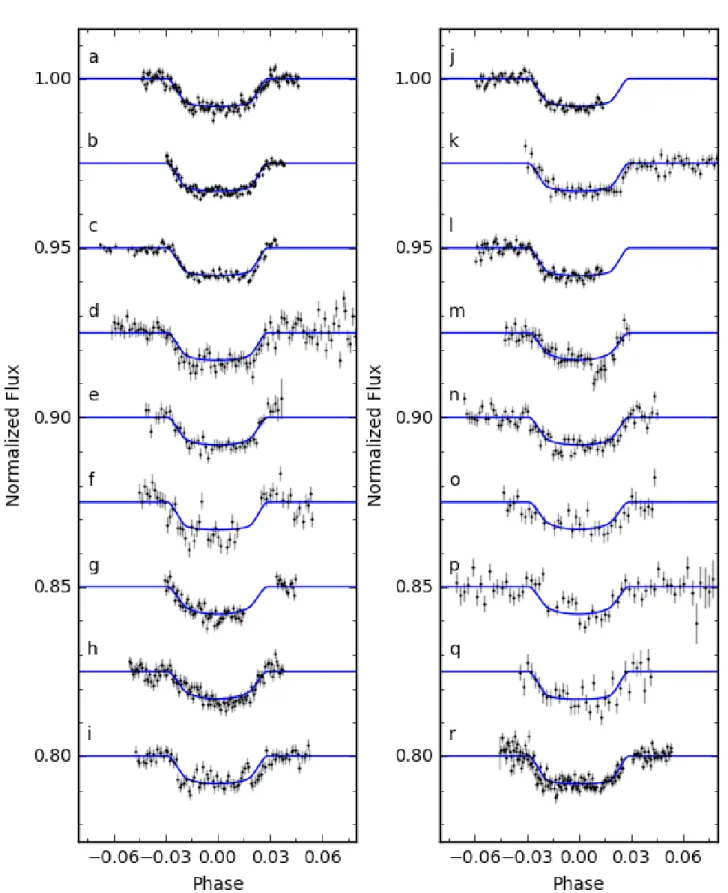
The WASP and KELT teams independently found a planet-like transit signal with a ∼ 2-day period (see Fig.1) and set about obtaining a total of 18 follow-up light curves of the transit. The observations are listed in Table1while the lightcurves are shown in Fig.2. The techniques for obtaining relative photometry have been reported in previous WASP
WASP-167b/KELT-13b
3
and KELT discovery papers, and since we have 18 transitcurves from disparate facilities we refer the reader to such papers for full details of the instrumentation and analysis (e.g. Hellier et al. 2014; Maxted et al. 2016; Kuhn et al.
2016; Pepper et al. 2016; Rodriguez et al. 2016). We give
key details of the instrumentation used in Table1.
In an attempt to refute the planetary hypothesis we, on three occasions, attempted to detect an eclipse (of the occulting body by the star) using TRAPPIST with a z0filter (see Table 1 for details). No eclipse was detected, with a 3σ upper limit of 1100 ppm, which is consistent with the occulting body being a planet.
The two teams also began monitoring the radial veloc-ity of the star using the Euler/CORALIE and TRES spec-trographs (Queloz et al. 2001;F˝uresz 2008). The measured values are listed in Table2. The crucial tomographic data, revealing the planet shadow, then came from an observation over a transit on the night of March 1st2016 using the ESO 3.6-m/HARPS spectrograph (Pepe et al. 2002).
We have searched the WASP photometry of WASP-167/KELT-13 for modulations indicating the rotational pe-riod of the star, as described byMaxted et al. (2011), but did not find any modulations above ∼ 1 mmag.
3 SPECTRAL ANALYSIS
To determine the spectral parameters of the host star we produced a median-stacked spectrum from the 17 HARPS spectra and used it to find the stellar effective temperature Teff, the stellar metallicity [Fe/H], and the projected stellar rotational velocity v sin i?. The spectra were line-poor and broad-lined, owing to the host star’s spectral type, which meant that a determination of the stellar surface gravity log g?was not possible. We therefore assume here a value of log g?= 4.3, the expected value for a similar star at zero age
(Gray 1992). The Teff was measured using the H-alpha line,
which was strong and unblended. The values obtained for each of these parameters are given in Table3. Fuller details of our spectral analysis procedure can be found in Doyle
et al. (2013). We also used the MKCLASS program (Gray
& Corbally 2014) to obtain a spectral type of F1V.
4 PHOTOMETRIC AND RADIAL VELOCITY ANALYSIS
We carried out a Markov Chain Monte Carlo (MCMC) fit-ting procedure, simultaneously modelling the WASP and KELT light curves, the 18 follow-up light curves, and the out-of-transit RVs. We use the latest version of the code de-scribed byCollier Cameron et al.(2007) andPollacco et al.
(2008).
Prior to the fit, the KELT team’s follow-up lightcurves were detrended by first fitting them using the online EX-OFAST applet (Eastman et al. 2013), removing the effects of airmass and some systematics (this was not needed for TRAPPIST lightcurves). Limb darkening was accounted for using theClaret(2000,2004) four-parameter non-linear law. At each step of the MCMC the limb-darkening coefficients were interpolated from the Claret tables appropriate to the passband used and the new values of Teff [Fe/H] and log g?.
Figure 1. The WASP (top) and KELT (bottom) discovery light curves for WASP 167b/KELT-13b, folded on the orbital period. The blue lines show the final model obtained in the MCMC fitting (see Section4).
Hot Jupiters settle into a circular orbit on time-scales that are often shorter than their host stars’ lifetimes through tidal circularization (Pont et al. 2011). We therefore assume a circular orbit, since this will give the most likely parame-ters (Anderson et al. 2012).
The system parameters which determine the shape of the transit light curve are: the epoch of mid-transit Tc, the
orbital period P, the planet-to-star area ratio (Rp/R?)2 or
transit depth δ, the transit duration T14, and the impact
parameter b. In the RV modelling, we fit the value of the stellar reflex velocity semi-amplitude K1 and the
barycen-tric system velocity γ. The proposed values of stellar and planetary masses and radii are constrained by the Enoch– Torres relation (Enoch et al. 2010; Torres et al. 2010). We allow for a possible offset in RVs between the CORALIE and TRES datasets.
Since we collect data from many sources with differing data qualities, our code includes a provision for re-scaling the error bars of each dataset to give χν2 = 1. This means that datasets that don’t fit as well are down-weighted, such that the final result is dominated by the better datasets. With 18 transit lightcurves, this means that the final parameters are relatively insensitive to red noise in particular lightcurves.
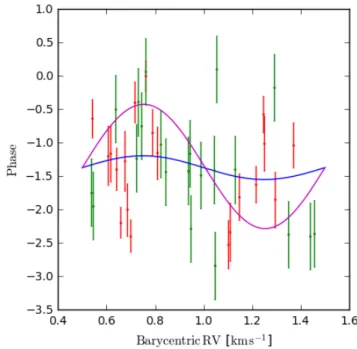
The radial velocities and the best-fitting model are shown in Figure3. There is a clear scatter in the RVs about the model, beyond that attributable to the error bars. This could, for example, be caused by the pulsations in the host star (see Section5) distorting the stellar line profiles, or by a third body in the system. Attempting to fit for a second planet does not properly explain the scatter, but does
Figure 2. The 18 follow-up transit light curves. The blue lines show the final model obtained in the MCMC fitting (see Section4). The label to the left of each data set corresponds to an entry in the final column of Table1.
WASP-167b/KELT-13b
5
Table 1. Details of all observations of WASP-167b/KELT-13b used in this work, including the discovery photometry, the follow-up photometry and the spectroscopic observations. The label in the final column corresponds to a lightcurve in Fig.2.
Facility Location Aperture FOV Pixel Scale Date Notes Label
(0×0) (00pixel−1) Discovery Photometry
WASP-South SAAO1, South Africa 111mm 7.8 × 7.8 14 2006 May– 26114 points
-2012 Jun
KELT-South SAAO, South Africa 42mm 26 × 26 23 2010 Mar– 4563 points
-2013 Aug Transit observations
TRAPPIST ESO2, La Silla, Chile 0.6m 22 × 22 0.65 2012 Feb 22 I+z’ a
TRAPPIST ESO, La Silla, Chile 0.6m 22 × 22 0.65 2012 Apr 30 I+z’ b
LCOGT-LSC CTIO3, Chile 1m 26.5 × 26.5 0.4 2014 May 17 i’ c
PEST Perth, Australia 0.3m 31 × 21 1.2 2014 Jun 22 Rc d
PEST Perth, Australia 0.3m 31 × 21 1.2 2015 Jan 14 V e
Skynet/Prompt4 CTIO, Chile 0.4m 10 × 10 0.59 2015 Feb 22 z’ f
T50 Telescope SSO4, Australia 0.43m 16.2 × 15.7 0.92 2015 Mar 24 B g
T50 Telescope SSO, Australia 0.43m 16.2 × 15.7 0.92 2015 Mar 26 B h
Mt. John UC5, New Zealand 0.6m 14 × 14 0.549 2015 Mar 26 V i
LCOGT-COJ SSO, Australia 1m 15.8 × 15.8 0.24 2015 Mar 28 r’ j
PEST Perth, Australia 0.3m 31 × 21 1.2 2015 Mar 28 Ic k
LCOGT-COJ SSO, Australia 1m 15.8 × 15.8 0.24 2015 Mar 28 i’ l
Hazelwood Victoria, Australia 0.32m 18 × 12 0.73 2015 Mar 30 B m
Ivan Curtis Adelaide, Australia 0.235m 16.6 × 12.3 0.62 2015 Mar 30 V n
Ellinbank Victoria, Australia 0.32m 30.4 × 14.1 1.12 2015 Apr 03 B o
PEST Perth, Australia 0.3m 31 × 21 1.2 2015 Apr 03 B p
LCOGT-CPT SAAO, South Africa 1m 15.8 × 15.8 0.24 2015 Apr 17 Z q
TRAPPIST ESO, La Silla, Chile 0.6m 22 × 22 0.65 2016 Mar 01 z’ r
Occultation window observations
TRAPPIST ESO, La Silla, Chile 0.6m 22 × 22 0.65 2011 Feb 13 z’
-TRAPPIST ESO, La Silla, Chile 0.6m 22 × 22 0.65 2011 Apr 25 z’
-TRAPPIST ESO, La Silla, Chile 0.6m 22 × 22 0.65 2011 May 09 z’
-Spectroscopic Observations
CORALIE ESO, La Silla, Chile 1.2m - - 2010 Apr– 21 RVs
-2017 Mar
TRES FLWO6, Arizona 1.5m - - 2015 Feb– 20 RVs
-2016 Apr
HARPS ESO, La Silla, Chile 3.6m - - 2016 Mar 01 17 CCFs
-1South African Astronomical Observatory,2European Southern Observatory,3Cerro Tololo Inter-American Observatory,4Siding Spring
Observatory,5University of Canturbury,6Fred Lawrence Whipple Observatory
icantly change the semi-amplitude fitted to the first planet. For this reason we do not regard the fitted semi-amplitude as a reliable measure of the planet’s mass, but instead report an upper limit of 8 MJup, which we regard as conservative
but sufficient to demonstrate that the transiting body has a planetary mass. We are continuing to monitor the system in order to discover the cause of the scatter. The parameters obtained in this analysis are given in Table3.
5 DOPPLER TOMOGRAPHY
We obtained 17 spectra with the ESO 3.6-m/HARPS spec-trograph through a transit on the night of March 1st 2016. We also observed the same transit photometrically using TRAPPIST (see lightcurve r in Fig.2, Table 1). The stan-dard HARPS Data Reduction Software produces a cross cor-relation function (CCF) correlated over a window of ± 300 km s−1 (as described inBaranne et al.(1996), Pepe et al.
(2002)). The CCFs were created using a binary mask match-ing a G2 spectral type.
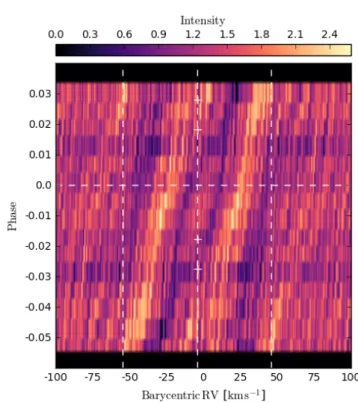
We display the resulting CCFs as a function of the planet’s orbital phase in Fig.4, where phase 0 is mid-transit. In producing this plot we have first subtracted the invariant part of the CCF profile. We do this by constructing a “min-imum CCF”, which at each wavelength has the lowest value from the range of phases.
We interpret the CCFs as showing stellar pulsations moving in a prograde direction (moving redward over time). Similar pulsations are seen in the tomograms of WASP-33
(Collier Cameron et al. 2010b;Johnson et al. 2015), which
is regarded as aδ-Scuti pulsator (Herrero et al. 2011). To try to remove the pulsations by separating the fea-tures into prograde-moving and retrograde components we followed the method ofJohnson et al. (2015), adopted for WASP-33, by Fourier transforming the CCFs. We find that we get the best separation of the components if we do not include the last two spectra in the transform (these two were
Table 2. Radial velocities and bisector spans for WASP-167b/KELT-13b. BJD RV σRV BS σBS (UTC) (km s−1) (km s−1) (km s−1) (km s−1) TRES RVs: 2457055.9950 –1.01 0.41 –0.12 0.33 2457057.0280 0.00∗ 0.23 0.03 0.21 2457058.0115 –0.57 0.28 0.53 0.37 2457060.9845 –0.39 0.31 0.33 0.21 2457086.9123 –0.63 0.29 0.04 0.24 2457122.8138 –1.85 0.42 –0.05 0.17 2457123.8544 –1.15 0.39 –0.23 0.28 2457137.7848 –2.39 0.24 –0.29 0.14 2457139.7803 –2.00 0.39 0.15 0.24 2457141.7805 –1.27 0.45 0.17 0.11 2457143.7671 –2.19 0.23 0.17 0.14 2457144.7561 –1.81 0.35 –0.05 0.18 2457145.7548 –1.39 0.32 –0.02 0.16 2457149.7475 –1.16 0.42 0.12 0.25 2457150.7423 –2.33 0.44 0.05 0.20 2457151.7486 –1.19 0.44 –0.20 0.23 2457152.7481 –2.52 0.36 –0.29 0.18 2457406.0418 –1.03 0.34 – – 2457491.8087 –0.84 0.34 – – 2457504.7985 –1.62 0.28 - -CORALIE RVs: 2455310.5197 –3.82 0.059 –2.38 0.12 2455310.7997 –3.74 0.061 –0.42 0.12 2455311.8274 –2.83 0.059 –1.30 0.12 2455320.5330 –3.50 0.063 1.80 0.13 2455320.7620 –2.23 0.066 –2.30 0.13 2455568.8071 –2.72 0.060 –2.70 0.12 2455572.8745 –3.09 0.066 – – 2455574.8560 –3.57 0.061 –4.96 0.12 2455646.7721 –2.51 0.070 –2.96 0.14 2455712.5524 –3.36 0.059 0.26 0.12 2455722.5352 –2.27 0.058 –4.94 0.12 2455979.6808 –3.76 0.062 –3.44 0.12 2455979.8947 –3.74 0.059 –7.50 0.12 2455981.7262 –4.62 0.065 –1.09 0.13 2457600.5003 –4.28 0.071 – – 2457616.4963 –4.70 0.066 0.048 0.13 2457759.8362 –4.71 0.065 –1.86 0.13 2457760.8358 –3.77 0.066 –3.70 0.13 2457804.7049 –4.08 0.065 – – 2457809.7742 –5.18 0.064 –2.88 0.13 2457818.6599 –4.73 0.067 –0.25 0.13
∗This observation was used as the template for the extraction
of the TRES radial velocities.
in any case outside the transit and so cannot contain infor-mation about a planet).
Fig. 5shows the Fourier-transformed data, where the feature running from bottom-left to top-right can be at-tributed to the pulsations. We thus applied the filter used by
Johnson et al.(2015), which contained zeroes in the
quad-rants containing the prograde pulsation signal and unity in the quadrants containing the retrograde signal, with a Hann function bridging the discontinuity.
We then Fourier transform the masked data back into phase versus velocity and display that in Fig.6. This shows an apparent retrograde trace, which we attribute to the
Figure 3. The 21 CORALIE RVs (green) and 20 TRES RVs (red) obtained for WASP-167/KELT-13. The blue line shows the best fitting semi-amplitude, which we do not regard as reliable. The magenta line shows the RV amplitude for a planet mass of 8 MJup, which we regard as a conservative upper limit.
shadow of a planet. This is again similar to what is seen in WASP-33 (Johnson et al. 2015).
The planet’s Doppler shadow seems to disappear to-wards the end of the transit (see Fig.6). It is likely that it has been reduced during the filtering process, as a result of imperfect separation of the planetary and stellar-pulsation signals. This might have some effect on fitting the alignment angleλ, which depends on the slope of the Doppler shadow, but should have less effect on the other fitted quantities.
In order to parametrise the planet’s orbit we then fit-ted the CCFs through transit, in a manner similar to the methods in Brown et al.(2017). Since we had subtracted the “minimum CCF” above, we first add that back in to the filtered CCFs in order to reintroduce the stellar line profile, which is a key feature for constraining the value of v sin i?.
The parameters which define the shape of the CCF line profile are: the projected spin-orbit misalignment an-gle λ; the stellar line-profile Full-Width at Half-Maximum (FWHM); the FWHM of the line perturbation due to the planet; the stellarγ-velocity, and v sin i?. These parameters were fitted using a MCMC fitting algorithm which assumes a Gaussian shape for the line perturbation caused by the planet. The value of v sin i?obtained in the spectral analysis was used as a prior in the fit. Initial values for the stellar line FWHM and theγ-velocity were obtained by fitting a Gaus-sian profile to the CCFs. Theλ angle was given no prior. Details of the fitting algorithm are given inCollier Cameron
et al.(2010a), and the resulting system parameters are listed
in Table3.
Lastly, in Fig. 7 we show the pulsations without the planet trace, obtained by filtering to leave only the prograde quadrants, and then transforming back into velocity space.
WASP-167b/KELT-13b
7
Figure 4. The line profiles through transit. We interpret this as showing prograde moving stellar pulsations and a retrograde mov-ing planet trace. The white dashed vertical lines mark the posi-tions of theγ velocity of the system and the positions of γ±v sin i?
(i.e. the centre and edges of the stellar line profile). The phase of mid-transit is marked by the white horizontal dashed line. The white + symbols indicate the four transit contact points, calcu-lated using the ephemeris obtained in the analysis in Section4.
6 EVOLUTIONARY STATUS
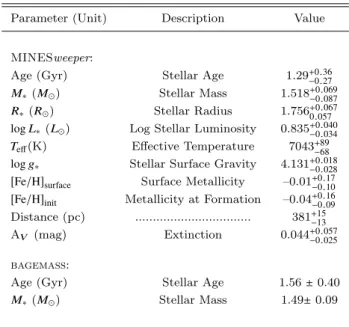
We then used MINESweeper, a newly developed Bayesian approach to determining stellar parameters using the MIST stellar evolution models (Choi et al. 2016). Examples of the use of MINESweeper in determining stellar parameters are shown inRodriguez et al.(2017a,b). We model the available BT, VT photometry from Tycho-2, J, H, Ks from 2MASS,
and WISE W1-3 photometry. We also include in the likeli-hood calculation the measured parameters from the spectro-scopic analysis (Teff= 6900±150 K and [Fe/H]= −0.04±0.18),
as well as the Gaia DR1 parallax (π = 2.28 ± 0.62mas;Gaia
Collaboration et al.(2016b,a)) and the fitted transit stellar
density (0.28 ± 0.02ρ ). We applied non-informative priors
on all parameters within the MIST grid of stellar evolution models, and a non-informative prior on extinction (AV)
be-tween 0–2.0 mags. Our final parameters are determined from the value at the highest posterior probability for each param-eter, and the errors are based on the marginalized inner-68th percentile range. These are given in Table 4.
For comparison, we also use the open source software bagemass1, which uses the Bayesian method described by
Maxted et al.(2015), to estimate the stellar age and mass.
The models used in bagemass were calculated using the garstec stellar evolution code (Weiss & Schlattl 2008). We use the grid of stellar models in bagemass and use the same
1 http://sourceforge.net/projects/bagemass
Figure 5. The Fourier transform of the line profiles. The stellar pulsations are seen as the diagonal feature from bottom-left to top-right. The weaker diagonal feature running bottom-right to top-left is produced by the planet.
Figure 6. The spectral profiles through transit after removing the stellar pulsations via Fourier filtering. The planet trace is then readily seen moving in a retrograde direction. The left-hand panel shows the simultaneous TRAPPIST photometry of the transit.
Figure 7. The spectral profiles through transit after removing the planet shadow via Fourier filtering. The stellar pulsations are seen moving in a prograde direction.
Figure 8. The best fitting evolutionary tracks and isochrones of WASP-167/KELT-13 obtained using bagemass.
temperature, metallicity and density constraints as for the MINESweeper calculation. We also apply a luminosity con-straint of log LT = 1.00+0.28−0.22, which was derived using the
Gaia parallax and the total line-of-sight reddening as deter-mined bySchlafly & Finkbeiner(2011);Maxted et al.(2014) (E(B-V) = 0.051 ± 0.034). The resulting age and mass val-ues are in Table 4. Both values are compatible with those from MINESweeper. The best-fit stellar evolution tracks and isochrones are shown in Fig.8.
Table 3. System parameters obtained for WASP-167b/KELT-13b in this work. 1SWASP J130410.53–353258.2 2MASS J13041053–3532582 RA = 13h04m10.53s, Dec = –35◦32058.2800 (J2000) V = 10.5 IRFM Teff= 6998 ± 151 K
Gaia Proper Motions: (RA) –19.031 ± 1.419 mas Dec) 0.664 ± 1.241 mas/yr
Parallax: 2.28 ± 0.62 mas
Rotational Modulations: < 1 mmag (95%)
Parameter (Unit) Value
Stellar parameters from spectral analysis:
Teff(K) 6900 ± 150
log A(Fe) 7.46 ± 0.18
[Fe/H] −0.04 ± 0.18
vsin i∗(km s−1) 52 ± 8
Parameters from photometry and RV analysis:
P (d) 2.0219591 ± 0.0000006 Tc(HJD) 2456592.4635 ± 0.0002 T14(d) 0.1133 ± 0.0008 T12= T34(d) 0.021 ± 0.001 ∆F= R2 P/R 2 ∗ 0.0082 ± 0.0001 b 0.77 ± 0.01 a (AU) 0.0365 ± 0.0006 i (◦) 79.9 ± 0.4 Teff(K) 7000 ± 250 log g∗(cgs) 4.13 ± 0.02 ρ∗ (ρ ) 0.28 ± 0.02 [Fe/H] 0.1 ± 0.1 M∗ (M ) 1.59 ± 0.08 R∗ (R ) 1.79 ± 0.05 MP (MJup) <8 RP (RJup) 1.51 ± 0.03
Parameters from tomography:
γ (km s−1) –3.409 ± 0.007
vsin i∗(km s−1) 49.94 ± 0.04
λ (◦) –165 ± 5
7 DISCUSSION
7.1 Stellar rotation rate and tidal interaction As an F1V star with Teff= 6900 ± 150 K, WASP-167/KELT-13 is among the hottest stars known to host a transiting hot Jupiter. Others include WASP-33 (Collier Cameron et al.
2010b), Kepler-13 (Shporer et al. 2011, 2014), KELT-17
(Zhou et al. 2016) and HAT-P-57 (Hartman et al. 2015).
In addition, WASP-167/KELT-13 appears to be one of the most rapidly rotating stars known to host a hot Jupiter, and one of the few with a stellar rotation period shorter than the planet’s orbit. The measured v sin i?of 49.94 ± 0.04 km s−1 and the fitted radius of 1.79 ± 0.05 R imply a rotation
pe-riod of Prot < 1.81 days, which compares with the planet’s
orbital period of 2.02 days.
Thus WASP-167/KELT-13 joins WASP-33 (Porb= 1.22 d; Prot< 0.79 d,Collier Cameron et al. 2010b), KELT-7 (Porb
= 2.7-d, Prot < 1.32, Bieryla et al. 2015) and CoRoT-11b
(Porb= 3.0 d; Prot < 1.73 d,Gandolfi et al. 2010) in having
WASP-167b/KELT-13b
9
Table 4. Stellar parameters obtained for WASP-167/KELT-13 in the SED analysis (see Section 6).
Parameter (Unit) Description Value
MINESweeper:
Age (Gyr) Stellar Age 1.29+0.36−0.27
M∗(M ) Stellar Mass 1.518+0.069−0.087
R∗(R ) Stellar Radius 1.756+0.0670.057
log L∗ (L ) Log Stellar Luminosity 0.835+0.040−0.034
Teff(K) Effective Temperature 7043+89−68
log g∗ Stellar Surface Gravity 4.131+0.018−0.028
[Fe/H]surface Surface Metallicity –0.01+0.17−0.10
[Fe/H]init Metallicity at Formation –0.04+0.16−0.09
Distance (pc) ... 381+15−13
AV (mag) Extinction 0.044+0.057−0.025
bagemass:
Age (Gyr) Stellar Age 1.56 ± 0.40
M∗(M ) Stellar Mass 1.49± 0.09
rate. See, also,Crouzet et al.(2016) for a discussion of other systems with Prot < Porbbut with longer period orbits.
The tidal interaction will be different in such systems compared to the more-usual Prot> Porb. In most hot Jupiters,
the tidal interaction is expected to drain angular momentum from the orbit, leading to tidal decay of the orbital period (e.g.Levrard et al. 2009). This would be reversed, however, for systems with Prot < Porb, and with the planet in a
pro-grade orbit (such as KELT-7b and CoRoT-11b), thus leading to a different dynamical history.
If, though, Prot < Porb and with the planet in a
retro-grade orbit, such as WASP-167b/KELT-13b or WASP-33b, tidal infall would again be expected.McQuillan et al.(2013) analysed Kepler detections and found a dearth of close-in planets around fast rotators, saying that only stars with rotation periods longer than 5–10 days have planets with periods shorter than 3 days. Teitler & K¨onigl (2014) then attributed this to the destruction of close-in planets, with the result of spinning up the star. While WASP-167/KELT-13 and the others just named are examples of systems with Prot < Porb they are undoubtedly rare and their dynamics
deserves further investigation.
7.2 The retrograde orbit
The planet WASP-167b/KELT-13b has a radius of 1.5 RJup and is thus inflated, though not exceptionally so. This is in line with WASP-33b, which also has a 1.5 RJup radius, and is expected for a hot Jupiter orbiting a hot star, given that a relation between inflated radii and stellar irradiation is now well established (e.g.Demory & Seager 2011; Enoch et al.
2012;Hartman et al. 2016). We should, though, warn of a
se-lection effect against observing non-inflated planets around relatively large A/F stars, in that the transits would be shal-lower and may escape detection in WASP-like surveys.
Crouzet et al.(2016) list 6 planets with measured
sky-projected obliquity angles (λ) that transit host stars hotter
than 6700 K (these are XO-6b, CoRoT-3b, KELT-7b, KOI-12b, WASP-33b & Kepler-13Ab). Of these, five seem to be misaligned but only moderately so, having non-zero λ val-ues with |λ| typically 10–40◦
. WASP-167b/KELT-13b hav-ing a highly retrograde orbit withλ = −165◦± 5◦, now joins the exception WASP-33b, which hasλ = −109◦± 1◦ (Collier
Cameron et al. 2010b).
As has been widely discussed (e.g.Albrecht et al. 2012;
Crida & Batygin 2014;Fielding et al. 2015;Li & Winn 2016),
stars hotter than 6100 K host hot Jupiters with a large range of obliquities, whereas cooler stars tend to have planets in aligned orbits (see, e.g., Fig. 8 ofCrouzet et al.(2016)). The suggestion is that hotter stars are less effective at tidally damping a planet’s obliquity, perhaps owing to their rel-atively small convective envelopes (e.g. Winn et al. 2010). The discovery of WASP-167b/KELT-13b now reinforces this trend.
7.3 Stellar pulsations
WASP-167/KELT-13 is one of a growing number of hot-Jupiter hosts that have shown non-radial pulsations. The first was WASP-33b (Collier Cameron et al. 2010b), which shows δ-Scuti pulsations with a dominant period near 21 cycles d−1 (86 mins) and an amplitude of several mmag
(Kov´acs et al. 2013; von Essen et al. 2014). Further,
Her-rero et al.(2011) noted that one of the pulsation frequencies
was very near 26 times the orbital frequency of the planet, which suggests that the planet might be exciting the pulsa-tions.
HAT-P-2b is an eccentric massive planet (8 MJup, e ∼
0.5) in a 5-d orbit.de Wit et al.(2017) detect pulsations in Spitzer lightcurves of HAT-P-2b, at a level of 40 ppm, much lower than in WASP-33b, but at a similar timescale of ∼ 87 mins. Owing to the commensurability between the pulsation and orbital frequencies,de Wit et al.(2017) again suggest that the planet is exciting the pulsations.
A third example is WASP-118, which shows pulsations at a timescale of ∼ 1.9 d and an amplitude of ∼ 200 ppm in K2 observations (Moˇcnik et al. 2017). Another is HAT-P-56, aγ-Dor pulsator with a primary pulsation period of 1.644 ± 0.03 days, which were also seen in K2 observations (Huang
et al. 2015).
In WASP-167/KELT-13 judging from Fig.4, the pul-sations appear to have a timescale of ∼ 4 hours, though with limited data we cannot be more precise. It is possible that some of the transit lightcurves in Fig.2are affected by pul-sations, but we need more extensive photometry to assess this and to evaluate the pulsation amplitude. Similarly, it may be that pulsations are contributing to the scatter in the RV measurements seen in Fig.3. Indeed, de Wit et al.
(2017) attribute radial-velocity scatter in HAT-P-2 to the pulsations.Hay et al.(2016) also report excess RV scatter in WASP-118.
The pulsations in WASP-167/KELT-13 have a longer timescale than in WASP-33 and HAT-P-2 and are near the borderline betweenδ-Scuti and γ-Dor behaviour, and so we are unsure which class to assign the star to. We run a second rotational modulation search on the WASP photometry of WASP-167/KELT-13, looking for pulsations at frequencies of 1-50 cycles/day. We do not detect a signal, implying that if the pulsations are present they must have an amplitude of
<500ppm. It is worth noting that both planets WASP-33b and WASP-167b/KELT-13b have retrograde orbits, whereas that of HAT-P-2b is highly eccentric, which may be relevant to the excitation of the pulsations.
ACKNOWLEDGEMENTS
WASP-South is hosted by the South African Astronomi-cal Observatory and we are grateful for their ongoing sup-port and assistance. Funding for WASP comes from con-sortium universities and from the UK’s Science and Tech-nology Facilities Council. The Euler Swiss telescope is sup-ported by the Swiss National Science Foundation. TRAP-PIST is funded by the Belgian Fund for Scientific Research (Fond National de la Recherche Scientifique, FNRS) under the grant FRFC 2.5.594.09.F, with the participation of the Swiss National Science Foundation (SNF). M. Gillon and E. Jehin are FNRS Research Associates. We acknowledge use of the ESO 3.6-m/HARPS under program 096.C-0762. L. Delrez acknowledges support from the Gruber Foundation Fellowship.
Work performed by P.A.C. was supported by NASA grant NNX13AI46G. D.J.S and B.S.G. were partially sup-ported by NSF CAREER Grant AST-1056524. S.V.Jr. is supported by the National Science Foundation Graduate Research Fellowship under Grant No. DGE-1343012. Work performed by J.E.R. was supported by the Harvard Future Faculty Leaders Postdoctoral fellowship.
REFERENCES
Albrecht S., et al., 2012,ApJ,757, 18
Anderson D. R., et al., 2012,MNRAS,422, 1988
Baranne A., et al., 1996, A&AS,119, 373
Bieryla A., et al., 2015,AJ,150, 12
Bourrier V., et al., 2015,A&A,579, A55
Brown D. J. A., et al., 2017,MNRAS,464, 810
Choi J., Dotter A., Conroy C., Cantiello M., Paxton B., Johnson B. D., 2016,ApJ,823, 102
Claret A., 2000, A&A,363, 1081
Claret A., 2004,A&A,428, 1001
Collier Cameron A., et al., 2006,MNRAS,373, 799
Collier Cameron A., et al., 2007,MNRAS,380, 1230
Collier Cameron A., Bruce V. A., Miller G. R. M., Triaud A. H. M. J., Queloz D., 2010a,MNRAS,403, 151
Collier Cameron A., et al., 2010b,MNRAS,407, 507
Crida A., Batygin K., 2014, in Ballet J., Martins F., Bournaud F., Monier R., Reyl´e C., eds, SF2A-2014: Proceedings of the Annual meeting of the French Society of Astronomy and As-trophysics. pp 217–220
Crouzet N., et al., 2016, preprint, (arXiv:1612.02776) Demory B.-O., Seager S., 2011,ApJS,197, 12
Dong S., Katz B., Socrates A., 2014,ApJ,781, L5
Doyle A. P., et al., 2013,MNRAS,428, 3164
Eastman J., Gaudi B. S., Agol E., 2013,PASP,125, 83
Enoch B., Collier Cameron A., Parley N. R., Hebb L., 2010,A&A,
516, A33
Enoch B., Collier Cameron A., Horne K., 2012,A&A,540, A99
F˝uresz G., 2008, PhD thesis, Univ. Svezged, Hungary Fabrycky D., Tremaine S., 2007,ApJ,669, 1298
Fielding D. B., McKee C. F., Socrates A., Cunningham A. J., Klein R. I., 2015,MNRAS,450, 3306
Gaia Collaboration et al., 2016a,A&A,595, A1
Gaia Collaboration et al., 2016b,A&A,595, A2
Gandolfi D., et al., 2010,A&A,524, A55
Gray D. F., 1992, The observation and analysis of stellar photo-spheres.
Gray R. O., Corbally C. J., 2014,AJ,147, 80
Hartman J. D., et al., 2015,AJ,150, 197
Hartman J. D., et al., 2016,AJ,152, 182
Hay K. L., et al., 2016,MNRAS,463, 3276
Hellier C., et al., 2011, in European Physical Journal Web of Conferences. p. 01004 (arXiv:1012.2286),
doi:10.1051/epjconf/20101101004
Hellier C., et al., 2014,MNRAS,440, 1982
Herrero E., Morales J. C., Ribas I., Naves R., 2011,A&A,526, L10
Huang C. X., et al., 2015,AJ,150, 85
Johnson M. C., Cochran W. D., Albrecht S., Dodson-Robinson S. E., Winn J. N., Gullikson K., 2014,ApJ,790, 30
Johnson M. C., Cochran W. D., Collier Cameron A., Bayliss D., 2015,ApJ,810, L23
Kov´acs G., et al., 2013,A&A,553, A44
Kuhn R. B., et al., 2016,MNRAS,459, 4281
Levrard B., Winisdoerffer C., Chabrier G., 2009,ApJ,692, L9
Li G., Winn J. N., 2016,ApJ,818, 5
Maxted P. F. L., et al., 2011,PASP,123, 547
Maxted P. F. L., et al., 2014,MNRAS,437, 1681
Maxted P. F. L., Serenelli A. M., Southworth J., 2015,A&A,575, A36
Maxted P. F. L., et al., 2016,A&A,591, A55
Mazeh T., Nachmani G., Sokol G., Faigler S., Zucker S., 2012,
A&A,541, A56
McQuillan A., Mazeh T., Aigrain S., 2013,ApJ,775, L11
Moˇcnik T., Hellier C., Anderson D. R., Clark B. J. M., 2017, preprint, (arXiv:1702.05078)
Pepe F., et al., 2002, The Messenger,110, 9
Pepper J., et al., 2007,PASP,119, 923
Pepper J., Kuhn R. B., Siverd R., James D., Stassun K., 2012,
PASP,124, 230
Pepper J., et al., 2016, preprint, (arXiv:1607.01755) Pollacco D. L., et al., 2006,PASP,118, 1407
Pollacco D., et al., 2008,MNRAS,385, 1576
Pont F., Husnoo N., Mazeh T., Fabrycky D., 2011,MNRAS,414, 1278
Queloz D., et al., 2001, The Messenger,105, 1
Rodriguez J. E., et al., 2016,AJ,151, 138
Rodriguez J. E., et al., 2017a, preprint, (arXiv:1701.03807) Rodriguez J. E., et al., 2017b,ApJ,836, 209
Schlafly E. F., Finkbeiner D. P., 2011,ApJ,737, 103
Shporer A., et al., 2011,AJ,142, 195
Shporer A., et al., 2014,ApJ,788, 92
Siverd R. J., et al., 2012,ApJ,761, 123
Teitler S., K¨onigl A., 2014,ApJ,786, 139
Torres G., Andersen J., Gim´enez A., 2010,A&ARv,18, 67
Weiss A., Schlattl H., 2008,Ap&SS,316, 99
Winn J. N., Fabrycky D., Albrecht S., Johnson J. A., 2010,ApJ,
718, L145
Wu Y., Murray N., 2003,ApJ,589, 605
Zhou G., et al., 2016, preprint, (arXiv:1607.03512) Zhou G., et al., 2017, preprint, (arXiv:1702.00106) de Wit J., et al., 2017, preprint, (arXiv:1702.03797) von Essen C., et al., 2014,A&A,561, A48
This paper has been typeset from a TEX/LATEX file prepared by