HAL Id: hal-00721642
https://hal.archives-ouvertes.fr/hal-00721642
Submitted on 29 Jul 2012HAL is a multi-disciplinary open access archive for the deposit and dissemination of sci-entific research documents, whether they are pub-lished or not. The documents may come from teaching and research institutions in France or abroad, or from public or private research centers.
L’archive ouverte pluridisciplinaire HAL, est destinée au dépôt et à la diffusion de documents scientifiques de niveau recherche, publiés ou non, émanant des établissements d’enseignement et de recherche français ou étrangers, des laboratoires publics ou privés.
feature based manufacturing with STEP-NC
Raphael Laguionie, Matthieu Rauch, Jean-Yves Hascoet
To cite this version:
Raphael Laguionie, Matthieu Rauch, Jean-Yves Hascoet. An eXtended Manufacturing Integrated System for feature based manufacturing with STEP-NC. International Journal of Computer Integrated Manufacturing, Taylor & Francis, 2011, pp.1. �10.1080/0951192X.2011.592992�. �hal-00721642�
For Peer Review Only
An eXtended Manufacturing Integrated System for feature based manufacturing with STEP-NC
Journal: International Journal of Computer Integrated Manufacturing Manuscript ID: TCIM-2010-IJCIM-0173.R1
Manuscript Type: Original Manuscript Date Submitted by the
Author: 08-Apr-2011
Complete List of Authors: Laguionie, Raphael; Irccyn Rauch, Matthieu; Irccyn Hascoet, Jean-Yves; Irccyn
Keywords: CIM, MANUFACTURING INFORMATION SYSTEMS, CAD/CAM Keywords (user): STEP-NC, CNC programming, manufacturing system, eXtended
CNC, manufacturing data exchange
For Peer Review Only
An eXtended Manufacturing Integrated System for feature based
manufacturing with STEP-NC
R. Laguionie*, M. Rauch, J.-Y. Hascoët
Institut de Recherche en Communications et Cybernetique de Nantes, Nantes, FRANCE
* Corresponding author phone: +33 240 376 944; fax: +33 240 376 930; e-mail: [email protected]
For Peer Review Only
An eXtended Manufacturing Integrated System for feature based
manufacturing with STEP-NC
CNC feature-based programming with STEP-NC standard extends the collaborative model of manufacturing data exchange all along the numerical data chain. This paper considers the mutations related to this approach from the manufacturing system level to the industrial enterprise as a whole. The eXtended Manufacturing Integrated System concept is introduced to fill in the gap of the current manufacturing data exchange bottleneck. It is composed of eXtended CAD and eXtended CNC systems to link the CAD model to the real machined part through the Manufacturing Information Pipeline. The contributions associated with these concepts are demonstrated through a validation platform implemented on industrial CNC manufacturing equipments.
Keywords: STEP-NC, CNC programming, manufacturing system, eXtended CNC, manufacturing data exchange
1 Introduction
In today’s global context, the manufacturing industry of developed economies has to compete and work with low labour cost countries: the vision of a company is no more centric but distributed in a network of subdivisions, sub-entities, suppliers, subcontractors and so on. New production systems are now necessary for enterprise integration and interoperability (Panetto and Molina, 2008). Managing these production systems has to answer the needs associated with local and international outsourcing, contract manufacturing, quality expectation, operational efficiency, etc. Thus, several new paradigms such as agile, lean, flexible,
reconfigurable and ubiquitous manufacturing have been proposed to face the changes within the manufacturing engineering field (Jovane et al., 2003; ElMaraghy, 2005; Suh et al., 2008).. However, Computer Integrated Manufacturing still relies on partitioned top-down systems with no actual integration of the manufacturing processes into the CAD/CAPP/CAM/CNC numerical data chain.
In contrast, an international effort aims at developing manufacturing approaches and data models that enable a total integration of design/manufacturing numerical data. Hence, the STandard for the Exchange of Product data model (STEP) has spread in the industry for the exchange of design data (Michael, 2001). In the same way, STEP compliant Numerical Control (STEP-NC) is under development to solve the bottleneck related to manufacturing data exchange (Suh and Cheon, 2002).
For Peer Review Only
However, there is still a lack of proposal for manufacturing integrated system concepts and industrial validations to integrate the new possibilities of feature-based manufacturing. This paper proposes an extended manufacturing integrated system which enables a total integration of design to manufacturing information. A validation and demonstration platform has been developed.
2 CNC production in manufacturing integrated systems
2.1 Manufacturing systems and computer integrated manufacturing
CIM gathers the processes functioning under computer control and digital information exchange (Mikell, 2007). It includes Computer Aided Design/Manufacturing (CAD/CAM), Computer Aided Process Planning (CAPP), Computer Numerical Control (CNC) for machining facilities but also the control of conveyance and storage systems, robotics, etc. CIM systems rely on information systems for data transfer between the different modules. The main challenges for manufacturing systems are to answer the demand of concurrent
manufacturing, environmental compatibility, reconfigurability, integration in the company context and integration of innovative processes (Council, 1998). To meet theses challenges, new manufacturing paradigms are necessary (Alvi et al., 2001). Proposal such as holonic (Babiceanu and Chen, 2006), random (Babiceanu and Chen, 2006), flexible and
reconfigurable (ElMaraghy, 2005), agent-based manufacturing systems (Monostori et al., 2006) reach the common objectives of being adaptable to the company needs and to markets evolutions.
In spite of these recent research evolutions, the computer aided numerical chain still proposes a top-down vision from the design to the manufactured product. In the industry, the lack of interoperability of CIM tools stands as a major bottleneck to deploy global manufacturing contexts. Vendor neutral data exchange standards are the necessary base for a collaborative information system. Today, legacy CAD software suites rely on widespread design data exchange standards such as STEP, IGES, Parasolid, etc. In contrast, there is no manufacturing data exchange standards used in the industry for CAPP, CAM and NC control. However, major collaborative activities in product manufacturing are run between process planning and
For Peer Review Only
manufacturing departments (Ming et al., 2008). In this context, STEP-NC standard aims at integrating CAM and CNC activities into the global PLM digital environment, but both industry and academic research have not proposed manufacturing systems which take fully advantage of this new approach.
2.2 Current place of CAM and CNC in the manufacturing numerical chain
In the CIM systems, manufacturing operations and workplans are defined from the CAD model of the part. CAM and CNC simulate the manufacturing parameters, generate the motions paths, execute and monitor them on manufacturing equipment. Hardware, software and communication standards used in CAM/CNC have to interact to fulfil the needs of interoperability, portability, scalability and compatibility of the systems (Ming et al., 2008). An objective is to enable end-users, control vendors and machine tool builders to benefit from more integrated, agile and flexible production facilities. At the NC controller level, OAC (Open Architecture Control) are developed to achieve a vendor neutral standardized
environment (Pritschow et al., 2001). Virtual operating systems are developed for operation training of manufacturing facilities and manufacturing process simulation. Some Virtual CNC architecture represents an actual CNC with modular feed drives, sensors, motors, and
amplifiers (Yeung et al., 2006). It opens new opportunities to integrate CNC and
manufacturing facilities behaviour at the CAM level. Current industrial CNC controllers are often considered as ‘black boxes’ and do not offer these capabilities.
2.3 Feature based manufacturing
Data exchange between CAM and CNC is currently insured by structured G&M codes programming. It is based on ISO 6983 that was standardized in the early eighties (ISO6983, 1982). It is today a major bottleneck for CAM/CNC integration as it calls for post-processing operations, uses vendor specific extensions, enables unidirectional data flow, infers a loss of information and is low level. This results into a break of the numerical chain at the CAM/CNC level.
For Peer Review Only
The vendors and users have been seeking for a common language for CAD, CAPP, CAM, and CNC, which integrates and translates the knowledge at each stage. Though there are many CAM tools to support NC manufacture, they are quite limited in terms of portability and interoperability from system to system.
STEP-NC feature-based programming is a hierarchical data structure that contains product geometry, working steps and machining parameters for part manufacture. STEP-NC refers to ISO 14649 Application Reference Model (ARM) (ISO14649-1, 2003) and ISO 10303-238 Application Interpreted Model (AIM) (ISO10303-238, 2007). This new vision of the
numerical chain enables the integration of the CNC data in the CAD/CAPP/CAM numerical chain. Manufacturing feature recognition is based on ISO 10303 AP224 (ISO10303-224, 2006). Some works have been carried out to develop feature extraction systems to take a STEP file as an input for feature-based process planning activities (Xu et al., 2006). Multi-agent models are also used to design process planning systems in a STEP-NC compliant environment (Nassehi et al., 2006). From process planning, machining parameters and strategies can be added to the STEP-NC database. Simulation and selection tools can be employed in parallel with human experience (Laguionie et al., 2009). Rule-based tools can help in selecting cutting tools and machining conditions (Arezoo et al., 2000). A STEP-NC interpreter is then able to generate and control toolpaths on the machining equipment. A machine tool functional model is also under implementation within STEP-NC standard and a unified manufacturing resource model has been proposed by Vichare et al (Vichare et al., 2009). Several STEP-NC CNC systems for a direct interpretation of STEP-NC are reviewed by Xu et al. in (Xu and Newman, 2006). However, no complete feature-based manufacturing integrated system has been implemented yet. From the literature study, it has been identified that most the systems suffered from one or more of the following weak points:
- no possibility of implementation on current industrial equipment - no modifications enabled at shop floor level
- no data feed back from the shop-floor to CAPP or CAD - no proposal for multiprocess integration
For Peer Review Only
- no applications or industrial demonstrations using STEP-NC ISO 14649 - no global overview of the manufacturing system integrated in the enterpriseSo today, the STEP-NC community proposes a range of tools, methods and solutions for feature-based CIM but there is still a lack of a comprehensive concept enabling an overview of feature based manufacturing implementation within the enterprise, associated with the development of a concrete application using industrial tools and equipment.
3 Extented Manufacturing integrated system (XMIS)
In this context, this paper proposes to introduce a concept of global system for feature based manufacturing integration in the enterprise numerical chain. After a presentation of the system, the paper details the manufacturing data exchange proposed to fill in the gap of current lacks of interoperability and communication breaks.
3.1 Structure of XMIS and generalities
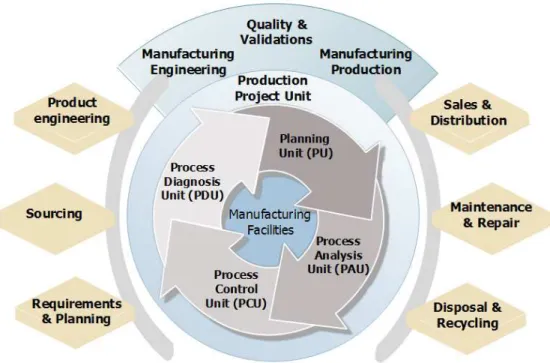
The eXtended Manufacturing Integrated System controls the manufacturing process from design to product, by integrating Manufacturing Engineering, Manufacturing Quality and Validations and Manufacturing Production (Error! Reference source not found.). XMIS is based on several units managed by a Production Project Unit (PPU). A multi-directional collaboration between the units allows their integration in an extended manufacturing numerical system. Feedback from every layers of manufacturing are enabled for experience capitalization, process optimizations and process planning. It is consequently adaptable to the specific needs and evolutions of the company.
XMIS is composed of the following main units:
Production Project Unit (PPU): Stores and manages high-level project data for production. It makes the link with the PLM platform by including Design and Development, Analyst, Prototyping, Marketing, Service and Support, Supplying, Sales, etc. Relevant information is shared with different services within the company but also with external actors
(manufacturing partners, customers, etc.). A main object of the PPU is to control the visibility of the data. The objective is to convey the right information to the right place for a specific need.
For Peer Review Only
Planning Unit (PU): Treats The Computer Aided Design model of a part for process planning. Several aspects are considered in link with PPU. Manufacturing workplan and features are selected according to available processes, facilities, resources and manufacturing partners. Process Analysis Unit (PAU): Runs part manufacturing simulation, optimization and verification. This includes operation sequencing, tool and machining conditions choices, toolpaths generation, etc. This unit is linked with the Manufacturing data Warehouse and the Manufacturing Knowledge database in a bidirectional way (optimization from experience and experience capitalization of the best solutions)
Process Control Unit (PCU): Executes process online control and monitoring. It performs online compensations, optimizations, diagnosis and adaptive control. Depending on the company structure, this unit can share applications at shop floor level, on manufacturing facilities level and at production management level.
Process Diagnosis Unit (PDU): Runs measuring and analyzing tools for part conformance, production quality and validation. It includes machining post-diagnosis and corrections. Shop floor experience capitalization can be implemented and a feedback to other units is allowed thanks to the Manufacturing Information Pipeline (MIP) in link with the Production Project Unit.
These units are the main constitutive parts of XMIS. Each of them gathers tools and modules that have to communicate together using Information and Communication Standards. These standards are an important technological bolt of current production data exchange and a direct cause of information loss and interoperability lack between applications. The communication standards supported by XMIS are chosen to fill in this gap.
3.2 ICT, OC and NC standards
Computer Integrated Manufacturing uses a multitude of data standards and applications to ensure data conformity from the designed to the manufactured part. The XMIS integrates this consideration and supports several data standards, software suite and hardware. In the general ICT (Information Communication Technology), OC (Opened Communication) and NC (Numerical Control) standards are distinguished:
For Peer Review Only
Vendor specific ICT standards for internal communication, operating system and hardware often have short innovation cycles and rely on ceaseless technology evolution. These standards are interfaced for communication with the other parts and units of the XMIS. OC standards are developed to unify the communication protocols between disparate devices and can avoid portability and information loss problems. As it is open, it can be extended to fit the real needs of the system. Longevity can be improved, as the standard is no more vendor tributary. Implementing of OC standards is privileged in XMIS. An example within the machine tool field is MTConnect standard (MTConnect, 2010). This standard, based on XML (Extensible Markup Language), offers a common communication hub between heterogeneous sensors, devices, equipments and applications for their interconnectability and the
interoperability of machine tools. Real manufacturing shop floor data manufacturing are observed online by PCU. A feedback to PAU, which can be based on MTConnect standard, allows relevant data extraction and optimization of machining analysis and CNC
programming. To finish, the PU benefits from this feedback for experience capitalization and optimization in future projects.
NC standards are common data models to communicate manufacturing attributes to the machining equipment. These data must be generic to be executed on a wide range of
controllers. They also have to be specific to support the needed machining information. The cursor between generic and specific manufacturing data models is hard to move, as it must fit varied companies environments. Currently, feature-based STEP-NC standard proposes an appropriate compromise to suite different environments as it covers a large field of manufacturing data and enables data feedback from shop-floor (Wosnik et al., 2006) to CAD/CAM.. Thus, XMIS manufacturing data exchange is based on STEP-NC for communication between the different units.
3.3 Generic and optimized NC data
XMIS is based on STEP and STEP-NC standards for integrated manufacturing and extended factory exchanges. STEP standard offers a unified standard to describe all the aspects of a product during its life cycle. STEP application protocols are dedicated to different application
For Peer Review Only
domains from design to maintenance. It is today largely widespread in the industry and
integrated in most of the CAD/CAM vendor applications for design data exchange. As a more recent standard, STEP-NC still needs developments, implementations and validations before being used in the industry. Research works done in this context have been presented in the frame of the participation of IRCCyN laboratory to the normative ISO committee
TC184/SC1/WG7 for STEP-NC ISO 14649 standardization (Laguionie et al., 2010). The XMIS concept proposes to combine STEP and STEP-NC for internal and external data exchange from design to NC control and inspection.
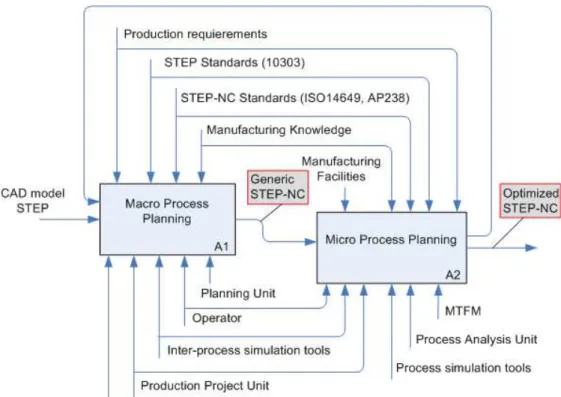
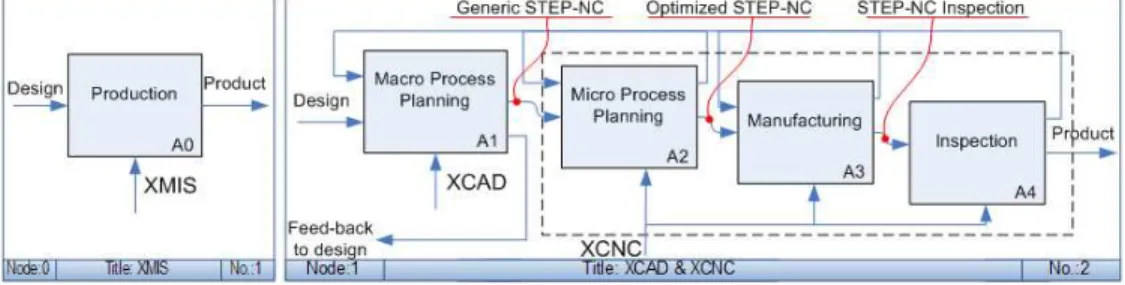
STEP-NC data can be decomposed in generic and native data (Wang et al., 2007). In XMIS, Process Planning activities are distinguished in two major categories (Error! Reference
source not found.):
- Macro Process Planning aims at the processes choices resulting in manufacturing features definition and work planning. In XMIS, the Planning Unit is responsible for Macro Process Planning to treat manufacturing of parts in a multi-process context. The company environment and production requirements lead to consider privileged manufacturing processes to produce a part. Manufacturing features and workplan are closely linked to the processes choices. Macro Process Planning aims at performing an internal loop, helped with inter-process and process planning simulation tools of the Planning Unit, to converge to a manufacturing operations workplan. The related information is supported by generic STEP-NC data, which only depends on process choice. At this stage, it is totally independent from any specific machine tool or manufacturing equipment.
- Micro Process Planning gathers all the activities linked with the choice of the appropriate manufacturing resources and parameters. In XMIS, this is the role of the Process Analysis Unit which gathers specific Process and Inter-process simulation tools. It is linked with the Machine Tool Functional Models (MTFM) of the selected manufacturing facilities. All the information generated is optimized for a manufacturing resource and are supported by optimized STEP-NC data. This relevant information is controlled by Production Project Unit in link with the other departments of the company. A feedback from Micro Process Planning
For Peer Review Only
to Macro Process Planning is enabled. In addition, STEP-NC standard is well adapted for closed loop planning and process analysis as it supports a wide range of object oriented data, from manufacturing features to manufacturing parameters and machine tool functional model (ISO14649-110, 2007). This optimized STEP-NC data can be directly executed on the CNC controller.
3.4 XMIS Manufacturing Information pipeline
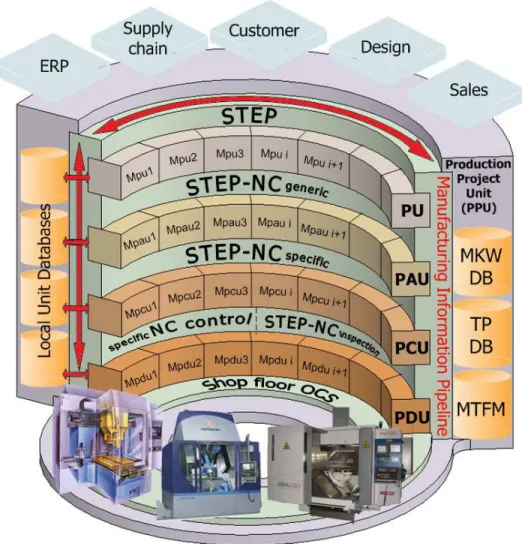
A general view of the XMIS Manufacturing Information Pipeline (MIP) is schematized in
Error! Reference source not found.. A 3D representation of data exchange in the MIP is proposed with the objective to break with the traditional top-down data flow of the current numerical chain. The MIP multi-directional data exchange is supported by standards enabling data exchange horizontally between modules (Mui) of the units, vertically between the units and radially between all the modules and the Production Project Unit which manages data storage and visibility. The modules are integrated in the units in a ‘plug and play’ way. The Unit Interpreter links the computation results of the units with the Production Project Unit Databases. Local Unit Databases store the internal unit computation data in module native standard and can be interpreted in vendor-neutral standards (STEP or STEP-NC) for inter-modules data exchange. The Production Project Unit manages databases shared between the different units (Manufacturing Knowledge Warehouse (MKW), Toolpaths database (TPDB), Machine Tool Functional Model (MTFM)). Data visibility is controlled at the PPU level for units to have access to the relevant information. PPU also manages visibility and security of manufacturing information exchange with all the other stakeholders services of the company (design, sales, supply chain, etc.) and partners (customers, collaborators, etc.). Machining facilities at the shop floor are totally integrated in the numerical chain. The Manufacturing Information Pipeline supports machining control and monitoring from the PCU. From the STEP-NC specific data, PCU directly pilots the machining resources using a STEP-NC compliant Controller. The use of current industrial controllers is also enabled by adapting toolpaths and machining parameters for specific NC control. Quality of the production is measured and validated by the Production Diagnosis Unit. Online and offline Inspection are
For Peer Review Only
supported by ISO 14649 part 16 (ISO14649-16, 2004) also called STEP-NC inspection. Sensor feedback from machine tool to Production Control and Diagnosis Units can be
supported by open communication standards. Experience capitalization and data management are allowed from design to machined part. Hence, the Manufacturing Information Pipeline supports common standardized standards for improving interoperability at every stage of the manufacturing numerical chain.
3.5 Digital Manufacturing Factory with XMIS
The Digital Factory concept is based on a common and integrated data model for global decision making from design to manufacture including maintenance. According to the new paradigms of Digital Manufacturing, Digital Factory and Ubiquitous Manufacturing (Suh et al., 2008), a universal information model has to be able to integrate applications from office level (PLM, ERP, etc.), plant level (Manufacturing Execution System, Quality, Control, etc.) to low level process automation and controls (NC programming, monitoring, inspection, etc.). XMIS is a new step to digital manufacturing factory and offers further possibilities for
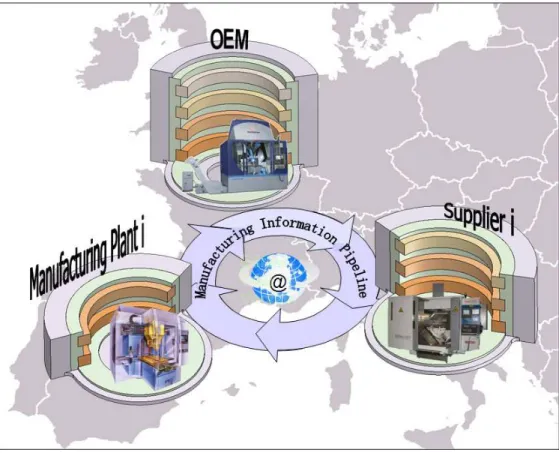
manufacturing Intra-enterprise and Extra-enterprise integration in a global context. In the “Design anywhere, Build anywhere, Support anywhere” paradigm, XMIS is centred around manufacturing integration and compliant with the “Build anywhere” concept (Error!
Reference source not found.).
The Manufacturing Information Pipeline is extended to make the manufacturing company departments collaborate with local shop floors, distant manufacturing plants, subcontractors and suppliers. Standardized data supports (STEP and STEP-NC in XMIS) allow data exchange semantic accuracy and full interoperability. Original Equipment Manufacturers (OEMs) and Small and Medium Enterprises (SMEs) need this link not only at design level but also at manufacturing level. A distributed implementation the XMIS is proposed: only the necessary XMIS Units are locally implemented. Others Manufacturing plants or suppliers get specific combinations of XMIS modules depending on their core competences. For example, the production plant Pi in Poland of a French car manufacturer (OEM) can be implemented with a restricted local shop floor Production Control and Diagnosis Units. Planning and
For Peer Review Only
Process Analysis can be performed in France and shared through the extended MIP. A feedback from shop floor enables real time production management at each level. The integration of suppliers on this model, with respect of the knowledge property managed by PPU, opens new ways of collaborations for conform and cost effective products-services. To conclude, real time connection of machines, devices and people over the Internet is a main capability of XMIS.
3.6 Discussion
The eXtended Integrated Manufacturing System gathers several Units to perform production tasks in the global Product Life-cycle Management. These units assist production from design to manufactured part. The NC programming process is not only top-down: a multi-directional feedback from the modules and devices allow preventive and adaptive correction and
optimizations in interaction with human decision. Rather than physically executing production operations, engineers and operators now capture ideas, develop knowledge and transfer
information. Frontiers between the different departments (CAD, CAPP, CAM, and CNC at the shop floor) are avoided and a totally integrated production system is plebiscited. Thus, an approach based on two sub-systems is proposed in the next part of the paper for implementing XMIS.
4 XCAD and XCNC in XMIS
For a total integration of XMIS, an extended point of view of design and manufacturing activities is adopted. The eXtended Computer Aided Design system (XCAD) and the eXtended Computer Numerical Control system (XCNC) are introduced (Error! Reference
source not found.).
4.1 XCAD
XCAD sub-system gathers all the integrated tools for design, simulation, design for manufacturing (DFM) and macro process planning. It is an extension of the current CAD modules towards the production system. It supports the missing link between design and manufacturing activities. XCAD carries out process planning tasks: manufacturing feature recognition, workplan generation according to design specifications, etc. Design benefits from
For Peer Review Only
the integrated feedback from production planning and execution. Modifications of shapes, tolerances, specifications and costs are allowed in upstream of the numerical chain and integrated with the environments of the company (sales, supply chain, co-realizers, etc.). XCAD integrates the Planning Unit of the XMIS and supports data exchange with STEP and STEP-NC. The output to XCNC is a generic STEP-NC data.
4.2 XCNC
The eXtended CNC is a sub-system of the XMIS that manages all the manufacturing tasks, from micro process choice to quality validation. It supports STEP-NC and integrates the Process Analysis, Control and Diagnosis Units of the XMIS. XCAD and XCNC are
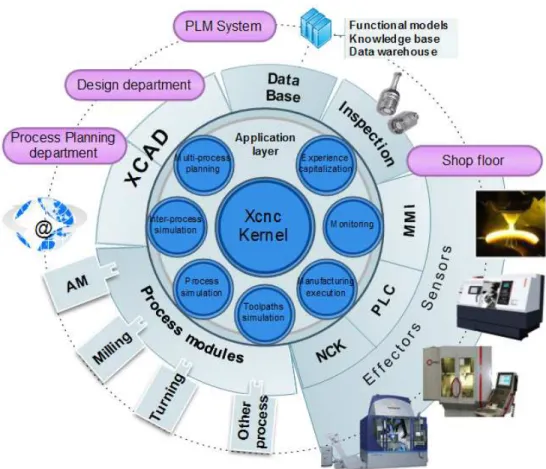
bidirectionally linked with STEP-NC common data exchange. The current CNC controllers are dedicated to machine motion and machining operations execution without any opportunity to be integrated and share data with the higher layers of the production system. In contrast, XCNC is extended to internal and external processing. Internal means in the machine facility at the shop floor. External means linked with micro process planning, process analysis and diagnosis. These two aspects are necessary for a total integration of the CNC in the complete manufacturing systems. Concretely, the XCNC system manages manufacturing analysis, simulation, optimization and execution according to the company environment (Error!
Reference source not found.).
XCNC concept is based on a multi-directional integration of the main components of the numerical chain. Computer Numerical Control is enriched with manufacturing intelligence, computation capability and decision power. The CNC becomes central in the manufacturing numerical chain, as there is no more data break between PLM, Design, Process planning departments and shop floor. XCNC is extendable by the addition of targeted modules to meet specific needs and evolutions of the company. The XCNC Kernel is part of the Process Project Unit. It manages an application layer, which gathers external modules from PAU, PCU and PDU. These modules include process planning simulation, process simulation and inter-process simulation in a multi-process environment (Laguionie et al., 2009). Internal modules for machining execution are linked through MIP: Numerical Control Kernel (NCK),
For Peer Review Only
Programmable Logical Controller (PLC), Man Machine Interface (MMI), Inspection facilities, etc.
An application of the concepts XCNC, XCAD and XMIS is proposed in the next part of the paper.
5 Application of XMIS in the STEP-NC Platform for Advanced and Intelligent Manufacturing (SPAIM)
The eXtended Manufacturing Integrated System concept proposes the integration of
manufacturing in the PLM, based on feature-based manufacturing. An application is given to show a concrete way of implementing XMIS on industrial equipments. After an overview of the tools developed, the structure of the system is presented. A test part is then manufactured to validate and show the possibilities of the system.
5.1 Overview of the SPAIM
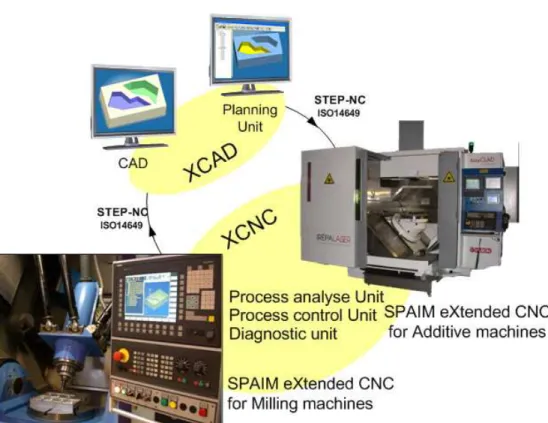
STEP-NC Platform for Advanced and Intelligent Manufacturing (SPAIM) aims to validate and demonstrate the concepts and tools of feature based manufacturing developed at IRCCyN. It is based on STEP-NC programming approaches and is composed of SPAIMXCAD and
SPAIMXCNC sub-platforms (Error! Reference source not found.).
SPAIMXCAD is mainly composed, in the implemented version adapted to the IRCCyN needs, of CAD software and of the Planning Unit modules of XMIS. SPAIMXCNC integrates the modules of Process Analyze, Process Control and Process Diagnosis Units. A software interface developed in Delphi language and has been implemented on the existing CNC controllers of the machine tools. Machining operations can be piloted either from an external computer or directly on the legacy CNC controller. SPAIMXCNC uses STEP-NC ISO 14649
interpreted programming approach (Rauch et al., 2009). The main developments associated with SPAIMXCNC have already been described in a previous work (Laguionie et al., 2009). SPAIMXCNC can be ported on most of the current industrial CNC controllers. In practice, implementations for milling and additive manufacturing processes on the following
For Peer Review Only
- Parallel Kinematic milling machine tool Fatronik Verne, equipped with a Siemens Sinumerik 840D controller (Terrier et al., 2005),
- Huron-Irepa laser powder deposit additive machine, equipped with a Siemens Sinumerik 840D controller.
5.2 Structure of SPAIM
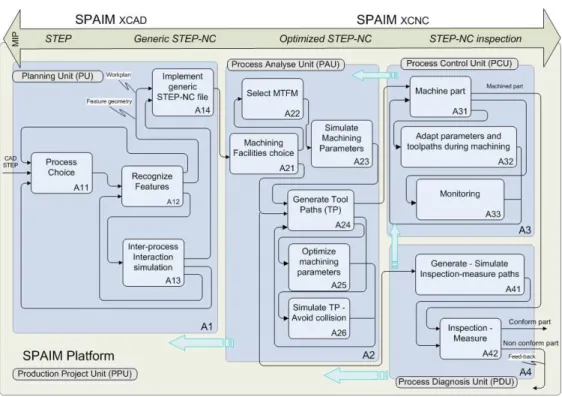
SPAIM platform has been built according to the XMIS concept. An overview of the main units implemented in SPAIM platform is presented in Error! Reference source not found.. SPAIM production project entry is a CAD model (STEP, but other CAD data exchange standards are available such as IGES, Parasolid, etc.).
In the Planning Unit, feature geometry and workplan are generated after a loop between process choice, feature recognition and inter-process interaction simulation. The process choice is initiated by the user. An adapted version of the Korean software tool PosSFP (Suh et al., 2002) is implemented for automatic feature recognition (Laguionie et al., 2008).
Simulation tools for inter-process interaction and optimal process choice are used based on other research works from IRCCyN (Kerbrat et al.). Generic STEP-NC files are implemented with simulated and optimized feature geometry and workplan. Requirements for machining equipment can be added to generic STEP-NC part programs.
The Process Analysis Unit, in link with the PPU and ERP systems, aims at performing simulation and optimization of machining parameters, including toolpaths generation and validations. Thus, these activities are done by a real feed-rate simulation module and a tool compensation module. These modules are based on works done on 3D solid simulation (Dugas et al., 2003) and tool deflection compensation (Suh et al., 1996). From the simulation results, if the requirement cannot be achieved or if problems are detected, a feedback to the PU enables corrections of process choice, workplan and feature geometry.
The Process Control Unit performs online machining from the NC code. Online adaptive and monitoring tools are implemented, based, for example, on the Intelligent Computer Aided Manufacturing (ICAM) concept, which optimizes the machining parameters and toolpaths by using the data available in the NCK and PLC of the controller (Hascoet and Rauch, 2006).
For Peer Review Only
The Process Diagnosis Unit generates, simulates and executes inspection and validation tasks. Feedback from machine sensors and online inspection are used in the PAU. Machining
parameters and toolpaths are adapted or regenerated from inspection data between the manufacturing operations.
Even though a module could work totally automatically, a validation from the user is needed. Indeed, these simulation and optimization modules are developed to assist the user and not to replace him.
5.3 Applications implemented in SPAIM
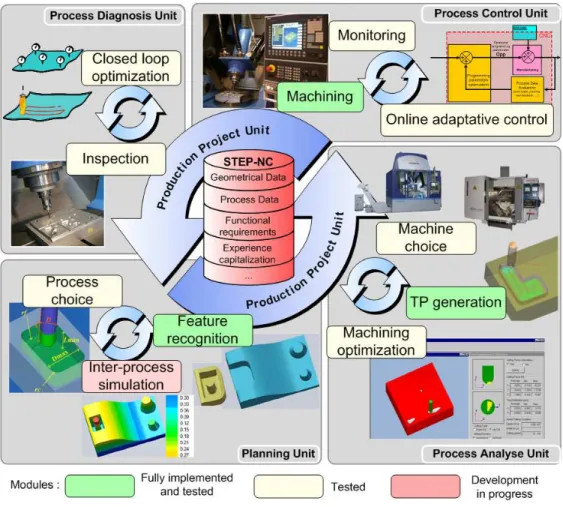
SPAIM has been developed and implemented at IRCCyN in a shop floor composed of several industrial machine tools, CNC controllers and Computer Aided Programming tools. Error!
Reference source not found. shows an overview of the modules that constitute the eXtended
Manufacturing Integrated System of SPAIM platform.
Some modules have been totally implemented, tested and their execution is automated after a user request. For example, to compute milling features, the toolpaths (TP) generation module of Delcam PowerMILL software (PowerMILL, 2010) is automatically controlled from an analysis of STEP-NC data. For additive manufacturing features, toolpaths are generated with the software PowerCLAD (Irepa-laser, 2010), also by using STEP-NC data. All the simulation results are stored in a toolpaths database and can be directly executed on the corresponding machine after user validation. Collision verifications are ensured by the use of the robust industrial software suites (PowerMILL, PowerCLAD) and their integrated verification algorithms. This example shows that the structure of XCNC system is made to integrate the existing industrial tools and competences in the innovating structure of XMIS. The objective is not to reinvent all the components of the manufacturing data chain but to emphasize their communication capabilities. Data information transfer between all the modules are enabled by the use of high level STEP-NC data, even for several processes. In this context, several modules already developed at the IRCCyN have also been tested manually to point out the feasibility of integration in SPAIM, but also to make use cases for the improvement of STEP-NC standard (Laguionie et al., 2010).
For Peer Review Only
A test part was designed to validate and demonstrate the possibilities offered by the SPAIM platform, in particular for manufacturing data exchange and feedback after modifications aspects. The part is composed of pockets, bosses and a hole with counterbore. Computation of this test part with SPAIMXCAD and SPAIMXCNC is presented in Error! Reference source not
found..
From the CAD model of the part, feature recognition module is executed and the generic STEP-NC data are created. For each feature, the manufacturing process parameters are
selected in regards with user experience and process simulation assisting tools. A first test part (#1) was directly machined from the input of STEP-NC data in SPAIMXCNC. It enabled to test
the reliability and demonstrate the feasibility of the proposed approach. Several other tests were done with part geometry and machining parameters modifications. These modifications were applied within the shop floor thanks to XCNC human machine interface (HMI). This could also be done on distant computers which share the SPAIMXCNC application modules.
Two examples of modifications are presented in Error! Reference source not found., the one concerning geometry and the second concerning the manufacturing process. In the first modified part, the rotation of a feature is operated (#2) to show the feasibility of geometry modifications at the shop floor or at the final stages of production engineering process. Data are written back in the STEP-NC file and the part can be machined directly. A feedback to XCAD is enabled based on the modified STEP-NC data. For another test part (#3), the manufacturing operation to produce the two bosses was changed from milling to additive manufacturing. The SPAIMXCNC platform, which is distributed on both milling and additive
manufacturing machines tools, carries out the required operations automatically: toolpaths generation, validation and control. A feedback to macro process planning data in XCAD and inter-process simulation is enabled from the modified STEP-NC data.
5.4 Discussion, perspectives and future works
SPAIM platform stands as an innovative way to implement STEP-NC feature based
For Peer Review Only
completes the existing demonstration tools reviewed in (Xu and Newman, 2006) and proposes a system:
- implemented on current industrial equipments
- enabling shop floor modifications and feed-back to planning and design activities - enabling a unification in multiprocess programming using an eXtended CNC
- proposing a practical implementation of feature based ISO 14649 manufacturing for industrials
The SPAIM platform has been developed as a research tool and helps in contributing to STEP-NC standard improvement. Several feed-back on standard implementation have been proposed to ISO TC184/SC1/WG7 working group on ISO14649 (Laguionie et al., 2010), specially concerning some difficulties found in the definition of complex geometric features with STEP AP224 and STEP-NC ISO14649 Part10. For additive manufacturing, the
implementation showed that the standard is comprehensive enough in its current status to machine simple geometry parts using a process as 5 axis laser powder deposit. In the future, as the research on additive manufacturing will enable new possibilities of multi-material or combination of additive manufacturing with other processes like milling, improvement of the standard will be necessary.
The SPAIM platform has also been developed to demonstrate concrete implementation and interests of feature based manufacturing to industrial partners. This paper shows the basic principles of a proposal for development of an integrated system. Further works aims at proposing a comprehensive, automated and autonomous system. A major step would lead to solve the remaining problems of transparency of current CNC controllers which is still a problem for their total integration in the system. The second main challenge in the future is to be able to provide studies including economic aspects to comfort and give quantitative
advantages of the system proposed. Before that, efforts must be done to properly define industrial needs and qualitative objectives for manufacturing programming. This must include consideration of the human in the system, and specially enabling modifications, decision making possibilities and overall validations at every step of the project.
For Peer Review Only
6 Conclusion
Feature based manufacturing calls for a new consideration of the numerical data chain. The evolution from current programming standards to STEP-NC high-level information is time consuming and involves substantial investments. As the industry has to be a leading actor in this trend, this paper proposes an eXtented Manufacturing Integrated System applied on industrial equipments. The main advantages of this system are the modularity and multi-directional high-level data exchange between the modules. The genericity of STEP and STEP-NC data increases the interoperability between different vendors-specific applications with a significant reduction of the information loss. It also permits to manufacture parts with multi-process operations on a centralized eXtended CNC shared between the different departments of the enterprise. Modifications are made easier, even at shop floor level, to improve the flexibility and the production setting times. XCNC can be distributed among different places, enabling advanced e-manufacturing and production remote control applications. Feedback of the manufacturing data from shop floor to process planning and XCAD opens the way of innovative applications.
Eventually, using a standard is being part of a community. The future of STEP-NC standard will be closely linked with major industrial partners implication in the project. For that, academics and industrials have to work together to demonstrate the actual technical and economic interests of STEP-NC approach. This is still a long way to run but this paper initiate and proposes some concrete developments and possible directions.
Beyond the STEP-NC standard development, this paper proposes concepts and applications contributing to the practical implementation of feature based programming in general. In the future, manufacturing activities and CNC machining have to benefit from the technical and computational advances. New challenges in manufacturing will inevitably lead to evolutions of programming methods and certainly decreasing interest in G-code programming. In this context, feature based programming will be an opportunity to overcome G-code and propose a
For Peer Review Only
new and efficient solution for CNC integration in the design & manufacturing numerical chain.
7 References
Alvi, U. A, Labib and W. A, 2001. Selecting next-generation manufacturing paradigms: an analytic hierarchy process based criticality analysis. London, ROYAUME-UNI, Mechanical Engineering Publications.
Arezoo, B., K. Ridgway and A. M. A. Al-Ahmari, 2000. "Selection of cutting tools and conditions of machining operations using an expert system." Computers in Industry 42(1): 43-58.
Babiceanu, R. and F. Chen, 2006. "Development and Applications of Holonic Manufacturing Systems: A Survey." Journal of Intelligent Manufacturing 17(1): 111-131.
Council, N. R., 1998. Visionary Manufacturing Challenges for 2020, National Academy Press, Washington, D.C. W. National Academy Press, D.C.
Dugas, A., J. J. Lee, M. Terrier and J.-Y. Hascoet, 2003. "Development of a machining simulator considering machine behavior." Proceedings of the Institution of Mechanical Engineers, Part B: Journal of Engineering Manufacture 217(9): 1333-1339.
ElMaraghy, H., 2005. "Flexible and reconfigurable manufacturing systems paradigms." International Journal of Flexible Manufacturing Systems 17(4): 261-276.
Hascoet, J.-Y. and M. Rauch, 2006. A generic method for real time adaptative force control in manufacturing operations using CNC data. International conference on High Speed milling, Suzhou (China).
Irepa-laser. "Irepa-laser Power CLAD." from www.irepa-laser.com/.
ISO6983, 1982. ISO 6983 - International Standard Organization. Numerical control of machines - Program format and definition of address words, TC 184/SC 1.
ISO10303-224, 2006. ISO 10303-AP224 - Industrial automation systems and integration -- Product data representation and exchange -- Part 224: Application protocol:
Mechanical product definition for process planning using machining features, ISO TC 184/SC 4.
ISO10303-238, 2007. ISO 10303-AP238 - Industrial automation systems and integration -- Product data representation and exchange -- Part 238: Application protocol:
Application interpreted model for computerized numerical controllers, TC 184/SC 4. ISO14649-1, 2003. ISO 14649 Part 1 - Industrial automation systems and integration --
Physical device control -- Data model for computerized numerical controllers -- Part 1: Overview and fundamental principles, TC 184/SC 1.
ISO14649-110, 2007. Industrial automation systems and integration -- Physical device control -- Data model for computerized numerical controllers -- Part 110: Machine tool data model for general manufacturing processes, TC 184/SC 1.
ISO14649-16, 2004. ISO 14649 Part 16 - Industrial automation systems and integration -- Physical device control -- Data model for computerized numerical controllers -- Part 16: data for touch probing based inspection.
Iwata, K, Onosato, M, Koike and M, 1994. Random manufacturing system: a new concept of manufacturing systems for production to order. Oxford, ROYAUME-UNI, Elsevier. Jovane, F., Y. Koren and C. R. Boër, 2003. "Present and Future of Flexible Automation:
For Peer Review Only
Kerbrat, O., P. Mognol and J.-Y. Hascoët, "Manufacturing complexity evaluation at the design stage for both machining and layered manufacturing." journal of
manufacturing science and technology 2: 208-215.
Laguionie, R., J.-Y. Hascoet and S.-H. Suh, 2009. A new STEP-NC based CNC interface for High Speed Machining. 12th Conference on Modelling of Machining Operations, San Sebastian, Spain.
Laguionie, R., M. Rauch and J.-Y. Hascoet, 2008. "Toolpaths programming in an intelligent STEP-NC manufacturing context." Journal of Machine Engineering 8(1): 33- 43. Laguionie, R., M. Rauch and J.-Y. Hascoet, 2010. Multi-process research based on STEP-NC
(ISO 14649) at IRCCyN 58th ISO TC 184/SC1 Plenary Meeting. Nantes (France). Laguionie, R., M. Rauch and J.-Y. Hascoet, 2009. Simulation and optimization in a
multi-process environment using STEP-NC. 7th IEE International Conference on Control and Automation, Christchurch, New Zealand.
Michael, J. P., 2001. "Introduction to ISO 10303---the STEP Standard for Product Data Exchange." Journal of Computing and Information Science in Engineering 1(1): 102-103.
Mikell, P. G., 2007. Automation, Production Systems, and Computer-Integrated Manufacturing, Prentice Hall Press.
Ming, X. G., J. Q. Yan, X. H. Wang, S. N. Li, W. F. Lu, Q. J. Peng and Y. S. Ma, 2008. "Collaborative process planning and manufacturing in product lifecycle
management." Computers in Industry 59(2-3): 154-166.
Monostori, L., J. Váncza and S. R. T. Kumara, 2006. "Agent-Based Systems for Manufacturing." CIRP Annals - Manufacturing Technology 55(2): 697-720.
MTConnect, (2010). "MTConnect TM.",Retrieved January 2010, from www.mtconnect.org. Nassehi, A., S. T. Newman and R. D. Allen, 2006. "The application of multi-agent systems for
STEP-NC computer aided process planning of prismatic components." International Journal of Machine Tools and Manufacture 46(2): 559-574.
Panetto, H. and A. Molina, 2008. "Enterprise integration and interoperability in
manufacturing systems: Trends and issues." Computers in Industry 59(7): 641-646. PowerMILL. "Delcam." Retrieved Septembre 2010, from http://www.powermill.com. Pritschow, G., Y. Altintas, F. Jovane, Y. Koren, M. Mitsuishi, S. Takata, H. van Brussel, M.
Weck and K. Yamazaki, 2001. "Open Controller Architecture - Past, Present and Future." CIRP Annals - Manufacturing Technology 50(2): 463-470.
Rauch, M., R. Laguionie and J.-Y. Hascoet, 2009. Achieving a STEP-NC Enabled Advanced NC Programming Environment. Advanced Design and Manufacturing Based on STEP. X. Xu and A. Y. C. Nee, Springer London: 197-214.
Suh, S.-H., J.-H. Cho and H.-D. Hong, 2002. "On the architecture of intelligent STEP-compliant CNC." International Journal of Computer Integrated Manufacturing 15(2): 168-177.
Suh, S. H. and S. U. Cheon, 2002. "A Framework for an Intelligent CNC and Data Model." The International Journal of Advanced Manufacturing Technology 19(10): 727-735. Suh, S. H., J. H. Cho and J. Y. Hascoet, 1996. "Incorporation of Tool Deflection in Tool Path
Computation: Simulation and Analysis." SME J. of Manufacturing Systems 15(3): 190-199.
Suh, S. H., S. J. Shin, J. S. Yoon and J. M. Um, 2008. "UbiDM: A new paradigm for product design and manufacturing via ubiquitous computing technology." International Journal of Computer Integrated Manufacturing 21(5): 540 - 549.
Terrier, M., M. Gimenez and J. Y. Hascoet, 2005. "VERNE - A five-axis parallel kinematics milling machine." Proceedings of the Institution of Mechanical Engineers, Part B: Journal of Engineering Manufacture 219(3): 327-336.
Vichare, P., A. Nassehi, S. Kumar and S. Newman, 2009. "A Unified Manufacturing Resource Model for representing CNC machining systems." Robotics and Computer Integrated Manufacturing 25(6): 999-1007.
Wang, H., X. Xu and J. D. Tedford, 2007. "An adaptable CNC system based on STEP-NC and function blocks." International Journal of Production Research 45(17): 3809 - 3829.
For Peer Review Only
Wosnik, M., C. Kramer, A. Selig and P. Klemm, 2006. "Enabling feedback of process data by use of STEP-NC." International Journal of Computer Integrated Manufacturing 19: 559-569.
Xu, X., P. Klemm, F. Proctor and S. Suh, 2006. "STEP-compliant process planning and manufacturing." International Journal of Computer Integrated Manufacturing 19: 491-494.
Xu, X. W. and S. T. Newman, 2006. "Making CNC machine tools more open, interoperable and intelligent--a review of the technologies." Computers in Industry 57(2): 141-152. Xu, X. W., H. Wang, J. Mao, S. T. Newman, T. R. Kramer, F. M. Proctor and J. L.
Michaloski, 2005. "STEP-compliant NC research: The search for intelligent CAD/CAPP/CAM/CNC integration." International Journal of Production Research 43(17): 3703-3743.
Yeung, C.-H., Y. Altintas and K. Erkorkmaz, 2006. "Virtual CNC system. Part I. System architecture." International Journal of Machine Tools and Manufacture 46(10): 1107-1123.
For Peer Review Only
Fig. 1 : The eXtended Manufacturing Integrated System (XMIS) in PLM environment 208x139mm (96 x 96 DPI)
For Peer Review Only
Fig. 2 : Generic and optimized STEP-NC data in XMIS 157x118mm (96 x 96 DPI)
For Peer Review Only
Fig. 3 : XMIS Units and Manufacturing Information Pipeline 212x210mm (96 x 96 DPI)
For Peer Review Only
Fig. 4 : XMIS for “Build anywhere” 220x175mm (96 x 96 DPI)
For Peer Review Only
Fig. 5 : XCAD and XCNC in XMIS 218x56mm (96 x 96 DPI)
For Peer Review Only
Fig. 6: Overview of the eXtended CNC (XCNC) concept 174x147mm (96 x 96 DPI)
For Peer Review Only
Fig. 7 : STEP-NC Platform for Advanced and Intelligent Manufacturing 168x123mm (96 x 96 DPI)
For Peer Review Only
Fig. 8 : Overview of the SPAIM structure 275x189mm (96 x 96 DPI)
For Peer Review Only
Fig. 9 : SPAIM main implemented modules 244x216mm (96 x 96 DPI)
For Peer Review Only
Fig. 10 : Test part computation in SPAIM platform 198x119mm (96 x 96 DPI)
For Peer Review Only
Dear Dr. Laguionie,Manuscript ID TCIM-2010-IJCIM-0173 entitled "An eXtended Manufacturing Integrated System for feature based manufacturing with STEP-NC" which you submitted to the International Journal of Computer Integrated Manufacturing, has been reviewed. The comments of the reviewer(s) are included at the bottom of this letter.
The reviews are in general favourable and suggest that, subject to minor revisions, your paper could be suitable for publication. Could you please consider these suggestions and I do hope that you will wish to revise and re-submit.
To revise your manuscript, log into http://mc.manuscriptcentral.com/tcim and enter your Author Center, where you will find your manuscript title listed under "Manuscripts with
Decisions." Under "Actions," click on "Create a Revision." Your manuscript number has been appended to denote a revision.
You will be unable to make your revisions on the originally submitted version of the
manuscript. Instead, revise your manuscript and upload and submit it through your Author Centre. Please also highlight the changes to your manuscript within the document by using the track changes mode in MS Word or by using bold or coloured text.
Main changes in the text have been colored red
When submitting your revised manuscript, it will help reassessment if you will please indicate how you have responded to the comments made by the reviewer(s) in the space provided. You can use this space to document any changes you make to the original manuscript. In order to expedite the processing of the revised manuscript, please be as specific as possible in your response to the reviewer(s). Should you disagree with any detail of the review, your counter-argument will be helpful and welcome.
IMPORTANT: Your original files are available to you when you upload your revised manuscript. Please delete any redundant files before completing the submission. Because we are trying to facilitate timely publication of manuscripts submitted to the
International Journal of Computer Integrated Manufacturing, your revised manuscript should be uploaded as soon as possible. If it is not possible for you to submit your revision in a reasonable amount of time, we may have to consider your paper as a new submission. Once again, thank you for submitting your manuscript to the International Journal of Computer Integrated Manufacturing and I look forward to receiving your revision. Sincerely,
Stephen
Prof. Stephen Newman
Editor in Chief, International Journal of Computer Integrated Manufacturing
Reviewer(s)' Comments to Author: Reviewer: 1
For Peer Review Only
First of all, thank you for your comments. Please find next some comments to help you point out the improvements of the paper thanks to your comments. Main changes in the text have been colored red.
1. Is the subject matter of relevance to manufacturing and appropriate to IJCIM? Is it more suitable to another journal?
Yes
2. Is the paper a research contribution, or is it a case study, a review, or a discussion? These latter can be acceptable if they make a contribution in their own right
A case study
3. Does the paper make a new and significant contribution to the literature in its own area? Yes the scope of the study is large enough for the contribution to be unique
4. Does the paper appropriately compare the performance of proposed methodologies with those found in the published literature?
The paper references many alternatives
5. Does the paper provide evidence of real or potential application for advancing manufacturing practice?
Yes the paper describes an application of STEP-NC
6. Is it a report of work done by the author(s) and does it state what the author(s) propose to do in the future?
Yes the work is by the authors. However, the paper is weak/vague on the next steps.
7. Is adequate credit given to other contributors in the field and are references sufficiently complete? (Please indicate any significant omissions.)
Yes
8. Is the character and contents of the paper clear from its title and abstract? Yes
9. Is the paper clearly, concisely, accurately and logically written? Are there any errors? Could it benefit from condensing or expansion? (Please give details.)
Yes
10. Has the paper been written to an acceptable level of English? Yes
Comments to the Author
This paper describes a very ambitious system and it is easy to believe that it has NOT all been fully implemented. Therefore, the paper would be much improved if a chart was given showing to what extent each module has been implemented. Perhaps a distinction between those that have been broadly designed, those that have been designed in detail, those that
For Peer Review Only
have been prototyped, those that have been implemented but not tested, and those that have been fully tested.
Fig 9 has been improved to give the state of implementation of the modules (fully implemented, only manually tested and under development). The paragraph 5.3
(Applications implemented in SPAIM) has been improved and completed to relate the current implementation of the modules. The discussion (§ 5.4) has also been improved to give the future works, and especially concerning the modules implementations, tests and validations.
The conclusion of the paper can then give priorities for what parts of the framework should be implemented next.
The conclusion and discussion sections have been improved in these perspectives. It also highlights the new challenges and scientific problematic to reach such a standard based-manufacturing system, especially in an industrial context.
Reviewer: 2
First of all, thank you for your comments. Please find next some comments to help you point out the improvements of the paper thanks to your comments. Main changes in the text have been colored red.
1. Is the subject matter of relevance to manufacturing and appropriate to IJCIM? Is it more suitable to another journal?
The subject matter is relevant to IJCIM as it describes a framework and implementation of computer integration of planning and execution activities for discrete parts manufacturing.
2. Is the paper a research contribution, or is it a case study, a review, or a discussion? These latter can be acceptable if they make a contribution in their own right
The paper has a minor research contribution component, the eXtended Manufacturing Integrated System (XMIS) architecture, and describes the its implementation. The
architecture will be recognizable to readers and therefore should be helpful to them should they decide to conduct similar research activities. The main contribution is the case study of the implementation. This reviewer found the paper most valuable in lending more support to the standards-based manufacturing approach.
3. Does the paper make a new and significant contribution to the literature in its own area? The architecture is a straightforward arrangement of production activities and is not a novel or unique contribution. The reported work does contribute to the expanding base of
standards-based manufacturing implementations, and is a contribution in that sense.
4. Does the paper appropriately compare the performance of proposed methodologies with those found in the published literature?
The paper is quite weak here. It would be strengthened if it included a review of manufacturing data integration architectures, pointing out some deficiencies using
quantitative measures or anecdotal experiences, and showed how the proposed architecture remedies the deficiencies.
This paper proposes the global concept of manufacturing system and a possible application. It is difficult, at this stage, to have quantitative measures of the improvements. It still need more developments but will certainly be possible in the future. For the moment, the
For Peer Review Only
architecture has been developed to fill in the gap of current systems using standards as STEP-NC. To emphasize this point, the paper has been improved, presenting the general lacks of current production systems approach using STEP-NC in § 2.3 and highlighting the improvement proposed by XMIS in discussion and conclusion.
5. Does the paper provide evidence of real or potential application for advancing manufacturing practice?
Yes, the case study does a good job of showing how feature-based manufacturing can work in practice. Readers undertaking research in this area are likely to come away with some stimulating ideas.
6. Is it a report of work done by the author(s) and does it state what the author(s) propose to do in the future?
The paper is a report of work done by the authors. There is no discussion of future work and the Discussion section is weak, repeating the benefits of standardized data formats and restating the objectives and what was done. The paper would be greatly improved if the results of the work were compared quantitatively or at least narratively with existing approaches.
Discussion section has been improved, including for example status of current modules implementation, future works and narrative (quantitative would need much more developments at this point) highlighting of the contribution of this approach.
7. Is adequate credit given to other contributors in the field and are references sufficiently complete? (Please indicate any significant omissions.)
The references are adequate and a reasonable amount of material is included at the beginning describing the state of practice and related efforts.
8. Is the character and contents of the paper clear from its title and abstract?
Yes, the paper follows the title and abstract. It is indeed a paper on a system that implements feature-based manufacturing using STEP-NC.
9. Is the paper clearly, concisely, accurately and logically written? Are there any errors? Could it benefit from condensing or expansion? (Please give details.)
The narrative treatment is clear but should be expanded with a more complete Discussion section that compares the benefits of their implementation and includes plans for future work.
Discussion section has been improved including future works and benefits of the approach.
The figures can be improved per the second and third paragraphs in the Comments to the Author.
10. Has the paper been written to an acceptable level of English?
The English is acceptable and readers should have no trouble understanding the material. Comments to the Author
Figures 2, 5 and 8 are IDEF-0 activity models. Figure 8 looks like the overall model, and figures 2 and 5 look like pieces. The labeling is inconsistent, for example, A1 is labeled "Generic Planning" in Figure 2 and "Process Planning" in Figure 5. These may be different
For Peer Review Only
activity models, but they can be unified as in Figure 8 and consistent labeling should be used. That way, the reader can refer easily between the various figures.
We made several changes in the paper, especially in fig. 2 and 5, and with the introduction of Macro and micro PP, introduced in 3.3. All the labels are now consistant in fig 2, 5 and 8. The modifications in fig 2 and 5 impacted changes in the corresponding text explanations in 3.3, 4.1, 4.2 and all along the whole text.
The 3-dimensional view of Figure 3 is confusing. It looks like the longitudinal up-down axis is the upstream-downstream direction, while the azimuthal around-the-edge direction is a combination of collections of machines at each step of the pipeline, but also a collection of unrelated labels at the top (PLM, ..., Design). Since it's 3-D, one would assume that the radial direction means something. This should really be a 2-D figure, and the role of Design, PLM etc. should be differentiated from the equipment labels.
We understand that this figure is a little confusing as the objective is really to break a traditional top-down vision of the numerical chain (1 axis vision). The objective is also to show data exchange possibilities in the MIP allowed by standards as STEP-NC. This is where the 3D representation is important : data exchange (represented by white arrows) is enabled between the modules in a same unit (azimuthal around-the-edge axis), between the units (longitudinal up-down axis) but also between all the modules and the Production Project Unit and its databases (radial direction). This is important as Production Project Unit
manages information based on standards and vendors formats and it is really a key point for the success of such a system. To make it more clear, we modified and improved §3.4. The labels at the top were modified in their shape and colors to avoid confusion and represent the other main ‘stakeholders’ of the complete enterprise. All the manufacturing information supported by the MIP can be shared with these ‘stakeholders’ through the Production Project Unit which manages communications and data visibility. §3.4 has also been modified to be more explicit on this subject.
Figures 7, 9 and 10 (and perhaps 6) could be unified so that there is a single overall view that shows the flow of data from design through planning, production and analysis, with relevant standards along the way. It would be most helpful to the reader if the specific standards were highlighted. In Figure 10, for example, the reader would like to know that the output of the CAD activity was a STEP AP-203 file that is input to the CAPP feature
recognition activity, that then outputs STEP AP-224. Since the role of standards is heavily promoted throughout the paper, their appearance throughout the computation activities should be highlighted.
.Fig 7, 9 and 10 have some distinct roles in the paper: Fig 7 is to give a picture of the platform actually working on industrial equipments, Fig 9 is to show a more detailed view of the modules implemented and tested as an application of XMIS, and Fig 10 represent a specific application with a test part. These 3 figures help in the gradual understanding of the implementation and demonstration of the possibilities of the platform. However, figures 6, 7, 9 and 10 have been modified for a better unification of the terms employed and links between them. Fig 9 has been improved by showing the current status of development, implementation and test of the different modules. Fig 10 has been improved to show the standards used in SPAIM at each step, thanks to your comments.
Readers would also like to know if the implementation activity uncovered any problems with the standards. Was ISO 14649 sufficient for the additive manufacturing test? What was missing? One of the most valuable contributions of the reported work can be comments to the responsible standards bodies that lead to improved revisions.
For Peer Review Only
Discussion section has been improved including comments about the standards
implementation, including additive manufacturing. Some proposals are regularly made to the ISO committees based our implementation works.
What will happen to the SPAIM implementation of the eXtended Manufacturing Integrated System? In the Conclusion, the reader would expect to learn that, for example, SPAIM is being commercialized, or being proposed as a unifying architecture through ISO or another standards body. If the role of SPAIM is to demonstrate that the tested standards are
sufficient to support implementation, but SPAIM is not expected to live on, then that should be made clear.
Conclusion and discussion section have been improved thanks to your comments. SPAIM is not currently developed to be commercialized, but more as a demonstration tool for industrial implementation of standards as STEP-NC.
Editor Comments
1. Please revise your paper and respond to the referees comments in a separate .doc file and submit this with the revised manuscript.
2. Please check your references are in IJCIM format as they should be alphabetical not numbered. Use the authors names in the text ie (Newman, 2007) Also please check the journal website
http://www.informaworld.com/smpp/title~content=t713804665~db=all
The references have been reformatted in accordance to IJCM template (Both in text and reference section).
3. Please check for IJCIM appropriate references as well. You currently have only a few references from IJCIM or none.
3 IJCM references were added. There are now 4 references from IJCM
4. Please resubmit your paper in 3 (THREE) .doc word files formatted in SINGLE Column representing the paper Text, Figures and Tables. Also add the response to referees as an additional file as identified in 1. above.
Also note that second reviews are undertaken much quicker and at present IJCIM has a 3 month paper acceptance to publication queue, thus your paper should be published in 3 or 4 months once accepted.
I look forward to receiving your revision. Best Regards