HAL Id: hal-00471313
https://hal.archives-ouvertes.fr/hal-00471313
Submitted on 29 Oct 2014
HAL is a multi-disciplinary open access
archive for the deposit and dissemination of
sci-entific research documents, whether they are
pub-lished or not. The documents may come from
teaching and research institutions in France or
abroad, or from public or private research centers.
L’archive ouverte pluridisciplinaire HAL, est
destinée au dépôt et à la diffusion de documents
scientifiques de niveau recherche, publiés ou non,
émanant des établissements d’enseignement et de
recherche français ou étrangers, des laboratoires
publics ou privés.
Aggregation of probabilistic PCA mixtures with a
variational-Bayes technique over parameters
Pierrick Bruneau, Marc Gelgon, Fabien Picarougne
To cite this version:
Pierrick Bruneau, Marc Gelgon, Fabien Picarougne. Aggregation of probabilistic PCA mixtures with
a variational-Bayes technique over parameters. IEEE/IAPR Int. Conf. on Pattern Recognition, Aug
2010, Istambul, Turkey. pp.702 - 705. �hal-00471313�
Aggregation of Probabilistic PCA mixtures
with a variational-Bayes technique over parameters
Pierrick Bruneau
1,2, Marc Gelgon
1,2, Fabien Picarougne
2(1) INRIA Atlas - (2) LINA (UMR CNRS 6241) - Nantes university, France.
[email protected]
Abstract
This paper proposes a solution to the problem of aggre-gating versatile probabilistic models, namely mixtures of probabilistic principal component analyzers. These models are a powerful generative form for capturing high-dimensional, non Gaussian, data. They simulta-neously perform mixture adjustment and dimensional-ity reduction. We demonstrate how such models may be advantageously aggregated by accessing mixture pa-rameters only, rather than original data. Aggregation is carried out through Bayesian estimation with a specific prior and an original variational scheme. Experimental results illustrate the effectiveness of the proposal.
1. Introduction
This paper proposes an effective and original solution to the problem of aggregating versatile probabilistic mod-els, namely mixtures of probabilistic principal compo-nent analyzers (MPPCA hereafter [8]). The contribu-tion of the paper is a demonstracontribu-tion of how this aggrega-tion can be conducted by accessing only the parameters of the models to merge, rather than the original data. Probabilistic PCA (PPCA) is a dimensionality reduction
technique that extends standard PCA with the follow-ing advantages : a) since a probabilistic model is fit to the data, Bayesian inference may be applied, in partic-ular to determine the appropriate model complexity; b) mixtures of such PPCA components may be built and estimated, to capture high dimensional data sets sup-ported by non linear manifolds. Let us emphasize that Bayesian MPPCAs enable the number of parameters to grow only as required by intrinsic data complexity re-quires. This is typically much lower than the number of parameters of Gaussian mixture model with high-dimensional covariance matrices. As a result, MPPCA models have better resilience to the curse of dimension-ality.
This paper deals with the aggregation of such models, providing a central tool to growing needs for perform-ing pattern recognition on distributed data sources, mo-tivated by infrastructures such as peer-to-peer, grids or sensor networks. Our scheme focuses on statistical learning of global data models through the aggregation of a set of local, parametric models, and its main fea-tures are as follows:
• motivated by low computational or network-load cost, or for protecting confidentiality of individual data entries, our proposal is designed so that only model parameters need be accessed to aggregate mixtures of PPCA. In other words, the scheme op-erates on the components of the mixtures to aggre-gate, rather than original data.
• aggregation of a set of MMPCA models consists in their addition, followed by a ”compression” phase that seeks an optimal combination of mix-ture components. A central issue to mixmix-ture aggre-gation is the determination of the number of com-ponents. We formulate it as Bayesian estimation and show how EM-like variational inference can address it. While this generalizes recent work [4] from GMMs to MPPCA, iterative update equations have to be largely reconsidered.
Section 2 recalls Probabilistic PCA and its extension to mixtures of PPCA; we then sketch an associated variational-Bayes estimation. Section 3 first discloses how mixtures of PPCA may be extended to handle com-ponents and presents a novel estimation scheme for this model. Section 4 provides experimental results.
2. Mixtures of Probabilistic Principal
Components Analysers (MPPCA)
2.1
A probabilistic view to the PCA
Principal Component Analysis is a popular, baseline technique for dimensionality reduction. Given a
d-dimensional data set, the principal subspace is gener-ally obtained by diagonalizing the sample covariance, i.e. by seeking an eigendecomposition of this d× d ma-trix. Tipping [9] proposed an alternative, probabilistic framework to PCA, based on the assumption that every data item y is generated by transforming a zero mean unit variance q-dimensional variable x (q < d) with ad-ditive isotropic noise.
y= Λx + µ + ǫ (1)
Let us define the associated probability density func-tions (pdf ) : p(y|x) = N (Λx + µ, σ2I d) (2) p(x) = N (0, Iq) (3) p(ǫ) = N (0, σ2I d) (4)
Results for linear Gaussian models [3] provide the fol-lowing marginal distribution for y :
p(y) = N (µ, ΛΛT+ τ−1I
d) (5)
where τ = σ−2. Λ is a d × q matrix, usually known
as the factor matrix. Later we denote C = ΛΛT +
τ−1Idfor concision. ML estimates forΛ were proven
to span the principal subspace of the data sample [9]. This estimate has no closed-form solution, but may be obtained through an iterative scheme. More precisely, update formulas can be derived for each parameter by differentiation, leading to an EM-like algorithm [9]. The ML solution obtained for the PPCA model is up to
an arbitrary rotation matrix. Still, this matrix can be recovered by diagonalizingΛT
M LΛM L[9], with limited
computational overhead as this matrix is q× q. Post-multiplyingΛM Lby this rotation matrix allows us to
obtain the scaled eigenvectors for our subspace, ordered by decreasing magnitude.
2.2
Handling a mixture of PPCA
The framework presented in paragraph 2.1 is naturally extended by introducing a latent variable z indicating the membership of a data item to a PPCA model (called component hereafter). A set of weights{ωk} is
associ-ated with K components to describe the relative impor-tance of components. z is a binary one-of-K variable, meaning that if any item y belongs to the component k, then zk = 1 and zj = 0, ∀j 6= k. Thus, a multimodal
density is fitted on the data set, and each component of the mixture density determines its principal subspace. For a data item, the associated pdf is:
p(z) = K Y k ωkzk p(y|z) = K Y k N (y|µk, Ck)zk (6) p(y) = K X k ωkN (y|µk, Ck) (7)
Consequently, a data set y= {y1, . . . , yN} has a
likeli-hood function defined as follows : p(y) = N Y n K X k ωkN (yn|µk, Ck) (8)
An iterative scheme can be obtained by differentiation, by analogy to the one-component case. ML estimation was addressed in [9], leaving open the target number of components K and the number of factors in each component q. Besides, like most ML approaches, it suffers from local minima and degeneracies issues ([3], ch.9,11). Closely related to our proposal, a variational-Bayes scheme was proposed for the single component PPCA [2] and the mixture of Factor Analysers [1, 6] . Factor Analysers and PPCA are very closely related models, but with sensibly different properties, discussed in [8]. Briefly stated, the design of variational algo-rithms enables them to overcome the ML defects indi-cated above. Using a Bayesian integration of the prob-lem with proper uninformative priors, a tradeoff be-tween desired properties (here, having a low number of components and factors per component) and the data likelihood is performed. This integrand is intractable, and an approximate solution is inferred by lower bound-ing usbound-ing variational distributions. Update formulas are obtained from functional calculus. This leads to an al-gorithm which general form is akin to the commun ML EM-like algorithm, but which optimizes against distri-butions instead of parameter values.
Uninformative priors and suitable initialization strate-gies are employed to perform the automatic choice of K and q. Beal [1] proposes a birth and death strategy to address the automatic choice of K. This same prob-lem was solved using a Dirichlet prior which favors a minimal number of effective components in [3], ch.11. q is found using Automatic Relevance Determination (ARD) [7]. More specifically, each factor has a zero-mean, normal prior, with a Gamma prior defined over its precision. If a factor plays no role in explaining data, the precision of the normal posterior will be driven to 0 by the Gamma posterior. This factor can then be dis-carded.
3. Aggregating MPPCA models
from their parameters
Let us now consider our input to be an existing MPPCA model. This mixture might be redundant (i.e. lapping or excessively numerous components, or over-complex factor matrices), for example if obtained from the aggregation of different sources of the same under-lying signal - which is our target application. In this sec-tion, we show first how such an input can be seen as the
limit representation of a virtual data set. Then, we in-corporate this representation in the algorithm sketched in section 2.2 in replacement of an ordinary data set. As a result, we obtain the low complexity model that best fits the data which would have been generated from the input mixture, without resorting to the data itself or any sampling scheme. Consider a sample originating from an arbitrary input PPCA mixture having L components. We denote this sample y= {ˆyl}, where ˆylis the subset
of items associated with the PPCA component l. The conditional likelihoodL of this data with respect to an output mixture (indexed by k) may be expressed as:
L(y|z) = L Y l K Y k [p(ˆyl|ωk, µk, Ck)] zlk (9)
This formulation is made under the assumption that all data generated from a component in the input mixture will be assigned to the same component in the output mixture. This assumption generally holds as an ag-gregation task is mostly about regrouping input com-ponents optimally. Expanding the log of the previous expression provides : ln L(y|z) = ln L Y l K Y k |ˆyl| Y j N (ylj|ωk, µk, Ck)z lk (10) ln L(y|z) = L X l K X k zlk |ˆyl| X j ln N (ylj|ωk, µk, Ck) = L X l K X k zlkln Llk
We now perform an asymptotical approximation [10]:
ln Llk= |ˆyl| X j ln N (ylj|ωk, µk, Ck) (11) ≃ N ωl X j ln N (ylj|ωk, µk, Ck) (12) ≃ N ωl[−KL(N (µl, Cl) k N (µk, Ck) − H(N (µl, Cl)] (13) where KL denotes the Kullback-Leibler divergence and H the entropy. Since these quantities have closed forms for Gaussians, we obtain :
ln Llk= N ωl[ d 2ln(2π) + 1 2det(ΛkΛ T k + τk−1Id) +1 2Tr((ΛkΛ T k + τk−1Id)−1 [ΛlΛTl + τl−1+ (µl− µk)(µl− µk)T)])]
In the remainer of the paper, we discard the influence of τl−1, as the ML value of this term embodies the small-est eigenvalues of the respective components. Since ΛlΛTl = P jΛ .j l Λ .j l T
, we may describe ln L as the combined likelihood of the means and factors of our in-put components (up to a correct normalization, and with respective means µkand 0).
Llk ≡ [N (µl|µk, Ck)
Y
j
N (Λ.jl |0, Ck)]N ωl (14)
Let us underline that our asymptotical approximation leads to a likelihood term with no dependence on an input data set, solely relying on the parameters of the input MPPCA. Furthermore, the functional form of the Gaussian is preserved, allowing the usual derivation of a lower bound that founds the variational algorithm [1, 2, 4]. Combining result (14) with (8) :
p(y) = L Y l K X k ωkN (µl|µk, Ck) q Y j N (Λ.j l|0, Ck) N ωl (15) We may introduce the latent variables x, as the covari-ance matrices in (15) permit it. In the classical scheme [1, 8], there is a single variable x per item. Now, each input component is associated with1 + q items, so x scales accordingly : p(y) = L Y l K X k (ωk Z dx1lp(x1l)N (µl|Λkx1l+ µk, τk−1Id) q Y j Z dx2ljp(x2lj)N (Λ.jl|Λkx2lj, τk−1Id))N ωl (16)
The lower bound formulation proposed in [1] is em-ployed with (16) as its likelihood term, and this leads to a tractable set of update formulas. Thorough mathe-matical and implementation details may be found in [5] In section 2.2, we mentioned the usage of uninforma-tive priors. These are still used here, but we may also jointly exploit some prior knowledge. Indeed we no-ticed that the standard estimation procedure was able to recover the scaled eigenvectors ordered by decreasing magnitude in the columns ofΛM L. We also remark that
the additional latent variables are associated with the columns of theΛ input matrices. Under the assumption of appropriately ordered inputΛ, intuitively we would associate the first column of the inputΛ to the first col-umn of the outputΛ and so on. As x variables denote the combination of columns ofΛ, we therefore choose to initialize x2.. estimates to canonical vectors, so as to reflect this belief. Experimentally this principle was found to improve the results very significantly.
● ● ● ● ● ● ● ● ● ● ● ● ●● ● ● ● ● ● ● ● ● ● ● ● ● ● ● ● ● ● ● ● ● ● ● ● ● ● ● ● ● ● ● ● ● ● ● ● ● ● ● ● ● ● ● ● ● ● ● ● ●● ● ● ● ● ●● ● ● ● ● ● ● ● ● ● ● ● ● ● ● ● ● ●● ● ● ● ● ● ● ● ● ● ● ● ● ● 1) 3) 4) 2)
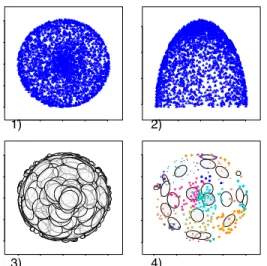
Figure 1. 1) Hemisphere data seen from above and 2) seen from one side. 3) Concatenation of several MPPCAs, form-ing the input for our algorithm. 4) Re-sult after aggregation, represented along with some data points. Gaussian com-ponents are represented by ellipses, with their background color indicating the re-spective weights.
4
Experimental results
We report experimental results on two synthetic data sets (one clustering-oriented, one with a non-linear mani-fold):
• a mixture of 3 multivariate Gaussians with ran-dom covariance matrices. The sample is produced from 2D Gaussians, and 6 additional dimensions are generated by various linear combinations of the 2D signal with additive noise.
• a hemisphere. For sampling each point, random angles and additive noise are chosen (fig. 1) For each data set, 3000 points are sampled and :
• subsamples of 300 points are randomly selected. A MPPCA model is fitted to each subsample (fig. 1);
• the first experiment is repeated 100 times. We monitor the number of clusters, and more impor-tantly, the dimensionality of the subspace discov-ered for each cluster. Indeed, our ground truth tells us we should find 2D manifolds;
• we assess our aggregation technique by choosing randomly 20 models and using them as an input
(fig. 1). This experiment is repeated 50 times. The quality of the obtained models will be assessed by monitoring the cluster subspaces dimensionality, and the Jensen-Shannon divergence between the model aggregation and the model obtained using the whole data set.
Correctly, 2D subspaces are always detected for all our clusters when fitting MPPCA to the subsamples. After the aggregations, this property is preserved. 3 clusters are always detected for the 2D Gaussians subsamples, and after aggregations these 3 clusters are found again. 15.2 clusters are found on average when fitting MPPCA to hemisphere subsamples. Aggregations of these mod-els produce22.1 clusters on average, thus validating the parsimony property.
We use J S(model1kmodel2) to denote the Jensen-Shannon divergence between two models. This diver-gence measure is a symmetrized and normalized vari-ant of the KL divergence. J S(model1kmodel2) ∈ [0, 1], and values below 0.2 generally indicate very similar distributions. For the 2D Gaussians and the hemisphere data sets, we respectively have J S(aggregationkfull data) = 0.15 and 0.20 on average, indicating strong similarity.
References
[1] M. J. Beal. Variational Algorithms for approximate
in-ference. PhD thesis, University of London, 2003.
[2] C. M. Bishop. Variational principal components.
Pro-ceedings of 9th ICANN, 1:509–514, 1999.
[3] C. M. Bishop. Pattern Recognition and Machine
Learn-ing. Springer, New York, 2006.
[4] P. Bruneau, M. Gelgon, and F. Picarougne. Parsi-monious reduction of Gaussian mixture models with a variational-Bayes approach. Pattern Recognition, 43:850–858, March 2010.
[5] P. Bruneau, M. Gelgon, and F. Picarougne. A variational algorithm for PPCA mixtures aggregation. Technical report, INRIA, available during Feb. 2010.
[6] Z. Ghahramani and M. J. Beal. Variational inference for Bayesian mixtures of factor analysers. Advances in
Neural Information Processing Systems, 2000.
[7] D. MacKay. Probable networks and plausible predic-tions — a review of practical Bayesian methods for su-pervised neural networks. Network: Computation in
Neural Systems, 6:469–505, 1995.
[8] M. E. Tipping and C. M. Bishop. Mixtures of proba-bilistic principal component analyzers. Neural
Compu-tation, 11(2):443–482, 1999.
[9] M. E. Tipping and C. M. Bishop. Probabilistic princi-pal component analysis. Journal of the Royal Statistical
Society - B Series, 61(3):611–622, 1999.
[10] N. Vasconcelos. Image indexing with mixture hierar-chies. Proceedings of IEEE Conference in Computer