HAL Id: hal-01572114
https://hal.archives-ouvertes.fr/hal-01572114
Submitted on 4 Aug 2017
HAL is a multi-disciplinary open access
archive for the deposit and dissemination of
sci-entific research documents, whether they are
pub-lished or not. The documents may come from
teaching and research institutions in France or
abroad, or from public or private research centers.
L’archive ouverte pluridisciplinaire HAL, est
destinée au dépôt et à la diffusion de documents
scientifiques de niveau recherche, publiés ou non,
émanant des établissements d’enseignement et de
recherche français ou étrangers, des laboratoires
publics ou privés.
Real-Time 20 and 25 Gbit/s Pre-Equalized C-band
Transmission With Electrical Duo-binary Detection
Justine Konopacki, Bertrand Le Guyader, Naveena Genay, Luiz Anet Neto,
Fabienne Saliou, Sylvain Barthomeuf, Philippe Chanclou, Didier Erasme
To cite this version:
Justine Konopacki, Bertrand Le Guyader, Naveena Genay, Luiz Anet Neto, Fabienne Saliou, et al..
Real-Time 20 and 25 Gbit/s Pre-Equalized C-band Transmission With Electrical Duo-binary
Detec-tion. ECOC, Sep 2017, Gothenburg, Sweden. �hal-01572114�
Real-Time 20 and 25 Gbit/s Pre-Equalized C-band
Transmission With Electrical Duo-binary Detection
J. Konopacki(1-2), B. Le Guyader(1), N. Genay(1), L. Anet Neto(1), F. Saliou(1), S. Barthomeuf(1),P. Chanclou(1), D. Erasme(2) (1)
Orange Labs, 2 avenue Pierre Marzin 22307 LANNION, France, [email protected] (2)
LTCI, Télécom ParisTech, Université Paris-Saclay, 75013 PARIS, France
Abstract We experimentally demonstrate real-time C-band transmissions with up to 29 dB optical
budget after 25 km propagation at 20 Gbit/s and 25 Gbit/s. Our solution uses pre-equalization and electro-optical components dedicaded for 10 Gbit/s transmissions.
Introduction
Currently deployed G-PON1 (Gigabit capable Passive Optical Network) is based on the transmission of NRZ (Non Return to Zero) through direct intensity modulation of a laser source and direct detection at the receiver side. The NG-PON2 (Next Generation Passive Optical Network) standard has been recently defined by ITU-T1 (International Telecommunications Union) still based on NRZ modulation and combines both TWDM (Time and Wavelength Division Multiplexing). Presently, IEEE (Institute of Electrical and Electronics Engineers) and FSAN (full Service Access Network) / ITU-T are preparing new standards based on 25 Gbit/s modulated channels2. Whatever the technology chosen optical access equipment must remain low-cost.
In such a context, optical components previously designed for 10 Gbit/s operation exploiting spectrally efficient modulation formats such as EDB (Electrical Duo-Binary) or PAM (Pulse Amplitude Modulation) have been considered3,4. In association with low chirp transmitters such as EML5 (Electro-absorption Modulated Laser) and with electrical equalization6, those formats help to mitigate CD (Chromatic Dispersion) related system degradations.
In this paper, we demonstrate a real-time EDB reception scheme operating up to 25 Gbit/s in the C-band and using optical devices designed for 10 Gbit/s operation. We use a DML (Directly Modulated Laser) and an APD (Avalanche PhotoDiode) dedicated for 10 Gbit/s transmissions. Different emission formats are assessed: either a straightforward NRZ signal or an EDB signal combined (or not) with pre-equalization to improve performances at the Tx (transceiver) side. In both cases, EDB detection is used, combined (or not) with a EDB-to-NRZ converter.
Pre-emphasis based duo-binary
EDB modulation has recently caught the attention of the optical research community for optical access network applications thanks to its capability to increase the bit-rates per wavelength.
The EDB modulation reduces by a factor 2 the signal bandwidth with respect to an NRZ signal at the same data bit-rate. It artificially introduces some controlled intersymbol interference to the signal through a single-tap FIR (Finite Impulse Response) filter. The filter attenuates abrupt transitions such as ”010” and ”101” generating a third level in the eye-diagram. In order to prevent error propagation due to such operation, the original NRZ signal has to be pre-coded7. This is done by means of a simple XOR operation on symbols. When using some PRBS sequences for transmission experiments, it is not necesary to use a pre-coder. Tab. 1 represents a PRBS sequence pre-coded (”Prec” in Tab. 1) and not pre-coded. Then, the sequence is filtered into a EDB one (”EDB” in Tab. 1) thanks to the use of a FIR filter. Using two LA (Limiting Amplifier) on EDB and /EDB combined with a XOR gate as a decoder, makes it possible to recover the emitted sequence when the PRBS sequence is pre-coded. When the PRBS sequence is not pre-coded, the decoder output corresponds to a delayed and inverted version of the emitted sequence. The same phenomenon occurs for all PRBS sequences. Therefore, the precoder can be eliminated in the framework of an experimental evaluation if a PRBS stream is used.
Our first approach to generate a EDB signal is straightforward. We start from a PRBS
PRBS 11001011100101 Prec 00010011110110 x EDB --00-0+++00+0- +0-000++0-000+ LA1 00000011100100 10000011000001 LA2 110010000000001 00100000010000 XOR 11001011100101 10100011010001
Tab. 1: Demonstration of a delay insertion in a duo-binary
sequence and use two coefficients of a commercial 4-tap FFE (Feed Forward Equalizer) in order to create a conventional EDB signal by means of FIR filtering. The remaining two taps are used to improve transmission performance by means of pre-emphasis. A second approach consists in transmitting a standard NRZ signal and using the roll-off of the optical components and transmission channel to generate an EDB signal at the receiver side. In this case, the channel frequency response actually supersides the FIR filter of a conventional EDB transmitter. Furthermore, our 4-tap FFE is also used at Tx to improve performance, but with two extra coefficients compared to the first case. A third approach with a preq-NRZ (pre-equalized NRZ) signal at Tx side and a direct BER measurement at the receiver side is also evaluated in our experiments
Transmission experimental setup
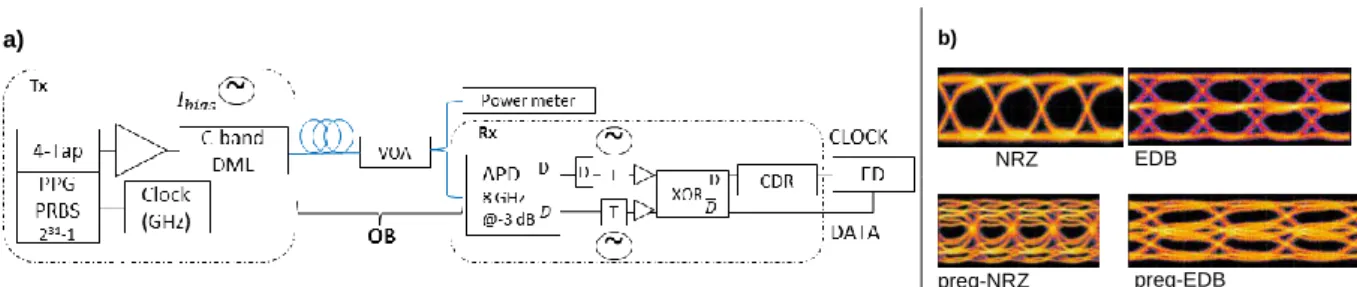
The experimental setup depicted in Fig. 1.a provides some details on the optical emission and reception schemes.
A 231-1 PRBS is generated by a PPG (Pulse Pattern Generator). Four configurations are generated thanks to a 4-tap FFE. First, a NRZ signal is generated at the Tx. In a second approach, the NRZ signal is pre-equalized (preq-NRZ) by adjusting the three other taps. When using the first two taps with the same amplifier coefficients, the NRZ signal is converted into an EDB signal. The other taps are used to optimize the EDB signal (preq-EDB). Electrical eye-diagrams at 20 Gbit/s for the four configurations are depicted in Fig. 1.b. The resulting signal is amplified up to 4.5 Vpp via an RF-amplifier for all cases and is used to directly modulate a 14 GHz electrical bandwidth C-band DML. The latter emits 10.7 dBm for a 110 mA bias current at 1550 nm. Different optical fiber lengths (up to 40 km) are used for the optical transmission and a VOA (Variable Optical Attenuator) allows assessing the maximum attainable OB (Optical Budget) for each scenario.
The receiver consists of an 8 GHz electrical bandwidth APD equipped with an integrated trans-impedance amplifier. When the transmitted signal is a 20 Gbit/s or a 25 Gbit/s NRZ signals, it acts as a filter that transforms this NRZ signal into an EDB one. When a standard EDB signal is transmitted, the APD electrical bandwidth has a reduced influence on the signal. Finally an in-line EDB-to-NRZ converter scheme as explained before processes the received EDB signal. A CDR (Clock and Data Recovery) unit is used to synchronize the ED (Error Detector).
Transmission performances in C-band at 20 and 25 Gbit/s
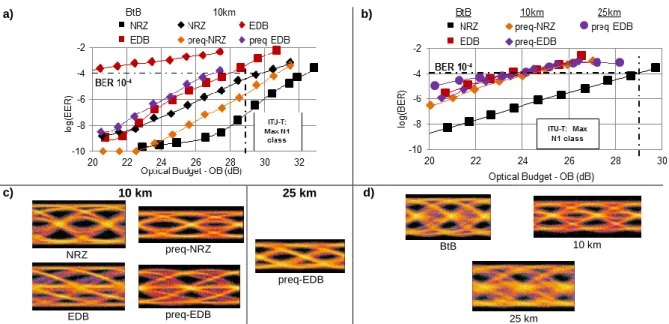
Fig. 2.a and Fig. 2.b represents C-band transmission performance at 20 Gbit/s and 25 Gbit/s respectively. Comparison between the various BER curves will be assessed through the determination of the OB penalty for a BER of 10-4.
The 20 Gbit/s (Fig. 2.a) BtB (Back-to-Back) evaluation is performed with both NRZ and EDB modulation formats. A 4 dB penalty can be observed for the EDB signal as compared to the NRZ. This can be explained by considering the same Vpp for both signal. The OB for the NRZ transmitter is 32.2 dB and is compliant with the legacy XGS-PON (10 Gigabit capable Symmetric Passive Optical Network) N1 class defined by ITU-T. As far as propagation is concerned, the pre-emphasis operation on the NRZ and EDB signals are optimized so as to have an optimum performance at BER 10-4. The NRZ signal can be transmitted over 10 km with 29.6 dB OB without pre-equalization. Introducing pre-equalization, the optimized NRZ signal budget is increased by 1.2 dB to attain 30.8 dB, becoming thus compliant with the N1 class. The same evaluation is made for the EDB and preq-EDB signals exhibiting a 20 dB OB and a 27 dB OB respectively. Introducing pre-equalization on EDB transmission to compensate CD increases significantly the performance. In fact, EDB allows a factor 2 reduction of the signal bandwidth with respect to an NRZ signal,
a) b)
NRZ EDB
preq-NRZ preq-EDB
Fig. 1: a) NRZ, preq-NRZ, EDB and preq-EDB transmission with EDB receiver and EDB to NRZ converter experimental
therefore egalisation is simplified for EDB. For a 10 km propagation, NRZ transmission out- performs EDB since CD and chirp effect are relatively low. BER curves for 25 and 40 km propagation with preq-EDB modulation (not displayed) exhibit 29.2 dB and 24.8 dB (for BER 10-3) respectively. For 25 km propagation and more, CD is predominant. Therefore it is necessary to use a robust modulation format with a reduced spectrum.
Eye-diagrams at 20 Gbit/s measured after detection are displayed in Fig. 2.c. Preq-NRZ with 10 km propagation and preq-EDB with 25 km propagation eye diagrams make it possible to measure the BER directly after the APD. Results are depicted in Tab.2, and show increased performances by +1.8 dB for 25 km propagation.
Fig. 2.b and Fig. 2.d present the transmission performance at 25 Gbit/s and eye-diagrams associated. BtB NRZ transmission reaches 29 dB OB, whereas the EDB is only 23.5 dB. In the case of 10 km propagation preq-NRZ modulation exhibits a 24.4 dB OB. Finally in the case of 25 km propagation, only preq-EDB modulation can be performed and exhibits a 24 dB OB. Performances are lower than with 20 Gbit/s data bit rate. Limiting the optical bandwidth at Tx is not sufficient to permit the
signal to be more robust to CD.
Conclusions and perspectives
In this paper, real-time experimental transmissions at 20 and 25 Gbit/s in the C-band using electro-optical components dedicaded for 10 Gbit/s operation were evaluated. The setup is based on a modulable modulation using a 4-tap FFE. The receiver is based on an EDB detection using an 8 GHz APD followed by a EDB-to-NRZ converter. We demonstrate 20 Gbit/s transmissions up to 25 km with more than 29 dB OB at BER 10-4, compliant with the maximum of the N1 class. At 25 Gbit/s, our system reaches 24 dB OB at BER 10-4 with 25 km propagation, compliant with the N1 class. Performances are worse due to the limited electrical bandwidth of the photodiode used. At 25 Gbit/s, the filtering function of the APD used is too abrupt and thus not adapted to generate the EDB signal. We advocate using a larger electrical bandwidth APD in order to improve performances in this case.
References
[1] D. Nesset, ”PON Roadmap [Invited],” JOCN, VOL.9, NO.1 (2017)
[2] “IEEE P802.3ca 100G-EPON PHY Task Force,” IEEE Std 802.3-2015 (2016)
[3] C. Sun et al., “Transmission of 28-Gb/s Duobinary and PAM-4 signal Using DML for Optical Access Network,” IEEE Photonics Technology Letters (2016)
[4] V. Houtsma et al.,”A Study of Options for High-Speed TDM-PON Beyond 10G,” JLT, VOL.35, NO.4, (2017) [5] D. van Veen et al., ”Symmetrical 25-Gb/s TDM-PON
With 31.5-dB Optical Power Budget Using Only Off-the-Shelf 10-Gb/s Optical Components,” JLT, VOL.34, NO.7, (2016)
[6] Dr. Pulidindi Venugopal et al., ”10Gbps Optical Line Using Electronic Equalizer and its Cost Effectiveness,” IJET, VOL.5, NO.4 (2013)
[7] T. Franck,et al., “Duobinary transmitter with Low Intersymbol Interference,” IEEE PTL, VOL.10, NO.4 (1998) a) b) c) 10 km 25 km d) BtB 10 km NRZ preq-NRZ preq-EDB EDB preq-EDB 25 km
Fig. 2: a) 20 Gbit/s and b) 25 Gbit/s transmissions performances, c) 20 Gbit/s 10 km and 25 km eye diagrams after APD
(100 mV/div - 10 ps/div) and d) 25 Gbit/s eye-diagrams after APD (100 mV/div - 10 ps/div)
Data rate 20 Gbit/s 25 Gbit/s
BtB 32.4 dB NRZ
30 dB w/o decoder 29 dB NRZ
10 km 30.8 dB preq-NRZ
29 dB w/o decoder 24.4 dB preq-NRZ
25 km 29.2 dB preq-EDB
31 dB w/o decoder 24 dB preq-EDB
40 km 24.8 dB preq-NRZ
(BER 10-3)
Tab. 2: Optical budget at BER 10-4 at 20 and 25 Gbit/s with EDB to NRZ decoder