11
thBelgian Day on Biomedical Engineering
December 7, 2012
THE RABBIT LEFT VENTRICLE MODELING AT THE CELLULAR
SCALE: APPLICATION TO FLOW-CLAMP EXPERIMENTS
S. Kosta1, A. Pironet1, P.C. Dauby1
1
University of Liege, GIGA-Cardiovascular Sciences, Liege, Belgium
Abstract
Modeling the cardiac function is often considered using a phenomenological approach, where the cardiac contraction is described macroscopically (at the organ level). However, in this study we use a microscopic approach and describe the rabbit ventricular contraction at the cellular and subcellular levels. This leads to a better description of the ventricle contraction during flow-clamp protocols. Keyword: modeling of physiological systems
1 Method 1.1 The model
In this work, we use a model of the rabbit ventricular myocyte developed by Shannon et al. [2]. This model describes both the electrophysiology and the mechanical contraction of the ventricular myocyte. We then incorporate this cell model into a whole left ventricle model for the rabbit using the mathematical method developed by J. Negroni and E. Lascano [1].
1.2 Flow-clamp
We tested our mathematical model with an experimental protocol called flow-clamp (FC). The excised heart is connected to a perfusion system and the flow through the ventricle is controlled. A sharp drop in ventricular volume (clamp) is applied while the ventricular pressure is measured.
2 Results
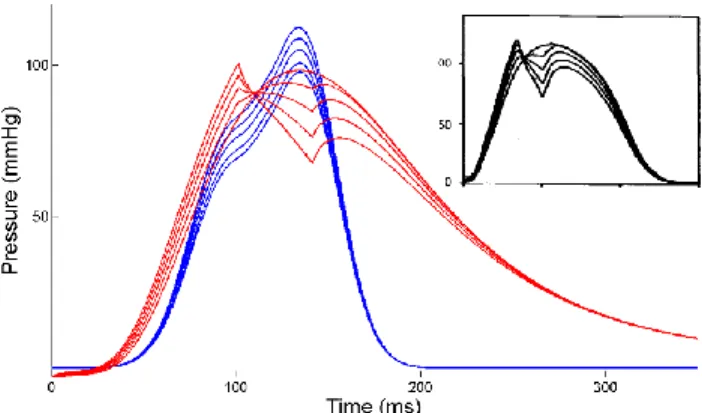
We simulated five FC experiments with our rabbit left ventricle model and the results are presented in Fig. 1 (red curves). The simulation results are in very good agreement with the experimental data [3] (black curves). We also compared our model, based on a microscopic approach, with a commonly used phenomenological model of the heart contraction called the varying elastance model. This model is not based on a cellular description and thus cannot reproduce at the organ scale all the consequences of the microscopic behavior of the myocytes. In particular, FC simulations obtained with this model
do not correctly reproduce the experimental data, as demonstrated by the blue curves in Fig. 1.
Fig. 1: Pressure vs. time during five FC experiments.
Red: simulations results from our model. Blue: simulation results from the varying elastance model. Black: experimental data.
3 Conclusion
We can conclude that our rabbit left ventricle model based on the cellular scale is able to reproduce properties of the cardiac muscle that cannot be observed with the varying elastance model. This suggests that working with phenomenological models can lead to misinterpretation when studying the cardiac function (in a cardiovascular model, for example). It is then preferable to use a cellular model of the heart when developing cardiovascular system models.
References
[1] Negroni, J.A. and Lascano E.C. Concentration and Elongation of Attached Cross-bridges as Pressure Determinants in a Ventricular Model. J
Mol Cell Cardiol.31, 1509-1526, 1999.
[2] Shannon, T.R. et al. A Mathematical Treatment of Integrated Ca Dynamics within the Ventricular Myocyte. Biophys J. 87(5), 3351-3571, 2004.
[3] Wijkstra, H. and Boom, H.B.K. Deactivation in the Rabbit Left Ventricle Induced Constant Ejection Flow. IEEE Transactions on Biomedical