HAL Id: hal-03228501
https://hal.archives-ouvertes.fr/hal-03228501
Submitted on 18 May 2021HAL is a multi-disciplinary open access archive for the deposit and dissemination of sci-entific research documents, whether they are pub-lished or not. The documents may come from teaching and research institutions in France or abroad, or from public or private research centers.
L’archive ouverte pluridisciplinaire HAL, est destinée au dépôt et à la diffusion de documents scientifiques de niveau recherche, publiés ou non, émanant des établissements d’enseignement et de recherche français ou étrangers, des laboratoires publics ou privés.
superstructure reflections
Maxime Dupraz, Steven Leake, Marie-Ingrid Richard
To cite this version:
Maxime Dupraz, Steven Leake, Marie-Ingrid Richard. Bragg Coherent Imaging of nanoprecipitates: role of superstructure reflections. Journal of Applied Crystallography, International Union of Crys-tallography, In press. �hal-03228501�
IMPORTANT: this document contains embedded data - to preserve data integrity, please ensure where possible that the IUCr Word tools (available from http://journals.iucr.org/services/docxtemplate/) are installed when editing this document.
1
Bragg Coherent Imaging of nanoprecipitates: role of superstructure
reflections
Authors
Maxime Duprazab*, Steven J. Leakeb and Marie-Ingrid Richardab
aIRIG MEM NRS, Univ. Grenoble Alpes, CEA Grenoble, 17 Avenue des Martyrs, Grenoble, 38000,
France
b ESRF, 71 Avenue des Martyrs, Grenoble, 38000, France
Correspondence email: [email protected]
Funding information European Research Council (grant No. 818823); Agence Nationale de la Recherche
(grant No. ANR-16-CE07-0028-01); Agence Nationale de la Recherche (grant No. ANR-18-ERC1-0010-01).
Coherent precipitation of ordered phases is responsible for providing exceptional high temperature mechanical properties in a wide range of compositionally complex alloys (CCAs). Ordered phases are also essential to enhance the magnetic or catalytic properties of alloyed nanoparticles. The present work aims at demonstrating the relevance of Bragg coherent diffraction imaging (BCDI) to study bulk and thin film samples or isolated nanoparticles containing coherent nanoprecipitates / ordered phases. Crystals of a few tens of nanometres are modelled with realistic interatomic potentials and relaxed after introduction of coherent ordered nanoprecipitates. Diffraction patterns from fundamental and superstructure reflections are calculated in the kinematic approximation and used as input to retrieve the strain fields using algorithmic inversion. We first tackle the case of single nanoprecipitates and show that the strain field distribution from the ordered phase is retrieved very accurately. Then, we investigate the influence of the order parameter S on the strain field retrieved from the superstructure reflections and evidence that a very accurate strain distribution can be retrieved for partially ordered phases with large and inhomogeneous strains. In a subsequent section, we evaluate the relevance of BCDI for the study of systems containing many precipitates and demonstrate that the technique is relevant for such systems. Finally, we discuss the experimental feasibility of using BCDI to image ordered phases, in the light of the new possibilities offered by the 4th generation
synchrotron sources.
Keywords: Bragg Coherent Diffraction Imaging, molecular statics, nanoprecipitates, ordering, superstructure reflections
2 1. Introduction
Precipitation strengthening with intermetallic compounds is the most effective approach for the enhancement of alloy strength in engineering structural materials, compared with solid-solution strengthening, grain-boundary strengthening, or work hardening (Wang et al., 2018; Gladman, 1999). For instance, the coherent precipitation of ordered L12-γ’ nanoprecipitates into a disordered face centred cubic (FCC)-γ matrix confers to Nickel (Ni)-based superalloys an exceptionally high degree of strength, which is retained at high fractions of their melting point (Van Sluytman & Pollock, 2012). These unique properties are strongly linked to the microstructure of the Ni-based superalloys: due to the ordered nature of the γ’-phase, the dislocations are restricted to the γ-matrix up to a cutting stress. Thereby dislocations are confined in the γ-channels which constrains plastic deformation (Reed 2006). Coherent intermetallic precipitates, especially the L12-γ’ ordered phase, have also demonstrated their efficiency for strengthening and improving thermal stability of Al-alloys (Knipling et al., 2006; Wen et al., 2013). Therefore, it is poignant to investigate precipitation in Al alloys to develop new light-weight materials that can be applied in high-temperature (HT) environments (>300 °C). In High-Entropy Alloys (HEAs), although initially a strong emphasis has been made on alloys with a single solid solution phase structure, the presence of an ordered phase in a solid solution matrix has been shown to be beneficial for obtaining a good combination of strength (including at high temperatures) and ductility (Senkov et al., 2016; Stepanov et al., 2019).
Coherent precipitation is not only the most efficient approach for the enhancement of alloys strength, but also the universal feature shared by all compositionally complex alloys (CCAs) with excellent HT mechanical properties. In particular, the perfect coherence between the ordered phase and the solid solution matrix is crucial for high temperature creep resistant properties of these alloys. In FCC alloys we have seen that the coherent ordered L12-γ’ phase is responsible for the unique HT mechanical properties in many systems. It is observed for instance in the form of Ni3Al nanoprecipitates in Ni-based
binary/ternary alloys (Giamei & Anton, 1985; Reed 2006; Kaufman et al., 1989; Johnson & Voorhees, 1992), Ni/Co-based superalloys (Pyczak et al., 2005; Ding et al., 2018; Charpagne et al., 2016) and HEA alloys (Shun & Du, 2009; Tong et al., 2005) or Al3X (X= Sc, Zr, Er) nanoprecipitates in Al-alloys
(Marquis & Seidman, 2001; Senkov et al., 2008; Booth-Morrison et al., 2011; Wen et al., 2013; Clouet
et al., 2006). In other FCC alloys such as Mg-Si (Andersen et al., 1998; Klobes et al., 2011) and
Al-Cu (Biswas et al., 2011) the maximum hardness is achieved in systems containing very fine (2.5 nm) fully coherent so-called Guinier-Preston zones (GP-I), sometimes in combination with semi-coherent, larger needles b’’ (GP-II) zones (Andersen et al., 1998). In body centred cubic (BCC) alloys on the other hand, precipitation strengthening is typically achieved by the introduction of the B2 ordered phase. In Fe-based alloys, for instance (Ferritic steels), the B2-phase inserted in the form of coherent NiAl nanoprecipitates (Teng et al., 2010; Vo et al., 2014; Jiang et al., 2017; Jiao et al., 2015) confers HT
3 creep-resistant properties of alloys due to the perfect coherence between the ordered phase and the solid solution matrix. The excellent mechanical properties of refractory HEAs (Senkov et al., 2016; Jensen
et al., 2016) or Al-transition metals (TMs) – HEAs (Wang et al., 2016; Ma et al., 2017; Zhang et al.,
2018) can also be attributed to a superalloy-like microstructure: cuboidal B2 NiAl or L21-Ni2AlTi (Song
et al., 2017) nanoprecipitates coherently embedded in the BCC matrix.
Not only the volume fraction, size, and distribution of the precipitates but also their shape have a large impact on the mechanical properties of these alloys, in particular at elevated temperatures. In coherent precipitation, the nanoprecipitates size and shape are highly dependent on the lattice misfit between the ordered phase and solid-solution phase. Hence, in the case of coherent precipitation, control of the lattice misfit between the ordered phase and its parent solid solution is of vital importance to develop high-performance CCAs and improve the resistance to deformation (Wang et al., 2014). In this optic, understanding the influence of the lattice misfit and the resulting elastic (coherency) strains in coherent nanoprecipitates is essential to understand their shape evolution during ageing. In addition, Cahn et al. (Cahn & Lärché, 1982) have shown that the shape of a coherent particle in a solid solution is not only controlled by the lattice misfit but also depends on the chemical interface. The particle equilibrium shape is therefore given theoretically by minimizing the sum of the interfacial energy Ei and of the elastic energy Ee. The former scales with the surface while the latter scales with the volume and is therefore prevailing for larger precipitate sizes (Johnson & Voorhees, 1992; Voorhees, 1992; Thompson
et al., 1994). Therefore, many researchers have been exploring how to maintain the long-term stability
of coherent precipitates through adjusting the amount of alloying elements or changing element species (Zhou, Ro et al., 2004; Lo et al., 2009; Zhou et al., 2017). Ni-based alloys for instance typically possess a finite lattice misfit between the ordered γ’ precipitates and the disordered γ matrix. Due to the elastic stresses associated with the misfit, precipitates undergo an evolution in shape during elevated temperature exposures, Ni3Al precipitates can fission into smaller particles once they reach a critical
size (Miyazaki et al., 1982; Kaufman et al., 1989; Glatzel & Feller-Kniepmeier, 1989) or change in shape with increasing particle size (Ardell & Nicholson, 1966; Doi et al., 1985) in order to minimize their elastic energy. The difficulty to obtain cuboidal or spherical morphology of coherent B2 or L21 precipitates in BCC-based HEAs can also be explained by the large lattice misfit between the B2 and BCC phases. In ferritic alloys on the other hand, the spherical shape of the NiAl precipitates, that is retained even for large precipitate size, indicates the dominance of the interfacial energy and low misfit strain between the matrix and the precipitate (Song et al., 2015). In addition, several theoretical investigations (Ardell & Nicholson, 1966; Voorhees, 1992; Thompson et al., 1994) and computer simulations (Abinandanan & Johnson, 1993; Wang & Mills, 1992; Goerler et al., 2017) have indicated that shape evolution during coarsening is primarily controlled by the minimization of the elastic misfit strain (Ee) and of the interfacial energy (Ei) but can also be strongly modified and even impeded by the elastic interaction between misfitting precipitates. In order to design stable coherent microstructures in different solid-solution matrices it is of great interest to image the elastic strain field created in both;
4 the nanoprecipitates and its matrix, and their evolution during ageing at elevated temperatures. This could give further insight for instance in the elastic interaction between the coherent precipitates and mobile dislocations which not only control the creep rate of these alloys (Larson, 1952) but is also related to the poor ductility of Ni-based alloys at room temperature (Semboshi et al., 2019).
Coherent ordered precipitates are not only responsible for the unique mechanical properties of CCAs but can also have a large impact on the functional (magnetic, catalytic, …) properties of these alloys. For instance chemically ordered L10 alloyed nanoparticles such as FePt (Tzitzios et al., 2005; Klemmer
et al., 2003), CoPt (Kitakami et al., 2001; Klemmer et al., 2002), NiPt (Cadeville et al., 1986) and FePd
(Oshima et al., 1988; Klemmer et al., 2002) attracted much attention for high density magnetic storage applications. In these alloyed nanoparticles, the transition from a disordered A1 phase to an ordered L10 can enhance their magnetocrystalline anisotropy by several orders of magnitude (up to 107– 108
ergs/cm3), the latter being intrinsic to the tetragonal symmetry of the L1
0 crystal structure. In isolated alloyed PtCu3 nanoparticles an enhancement effect of structural ordering for the oxygen reduction
reaction (ORR) was observed. Improved stability and enhanced activity were achieved in a partially ordered catalyst containing a disordered FCC core and a few nanometers thick L12 shell (Hodnik et al., 2012).
Ideally, probing the defect state and elastic strain of individual precipitates requires high spatial resolution as well as high chemical sensitivity. So far, several techniques have been employed to characterise the crystal structure, composition, and crystal orientation of nanoprecipitates. Among them, transmission electron microscopy (TEM), (Bhat et al., 1979; Vo et al., 2014; Knipling et al., 2008; Zhang et al., 2018) atom probe tomography (APT) (Teng et al., 2010; Jiang et al., 2017; Xu et al., 2015; Jiao et al., 2014, 2015), electron backscatter diffraction (EBSD) or X-ray diffraction (XRD) (Wang et
al., 2016) are the most commonly employed. TEM and APT have the advantage of atomic resolution
but are hindered by strong experimental constraints on the sample thickness and environment. These constraints are relaxed when using positron annihilation spectroscopy (PAS) in combination with ab
initio calculations to refine the structures (Klobes et al., 2011). This approach has a chemical sensitivity
and allows to probe the defect state but is not sensitive to the elastic strain field. X-ray diffraction on the other hand shows several advantages: it is non-destructive, highly-strain sensitive, can penetrate a large amount of matter to probe embedded material and is sensitive to ordered phases. The latter feature is essential in order to characterize the strain and defect and strain states of ordered phases. In solid solution alloys, the atomic sites are randomly occupied by chemical elements. Long-range order is absent, and the scattering from such alloys is like the one from monoatomic crystals. In ordered phase alloys on the other hand, a given chemical element occupies one set of positions in the unit cell (for instance the corners) and the other element takes the other set of positions (for instance the cube centre positions). This long-range order gives rise to additional reflections in diffraction patterns known as superstructure reflections. These weak diffraction spots appear between the stronger fundamental reflections at the usual anti-Bragg positions (Warren, 1969) (Figure 1). In this work we aim at using
5 these superstructure reflections in order to characterize the strain fields of coherent nanoprecipitates. To do so, a possible approach is to use Bragg Coherent Diffraction Imaging (BCDI): a lens less imaging technique that uses coherent X-rays in order to reconstruct real space images from the algorithmic inversion (Gerchberg, 1972; Fienup, 1982; Marchesini et al., 2003) of high-resolution reciprocal space data (Robinson & Harder, 2009). In Bragg geometry the technique gives access to the displacement and strain fields of isolated crystals with a good spatial resolution (10 nm) and a very high strain sensitivity (few 10-4) (Labat et al., 2015; Cherukara et al., 2018). It has a great potential for the study of coherent
nanoprecipitates by imaging them using both fundamental and superstructure reflections and answer fundamental questions related to the interaction of dislocations with the elastic strain field of coherent precipitates.
A key limitation of BCDI is that it requires crystallographically isolated nano/micro-crystals in the range of 50 nm to 1 μm; large enough to give a strong scattering signal, but small enough to match the coherence volume of the X-ray beam. Only a small number of materials form crystals that fall into this size range, for example isolated metallic nanoparticles (Dupraz et al., 2017) or metal thin films with grain size in this range (Yau et al., 2017). The technique has therefore a great potential to image the nucleation of ordered phase using both fundamental and superstructure reflection in isolated crystals and fine-grained bulk samples. However, imaging of ordered precipitates embedded in a disordered matrix, is in principle not possible in single crystal bulk or thin film specimens. Using a FIB-based technique (Hofmann et al., 2020), one can manufacture BCDI samples from bulk samples. However, in order to avoid a time consuming and delicate sample preparation, another possibility to image the shape and strain of precipitates is to measure a superstructure reflection that is only sensitive to the ordered phase. If the beam is larger than the precipitates it should be possible to use BCDI to reconstruct a single or an assembly of precipitates.
Here, we use numerical simulations to simulate precipitates embedded inside a matrix and to calculate the scattering from fundamental and superstructure reflections. In a first part, the case of a single coherent ordered precipitate is investigated in extensive details. The second part of the manuscript aims at quantifying the influence of the order parameter S on the strain retrieved from superstructure reflections. Finally, the last section aims to demonstrate the capability of Bragg Coherent Diffraction Imaging (BCDI) to retrieve from superstructure reflections the strain fields inside coherent nanoprecipitates.
2. Modelling / Tools & methods
The alloy considered in this study is a red gold alloy used in the jewellery industry (Plumlee, 2014). The manufacturing of red-gold components (nominal composition: Au, 43.3% at. Cu and 5.6% at. Ag) implies effectively controlling precipitation hardening. During its processing, this alloy typically undergoes a disorder-order transition from a chemically disordered FCC A1 phase (space group 𝐹𝑚3̅𝑚) to an ordered tetragonal (FCT) L10 phase (space group 𝑃4/𝑚𝑚𝑚) (Garcia-Gonzalez et al., 2019). The
6
L10-ordered structure consists of alternate stacking of Au and Cu atoms along the c-axis of the FCT structure.
Two types of configurations are simulated in this study. Periodic boundary conditions are used for both types. The first type of simulation cells consists of spherical nanoprecipitates embedded in a parent matrix phase. The case of single precipitates is tackled in the initial part of the results section while assemblies of precipitates are considered in the last part of the same section. These nanoprecipitates (L10 phase) are coherent with the parent matrix (A1 phase), inducing large misfit strains. The orientation relationship between the nanoprecipitates and the matrix is well defined with three possible L10 variants:
L10 [1 0 1̅] || A1 [1 1̅ 0 ], L10 [1 1̅ 0] || A1 [1 1̅ 0] and L10 [0 1 1̅] || A1 [1 1̅ 0]. In this work, we mostly consider the L10 [1 0 1̅] variant but the L10 [1 1̅ 0] variant is also shown in supporting information S1. Unless otherwise specified, lattice orientations, which correspond with the axes of the simulation cell, are therefore 𝑋𝑝[1 0 1̅], 𝑌𝑝[1 0 1], 𝑍𝑝[0 1̅ 0] and 𝑋𝑚[1 1̅ 0], 𝑌𝑚[1 1 0], 𝑍𝑚[0 0 1] for the L10 and A1 phases, respectively. This configuration is representative of the early stages of precipitation where both the size and spacing of the precipitates are of the order of a few nanometres (Figure 2&Figure 3). Semi-coherent and incoherent precipitates are also investigated in this work. The former are obtained by rotating the precipitates around the 𝑍𝑝 axis. Above a critical angle, the elastic strain can no longer
accommodate the lattice misfit, and interfacial dislocations are formed at the nanoprecipitate/matrix interface (Figure S1). In this case, the interface can be described as semi-coherent. Incoherent precipitates are inserted by further increasing the misorientation between the L10 and A1 phases (supporting information S1). Several crystal sizes are considered in this study. They range from 11 x 11 x 10.9 nm3 to 66.1 x 66.1 x 65.8 nm3 for the cells containing coherent nanoprecipitates, corresponding
respectively to 89,600 and 19,360,100 atoms. The radii of nanoprecipitates range from 0.75 nm to 7.5 nm, which is consistent with the experimental observations (Garcia-Gonzalez et al., 2019).
The second type of simulation cell in subsection 3.2. The latter contains only the tetragonal L10 AuCu
phase and is used to characterize the influence of the long-range order parameter, S (Warren, 1969). The simulation cell is shown in Figure 4a, the crystallographic directions corresponding with the axes of the simulation cell are 𝑋𝑝[1 1̅ 0], 𝑌𝑝[1 1 0], 𝑍𝑝[0 0 1]. We use a 11.2 x 11.2x 30.7 nm3 simulation
cell, which contains 267200 atoms. Note that these numbers can slightly fluctuate depending on the atomic composition of the alloy.
The interaction between atoms are modelled with two different embedded-atom model (EAM) (Daw & Baskes, 1983, 1984) potentials developed by (Foiles et al., 1986) and (Zhou, Johnson et al., 2004). It is well established that EAM potentials describe accurately the properties such as lattice and elastic constants, cohesive energies, and the vacancy formation energies of FCC metals. From these reliable monoatomic potentials, it is then possible to derive alloy potentials by specifically fitting the parameters of the potentials to alloy properties (such as the enthalpy of mixing). This approach has been employed to develop the EAM potentials used in this study.
7 Molecular Statics simulations are carried out with the open-source Large-scale Atomic/Molecular Massively Parallel Simulator (LAMMPS) (Plimpton, 1995). The system is relaxed at 0 Kelvin using a conjugate gradient algorithm. In this study, we used the Polak-Ribière version of this algorithm: at each gradient, the force gradient is combined with the previous iteration information to compute a new search direction perpendicular (or conjugate) to the previous search direction.
The three-dimensional (3D) diffraction patterns are calculated by summing the amplitudes scattered by each atom with its phase factor, following a kinematic approximation:
𝐼(𝒒) = |∑ 𝑓𝑗 𝑗(𝑞) ∙ 𝑒−2𝜋𝑖𝒒∙𝒓𝑗| 2
(1)
where 𝒒 is the scattering vector, 𝑓𝑗(𝑞) and 𝒓𝑗 are respectively the atomic scattering factor and position
of atom j. Note that the crystallographic convention is used in this manuscript, i. e. the 2𝜋 factor is not included in q, which implies that a given q value corresponds to a real space distance d of q = 1/d. Equation (1) assumes fully coherent scattering. Absorption and refraction are not considered in this study since they are both negligible for simulation cells of few tens of nanometres.
Given the large number of atoms (104 – 107 atoms) and the similarly large number of points in the
reciprocal space for which the calculation is performed (105 – 107 points), the computation is performed
with a graphical processing unit (GPU) using the PyNX scattering package (Favre-Nicolin et al., 2011). The calculations are carried out in the vicinity of Bragg positions 𝒈 defined by their Miller indices hkl. Note that for all the reciprocal space points of a given reciprocal space map, we made the approximation that 𝑓𝑗(𝑞) = 𝑓𝑗(𝒈). For the sake of simplicity, 𝒈, which is a particular case of the generic scattering
vector 𝒒, will be referred as the scattering vector in the following.
Both fundamental and superstructure reflections are systematically calculated. We will see in the following sections that the former are generally sensitive to both phases, while the latter are only sensitive to the ordered L10 phase. This feature can be exploited to characterize the degree of ordering of a precipitate (subsection 3.2) and, very interestingly, can also be used to image an assembly of precipitates in an extended thin film or bulk specimen (subsection 3.3).
Figure 1 shows slices of the reciprocal maps calculated from equation (1) for several configurations.
The sensitivity of the superstructure reflections to the order parameter S is here obvious. The intensity of the superstructure reflections decreases with the order parameter (Figures 1d-f) and completely vanishes for S =0 (Figure 1f). The size and shape of the ordered phase are also reflected in the intensity distribution around the superstructure nodes. A single spherical L10 nanoprecipitate coherently embedded in a disordered A1 matrix yields a spherical intensity distribution around the superstructure reflections (Figures 1b-c). For a fully ordered FCT L10 cell on the other hand, both fundamental and superstructure reflections reflect the tetragonal shape of the simulation cell (Figure 1a,d,e). The average strain values reported in section I and supporting information S1 are obtained from the centre of mass of high order fundamental reflections (typically g = 0 0 8 and g = 0 0 10) calculated from equation (1).The real space displacement field, 𝒖(𝒓), is calculated using two different methods. The first method
8 relies on the calculation of the atomic scattering quantity, 𝜌̃(𝒓), directly from the complex scattered amplitude 𝐴̃(𝒒). 𝜌̃(𝒓) is also designated as a complex sample density/object, whose amplitude is the real Bragg electronic density, 𝜌(𝒓) and whose phase encodes the projection of the displacement field 𝒖(𝒓) onto the scattering vector 𝒈. The complex sample density can be obtained by performing a simple inverse Fourier transform (FT-1) of the scattered amplitude:
𝜌̃(𝒓) = 𝜌(𝒓)𝑒2𝜋𝑖𝒈.𝒖(𝒓) = 𝐹𝑇−1(𝐴̃(𝒒)). (2)
Figure 1 Slices of the reciprocal space intensity maps calculated for different atomistic configurations after
relaxation (a) Tetragonal simulation cell containing only a fully ordered L10 FCT phase (S = 1) (b) Single ordered L10 FCT nanoprecipitate (r = 2.5 nm) embedded into a disordered A1 FCC matrix (c) Same nanoprecipitate (r =
2.5 nm) without the disordered A1 phase. (d)-(f) Tetragonal simulation cell containing only a partially ordered L10 FCT phase: S = 0.5 (d), S = 0.2 (e), S = 0 (f). The reciprocal space volume (RSV) is kept constant in all
figures and is equal to 11.99x11.99x12.01 nm-3.
The projection of the displacement field 𝒈. 𝒖(𝒓) can then be compared to the atomic displacement field directly calculated from the relaxed atomic positions using OVITO (Stukowski, 2009). The strain field can then be derived from the displacement field: for instance, 𝜀𝑥𝑥 =
𝜕𝑢𝑥 𝜕𝑥 .
If the complex sample density can be easily derived from the scattered amplitude in simulations, this is not the case experimentally, where a scattered intensity is measured on the far-field detector (square modulus of the scattered amplitude). However, if the diffraction pattern is sufficiently oversampled, the complex sample density may be reconstructed using phase retrieval algorithms (Miao et al., 1999; Robinson & Harder, 2009). We aim at demonstrating that this BCDI-based approach is suitable to image
9 the local displacement and strain fields inside and in the vicinity of coherent precipitates. This corresponds to the second method used in this paper to calculate the real space displacements.
The reconstruction of the samples is carried out using the PyNX CDI package (Mandula et al., 2016). The initial support, i.e. the real space constraint, is estimated from the real autocorrelation of the diffraction intensity. A series of 1200 Relaxed Averaged Alternating Reflections (RAAR (Luke, 2004)) is followed by 200 Error-Reduction steps (Gerchberg, 1972; Fienup, 1982). In order to refine the support, the shrink-wrap algorithm is used every 20 iterations (Marchesini et al., 2003). Note that the threshold is carefully adjusted for each dataset in order to maximize the success rate of the phase retrieval procedure (supporting information S8). For each simulated dataset 200 reconstructions with random phase start are performed. The quality of each reconstruction is then evaluated by comparing the retrieved displacement field component with the atomic displacement calculated from the relaxed atomic positions in OVITO. In order to allow a relevant comparison, the latter is averaged over a radius corresponding to the real space voxel size of the phase retrieval data. The quality of the reconstruction and in particular the accuracy of the displacement field is evaluated by comparing it to the calculations obtained from the atomistic positions (OVITO) and from the inverse Fourier transform of the scattered amplitude.
Successfully reconstructing the precipitate requires achieving a high spatial resolution, while satisfying the oversampling ratio, so that the phase retrieval algorithms can converge. The very small size of the spherical nanoprecipitates (ranging from 0.7 to 7.5 nm) requires a very high spatial resolution in the real space and therefore probing a large volume of the reciprocal space around the 𝒈 of interest, significantly larger than the one typically measured experimentally (Labat et al., 2015; Dupraz et al., 2017). This allows generally to retrieve simultaneously the A1 and L10 phases from a fundamental reflection. Indeed, despite the large lattice mismatch between both phases, both can be retrieved accurately if the Bragg peaks are included in the calculated reciprocal space volume (RSV) (supporting
information S2). Typically, the scattering is computed on 120x120x120 reciprocal space points (RSPs)
with a varying sampling partially controlled by the size of the simulation cell. For the largest samples (66x66x66 nm3) for instance, the sampling is varied between 1/900 reciprocal lattice units (r.l.u.,
corresponding to 2.84x10⁻³ nm-1 for the FCC reference lattice, a = 3.901 Å) and 1/240 r.l.u. (1.05x10⁻²
nm-1). The reciprocal space volume (RSV) measured is thus equal to 0.34x0.34x0.34 nm-3 for the fine
sampling and 1.25x1.25x1.25 nm-3 for the coarse sampling. This translates to real space voxel sizes of
2.95 nm and 0.731 nm and oversampling ratios of 119 and 2.65 respectively. The latter is still fine enough to fulfil the oversampling criterion (s > 2) defined by (Miao et al., 1998)
For the smallest sample (11x11x11 nm3) (subsections 3.1 and 3.3), the Fourier space is probed with
coarser steps (typically 1/80 r.l.u. or 3.2 x10⁻² nm-1). If the scattering is computed on 140x140x140
10 that this value is smaller than the first neighbour distance in both the A1 and L10 phases (around 0.276
nm).
For the case of the FCT L10 configuration (11x11x31 nm3) (subsection 3.2), the sampling is kept
constant (1/150 r.l.u. or 1.71 x10⁻² nm-1 corresponding to s = 46) but the RSV is varied between
0.827x0.827x1.19 nm-3 and 2.51x2.51x3.64nm-3 corresponding to 50x50x66 and 150x150x200 RSPs
respectively. These RSVs translate to an average voxel size of 1.09 nm and 0.357 nm, respectively.
The integrated amplitudes and intensities are calculated by summing the intensities of each RSP over RSVs of 0.827x0.827x1.19nm-3 (50x50x66 RSPs) or smaller 0.413x0.413x0.593nm-3 (25x25x33
RSPs), centred around the centre of mass of the considered reciprocal space nodes. This range was selected because of the excellent agreement with the theoretical values given by Eqs. (8) and (9). Further increasing the RSV for the integration tends to worsen the agreement with the theory (supporting
information S4-S6). The integrated electron densities (ρint) are calculated by summing the amplitude of each voxel in the real space image. Only the voxels whose density is larger than an arbitrary fraction of the maximum of electron density in the crystal are considered for the calculation. Therefore, varying the threshold can affect the value of ρint, in particular for a small voxel size and can influence the value of ρint for the superstructure reflections (supporting in formation S5). In this work, the threshold is typically set between 25% and 40% of the maximum electron density for the small RSV and between 12.5% and 25% for the large RSV. Finally, the accuracy of the strain fields retrieved from the superstructure reflections is assessed by calculating the Pearson correlation coefficients of the latter with the strain fields retrieved from the fundamental reflections that probe the same strain component.
3. Results
3.1. Imaging of a single coherent nanoprecipitate
In this first section, we consider the case of a single L10 precipitate coherently embedded in the disordered A1 matrix phase. Figure 2a shows a slice taken at the centre of the simulation cell containing a nanoprecipitate of radius r = 1.755 nm. The slice is oriented along the [0 1̅ 0] direction of the A1 matrix phase. In the initial configuration, the nanoprecipitate is inserted with two distincts crystal structures: in the first case hereafter referred as the FCC configuration, a = c = 3.901 Å, i. e. the average lattice parameter of the solid solution (A1 phase) and in the second case, hereafter referred as the FCT configuration, a = 3.95 Å and c = 3.65 Å. This case gives a 𝑐
𝑎 ratio, also known as the degree of
tetragonality, of 0.92. This value corresponds to the equilibrium value in undeformed bulk specimens reported in the literature (Volkov, 2004). Figure 2b shows the z-component of the atomic strain tensor (zz) after energy minimization for the FCT configuration. This direction corresponds to the [0 0 1] crystallographic direction of the A1 matrix phase (zz =001) and is aligned with the c-axis of the L10
11 nanoprecipitate (i.e. the [0 1̅ 0] crystallographic direction). In the following 001 always refers to the strain component along the c-axis of both L10 (nanoprecipitate) and A1 phases. As seen from Figure 2b, an homogeneous tensile strain builds up during relaxation in the nanoprecipitate region (𝜀̅̅̅̅̅ = 001
+4.1%), associated to an increase of the 𝑐
𝑎 ratio from 0.92 to 0.96. The magnitude of this tensile strain
is in reasonably good agreement with the experimental values measured by X-ray diffraction (Garcia-Gonzalez et al., 2019; Garcia-Gonzalez et al., 2020), where 𝜀001̅̅̅̅̅ reaches a maximum value of 3.5%
(supporting information S11). In the surrounding A1 matrix phase, alternating regions of compressive
and tensile strain are observed. These strain fluctuations are associated to local variations of the atomic composition, since the atoms are distributed randomly on the FCC lattice sites. The average lattice parameter of the A1 matrix phase remains constant during the relaxation, therefore the average strain value in the matrix is close to zero (𝜀̅̅̅̅̅ ≈ 0). In contrast, 001 Figure 2c shows the 001 atomic strain component after relaxation for the FCC configuration. The strain distribution in the A1 matrix phase is identical to the FCT configuration, except in the close vicinity of the precipitate; in both cases the initial reference lattice is the disordered A1 FCC phase which results in the same strain distribution after relaxation. On the other hand, the strain distribution in the nanoprecipitate after relaxation differs significantly from the FCT configuration. Interestingly, in contrast with the FCT configuration, a compressive strain builds up during relaxation (𝜀̅̅̅̅̅ ≈ −2.6%). The latter corresponds to a decrease 001
of the 𝑐
𝑎 ratio from 1 to 0.96 and illustrates the importance of the choice of the reference lattice for the
calculation of the atomic strain. At first glance, one could indeed conclude that the relaxed strain state of the FCC nanoprecipitate differs from the FCT nanoprecipitate, however, this interpretation is not correct as revealed by the computation of 001 strain maps from Eqs. (1-2) for the FCC and FCT configurations (Figures 2d-i). Figures 2d-e show the 001 component for the FCC and FCT configurations, respectively, before energy minimization. The real space voxel size is set to 0.225 nm by tuning the size of the RSV. For both configurations, the 001 strain component is retrieved from the fundamental Bragg reflection (g = 0 0 2) and the same reference FCT lattice (a = 3.95 Å and c = 3.65 Å) is used to calculate 001. As illustrated in Figures S3c,d, using the FCT reference implies that the RSV is centred around the intensity scattered by the spherical nanoprecipitate. Since the c-parameter of the A1 FCC phase is much larger than the reference c-parameter of the FCT reference lattice (3.901 Å vs 3.65 Å), a large tensile strain phase (𝜀̅̅̅̅̅ ≈ 6.9%) is observed in both cases in the A1 matrix. The 001
latter is consistent with the lattice mismatch between the c-axes of the FCT and FCC lattices. In the precipitate region, the strain state depends on the crystal structure of the precipitate. The FCC - precipitate, whose c-parameter is the same as the surrounding matrix, exhibits the same high tensile strain as the matrix (6.9%, Figure 2d). On the other hand, the lattice parameter of the FCT precipitate is set to the reference FCT lattice, therefore 𝜀̅̅̅̅̅ = 0 in the initial configuration (001 Figure 2e). Using a
12
L10 precipitate region (𝜀̅̅̅̅̅ = 0, 001 Figure 2f). On the other hand, the scattered amplitude (𝐴̃(𝒒)) from the disordered A1 matrix is very weak. Hence 𝜌̃(𝒓), the inverse Fourier transform of 𝐴̃(𝒒), is also very weak and the strain is not retrieved accurately in the matrix region, whereas it is well retrieved in the precipitate region. Figure 2g-i show the strain distribution for the same configurations after energy minimization. Again the same FCT reference lattice is used for both FCC and FCT configurations.
Figure 2 (a) Atomistic configuration showing a L10 nanoprecipitate coherently embedded in the A1 parent matrix
The brown, yellow and silver atoms correspond to Cu, Au and Ag, respectively. (b)-(c) 001 atomic strain
component after energy minimization (relaxation) of a simulation cell containing a FCT (FCC) precipitate respectively. (d)-(e) 001 retrieved from equation (2) for an unrelaxed configuration containing a FCC and FCT
precipitate, respectively. Both strain maps are calculated using a fundamental reflection g = 0 0 2. (f) 001 before
relaxation for the FCT precipitate. The strain map is retrieved from a superstructure reflection g = 0 0 1. (g)-(h) 001 after relaxation for the FCC and FCT precipitates, respectively, using g = 0 0 2. (i) 001 after relaxation for
the FCT precipitate using g = 0 0 1. The strain maps shown in panels (d)-(i) are calculated from equation (2) and use the perfect FCT lattice (a = 3.95 Å and c = 3.65 Å) as a reference for the calculation. For all strain maps, the calculations are performed on a RSV of 4.50x4.50x4.50 nm-3, which corresponds to a voxel size of 0.222 nm.
Interestingly, and in contrast to the calculations from the relaxed atomic positions, the strain distribution is not only identical in the A1 matrix region but also in the L10 nanoprecipitates (Figures 2g,h). For g = 0 0 2 average strain values of 𝜀̅̅̅̅̅ ≈ +4.1% and 𝜀001 ̅̅̅̅̅ ≈ 6.9% are found for both configurations in 001
13 the L10 and A1 phases, respectively. Both the magnitude and strain distribution are consistent with the one calculated directly from the relaxed atomic position of the FCT configuration. In the A1 matrix region, the average c-parameter remains constant and equal to the c-parameter of the FCC lattice, explaining the large tensile strain with respect to the reference FCT lattice. For the superstructure reflection (g = 0 0 1), the calculation of 𝜀̅̅̅̅̅ gives the same value of +4.1% (001 Figure 2i) with a strain
distribution very consistent with the one obtained from the fundamental reflection. Similarly to the unrelaxed state (Figure 2f), the strain is not retrieved accurately in the matrix region.
Figure 3 (a) 001 atomic strain component after energy minimization of a simulation cell containing a FCC
nanoprecipitate. (b)-(c) 001 after relaxation for the FCC and FCT precipitates respectively using g = 0 0 2. (d)
001 after relaxation for the FCT precipitates using g = 0 0 1. The strain maps shown in panels (b)-(d) are calculated
from equation (2) and use the perfect FCC lattice (a = 3.901 Å and c = 3.901) as a reference for the calculation. For all strain maps, the calculations are performed on a RSV of 4.50x4.50x4.50 nm-3, which corresponds to a
voxel size of 0.222 nm.
Figure 3a displays 001 after energy minimization for the FCC configuration. The slice is oriented along
the [1 0 0] crystallographic direction of the A1 matrix phase. Note that in order to obtain a smoother representation of the atomic strain, the latter is averaged over a radius of 0.7 nm much larger than the 0.3 nm cut-off radius used in Figures 2b-c. As seen in Figure 3a, this larger averaging volume tends to emphasize the regions in tension above and below the nanoprecipitate along the [0 0 1] crystallographic direction. As already observed in Figure 2c, in order to reach the equilibrium 𝑐
𝑎 ratio, the c-axis of the
L10 nanoprecipitate must go into compression during the energy minimization (𝜀̅̅̅̅̅ ≈ −2.6% ). 001
Figures 3b-c show the strain distribution after energy minimization for the FCC and FCT configurations respectively, computed from the fundamental reflection g = 0 0 2, this time taking the perfect FCC lattice as the reference for the strain calculation in both configurations. In contrast to the FCT reference, the RSV is in this case centred around the intensity scattered by the disordered FCC A1 matrix (Figure S3f). In order to obtain a strain distribution consistent with the one obtained in the
14 atomistic configuration, the retrieved strain component is also averaged over the first five
neighboring voxels in all 3 directions of space (Figures 3c-d). Hence, the averaging volume is very similar to the one used in atomistic calculations (1.423 nm3 for atomistic simulation vs 1.436 nm3 for
retrieved strain). Using the FCC reference lattice confirms that the strain distribution is identical for the two configurations, not only for the A1 phase but also in the L10 nanoprecipitate (𝜀̅̅̅̅̅ ≈ −2.6%). The 001 strain distribution is also very consistent with the atomic strain calculated from the relaxed atomic positions in the FCC configuration (Figure 3a). This confirms that the relaxed state of the nanoprecipitate does not depend on its initial (FCC or FCT) crystal structure: both FCC and FCT precipitate reach an optimum 𝑐
𝑎 ratio of 0.96 after energy minimization. The discrepancy between the
strain states directly obtained from the atomic positions for the FCT and FCC configurations can therefore be explained by the different reference lattices used for the calculations. After relaxation, a tensile strain (Figures 2g,i) is obtained for both configurations of nanoprecipitate with the FCT reference, while a compressive strain (Figures 3b-c) is observed in both cases with the FCC reference. For the superstructure reflection (g = 0 0 1), one also obtains an average strain value of −2.6% for the nanoprecipitate (Figure 3d), while the matrix region is not retrieved accurately, a result in good agreement with the calculations performed with the reference FCT lattice (Figure 2i).
From these calculations, one can conclude that the strain distribution retrieved from the diffraction pattern (see Eqs. (1) and (2)) is very accurate and consistent with the direct calculations from the atomic positions. Fundamental and superstructure reflections give similar results for the ordered phase, while the strain is retrieved accurately only for the fundamental reflection in the disordered matrix. The equilibrium configuration of the precipitate is independent of its initial crystal structure: the strain distribution after relaxation is identical for the FCT and FCC precipitates, but one needs to be careful when selecting the reference lattice in order to correctly interpret the strain distribution in the nanoprecipitate. The case of semi-coherent and incoherent precipitates is discussed in supporting
information S1.
3.2. Influence of the order parameter on the reconstructed data from a superstructure reflection
In the previous section, we consider fully ordered and defect free precipitates. However, this is not necessarily the case experimentally, in particular at the early stages of the ordering, where a large number of defects such as antiphase boundaries are observed (Warren, 1969). A convenient approach to characterize the degree of ordering is the long range order parameter defined by (Warren, 1969):
𝑆 = 𝑟𝛼− 𝑤𝛾= 𝑟𝛾− 𝑤𝛼 , (3)
where 𝑟𝛼 and 𝑟𝛾 are the fraction of α and γ atomic sites occupied by the right atoms, while 𝑤𝛼 and 𝑤𝛾 are
the fraction of α and γ sites occupied by the wrong atoms. From this definition, it comes that S = 1 corresponds to a fully ordered crystal with a stoichiometric composition, while S = 0 corresponds to a completely random arrangement of atoms. The structure factors F for the superstructure reflections are
15 proportional to S and therefore a S2 parameter can be derived from the measured intensity during
experiment.
We consider here that for a completely ordered alloy with ideal stoichiometry, all the α sites are occupied by Cu atoms, while all the γ sites are occupied by the Au atoms. The sample composition is the sum of the atom fractions 𝑛𝐶𝑢+ 𝑛𝐴𝑢= 1. The structure factor for a partially ordered alloy can be
obtained by summing over all atomic positions in the unit cell. For a fundamental reflection such as the 0 0 2 it is given by:
𝐹0 0 2 = 2[𝑓𝐴𝑢{𝑟𝛾+ 𝑤𝛼} + 𝑓𝐶𝑢{𝑟𝛼+ 𝑤𝛾}] = 4(𝑓𝐴𝑢𝑛𝐴𝑢+ 𝑓𝐶𝑢𝑛𝐶𝑢), (4)
where 𝑓𝐴𝑢 and 𝑓𝐶𝑢 are the Thompson scattering factors.
For a superstructure reflection such as the 0 0 1, the structure factor is given by:
𝐹0 0 1 = 2[𝑓𝐴𝑢{𝑟𝛾− 𝑤𝛼} + 𝑓𝐶𝑢{−𝑟𝛼+ 𝑤𝛾}] = 2𝑆(𝑓𝐴𝑢− 𝑓𝐶𝑢). (5)
It comes that the integrated intensity of the 0 0 2 fundamental reflection is equal to:
𝐼002 = 16𝑐𝑉002(𝑓𝐴𝑢𝑛𝐴𝑢+ 𝑓𝐶𝑢𝑛𝐶𝑢)2 , (6)
where V002 is the volume of the region at the Bragg condition and c are the scattering constants. A similar
expression can be derived for the 0 0 1 superstructure reflection:
𝐼001 = 4𝑐𝑉001𝑆2(𝑓𝐴𝑢− 𝑓𝐶𝑢)2. (7)
Assuming that the intensities are measured from a region of reciprocal space with equal volume (V001 =
V002) one can derive the order parameter from the ratio between integrated intensities: 𝐼001 𝐼002 = 𝑆2(𝑓𝐴𝑢−𝑓𝐶𝑢)2 4(𝑓𝐴𝑢𝑛𝐴𝑢+𝑓𝐶𝑢𝑛𝐶𝑢)2, (8) which gives 𝑆 = √𝐼001 𝐼002 2(𝑓𝐴𝑢𝑛𝐴𝑢+𝑓𝐶𝑢𝑛𝐶𝑢) (𝑓𝐴𝑢−𝑓𝐶𝑢) = 𝐴001 𝐴002 2(𝑓𝐴𝑢𝑛𝐴𝑢+𝑓𝐶𝑢𝑛𝐶𝑢) (𝑓𝐴𝑢−𝑓𝐶𝑢) (9)
In order to evaluate the influence of the order parameter S on the reconstructed data, the latter was varied in two different ways:
- by modifying the chemical composition of the cell, i.e. a fraction of the Au atoms on the γ sites is replaced by Cu atoms (hereafter referred as varying composition),
- by keeping constant the stoichiometric composition (𝑛𝐴𝑢= 𝑛𝐶𝑢 = 0.5), a fraction of the Cu atoms
occupies the γ sites, while the same fraction of Au atoms occupies the α sites (hereafter referred as fixed composition). Doing so the stoichiometric composition is kept constant but the order parameter S decreases as the fraction of Au atoms (resp. Cu atoms) increases on the α sites (resp. γ sites).
Figure 4 shows the case of a fully ordered cell (S = 1) with a stoichiometric composition: all the Au
atoms are located on the γ sites, while all the Cu atoms are on the α sites. The scattered amplitudes are calculated from equation (1) for a superstructure reflection (g = 0 0 1) and for a fundamental reflection (g = 0 0 2) using a small (50x50x66 RSPs) and a large (150x150x200 RSPs) RSV. The calculations are performed on a relaxed configuration. The complex sample densities are then derived from equation
-16 Figure 4 (a) Atomistic configuration for an ordered FCT L10 phase (S = 1). u001 displacement in the (1 1 0) plane
calculated from a superstructure reflection, g = 0 0 1 for a small (0.357 nm / RSV(2.51x2.51x3.64 nm-3)) (b) and
a large (1.09 nm / RSV(0.827x0.827x1.19 nm-3)) (d) voxel size. Same u
001 displacement calculated from a
fundamental reflection, g = 0 0 2 for a small (c) and a large (e) voxel size. The voxels, for wich < 0.2 max, are
set to zero.
Figure 5(a) Atomistic configuration for a partially ordered FCT L10 phase (S = 0.5). u001 displacement in the (1
1 0) plane calculated from a superstructure reflection, g = 0 0 1 for a small (0.357 nm / RSV(2.51x2.51x3.64 nm -3)) (b) and a large (1.09 nm nm / RSV(0.827x0.827x1.19 nm-3)) (d) voxel size. Same u
001 displacement calculated
from a fundamental reflection, g = 0 0 2 for a small (c) and a large (e) voxel size. The voxels, for wich r < 0.2 r
17
- (2). Figures 4b-e show the displacement field component along the c-axis, u0 0 1,calculated for g = 0 0 1, (Figures 4b,d) and g = 0 0 2 (Figures 4c,e). The calculations performed on the small (Figures 4d,e) and large (Figures 4b,c) RSVs both reveal an excellent agreement between the two reflections: the calculation of the Pearson correlation coefficient gives a 99.4% and 99.8% agreement for the small and large RSV, respectively (Table 1). This excellent agreement is consistent with the theory as both reflections are sensitive to the same component of the displacement field.
In contrast, Figure 5 shows the case of a partially ordered cell (S = 0.5), where 25% of the α sites are occupied by Au atoms and 25% of the γ sites are occupied by Cu atoms. The calculation of u0 0 1 for a relaxed configuration reveals some discrepancies between the superstructure and the fundamental reflections. This is especially true for the large RSV, where the voxel size (0.357 nm) is just slightly larger than the first neighbour distance (0.276 nm, Figures 5b,c). Since the Au (resp. Cu) atoms are placed randomly on the α (resp. γ) sites, the local ordering varies significantly depending on the location in the crystal. In some regions, the signal from the superstructure reflection is very weak, resulting in an extremely low electron density. In these regions, the u0 0 1 is not retrieved accurately as shown in Figure 5b. For the small RSV (voxel size 1.09 nm) on the other hand (Figures 5d,e), the agreement between the fundamental and the superstructure reflection remains excellent. Because each voxel contains on average 90 atoms (only 3 atoms per voxel for the large), the local ordering is less dependent on the atomic position and the retrieved electron density is reasonably high and homogeneous everywhere in the crystal. As a consequence, u0 0 1 is still retrieved accurately for g = 0 0 1 (Figure 5d). The calculation of the Pearson correlation confirms the visual interpretation with calculated correlations of 91.5% and 59.6% for the small and large windows, respectively (see also Figure 9 & Table S14). In order to quantify the accuracy of the strain and displacement retrieved from the superstructure reflections, we calculated the evolution of the ratio of the integrated electron density retrieved in the real space (ρint_001 / ρint_002), and the ratios of the integrated scattered amplitude (Aint_001 / Aint_002) and intensities (Iint_001 / Iint_002) in the reciprocal space as a function of the order parameter S. These values are compared with the theoretical ratio (Ith_001 / Ith_002) and (Ath_001 / Ath_002) calculated from equation (8) (see Tables S3-S8). As a reminder, the amplitudes and intensities are typically integrated over 25x25x33 and/or 50x50x66 RSPs centred around the maximum of intensity of the calculated Bragg reflection. For the integrated electron densities, three thresholds are considered (25%, 32.5% and 40% of the maximum electron density).
Figure 6 shows the evolution of the intensities integrated over 25x25x33 RSPs for a varying and a fixed composition, respectively. The results for the large RSV, where the integration can be performed over larger RSVs (up to 150x150x200), are presented in supporting information S4-S6. The calculations for the varying composition reveal an excellent agreement with the theory for both relaxed and unrelaxed configurations (Figure 6a & Table S3). One can also note that (Iint_001 / Iint_002) is mostly independent of the selected RSV for integration. The agreement remains very good for a fixed composition; however,
18 one can notice that larger deviations are observed for a low order parameter (S ≤ 0.2), where the ratio of integrated intensities is significantly larger than the theoretical value (Figure 6b & Table S4).
Figure 6 Evolution of (Iint_001 / Iint_002) and (Ith_001 / Ith_002) for relaxed and unrelaxed configurations as a function
of the order parameter S for a varying composition (a) and a fixed composition (b). In both cases, the calculations are carried out on the small RSV (50x50x66 RSPs) and the integrations are performed over 25x25x33 and 50x50x66 RSPs.
Interestingly, these deviations are more pronounced for the unrelaxed configurations. In addition, Iint_001
/ Iint_002 shows a larger dependence to the size of the RSV, the smaller RSV showing the best agreement with the theory. We assume that the larger deviations for the unrelaxed configurations are most likely related to artefacts caused by the finite size of the simulation box.
Figure 7 Evolution of (Aint_001 / Aint_002), (Ath_001 / Ath_002) and (ρint_001 / ρint_002) as a function of the order parameter S for a varying atomic composition before (a) and after (b) relaxation. Same ratios as a function of S for the fixed composition before (c) and after (d) relaxation. In both cases, the calculations are carried out on the small RSV (50x50x66 RSPs) and the integrations are performed over 25x25x33 and 50x50x66 RSPs.
19 Similar observations can be drawn from the calculation of (Aint_001 / Aint_002), which enables a direct comparison with (ρint_001 / ρint_002) (Figure 7). As shown in Figures 7a-b and Tables S5-S8, the (ρint_001 / ρint_002) and (Aint_001 / Aint_002) ratios are almost in perfect agreement for the varying composition. This can be understood from mathematical considerations since the electron density is the modulus of the Fourier transform of the scattered amplitude (equation (2)). Logically, they are also in very good agreement with the theoretical ratio (Ath_001 / Ath_002); the small deviations already reported for the integrated intensities for low S values (S ≤ 0.15) are here well visible, in particular for the unrelaxed configurations (Figure 7a). We also note that the results are extremely robust since they are mostly independent of the integration volume for the scattered amplitude and of the threshold used for the integration of the electron density.
For the fixed composition, (ρint_001 / ρint_002) and (Aint_001 / Aint_002) are also in very good agreement (Figures 7c-d & Table S6). However, the (ρint_001 / ρint_002) ratio shows a larger dependence to the integration threshold than for the varying composition: the larger is the threshold, the smaller is the (ρint_001 / ρint_002) ratio. The smaller is the RSV, the smaller is the (Aint_001 / Aint_002) ratio. The trends observed for (ρint_001 / ρint_002) are similar to the ones observed for the integrated intensities and amplitudes; the largest deviations are observed at low S, the ratios calculated for the unrelaxed configurations are significantly larger than the theory (Ath_001 / Ath_002), while a better agreement is obtained for the relaxed configurations. In addition, a much better agreement is obtained for the small RSV / large voxel size (Figure 7c-d & Table S6) than for the large RSV / small voxel size (Figures S5c,d & Table S8).
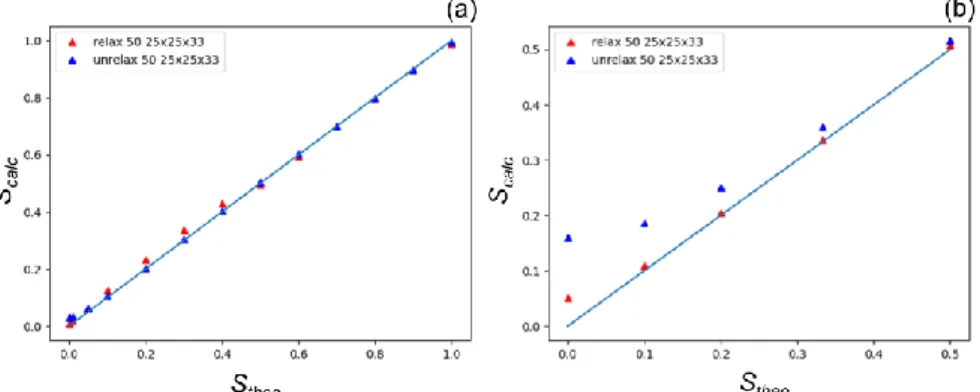
Figure 8 Evolution of the order parameter calculated from the ratio of the integrated intensities (Scalc , equation
(9)) as a function of the theoretical order parameter (Stheo , equation (3)) for the varying (a) and fixed (b)
compositions. In both cases, the calculation is performed on the small RSV (50x50x66 RSPs) and the integrations are performed over 25x25x33 RSPs.
Another way to interpret these results consists in using equation (9), in order to calculate the order parameter (Scalc) and compare it with its theoretical value (Stheo) obtained from equation (3). As expected,
20 deviation for the smaller value of S (Figure 8a & Tables S6a,c). For a fixed composition, the agreement between Scalc and Stheo is significantly better for the relaxed configurations than for the unrelaxed, Scalc being overestimated for the latter. In addition, the largest deviations are observed in both cases for small
S values (Figure 8b & Tables S9,S11).
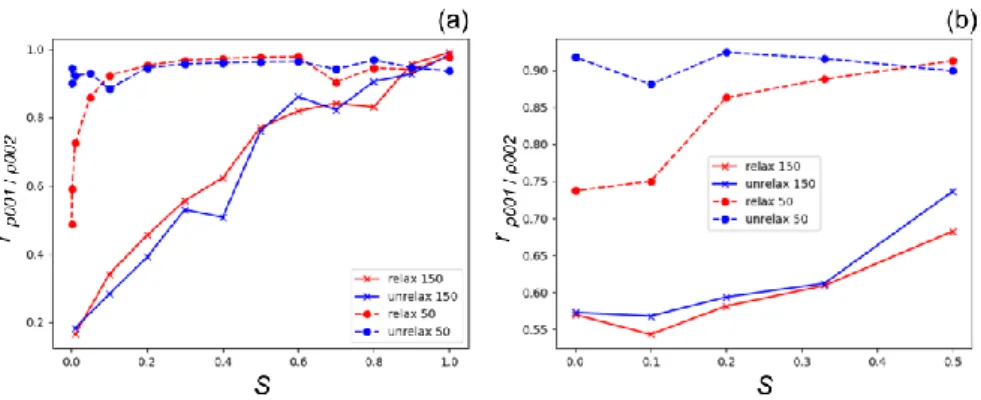
Finally, Figure 9 and Tables S10,S12 show the evolution of the Pearson correlation r between the
strain calculated from the fundamental and superstructure reflections as a function of the order parameter. In good agreement with our previous observations, this parameter largely depends on the real space voxel size. Indeed, for a large voxel size (small RSV), r remains high even for a very low order parameter, while r drops rapidly with S for a small voxel size (large RSV). This trend is well visible for the varying composition for both relaxed and unrelaxed configurations (Figure 9a & Table S13). For the large voxel size, r remains above 90% in the range 0.1 < S < 1, while for a small voxel size it drops from nearly 100% (S = 1) to around 30% for S = 0.1 (34% and 28% for the relaxed and unrelaxed configurations, respectively). Interestingly for the small voxel size in the range 0.0002 < S < 0.1, r remains very high and above 90% for the unrelaxed configuration, while a sharp drop is observed for the relaxed configurations (from r = 92.3% for S = 0.1 to r = 48.9% for S = 0.0002). The origin of this discrepancy remains unclear and could be caused by artificial ordering in the unrelaxed configuration due to the small size of the simulation box. Similar trends are observed for the fixed composition, although r shows less dependence to the order parameter, even for the small voxel size, where r drops by only 20%, when decreasing S from 0.5 to 0 (Figure 9b & Table S14). Similarly, to the varying composition, for a large voxel size and for the unrelaxed configurations, r remains very high (~ 90%) and mostly independent on the order parameter. In contrast, for the relaxed configurations
r drops significantly (by ~ 20%) for low S values.
Figure 9 Pearson correlation between the retrieved from the superstructure (g = 0 0 1) and the fundamental (g = 0 0 2) reflections as a function of the order parameter S for the varying (a) and fixed (b) compositions for the relaxed and unrelaxed configurations and different integrated RSVs.
Similar trends are observed for the fixed composition, although r shows less dependence to the order parameter, even for the small voxel size, where r drops by only 20%, when decreasing S from 0.5 to 0 (Figure 9b & Table S14). Similarly, to the varying composition, for a large voxel size and for the
21 unrelaxed configurations, r remains very high (~ 90%) and mostly independent on the order parameter. In contrast, for the relaxed configurations r drops significantly (by ~ 20%) for low S values.
In summary, one can conclude that the larger is the voxel size, the better is the accuracy of the retrieved strain. For a voxel size larger than 1 nm, the strain retrieved for low order parameter is still in excellent agreement with the calculations from the relaxed atomic positions, even S drops to low values. This is especially true when the decrease of the order parameter is induced by a variation of the composition. In addition, a better agreement is generally obtained for relaxed configurations compared to unrelaxed configurations. These two results are encouraging and promising in the optic of an experimental validation of the method:
- The resolution achieved experimentally is approximately one order of magnitude larger than the voxel size range used in these simulations. The accuracy of the retrieved strain should greatly benefit from this larger averaging volume.
- The relaxed configurations, where large and inhomogeneous strains are observed in the precipitate and in the matrix, are more representative of the experimental samples.
For these two reasons the technique appears to be suitable not only for perfect/ideal samples but also for realistic defective/strained nanoprecipitates with a low order parameter which are found in many systems.
3.3. Imaging of an assembly of nanoprecipitates
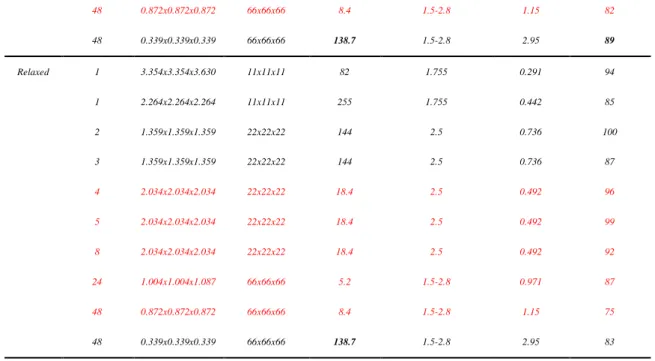
In the first two subsections, we have seen that the real space displacement and strain fields can be retrieved very accurately by performing an inverse Fourier transform on the complex scattered amplitude (equation (2)). A perfect agreement is obtained with the atomic strains calculated directly from the relaxed atomic positions (Figure 2 & Figure 3). Moreover, the influence of the order parameter on the reconstructed data was evaluated quantitively (subsection 3.2). It was established that the accuracy of the retrieved strain from the superstructure reflections benefits from large averaging volumes (voxel size) and is also usually better for relaxed configurations; two important results if one aims at using the method on experimental samples. However, if the complex sample density can be easily derived from the scattered amplitude in simulations, using equation (2), this is not the case experimentally, where a scattered intensity is measured on the far-field detector. The present section aims at establishing the ability of phase retrieval algorithms to recover the complex sample density from high resolution diffraction patterns measured in the vicinity of a superstructure reflection. To do so, we considered several crystals with a varying number N of L10 nanoprecipitates (N varying from 1 to 48) coherently embedded in the A1 matrix phase. As indicated in the methods section and as shown in Table 1, the crystals size range from 11x11x11 nm3 to 66x66x66 nm3 and the sampling conditions in the
22 66x66x66 nm3 crystal containing an assembly of 24 FCT L1
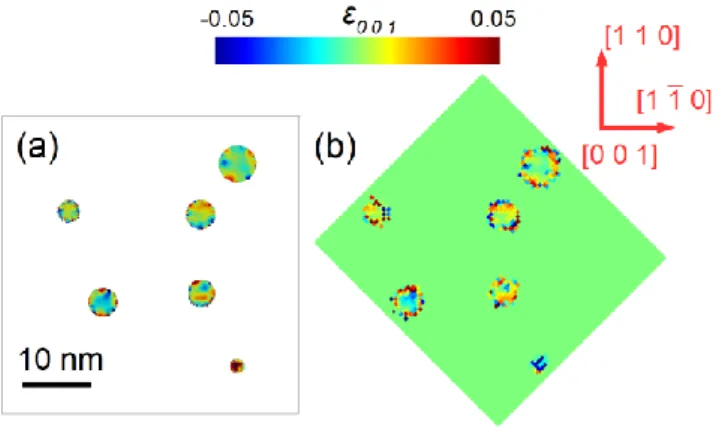
0 nanoprecipitates randomly distributed in the matrix solid solution. The radii of the precipitates vary between 1.5 and 2.8 nm. Note that some nanoprecipitates are rotated by few degrees around their c-axis and are therfore not fully coherent with the matrix. The atoms of the A1 matrix phase are removed in order to allow better visualization of the nanoprecipitates. Figure 10b shows the evolution of the 001 atomic strain component after energy minimization. One can notice the large and local strain variations at the matrix/nanoprecipitates interfaces. The scattered intensity from this relaxed configuration (including the A1 matrix atoms) was calculated using equation (1) in the vicinity of the 0 0 1 superstructure reflection (g = 0 0 1) and used as input to evaluate the ability of BCDI to reconstruct the complex image of an assembly of precipitates.
Figure 10 (a) Simulation cell containing an assembly of 24 L10 nanoprecipitates (r varying from 1.5 to 2.8 nm).
The atoms from the A1 matrix phase are not shown in order to facilitate the visualization. (b) Evolution of
after relaxation. (c-d) Isosurface of the reconstructed Bragg electron density in the vicinity of the 0 0 1 superstructure reflection (RSV: 1.25x1.25x1.25 nm-3 / real space voxel size: 0.731 nm). The threshold for the
isosurface is set to 42% of the maximum of the Bragg electron density. (c) is a zoom of (d). (e) Reconstructed Bragg electron density for the same reflection (g = 0 0 1) and a smaller RSV / larger voxel size (RSV:0.339x0.339x0.339 nm-3 / real space voxel size: 2.91 nm). The threshold for the isosurface is set to 45% of
23 Figure 11 (a) atomic strain component displayed on a 1 nm thick (4 atomic layers) (0 0 1) slice taken at the centre of the relaxed configuration. A 0.365 nm cut-off radius is selected for the averaging, so that the averaging volume matches the voxel size of the phase retrieval data. The atoms from the A1 matrix are discarded to ease the visualization of the data (b) (0 0 1) slice of the reconstructed strain component retrieved from the 0 0 1 superstructure reflection (RSV: 1.25x1.25x1.25 nm-3 / real space voxel size: 0.731 nm).
A close-up view of the intensity scattered by a varying number in the vicinity of (g = 0 0 1) is shown in
supporting information S9. The result of the phase retrieval using the procedure detailed in the methods
section is show in Figures 10c-e. Figures 10c-d show the retrieved Bragg electron density for a 0.731 nm voxel size: a perfect agreement is found with the atomistic configuration indicating that the complex electron density was succesfully retrieved.
Table 1 Influence of the number of precipitates, oversampling conditions, and voxel size on the success rate of the phase retrieval. The lines in black refer to the conditions with a high oversampling ratio ( >80) while the ones in red indicate conditions with a low oversampling ratio ( < 32)
N precipitates RSV (nm-3) Crystal size (nm3) Oversampling Radius precipitates (nm) Voxel size (nm) Success rate (%)
Unrelaxed 1 3.354x3.354x3.630 11x11x11 82 1.755 0.291 96 1 2.264x2.264x2.264 11x11x11 256 1.755 0.442 100 1 2.684x2.684x2.904 33x33x33 5.5 5.265 0.363 90 1 1.004x1.004x1.087 44x44x44 17.8 7.5 0.971 84 1 0.508x0.508x0.508 44x44x44 140.5 7.5 1.95 100 2 2.236x2.236x2.420 22x22x22 31 2.5 0.436 99 2 1.359x1.359x1.359 22x22x22 145 2.5 0.736 89 3 1.359x1.359x1.359 22x22x22 145 2.5 0.736 85 4 2.034x2.034x2.034 22x22x22 18.7 2.5 0.492 84 5 2.034x2.034x2.034 22x22x22 18.7 2.5 0.492 87 8 2.034x2.034x2.034 22x22x22 18.7 2.5 0.492 88 24 1.004x1.004x1.087 66x66x66 5.2 1.5-2.8 0.971 84