Ministry of Higher Education and Scientific Research
University of Abou Bekr Belkaid -Tlemcen- Faculty of Literacy and Foreign Languages
Department of English
Dissertation submitted to the department of English as a partial fulfillment of the requirements for the degree of Master in Didactics and Assessment in English Language Education.
Presented by: Supervised by:
Miss. BERRICHI Ghezlane Dr. BOUKLIKHA GRAIA Wassila Miss. BEDDIAR Soulef
BOARD OF Examiners:
Dr. BASSOU Abderrahmane President (MCA)
Dr. BOUKLIKHA GRAIA Wassila Supervisor (MCA)
Dr. BENSAFA Abdelkader Examiner (MCA) Classroom Management for an Effective Learning:
The Case of First Year EFL Students of the English Department, Tlemcen University.
We declare that this work is our work and it does not contain any published materials before or written by another person. We also clarify that this present research work does not contain plagiarism and it is the results of our own investigation, expect where otherwise stated.
BERRICHI Ghezlane BEDDIAR Soulef Date:
My deep appreciation goes to my parents who instilled in me the values that make me into what I am today, whose pray, love and encouragements paved my learning toward
success.
I dedicate this work to my lovely sisters and my brother. To all my extended family.
To my friends, Amina, Wafaa, Asma, Youcef, Mohammed and Salim, who are very close to my heart.
To all my teachers
And special dedication goes to my best friend « Soulef ».
This dissertation was completed with the grace of God and the help of all who are closr to me.
BERRICHI Ghezlane
I dedicate this work to my dear mother and beloved father who help, motivate and encourage me during my educational journey from the first day until now. This work is also dedicated to my sister ‘Racha’, to my brother ‘Imad’, my aunts ‘Houwaria’,‘Rabia’,‘Rahma’, my grandfather and grandmother for their support and
love.
Special thank go to my second father and second mother ‘BERRICHI Mohammed ‘and ‘BERRICHI Fatima’ for their encouragement and understanding.
To all my extended family.
To all my dear friends Wafaa, Mohammed, Zaki, Amina, Asma. To all my classmates.
A special dedication goes to Othman. And to my faithful best friend Ghezlane
Thanks to Allah for giving us the strength, capacity, and power to preserve and complete our dissertation.
First of all, we wish to express our sincere gratitude to our supervisor Dr. Wasilla GRAIA BOUKLIKHA for her help, advice and encouragement. This work could not have reached
completeness without her guidance, patience, and motivation.
A great respect to the members of the jury Dr. BASSOU Abderrahmane and Dr BENSAFA Abdelkader for their acceptance to read and examine our dissertation. We can not forget to thank all teachers and students who were patient in answering our
Classroom management is an important area in educational psychology that is used by teachers to create and maintain appropriate students’ behaviour in classroom setting. One of the biggest challenges faced by teachers is the lack of classroom management using of a particular skills, procedures, techniques and strategies which affects both the teachers and also the students in the learning process. This research was at Tlemcen University, Department of English and was a case study of first year LMD students. The collection of data was done through the use of two research instruments: a students’ questionnaire completed by 1st year LMD students and a teacchers’ interview addressed to English teachers of diferent modules. This research investigated the main methods, approaches and theories which teachers can follow for a productive learning environment. After the analysis of data, the findings revealed that an effective classroom management needs the application of appropriate skills, strategies, techniques and establishment the appropriate procedures to manage the classroom and create an organized classroom atmosphere.
Table of Contents
Statement of Originality………... Dedications………. Acknowledgements……… Abstract……….. Table of Contents……… List of Tables………... List of Figures……… List of Abbreviations………... General Introduction………..CHAPTER ONE: Insights on Classroom Management
1.1Introduction………... 1.2Definition of Classroom Management ………... 1.3Classroom Management Theories………... 1.3.1 Skinner’s Theory………... 1.3.2 Glasser’s Theory……….. 1.3.3 Kounin’s Theory………. 1.3.4 Maslow’s Theory ……… 1.3.5 Canter’s Theory……… 1.4 Approaches for Managing Student Behavior………... 1.5 Classroom Management Skills, Procedures, Techniques, and Strategies…………... 1.5.1 Skills………... 1.5.2 Procedures………... 1.5.3 Techniques……….. 1.5.4 Strategies……….
I
II
VI
VI
VI
VI
VI
VI
1
6 6 7 8 8 9 9 10 10 13 13 17 18 191.6.2 Teachers’ Approach………... 1.6.3 Learning Process………. 1.6.4 Students’ Social Life………... 1.7 The Role of Classroom Management for an Effective Learning………. 1.8 Conclusion………...
CHAPTER TWO: Research Design, Data Analysis and Suggestions
2.1 Introduction……….. 2.2 Setting……….. 2.3 Research Design……….. 2.4 Sample……….. 2.4.1 Learners’ Profile………. 2.4.2 Teachers’ Profile………. 2.5 Research Instruments………... 2.5.1 Students’ Questionnaire……….. 2.5.2 Teachers’ Interview………. 2.6 Data Analysis………. 2.6.1 Students’ Questionnaire………... 2.6.2 Teachers’ Interview………. 2.7 Interpretation of the main Results……… 2.8 Suggestions and Recommendations………. 2.9 Conclusion………... General Conclusion ………. Bibliography………... Appendices………. 23 23 23 23 24 27 27 27 28 28 28 28 28 30 32 33 41 46 47 48 50 53 58
Table 1.1: Basic Approaches …………...………... Table 1.2: Categorization of Procedures……….. Table 2.1: Learners’ Attitude toward Teachers’ Preparation of Lectures………... Table 2.2: Opinions on Teachers’ Methods………...……….. Table2.3: Effectiveness of Classroom Management on Students’ Learning…………..
12 17 34 37 39
Figure 1.1 Basic Classroom Management Skills……… Figure 2.1 Students’ Definition of Classroom Management………. Figure2.2 The Motivation of Students by Teachers ………. Figure 2.3 Techniques that Motivate the Students……… Figure 2.4 The Use of Classroom Activities and Resources ……… Figure 2.5 The Classroom Practices Used by Teachers……… Figure 2.6 Teachers’ Practices at the End of the course……… Figure 2.7 Students’ Opinion toward Classroom Management……… Figure 2.8 Difficulties in the Classroom………... Figure 2.9 Analysis of Students’ Needs………
14 33 35 36 37 38 40 40 42 44
NCTQ: National Council on Teachers Quality
PBIS: Positive Behavior Interventions and Support
AF: Absolute Frequency
RF: Relative Frequency
General introduction
Teaching is the process that includes planning, implementation, evaluation, and revision. So, it is not just about knowing the whole content and methodology of the course, but the way to connect with students and help them to grow and develop curiosity and to provide an effective learning environment. Teachers are classroom managers who have the responsibility to ensure the successful of the learning.
Classroom management is identified as one of the most important variables to understand and reduce students’ classroom misbehaviour and to respond in an effective way to the problems that occur and so prevent them. It deals also with how order should be established and maintained in the classroom setting. The teacher as a classroom manager plays the most essential role for successsful teaching to provide an effective learning environment. So classroom management is the most important aspect of teaching and the highest concern of teachers.
The aim of this study is to present and identify why classroom management is so important to establish and sustain an orderly environment using prcedures, strategies , and techniques, and to identify the goals of classroom management in order to increase meaningful academic and effective environment.
This research was guided by the following research questions :
1) What are the Classroom Management techniques considered effective during a lesson ?
2) How does Classroom Management affect learning ?
These questions may lead to the formulation of the following hypotheses:
a) Giving instructions, creating an agenda for each class, authority, knowledge and time management are regarded to be effective classroom management techniques.
b) Classroom management could affect learning by the teacher’ use of appropriate strategies to organize their classroom, deliver course content, manage students’ success, monitor student’ behaviour, and create an overall positive learning environment. Effective classroom management is the foundation for effective students learning.
In order to check the validity of these hypotheses, a case study of 1st year EFL students in the Departement of English is designed. Two research instruments are used for data collection, the first one is a questionnaire completed by 1st year EFL students in the Departement of English, at Tlemcen University and the second one is a teacchers’ interview addressed to teachers in the same Department.
This research work is devided into two chapters ; one is theoritical and the other practical. The theoritical chapter concerns a review of literature on classroom management, in which the researchers give general definition of classroom management, identify its approaches, procedures, skills, techniques and strategies that help teachers to organise their classes, and highlight the factors that may affect the classroom management as well as the role of classroom management for an effective learning.
The second chapter is practical dealing with the description of the research design and the research instruments used in the study. Then, the analysis and the interpretation of the results is summarized without forgetting some suggestions put forward to make classroom management as more effective for learning as possible.
CHAPTER ONE: Insights on Classroom Management
1.1 Introduction
1.2 Definition of Classroom Manageme0nt 1.3 Classroom Management Theories
1.3.1 Skinner’s Theory
1.3.2 Glasser’s Theory
1.3.3 Kounin’s Theory
1.3.4 Maslow’s Theory
1.4 Approaches for Managing Student Behavior 1.5 Classroom Management Skills
1.5.1. Skills
1.5.2. Procedures
1.5.3. Techniques
1.5.4. Strategies
1.6 Factors Affecting Classroom Management
1.9.1 Environment
1.9.2 Teacher’s Approach 1.9.3 Students’ Learning 1.9.4 Students’ Social Life
1.7 The Role of Classroom Management for an Effective Learning 1.8 Conclusion
1.1 Introduction
Teaching is a profession which requires the ability to cope with the new demands and change needs in addition to the management of the classroom. Classroom management has been an important part in the educational psychology. In fact, it represents a significant aspect in the teachers ‘pedagogical knowledge.
Classroom management is the ability to create and maintain successful,
conductive, collaborative, and effective learning environment. Every teacher is concerned with this process because it supports both teaching and learning in order to prevent behaviour issues and to improve learning.
The present chapter attempts to provide the main elements related to classroom management for an effective learning. In addition we presented different approaches related to the managing of students’ behaviour, providing details on the main classroom management skills, procedures, techniques, and strategies. The main factors affect in class. To conclude, the researchers highlight the role of classroom management in an effective learning.
1.2 Definition of Classroom Management
Classroom management has been defined in many different ways. According to Proctor (1977: 03): « classroom management is a set of teaching behaviours by which the teacher establishes and maintains order in the classroom ». That is to say, it is a set of rules and regulations used by teachers in order to facilitate the classroom order. In the other hand Richards (1990: 06) refers to classroom management as: « the way in which the students’ behaviour, movement and interaction during a lesson are organized and controlled by the teacher ». In other words, it is the process by which teachers control learning and the direction of classroom.
Moreover, Martin and Sugarman (1993: 09) say that « classroom management refers to those activities of classroom teachers that create a positive climate within effective teaching and learning can occur », and this means that is the strategy used by
teachers in order to create a comfortable atmosphere to affect teaching and learning process positively.
Also, Evertson and Weinstein (2004: 04) define classroom management as: « the actions teachers take to create environment that supports and facilitates both academic and social emotional learning ». In other words, classroom management represents the actions taken by teachers in order to engage students, establish order and their cooperation.
Accordingly, Brophy (2006: 17) clarifies that:
« Classroom management refers to actions taken by teachers to create and maintain a learning environment conductive to successful instruction (arranging the environment, establishing rules and procedures, maintaining students ‘attention to lesson and engagement in activities) »
As a whole, classroom management is seen as the actions taken by teachers in terms of rules, procedures, discipline and classroom structure.
The terms classroom ‘management’ and ‘discipline’ have been often considered as synonyms. Classroom management includes the ways to reduce misbehaviour in the classroom setting while discipline is to shape and correct the appropriate behaviour. In the same vein, Doyle (1986: 395) says that « classroom management evokes several terms such as ‘order’, ‘discipline’, and ‘cooperation’ ».
To sum up, classroom management is an important part of the teaching process as a whole since it helps teachers to prevent behaviour problems through the use of good planning, organization, managing classroom activities and arranging the learning environment. In addition to the definitions stated, classroom management has a great influence on learning through various theories.
1.3 Classroom Management Theories
From 1930s until the present day, behaviour theorists are still working on how teachers manage their classrooms in order to achieve an effective learning
environment. Educators know that all students learn differently and they choose the right instructional style that mitigate behavioural issues and make good instruction possible. Many behaviour theorists have different opinions on how classroom management influences learning.
1.3.1 Skinner’ s Theory
The issue of classroom management is related to Burrhus Frederick Skinner’s
philosophies in which he emphasized how organism learns. Skinner is the father of behavioural modification in the classroom; he believed that students’ behaviour would be reshaped through the use of reinforcement. His work was based on the idea that learning is a result of associations formed between stimuli and actions, or impulses to act. Skinner (1974:181) states that:
« Everything we know about operant conditioning is relevant to making behaviour more or less likely to occur upon a given occasion. This is the traditional field of rewards and punishment but much sharper distinctions can be made in taking advantage of what we know about contingencies of reinforcement ».
In other words, Skinner saw learning resulted due to conditioning similar to Pavlov’ theory (Pavlov’s dog’s being conditioned to salivate at the sound of specific tone). That is to say, if students are rewarded for good behaviour and are ignored or punished for wrong behaviour, they could come to understand how to behave in a classroom environment. Behaviours which are rewarded would be repeated and those that were not would be avoided and then well-behaved class would be the result. This conditioning process helped Skinner to develop his first ‘teaching machine’ in the 1950s which is a form of programmed instruction as a learning aid.
1.3.2 Glasser’ s Theory
William Glasser’s theory (1950) was based on the notion of classroom environment and the curriculum. He emphasized on helping learners to acheive success using appropriate behavioural choices. According to him, behaviour is related to personal choices and the teacher must help the learners to make good choices, and
these so learners would realize the importance of ‘good’ choices in behaviour and continue to make them in the future. Also, Glasser in his theory, noticed that when learners work together in small groups, they will help each other in order to enhance classroom relationships. Glasser’s theory promotes good behaviour and diminishes bad behaviour in the classroom and provides a successful environment.
1.3.3 Kounin’ s Theory
Jacob Kounin is an educational theorist who focused on teacher’s ability to affect students’ behaviour. In the 1970s, Kounin and his colleagues brought the idea of both instructional and disciplinary aspects of the classroom together. Kounin developed theories related to classroom management that were based on teacher’s ability to plan and organize their classroom using proactive behaviour and high student involvement. He believed that effective connection between management and teaching needed a good Lesson Movement which is achieved through withitness, overlapping, momentum, smoothness, and group focus.
First, withitness is the teacher’s ability to know what was going on at all times in the classroom. Then, overlapping is the ability of the teacher to deal with more than one issue or problem at time. After that, momentum is the flow of a lesson. While, smoothness means that teacher should be able to open on track without getting on tangents and being diverted by irrelevant questions or information is important. The final aspect is group focus, which is the ability of the teacher to engage the whole class using different techniques. Kounin’s research helped teachers to select many issues that are still facing it in today’s classrooms.
1.3.4 Maslow’ s Theory
Maslow is one of the theorists of classroom management, he clarified that human motivation is based on people seeking for change through personal growth. His research of hierarchy of needs can be divided into basic needs (safety, love, physiological) and growth needs (self-actualization, cognitive, and aesthetics). Helping students to meet their needs is the most important step to enhance students’ learning opportunities and maintain teacher longevity in the classroom. According to Maslow,
there is an ‘order-of-importance’ that is universal. The individual will not be concerned with the needs of the next level of importance, until these needs are met. That is to say, Maslow’s Hierarchy of needs is extremely important in the classroom atmosphere. If one of the necessities is missed, students will not be able to concentrate on learning. In other words, based on Maslow’s theory, if everyone in the classroom feels respected and appreciated for what he is, he will be able to focus on learning.
1.3.5 Canter’ s Theory
Lee Canter is the founder of Canter & Associates which is an organization that provided training in classroom discipline and published materials for educators and parents. Lee Canter and Marlene Canter created the Assertive Discipline plan in the 1976’s for classroom management. It is a method for teachers to execute a discipline plan geared to eliminate behavioural problems. Their goal was to help teachers establish classrooms by where students may learn and teachers may teach effectively. The Canters proposed methods to improve academic success for all students by establishing a positive learning environment.
From all these theories related to classroom management, there are also many approaches that exist in literature to manage students’ behaviours.
1 .4 Approaches for Managing Students’ Behaviour
One of the biggest challenges that may face the teacher while giving a lecture
is managing students’ behaviour Mathew (2003: 18) states that behaviour can be described in terms of « calling out, makes extaneous comments, distracts others, leaves
his work area. and completes a limited amounts of work». It means that behaviour relates to the actions and events that happen in the classroom during the day.
Skinner’s Behaviour Management believed that the most successful way to understanding behaviour was to observe actions of students and their consequence on learning. According to Skinner (1974:181), operant conditioning of learning believed that teachers need to manage student’s behaviour through reinforcement. Thus,
Skinner defined the term reinforcement as behavioural consequence that increases the probability that a response will be repeated in the future.
These reinforcements can be positive or negative .Positive reinforcement implies when the student does something pleasant, he receives a reward from his teacher for example grade, praise, free of time. Whereas, negative reinforcement involves the
removal of undesired stimulus,(weekend homework, less of opportunities ,etc… At least, «Extinction as a procedure occurs when reinforcement of a previously
reinforced behaviour is discontuned; as a result, the frequency of that behaviour decreases in the future», (Cooper, Herson, & Haward. 2007:457).Extinction is the most powerful tool used by teachers to decrease negative behaviours provided by using either positive or negative reinforcement. On the other hand, inappropriate students’ actions can be decreased through the use of punishment. Just like reinforcement is divided in two categories; Response cost punishment is the most commonly used form, it involves the operations of some undesirable stimulus .For example, unpleasant students actions can be followed by private reprimand or isolation. In contrast, punishment with aversives involves the removal of deseared stimulus. For example, unsuitable students’ behaviour can be followed by a loss of opportunities or exclusion from the faculty. The following table summarizes the basic approaches related to managing students’ behaviour.
Table.1.1: Basic Approaches
Operation Stimulus Action Effect on
Behaviour
Positive reinforcement
positive stimulus added depending on desired behaviour
Behaviour increases
Negative reinforcement Negative stimulus removed on desired behaviour
Behaviour decreases
Extinction Reinforcement stimulus following behaviour is discontinued
Behaviour decreases
Response cost punishment Portion of positive stimulus removed contingent on undesirable behaviour
Behaviour decreases
Punishment with aversives Negative stimulus added contingent on undesirable behaviour
Behaviour decreases
Generally, there are five basic operations for managing the classroom behaviour which are positive reinforcement, negative reinforcement, extinction, response cost punishment and punishment with aversives. The basic principle behind each operation is presented in the above table 1.1.
The Canters have made considerable contributions to the concept of classroom discipline; they focused on « the concept of rights in the classroom-the rights of students to have teachers help them learn in calm, safe environment and the rights of teachers to teach without disruption ». (Charles, 1994: 38).The Canters developed an approach called Assertive Discipline based on the skinner’s believe in operant conditioning. Research by the Canters in 2009 found that many instructors have been not capable to manage the unpleasant behaviour that occurred in the classroom when
consulting the school system, because of the teacher’s failure on training regarding behaviour management. They based their research on the assertiveness training and applied behaviour analysis. Moreover, they developed a common sens-easy to learn approach to help teachers positively influence classroom learning through leadership (Canter, 2009. 43). Canters (2001) clarifies that students have a need for and the right to warm, supportive classroom environment for learning where teachers do their best to help students to be successful learners.
To have successful and well managed classroom, the teacher should be assertive. Assertive teachers clearly, confidently and firmly communicate their needs and express their expectations to their students. They are prepared to reinforce their words with appropriate actions, and work hard to build trust. « Assertive teachers believe that a firm teacher-in-charge classroom is in the best interest of the student. They believe that students wish to have the personal and psychological safety experienced when their teacher is highly competent in directing behaviour » (Canter, 2009).Teachers used to teach students how to behave and they implement discipline that encourages students’ cooperation.
From the Canter’s framework (1976:13) the following are the main objectives for assertive discipline approach.
Explain how teachers set up personal « roadblocks » to their becoming assertive.
Explain how a teacher can identify his/her wants and needs in the classroom.
Identify the skills a teacher needs to follow through on teacher verbal responses.
Describe how teachers can clearly express their, wants and feelings with parents and principles Classroom Management Skills and Procedures.
1.5 Classroom Management Skills, Procedures, Techniques and Strategies
In fact, classroom management has different skills, procedures, techniques and strategies mentioned in the literature related to teaching and education in general. 1.5.1 Skills
Classroom Management skills are primary important to determine the teaching success which is measured by students learning or by ratings. According to Emmer and Stough (2001), « the development of classroom understanding and skill is likely to be staged process ». In other words, every teacher must have a basic knowledge of the specific skills needed in the process of managing the classroom.
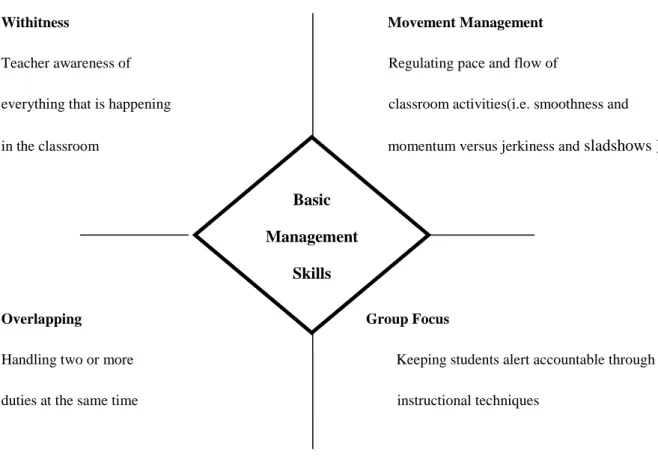
Kounin (1970) developed a theory about classroom management which is based around the teacher’s ability to plan and organize the classroom. Kounin’s beliefs of the effectiveness of Lesson Movement that is considered to be the basic management skills needed to be taken into account by every teacher. They are withitness, overlapping, movement management, and group focus as mentioned in the following figure.
Withitness Movement Management
Teacher awareness of Regulating pace and flow of
everything that is happening classroom activities(i.e. smoothness and
in the classroom momentum versus jerkiness and sladshows )
Overlapping Group Focus
Handling two or more Keeping students alert accountable through
duties at the same time instructional techniques
Figure 1.1: Basic Classroom Management Skills (Kounin 1970)
The above figure show the main skills that teachers must have according to Kounin, they are as follow:
Basic Management
Withitness: is the teacher’s ability to know what is happening in class all the time. To develop this skill, the teacher should: stands where he/she can seen by students when giving and presenting a lesson, also he/she makes an eye contact with students, and stands in an angle to write on the board in order to see all the students as possible.
Overlapping: is the ability of the teacher to be multitask. Similarly to the concept of withitness, the teacher develop the overlapping skill through making an eye contact, teacher gestures, directing a question to non paying attention students to regain their interest ….
Managing Movement: is the skill by which the teacher regulates space and flow of the lesson and design activities which keep the students on task. To manage movement, the teacher should organize materials, learning centres and teaching aids, teach the students specific procedures (for example : to tell students what is the next lesson and what are the books needed to reach the lesson, design various activities ….ect)
Group focus: the teacher must use collaborative and group activities which help the students to build the skills they need to think critically solve problems in adult world and acquire social skills.
In addition to Kounin’ framework, there are other classroom management skills given by many scholars that must be taken by teachers, they are as follow:
To know the students: it is very important for teachers to know their students, so it is necessary to invest time in the 1st? day or lecture to know the students and use their name in practice.
To prepare lesson in advance: it is an essential part to prepare lessons in advance in order to have a class where things run smoothly. The teacher must think through all steps and details before coming to class.
To make learning Hands-On: when the teacher makes his/her lessons, the students will exhibit behaviours that lead to focused learning. On way to make this is to make them hands-on. Students are more motivated to
learn when they feel they can interact with materials used by teachers to teach them. For example, students can make a play in which they will focused more on participating in the activity and make them experience the lesson.
To use praise and reward: one of the most powerful rewards a student can receive is praise from his or her teacher, because the teacher is a model who holds a lot of power as the gatekeeper to knowledge for the students. For example, the teachers can use encouragement statements: I love the way you are answering the questions… this will push the student to participate more. So, the praise will improve the learning process and it is an effective tactic.
Minimize reprimanding: it is important for teachers to keep reprimanding a minimum. When the teacher reprimand the students will have a chance to get used this and the desired effect will be dimmed. It is necessary that the discipline action should always be the last resort.
Authority: in order to be taken seriously by students, the teacher must be presentable and confident of himself /herself.
Knowledge: the teacher must be knowledgeable and competent when giving instruction in order to affect the learning process also he / she should know all topics programmed in the curriculum.
Individualization: a good teacher know how to tailor his /her lesson according to the students he/she teach them, so the teacher must manage the class effectively and should know how to assess each class.
Time management: the teacher controls the classroom, so time management is an essential part of the instruction; teachers must manage the time in their classes according to the lesson, procedures and materials used.
To conclude, classroom management skills are so crucial and fundamental that every teacher needs to acquire them in order to organize, control and maintain
discipline and order through the use of different procedures to rich an effective management.
1.5.2. Procedures
Every teacher should think about classroom procedures which are the art of the teaching process and classroom management in order to make his/her students successful, make the learning environment easier , and create a more effective learning atmosphere . According to many educators, the teacher must explain what he/she expect from the students, then practices it and lastly reinforce it until it becomes a routine.
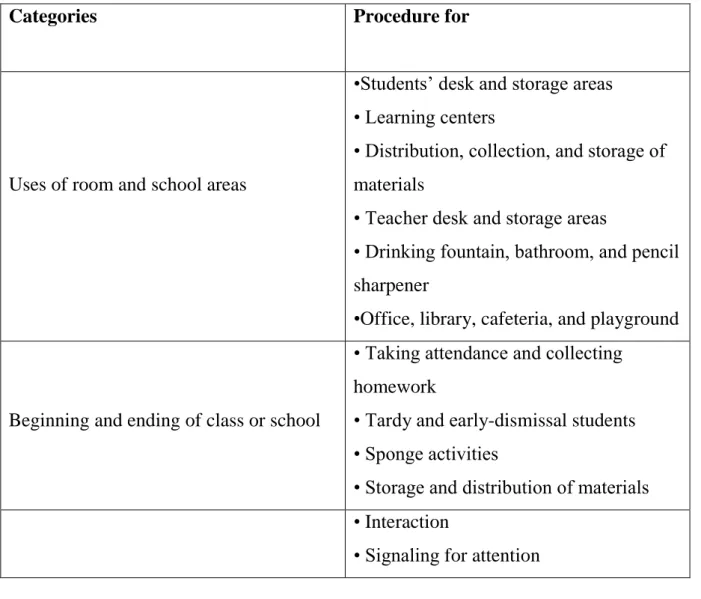
The following table shows the categories of procedures into groups:
Table 1.2 : Categorization of Procedures
Categories Procedure for
Uses of room and school areas
•Students’ desk and storage areas • Learning centers
• Distribution, collection, and storage of materials
• Teacher desk and storage areas
• Drinking fountain, bathroom, and pencil sharpener
•Office, library, cafeteria, and playground
Beginning and ending of class or school
• Taking attendance and collecting homework
• Tardy and early-dismissal students • Sponge activities
• Storage and distribution of materials • Interaction
Whole-class and small-group instruction • Movement within the classroom • Materials
Transitions • Time between subject areas or classes • Unexpected free time
• Controlling noise levels and talking
Student Works
• Paper headings
• Incomplete, late, or missing assignments • Posting assignments
• Collecting work • Due dates and times
• Checking work (both students and teachers
• Turning in papers
• Keeping track of what work is turned in and what isn’t
• Returning student work • What to do when finished
• Getting help when the teacher is busy
Miscellaneous
• Disaster drills
• Emergency situations (e.g., sick and injured students)
• Movement around school grounds
The above table shows how teachers can organize and categorize procedures which create independent learning and success for all students in the classroom and for teachers to control the of running of the learning process. As the procedures of classroom management create a particular atmosphere of learning in the classroom, there are also different techniques related to classroom management.
Classroom management is a collection of techniques and strategies that teachers use to encourage effective learning. The most essential techniques of good classroom management are introduced by some educators as follow:
Building a community: A classroom is a small community in which students need to get opportunities to know each other and to be connected to their classmates to feel motivated. The teacher should take time at the beginning of the course to provide activities that permit students to realize each other.
Create a safe supportive environment: Teacher’ model of respect, carring and encouragement can create a safe environment without students’ fear while learning, so that, they feel relaxed and tension decreases.
Know your students: Teachers must realize their students on personal level in order to design lessons and activities that meet their needs and interests.
Be fair and consistent with all students: There are teachers who have preferences among students, those who are extra inspired and organized, and those who are less stimulated and prepared. So, teachers should treat students equally in order to make them feel relaxed.
Have a clear plan for the lesson and keep students informed of the plan
and its purpose: The teachers need to be clear about their lessons, objectives
and how they intend to achieve them, they need to make plan about the activities and what they are expected to do during the lesson.
Similarly, there are some classroom management strategies that are effective for learning.
1.5.4 Strategies
The NCTQ (National Council on Teachers Quality, January 2014) research study identified five strategies that are most effective in the classroom including:
Rules: the teacher should develop expectations for behaviour and create set of rules at the beginning of the school year to contribute a successful learning and orderly environment.
Routines: or procedures, the term refers to the activities and behaviours that led to easy classroom operation. Where teachers should put their procedures and teach them. They should include specific guidelines for how to act in situation. Routines should be thought at the beginning of each lecture and are reinforced through reminder rather than consequences.
Praise: (include acknowledgement and rewards). Teachers should encourage students through positive reinforcement using acknowledgement, praise, and appropriate rewards. The NCTQ identified the following DO and Don’t for successful use of the acknowledgement praise and positive reinforcement.
Do…
Be sincere in the way praise is given to the student
Consider the individual student’s characteristics, such as age and give the praise appropriately.
Praise demonstration of appropriate process or strategies without including judgment of the target outcomes.
Be specific about the behaviour being acknowledged or praised. Don’t…
Use reinforcers for a task that students already want to do without setting a performance target.
Inflate praise.
Ignore the student’s individual response to praise. Praise trivial accomplishment or weak efforts.
Misbehaviour : teachers need to determine appropriate consequences and apply it for reducing problems .Good academic management created many strategies for reducing misbehaviour :
Look for ways for students to have some degree of choice in determining their learning activities.
Select interested learning activities.
Give frequent feedback and encouragement.
Use PBIS, (Positive Behaviour Interventions and Supports) that is proactive approach to establishing the behavioural supports and social culture needed for all students in a school to achieve social, emotional and academic success.
Engagement: This strategy is related to the quality of instruction. Teachers should engage students in classroom by creating an interesting lesson that holds’ students’ attention on building appropriate participation.
There are other effective classroom strategies that may motivate students:
Create an effective learning environment:It means that students will appreciate and follow the classroom routine in advance and greater without problems if they are organized.
Create a motivational environment :there are different classroom conditions that will help create classroom climate that encourages learning like :
Develop interesting lessons that challenges students. Give a clear direction: ask students to repeat directions.
Engage all students actively: for instance, while one student make a presentation, other students take notes or use a rubric to evaluate the presentation.
Teach a different learning style: for example write key words at the broad or use a diagram or visual and so on.
Make every minute counted :
Begin on time. End on time ,here teachers need to Plan each lesson individual
Write learning objectives :examples , problems…etc
Be prepared with an emergency lesson or activity (i.e. .have an organized plan if your planned lesson for the day runs short or you want to full the time.)
Keep everyone engaged: by asking questions, wait time (3or 5 seconds) then call one student. Encourage a student to try and to answer the question.
Teach life skills and good learning habit: these skills permit students to become mature, confident and successful adult.
Use time-management strategies like making observe schedules, each day goals, or to do lists. Teach an individual lesson or unit on study skills.
Demonstrate memory techniques: Acronyms and acrostics. Falsh cards to use for repetion.?
Be creative: by making learning more interesting and effective using imaginative approaches in the classroom.
Use project design and management techniques :the steps that should be followed to create and manage a project are as follow :
Step one: identify the strengths and the needs that exist to facilitate teaching and learning.
Step two: prepare a classroom management plan.
Step three: monitor the classroom plan to determine if it is being consistently followed and make adjustments as needed.
Step four: celebrate success with your students.
1.6 Factors Affecting Classroom Management:
Classroom management generally refers to the way in which teachers set up the classroom where students can learn effectively. Setting up the classroom means both physical and how the teacher structures during the day. Managing the classroom is not an easy task, teachers should be aware of some factors which are identified by some scholars.
Environment: the environment can have direct and indirect impact on the classroom. For example: the classroom with over 40 students has low participation, because students at the back could not hear or listen to the teacher and others may cause distraction. The teacher should organize well the arrangement in the class and the students’ seats especially for particular situation, example: blind students. Also teachers should walk around the class to make the student on the task and to attract their attention.
Teachers approach: the teacher has to develop activities to help students create the rules instead of telling them what the rules are .This is going the same for assignments. If the teacher can not permit students determine the guidelines, he can communicate to them about what their guidelines means .This will make students feel if they are creating the assignment.
Learning Process :students with learning disabilities may affect the way teachers manage the class, in which he spend more time with the student who gained knowledge of disability or he is allow to develop techniques to work with this student.
Students’ social life :social stuff and daily problems may destroy the students’
self-confidence , and they feel as they are ignored and excited so teacher must be aware about his student reaction during the day and he try to communicate with him/her and make the student feel relaxed.
Since there are factors that affect the classroom management, what about its role for an effective learning?
1.7 The Role of Classroom Management for an Effective Learning
Brophy (1983) defines classroom management by providing his assumptions that
were: (a) the teacher is both the authority figure and the instructional leader in a classroom, (b) good classroom management implies good instruction, and (c) optimal classroom management strategies are not merely effective, but cost effective. In other words, the teacher is the leader in the classroom. He is the one who has the authority to organize and provide a good instruction. So, effective teaching and classroom management prevent discipline problems and disruptions during the learning process. The following behaviours related to the process of managing classroom given by many educators are very effective in creating and maintaining effective learning environment:
o To create and maintain a positive, productive learning environment. o To support and foster a safe classroom community.
o To reduce distraction from leaning.
o To organize and facilitate the flow of learning activities. o To assist students to keep task focus.
o To help students to manage themselves. o Socialize Students.
o To decrease the disruptions in the classroom. o To encourage students success.
o To minimize inappropriate students behaviour.
o To address the needs of students both in terms of ‘what’ they teach and ‘how’ they teach.
To sum up, classroom management has a dominant role in order to affect positively the learning process through the use of various techniques, skills, strategies and procedures following one of the approaches according to students.
1.8 Conclusion :
Teaching is a complex process in which classroom management plays a key role. This research work highlights the main components of classroom management providing some behavioural theorists such as Skinner, Glasser, Kounin, Maslow and Canter who devoted their time into researching behaviour and how teachers can motivate the students. In addition, different approaches for managing behaviour are mentioned since they are important parts in the development and evolution of education and behaviour management in the classroom. This chapter presents also the different classroom skills, procedures, techniques, and strategies which help the teacher to set the class up for the success of learning. It shows also the most important factors affecting classroom management for an effective learning and how the teachers can reach their goals.
A part of the theoretical framework of the study, the researchers prepare a practical part dealing with the research of the study, how data were collected, what instruments were used and then came an analysis of the findings obtained from these data. Finally, some suggestions were put.
CHAPTER TWO: Research Design, Data Analysis and Suggestions 2.1 Introduction 2.2 Setting 2.3 Research Design 2.4 Sample 2.4.1 Learners‟ Profile 2.4.2 Teachers‟ Profile 2.5 Research Instruments 2.5.1 Students‟ Questionnaire. 2.5.2 Teachers‟ Interview 2.6 Data Analysis 2.6.1 Students‟ Questionnaire 2.6.2 Teachers‟ Interview
2.7 Interpretation of the Main Results 2.8 Suggestions and Recommandations 2.9 Conclusion
2.1. Introduction :
This chapter is divided into three sections: the first one deals with a description of
the research design used in the current study, the second one concerns the data analysis and interpretation of the main findings and the third one is related to some suggestions and recommendations given after analysis of the issue.
2.2. Setting
The study is conducted in the English Department which was founded in 1990 in Tlemcen University. The foreign language Department has been restricted and the English section has become an independent Department including Translation. LMD (License/Master/Doctorate) has been implemented in Algeria since 2004/2005; this system is used in all Departments in Tlemcen University. After three years of study in the English Department, students can choose their specialty in first year of Master study. The English Department offers a variety of modules for 1st year LMD that are Grammar, Phonetics, Linguistics, Anglo Saxon Culture and Civilization, Human Social Sciences, Study skills, Comprehension and Oral Expression, Comprehension and Written Expression, Literature, and French. In the 2nd year the same modules are taught in addition to Translation and ICT in the 2nd semester. In the 3rd year, the modules are as follow: Linguistics, Didactics, Comprehension and Written Expression, ESP, Methodology, Anglo Saxon Culture and Civilization, Comprehension and Oral Expression, Translation and Literature. When students finish the Licence degree, they will be able to choose one of the specialties offered in Master; Literature and Civilization, Language Studies, Didactics and Assessment in English Language Education, or at least Translation. Each speciality deals with particular modules taught by specialists in the field. All these years of study are completed by a student‟s dissertation.
2.3 Research Design
This research is a case study which aims to collect data about Classroom management for an effective learning in order to establish sustain and effective environment in the classroom and to increase meaningful academic learning. One of the most practical methods used is a case study. According to Gerring (2004: 342) a
case study is: “an intensive study of a single unit for the purpose of understanding larger class (similar) units». The present study is a descriptive case study aiming to give better understanding of how classroom management affects the learning process. The current case study deals with a sample of population described below.
2.4 Sample
Sampling is the process of selecting a number of individuals called the sample. In this research work, the researchers chose 8 teachers and 43 students as a sample.
2.4.1 Learners’ Profile
The Participants are 1st year EFL students from the Department of English, at Tlemcen University. They are in fact 43 students from different groups in order to vary data about classroom management via different classroom situations.
2.4.2 Teachers’ Profile
The researchers select eight teachers from the Department of English, at Tlemcen University. They varied in terms of experience and modules taught.
Both populations answer the research instruments used in the study.
2.5 Research Instruments
The instruments used in this study in order to collect data are a students‟ questionnaire and a teachers‟ interview which are described below.
2.5.1 Students’ Questionnaire
A questionnaire design is a very crucial and important part of research since it is a set of adequate and appropriate questions in a sequential order aiming to answer particular research questions. Brown (2001:1) defines this instrument of research as „„any written instrument that present respondent with a series of questions or statements to which they are to reach either by writing out their answers or selecting them among existing answers ‟‟
In the same vein, the questionnaire used in this study is addressed to 1st year EFL students, at Tlemcen University in the Department of English, to gather information
about the perspectives and views of students towards their teachers‟ classroom management.
In the present study, the researchers formulated a questionnaire based on both closed-ended and open-ended questions in order to obtain different and varied data which can attribute to the research. In close-ended questions, the researchers made a set of answers and the participants chose one from them ones while in open-ended questions, the participants had the opportunity to answer in their own words to have their opinions and to provide later on suggestions related to the study. The current questionnaire is made up of twelve questions as follow:
Q1: How can you define classroom management?
The last question aims to know if students have certain knowledge on the classroom management definition.
Q2: Do you feel that your teacher is well prepared when presenting the lecture?
This question aims to know whether the students felt the teachers‟ preparation of lectures in advance or not.
Q 3: Does your teacher try to motivate you?
This question seeks to know if the students were motivated by their teachers or not. Q 4: How does he/she do so?
The purpose of the fourth question which is linked to the previous one is to know how teachers motivated their students.
Q5: Do you agree with the methods used by your teachers when presenting their lessons?
This question aims to know if students were convinced with the different methods given by their teachers when explaining their lessons.
It aims to comprehend if the teacher dealt with different activities and resources that could attract students.
Q7: What are the classroom practices used by your teacher?
This question was asked to have an idea about the classroom practices of teachers. Q8: How can your teacher keep you on task during a lesson?
This question aims to identify the strategies used by teachers in order to attract students‟ attention during the lecture and especially when performing a task.
Q9: Do you think that classroom management can affect your learning?
The objective of this question is to have an idea on how classroom management affected the learning process.
Q10: What do you do when you finish your lessons early?
This question was asked to understand how teachers were managing their time in the classroom.
Q11: Give your opinion about the classroom management of your teachers?
The purpose of this question is to know students‟ opinion towards their teachers‟ classroom management.
2.5.2 Teachers’ Interview
The researchers used a structured interview as a conversation between the researchers and the teachers to attain specific information about the studied issue. Accordingly, Gillhom (2000:01) defines the interview as « a conversation usually between two people, but it is a conversation where one person the interviewer is seeking the response for a particular purpose from the other person ». In this research work, the investigators focus on the use of a structured interview that enables them to examine the level of understanding the teachers have about their topic in order to guarantee the reliability of the collected answers. This interview is addressed to 08 EFL teachers from Tlemcen University in the English Department. Five of them have
a PhD and the other three teachers have a Magister degree. The interview was delt with teachers in the academic year of 2018-2019.
In the current study, the researchers formulated a structured interview made up of ten questions based on both closed-ended and open-ended questions. From this instrument of research, the investigators seek a set of questions that may help to find answers to the research questions.
Before starting asking questions, the teachers completed information about their degrees and experience, then a first question was asked to know if those teachers liked the noble task they did which is teaching followed by a question about understanding whether those teachers had a good contact with their students.
Q3: What aspects do you think the most difficult nowadays?
Teachers were asked to select the aspects they were facing in the teaching and learning process, especially with these new generations.
Q4: Do you think that classroom management is important for the teaching process? The aim of this question is to know if teachers were aware about the importance the classroom management as a way to affect the teaching process.
Q5: Do you think that students‟ social problems can have an impact on the classroom management?
The objective of this item was to explore if teachers were concerned with the social problems of their students.
Q6: How do you manage your classroom?
Teachers were asked this question to extract information on how they managed their classroom.
This item aims at knowing if teachers analysed their students‟ needs before teaching any lesson and by the way to know if their lessons followed their students‟ needs or not.
Q8: How do you manage to raise students‟ motivation in the classroom?
The objective of this question is to explore the different methods used by teachers in order to raise students‟ motivation.
Q9: What do you think the biggest problems teachers face in the classroom are?
The aim of this item is to collect information about the difficulties faced by teachers in the classroom.
Q10: How do you think that classroom management affect students‟ learning?
The teachers were asked to know their techniques toward classroom management as way to affect learning.
2.6. Data Analysis
The data analysis is the process of evaluating the gathered data in order to help the researchers to find answer to the research questions. The data collected in this study were analysed qualitatively and quantitatively. The difference between the two kinds of analyses was that the former was descriptive and the latter was experimental.
In this vein, qualitative data analysis is the process of explain and interpretate the collected data that is not in a numerical form. Accordingly, Seliger and Shohamy (1989:205) describe it as “usually in the form of words in oral or written modes‟‟. In this study, the use of qualitative data analysis is used to analyse the questions in both the questionnaire and the interview in order to know the why and how of some questions.
In the other hand, the quantitative data analysis is a process of evaluating data in numerical form dealing with quantity or numbers. As Aliaga and Gunderson (2002, qtd. in Muij 2004: 01) said, “quantitative research is explaining phenomena by
collecting numerical data that are analyzed using mathematically- based methods (in particular statistics)”.
Moreover, the use of these two types of method when analysing data is very beneficial. According to Johnson and Onwuegbuzie (2004 :17), “mixed methods research is formally define here as the class of research where the researcher mixes or quantitative and qualitative research techniques, methods, approaches, concepts or language into a single study”.
This section comprises the analysis of the data collected from the research instruments stated above.
2.6.1 Students’ Questionnaire
In this research the questionnaire was addressed to 43 first EFL year students at Tlemcen University in the English Department, to gather information about the perspectives and views of students towards their teachers‟ classroom management.
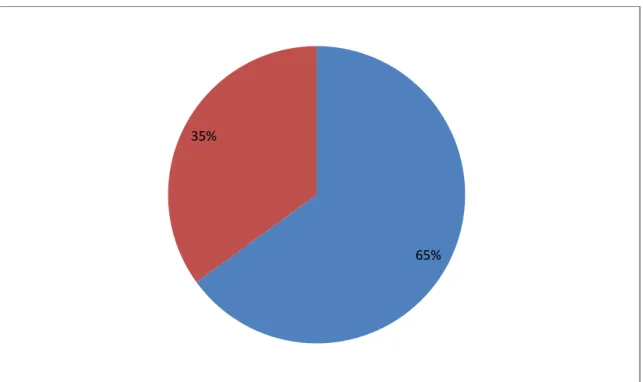
Q1: The Definition of Classroom Management
Figure 2.1 Students' Definition of Classroom Management
65% 35%
The findings showed that the majority of students (65%) had a previous knowledge about classroom management, they defined it as the way of teaching using a variety of skills, techniques, and strategies in order to keep the students well organized and to affect positively their learning, and other minority (35%) did not answer this question.
Q.2 Learners‟ Attitude toward Teachers‟ Preparation of Lectures.
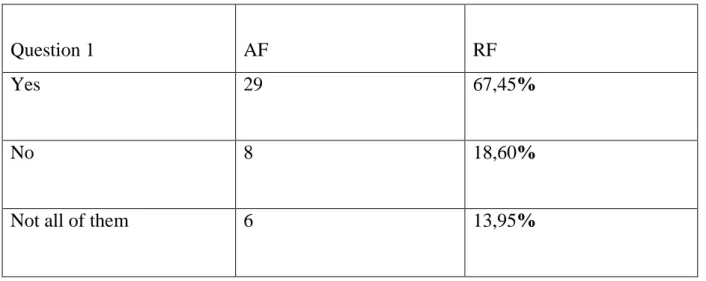
The findings are shown in the following table:
Table 2.1 Learners’ Attitude toward Teacher' Preparation of Lectures
Question 1 AF RF
Yes 29 67,45%
No 8 18,60%
Not all of them 6 13,95%
AF : Absolute Frequency RF : Relative Frequency
The findings in the table above showed that the majority of students (67, 45%) reported that their teachers were well prepared when presenting their lectures, (18,
60%) of them stated that teachers presented their lectures spontaneously without any
preparation. The remaining ones (13.95%) claimed that there were some teachers who were well prepared while others were not.
Q 3: The Motivation of students by Teachers.
Figure 2.2 The Motivation of Students by Teachers
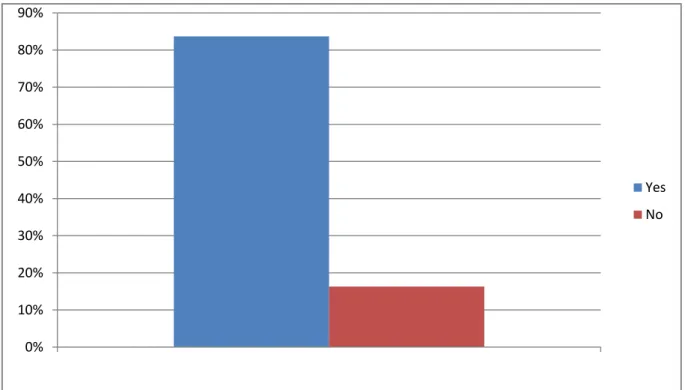
The results showed that the generality of students (83, 72%) were motivated by their teachers. While a few of them (16, 28%) reported that their teachers did not motivate them using different techniques.
Q4: Techniques that motivate the students.
The findings are shown in the following figure:
0% 10% 20% 30% 40% 50% 60% 70% 80% 90% Yes No
Figure 2.3 Techniques that motivate the students
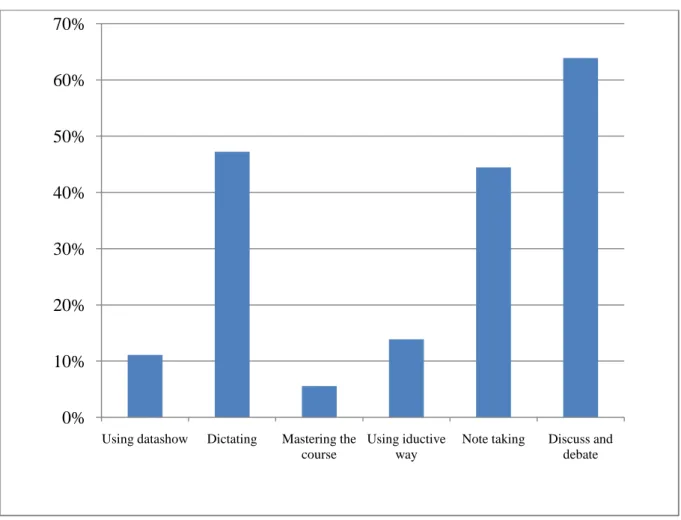
The findings revealed that teachers used a variety of techniques in the same lecture. The researchers noticed that the generality of students (63,88%) were motivated by discussing and debating in the classroom , 47,22% of students were motivated by dictating, others prefer (44,44%) to take note, 13,88% of them reported that they were motivated through the inductive way, others (11,11%) were motivated by the use of datashow in order to get more details. Finally, the remaining students (5,
55%) reported that they were motivated when the teachers mastered the course.
Q5: Students‟ Opinions about Teachers‟ Methods.
The findings are shown in the following table: 0% 10% 20% 30% 40% 50% 60% 70%
Using datashow Dictating Mastering the course
Using iductive way
Note taking Discuss and debate
Table 2.2 Students’ Opinions about Teachers’ Methods
Question 5 AF RF
Yes 17 39,53%
No 10 23,25%
Not all of them 16 37,21%
The findings showed that 39, 53% of students agreed with teachers‟ method and clarified that these methods helped them a lot in the learning process. 23, 25% of them reported that these methods did not convince them to understand the lessons. The remaining students (37, 21%) claimed that they agreed with some teachers‟ methods while others could not convince them to learn.
Q6: The Use of Classroom Activities and Resources
The following figure shows the findings:
Figure 2.4 The Use of Classroom Activities and Resources
60,47% 37,21%
2,32%
Yes No
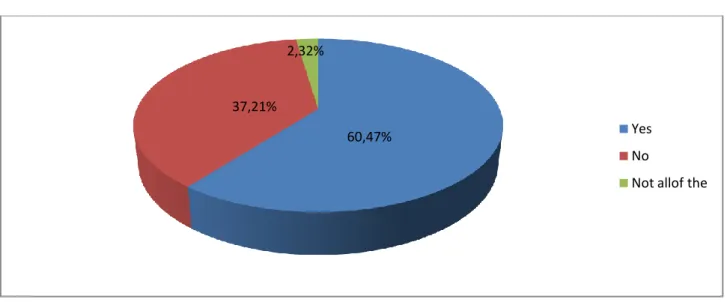
The results revealed that teachers used a variety of classroom activities and resourses as 60, 47 % students answered as such. 37, 21% of them stated that teachers used only one type of activities or just ask questions. The minority of them (2, 32%) claimed that not all teachers used a mixture of activities and resources.
Q7: The Classroom Practices Used by Teachers
The findings are shown in this figure:
Figure 2.5 The Classroom Practices Used by Teachers
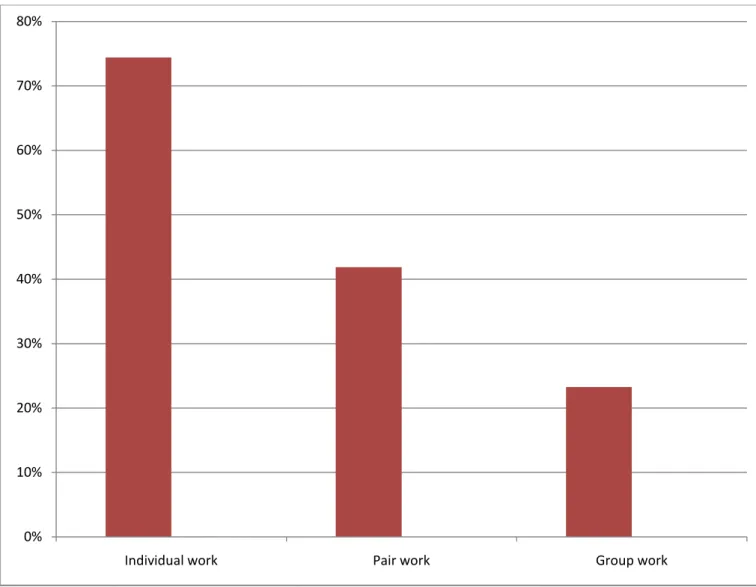
The findings showed that individual work was the most used classroom practice by teachers as 74, 42% of students claimed as such. After that, came pair work in which 41, 86% of them agreed on that kind of practices, the final one was the group
work as 23,25% of students answered.
0% 10% 20% 30% 40% 50% 60% 70% 80%
Q8: The way of Keeping Students on Task
The teachers used different behaviours in order to make students attracted to the course. The majority of students said that their teachers asked questions during the lecture to make them in the task, others asked them to do activities or told them jokes to attract their attention, and some others talked outloud or screamed saying «Shut up», and the remainig teachers did not care as students claimed.
Q9: Classroom Management Affect Learning
The findings are shown in the following table:
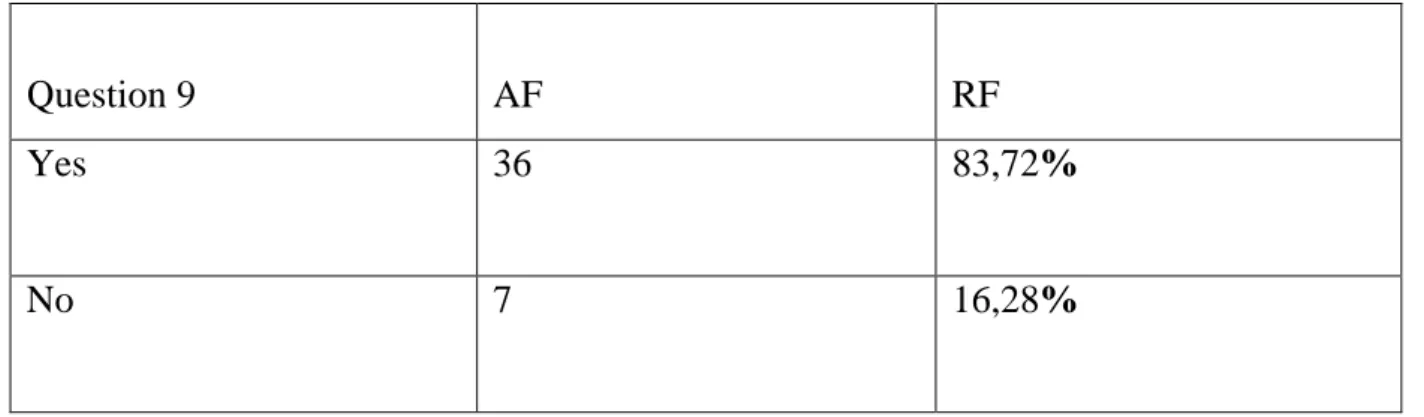
Table 2.3 Effectivenes of Classroom Management on Students’ Learning
Question 9 AF RF
Yes 36 83,72%
No 7 16,28%
The findings revealed that the majority of students (83, 72%) reported that classroom management affected their learning while 16, 28% of them said that they learnt by themselves and classroom management could not affect their learning process.
Q10: Teachers practices at the end of the course.
Figure 2.6 Teachers' Practices at the end of the course
The findings showed that the majority of teachers (60%) asked their students some questions or to did extra activities. Some others (15%) gave a brief introduction on the next lecture. Also there are teachers (15%) who asked their students to summarize the lesson in their own words after that they would discuss the misunderstood points. Finally, there are teachers (10%) who left the classroom just when the lecture finish although the time of the lecture was not completed yet.
Q11: Students‟ Opinion toward Teachers‟ Classroom Management
The results are shown in the following figure:
Figure 2.7 Students' Opinion toward Classroom Management
15% 15% 10% 60% 75% 25%
The results revealed that the majority of students (75%) were satisfied about the classroom management used by their teacher, they stated that it was perfect, good, successful, organized, and well prepared. The minority of them (25%) claimed the contrary saying that there were teachers who made the session boring without any motivation and it became a routine without any innovation.
2.6.2 Teachers’ Interview
This interview is addressed to eight EFL teachers in Tlemcen University from the English Department; five of them have PhD and the other three teachers have a Magister degree. The teachers‟ experiences differed from one teacher to another; five of them had more than 10years of experience, two had 5 to 10years of experience and one teacher had less than 5years. The interview was with teachers in the academic year 2018-2019. There were answers to the questions related to the teachers‟ profile.
When asking teachers on their love of teaching, all of them stated that they loved this noble task. Regarding their contact with students, the findings showed that all teachers had a good contact with their students.
Q3: Difficulties in the Classroom