President : Pr Zahri HAROUNI
.………University of Constantine
Supervisor : Pr Hacène SAADI
.………University of Constantine
Member : Pr Brahim MAHI
.………University of Oran
Member : Pr Mohamed. MEZIANE
.………University of Oran
D E D I C A T I ON
This thesis is dedicated to my wife, and to my kids: Wiem & Weil,
my most loving supporters.
This dissertation is utterly dedicated to my late mother, may she rest in peace, amen!
Thank you for your genes, mum!
The dedication also extends to Si Lazhar, father, friend and mentor by whom I was first
motivated to learn and think. May he be blest now and forever!
This work is also dedicated to my brothers, to my sisters, and to all the extended family;
and to my in-laws.
ﺲﯾردإ ﻦﺑا ،ﻲﻌﻓﺎﺸﻟا
)
1998
(
ﻓﺎﺸﻟا مﺎﻣﻹا ناﻮﯾد
ﻲﻌ
ﺔﻠﯿﻠﻣ ﻦﯿﻋ ،ىﺪﮭﻟا راد
Thou shan’t get knowledge lest six thou shalt implement
So here they art, for thee I fix in easy rime.
Smartness, eagerness; go-go will, ‘n’ accomplishment;
All go with a teacher’s company; patience ‘n’ time.
(Translation mine)
لﺎﻨﺗ ﻦﻟ ﻲﺧأ
ـــﻌﻟا
ـــ
ﻢﻠ
ﻻإ
ﺔﺘﺴﺑ
ﻚﯿﺒﻧﺄﺳ
ﻦﻋ
ﯿﺼﻔﺗ
ــــــ
نﺎﯿﺒﺑ ﺎﮭﻠ
ءﺎﻛذ
،
صﺮﺣ و
،
ﺔﻐﻠﺑ و دﺎﮭﺘﺟاو
ﺔﺒﺤﺻ و
ذﺎﺘﺳأ
،
و
‘
I daresay that the compensation system is the gravedigger of pedagogy in our universities.’
A C K N O W L E D G E M E N T S
First and foremost, I would like to praise my supervisor Pr. Hacène SAADI. I recognize in him the genius, the talent, and the modus operandi. I have thoroughly enjoyed my association with this master supervisor. He guided my writing with extensive and thoughtful reviews. I certainly was privileged and honored to work with him. He deserves a standing ovation!
I wish to address my thanks to the Ministry of Higher Education and to Mentouri University – Constantine, and to the staff of our Department for their assistance.
I should like also to thank my students who helped me do this research.
My special thanks are for Pr Noureddine MEBARKI, Department of Physics and for Dr Hacène BOUSSAHA, Department of French, of the University of Constantine whose help in
the making of this dissertation is truly beyond any estimation.
My other special thanks certainly go to the HAROUNIS, Department of English, University of Constantine for their great help.
My thanks extend to my nephews, the Twins Issam and Lotfi AMRANI - not best named first- from the University of Annaba for their unprecedented help with technical support whenever my hard-headed-virus-bound computer went mad.
I should not forget to thanks Pr Brahim MAHI, and Pr Mohamed MEZIANE who accepted to be in my jury, and for all they did to be on time for the viva despite the difficulties.
My other special thanks go to my Briton cousin Heil; to Mrs. Madja CHELLI and Sameh BELKERMI, to Miss Salima SELMENE; to Adel BOUSHABA for his Excel guidance; to
Foued BOULKROUNE; Foued BOUABDALLAH, Othmane AZIZI, and to many other people who always kept warming me up while I was deeply engrossed drafting the present research.
Finally, I want to voice out a big thank you to my wife, friend, passion, support, and inspiration. I heartily thank her for her long patience, endurance, and for the many cups of coffee she served me -every time I needed a caffeine boost during the long days and nights that I worked
ABSTRACT
The present dissertation, a total of eight chapters including two experiments (on building awareness for working without entirely relying on the compensation system), aims at describing and analysing how the efforts of learning and thinking are taking place among our learners. Through a series of questionnaires administered to 2nd-years and to teachers (of different disciplines) at the Department of English, University of Constantine, plus our own classroom observations, we intended to investigate the students’ learning and thinking, and thus decide for specific course objectives to be attained. All this was to be sustained by an appropriate methodology. The general objective is that students should learn how to adopt a learning pattern to acquire the language they are learning, i.e. learning to learn in concert with activating/re-activating their thinking potential and abilities, namely learning to think. The present research also aims at showing that what is happening in our department (and probably elsewhere) is that our learners have a attitude vis-à-vis learning which is to rely entirely on a Samaritan compensation system which has made them indefatigable least-efforts learners, as the students’ questionnaires have revealed. Our experiments were designed, in effect, with the intention to study the effect of building awareness in our learners for working without entirely relying on the compensation system, but rather on their learning and thinking efforts and potentials. The results of the present study tend to show first, that the compensation system is truly the gravedigger of pedagogy in our department (and most probably in all our universities!), a fact which all the teachers of our questionnaires agree upon. Second, likewise learning and thinking are so ‘sentenced’ to be limited to getting a pass mark, and us teachers are considered by many students
ﺺﺨﻠﻣ
نﻮﻜﺘﯾ
اﺬھ
ﺔﯿﻧﺎﻤﺛ ﻰﻠﻋ ﺚﺤﺒﻟا
لﻮﺼﻓ
و ﺾﯾﻮﻌﺘﻟا نﻮﻧﺎﻗ عﻮﺿﻮﻣ ﺞﻟﺎﻌﯾ و
ﻞﻛﺎﺸﻣ ﻦﻣ ﮫﯿﻠﻋ ﺐﺗﺮﺘﯾ ﺎﻣ ﻞﻛ
.
ﻖﻠﻄﻨﻣ ﻦﻣ
تارﺎﺴﻔﺘﺳﻻا
ﻲﺘﻟا
ﺔﺒﻠﻄﻠﻟ ﺖﻣﺪﻗ
ﺔﯿﺒﻨﺟﻷا تﺎﻐﻠﻟا ﻢﺴﻘﺑ ةﺬﺗﺎﺳأ ﻰﻟإ و ،ﺔﯿﻧﺎﺜﻟا ﺔﻨﺴﻟا
ﺎﻨﻟوﺎﺣ ،ﺔﻨﯿﻄﻨﺴﻗ ﺔﻌﻣﺎﺠﺑ
ﺔﯿﻤھﺄﺑ ﻲﻋﻮﻟا ﺚﺑ ﺔﯿﻔﯿﻛ ﻲﻓ ﺚﺤﺒﻟا
ﻌﺗ و ﻢﻠﻌﺘﻟا ﻢﻠﻌﺗ
ﺎﻤھﺎﻨﻠﻌﺟ ناﺬﻠﻟا ﺮﯿﻜﻔﺘﻟا ﻢﻠ
اﺬھ ﺎﻨﺜﺤﺑ ارﻮﺤﻣ
.
نﻮﻟﻮﯾ ﺎﻨﺘﺒﻠﻃ ﻞﻌﺟ ﺔﯿﻔﯿﻛ ﻮھ ﺎﻀﯾأ ﮫﯿﻠﻋ ﺎﻧﺰﻛر ﺎﻣ
ﺎھﺎﺒﺘﻧا
ﻢﮭﺋﺎﻨﺘﻗا ﺪﻨﻋ اﺰﯿﻛﺮﺗ و
تﺎﻣﻮﻠﻌﻤﻟا
.
ﻢﮭﻨﻘﻠﻧ نأ ﺎﻨﻟ ﻦﻜﻤﯾ ﻒﯿﻛ اﺬھ ﻦﻣ و
ﺖﺳﻹا
ﺎﯿﺟار
ت
ﺔﻣزﻼﻟا
ﻢﮭﻟ ﻰﻨﺴﺘﯾ ﻰﺘﺣ
ﺔﺻﺎﺨﻟا ﻢﮭﺘﻘﯾﺮﻃ ﻦﯾﻮﻜﺗ
.
فﺪﮭﯾ
ﺚﺤﺒﻟا اﺬھ
نﻮﻧﺎﻗ ﻰﻠﻋ ﺔﯿﻠﻛ نوﺪﻤﺘﻌﯾ ﺎﻨﺘﺒﻠﻃ نﺄﺑ ةﺮﻜﻔﻟا زاﺮﺑإ ﻰﻟإ
ﺬﻨﻣ ﮫﺑ لﻮﻤﻌﻤﻟا ﺾﯾﻮﻌﺘﻟا
نﻮﻟﻮﯾ ﻻ ﻢﮭﻠﻌﺟ يﺬﻟا و ﺔﻨﺳ نوﺮﺸﻋ و ﺔﺴﻤﺧ
ﺮﯿﻜﻔﺘﻟا وأ ﻢﻠﻌﺘﻠﻟ مﺎﻤﺘھا يأ
دﺮﺴﻟا و ﻆﻔﺤﻟا ﻰﻠﻋ ﻦﯾﺮﺼﺘﻘﻣ اﻮﺤﺒﺻأ ﻰﺘﺣ
ﻂﻘﻓ
.
نﺎﺘﺑﺮﺠﺗ ﺎﻨﯾﺮﺟأ اﺬھ ﻞﺟأ ﻦﻣ
ﺔﺒﻟﺎﻃ و ﺐﻟﺎﻃ ﺔﺋﺎﻣ ﻰﻠﻋ
.
ﻞﺼﺤﺘﻟا ﺞﺋﺎﺘﻨﻟا
ﺮﺑأ ﺎﮭﯿﻠﻋ
ﺾﯾﻮﻌﺘﻟا نﻮﻧﺎﻗ نأ تز
ﺎﯿﺟﻮﻏاﺪﯿﻟا مدﺎھ ﻮھ
.
ﻦﻣ نذإ ﺢﺒﺻأ
ﻠﻋ ﺐﺟاﻮﻟا
ﻰﻠﻋ ﺎﻨﯿﺒﻠﻃ ﻞﻌﺠﻧ نأ ﺎﻨﯿ
ﺔﻈﻘﯾ
ﺎﻌﺟﺎﻧ ﺲﯿﻟ نﻮﻧﺎﻘﻟا اﺬھ نﺄﺑ ﻲﻋو و
هﺮﯿﻏ ﻦﻣ ﺮﯿﻜﻔﺘﻟا ﺐﺠﯾ و
ﻲﺘﻟا ﺔﯿﻘﯿﻘﺤﻟا ﻢﮭﺗارﺎﮭﻣ زاﺮﺑإ ﻢﮭﻟ ﻰﻨﺴﺘﯾ ﻰﺘﺣ
Résumé
Cette dissertation de huit chapitres –dont deux expérimentations- a pour but de
décrire ainsi que d’analyser la situation d’apprentissage et de réflexion des étudiants de
deuxième année d’anglais au département des langues étrangères de l’université de
Constantine.
A partir d’une série de questionnaires adressés à nos étudiants ainsi qu’aux
enseignants, et en plus des observations, nous avons tenté d’enquêter sur les problèmes
relatifs aux deux pivots de notre recherche, soient: apprendre à apprendre et
apprendre à réfléchir. A partir de cela, nous avons aussi commencer notre réflexion sur
la méthode la plus appropriée qui puisse nous permettre d’inculquer à nos apprenants
l’idée d’apprendre et de réfléchir sans trop compter sur le Samaritain système de
compensation. Ce dernier a depuis vingt deux ans poussé nos étudiants dans notre
département et ailleurs à ne plus faire l’effort de réfléchir, voire d’apprendre.
Cette dissertation discute donc de la manière la plus efficace de faire changer à nos
étudiants -devenus donc des partisans du moindre effort- leur habitude d’apprentissage
et de réflexion. Nos deux expérimentations ont été, en effet, désignées pour permettre de
trouver la méthode la plus adéquate afin de pouvoir inculquer à nos apprenants une
prise de conscience à, savoir travailler sans trop considérer le système de compensation
-désormais le fossoyeur de la pédagogie dans nos institutions universitaires. Les
résultats obtenus tentent à démontrer qu’avec un tel système, nos étudiants sont
condamnés à limiter leurs ‘efforts intellectuels’ à seulement obtenir une note de
passage. Pour cela, il est devenu plus essentiel, voire impératif que nos étudiants
réapprennent à apprendre et réapprennent à réfléchir.
List of Abbreviations and Coding Conventions
L.M.D C.A C.R C.S E.A.P E.F.L E.O. g G.E I.Q I.V S.R T.T.T. U.R U.S F.L G.P N.S s2 s T.LLicence Master Doctorate Chronological Age
Conditioned response Conditioned stimulus
English for Academic Purposes English as a Foreign Language English for Occupational Purposes general factor
General English Intelligence quotient Independent variable Stimulus-response Teacher Teaching Time Unconditional response Unconditional stimulus Foreign Language General Purpose Native Speakers Variance Standard Deviation Target language
LIST OF TABLES
Table 01 Scheduling Reinforcement p. 29
Table 02 A Cross-Analysis of Yamamori and Williams and Burden’s Three-Stage Model p. 51
Table 03 The Brain Working Pattern p. 105
Table 04 Mnemonics for the 6 P’s p. 108
Table 05 Mnemonics for the Colors of the Spectrum p. 108
Table 06 Diagram of the Social Strategies p. 120
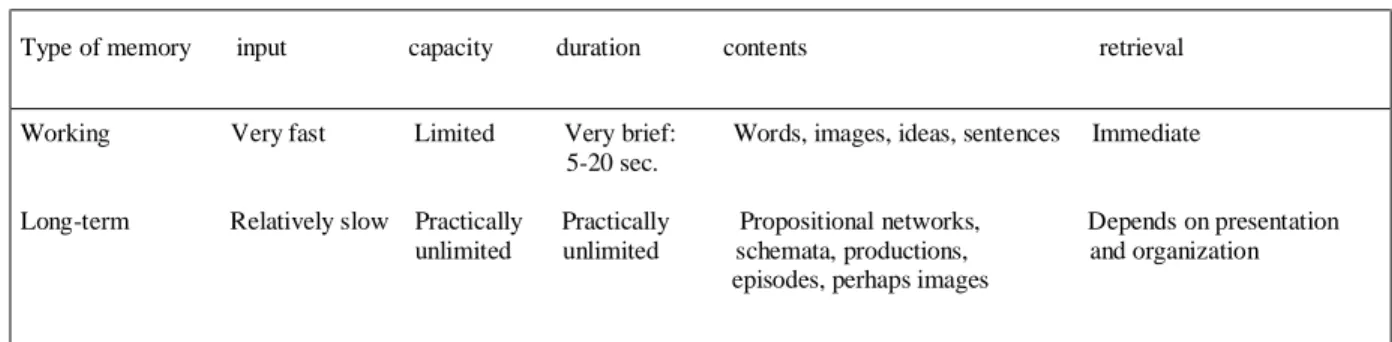
Table 07 Working and Long-Term Memory p. 125
Table 08 Long-Term Memory: Explicit and Implicit p. 131
Table 09 Baccalaureate stream and Access to University (MotQuest) p. 235
Table 10 Who do you think you are? p. 237
Table 11 What do you thin of going to the U. every day? p. 237
Table 12 When do you arrive to the U.? p. 238
Table 13 When do you arrive in time? p. 239
Table 14 How do you find going to the cafeteria before the course? p. 239
Table 15 How do you feel before the course starts? p. 240
Table 16 How do you feel once the course starts? p. 241
Table 17 How do you feel once the course is over? p. 241
Table 18 If no above, are you happy because another one starts? p. 242
Table 19 How do you feel when the teacher is absent? p. 242
Table 20 What do you find classwork? p. 243
Table 21 How do you find the program you follow? p. 244
Table 22 Mark the modules you like to study by degree of preference p. 245
Table 23 Can you justify your answers? p. 245
Table 24 Do you go to the library? p. 246
Table 25 If yes above, how frequently do you go? p. 246
Table 25 Do you think that the U. is an important stage in your life? p. 247
Table 27 Baccalaureate stream and access to university (GenInfQuest) p. 249
Table 28 Your impressions when you entered university? p. 249
Table 29 Was it your choice to study English or was it somebody else’s p. 250
Table 30 Are you still satisfied being a student of English? p. 250
Table 32 In general how do you find [the subjects of] the courses? p. 251
Table 33 How do you find your teachers? p. 252
Table 34 Do you participate in class? p. 252
Table 35 Do you think you learn better when you ask questions? p. 253
Table 36 Do you read at all? p. 254
Table 37 If yes above, what do you usually read? p. 254
Table 38 Do your teachers give you homework? p. 255
Table 39 Do you like homework at all? p. 255
Table 40 If yes above, do you think regular homework helps you? p. 256
Table 41 If you don’t homework, is it because you find them? p. 257
Table 42 All in all, are you happy to be a student? p. 257
Table 43 Teachers’ major teaching subjects p. 259
Table 44 Do you stick to an established program? p. 260
Table 45 If no above, why? p. 261
Table 46 To which activity do you devote more time? p. 261
Table 47 Which activities students better respond to? p. 262
Table 48 Do you think that participation serves maximize students’ achievements? p. 262
Table 49 Do your students show difficulties in? p. 263
Table 50 If in participation, what are difficulties due to? p. 263
Table 51 Which feedback do you suggest to remedy to? p. 264
Table 52 What is the role of the compensation system in the students’ learning progress? p. 265
Table 53 If for above you answered doing harm, what do you suggest? p. 265
Table A1
25 scores of the test on the cellphone caricature of the awareness building treatment of the experimental group of the first experiment
p. 374
Table A2 25 scores of the test on the cellphone caricature of the awareness building
treatment of the control group of the first experiment
p. 375
Table A3 Data of Tables A1 et A2 reorganized in the form of frequency distributions of the
experimental and control groups of the experiment
p. 295
Table A4
Computation of the mean, the variance and the standard deviation of 25 scores on the portable caricature of 25 students of the experimental group based on a frequency distribution of the 1st. experiment
Table A6 Intervals and frequencies of the scores of the experimental and control groups in the awareness building treatment of the first experiment
p. 303 Table B1 25 scores of the test on the restaurant caricature of the awareness building treatment
of the experimental group of the second experiment
p. 377
Table B2 25 scores of the test on the restaurant caricature of the awareness building treatment of the control group of the second experiment
p. 378 Table B3 Data of Tables B1 et B2 reorganized in the form of frequency distributions of the
experimental and control groups of the second experiment
p. 319
Table B4 Computation of the mean, the variance and the standard deviation of 25 scores on the restaurant caricature of 25 students of the experimental group based on a frequency distribution of the second experiment
p. 321
Table B5 Computation of the mean, the variance and the standard deviation of 25 scores on the restaurant caricature of 25 students of the control group based on a frequency distribution of the second experiment
p. 322
Table B6 Intervals and frequencies of the scores of the experimental and control groups in the awareness building treatment of the second experiment
LIST OF FIGURES
Figure 01 The negative reinforcement chain reaction p. 27
Figure 02 The positive reinforcement chain reaction p. 28
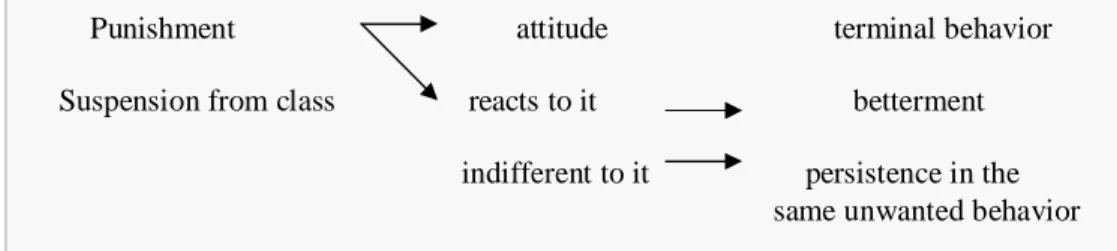
Figure 03 The punishment diagram p. 31
Figure 04 The three-stage model of reaction p. 50
Figure 05 A taxonomy of ESP course p. 79
Figure 06 The aims of learning training p. 81
Figure 07 Diagram of the memory strategies p. 89
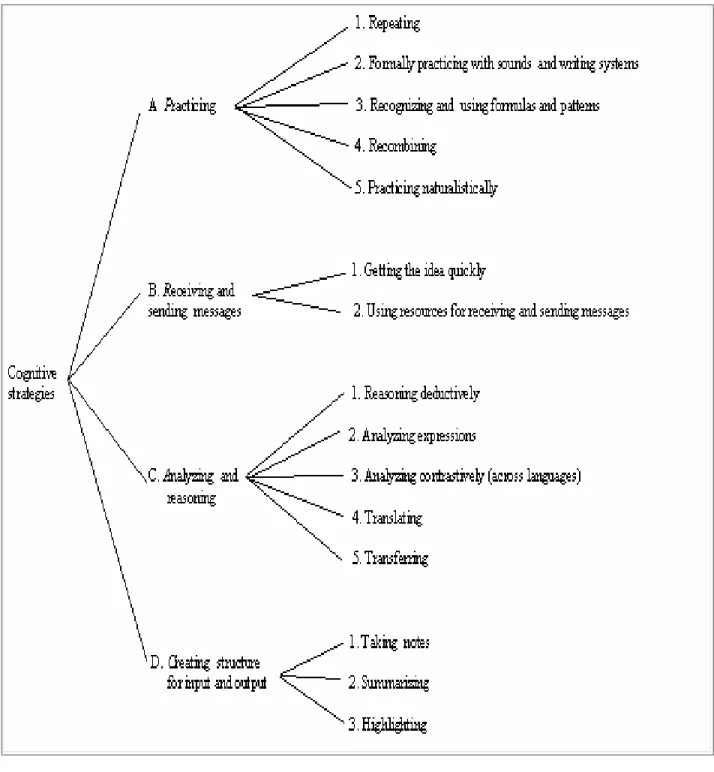
Figure 08 Diagram of the cognitive strategies p. 91
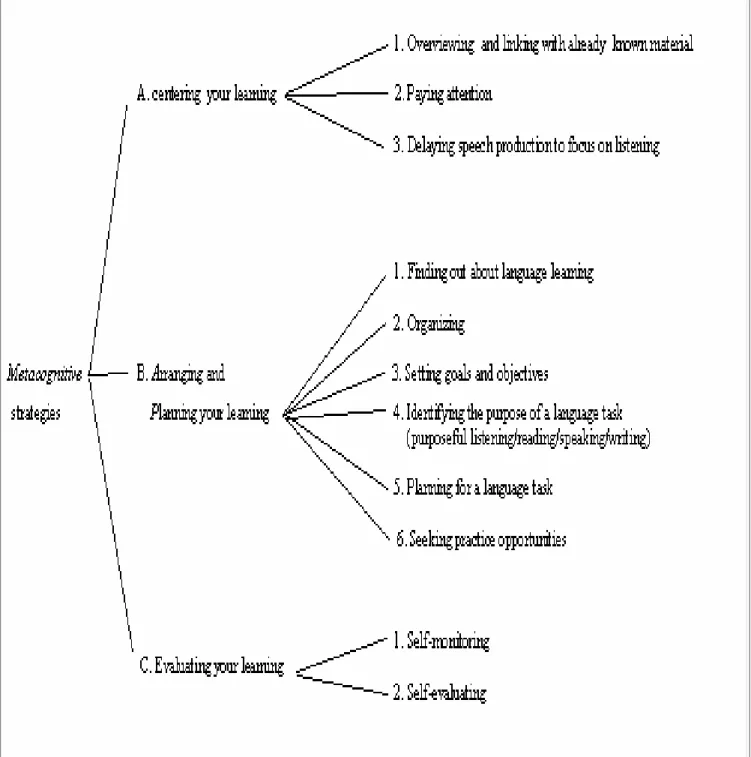
Figure 09 Diagram of the metacognitive strategies p. 93
Figure 10 Diagram of the social strategies p. 96
Figure 11 Atkinson and Shiffrin’s model of memory p. 110
Figure 12 The letter display for the visual-report experiment p. 111
Figure 13 Diagram of the problem-solving process p. 159
Figure 14 A challenge to think p. 161
Figure 14 bis Division and multi-directional “reading” of a caricature p. 285
Figure 15 Diagram of the experiment treatment p. 286
Figure 16 The upside-down diagram of the treatment condition p. 287
Figure 17 Frequency histograms of the test scores of the experimental and the control groups in the awareness building treatment of the first experiment
p. 300
Figure 18 Frequency polygons of the test scores of the experimental and the control groups in the awareness building of the first experiment
p. 301 Figure 19 Histograms of the frequency percentages test scores of the experimental and
the control groups in the awareness building treatment of the first experiment
p. 304 Figure 20 Frequency polygons of the test scores of the experimental and the control
groups in the awareness building treatment of the second experiment
p. 324 Figure 21 Frequency histograms of the test scores of the experimental and the control
groups in the awareness building treatment of the second experiment
p. 325 Figure 22 Histograms of the frequency percentages test scores of the experimental and
the control groups in the awareness building treatment of the second experiment
CONTENTS
Dedication ... i
Acknowledgements ... iv
Abstract ... v
List of abbreviations and coding conventions ... vi
List of tables ………... vii
List of figures ………... x
CHAPTER I
General Introduction
1. 1. Introduction to the present research ... 21. 2. Aims of the research ... 3
1. 3. Statement of the problem and hypotheses ... 4
1. 4. Methodology ... ... 5
1. 5. Structure of the thesis ... ... 6
CHAPTER II
Learning and Motivation
2. 1. Introduction ... 172. 2. Learning defined ... 18
2. 3. Learning and the brain ... 19
2. 4. Early explanations of learning ... 20
2. 5. Forms and functions of learning... 36
2. 6. Social learning ... 42
2. 7. The desire to learn and motivation ... 48
2. 8. Shaping a behavior of learning : Learning to Learn ... 68
CHAPTER III
Strategies for Learning to Learn
3. 1. Introduction ... 72
3. 2. Learning strategies defined... 72
3. 3. Considerations for learning strategies... 74
3. 4.Ubiquitous primary learning strategies …... 78
3. 5. Other types of other learning strategies ... 83
3. 6. Conclusion ... 98
CHAPTER IV
Memory and Enhancing Effective Memory in Students
4. 1. Introduction ... 1014. 2. Memory defined ... 102
4. 3. Information processing ... 104
4. 4. Storage and forgetting... 133
4. 5. Conclusion ... 137
CHAPTER V
Learning to Think
5. 1. Introduction ... 1395. 2. Thinking defined ... 140
5.3. Development of thinking ... 143
5.4. Categorization of thinking ... 154
CHAPTER VI
Intelligence and Thinking
6. 1. Introduction ... 195
6. 2. Defining intelligence ... 196
6. 3. Considerations of the nature of intelligence... 198
6. 4. Improving intelligence ... ... 215
6.5. Conclusion ……… 222
CHAPTER VII
Research Situation Analysis
7.1. Introduction ... 2257.2. Situation design ... 225
7.3 The pilot study ... 228
7.4. Description of the questionnaires ... 232
7. 5. Administration of the questionnaires ... 234
7.6. Conclusion ... 267
CHAPTER VIII
Field Work and Experiments
Experiment One
8.1. Rationale ... 2708. 2. Research design ... 271
8. 3. Subjects’ sampling and population... 271
8. 4 Results and discussion: preliminary considerations... 293
8. 5. Results and interpretations ……... 296
8. 6. Putting it altogether... 305
Experiment Two
8. 8. Research design ... 311
8. 9. Subjects’ sampling and population ... 312
8. 10. Results and discussion: preliminary considerations ... 318
8. 11. Results and interpretations ……... 320
8. 12. Putting it altogether... 328
8.13.. Conclusion ……….…………... 331
General Conclusion and Recommendations ... 333
Bibliography... 342
1
Chapter 01
General Introduction
1. 1. Introduction to the present research ... 2
1. 2. Aims of the research ... 3
1. 3. Statement of the problem and hypotheses ... 4
1. 4. Methodology ..………... 5
Chapter 01
General Introduction
1. 1. Introduction to the present research
The present research attempts to explore the fundamentals of two related milestones of the cognition act: learning and thinking. These two are firmly grounded in the cognitive enterprise and represent its corner stones. Learning means to employ a set of strategies to make possible comprehension, acquisition, retention, retrieval, and application of information (Hedge.2000). On the other hand, thinking means to consciously process information in the mind to find a thoughtful solution to a problem. In other words we break down a puzzling problem to its components and then we re-build it up again and synthesize it into a novel final form (cf. Sternberg.1995). In the process of thinking, we learn to decompose and compose a puzzle or a quiz to find out how to solve it, and in learning we use our thought and mind to find a way, a pattern to follow to utilize our mental and cognitive capacities to ‘survive’, to extend and to transform the milieu in which we are evolving.
Students come to university to learn a language to later utilize it for their own ‘survival’, for their job, or for their manifold communication purposes. Thinking and
learning are firmly grounded in tertiary tuition. Indeed, at the university level, students are expected to behave in a more elaborated manner than they used to while
3
their imagination, creativity, and problem solving capacities which the tertiary tuition is precisely all about. In other words, at the university -more than before, it is likely
improbable that our learners would acquire the language they are learning, extend the
environment in which they evolve, and broaden the scope of their knowledge –together with between-the-lines knowledge- and their wit without first
using appropriately their learning capacities, in concert with their other mental and thinking abilities. In primary school, middle school, and high school, the gate keeper of ideas, information, and knowledge is the teacher, the imperious deliverer of the truth and science. In the university, things are different. For acquiring and obtaining knowledge and science, the gate keeper is the learner himself; the teacher is a facilitator and a motivator. The learner has to learn to learn, as well as to learn to think to judiciously employ the maximum of his grey matter potential to achieve the purpose of acquiring a knowledge which he set himself to acquire.
1. 2. Aim of the research
The guiding commitment of the present research is precisely that we are dealing with human minds, not dead matter, within an intrinsic kaleidoscopic compensation system which distorts our pedagogic objectives which we set ourselves to reach,
together with our expectation which is to see our learners active members in the little g fan club.
Sternberg (1995) explains that in a wise investment, it is to buy low and sell high. In the classroom, as a matter of fact, once the teacher has convinced the ‘other people
of the worth of his idea, this [teacher] moves on to the next idea’ (p.363). In our view, the compensation system as it stands and regulates our language policy does not allow such an investment to take place. Learning the foreign (target) language is reduced to rote learning and to giving/obtaining a pass mark be it a bad one since compensation guarantees to balance out any deficiencies.
The basic findings about a deeper recognition of learning to learn and learning to
think through a habituation of our learners not to consider the compensation as a good means for succeeding without truly learning, and without making the real effort of thinking appear more and more in our view to agree
with our contention to make of that habituation an approach to the T.L while our learners learn and utilize their thinking potential. This adopted view and other closely related views which are being reflected here, will be discussed in some detail in the present study, in order to bring more support for our research hypotheses.
1. 3. Statement of the problem and hypotheses
As a matter of fact and for the purposes of our present research, we have advanced the following hypotheses.
One hypothesis in the present study is that our learners can learn effectively and
develop their thinking abilities if we create a learning atmosphere in which they behave without giving absolute priority to the compensation system. Learning in our
universities is largely orchestrated over the expectation that the compensation system is [simply] meant to aid learners whenever troubles arise. What truly happens is that
5
instead of using it as a fire exit utilized only when emergency spurs upon, our students rather use it as an easy exit when and when not difficulties surface.
The other related hypothesis is that if we build in our learners awareness about the usefulness of constructing a solid knowledge by utilizing learning strategies and later by creating their own and individual strategies, they will learn to face whatsoever problem, and they could learn to mesh with any learning / thinking difficulty by bridging problems gaps. We believe that by enticing them to do likewise, will slowly but surely help them forget of the compensation system a do-good Samaritan but rather they would [start to] consider it as a ‘spare wheel’ used only when an urgent need arises, or when an unexpected problem surfaces.
Moreover and as closely related hypothesis is that granting a bonus mark is to
reinforce them to build their awareness, as discussed in Chapter II. We believe that awareness building and rewarding go together for the second consolidates the first and the first, in return, would lead to make the learner gradually replace the concept of
relying on the compensation system only when problems arise. The present research is built up on these two basic hypotheses.
1. 4. Methodology
Our population of one hundred sophomore students (N=100) are taken from a general population of 280 English B.A students of the Department of Languages of
the University Mentouri at Constantine. We will administer them two sets of questionnaires (cf. Appendix # 1 & 2), one entitled the motivation questionnaire, or the
MotQuest which intends to know the motivational profile of our population of learners,
what pushed them to learn English, to see if someone has helped them choose their stream; their relationship with their peers, their teachers. Questions were also put to enquire about they behavior outside and inside the classroom, and other related questions.
The other questionnaire entitled The General Information Questionnaire or the
GenInfQuest tries to ask questions the former questionnaire does not ask. If both
questionnaires seem to ask the same question –which is not repetition- it is because we want to reinforce our quest for really understanding who our population students are, how they think, and which positions do they [really] take vis-à-vis the points raised in our questions. Generally, when the questions are the same in both questionnaires
(sometimes, there is no escape from it); we formulate them in a totally different way (cf. Tables 03 & 20; Tables 11 & 25 or Tables 34 & 18).
A third questionnaire will be administered to 16 different teachers of our department (cf. appendix # 03).. This questionnaire is to probe many aspects of teaching as the teachers’ way of teaching, their opinions about the program, and many other pedagogic aspects of interest in the present research. The results of all the questionnaires will bring light to many points in our present research about the learning and the thinking capacities and anilities of our learners.
1. 5. Structure of the thesis
7
background of our basic assumptions: learning to learn and learning to think. In the subsequent Chapter Eight, the results of the experiment on the effect of building awareness about not relying too much on the compensation system are described and interpreted in some details.
In the second chapter of this study, we will tentatively discuss learning and the learning act and its other different dimensions. We will discuss the relationship of leaning and the brain, and the Wernicke or Broca’s areas of the brain that harbor
particular linguistic functions. The study of these areas has been substantiated by the works of Kimura (1993) who has observed that his patients with brain damages, in the spina fida (Cromer.1994) have been found to have language deficits, as well as cognitive impairments. Piaget (1983) and Karmiloff-Smith (1979) have also observed that cognitive impairment entails linguistic retardation. Such brain-and-mind relationships have in the 1920’s given rise to Emergentism, an empiricism which explains the relationship between the brain and the non-physical mind.
In fact, such a relationship between the brain and the non-physical mind has long ago triggered the cogitations of the ancient Greek philosophers who wanted to understand how learning occurs. To Aristotle, learning occurs with associations, and under the impulse of stimulus, and we also learn by associations, or the trigger chain, in which an element calls for another, and like this (McMahon.1999; Sternberg.1995). In present times, Pavlov has set the principles of classical learning or classical
conditioning; also known as stimulus-response. The conditioned response –the salivation of the dog- is due to a conditioned stimulus –the sound of a
bell. The dog learns to respond to salivation whenever food or any other stimuli, the concept of generalization, and gradually ceases to respond when the stimulus is no more presented the notion of extinction. Such a classical conditioning has served, in the long run, to step the way to truly understand the whole process of leaning. Concepts like operant learning have come up to investigate how learners, as well as people at large, act upon the environment in which they live. The studies of Thorndike in operant conditioning have brought about the law of trial-and-error exploration of the environment. Giving bonus mark to students for a good answer will, in all likelihood, push them to always try to do well to make the same reward occur again and again. (Skinner.1953; Gardner.1983, and elsewhere).
Learning is also observing people’s behaviors, as a student does inside the classroom imitating his teacher. Such social learning -observational and experiential- results from assimilation, representations of people’s behaviors, and modeling; it is a communal activity, a sharing of culture (Bandura.1977; Bruner.1986). All this help shape the behavior of learning of our learners, that is learning to learn how to construct their own knowledge.
In the third chapter, closely related studies to the present research are discussed in
some detail within the quest of learning and learning to learn. Indeed, authoral research has been carried on language learning strategies to try to determine
how much these are prominent for any learning behavior. The final aim of such research is to inculcate in the learner –at large- the awareness of the utilization of learning strategies for the acquisition and the construction of knowledge. We will try to
9
see whether such an attempt to raise awareness finds its way with our compensation
system- bound learners.
One of the most important accomplishments in learning strategies studies (cf. O’Malley (1990); Oxford (2000) is to investigate how much these strategies have
been / are employed by teachers in their different teaching tasks, and by learners while learning. The propounding principle in pedagogy tends to be that in teaching the
teacher does not teach, but students learn. Of course, this principle does certainly not
mean that the teaching activity is reduced to presenting core matter to the students asking or expecting them to change it and develop it into comprehensible knowledge.
This is not so because, as a matter of fact our learners have little or no opportunities at all to receive language outside the
classroom (cf. Kougaro.1993). Worse, the overwhelming majority of our learners has never been, and will probably rarely if ever go to the English-speaking community (for visa and financial reasons) to supposedly practice the language they are learning [listening and speaking/communication skills]. At any rate, for the aforementioned impediments and probably for others, we did not discuss in the present research the idea of ‘going out there’ (to receive the desired linguistic bath) as a learning strategy. Thus, our learners’ possibilities for picking up the language they are learning remains confined within the confined province of the classroom with –at the end of their tuition- to function in a non-English situation (Lowe.1981). To parry this, we have to provide them with a total all clear about what these learning strategies are, how to utilize them and how to profit from them in constructing their personal idiosyncratic way to gulp
knowledge. For this, we do not expect our different learners to employ evenly the learning strategies. We do not expect [to witness] an explosion of concepts
either, but still –as practitioners– we should bound ourselves to inculcate idiosyncrasy,
together with self-awareness, and to never be afraid to kick open and anthill (cf. Honey. 1998). We abide by the idea that learning to learn, which is central
in the present research, represents the essence of the teachability of the learning strategies.
In the fourth chapter, we will discuss memory and how to enhance effective memory in our students. Memory is an active process that helps construct a stock of information (Neisser. 1982). It is also a dynamic process with mechanisms which helps
to retain and to retrieve information whenever needed (Crowder.1976;
Sternberg. 1995). Studies by Atkinson and Shiffrin (1968) see that memory is threefold: sensory memory, short-term and long-term memory.
The active dynamism makes that what is stored in the long-term memory is judiciously and regularly updated and renewed, actively worked out and exchanged with the short- term memory, also know as working memory (Baddeley. 1980), as the Atkinson and Shiffrin model (1968) shows. Our brain processes the information, processes and transforms these stimuli [into cerebral waves] into coded information, stores them, and retrieves them whenever necessary. Such sensory memory helps us remember icons, colors, sounds (echoic store), and figures. We utilize as aids for memory mnemonics as 15GCE 15 Pizzas which stands for 15 girls can’t eat 15 pizzas and many more similar ones (Sperling.1960, Anderson.1995). Perception and attention
11
help detect a new stimulus and giving it a particular meaning according to data that has been already internalized, and internalizing it in terms of [Gestalt] patterns and wholes (Russel.1961. Saadi.1990).
The short-term memory, later coined by Baddeley (1986) as Working Memory, is
the corner stone between sensory memory and long-term memory. In the two last decades, starting from the work of Baddeley (1986, 1998), working memory is
described as comprising a central executive, a phonological loop, and a visuospatial sketchpad (cf. Woolfork. 2004). The central executive supervises, rehearses, retrieves, makes plans, and integrates in-coming data (Brown 1958; Peterson et al 1959). It is the headquarter of all the memory operation for which it requires the help of the phonological loop and the visuospatial sketchpad. The first is a system that stores a limited number of sounds for a limited period of time (Gatherhole.1997), whereas the second stores images and icons. We visualize what is being told by giving it a spatial representation in the form of a scene or occurrence (cf. Woolfork.2004).
The long-term memory, or the long-term reservoir, has the particular characteristics of capacity and duration. The capacity of the long-term memory is much greater where information is securely held, through rehearsals basically, for a longer time for long-term requirements and future needs and applications. Long-term memory hosts also the explicit memory, or the consciousness-driven memory; and the implicit memory, which deals with habits as we feel involuntarily afraid to sit for an examination even if we have revised well for it (Wolpe.1969; Mook.1982). Long-term
memory also hosts the procedural memory, our habits skills and the way of doing things.
Remembering is most of the times coined with forgetting. It represents the other side of the coin. With the passage of time, and with the diminution
(or disappearance) of rehearsal, memory traces decay (decay theory) which causes us to forget (Anderson.1995). Furthermore, we also forget a piece of relatively old information when new information interferes with (interference theory) and displaces it in the short-term store. Put in a nutshell, we can say that memory plays a redoubtable role in learning, and we are yet to see how we could simply learn or think or do anything without the help of our memory.
In the fifth chapter, we discussed in some length what thinking is al about. Thinking is to consciously process information to find a thoughtful solution to a problem. It is an operation of deconstruction, analysis synthesis and of reconstruction. Thinking develops in society and acts upon it. Vygostsky (1978) sees that the process of cognitive development is greatly dependent on social interaction. He identifies a Zone of Proximal Development as being the distance between solving a problem by our own capacities (individual thinking and idiosyncrasy) , and under the tutelage of an adult.
To Piaget (1954 and elsewhere), our cognitive processes change radically as we strive to understand the world in which we live through maturation, activity, and social experiences.
The thinking process can be categorized as problem solving; decision
making; reasoning, and creativity. Before we solve a problem, we have first to understand its contours, after which we solve it by taking different routes
13
and approaches. Taking a [final] decision could be one aspect of solving a problem. In
striving to do so, we –again take recourse to many optimal decisions, using a matrix of correspondences in which we draw all the elements that compose the problem to try to solve it (Greeno.1991, Matlin (2003). By so doing, we try to seek the maximum of pleasure and avoid pain (Sternberg. 1995) as we weigh the positive and the negative utilities and we seek the highest possible utility. Satisficing is to choose an option; the one which we see satisfies our need to solve a problem.
We also solve a problem by reasoning. When we reason, we choose among many alternatives, but we do not always make a well-thought decision. In the realm of thinking, there are sets of rules that tell us what to do, how to do, and when to do. We try sometimes to deduce from general premises through syllogisms to [finally] arrive to a logical conclusion. Conversely, we may reason inductively, through analogies and classifications, moving from specific facts to reach a general conclusion.
Creativity is another stance of thinking. Some believe that for solving a difficult problem, it is advisable to give it to a lazy man because he will find the easiest way to solve it. He creates a new idea, a theory, or a new style. Thinking is an issue of paramount importance. We will try to shed light on all its components, all of which are important. Using the appropriate heuristic is most of the time done thoughtfully. If we can implement in our learners [all] these aspects of thinking, we can then be confident
that we could stop the badly influential compensation system, making of our learners true thinkers.
In chapter six, we will tentatively discuss the issue intelligence which is closely related to thinking. Intelligence seems commonplace to many who think that we are
born with a potential of intelligence. Others see that we acquire it from experience and from the observation of the others. And if this be intelligence, could we know how much one is intelligent par rapport another one. The nineteenth century Francis
Galton, and the twentieth century Alfred Binet have each one of them tried to measure intelligence by putting a scale of measurements.
Theorizing about intelligence, Galton’s observations led him to think that gifted people have the capacity and the energy to do things which ordinary people can’t. Wechsler’s (1950) findings, less [racially] discriminating found that the same people can do good or bad on the same large number of tests. Accordingly, denotes the state of being intelligent, but does not explain it.
Alfred Binet (1916) on his part, with his colleague Theodore Simon devised tests that measure intelligence. For this Binet’s (and his colleague) findings were also discriminatory, but not in Galton’s sense. The discrimination Binet brought about concerns more realistic about mental age according to which an individual judges well, comprehends well, and reasons well. People develop a good sense, or a practical sense with which they customize with their environment.
Charles Spearman (1927) a psychometric psychologist has put forward in his
treatise the idea of a multilevel hierarchy dimension to intelligence. He elaborated a two-factor theory of intelligence with at the top a general factor g common to all tasks
requiring a kick of intelligence which represents the power of reasoning. At the bottom, a fact that differentiates between the mental energy (Sternberg et al. 1982) of people while performing intellectual tasks as problem-solving, and the like.
15
Since intelligence is not static it, so, develops, and one can act upon to improve it as human cognitive systems are modular and encapsulated (Howe.1997) since every class is different and every one topic should be considered according to its specific core ideas, issues, and most of susceptibilities to misconceptions (Gardner.1999).
In education, intelligence imposes itself for it moulds the way the student reacts to
what he does as it is pervasive both in learning and thinking, and it is hard to try to see the latter without the interference of intelligence. In giving marks in examination,
we are probably testing our learners’ intelligence according to Boring’s (1921) definition that ‘intelligence is what intelligence tests measure’.
Chapter seven is entirely consecrated to the situation analysis. The data obtained from the different questionnaires which we administered to our colleagues and to our learners will be described and analyzed. Such an analysis will allow us to have a clear and distinct view about teaching –in general– and how it is conducted in our department. Out of this analysis, we will show the contours of our research, and what we aspire to find out and do with our students. We will present our suggestions concerning teaching and learning in our department.
Finally, in Chapter VIII, we will present and analyze the results of our experiment on the effects of awareness building, i.e. in making our students think they are not in the compensation system and should behave otherwise so as not to totally rely on it. The results of our experiment will bear about one important research hypothesis (H1)
that making students work without thinking to totally rely on the compensation system (our independent variable)allows the learner to think more and
better activate his cognitive abilities (thinking, memorizing, utilizing learning strategies, reasoning).
CHAPTER II
Learning and Motivation
2. 1. Introduction ... 17 2. 2. Learning defined ... 18 2. 3. Learning and the brain ... 19 2. 4. Early explanations of learning ... 20 2. 4. 1. Classical conditioning ... 21 2. 4. 2. Operant conditioning ...23 2. 5. Forms and functions of learning ... 36 2. 5. 1. Preprogrammed behavior ... 36 2. 5. 2. Scheme and novelty ... 37 2. 5. 3. Reflex and spontaneity ... 39 2. 5. 4. Instinct and intuition ... 42 2. 6. Social learning ... 42 2. 6. 1. Observational learning ... 45 2. 6. 2. Experiential learning: old experience; new experience ... 46 2. 7. The desire to learn and motivation ... 48 2. 7. 1. General approaches to motivation... 52 2. 7. 2. Which threshold? ... 58 2. 7. 3. The teacher: an expert motivator ... 66 2. 8. Shaping a behavior of learning ... 68 2.9. Conclusion ... 70
17
Chapter 2
Learning and Motivation
2. 1. Introduction
In this chapter, we will show the contours of the operation of learning, how the student learns and internalizes knowledge, and which strategies does he adopt to achieve the operation of learning.
We will try also to demonstrate whether the operation of learning requires from the learner to be intelligent, or whether it simply requires a social exposition to the language he is learning and to the knowledge he* wants to get, that is whether the operation of learning is only conscious or also unconscious.
We will also try to discuss motivation as a driving force responsible of initiation, direction and vigor of goal-directed behavior. This will be discussed in the light of how to motivate our students to learn to enable them to fulfill in the best way possible their task of learning the self-schemes together with the motivational factors that help them enhance their own learning.
Finally, we will place the process of learning within the theoretical and practical opportunities that our language policy (with the compensation system) offers, and we will try to shed light on the efficiencies and the inefficiencies that mark the very language policy.
_________________________
2. 2. Learning defined
Philosophers see that acquiring skills, knowledge and information constitute learning. This learning comes from observation and experience, and this is true to a very great extent. Perception means observation and experience, (as two important modes of perception being background actions to the process of earning) that is to be aware of something by means of which is the awareness of something by means of seeing, hearing, and which represent our audio-visual tools.
As an operational definition, learning means using strategies defined as specific methods or techniques used by learners (as individuals at large) to first make possible comprehension, acquisition, retention, retrieval, and later, whenever needs arise, the application of information (Hedge. 2001). Using strategies also requires a certain degree of consciousness or cognition, which permit the learner to reinforce his learning, as opposed to rote learning (cf. Lan 2003; Yamamori et al. 2003:381).
At any instance of learning, there is an important interplay between the individual’s -the student’s brain, his nervous system, and the external environment in which he evolves, which surrounds him, and in which he may find himself alien at times, and to which he responds and acclimatizes, in other times.
To Sternberg (1995), learning is any ‘permanent change in the behavior, thoughts or feelings of an organism(…)that results from experience’ (p 236). Such an experience could be linguistic and non-linguistic resulting from the external
environment (cf. Steinberg et al. 2001). Learning affects the learner’s behavior, and his behavior becomes programmed. When put in a [total] different environment as the
19
university environment, for instance, the learner learns new chunks of language in the form of responses or even questions which are generally prompted by the (sudden) change or demand in the environment in which he evolves.
2. 3. Learning and the brain
The study of the relationship between language production and the brain is not a new one. Broca and Wernicke’s discoveries about aphasia give well-documented instances about brain lesions that affect linguistic functions. Studies on these lesions have concluded to know a lot about the relations between precise areas of the brain and particular linguistic functions. Indeed, many linguistic functions and manifestations are located in the Wernicke’s area of the brain -the posterior of the cortex- or Broca’s area -closer to the front of the brain- (cf. Sternberg.1995).
Language and other cognitive skills are believed to be a product of separate-skill-specific brain nuclei as Chomsky (1983) and Fodor (1983) see it. To Fodor (1983), who advances the notion of modularity, the brain is structured in the form of modular processing units (the computer has the same structuring) each one having a specific function. The processing modules in question are set to harbor the innate ‘universal grammars’ (specific linguistic structures) which allow the child proceed his linguistic
input (Chomsky.1983). Other evidence shows that, for example, the cerebellum (a common brain area) is active when the learner engages in linguistic or
Kimura (1993), on the other hand, sees that the linguistic spatio-temporal representations, for instance, are innate. Such evidence is supported by a host of
different ideas presented about neurological evidence (Hewes.1992; Gazzaniga, 1992). Kimura (1993) has observed that patients with localized brain damage have been found
to have deficits language (as well as motor malfunction), suggesting that precisely the damaged area is required for linguistic (and motor) functions.
These brain damages when they occur lead to (severe) cognitive impairments. Such impairments were observed in cases of hydrocephaly and spina bifida (Cromer, 1994). By ricochet, this explains Piaget’s assumptions of a sensorimotor cognitive development (1983) as conditional for language development, that, for example, cognitive deficits could entail linguistic retardation (Karmiloff-Smith, 1979). The mind and the body and their intrinsic relationship have triggered the curiosity of researchers as early as the 1920’s, in those times an empiricism called Emergentism was already popular (Morgan.1923). Emergentism is a form of the relationship between the mind and the body as to say that the brain can give rise to non-physical mind (Steinberg et al. 2001).
2. 4. Early explanations of learning
In Greek times already, philosophers such as Aristotle had discussed the idea of learning and how it occurs. According to him, learning is threefold: 1. similarity; 2. contrast; and, 3. contiguity. So, we learn things when they are similar, or when they are opposites. With contiguity, Aristotle explains when events or sensations occur together
21
[repeatedly] many times; they will become associated -learning by associations.
Learning by associations occurs when one of these things or sensations, let us call it stimulus occurs, it brings about the other things or associations that have been learnt together, that is they will be remembered, too, that is response. (cf. Wasserman et al. 1997). Such a remembering operates in a chain reaction style as one stimulus brings about the occurrence of another one. Chain reaction remembering can be explained as follows.
Relying on our senses, we remember by making associations as to associate a particular event to an odor, a scene, or a sound. One of these in a trigger chain fashion ‘activates a [stimulus] which in turn motivates a subsequent set of [stimuli]’ (McMahon. 1999:147)), and like this. If the trigger-chain theory does not explain everything about memorization, it has the merit to give us an idea that our mind works in an orderly assembly line while we are learning. So, we perceive the sensations and events through our senses and our mind, through the executive processor in our mind which understands and stores information.
The concept of association or associative learning is debatable and asks for further validation. To Sternberg (1995) associative learning, after many experiments, has been found ‘again and again to be among the poorest measures of intelligence’ (p. 337). We will discuss intelligence further down in the coming chapters.
2. 4. 1. Classical conditioning
Contiguity, so, with its stimulus and response leads us to deals with another process of learning best known as classical conditioning. However, in discussing
learning and learning to learn, we don’t want thought to pay credit here to Ian Pavlov, the Russian psychologist, who in the 1920’s, had to a great extent inspired the works and research on learning of many psychologists and behaviorists such as Luria, Vygostsky, and Leontiev and their followers. These have had later quite different views
in psychology, in learning strategies, stimulus and the response to it, and the other subjects.
Pavlov (1928) has demonstrated with dogs that response salivation is generated by a stimulus which is food. The same response (salivation) could be obtained by the introduction of another stimulus, the bell at the same time as food, and food could be dropped, and the bell becomes the new stimulus for salivation. If the first natural stimulus -food- is closely associated (repeatedly associated) with the neutral stimulus – the bell- then the response (salivation) tends to appear immediately upon hearing the ringing of the bell. The animal (the dog) has associated in its mind the coming of the food just upon hearing the bell. This typical behavior is being reinforced whenever the experimenter keeps associating, for a certain time, the natural stimulus withy the neutral one. The decrease of the response (salivation) occurs when there is no more
reinforcement of the behavior of the animal through the close association of the two stimuli.
So, using three elements: the food, the salivation and the bell/buzzer, Pavlov demonstrated that a dog could salivate after hearing the sound of a bell or buzzer. The contiguous pairing of sound and food is the basis of S-R, that is the association
23
of automatic responses with new stimuli. First, food is an unconditioned stimulus (US), unconditioned because it is needed to obtain salivation. Salivation, on the other hand is an unconditioned response (UR), again because it occurs automatically. When food is replaced by a sound, the latter becomes a conditioned stimulus (CS). The response of salivation after hearing the bell/buzzer has become the conditioned response (CR). Still within the classical conditioning, Pavlov has also identified other processes:
generalization, and extinction. The first is when the subject responds in an even way to
similar stimuli, and the second is the gradual disappearance of a learned response. Classical conditioning focuses more on the learning of involuntary emotional and physical responses as salivation, sweating, and fear. It happens sometimes to me, it may have happened also to many if they are like me, that I salivate whenever I remember
anchovies simply because before I first tasted them in my childhood , I thought they
were mere sardines but I discovered that they were very salty.
2. 4. 2. Operant conditioning
Undoubtedly, Pavlov’s classical conditioning had stepped the way to understanding the process of learning. Different from conditioning and involuntary responses as salivation, another type of conditioning helps also understand deeper and more clearly how learning takes place. Most of our behaviors are conscious and rather voluntarily enacted. Furthermore, classroom observation leads us to contend that learning is not [all] automatic of unintentional. The alternative is so associative learning, also known as operant conditioning.
As an operational definition, operant conditioning, also termed instrumental conditioning, means that learners (and people at large) act upon the environment in
which they live. They operate ‘on their environment to produce different kinds of consequences’ (Woolfolk. 2004:203). It is the learning produced by actions or
behaviors of persons (or animals) called operants interacting in and with a particular environment or situation. Thorndike is to operant conditioning what Pavlov is to classical conditioning. Through his famous experiment with the cat in the puzzle box, Thorndike proposed a mechanism called Law of Effect that goes around the concept of trial-and-error search of the environment (Sternberg.1995:250). The guiding principle of such a mechanism is reward and punishment, and our lives in general are principally guided by these two. It is commonly held by this law that the actions for what we have been rewarded and which resulted in pleasurable consequences; these tend to be largely consolidated for we will incite them to reoccur again and again;
whereas those actions for which we have been punished and which resulted to aversive consequences tend not to be engraved in our memories, maybe because we will act for not allowing them to occur again.
In the same ardor to follow the general law and processes in [basically] the human the capacities to do the things, B.F. Skinner, on the other hand also had a share searching for the basic laws of:
sensation, perception, memory, attention, and learning, which, once discovered, were assumed to work equivalently across
language(…)across visual and auditory stimuli, across elementary and complex
25
In his search to conceptualize the principle of operant behavior, Skinner saw that only a minor portion of our actions and behaviors has to do with the classical
conditioning. To him many human behaviors are operant, especially the new operant behaviors. For this he advanced the idea that the environment influences upon our behavior are twofold: actions that precede our behavior which he called the antecedents and those which come after it called the consequences.
(cf. Skinner. 1953 and elsewhere).
2. 4. 2. 1. Reinforcement
Since our early childhood, our parents have rewarded us for our good deeds, and
punished us for the bad ones. Parents in rewarding their children hope to reinforce a particular behavior and don’t want to see it fade away. For a maladaptive
behavior, they punish for it so that to see it weakening and later completely disappearing from the memory of the child.
A reinforcer is any good result or consequence whose job it is to strengthen the behavior we intend to strengthen and increase its duration and, -it is well hoped- its frequency. Good behaviors in the classroom as 100% attendance, or a bonus mark or a 100% attendance and diligence certificate (cf. Appendix 6) for having been spotted in the library four days a week are meant to persist for the entire academic cycle of the learner (4 years or 3 years for L.M.D. people).
In school as well as in universities, the same mechanisms are applied seeking the same objectives. In primary school, in the times where I was a pupil, for encouraging
us to study and make efforts, and especially to continue to make efforts, our teachers used to give us what was then called a label made of carton called Bon Point. At the end of the academic year, every four labels collected, the pupil gets a present from the teacher! As a matter of fact, Woolfork (2004) proposes a set of different rewards:
All these rewards have been tried in our classrooms with our learners and they all gave visible results. Indeed, rewards such as ‘certificates’ (concrete rewards), or the welcomed decision to give ‘no homework’ (‘welcomed’ because most students wish to have no homework at all!) are good rewards helping, first to differentiate between easy going students and hard working ones. Second and most importantly, entice those who do not want to work to develop further and greater effort to follow their hard working comrades.
We will sketch it out further down. Furthermore, reinforcement can be seen in the teachers’ behaviors as such. For Ur:
There are(…)certain teacher behaviours which can quickly catch or lose learner interest, and it is important to be attentive to their effect(…)Teacher-associated fluctuations in interest(…)can be observed to some extent in all classes.
• Concrete rewards as: prizes, stickers, certificates
• Activity rewards as: free time, free reading
• Exemption rewards as: no homework, no weekly test
• Social rewards as: praise, recognition
27
In this context, reinforcement depends greatly upon the individual and his particular perception, for a learner ‘may choose(…)a course to become more spontaneous in learning(…)a wide range of stimuli’ (Roger.1983:159). Reinforcement, thus, comes principally from the teacher, especially when he understands before hand what his real learners’ needs are.
2. 4. 2. 1. 1. Negative reinforcement
However, since we are dealing with human minds and not with dead matter, it is not always true that what does not seem desirable to us may be reinforcement for others. For example, being given a break when a student has a sudden bleeding nose may become reinforcing to this student, a stratagem to escape a particular course -not necessarily with the same teacher, though. Such reinforcement could be considered as a negative reinforcement.
By negative is meant here that instead of strengthening, a particular action as when a student provokes a bleeding nose example (someone who has a sensitive nose and bleeds for the simplest touch –I had a case like this in my classes) and the stimulus which is attending lectures disappears. The following figure illustrates this case.
Fig. 01 The Negative Reinforcement Chain Reaction
Provoking nose bleeding a not attending any ‘boring’ session a is increased and repeated