People’s Democratic Republic of Algeria Ministry of Higher Education and Scientific Research
Mohamed Seddik Ben Yahia University- Jijel Faculty of Letters and Languages
Department of English
An Evaluation of the Grammatical Components in the First Year Secondary School Textbook ‘At the Crossroads’
Dissertation Submitted in Partial Fulfillment of the Requirements for the Master Degree in Language Sciences Studies
Submitted by: Supervised by: Hayet KEMIHA Chadia CHIOUKH Imene CHIOUKH
Board of Examiners:
Chair person: Safia NEGHIZ University of Mohamed Seddik Ben Yahia Jijel. Examiner: Malika NOURI University of Mohamed Seddik Ben Yahia- Jijel. Supervisor: Chadia CHIOUKH University of Mohamed Seddik Ben Yahia- Jijel.
An Evaluation of the Grammatical Components in the First Year Secondary School Textbook ‘At the Crossroads’
Hayet Kemiha Imene Chioukh
Abstract
The present work aimed at evaluating the teaching of English grammar in the first year Algerian Secondary School textbook ‘At the Crossroads’. That is, the foremost target behind this study is to measure the extent to which the grammar aspect is embedded in the textbook and the method used to teach grammar. Hence, the dissertation in hand is based on the hypothesis that the more grammar is presented adequately and rehearsed
appropriately in this book, the more students improve their proficiency level. Accordingly, theoretical issues connected with teaching grammar and textbook evaluation are covered in the first two chapters. With reference to the practical part and to get a clear overview about the issue under investigation a questionnaire was addressed to forty secondary school teachers of English along with the use of a checklist for evaluating the grammatical components. The findings revealed that teaching grammar was not all the time done implicitly as suggested by the Competency Based Approach, and even the included activities in ‘At the Crossroads’ textbook did not stimulate greatly inferring and communication. The analysis of the data collection via the use of the checklist and teachers’ questionnaire revealed that teachers were not very satisfied with the teaching of grammar in that textbook since lots of factors impeded teaching it under the currently adopted approach, namely Competency-based Approach. On the basis of these results, some pedagogical recommendations are suggested for adjusting grammar teaching in the textbook to be more efficient and in accordance with teachers’ expectations and learners’ proficiency and needs for communication.
In the Name of Allah, the Most Compassionate, the Most Merciful
Dedication
We dedicate this modest work:
To the two candles who always enlighten my life The reason of what I become today
Thanks for your great support and continuous care; Dad & Mom To my dearest sisters and brothers: Lynda, Ferhat, Fazilet, Farid, Siham. To all my beloved nephews and nieces: Sami, Amira, Amir, Djihan, Soukeina,
My sweetheart, Mehdi and Abir.
To my childhood friend Fadila, and my dearest Zahia
For all, who work hardly to satisfy Allah, herself and to benefit this world.
Hayet Kemiha
To the only person with the exception of God nothing is more important: to you, Dad. To the dearest and the nearest person to my heart, the symbol of persistence: to you, Mom.
To my brothers whom I love: Abd Elhadi and Tahar To my dear sister: Halima
To my grandmother ‘dawia’ and grandfather ‘Mohammed’ and above all to the spirit of my grandfather ‘Ferhat’ whom I love a lot.
To my aunts and uncles Noura, Fatma, zoubida, Houria, Souhila, Ahmed, Ahcen, Riyad, Abd Elhak, AbdElhamid, Mohammed, Abdelwahab, and their families.
To my dear cousins Hania, Amina, Amel. Karima and my best freind Hamida
ACKNOWLEDGEMENTS
First and foremost, we thank Allah the all mighty for giving us the blessings and the strength to do this work.
We would like to express our heartily thanks to our supervisor Mrs.Chadia CHIOUKH for her unwavering support, precious pieces of adviceand her encouragement and support on so many different levels. We will be always in debt to her for her unlimited care and overwhelming kindness.
We would like to express our sincere thank to the chair of our humble work Mrs. NEGHIZ Safia for accepting to evaluate the present work and taking the trouble to read it.
We would like to express our deepest gratitude to Mrs. Malika NOURI for having accepted to read and examine this dissertation.
We would like to thank Mrs. NEGHIZ Safia, Mrs. KOUIRA Loubna, and Mrs. NOURI Malika for providing us with valuable references.
Many thanks are expressed to our teacher Mr. BOUKAZOULA Mohammed for his kindness and directing us to choose the topic.
We will not forget, of course, to express our gratitude to all secondary school
teachers who filled in the questionnaire and more precisely Mr. Riad CHELGHAM for his help and support.
To our wonderful friends and colleagues who were always there for us whenever we needed their support.
List of Abbreviations and Symbols
APC: L’approche Par Compétences CBA: Competency Based Approach CBE: Competency Based Education
CBLT: Competency Based Language Teaching CLT: Communicative Language Teaching EFL: English as a Foreign Language ELT: English Language Teaching ESL: English as a Second Language FL: Foreign Language
G-T M: Grammar-Translation Method MS: Middle School
O.N.P.S: Office National de Publication Scolaires SE1: Secondary Education, Year One
List of Tables
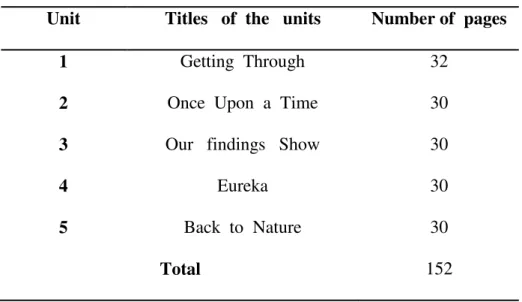
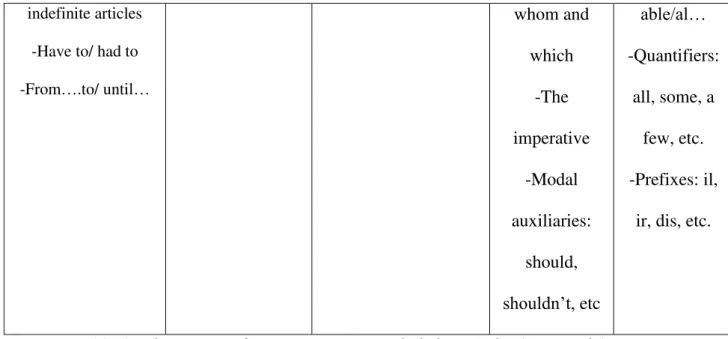
Table 1: Units in ‘At the Crossroads’………68 Table 2: Examples of Mechanical Activities in ‘At the Crossroads’……….72 Table 3: Examples of Meaningful Activities in ‘At the Crossroads’……….72 Table 4: Examples of Communicative Activities in ‘At the Crossroads’………...……..73 Tables 5: The content of Language Form in ‘At the Crossroads’…………...…………..74
List of Figures
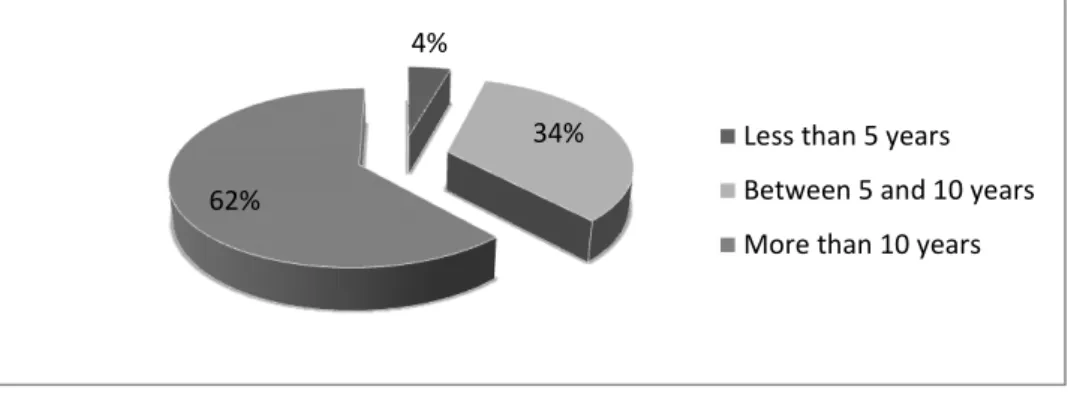
Figure 1:Teachers’ Years of Experience………..…………...….80 Figure 2:Teachers’ Years of Experience in Teaching First Year Classes……..…………..80
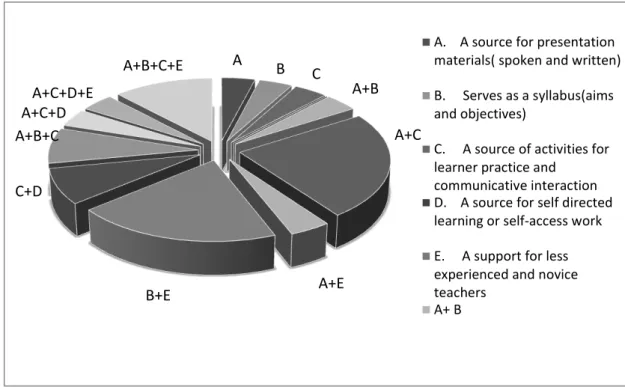
Figure 3: The Teachers’ views about the Textbook roles………...…………...…....81 Figure 4: The Teachers’ Use of the competency based approach……….…...82
Figure 5: The Teachers’ use of Inductive/ Implicit Grammar Method……….…...…83 Figure 6: Teachers’ Opinions about the Improvement of the Pupils’ Grammar Level Using Indirect Way…...84
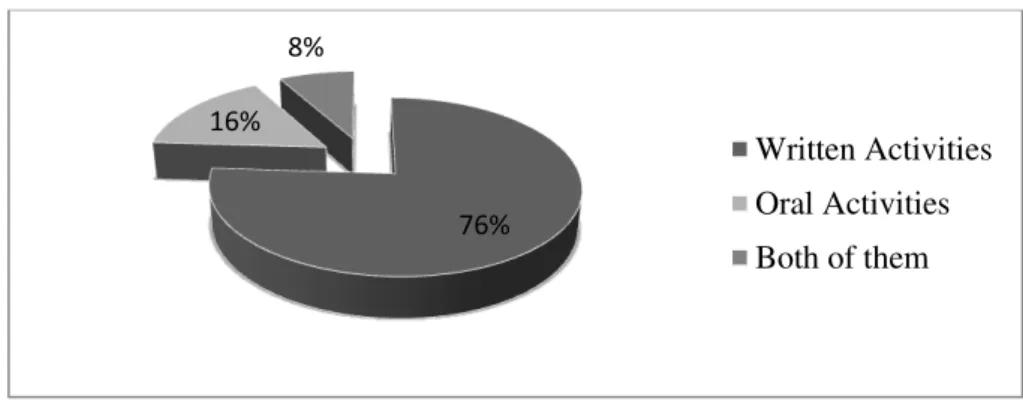
Figure 7:The Categories of Grammar Activities Covered in the Textbook ‘At the Crossroads’………...…...….85 Figure 8: The Main Types of Grammar Activities Introduced in the Textbook…….….…86 Figure 9: The Emphasis on Language Form in the Activities of ‘At the Crossroads’….…87 Figure10:The Emphasis on Language Use (Meaning) in the Activities of ‘At the
Crossroads’………...………87
Figure11: The activities that the Textbook ‘At the Crossroads’ Emphasizes………..88 Figure12: The Development of the Learners’ Skills through Grammar Exercises of ‘At the Crossroads’………...……89 Figure 13: The Teachers’ perception about the Communication in Grammar Activities in ‘At the Crossroads’……...…90
Figure 14: The Introducing of New Items in Grammar Activities and the Reflection on the Previous Knowledge of the Students……….………..90 Figure15: The Teachers’ Perception about the Matching of Grammar Activities with the Learners’ Actual Level…...…91 Figure16: The Emphasis of Grammar over other Aspects of the Language in the
Textbook………...…92 Figure17: The Teachers’ Perception about the Grading of Grammar Content in the
Textbook……….93
Figure18: The Teachers’ Opinion about the Sufficiency of Time Devoted to Teach
Grammar………..……..….93
Figure 19: The correspondence of the Grammar Items Included in ‘At the Crossroads’ to the learners’ needs………..…94 Figure 20: The Teachers’ Role in Teaching Grammar under the CBA……….………....95 Figure 21: The teachers’ Use of Extra Materials………...……….…96 Figure 22: The Teachers’ Perceptions about the Satisfaction with the Textbook……...…97
List of Contents
Abstract………..2
Dedications……….………….…..3
Acknowledgements………4
List of Abbreviation and Symbols………...……….…....5
List of Tables……….6
List of Figures………7
List of Contents..………..………..9
General Introduction I. Background of the Study………..13
II. The Statement of the Problem……….14
III. Aim of the Study ………..….15
IV. Research Questions………...…….15
V. Hypothesis………...16
VI. Research Methods and Tools……….…....16
VII. Structure of the Study………...………17
Chapter One: Teaching Grammar Introduction……….18
1.1.Definition of Grammar……….…18
Morphology and Syntax……….……...………..……..20
1.2.The Role of Grammar in English Language Teaching………...….….21
The Role of Grammar in Communicative Language Teaching……….…….……..21
1.3.The Three-Dimensional Grammar Framework……….…23
1.4.Types of Grammar………24
1.5.1.Explicit and Implicit Knowledge……….……….…27
1.5.2.Deductive and Inductive Methods of Teaching Grammar ….………….….…28
1.6.Grammar and Language Skills………..30
1.7.Approaches and Methods in Teaching Grammar………..……31
1.7.1.Grammar Translation Method………..……….31
1.7.2.Direct Method………..…..31
1.7.3. Audio Lingual Method………..…..32
1.7.4.Communicative Language Teaching……….33
1.8.Teaching Grammar under the Competency Based Approach……….……..33
1.8.1.Definition……….…………..……....…33
1.8.2. The principles of Competency Based Approach………...…………..….34
1.8.3.Theory of Language and Learning………...…………...…37
1.8.4.The Role of Grammar within Competency Based Approach………….……...37
1.8.5.Teacher’s Role In the Competency Based Approach …………....……..…….39
1.8.6.Learner’s Role in the Competency Based Approach ……….….……..39
1.8.7.Types of Teaching and Learning Activities……….……..……40
Conclusion……….……...…42
Chapter Two: Textbook Evaluation in English Language Teaching 2.1.Definition of Textbook……….….…43
2.2.The Role of Textbook in EFL/ESL Classroom……….44
2.3.The Supplementing Materials………...……46
2.4.The Purpose of Textbook Evaluation………..………..47
2.5.Types of Evaluation………..49
2.5.1.Formative Evaluation……….……….49
2.5.3.Illuminative Evaluation……….……..51
2.5.4.Predictive Vs Retrospective Evaluation……….……….52
2.6.The Participants in the Evaluation………...…….….52
2.7.Approaches to Textbook Evaluation………...53
2.7.1. The Impressionistic Approach………...53
2.7.2.In- depth Approach………...….…..54
2.7.3.Checklist Approach………...…..55
2.7.3.1.Cunningsworth’s Checklist………...…56
2.7.3.2.Ur’s Checklist……….….…….58
2.7.3.3.Sheldon’s Checklist………..59
2.7.3.5.William’s Checklist………..60
2.7.3.6.McDonough and Shaw’s Model………...61
2.7.3.6.Candlin and Breen’s Model……….…….…61
2.8.Materials Evaluation Vs Textbook Evaluation………...….….62
Conclusion……….……..64
Chapter Three: Research Methodology and Data Collection Analysis Introduction………..…65
3.1.Section One: The Evaluation of ‘At the Crossroads’ Textbook………....65
3.1.1.Overview about English Language Textbooks used in the Algerian Schools…66 3.1.2.General Information about the Textbook………...…..…………67
3.1.3.The Structure of the Textbook………..………...67
3.1.4.Textbook Evaluation Checklist………..………....70
3.2. Section Two: Discussion and Interpretation of the Questionnaire ………....77
3.2.1. The Sample………...78
3.2.3.Presentation and Analysis of Data………...79
3.2.4.Discussion and Interpretation of the Results………...98
3.3. Pedagogical Recommendations………..……..……….……101
3.4.Limitations of the Study……….……..…..102
3.5.Suggestions for Further Future Research………...103
Conclusion………104 General Conclusion………...….…..105 References………..….….108 Appendices………...114 Résumé صخلم
I. Background of the Study II. The statement of the Problem III. Aim of the Study
IV. Research Questions V. Hypothesis
VI. Research Methods and Tools VII. Structure of the Study
I. Background of the Study
In the history of foreign language teaching, Grammar has been addressed in different ways according to the principles that underlie each approach or method. Teaching grammar has been debatable; some approaches overstressed its importance in the processes of the target language teaching/learning while others undermined its significance in those imperative processes. Yet, grammar still has, indeed, a crucial role to play in the teaching/learning processes for the purpose of enhancing the language repertoire of the learners.
In language learning, grammar is a very important aspect which learners need to master in order to use language accurately and appropriately. The Algerian school has witnessed many changes as far as the methods and approaches of teaching are concerned, starting with the grammar translation method which aims at enhancing the grammatical competence of the students, and arriving to the latest approach which is the competency based approach. This approach basically aims at developing the learners’ competencies and at integrating them in the field of work. Accordingly, this newly adopted approach in teaching English as a foreign language; namely CBA, is being applied stemming its real practice from its basic principles.
So far, some researchers and educators have conducted various researches to investigate the suitability of the textbooks. With reference to EFL in the Algerian school context, some researchers have investigated the effectiveness of the CBA in teaching English in general and grammar in particular. Bellouahem (2008, p. 4), for instance, in his research states that “aims to achieve insights into teachers’ and learners’ perception of the course book and to explore whether the course book serves the students’ expectation in relation to the objectives of the programme”. The results showed that even if the course book matches the objectives of the ministry of education, it does not suit the teachers’ and
learners’ expectation. In terms of grammar, the results found that teaching grammar communicatively is an essential need to develop the learners’ language proficiency.
Since the textbook is the most useful source to teacher which acts as a guide in the classroom during the teaching/learning process, our study is conducted to add some knowledge to this areas of research by evaluating the teaching method of grammar presented in the textbook ‘At the Crossroads’ under the Competency Based Approach (CBA) . Since its emphasis is on developing competencies of learners, grammar should be taught implicitly in the textbook and hence, it is expected to be a practical strategy to activate learners’ repertoire about the grammar components that should be mastered by the end of first year high school syllabus.
II. Statement of the Problem
So far, teaching English grammar under the CBA in the Algerian educational system does not seem to be very satisfactory. The majority of Algerian foreign language learners fail to grasp the grammar rules; therefore, they find it difficult to do most of the activities assigned to them, and when coming to the productive skills, namely writing and speaking, most of the Algerian high school students face enormous problems to generate correct and accurate English sentences. Hence, as long as grammar is taught in accordance with the CBA principles with its enthusiastic aims that stress the basic role of learners, students are normally expected to be good enough to produce accurate grammar utterances as first year high school students, especially that they have been taught under the CBA for more than three years in middle school education.
Thus, being unable to practise the grammar rules appropriately and incapable of producing simple structured grammar sentences for the majority of first year students, raises the following question: does the teaching of grammar using CBA and the syllabus of
the textbook help teachers in achieving their goals and objectives, thus the learners’ grammar level would be improved? Hence, the dissertation in hand pinpoints the types of grammar activities that are included in ‘At the Crossroads’ textbook, the way they are taught so as to unveil the factors behind learners’ deficiency in performing grammar tasks in classroom specifically, and communicate correctly via the use of grammar. We also attempt to reveal to what extent first year English language high school textbook is relevant to be used in the Algerian classroom context, taking into consideration its grammar teaching distinctively.
III. Aims of the Study
This research aims to evaluate the grammatical components of the first year secondary school text book ‘At the Crossroads’. It aims to shed light on the status of teaching grammar under the CBA approach, and reviews teachers' suggestions and recommendations which are worthy for developing the textbook in question.
IV. Research Questions
To fulfill our aim, here are the main research questions which we will explore and answer in the present thesis:
Do teachers understand the principles of currently adopted approach they are dealing with?
Is the method (CBA) used by the teacher in explaining grammar aspects effective? Does the secondary school textbook give much more importance to the teaching of
grammar?
Are grammatical components adequately presented in the first year secondary school textbook ‘At the crossroads’?
Is the content of the textbook concerning grammar aspects sufficient and meets the learners’ needs?
V. Hypothesis
The dissertation in hand hypothesizes that if grammar components of ‘At the Crossroads’ textbook are structured in accordance with the CBA basic principles and presented adequately by the teachers, first year high school learners will be grammatically proficient.
VI. Research Methods and Tools
As defined by Murray (2002), research methodology refers to the theoretical paradigm or framework in which the researcher is working, adopting either a quantitative or a qualitative paradigm in his frame work, building up his assumptions on solid arguments, including the choice of research questions or hypotheses (as cited in Chioukh, 2011, p10)
In essence, the choice of the research tools is based on the nature of the research and the data to be collected. Since our topic is concerned with the evaluation of the grammar teaching in first year secondary school textbook, the most appropriate method to be followed up in conducting this study is the descriptive design. Accordingly, the data gathering tools are the questionnaire and an adapted textbook evaluation checklist. First, the questionnaire is displayed to secondary school teachers to discover their attitudes and perspectives toward the effectiveness of teaching English grammar within the CBA in the textbook ’At the Crossroads’. The second tool of collecting data is an adopted checklist, which is the most commonly used tool for evaluating textbooks and materials.
VII. Structure of the Study
As far as the organization of the study is concerned, it is structured in three foremost chapters. In chapter one, light we shed light on the nature of grammar and its definition, the historical overview about grammar language teaching approaches and methods with more emphasis on the CBA, including its definition, historical background and principles.
The second chapter reviews the theoretical issues associated with textbook evaluation. It deals with the definition and the role of the textbook, the purpose, types and approaches of the textbook evaluation, then materials evaluation vs. textbook evaluation.
The third chapter, that is practical in nature, treats the data collected from teachers’ questionnaire and textbook evaluation checklist. This chapter also exposes pedagogical recommendations to improve the material in general and grammar teaching in particular.
Introduction
1.1. Definition of Grammar
1.2. The Role of Grammar in English Language Teaching 1.3. The Three-Dimensional Grammar Framework 1.4. Types of Grammar
1.5. The Presentation of Grammar
1.5.1. Explicit and Implicit knowledge
1.5.2. Deductive and Inductive Teaching Methods 1.6. Grammar and Language Skills
1.7. Approaches and Methods of Teaching Grammar
1.7.1. Grammar-Translation Method (The Classical Method) 1.7.2. Direct Method
1.7.3. Audio-lingual Method
1.7.4. Communicative Language Teaching (CLT)
1.8. Teaching Grammar under the Competency Based Approach (CBA) 1.8.1. Definition of the Competency Based Approach
1.8.2. The Principles of the Competency Based Approach 1.8.3. Theory of Language and Learning
1.8.4. The Role of Grammar within the Competency Based Approach 1.8.5. Teacher’s Role in the Competency Based Approach
1.8.6. Learner’s Role in the Competency Based Approach 1.8.7. Types of Teaching and Learning Activities
Introduction
This chapter is devoted to the exploration of the main subject of this piece of research. It starts with giving some definitions of the concept of grammar and the role of teaching it in foreign language classrooms. Then, it moves to the dimensions, the types, the presentation of grammar, and the way it has been dealt with through the different teaching approaches and methods. This chapter also highlights the importance of grammar in enhancing the four skills. Finally, it ends with an emphasis on the CBA; definition, principles, teacher’s role, and the types of activities.
1.1. Definition of Grammar
Grammar has been defined in different ways by many scholars . Some linguists see it as the structures that form the language system. For others, grammar was seen in
relation to meaning. It is the study of speaker’s native language used to code and decode meaning . Grammar is the most important aspect of the language since it is the basis of any language in the world . In other words , it is the core of the language .
Fronkin, Rodman, and Hyams (2003) state that “grammar of a language consists of the sounds and sound patterns , the basic units of meaning such as words , and the rules to combine all of these to form sentences with the desired meaning ’’(p. 14). It means, grammar consists of the sound patterns, words and the rules to combine these words into sentences with the intended meaning.
Greenbaum and Nelson, (2002, p. 1) define grammar as a group of rules that permit us to join the parts of speech in our language to form a longer unit.
Harmer (2001) acknowledges that grammar is the description of ways in which words are combined to form sentences. That is, grammar is concerned with the study of the
structure and forms of language and the description of rules which govern how language sentences are formed.
Huntsman (1983, p. 59) states that “Grammar is considered the gate way to sacred knowledge as well as secular; it was the prerequisite for understanding theology and philosophy as well as literature” (as cited in Weaver, 1996, p. 3). Therefore, grammar is considered as the core of any language learning and teaching.
Yule (1985, p. 81) maintains that grammar is the description of the language patterns and structures of sentences taking into account all the grammatical forms in a language and ruling out all the ungrammatical sequences. In other words, it is thedescription of a body of rules considering the grammatical sequences.
Porpura (2004) reports that “grammar, the structural glue, the code of language, is arguably at the heart of language use, whether this involves speaking, listening, reading or writing”(p. 1). By this definition, Porpura refers to grammar as the core of language use in the four skills.
Williams (2005) writes that “grammar is the formal study of the structure of a language and describes how words fit together in meaningful construction’’(p. 2). That is to say, grammar is concerned with studying the structure of a language and describing how words are gathered into a meaningful construction.
Hartwell (1985, pp. 352-353) offers five different definitions, summarized subsequently:
1. A set of formal patterns in which the words of a language are arranged to convey a larger meaning.
2. The branch of linguistics concerned with the description, analysis, and formulation of formal language patterns.
4. School grammar, or the names of the parts of speech.
5. Grammatical terms used in the interest of teaching writing. (as cited in Williams, 2005, p. 2)
Williams (2005, p. 1) defines grammar as the description of the native speaker’s language.
In short, grammar is the study of words and arranging these words to form the grammatical structures which in turn build the system of language.
1.1.1. Morphology and Syntax
There are two notions that are mainly related to the term grammar; morphology and syntax. Many definitions are given to make the distinction between them clear.
Greenbaum and Nelson (2002, p. 1) claim that, syntax is the study of how words are combined to form sentences, whereas, morphology is the body of rules that describes how words are structured. Harmer (2001) defines morphology as “using morphemes to change the meaning or grammar of a word, whereas, syntax is the order that words can be arranged in”(p. 13).
Halliday (1994) notes that “In formal linguistics, the term syntax is used to replace grammar; this usage comes from the philosophy of language, where syntax is opposed to semantics’’ (p. 40). That is, concerning the philosophy of language which considers syntax as totally different from semantics, the terms syntax and grammar can be used interchangeably.
Fronkin, Rodman, and, Hyams (2003) refer to morphology as “the rules of word formation, whereas, syntax is the rules of sentence formation”(p. 18). In other words, morphology is the combination of morphemes to form words and syntax is the
branch of linguistics that deals with the structure of morphemes, whereas, syntax is the branch that deals with the structure of phrases above the level of words”(p. 24).
Inferring from the exposed definitions beforehand, morphology and syntax are defined in much the same way. Morphology is concerned with putting morphemes together to get a word, and syntax is linking words to get an accurate sentence.
1.2. The Role of Grammar in English Language Teaching
Grammar has a crucial importance in the field of language teaching. It is the heart of academic life. Weaver (1996, pp. 7-8) offers various reasons for teaching formal grammar. They are subsequently explained.
1. The study of grammar is important simply because language is a supreme human achievement that deserves to be studied as such.
2. The study of grammar can be an important vehicle for learning to study something the way a scientist does.
3. The study of grammar will help form the mind by prompting mental discipline. 4. The study of grammar will help the students score better on standardized tests
that include grammar, usage and pronunciation.
5. The study of grammar will help people master another language more readily. 6. The study of grammar will help people master the socially prestigious
convention of spoken and written usage.
7. The study of grammar will help people become better users of language, that is, more effective as listeners and speakers, and especially as readers and writers.
1.2.1. The Role of Grammar in Communicative Language Teaching
Concerning the role of grammar in communicative language teaching, linguists have different views.
Rama and Agullό (2012) claim that there is a widespread belief that CLT has nothing to do with the structures of language. However, Spada (2007, p. 275) strongly argues that CLT is not based only on meaning (as cited in Rama and Agullό, 2012, p. 181). Thornbury (1991, p. 23) maintains that the idea that CLT did not give much
importance to grammar is not totally true , since communicative language teaching syllabuses are designed on the basis of both the function and grammar (as cited in Rama and Agullό, 2012, p. 181). In other words, the belief that communicative language teaching ignored grammar, in its principles, has nothing to do with reality since both functions and grammatical points are taken into consideration when designing syllabuses. According to Thornbury (1999, pp. 18-19), there are two types of CLT; the shallow-end approach and the deep-shallow-end approach. The shallow-shallow-end approach to CLT focuses on the necessity to learn grammatical rules first, then, use language in a communicative situation. The deep-end approach to CLT is rooted on the belief of using language in communicative situation in order to learn or acquire grammar. So, there is a need to teach grammar
implicitly and explicitly.
(Foto, (1994); Lightbown, (1998); Nassaji, (2000); Wang, (2009) argue that form-focused instruction and communicative activities should be combined. Students pay more attention to target forms, and the forms become more memorable if students learn them in context (as cited in Wong &Barrea-Marlys, 2012, p. 63). It means that the form and the meaning are not separate. Learner’s awareness of the language forms is not sufficient; these forms should be practiced in real life situation in order to be memorized. In other words, the language forms will take place in the learner’s memory when they are used in context.
1.3. The Three-Dimensional Grammar Framework
According to Larsen-Freeman (2001, p. 252) there are three dimensions to grammar instruction: form, use, and meaning. This framework helps teachers identifying where the learning challenge lies and then make clear decisions about how to teach grammar.
Form refers to the mechanics of the language, i.e., the structure of the language. Larsen-Freeman (2001, p. 252) defines form or structure as “those overt lexical and morphological forms that tell us how a particular grammar structure is constructed and how it is sequenced with other structures in a sentence or text.” This means, a sentence has a structure in that there are rules that decide the elements that can co-occur in the sentence and the order in which they can occur. For example, the morpheme –ed is used to form a past verb, and the present perfect tense is formed with the auxiliary verb ‘have/ has’ plus the past participle of the main verb ‘taken’. Williams (2005, p. 53) claims that the structure of a sentence is constructed with isolated words which can be characterized under certain grammatical categories called form. For instance, the word ‘sun’ is a noun, ‘go’ is a verb and so on.
Larsen Freeman (2001, p. 252) argues that the structure of sentence does not only have form, but it expresses meaning or semantic. Besides, meaning can belexical or grammatical. The former is the meaning of a base morpheme or word, independent of its use within a construction, such as content word. The later is the meaning of a word by reference to its function within a sentence rather than to a word outside the sentence, such as function word. According to Thornbury (1999, p. 3), meaning is what the speakers convey through using a correct form, and what it means in the context that it has been used. Accordingly, grammar is a means for constructing meaning, knowing what particular forms will express their particular meanings (Thornbury, 1999, p. 4).
Larsen- Freeman (2001, p. 252) states that grammar instruction should include the answers to when and why the learner uses any given structure, and this is the use
(pragmatics) or function of form. When words are jointed together in a sentence in several ways, this is their function (Williams, 2005, p. 53).In this case, the word ‘boy’ is a noun; it may function as a subject in a sentence, like in ‘the boy plays hide and seek’, as it may function as an object, like in ‘the ball hits the boy’. Halliday (1985) (2000, p. 152) points that form and function are related together under several principles. Thus, knowing one of them would help to determine the other (as cited in Nunan, 2000, p. 152).
1.4. Types of Grammar
Many researchers suggest different types of grammar. Cook (2008) divides grammar into structural, traditional, and prescriptive grammar. Ellis (2006) outlines three different types of grammar: structural grammars, generative grammars (based on a theory of universal grammar), and functional grammars. Woods (1995), from his part, suggests five different types of grammar: prescriptive and descriptive, traditional grammar, phrase structure grammar, transformational- generative grammar and functional- systematic grammar (as cited in Bechoua, 2012, p. 21). These five types of grammar influence language in general and teaching grammar in particular.
Prescriptive grammar is regarded as a series of rules to be learned, and utterance or sentence are analyzed and judged grammatically to be correct or not. Yule (1985, p. 72) states that, prescriptive grammaris concernedwith rules which should be acquired by speakers. Consequently, prescriptive grammar is when the correct use of language is prescribed by a set of rules which are fixed (Quirk et al., 1985).On the other hand,
descriptive grammar (structural grammar) attempts to give an objective description of the grammar as it is used. Fromkin, Rodman, and Hyams (2003) say that, “descriptive
knowledge” (p. 14). In other words, it describes how people actually speak, and what they know about the words, and sentences of their language. According to Ellis (2006, p. 86), structural syllabuses have been influenced by descriptive grammar that is why the teaching of form has much importance than meaning.
Traditional grammar takes the first place in the hierarchical realm of grammar because as Williams (2005) observes, “in nearly every instance, school grammar is traditional grammar” (p. 50). Traditional grammar generally classifies words into parts of speech such as nouns, pronouns, verbs, adjectives, preposition, conjunctions, and
interjections. They describe the patterns for word inflection, the modification of the word to express different grammatical categories such as tense, mood, person, gender etc, and the rules of syntax by which those words are combined into sentences. Cook (2008)says “Analysing sentences in this approach (traditional grammar) means labelling the parts with their names and giving rules that explain in words how they may be combined ˮ(p. 20). Traditional grammars are also considered “prescriptive,” and not “descriptive.” Williams (2005)clarifies the distinction in this manner: “We say that traditional grammar is prescriptive because it focuses on the distinction between what some people do with language and what they ought to do with it, according to a pre-established standard.” (p. 50).For example, instead of saying ̒ she do not have the key’ it ought to use ‘she does not have the key’.
Phrase- structure grammar hasbeen originally introduced by Noam Chomsky in 1957. Cook (2008, p. 21) states that phrase structure grammar emphasizes the relationship of words and phrases in a sentence because it helps to perceive how the structure of words and phrases support the meaning beared through language. This relationship is presented in tree diagrams, and it has been used by teachers in presenting grammar lessons. In other
words, according to this theory, you can take a sentence and mathematically divide it into parts.
In 1957, Noam Chomsky published Syntactic Structures, the book that contained the ideas of new theoretical perspective on language, the Transformational- generative
grammar. Chomsky (1965) states that “generative grammar must be a system of rules that can iterate to generate an in-definitely large number of structures” (pp. 15-6).In other words, grammar is a generative system, by which speakers can produce infinite number of grammatical sentences. According to Chomsky (1965, pp. 8-18), grammar should describe a native speakers’ intuitive understanding of the language he or she uses. The term ‘surface structure’ and ‘deep structure’ are used to describe this intuitive knowledge. Thus, the formal rules known as transformational rules specify how ‘deep structure’ is transformed into ‘surface structure’. Chomsky’s transformational grammar offers insights into features of language, which are important for language learning and useful for language teaching. Through transformational generative grammar exercises, which illustrate how the parts of a sentence can be rearranged, combined and substituted, or deleted, learners can manipulate and play with language to reach a paragraph level.
Systematic Functional grammar is a form of grammatical description originated by Michael Halliday. It is defined as, “systematic functional grammar attempts to explain and describe the organization of the meaning-making resources” (Halliday and Matthiessen, 2004, p. 4).That is to say, functional grammar is concerned with the way that the different kinds of meaning that contribute to grammatical structure are comprehensively. For the same author, functional grammarians see meaning as central, i.e., grammar is a resource for making and exchanging meaning (ascited in Carter & Nunan, 2001). This means that functional grammar is concerned with the way in which grammar is organized to make meaning. Carter and Nunan (2001)argue that, “functional grammar conceive of language
as largely social interaction, seeking to explain why one linguistic form is more appropriate than another in satisfying a particular communicative purpose in a particular context” (p.34 In other words, functional grammar looks at language in context and thus focuses on the actual function of words and words patters to construct texts in their context of use. 1.5. The Presentation of Grammar
In EFL or ESL, grammar teaching methods are debatable. Some see grammar as the backbone of languages and learners should be presented with explicit and deductive grammar courses. Others, however, think that implicit and inductive grammar necessarily leads to language mastery. Which one of these methods is the appropriate one?
1.5.1. Explicit and Implicit knowledge
In the grammar learning process, there are two major ways of acquiring knowledge explicit versus implicit through that the FL learners gain proficiency in second language.
Explicit knowledge is defined by Purpura (2004) as “a conscious knowledge of grammatical forms and their meaning” (p. 42).That is to say,explicit grammar starts with an explanation of the rules. For example, it explains when to use ‘have’ and ‘has’ and provide sample sentences that illustrate how to conjugate the verb.Ellis (2006) states that “ explicit knowledge is held consciously, is learnable and verbalisable, and is typically accessed through controlled processing when learners experience some kind of linguistic difficulty in using the L2”(p. 95). Widodo (2006) states that, “explicit knowledge is generally accessible through controlled processing. In short, it is conscious knowledge of grammatical rules learned through formal classroom instruction” (p. 125). In other words, the foreign language learners are aware about the grammar items, their different
applications, and the use of grammatical terminology.
On the other hand, implicit knowledge refers to unconscious knowledge of the
occurring language behaviour (for example, in a conversation) in which the speaker has no awareness of it (Ellis, 2006, p. 95). In other words, implicit knowledge emphasizes the exposure to the language. When teaching English as FL, the teacher may present the present tense of ‘have’ implicitly by reading a story aloud, and then lead a discussion about the story. Brown (2007) maintains that “Implicit knowledge is information that is
automatically and spontaneously used in language tasks “(p. 302) .That is to say, there is no explicit presentation of rules or any explanation, therefore, the FLL perform the language.
Both explicit and implicit grammar knowledge is helpful in producing accurate forms of language and acts in monitoring its use and that what Ur (1988, p. 4) comes forward. So, grammar knowledge should take into consideration the appropriate use of language and the internalization of the rules.
1.5.2. Deductive and Inductive Methods of Teaching Grammar
The two main instructional approaches of grammar teaching are distinct and opposed to each other. According to Widodo (2006), “a deductive approach derives from deductive reasoning where the concept goes from general to specific” (p. 126), whereas an inductive approach “comes from inductive reasoning where reasoning proceeds from particulars to generalities” (p. 127).
In teaching grammar, the deductive approach is a way of teaching through rules where the teacher presents the rules followed by examples which show how rules are use in context. This approach is also known as ‘rule-driven learning’ (Widodo ,2006, p. 126), or teacher-centered. That is to say, the teacher begins with the broadest explanation of the rules using examples, and the students are engaged in making their own deductions based on their teacher’s examples. Thornbury (2002) claims that the deductive approach is “a more traditional style of teaching in that the grammatical structures or rules are dictated to
the students first”(p. 30). For instance, in a deductive classroom, the teacher explains the process of converting sentences that are in the active to the passive voice, then gives the students a set of sentences and ask them to convert them.
The deductive approach has some quite significant disadvantages that cannot be disregarded. According to Thornbury (2002, p. 30), it is the lack of students’ involvement and struggle for understanding which may result in the lesson being teacher-centered and not demanding in terms of creativity and imagination. There is no attention paid to
meaning and knowing rules is the most important process. On the other hand, this method has noticeable advantages that are suggested by Thornbury (2002). He states that the deductive approach is easier to apply because rules are concisely and clearly stated. It does not require much preparation on the part of the teacher; time-consuming. It makes students feel secure and provides them with tools with which to tackle the tasks at hand; numerous examples are given (p. 30).
On the contrary, the inductive approach to teaching grammar is the opposite of the deductive approach. It involves giving the students examples of language and they come up with the grammatical rules and that what Richards et al. (1985) confirm “… inductive learning in which learners are not taught grammatical or other types of rules directly but are left to discover or induce rules from other experience of using the language” (as cited in Nunan, 1991, p. 156). Mackay (1987, pp. 5-7) (as cited in Nunan, 1991, p. 158) provides an example about inductive approach. The teacher contract the present progressive and past tense by giving an order to one student to open the window, and s/he writes the sentence in present progressive on the board such as “Luvan is opening the window” after that s/he commands to the same student to close the window and then writes the same sentence in the past tense “Luvan closed the window”. Thus, the student infers how the present progressive and past tense are constructed in English. Mckay(1987, pp. 5-7)
maintains that the two approaches (inductive and deductive) rely on the age of the students and the difficulties of the grammatical rule. For instance, using inductive approach with children will help them to be more productive and creative in learning grammar. In
contrast, deductive approach is more requested for adult who want exhaustive explanation of the grammatical rule (as cited in Nunan, 1991, p. 158).
Similarly to the deductive method, the inductive method has some limitation and benefits. According to Widodo (2006), the limitation of this approach is that, it is energy- consuming because it depends too much on the teacher who choose examples that will guide students to the desired conclusion which is a very hard demand, it may frustrate the learners with their style, who prefer to be given grammar rules directly. Concerning the benefits of inductive approach, it encourages mental effort and forces students to rely on their intelligence in their learning, it helps them to be self-dependent for their future study, it also motivates students to be active when they come up with the exact rules, it
encourages students to interact with each other and practice language when they deal with problem solving (p. 128).
1.6. Grammar and Language Skills
Grammar is taught in order to enhance the four basic skills of a language: listening, speaking, reading and writing.
Corder (1988), Widodo (2004) state that grammar has a crucial role in enhancing speaking and listening; it improves the capability of people to grasp and utter expressions (as cited in Widodo, 2006, p. 122).
Widodo (2006) says that “In reading, grammar enables learners to comprehend sentence interrelationship in a paragraph, a passage and a text.” This means that, grammar helps in identifying how sentences and paragraphs are related in a coherent way. “In the context of writing, grammar allows the learners to put their ideas into intelligible sentences
so that they can successfully communicate in a written form”(Widodo, 2006, p. 122).In other words, grammar assists learners in enhancing the writing skill in thesense that it improves their style of writing and the ability to communicate successfully in the written form.
1.7. Approaches and Methods in Teaching Grammar
There are lot of methods and approaches that are used in teaching English as a foreign language.
1.7.1. Grammar-Translation Method (The Classical Method)
The grammar translation method is the earliest method that is followed in the field of teaching English as a foreign language.
Richards and Rodgers (2001, p. 5) claim that the grammar - translation method was used in the early years of learning foreign languages such as Latin and Greek. This method was based on the notion that language is learned through the analysis of its rules and structures, and the task of translating sentences and literary texts from and into the target language. In this method, language is restricted to the grammatical system; a system of rules and structurally related elements. In this respect, language learning is acquired through mastering the rules and the ability to translate vocabulary words into and out of the language. Some basic features of G-T M are as follows:
1. The written form is given much more importance than the spoken one, since GTM is concerned with translating literary texts. That is, writing is prior to speaking 2. The sentence is the basic unit of language teaching and learning.
3. Grammar is taught explicitly; the teacher provides the grammatical rules and examples in which they are applied.
1.7.2. The Direct Method
The direct method is the second method in teaching English as a foreign language. Brown (2000, pp. 19-20) maintains that the direct method was posited by Charles
Berlitz who was influenced by the insights of Gouin in language teaching methodology. The direct method is based on teaching a second language directly, without the interference of the first language, and without translating from and into the target language.
According to Richards and Rodgers (1986, pp. 9-10). Some basic features of the direct method are as followed:
1. More attention was given to speaking and listening.
2. Grammar is taught implicitly; it is acquired unconsciously through intensive listening and imitation. Learners induce the rules.
3. Correct vocabulary is taught through pictures and objects. 4. Fluency is emphasized.
5. It requires a teacher who is a fluent speaker of the target language.
6. Only the target language is used.
1.7.3. Audio-lingual Method
The audio-lingual method is the third approach in teaching English as a foreign language. Richards and Rodgers (1986, pp. 48-49) claim that the audio-lingual method was based on two theories; structural linguistics and behavioral psychology . In structural linguistics, language was seen as a system of structurally interrelated elements for the sake of conveying meaning and messages. These elements were of phonemic, morphological and syntactic nature. From the psychological point of view of skinner’s behaviorism, language is a set of habits, and language learning is learning these habits. Learning itself is achieved via the principles of stimulus- response.
1.7.4. Communicative Language Teaching (CLT)
Murcia (1991) maintains that the goal of communicative language teaching is to enable the learners to communicate using the target language. First, it is assumed that courses should be designed on the basis of both the notions and the functions. Second, pair work is necessary to exchange ideas which in turn enhance communication. Then, Learners benefit from role plays; this adjusts using the target language in different contexts(as cited in Koç, 2011. p. 6).
CLT is an approach that aims to develop the communicative competence of the learners with little attention given to the grammatical competence. Lessons under communicative approach are more realistic since, the teacher creates contexts that push the learners to negotiate meanings.
Howatt (1984) claims that CLT has two versions. The weak version stresses the idea that learners use English for communicative purposes. The strong version of communicative teaching is based on the concept that learners should be exposed to communicative situations in order to acquire a language( as cited in Richards and Richards 1986, p. 66).
1.8. Teaching Grammar under the Competency Based Approach (CBA) The competency based approach is one of the recent approaches to language teaching.
1.8.1. Definition of the Competency Based Approach
As its name implies, the CBA is based on the competences of the learners. It seeks to develop communicative skills in them. The CBA is a continuity of CLT; it does not refuse CLT in its principles but they are re-interpreted and extended. The CBA is concerned with enhancing different abilities of the learners to behave and function appropriately in different contexts that are related to work. In other words, learners
construct their capacities through practice and the integration of these abilities, skills and knowledge that will be used effectively in various problem solving circumstances. Richards and Rodgers (2001) say that “ CBE is based on a set of outcomes that
are derived from an analysis of tasks typically required of students in life role situation’’(p. 114).Hence, what can be inferred from the previously exposed quote, is that Competency Based Education is based on a set of results determined through the analysis of performances and tasks typically of students in realistic contexts. Doking (1994: 16) states that “competency based teaching by comparison is
designed not around the notion of subject matter knowledge but around the notion of competency. The focus moves from what students know about language to what they can do with it’’(as cited in Richards & Rodgers, 2001,p. 144). This means, teaching under the CBA is based or shifted from the knowledge that learners have to the reflection or the practice of that knowledge. The CBA addresses what the learners are expected to do rather than what they are expected to learn about.
1.8.2. The Principles of the Competency-Based Approach (CBA)
The CBA is based on constructivist approach since it focuses on the learners and their own development of the learning process. At this level, Pitchards and Woollard (2010) state that the constructivist is a theory which focuses more on the learner who creates his own understanding and chooses or transforms information into new knowledge, to be able to use it in daily life (p. 8). According to by Auerbach (1986) (as cited in
Richards and Rodgers, 2002, p. 146) the essential features that characterize the CBA are as follow:
A focus on successful functioning in society: The goal is to enable students to become autonomous individuals capable of coping with the demands of the world.
A focus on life skills. Rather than teaching language in isolation, Competency Based Language Teaching teaches language as a function of communication about concrete tasks. Learners are taught those language forms/skills required by the situations in which they will function. These forms are determined by ‘empirical assessment of language required’ (Findley and Nathan 1980:224). The forms are normally determined by needs analysis. Even if the class varies in backgrounds, the needs analysis itself will be able to let instructor know about the individuals’ needs the groups want to focus on.
Task- or performance-centered orientation: What matters is what students can do as a result of instruction. The emphasis is on overt behaviours rather than on knowledge or the ability to talk about language and skills. That is to say, it is the response to each of the situations learners will have to face. There is no time to be focus on the language skills, particularly grammar, but it is the ability to carry on and finish the action that matters.
Modularized instruction: Language learning is broken down into meaningful chunks (Center for Applied Linguistics 1983: 2). Objectives are broken into narrowly focused sub-objectives so that both teachers and students can get a clear sense of progress.
Outcomes that are made explicit: Outcomes are public knowledge, known and agreed upon by both learner and teacher. They are specified in terms of behavioural objectives so that students know exactly what behaviours are expected of them. This will assist each of the learners to realize certain actions when they arefaced with the real situations.
Continuous and ongoing assessment: Students are pretested to determine what skills they lack and post-tested after instruction in that skill. If they do not achieve
the desired level of mastery, they continue to work on the objective and are retested.
Demonstrated mastery of performance objectives: Rather than the traditional paper-and-pencil tests, assessment are based on the ability to demonstrate pre-specified behaviours. This statement is self-explanatory in a sense that certain actions are to be expected of and to carry forward.
Individualized, student-centered instruction: In content, level, and pace, objectives are defined in terms of individual needs; prior learning and achievement are taken into account in developing curricula. Instruction is not time-based; students progress at their own rates and concentrate on just those areas in which they lack competence.
According to Chelli (2010), one of the most distinctive features of CBA is its integration of project work as part of the learning strategy. Over all, if the CBA expands on the communicative approach, it is in the sense that it seeks to make the attainment visible, i.e, concrete through the realization of projects. It also makes co-operate learning a
concrete reality and opens new avenues for action interaction and the construction of new knowledge. In short, it is only through carrying project work and the construction of new knowledge. In short, it is only through carrying project work that we and our learners can live basic principles of CBA.
To conclude with, there are two things to note about competency-based instruction involving CBLT. First, it seeks to build more accountability into education by describing what a course of instruction seeks to accomplish. Secondly, it shifts attention away from methodology or classroom processes, to learning outcomes. In a sense one can say that with this approach, it doesn’t matter what methodology is employed as long as it delivers the learning outcomes (Richards, 2006, p. 43).
1.8.3. Theory of Language and Learning
The major basis of CBLT is the “functional and interactional perspective on the nature of language” (Richards & Rodgers, 2001, p. 143) which means that language learning always needs to be connected to the social context it is used in. Therefore, language is seen as “a medium of interaction and communication between people” who want to achieve “specific goals and purposes” (Richards & Rodgers, 2001, p.143). Competency-Based Language Teaching shares behaviourist view of learning that “language form can be inferred from language function; that is, certain life encounters call for certain kinds of language” (Richards & Rodgers, 2001, p.143). Another key aspect of both language and learning theory is the so called “mosaic approach to language learning” (Richards & Rodgers, 2001, p.143), which assumes that language can be divided into appropriate parts and subparts. Communicative competence is then constructed from these subparts put together in the correct order (Richards & Rodgers, 2001, p. 143). In other words, using language correctly and appropriately to accomplish communicative goals is made up of four competence areas: linguistic, sociolinguistic, discourse, and strategic. All these aspects together show that, CBLT is in some respects, similar to Communicative Language Teaching (Richards & Rodgers, 2001, p. 143).
1.8.4. The Role of Grammar within the Competency Based Approach Richards and Rogers (2001) stress that, “CBLT is built around the notion of communicative competence and seeks to develop functional communication skills in learners” (p. 143). According to Thornbury(1999), many researchers argue that
“grammatical knowledge (linguistic competence) is merely one component of what they call communicative competence” (p. 18). This latter, “involves knowing how to use the grammar and vocabulary of language to achieve communicative goals, and knowing how to do this in a socially appropriate way” (p. 18). Indeed, Canale and Swain(1980) assert
that communicative competence consists of: Sociolinguistic competence (i.e., appropriacy), it refers to an understanding of the social context in which the communication take place, the relationship of the participants, and the communicative purpose for their interaction; Discourse competence refers to interpretation of individual message in which the elements are interconnected and the meaning is clearly represented; linguistic competence (i.e., accuracy) or grammatical competence refers to use a words and rules correctly to make accurate message; strategic competence refers to appropriate use of communication
strategies to repair any weaknesses in the above three areas. Consequently, the competency based model aims principally at the mastery of these specific competencies and is learner participant centered, the teaching/learning of pronunciation, vocabulary and grammar (linguistic competence) is most effective when they are integrated into activities that use the target item meaningfully for a communicative purpose (Thornbury1999, p. 149).
According to Sysoyev (1999) “Integrative grammar teaching combines a form-based with a meaning-based focus.” In other words, the students need to know the rules and at the same time need to communicate in second language. Similarly, Ellis (2006, p. 100) states that “focus on forms” refers to students’ accuracy i.e. the form is the primary focus, while “focus on form” or meaning means the use of particular grammar structure in communicative activities. Accordingly, instead of teaching grammar in isolation it is preferable to integrate it in the communicative tasks (Ellis, 2006, p. 101). At this level Celce- Murcia (1991, p. 466) assert that the efficiency of grammar depends on regarding it as a resource for expressing ideas and not an end in itself. Thus, relating it to oral and written discourse. Similar to this position, Larsen-Freeman( 1991, p. 467) stresses that grammar is based on form, meaning and function, the three interacting dimensions of language, and the teacher’s role is to find the challenging dimension for students to explain and clarify it( as cited in Celce-Murcia 1991, p, 467). Moreover, Keh(1991) says that
grammar should be “contextualized, i.e. presented in a meaningful context, text-based, i.e. presented beyond one sentence, and student-centered, i.e. students’ own errors provide the outline of the grammar syllabus- what is taught and when it is taught” (p. 17-18) ( as cited in Bouhana & Boukleb, 2013, p. 60). This means that the teacher should emphasize more practice than theory, because its main goal is to foster linguistic
performance in the learners.
1.8.5. Teacher’s Role in the Competency Based Approach
The teacher’s role in the competency-based approach is the same as in communicative language teaching approach addresses different roles of the teacher;
1. A facilitator; he makes the learners communicate easily.
2. An independent participant; there is no long-period exchange between the teacher and the learner.
3. A guide; he acts as a guide in the classroom by orienting the learners towards effective materials and activities.
4. A needs analyst, he determines the needs of the learner and suggests innovative materials to fit these needs.
1.8.6. Learner’s Role in the Competency Based Approach
The competency-based approach focuses on the learner's role rather than on the teacher's role. The learner plays the central element inside the classroom. He learns
through a series of activities that are proposed by the teacher. Richards and Rodgers (2001, p. 146) states that the role of the learner in a competency-based framework is to decide whether the competencies are useful and relevant for him/her. Therefore, the learner has an active role in the classroom which is underlined by the fact that the students are expected to perform the skills taught (Richards & Rodgers, 2001, p.146). The competencies the students will grasp are clearly defined and present in the public. So that, the student knows
exactly what needs to be learned, and for which purpose he/she has to use the
competencies (Richards & Rodgers, 2001, p.147). In this regard, it is vital that every competency is mastered one at a time because this makes sure that the learners know what they have already learned and what the next steps will look like (Richards & Rodgers, 2001, p.147).Consequently, The main goal of the learner in Competency-Based Language Teaching is to be able to adapt and transfer knowledge from one setting to another, to succeed and be able to face problems in their daily life.
1.8.7. Types of Teaching and Learning Activities
According to the CBLT, learning tasks are similar to those of communicative language teaching. As Richard and Rodgers (2001, p. 143) say CBLT shares some concepts of the communicative competence which considers the important elements to promote functional communicative skill of the learner. Indeed, the CBLT has much in common with the approach of the CLT. Richards and Rodgers (2001, p. 144) claim that the activities and tasks are related to many fields of life that will be integrated later in the field of work. A great variety of competencies should be improved by these tasks. On the one hand, knowledge and learning competencies as well as oral competencies are dealt with. On the other hand, the materials include tasks to improve the reading and writing
competencies (Richards & Rodgers, 2001, p.147).
Richards (2006, pp. 16-7) states that some advocates make a distinction between three different kinds of grammar practice which are mechanical, meaningful, and communicative.
Firstly, Mechanical activity is a controlled practice in which students produce examples of the structure following their teacher’s examples. Such kind of activities is repetition drills and substitution drills in which particular grammatical items are practiced. Similarly Ur (2012, p. 84), claims that such kind of activities is called controlled drills in
which the teacher or the textbook determines examples, and the learners follow very clear instruction like rewrites or translation.
Secondly, Meaningful activity is still a controlled one, but students have to make a meaningful choice when doing these activities. For instance, to describe location of place, students have to use some given prepositions and a street map with diverse buildings identified in different locations. Thus, they are required to answer questions such as “Where is the book shop? Etc. This practice is meaningful because the students respond through using map and with their own information. According to Ur, in meaningful drills the learners follow the instruction, but with limited choices. Besides, guided, meaningful practice enables students to use their own words following a set of pattern (2012, p. 84).
Finally, Communicative activities are related to real- life situations, and the language used by the students is composed by him/her. It is an ‘open-ended discussion activity’.For example, students’ activity is to draw a map of their neighborhood and give an answer to the location of different places such as, where is the nearest bus stop or the nearest café, and so on. Ur (2012, p. 84) sets different types of grammar practice towards communication such as, free sentence composition (structure based) offers a visual or situational cue and the learners respond using their own words. For example the class has to describe a picture by using the appropriate tense. Discourse composition (structure based) the learners conduct a discussion or written task under instruction; free discourse where students carry out a task without any given direction.
The basic language activities in grammar practice are aimed to focus on accuracy and fluency. Richards (2006, p. 14) maintains that the major goals of CLT is to improve the student’s level of fluency. He makes a distinction between the accuracy and fluency practice. In the case of the former, the student achieves accuracy by paying attention to form, practices language out of context, and practices small samples of language in the
classroom. In the case of the latter, the students focus is entirely on meaning, seeks to link language use to context, and produces language that may not be predictable. Richards (2006, p. 15) says teachers were recommended to use a balance of fluency activities and accuracy. For instance,students’ performance on fluency task such us role play, the teacher could assign accuracy work to deal with grammatical or pronunciation problems, so s/he observed while students were carrying out the task.
All the Algerian educational syllabuses aim to promote the learner through doing a series of activities. Some of these activities can be done in the classroom and some others should be done outside the school and it can be done individually or in groups. For example, a project work represents the practical part of a syllabus which should be prepared outside the class and then presented to the teacher.
Conclusion
This chapter has been concerned primarily with the teaching of grammar and the approaches and methods, and the importance of grammar in the language teaching process. Today the educational movement adapted a new approach which is the CBA, an outcome based approach. This new approach emphasized the learner's role in the learning process and his output rather than on teacher's input. Therefore, teaching grammar has witnessed some changes in order to cope with the CBA as an educational system in Algeria which was adapted to give the learners a chance to develop their competencies by creating new knowledge and skills necessary for them in everyday life.