HAL Id: tel-01163806
https://tel.archives-ouvertes.fr/tel-01163806
Submitted on 15 Jun 2015
HAL is a multi-disciplinary open access archive for the deposit and dissemination of sci-entific research documents, whether they are pub-lished or not. The documents may come from teaching and research institutions in France or abroad, or from public or private research centers.
L’archive ouverte pluridisciplinaire HAL, est destinée au dépôt et à la diffusion de documents scientifiques de niveau recherche, publiés ou non, émanant des établissements d’enseignement et de recherche français ou étrangers, des laboratoires publics ou privés.
Environments through a Shared Infrastructure
Mengxuan Zhao
To cite this version:
Mengxuan Zhao. Discrete Control in the Internet of things and Smart Environments through a Shared Infrastructure. Other [cs.OH]. Université Grenoble Alpes, 2015. English. �NNT : 2015GREAM011�. �tel-01163806�
THÈSE
pour obtenir le grade de
DOCTEUR DE L’UNIVERSITÉ DE GRENOBLE
Spécialité :
Informatique
Arrêté ministériel : 7 août 2006Présentée par
Mengxuan ZHAO
Thèse dirigée par
Hassane ALLA
et codirigée par
Eric RUTTEN et Gilles PRIVAT
préparée au sein du
Orange Labs, Gipsa Lab et INRIA Rhône-Alpes
et de
L’Ecole Doctorale Mathématiques, Sciences et
Technologies de l’Information, Informatique
Discrete Control in the Internet of
Things and Smart Environments through a
Shared Infrastructure
Thèse soutenue publiquement le7 mai 2015,
devant le jury composé de:
Eric NIEL
Professeur, INSA Lyon, Rapporteur
Thierry MONTEIL
Maître de conférence (HDR), INSA Toulouse, Rapporteur
Frédérique BIENNIER
Professeur, INSA Lyon, Examinatrice
Noureddine ZERHOUNI
Professeur, ENS2M, Examinateur
Hassane ALLA
Professeur, Université Joseph Fourier, Directeur de thèse
Eric RUTTEN
Chargé de recherche, INRIA Rhône-Alpes, CoDirecteur de thèse
Gilles PRIVAT
UNIVERSITÉ DE GRENOBLE
MSTII
Ecole Doctorale Mathématiques, Sciences et Technologies de l’Information, Informatique
T H È S E
pour obtenir le titre dedocteur en sciences
de l’Université de Grenoble
Mention : Informatique
Présentée et soutenue par
Mengxuan ZHAO
Contrôle Discret pour l’Internet des Objets et les
Environnements Intelligents au travers d’une infrastructure
partagée
Thèse dirigée par Mengxuan ZHAO
préparée au laboratoire
Orange Labs, Gipsa-Lab et INRIA Rhône-Alpes
soutenue le date de soutenanceJury :
Rapporteurs : Eric NIEL - INSA Lyon
Thierry MONTEIL - INSA Toulouse Examinateur : Frédérique BIENNIER - INSA Lyon
Noureddine ZERHOUNI - ENS2M
Directeur : Hassane ALLA - Université Joseph Fourier CoDirecteur : Eric RUTTEN - INRIA Rhône-Aples Encadrant : Gilles PRIVAT - Orange Labs
Abstract
The Internet of Things (IoT) and Smart Environments (SE) have attracted a lot of research and development activities during the last decade. Yet many present-day IoT/SE applica-tions are still limited to the acquisition and processing of sensor data and its context, with control, if any, using either basic solutions or requiring human intervention, far away from the automatic control which is an essential factor to promote the technologies. This thesis targets to bring knowhow from control theory and reactive systems to the IoT/SE domain to achieve a solution with a formal method for the missing control aspect.
We propose the extension of a framework in order to build a shared generic IoT/SE infrastructure offering high-level interfaces to reduce design effort, and enabling the self-configuration and adaptation of control applications over generic properties of the environ-ment without human interaction by using general knowledge over the domain that applies to each target instance of IoT/SE system. In this extended framework, individual physical entities (including all relevant "things", appliances and subsets of space) may be grouped as virtual entities by shared properties to provide a higher level abstraction for control and other applications and better adaptation to lower level configuration changes.
Requiring a generic common denominator solution shared by all IoT/SE applications in a given environment, we propose for this infrastructure, to model by finite state automata the target entities to be monitored and controlled, including both individual entities and their groupings, as well as things and space entities, to be able to apply discrete controller synthesis (DCS) technique over any of these at different levels of abstraction and granu-larity. DCS is a formal method which constructs automatically a controller, if it exists, guaranteeing the required control objectives regarding to the given system behavior model in terms of synchronous parallel automata. The existing BZR programming language and Sigali tools are employed to perform DCS and generate a controller in an automatic way.
Necessary supporting software modules are proposed in the implementation such as the relation maintenance module keeping the correct association between individual entity instances and groups, and dispatching the action orders from the high level control to corresponding actuators. This module would evolve later to a more generic solution such as a graph data base including both the general knowledge base and specific environment instance relations. Conflict resolution between objectives of control coming from concurrent controllers is also indispensable due to the intended openness of the platform. A java based context simulator has been developed to simulate the home environment within several scenarios proposed for the validation, such as electrical load control and activity context adaptation.
L’Internet des Objets (IdO) et les Environnements Intelligents (EI) ont attiré beaucoup d’activités de recherche et développement au cours de la dernière décennie. Pourtant, de nombreuses applications IdO/EI d’aujourd’hui sont encore limitées à l’acquisition et au traitement des données de capteurs et de leur contexte, avec un contrôle, le cas échéant, utilisant soit des solutions de base ou demandant l’intervention humaine, loin du contrôle automatique qui est un facteur essentiel de promouvoir ces technologies. Cette thèse vise à apporter le savoir-faire de la théorie du contrôle et des systèmes réactifs dans le domaine IdO/EI pour arriver à une solution avec une méthode formelle pour l’aspect de contrôle qui fait défaut.
Nous proposons l’extension d’un canevas logiciel pour une infrastructure générique et partagée IdO/EI qui offre des interfaces de haut niveau pour réduire l’effort de concep-tion, et qui permet l’auto-configuration et l’adaptation des applications de contrôle sur des propriétés génériques de l’environnement sans intervention humaine en utilisant les connaissances générales sur le domaine qui s’appliquent à chaque instance cible de sys-tème IdO/EI. Dans cette infrastructure étendue, les entités physiques individuelles (y compris toutes les "choses", appareils électriques et sous-ensembles de l’espace) peuvent être regroupées comme des entités virtuelles par des propriétés communes afin de fournir un niveau d’abstraction plus élevé pour le contrôle et d’autres applications, ainsi qu’une meilleure adaptation aux changements des configurations au niveau inférieur.
Sur le requis d’une solution générique et commun dénominateur partagée par toutes les applications de l’IdO/EI dans un environnement donné, nous proposons pour cette infrastructure, de modéliser les entités cibles supervisées et contrôlées, y compris les entités individuelles et de leurs regroupements, ainsi que les choses et les entités spatiales, par des automates à états finis, pour être en mesure d’appliquer la technique de la synthèse des contrôleur discrets (SCD) aux différents niveaux d’abstraction et de granularité. SCD est une méthode formelle qui construit automatiquement un contrôleur, s’il existe, en assurant les objectifs de contrôle exigés concernant le modèle de comportement du système donné en termes d’automates parallèles synchrones. Les langages de programmation BZR et les outils Sigali existants sont utilisés pour effectuer la SCD et de générer un contrôleur de manière automatique.
Les modules logiciels nécessaires sont proposés dans l’implémentation tels que le module de maintenance de relation qui garde une association correcte entre les instances d’entités individuelles et les groupes, et répercute des commandes d’action du contrôle de haut niveau aux actionneurs correspondants. Ce module est destiné à évoluer plus tard vers une solution plus générique comme une base de données graphes comprenant à la fois la base de connaissances générales et relations spécifiques d’instance environnement. La résolution des conflits entre les objectifs de contrôle venant de contrôleurs concurrent est également indispensable en raison des objectifs de l’ouverture de la plateforme. Un simulateur de contexte basé sur Java a été développé pour simuler l’environnement de la maison au sein de plusieurs scénarios proposés pour la validation, tels que le contrôle de la charge électrique et l’adaptation au contexte de l’activité.
Contents
Abstract 1 List of Figures 8 List of Tables 11 List of Acronyms 12 1 Introduction 1 1.1 Scope Identification . . . 1 1.2 Problem statement . . . 2 1.3 Contributions . . . 3 1.4 Thesis outline . . . 4I State of the art 5 2 General background of the IoT and SE 7 2.1 Common characteristics and challenges . . . 8
2.2 Current standards and references . . . 9
2.2.1 ITU-T recommendation Y.2060: standard for the IoT in general . . 9
2.2.2 ETSI M2M: Identification & communication oriented . . . 10
2.2.3 Smart Home Environments . . . 11
2.2.4 Naming/Identification standards . . . 12
2.3 Technology background . . . 12
2.3.1 Identification and configuration . . . 13
2.3.2 Wireless sensor actuator network . . . 14
2.3.3 Sensor data aggregation and complex event processing . . . 15
2.3.4 Middleware . . . 16 3
2.3.4.1 System architecture: SOA vs ROA . . . 16
2.3.4.2 An open source platform: OpenHAB . . . 17
2.4 Semantic modeling . . . 18
2.4.1 Semantic approach for IoT and Smart Environment . . . 18
2.4.2 Domain ontologies . . . 19
2.4.3 Tools for ontologies . . . 21
2.5 Data sharing . . . 22
2.6 Applications . . . 23
2.6.1 Safety and Security . . . 23
2.6.2 Energy Management . . . 23
2.6.3 Comfort enhancement . . . 24
2.6.4 Health and assistance . . . 24
2.7 Summary and discussion . . . 24
3 Models and Discrete Control 27 3.1 Common modeling approaches in IoT/SE . . . 27
3.1.1 Object-oriented modeling . . . 27
3.1.2 Agent-based modeling . . . 28
3.2 Automaton-based modeling . . . 29
3.2.1 Definition of Automata . . . 29
3.2.1.1 Hierarchical automata . . . 30
3.2.1.2 StateCharts and UML state machine . . . 30
3.2.1.3 Synchronous composition of automata in parallel . . . 31
3.2.2 Synchronous programming . . . 31
3.2.2.1 Automaton-based synchronous languages . . . 32
3.2.2.2 Heptagon language . . . 32
3.3 Supervisory control and Discrete Controller Synthesis (DCS) . . . 33
Contents 5
3.3.2 Control objectives . . . 35
3.3.3 BZR synchronous programming language . . . 35
3.3.4 Discrete control applications . . . 36
3.4 Related control approaches in IoT/SE . . . 37
3.4.1 Languages for rule statement and Rule engines . . . 37
3.5 Summary and discussions . . . 37
II Contributions 39 4 Framework for a shared infrastructure for IoT data abstraction 41 4.1 Modeling framework overview . . . 41
4.2 Physical plane . . . 42
4.2.1 Entities/subsystems . . . 43
4.2.2 ICT devices/connected objects . . . 43
4.2.3 Devices (sensors and actuators) . . . 44
4.3 Model plane . . . 45
4.3.1 Generic entity finite automata models . . . 45
4.3.2 Domain ontology . . . 47
4.3.3 Virtual entity model . . . 49
4.3.4 Establishing hierarchical relationship between virtual entity models . 50 4.4 Proxy instance plane . . . 54
4.4.1 Device abstraction layer . . . 54
4.4.2 Entity instance proxy layer . . . 54
4.4.3 Entity group layer . . . 55
4.4.4 Service and local application layer . . . 56
4.4.5 Remote applications layer . . . 57
5 Generic models for discrete control based on the shared infrastructure 59 5.1 Control-oriented models . . . 59
5.1.1 Entity group models . . . 61
5.1.2 State Mapping of group category VE and member entities . . . 65
5.1.3 Data combination . . . 70
5.1.4 Control order dispatching towards individual entity instances . . . . 70
5.2 Controller generation using BZR . . . 72
5.2.1 BZR encoding of the system model . . . 72
5.2.2 Control objectives as contract . . . 74
5.3 Corpus of control rules . . . 74
5.3.1 Generic rules and their categories . . . 75
5.3.2 Category of rules . . . 76
5.3.3 Control rules compatibility . . . 76
5.3.3.1 Controller by category of rules . . . 77
5.3.3.2 Resolution of conflict from different controllers with differ-ent priority . . . 78
5.3.3.3 Example . . . 79
5.3.3.4 Conclusion of the compatibility resolution . . . 81
III Validation 83 6 Implementation 85 6.1 Overall functional architecture . . . 85
6.2 Ontology implementation . . . 86
6.3 Implementation on OGSi . . . 87
6.4 Context simulator . . . 89
7 Case studies 91 7.1 Preliminary: discrete control on generic models for a smart home instance . 91 7.1.1 Case study description . . . 91
Contents 7
7.1.3 Implementation and simulation . . . 95
7.2 Power control for home: load shedding . . . 95
7.2.1 Case study description . . . 96
7.2.2 System modeling and controller generation . . . 96
7.2.3 Closing the control loop using the platform . . . 99
7.2.4 Experiments . . . 102
7.3 Home office scenario . . . 105
7.3.1 Case study description . . . 105
7.3.2 System modeling and controller generation . . . 105
7.3.3 Experiments . . . 107
IV Conclusion 109 8 Conclusion and perspectives 111 8.1 Conclusion . . . 111
8.2 Perspectives . . . 112
8.2.1 Generic and basic control as a "safety guard" service . . . 112
8.2.2 Validation beyond home and Application beyond the initial scope . . 113
Appendices 115 A BZR encoding of the load shedding case study 117 A.1 System behavior modeled by groups . . . 117
A.2 System behavior as composition of generic individual entities . . . 119
A.3 System behavior as composition of specific individual entities . . . 121
List of Publications 125
List of Figures
2.1 The IoT reference model of ITU . . . 10
3.1 Synchronous composition example . . . 31
3.2 The graphical and textual syntax of a delayable task . . . 33
3.3 The textual syntax of two delayable tasks in parallel . . . 33
3.4 Controlled system with synthesized discrete controller in a closed-loop . . . 34
3.5 Delayable tasks: exclusion contract. . . 36
3.6 Bulb model with failure . . . 36
4.1 General framework presentation . . . 42
4.2 Generic "thing" automaton model: (a)Lamp; (b)Radiator; (c)Washing ma-chine . . . 46
4.3 Generic "space" automaton model of room . . . 46
4.4 Ontology/taxonomy graph in an home instance example . . . 47
4.5 Partial ontology of city . . . 48
4.6 Generic model: (a)light-emitting; (b)electrical appliance . . . 49
4.7 Example of using different abstraction level models . . . 50
4.8 (a)State machine ontology; (b)Example of state mapping of light-emitting and lamp . . . 51
4.9 Multiple inheritance: lamp.on inherits values from parents . . . 52
4.10 Ancestor/descendant state mapping in "is a" relationship . . . 53
4.11 Association is made on both intrinsic hierarchical relationship and extrinsic environment-specific relationship . . . 56
5.1 High level overview of entity groups and entities with functional supportive blocks . . . 60
5.2 Overview of the relationship between entity group and individual entities via the model plane . . . 60
5.3 (a) 2-state VE model; (b) general template for group model of 2-state models
and its simplified version (c) . . . 64
5.4 Illustration for state mapping procedure: developed from figure5.2 . . . 66
5.5 state data combination of member entities and control order dispatching . . 71
5.6 Partial ontology graph for the example . . . 79
6.1 Overall functional architecture of the implementation . . . 85
6.2 A piece of the implementation of the ontology DAG by Protégé . . . 86
6.3 FSM "Lamp" implemented by Protégé . . . 87
6.4 Architecture of the (Home) abstraction platform implemented on OSGi . . . 88
6.5 MiLeSEnS GUI example: a home environment interface . . . 89
7.1 Home environment configuration with control system . . . 92
7.2 Model with control of (a)Door; (b)Lamp; (c)Washing machine; (d)Radiator 93 7.3 Ontology applied for case study 1 and 2, part taken from a more complete ontology DAG . . . 94
7.4 Case study 1: Simulation with synthesized controller . . . 95
7.5 Home instance example . . . 96
7.6 (a)Power observer and (b) grid observer . . . 97
7.7 Entity group model of (a)light emitting category; (b)high power appliance . 97 7.8 A simulation scenario of safety control . . . 103
7.9 "Mixed" implementation for the case study: kettle and radiator are hardware and others are simulated, including the space entity room . . . 104
List of Tables
5.1 Table maintaining state mapping of parent/children VE models for a parent. 67 5.2 Target states according to different rules from different category . . . 78 5.3 Target states snapshot when 2 rules execute together . . . 80 5.4 Target states snapshot when 2 rules execute together: another possibility . . 81 7.1 State mapping of ancestor/descendant VE models . . . 100 7.2 The time costs for DCS operations according to different abstraction level . 104
List of Acronyms
ABM Agent-based modeling. 28,37
API Application Programming Interface. 16,43
CPS Cyber-Physical System. 37
CRUD Create, Read, Update, Delete. 17
DAG Directed Acyclic Graph. 3,37,47,61,75 DCS Discrete Controller Synthesis. 34,37,59 DES Discrete Event System. 29,33,37
DNS Domain Name System. 12,24
FPGA Field-Programmable Gate Array. 36
FSM Finite State Machine. 29,31,37,45
HVAC heating, ventilating, and air conditioning. 20
ICT Information and communications technology. 1,10,13,44
ITU International Telecommunication Union. 24
M2M Machine to Machine. 10,24
OOM Object-Oriented Modeling. 27,37,55
OSI Open System Interconnection. 14
QoS Quality of Service. 20
RDF Resource Description Framework. 22,45
REST REpresentational State Transfer. 10,44,89 RFID Radio Frequency IDentification. 2,8,13,44
ROA Resource-Oriented Architecture. 54
SOA Service-Oriented Architecture. 8
UPnP Universal Plug and Play. 2,8,13 URI Uniform Resource Identifier. 12,21
W3C World Wide Web Consortium. 21
WSAN Wireless Sensor Actuator Network. 14,25
Chapter 1
Introduction
Contents 1.1 Scope Identification . . . 1 1.2 Problem statement . . . 2 1.3 Contributions . . . 3 1.4 Thesis outline . . . 41.1
Scope Identification
Smart Environments (SE) are meant to enhance the interaction between humans and the physical world in which intelligence is embedded seamlessly through sensor networks and ICT devices. They have mostly been seen as an extension and evolution of traditional device-based human interfaces, using generic models of space. On the other hand, the Internet of Things (IoT) aims to integrate a large number of everyday things, including non-ICTobjects, into the digital world, to make them communicate and interact, thanks to unique addressing and communication technologies. With an extremely large application spectrum from supply chain management to transportation assistance, from health care to social network, the IoT offers great potentialities to development of new services and applications, in order to not only improve the everyday life of private users, but also to make benefits to the whole society by increasing the efficiency and productivity in industrial and public domain. However, it is unfortunately too large to come up with a generalization over the entire range.
Therefore, the scope of the current thesis is limited to the intersection of the IoT and Smart Environment, i.e. the IoT restricted to the application domain of Smart Environ-ment, including Smart Home, Smart building, Smart City, as a trade-off of the genericity and the usefulness of the proposition in the current thesis. Thanks to the lower and lower cost, network connectivity equipment becomes more and more accessible to the public, which makes this intersection of the two domains booming in terms of number of applica-tions, number of industrial investigators and amount of research interest. They have some shared characteristics which our proposition will take into account: openness, dynamicity, heterogeneity, non reproducibility and similarity from one instance to another. In spite of their common points, the nuance between the IoT and SE makes the practiced research ap-proaches in the two domains different: in the IoT, a "thing" vision is more adopted while in SE, it is more environment centric. Very often, to resolve a problem involving both
"things" in the IoT and "environment" in SE, at least a distinct "thing" model and an "environment" model are given. This makes the control designing even more complicated which consists of cutting the problem into two parts to be modeled separately and control-ling the two parts in a consistent way. Thus, the second reason we choose this intersection to make contribution is that we would like to propose a uniform modeling method within the scope to reduce the complexity of modeling procedure.
In the entire document, unless explicitly stated, we try to make our proposition gen-eralizable to the underlined scope thus defined which is referred to as the target scope or IoT/SE.
1.2
Problem statement
Many present-day IoT/SE applications are still limited to unidirectional data collection from sensors for remote monitoring purposes with remote control, if any, using either basic solutions relying on unquestioned assumptions or requiring human interaction in a human-in-the-loopfashion, far away from the automatic control which is an essential factor to make technologies invisible. Besides, they often get limited to specific identification technologies, such asRFID,UPnP, and network technologies such as lower-power radio. The automatic control aspect is generally missing in such applications. Two main causes responsible for this situation are identified:
• First, concerning the classic control in industrial domain, mainstream applications still rely on fully customized and ad hoc top-down vertical design laying directly on the physical interface, i.e. sensor and actuator level, which has been so far dominant in classic automatic control and cyber-physical systems. Control applications in such case need to be installed and configured by an expert capable to specify the individual correspondent devices to each application in each individual environment which is a heavy and tedious procedure and not supposed to be within the ability of the public. If any configuration change takes place during the run time, which is unfortunately quite frequent due to the highly dynamic nature of such environment instances, there is also need of expertise. This individual design and installation, plus the maintenance expertise makes the total cost of such application extremely high which is unacceptable to the constraints of mass-market in the IoT/SE domain. • Second, concerning the emerging consumer SE platforms, weakness of some present
day rule engines for control applications is observed: sequential execution of rules may create random non-expected results if the order of rules is altered, and no guarantee of objective achieved if the open loop control approach is adopted. Moreover, the best-effort and time-insensitive culture inherited from the general information engineering by generic infrastructures in the IoT/SE domain, which could be disturbing in some reactive applications with time delay constraints. The lack of formal method makes the reliability and effectiveness of such control applications not satisfactory.
To release the entire potential of the promising IoT/SE domain, automatic control which is an important way to make the environment intelligent, should be more accessible
1.3. Contributions 3
to the public in terms of cost and liability. In order to reach this goal, we argue that the following elements are inevitable to overcome the above issues:
• A shared infrastructure offering high-level interfaces to reduce design effort, and enabling the self configuration and adaptation of control application on generic prop-erties of the environment without human interaction by using general knowledge over the domain and creating horizontal layers according to the abstraction levels of the physical world.
• Application of new control techniques, possibly from more critical domain such as real-time embedded systems, on the above proposed infrastructure in the IoT/SE domain to deal with the liability of desired result and real-time issues present in many today’s control applications.
1.3
Contributions
In this thesis, we present several contributions to the previous objectives:
We begin with the proposition of a high-level framework using a knowledge base over the domain and a method of modeling in order to integrate target physical entities into the ICT system. The invariant knowledge base over different environments of the domain, also called domain-specific ontology, structured in a directed acyclic graph (DAG), allows to capture the generic properties over the domain and arrange them following a hierarchical relationship, which makes it easier to make variable abstraction level of the target environ-ment according to the demanded need of the given application. Each node of the DAG, representing either a property or a concrete object type, is provided with a finite state model which is used as a template during the auto discovery phase, or as instantiation blueprint for individual objects. Environment entities are presented in the same way as "things" by a finite state model and occupies a parallel branch to all the "things". The adaptability over various environment instances is furthermore enhanced by making the change at physical entity level transparent to high-level applications. The approach is to model the target group of objects sharing the model at the abstraction level required by the application, i.e. the node in the DAG that the application addresses. This group model, possibly specific to each generic application requirements but available in all environment instances, allows the reuse of these applications without dozens of device-application input/output associations to do by offering a unified and invariant high-level interface.
To respond to control requirements, we propose a discrete control approach based on a tool-supported synchronous variant. It favors automatic and correct-by-construction manager derivation which has been applied in diverse domains. Models of relevant groups of entities are considered as synchronous parallel automata on which the discrete controller synthesis (DCS) is performed with the desired objectives expressed formally as logical equations. A controller is generated if there is a solution, which warrants the objectives are satisfied. All necessary supporting software modules are also proposed such as the topology maintenance module keeping the correct association between individual entity instances and groups of entities and dispatching the action order from the high level control
to corresponding actuators. Conflict resolution between different objectives of control is also indispensable due to the openness of the domain where objectives are from diverse origins.
1.4
Thesis outline
This thesis is divided into three parts.
Part I presents the state-of-the-art, interleaving background with related work. It has two chapters. Chapter 2 identifies the common characteristics, the current standards to which our proposition would made contribution, the enabling technologies as a start point of our proposition and the most popular applications already available on the market in our target scope. Chapter 3 presents the existing models, languages and tools that can be employed to address the targeted design issues. Among them, we identify and introduce the synchronous models, and discrete control techniques and tools that will be applied in the thesis.
Part II exhibits the contributions of the thesis. It has two chapters. Chapter 4 first presents an overview of our proposed framework. The focus is put on the modeling aspect of "thing", "space" in the target scope, as well as the modeling of an abstract type or a shared property by finite state machine. Their hierarchical relationship should be correctly established and a group of same type entities is possibly abstracted by one model to reduce the complexity of the system. Chapter 5 presents the mechanism implemented in the proposed framework to enable to use discrete control techniques, and the conflict resolution over generic control rules taken from a shared corpus.
Part III describes the implementation of such framework extending an existing one on OSGi. Several case studies using the framework are presented, as well as some discussions over their results.
Part I
State of the art
Chapter 2
General background of the IoT and
SE
Contents
2.1 Common characteristics and challenges . . . 8
2.2 Current standards and references . . . 9
2.2.1 ITU-T recommendation Y.2060: standard for the IoT in general . . . 9
2.2.2 ETSI M2M: Identification & communication oriented . . . 10
2.2.3 Smart Home Environments . . . 11
2.2.4 Naming/Identification standards . . . 12
2.3 Technology background . . . 12
2.3.1 Identification and configuration . . . 13
2.3.2 Wireless sensor actuator network . . . 14
2.3.3 Sensor data aggregation and complex event processing . . . 15
2.3.4 Middleware . . . 16
2.4 Semantic modeling . . . 18
2.4.1 Semantic approach for IoT and Smart Environment . . . 18
2.4.2 Domain ontologies . . . 19
2.4.3 Tools for ontologies . . . 21
2.5 Data sharing . . . 22
2.6 Applications . . . 23
2.6.1 Safety and Security . . . 23
2.6.2 Energy Management . . . 23
2.6.3 Comfort enhancement . . . 24
2.6.4 Health and assistance . . . 24
2.7 Summary and discussion . . . 24
This chapter describes the general context and background of the scope of the present thesis. We begin with the identification of common properties of the addressed domain which will serve as a base of requirements to our proposition. Current standardization and reference model effort is then presented. Commonly used enabling technologies are indispensable to be considered in today’s researches and applications. The application scope we are aiming is extremely large where research directions are numerous and various. We hope to make a clear position of our proposition through this chapter.
2.1
Common characteristics and challenges
The target scope is a particular hardware and software environment. This section describes the identified shared properties and the challenges raised by each of them.
Openness. Devices in an instance of IoT/SE environment, including sensors/actuators
and smart objects, are often made by different manufacturers. Out-sourced data and infor-mation are from different providers. Applications that give intelligence to the environment along with the devices and data are also developed by different developers. One environ-ment instance is not necessarily managed by only one stakeholder, which is especially true in building and city scales. The openness enables the data sharing among objects, devices, applications and systems, which helps improving the artificial intelligence, for example the accuracy of automated decisions based on the context information, and the accuracy of pattern recognition. It promotes also the development of such applications. This open-ness requires the environment modeled as a comprehensive system, supporting different applications, rather than one by one in a top-down fashion as a set of vertically integrated solutions for individual applications.
Dynamicity. An IoT/SE environment is supposed to be dynamic during its lifetime, as
devices appear and disappear all the time and some of them can move within the environ-ment, context information is changing permanently on runtime. The entire system should be able to detect the changes in the environment, to adapt itself to the new configuration and to act correctly to keep the whole system respecting current requirements. The la-tency introduced by the whole reaction chain should respect the temporal constraints that prescribed by individual applications, i.e. a lot more severe for real time applications than for time-insensible ones like the update of meteorological information.
Heterogeneity. The devices and applications in an IoT/SE environment provide various functionalities. Different devices and applications may offer the same functionality. They use different communication protocols, like Wifi, Zigbee, ZWave for indoor wireless com-munication, and they may be connected by diverse identification technologies like RFID,
UPnP. Apart from the objects coming with a network connection and some intelligence, the so-called Smart Objects, there are things of previous generations which do not have an embedded network connection. To cope with this heterogeneity, there should be a uni-versal and generic model to capture the invariants from the diversity in a semantic way in order to represent them independently of the technologies or vendors. The SOA allows
a loose couple between applications and devices to hide the implementation details of a given functionality or assures a feature faced to the dynamicity.
Non reproducibility. Industrial control applications had manufacturing, dedicated sys-tems (example: avionics), people with specified needs as their targets in the past. The common point among those applications is that the design is a case-by-case one and the costs of such design are recovered by producing a large number of identical items.
Unfortu-2.2. Current standards and references 9
nately in the target scope, almost non of the application instances is identical to another, even in a block of identically built houses where the inside installation is different according to the house holder’s need. By contrast to the solutions like luxury residence, production line which do not have much constraint on cost, an entire case-by-case design does not fit for the solutions because of its high cost of design and maintenance (money and time) and the non reproducibility of those instances, in which a self-configurable solution is much more attractive.
Similarity. Though all instances of IoT/SE environments are rarely identically repro-ducible, they are structured by a few broad organizational features that are invariant from one instance to another: all homes are composed by rooms, all buildings are divided into floors and rooms, all cities are structured by streets, crossings, blocks, etc. The physical entities in these environments are also similar from one instance to another like all homes have some generic categories of appliances such as washing machine, lamps, heatings, etc. This characteristics makes sense of a general solution that can self-configure once installed in an environment with minimum human input based on generic and reusable models of entities in these similar environment instances.
2.2
Current standards and references
Facing the above characteristics, especially the openness and heterogeneity, standards are urgently needed to establish a baseline or a common grounding to improve high-level in-teroperability. According to the fact that different domains have specific needs, various standards may exist with higher or lower level abstraction targeting more or less generic use cases: home, city, personal health, industry, etc. It is an ongoing work with a lot of activities. Standardization organizations, companies, academic institutions, governments are all involved and contribute their propositions.
2.2.1 ITU-T recommendation Y.2060: standard for the IoT in general
ITU (International Telecommunication Union) is the United Nations specialized agency for information and communication technologies – ICTs1. Its Standardization sector (ITU-T) develops international standards known as ITU-T Recommendations, some well known examples are JPEG for imaging coding, H.264/MPEG-4 for video coding, (x)DSL for internet access via a telephone line.
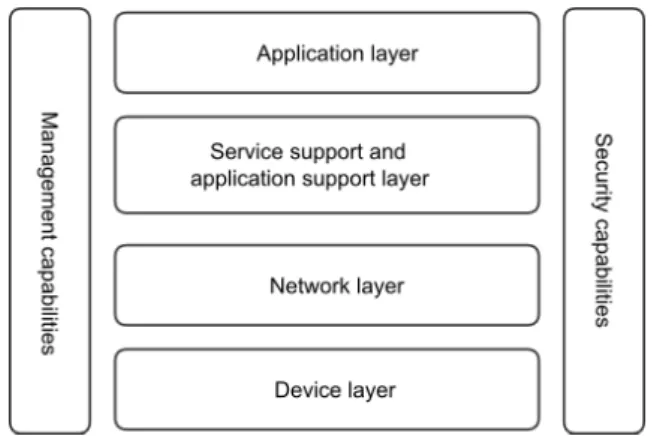
The current Y.2060 provides an overview of the IoT by giving a brief introduction of the IoT concept, identifying its common characteristics and high-level requirements in order to establish the IoT reference model (in figure 2.1) which has 4 horizontal layers together with 2 transversal supporting modules corresponding to identified requirements arranged from the closest to software application to the closest to physical things. This very high level and general reference model will be the basis of our proposition of architecture.
1
Figure 2.1 – The IoT reference model of ITU
While standards for IoT in general are kept quite abstract to enable different concrete architectures, technologies responding specific requirements coming from the broad appli-cation domains that general IoT covers, more specific standards are also under work to provide more practical and concrete reference and guidelines.
2.2.2 ETSI M2M: Identification & communication oriented
The term M2Mtakes its origin in the telecom industry as firstly an extension of services using the cellular network to connect terminal with embedded SIM cards. M2M services are now understood as potentially using all kinds of networking and technology to enable data exchange among machines and considered having a large range of applications. ETSI M2M2 has have published standards for from overall functional architecture to detailed communication interfaces, together with semantic models and use case identification. A large part of ETSI M2M standards have been taken by OneM2M3, a global organization developing standards for M2M communications and the IoT, which encompasses ETSI and other organizations as active partners.
ETSI M2M standardization aims to provide a horizontal Service Capability Layer (SCL) which is a set of services accessible from shared and open interfaces: instead of a vertical
ICT infrastructure developed by each vendor for its proper applications, a shared service and network platform is provided which takes care of the supportive functionalities so that developers or users only have to declare the objects in a standardized way and use the common interfaces to implement the applications. The entire architecture is divided into 3 main domains: network, gateway and device, which interact among themselves via mId interface and interact with applications with mIa or dIa interfaces. These interfaces are generic and extensible. It adopts a RESTful architectural style (2.3.4.1) in the sense that each SCL contains a standardized resource tree where each resource is accessible via a URI by standard CRUD (Create, Read, Update, Delete) requests.
OM2M [Ala+14] is an open source M2M service platform which implements the ETSI
M2M standards, especially the part over the functional architecture and communication
2
http://www.etsi.org/technologies-clusters/technologies/m2m
3
2.2. Current standards and references 11
interfaces, for the first time. It is built on top of the OSGi Equinox4 runtime adopting a modular architecture that features or functions of an SCL specified in the standards are implemented as a "plugin" to facilitate the SCL extension as required in the standard. Services are exposed via RESTful API and an object oriented database is provided. This implementation provides also a self-configuration mechanism using autonomic computing plugin, which facilitates the despoilment of a M2M network.
The present OM2M solution’s advantage is that it is an implementation of a well known standard ETSI M2M which makes it easy to be accepted by application developers and compatible with other M2M solutions. However, ETSI M2M defines services and interfaces addressing individual devices such as sensors, smart or legacy devices without recommendations on how to manage these devices and how to use data they provide. A pre-normative study on semantics for M2M data is ongoing. Therefore, OM2M implementation does not provide any support for M2M data processing apart from the autonomic self-configuration mechanism following basic SWRL (Semantic Web Rule Language) rules to bind sensor/actuator to monitor/controller. Application developers should at their own charge to define the signification behind each individual resource and use them properly.
2.2.3 Smart Home Environments
The two following are either reference model or pre-standardization activity which are susceptible to be a standard in the future .
HGI (Home Gateway Initiative)5 is an industrial alliance of service providers target-ing the digital home aims to provide a flexible Smart Home delivery platform connecttarget-ing home devices and the internet where services from various vendors can be deployed easily and interoperate. It has published reference Smart Home architecture, requirements for network connection and service support collected from members. It is also a partner of OneM2M.
IEEE-SA IC, Convergence of Smart Home and Building Architectures. Both
the similarities among Smart home and building architectures and a gap preventing the internetworking between these domains have been observed during the latest years. This ongoing per-normative activity6 aims to offer a seamless experience over multiple domains by converging the Smart Home and Building architectures to enable domain inter-networking which creates benefits in many aspects such as increased granularity, visibility and awareness, increased level od usability, etc.
Smart Appliances7 is a project trying to result a reference ontology that fits the ETSI M2M architecture, with the scope of the consumer market of the home, public buildings
4 http://www.eclipse.org/equinox/ 5http://www.homegatewayinitiative.org 6 http://standards.ieee.org/develop/indconn/activities.html 7 https://sites.google.com/site/smartappliancesproject/home
and offices, as well as the standard appliances in such environment. It has studied a range of existing semantic assets and use case assets to be translated and mapped to make up a common reference ontology, called "Smart Appliances REFerence (SAREF) ontology" (c.f.2.4.2). This resulting ontology is to be contributed to ETSI as a future standard.
2.2.4 Naming/Identification standards
An identifier which does not create confusion in a reasonable range is essential for manag-ing thmanag-ings in the IoT/SE scope. Accordmanag-ing to the nature of different application domains, requirements and approaches can be different. Scalability, searchability and the capabil-ity to provide basic configuration information are some identified requirements for such standards.
Domain Name System (DNS) is a hierarchical distributed naming system to identify
resources connected to the Internet or any network, standardized as an RFC (Request for Comments) document published by IETF (Internet Engineering Task Force )8. It translates easily memorized domain names to IP addresses needed for the purpose of locating services and devices. The domain names are arranged in a tree structure, the Domain Name Struc-ture, that reflects in the syntax that we see in every single name like www.example.com. There are components for registering, storing and resolving domain names like a database. It can be used in the domain of IoT/SE for finding the knowledge data for a given entity by the URIassociated to it.
Electronic Product Code (EPC)9 is a universal identifier that gives to a physical
object an identity unique among all objects. It was first build in the context of supply chain item tracing and management, but expanded and gained its popularity thanks to RFID in which the EPCs are encoded in most of the cases. The main idea of EPC is to attribute each object a globally unique code that two identical objects can be distinguished. In an EPC identifier, numerous information can be found, such as information about the EPC code (generation, length), manufacturer, object class and unique serial number. These informations are accessible via several services coming with the EPCglobal Architecture Framework (EPCAF), such as the Object Name Service (ONS) which is an automated networking service similar to theDNS.
2.3
Technology background
The IoT or Smart Environments would not been existing without any of the following tech-nologies. The development of IoT qnd SE has also promoted the research and development of these technologies. This technology background will establish the base and the start line of our research.
8
available onhttp://www.rfc-editor.org/
9
2.3. Technology background 13
2.3.1 Identification and configuration
Things should be first identified in order to be integrated into the network to provide data and get control. Nowadays, most identification technologies consist of a naming, addressing or tagging phase as a prerequisite, either during manufacturing like attributing a MAC address for classical network devices, embedding a SIM card in a telco style, or giving attached tag later like Barcode,RFID tag. Unfortunately this tagging process can be very costly and tedious since the number of "things" is potentially in the order of trillion. Automatic identification and data capture technologies based on nature features like using biometric data are under exploitation [CAS] to extend the IoT which has been originally defined as the "global networking connecting any smart object" by the IoT-A project10to all sense-able things without necessary a digital interface [Pri12] like a legacy appliance or a human.
The identification is not the final objective. After this phase has been accomplished, the configuration process takes place to integrate the newly identified object into the network to enable monitoring and control over it through the discovered interface. The plug&play basis which assumes "zero configuration" discovery and integration of new devices is now adopted in many network and distributed infrastructures. The self-configuration capability may be in low level like the automatically assigned private network IP address by DHCP (Dynamic Host Configuration Protocol) when a new device with network interface arrives, or in a higher level, such as in UPnP where networked devices are assigned by a unique address, advertise the services it supports to get discovered. After the discovery, the descriptive in XML format coming together with the device details its information and capabilities to be get controlled by the system.
However, these solutions are limited to digital things with a network-ready interface or tag. What’s more, devices should be fully identified to very specific types to get things to work. An approximate identification of a general category like kettle, TV is not enough to be integrated in a regular Service oriented architecture. In fact, it is often sufficient for applications to work with an approximate identified thing to get things speed up, as long as the basic required features are available in the approximate type. It should also be noted that the fashionable unique ID does not provide metadata such as the knowledge of the context, which brings an other challenge that useful contextual data should be carefully and efficiently associated with the ID.
In [Hu14] the authors propose an approximate and contextual identification and con-figuration mechanism. The target entities are physical things or subsets of space without a native network interface. They are the sense-able and actionable (if possible) objects through the intermediate of sensors and actuators playing the role of network interface. Target entities do not need to be tagged in advance, instead, they are to be discovered: models of generic categories (like "printer") are available in the system as identification templates with which the classification algorithm, like energy consumption pattern recogni-tion, compares the available sensor data to determine the type of the entity to be integrated. An ICT shadow11 is automatically created as representative of the target physical entity
10
www.iot-a.eu
11
for the ICT system which is capable of self-configuring, monitoring and controlling these entities. The advantages of this proposition are (a) no need of digitization for everything to get integrated in the network; (b) no need of complete identification: a very generic model will be given to the discovered entity until more available data enabling a finer and precise identification as a re-configuration process.
2.3.2 Wireless sensor actuator network
A wireless sensor network (WSN) consists of a certain number of sensors to monitor the physical environment and pass their measurement data to where they are needed through the network. With the decreasing price of small and low-power sensors thanks to the sig-nificant progress of micro-electro-mechanical systems (MEMS) technology in recent years, WSNs, which become WSANs including actuators, have promoted and become a basic enabler and crucial part of the IoT and Smart Environment.
As the N its names reveals, aWSANis at first a network which has similar character-istics than other classical networks like IP network, as well as open issues. In a survey over the WSN [Aky+02], a communication architecture of sensor networks is presented where individual sensor nodes with data collecting and routing capabilities form a sensor field connected to the Internet through a sink playing the role of a gateway. The presented protocol stack with 5 layers is very similar to the OSI reference stack model. Common issues including:
• Scalability. The number of potential sensors and actuators can be very large like a person can carry hundreds of sensor nodes embedded in glasses, clothes, shoes, watch, etc. [Aky+02], the current addressing system, mostly based on the IEEE 802.15.4 standard, may fail to identify, integrate and manage in a efficient way. Research directions includes semantic approaches, new addressing systems like IPv6 addressing been proposed within the 6LoWPAN [SB11] context.
• Security. Security has been widely studied in all traditional computing and communi-cation systems, yet it remains a study topic and the WSN is extremely vulnerable to attacks as (a) its wireless communication making eavesdropping very simple; (b) its nodes are with limited in terms of both energy and computing capabilities that they cannot support complex scheme of security like complex encrypting or authentication process. Current standards or technologies mentioned earlier in the chapter all take this problem into account and have a dedicated module for the security, as well as for privacy.
WSANs also have some particularities due to its nature:
• Power consumption constraint. Depending on the application, WSANs can be very different in size, in fault tolerance, in accessibility, etc. from one to the other. In any case, changing battery would be an expensive operation considering the total number of sensor/actuator nodes, the embedded aspect, or even impossible like the WSAN for battlefield surveillance, meteorological inspection, tracking of movement of animals,
2.3. Technology background 15
etc, which infers that the life time of such network may depend on the power resource of the component devices. Thus an important requirement on such devices is that they work at extremely low power du to the limitation in their (battery) size. • Limited computational capabilities. Though technological progress is making higher
and higher computational power in smaller and smaller unit, processing and mem-ory are still precious resources in sensor/actuator nodes. For example, in a Texas Instruments system-on-chip solution for Zigbee, the processing unit is a 8051 micro-controller with up to 256 KB Flash memory and 8 KB of RAM. Therefore, these capabilities are needed for sensing, actuating, communication and other data pro-cessing objectives to interact with their surroundings. This feature should limit the data processing rate for the devices.
Facing these issues, protocols designed specifically for WSAN are many according to various application domains. For example, Wireless HART (Highway Addressable Remote Transducer)12 protocol is very popular in industrial implementations for its capability of communicating over legacy analog instrumentation wiring, while Bluetooth is widely used for communications between personal terminals. Zigbee13 is a suite of of high level com-munication protocols based on an IEEE 802.15 standard, the same as mentioned Wireless HART and 6LoWPAN. It is a low-rate and short-distance technology which meets the requirements of WSAN. It is mostly suitable for Wireless Personal Area Network (WPAN) as its range is 10–100 meters line-of-sight. Z-Wave14 is also an extensively used WPAN protocol built upon ITU-T G.9959 specification, sharing the same position as the 802.15 family.
2.3.3 Sensor data aggregation and complex event processing
Sensor data aggregation consists of a preliminary data processing of low level information, often the raw data directly from sensors. This processing aims to provide more accurate and meaningful information about the physical world without complex data processing algorithms or extra knowledge. A lot of work has been done in this research direction, here are some examples. In the work of [Tap+06], a flexible kit of wireless sensing de-vices for pervasive computing research in natural settings is developed. In [Gur+08], a service-oriented middleware is put forward for heterogeneous sensor data aggregation and management. The authors of [TIL04] propose an aggregation of raw data coming from ei-ther sensors or oei-ther sources in order to recognize activities in home areas. [LF09] uses data from a variety of wireless sensors to build up a robust location-aware activity recognition for smart home applications.
By contrast to sensor data aggregation, the complex event processing which takes mul-tiple continuous and discrete data from on-site sensors to compute a result with the help of external data about the environment. Among numerous FIWARE generic enablers (GE), a CEP (Complex Event Processing) GE15 analyses event data in real-time, reacts to
situ-12 http://en.hartcomm.org/ 13http://www.zigbee.org 14 http://www.z-wavealliance.org/ 15 http://catalogue.fiware.org/enablers/complex-event-processing-cep-proactive-technology-online
ations based on a series of events that have occurred within a dynamic time window called processing context, rather than to single events. It is implemented by the Proactive Tech-nology Online, a scalable integrated platform providing tools and web user interface for performing the CEP GE.
The two methods can do their job individually, or be combined in a given context in order to realize the context-awareness for a specific application.
2.3.4 Middleware
Sensors and actuators come from various vendors, using different protocols and are not necessarily interconnected. To be truly useful, they need to be ubiquitously and seamlessly integrated into the network. On the other hand, application programmers are not assumed expert in sensor and actuator protocol to be able to develop applications. Thus, an inter-mediate layer or several sub layers are needed between the device and the application layers to provide a unifying platform. This layer or sub layers, defined as middleware, should hide technological details, provide abstraction of things, useful services and high-level APIs to applications such as interoperation at network, syntactic and semantic level, basic data aggregation, resource discovery, security management, available command on the physical things [Ban+11]. As the application development become more and more rapid and devices become more and more divers, the middleware has become more and more indispensable for simplifying development of applications using heterogeneous devices. It enhances the separation of concerns by horizontalizing the infrastructure. Programmers no longer need to have the exact knowledge of the technologies adopted in the low level and develop various versions for the same application to adapt the low level.
2.3.4.1 System architecture: SOA vs ROA
In the current literature, the Service Oriented Architecture approach is widely adopted by middleware architectures in IoT and Smart Environments [Spi+09]; [VM11]; [Mar+13];
[Tei+11]. It is based on services which are units of functionality and can be consumed
by client not necessarily from the same vendor or using the same protocol. SOA gains its popularity for several reasons. First, it decouples the service consumer (client) and service provider. Secondly, interaction is done by simple messages over common interfaces and standard protocols instead of whole object reference and data exchange which is specific to implementation and may be influenced by network performance. At last, a significant advantage of SOA is that it allows software and hardware reusing as it does not impose a specific technology for the service implementation as long as the services respect the required interface for the clients. Resource Oriented Architecture (ROA) is an other archi-tectural style as an evolution of SOA after some weakness observed in SOA such as pool performance of message translation due to heavy data structure of XML and the need of knowledge of the contract of service before using it [Ove07]. Instead of transferring a SOAP message with a heavy overhead like in a typical SOA, ROA makes every entity a resource and interactions are around the stateless representations of the resources [Fie00]. Here, the signification of stateless is that a system state representation responding to a request
2.3. Technology background 17
is independent of the previous system state. Unlike SOA which has several possibilities in choice of transport protocols, including HTTP, ROA is built upon a unique protocol which permits it to provide a uniform interface, like in the famous and widely applied example REpresentational State Transfer (REST) and RESTful Web Services which uses HTTP
and its vocabulary (POST, GET, PUT, DELETE respectively for CRUD) for requests.
Another weakness of SOA is that what matters in SOA seem to be the functionality sup-posed to be provided by hidden resources without ever worrying about what really can be provided by the resource at the moment of the request due to its internal semantics and constraints. ROA deals with this issue by providing a state of the resource as response to a request with all the information and functions that can be accessed at the moment.
In [Del14] a new architectural style is proposed by combining REST and SOA to get the
advantages of both to improve interoperability and facilitate the implementation in IoT. In this thesis, our proposition will adopt the ROA approach in different abstraction and service level to conserve the flexibility coming from the loose coupling and reusability of SOA while respecting the internal semantics and eventual temporal constraints of each resource entity.
2.3.4.2 An open source platform: OpenHAB
OpenHAB (open Home Automation Bus)16 is an open source platform running on top
of OGSi Equinox, the same as the previously introduced OM2M in2.2.2, which makes it modular and extensible in functionalities. Its goal is to integrate home automation systems and technologies in a single solution so that they can communicate and be managed via a uniform interface. It uses the notion of item, a data centric functional atomic building block, which represents a source of data: if an appliance provides two sources of data, say temperature and energy consumption information, it is modeled by 2 items. These items are the ones users see on the user interface and implied in the control rules in form of script.
OpenHAB connects devices or sub-systems using different technologies by bindings which are OSGi plugins running on top of the core and other basic modules of Open HAB and added/removed on runtime according to the need. Today, the available bindings include most of the popular protocols, such as KNX, Z-Wave, Insteon, and smart devices, such as Koubachi (plant care) and Netatmo (weather station). Items can be related to specific user-defined groups so that they can be monitored, displayed and controlled as an integrated body. OpenHAB allows user to define their own control rules in form of a script concerning the already connected items. It uses Drools open source Java rule engine17 where rules are described in the format of Condition-Action.
The fact that OpenHAB is a java based platform makes it run on any operating sys-tem with a java virtual machine, including embedded platforms such as Raspberry Pi , BeagleBone Black. It also provides multi-platform UI (iOS, Android, Web browser) to monitor and control home devices. OpenHAB joint the Eclipse SmartHome project for better support and further development.
16
http://www.openhab.org
17
OpenHAB provides a platform that puts together the fragmented Smart Home market by establishing a common interface to access all. It is flexible, modular and lightweight that can run on embedded systems. It provides also user-friendly UI and programming support for end users to see the state of the system and to define their control rules easily. However, its original goal makes it focus on connecting smart objects to provide interfaces based on unified device abstraction (here the term "device" means also the individual sensors and actuators). Service, in the sense of generic functions provided to applications, and self-configuration are not in its scope. Objects should be declared explicitly to be connected and groups should be specified manually. The notion of item may also create confusion because it is not equivalent to an object, which is the opposite to intuition.
2.4
Semantic modeling
The term Ontology takes its origin in philosophy which studies the nature of being, existing and their categories and relations. It is used in computer science and information science to represent a knowledge about the world. It is defined as a formal specification of the con-cepts and relationships of terms and consists often of taxonomic hierarchies to categorize terms, class definitions, subsumption relations [Gru93]. Moreover, it provides a priority knowledge, most coming from the real world, defining the semantics over the categoriza-tion and the relacategoriza-tions, which makes it differ from tradicategoriza-tional informacategoriza-tion classificacategoriza-tion or organization which may be arbitrary. In the scope of this thesis, the term ontology is used in the sense in computer science or information science.
2.4.1 Semantic approach for IoT and Smart Environment
In our target scope of application domain, we should expect the number of entities to be managed extremely high that the issues in maintaining the interoperability of these entities becomes more and more challenging, such as how to present, store, interconnect, organize information generated by the entities. To deal with these problems, semantic approaches could play a key role. Semantic technologies aim to provide a globally under-standing between "things" to enable the self-capabilities of the target context, for instance self-discovery, auto-configuration, context awareness in the domain of IoT. Semantic solu-tions can reduce greatly the amount of work to make the devices implementing the current existing various standard inter operate and do not require any extra work from the man-ufacture. The importance of semantics to the research and development of IoT from dif-ferent aspects including interoperability, resource discovery, reasoning and interpretation, has been shown and discussed in [Bar+12].
Some experimental platforms for IoT and Smart Environments have been developed in the recent years. SESAME-S aims to enhance energy optimization and efficiency in Smart Home and Office using semantical technologies [Fen+13]. Together with energy ef-ficiency applications, the platform hosts ontologies, rules and services to create a flexible and user-friendly system, and has already been installing in real building in the trail phase.
In [SCM10], the authors propose a solution of semanticization of multiple existing
2.4. Semantic modeling 19
the specifications of the standard and wrap them into a universally understood semantic language, which makes heterogeneous devices work together without modifying the native standards.
2.4.2 Domain ontologies
Multiple definitions of the term ontology exist in the literature with some slight differences
[Gru93]; [NM+01]; [Gua98]. To be simple, we take the basic and common parts of these
definitions for the purpose of this thesis: an ontology describes a hierarchy of concepts (classes or categories) related by subsumption relationships or other relationships, which may be described as a triple conceptA − relationship − conceptB. Properties may be added to each concept to describe their features and attributes as well as restrictions. An ontology is an abstract model of the reality, together with the individual instances of classes, establishing a knowledge base over the modeling target domain.
By contrast to an upper or foundation ontology which tries to describe the very general concepts with a widely understood common vocabulary across multiple domains, a do-main ontology or domain-specific ontology only tries to model one domain of interest with particular vocabulary and semantics, for example, an ontology for the sensor network, an ontology for Smart Home that we will present in the following part of this section. A domain ontology can be considered as an under ontology with more details a finer-grained version of one part of an upper ontology which provides a semantic interoperability over its under ontologies. Domain specific ontology is more practical to use as it provides more de-tailed and useful information/knowledge about the domain, whereas an top-level ontology is often domain- and problem-independent that may not suit for a particular application.
In the target scope of the thesis, a semantic solution is often dependent of a domain specific ontology, as presented in the examples in 2.4.1. Apart of those coming with a systematic solution, a lot of research work has been dedicated to proposition and establish-ment of functional domain ontologies that can be used as an input resource to a system. The following are just some examples among many propositions.
Sensor network ontology. Sensor networks are essential and enabling technologies for IoT and Smart Environment. Data collected by a sensor network are direct information about the context and things in the context. The Semantic Sensor Network Ontology (SSN
ontology)18 is developed by the W3C Semantic Sensor Networks Incubator Group
(SSN-XG) and has been admitted since several years in the domain. It can describe sensors, sensing, the measurement capabilities of sensors, the observations that result from sensing, and deployments in which sensors are used. These modules are all inter-connected in the ontology. Sensors are not limited to physical sensing devices: any device or a computational process that can estimate or calculate the value of a phenomenon can play the role of sensor. As sensors are often constrained by its memory, computation capability, power availability, semantics which is basis of inference or reasoning techniques is needed to formally represent these constraints. That’s why SSN ontology also aims to extend the Sensor Model Language
18
(SensorML), one of the four SWE languages, to support semantic annotations to improve semantic interoperability. Another approach to establish a sensor ontology is to create an ontology that links other domain ontologies. SenMESO ontology (Sensor Measurements Ontology) [Gyr13] is such an ontology which interfaces other ontologies at semantically identical categories in both ontologies to have additional information.
Ontology for Smart Environment. There is very active work on smart environment
ontology proposals with various emphasis. Some of them try to cover a sub domain of the smart environment, like homeActivity19and homeWeather20in the Linked Open Vocabular-ies (LOV) project21; some of them try to accomplish a goal like home energy management
[Rei+11]. An survey[GNP13] has shown that ontologies from different horizons can be
connected and extended to create a comprehensive knowledge base that covers all the facets of a very rich domain like the Smart Home. We describe in the following 2 wildly cited Smart Environment ontologies which gave us inspiration for the ontology described in Contribution.
• DogOnt[BC08] is a house modeling ontology designed to fit real world domotic sys-tem capabilities and to support interoperation between currently available and future home automation system solutions. It has several particularities which make it more flexible and more appreciated by the community: (a) it dedicates a branch of hier-archical tree to controllable objects including appliances and house plants likeHVAC
system, which facilitates the implementation of control applications by knowing the controllability of addressed objects; (b) it suggests the concept of state representing a stable functional state of the modeling target, which provides more information and some restrictions during not only instantiation phase but also runtime. This ontology gives us some inspiration of properties and common entities to take into account for our ontology.
• BONSAI[Sta+12] is an ontology for enabling Ambient Intelligence in a Smart Build-ing. It relies and extends existing ontologies in the domain such as CoDAMos and OWL-S in order to create a comprehensive and more operation-able ontology for Smart Building service-oriented system. It has 5 sub-clusters which are linked to-gether to model every aspect needed in a SOA Smart building system: (1) Hardware, like appliance and device, which are able to offer or receive services; (2) Context, like location and other contextual parameters; (3) Functionality, including parameters like power consumption and actions by actuators; (4) Service, imported from OWL-S; (5)QoS, system performance related concept enabling optimization solutions. The target domain of this ontology has intersection with our proposition.
A new reference ontology, Smart Appliances REFerence (SAREF) ontology22,
targeting the appliances in the home and building areas is under work. It started from existing semantic assets, tries to separate and recombine them, with the ultimate objective
19 http://sensormeasurement.appspot.com/ont/home/homeActivity 20https://www.auto.tuwien.ac.at/downloads/thinkhome/ontology/WeatherOntology.owl 21 http://lov.okfn.org/dataset/lov/ 22 https://sites.google.com/site/smartappliancesproject/ontologies/reference-ontology