RESEARCH OUTPUTS / RÉSULTATS DE RECHERCHE
Author(s) - Auteur(s) :
Publication date - Date de publication :
Permanent link - Permalien :
Rights / License - Licence de droit d’auteur :
Bibliothèque Universitaire Moretus Plantin
Institutional Repository - Research Portal
Dépôt Institutionnel - Portail de la Recherche
researchportal.unamur.be
University of Namur
A particular case of karstification in dolostones (Waulsort Formation, Belgium)
Dewaide, Lorraine; Hallet, Vincent; Baele, Jean Marc
Publication date:
2016
Link to publication
Citation for pulished version (HARVARD):
Dewaide, L, Hallet, V & Baele, JM 2016, 'A particular case of karstification in dolostones (Waulsort Formation, Belgium)'.
General rights
Copyright and moral rights for the publications made accessible in the public portal are retained by the authors and/or other copyright owners and it is a condition of accessing publications that users recognise and abide by the legal requirements associated with these rights. • Users may download and print one copy of any publication from the public portal for the purpose of private study or research. • You may not further distribute the material or use it for any profit-making activity or commercial gain
• You may freely distribute the URL identifying the publication in the public portal ? Take down policy
If you believe that this document breaches copyright please contact us providing details, and we will remove access to the work immediately and investigate your claim.
A particular case of karstification in dolostones (Waulsort Formation,
Belgium)
The present study focus on observations that were made on the dolostones of the Wauslort Formation outcropping namely in South of Belgium. This Formation consists in lenticular deposits of several kilometers long and a few hundreds of meters in thickness. They are lime mud buildups developed in a ramp setting from Late Tournaisian to Early Visean and outcropping in several places of Northern Europe. They corresponds to massive limestones made of mainly bryozoans and stromatoporoïds. An important dolomitization affected some parts of those buildups in a very heterogeneous way.
The study started with the simple observation that on a regional scale, the Waulsort Formation is statistically more affected by karstification than the other limestone formations nearby. Consequently the question arises: why those partially dolomitized rocks are more karstified than the purer limestones nearby? Under this questioning lay interrogations about the relative solubility of limestone and dolostone, the structural and mechanical influences on karst development and the paleo-conditions in which karstification took place.
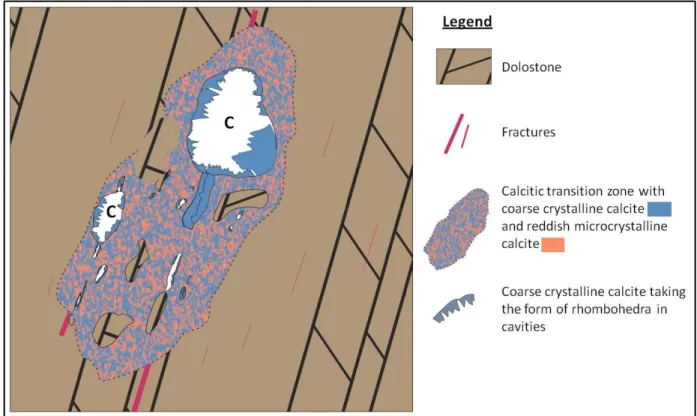
According to field observations, it seems that a majority of karst in the studied zone is developed precisely on the dolomitized sections of the buildups and that this karst is characterized by some very distinctive features. First, the cavities seem systematically developed along one or several fractures and corresponds mainly to small cavities of a few meters in extensions at a maximum. Second, although these cavities are found within dolomitized rocks, a calcitic transition zone almost systematically outlined the boundary of the cavity. This transition zone has an elongated lenticular outer shape with its major axis oriented parallel to the fracture. It consists of microcrystalline calcite and fine to coarse macro-crystalline calcite. Large calcite rhombohedra that can reach a decimeter in size can line the walls of the cavity and fracture axis. These particular karst occurences were called ‘the dolostone cavity type” (fig. 1) (Dewaide et al., 2014).
Figure 1. Sketch showing the main features of a typical karst cavity (C) developed in waulsortian
dolostones. The cavities are surrounded by calcitic zones that contrast with the host dolostone.
Several occurences of the “dolostone cavity type” were sampled and studied in detail. Cathodoluminescence observations defined three major textures: dolomite, calcite and dedolomite. Furthermore, those texture are organized, at thin section scale, in a kind of gradient where dedolomite is the mid-term between dolomite and calcite (fig. 2). Calcite fills microcavities and seems to affect the host dolomite by dedolomitization. The dedolomitization (replacement of dolomite by calcite) is higher close to the microcavity and decreases towards the host dolomite.
Figure 2. Cathodoluminescence textures implied in the dolostone cavity type (thin section scale). Development of a gradient from a microcavity filled with calcite that seems to be pervasive into the host dolostone.
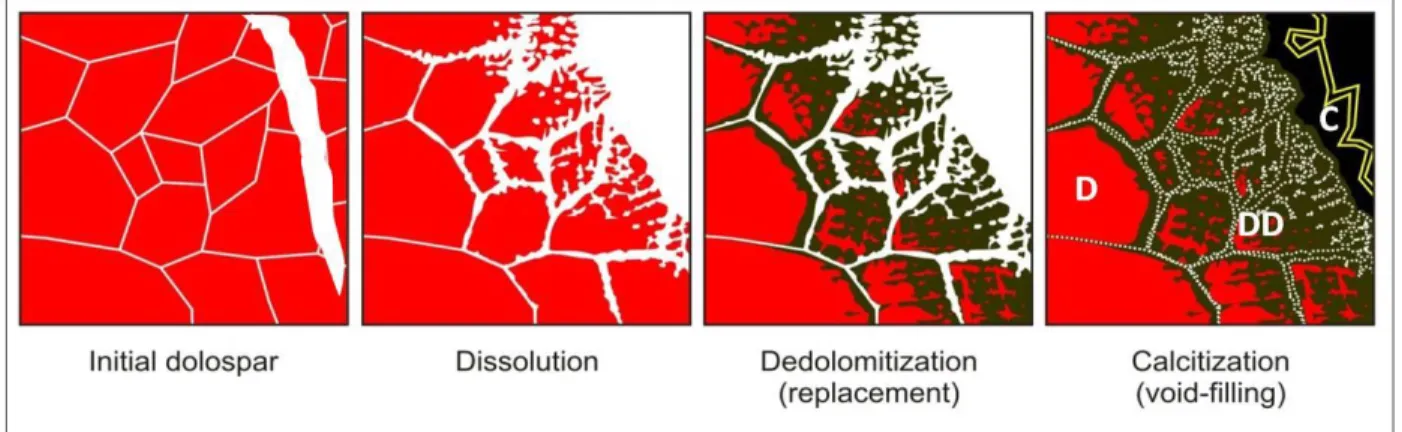
Cathodoluminescence observations, along with microprobe analysis, led to the elaboration of a simplified paragenesis of the processes implied in the microscopic gradient appearance (fig 3).
Figure 3. Sketch of the process leading to the observed fabrics and their distribution at thin-section scale.
Dissolution occurs from a fracture affecting the initial dolospar. Dissolution creates a cavity by enlargement of the initial fracture and inter- and intra-granular porosity that decreases away from the initial fracture. The corroded dolomite crystals are then entirely or partly dedolomitized through
replacement. The last step consists of calcitization (void-filling) in inter- and intra-granular porosity and in the cavity. The petrographic gradient is the end result with [C] calcite in cavities, [DD] dedolomite
texture, [D] dolomite.
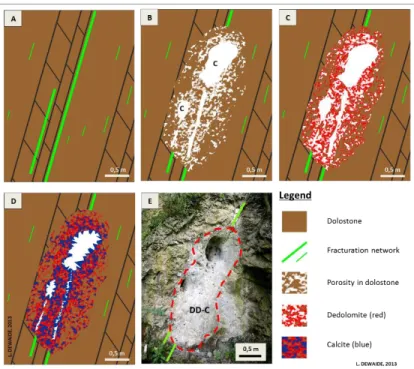
An analogy of these microscopic processes with macroscopic events have been proposed and leads to a genetic model of the “dolostone cavity type”: at first, dissolution of the initial dolostone took place along the discontinuities represented by the fracture network. Fluids penetrated the rock causing pervasive dissolution that progressed from the fractures into the rock. An heterogeneous but globally highly porous material was created and open cavities developed locally. This porous material can be compared to the “Ghost Rock” (Quinif, 1999; Quinif, 2010), whose formation is a general process of in situ dissolution of rocks (here dolomite) that can further evolve to more classical forms of karst. Subsequently, dedolomitization occurred by both calcite precipitation in the voids of the altered dolomite (calcitization) and direct replacement of dolomite (dedolomitization s.s.). In macroscopic cavities, calcite cement developed as large rhombohedra. The “dolostone cavity type” and its calcitic transition zone observable today are the final macroscopic result of the whole process (fig. 4).
Figure 4. Proposed genetic model for the development of “dolostone cavity type” karst in Waulsortian
mudmounds. (A) Initial dolostone, crudely stratified. A fracture network developed parallel to the stratification. (B) Creation of porosity and cavities [C] by heterogeneous dissolution of the dolostone. Porosity is preferentially developed along fractures. (C) Replacive dedolomitization of the altered dolostone occurs from the porosity development. (D) Final step with calcitizing fluids precipitating in the residual porosity (cementation). Calcite rhombohedra grew in the largest voids (cavities) but the latter were not completely filled so that residual karstic cavities are observable today. (E) Comparison with field observation (the dedolomite/calcite zone [DD-C] is outlined).
Dolomite dissolution, calcite replacement (dedolomitization s.s.) and calcite cementation leading to the actual “dolostone cavity type” and its major features correspond to distinct processes that require a change in fluid chemistry and/or flow regime. These changes could have happened in a large range of environments from burial conditions to subaerial exposure. The investigations that are currently leaded aim to precise the paleo-environment in which these processes took place and the timing of those.
So far, fluid inclusions and oxygen and carbon isotopes analysis have shown that the waulsortian dolostone has a deep burial origin while the dedolomitization and the calcite cementation stage seems to be linked to meteoric water. The dolomite dissolution step is more difficult to insert in the paragenesis but it could have intervene at a very early stage after dolostone diagenesis. The reason of this massive dolostone dissolution could be linked to a certain instability of the initial dolomite crystals. Indeed, microprobe analysis of dolomite samples involved in the dolostone cavity type show that the dolomite has a non-stoichiometric composition. This slight instability could have initiated the dissolution of dolomite by fluids that were probably sur-saturated with respect to calcite given the largely lime-dominated surrounding environment.
References :
Dewaide L., Baele J-M., Collon-Drouaillet P., Quinif Y., Rochez G., Vandycke S. & Hallet V., 2013. «Karstification in dolomitized Waulsortian mudmounds (Belgium)». Geologica Belgica, volume 17 (2014) : 43-51.
Quinif, Y., 1999. Fantômisation, cryptoaltération et altération sur roche nue. Le tryptique de la karstification. Actes du Colloque Européen Karst-99, 159-164.
Quinif, Y, 2010. Fantôme de roche et Fantômisation. Essais sur un nouveau paradigme en karstogenèse. Karstologia-Mémoires, 18, 196 p