HAL Id: tel-00563690
https://tel.archives-ouvertes.fr/tel-00563690
Submitted on 7 Feb 2011HAL is a multi-disciplinary open access archive for the deposit and dissemination of sci-entific research documents, whether they are pub-lished or not. The documents may come from teaching and research institutions in France or abroad, or from public or private research centers.
L’archive ouverte pluridisciplinaire HAL, est destinée au dépôt et à la diffusion de documents scientifiques de niveau recherche, publiés ou non, émanant des établissements d’enseignement et de recherche français ou étrangers, des laboratoires publics ou privés.
Integrating the concepts of optimization and reliability
in the design of agricultural machines
Abd Al-Kareem Abo Al-Kheer
To cite this version:
Abd Al-Kareem Abo Al-Kheer. Integrating the concepts of optimization and reliability in the de-sign of agricultural machines. Other [cond-mat.other]. INSA de Rouen, 2010. English. �NNT : 2010ISAM0024�. �tel-00563690�
Année 2010
_____________________________________________________________________________________________________________
Laboratoire de Mécanique de Rouen (LMR) Institut National des Sciences Appliquées de Rouen LMR / INSA de Rouen / Technopole du Madrillet, Avenue de l’Université,
76801 Saint Etienne du Rouvray cedex France
Ecole doctorale SPMII
Thèse
Présentée à
L’Institut National des Sciences Appliquées de Rouen
Pour obtenir le grade de Docteur de l’Institut National des Sciences Appliquées de Rouen
Spécialités : Génie mécanique
Intégration des concepts d’optimisation et de fiabilité
dans la conception des machines agricoles
Par
Abd Al-kareem ABO AL-KHEER
Soutenue le 19
novembre 2010 devant la commission d’examen composée de :
A. CHATEAUNEUF Rapporteur Professeur à l’Université Blaise Pascal F. GUERIN Rapporteur Professeur à l’Université d'Angers G. KHARMANDA Examinateur Professeur à l’Université d’Alep A.M. MOUAZEN Examinateur Professeur à l’Université deCranfield Y. AOUES Examinateur Maître de Conférence à l’INSA de Rouen M. EID Examinateur Professeur à l’INSA de Rouen
i
Rouen National Institute of Applied Sciences
Mechanical Engineering Laboratory
Doctoral school SPMII
Integrating the concepts of optimization and reliability
in the design of agricultural machines
A Thesis submitted for the degree of Doctor in
Mechanical Engineering
By
Abd Al-kareem Abo Al-kheer
ii
Abstract
Agricultural machines should be designed to be optimal, reliable and have the capacity to resist failure by fatigue. Although, the deterministic design approach does not guarantee these requirements, it is traditionally applied in the design of agricultural machines. This is due to the difficulties to model the stochastic nature of the forces acting on agricultural machines, especially the forces acting on tillage machines which work in irregular environment and under varying conditions. Therefore, the main objective of this dissertation is to develop a general framework for the design of agricultural machines by integrating the optimization, the reliability and the fatigue tools. We aim to provide an alternative to the traditional deterministic design one. First, this dissertation proposes methods and models for modeling the variability in tillage forces considering both the variability in tillage system parameters and the soil failure. Second, based on the available methods in reliability-based design optimization and fatigue analysis approaches, it proposes methodologies for the design of agricultural machines. Throughout the dissertation, the developed approaches are applied to the design of the shack of a chisel plough.
Keywords: variability; tillage system parameters; soil failure; tillage forces; tillage
machines; reliability; optimization; fatigue analysis.
iii
Résumé
Les machines agricoles doivent être conçues pour être optimales, fiables et résistantes à la rupture par fatigue. L’approche déterministe de la conception ne garantit pas ces exigences, elle est néanmoins traditionnellement appliquée pour la conception de machines agricoles. Cela est dû à la difficulté de modéliser la nature stochastique des forces agissant sur les machines agricoles, en particulier les machines de labour, car elles fonctionnent dans un environnement irrégulier et dans des conditions de fonctionnement variables. Le principal objectif de cette thèse est de développer un cadre général pour la conception de machines agricoles, en intégrant les outils d'optimisation, de fiabilité et de fatigue. En cela, nous visons à proposer une alternative à l'approche déterministe. Tout d'abord, cette thèse propose des méthodes et des modèles pour modéliser la variabilité des forces durant le labour en prenant en compte à la fois la variabilité des paramètres du système de labour et de rupture du sol. Deuxièmement, sur la base des méthodes d’optimisation fiabiliste et d’analyse de la fatigue, nous proposons des méthodologies pour la conception de machines agricoles. Tout au long de la thèse, les approches développées sont appliquées à la conception de la dent d'un chisel.
Mots-clés: variabilité; paramètres du système de labour; rupture du sol; forces de labour;
v Acknowledgments
First, I would like to express my sincere gratitude to my advisor, Prof. A. El-hami, for his support and encouragement during my stay at the Rouen Mechanics Laboratory. He gave a lot of freedom in my course and research work, and has been understanding at all times.
I would thank the committee members: Prof. A. Chateauneuf and Prof. F. Guerin. I would like to express my gratitude to Prof. G. Kharmanda, Dr. A. Mouazen, Prof. M. Eid, and Dr. Y. Aoues for helping me in my research activities and for valued contributions at this work. Thanks are due to Dawn Hallidy, from LeHavre university, for proofreading the paper “Probabilistic analysis of soil tillage forces“.
I would like to extend my thanks to the staff of the Rouen Mechanics Laboratory and the mechanical department in the National Institute of Applied Sciences and especially to Dr. F. Barbe, Dr. B. Vieille, Dr. A. Guillet, Dr. L. Khalij and Dr. E. Pagnacco for their constructive comments and assistance. Many thanks go to D. Blanchard and A. Lépine for administrative support.
I wish to acknowledge the financial support from the Aleppo University, which enabled me to carry out the research activities.
I would also like to thank my colleges in the Rouen Mechanics Laboratory; S. Meftah, J. Rojas, S. Lambert, A. Makhloufi, J. Aucher, C. Kpodekon, I. Nistea, N. Benmeziane, A. Tahimi and A. Belattar.
Last but not the least; I thank each member of my family and all my friends for their moral support and unending encouragement.
vi
Publications
The following papers were produced from this work and are incorporated in this Thesis. A. Abo Al-kheer, M.G. Kharmanda, A. El-Hami. Probabilistic design of agricultural
machines. International Conference on Non-convex Programming, Rouen, France, 2007.
A. Abo Al-Kheer, M.G. Kharmanda, A. El-Hami. Probabilistic analysis of soil tillage
forces. 18th Triennial ISTRO Congress, Izmir, Turkey, 2009.
A. Abo Al-Kheer, M.G. Kharmanda, A. El-Hami. Intégration des incertitudes de
propriétés mécaniques du sol pour l’analyse de conception de machines agricoles. 19ème
Congrès Français de Mécanique, Marseille, France, 2009.
A. Abo Al-Kheer, M.G. Kharmanda, A. El-Hami. Application of reliability methods for the
safety assessment of soil tillage machines. International Congress for Applied Mechanics,
Marrakech, Morocco, 2010.
A. Abo Al-Kheer, Y. Aoues, A. El-Hami. Integrating the reliability constraints into the
design optimization of tillage machines. International symposium on aircraft materials,
Marrakech, Morocco, 2010.
A. Abo Al-Kheer, A. El Hami, M. G. Kharmanda, A. M. Mouazen. Reliability-based
design for soil tillage machines. Journal of Terramechanics, 2011, Issue 1, Vol. 48, pp.
57-64.
A. Abo Al-Kheer, Y. Aoues, A. El-Hami. Integration of economical requirements into
probabilistic approach for the design of agricultural machines. In "Proceedings of the
Tenth International Conference on Computational Structures Technology", Civil-Comp Press, Stirlingshire, UK, Paper 177, 2010. doi:10.4203/ccp.93.177
A. Abo Al-Kheer, Y. Aoues, A. El-Hami, M. Eid. Reliability-based design optimization of
soil tillage machines while considering fatigue life performance. In "Proceedings of the
Tenth International Conference on Computational Structures Technology", Civil-Comp Press, Stirlingshire, UK, Paper 176, 2010. doi:10.4203/ccp.93.176.
A. Abo Al-Kheer, M. G. Kharmanda, A. M. Mouazen, A. El Hami. Estimating the
variability of tillage forces on a chisel plough shank by modeling the variability of tillage system parameters. Article submitted to the International Journal of Computers and
Electronics in Agricultural.
A. Abo Al-Kheer, M. Eid, Y. Aoues, A. El-Hami, A. M. Mouazen. Modeling the spatial
variability in tillage forces for fatigue analysis of tillage machines. Article submitted to
vii
Table of contents
Abstract ... ii Résumé ... iii Acknowledgments ... v Publications ... viTable of contents ... vii
List of figures ... x
List of tables ... xii
Extended French summary... xiii
1 Introduction and objectives ... 1
1.1 Introduction ... 1
1.2 Overview of the work ... 2
1.3 Research objectives ... 3
1.4 Outline of the dissertation ... 4
2 Modeling variability in tillage forces ... 5
2.1 Introduction ... 5
2.2 Soil-tillage tool interactions ... 6
2.2.1 Introduction ... 6
2.2.2 Soil failure patterns ... 7
2.2.3 Soil-tillage tool forces ... 8
2.2.4 Analytical approach ... 9
2.2.5 Numerical approach ... 10
2.2.6 Empirical approach ... 11
2.3 Probabilistic approach for modeling the variability of tillage forces ... 12
2.3.1 Determining tillage system parameters ... 13
2.3.2 Modeling the variability of tillage system parameters ... 19
2.3.3 Sensitivity analysis ... 22
2.3.4 Determining the variability of tillage forces ... 23
2.4 Determining the variability of tillage forces for the shank of a chisel plough ... 26
2.4.1 Modeling the variability of soil engineering properties ... 26
2.4.2 Effects of the variability of tillage system parameters on tillage forces ... 28
2.4.3 Determining the variability of tillage forces for the shank of a chisel plough ... 29
2.5 Conclusions ... 31
viii
3.1 Introduction ... 32
3.2 Design under uncertainty ... 32
3.3 Deterministic design optimization ... 33
3.4 Structural reliability analysis ... 34
3.4.1 Approximation methods ... 35
3.4.2 Simulation techniques ... 37
3.5 Reliability-based design optimization ... 38
3.5.1 RBDO approaches ... 38
3.5.2 Reliability index approach (RIA) ... 41
3.5.3 Sequential optimization and reliability assessment (SORA) ... 41
3.6 RBDO approach for tillage machines ... 42
3.7 Numerical application ... 44
3.7.1 Dispersion effects of random variables on limit state functions ... 44
3.7.2 Reliability analysis ... 46
3.7.3 RIA and SORA methods ... 48
3.7.4 Optimal reliability analysis ... 49
3.8 Conclusions ... 50
4 Modeling the spatial variability in tillage forces ... 51
4.1 Introduction ... 51
4.2 Necessity of modeling the spatial variability in tillage forces ... 51
4.3 Soil failure mechanisms ... 52
4.4 Modeling the spatial variability of tillage forces ... 54
4.4.1 Basic assumptions for the proposed model ... 54
4.4.2 Modeling the spatial variability in the global tillage forces ... 55
4.4.3 Modeling the spatial variability in the local tillage forces ... 57
4.4.4 Modeling the spatial variability in the total tillage forces ... 57
4.4.5 Special cases ... 59
4.5 Modeling the spatial variability of tillage forces on the shank chisel plough ... 60
4.6 Conclusions ... 62
5 Fatigue analysis ... 63
5.1 Introduction ... 63
5.2 Fatigue of materials and their approaches ... 63
5.3 Stress-based fatigue life ... 64
ix
5.3.2 Modifying factors ... 67
5.3.3 Fatigue analysis for random stress ... 67
5.3.4 Multiaxial fatigue ... 68
5.4 Fatigue analysis of tillage machines ... 69
5.4.1 Proposed approach ... 69
5.4.2 Numerical application ... 70
5.5 Conclusions ... 74
6 Conclusions and future work ... 75
6.1 Summary and conclusions ... 75
6.2 Recommendations for future work ... 77
Bibliography ... 79
Appendix : Commonly used probability distributions ... 85
Appendix : Chi-square and Kolmogorov-Smirnov tests ... 96
Appendix : Tillage forces-tillage system parameters relationships ... 99
Appendix V: Correlation analysis of soil engineering properties ... 100
Appendix V: Samples of soil engineering properties ... 103
x
List of figures
Figure 1-1 : Overview of the work ... 3
Figure 2-1 : Basic tillage tool geometry ... 7
Figure 2-2 : Internal and boundary soil failure during cutting ... 7
Figure 2-3 : Patterns of soil failure ... 8
Figure 2-4 : Forces acting on the tool according to different tool orientations ... 9
Figure 2-5 : Logarithmic spiral failure zone ... 10
Figure 2-6 : Flowchart of the probabilistic approach steps ... 13
Figure 2-7 : Soil failure model for narrow blades ... 14
Figure 2-8 : Forces acting on soil segment... 14
Figure 2-9 : Comparison between theoretical and experimental results for horizontal force ... 18
Figure 2-10 : Comparison between theoretical and experimental results for vertical force ... 18
Figure 2-11 : Proposed methodology for modeling the variability in soil engineering properties .. 21
Figure 2-12 : The concept of estimating the effects of random variable dispersion ... 23
Figure 2-13 : Flowchart of the methodology for determining the variability of tillage forces ... 25
Figure 2-14 : Histograms and probability density functions for soil engineering properties ... 27
Figure 2-15 : Illustration of a five-shank chisel plough ... 29
Figure 2-16 : Histograms and probability density functions for horizontal and vertical forces ... 30
Figure 3-1 : Limit state concept ... 34
Figure 3-2 : Illustration of the FORM and SORM approximations ... 36
Figure 3-3 : Basic principle behind Monte Carlo simulation ... 38
Figure 3-4 : Flowcharts of reliability-based design approaches ... 40
Figure 3-5 : Flowchart of the proposed RBDO approach for tillage machines ... 43
Figure 3-6 : A schematic drawing of the shank with acting forces ... 44
Figure 3-7 : Objective function history ... 48
Figure 3-8 : Total cost-failure probability relationships ... 49
Figure 4-1 : Successive failure planes in front of the tool ... 52
Figure 4-2 : Fluctuations in the tillage force due to formation of failure planes in the soil ... 53
Figure 4-3 : Typical tine force-displacement curves ... 53
Figure 4-4 : Illustration of the spatial variability in the global tillage forces ... 56
Figure 4-5 : Illustration of the spatial variability in the local tillage forces ... 58
Figure 4-6 : Illustration of the spatial variability in the horizontal and vertical forces ... 58
xi
Figure 4-8 : Spatial variability in tillage forces when omitting local tillage forces ... 59
Figure 4-9 : Illustration of the shank of a chisel plough with tillage forces ... 60
Figure 4-10 : The spatial variability of the horizontal and vertical forces ... 61
Figure 5-1 : Typical S-N curves ... 65
Figure 5-2 : Fully-reversed stress ... 66
Figure 5-3 : Comparison of mean stress - stress amplitude relationships ... 67
Figure 5-4 : Flowchart of fatigue analysis of tillage machines ... 70
Figure 5-5 : a- Meshed model and boundary conditions; b- Maximum equivalent stress ... 71
Figure 5-6 : Equivalent stress history across proposed 1000 m distance ... 71
Figure 5-7 : Histograms of stress amplitude and mean stress ... 72
Figure 5-8 : Distance to failure-Shank dimensions plot ... 73
xii
List of tables
Table 2-1 : Soil description ... 17
Table 2-2 : Average percent deviation of predicted forces from experimental observation ... 17
Table 2-3 : Probabilistic characteristics of soil engineering properties ... 26
Table 2-4 : Results of the differential sensitivity method and the proposed method ... 28
Table 2-5 : Probabilistic characteristics of tillage forces ... 30
Table 3-1 : Dispersion effects of basic random variables on limit state functions ... 45
Table 3-2 : Coordinates of the design points ... 46
Table 3-3 : Results of reliability analysis ... 47
xiii
Extended French summary
Cette partie présente la synthèse des travaux réalisés, qui sont ensuite détaillés en version anglaise.
1 Introduction (Chapitre 1)
Le sol est une structure hétérogène et discontinue. Toutefois, il est considéré comme le facteur prépondérant pour la conception des machines agricoles. Les verrous de la conception des machines agricoles sont liés à la détermination du comportement du sol sous les chargements mécaniques et le calcul des forces agissant sur les outils de labour. Pour cela, cette conception est généralement basée sur des règles issues des observations expérimentales.
Toutefois, au cours des six dernières décennies, des recherches ont déterminé les formes de la rupture du sol sous différentes conditions de fonctionnement et ils ont proposé des modèles pour estimer les forces agissant sur les outils de labour. Le premier modèle a été proposé par Reece en 1965 basé sur les travaux de Terzaghi. Aujourd’hui des efforts considérables ont été accomplis dans ce domaine, toutefois, il n’existe pas de modèle général permettant de prévoir l’interaction entre le sol et l’outil de labour.
La démarche déterministe de la conception des machines agricoles est basée sur la mesure des forces agissant sur les machines dans différentes conditions de fonctionnement afin de déterminer leurs valeurs nominales. Ensuite, des facteurs de sécurité empiriques sont appliqués afin d’assurer une marge de sécurité entre les contraintes appliquées et la résistance limite du matériau.
La démarche déterministe de la conception basée sur les coefficients de sécurité ne garantit pas une conception fiable. Puisque, la forte variabilité des propriétés mécanique du sol et des conditions de fonctionnement des machines agricoles peut conduire à des écarts imprévisibles des performances réelles et espérées. Par conséquent, la conception de ces structures doit être placée dans un contexte aléatoire.
La démarche rationnelle de la conception des machines agricoles consiste à considérer la propagation des incertitudes dans l’analyse en s'appuyant sur une modélisation probabiliste des propriétés mécaniques du sol, les paramètres de conception des outils de labour et les conditions de fonctionnement. La théorie des probabilités offre
xiv
un cadre global pour la considération des incertitudes et des variabilités des données dans la modélisation mécanique.
L’optimisation de la conception basée sur les critères de fiabilité propose de tenir compte des incertitudes dans la recherche de la conception optimale des structures. Cette approche datant du début des années 70 vise à trouver le meilleur compromis entre les coûts de la conception et la fiabilité d'un dimensionnement. Aujourd'hui, une variété d’approches d’optimisation fiabiliste sont développées afin de relever le défi de la conception des structures complexes. En outre, ces méthodes ont été appliquées dans plusieurs domaines industriels, par exemple l’automobile, les systèmes micro-électro-mécaniques, l’aéronautique, et le formage des matériaux.
Ces développements (fiabilité des structures, optimisation fiabiliste, analyse de fatigue) n’ont pas été appliqués à la conception des machines agricoles. Cela est principalement dû aux difficultés liées à la modélisation de la variabilité des forces agissant sur les outils de labour. Par conséquent, l’objectif principal de ce travail de thèse est de proposer une approche destinée à la modélisation de la variabilité des forces agissant sur l’outil de labour. Ensuite, d’utiliser l’approche de l’optimisation fiabiliste pour la recherche de la conception optimale des machines agricoles. Finalement, une approche de modélisation de la variabilité spatiale des forces de labour est proposée pour l’analyse de fatigue des machines agricoles.
2 Objectifs du travail (Chapitre 1)
Cette thèse propose des méthodologies pour l’intégration des approches de la fiabilité des structures, de l'optimisation fiabiliste et de l’analyse de fatigue dans la conception des machines agricoles. L'objectif principal est de développer un cadre probabiliste pour la conception des machines agricoles en considérant la variabilité des forces de labour.Ainsi, l’approche probabiliste développée peut être considérée par les concepteurs comme une alternative à l’approche déterministe. Les objectifs de ce travail sont les suivants:
1- Proposer une approche probabiliste pour la modélisation de la variabilité des
forces de labour résultant de la variabilité des paramètres du système de labour (les propriétés mécaniques du sol, les paramètres de conception de l’outil de labour et les conditions de fonctionnement).
2- Développer une méthodologie d’optimisation fiabiliste pour les machines de
xv
3- Développer un nouveau modèle pour décrire la variabilité spatiale des forces
totales de labour.
4- Analyse du comportement en fatigue des machines de labour afin de calcul la
durée de vie en tenant en compte de la variabilité spatiale des forces de labour. 3 Synthèse du travail de thèse réalisé (Chapitre 1)
La variabilité des forces de labour peut résulter de deux sources distinctes: d’une part la variabilité des paramètres du système de labour qui ont des effets globaux, d’autre part, la variabilité des formes de la rupture du sol qui ont des effets locaux. Par conséquent, nous appelons les forces de labour liées aux paramètres du système de labour par les forces globales de labour et celles liées à la rupture du sol par les forces locales de labour.
La variabilité des paramètres du système de labour résulte de la variabilité des propriétés mécaniques du sol, de la variabilité des paramètres de conception de l’outil de labour et de la variabilité des conditions de fonctionnement. La variabilité des propriétés mécaniques du sol reflète l'hétérogénéité et la discontinuité du sol. La variabilité des paramètres de conception de l'outil de labour est due aux processus de fabrication. Par contre, la variabilité des conditions de fonctionnement est due au fait que ces paramètres ne sont pas complètement contrôlée pendant l’opération de labour.
L’organigramme de ce travail est présenté en Figure 1. Premièrement, la variabilité des forces globales de labour résultant de la variabilité des paramètres du système de labour est modélisée et intégrée dans l’optimisation fiabiliste afin d'avoir des machines optimales et fiables. Deuxièmement, la variabilité de la rupture du sol est ajoutée à la variabilité des paramètres du système de labour et la variabilité des forces totales de labour est prise en compte dans l'analyse de fatigue pour estimer la durée de vie des machines de labour.
La variabilité des forces locales de labour est négligée lors de l'analyse d’optimisation fiabiliste, pour plusieurs raisons. D’une part, elle n’a aucun effet significatif sur la variabilité des forces totales de labour, et d’autre part, pour des raisons de simplicité et de réduction du temps de calcul. Par contre, la variabilité des forces locales de labour est prise en compte dans l'analyse de fatigue car celle-ci a un caractère cyclique qui affecte de manière significative la durée de vie des machines de labour.
xvi
Figure 1 : Organigramme du plan du travail 4 Modélisation de la variabilité des forces de labour (Chapitre 2)
Ce chapitre propose une approche probabiliste pour la modélisation de la variabilité des forces de labour résultant de la variabilité des paramètres du système de labour. Cette approche est composée de quatre étapes, telles qu’illustrées en Figure 2. La première étape vise à estimer les forces de labour en utilisant le model de McKyes et Ali et de déterminer les principaux paramètres du système de labour (propriétés mécaniques du sol, les paramètres de conception d’outil de labour et les conditions de fonctionnement), qui affectent les forces de labour.
Les propriétés mécaniques du sol Les paramètres de conception
Les conditions de travail
La rupture du sol Les forces globales de labour
Les forces locales de labour Optimisation fiabiliste L’analyse de fatigue L es p ar am èt re s du s ys tè m e de la bo ur
Des machines optimales et fiables
Des machines durables Obj
ec
tiv
xvii
La deuxième étape vise à modéliser la variabilité des propriétés mécaniques du sol en utilisant des techniques graphiques et quantitatives et de proposer des hypothèses pour modéliser la variabilité des paramètres de conception de l’outil de labour et des conditions de fonctionnement.
La troisième étape vise à déterminer les effets de dispersion des paramètres du système de labour sur les forces de labour. A ce stade, nous allons négliger la variabilité des paramètres du système de labour qui n'a aucun effet significatif sur les forces de labour afin de simplifier la modélisation et de réduire le temps de calcul.
La dernière étape consiste à estimer la variabilité des forces de labour en prenant en compte la variabilité des paramètres du système de labour. La méthodologie proposée s’appuie sur la technique de MCS (les simulations de Monte Carlo).
Figure 2 : Organigramme de la modélisation de la variabilité des forces de labour Cette approche est appliquée à la modélisation de la variabilité des forces horizontale et verticale de labour pour la dent d’un chisel (Figures 3 et 4). Nous avons utilisé 57 échantillons pour modéliser la variabilité des propriétés mécaniques du sol. En plus, Nous avons utilisé les lois normale et uniforme pour représenter la variabilité des paramètres de conception et des conditions de fonctionnement. Les histogrammes et les fonctions de
Déterminer les paramètres du système de labour
Modéliser la variabilité des paramètres du système de labour
Sélectionner les variables aléatoires des paramètres du système de labour Techniques graphiques et quantitatives
Méthodologie basée sur MCS L’analyse de sensibilité Le model de McKyes et Ali
Déterminer la variabilité des forces de labour
xviii
densité de probabilité des forces horizontale et verticale sont présentés en Figure 5. Les résultats obtenus montrent que les deux forces suivent la loi log-normal et leur caractéristiques probabilistes sont et
respectivement. Le coefficient de corrélation entre les forces horizontale et verticale est de . Ces résultats montrent que les dispersions des forces de labour sont importantes et nous devons les prendre en compte dans l’analyse de fiabilité.
Figure 3 : Illustration de la dent d'un chisel avec les forces de labour
xix
Figure 5 : Les histogrammes et les fonctions de densité de probabilité des forces horizontales et verticales
5 Optimisation fiabiliste des machines de labour (Chapitre 3)
L'approche proposée pour la conception des machines de labour s’appuie sur les outils de conception probabiliste et les méthodes d’optimisation fiabiliste. Cette approche se compose de quatre étapes principales, comme illustré en Figure 6.
La première étape de cette approche consiste à déterminer les fonctions d’état limite selon les scénarios de défaillance. Pour les machines de labour, deux fonctions d’état limite peuvent être considérées. La première fonction d’état limite est liée à la résistance mécanique des machines et la seconde fonction d’état limite à la qualité de l’opération de labour.
Les fonctions d'état limite déterminées dans la première étape sont fonctions des variables d’entrée. Ces variables n'ont pas la même variabilité et la même influence sur la probabilité de défaillance. Par conséquent, l’analyse des sensibilités est appliquée pour déterminer les vecteurs de variables déterministes et aléatoires.
La troisième étape consiste à utiliser la technique de MCS et la méthode FORM pour calculer la probabilité de défaillance selon les fonctions d'état limite déterminées dans la première étape. La technique de MCS est utilisée directement pour estimer la probabilité
xx
de défaillance, lorsque les deux fonctions d'état limite sont impliquées dans l'analyse de fiabilité. Lorsque la méthode FORM est utilisée, un indice de fiabilité est calculé pour chaque fonction d'état limite. En suite, la défaillance du système est estimée par la méthode de Ditlevsen.
Figure 6 : Organigramme de la l'approche proposée pour la RBDO des machines de labour
La résistance des machines de labour
La qualité de l’opération de labour
La détermination des fonctions d’état limite
Le vecteur de variables déterministes
Les variables d’entrée
Le vecteur de variables aléatoires
L’analyse des sensibilités
Machines de labour optimales et fiables
L’analyse de fiabilité MCS et FORM
La méthode de Ditlevsen
RIA et SORA L’optimisation fiabiliste Défaillance du système
xxi
La quatrième étape a pour objectif de rechercher la conception optimale et fiable des machines de labour. Deux approches de l’optimisation fiabiliste sont utilisées, d’une part, l’approche classique de l’optimisation fiabiliste souvent appelée RIA (Reliability index approach), et d’autre part, la méthode SORA (Sequential optimization and reliability assessment). La comparaison des deux méthodes est réalisée à travers les solutions optimales obtenues est les performances numériques des deux approches.
Les résultats de l'analyse de fiabilité montrent que la méthode FORM peut être utilisée pour calculer la probabilité de défaillance en considérant seulement la première fonction d’état limite et la présence de la corrélation entre les forces de labour. Cette simplification conduit à une estimation moins couteuse en temps de calcul de la probabilité de défaillance. De plus, cette simplification n’altère pas la précision des résultats.
Les méthodes RIA et SORA sont appliquées pour déterminer le volume minimum de la dent d’un chisel tout en vérifiant un indice de fiabilité cible de . La méthode RIA a convergé au volume minimal de !correspondant à la conception optimale de"#$ % & & '. Par contre, la méthode SORA a convergé au
volume minimal de & ! correspondant à la conception optimale de"#$ % & & ', Figure 7.
Figure 7 : L'historique de la fonction objective
Les solutions optimales obtenues par les deux méthodes sont pratiquement identiques. Cependant, la méthode RIA nécessite 1100 évaluations du modèle d’éléments finis. En revanche, la méthode SORA exige 397 évaluations seulement. D'un point de vue
xxii
numérique, la méthode SORA est plus efficace que la méthode RIA. Par conséquent, la méthode SORA peut être adoptée pour résoudre le problème de la RBDO des machines de labour.
La méthode SORA est utilisée pour la recherche du niveau optimum de fiabilité cible permettant de minimiser le coût total composé du coût initial (coût de construction) et du coût de défaillance. La Figure 8 montre que le niveau optimum de fiabilité cible de ()* permet de vérifier l'équilibre entre le coût initial et le coût de défaillance. En effet, ce niveau optimum de fiabilité correspondant à un indice optimal de fiabilité cible est différent de l’indice cible utilisé au début de ce travail. En d’autres termes, la recherche de l’indice de fiabilité optimal cible doit être intégrer dans une procédure de la RBDO afin de vérifier le meilleur compromis entre le coût total et le niveau de fiabilité souhaitée.
Figure 8 : La relation entre le coût total et le niveau de fiabilité 6 Modélisation de la variabilité spatiale des forces de labour (Chapitre 4)
Ce chapitre vise à proposer un nouveau modèle pour la modélisation de la variabilité spatiale des forces de labour, en tenant compte de la variabilité des forces de labour résultant de la variabilité des paramètres du système de labour (la variabilité des forces globales de labour) et de la variabilité des forme de défaillance du sol (la variabilité des forces locales de labour).
Le modèle proposé repose sur deux hypothèses fondamentales, qui sont les suivantes: 1) la variabilité spatiale des forces globales est aléatoire, reflétant la variabilité des sols agricoles, les incertitudes des paramètres de conception de l’outil de labour, les fluctuations des conditions de fonctionnement qui sont généralement immaîtrisables
xxiii
pendant l’opération de labour, 2) la variabilité spatiale des forces locales de labour est cyclique reflétant la formation répétitive des blocs du sol devant l'outil de labour.
La variabilité spatiale des forces globales de labour est combinée à la variabilité spatiale des forces locales de labour en tenant compte de l'hypothèse que les forces locales sont proportionnelles aux forces globales. Par conséquent, la variabilité spatiale des forces de labour peut être représentée par les cinq paramètres suivants +, - telle
que illustrée en Figure 9. Où, est la force globale horizontale, est la force globale verticale, est la distance entre deux changements successifs des forces globales, est la durée du cycle des forces locales et - est le pourcentage de proportionnalité entre les forces
locales et les forces globales de labour.
Figure 9 : Illustration de la variabilité spatiale des forces horizontale et verticale Figure 10 montre la variabilité spatiale des forces horizontale et verticale pour la dent d’un chisel à travers 1000 m de distance.
xxiv
7 L’analyse de fatigue des machines de labour (Chapitre 5)
Les machines de labour sont soumises à des contraintes multiaxiales provoquées par la variabilité des forces de labour. La défaillance du sol crée des chargements cycliques sur les machines qui peuvent avoir des effets sur la durée de vie de ces machines. Pour cette raison, nous avons étudié les effets de la variabilité des forces de labour sur la durée de vie des machines de labour. Les étapes principales de cette analyse sont présentées en Figure 11.
Figure 11 : Organigramme de l’analyse de fatigue des machines de labour
La contrainte équivalente générée par les contraintes multiaxiales est calculée selon le critère de Von Mises dans un intervalle de distance bien déterminée. L'algorithme de Rainflow est utilisé pour extraire les cycles de contrainte et de déterminer leurs moyennes et leurs amplitudes. La fraction du dommage causé par chaque cycle de contrainte est calculée par la fonction de Kwofie et le critère de Soderberg. Le choix de la fonction de Kwofie et le critère de Soderberg est basé sur l’hypothèse de la linéarité des déformations.
États de contraintes multiaxiaux
L'historique de contrainte équivalente
Les cycles de contrainte Le critère de Von Mises
La fonction de Kwofie et le critère Soderberg
La méthode de Rainflow La variabilité des forces de labour
La fraction du dommage
La loi de Miner Le dommage cumulé
L'intervalle de distance/ Le dommage cumulé
La distance parcourue estimée jusqu’à la défaillance
xxv
En d’autres termes, les contraintes appliquées sur les machines de labour sont toujours dans le domaine élastique du matériau. Ainsi, le dommage cumulé causé par tous les cycles est calculé selon la loi de Miner. Enfin, la distance parcourue estimée jusqu’à la défaillance est calculée en divisant l'intervalle de distance par le dommage cumulé.
Le dommage total calculé sur l'intervalle de distance de ./ est égal à0 1 . La distance parcourue estimée jusqu’à la défaillance est égale à.2 3 . Malgré que la contrainte équivalente soit inférieure à la limite élastique, la défaillance se produit après une certaine distance.2. En suite, nous avons utilisé des valeurs différentes de h et b pour calculer la distance parcourue estimée jusqu’à la défaillance, comme illustre la Figure 12. Les résultats montrent que la variation de la distance parcourue jusqu’à la défaillance en fonction des dimensions 4 5 est très
importante6.2 789 :3 .2 7;< =3 >
Figure 12 : La distance parcourue estimée à la défaillance en fonction de b et h Nous avons également étudié l'effet du pourcentage ( ) sur la distance.2, voir Figure 13. En effet, une augmentation de de 0,1 à 0,4 provoque une réduction de.2de
?3 . Cela signifie que la réduction de .2 en raison de l'augmentation de est très importante. Par conséquent, nous conseillons d'effectuer l'opération de labour lorsque l’humidité du sol est autour de la limite de liquidité. Cela peut améliorer considérablement la distance parcourue jusqu’à la défaillance et augmenter la durée de vie des machines de labour.
xxvi
Figure 13 : La relation entre - et .2 8 Conclusions et perspectives (Chapitre 6)
Le principal objectif de cette thèse est de proposer une alternative à l'approche déterministe de la conception des machines agricoles, cela en intégrant les approches de fiabilité des structures, d’optimisation fiabiliste et d’analyse de fatigue. L’approche probabiliste proposée dans la Section 5 nous a permis de modéliser la variabilité de forces de labour résultant de la variabilité des paramètres du système de labour. La modélisation de la variabilité des forces de labour a permis ensuite d’effectuer l’optimisation fiabiliste des machines agricoles. Cela dans l’objectif de concevoir des machines de labour fiables et économiques. Le modèle proposé dans la Section 7 associe la variabilité de forces de labour résultant de la rupture du sol et la variabilité de forces de labour résultant de la variabilité des paramètres du système de labour, cette combinaison a permis de modéliser la variabilité de forces totales de labour. Ainsi, le modèle développé est utilisé dans l’analyse de fatigue présentée dans la Section 8. Cette analyse nous a conduit à étudier la sensibilité de la distance parcourue jusqu’à la défaillance par rapport aux paramètres de la conception et par rapport au paramètre de proportionnalité entre les forces locales et les forces globales de labour.
Afin d'améliorer l'estimation de la variabilité des propriétés mécaniques du sol, un nombre élevé d'échantillons doit être employé et les inter-corrélations entre ces propriétés devraient être étudiées. Des observations expérimentales peuvent être utilisées pour améliorer les estimations de la variabilité des paramètres de conception et des conditions de fonctionnement. Des recherches supplémentaires sont nécessaires pour étudier les
xxvii
corrélations entre les forces globales et locales de labour et la variabilité des paramètres - du modèle présenté en Section 7. La distance parcourue estimée
jusqu’à la défaillance est calculée sur 1000 m ne suffit pas pour représenter la variabilité spatiale des forces de labour. En effet, l'analyse de fatigue sur une distance plus longue doit être réalisée afin d'obtenir une estimation plus précise de la distance parcourue jusqu’à la défaillance. De plus, la génération de plusieurs trajectoires spatiales des forces de labour permettra d’utiliser les simulations de Monte Carlo afin d’estimer la distribution de probabilité de la distance parcourue jusqu’à la défaillance.
1
1 Introduction and objectives
Chapter 1
Introduction and objectives
1.1 Introduction
In the design of agricultural machines, the soil heterogeneity and discontinuous structure should be taken into account. Given the difficulties related to the determination of soil failure patterns under mechanical loads and the calculation of the relevant forces, the design of agricultural machines is far from being a deterministic science. However, in the last six decades, researchers have worked to determine the patterns of soil failure under different operational conditions and propose models to estimate the acting forces. The first model was proposed by Reece in 1965 and was based on the work of Terzaghi. From there on, immense efforts have been made in this area, but there is still no well-defined generalised model to predict the behaviour of soil-tool interactions.
Because of to these drawbacks in the design analysis of agricultural machines, designers maintain the classical design approach, i.e. the deterministic design approach. In this approach, the designers measure the forces acting on machines in different field conditions in order to determine their maximum values. Then, safety factors are applied so as to assure that the stresses resulted by the applied forces are smaller than the resistance of the materials used in manufactory processes.
In the early 70's, reliability-based design optimization was proposed to account for the uncertainty of design variables in the optimization design approach in order to overcome the drawbacks of deterministic design approach. Nowadays, a variety of reliability-based design optimization methods is available to meet the challenge of design analysis of complex structural systems. Furthermore, these methods have been applied in several industrial fields, e.g. automotive, micro-electro-mechanical systems, aircraft, and metal forming.
In the 19th century, remarkable research was done by August Wöhler to investigate the effects of cycle loading on structures. This phenomenon, so-called fatigue, has become
2
more and more well-known and understood. Fatigue mechanism for the most commonly used materials has been well-defined and four main fatigue analysis approaches have been developed, according to fatigue phases, in order to estimate the life time of structures and to prevent failure by fatigue.
All these developments in the reliability-based design optimization approaches and the fatigue analysis approaches haven’t been applied yet for the design of agricultural machines. This is mainly due to the difficulties related to the modeling of the variability in forces involved, especially the forces acting on tillage machines.
Therefore, the main focus of this work is to model the variability in the acting forces and to use appropriate methods available in reliability-based design optimization and fatigue analysis approaches. Special attention has been given to tillage machines that work in irregular environment and under variable conditions.
1.2 Overview of the work
The variability in tillage forces can be generated by two main sources: the variability in tillage system parameters which has a global effect on tillage forces and the variability in soil failure patterns which has a local effect on tillage forces. Therefore, we call the tillage forces related to the tillage system parameters as global tillage forces and those related to the soil failure as local tillage forces.
The variability in tillage system parameters is caused by the variability in soil engineering properties, in tool design parameters and in operational conditions. The variability in soil engineering properties reflects the heterogeneity and the discontinuity of agricultural soils. The variations in tool design parameters are due to the manufacturing processes, while the variations in operational conditions are due to the fact that these parameters are not completely controlled during tillage operation. The variability in soil failure patterns can be attributed to the variations of mechanical behaviour of soil under mechanical loads.
An overview of this work is illustrated in Figure 1-1. Firstly, the variability in global tillage forces derived from the variability in tillage system parameters were modelled and integrated in the reliability-based design optimization analysis in order to achieve optimum and reliable machines. Secondly, the variability in soil failure was added to the variability in tillage system parameters and the total variability in tillage forces were considered in the fatigue analysis for the object of calculating the live time of tillage machines.
3
The variability in local tillage forces was omitted during the reliability-based design optimization analysis for several reasons. Firstly, it has no significant effects on the variability of total tillage forces. Secondly, we wanted to simplify the calculation procedures and reduce the computational cost. This variability was considered in the fatigue analysis because it has a cyclic nature that affects significantly the life time of tillage machines.
1.3 Research objectives
This dissertation investigates and develops formulations and methodologies for integrating the optimization, reliability and fatigue in the design of agricultural machines. The main focus is to develop a general framework for the design of agricultural machines in order to provide an alternative to traditional deterministic design methods by considering the variability in tillage forces. The research objectives were:
1- Proposing a probabilistic approach for modeling the variability in tillage forces due to the variability of tillage system parameters (soil engineering properties, tool design parameters and operational conditions).
2- Implementing a reliability-based design optimization framework for tillage machines based on existing probabilistic design tools and reliability-based design optimization methods.
3- Developing a new model to describe the variability in both global and local tillage forces.
Soil engineering properties
Tool design parameters
Operational conditions Tillage system parameters
Global tillage forces
Local tillage forces Soil failure
RBDO analysis Fatigue analysis
Optimum and reliable machines
Safe machines
4
4- Investigating the existing fatigue analysis methods and select those which are appropriate for calculating the life time of tillage machines when considering the spatial variability in tillage forces.
1.4 Outline of the dissertation
In Chapter 2, the objectives of tillage and their implements are presented, followed by an overview of the soil failure patterns according to the tillage depth/tool width ratio. Next, the soil-tillage tool forces are determined and different approaches used to estimate the forces needed to cut the soil are presented. The probabilistic approach proposed to model the variability in tillage forces derived from the variability in tillage systems parameters is then described. This is followed by modeling the variability in tillage forces for a chisel plough shank by means of 57 samples of soil engineering properties.
Chapter 3 begins with the types of uncertainties encountered during the design of structural systems and the necessity to consider the uncertainties of design variables in the design analysis. A general formulation of the deterministic design optimization and its drawbacks are then presented. Next, structural reliability methods used to estimate the failure probability of a structure is discussed, followed by a brief description of the reliability-based design optimization methods. A reliability-based design optimization approach for tillage machines is detailed. At the end of this chapter, a numerical application demonstrates the interest of using this approach for tillage machines.
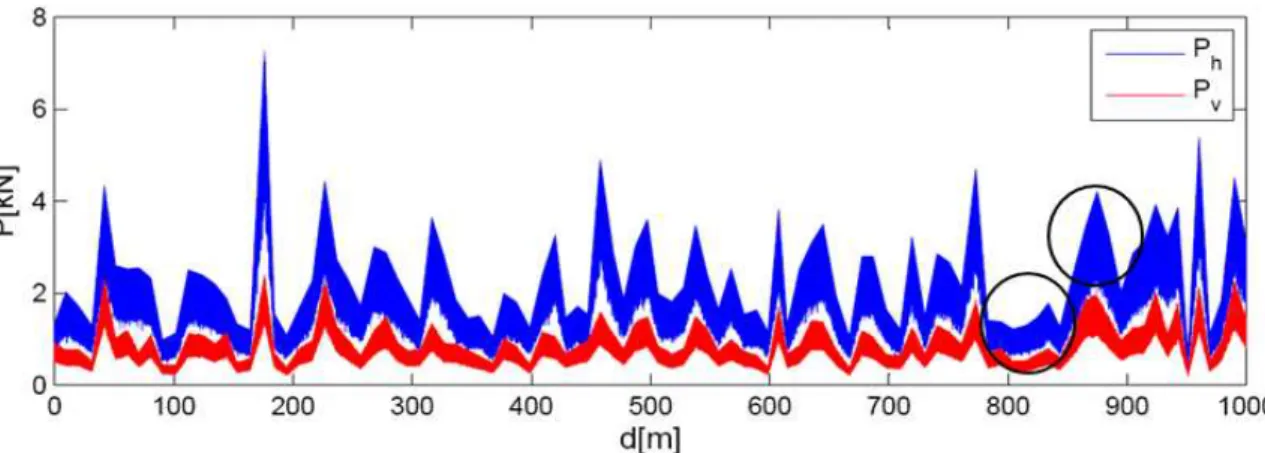
In Chapter 4, the soil failure mechanism and its effect on the total tillage forces are presented. Next, a new model for describing the spatial variability in tillage forces when considering both the variability in tillage system parameters and soil failure is presented. This model is then applied to model the spatial variability of the shank of chisel plough across a distance of 1000 m.
Chapter 5 explains the fatigue phenomenon and presents the main approaches proposed to deal with it according to its phases. More details on the stress-based fatigue life approach are given in this chapter. The methods used to calculate the life time of tillage machines, i.e. expected travel distance to failure, are presented and applied with considering the results obtained in Chapter 4.
Chapter 6 presents a summary of this dissertation, conclusions concerning the results and recommendations for future work.
5
2 Modeling variability in tillage forces
Chapter 2
Modeling variability in tillage forces
2.1 Introduction
This chapter consists of four sections. The first one provides a general overview of the soil-tillage tool interactions. This section begins with an introduction to the definition of a tillage operation, their objectives and their implements. Soil failure patterns, according to the tillage depth/tool width ratio, are then presented. This is followed by presenting the soil-tillage tool force components and the three approaches (analytical, numerical and empirical approaches) used to estimate the forces needed to cut the soil.
The second section describes the main steps of the proposed approach for modeling the variability in tillage forces. This section starts by determining the tillage system parameters (soil engineering properties, tool design parameters and operations conditions) involved in the calculations of the tillage forces. Then, the methodology proposed for modeling the variability in soil engineering properties and assumptions about the variability in tool design parameters and operational conditions are presented. After that, a method for determining the dispersion effects of tillage system parameters on tillage forces is introduced. This section finishes by the methodology proposed for determining the variability in tillage forces.
The third section presents an illustration application of the proposed approach for modeling the variability in tillage forces on the shank of a chisel plough. A total of 57 soil samples were considered for modeling the variability in soil engineering properties (soil density, soil cohesion, internal friction angle, soil-tool friction angle and soil-tool adhesion). Uniform and normal distributions were used to present the variability in tool design parameters (tool width and rake angle) and operations conditions (tool working depth, surcharge pressure at the soil surface and tool speed), because no data are available for these parameters. This chapter is concluded by some conclusions of the realized work.
6 2.2 Soil-tillage tool interactions
2.2.1 Introduction
“Tillage” may be defined as the mechanical manipulation of soil for any purpose, but usually for cultivating crops. The objectives of soil tillage can be resumed as: 1) to develop a desirable soil structure for a seedbed or a root-bed, 2) to control weeds or remove unwanted crop plant, 3) to manage plant residues, 4) to minimize soil erosion, 5) to establish specific surface configurations, 6) to incorporate and mix fertilizers, manure, … into the soil and 7) to accomplish segregation which may involve moving soil from one layer to another, removal of rocks and undesired objects or root harvesting [1]. In order to achieve these objectives, different types of tillage implements provided with different types of tillage tools have been developed.
A tillage tool, also called the working part, is an individual soil-working element, such as a plow bottom, a disk blade or a cultivator shovel. The working part, receiving energy from the tractor or other sources, works the soil and changes its state and properties [2]. A tillage implement consists of a single tool or a group of tools, together with the associated frame, wheels, control and protection devices, and any other structural and power transmission components [3].
Tillage implements can be classified according to their tasks into five main categories: primary tillage implements, secondary tillage implements, cultivating tillage implements, combined primary tillage implements and combined secondary tillage implements [1] [4] [5]. Primary tillage implements are used after harvest and it is normally designed to reduce soil strength, cover plant materials, and rearrange the aggregates, e.g. moldboard plows and subsoilers. Secondary tillage implements are used to break down large clods and to prepare an ideal seedbed, e.g. spring tooth harrows and rotary hoes. Cultivating tillage implements perform shallow post-plant tillage to aid the crop by loosening the soil and/or by mechanical eradication of undesired vegetation, e.g. row crop cultivators and rotary tillers-strip type. Combination primary tillage implements perform primary tillage functions and utilize two or more dissimilar tillage components as integral parts of the implement. Combination secondary tillage implements perform secondary tillage functions by using two or more dissimilar tillage components as integral parts of the implement, e.g. roller harrow with dual folding wings.
7 2.2.2 Soil failure patterns
The cutting of the soil involves the failure (or the rupture) of the soil which usually occurs in the shear mode along internal rupture surfaces, and often at the boundary between soil and tillage tool surface [4]. For a simple tillage tool, shown in Figure 2-1, the soil failure pattern can be similar to that shown in Figure 2-2.
Figure 2-1 : Basic tillage tool geometry
Figure 2-2 : Internal and boundary soil failure during cutting
Godwin and O'Dogherty [6] reported that soil failure patterns are significantly affected by the depth . / width @ ratio of a tillage tool. They subdivided tillage tools,
depending on their .A@ ratio, into the following three categories: • Wide tines for which.A@ B .
• Narrow tines for which B .A@ B &. • Very narrow tines for which.A@ C &.
Wide and narrow tines with .A@ ratios less than 5 and rake angles less than D tend to produce the patterns shown in Figure 2-3 (a) and (b). This type of upward and forward failure tends to loosen the soil in a crescent manner. As the .A@ ratio increases,
the soil failure changes to that shown in Figure 2-3 (c), where there is a small crescent close to the soil at depth which is forced laterally to produce a slot.
8
The transition from one type to another occurs at a critical depth.E. Therefore, knowledge of .E is required to determine the tine force components [6]. Godwin and Spoor [7] determined the critical depth for a narrow tine by minimizing the horizontal force. Determining the critical depth in this way requires the rupture distance ratio (forward rapture distance/critical depth). Therefore, they plotted the rupture distance ratio for different tine rake angles, experimentally.
Figure 2-3 : Patterns of soil failure 2.2.3 Soil-tillage tool forces
A tillage implement moving with constant velocity is subjected to the following three main forces: 1) the weight of the implement, acting through the centre of gravity, 2) the forces acting upon the implement and 3) the forces acting between the implement and the prime mover [3]. For a simple tillage tool (Figure 2-1) two components are considered: 1) horizontal tool force, which is the amount of force required to pull or push the tool through the soil and 2) vertical tool force which is the tool force assisting or preventing penetration into the soil. Therefore, the soil reaction force on a tillage tool has two components, the horizontal tillage force and the vertical tillage force .
Ideally, the horizontal force must be as small as possible and the vertical force must be directed upward to assist penetration for major soil loosening operations
9
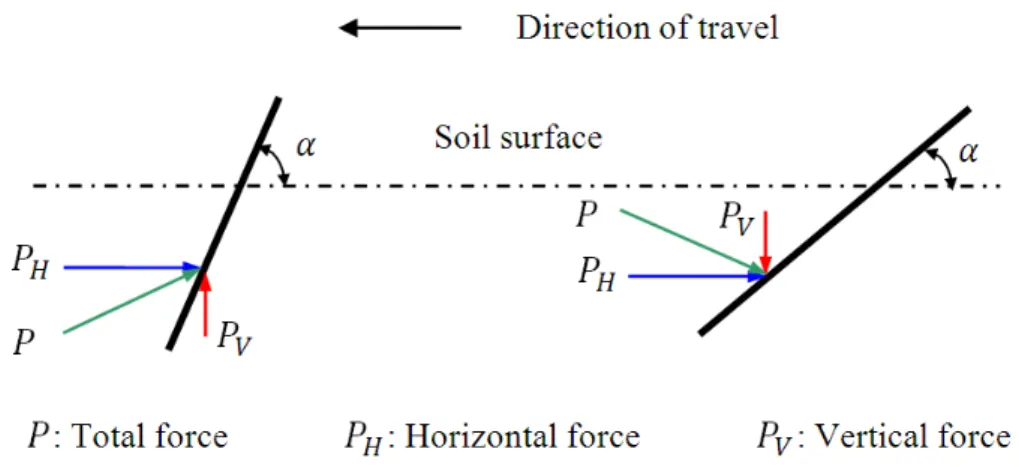
[8]. However, Godwin and Spoor [7] found that at a critical rack angle, the direction of vertical force changes from upward to downward, as shown in Figure 2-4. Godwin [8] expressed this critical angle for a simple plane steel tine as:FE GH I where FE is the critical rack angle and I is the angle of soil-tool friction.
Figure 2-4 : Forces acting on the tool according to different tool orientations
Determining the amplitude and direction of tillage forces is of great value to both implement designers and farmers [9]. Three approaches have been developed for that purpose, namely analytical, numerical and empirical approaches. In the following a brief description of each approach is presented.
2.2.4 Analytical approach
The analytical approach is one of the first methods that has been used to predict the interaction between the soil and a tillage tool. This approach has been widely employed by many researchers in the field of soil tillage [10]. The first work for modeling the soil forces was the model of Reece [11], who recognized that the mechanics of earthmoving is similar in many respects to the bearing capacity of shallow foundations on soil as described by [12], Figure 2-5. The soil in front of a tool and above the failure surface is assumed to consist of two parts: 1) a Rankine passive zone and 2) a complex shear zone bounded by a part of a logarithmic spiral curve.
By using the force equilibrium equations over the entire system (soil, tool), Reece [11] proposed the universal earthmoving equation, presented in Equation 2.1, for describing the force required to cut the soil by a tool.
10
where is the total force acting on the tool, J is the soil density, . is the tool working depth, LM is the gravity coefficient,O is the soil cohesion factor, LE is the cohesion coefficient,P is the surface surcharge pressure, LQ is the surcharge pressure coefficient and
@ is the tool width. The N-factors LM LE LE; LQ are functions of the geometry of soil-tool interfaces, the internal friction angle of the soil and the soil-metal frictional angle.
Figure 2-5 : Logarithmic spiral failure zone
Reece model formed a basis in the analytical approach, which is approximately valid for soil cutting tools with a width/depth ratio greater than one. With narrow tillage tools, the soil in front of a tool moves not only horizontally and vertically, but also sideways in the direction of the tool width (Figure 2-3). In this situation the soil failure configuration becomes more complicated and the Reece model is no longer sufficient in describing the three-dimensional failure surface [13]. Therefore, several semi-empirical models have been proposed to describe the three-dimensional failure surface, based upon the experimental observations and simplifications [7] [14] [15] [16] [17]. The principal differences between these models are the shape of soil failure surface and the form of equilibrium equations. The results of this approach are valid to some extent and its governing rules are sometimes used in other approaches such as numerical and empirical approaches.
2.2.5 Numerical approach
Two numerical methods can be recognized in tillage science: 1) finite element method (FEM) and 2) discrete element method (DEM). Overall, these methods are complicated and difficult to implement as they need good knowledge of mathematics and computer science. Among the numerical approaches, FEM has received more attention and was implemented in many works to describe the soil-tillage tool interaction [13] [18] [19] [20]. The principal differences between these models are the assumption of soil material
11
behavior, soil-metal interaction and soil failure criteria. Literature shows acceptable results obtained from this method. The main limitations of this method are individual creativity and patience when setting up boundary conditions, and the amount of computational time available [21].
The DEM method is an explicit numerical technique that treats soil as a collection of individual unconnected but interacting particles. Particles interact through a series of contact laws and the motion of the particles is controlled by Newton's laws of motion [20]. It is noted that the application of this method in the field of soil tillage is still limited. 2.2.6 Empirical approach
These methods typically correlate the implement draught with relevant parameters such as working depth, velocity, soil moisture content and density. They are very costly due to the instrumentations which are required to record data, precisely. Furthermore, they cannot be implemented at any desired time and place since providing required instrumentation may not be possible. In most cases, empirical methods represent only regional conditions. However, they could give an indication of the average force requirements, and their variability, for specific soil-implement combinations [9].
Artificial neural networks (ANN), which can be considered as the most common method in this approach, consists of essentially parallel computational models comprised of densely interconnected adaptive processing units with the simulation of knowledge acquisition and organization skills of the human brain [22]. The literature does not show many applications of this method in the field of soil-tillage tool interaction.
12
2.3 Probabilistic approach for modeling the variability of tillage forces
As mentioned before, there are several available models that can be used to predict the forces acting on a tillage tool at soil failure. Analytical and numerical modeling methods are usually used to achieve this goal. In the analytical methods, soil-tool forces are considered as functions of three categories of variables, namely soil engineering properties, tool design parameters and operational conditions. Soil engineering properties are conventionally considered to be constant, reflecting a homogeneous soil profile, and tillage forces are calculated for assigned tool design parameters and operational conditions [6] [8] [17]. When numerical methods, e.g. the finite element method (FEM), are adopted to model the soil-tillage tool interaction, two different theoretical approaches are introduced, namely the curve-fitting technique and the elastic-perfectly plastic assumption [21]. The elastic-perfectly plastic method considers Young's modulus of elasticity and Poisson's ratio as constants, while the curve-fitting method only accounts for a variable Young’s modulus as a function of load history [18]. For both of these FEM methods, the soil is treated as a homogeneous structure with very few exceptions. Mouazen and Neményi [20] developed a three-dimensional FEM model for cutting non-homogeneous (vertically) sandy loam soil by a subsoiler with a chisel and shank. The non-homogeneity in the soil was proposed to simulate the differences in soil strength among different soil layers. However, they considered Young's modulus of elasticity and Poisson's ratio as constant in the FEM analysis. Moreover, Fielke [19] studied the effect of a variable Poisson's ratio on tillage forces and soil movement around the cutting edge.
In reality, soil is neither a continuous nor a homogeneous structure, but a three-phase medium composed of solid, liquid and gaseous particles [2]. Consequently, soil engineering properties vary in both vertical and horizontal directions [23]. Estimating tillage forces using analytical or numerical methods with the assumption that soil engineering properties are uniform does not reflect the nature of soil. Therefore, we intend to propose a probabilistic approach for modeling the variability of tillage forces due to the variability of tillage system parameters (soil engineering properties, tool design parameters and operational conditions). The variability of soil engineering properties reflects the heterogeneous nature of agricultural soils. The variability of tool design parameters is due to the tolerances of manufacturing processes. The variability of operational conditions is due to the fact that these parameters are partially controlled during a tillage operation.
13
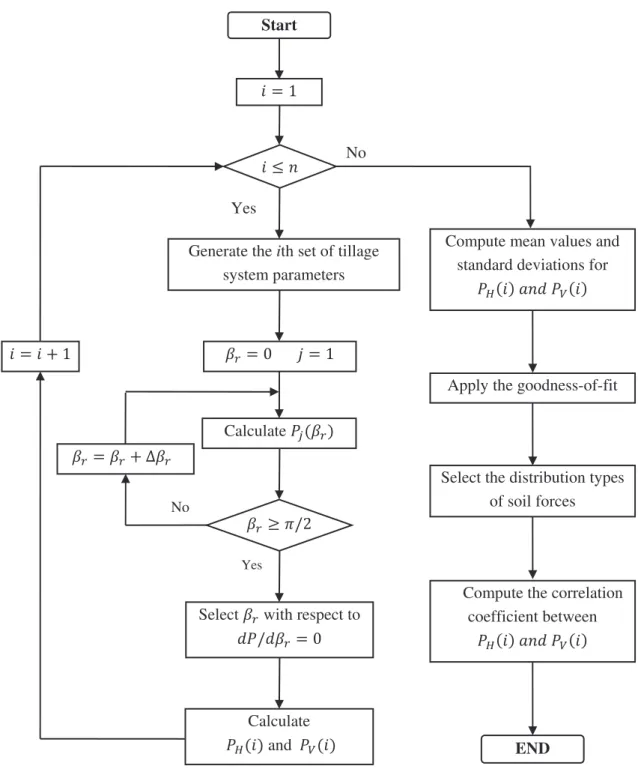
The proposed approach consists of four steps and an overview of the different steps is shown in Figure 2-6. The first step attempts to estimate the tillage forces of narrow tines and to determine the main tillage system parameters (soil engineering properties, tool design parameters and operational conditions) affecting the tillage forces. The second step aims to model the variability of soil engineering properties and propose some assumptions about the variability of tool design parameters and operational conditions. The third step presents the method used to determine the dispersion effects of the tillage system parameters on the tillage forces. At this stage, we intend to neglect the variability of those tillage system parameters that has no significant effect on the tillage forces in order to simplify the quantification of the variability of tillage forces and to reduce the computational time. The last step is to estimate the variability of tillage forces based on the variability of the tillage system parameters. This methodology is based on the MCS technique. In addition, the correlation coefficient between the horizontal and vertical forces, required in the calculation of failure probability, is calculated in order to determine its effect on the failure probability.
2.3.1 Determining tillage system parameters
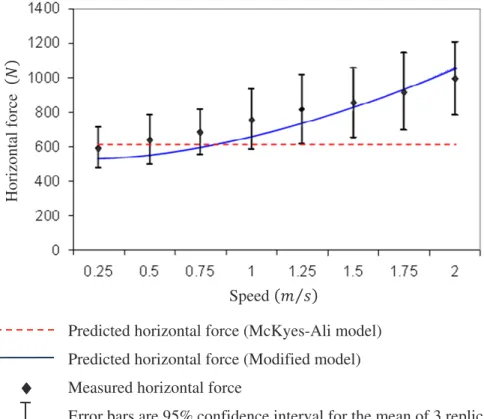
The model of McKyes and Ali [14] is used to estimate the forces acting on a tillage tool and determine the tillage system parameters. This model was selected because it is simple and accurate [24], and has shown good agreement with experimental results, especially at low velocity [25].
Determine the tillage system parameters
Estimate the variability of tillage system parameters
Methodology based on the MCS technique Soil-tillage tool model
Graphical and quantitative techniques
Sensitivity analysis
Estimate the variability of horizontal and vertical forces Select the random variables from
the tillage system parameters