HAL Id: tel-03033677
https://tel.archives-ouvertes.fr/tel-03033677
Submitted on 1 Dec 2020
HAL is a multi-disciplinary open access archive for the deposit and dissemination of sci-entific research documents, whether they are pub-lished or not. The documents may come from teaching and research institutions in France or abroad, or from public or private research centers.
L’archive ouverte pluridisciplinaire HAL, est destinée au dépôt et à la diffusion de documents scientifiques de niveau recherche, publiés ou non, émanant des établissements d’enseignement et de recherche français ou étrangers, des laboratoires publics ou privés.
characterization and application for heat and energy
systems
Samah Hamze
To cite this version:
Samah Hamze. Graphene based nanofluids : development, characterization and application for heat and energy systems. Mechanical engineering [physics.class-ph]. Université Rennes 1, 2020. English. �NNT : 2020REN1S010�. �tel-03033677�
T
HESE DE DOCTORAT DE
L'UNIVERSITE
DE
RENNES
1
ECOLE DOCTORALE N°602
Sciences pour l'Ingénieur
Spécialité : Energétique, Thermique et Combustion
Par
Samah HAMZE
Graphene based nanofluids: development, characterization and
application for heat and energy systems
Thèse présentée et soutenue à l’Université de Rennes 1, le 15 octobre 2020 Unité de recherche : Laboratoire de Génie Civil et Génie Mécanique
Thèse N° :
Rapporteurs avant soutenance :
Leonor HERNÁNDEZ LóPEZ Professeur, Universitat Jaume I, Espagne
Alina ADRIANA MINEA Professeur, Technical University Gheorghe Asachi, Romanie
Composition du Jury :
Examinateurs : Stefan VAN VAERENBERGH Professeur, Université Libre de Bruxelles, Belgique
Josefa FERNÁNDEZ PÉREZ Professeur, University of Santiago de Compostela, Espagne Alina ADRIANA MINEA Professeur, Technical University Gheorghe Asachi, Romanie Leonor HERNÁNDEZ LóPEZ Professeur, Universitat Jaume I, Espagne
Dir. de thèse : Thierry MARÉ Maître de Conférences HDR, Université de Rennes 1
Co-dir. de thèse : Patrice ESTELLÉ Maître de Conférences, Université de Rennes 1
Invité(s)
“Science opens an infinite path for the human mind and
launches it, through a series of countless steps, onto the
asymptote of truth.”
i
Acknowledgements
First of all, I would like to thank my thesis director Dr. Thierry MARÉ, and my co-director Dr. Patrice ESTELLÉ, without whom this work could not have been carried out. I would like to say that I have had the best possible supervision to carry out the hard work that is the thesis. During these three years, they (especially Dr. Patrice ESTELLÉ) were able to lavish me with their knowledge, their great availability, their extreme patience, their humour, their kindness, and above all their unfailing support from the beginning to the end of this thesis.
I would like to warmly thank our collaborators at the Institut Jean Lamour especially Dr. Brigitte VIGOLO and Dr. Nawal BERRADA, and all the team who worked with us on this project: Dr. Alexandre DESFORGES, Dr. Dominique BEGIN, Dr. Florentin MICHAUX, Dr. Jaafar GHANBAJA and Dr. Jérôme GLEIZE. Thank you for the countless discussions and for all the little and big moments that contributed to the success of this work.
I thank all the jury members. Sincere thanksto Pr. Stefan VAN VAERENBERGH, president of the jury and examiner of this thesis. I am extremely grateful to Pr. Josefa FERNÁNDEZ PÉREZ and Dr. Brigitte VIGOLO for examining this work. I am very warmly grateful to Pr. Alina ADRIANA MINEA and Pr. Leonor HERNÁNDEZ LÓPEZ for giving me the benefit of their expertise by agreeing to judge this work and to devote time to the examination of this manuscript. I would like to warmly thank all the staff of the IUT of the University of Rennes 1 for having welcomed me during these three years of thesis and in particular Pr. Christophe LANOS, director of the Laboratory of Civil Engineering and Mechanical Engineering (LGCGM), and my colleagues especially Nourhan MORTADA, Naima BOUMEDIENE, Damien GAUDREL and Moussa KA for their good mood, their kindness and their encouragements.
Another people that I would like to thank very much for all the time we've been working on together is Abdussamet SUBASI, associate professor at the Istanbul Technical University, Turkey, and David CABALEIRO, doctor at the University of Vigo, Spain, and his team of work, especially Pr. Luis LUGO. Thank you very much for your availability, your advice, your encouragement, and especially your kindness.
ii
And what would those years have been like without the support of my family and friends?
I want to thank my family, my brothers and sisters, for supporting me. Unfortunately, the distance did not allow us to see each other often, thank you for always being there to support me.
A huge thank you to my friends: Farah, Soumaya, Lina, Nourhan, Marwan, Queen, Naima, Nour, Asseel, Ali, Hassan... who believe in me and help me to move forward and be who I am.
These last lines will allow me to show my deepest love and gratitude to my dear mother. Thank you for your devotion to me and for all the sacrifices made to get me here. Thank you for always supporting me...
Nomenclature……….
1
Résumé………...
3
I- Introduction………... 13
I.1- Research context……… 14
I.2- Objectives………... 16
I.3- Structure………... 17
I.4- References……….. 18
II- General information on graphene nanofluids………... 21
II.1- Introduction………... 22
II.2- Definition……….. 22
II.2.1- Base fluids………... 23
II.2.2- Nanoadditives………... 25
II.3- Proposal process of new nanofluids………... 28
II.3.1- Nanofluid design………... 29
II.3.1.1- Nanoparticles synthesis and characterization……... 29
II.3.1.2- Nanofluid preparation………... 37
II.3.1.3- Stability………... 39
II.3.2- Thermophysical profile……… 42
II.3.2.1- Thermal conductivity………. 44
II.3.2.2- Rheology and Dynamic viscosity………... 49
II.3.2.3- Isobaric heat capacity………... 58
II.3.2.4- Density……… 60
II.3.2.5- Surface tension………... 61
II.3.3.1- Qualitative approach………... 66
II.3.3.2- Quantitative approach………... 67
II.4- Conclusion……… 70
II.5- References………... 71
III- Materials and experimental methods………... 83
III.1- Introduction……….. 84
III.2- Presentation of the nanofluids used………. 84
III.3- Graphene synthesis……….. 86
III.4- Graphene characterization………... 88
III.5- Nanofluid preparation……….. 89
III.6- Nanofluid stability………... 92
III.7- Thermophysical properties of nanofluids: measurement
techniques, experimental protocol and validation……….. 93
III.7.1- Thermal conductivity………. 93
III.7.2- Isobaric heat capacity………. 97
III.7.3- Dynamic viscosity……….. 98
III.7.4- Density……… 102
III.7.5- Surface tension………... 105
III.8- Conclusion………... 106
III.9- References………... 107
IV- Characterization of FLG based nanofluids and their thermophysical
properties: results and discussion………. 111
IV.1- Introduction………... 112
IV.2- Few-Layer Graphene-Based Nanofluids with Enhanced Thermal
Conductivity……….. 114
IV.4- Volumetric properties and surface tension of few-layer graphene
nanofluids based on a commercial heat transfer fluid……… 144
IV.5- Shear flow behavior and dynamic viscosity of few-layer graphene
nanofluids
based
on
propylene
glycol-water
mixture……….. 163
IV.6- Conclusion………... 176
V- Thermal performance of stable FLG nanofluids: qualitative
approach………. 179
V.1- Introduction………... 180
V.2- Laminar regime………... 180
V.3- Turbulent regime………... 186
V.4- Conclusion……… 191
V.5- References………... 192
VI - General conclusion and perspectives……….. 193
1
Nomenclature
k Thermal conductivity [W.m-1.K-1]
T Temperature [K]
𝜂 Dynamic viscosity [mPa.s] Cp Isobaric heat capacity [J.g-1.K-1]
𝜑𝑣 Volume fraction
𝜑𝑚 Mass fraction
𝜌 Density [kg.m-3]
ST Surface tension [mN.m-1]
𝐶𝑘 Coefficient of thermal conductivity improvement 𝐶𝜂 Coefficient of dynamic viscosity improvement
Mo Mouromsteff number
Re Reynolds number
FLG Few layer graphene
SEM Scanning electron microscopy TEM Transmission electron microscopy
HRTEM High-resolution transmission electron microscopy FFT Fast Fourier Transform
IFFT Inverse Fast Fourier Transform
TrX Triton X-100
P123 Pluronic® P-123
GA Gum Arabic
AAD Absolute average deviation [%]
DW Distilled water
𝛾̇ Shear rate [s-1]
𝜎 Shear stress [Pa]
CMC Critical micelle concentration 𝛼𝑝 Isobaric thermal expansivity [K-1]
2
St. Dev. Standard deviation ai Fitting parameters
R Cone and plate diameter [m]
𝛼 Cone angle [ °]
𝑊̇ Pumping power consumption FOM Figure of merit
GO Graphene oxide
rGO Reduced graphene oxide GQD Graphene quantum dots CVD Chemical vapor deposition LPE Liquid phase exfoliation Subscripts np Nanoparticles nf Nanofluid sft Surfactant tyf Tyfocor bf Base fluid Symbols ↑ Increase → Stable or constant ↓ Decrease
3
Résumé
Dans notre vie quotidienne, le transfert de la chaleur et de l’énergie constitue la base de nombreux processus industriels. L’épuisement progressif des énergies fossiles conduit à améliorer et optimiser les rendements de ces échanges par de nouveaux procédés. Les « nanofluides » peuvent s’inscrire dans ce cadre pour être l’outil de transfert thermique et énergétique de nos jours et dans l’avenir. Ils apparaissent comme un sujet de recherche mondial en raison de leur potentiel, et ils peuvent être utilisables dans les échangeurs de chaleur, les systèmes énergétiques, les capteurs solaires, les appareils électroniques, en substitution des liquides caloporteurs traditionnels.
Qu’est-ce qu’un nanofluide ? Et quelles sont ses propriétés intéressantes qui le rendent important dans ce domaine ? Les nanofluides sont constitués des nanoparticules (des particules de taille nanométrique < 100 nm) qui ont une forme déterminée (sphériques, cylindriques…), dispersées dans un fluide de base avec ou sans présence d’un surfactant qui aide si nécessaire à la dispersion des nanoparticules dans le fluide et à leur stabilité. Les nanoparticules peuvent être de type métallique (Cu, Ag, Au…), des oxydes (Al2O3, CuO, SiO2, TiO2…), des nanotubes de carbone
(CNT), graphène, etc…
L’idée est d’améliorer les propriétés thermiques des fluides caloporteurs en y insérant une phase solide de conductivité thermique très élevée, ainsi les nanofluides présentent une conductivité thermique significativement plus élevée que les fluides de base qui augmente avec l’augmentation de la concentration de nanoparticules. Dans leur développement et leur exploitation, il convient de trouver un compromis entre de meilleures propriétés thermiques tout en maîtrisant leur viscosité (qui ne doit pas être trop importante dans les échangeurs par exemple) et leur stabilité qui doit être assurée, sans quoi les propriétés peuvent être modifiées. Plusieurs paramètres peuvent jouer un rôle dans l’efficacité des nanofluides comme la concentration et la nature des nanoparticules, leur densité, leur type, leur taille, leur aspect, la température, le fluide de base, la présence d’un surfactant, etc…
Parmi les familles de nanoparticules, les nanomatériaux à base de carbone (nanotubes de carbone, graphène, diamant…) sont d’un intérêt majeur en raison de leurs excellentes propriétés thermiques intrinsèques et qui permettent d’obtenir des nanofluides plus performants que ceux préparés avec
4
des nanoparticules d’oxyde métallique par exemple. C’est pourquoi notre projet se focalise sur les nanofluides à base de carbone et le graphène plus spécifiquement.
Ce projet s’inscrit aussi dans une collaboration avec l’Institut Jean Lamour de Nancy, spécialisé dans les propriétés chimiques des matériaux à base de carbone et de graphène. C’est dans cet organisme que sont préparés les nanofluides dédiés à notre étude. Plus largement, notre projet contribue également à l’European COST Action NanoUptake OC-2015-1-19591, « Overcoming Barriers to Nanofluids Market Uptake », puisqu’il vise au développement et à l’exploitation pratique de nanofluides.
Nous présentons dans cette thèse une étude complète sur les nanofluides à base de graphène à quelques couches (FLG), y compris la synthèse du FLG, la préparation des nanofluides à base de FLG et l’étude de leur stabilité, ainsi que l’évaluation expérimentale de leurs propriétés thermo-physiques en fonction de la concentration en graphène, du type de surfactant utilisé et de la température. Finalement, sur la base de ces résultats et par une approche qualitative, le potentiel applicatif des nanofluides dans des systèmes énergétiques est déterminé pour sélectionner le meilleur candidat.
Les feuillets de graphène sont synthétisés par une méthode originale d'exfoliation mécanique de graphite expansé dans de l’eau assistée par des agents de surface biosourcés, tels que l'acide tannique, comme montre la figure 1. Les molécules d’acide tannique viennent ainsi s’intercaler entre les feuillets et favoriser leur séparation.
Figure 1. Schéma de la méthode d'exfoliation mécanique en milieu aqueux assistée par l'acide
5
La caractérisation morphologique et structurelle de FLG synthétisé est étudiée à la fois par microscopie électronique à balayage (MEB) et à transmission (MET) et par spectroscopie Raman.
Figure 2. Images MEB (a) et MET (b et c) du FLG synthétisé [1].
La figure 2 montre les images MEB et MET du matériel graphique synthétisé. Les images d'observation à faible grossissement du MEB (Fig. 2a) et du MET (Fig. 2b) montrent que le matériau préparé se présente sous la forme de très fines feuilles d'environ 3 à 5 couches d'une épaisseur généralement comprise entre 1 et 2 nm (image typique illustrée dans la Fig. 2c), ce qui signifie que la méthode d'exfoliation utilisée produit de préférence du FLG. La taille latérale moyenne des feuilles de FLG est d'environ 5 µm, comme le montre la Fig. 2a. Les feuillets de graphène ont été caractérisés aussi par la spectroscopie Raman qui a montré que le rapport d’intensité ID/IG du graphite est supérieur à celui du FLG, ce qui signifie que ce dernier était de
haute qualité structurelle.En accord avec la spectroscopie Raman, des caractérisations MET à haute résolution, transformée de Fourier rapide, et transformée de Fourier rapide inverse ont montré que le FLG utilisé a une excellente qualité structurelle avec son réseau d'atomes de carbone en nid d'abeille qui était bien visible.
Les nanofluides ont été préparés par la méthode de deux étapes où surfactants non ioniques (Triton X-100, Pluronic® P-123 et Gomme Arabique), un mélange commercial d'eau et de propylène glycol (Tyfocor® LS) et une teneur massique en FLG de 0,05 à 0,5% ont été utilisés, avec un rapport surfactant:FLG égal à 2 pour toutes les concentrations testées. La préparation est réalisée avec une sonde à ultrason en contrôlant les temps de sonication et la température des échantillons. Les échantillons à faible concentration en graphène sont obtenus par dilution de la solution la plus concentrée.
6
La stabilité statique des nanofluides à base de FLG a été suivie dans le temps par des observations visuelles et des analyses au Turbiscan. Le Turbiscan a permis de mesurer l'évolution de la sédimentation dans les nanofluides à base de FLG préparés avec le Triton X-100 et le Pluronic® P123 (Fig. 3b). Dans le cas de ces deux séries de nanofluides, le comportement de la sédimentation n'a pas été modifié par la concentration en FLG. La sédimentation complète a été plus rapide pour le Triton X-100 que pour le Pluronic® P123. La sédimentation des nanoparticules de FLG a été achevée après un jour avec le Triton X-100, tandis qu'avec le Pluronic® P123, la sédimentation du FLG a été atteinte 3 jours après la préparation du nanofluide (Fig. 3b). Une analyse fiable n'a pas été possible avec la gomme arabique alors que ce nanofluide a été visuellement observé plus stable que les deux autres.
Figure 3. a) Photos de nanofluides à base de FLG avec 0,1 % en masse de FLG et (1) Triton
X-100, (2) Pluronic® P-123 et (3) Gomme Arabique comme agent tensioactif 6 jours après leur préparation. b) Niveau de sédimentation du Turbiscan pour les nanofluides à base de FLG avec
Triton X-100 et Pluronic® P-123 pour 0,05 et 0,1 % en masse de FLG [1].
Les mesures des propriétés thermo-physiques des trois séries de nanofluides à base de FLG sont effectuées dans la plage de température de 283,15 à 323,15 K. La conductivité thermique des fluides de base et des nanofluides a été évaluée avec un dispositif THW-L2 (Thermtest Inc., Canada) en utilisant la méthode du fil chaud transitoire. Les résultats ont montré que l’ajout du surfactant n’a pas d’effet significatif sur la conductivité thermique du Tyfocor® LS. A propos des nanofluides, l’ajout de FLG a amélioré la conductivité des fluides de base avec le Triton X-100, Pluronic® P-123 et Gomme Arabique par un taux maximal de 23,9%, 18,3% et 21,5%,
7
respectivement. Cette amélioration a été obtenue pour les nanofluides de concentration la plus élevée (0,5 % en masse), et elle est indépendante de la température. Un exemple à la température 283,15 K de la conductivité relative à toutes les concentrations volumiques est présenté dans la figure 5.
Figure 5. La variation de la conductivité thermique relative des nanofluides avec le Triton
X-100, Pluronic® P-123 et Gomme Arabique en fonction de la concentration volumique de FLG à 283,15 K.
La conductivité thermique des nanofluides préparés a été comparée à plusieurs modèles et il a été démontré que l'amélioration de la conductivité thermique des nanofluides à base de graphène est régie par des effets combinés tels que la taille du FLG, la résistance thermique à l'interface du FLG, l'épaisseur et leur rapport de planéité.
Les mesures de la chaleur spécifique de FLG, des surfactants, du Tyfocor® LS, des fluides de base et des nanofluides ont été faites avec un Calorimètre Différentiel à Balayage DSC-Q2000 (TA Instruments, New Castle, USA) entre 283,15 K et 323,15 K. Les résultats ont montré que ni l’ajout du surfactant, ni l’ajout de FLG n’a un effet significatif sur la chaleur spécifique du Tyfocor® LS. Une comparaison entre les valeurs expérimentales de la chaleur spécifique et les valeurs calculées à l'aide de la loi de mélange montre que cette dernière peut décrire d’une manière adéquate les résultats expérimentaux des fluides de base et des nanofluides (voir Fig. 6).
0.8 0.9 1 1.1 1.2 1.3 1.4 0 0.1 0.2 0.3 0.4 knf /kbf à 28 3. 15 K φ (vol%) FLG+Tyfocor+TrX FLG+Tyfocor+GA FLG+Tyfocor+P123
8
Figure 6. La variation de la chaleur spécifique des nanofluides de la concentration maximale, 0,5
% en masse de FLG, avec le Triton X-100, Pluronic® P-123 et Gomme Arabique, trouvé expérimentalement et par calcul en utilisant la loi de mélange, en fonction de la température. Les densités du Tyfocor® LS, du Triton X-100 liquide, et de chaque mélange tensioactif+Tyfocor® LS utilisé comme fluide de base ainsi que les nanofluides préparés à base de FLG ont été déterminées expérimentalement au moyen d'un densimètre DMA 501 (Anton Paar, Autriche).La densité du FLG a été mesurée à température ambiante à l'aide d'un pycnomètre à gaz Quantachrome Ultrapyc 1200e (Quantachrome Instruments, Anton Paar, USA) travaillant avec de l'hélium sous un mode d'impulsion adapté aux poudres. Les densités du Pluronic® P-123 et Gomme Arabique ont été prises de la littérature. Il a été observé que la densité des nanofluides et des fluides de base préparés diminue avec la températureavec une tendance similaire. De plus, il a été trouvé que l'ajout de surfactant n'a pas d'effet significatif sur l'évolution de la densité par rapport au Tyfocor® LS seul, sauf pour l'ajout de 0,5 et 1 % en masse de Gomme Arabique dans le Tyfocor® LS, pour lequel la densité augmente de 0,18 et 0,36%, respectivement. Les résultats montrent aussi que la densité des nanofluides diminue légèrement pour les plus faibles concentrations de FLG et augmente pour les concentrations les plus élevées. Les résultats sont similaires pour les trois séries de nanofluides étudiés. Un exemple à 303,15 K de la densité relative des nanofluides en fonction de la concentration massique de FLG est présenté dans la figure 7.
3 3.2 3.4 3.6 3.8 4 4.2 280 290 300 310 320 330 Cp (J .g -1.K -1) T (K) 0.5wt% FLG+Tyfocor+1wt% Pluronic® P-123_Equation 0.5wt% FLG+Tyfocor+1wt% Triton X-100_Equation 0.5wt% FLG+Tyfocor+1wt% Gum Arabic_Equation 0.5wt% FLG+Tyfocor+1wt% Pluronic® P-123_Experiment 0.5wt% FLG+Tyfocor+1wt% Triton X-100_Experiment 0.5wt% FLG+Tyfocor+1wt% Gum Arabic_Experiment Tyfocor
9
Figure 7. La densité relative des nanofluides, qui est définie comme le rapport de la densité des
nanofluides à la densité des fluides de base correspondants, en fonction de la concentration massique de FLG à 303,15 K [2].
L'évolution de la densité des nanofluides à base de FLG en fonction de la température et de la concentration en FLG est bien prédite par l'équation de la moyenne pondérée de la densité, en tenant compte des densités de tous les composants.
À partir des résultats de la densité expérimentale, les effets de la température, de la nature et de la concentration des surfactants, ainsi que la concentration massique de FLG sur le coefficient d’expansion thermique isobare ont également été évaluées. Il a été démontré que le coefficient d’expansion thermique isobare, qui augmente avec la température, est similaire pour les tous les fluides de base sans aucun effet distinct de l'agent de surface utilisé. Contrairement aux fluides de base, une diminution de cette propriété a été remarquée en présence de FLG avec tous les fluides de base utilisés.
Pour la tension de surface du Tyfocor® LS, des fluides de base et des nanofluides, un analyseur de goutte tombante DSA-30 de KRÜSS GmBH (Hambourg, Allemagne) a été utilisé pour effectuer les mesures.La tension de surface des nanofluides est plus sensible au type de tensioactif et à sa teneur en fonction de leur concentration critique de micelles (CMC). L’ajout de tensioactif a diminué la tension de surface du Tyfocor® LS, sauf dans le cas de la Gomme Arabique. Pour les nanofluides étudiés, cette propriété a évolué d’une manière variable en fonction du tensioactif utilisé et de la teneur en FLG. L'ajout de FLG peut induire une augmentation ou ne pas modifier
0.9990 0.9995 1.0000 1.0005 1.0010 1.0015 1.0020 1.0025 0 0.2 0.4 0.6 ρnf /ρbf φm,np (%)
FLG:Gum Arabic (1:2 ratio) FLG:Pluronic® P-123 (1:2 ratio) FLG:Triton X-100 (1:2 ratio)
10
fortement la tension de surface.Par exemple, par rapport au Tyfocor® LS, la tension de surface des nanofluides est inférieure à celle du Tyfocor® LS dans le cas des tensioactifs Triton X-100 et Pluronic® P-123 et elle est supérieure dans le cas de la Gomme Arabique. Un exemple des résultats d’une série, celle avec le Pluronic® P-123, est présenté dans la figure 8.
Figure 8. La variation de la tension de surface du Tyfocor® LS, des fluides de base et des
nanofluides correspondants en fonction de la température [2].
Les études de viscosité dynamique ont été réalisées avec un rhéomètre rotatif Malvern Kinexus Pro de Malvern Instruments Ltd. (Malvern, Royaume-Uni) équipé d'une géométrie cône-plan appropriée pour étudier les suspensions colloïdales de faible viscosité. Au-delà de l’évaluation de la viscosité dynamique des nanofluides, l'étude montre que la température, le cisaillement et la durée du cisaillement jouent un rôle important sur la stabilité des nanofluides sous écoulement en fonction du surfactant et de la concentration en graphène. Les nanofluides avec le Pluronic® P-123 sont plus stables sous cisaillement que les deux autres séries. L'ajout de la concentration de FLG la plus élevée (0,5 % en masse) avec la présence du surfactant augmente la viscosité du Tyfocor® LS jusqu'à 19,9 %, 34,5 % et 121,6 % dans le cas de Pluronic® P-123, Triton X-100 et Gomme Arabique à 283,15 K, 283,15 K et 303,15 K, respectivement. Un exemple de la viscosité
25 27 29 31 33 35 37 39 41 43 45 280 290 300 310 320 330 S T (m N. m -1) T (K) Tyfocor Tyfocor+0.1wt% Pluronic® P-123 Tyfocor+0.2wt% Pluronic® P-123 Tyfocor+0.5wt% Pluronic® P-123 Tyfocor+1wt% Pluronic® P-123 0.05wt% FLG+Tyfocor+0.1wt% Pluronic® P-123 0.1wt% FLG+Tyfocor+0.2wt% Pluronic® P-123 0.25wt% FLG+Tyfocor+0.5wt% Pluronic® P-123 0.5wt% FLG+Tyfocor+1wt% Pluronic® P-123
11
relative (par rapport au mélange Tyfocor® LS+surfactant) des trois séries à 283,15 K est présenté dans la figure 9.
Figure 9. Variation de la viscosité relative des nanofluides avec Triton X-100, Pluronic® P-123,
et Gomme Arabique en fonction de la concentration volumique de FLG à 283,15 K. Enfin, pour les nanofluides stables sous cisaillement, l'évolution de la viscosité dynamique avec la température a été corrélée au modèle de Vogel-Fulcher-Tammann (VFT) [3].
En se basant sur les résultats de ces études, une approche théorique a été utilisée pour évaluer, dans un premier temps, les avantages offerts par les nanofluides à base de FLG, qui sont stables sous cisaillement, par rapport au Tyfocor® LS. Cette approche peut être utilisée pour prévoir les conditions expérimentales et les teneurs en particules qui tendraient vers un bilan énergétique favorable et identifier les nanofluides qui pourraient être testés dans des conditions réelles d'échange thermique. L'étude des performances de transfert de chaleur des nanofluides stables de FLG à base de Tyfocor® LS avec l'utilisation de Triton X-100, Pluronic® P-123, et de la Gomme Arabique comme tensioactifs a montré que la série de Pluronic® P-123 est la meilleure pour une utilisation possible dans un échangeur de chaleur entre 283,15 K et 323,15 K, en particulier la concentration volumique 0,143% qui correspond à la teneur massique 0,25%, sous écoulement laminaire et turbulent. De plus, les résultats de la tension de surface affirme aussi ce choix comme les nanofluides avec le Pluronic® P-123 ont les tensions de surface les plus faibles par rapport au Tyfocor® LS. 0.8 0.9 1 1.1 1.2 1.3 1.4 0 0.1 0.2 0.3 0.4 ηnf /ηbf à 28 3. 15 K φ (vol%) FLG+Tyfocor+TrX FLG+Tyfocor+GA FLG+Tyfocor+P123
12
Dans le prolongement de ces travaux, il serait pertinent d'étudier les performances thermiques du ou des nanofluides sélectionnés en utilisant une approche quantitative, alors en réalisant des expériences dans un échangeur de chaleur et en étudiant ses performances en situation réelle. En outre, en ce qui concerne la stabilité des nanofluides, différentes actions pourraient être effectuées. Il sera intéressant de déterminer la nature des agents de corrosion et de vieillissement existant dans le fluide commercial utilisé, Tyfocor® LS, et d'évaluer leur influence sur la stabilité des nanofluides. Un développement des nanofluides similaires en remplaçant ce fluide de base par un mélange de composés purs de propylène glycol et d'eau avec le même rapport en masse (40:60)% pourrait aider dans ce sens. En outre, une étude des interactions entre les feuillets de graphène et les tensioactifs et le fluide de base pourrait être réalisée. Bien sûr, le graphène de haute qualité à quelques couches étudié et utilisé dans ce travail peut être employé pour produire des nanofluides avec différents fluides de base et/ou tensioactifs, et la présente étude pourrait être étendue à une gamme de températures plus large. Enfin, la vaste base de données expérimentale des propriétés thermo-physiques des nanofluides produits dans le cadre de ce travail peut être utilisée pour des recherches numériques dans différentes configurations.
Références
[1] S. Hamze et al., “Few-Layer Graphene-Based Nanofluids with Enhanced Thermal Conductivity,” Nanomaterials, vol. 10, no. 7, p. 1258, Jun. 2020, doi: 10.3390/nano10071258. [2] S. Hamze et al., “Volumetric Properties and Surface Tension of Few-Layer Graphene Nanofluids Based on a Commercial Heat Transfer Fluid,” Energies, vol. 13, no. 13, p. 3462, Jul. 2020, doi: 10.3390/en13133462.
[3] S. Hamze et al., “Shear flow behavior and dynamic viscosity of few-layer graphene nanofluids based on propylene glycol-water mixture,” Journal of Molecular Liquids, vol. 316, p. 113875, Oct. 2020, doi: 10.1016/j.molliq.2020.113875.
13
Chapter I- Introduction
I.1- Research context……….. 14
I.2- Objectives………
16
I.3- Structure………... 17
I.4- References……… 18
14
I.1- Research context
Energy consumption is one of the fundamental bases for the daily activity of societies in the 21st
century. In the last century, the world energy demand has exponentially increased, mainly due to transport rising, energy-dependent human quotidian actions, population growth and industrial development [1]. So the growth in energy consumption pushes us to make an energy transition, which requires a research effort focused on the development of innovative, intelligent, durable, and effective solutions. Heat transfer plays an important role in many industrial processes, such as electronic devices, refrigerators, heat exchangers, solar energy systems, heating and cooling of buildings… Consequently, improving heat transfer is a key parameter, one solution consist of enhancing the thermal properties of usual heat transfer fluids.
Based on the fact that solids have intrinsic thermal properties higher than conventional heat transfer fluids as water, ethylene glycol, propylene glycol and engine oil (see Table I.1), the introduction of millimetric and micrometric solid particles in the fluids to enhance their thermal properties was initiated in the last decades of the 20th century.
Table I.1. Thermal conductivity of different materials [13–16].
Thermal conductivity (W.m-1.K-1) Conventional fluids a Water 0.613 Ethylene glycol 0.253 Propylene glycol 0.203 Engine oil 0.145 Metallic solids b Silver 429 Copper 401 Aluminium 237 Non-metallic solids b Graphene ~ 3000-5000 Diamond ~ 2300 Pure graphite ~ 2000 Silicon 148 Alumina 40 a At 300 K b At room temperature
15
More recently, the concept of “nanofluids” was introduced in 1995 by Choi et al. [2] who proposed the use of nanosized particles, which make the solution more stable than in the case of bigger particles because of the size effect and the Brownian motion of the nanoparticles in the fluid [3]. Since that time, this topic and related issues are of growing interest worldwide [4–12], due to the large number of applications where nanofluids could be used in replacement of common fluids (Figure I.1).
Figure I.1. General applications of nanofluids [17].
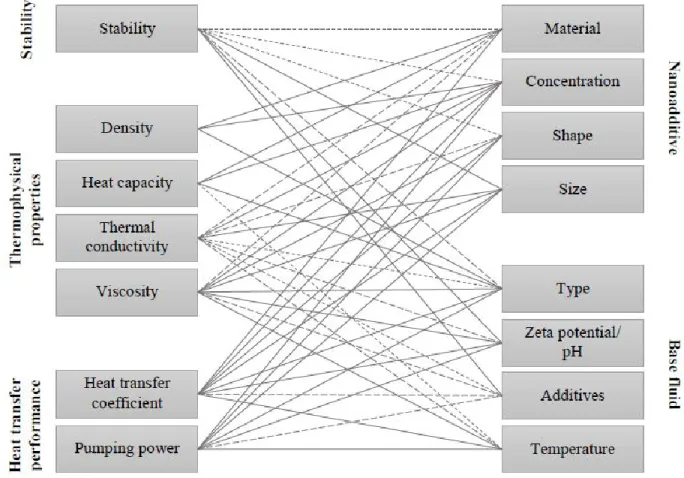
The key issue of nanofluid research, in view of applications, is to prepare stable solutions, to increase the thermal conductivity of the liquid, without a large increase in viscosity. Many factors can affect the thermal conductivity of a nanofluid, like the other thermophysical properties, such as particle size, particle shape, concentration of nanoparticles, and addition of surfactant. For that, different types of nanofluids that differ by the base fluid, and/or by the type of the nanoparticles such as metal oxide [18–22], metallic nanoparticles [23,24], or carbon nanomaterials [25–31] have been studied. Since the discovery of graphene [32], this material has found many interesting
16
applications, as it has many excellent physical, chemical, and mechanical features [7]. Quite naturally, the development of graphene-based nanofluids started a few years ago because of the high intrinsic thermal conductivity of graphene compared to other types of nanoparticles and carbon-based materials (see Table I.1). Thus, graphene appears as a promising candidate for nanofluid preparation and applications. Such a development, with a comprehensive characterization of graphene and graphene-based nanofluids, is the aim of this PhD thesis. This project was performed within the Laboratoire de Génie Civil et Génie Mécanique (LGCGM) from Université de Rennes 1, whose activities in the field of nanofluids are more than ten years old, particularly with carbon-based nanofluids. It is also part of a strong collaboration with the Institut Jean Lamour in Nancy, specialized in the chemical properties of carbon and graphene-based materials. The nanofluids dedicated to our study were prepared in this institute. More broadly, our project contributed to the recently completed European COST Action NanoUptake OC-2015-1-19591, "Overcoming Barriers to Nanofluids Market Uptake". It should be finally noted that, before the comprehensive study about few-layer graphene nanofluids reported in this manuscript, preliminary studies and tests have been carried out with graphene oxide and reduced graphene oxide as well as with carbon nanotubes without obtained convincing results in terms of both stability and thermal conductivity enhancement. However, these results were a great source of information and they have led to some publications [33,34].
I.2- Objectives
The general objectives of this study are described as following:
1. Synthesis of suitable graphene nanomaterials for obtaining stable heat transfer nanofluids. 2. Characterization of the synthesized nanopowders to analyze their morphology, size and structural quality.
3. Preparation of different concentrations of nanofluids by dispersing the synthesized graphene in a base fluid employed in heat transfer applications to obtain stable nanofluids with the help of surfactants.
17
5. Experimental determination of the thermal conductivity of the base fluids and the prepared nanofluids in a wide range of temperatures and concentrations.
6. Performing complete rheological tests for all base fluids and nanofluids.
7. Determining the density, surface tension, and heat capacity of the base fluids and nanofluids. 8. Modelling the studied thermophysical properties.
9. Analyzing the heat transfer performance for the selected nanofluids for heat transfer applications.
10. Evaluation and discussion of the obtained results for all the analyzed nanofluids in the function of composition parameters and temperature, and determination of general conclusions.
I.3- Structure
The second chapter of the thesis presents a bibliographical synthesis allowing a better understanding of the current knowledge in the development of graphene-based nanofluids, including graphene production methods, and their thermo-physical properties, and a description of the different models of the literature often used for the estimation of thermo-physical properties (thermal conductivity, dynamic viscosity, density...). The analysis of this work allows us to identify the different parameters that can influence the thermal and hydrodynamic properties of graphene-based nanofluids.
Thus, the third chapter presents, after a detailed description of the graphene production and characterization methods, nanofluids used and how they were prepared and evaluated in terms of stability, the experimental systems and devices used for experimental characterization of the thermo-physical properties, thermal conductivity, dynamic viscosity, density, surface tension, and isobaric heat capacity of nanofluids. The experimental procedures and the determination of measurement uncertainties are also detailed.
In the fourth chapter, we present the main results of the thesis, including the full characterization of graphene, the stability of nanofluids, at rest and under shear and the thermophysical properties of nanofluids tested (thermal conductivity, dynamic viscosity, density, etc). In this chapter, we also present an analysis of the results to evaluate the influence of the type of surfactant,
18
temperature, and volume fraction of graphene. These results are also compared and discussed with some existing models. This was done in the form of published articles.
The fifth chapter proposes a theoretical qualitative approach to evaluate the heat transfer potential of the stable nanofluids in a heat exchanger.
The main conclusions and perspectives of this work will be finally presented in the last chapter.
I.4- References
1. H.F. Matare, Energy: facts and future, CRC Press, Boca Raton, FL, USA, 2018.
2. S.U.S. Choi, J.A. Eastman, Enhancing thermal conductivity of fluids with nanoparticles, International Mechanical Engineering Congress and Exhibition, Argonne National Lab, USA 1995, pp. 99–105.
3. Haddad, Z.; Abid, C.; Oztop, H.F.; Mataoui, A. A review on how the researchers prepare their nanofluids. International Journal of Thermal Sciences 2014, 76, 168–189,
doi:10.1016/j.ijthermalsci.2013.08.010.
4. Safaei, M.R.; Ranjbarzadeh, R.; Hajizadeh, A.; Bahiraei, M.; Afrand, M.; Karimipour, A. Effects of cobalt ferrite coated with silica nanocomposite on the thermal conductivity of an antifreeze: New nanofluid for refrigeration condensers. International Journal of Refrigeration 2019, 102, 86–95, doi:10.1016/j.ijrefrig.2018.12.007.
5. Nazari, S.; Safarzadeh, H.; Bahiraei, M. Experimental and analytical investigations of productivity, energy and exergy efficiency of a single slope solar still enhanced with thermoelectric channel and nanofluid. Renewable Energy 2019, 135, 729–744,
doi:10.1016/j.renene.2018.12.059.
6. Sardarabadi, H.; Zeinali Heris, S.; Ahmadpour, A.; Passandideh-Fard, M. Experimental investigation of a novel type of two-phase closed thermosyphon filled with functionalized carbon nanotubes/water nanofluids for electronic cooling application. Energy Conversion and Management 2019, 188, 321–332, doi:10.1016/j.enconman.2019.03.070.
7. Bahiraei, M.; Heshmatian, S. Graphene family nanofluids: A critical review and future research directions. Energy Conversion and Management 2019, 196, 1222–1256,
doi:10.1016/j.enconman.2019.06.076.
8. Qi, C.; Liu, M.; Tang, J. Influence of triangle tube structure with twisted tape on the thermo-hydraulic performance of nanofluids in heat-exchange system based on thermal and exergy efficiency. Energy Conversion and Management 2019, 192, 243–268,
doi:10.1016/j.enconman.2019.04.047.
9. Bellos, E.; Tzivanidis, C. Investigation of a nanofluid-based concentrating thermal photovoltaic with a parabolic reflector. Energy Conversion and Management 2019, 180, 171–
182, doi:10.1016/j.enconman.2018.11.008.
10. Yen, P.-H.; Wang, J.-C. Power generation and electric charge density with temperature effect of alumina nanofluids using dimensional analysis. Energy Conversion and Management
2019, 186, 546–555, doi:10.1016/j.enconman.2019.03.005.
11. Karimipour, A.; Bagherzadeh, S.A.; Goodarzi, M.; Alnaqi, A.A.; Bahiraei, M.; Safaei, M.R.; Shadloo, M.S. Synthesized CuFe2O4/SiO2 nanocomposites added to water/EG: Evaluation of the thermophysical properties beside sensitivity analysis & EANN. International Journal
19
of Heat and Mass Transfer 2018, 127, 1169–1179,
doi:10.1016/j.ijheatmasstransfer.2018.08.112.
12. Bahiraei, M.; Ahmadi, A.A. Thermohydraulic performance analysis of a spiral heat exchanger operated with water–alumina nanofluid: Effects of geometry and adding nanoparticles. Energy Conversion and Management 2018, 170, 62–72,
doi:10.1016/j.enconman.2018.05.061.
13. S.K. Das, S.U. Choi, W. Yu, T. Pradeep, Nanofluids: science and technology, John Wiley & Sons, Hoboken, NJ, USA, 2007.
14. Mallan, G.M.; Michaelian, M.S.; Lockhart, F.J. Liquid thermal conductivities of organic compounds and petroleum fractions. Journal of Chemical & Engineering Data 1972, 17,
412–415, doi:10.1021/je60055a028.
15. Hone, J.; Whitney, M.; Piskoti, C.; Zettl, A. Thermal conductivity of single-walled carbon nanotubes. Physical Review B 1999, 59, R2514–R2516, doi:10.1103/PhysRevB.59.R2514.
16. Hu, J.; Ruan, X.; Chen, Y.P. Thermal Conductivity and Thermal Rectification in Graphene Nanoribbons: A Molecular Dynamics Study. Nano Letters 2009, 9, 2730–2735,
doi:10.1021/nl901231s.
17. Arshad, A.; Jabbal, M.; Yan, Y.; Reay, D. A review on graphene based nanofluids: Preparation, characterization and applications. Journal of Molecular Liquids 2019, 279, 444–
484, doi:10.1016/j.molliq.2019.01.153.
18. Yasinskiy, A.; Navas, J.; Aguilar, T.; Alcántara, R.; Gallardo, J.J.; Sánchez-Coronilla, A.; Martín, E.I.; De Los Santos, D.; Fernández-Lorenzo, C. Dramatically enhanced thermal properties for TiO2-based nanofluids for being used as heat transfer fluids in concentrating solar power plants. Renewable Energy 2018, 119, 809–819, doi:10.1016/j.renene.2017.10.057.
19. Yiamsawas, T.; Dalkilic, A.S.; Mahian, O.; Wongwises, S. Measurement and Correlation of the Viscosity of Water-Based Al2O3 and TiO2 Nanofluids in High Temperatures and Comparisons with Literature Reports. Journal of Dispersion Science and Technology 2013,
34, 1697–1703, doi:10.1080/01932691.2013.764483.
20. Angayarkanni, S.A.; Philip, J. Review on thermal properties of nanofluids: Recent developments. Advances in Colloid and Interface Science 2015, 225, 146–176,
doi:10.1016/j.cis.2015.08.014.
21. Lee, S.; Choi, S.U.-S.; Li, S.; Eastman, J.A. Measuring Thermal Conductivity of Fluids Containing Oxide Nanoparticles. Journal of Heat Transfer 1999, 121, 280–289,
doi:10.1115/1.2825978.
22. Mahian, O.; Kianifar, A.; Heris, S.Z.; Wongwises, S. Natural convection of silica nanofluids in square and triangular enclosures: Theoretical and experimental study. International Journal of Heat and Mass Transfer 2016, 99, 792–804, doi:10.1016/j.ijheatmasstransfer.2016.03.045.
23. Gómez-Villarejo, R.; Martín, E.I.; Navas, J.; Sánchez-Coronilla, A.; Aguilar, T.; Gallardo, J.J.; Alcántara, R.; De los Santos, D.; Carrillo-Berdugo, I.; Fernández-Lorenzo, C. Ag-based nanofluidic system to enhance heat transfer fluids for concentrating solar power: Nano-level insights. Applied Energy 2017, 194, 19–29, doi:10.1016/j.apenergy.2017.03.003.
24. Navas, J.; Sánchez-Coronilla, A.; Martín, E.I.; Teruel, M.; Gallardo, J.J.; Aguilar, T.; Gómez-Villarejo, R.; Alcántara, R.; Fernández-Lorenzo, C.; Piñero, J.C.; et al. On the enhancement of heat transfer fluid for concentrating solar power using Cu and Ni nanofluids: An
20
experimental and molecular dynamics study. Nano Energy 2016, 27, 213–224,
doi:10.1016/j.nanoen.2016.07.004.
25. Seong, H.; Kim, G.; Jeon, J.; Jeong, H.; Noh, J.; Kim, Y.; Kim, H.; Huh, S. Experimental Study on Characteristics of Grinded Graphene Nanofluids with Surfactants. Materials 2018,
11, 950, doi:10.3390/ma11060950.
26. Naddaf, A.; Zeinali Heris, S. Experimental study on thermal conductivity and electrical conductivity of diesel oil-based nanofluids of graphene nanoplatelets and carbon nanotubes. International Communications in Heat and Mass Transfer 2018, 95, 116–122,
doi:10.1016/j.icheatmasstransfer.2018.05.004.
27. Kamatchi, R., & Kannan, K. G. (2018). An aqua based reduced graphene oxide nanofluids for heat transfer applications: synthesis, characterization, stability analysis, and thermophysical properties. INTERNATIONAL JOURNAL OF RENEWABLE ENERGY RESEARCH, 8(1), 313-319.
28. Bahaya, B.; Johnson, D.W.; Yavuzturk, C.C. On the Effect of Graphene Nanoplatelets on Water–Graphene Nanofluid Thermal Conductivity, Viscosity, and Heat Transfer Under Laminar External Flow Conditions. Journal of Heat Transfer 2018, 140,
doi:10.1115/1.4038835.
29. Hussien, A.A.; Abdullah, M.Z.; Yusop, N.M.; Al-Nimr, M.A.; Atieh, M.A.; Mehrali, M. Experiment on forced convective heat transfer enhancement using MWCNTs/GNPs hybrid nanofluid and mini-tube. International Journal of Heat and Mass Transfer 2017, 115, 1121–
1131, doi:10.1016/j.ijheatmasstransfer.2017.08.120.
30. Manasrah, A.D.; Al-Mubaiyedh, U.A.; Laui, T.; Ben-Mansour, R.; Al-Marri, M.J.; Almanassra, I.W.; Abdala, A.; Atieh, M.A. Heat transfer enhancement of nanofluids using iron nanoparticles decorated carbon nanotubes. Applied Thermal Engineering 2016, 107,
1008–1018, doi:10.1016/j.applthermaleng.2016.07.026.
31. Ettefaghi, E.; Ghobadian, B.; Rashidi, A.; Najafi, G.; Khoshtaghaza, M.H.; Pourhashem, S. Preparation and investigation of the heat transfer properties of a novel nanofluid based on graphene quantum dots. Energy Conversion and Management 2017, 153, 215–223,
doi:10.1016/j.enconman.2017.10.010.
32. Novoselov, K.S. Electric Field Effect in Atomically Thin Carbon Films. Science 2004, 306,
666–669, doi:10.1126/science.1102896.
33. Hamze S., Berrada N., Desforges A., Vigolo B., Gleize J., Ghanbaja J., Maré T., Cabaleiro D., and Estellé P. Dynamic viscosity of purified MWCNT water and water-propylene glycol based nanofluids, Heat transfer Eng., accepted.
34. Berrada, N.; Hamze, S.; Desforges, A.; Ghanbaja, J.; Gleize, J.; Maré, T.; Vigolo, B.; Estellé, P. Surface tension of functionalized MWCNT-based nanofluids in water and commercial propylene-glycol mixture. Journal of Molecular Liquids 2019, 293, 111473,
21
Chapter II- General information on
graphene nanofluids
II.1- Introduction………
22
II.2- Definition……… 22
II.2.1- Base fluids………...
23
II.2.2- Nanoparticles………... 25
II.3- Proposal process of new nanofluids……… 28
II.3.1- Nanofluid design……….. 29
II.3.1.1- Nanoparticles synthesis and characterization…………... 29
II.3.1.2- Nanofluid preparation………... 37
II.3.1.3- Stability………
39
II.3.2- Thermophysical profile……… 42
II.3.2.1- Thermal conductivity……… 44
II.3.2.2- Rheology and Dynamic viscosity……….. 49
II.3.2.3- Isobaric heat capacity……… 58
II.3.2.4- Density……….. 60
II.3.2.5- Surface tension……….
61
II.3.3- Heat transfer performance……… 65
II.3.3.1- Qualitative approach………. 66
II.3.3.2- Quantitative approach………... 67
II.4- Conclusion………..
70
22
II.1- Introduction
The basic fluids often used in heat transfer applications have very low thermal conductivities, which sometimes limit their capacity to heat transfer. The use of nanofluids is likely to bring very significant gains in thermal performance. To develop more efficient heat transfer fluids, and to better understand the physical mechanisms involved in the use of nanofluids, a great deal of research has been carried out on this new generation of fluids.
This chapter aims to provide an overview of the literature background about graphene-based nanofluids that are the subject of this research work.
II.2- Definition
Nanofluids are colloidal solutions made up of nano-sized particles (tens to hundreds of nanometers in at least one dimension) [1] suspended in a carrier liquid. This type of solution is a subject of great interest since the discovery of their special thermal properties. Indeed, base fluids often used in cooling or heating applications have very low thermal conductivities that limit their heat transfer capacity. The idea is then to insert solid nanoparticles of very high thermal conductivity into the base liquids, to increase the effective thermal conductivity of the mixture and thus improve their thermal performance. An example of graphene-based nanofluid is shown in Figure II.1.
23
II.2.1- Base fluids
Water, glycols (in particular ethylene glycol) and mixtures of both, as well oils are the common heat transfer fluids employed in heating and cooling applications [3–6]. So, they are logically the most used fluids to produce nanofluids. Some important properties about water and propylene glycol liquids, that compose the commercial base fluid used in this study, are provided in the following.
Water (H2O), molecules consist of hydrogen and oxygen atoms joined by covalent bonds, is an
inorganic compound. At atmospheric conditions, it does not have any color, odor or taste [7]. As its molecules create hydrogen bonds with other molecules easily, and because of its strong polarity, water was identified as a good solvent. Besides, water can be freely mixed with other liquids (alcohols for example) [8]. Regarding its physical properties (see Table II.1), water presents some unusual behaviors. At atmospheric pressure, its density decreases with temperature in the majority of the liquid-state range, as usual, while it increases from the freezing point to 277 K [9]. While heat capacity usually increases with temperature, a minimum value occurs in case of water at around 308 K. Furthermore, most liquids under higher pressures become more viscous while the viscosity of water shows a minimum as a function of pressure [9].
24
Table II.1. Physical properties of water and propylene glycol [10,11].
Water Propylene glycol
Chemical formula H2O C3H8O2
Structural formula
Molecular mass (g.mol-1) 18.02 76.09
Density (kg.m-3) At 293.15 K 998.2 1036 Specific heat (kJ.kg-1.K-1) At 293.15 K 4.184 2.481 Viscosity (mPa.s) At 273.15 K _ 243 At 293.15 K 1.00 60.5 At 313.15 K 0.653 18.0 Refractive index At 293.15 K 1.3333 1.4329 Freezing point (K) 273 214
Boiling point (K) At 101.3 kPa 373 460
At 6.67 kPa 311 389
At 1.13 kPa 284 358
Vapor pressure (Pa) At 293.15 K 2.4 9.3
Propylene glycol or propane-1,2-diol (C3H8O2), molecules consist of carbon, hydrogen and oxygen
atoms, is an organic compound. At atmospheric pressure and room temperature, it is an odorless and colorless viscous liquid with low toxicity and a slightly sweet taste. Propylene glycol is mainly industrially produced at elevated pressure and temperature by the hydration of propylene oxide. It is used in different applications as the production of foods, polyester resins, personal care, products, drugs, and cosmetics, among others [12]. It is extensively used in heat transfer applications as de-icing fluids, a part of antifreeze mixtures as a green replacement of ethylene glycol [12]. Because of their much lower toxicity [13], they are more suitable for the heat transfer applications which need an indirect contact with food, natural resources or liquids for human consumption, used as a secondary working fluid in the geothermal collection, solar thermal energy or food industry. Among their physical properties (see Table II.1 and Figure II.2), we can note that propylene glycol has a great hygroscopicity and has a freezing point lower than that of ethylene glycol and water. Nevertheless, as shown in Figure II.2, for the same volume concentrations of propylene glycol and ethylene glycol in water, similar freezing points were obtained.
25
Figure II.2. Freezing and boiling points of glycoled waters at different ethylene glycol and
propylene glycol volume concentrations [10].
II.2.2- Nanoparticles
The production of new nanomaterials and nanoparticles is a growing field of research, so only the most commonly used nanoparticles in heat transfer applications are briefly mentioned here. In general, while a classification by nanoparticle nature is also used, nanoparticles can be divided into three broad categories according to their shape (Figure II.3):
Spherical nanoparticles, for which several types of materials can be used in their manufacture. These spherical nanoparticles can thus be based on metals (copper Cu, iron Fe, gold Au, silver Ag...) or metal oxides (aluminium oxide Al2O3, copper oxide CuO,
titanium oxide TiO2...).
Nanotubes (carbon nanotubes NTC, titanium nanotubes, silicon nanotube, boron nitride...). Nanosheets (graphene nanosheets, graphene oxide nanosheets, reduced graphene oxide
nanosheets…).
Some other shapes like triangular, cubic, hexagonal, oval, helical, prism and rod nanoparticles can be accounted.
26
Figure II.3. TEM images of some examples of nanoparticles: spherical nanoparticles [14] (a),
carbon nanotubes [15] (b), and graphene nanosheets (c).
As the name suggests, graphene, “the mother of all graphitic forms of carbon” [16], is obtained from graphite and is a simple two-dimensional sheet consisting of carbon atoms arranged in a hexagonal pattern. Expectations around this material can be explained by its exceptional properties:
It consists of a single atomic layer of hexagonal mesh with a thickness (in the order of carbon atom) of 70 picometers, i.e. one-millionth of a human hair [16].
It is considered to be the thinnest and lightest material (0.77 milligrams per square meter).
It is among the strongest materials known to date as it has Young's modulus close to ~1000 GPa and a fracture limit of 130 GPa.
Its elasticity modulus is high in the order of ~0.25 TPa [17].
It has a high intrinsic thermal conductivity ~5000 W.m-1.K-1 (measured for single-layer graphene) [18]. For comparison, the thermal conductivity of copper is 400 W.m-1.K-1.
27
It is impermeable to standard gases, including Helium [20].
Its electrical conductivity is ~2000000 cm2.V-1.s-1 or 200 S.m2.C-1 [21].
Its melting point is above 3000 degrees Celsius [22].
Graphene nanoparticles have many advantages over the other types of nanoparticles [23–25]. For example, they have very high thermal conductivity, they are more stable, they can be easily synthesized, and they have a larger surface area to volume ratio which enhance the heat transferability. All these reasons make graphene a really good candidate for nanofluid design. There are different types of graphene-based nanoparticles as pristine graphene, graphene oxide, reduced graphene oxide, and graphene quantum dots as shown in Figure II.4.
Figure II.4. Structures of graphene-based materials: pristine graphene (purely arranged carbon
atoms) with sp2-hybridized carbon atoms (a), and the chemically modified graphene, including
GO (b), rGO (c) and GQD (d) [26].
Graphene oxide (GO), which is called also graphitic acid [27], was discovered in 1859. It is also a two-dimensional material. Graphene oxide is the oxidized form of graphene, with O functional groups decorating the sp2 C basal plane. Contrary to hydrophobic graphene, GO is hydrophilic due
to the presence of the oxygen functional groups, so it can be dispersed in water solution.
Reduced graphene oxide (rGO) is the form of graphene oxide that is processed by thermal, chemical and other methods to reduce the oxygen-containing groups.
Graphene quantum dots (GQDs) are zero-dimensional members in the carbon family and are considered usually as a chopped fragment from a graphene sheet [28].
28
Graphene-based nanomaterials are classified based on three fundamental features (C/O atomic ratio, average lateral dimensions, and the number of layers) as shown in Figure II.5.
Figure II.5. Classification for different graphene-type materials based on the lateral dimensions,
the C/O ratio and the number of layers, from Ref. [29], reused with permission from John Wiley and Sons.
II.3- Proposal process of new nanofluids
To develop new nanofluids for heat transfer applications, three main phases are required: nanofluid design, characterization of thermophysical properties of nanofluids, and analysis of their heat transfer performance, as shown in Figure II.6. In addition to these steps of development, a trade-off between stability, an increase in thermal properties and performance and management of viscosity increase has to be aimed for practical issues.
29
Figure II.6. Main steps of the proposal process of new graphene nanofluids for heat transfer
applications.
II.3.1- Nanofluid design
The design phase of the nanofluids plays a very important role in any experimental analysis of their thermophysical properties and heat transfer performance. The concentration accuracy of each component of the nanofluid, the precision of the characterization of the dimensions, shape or morphology of the nanoadditives used and the homogeneity and stability of the suspensions are all key parameters.
II.3.1.1- Nanoparticles synthesis and characterization
II.3.1.1.1- Synthesis of graphene-based nanomaterials
To fulfil the need for industry and academia for high-quality graphene in bulk quantities, many preparation methods have been proposed. In the literature, a list of synthesis strategies of graphene has been reported and few of them are adopted by graphene supplying industries. The methods are as follows [24]: mechanical exfoliation, chemical vapor deposition (CVD), liquid-phase exfoliation (LPE), electrochemical exfoliation, chemical reduction of GO, and bottom-up synthesis.
a) Mechanical exfoliation
This method is based on the top-down approach where graphene nanosheets can be produced by the direct exfoliation of pristine, expended or oxidized graphite. The method known as scotch exfoliation of graphite or micromechanical cleavage of graphite constitutes the first experimental method that was used for the production of graphene nanosheets (see Figure.II.7).
30
Figure II.7. (a-d) The steps of graphene synthesis from graphite exfoliation with scotch [30].
This discovery was made by Novoselov et al. in 2004 [16]. This approach is very efficient to obtain nanosheets with excellent crystalline quality but its extremely low yield makes it impossible to consider for production on an industrial scale.
b) Chemical vapor deposition
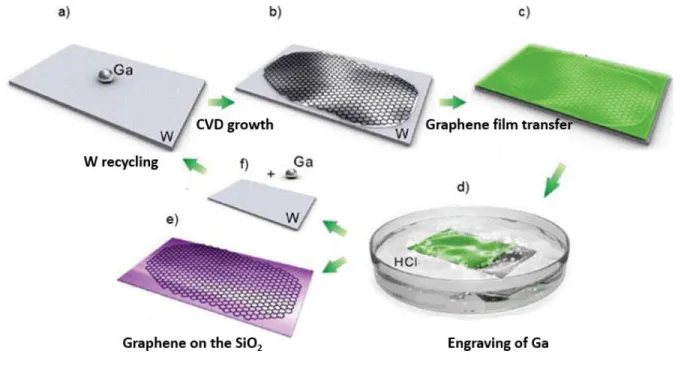
This method consists of producing the graphene layer by chemical vapor deposition (CVD) on a metal substrate. There are different metals which are used for this method such as cobalt (Co) [31], platinum (Pt) [32], nickel (Ni) [33] and copper (Cu) [34].The gaseous sources generally used for this type of deposition are hydrocarbons such as methane, acetylene or ethylene, which decompose when they come into contact with the surface of metals to form graphene layers. Figure II.8 shows the formation of graphene by CVD from a drop of gallium (Ga) localized on a tungsten (W) substrate [30].
31
Figure II.8. Different stages of graphene growth on a drop of gallium (Ga) supported on a
substrate (W): a) a drop of Ga placed on a support sheet (W), b) CVD growth of the graphene on the surface of liquid Ga, c) the graphene is coated with a layer of PMMA by spin-coating, d) coating of the graphene with PMMA and separation from the tungsten sheet driven by the H2
bubbles produced at the interface between the graphene and the Ga-W substrate, e) the graphene is transferred to a SiO2/Si substrate and f) the tungsten foil is reused as a Ga support [30].
The advantage of this method is its low cost and reproducibility. The specific surface area of the graphene synthesized by this method is around 2600 m²/g according to the literature. This value is higher than that of graphene synthesized by the mechanical exfoliation method. Nevertheless, this specific surface area depends on the size of the metal film used, the temperature and pressure which are key elements for growth [32].
c) Liquid phase exfoliation
The chemical route is the most suitable technique for a large application scale in the field of composite materials because it allows the exfoliation of the graphite sheets and their subsequent functionalization [35–43]. The use of intercalating agents and surfactants generally increases the interlayer space between the graphene sheets within the graphite. Indeed, surfactants play an
32
important role in the exfoliation and stabilization of graphene in polar solvents such as water (Figure II.9).
Figure II.9. Graphite exfoliation in solution in the presence (or not) of surfactants [36].
For example, Bepete et al. [44] carried out the dispersion of graphite in water to obtain graphene monolayers. In order to obtain a stable homogeneous dispersion of the monolayers in water, negatively charged graphene solutions were solubilized in tetrahydrofuran (THF) with degassed water followed by evaporation of the organic solvent.
d) Electrochemical exfoliation
Electrochemical exfoliation of graphite in the presence of ionic liquids has been developed as an effective technique for the production of functionalized graphene nanosheets in large quantities. The advantage of this method is that it allows the production of functionalized graphene nanosheets with imidazolium groups that can assist the dispersion of the nanosheets in aprotic solvents [45].
33
Figure II.10.Schematic representation of electrochemical exfoliation (right); exfoliation of chemically modified graphene from a graphite anode [45].
The aim of the electrochemical exfoliation is, first of all, to intercalate molecules or ions between the graphene sheets to separate them by breaking the van der Waals interactions which make graphite exist. In a second time, exfoliation generates the graphene nanosheets (see Figure II.10).
e) Chemical reduction of graphene oxide
In chemical reduction methods, a stable dispersion of GO is produced and followed by a reduction of the exfoliated graphene oxide nanosheets (Figure II.11). However, stable dispersions of GO are obtainable by using water or organic solvents using a sonication treatment or mechanical agitation. Chemical reduction allows removing, at least partially, oxygen-containing groups present on the surface and the edges of the GO.
34
Figure II.11. Schematic representation of the oxidation/exfoliation/reduction process of graphite
into graphene nanosheets [46].
Colloidal suspensions of GO and its organically treated version can be chemically reduced to graphene nanosheets by using different chemical reducing agents such as hydrazine hydrate [47– 49], dimethylhydrazine [50], sodium borohydride followed by hydrazine [51], hydroquinone [52], UV-irradiated TiO2 [53], sulfur-containing compounds [54], Vitamin C [55], iron atoms [56] and
sodium hydroxide [57].
f) Bottom-up synthesis
The bottom-up approach is an alternative method to prepare graphene nanosheets, where graphene molecules are synthesized starting from small and atomically-precise building blocks [58]. Coupling sites are needed for these building blocks. They can be stimulated from the outside to assemble to the next structural units. The process is usually performed at high temperatures where the structural variants are produced, and then part of them are separated to produce the desired structure. The control of the resolution with an atomic precision which allows obtaining very high-quality graphene is the major advantage of this method. Its main disadvantage is the constraint in the handling and transfer of the material produced, as well as the few possibilities for larger-scale replication due to the limitations of uniformity and order on a large scale.
Summary of the synthesis methods
Each method produces graphene nanomaterial with different characteristics and has different possibilities for upscaling. Raccichini et al. [59] summarized the advantages and the drawbacks of each method. They also evaluated different methods of graphene production based on the most
35
important aspects of the graphene synthesized, purity and quality, and each method, cost, yield and scalability. Their results are presented in Figure II.12. We can see that each method has different characteristics in terms of yield and therefore the selection of the method must be made each time, depending on the application for which the graphene will be used. For example, graphene oxide reduction, which is widely used in the literature, has a very high yield and scalability; however the purity and quality of the material produced is quite low. Inversely, some LPE method may have a low yield but produce high-quality graphene, and can be easily scaled up that makes this method interesting for nanofluid production.
Figure II.12. The key characteristics of the most common methods of graphene production in a
scale of 0-3; The letters refer to (G) the graphene quality, (C) the cost of production (a low value corresponds to the high cost of production), (S) the scalability, (P) the purity and (Y) the yield of

![Figure II.2. Freezing and boiling points of glycoled waters at different ethylene glycol and propylene glycol volume concentrations [10]](https://thumb-eu.123doks.com/thumbv2/123doknet/14691048.745377/36.918.142.745.120.406/figure-freezing-boiling-glycoled-different-ethylene-propylene-concentrations.webp)
![Figure II.3. TEM images of some examples of nanoparticles: spherical nanoparticles [14] (a), carbon nanotubes [15] (b), and graphene nanosheets (c)](https://thumb-eu.123doks.com/thumbv2/123doknet/14691048.745377/37.918.229.688.118.518/figure-examples-nanoparticles-spherical-nanoparticles-nanotubes-graphene-nanosheets.webp)

![Figure II.11. Schematic representation of the oxidation/exfoliation/reduction process of graphite into graphene nanosheets [46]](https://thumb-eu.123doks.com/thumbv2/123doknet/14691048.745377/45.918.130.788.130.351/schematic-representation-oxidation-exfoliation-reduction-graphite-graphene-nanosheets.webp)
![Figure II.18. Parameters that affect the thermal conductivity of nanofluids [2,83].](https://thumb-eu.123doks.com/thumbv2/123doknet/14691048.745377/55.918.107.801.556.976/figure-ii-parameters-affect-thermal-conductivity-nanofluids.webp)
![Figure II.21. Behaviors of Newtonian and non-Newtonian fluids: dynamic viscosity as a function of time (a) and shear rate (b) [79]](https://thumb-eu.123doks.com/thumbv2/123doknet/14691048.745377/63.918.132.767.115.404/figure-behaviors-newtonian-newtonian-fluids-dynamic-viscosity-function.webp)