HAL Id: tel-03137561
https://tel.archives-ouvertes.fr/tel-03137561
Submitted on 10 Feb 2021HAL is a multi-disciplinary open access archive for the deposit and dissemination of sci-entific research documents, whether they are pub-lished or not. The documents may come from teaching and research institutions in France or abroad, or from public or private research centers.
L’archive ouverte pluridisciplinaire HAL, est destinée au dépôt et à la diffusion de documents scientifiques de niveau recherche, publiés ou non, émanant des établissements d’enseignement et de recherche français ou étrangers, des laboratoires publics ou privés.
Improving organizational performance by implementing
customer complaint management through socio
economic approach to management in a case study of
SME, Vietnam
Tu Anh Nguyen
To cite this version:
Tu Anh Nguyen. Improving organizational performance by implementing customer complaint man-agement through socio economic approach to manman-agement in a case study of SME, Vietnam. Business administration. Université de Strasbourg, 2019. English. �NNT : 2019STRAB018�. �tel-03137561�
i
UNIVERSITÉ DE STRASBOURG
ÉCOLE DOCTORALE AUGUSTIN COURNOT
HuManiS (EA 7308)
THÈSE
présentée par:
Tu Anh NGUYEN
Soutenue le: 17 juillet 2019
Pour obtenir le grade de: Docteur de l’université de Strasbourg
Discipline/ Spécialité:
Sciences de Gestion
Improving organizational performance by implementing customer complaint management through socio economic approach to management in a case study of
SME, Vietnam
L’amélioration de la performance organisationnelle en combinant la gestion des réclamations clients et l’approche socio-économique : une étude de cas d'une SME, Vietnam
THÈSE dirigée par: Madame Isabelle BARTH
Professeure des Universités, Directrice générale INSEEC BE Directrice de la recherche INSEEC U
Monsieur Thierry NOBRE
Professeur des Universités, Université de Strasbourg
RAPPORTEURS: Monsieur Gilles PACHE
Professeur des Universités, Université Aix-Marseille
Monsieur Laurent CAPPELLETTI
Professeur des Universités, CNAM
AUTRES MEMBRES DU JURY: Monsieur Marc BONNET
Professeur des Universités, Université Lyon III
Monsieur Philippe CHAPELIER
Professeur des Universités, Université Montpellier Soutenue le17 juillet 2019
i L’université n’entend donner aucune approbation ni improbation aux opinions émises dans les theses: ces opinions doivent être considérées comme propres à leurs auteurs.
ii
Acknowledgement
I would like to show my deep gratitude to French Vietnamese Center for Management Education (CFVG Vietnam) for creating an international learning environment and bridging me to excellent French education.
I would like to express my sincere gratitude to the Augustin Cournot Doctoral School, University of Strasbourg for an acceptance of my applications in doctoral program and all professors as well staffs of HuManiS research laboratory that provide the best research services for PhD students with interesting courses, advices for my dissertation and administrative supports to foreigners like me.
I would like to acknowledge with the supervision of my thesis directors – Professor Isabelle BARTH and Professor Thierry NOBRE who instructed me from methodology to theories and persuading me to revise the dissertation.
I would like to show my appreciation to the members of the jury, Professor Gilles PACHE, Professor Laurent CAPPELLETTI, Professor Marc BONNET, and Professor Philippe CHAPELIER for accepting to participate in the jury and for the time they have taken my research.
I am highly indebted and thoroughly grateful to Board of Directors and managers of the passenger transport company in Vietnam under this study to accept my intervention research from 2014 to 2018.
My sincere thanks also go to President of Thai Nguyen University and Dean of International School for financial supports and work days off to finish and defend my dissertation in France.
Last but not the least; I would like to thank my family for supporting me spiritually throughout researching in field, writing this dissertation and my life in general.
iii Index
Index of Acronyms and Abbreviations ... 1
Introduction ... 3
Chapter 1 - Literature review ... 26
Chapter 2 - Research methodology ... 58
Chapter 3 - Case study analysis ... 118
Chapter 4 - First action plan (2015-2016) ... 132
Chapter 5 - Second action plan (2017-2018) ... 175
Chapter 6 - Discussion ... 199 Conclusion ... 240 Bibliography ... 247 List of figures ... 270 List of tables ... 271 Glossary ... 272 Abstract ... 275 Résumé ... 284 Appendices ... 316
iv
Table of contents
Index of Acronyms and Abbreviations ... 1
Introduction ... 3
Chapter 1 - Literature review ... 26
1.1 Research focus: How a SME improves organizational performance by combining CCM and SEAM ... 27
1.2 Relationship marketing ... 29
1.2.1 Paradigm in marketing ... 29
1.2.2 Paradigm in relationship marketing ... 31
1.2.3 History of relationship marketing ... 32
1.2.4 Features of relationship marketing ... 34
1.2.5 Expectations of contributing to relationship marketing ... 35
1.3 Customer relationship management ... 36
1.3.1 Prominent attributes of CRM ... 37
1.3.2 Customer relationship management components ... 38
1.3.3 Customer relationship management implementation and measurement ... 39
1.4 Customer complaint management ... 40
1.4.1 Distinctive aspects of customer complaints ... 41
1.4.2 Customer complaint management approached from different theories ... 41
1.4.3 Methodology to implement customer complaint management ... 44
1.4.4 Challenges in customer complaint handling ... 45
1.5 Customer complaint management and organizational performance ... 45
1.5.1 Typical characteristics of organizational performance ... 45
1.5.2 The relationship between customer complaint management and organizational performance ... 46
v
1.5.3 Selection of organizational performance measurement ... 47
1.5.3.1 Corporate social performance ... 48
1.5.3.2 Hidden cost calculation models ... 49
1.5.3.3 Calculation of customer complaint management profitability ... 50
1.6 Vietnam’s researches in customer complaints management ... 51
1.7 Challenges of implementing customer complaint management through SEAM in small-and-medium sized enterprises of developing country (Vietnam) ... 52
1.8 Model of customer complaint management framework combined with SEAM ... 52
1.8.1 Research questions ... 52
1.8.2 Research model ... 53
1.9 Chapter summary ... 55
Chapter 2 - Research methodology ... 58
2.1 Problem statement ... 58
2.1.1 Research objectives ... 59
2.1.2 Research questions ... 59
2.2 Ontological, epistemological stances and research methods in management sciences ... 60
2.2.1 Ontological and epistemological stances in management sciences ... 60
2.2.1.1 Introduction to management science ... 60
2.2.1.2 Paradigm in management science ... 61
2.2.1.3 Epistemology in management science ... 62
2.2.1.4 Scientific reasoning of management science ... 62
2.2.2 Research methods in management sciences... 63
2.3 Action research ... 64
vi
2.3.2 Pragmatic versus critical orientation of action research ... 66
2.3.3 Modified action research process ... 67
2.3.4 Qualimetric intervention research ... 69
2.3.5 Socio economic approach to management ... 70
2.4 Selected research methodology for this study ... 79
2.4.1 Ontology, Epistemology and Logic of the research ... 80
2.4.2 Research design ... 81
2.4.2.1 Research Strategy ... 81
2.4.2.2 Qualimetric intervention research... 83
2.4.2.3 The first action plan of 2015-2016 ... 84
2.4.3.4 The second action plan of 2017-2018 ... 96
2.4.3 Hybrid data collection ... 109
2.4.4 Classification and treatment of data ... 110
2.4.5 Codification ... 111
2.4.5.1 The first action plan (2015-2016) ... 111
2.4.5.2 The second action plan (2017-2018) ... 113
2.5 Ethical issues of management research ... 115
2.6 Chapter summary ... 116
Chapter 3 - Case study analysis ... 118
3.1 Analysis of developing countries context ... 118
3.1.1 Developing world context ... 118
3.1.2 Asian developing context ... 119
3.1.2.1 Roles of service industry in developing countries’ economy ... 119
vii
3.2 Analysis of Vietnam’s economy context and transport industry context ... 120
3.2.1 Vietnam economy from 1986 to now ... 120
3.2.2 Roles of service industry in Vietnam economy ... 121
3.2.3 Prominent attributes of transport industry in Vietnam ... 122
3.3 Private sector in Vietnam ... 123
3.3.1 Introduction to Private sector in Vietnam ... 123
3.3.2 Some obstacles in private sector development in Vietnam ... 124
3.3.3 Small – and – medium sized enterprises in Vietnam ... 124
3.4 Case study of a passenger transport SME ... 125
3.4.1 Introduction to the case study of a passenger transport SME ... 125
3.4.2 Organizational performance of the company at the end of 2014 ... 127
3.4.3 Customer complaint management in the case study ... 128
3.4.4 Socio economic approach to management in the case study ... 129
Chapter 4 - First action plan (2015-2016) ... 132
4.1 Collection and analysis of customer complaints ... 132
4.1.1 Collection of customer complaints ... 133
4.1.1.1 Open interviews ... 133
4.1.1.2 In – depth interviews ... 134
4.1.2 Customer complaint analysis ... 134
4.2 Diagnostic of dysfunctions and socio economic evaluation at the end of 2014 .... 136
4.2.1 Diagnostic of dysfunctions ... 136
4.2.1.1 Collection and Analysis of top management’s opinions about customer complaints ... 136
4.2.1.2 Collection and analysis of employees’ opinions about customer complaints ... 139
viii
4.2.2 Socio-economic evaluation at the end of 2014 ... 141
4.2.2.1 Analysis of hidden costs ... 141
4.2.2.2 Organizational performance analysis ... 142
4.2.2.3 Mirror effects ... 143
4.2.2.4 Integrated horizontal and vertical intervention research ... 144
4.3 Cooperative conception and development of innovative organizational solutions of SEAM ... 145
4.3.1. Matching customers’ and employees’ opinions about internal causes of service quality dimensions ... 145
4.3.2 Dysfunction basket 1 – Suggesting new corporate strategy ... 150
4.3.2.1 Analyzing the current strategy of the case study ... 151
4.3.2.2 Suggesting new strategies for the case study ... 156
4.3.3 Dysfunction basket 2 – Organizational learning from other successful companies ... 158
4.3.4 Dysfunction basket 3 – Investment into new vehicles ... 158
4.3.5 Dysfunction basket 4 – Investment into new information technology ... 159
4.3.6 Dysfunction basket 5 – Reinforcing human resource ... 159
4.4 Implementation of strategic action plans ... 161
4.4.1 Structured implementation specific actions ... 162
4.4.1.1 Internal – external strategic action plan ... 162
4.4.1.2 Priority action plan ... 162
4.4.2 Implementation results of the first action plan ... 164
4.4.2.1 Implementation results of dysfunction basket 1 – Suggesting socially responsible corporate strategy ... 165
ix 4.4.2.2 Implementation results of dysfunction basket 2 – Organizational learning
... 166
4.4.2.3 Implementation results of dysfunction basket 3 – investment into new vehicles ... 166
4.4.2.4 Implementation results of dysfunction basket 4 – investment into new information technology ... 166
4.4.2.5 Implementation results of dysfunction basket 5 – reinforcing human resource ... 167
4.4.2.6 Summary of strategic action plan implementation in the period of 2015-2016 ... 167
4.5 Socio economic evaluation after implementing the first action plan ... 168
4.5.1 Data collection before socio economic evaluation ... 169
4.5.2 Analyzing People, Process and Technology of CRM at strategic level ... 169
4.5.3 Economic and social performance outcomes ... 171
4.5.4 Customer complaint management profitability ... 172
4.5.4.1 Customer complaint management profitability calculation model of Stauss ... 172
4.5.4.2 Customer complaint management profitability calculation model of Gupta ... 173
4.5.5 Hidden costs analysis ... 173
4.5.5.1 Hidden costs calculation model of SEAM ... 173
4.5.5.2 Hidden costs calculation model of Lakshmi ... 173
4.6 Chapter summary ... 174
Chapter 5 - Second action plan (2017-2018) ... 175
5.1 Collection and analysis of customer complaints through social media ... 176
x
5.1.2 Analysis of customer complaints ... 177
5.2 Diagnostic of dysfunctions and socio economic evaluation at the end of 2016 .... 177
5.2.1 Analysis of customer complaints from top management’s opinions ... 177
5.2.1.1 Horizontal diagnostic inventory of the dysfunctions identified by top management ... 178
5.2.1.2 Cooperative conception and innovative organizational solutions from horizontal research ... 179
5.2.2 Analysis of customer complaints from employees’ opinions ... 180
5.2.2.1 Vertical diagnostic inventory of the dysfunctions identified by employees ... 180
5.2.2.2 Cooperative conception and innovative organizational solutions from vertical research ... 182
5.2.3 Socio economic evaluation at the end of 2016 ... 183
5.2.3.1 Socio economic performance results ... 183
5.2.3.2 Mirror effects ... 183
5.2.3.3 Integrated horizontal and vertical intervention research ... 185
5.3 Cooperative conception and development of innovative organizational solutions of SEAM ... 185
5.3.1 Problems of People and Process at the company ... 185
5.3.2 Specific actions for integrated horizontal and vertical intervention research .. 186
5.4 Implementation of strategic action plans ... 189
5.4.1 Structured implementation of specific action plans ... 189
5.4.1.1 Internal external strategic action plan ... 189
5.4.1.2 Priority action plan ... 190
xi
5.4.2 Implementation results of the second action plan ... 191
5.5 Socio economic evaluation of the second action plan ... 193
5.5.1 Economic and Social performance analysis at the end of 2018... 194
5.5.2 Customer complaint management profitability at the end of 2018... 196
5.5.3 Analysis of hidden costs at the end of 2018... 196
5.6 Chapter summary ... 197
Chapter 6 - Discussion ... 199
6.1 Discussion about reasons to suggest the two action plans from academics perspectives ... 199
6.1.1 Discussion about reasons to propose the first action plan of 2015-2016 period ... 200
6.1.1.1 Basket 1 - Suggesting related diversification strategy... 200
6.1.1.2 Basket 2 - Organizational learning ... 203
6.1.1.3 Basket 3 - Investment into new vehicles ... 204
6.1.1.4 Basket 4 - Investment into new information technology ... 205
6.1.1.5 Basket 5 - Reinforcing human resource ... 206
6.1.2 Discussion about the second action plan of 2017-2018 period... 209
6.1.2.1 Basket 1 - Commitment to improve service quality – Defensive marketing strategy ... 209
6.1.2.2 Basket 2 - Marketing policies ... 211
6.1.2.3 Basket 3 - Human resource management ... 212
6.2 Discussion about results of the action plans implementation... 215
6.2.1 Organizational context of the company ... 216
6.2.2 Action plan implementation from 2015 to 2018 ... 217
xii
6.2.3.1 Step 1 – Diagnosing customers’ complaints ... 219
6.2.3.2 Step 2 – Diagnosing sources and causes of customers’ complaints from employees’ viewpoints ... 220
6.2.3.3 Step 3 – Suggesting strategic action plans ... 221
6.2.3.4 Step 4 – Implementing the action plans ... 222
6.2.3.5 Step 5 – Socio economic evaluation of implementing customer complaint management ... 223
6.3 Discussion about the methodological role of SEAM in the relationship between customer complaint management and organizational performance ... 225
6.3.1 Discussion about customer complaint management framework without SEAM ... 225
6.3.1.1 Hsiao’s customer complaint management framework ... 225
6.3.1.2 Arash’s customer complaint management framework ... 227
6.3.2 Advantages of SEAM in combination with customer complaint management framework ... 228
6.3.2.1 Superiority of socio economic diagnostic ... 228
6.3.2.2 Strength of maintenance or extension phase of SEAM ... 229
6.3.2.3 Reinforcement of structured actions to organizational performance ... 229
6.3.2.4 Similarity between socio economic evaluation and organizational performance ... 230
6.3.2.5 Employee motivations in organizational change ... 231
6.4 Theoretical contributions ... 231
6.5 Managerial contributions, implications and recommendations ... 234
6.6 Methodological contributions ... 235
6.7 Theoretical considerations ... 236
xiii
6.9 Recommendations for future researches ... 238
Conclusion ... 240 Bibliography ... 247 List of figures ... 270 List of tables ... 271 Glossary ... 272 Abstract ... 275 Résumé ... 284 Appendices ... 316
1
Index of Acronyms and Abbreviations
AR Action research
BCG Boston Consulting Group
BIDV Bank for Investment and Development of Vietnam
BOD Board of Directors
Boeing A&T Boeing Aircraft and Tanker
CCM Customer complaint management
CEOs Chief executive officers CFA Confirmatory factor analysis
CRM Customer relationship management CSFs Critical success factors
CSR Corporate social responsibility EFA Exploratory factor analysis
GDP Gross domestic product
HCVAVC Hourly contribution to value added on variable cost
HRM Human resource management
IESAP Internal external strategic action plan
ISEOR Institut de Socio-Economie des Entreprises et des Organisations
ISO International organization for standardization
IT Information technology
KPI Key performance indicator
2
LTV Lifetime value
NGOs Non-government organizations
NRMA National Roads and Motorists Association
OECD Organization for Economic Co-operation and Development
PAP Priority action plan
PDA Principle component and data envelopment PNAC Periodically negotiable activity contract
ROA Return on assets
ROE Return on equity
ROS Return on sales
SEAM Socio-economic approach to management SEM Structural equation modeling
SME Small-and-medium sized enterprise
SPACE Strategic position and action evaluation matrix
VND Viet Nam Dong
3
Introduction
This study describes the positive relationship between customer complaint management and organizational performance at a small-and-medium sized enterprise (SME) in Vietnam. A pragmatic oriented action research methodology such as socio-economic approach to management (SEAM) is applied to enhance service quality and the company sustainable performance. The research is expected to inherit outcomes of previous researchers (i.e. Arash (2014), Hsiao et al. (2016), Faed et al. (2015), Yilmaz (2015), Cappelletti et al. (2009), Savall (2003), Haddad et al. (2017), etc.) by approaching customer complaint management at strategic level, aggregate complaint analysis and organic perspective of exit – voice theory in combination with SEAM in order to standardize customer complaint management framework to recover service failure as well as customer dissatisfaction; achieve multi-dimensions of organizational performance; and develop human capital of the SME.
Customer complaint management is considered as a system for managing complaints that are transformed into knowledge about customers. Johnston’s model (2001), Boeing A&T model (Zairi, 2000), NRMA’s model (1992) (Zairi, 2000), Arash’s (2014) comprehensive CCM system, and Hsiao’s (2016) novel framework for CCM prove complaint handling benefits in terms of financial, human, and standard process achievements. These are phase – by – phase frameworks from customer complaint data collection to implement solutions and evaluation, showing that implementation of customer complaint management has been researched from 1990s to now.
The relationship between customer complaint management and organizational performance attracts attentions of researchers as well as CEOs of enterprises in the
4
increasingly-dominant-service world economy. Customer complaint handling drives customer loyalty (Homburg et al., 2013) leading to the company sustainable performance.
Previous authors suggested some approaches for this relationship, for example, mechanistic and organic of exit-voice theory of Hirschman (1970), individual complain handling and aggregate complaint analysis of complaint management (Lapidus et al., 1994), integrated holistic approach of People, Process and Technology of CRM or separate approach of these three components (Bull, 2003; Chen et al., 2003; Mendoza et al., 2006; Rahimi and Gunlu, 2016), empowered approach (Johnston, 2001) for CCM strategy, process and analysis.
A research of Hsiao et al. (2016) describes an action research in customer complaint management with five phases (e.g. Define, Measure, Analyze, Improve and Control). Hsiao’s framework is good at approaching service quality to solve customer complaints with facilitating tools like service management system, voice of customer analysis, servqual model, decision tree inductive learning algorithm, cause-and-effect diagrams, etc. However, this research hasn’t been showed position of customer complaint management in corporate management, at strategic or functional level; it only considers problems of service process; and employees’ perspectives haven’t been described. Hsiao’s research hasn’t been approached from integrated holistic approach between People, Process and Technology.
In order to recommend a CCM framework or prove the positive impact of CCM to organizational performance, CCM system evaluation is based on both quantitative and qualitative methods. Faed et al. (2015) and Yilmaz et al. (2015), moderated effects of customer complaint management on firm performance approached from both mechanistic and organic perspectives of exit-voice theory, respectively. They use deductive reasoning with PDA analysis (Faed et al., 2015), and symmetric testing using hierarchical regression analysis of data obtained from complainants and firm managers (Yilmaz et al., 2015). So, the two previous proved that customer complaint management is very important to improve organizational performance, but organizational performance is sparely evaluated by only financial performance. Otherwise, their research findings aren’t conducted in their case studies; they are just recommendations in reports. These researches are just empirical testing with quantitative methods, resulting in not increasing societal impacts of academic research.
5 Hsiao et al. (2016) used customer satisfaction survey and simple calculation such as number of complaints per month or percentage of working time to deal with customer complaints, that don’t reflect hidden costs as well as revenues from implementing customer complaint management process. Therefore, the author recommends that research outcomes must recognize results of core business strategy that integrates internal processes and functions, with external networks, to create and deliver value to targeted customers at a profit related to People, Process and Technology measured by multi-dimensional indicators when CCM is considered as strategic organization change caused by new strategic orientation from intentional approach involving strategic management.
It’s the reason why the company needs an appropriate methodology to effectively implement customer complaint management that is a socio economic intervention research, solving service failure, revealing human capital development in this process and new comprehensive evaluation of organizational performance by not only separate and simple indicators as the above previous researches but also customer complaint management profitability, hidden costs analysis models and company performances.
This study explains the relationship between customer complaint management and organizational performance approached from organic aspect of exit-voice theory (Hirschman, 1970) meaning making favorable (or supportive) internal environment by motivational processes and creating shared values and norms. This study only develops the organic approach because it is the first time for the case study of SME to conduct customer complaint handling, so it’s difficult to immediately install formal organizational policies for complaint handling process in this trial period regarding to employees’ responses to the strategic change as contents of mechanistic approach. In the future, after this successful action research, mechanistic approach with processes, outcomes and behavioral guidelines will be used to continue customer complaint management as suggested by Homburg et al. (2005) or ISO 10002 with the international standard on complaints-handling. Organic approach supports the company to successfully implement CCM strategy.
The author develops customer complaint management framework based on aggregate complaint aspects of customer complaint management at strategic level in which customers, top management as well as frontline employees all join the process because they provide
6
useful information and their participation will reduce their resistance to organizational change related customer complaint management.
Which methodology is the best to implement customer complaint management? A pragmatic oriented action research (Cappelletti et al., 2009) or socio-economic approach to management (SEAM) is the most consistent with customer complaint management framework as explained below:
Firstly, customer complaint management is developed based on designing phase-by-phase system (e.g. Arash (2014), Hsiao et al. (2016)) in action research projects. However, there is no action research describing the relationship between customer complaint management and organizational performance using qualimetric intervention research or socio-economic approach to management. Besides, forty years of developments SEAM has been spreading the four continents (Cappelletti et al., 2018). This case study of Vietnam contributes to make SEAM appear in more Asian countries.
Secondly, SEAM is a systematic approach to organizational change, appropriate to strategic level of customer complaint management. Savall (2003) concludes “bio systemic” as follows: In order to calculate hidden costs of dysfunctions, human resources and financial management are integrated to explore lack of quality management; marketing, sales and strategy – vigilance indicators at all departments in the enterprise; operations and production management with organizational development - involving the actors in determining solutions to improve process based on technologically appropriate principle. So, SEAM will be expected to accelerate holistic integration of People, Process and Technology of the organization.
Thirdly, SEAM clearly describes how to collect and analyze data from top management to frontline employees, determine dysfunctions formulated by interaction between organization structures and employee’s behaviors, so SEAM supports organic approach of exit-voice theory in customer complaint management process referring to create a supportive internal environment for the new organizational change.
7 Fourthly, four-stage SEAM explores problems of all People, Process and Technology and shows causes of these problems rooted in dysfunctions; and decreased by structured implementation of specific actions.
Fifthly, SEAM provides management tools such as time management, competency grid, piloting logbook, internal external strategic action plan, priority action plan and periodically negotiable activity contract that are to simultaneously support top management in strategy orientation, human potential development and achievement of all economic objectives from short term to long term ones (Cappelletti et al., 2009).
Sixthly, in socio economic evaluation, organizational performance is measured based on qualitative, quantitative and financial data, not only based on financial data or simple CCM results as presented in previous studies. SEAM’s great advantages are a “renewed pedagogy of costs and a more dynamic evaluation of intangible investments and human capital” as well as converting hidden costs into visible values and tangible performances (Cappelletti et al., 2018). In this dissertation, customer complaint management profitability, economic performance, social performance and hidden costs are applied, indicating outcomes of socio economic intervention research such as reduction of dysfunctions, improvement of individual behaviors and organization structures, and decline in hidden costs.
Seventhly, SEAM helps the company to get sustainable performance by meeting needs of external stakeholders like customers, and internal actors (i.e. employees). According to Johnston (2001), if the company uses information from complaints to improve operational and organizational – wide processes, satisfies and retains employees, the company will receive financial benefits accrued from satisfying and retaining dissatisfied customers through service recovery.
Therefore, embedding pragmatic oriented action research (SEAM) project in implementing customer complaint management will make customer satisfied, develop human capital, increase the company sustainable performance as well as reinforce the relationship between the researcher and those researched. This study is conducted at a SME in passenger transport industry of Vietnam. The time is started from August of 2014 and finished on December of 2018, in which there are two action plans (2015-2016 and 2017-2018) are finished.
8
In conclusion, the dissertation is expected to bridge the gap between traditional action research and SEAM in CCM framework in order to reinforce the relationship between customer complaint management and organizational performance by SEAM. Proving human capital development in CCM framework combined with SEAM and indicating company sustainable performance haven’t been revealed in previous studies.
The Introduction part consists of author’s background in subject, introduction to SMEs in Vietnam, context and origins of research in Vietnam’s transport industry, epistemology and research methods, problem statement, research objectives and research questions, hypothesis, scope and limitations, organization and structure of dissertation.
Author’s background in subject
The author is a Vietnamese who has studied, worked and lived in Vietnam, Malaysia and France and has a professional and academic career associated with enterprising management, marketing management and corporate finance. She got bachelor of Banking – Finance in 2008, and bachelor of Politics in 2018; master of business administration in 2010 and master of research in 2016. From 2009 until now, she’s working for Thai Nguyen University as a lecturer. From 2015 to present, she is promoted as a Vice Head of Economics – Management Department of International School.
During the 2009 – 2014 period, she run three international projects including (1) Corporate training for enterprises’ leaders (HEG – USA and TUEBA – VIETNAM); (2) City planning and developing (MPED-Canada, ACVN and People committee of Thai Nguyen city); (3) Improving infrastructure of Northern mountainous cities of Vietnam (funded by World Bank and People committee of Thai Nguyen city). From 2014 to now, she is working part-time as a consultant in a small-medium sized enterprise in Thai Nguyen province that is the case study of this dissertation. From 2019 to 2020, she starts to lead two research projects funded by Vietnam government for national branding of specialties (Mu Cang Chai Black-Bone Chicken and Luc Yen Pregnant Duck) in a mountainous province-Yen Bai of Vietnam.
In academics, the author successfully defended 3 researches funded by Vietnam government regarding to supply chain management of tourism companies, competitiveness of transportation companies, and corporate financial analysis of tourism companies. She well
9 understands businesses of transportation companies in Thai Nguyen province as well as in Vietnam. She also published 6 papers in scientific journals of Vietnam and 1 paper in an international conference. The contents of these papers focus on human resource management, customer satisfaction, financial capacity, vertical integration and linkages, and socially responsible service operations management.
The author’ efforts prove that she can well utilize socio economic theory in the action research with the qualimetric methodology and hybrid data (quantitative, qualitative and financial) to implement organizational change. The most important content of this dissertation is to illustrate transformation from low-priced passenger transport service in a seriously competitive market to highly-priced qualified one for a new segment of customers as well as new customer interaction by implementing SEAM method. Objectives of this transformation are to improve not only customer complaints but also organizational performance in the period of 2015-2016 and 2017-2018 in a passenger transport SME of Vietnam.
Almost researches about the relationship between customer complaint management and organization performance don’t apply action research. However, Arash (2014) and Hsiao et al (2016) also did action researches related to customer complaint management in service companies, but these researchers are weak at choosing consistent methodology, for example, how to collect and analyze context feature data, approach integrated People, Process and Technology, implement CCM at strategic level as well as assess effects of solutions to the firm performance.
So, the author chooses CCM action plans that are illustrated and implemented by socio economic approach to management in order to develop the relationship between CCM and organizational performance as well as between the researcher and those researched.
Introduction to SMEs in Vietnam
According to Organization for Economic Co-operation and Development (OECD) (2019), small and medium-sized enterprises (SMEs) employ fewer than 250 people; are further subdivided into micro enterprises (fewer than 10 employees), small enterprises (10 to 49 employees), medium-sized enterprises (50 to 249 employees); large enterprises (250 or more people).
10
The Vietnamese government defines SMEs by Decree 39/2018/ND-CP as follows: Small and medium-sized enterprises are business establishments that have registered their business according to law and are divided into three levels: very small, small and medium according to the sizes of their total capital (equivalent to the total assets identified in an enterprise’s accounting balance sheet) or the average annual number of laborers or total revenue.
Based on this Decree, the company in this case study is categorized as a small – sized enterprise from 2010 to 2016 because total revenue is less than VND 100 billion. From 2018 to now, the company is considered as a medium sized enterprise with total revenue of more than VND 100 billion. This action research supported the company to get higher ranking, from small sized to medium sized.
Prominent attributes of SMEs in economic development of a country
Pislaru et al. (2012) conclude that dynamics, flexibility and innovative power are outstanding characteristics of almost SMEs, who are significantly contributing to the economies by technological innovation, employment opportunities and export promotion. The ability of SMEs in innovation is important because it can increase the competitive edge to the companies, industry and the economy.
In addition, SMEs have been defined as a backbone of industrial development in a country. The objective of innovation at SMEs is to innovate and create value for the market integrated into society and therefore to achieve sustainable growth, high quality and productivity levels of services, quick response to changing customer needs and wants. However, in order to achieve these results, there are several barriers to innovation that have to be taken by the SMEs. Tiwari et al. (2007) listed five barriers such as (1) financial difficulties resulting in high innovation costs and high economic risks; (2) limited internal person in managing the innovation process effectively and efficiently; (3) missing market and to enter foreign markets; (4) bureaucratic issues with long administrative procedures, restrictive laws and regulations; (5) lack of intellectual property rights is a barrier to SMEs’ innovation.
One of service innovation challenge is to “offer the continuously improved, if not new, services”. Service innovation means value addition which was not provided for customers
11 before and alters service concept as well as delivery process. Nada et al (2015) suggest that the way for dynamic and agile SMEs to innovate service is service design should be considered as a top priority.
What are the differences in service innovation between SMEs and large scaled companies? According to Raymond et al. (2010), SMEs pay attention to develop new products, create core values, and maintain competitive advantages by seizing new opportunities. Rothwell et al. (1994) and Hadjimanolis (2000) prove that SMEs are more quickly respond to changes in the market than large companies; owing to advantages of small companies’ size SMEs also are more flexible and dynamic than the large ones. Although big companies own advantages of resources, they more slowly react to the changes of business environment than SMEs (Rothwell et al., 1994). Besides, Fuller et al. (2007) designate that SMEs are more innovative than large companies in the manufacturing context.
SMEs have been developed in recent years, accounting for 98% of total enterprises in Vietnam. Size of SMEs is intended to be smaller showing feature of Vietnam, for example, to be consistent with technology science such as 4.0 industrial revolutions.
Therefore, the author selects a SME in a developing country like Vietnam to do intervention research in service innovation. This case study is a passenger transport service provider who provides taxi, intra-city bus, and inter-city bus. The company experiences many difficulties in delivering inter-city bus service to passengers. This service is a flagship service which should be innovated to make the company survival in the market.
Context and origins of research in Vietnam’s transport industry Context in Vietnam
National government in managing transport industry in Vietnam
During more than 30 years of renovation since 1986, Vietnam has been significantly changing in many aspects of life such as politics, economy, society, etc. Since joining into the WTO in 2006, the Vietnamese economy was faced with a variety of opportunities and challenges.
An emerging market context such as Vietnam is investigated. According to Narasimhan et al. (2015), emerging market research is increasingly important to scientists as well as social
12
actors regarding to provide new managerial implications and expand theoretical knowledge in general and marketing in particular.
The service industries have been significantly contributing to economic and social development of the world (Daniel and Harrington, 2007). Emerging markets have also accomplished significant growth in the service sector. For instance, approximately 40% of the GDP in Vietnam was contributed by service industries in 2008 and 2009 (Vietnamese General Statistics Office, 2010). Recently, 42.7% of the GDP in Vietnam was attributed to service industries in 2018 (Vietnamese General Statistics Office, 2018), increasing 7.03% in comparison with the period of 2012-2016, 11.7%-2017. Especially, logistics, transport, hotel, banking, insurance and retailing get good growth with the total value of VND 4400 thousand billion. It is noting that service in general, transport in specific, plays important roles in Vietnam economy development.
In addition, Burgess et al. (2006) show that emerging markets can be considered as a fertile ground for marketing researchers to develop new constructs, new variables as well as new theoretical frameworks. One of the reasons is transformation in these markets that are transformed from state ownership and management to private one intended to more market – driven, more and more companies from developed countries move their business operations to developing countries to take advantages of low costs and investment attraction policies as well as board markets. For example, in passenger transport industry of Vietnam, Uber and Grab successfully penetrated Vietnam market leading to make traditional taxi companies go bankruptcy. This makes the domestic market such as Vietnam is more crowded from perspectives of supply, resulting to promote SMEs of Vietnam changing to survive. Therefore, the transformation leads to various changes of consumer and company behaviors in marketing.
Features of passenger transport service in Vietnam
Passenger transport systems operate on the inter-city, sub-urban, intra-city and international (including inter-continental) levels. Passenger traffic is described in terms of the number of passengers carried and the total volume of passenger kilometers, that is, the product of the number of passengers and distance traveled. Ordinary inter-city passenger transport
13 service with low fare is very popular and seriously competitive market in Vietnam. Many companies have been going bankrupt, leading to find new segments such as luxury one.
The special characteristics of services such as intangibility, inseparability, variability, perishability, and customer participation require specific form of distribution system. Direct marketing is the best way to facilitate services to the customers. The production and distribution of the corporation are bus stations, bus shelters, and bus stops.
Information which customers need to know includes details of bus routes; types of bus services – ordinary, express, luxury, hi-tech; bus timings; bus fares against type of service; bus numbers; cancellation of bus services in routes; special services arranged; reservation of seat details; reservation, postponement, and cancellation charges details; portage charges. However, this information is not publically announced in Vietnam’s passenger transport enterprises.
In transport service organizations, frontline employees play vital role in producing and delivering services. They directly interact with the customers at various levels of service production process. Employee satisfaction is the key for the success of transport service organizations because it results in customer satisfaction, customer trust and relational commitment, then getting customer loyalty as well as their purchasing actions, and finally improving the organizational performance.
Almost passenger transport service companies of Vietnam are SMEs without social enterprises in this industry. They are limited in resources but run their business in seriously competitive market. 98.07 % of accidents are on the road, rooted from subjective reasons of drivers. Therefore, it is impossible for them to provide value-added services for customers and citizens.
Although the public-private partnership decree has been approved on February of 2015, it still focuses on encouraging investment in infrastructure construction, mainly green-field projects. Responsible business has just fast developed from 2000s. Since 2010 until now, an increase in service quality is contributing to consolidate the transportation company’s responsible business in Vietnam. Service quality is expected to improve the relationship between an enterprise (service provider) and customers.
14
Regulations from national and local government
Vietnam government has issued Decree No 86/2014/NĐ-CP and Circular No. 63/2014/TT-BGTVT. Decree No 86/2014/NĐ-CP focuses regulations on transport business, transport conditions and transport business license. Circular No. 63/2014/TT-BGTVT issues regulations on organization and management of road transport companies.
Local government (Thai Nguyen province) implemented safety transport projects from 2011 until now to decrease accidents and increase traffic participants’ consciousness.
Problems of serious competition in passenger transport services in Thai Nguyen province
Thai Nguyen is a mountainous province in the Northeast region of Vietnam near Hanoi Capital. Thai Nguyen is positioned as a center of education and culture of this region.
At the beginning of the action research, in the year of 2014, in Thai Nguyen province there were more than 400 passenger cars on 222 inter-provincial schedules and 3 inner-provincial schedules, 36 taxi firms with more than 2000 cars, as well as more than 13000 trucks. However, immigration rate was increasing and the number of students coming to Thai Nguyen University was decreased. Therefore, demands in passenger transport service were significantly decreased, but supplies were crowded. So, it is the reasons why service quality was worse and enterprises’ profits were reduced.
In Thai Nguyen province, all passenger transport companies are private-owned SMEs. Therefore, Thai Nguyen province has many features of Vietnam transport context as well as SMEs. These are reasons for the researcher to choose Thai Nguyen as the case study of this dissertation.
Organizational context of the case study
The company was established in 2003 in Thai Nguyen province. Initially, it had 30 cars and 50 employees. In 2014, this was a SME with 250 cars, multi-business (taxi, intra-city bus, inter-city bus, fast delivery service, garage), and 338 employees. At the end of 2018, the company has 10 branches in Hanoi, Thai Nguyen, Bac Kan and Tuyen Quang. Total cars are 219 in which there are 103 buses, 67 limousine cars, 49 taxi cars. Total employee number is 520 people and male accounts for averagely 88.5%.
15 At the end of 2014 (before the action plans), the company is facing many problems related to organizational performance as follows:
The researcher used corporate social performance indicators written by O’Connor et al (2008) to diagnose problems such as strongly decreased profitability; low profitability of flagship service that is inter-city bus; high turnover rate, unsatisfied employees, no service innovation.
In terms of customer relationship management, customers complain a lot about the service quality of inter-city bus such as dimensions of empathy, reliability, guarantee and responsiveness. They feel unsafe and angry because of bad service operations, then leave the company and choose other providers who are the company’s competitors, resulting in significantly profits during 5 years from 2010 to 2014.
In conclusion, the company should do something to improve low profitability and high turnover rate of direct employees by finding out reasons and negative outcomes. It means that SEAM will be used to prove dysfunctions as well as hidden costs which are the foundation of suggesting action plans in promoting customer complaint management that combines some sub-strategies in the period of 2015-2018 for one flagship service - inter-city bus that is in the trouble period with gradually decreased profits. The main reason is that customers are not satisfied about People, Process and Technology of customer relationship management and it needs a strategic change to be survived in the seriously competitive market.
Epistemology and research methods
This research is conducted based on paradigm, epistemology and methods of marketing, relationship marketing, management science and SEAM. Firstly, in terms of marketing, idealism and subjectivist are chosen. Secondly, from perspectives of relationship marketing, system approach and relational approach are applied in the study. Thirdly, in management science manners, selected paradigms are interpretive and alternative; constructivism and applied epistemologies are utilized; abductive reasoning is the most consistent with intervention research of the case study; methods such as participatory action research and pragmatic method are used. Lastly, SEAM’s ontology and epistemology including generic
16
constructivist, interpretivist, and abductive reasoning; cognitive interactivity, contradictory intersubjectivity, and generic contingency are used in this dissertation.
Problem statement, research objectives and research questions Problem statement
Hsiao et al. (2016) suggested a novel framework for customer complaint management by integrating a decision tree inductive learning algorithm into the Six Sigma analysis toolset, to enhance the effectiveness of managing complaints and improving service quality. There are five phases in the framework. Firstly, Define phase is started from receiving customer complaints, assessing, reviewing policies as well as processes of maintaining service quality, and identifying improvement opportunities. Secondly, in the Measure phase, the researcher identifies quality gap and improvement goal, understands customer complaints and key areas of concern, and collects context feature data of service. Thirdly, the Analyze phase is begun at inducting the inferring rules for customer complaint dimensions based on context features of service, verifying them and stopped at investigating sources and causes of customer complaints. Fourthly, Improve phase focuses on recommending and verifying solutions to improve service quality. Finally, Control phase is to determine and implement control plans.
Hsiao’s framework is good at approaching service quality to solve customer complaints with facilitating tools like service management system, voice of customer analysis, servqual model, decision tree inductive learning algorithm, cause-and-effect diagrams, etc. However, it stills has some weaknesses. Firstly, in the Define phase, Hsiao didn’t illustrate how to collect data and from whom. Secondly, their study determined only problems of service process. Thirdly, they simply assess effects of solutions by customer satisfaction, number of complaints per month and percentage of working to deal with customer complaints although the research is approached from project – driven quality improvement. Besides, according to Cappelletti et al. (2018), one pitfall of traditional methods of cost reduction, such as Six Sigma can lead to “shrinkage” of activity and a mutilation of human potential and staff.
Another research model of customer complaint management is called comprehensive CCM system by Arash (2014). In this system, there are seven steps in which step 1 is document voice of customer (VOC), step 2 is translating VOC into customer needs or problems, step 3
17 is analyzing and solving the problem, step 4 is exploiting customer needs, step 5 is updating failure modes and effects analysis, step 6 is sharing solution with affected customer and step 7 is updating system performance measurement. Arash approached empowerment in order to add value not only to the customer but also to organizational performance which is measured by customer complaint management profitability or return on complaint management. Arash’ study improves weaknesses of old fashioned complaint management, for example, complaint handlers are an important part of the company, customer satisfaction is paramount, positive and proactive attitudes are encouraged, fast reply and simple solutions are appreciate, computerized system and telephone are used to personalize contacts and increase response speeds, regular feedbacks are sought from both customers and front-line employees to identify customer satisfaction and areas for improvement. However, the 7 step process is quite complicated and steps should be merged to ensure logics. Besides, customer complaint management is considered as function level, so the measurement is based on economic aspect that is customer complaint management profitability, but this indicator is not enough to prove impact of CCM on organizational performance because organizational performance must be calculated based on social performance.
To summarize, both the two models of CCM lack indicators to evaluate how organizational performance is changed; they also didn’t indicate how top management, managers and frontline employees coordinate with each other to propose specific actions for problems of People, Process and Technology.
Based on weaknesses of action research methodology and measurement of CCM project results, the author propose pragmatic oriented action research combining CCM with SEAM to recover customer satisfaction and develop human capital of SME.
Firstly, in terms of the combination between CCM and SEAM, there is no research developing the relationship between customer complaint management and organizational performance applying socio economic approach to management method. SME will engage both customers and employees in implementing customer complaint management. They are critical stakeholders of the company, their participations will provide useful information for the company as well as make the company to have their consensus and unite to successfully increase organizational performance, reducing their resistance to organizational change.
18
Moreover, through SEAM, they are improved skills and knowledge. According to Voyant et al. (2017) through a stimulation of the human potential to release resources useful to the development of the survival-development capacity is conducted by converting the organization’s hidden costs into performances. SEAM will clearly instruct how to collect and analyze top management, managers and employees’ viewpoints, their approvals as well as their tasks in specific steps and in detailed actions. SEAM occurs in 4 over 5 steps of customer complaint management as presented above:
The socio – economic problem solving method comprises four stages: (1) Diagnostic of dysfunctions and evaluation of hidden costs; (2) Cooperative conception and development of innovative organizational solutions; (3) Structured implementation of improvement actions and (4) Evaluation of qualitative, quantitative and financial performances.
Stage 1 of SEAM is available in Step 2. Stage 2 of SEAM is conducted in step 3. Stage 3 of SEAM is made in step 4. Stage 4 of SEAM is occurred in step 5.
Secondly, from perspectives of measuring organizational performance, SEAM supports the company to comprehensively evaluate socio economic performances because of qualimetrics method with hybrid data. So, it’s appropriate to calculate four indicators including customer complaint management profitability, economic performance, social performance and hidden costs.
In this dissertation, the organic approach of exit – voice theory is applied to suggest that customer complaint management can support the company to successfully achieve better organizational performance through favorable internal environment and socio economic approach to management. Therefore, the term “customer complaint management” is clearly defined as a five-step process at strategic level of management approached from integrated holistic combination of People, Process and Technology, aggregate customer complaint analysis and organic perspective of exit – voice theory by SEAM methodology, resulting in changing employees’ customer – oriented behaviors, collective actions, service innovation and getting higher organizational performance. These outcomes mean organization caused by new strategic orientations, or intentional approach involving strategic management.
19 Customer complaint management framework is more developed in this study. That is a process of 5 steps. Step 1 is customers’ complaints analysis to explore dimensions of service quality; Step 2 is determining causes of the problems related to People, Process and Technology by finding out dysfunctions from interaction between organization structure and employee behaviors based on socio economic approach to management; Step 3 is suggesting strategic action plans to implement customer complaint management at strategic level of management by socio economic approach to management methodology; Step 4 is implementing the strategic action plans; and Step 5 is evaluating organizational performance after implementation of the strategic action plans.
The expected contribution of this research is to confirm the role of socio-economic-approach-to-management methodology in the relationship between customer complaint management and organizational performance that hasn’t been proved in previous studies. Otherwise, the research outcomes will reinforce factors affecting relationship marketing success.
Research objectives
Based on the above problems, the research will be conducted with the following objectives: Firstly, suggest a customer complaint management framework for SMEs in developing countries through SEAM in order to increase their organizational performance.
Secondly, recommend managerial implications for a small – and – medium sized enterprise to implement customer complaint management in SME by using socio economic approach to management.
Research questions
While conducting an action research, research questions are originated from a thematic concern rather than hypotheses. According to Kemmis et al (1988), the thematic concern is occurred when the author begins the study focusing on some improvement plans, and shows that research questions are stemmed from reality. In this dissertation, the first concern was that the company was facing significant decreasing organizational performance such as economic and social performance. Secondly, customers complained a lot about dimensions of customer relationship management (People, Process and Technology) and change to use service provided by competitors. The company had to find a way to retain customers.
20
Taking these concerns into consideration, the author concluded that addressing customer complaints would be of great value to the organization. Therefore, the researcher took up customer complaint management as the thematic concern for her research.
From the common thematic concern, the author developed the only one research question that was how a small and medium sized enterprise in Vietnam improves organizational performance by implementing customer complaint management through socio economic approach to management. .
To answer this research question, a more refined analysis is performed by answering five sub-research questions.
Sub research question 1: What do customers complain?
Sub research question 2: Why do customers complain from employees’ viewpoints? Sub research question 3: How does a SME improve customer complaints?
Sub research question 4: How does a SME implement strategic action plans?
Sub research question 5: How does a SME evaluate its organizational performance after implementing strategic action plans?
The five sub research questions are answered, resulting in specific guidelines of 5 steps in customer complaint management framework.
Hypothesis
Intervention research consists of three aspects: describe, explicate, and transform the research object in order to thoroughly understand it. The transformation of the research object is legitimate from both epistemological and social perspectives. Therefore, hypothesis of this research comprises four kinds of hypothesis such as Central, Descriptive, Explicative and Prescriptive.
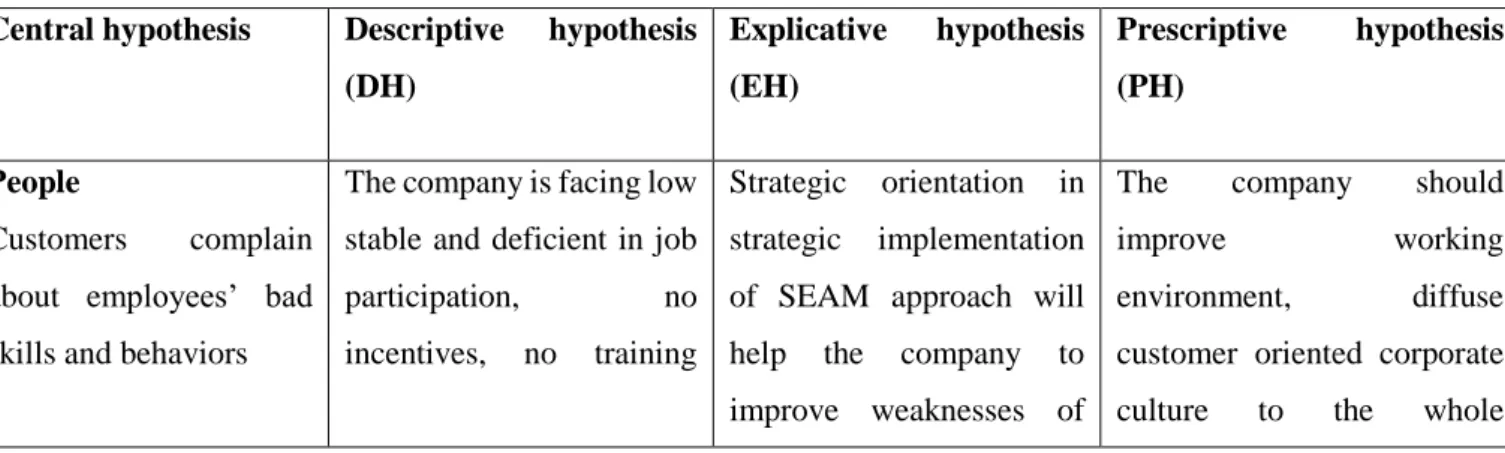
Central core hypothesis: It’s possible for a SME in passenger transport service industry to improve organizational performance by implementing customer complaint management through socio economic approach to management for inter-city bus service. To do that, SME should implement solutions to solve problems of People, Process and Technology as presented in the below table.
21
Table 1: Sub-hypothesis of central hypothesis Central hypothesis Descriptive hypothesis
(DH) Explicative hypothesis (EH) Prescriptive hypothesis (PH) People Customers complain about employees’ bad skills and behaviors
The company is facing low stable and deficient in job participation, no incentives, no training
Strategic orientation in strategic implementation of SEAM approach will help the company to improve weaknesses of
The company should
improve working
environment, diffuse customer oriented corporate culture to the whole
22
programs, and no clear regulations for employees.
human resource
management.
employees, training them professional programs, and labor policies.
Process
Customers complain a lot about delayed schedules and wrong time, resulting in gradually decrease in this service’s profitability. There is no innovation from 2008 to 2014, inter-city bus service cannot compete with crowded competitors; lacking functional strategy such as marketing strategy leading to bad relationship between the company and customers; and no clear strategy
Working conditions and strategic implementation dysfunctions of SEAM will support the company to improve business process
Some specific actions are suggesting socially responsible corporate strategy, organizational learning from other successful companies, selecting offensive marketing strategy, launching new limousine service, using software to manage business processes.
Technology
Old and broken cars make customers feel worried and afraid of accidents. There is no medical equipment in the inter-city bus with long trip.
The company has no booking system, so uncertainty of profitability is very high, the company cannot predict customers’ needs and well prepare to serve customers.
There is no investment into vehicles from the year of 2008 to 2014
Information system and Strategic orientation in Strategic implementation of SEAM will make the company to improve technology component of customer relationship management
The company should invest into new vehicles and new information technology.
Scope and limitations
Scope of the dissertation is to focus on combining aggregate complaint analysis aspects of customer complaint management at strategic level; integrated holistic approach between People, Process and Technology; and organic approach of exit-voice theory to successfully conduct qualimetrics intervention research, specifically as below:
23 Firstly, Lapidus et al. (1994) describe two key parts of customer complaint management that are individual complaint handling and aggregate complaint analysis. A few studies approach complaint analysis at the aggregate level although previous researchers provide theoretical support for its profitability (Fornell et al, 1987; Johnston, 2001) and guidelines for its implementation (Lapidus et al, 1994). Moreover, aggregate complaint analysis is rarely used in action research as well as reviewed in literature. The author chose aggregate complaint analysis which allows a company to manage its business proactively. The aim is to identify the causes of complaints, deriving strategic changes in business practices that can be communicated across all levels of the organization to reduce complaints over time. In order to improve customer complaints, it’s important to implement strategic change with priced costs for a flagship service of a SME. In this dissertation, the PhD student applies SEAM to find dysfunctions, hidden costs as well as suggest action plans and evaluation of the research project’s effectiveness, that reinforces aggregate complaint analysis at strategic level and that hasn’t been studied in any research before.
Secondly, Hsiao et al (2016) describes stages of customer complaint management in combination with service quality, but this study proves that the relationship between customer complaints management and organizational performance can be strengthened by implementing SEAM is a new contribution to relationship marketing.
Thirdly, organizational performance is broader measured than the one in previous researches, in which measurement includes not only economic performance, stakeholder satisfaction, but also customer complaint management profitability, social performance, and decreased hidden costs.
Limitations of the research are not to cover an aspect of individual complaint handling in customer complaint management. One more approach of exit-voice theory is mechanistic that based on establishing guidelines hasn’t been developed in this dissertation and will be done in 2020 with quality of process, behavioral and outcome guidelines.
Moreover, although the case study is conducted in a locality of Vietnam (Thai Nguyen province) that comprehensively reflects Vietnam context in transportation service industry, it will not be assured findings and recommendations to the world.
24
Organization and structure of dissertation Introduction
Introduction part introduces the overview of critical contents which the audiences can understand without reading the whole dissertation. It illustrates author’s background in subject, introduction to SMEs in Vietnam, context and origins of research in Vietnam’s transport industry, problem statement, research objectives and research questions, hypothesis, scope and limitations, organization and structure of dissertation.
Chapter 1: Literature review
This chapter presents the relationship between customer complaint management and organizational performance through socio economic approach to management. Besides, the author also describes reality of Vietnam related to the research topic such as Vietnam’s researches in customer complaints management and organizational performance, and challenges of implementing customer complaint management through SEAM in small-and-medium sized enterprises of developing country such as Vietnam.
Chapter 2: Research methodology
This chapter describes types of action research. Also, the author analyzes theoretical framework specific to customer complaint management. Besides, methodological fit in management field research is presented to prove that this research is consistent to implement intervention research or not.
More specifically, abductive method of processing qualitative data is used in this dissertation. Based on SEAM approach, the socio – economic problem solving method comprises four stages: (1) Diagnostic of dysfunctions and evaluation of hidden costs; (2) Cooperative conception and development of innovative organizational solutions; (3) Structured implementation of improvement actions and (4) Evaluation of organizational performances.
The four stages were conducted two times, step – by – step. After evaluation of the first plan in 2016, the researcher repeats the four stages of SEAM again for the second action plan during the period of 2017-2018. Firstly, in 2014, the researcher focused on People, Process and Technology problems of the case study. Secondly, in 2016, the researcher focused on