Asbestos: Operating System Security for Mobile
Devices
by
Martijn Stevenson
Submitted to the Department of Electrical Engineering and Computer
Science
in partial fulfillment of the requirements for the degree of
Master of Engineering in Computer Science and Engineering
at the
MASSACHUSETTS INSTITUTE OF TECHNOLOGY
May 2006
@
Massachusetts Institute of Technology 2006. All rights reserved.
Author..
.. /.I.- ,. ...Dep
amentofElectrical
Engineering and Computer Science
May 26, 2006
C ertified
by ....
.:. ...
Robert T. Morris
Associate Professor
7Thesis Supervisor
/PAccepted by
.. , ... ... ...Arthur C. Smith
Chairman, Department Committee on Graduate Students
ARCHIVES
MASSCHUSETTS INSTITUTE OF TECHNOLOGYAUG
1
4
2006
LIBRARIES
-
.1 ··-;/ .... '~~~'Asbestos: Operating System Security for Mobile Devices
by
Martijn Stevenson
Submitted to the Department of Electrical Engineering and Computer Science on May 26, 2006, in partial fulfillment of the
requirements for the degree of
Master of Engineering in Computer Science and Engineering
Abstract
This thesis presents the design and implementation of a port of the Asbestos oper-ating system to the ARM processor. The port to the ARM allows Asbestos to run on mobile devices such as cell phones and personal digital assistants. These mobile, wireless-enabled devices are at risk for data attacks because they store private data but often roam in public networks. The Asbestos operating system is designed to prevent disclosure of such data. The port includes a file system and a network driver, which together enable future development of Asbestos applications on the ARM plat-form. This thesis evaluates the port with a performance comparison between Asbestos running on an HP iPAQ hand held computer and the original x86 Asbestos.
Thesis Supervisor: Robert T. Morris Title: Associate Professor
Acknowledgments
I would like to thank my thesis advisor, Robert T. Morris, for his support and guidance on this thesis. Robert always welcomed and answered technical inquiries and he provided a strong vision for what this thesis should accomplish. Without his insights the ARM Asbestos port would not have reached completion.
The people of the Parallel and Distributed Operating Systems group at MIT helped make my working environment a, pleasant one. While Professor Frans Kaashoek
appreciated my accomplishments, Micah Brodsky and Max Krohn shared my frus-trations and often provided a helpful set of eyes or ears when problems arose. In
addition, I thank Asbestos team members Eddie Kohler, Steve VanDeBogart and Petros Efstathopoulos for giving me code, critique, benchmarks and advice. Helpful also were the words of iPAQ wizard Jamey Hicks, and the work of other developers
at www. handhelds. org.
Finally I want to thank my parents for the support they have given me these past five years at MIT. I have always been able to count on them for words of wisdom and encouragement.
Thllis research wiLs supported by a grant from Taiwan's Industrial Technology Research Institute. Portions of this thesis are adapted from and/or contain text written in ma.ster's theses by Cliff Frey
Contents
1 Introduction 1.1 Motivation: 1.2 Motivation: 1.3 Motivation: 1.4 Challenges 1.5 Approach 1.6 Outline . Asbestos ... Mobile Security . ... ARM ... ... 2 Related Work 3 Development Environment 3.1 Hardware . ... 3.1.1 The iPAQ h5555 ... 3.1.2 Bootldr: A Flash Bootloader. 3.2 Software . ...3.2.1 Simulators ... 3.2.2 Compilation ...
3.3 ARM Platform Peculiarities ... 3.3.1 Data Alignment ... 3.3.2 Floating Point ...
3.3.3 Caches & Write Buffers. . . 4 Porting the Asbestos Kernel
4.1 Booting Asbestos
4.2 Entering and Leaving the Kernel ... . 35
4.2.1 Context Switches ... ... 35
4.2.2 User Page Fault Handler ... .. 39
4.2.3 Passing Arguments ... .. . . 41
4.3 Memory Management Module ... ... 41
4.3.1 Page Table Entries ... ... 41
4.3.2 Page Directory Entries ... ... 43
4.3.3 Defining the MMU HAL ... .. 44
4.4 Hardware Modules ... ... . 47 4.4.1 Serial Port ... ... 47 4.4.2 Timers ... . ... 47 4.4.3 Interrupts ... ... . 48 4.4.4 Memory-mapped IO ... .. . 48 5 System Services 51 5.1 File System ... ... 51
5.1.1 Compact Flash Driver ... ... 51
5.1.2 Separating Pages and Blocks . ... 52
5.2 Network ... ... ... ... 54
5.2.1 PCMCIA ... ... 55
5.2.2 The Orinoco Wireless Driver . ... 55
6 Evaluation 57 6.1 Measuring Performance ... ... 57
6.2 Results ... ... ... .. 58
6.2.1 Caching ... ... 59
6.2.2 Operating System Benchlnarks ... . . ... 60
6.2.3 ARM Efficiency .... . ... ... 62
6.3 Cleanliness & Portability .... .. . . ... .. ... 66 8
7 Conclusion
A Code Split 69
B ARM Asbestos HOWTO 71
B.1 Running Asbestos on the Skyeye Simulator ... . . ... .. 71 B.2 Running Asbestos on the iPAQ.. . . . .. . . ... . .. .. 72 B.3 Hardware Notes and Resources ... . .. . .. . ... .. ... 73
List of Figures
3-1 Data bytes accessed by a non-aligned address . .
3-2 The structure packing problem on ARM .
4-1
4-2 4-3
4-4
rThe Asbestos HAL . ...
An ARM context switch from kernel to user mode An ARM context switch from user to user mode . Virtual addresses and page table entries . . . . 5-1 Old and new Asbestos file structures . . . ..
6-1 Assembly code to test memory write performance .
.. . . . 34 . . . . . 39 . . . . . 40 .. . . . . 42 .. . . . . 53 . . . . . 64
List of Tables
3.1 Relative speeds of floating point operations . ...
4.1 ARM mapping between exceptions and resulting execution modes 4.2 Asbestos page table permission mappings . ...
4.3 ARMv4 and ARMv5 access permission bits . ... 6.1 6.2 6.3 6.4 6.5 A.1 A.2 A.3
Kernel label operation benchmarks in thousands of cycles. Operating system benchmarks in thousands of cycles. ... ARM efficiency for each OS benchmark . ... . Random-access memory benchmarks. ...
Possible caching scenarios and resulting CPI. ... Separate kernel code . ...
Mostly shared kernel code ... Shared kernel code . ...
. . . . 59 . . . . 60 . . . . 63 . . . . 64 . . . . 65
Chapter 1
Introduction
This thesis presents the port of the Asbestos operating system to the ARM proces-sor architecture. ARM Asbestos brings the operating system security guarantees of Asbestos to a mobile computer, supplemented by a, file system and a network driver.
1.1
Motivation: Asbestos
On most networked computers, only a suite of user-level software protects private data from remote access. Experience has shown that it is too difficult to ensure that all software handling private data is free of exploitable flaws. We routinely learn about exploits made possible by buffer overflows [11, 10, 9, 12, 14], vulnerabilities in the Java, virtual machine [13], and improper allocation and deallocation of memory [15].
Typically, these vulnerabilities result in the complete compromise of the system. Instead of relying on a~pplications to protect sensitive data, one can contain soft-ware flaws at the operating system level, using the principle of least privilege [36]: each part of a system should have no more than the capabilities required for it to
performn its tasks. For example, an email reader should be able to confine an exe-cutable attachment by only giving it access to a display window and restricting its access to the network and file system. A Web a.pplication should be able to ensure that one user's private data cannot be sent to another user's browser by faulty Web server aI)plication code.
The Asbestos operating system employs the principle of least privilege to limit the impact of exploited software vulnerabilities [28, 19]. It allows programmers to dynamically define data compartments, and only grant access to that data to those system services that require it. An example is the OK Web Server (OKWS) for Asbestos [29]. Using the security primitive of Asbestos labels, OKWS creates a compartment for each user's data. It restricts the compartment such that it can only communicate with a specialized worker process, the trusted local database, and a, single connection to the network. The rest of the network connections and the other processes cannot communicate with the worker, thus preventing the unintended disclosure of information.
1.2
Motivation: Mobile Security
The development of Asbestos OKWS for desktop servers was a direct response to the security breaches experienced in recent years by web-based organizations. However, desktop servers are not the only types of computers coping with threats coming from the network. The mobile device space is a prime candidate for security research, because hand held devices are facing increasing threats as their popularity grows. The security threats to mobile devices are similar to the threats facing servers in that these devices can remain on without user attention, and are always connected to a network. There are already billions of cell phone, PDA and smart phone users [34], whose devices often store private data such as phone numbers and addresses. The demand for global connectivity is quickly driving phone service providers to consolidate networks and standardize communication protocols [20], making it easier to create attacks that affect large numbers of users. Network bandwidth and storage are expanding to meet increased demand for data, downloads and mobile data, increasing the risk of data. leaks and the spread of malicious code. The first mobile worms have already a.ippeared [37], and we should expect the security risks to increase as mobile networks grow and users trust their mobile device software to handle more personal data.
1.3
Motivation: ARM
The Asbestos port to ARM is beneficial because the ARM processor dominates mo-bile computing. The x86 processor is one of the most common CPUs in desktop computers. Mobile devices, on the other hand, have stringent power requirements: lower power consumption means longer battery life. The dominant chips in the mobile market are ARM processors. ARM manufactures 90 percent of processor cores for cell phones. A host of other mobile devices also run on ARM processors, including many PDAs and Apple Computer's iPod. In 2004, 1.3 billion chips shipped contained ARM cores [35]. Porting Asbestos to ARM will bring operating system security guarantees to a large number of mobile devices.
1.4
Challenges
Several challenges arose in porting Asbestos to the ARM. Not the least of these challenges was that, until now, Asbestos has been a pure x86 operating system. This is the first attempt to port Asbestos to any other architecture. This project had to define a Hardware Abstraction Layer (HAL), a common interface between the kernel and the hardware. This proved difficult because the ARM and x86 processors have different memory management hardware. In particular, x86 Asbestos makes use of unused bits in the hardware page table entries to store extra state. The ARM port had to mimic this behavior, sometimes without extra bit space. This first port of Asbestos also uncovered a. number of previously untickled kernel bugs. as also happened frequently during the development of the OK Web Server.
Another challenge in porting Asbestos was choosing a suitable ARM platform for deployment. The ARM architecture has existed for fifteen years and has evolved considerably in that time. There are many generations of ARM processors, and while most supp)ort a consistent instruction set, there are small variations between the generations. ARM processors are used in many different configurations of commercial devices, which made it. difficult to find ARM simulators that work for a specific
hardware model (the HP iPAQ, in this case). In addition, the wide range of ARM devices means open-source drivers are not available for all ARM hardware layouts. Fortunately this project was able to build on code from other ARM ports, such as
ARM Linux for the iPAQ, maintained at www.handhelds.org.
Finally, there were challenges in designing the system services for ARM Asbestos, namely the file system and the network driver. The Asbestos file system (ASFS) uses little-endian ELF program images. One challenge was maintaining binary compatibil-ity for the file system across architectures, so that program image files may be shared between the ARM and x86 builds. Another challenge was the medium on which the file system is stored. x86 Asbestos can interface with IDE disk drives for persistent storage, or can maintain file system state in RAM. To achieve persistent storage on disk-less ARM architectures, Asbestos requires a Compact Flash driver.
Implementing a new network driver presented yet other challenges. x86 Asbestos supports two wired ethernet network cards: the e1000 and the ne2k. A network interface in a mobile device is guaranteed to be a wireless network card, probably supporting 802.11 Wi-Fi. Adapting to this kind of interface requires a wholly different network driver than the drivers currently in place. Furthermore, the ARM network driver should interface with the LWIP network stack [17], just as x86 Asbestos does. This way, both builds can use netd, the user process that implements the network service.
1.5
Approach
The work in this thesis took place in several steps. First, to gain familiarity with the ARM instruction set and hardware, I ported the JOS kernel to ARM. The Asbestos operating system is based on the much simpler JOS operating system used for systems education at MIT, UCLA and NYU [1]. The JOS port involved setting up a simple boot process and interfacing with the serial port to establish a minimal debugging environment. Next I set up a crude memory management system and simple context switching, proving that the basic needs of Asbestos can be met by the ARM processor.
The second step was to merge this early development with the Asbestos mainline. In deciding what system modules the x86 and ARM builds would share, I defined the Asbestos Hardware Abstraction Layer (HAL), a hardware interface that determines what is required of future ports of Asbestos. The merging step ensured that the various versions of Asbestos remain synchronized as the Asbestos security mechanisms
and system services develop.
Next I designed the essential services for ARM Asbestos: the file system and network driver. The file system is based largely on x86 ASFS, although file blocks had to be decoupled from x86 pages. In this thesis I discuss the design of a Compact Flash driver and wireless network driver, though their implementation is not finished at the time of writing. The goal of the Compact Flash driver is to utilize permanent storage on mobile devices. The network driver will be based on open-source ARM
Linux for iPAQs, and should implement the 802.11 wireless protocol.
Finally I evaluated the port, assessing whether ARM Asbestos' performance is comparable to x86 Asbestos on commodity mobile hardware. I ensure that ARM Asbestos does indeed meet the basic usability requirements of a mobile operating system.
1.6
Outline
The remainder of this thesis is organized as follows. Chapter 2 discusses related work in operating systems and mobile computing. Chapter 3 summarizes the development environment for the ARM Asbestos port. A lot of time on this project was spent gaining understanding of the ARM architecture, and its software and hardware pe-culiarities. Chapter 4 discusses the design and implementation of the ARM Asbestos kernel. It explores how this port forked from x86 Asbestos and examines the choices made in defining the Asbestos HAL. Chapter 5 considers the design of the file sys-temn anud l etwork initerface. Chapter 6 evaluates the I)erformance of the ARM port
by compnlaring it to x86 Asbestos. Finally, Chapter 7 concludes with a review of the
Chapter 2
Related Work
The Asbestos operating system was designed for the x86 architecture, without specific regard for future expansion. This thesis aims to run Asbestos on the ARM architec-ture. Other operating systems have demonstrated the utility of supporting multiple platforms. NetBSD is a, Unix-like operating system that also started on the x86, and since 1993 has been ported to seventeen different processors and more than forty plat-forms [33]. Some operating systems were designed from the start with portability in mind. eCos, a flexible real-time operating system, now supports ten different proces-sor architectures [18]. eCos distances the core OS software from platforms' hardware differences with a Hardware Abstraction Layer (HAL): a programming interface be-tween hardware and software. Porting eCos involves implementing the HAL on a new system, after which the port is guaranteed to work. The Asbestos port achieves platform separation with two sets of architecture-specific code files. In essence the decisions about how to separate source files define a HAL: each new Asbestos port will only have to implement the functions that the ARM port implements.
The ARM port of Asbestos borrows some code from other sources. The volunteers at http:,//www. handhelds. org have made a considerable effort at porting Linux to various ARM iPAQs [22]. The handhelds.org implementations provide examples of how to control iPAQ hardlware such as 802.11 wireless cards. The Asbestos port uses the CoIni:,aq/HP l)bot loader to transfer Asbestos images to the iPAQ and boot them. ARTMI Asbestos takes (:les about cnemory management and context switching from
JOS, the educational operating system on which Asbestos is based. The port uses the same lightweight TCP/IP stack as x86 Asbestos to control the network driver [17].
Asbestos, like JOS, is a. microkernel: most of the drivers and system services are pushed out of the kernel into user processes. While often criticized for their lower performance, microkernels can achieve security and reliability goals which monolithic kernels can never hope for. The L4 microkernel [23] separates an operating system from its drivers and applications by running each component in a separate virtual machine. The Minix 3 microkernel [24, 38] exclusively handles process management, scheduling, interrupts and IPC. In user space it has applications layered on top of servers, layered on top of device drivers. The kernel automatically restarts any of these entities in case of a crash or failure. Both of these microkernels achieve reliability by separating critical code from drivers and servers. Asbestos adds strict security guarantees by restricting communications and data sharing between processes.
Many different operating systems support the ARM architecture. Commercial operating systems include Windows CE, Palm OS and Symbian. There have also been efforts to port existing desktop operating systems such as Linux, by compa-nies [31, 30] and groups of volunteers [22]. None of these systems have security as a primary focus, which is cause for some concern. A security evaluation of Windows CE identified all of the traditional security concerns of desktop Windows, as well as new vulnerabilities [16]. The many new interfaces that mobile devices support (wireless networking, Bluetooth connections, infrared ports, and telephony) allow communica-tion with fewer restriccommunica-tions than tradicommunica-tional Ethernet.
Chapter 3
Development Environment
This chapter will describe the development environment in which the work for this thesis was performed. It will detail the hardware that was available, as well as software that either simulated the hardware or aided in its use. The information may serve as a. guide not only to future developers of ARM Asbestos, but also as a reference to anyone developing for the ARM platform.
3.1
Hardware
The port of ARM Asbestos was frequently tested on real hardware, ensuring that the port did not rely on simulator oddities, such as initially zeroed memory. The hardware used was an HP iPAQ pocket computer, model h5555.
3.1.1
The iPAQ h5555
The h5555 is a powerful hand held computer. It contains a 400 MHz PXA255 XScale processor developed by Intel, as well as two 64 MB banks of SDRAM. It also has a 48 MB Compact Flash card inside (not removable) and an SD/MMC card expansion slot. The h5555 boasts an array of wired and wireless interfaces: USB. Bluetooth,
Wi-Fi and Infrared. It ships with the Windows Mobile 2003 operating system. the
use of the LCD touchscreen, speaker or microphone. While these are nice features for a production OS, the focus of this thesis was on providing operating system security to a hand held device connected by a wireless interface (Wi-Fi in this case).
3.1.2
Bootldr: A Flash Bootloader
The first step to this project was to remove the production operating system and replace the bootloader with something that could download and boot a custom kernel. I followed the detailed instructions in The Linux iPAQ HOWTO [5] to install a new bootloader named Bootldr. Bootldr was written by developers at Compaq [7] and www. handhelds .org [25]. The key functionality of Bootldr is that it allows developers
to upload kernel and file system images from a PC to the iPAQ's Compact Flash card. The transfer happens over the serial line via the iPAQ's cradle. Once a recognized image is uploaded (such as a Linux kernel image), Bootldr can copy the OS image into RAM and boot it.
The ARM port takes a small shortcut by booting Asbestos as if it were a Linux kernel. A Linux identifier in the right place in the kernel image will cause Bootldr to start up the Asbestos port. The choice of starting Asbestos as a Linux kernel will ease future deployment onto other driven ARM devices. Alternate Linux-enabled devices with wireless cards are the Nokia N770 Internet Tablet and several Linux-based smart phones.
There are several annoying limitations to testing Asbestos on iPAQ hardware. First and foremost, Bootldr does not support USB file transfers, though the cradle plugs into the USB port on the iPAQ and has a USB connector for the PC. This means that every test of Asbestos on hardware involves a painstaking transfer over the serial port. The slimmed down version of Asbestos is approximately 2 megabytes large, partly due to the lack of dynamic library linking. At a, transfer speed of 115,200 bits per second, uploading such an image to the hardware takes two and a half minutes. This makes for a rather slow development cycle.
Another oddity that. slowed the development cycle was the interaction of Bootldr with the h5555*s battery charging circuit. The iPAQ's main charge circuit is
un-fortunately activated in software, for example by Bootldr. When the iPAQ is reset, Bootldr shows a boot> prompt and charges. However, the iPAQ does not charge in its cradle when Asbestos runs, or after Bootldr loads an image over the serial port. If the iPAQ remains in one of these states for long, it is possible for the lithium ion battery to get so discharged that after the next reset, it hangs during the boot process and buzzes without stopping. The solution in this case is to leave the battery and iPAQ disconnected for several hours, and then perform a special "hard reset" that wipes all of Flash except for the protected Bootldr partition. To avoid this time-consuming and battery-damaging error state, it is best to always reset the iPAQ after every boot or image load, allowing it to charge in the cradle when not in use.
In spite of these frustrating development quirks, Bootldr is an essential part of iPAQ OS development. Without it, the Asbestos ARM port would hardly have been possible.
3.2
Software
A lot of time in this project was spent trying to discover what software tools were needed. In choosing software tools, I had two goals: speeding up development and maintaining compatibility with x86 Asbestos.
3.2.1
Simulators
In the face of long hardware testing cycles, I searched desperately for good simulators. The first tool tried wa.s Sim-iPAQ, a SimpleScalar-based [4] iPAQ simulator developed in a joint power modeling project between the University of Michigan and the Uni-versity of Colorado [32]. The project wa.s last updated in 2002, and halfway through the port I discovered that the simulator was laden with bugs and did not support. the entire iPAQ architecture. At this point Jamey Hicks, the principal Bootldr developer, advised me to try SkyEye [26], an open-source ARM simulator developed at several universities in China a.ndl maintained a.t http://www. skyeye. org/. SkyEye suI)pports several of the latest ARM\ CPUs and a host of peripherals including timers. UARTs
and even LCDs and touch screens. The latest version also allows remote debugging through GDB.
SkyEye is under active development, which is both a benefit and drawback. On the one hand, it is not a finished product: support for the PXA255 processor was just recently added. Before this point I used the SA1110 processor model to test the port. On the other hand, SkyEye has an active developer community that responds to user questions, and new features and bug fixes are constantly being released.
3.2.2
Compilation
At the start of this project, the ARM port was compiled using a prebuilt x86-to-ARM cross-compiler tool chain of GCC 2.95. I soon found it necessary to build my own cross-compiler (arm-elf-gcc 3.4.3) for a variety of reasons. First, the developers of x86 Asbestos began to use advanced compiler directives in their source code. Such di-rectives included nested C structures and unions and the "__builtinexpect" keyword, which allows the compiler to do branch prediction. Second, I needed to specify the architecture I was compiling for. In particular, the PXA255 does not have a floating point unit, so the compiler needs to include software floating point libraries. This is discussed further in Section 3.3.2.
There are many generations of ARM processors with similar instruction sets but wildly varying hardware. The compiler, arm-elf-gcc, lets developers specify the ar-chitecture version of the targeted machine. The ARM Asbestos port is compiled for ARM version 4, the oldest and most compatible version of the architecture supported today [3]. More recent ARM processors have instruction sets that are backwards compatible with ARIMv4, making it a, good target version. The compiler can also generate either big- or little-endian ARM instructions. For compatibility with the little-endian x86. we use the ARM CPU in little-endian mode.
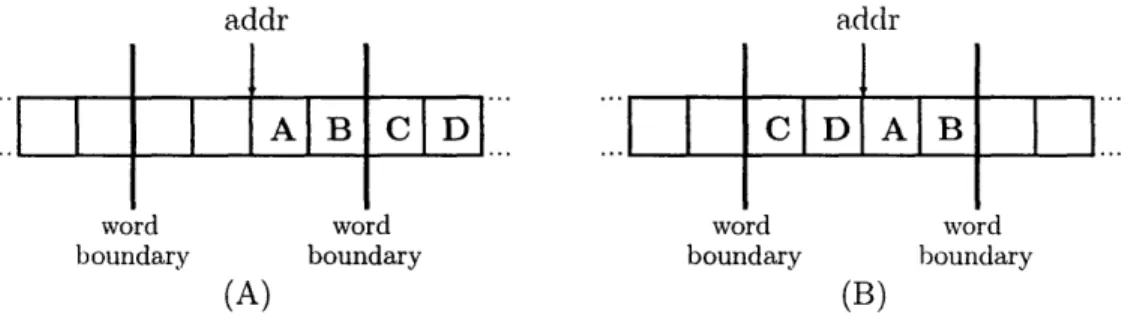
addr addr
A B C
I I C D A
I
word word word word boundary boundary boundary boundary
(A) (B)
Figure 3-1: Data bytes accessed by a non-aligned address
On x86 (A) bytes are accessed sequentially, whereas on ARM (B) bytes wrap around to the start of an aligned word.
3.3
ARM Platform Peculiarities
In the course of porting Asbestos to ARM, I encountered some distinctive ARM behaviors that cost me many hours to track down. These behaviors often appeared only on hardware, and always caused strange crashes.
3.3.1
Data Alignment
ARM processors have become popular because they are cheap and simple. This is in part because ARM CPUs, like other RISC processors, are optimized to efficiently access aligned data. ARM processors do very well with addresses that are word-aligned (multiples of four). In contrast, the x86 can access data. at any byte offset.
ARM CPUs perform an interesting and counterintuitive operation when directed to load or store data at a non-aligned address. For any access that passes a. word boundary, ARM processors rotate excess bytes around to the start of the currently accessed word. See Figure 3-1 for an example of a word access performed at a non-word boundary. Unless the compiler is specifically instructed to access data one byte at a time, programs will read wrapped data values when accessing, for example. a 32-bit field at an address that is not word-aligned.
GCC 3.4.3 is relatively clever about aligning data structures so that data words lie on word boundlaries. It normally pads structures with extra, unused bits so that
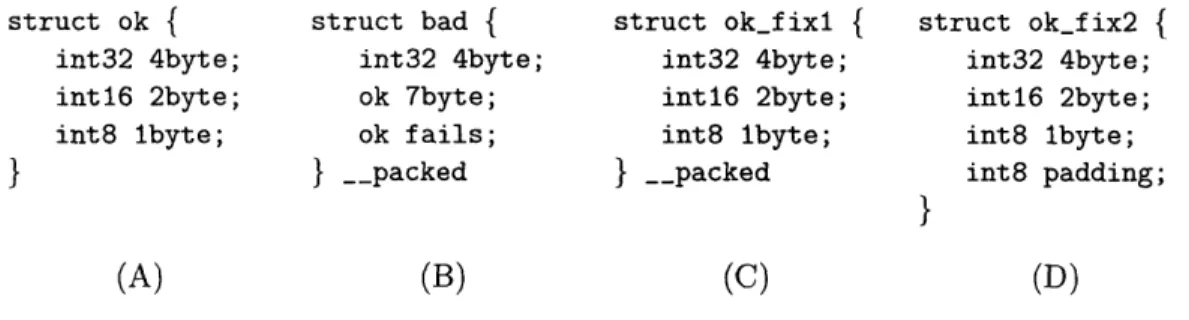
struct ok { struct bad { struct ok_fixl { struct ok_fix2 {
int32 4byte; int32 4byte; int32 4byte; int32 4byte; int16 2byte; ok 7byte; int16 2byte; int16 2byte;
int8 1byte; ok fails; int8 1byte; int8 1byte;
} } __packed } __packed int8 padding;
}
(A) (B) (C) (D)
Figure 3-2: The structure packing problem on ARM
Structure A is automatically padded by the compiler to end on a word-boundary. Structure B is packed, but contains two non-packed instances of A. The second of these, "fails", will suffer alignment errors. Packing A, which results in Structure C, forces the compiler to generate correct byte-by-byte accesses. Another solution is manually padding A to ensure proper alignment in B, resulting in structure D.
the average developer doesn't have to worry about alignment problems. When data structures are defined as packed, however, alignment becomes an issue on ARM. The keyword "packed" directs to compiler not to insert padding to auto-align fields. Packing a structure on ARM also forces the compiler to generate slow, but correct, byte-by-byte data accesses [2]. In x86 Asbestos, developers packed the File structure to ensure that the compiler would not inflate it beyond its intended 256-byte size. This caused problems for the ARM port, because the data fields of internal C structures ended up unaligned, as Figure 3-2 illustrates. This problem has two solutions. One solution is to declare the internal C structures packed as well, keeping data fields unaligned, but ensuring byte-by-byte accesses. This slows down the accessing code tremendously, requiring four times as many memory accesses for every word-length data field. The alternative, chosen in Asbestos, is to remove the packed attribute from the File structure and its internal structures. Instead, the data fields of all involved
structures are padded manually to ensure correct (and speedy) access on ARM.
Modern ARM processors such as the PXA255 contain hardware alignment check-ing, a. useful new developnlent feature that helps prevent alignment errors. By raising
a flag to the mnemiorv management unit, the programmer can let the hardware throw an alignment fault (including the faulting address) whenever a word-aligned
instruc-Table 3.1: Relative speeds of floating point opera.tions OS FPU? Compile Flag Relative speed Gentoo Linux yes hard-float 77
ARM Asbestos no soft-float 7 ARM Linux no hard-float 1
tion is called on a byte-aligned address. This has proved to be extremely useful during the Asbestos port.
3.3.2
Floating Point
Most modern CPUs are bundled with floating point units (FPUs), coprocessors that rapidly perform non-integer arithmetic. ARM developers have several options when it comes to handling floating point math. If the target architecture has an FPU, the compiler can generate special instructions for the hardware unit using the "hard-float" compilation option. Alternatively, developers can use a compiled-in library of optimally coded software floating point routines, included by the compiler flag
"soft-float".
Not all ARM ports can use "soft-float", particularly because using this flag changes the ARM calling conventions and thus makes the binaries incompatible with compiled "hard-float" code. The default on ARM Linux has traditionally been to have the compiler use hard-float, even though ARM Linux never ran on any ARM CPU with a hardware FPU. On every FPU operation, this operating system catches an invalid instruction exception in the kernel and emulates it in software. Not only must the kernel perform the FP operation, it also emulates the whole hardware FPU [21].
Table 3.1 shows the relative speeds of the floating point options [27]. Unfor-tunately. the PXA255 does not come with a floating point coprocessor. However. because it does not depend on a legacy ARM code base, ARM Asbestos can choose the "soft-float" option, which is the optinmal solution without an FPU.
3.3.3
Caches & Write Buffers
The ARM processor has a hardware cache and a write buffer which can be separately enabled by raising a flag on the memory management unit. Turning on these hardware features is an optimization, and not essential to the operation of ARM Asbestos. However, principal Bootldr developer Jamey Hicks reported a twofold improvement in performance after enabling ARM hardware caching. Mr. Hicks said that write buffer improvements were less noticeable, so the ARM Asbestos efforts have been focused primarily on enabling the cache. Data caches and instruction caches can be separately enabled on the ARM MMU. On PXA chips the data and instruction caches are separate entities, but on other chips they may be shared. When caching is on and buffering is off, ARM caches act as write-through, meaning data writes immediately pass to memory.
Maintaining cache coherence is a new problem for Asbestos. The x86 features a physically addressed cache: all data is remembered by its physical address. Because all writes to random-access memory are reflected in subsequent reads, it is impossible to get inconsistent cache state on x86. The only caveat is memory-mapped IO, which must always be marked uncacheable. ARM processors feature virtually addressed caches, in which cache data, is associated with virtual addresses and cache lookups occur in parallel with virtual address translation. The major problem with caching on ARM is that Asbestos maps all user pages doubly: one virtual address is used in user space, the other is used in kernel space.
Maintaining two ca~ched virtual address lines for one physical memory location can cause cache inconsistencies. One example is the kernel block cache. The block cache fulfills a user write request by copying data to a user page's kernel space address. When a user process (even the one that wrote to the block) performs a read on this cached address, the cache will return stale data. Although the data at the physical a.ddress of the block has changed via the kernel virtual address, the user cache line
remembers the old data values. In this exa.mple, the solution is to invalidate the cache
will be answered by the up-to-date kernel block cache instead of the hardware cache. Cache problems such as these are usually difficult to fix because there is no local solution: if the block cache had access to the user virtual address of the page, then it could p)erform memory writes to the user address, avoiding the cache consistency problem altogether.
To fix the Asbestos cache problem in general, I make several observations. First, user code only has access to the user space virtual address of a user page: only the kernel (a.s a, whole) has a choice of which address to write to. Second, kernel code is of a restricted size while user code is not: one can fix cache problems in the kernel, but cannot predict what code programmers will run on Asbestos in the future. Finally, it is cleaner to fix cache issues in the operating system than in user applications: application programmers should not be burdened with maintaining cache consistency. With these observations in mind, I decided to handle cache invalidations in the kernel code.
Cache lines only need to be invalidated if they represent user memory; kernel memory only has one virtual address. The kernel has access to all three different addresses representing user data pages. Given a user-space virtual address, it can always discover the kernel-space virtual address as well as the physical address. Be-cause MM1U page translation remains on in kernel mode, the kernel will never perform data accesses via a physical address. However, kernel code does use the user-space and kernel-space virtual addresses interchangeably. Access to one physical address through two different (cached) virtual addresses causes cache inconsistencies. To en-sure up-to-date cache ldata, I established the following caching policy. Cache lines representing user data must be invalidated in three cases in the kernel code:
1. Before reading from user memory via a kernel virtual address. After a kernel virtual address first enters the cache, a user program may write to it a.t its user virtual address. Before a. subsequent read, the kernel must invalidate the cached
kernel utirtrual add'ress to prevent reading stale user data.
address representing the physical memory being written may already reside in the cache. In this case it is now stale data, and the kernel must invalidate the
cached user virtual address to ensure freshness on the next access.
3. On any TLB flush. When a, page translation becomes invalid, it means that the cached underlying memory should no longer be readable. The set of TLB invalidations is a subset of the set of cache invalidations.
The implementation of this design in the Asbestos kernel took some effort. Luckily, most user virtual addresses must pass a series of access checks before being derefer-enced by Asbestos kernel code. These checks are the perfect place to implement cache invalidations. For details of how enabling the cache affects the performance of ARM Asbestos, see Section 6.2.1.
Chapter 4
Porting the Asbestos Kernel
The goal of this thesis is to make Asbestos usable on hand held devices. While Asbestos was designed for the x86 architecture, most hand held devices run on ARM hardware. The CPU, memory management unit, interrupt controller and timers are all different on ARM than on x86. The operating system had to be adapted to interface with this completely new set of hardware components.
Because the Asbestos kernel must interface with architecture-specific hardware on each platform, it had to be split into sets of architecture-specific and common components. Deciding how to split the kernel was a major challenge. On the one hand, all the new ARM hardware required a lot of new code. On the other hand, it was desirable to keep the split between architectures minimal for two reasons. First, there was pressure from the other members of the Asbestos development team, who continue to work with the x86 code base to develop new applications that take advantage of Asbestos' security features. Second, a minimal architecture fork means that porting Asbestos to other architectures in the future will be simpler. In splitting the kernel into x86, ARM and common components, I defined a Hardware Abstraction Layer (HAL) for Asbestos. The HAL is the boundary between kernel software and architecture hardware. For details of how the source code was split, see Appendix A. Figure 4-1 shows the Asbestos HAL and the modules it defines. The largest part of the Asbestos HAL is the imemnorv management module. Because memory management is one of the kernel's biggest jobs, there are many references to the
(comon HL iterfce)(separate HAL interfaces)
Figure 4-1: The Asbestos HAL
MMU module in both the shared and architecture-independent code. Both x86 and ARM Asbestos use the same, well-defined HAL MMU interface. On the contrary, the other hardware modules are referenced only by architecture-specific trap handling code. The rest of the Asbestos kernel hardly interfaces with the non-MMU hardware modules because Asbestos, as a microkernel, pushes most driver code into user space. As a result, the interfaces to non-MMU modules are not globally defined: x86 code might call timer_init(), while ARM code might call timer_start(). In this sense, most of the Asbestos HAL is not a list of hardware interfaces, but rather a set of expectations about what functions the hardware should perform. For example, Asbestos expects a timer to raise an interrupt 100 times per second, but there is no common set_timer_interval () function. Section 4.4 discusses each hardware module, and how Asbestos expects each module to function.
This chapter describes the design and development of the ARM side of the As-bestos kernel. First it explains how ARM AsAs-bestos boots and performs context switching. Next it describes the memory management design. The chapter ends with a discussion of several smaller hardware modules, and how they were implemented on ARM.
4.1
Booting Asbestos
All the code responsible for booting an operating system is architecture-specific; it must be replaced during a port. One of the tricky designs of the ARM port is the boot code. On x86, segmentation registers map a physical memory address to a. linear address, and paging maps a linear address to a virtual address. The Asbestos boot process on x86 uses segmentation registers to fool the kernel startup code into thinking that it is running at a high address in memory. Once the page tables are initialized in the kernel, the segmentation offset is set to 0, and paging alone translates low physical addresses to high virtual addresses.
ARM programmers cannot enjoy the luxury (or rather, confusion) of segmenta-tion. The ARM boot code instead creates a full, but temporary, page table mapping between the physical location of the kernel, PHYSBASE, and its final virtual ad-dress, KERNBASE. To ensure that the boot code can continue running in place, there must also be a 1-to-i mapping from PHYSBASE to PHYSBASE. The boot code then turns on the memory management unit (see Section 4.3), activating page translation. Switching on the MMU does not change the CPU's program counter, so the boot code is still executing at its physical address in memory. The final trick is to jump the program counter to a virtual address above KERNBASE, where the entire kernel will eventually be mapped. This readies the processor for the rest of the C boot code, which will create a, new page directory and switch the MMU's pa.ge directory from the temporary mapping to the actual Asbestos memory layout.
4.2
Entering and Leaving the Kernel
4.2.1
Context Switches
Asbestos is a message-passing microkernel, which means system services such as the file system and network driver run as their own user processes. Context switching is very inlmportanlt to Asbestos because all interactions between services. a.s well as process scheduling and system calls, require a. jump into and back out of kernel mode.
In x86 Asbestos, the steps below are taken to handle interrupts from user mode. It is assumed here that the example context switch causes a change of environments, but the same steps are taken when the kernel returns control to the same user process that was interrupted.
1. the CPU enters kernel mode
2. process A's entire execution state is saved at the top of the kernel stack 3. the interrupt or system call is handled in the kernel trap() function
4. process A's state is copied from the kernel stack to A's environment structure 5. process B's execution state is loaded from B's environment structure
6. the CPU enters user mode, running process B
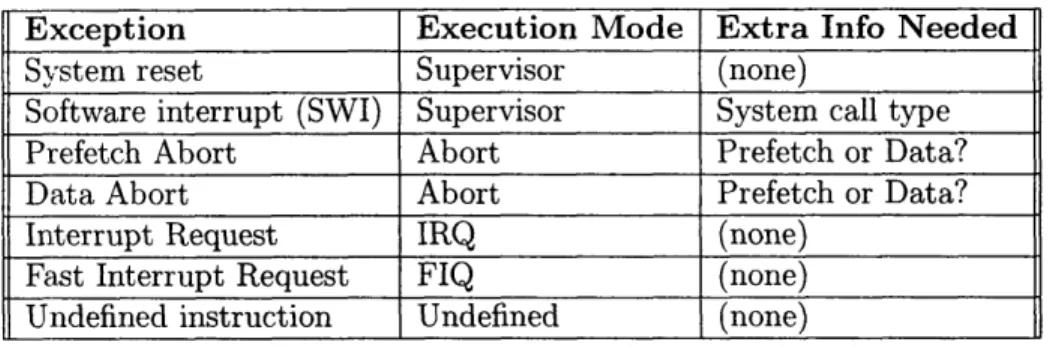
For consistency and clarity, these steps are duplicated in the ARM port, including the somewhat wasteful double copy of process A's execution state. On ARM, however, there is one added step. The ARM processor understands a set of interrupts and exceptions that does not map 1-to-1 to its set of privileged execution modes (see Table 4.1). For example, both Prefetch and Data interrupts will cause the processor to enter Abort mode. Furthermore, any software interrupt instruction, whether intended as a system call or a breakpoint, triggers Supervisor mode. It is for this reason that ARM Asbestos includes a step 2.5 that pushes an extra argument to the trap() function. This argument describes the type of system call (by investigating the last executed instruction in user space) or the type of abort that has occurred (from the type of exception thrown).
Another interesting difference between x86 and ARM is how the kernel knows to get from step 1 to step 2. x86 uses an interrupt descriptor table, initialized by Asbestos on system startup, that maps exceptions and interrupts to kernel entry points. On ARM., this table's address is unfortunately hard-wired into the processor. All interrupts and exceptions cause the program counter to jump to a. virtual address in the range OxO-0x28. At runtime, the ARM port maps this virtual address range
Table 4.1: ARM mapping between exceptions and resulting execution modes Exception Execution Mode Extra Info Needed
System reset Supervisor (none)
Software interrupt (SWI) Supervisor System call type Prefetch Abort Abort Prefetch or Data?
Data Abort Abort Prefetch or Data?
Interrupt Request IRQ (none)
Fast Interrupt Request FIQ (none) Undefined instruction Undefined (none)
to a set of instructions that load the program counter with the interrupt handlers described in step 2.
The multiplicity of execution modes on the ARM creates some challenges regarding context switches. On x86, there are just two modes: privileged (kernel) and non-privileged (user). In Asbestos, these execution modes have separate stacks: a kernel
stack in kernel memory and a user stack in user memory. On every abort, IRQ and system call from user mode, Asbestos clobbers the stack pointer, setting it to the top of the kernel stack. This resetting of the kernel stack is necessary because sometimes kernel code returns from the trap handler by using the function env_run(), which restores user execution state from a trap frame but does not unroll (pop) the stack frames of the trap handler.
On ARM, all the execution modes have separate physical registers for stack point-ers. On traps from user mode Asbestos always clobbers the sta.ck pointer for whatever privilege(d mode it's in to the top of the kernel stack. The problem is that Asbestos also takes two types of interrupts within kernel mode: clock IRQs to configure timers during boot, and page faults to handle copy-on-write pages. In these cases, the trap
handler must avoid clobbering existing data on the kernel stack. When x86 Asbestos takes a trap from kernel mode, it layers the trap frame on top of the kernel stack, handles the trap, and then pops the trap frame without switching stack pointers. Unfortunately. on ARM the execution mode switch also forces a switch to the new mode's stack pointer. It is not easy to load the stack pointers from other execution
modes, so layering stack frames becomes cumbersome. There are three ways to handle this kernel trap problem:
1. Make all privileged execution modes use the same kernel stack. Just after the trap, quickly enter Supervisor mode. Store away the Supervisor stack pointer to a known location, and return to the previous execution mode. Load the Supervisor stack pointer and proceed as on x86, building a trap frame on top of the existing kernel stack.
2. Always use Supervisor mode to handle exceptions. On traps, save the current execution mode's banked hardware registers to a known location. Enter Super-visor mode and load the saved hardware registers, except for the stack pointer (use the Supervisor stack as the only kernel stack).
3. Use separate exception stacks for each privileged execution mode. On user traps, always clobber the stack pointer to point to the kernel stack, regardless of the execution mode. On kernel traps, always clobber the stack pointer to point to a separate execution stack for each mode (IRQ, Abort, etc).
Each of these solutions has advantages and drawbacks. Solutions 1 and 2 implement a shared kernel stack, requiring that recursive exceptions always clean up their stack state (never use env_run() to return). On the other hand, they both allow fully recursive kernel exceptions. Solution 3 does not require exception handlers to clean up their stack state, because separate stacks are used. On the other hand, it allows a layering of exceptions (one for each execution mode), but does not allow fully recursive exceptions. Currently, fully recursive faults are not required in Asbestos, and kernel exceptions (clock IRQs and COW page faults) always clean up their stack state. For the imoinent, then, the choice is arbitrary. I have chosen solution 3: separate exception stacks.
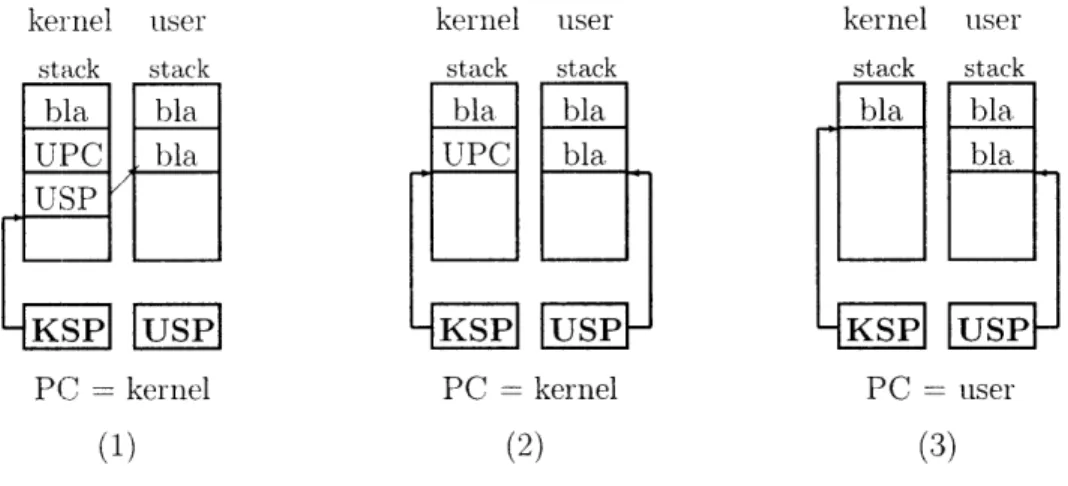
kernel user kernel user kernel user
stack stack stack stack stack stack
bla bla bla bla bla bla
UPC
bla
UPC
bla
bla
USP
KSP USPu
IUSP
KS
KP USP
PC = kernel PC = kernel PC = user
(1) (2) (3)
Figure 4-2: An ARM context switch from kernel to user mode
The kernel trap handler (1) restores the user stack pointer into the user mode stack register (2), then jumps the program counter into user mode (3).
4.2.2
User Page Fault Handler
JOS, the educational operating system on which Asbestos is based, allows user pro-grams to handle their own page faults. This lets user propro-grams dynamically grow their own stacks, allocating new stack pages as space is required. Page faults can even occur recursively, from within the page fault handler! Asbestos adopted this same page fault handling method, which demanded some attention during the ARM port.
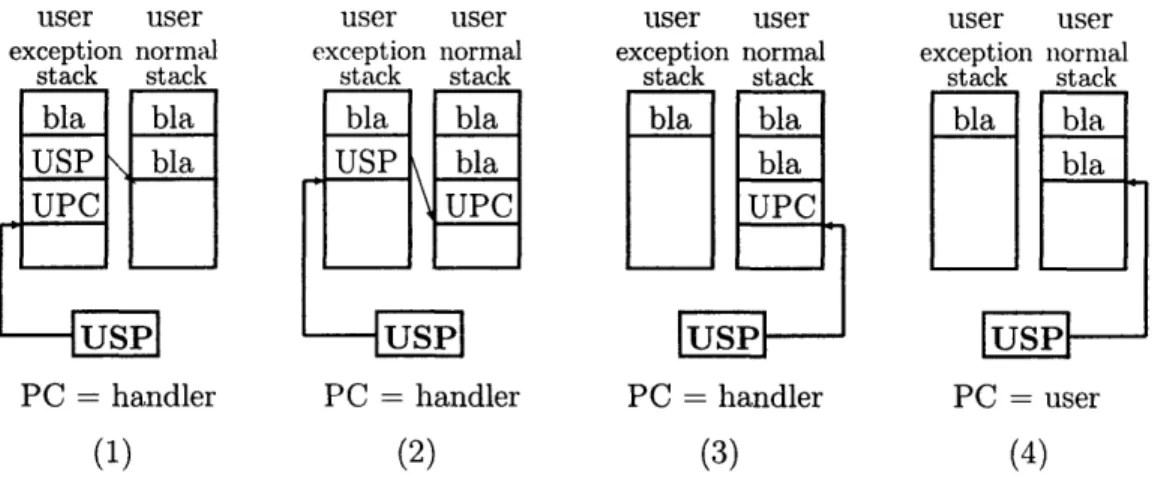
Handling page faults in user space is more difficult than handling them in the kernel. When a page fault occurs in a user-accessible address range, the kernel sets up a special user-space exception stack and passes control to the user page fault handler. Transferring control to the handler is as easy as transferring control to any user process. However, restoring the user program's trap-time state from the user page fault handler is difficult.
Normally, Asbestos transfers control to a user program from the kernel, which operates in Supervisor mode. Transferring control is doable because ARM provides separate registers in each execution nlo(le for the stack pointer, link register and processoi flags. This means one can load the user stack pointer into the user register,
user user user user user user user user
exception normal exception normal exception normal exception normal stack stack stack stack stack stack stack stack
bla bla bla bla
USP
bla
USP
bla
UPC
UPC
__EB,,US
[
PC = handler PC = handler PC = handler PC = user
(1) (2) (3) (4)
Figure 4-3: An ARM context switch from user to user mode
The user trap handler (1) pushes the trap-time program. counter onto the normal user stack, also updating the trap-time user stack pointer (2). Then the trap handler restores the user stack pointer into the user stack register (3), and pops the trap-time program counter, returning to the user program (4).
and then load the user program counter from the unchanged kernel stack pointer (see Figure 4-2). The luxury of operating with separate stack pointers is lost when transferring from user to user mode, yet the trap handler must restore both the trap-time stack pointer and program counter. The solution is to push the trap-time program counter onto the normal (trap-time) user stack. One can then switch the user stack pointer from the user exception stack to the normal user process stack, and finally restore the trap-time program counter from that stack. Figure 4-3 shows the details of this operation, which x86 Asbestos performs in a similar manner.
The user page fault handling procedure requires saving the trap-time program counter and stack pointer onto the user exception stack. As on x86, the caller-saved registers also needed to be saved, because the user page fault handler might clobber these registers. A caveat on the ARM processor is register R12, also called IP. R12 is a scratch register, most commonly used in function prologues to keep track of a function's stack frame. This means R12 is written on function entry, but not restored on function exit! Ipso facto. R12 muust be saved on all context switches, or else page faults may corrupt the executing program's state.
4.2.3
Passing Arguments
The ARM C calling convention differs a bit from the x86 calling convention. The most notable difference is that the first four arguments to a C function are held in the callei-saved registers RO through R3. Any further arguments are saved on the stack. Return values are saved in register RO (and R1, if the value is 64-bit). Compiled C code automatically adheres to this calling convention, but the differences becomes important when assembly code calls C code. During boot or when a new process is started with a fork() or spawn() call, the code that sets up the new environment
must take care to pass initial arguments in registers.
4.3
Memory Management Module
The memory management module is one of the larger chunks of the Asbestos oper-ating system. Unfortunately, it is also linked deeply to the x86 hardware memory management unit (MMU). It would be best to define a common memory interface as part of a cross-architecture Hardware Abstraction Layer (HAL), and to implement memory management independently in the ARM port. However, the goal of keeping a minimal fork for the ARM port required some sacrifices in the memory module. The memory management code was separated into two parts. First, a shared page tracking module maps pages into environments and keeps reference counts for all
pages. Second, a separate page table module defines functions to access the M\IMU. setting hardware and software flags on the page tables. The page table interface is the most well-defined part of the Asbestos HAL, and it is described in Section 4.3.3.
4.3.1
Page Table Entries
There ar(e considerable differences between ARM and x86 page tables. On both
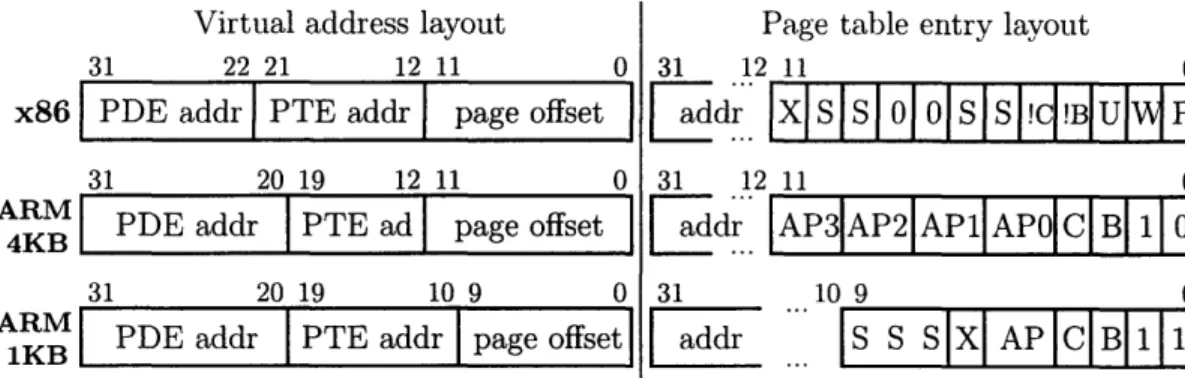
architectures, a virtual address consists of three parts: a page directory index, a page tHable index. and a page offset. The page directory index and page taltle index are offsets into first- and second-level tables of addresses. The page offset indexes
Virtual address layout
31 22 21 12 11 0
x86 PDE addr PTE addr
page offset
31 20 19 12 11 0
ARM
PDE addr
PTE ad
page offset
31 20 19 10 9 0
ARM
1KB PDE addr PTE addr I page offsets
Page table entry layout
31 12 11 0
addr X
SS
01 I
SS!
!BU7
P
31 12 11 0
addr
IAP3AP2
AP1 APOICIBI
110
31 10 9 0
addr
S
SXI
AP
ICIB
llI
Figure 4-4: Virtual addresses and page table entriesThese are the layouts for x86 (top), ARM with 4 KB pages (middle) and ARM with 1 KB pages (bottom). The PTE bits are as follows: P = present, AP = access
permissions, W = write, U = user, C = cacheable, B = bufferable, S = free for
software use, X = software COW.
into a memory page itself. The respective sizes of these three fields determine a lot about the paging mechanism. On x86, the 32 bits of a virtual address are divided as 10:10:12 (see Figure 4-4). This means that pages are 212 or 4096 bytes in size. Each page directory and each page table stores 4 x 210 or 4096 bytes of data, which fits conveniently within one page. It also means that each page table entry stores 20 bits of a page's memory address, and 12 bits of meta data about a page. Asbestos makes ample use of this meta data space, storing both hardware flags (present, user, write) and software flags (copy-on-write, dirty).
ARM gives programmers a choice for the layout of their page tables. ARM allows for large (64 KB), small (4 KB), or tiny (1 KB) pages. ARM's 4 KB pages are divided as 12:8:12. This ARM division stores more data in page directories than the x86 (4 x 212 or 16384 bytes) and less data in page tables (4 x 28 or 1024 bytes). This means page directories require four aligned, contiguous memory pages, and page tables will only use up one fourth of a page. This is less convenient than the x86 configuration, in which every page directory and page table takes up one page. Furthermore, page table entries in this MMU configuration do not contain any bit space for implementation-specific (software) flags, should they be needed.
bits of space in the page table entries. Using the tiny layout, the 32 bits of a virtual address are divided as 12:10:10. This means that pages are 210 or 1024 bytes in size. It also means that each page table entry stores 22 bits of a page's memory address, and 10 bits of meta data about a page. Page directories now take up sixteen aligned and contiguous pages, whereas page tables require four tiny pages of space.
x86 Asbestos uses page table entries to store two software flags: copy-on-write and dirty. In the ARM port, the use of software PTE flags can be completely avoided. The dirty bit is no longer used in the latest version of the file system, and the software COW bit; can be implemented in hardware, as we'll see later in this section. This means I can decide between 4 KB pages and 1 KB pages in ARM Asbestos, which is a significant design choice. Using 4 KB pages wastes memory, because Asbestos grants memory at the granularity of pages and 4 KB page tables are 1 KB in size. The downside to tiny pages is that they incur more memory management overhead than small pages, for equally sized data structures and files. On the other hand, mobile ARM devices usually have less memory to use than desktop computers, and in this context tiny pages seem reasonable. In Section 6.2.2 I examine both paging configurations and see which is more efficient. If at some future point ARM Asbestos requires the use of software PTE flags, programmers will want to use 1 KB pages. This avoids the use of shadow page tables to keep track of software flags. Such structures are not only cumbersome to program, they require additional memory as well. Switching between the paging layouts is as easy as flipping a flag in the source code.
4.3.2
Page Directory Entries
On x86, the memory management unit checks page permissions twice on every
mem-ory access:: once in the page directory entry and once in the page table entry. It is thus possible to restrict page permissions for an entire page table by changing the periission bits on a page directory entry. The Asbestos memory module uses this hardware feature to quickly mark an entire page talble copy-on-write (not writable), usually when forking a process.
During a normal process fork, the memory pages of the parent process are copied into the child process. This is CPU-intensive and can be wasteful if neither the parent nor the child performs many memory writes. As a fork optimization, Asbestos avoids copying memory. It remaps user memory pages and marks them copy-on-write, meaning they can be read as usual, but must be copied when a write occurs. On x86, this permission is implemented by stripping write permissions at the page directory level and raising a software-defined copy-on-write flag in the PDE. When a write occurs, the MMU generates a fault, and the page fault handler recognizes the COW flag and performs the page copy, giving back write permissions. Note that while removing the write flag from an x86 PDE restricts an entire page table, setting a PDE's write flag does not give write access to all its sub pages (access is checked also at the PTE).
On ARM, the MMU hardware does not perform read/write permission checks at the page directory entry level. There is an analogous entity on ARM called a domain, which can completely restrict a page table from non-kernel access. This is useful for shielding kernel memory from user processes, but Asbestos can't use it to implement the copy-on-write permission (which should still allow reads). The best solution would be to remove Asbestos' reliance on page directory entry permission bits. However, in the interest of a minimal fork, the ARM design solution is as follows. When removing the write permission from a PDE (when setting it COW), the ARM build will remove the write permission from every page table entry covered by that page directory entry. This ARM workaround is unfortunate for performance, because setting a page directory copy-on-write now requires 257 memory writes instead of one (or 1025, for 1 KB ARM pages). Setting a PDE writable requires no extra work, because the ARM's behavior is just like the x86's: it does not restrict the page table's pages.
4.3.3
Defining the MMU HAL
Defining a common HAL for two different sets of paging hardware was not straight-forward. x86 and ARM use different mechanisms for restricting access to paged
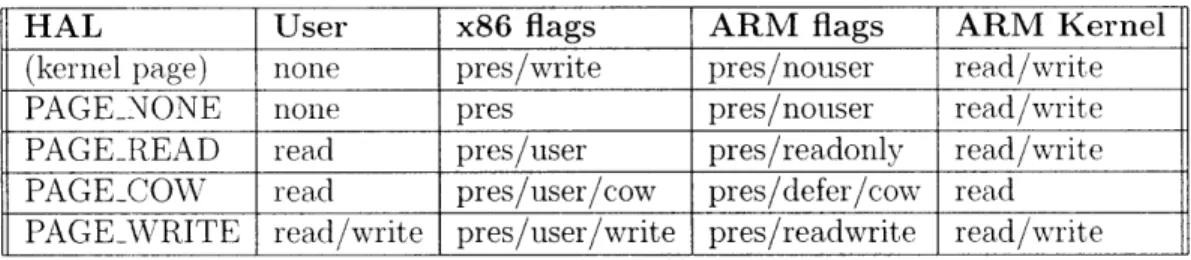
Table 4.2: Asbestos page table permission mappings
HAL User x86 flags ARM flags ARM Kernel
(kernel page) none pres/write pres/nouser read/write PAGENONE none pres pres/nouser read/write PAGEREAD read pres/user pres/readonly read/write PAGECOW read pres/user/cow pres/defer/cow read
PAGEWRITE read/write pres/user/write pres/readwrite read/write memory. Table 4.2 shows the hardware flags each architecture uses. I defined a set of common user permission concepts that are understood by both MMUs and sufficient to express the memory permissions needed by the Asbestos memory management module. These permission concepts (PAGENONE, PAGEREAD, PAGECOW and PAGE_WRITE) describe the permissions that kernel and user code have with respect to a page.
In Asbestos, all user pages are mapped twice: once into the kernel address space, and once into user address space. These mappings have different permissions. On x86. the kernel is constrained from writing to user-space virtual addresses in the same way that user code is constrained: it needs the write flag to write. x86 Asbestos uses this fact to evoke copy-on-write faults within the kernel. ARM Asbestos must emulate this behavior.
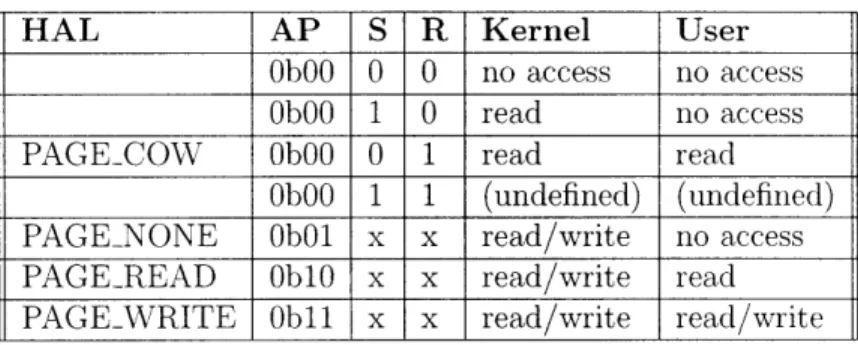
On version 4 and 5 ARM processors such as the PXA255, kernel code usually enjoys full write permissions on all addresses even though user permissions may be restricted. This will not do for the copy-on-write permission, because Asbestos ex-pects COW faults for user pages to occur from user code as well as kernel code. The
COW permission must therefore restrict kernel write access to user-mapped pages. To
implement the COW permlission, ARM Asbestos uses a hardware workaround that is deprecated for modern ARM processors (version 6 and above). The page table access permissioln flags are set to defer to system-wide MMU permissions flags (the S and R bits), wthich can restrict kernel write access. These systeim-wide permission flags are initialized to allow kernel and user read access. The ARM\ halrdware interface is detailed in Table 4.3. This technique for restricting kernel access stretches the