WORKING
PAPERS
SES
N. 471
VII.2016
FOn the Use of Interview Data
for the Microsimulation of
Ideological Conflicts:
An Analysis of the Political
Cleavages of the European
Left
On the Use of Interview Data for the
Microsimulation of Ideological Conflicts:
An Analysis of the Political Cleavages
Of the European Left
©
Georg P. Mueller
Acknowledgement
The author is indebted to the Department of Communication and Media Research (DCM) of the University of Fribourg for office space and other academic infrastructures, which allowed him to finish this article after his official retirement.
1. Introduction
There is an increasing number of international survey projects like the International Social Survey Programme (ISSP 2015), the European Values Study (EVS 2008), or the Europe-an Social Survey (ESS 2015), which claim to produce internationally comparative interview data. Important measures for achieving this goal are careful translations into the different national languages of the survey, extended pretests of the questionnaires, etc. (Saris / Gallhofer 2007, Harkness / Van de Vijver / Mohler 2003, Harkness 2007, Harkness et al. 2010). In spite of all these methodological efforts, it is still possible that international com-parisons of interview answers are impaired by the different meanings of concepts in differ-ent cultural or national contexts. Examples of such ambiguous concepts with differdiffer-ent meanings are good life, left politics, etc.
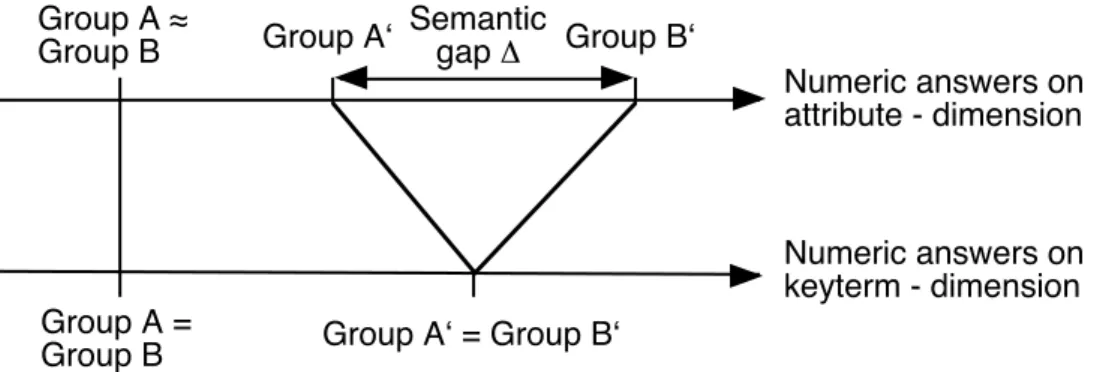
One of the methods for unrevealing this kind of semantic gap is the analysis of co-words, which was originally developed in scientometrics in order to categorize the content of scientific papers (Callon et al. 1993: chap. 7, de Bellis 2009: 143 ff.). If two groups A and B use the same key-term, they should assign to it the same co-words or attributes, if the key-term has for both groups really the same meaning. Fig. 1 describes this kind of consensus for a standardised interview, where co-words like e.g. „strongly agree“ or „disa-gree“, etc. are represented by value-labels 1, 2, 3,... of the numerical attribute- and key-term dimensions. The figure displays also another situation, where two groups Aʻ and Bʻ assign to the same key-term different co-words, represented by numerical values on an ordinal- or interval-scale, which describes an attribute of this key-term. Thus for Aʻ and Bʻ there is a semantic gap, which points to different meanings of the mentioned key-term.
Fig. 1: Tackling the problem of semantic gaps by analysing the
attributes of a key-term.
Fig. 1 is in so far a simplification as the meaning of a key-term generally depends not only on one but on several attribute dimensions, like e.g. the meaning of being a „good Swiss citizen“. In order to consider this additional complexity one could of course add to Fig. 1 other attribute-dimensions. However, also these polarity profiles are still simplifica-tions, since interview data about groups have always some inter-individual variation, which is often reduced to simple statistical values like means or medians. One might be tempted to identify the mentioned semantic gap by comparing the two groups with regard to these
Group Aʻ = Group Bʻ Group Aʻ Group Bʻ
Numeric answers on attribute - dimension Semantic gap ! Group A = Group B Group A ≈ Group B Numeric answers on keyterm - dimension
statistical means or medians on one or several attribute dimensions. Fig. 1 displays this kind of simplification. This approach, however, bears the risk of an ecological fallacy (Crow 2006): if e.g. groups A and B have the same mean value on a quantitative co-word dimen-sion but group A has a much greater standard deviation than B, there may be considera-ble dissent between A and B about the semantics of the key-term in question. In conven-tional statistical analysis this semantic gap is hidden by the identical mean values of A and B. Thus in an earlier paper (Mueller 2011) the author has proposed to measure the amount of virtual dissent or conflict between two groups by the simulation of virtual en-counters between the interviewed individuals of the two groups.
In this article, the mentioned methodology of virtual encounters will be applied to the political semantics of left-wing orientation of individual respondents in the European Val-ues Study (EVS 2008): for three exemplary countries, i.e. France, Sweden, and the UK, we attempt to investigate, which of the traditional values of the left are common to two or even all of these countries and which are particularities of the left of only one of the na-tions. For this purpose we shall first explain the three steps of the methodology of virtual encounters and subsequently present the results for three political values of the left: social security, state ownership of industry, and income equality.
2. A three step methodology for analysing semantic gaps 2.1 Step one: Microsimulation of virtual interpersonal conflicts
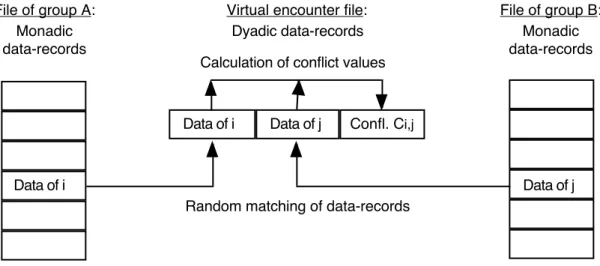
Conventional datasets with interview data for secondary analysis are generally monadic: each data-record describes just one single respondent. This is the standard format of most national or international surveys like e.g. the European Values Study EVS. Microsimulation of virtual interpersonal dissent or conflict, however, requires dyadic datasets containing data of two interacting persons i and j. Fig. 2 describes the construction of such dyadic
Fig. 2: The microsimulation of virtual value conflicts between pairs of persons.
Random matching of data-records
File of group B: Monadic data-records
Confl. Ci,j
Calculation of conflict values Virtual encounter file:
Dyadic data-records
Data of i Data of j
File of group A: Monadic data-records
Legend: i and j are members of the groups A and B. Conflict Ci,j with regard to an attribute X = Value difference |Xi–Xj|. Source: Adapted from Mueller (2011), Fig. 2.
data-records by a random matching process, which can e.g. be implemented with conven-tional statistical software like SPSS (2015): randomly permuted files of a group A and a group B are trimmed to the same length and stuck together such that the data of person i and j are joined in the same dyadic data-record. Virtual conflicts Ci,j between i and j with regard to an attribute X can subsequently be determined by calculating the absolute differ-ences |Xi-Xj| between the attribute-values Xi and Xj of the two persons. The result oft this random matching process corresponds in a certain way to the situation of modern urban societies, where spontaneous encounters with strangers are more important than contacts with local neighbours (Toennies 1979). However, by selecting appropriate membership criteria of the two groups A and B it is possible to limit this randomness of virtual encoun-ters and to make this way all kinds of experiments of thought („Gedankenexperimente“), which is a typical advantage of social simulation. The resulting similarity or dissimilarity of compared group members brings the proposed method of virtual encounters quite close to 1-dimensional propensity score matching (Guo / Fraser 2010), although the algorithms (microsimulation vs. logistic regression) as well as the purposes (experiments of thought vs. correction of sampling bias) of the two methods are rather different.
2.2 Step two: The identification of virtual inter-group conflict
By the aggregation of simulated inter-personal virtual dissent or conflicts Ci,j it is easily possible to calculate mean values of inter-group conflicts: most statistical programs like SPSS (2015) offer filters, which select pairs of persons with the right group-attributes for this process of data aggregation. The resulting conflict-scores are often hard to assess and consequently call for a reasonable benchmark or reference value, in order to under-stand their real importance. One of them is the average intra-group conflict (Mueller 2011: 24), which however only makes sense for small and rather closed groups. For groups with weak or open boundaries, a more realistic reference value is the mean level of conflict, which the members of a group encounter in their everyday interactions with all other
mem-bers of their national society, i.e. including their own group mates. In what follows we shall
use this kind of intra-national benchmark for the assessment of inter-group conflicts. This decision has however the consequence that the same amount of inter-group conflict can be evaluated by the benchmark of group A as well as by the different benchmark of group B and may thus result in an asymmetrical perception of inter-group conflict. Consequently an overall-evaluation of the value conflict between the two groups has to consider both perspectives.
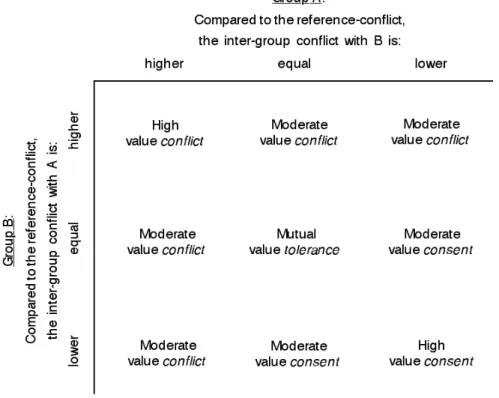
Fig. 3 presents an integration of the differing perspectives of the two groups, which is based on the following principles:
a) If the inter-group conflict is higher than the intra-societal reference-conflict of a group, the latter group has a negative perception of the other one.
b) If the inter-group conflict is lower than the intra-societal reference-conflict of a group, the latter group has a positive perception of the other one.
c) If the mutual perceptions of the two groups are both positive, there is a high value
consent between the two groups.
d) If the mutual perception of the two groups are both negative, there is a high value
con-flict (cleavage) (Rae / Taylor 1970) between the two groups.
e) If only one of the groups has a negative perception of the other, there is a moderate
value conflict. Thus it is assumed that by the dynamics of conflicts an initially
asym-metrical situation becomes symasym-metrical.
Fig. 3: The integration of the conflict perceptions of two groups A and B.
2.3 Step three: Network analysis of virtual conflicts and semantic gaps
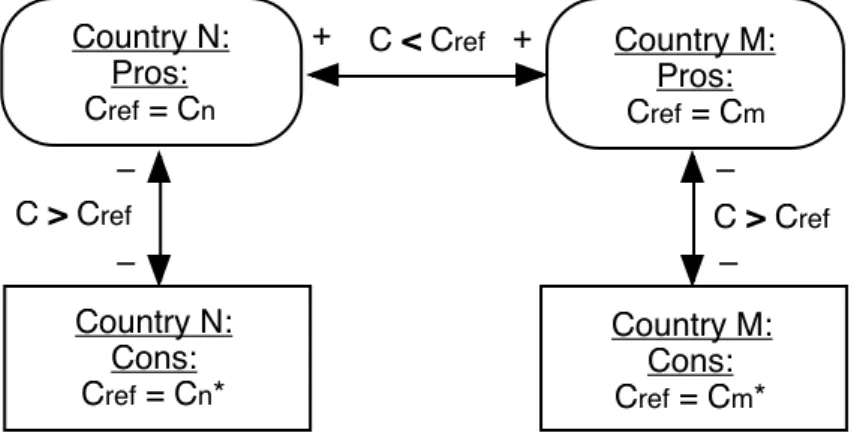
As a matter of course, intergroup-conflict and -consensus can be represented as social networks (Wasserman / Faust 2007): nodes stand for groups with similar values and bi-directional arcs correspond to the mutual perceptions of groups, that are either positive, negative, or neutral. Fig. 4 shows an example of such a network: it is the ideal-type of the relations between the protagonists (pros) of a key-concept like e.g. socialism in two coun-tries N and M and the respective national antagonists (cons) of the same key-concept. The arrows between these groups represent value-conflicts and -consensus with regard to an attribute (e.g. equality) of the key-concept. The two plus-signs between the protagonists (pros) of Fig. 4 point to a high value consensus between the pros in nation N and M: the intergroup-conflict C between the pros in the countries N and M is smaller than the respec-tive group specific references Cref=Cn and Cref=Cm. Thus the key-concept analysed in Fig. 4 has the same meaning in nation N and nation M since the protagonists in both
coun-tries have a mutual consensus about its attribute. To the contrary, the relations between the pros and the cons point in Fig. 4 to strong value conflicts (two minus-signs), since the respective inter-group conflicts C are always higher than the four group-specific reference conflicts Cref=Cn, Cref=Cn*, Cref=Cm, and Cref=Cm*. As a consequence, the analysed at-tribute is specific for the key-concept since the mentioned atat-tribute is mainly supported by those, who represent the key-concept, i.e. the pros, and opposed by the cons.
In a more general way, in order to prove that a key-concept has in two countries the
same meaning, one has to show that all its major attributes do not trigger moderate or
even high value conflicts (see Fig. 3) between the protagonists of the concept in the two mentioned countries. Thus not only high value consensus like in Fig. 4, but also moderate consensus and value tolerance are acceptable for excluding big semantic gaps. In order to avoid to focus on trivial attributes of a key-concept it is also important that the analysed attributes are specific for the underlying key-concept. Thus, one has to make sure that be-tween the pros and the cons of the key-concept there is at least a moderate or even a high value conflict about these attributes. Value tolerance or even moderate value consensus between the pros and cons would destroy this specificity.
Fig. 4: The ideal conflict structure about a common and
specific attribute of a key-concept.
3. Empirical analyses of the semantics of left ideologies 3.1 Introduction
This section aims at an exemplary analysis of the political semantics of left ideologies (Vincent 2010: chap. 4) in three European countries with rather different political traditions (Bartolini 2000: chap. 2, Weakliem / Heath 1999, Svallfors 1999): France with a strong communist tradition and a centralist state; Sweden with a long history of social-democratic governments stressing the importance of societal equality; the United Kingdom (UK), which switched under Tony Blair to a postindustrial version of social democracy (New
La-Country N: Pros: Cref = Cn Country M: Pros: Cref = Cm Country M: Cons: Cref = Cm* Country N: Cons: Cref = Cn* + + – – – – C < Cref C > Cref C > Cref
Legend: Pros and Cons: Protagonist and antagonists of key-concept. C = Inter-group conflict about attribute of key-concept. Cref = Reference conflict, with group-specific values Cn, Cn*, Cm, and Cm*.
bour). Differences between the mentioned countries could of course be analysed by study-ing the „official“ platforms of left political parties. Here we are more interested in the self-definition of left citizens. In the long run, their power as voters is more important for what left politics really mean. Consequently we will focus on comparative survey-data about their political views.
A relatively useful data-source for this purpose is the European Values Study (EVS 2008). For the three mentioned countries it contains among others information about the following variables:
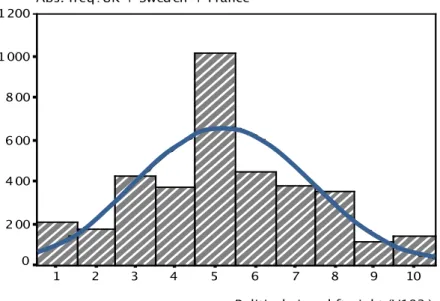
a) The self-evaluation of the respondents on a political left-right scale (= variable V193), ranging from 1 (= left) to 10 (= right). The statistical distribution of the original data, as given in Fig. 5, suggests to exclude the value V193 = 5 in the middle and to divide the remaining data into two groups: V193 ≤ 4 as partisans of the left and V193 ≥ 6 as par-tisans of the right.
b) The personal approval of social security (= variable V194) as an alternative to self-responsibility for the own wellbeing, also measured on a 1 to 10 scale.
c) The personal approval of state ownership of industry (= variable V199) as an alterna-tive to free entrepreneurship, measured on a 1 to 10 scale.
d) The subjective importance of income equality, also measured on a 1 to 10 scale. It corresponds to 11-V198, i.e. the inverse of the original EVS-variable V198, which has a different polarity than the variables mentioned under (b) and (c).
Thus with the variables available in the EVS it is possible to explore, in which countries left ideology is associated with social security, state ownership of industry, and income equali-
Fig. 5: The statistical distribution of the analysed respondents
on the left-right continuum of variable V193.
Political view: left-right (V193 ) 10 9 8 7 6 5 4 3 2 1
Abs. freq : UK + Swed en + France 1 200 1 000 8 00 6 00 4 00 2 00 0
ty: we use left partisans – identified by the self-definition mentioned under (a) – as
quasi-experts for the importance of the attributes (b), (c), and (d) for the different national left
ideologies. Thus, in the next three sections, there will be separate analyses for each of these attributes.
3.2 Results for the attribute social security
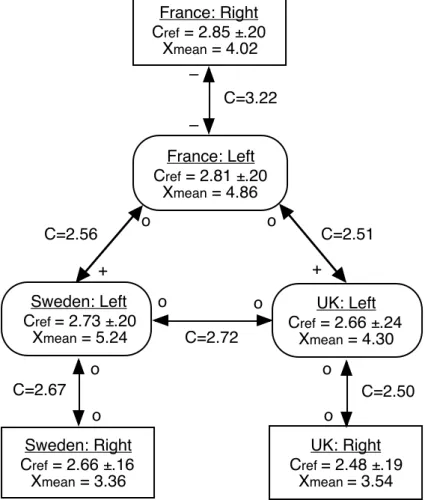
According to Fig. 6, social security seems to be a rather universal value of the European left: between France and Sweden as well as between France and the UK the left has a moderate consensus (= one plus-sign) about this value. Similarly, there is value tolerance between the Swedish and the British left (see zeros in Fig. 6). Nonetheless it is problemat-ic to consider social security as a central element of the ideology of the left of the three mentioned countries: in the UK and Sweden there is a value tolerance between the left and the right, which means that the support for social security has in these countries spread to the political right and is consequently not a specific value of the left. As the cleavage-like value conflict between the left and the right in France demonstrates, social security is only in this country a really specific endeavour of the political left.
Legend: Xmean: Mean value of social security; C: Inter-group conflict;
Cref ± e = Reference conflict (see text), with 90% confidence interval;
+ relation: C < Cref -e; - relation: C > Cref +e; o relation: C ≈ Cref±e
Fig. 6: Simulated value conflicts with regard to social security.
C=2.67 C=2.50 C=3.22 France: Left Cref = 2.81 ±.20 Xmean = 4.86 Sweden: Left Cref = 2.73 ±.20 Xmean = 5.24 UK: Left Cref = 2.66 ±.24 Xmean = 4.30 C=2.72 C=2.51 C=2.56 France: Right Cref = 2.85 ±.20 Xmean = 4.02 UK: Right Cref = 2.48 ±.19 Xmean = 3.54 Sweden: Right Cref = 2.66 ±.16 Xmean = 3.36 – – + + o o o o o o o o
3.3 Results for the attribute state ownership of industry
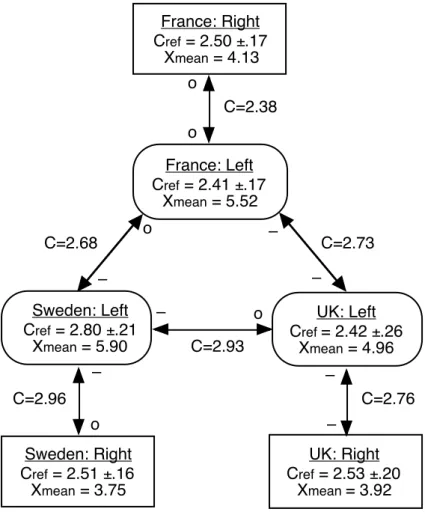
Contrary to social security, state ownership of industry is not a shared value of the left in Britain, France, and Sweden. According to Fig. 7, there is a moderate to cleavage-like con-flict about state ownership of industry between the three countries (see one or even two minus-signs). Moreover it is only in Britain and Sweden a specific value of the left – in France the belief in the central state seems to be so universal, that the left and the right agree very much about the role of the state in controlling industry.
In sum, the specificity of state ownership of industry for the left restricts the meaning-ful analyses to Sweden and the UK. A comparison of these two countries, however, sug-gests that state ownership of industry cannot be considered as equally important for the left of the two countries: in Sweden the mean value Xmean = 5.90, whereas in the UK the corresponding value Xmean = 4.96 is considerably lower (see Fig. 7). Consequently there is a moderate value conflict about state ownership of industry between the left of the two countries (see minus sign between Swedish and UK left).
Legend: Like legend of Fig. 6, but for state ownership of industry.
Fig. 7: Simulated value conflicts with regard to state ownership of industry.
C=2.96 C=2.76 C=2.38 France: Left Cref = 2.41 ±.17 Xmean = 5.52 Sweden: Left Cref = 2.80 ±.21 Xmean = 5.90 UK: Left Cref = 2.42 ±.26 Xmean = 4.96 C=2.93 C=2.73 C=2.68 France: Right Cref = 2.50 ±.17 Xmean = 4.13 UK: Right Cref = 2.53 ±.20 Xmean = 3.92 Sweden: Right Cref = 2.51 ±.16 Xmean = 3.75 – – – – – – – o o o o o
3.4 Results for the attribute income equality
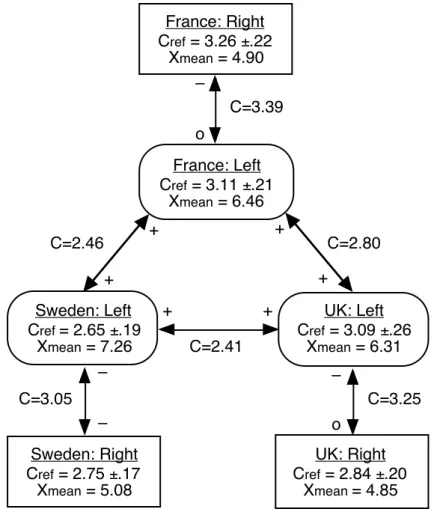
According to Fig. 8, income equality seems to be an essential value of the political left. In all three countries there is a moderate or even high conflict between the left and the right about this value. This points to the general specificity of equality for the left, which is fur-ther corroborated by the fact that the mean value of the support for income equality Xmean is for the left partisans always higher than for the right ones (see Fig. 8). Moreover, equali-ty seems to have a common meaning in the ideologies of the left in Sweden, UK, and France: All possible left inter-group relations have two positive signs, which points to a high left inter-group consensus about this value.
Legend: Like legend of Fig. 6, but for income equality.
Fig. 8: Simulated value conflicts with regard to income equality.
4. Critical summary and outlook to the future
In this paper we wanted to answer the question whether left political orientation has the same meaning in different countries. In order to answer this question we simulated virtual encounters between persons, who participated in the European Value Studies (EVS 2008). The method has the advantage of giving a more realistic picture of the amount of inter- and intra-group conflict than the traditional statistical methods, which often yield
re-C=3.05 C=3.25 C=3.39 France: Left Cref = 3.11 ±.21 Xmean = 6.46 Sweden: Left Cref = 2.65 ±.19 Xmean = 7.26 UK: Left Cref = 3.09 ±.26 Xmean = 6.31 C=2.41 C=2.80 C=2.46 France: Right Cref = 3.26 ±.22 Xmean = 4.90 UK: Right Cref = 2.84 ±.20 Xmean = 4.85 Sweden: Right Cref = 2.75 ±.17 Xmean = 5.08 + – + + + + + – – – o o
sults that are distorted by so-called ecological fallacies (Crow 2006): the traditional meth-odology of comparing mean values tends to underestimate intergroup conflicts, especially if the differences of the means are small and the variances of the intra-group attitudes are relatively high. By the proposed microsimulation also the most extreme ideological posi-tions may encounter by random matching and thus contribute to a more realistic assess-ment of the inter-group conflict. Moreover, by comparing the same intergroup conflict with two different group-specific conflict references it is possible to identify initially asymmetrical conflicts.
By means of the mentioned microsimulation-method we were able to compare the French, the British, and Swedish left. It seems that the left of the three countries has only
one common and specific value: income equality. The other two tested attributes, i.e. state
ownership of industry and social security are either not universally shared by the left parti-sans of these countries or not very specific for them.
As a matter of course, these findings are also influenced by the following limitations of our research design:
a) The limited number of variables, which could certainly be enlarged in a follow-up study: interview questions about taxes for the rich or the size of the military budget are possible clues to more refined empirical results about left ideologies.
b) The limited number of countries: There are many other countries in the European Val-ues Study, which could have been included in this analysis. In order to avoid too much heterogeneity, it is advisable to include in future studies mainly countries with a similar history or similar institutions. Eastern European countries with a Soviet communist past or liberal welfare states with a lack of social security are typical examples of such groups of homogeneous countries (Esping-Andersen 1993: chap. 1, Gelissen 2002: chap.2).
c) For practical reasons, the number of observations in the dyadic files was limited to 1000 pairs of persons. This is only a very small fraction of the 1 to 4 million pairs of re-spondents that can be constructed with 1 to 2 thousand original interviews per nation. Hence, it is easily possible to increase the sample size of the current study in order to reduce the width of the confidence intervals of the simulated conflicts (Cramer / Howitt 2004: 32–35), which in turn means increased statistical significance of the network re-lations depicted in Figs. 6 to 8.
References
Bartolini, S. (2000): The Political Mobilization of the European Left, 1860-1980: The Class
Cleavage. Cambridge: Cambridge University Press.
Callon, M., Courtial, J.-P., and Penan, H. (1993): La scientométrie. Paris: Presses Univer-sitaires de France.
Cramer, D. and Howitt, D. (2004): The Sage Dictionary of Statistics. London: Sage Publi-cations.
Crow, I. (2006): Ecological Fallacy. In: V. Jupp (ed.), The Sage Dictionary of Social Re-search Methods, 82–83. London: Sage Publications.
de Bellis, N. (2009): Bibliometrics and Citation Analysis. Toronto: Scarecrow Press.
Esping-Andersen, G. (1993): The Three Worlds of Welfare Capitalism. Cambridge: Polity Press.
ESS (2015): European Social Survey: Overview. http://www.europeansocialsurvey.org/ (accessed on 11/5/2015).
EVS (2008): European Values Study 2008: Data and Handbook. Köln: Gesis.
Gelissen, J. (2002): Worlds of Welfare, Worlds of Consent? Public Opinion on the Welfare
State. Leiden: Brill.
Guo, S. and Fraser, M. (2010): Propensity Score Analysis. Los Angeles: Sage.
Halman, L., Sieben, I., and van Zundert, M. (2012): Atlas of European Values, 85 ff. Lei-den: Brill.
Harkness, J., Van de Vijver, F., and Mohler, P. (eds) (2003): Cross-Cultural Survey
Meth-ods. Hoboken: John Wiley.
Harkness, J. (2007): Improving the Comparability of Translations. In: R. Jowell et al. (eds), Measuring Attitudes Cross-Nationally: Lessons from the European Social Survey, chap. 4. London: Sage Publications.
Harkness, J. et al. (eds) (2010): Survey Methods in Multinational, Multiregional, and
Multi-cultural Contexts. Hoboken: John Wiley.
ISSP (2015): International Social Survey Programme: Overview. http://www.issp.org/ (ac-cessed on 11/5/2015).
Mueller, G. (2011): Microsimulation of Virtual Encounters: A New Methodology for the Analysis of Socio-Cultural Cleavages. Int. J. of Microsimulation 4(1), 21-34.
Rae, M. and Taylor, M. (1970): The Analysis of Political Cleavages. New Haven: Yale Uni-versity Press.
Saris, W. and Gallhofer, I. (2007): Can Questions Travel Successfully? In: R. Jowell et al. (eds), Measuring Attitudes Cross-Nationally: Lessons from the European Social Sur-vey, chap. 3. London: Sage Publications.
SPSS (2015): http://www-01.ibm.com/software/analytics/spss/products/statistics/ (acess- ed on 3/12/2015).
Svallfors, S. (1999): The Class Politics of Swedish Welfare Politics. In: G. Evans (ed.), The End of Class Politics? Class Voting in Comparative Context, chap. 8. Oxford: Oxford University Press.
Toennies, F. (1979): Gemeinschaft und Gesellschaft (Community and Society). Darm-stadt: Wissenschaftliche Buchgesellschaft.
Vincent, A. (2010): Modern Political Ideologies (3rd edition). Chichester: Wiley-Blackwell. Wasserman, S. and Faust, K. (2007): Social Network Analysis. Cambridge: Cambridge
University Press.
Weakliem, D. and Heath, A. (1999): The Secret Life of Class Voting: Britain, France, and
the United States Since the 1930s. In: G. Evans (ed.), The End of Class Politics?
Author
Georg P. MUELLER
The author has a Ph.D. from the University of Zurich (Switzerland), where he studied sociology, mathematics, and philosophy. Before his retirement in 2014 he worked as senior lecturer (Maître d‘enseignement et de recherche) at the Department of Communication and Media Research (DCM) of the University of Fribourg, were he thought research methodology and statistics. His research interests include public policy analysis, the construction of social indicators, and the development of mathematical models of social processes. E-mail: [email protected]
Bd de Pérolles 90, CH-1700 Fribourg Tél.: +41 (0) 26 300 82 00
Université de Fribourg, Suisse, Faculté des sciences économiques et sociales Universität Freiburg, Schweiz, Wirtschafts- und sozialwissenschaftliche Fakultät
Working Papers SES collection
Abstract
There is an increasing number of interview projects like the European Values Study (EVS) or the International Social Survey Programme (ISSP), which collect in many different countries internationally comparative interview data. Some of them even offer time series, which go back to the 1980ies. Unfortunately, these public datasets are generally not suitable for the analysis of political conflicts and socio-cultural cleavages.
Hence the present paper tackles the problem of extracting conflict data from such interview projects by means of a new microsimulation method: instead of analysing the original interviews by focusing on individuals, the paper proposes to look at the value-differences between randomly matched artificial pairs of respondents. These artificial dyadic data records are used to simulate virtual encounters of persons, who may have either the same or different opinions about a certain issue. In the first case there is harmony, in the second virtual conflict that can be statistically aggregated for all analysed dyads of persons. This way it becomes possible to measure the total amount of conflict of a group (i) with the rest of society, (ii) with a similar group in another country, and (iii) with a politically opposite group.
The afore-mentioned methodology of simulated virtual conflicts is used in order to analyse the variation of the ideology of the political left in different European countries. Of special interest are conflicts about traditional left values like equality, social security, and state ownership of industry, which concern respondents, who are partisans of the left as well as those, who identify with a right party. On the basis of the already mentioned European Values Study, the analysis is performed for three typical countries with rather different left party traditions: Sweden, France, and the UK.
Citation proposal
Georg P. Mueller, 2016. «On the Use of Interview Data for the Microsimulation of Ideological Conflicts: An Analysis of the Political Cleavages of the European Left». Working Papers SES 471, Faculty of Economics and Social Sciences, University of Fribourg (Switzerland)
Jel Classification
C53, D63, H55, P31
Keywords
Conflict simulation, network analysis, international comparison, virtual encounters, interview data, political semantics
Last published
466 Bodory H., Camponovo L., Huber M., Lechner M.: The finite sample performance of inference methods for propensity score matching and weighting estimators; 2016
467 Denisova-Schmidt E., Huber M., Leontyeva E.: On the Development of Students’ Attitudes towards Corruption and Cheating in Russian Universities; 2016
468 Imhof D., Karagök Y., Rutz S.: Screening for Bid-rigging – Does it Work?; 2016
469 Huber M., Kotevska A., Martinovska Stojcheska A., Solovyeva A.: Evaluating an information campaign about rural development policies in (FYR) Macedonia; 2016
470 Bodory H., Camponovo L., Huber M., Lechner M.: A Wild Bootstrap Algorithm for Propensity Score Matching Estimators; 2016
Catalogue and download links
http://www.unifr.ch/ses/wp
http://doc.rero.ch/collection/WORKING_PAPERS_SES
Publisher