http://palaeo-electronica.org
PE Article Number: 12.3.10A
Copyright: Society for Vertebrate Paleontology December 2009 Submission: 15 May 2009. Acceptance: 9 August 2009
Bibi, Faysal, Bukhsianidze, Maia, Gentry, Alan W., Geraads, Denis, Kostopoulos, Dimitris S., and Vrba, Elisabeth S., 2009. The Fossil Record and Evolution of Bovidae: State of the Field. Palaeontologia Electronica Vol. 12, Issue 3; 10A: 11p;
The Fossil Record and Evolution of Bovidae: State of the Field
Faysal Bibi, Maia Bukhsianidze, Alan W. Gentry, Denis Geraads,
Dimitris S. Kostopoulos, Elisabeth S. Vrba
ABSTRACT
This paper presents a summary of the current state of knowledge on the evolution and fossil record of Bovidae and identifies topics and problems for further study. The earliest records of the different bovid tribes are reviewed, along with their geographic locations. Future work on the fossil bovid record should focus on: the reinvestigation of osteological characters that might distinguish early bovids from stem taxa; the late Mio-cene fossil record with respect to the evolutionary origins and biogeography of the liv-ing bovid tribes; and improved methodologies for reconstructliv-ing bovid phylogeny usliv-ing morphology. This paper reflects the main themes discussed at the meeting of the Revealing Hominid Origins Initiative Bovid Analytical Working Group in Addis Ababa, Ethiopia.
Faysal Bibi. Department of Geology and Geophysics, Yale University, PO Box 208109, Connecticut, 06520-8109, USA. [email protected]
Current address:
Institut international de Paléoprimatologie, Paléontologie humaine, Evolution et Paléoenvironnements, Université de Poitiers, F-86022, POITIERS cedex
Maia Bukhsianidze. The National Museum of Georgia, 3 Purtseladze St., 0107 Tbilisi, Georgia. [email protected]
Alan W. Gentry. c/o Department of Palaeontology, Natural History Museum, Cromwell Road, London, SW7 5BD, United Kingdom. [email protected]
Denis Geraads. CNRS UPR 2147, 44 rue de l’Amiral Mouchez, 75014 Paris, France. [email protected]
Dimitris S. Kostopoulos. Aristotle University of Thessaloniki, School of Geology, Laboratory of Geology and Paleontology, 54124 Thessaloniki, Greece. [email protected]
Elisabeth S. Vrba. Department of Geology and Geophysics, Yale University, PO Box 208109, Connecticut, 06520-8109, USA.
INTRODUCTION
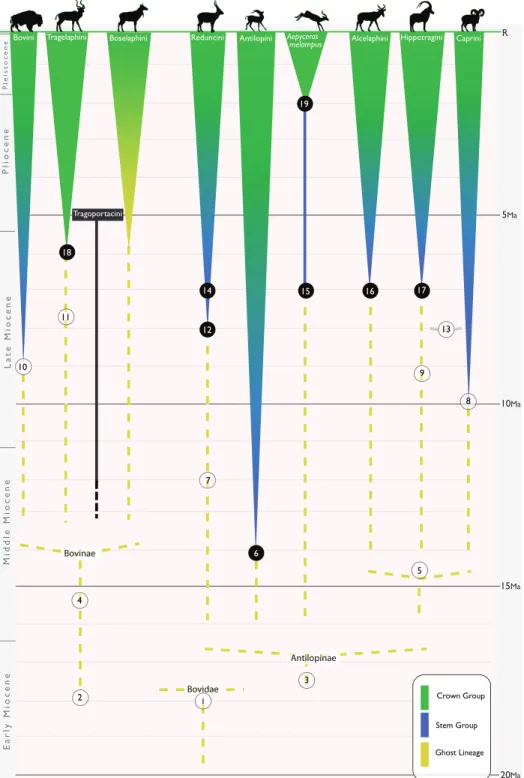
Bovids are diverse herbivorous mammals that inhabit a wide spectrum of habitats and occur natu-rally over much of the globe. Ranging from the enigmatic and elusive forest antelopes of South East Asia and Central Africa to the ubiquitous cat-tle and other livestock common to most world cul-tures, and from the Himalayan goat to the desert oryx to the North American bison, bovids represent an example of a clade that owes its success to its capacity to diversify in the face of selective pres-sures. The evolutionary history of Bovidae is known to have taken place in the Miocene to Recent, or within the last 23 Ma (Figure 1). The Miocene fossil record is both rich and geographi-cally extensive, and as a result the reconstruction of the evolutionary history of Bovidae promises to provide one of the most complete such histories for any large mammal group.
Between August 4 and 8, 2008, the Bovid Analytical Working Group of the Revealing Hom-inid Origins Initiative (National Science Foundation, USA) met in Addis Ababa for a conference on the fossil record and evolution of Bovidae with special emphasis on the late Miocene to early Pleistocene. A summary of the main themes, findings, and rec-ommendations of the conference follows.
BOVID ORIGINS
Recognition of the earliest fossil bovids is not straightforward, nor for that matter is recognition of early or stem members of the different bovid sub-clades. Bovidae is diagnosed by the presence of permanent and unbranched horn cores with a per-manent and unbranched horn sheath (Janis and Scott 1988). Sheaths are rarely preserved as fos-sils, so the recognition of an early bovid in the fossil record relies on the presence and morphology of the bony horn core alone. This proposition is prob-lematic, however, given that members of other pec-oran groups also bear a very similar horn-core structure (both fossil and living species, e.g.,
Antilocapra americana) and given the potential
absence of horns in female individuals. Dental and other cranial and postcranial osteological charac-ters of potential use for distinguishing the earliest bovids and stem bovids should be further investi-gated. Teeth and cranial characters of certain spe-cies of Eotragus, long considered the earliest bovids, may indicate that certain of these species are basal to (i.e., precede on the cladogram) the last common ancestor of all the living Bovidae.
Eotragus artenensis (Ginsburg and Heintz 1968;
France, MN4 in Gentry et al. 1999; ca.18–17Ma in Steininger 1999) has been proposed as a stem bovid (see also Azanza and Morales 1994), as has
E. noyei (ca.18Ma, Pakistan, Solounias et al.
1995). Eotragus minus, from the early Miocene of Pakistan, may be even older than E. noyei, and possibly more primitive in morphology (Ginsburg et al. 2001).
Other taxa worth further consideration in rela-tion to stem bovids include Andegameryx,
Amphi-moschus, Namibiomeryx, Namacerus,
Pseudoeotragus, and Homoiodorcas. Taxa
included in Hypsodontinae (Köhler 1993) might be diphyletic to (i.e., the sister group of) the remainder of Bovidae (Gentry et al. 1999). Various Miocene taxa have been referred to Hypsodontinae (Köhler 1987). The group is in need of revision, having never been treated in much detail, and its phyloge-netic status remains unclear.
TRIBAL ORIGINS AND RADIATIONS
Bovids have long been classified among a dozen or so higher taxa, typically tribes. Simpson’s (1945) classification divided bovids among 13 tribes in five subfamilies. Since that time, work on bovid systematics (morphological, behavioral, and molecular) has revealed a deep bifurcation within Bovidae separating the Bovinae from all the remaining bovids (Kingdon 1982; Lowenstein 1986), and has condensed the number of tribes to around 10 (e.g., Hassanin and Douzery 1999b).
Bovinae (Bovini+Tragelaphini+Boselaphini)
Bovinae is the sister group to all remaining liv-ing bovids and is characterized by numerous mor-phological, behavioral, and molecular synapomorphies (e.g., Kingdon 1982; Hassanin and Douzery 1999b; Vrba and Schaller 2000; Bibi 2009). Eotragus sansaniensis (15.2Ma, France, Sen 1996), E. noyei (ca.18Ma, Pakistan), and an unnamed species from the Vihowa Formation (ca.18Ma, Pakistan) have been tentatively pro-posed as early or stem Bovinae (Solounias and Moelleken 1992; Azanza and Morales 1994; Solounias et al. 1995). These fossils would sug-gest that the cladogenetic event separating the Bovinae from the remainder of Bovidae must have occurred in the early Miocene, or certainly by 18Ma.
Stem Bovini were likely present in southern Asia (Siwaliks) by 9Ma, as represented by
Seleno-portax (Bibi 2007). After this time, early bovines
dispersed first to Africa then to Europe. It is not clear when or where exactly the crown clade
origi-10Ma 5Ma 15Ma 20Ma Crown Group Stem Group Ghost Lineage R
Bovini Tragelaphini Boselaphini Reduncini Antilopini Aepyceros
melampus Alcelaphini Hippotragini Caprini
Tragoportacini Bovinae Antilopinae 10 18 11 19 14 12 15 16 17 9 13 8 7 6 4 2 3 5 Bovidae 1 Earl y Miocene M id dl e Mi oce n e Late M ioce n e P li oce n e Pl e istoce n e
FIGURE 1. Phylogenetic diagram charting the evolution of the major bovid clades. Solid numbered
cir-cles represent fossils assignable to crown or stem groups, while open circir-cles represent fossil taxa of potential phylogenetic affinity. Numbers refer to the following: 1, Eotragus artenensis, Eotragus noyei,
Eotragus minus; 2, Eotragus noyei, Vihowa Bovidae indet.; 3, Pseudoeotragus seegrabensis; 4, Eotra-gus sansaniensis; 5, Caprotragoides, GentrytraEotra-gus, TethytraEotra-gus; 6, Fort Ternan Gazella sp.; 7, Ngorora
‘Pachytragus aff. solignaci’; 8, Pachytragus solignaci; 9, Djebel Krechem Hippotragini? indet.; 10,
Seleno-portax; 11, Pheraios chryssomallos; 12, Siwalik Reduncini; 13, Protoryx/Pachytragus; 14, Lothagam
Reduncini; 15, Lothagam Aepyceros; 16, Lothagam Alcelaphini; 17, Toros Menalla & Lothagam Hip-potragini; 18, Lukeino Tragelaphus cf. spekii; 19, Omo & Koobi Fora Aepyceros melampus. Bovid silhou-ettes adapted from Kingdon (1982).
nated as the fossil taxon closest to the most recent common ancestor of all living bovines has not yet been identified. The earliest African record of a bovine is at Toros-Menalla (Vignaud et al. 2002), Chad, at around 7Ma. By the end of late Miocene, several western Eurasian “boselaphines” begin to exhibit morphology suggestive of the bovine condi-tion but the earliest European record of a bovine is in the early Pliocene (Gromolard 1980). The ability to confirm with certainty a southern Asian origin of Bovini is hampered by the poor African fossil record between 10 and 7Ma, whereby the absence of Bovini from Africa during this time may be a result of preservation bias. Once Bovini had origi-nated, multiple bovine lineages become evident but good hypotheses of between- and within-lin-eage relationships are lacking. The water buffalo
Bubalus most likely emerged from the Pliocene Proamphibos (Pilgrim 1939) and the African Syn-cerus from a Ugandax (Gentry and Gentry 1978)
though the precise limits of the latter genus, along with that of Simatherium, are still unclear. The ori-gins of Bos and Bison and the interrelationships of the many fossil species seemingly relevant to them remain problematic. The hypothesis that Pelorovis gave rise to Bos (Martínez-Navarro et al. 2007) requires further evidence.
The history of the Tragelaphini as known so far is almost entirely African. The earliest tragela-phine that is probably a crown group member (i.e., not a stem representative) is recognized from the Lukeino Formation (Thomas 1980), Kenya, dated to between 6.56–5.72Ma (Deino et al. 2002). Tragelaphini are entirely absent from the fossil record of Chad (Geraads et al. 2001; Vignaud et al. 2002) and not well represented in the North African record (Geraads et al. 1998). The Lukeino tragela-phine already bears the main horn core synapo-morphies of the group, and no consensus was reached on the possible existence of any stem group lineages or potential ancestors for Tragela-phini. The stem tragelaphine lineage may have evolved either in Africa or Eurasia. Pheraios
chrys-somallos (Kostopoulos and Koufos 2006), from the
late Miocene of Greece, has been proposed as a possible stem tragelaphine.
Boselaphini is a large, diverse, and, as cur-rently understood, non-monophyletic group. A revi-sion of the systematics of taxa variously grouped as Boselaphini is warranted. The crown clade—i.e. the two living boselaphines, Boselaphus
tragocam-elus and Tetracerus quadricornis, along with their
immediate ancestors—is most likely separate from the majority of Miocene fossil forms generally
referred to “Boselaphini.” Crown Boselaphini has a poor fossil record, with a handful of Asian localities of imprecise Plio-Pleistocene age yielding fossil
Boselaphus and Proboselaphus (Rütimeyer 1878;
Matsumoto 1918; Pilgrim 1939). We know of no fossil record for Tetracerus. The Miocene fossils traditionally attributed to “Boselaphini” may be divided among independent clades and stem groups of one or more living bovid tribes (Pilgrim 1939; Moyà-Solà 1983; Thomas 1984b; Bibi 2007). The dominant late Miocene fossil “boselaphines,” both in terms of diversity and geographic range, are species of the genera Miotragocerus and
Tragoportax. Interrelationships between Tragopor-tax and Miotragocerus remain unclear, with
diagno-ses so far proposed to distinguish the two genera being difficult to consistently apply in a wide con-text. Species of these genera range throughout the late Miocene, and are found across Eurasia from China to Spain, in the Siwaliks, and to the far south of South Africa. Tragoportax, Miotragocerus, and other taxa such as Protragocerus, have been united under the name Tragocerina or Tragocerini (Sokolov 1953; Korotkevich 1981; Thomas 1984a, 1984b). However, by the rules of the International Code on Zoological Nomenclature (Article 39), a family-group taxon name may not be based on a genus found to be a junior homonym—in this case
Tragocerus, previously occupied for a beetle. As a
result we adopt for this fossil group the name Tragoportacini, appropriately based on
Tragopor-tax—this being the genus in which we now place
the old type species T. amalthea, of
Trago-cerus—for a fossil group uniting Tragoportax, Miotragocerus, and allies.
Antilopinae/Aegodontia
The clade including all bovids that are not Bovinae is known as either Antilopinae (Kingdon 1982; Hassanin and Douzery 1999b) or Aegodon-tia (Schlosser in Zittel 1911:499, sensu Vrba and Schaller, 2000). The former term is more appropri-ate in the context of phylogenetic nomenclature but is problematic for the Linnean system, as it would incorporate other subfamilial designations (e.g., Caprinae). ‘Antilopinae’ (sensu Simpson 1945) has also been previously used to unite the Antilopini + Neotragini, but the non-monophyly of the latter group (see below) means such a designation is now probably unnecessary, leaving the name avail-able for redefinition as the sister-group to Bovinae. Aegodontia has been recently redefined, but is ambiguous in that this group would include bovids that are not ‘aegodont’ (‘goat-toothed’) as originally
diagnosed. This clade is supported by numerous morphological, behavioral, and molecular synapo-morphies (e.g., Kingdon 1982; Hassanin and Dou-zery 1999b; Vrba and Schaller 2000; Bibi 2009).
Pseudoeotragus seegrabensis from Austria
may be an early stem member of Antilopinae (Azanza and Morales 1994 figs. 7-8), with an age of 18–17Ma (MN4, Made 1989; Agustí et al. 2001). The oldest substantiated African occurrences of Reduncini occur at Lothagam (Harris 2003) and Toros-Menalla (Vignaud et al. 2002). These may prove younger than the earliest occurrence in the Siwaliks, which may be 8Ma or older (Barry et al. 2002). The cranium attributed to Pachytragus aff.
solignaci from the late middle or early late Miocene
of Ngorora, Kenya (Thomas 1981), deserves re-examination as a possible reduncine. The problem of the relatively poor African late Miocene fossil record is again pertinent here.
In line with recent phylogenetic studies, it was agreed that “Neotragini” is not monophyletic. The majority of “Neotragini” are paraphyletic with respect to Antilopini (Gentry 1992; Rebholz and Harley 1999). The most species-rich and wide-spread antilopine is Gazella. Fossils attributed to this taxon go back to the late mid-Miocene of Fort Ternan, Kenya (ca. 14Ma, Gentry 1970; Shipman et al. 1981).
The origins of the impala, Aepyceros, remain unknown. The impala is first known from late Mio-cene African localities, with the oldest secure records coming from Lothagam and Toros-Menalla (Harris 2003; Geraads et al. 2008). A study of impala origins should investigate a possible con-nection with European and North African spiral-horned antilopines. The living species, A.
melam-pus, is first recorded in the latest Pliocene, at Koobi
Fora (Harris 1991) and possibly Omo (Gentry 1985).
The Hippotragini + Alcelaphini + Caprinae together form a monophyletic clade, substantiated by numerous recent phylogenetic studies (e.g., Vrba and Schaller 2000; Ropiquet and Hassanin 2005). Fossil taxa such as Protoryx and
Pachytra-gus, debated to be either caprine or hippotragine
(Bosscha Erdbrink 1988; Gentry 2000) may actu-ally lie closer to a common ancestor of both these clades. Taxa such as Tethytragus, Gentrytragus, and Caprotragoides may also lie in various posi-tions in, or close to, the stem group of the larger clade Caprini+Hippotragini+Alcelaphini (Azanza and Morales 1994; Gentry 2000). The relationships of these three genera to one another are still not known, particularly of Tethytragus to the other two.
The old name Pseudotragini (sensu Solounias and Moelleken 1992) has been proposed as a para-phyletic group that includes possible stem caprines. Pachytragus solignaci (Tunisia, MN9/10 in Geraads 1989; ca.10Ma in Steininger 1999) has more specifically been proposed as a potential early crown caprine (Solounias and Moelleken 1992). “Ovibovini” is non-monophyletic, with phylo-genetic studies partitioning Budorcas and Ovibos among Caprinae, (Bouvrain and de Bonis 1984; Ropiquet and Hassanin 2005).
The earliest confirmed hippotragines are known from Toros-Menalla, Chad, aged to about 7Ma (Geraads et al. 2008). The Chadian fossils demonstrate that hippotragines present a mix of derived and primitive characters that suggestively place them at the stem of the hippotragine clade. The maximal age of the most recent common ancestor of all living Hippotragini (crown clade) is as a result set to around 7Ma.
The oldest Alcelaphini are known from between about 7.5–6.5Ma from Lothagam, Kenya (Harris 2003; McDougall and Feibel 2003). Alcela-phini are virtually absent at Toros-Menalla, and not recorded from Mpesida (Thomas 1980) and Mio-Pliocene Middle Awash deposits (Haile-Selassie et al. 2004; Haile-Selassie et al. 2009). Vrba’s (1997) phylogenetic study suggests the origins of crown Alcelaphini are to be found prior to 5Ma.
APPROACHES TO SYSTEMATICS
Bovids, being diverse animals that inhabit a spectrum of habitats from arid environments to wetlands, present an excellent resource with which to formulate and test evolutionary and paleoeco-logical hypotheses. At the same time, their great diversity presents a serious challenge to morpho-logical systematics. Homoplasy in bovid evolution is evidently rampant (Gentry 1992), and the appli-cation of comprehensive morphological cladistic methods to bovid systematics requires much more work, particularly as concerns the difficult task of character formulation and coding. Over recent years, morphological cladistic analyses using a selective set of characters and taxa (in contrast to ‘total’ methods) have had greater success in pro-ducing phylogenies commensurate with the fossil and molecular data (e.g., Vrba 1997; Geraads et al. 2008). Future phylogenetic work would benefit greatly from increased incorporation of ontogenetic data (e.g., Vrba et al. 1994).
Molecular systematics has over the last 20 years provided significant insight into the evolution-ary history of, and interrelationships within,
Bovi-dae. Molecular systematic work provided strong evidence for the existence of Antilopinae/Aegodon-tia (Lowenstein 1986; Hassanin and Douzery 1999b), the polyphyly of Neotragini (Hassanin and Douzery 1999b; Matthee and Robinson 1999; Reb-holz and Harley 1999) and Ovibovini (Groves and Shields 1997; Hassanin et al. 1998; Ropiquet and Hassanin 2005). Molecular phylogenetic work has also advanced knowledge of living but enigmatic bovid species. Notable among these is the case of the saola, Pseudoryx nghetinhensis, a goat-like antelope living in the forests of Vietnam and Laos, only first described in 1993 (Dung et al. 1993; Kemp et al. 1997). Morphological comparisons (Thomas 1994) suggested inclusion within the Caprini while molecular work proposed affinity to Bovinae and Bovini (Dung et al. 1993; Hassanin and Douzery 1999a). A ‘total evidence’ approach using both morphological and molecular characters supported the previous contentions of the molecu-lar evidence, that the saola was in fact a member of Bovinae and even nested deep within Bovini (Gatesy and Arctander 2000). Pseudonovibos
spi-ralis, the linh duong, is another recently described
bovid (Peter and Feiler 1994) of uncertain status.
Pseudonovibos spiralis is known only from a
num-ber of horn sheaths collected from Vietnam, and controversy has raged over whether the character-istically spiraled and annulated horns are indeed indicative of a new species, or whether they are simply modified horn sheaths of cattle, Bos taurus. Molecular phylogenetic studies have made a strong case that Pseudonovibos spiralis is simply a synonym of Bos taurus (Peter and Feiler 1994; Olson and Hassanin 2003 and references therein).
BIOGEOGRAPHY
The wide geographic range of Bovidae, and the fact that many bovid clades are restricted in their distributions, makes this group ideal for bio-geographic investigation. The Miocene evolution of Bovidae took place against the backdrop of major climatic and physiographic changes, including the closure of the Tethys Gateway (Berggren 1972), opening of the East African and Red Sea rift val-leys (Ghebreab 1998), gradual global cooling (Zachos et al. 2001), the Messinian salinity event (Hsü et al. 1973), and the global expansion of C4 grasslands at low latitudes (Cerling et al. 1997). As such, the search for correspondence between global environmental changes and major biogeo-graphic events in the evolutionary history of Bovi-dae is a main focus of any synthetic treatment of the bovid fossil record.
Bovids are diagnostic components of biogeo-graphic zones defined on the basis of whole fossil faunas. For example, the fossil bovids from the late Miocene Baynunah Formation (United Arab Emir-ates, Gentry 1999) suggest an overlapping of the North African, Greco-Iranian (=Sub-Paratethyan), and Oriental (south Asian) Provinces. These tradi-tional biogeographic provinces, outlined for the late Miocene by Bernor (1984), continue to remain rele-vant for discussion today, as do the topics addressed by past syntheses of bovid paleobio-geography (Gentry 1968; Thomas 1984a).
Systematic and paleontological work of the last two decades has significantly improved the resolution at which bovid paleobiogeography can formulate and test hypotheses. For one, the pro-duction of more robust phylogenies, particularly by way of molecular methods, has allowed for the rapid development of phylogeographic studies. Such studies have worked to reconstruct ancestral areas for higher clades (e.g., Hassanin and Ropi-quet 2004) as well as the geographic range expan-sions and contractions of individual species (e.g., Arctander et al. 1999). Additionally, the fossil record has been sufficiently improved to allow for new appraisal of late Miocene biogeographic trends. Higher resolution paleobiogeographical studies are now possible that reveal developing zoogeographies both among and within biogeo-graphic provinces in the late Miocene. For exam-ple, marked differences appear to have differentiated the Southern Balkan vs. Anatolian faunas of the late Miocene Greco-Iranian Province (Kostopoulos 2009).
The presence of a monophyletic Caprini+Alcelaphini+Hippotragini (unnamed clade) provides a good opportunity for paleobiogeo-graphic studies as the living Caprini are almost entirely Eurasian while recent Alcelaphini and Hip-potragini are African (the latter are present in Ara-bia as well). On the basis of fossil and molecular phylogenetic evidence, Ropiquet and Hassanin (2005) proposed that Caprini originated on Medi-terranean islands in the late Miocene. In addition to major cladogenetic and dispersal events, the record of rare and isolated occurrences of bovid taxa outside their expected geographic range is another important indicator of biogeographic inter-change. For example, caprines have a very limited record of presence in Africa, and Plio-Pleistocene fossil caprines like Bouria and Makapania are taken to be immigrants southwards from Eurasia. The age of occurrence of these fossil caprines in Africa happens also to correspond to pronounced
global cooling events (Vrba 1995). Both Alcelaphini and Hippotragini have a limited Plio-Pleistocene record (Pilgrim 1939) outside of Africa, namely in the Siwaliks, and Alcelaphini may have also occurred in the late Miocene of Italy with
Marem-mia (e.g., Thomas 1984a). Additional possible
Afri-can occurrences in Europe include possible reduncines from late Miocene Sicily and Turkey (Seguenza 1902; Köhler 1987; Gentry 1999). Late Miocene links between sub-Saharan Africa and southern Asia are also apparent in the shared presence of bovid taxa such as the reduncine
Kobus porrecticornis (see Haile-Selassie et al.
2009). In light of the apparent barriers to exchange between southern Asia and the Greco-Iranian Province (Beden and Brunet 1986), shared occur-rences of Bovidae between the Siwaliks and parts of Africa begs further investigation.
BOVIDS IN THE CONTEXT OF HOMINID ORIGINS
The oldest hominids known are
Sahelanthro-pus tchadensis from Chad (ca.7Ma, Lebatard et al.
2008), Ardipithecus kadabba from Ethiopia (5.7Ma, WoldeGabriel et al. 2001), and Orrorin tugenensis from Kenya (ca.6Ma, Pickford and Senut 2001). Though these may be the three most popular actors on the late Miocene stage, it is on the basis of the remainder of the fossil fauna that the contex-tual picture (climatic, vegetational, and biogeo-graphic) is drawn. A major impediment to increasing the resolution of the paleontological ‘big picture’ in the late Miocene is the limited nature of the African fossil record prior to 7Ma. Even with such limitations, Bovidae, often the most abun-dantly represented mammalian group in these fos-sil contexts, have the greatest potential to inform the biogeographic and climatic contexts of early hominid origins. For example, the absence of tragelaphines from the late Miocene and Pliocene Chadian fossil record (Geraads et al. 2001; Vig-naud et al. 2002) hints at deep biomic discontinui-ties between the Lake Chad basin and the entire East African Rift Valley throughout this time. The abundance of Tragelaphus at the 4.4Ma Aramis hominid site provides a key indication that
Ardipith-ecus ramidus inhabited a wooded environment
(WoldeGabriel et al. 1994). Changing proportions of alcelaphines and antilopines at late Pliocene hominid sites provide a main support for the hypothesis that Homo and Paranthropus originated during a major drying trend between 2.8–2.0Ma (Vrba 1985; Bobe and Eck 2001).
The environmental and ecological dynamics responsible for the evolution and distribution of early hominid taxa are rarely to be reconstructed from the hominids themselves. That bovids are ecologically diverse and present in abundance at hominid sites means this clade provides some of the strongest evidence with which to propose and test hypotheses relating human evolution to envi-ronmental changes. To those interested in the con-text of early hominid evolution, these are interesting times as multiple independent fieldwork efforts, in Africa and elsewhere, target the period between 5 and 10Ma. This span of time is much better known from Europe and will soon be better understood from southern and central Asia with work currently in progress. The grand task of threading together the inter-continental picture of evolutionary, biogeographic, and climatic changes will prove to be a major objective of those working on bovid paleontology and systematics in the years to come.
ACKNOWLEDGMENTS
Our meeting was made possible by funding from the Revealing Hominid Origins Initiative (PIs: T. White and the late F.C. Howell) under the U.S. National Science Foundation Award #BCS-0321893. We are grateful to the National Museum of Ethiopia for welcoming us and to B. Asfaw and T. White for their help in conference organization. F.Bibi was supported by a National Science Foun-dation Graduate Research Fellowship.
REFERENCES
Agustí, J., Cabrera, L., Garces, M., Krijgsman, W., Oms, O., and Pares, J.M. 2001. A calibrated mammal scale for the Neogene of Western Europe. State of the art. Earth-Science Reviews, 52:247-260.
Arctander, P., Johansen, C., and Coutellec-Vreto, M.A. 1999. Phylogeography of three closely related Afri-can bovids (tribe Alcelaphini). Molecular Biology and Evolution, 16:1724-1739.
Azanza, B., and Morales, J. 1994. Tethytragus nov. gen et Gentrytragus nov. gen. Deux nouveaux Bovidés (Artiodactyla, Mammalia) du Miocène moyen. Pro-ceedings, Koninklijke Nederlandse Akademie Van Wetenschappen, B 97:249-282.
Barry, J.C., Morgan, M.E., Flynn, L.J., Pilbeam, D., Beh-rensmeyer, A.K., Raza, S.M., Khan, I.A., Badgley, C., Hicks, J., and Kelley, J. 2002. Faunal and environ-mental change in the late Miocene Siwaliks of north-ern Pakistan. Paleobiology, 28(S2):1-71.
Beden, M., and Brunet, M. 1986. Faunes de mammifères et paléobiogéographie des domaines indiens et péri-indiens au Néogène. Sciences de la Terre, 47:61-87.
Berggren, W.A. 1972. A Cenozoic time-scale — some implications for regional geology and paleobiogeog-raphy. Lethaia, 5:195-215.
Bernor, R.L. 1984. A zoogeographic theater and bio-chronologic play: The time/biofaces phenomenon of Eurasian and African Miocene mammal provinces. Paléobiologie Continentale, 14:121-142.
Bibi, F. 2007. Origin, paleoecology, and paleobiogeogra-phy of early Bovini. Palaeogeograpaleobiogeogra-phy Palaeoclima-tology Palaeoecology, 248:60-72.
Bibi, F. 2009. Evolution, Systematics, and Paleoecology of Bovinae (Mammalia: Artiodactyla) from the Late Miocene to the Recent. Ph.D. Thesis, Yale Univer-sity, New Haven.
Bobe, R., and Eck, G.G. 2001. Responses of African bovids to Pliocene climatic change. Paleobiology, 27:1-47.
Bosscha Erdbrink, D.P. 1988. Protoryx from three locali-ties east of Maragheh, N.W. Iran. Proceedings Konin-klijke Nederlandse Akademie Van Wetenschappen Ser B, 91:101-159.
Bouvrain, G., and de Bonis, L. 1984. Le genre Mesmbri-acerus (Bovidae, Artiodactyla, Mammalia): Un ovibo-viné primitif du Vallésien (Miocène supérieur) de Macédoine (Grèce). Palaeovertebrata, 14:201-223. Cerling, T.E., Harris, J.M., MacFadden, B.J., Leakey,
M.G., Quade, J., Eisenmann, V., and Ehleringer, J.R. 1997. Global vegetation change through the Mio-cene/ Pliocene boundary. Nature, 389:153-158. Deino, A.L., Tauxe, L., Monaghan, M., and Hill, A. 2002.
Ar-40/Ar-30 geochronology and paleomagnetic stra-tigraphy of the Lukeino and lower Chemeron Forma-tions at Tabarin and Kapcheberek, Tugen Hills, Kenya. Journal of Human Evolution, 42:117-140. Dung, V.V., Giao, P.M., Chinh, N.N., Tuoc, D., Arctander,
P., and Mackinnon, J. 1993. A new species of living bovid from Vietnam. Nature, 363:443-445.
Gatesy, J., and Arctander, P. 2000. Hidden morphologi-cal support for the phylogenetic placement of Pseu-doryx nghetinhensis with bovine bovids: A combined analysis of gross anatomical evidence and DNA sequences from five genes. Systematic Biology, 49:515-538.
Gentry, A.W. 1968. Historical zoogeography of ante-lopes. Nature (London), 217:874-875.
Gentry, A.W. 1970. The Bovidae (Mammalia) of the Fort Ternan fossil fauna, p. 243-323, Fossil Vertebrates of Africa, Vol. 2. Acad. Press, London-New York. Gentry, A.W. 1985. The Bovidae of the Omo Group
deposits, Ethiopia (French and American collec-tions), p. 119-191. In Coppens, Y., and Howell, F.C. (eds.), Les faunes Plio-Pléistocènes de la basse Vallée de l'Omo (Ethiopie); I: Perissodactyles-Artio-dactyles (Bovidae). Cahiers de Paléontologie. CNRS, Paris, France.
Gentry, A.W. 1992. The subfamilies and tribes of the family Bovidae. Mammal Review, 22:1-32.
Gentry, A.W. 1999. Fossil pecorans from the Baynunah Formation, Emirate of Abu Dhabi, United Arab Emir-ates, p. 290-316. In Whybrow, P.J., and Hill, A. (eds.), Fossil Vertebrates of Arabia. Yale University Press, New Haven.
Gentry, A.W. 2000. Caprinae and Hippotragini (Bovidae, Mammalia) in the Upper Miocene, p. 65-83. In Vrba, E.S., and Schaller, G. (eds.), Antelopes, Deer, and Relatives. Yale University Press, New Haven. Gentry, A.W., and Gentry, A. 1978. Fossil Bovidae
(Mam-malia) of Olduvai Gorge, Tanzania; Part I. Bulletin of the British Museum. Natural History. Geology Series, 29:p. 289-446.
Gentry, A.W., Rössner, G.E., and Heizmann, E.P.J. 1999. Suborder Ruminantia, p. 225-258. In Rössner, G.E., and Heissig, K. (eds.), The Miocene Land Mammals of Europe. Verlag Friedrich Pfeil, Munich.
Geraads, D. 1989. Vertébrés fossiles du Miocène supérieur du Djebel Krechem el Artsouma (Tunisie Centrale). Comparaisons biostratigraphiques. Géo-bios, 22:777-801.
Geraads, D., Amani, F., Raynal, J.-P., and Sbihi-Alaoui, F.-Z. 1998. La faune de mammifères du Pliocène ter-minal d'Ahl al Oughlam, Casablanca, Maroc. Comptes Rendus de l'Académie des Sciences, Sci-ences de la Terre et des Planètes, 326:671-676. Geraads, D., Brunet, M., Mackaye, H.T., and Vignaud, P.
2001. Pliocene Bovidae (Mammalia) from the Koro Toro Australopithecine sites, Chad. Journal of Verte-brate Paleontology, 21:335-346.
Geraads, D., Blondel, C., Likius, A., Mackaye, H.T., Vig-naud, P., and Brunet, M. 2008. New Hippotragini (Bovidae, Mammalia) from the late Miocene of Toros-Menalla (Chad). Journal of Vertebrate Paleontology, 28:231-242.
Ghebreab, W. 1998. Tectonics of the Red Sea region reassessed. Earth Science Reviews, 45:1-44. Ginsburg, L., and Heintz, E. 1968. La plus ancienne
anti-lope d'Europe, Eotragus artenensis du Burdigalien d'Artenay. Bulletin du Muséum National d'Histoire Naturelle, 40:837-842.
Ginsburg, L., Morales, J., and Soria, D. 2001. Les Rumi-nantia (Artiodactyla, Mammalia) du Miocène des Bugti (Balouchistan, Pakistan). Estudios Geol., 57:155-170.
Gromolard, C. 1980. Une nouvelle interprétation des grands Bovidae (Artiodactyla, Mammalia) du Pliocène d'Europe occidentale classés jusqu' à présent dans le genre Parabos: Parabos cordieri (de Christol) emend., ?Parabos boodon (Gervais) et Ale-phis lyrix n. gen., n. sp. . Géobios, 13:767-775. Groves, P., and Shields, G.F. 1997. Cytochrome B
sequences suggest convergent evolution of the Asian takin and Actic muskox. Molecular Phylogenet-ics and Evolution, 8:363-374.
Haile-Selassie, Y., Vrba, E.S., and Bibi, F. 2009. Bovi-dae, p. 277-330. In Haile-Selassie, Y., and WoldeGa-briel, G. (eds.), Ardipithecus kadabba: Late Miocene Evidence from the Middle Awash, Ethiopia. Univer-sity of California Press, Berkeley.
Haile-Selassie, Y., WoldeGabriel, G., White, T., Bernor, R.L., Degusta, D., Renne, P.R., Hart, W.K., Vrba, E.S., Stanley, A., and Howell, F.C. 2004. Mio-Plio-cene mammals from the Middle Awash, Ethiopia. Géobios, 37:536-552.
Harris, J.M. 1991. Family Bovidae, p. 139-320. In Harris, J.M. (ed.), Koobi Fora Research Project Volume III. Koobi Fora Research Project. Clarendon Press, Oxford.
Harris, J.M. 2003. Bovidae from the Lothagam succes-sion, p. 531-579. In Leakey, M.G., and Harris, J.M. (eds.), Lothagam: The Dawn of Humanity in Eastern Africa. Columbia University Press, New York. Hassanin, A., and Douzery, E.J.P. 1999a. Evolutionary
affinities of the enigmatic saola (Pseudoryx nghet-inhensis) in the context of the molecular phylogeny of Bovidae. Proceedings of the Royal Society of London Series B-Biological Sciences, 266:893-900.
Hassanin, A., and Douzery, E.J.P. 1999b. The tribal radi-ation of the family Bovidae (Artiodactyla) and the evolution of the mitochondrial cytochrome b gene. Molecular Phylogenetics and Evolution, 13:227-243. Hassanin, A., and Ropiquet, A. 2004. Molecular
phylog-eny of the tribe Bovini (Bovidae, Bovinae) and the taxonomic status of the Kouprey, Bos sauveli Urbain 1937. Molecular Phylogenetics and Evolution, 33:896-907.
Hassanin, A., Pasquet, E., and Vigne, J.-D. 1998. Molec-ular systematics of the subfamily Caprinae (Artiodac-tyle, Bovidae) as determined from Cytochrom b sequences. Journal of Mammalian Evolution, 5:217-236.
Hsü, K.J., Ryan, W.B.F., and Cita, M.B. 1973. Late Mio-cene desiccation of the Mediterranean. Nature, 242:240-244.
Janis, C.M., and Scott, K.M. 1988. The phylogeny of the Ruminantia (Artiodactyla, Mammalia), p. 273-282. In Benton, M.J. (ed.), The Phylogeny and Classification of Tetrapods; Volume 2, Mammals. Systematics Association Special Volume. Academic Press [for the] Systematics Association, London-New York, International.
Kemp, N., Dilger, M., Burgess, N., and VanDung, C. 1997. The saola Pseudoryx nghetinhensis in Viet-nam - New information on distribution and habitat preferences, and conservation needs. Oryx, 31:37-44.
Kingdon, J. 1982. East African Mammals: An Atlas of Evolution in Africa, IIIC. Academic Press, London. Köhler, M. 1987. Boviden des turkischen Miozäns
(Käno-zoikum und Braunkohlen der Türkei). Paleontologia y Evolució, 21:133-246.
Köhler, M. 1993. Skeleton and habitat of recent and fos-sil ruminants. Münchner Geowissenschaftliche Abhandlungen (A), 25:1-88.
Korotkevich, E.L. 1981. Late Neogene Tragocerines of the Northern Black Sea Region. Zoologii Institut Aka-demiya Nauk Ukrainskoi SSSR, Kiev.
Kostopoulos, D.S. 2009. The Pikermian Event: Temporal and spatial resolution of the Turolian large mammal fauna in SE Europe. Palaeogeography Palaeoclima-tology Palaeoecology, 274:82-95.
Kostopoulos, D.S., and Koufos, G.D. 2006. Pheraios chryssomallos, gen. et sp nov (Mammalia, Bovidae, Tragelaphini), from the late Miocene of Thessaly (Greece): Implications for tragelaphin biogeography. Journal of Vertebrate Paleontology, 26:436-445. Lebatard, A.E., Bourles, D.L., Duringer, P., Jolivet, M.,
Brauchert, R., Carcaillet, J., Schuster, M., Arnaud, N., Monie, P., Lihoreau, F., Likius, A., Mackaye, H.T., Vignaud, P., and Brunet, M. 2008. Cosmogenic nuclide dating of Sahelanthropus tchadensis and Australopithecus bahrelghazali: Mio-Pliocene hom-inids from Chad. Proceedings of the National Acad-emy of Sciences, 105:3226-3231.
Lowenstein, J.M. 1986. Bovid relations based on serum immunology. South African Journal of Science, 82:77-78.
Made, J.v.d. 1989. The bovid Pseudoeotragus seegra-bensis nov. gen., nov. sp. from the Aragonia (Mio-cene) of Seegraben near Leoben (Austria). Proceedings Koninklijke Nederlandse Akademie Van Wetenschappen Ser B, 92:215-240.
Martínez-Navarro, B., Pérez-Claros, J.A., Palombo, M.R., Rook, L., and Palmqvist, P. 2007. The Olduvai buffalo Pelorovis and the origin of Bos. Quaternary Research, 68:220-226.
Matsumoto, H. 1918. On some fossil mammals from Sze-chuan, China. Science Reports of the Tohuku Imperial University, Senday, Japan. Second series (Geology), 3:1-28.
Matthee, C.A., and Robinson, T.J. 1999. Cytochrome b Phylogeny of the Family Bovidae: Resolution within the Alcelaphini, Antilopini, Neotragini, and Tragela-phini. Molecular Phylogenetics and Evolution, 12:31-46.
McDougall, I., and Feibel, C.S. 2003. Numerical age control for the Miocene-Pliocene succession at Lothagam, a hominoid-bearing sequence in the northern Kenya Rift, p. 43-64. In Leakey, M.G., and Harris, J.M. (eds.), Lothagam: the Dawn of Humanity in Eastern Africa. Columbia University Press, New York.
Moyà-Solà, S. 1983. Los Boselaphini (Bovidae Mamma-lia) del Neogeno de la Península Ibérica. Publica-ciones de Geología, Universidad Autònoma de Barcelona, 18:1-236.
Olson, L.E., and Hassanin, A. 2003. Contamination and chimerism are perpetuating the legend of the snake-eating cow with twisted horns (Pseudonovibos spira-lis). A case study of the pitfalls of ancient DNA. Molecular Phylogenetics and Evolution, 27:545-548. Peter, W.P., and Feiler, A. 1994. Eine neue Bovidenart
aus Vietnam und Cambodia (Mammalia: Ruminan-tia). Zool. Abh. Staatliches Mus. Tierkd. Dresden, 48:169-176.
Pickford, M., and Senut, B. 2001. The geological and faunal context of Late Miocene hominid remains from Lukeino, Kenya. Comptes Rendus De L Academie Des Sciences Serie Ii Fascicule A-Sciences De La Terre Et Des Planetes, 332:145-152.
Pilgrim, G.E. 1939. The fossil Bovidae of India. Palaeon-tologia Indica, NS 26:1-356.
Rebholz, W., and Harley, E. 1999. Phylogenetic relation-ships in the bovid subfamily Antilopinae based on mitochondrial DNA sequences. Molecular Phyloge-netics and Evolution, 12:87-94.
Ropiquet, A., and Hassanin, A. 2005. Molecular phylog-eny of caprines (Bovidae, Antilopinae): the question of their origin and diversification during the Miocene. Journal of Zoological Systematics and Evolutionary Research, 43:49-60.
Rütimeyer, L. 1878. Die Rinder der Tertiär-Epoche. Abhandlungen der Schweizerischen Paläontologis-chen Gesellschaft, 5:3-205.
Seguenza, L. 1902. I vertebrati fossili della Provincia di Messina, 2, Mammiferi e geologia del piano Pontico. Bolletino della Societá Geologica Italiana, 21, p . 115-175.
Sen, S. 1996. Present state of magnetostratigraphic studies in the continental Neogene of Europe and Anatolia. In Bernor, R.L., Fahlbusch, V., and Mitt-mann, H.-W. (eds.), The Evolution of Western Eur-asian Neogene Mammal Faunas, p. 56-63. Columbia University Press, New York.
Shipman, P., Walker, A., Van Couvering, J.A., Hooker, P.J., and Miller, J.A. 1981. The Fort Ternan hominoid site, Kenya: Geology, age, taphonomy and paleo-ecology. Journal of Human Evolution, 10:49-72. Simpson, G.G. 1945. The principles of classification and
a classification of mammals. Bulletin of the Ameican Museum of Natural History, 85:1-350.
Sokolov, J.J. 1953. Natural Classification of Bovidae. Trudy Zoologicheskogo Instituta, Akademiya Nauk SSSR, 14:1-295.
Solounias, N., and Moelleken, S.M.C. 1992. Dietary adaptations of two goat ancestors and evolutionary considerations. Géobios, 25:797-809.
Solounias, N., Barry, J.C., Bernor, R.L., Lindsay, E.H., and Raza, S.M. 1995. The oldest bovid from the Siwaliks, Pakistan. Journal of Vertebrate Paleontol-ogy, 15:806-814.
Steininger, F.F. 1999. Chronostratigraphy, geochronology and biochronology of the Miocene "European land mammal mega-zones" (ELMMZ) and the Miocene "mammal-zones" (MN-zones), p. 9-24. In Rössner, G.E., and Heissig, K. (eds.), The Miocene Land Mammals of Europe. Verlag Friedrich Pfeil, Munich. Thomas, H. 1980. Les bovidés du Miocène supérieur
des couches de Mpesida et de la formation de Luke-ino (district de Baringo, Kenya), p. 82-91. In Leakey, R.E.F., and Ogot, B.A. (eds.), Proceedings of the 8th Panafrican Congress of Prehistory and Quaternary Studies (Nairobi 1977).
Thomas, H. 1981. Les Bovidés miocènes de la formation de Ngorora du Bassin de Baringo (Rift Valley, Kenya). Proceedings Koninklijke Nederlandse Akad-emie Van Wetenschappen Ser B, 84:335-410. Thomas, H. 1984a. Les Bovidae (Artiodactyla;
Mamma-lia) du Miocène du sous-continent indien, de la pén-insule arabique et de l'Afrique: biostratigraphie, biogéographie et écologie. Palaeogeography, Palae-oclimatology, Palaeoecology, 45:251-299.
Thomas, H. 1984b. Les Bovidés anté-hipparions des Siwaliks inférieurs (Plateau du Potwar, Pakistan). Mémoires de la Société Géologique de France, Nou-velle Série, 145:1-68.
Thomas, H. 1994. Anatomie crânienne et relations phy-logénétiques du nouveau bovidé (Pseudoryx nghet-inensis) découvert dans la cordillère annamitique au Vietnam. Mammalia, 58:453-481.
Vignaud, P., Duringer, P., Mackaye, H.T., Likius, A., Blondel, C., Boisserie, J.R., de Bonis, L., Eisenmann, V., Etienne, M.E., Geraads, D., Guy, F., Lehmann, T., Lihoreau, F., Lopez-Martinez, N., Mourer-Chauviré, C., Otero, O., Rage, J.C., Schuster, M., Viriot, L., Zazzo, A., and Brunet, M. 2002. Geology and palae-ontology of the Upper Miocene Toros-Menalla hom-inid locality, Chad. Nature, 418:152-155.
Vrba, E.S. 1985. Ecological and Adaptive Changes Associated with Hominid Evolution, p. 63-71. In Del-son, E. (ed.), Ancestors: The Hard Evidence. Liss, New York.
Vrba, E.S. 1995. The fossil record of African antelopes (Mammalia, Bovidae) in relation to human evolution and paleoclimate, p. 385-424. In Vrba E.S., Denton, G.H., Partridge, T.C., and Burckle, L.H. (eds.), Paleo-climate and Evolution, with Emphasis on Human Ori-gins. Yale University Press, New Haven, CT, United States.
Vrba, E.S. 1997. New fossils of Alcelaphini and Caprinae (Bovidae; Mammalia) from Awash, Ethiopia, and phylogenetic analysis of Alcelaphini. Palaeontologia Africana, 34:127-198.
Vrba, E.S., and Schaller, G. 2000. Phylogeny of Bovidae based on behavior, glands, skulls, and postcrania, p. 203-222. In Vrba, E.S., and Schaller, G. (eds.), Ante-lopes, Deer, and Relatives. Yale University Press, New Haven.
Vrba, E.S., Vaisnys, J.R., Gatesy, J.E., Desalle, R., and Wei, K.Y. 1994. Analysis of pedomorphosis using allometric characters – the example of Reduncini antelopes (Bovidae, Mammalia). Systematic Biology, 43:92-116.
WoldeGabriel, G., Haile, S.Y., Renne, P.R., Hart, W.K., Ambrose, S.H., Asfaw, B., Heiken, G., and White, T. 2001. Geology and palaeontology of the Late Mio-cene Middle Awash valley, Afar rift, Ethiopia. Nature, 412:175-178.
WoldeGabriel, G., White, T.D., Suwa, G., Renne, P., de, H.J., Hart, W.K., and Heiken, G. 1994. Ecological and temporal placement of early Pliocene hominids at Aramis, Ethiopia. Nature (London), 371:330-333. Zachos, J., Pagani, M., Sloan, L., Thomas, E., and
Bil-lups, K. 2001. Trends, rhythms, and aberrations in global climate 65 Ma to present. Science, 292:686-693.
Zittel, K.A.v. 1911. Grundzüge der Paläontologie (Paläo-zoologie), II. Abteilung Vertebrata. Oldenburg, Munich.