Reports
Carbon-14 Dates
at
Grande Pile:
Correlation of
Land and Sea Chronologies
Abstract. Sixteen radiocarbon dates extending back to 70,000 years provide a
chronology for the continuous continental pollen record of Grande Pile. This record reflects climatic changes over the last 140,000years in northeastern France. The
coldperiod initiating the Middle Weichselian, dated previously at55,000 years, is
datedat 70,000years before thepresent(B.P.)atGrande Pile. Thiseventismarked by the disappearance of deciduous forests at this site. The Early Weichselian is
placed before 70,000yearsB.P. A correlation with theoxygen isotopestagesfrom oceanic records isdemonstrated until 70,000yearsB.P. andattempted beyond.
Grande Pile, located in northeastern
France, isakey Pleistocene site (1) with
finely laminated pollen-rich sediments
thatweredeposited continuously during
the past 140,000 years (2). The classical late-Pleistocene stratigraphic scheme for
northwestern Europe as well as the
stagesof the deep-sea chronology seem recognizablewithinthe pollendata from Grande Pile. The lower three major
in-tervals ofclosed deciduous forests
prob-ably correlate with oxygenisotopestage
5 (Fig. 1).Thelowermost interval
corre-sponds to typical pollen profiles of the
Eemian interglacial (3), the probable
equivalent ofoxygenisotope substageSe
(4), which is dated at 125,000 years.
Withoutaseries of14Cdates, the
accep-tance of the correlations above the
Eemian was uncertain. Only one
abso-lute date of 29,980 ± 970 years before
the present(B.P.) (Lv-748)wasavailable
(2). We now have a series of 14C dates
Fig. 1. Correlation between the Grande Pile (G.P.) continental deposit and the deep-sea record: time series of total tree and shrub
pollen versus herb pollen from Grande Pile (18). The depth scale is uniform except
be-tween G.P. XVIII and I (2.5 to 4.5 m), but verifications have shown that the pollen rec-ord has tobeconsideredas perfectly
contin-uous. Pollen zones are designated by the numbers I to 21 on this time series; local
stratigraphic names aredesignatedasfollows
(2); Eemian, Eem; St. Germain I, SG 1;St.
GermainII,SG2; Amersfoort, A;Brorup,B;
Odderade, 0; Moershoofd, M; Hengelo, H; Denekamp, D; Late Glacial, LG; Younger Dryas, YDr; Holocene, Hol; coldmaximum, C.M.;andinterglacial maximum, I.M.All the C ages (19) are expressed in conventional
14C years B.P. Asterisks indicate dates ob-tained on aparallel core. The ages - 62,000
and- 70,000years B.P.arededuced (Fig. 2).
The 180 stages are after Emiliani (20) and Shackleton (21).Theages of stage boundaries
areafter Haysetal,(6) and Kominzetal. (7).
SCIENCE, VOL. 215,8JANUARY 1982
from Grande Pile sedimentswith an
un-interrupted pollen record (Fig. 1), and
we describe the correlation of the new
dates for thecontinental recordwith the
Depth (m) Continent Pollen (%) 50 0 0- 2--5 x 9- 11- 13-x 15-0.L 0 0 17-1
9-marine chronology that is based primari-ly on dates determined by use of the uranium-series method (5-7).
In the pollen diagram (Fig. 1), the values for total tree and shrub pollen
range from 5 to 95 percent. When the
percentages for this total are low, the percentages for herb pollen are high (Fig.
1). Increasing percentages of tree and
shrub pollen imply a warming climate.
The youngest 14Cdate, 9750 ± 40 years
(GrN-9049), is consistentwith thepollen
evidence forthe Preboreal period
start-ing the Holocene (zone21). The datesof
10,175 ± 50 years (GrN-9050) and
11,170 ± 100 years (Lv-1046) seem
about 1000 years too youngaccordingto
the interpretation of the pollen data as
showing the Bolling-Allerod warming
(zone 19) preceding the YoungerDryas
(zone 20). Theseconddate, althoughtoo
old for the beginning of the Holocene,
nevertheless confirms aLateGlacialage
forthesedimentsatabout5 m.The ages
of 20,050 ± 80 years (GrN-8745) and 14C age 100 (years B.P.) Deep sea
180
stage Age (years B.P.) 50* 1 11,000 2 29,000 3a
b
4 5 Cd
- 61,000 - 73,000 - 95,000 - 115,000e
6 127,000 0036-8075/82/0108-0159$01.00/0 CopyrightK) 1981 AAAS 159 on January 14, 2010 www.sciencemag.org Downloaded from20,120 ± 100years(GrN-9660) date the lateWeichselianperiod (zones 17 to20)
(8). Variation in the composition of
her-baceous species (expansion of aquatic
plants) reflects a warming (zone 17)
with-in the last glacial maximum (zone 18).
But neither the pollen spectra nor the
absolute datings enable us to make reli-able correlations with the Lascaux (at
17,500 yearsB.P.)orLaugerie (at 19,500
years B.P.) interstadials of southern
France (9).
Sevendates close to each other span
the interval between .28,880 and 30,820
years. Two of these, 30,650 ± 320 years
(GrN-8767) and 28,880 ± 230 years
(GrN-9659),
date.the samples from thetransitional zone of the Middle-Late
Weichselian boundary defined at25,000 years B.P. (8).
Tie
otherfive dates arelocated within three obvious episodes
of open pine-birch forests (zone 16):
29,090 + 250 years (GrN-9051), 29,980
± 970 years(Lv-748), and
28,960
200years(GrN-9052) date the youngest
os-cillation; 29,740 ± 260 years(GrN-9053)
the middle one; and 30,820± 210 years
(GrN-8768)theoldest. Thesedatings are
comparable to the '4C dates gained for
5- 6-7 8-9 E 05 10' 11 12 13- 14-15 16
the Denekamp interstadial desc
theNetherlands (10). The datec
± 600 years(GrN-8746)is obtaii
anolder interval of open birch-]
ests (zone 15) that may repre
Hengelo interstadial ofthe Net
(10);'34,100 ± 290 years
(G]
dates the middle of the upper dial. The open birch-pine fo
zones 14and 13areprobablyec
to the Moershoofd interstadia
plex"definedin theNetherland
The,age of49,800 I I300 yeai 8769) obtained for the top of this is some 6000 years older than tb hitherto known. This age, howel
good agreement with the' dat
zones 16and 15 ifaconstantsei
tion rate isassumed (Fig. 2, so
Thehomogeneous lithology fro
19 to 12(gyttja-claywithonly lit!
tions, except gyttja within zon
makes itreasonableto assume a
sedimentation rate within this
(zone 16excluded).The'4C date
sectionfrom zones 16 to14(Fig
line) support this assumption. I
this evidenceand withtheassun
a constant sedimentation rate
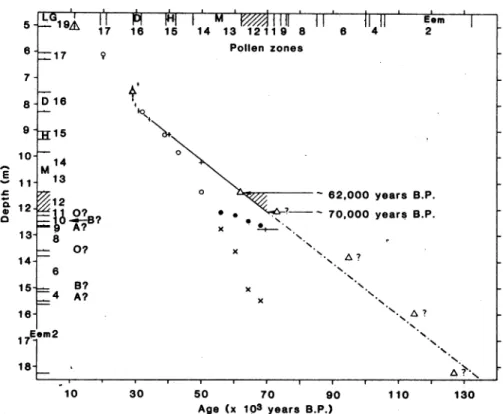
E.m2 1Tj 18 =- - I lI r 10 30 50 70 9c Age (x 103 years B.P.) 110 0
Fig.2.Depth-date plot of'4C dates(+)of GrandePilesediments.(Theverticallengt
plussignis thesampling interval, and thehorizontal length signifiestheerrorbarfc
date.) Pollenzonesand localstratigraphicnames areasinFig. 1.Polien-stratigraphic
0, and x)follow the radiocarbon time scale of Grootes (12), withbothalternative
correlationsofpollenzones9, 10,and11(e)or4, 6,and 8(x)with Amersfoort(A),Bi
andOd4erade(0), respectively. Theassumed constantsedimentation rate through
neoussedimentsfromthe base ofzone 16tozone 12isrepresented byasolidline, extendedas adashed-dotted line-throughthenonhomogeneoussediments belowzon implieddatesforzonesatGrande Pilebythedashed-dotted lineare,however,unver
agesofdeep-seastageboundaries(A)areplacedastheyweregiveninFig. 1; (?)it
nonassured level withinthepollen diagram.
160
:rribed in pollenzones, 14 and 13 (Fig. 2,solidline),-.
)f 40,000 anage of about62,000years B.P. can be
nedfrom assessed for the lower limit of the
warm-pine for- ing that canbe, inferred at the boundary
sent the between zones 13 and 12.
,herlands Given this series of'4C dates that are
rN-9054)
direqtly
connected with pollen analyticcold sta- evidence, we suggest that thebeginning
irests of of the prominent cooling episode(zone
luivalent 12),
wellknown
asmarking
the start of 1 "coom- the MiddleWeichselian innorthernEu-ls (11). rope, may have occurred before 60,000
rs (GrN- years B.P. Itis clear from the pollen and
interval the radiocarbon data that the previous
ievalues date of55,000 years B.P. (12), derived
ver,isin from the base of the equivalent of this
Les from coldperiod, cannot be correct.
Follow-dimenta- ing our earlierassumptionaboutthe
con-'lidline). stant sedimentation rate between zones
im zones 16 and 12 (,Fig. 2, solid line), we have
.tlevaria- estimated the age ofthislevel(boundary
e 16) (2) between zones 12 and 11) tobe about
constant 70,000 years B.P.
section Thermaldiffusion isotopicenrichment
:s for the of14C(12)hasbeen used to datethetop
2, solid ofpollen zone 8. Because of the
limita-Based on tions inherent in this method, theresult
nption of of69,500+ 2608years (GrN-9187) might
through beregardedasaminimal age. To
under-stand thechronostratigraphic positionof
zone8, wedescribeher,e the
interpreta-tion of the intervalsoccurringbelow it.
The correlation between pollen zone 2
and the Eemian interglacial ofnorthern
and western Europe, asrecognizedby its
typical vegetational succession (3), has been demonstrated (2). Following the
chronostratigraphic definition of the
Eemian stage (13), we are inclined to
correlate the Eemian-Weichselian stage
-boundary with the boundary between
zones 3 and 2ofGrande Pile.
Asaresult-ofthiscorrelation, several
investigators(4, 14) wouldliketo see the
Early Weichselian interstadials
Amers-foort, Brorup (3, 15), and Odderade (16) asmatching GrandePilepollenzones 4,
6, and 8, respectively, locallynamed St.
Germain I (zones 4 through 6) and St.
Germain II (zone 8). This
possibility
appears,however, tobeinconflictwith
the old date
inferred
for the topofzone8(Fig.
2).
A directbiostratigraphic
corre-4>- - lation, moreover, isimpossiblebetween
the interglacial-like vegetational
devel-130 opmentofSt.GermainIandSt.Germain
II and the completely different
vegeta-thofeach tion described for the Early
Weichseli-Dr the C ,an interstadials
(2).
On theother
hand,dates(0, .df
and,
es for the
Grande Pile
-zones9,
10, and11I
(locally
rorup
(B), namedOgnon
I,Ognon II, and Ognon
homoge-
IU)
clearly precede the MiddleWeich-wIhich
is
selian and takeplaceintheEarly
Weich-ie 12.The
ifled.'
The selian, ifonereferstotheclassical
strati-ndicatesa graphic scheme. In view oftheir
vegeta-tional- andclimatic character, we
might
SCIENCE,VOL.215 LG 1111H
MIZA
i I~
i ii Em-l9Lt0
17 16
1514
13 12 9 8
6
4
2
Pollen zones =17 'I D 16 4 154 13~12?0
- 62,000 years B.P.O|^A?B7 * * . > -~ 70,000 years B.P.
A? ~~~~~~x 8 O? x ' 6 B? x 4 A? x on January 14, 2010 www.sciencemag.org Downloaded from
regard these zones as equivalentto the
EarlyWeichselian interstadials. If pollen
zones 9, 10, and 11 were tobe correlated
with theseinterstadials, weshould
con-clude that alarge hiatus exists between
the end of the Eemian and the
Amers-foort intheNetherlands, but evidence in
support of this conclusion does not ap-pear toexist. The radiocarbon time scale used earlier for the Weichselian
strati-graphiceventshas the Amersfoort
start-ingat68,200 ± 1100years,theBrorupat
64,400 ± 800years,and the Odderadeat
60,500 ± 600 years B.P. (12). If this
chronology is correct, our 14C date of
69,500 + 380 years B.P. for the end of
zone 8supportsthe correlationbetween
zones 9, 10, and 11 and these Early
Weichselian interstadials (Fig. 2).
Fur-ther data are needed to resolve this di-lemma.
Thepollen and'4Cdata takentogether
enable us to attempt correlations
be-tween the Grande Pile continental se-quence and the ocean records (Figs. 1
and 2). Three minima in the time series
for total tree and shrub pollen indicate
three maximum cold periods, zones 1,
12,and 18, whichcanbe correlated with
theprominentice-growthphases
reflect-ed indeep-sea sedimentsbyoxygen
iso-tope stages 6, 4, and 2, respectively.
Absolute datings from land and ocean,
respectively, fix the cold maximum
(zone12)initiatingthe Middle
Weichsel-ian between about 62,000 and 70,000
yearsB.P. anddeep-seastage 4between
61,000 and73,000years B.P. Both
inter-glacial maxima(pollenzones 2 and21),
identified as the Eemian and Holocene
interglacials,arewellcorrelated with
ox-ygen isotope substage 5e and stage 1,
respectively. The formercorrelation has
recently been demonstrated (4). The
Middle Weichselian, located here
be-tween 29,000 and about 62,000 years
B.P., can beregarded asthe equivalent
ofoxygenisotopestage3. Pollenzones3
to 11thenmightcorrelatewiththe
deep-seasubstages SdthroughSa.The
corre-lations suggested in Fig. 1 within this
interval are,however, stillunproved.
Theresults ofour study show agood
agreement between land and sea
chro-nologies, reflecting a primary change
from"interglacial" toglacialconditions
atabout 70,000to73,000 yearsB.P.This
timecorrespondstothestartof the Mid-dleWeichselianatGrandePile andtothe
boundary betweenoxygenisotopestages
5 and 4 in the oceanic records (17).
Uncertainty remains about the
correla-tions between our pollen zones 4 to 11
and the classical stratigraphy: (i) zones
4, 6, and8aswellas zones9, 10, and 11
donotresemble thepollenrecords of the
SCIENCE,VOL.215,8 JANUARY 1982
Early Weichselianinterstadials; if zones
9, 10, and 11 correspond to these
inter-stadials, a hiatus exists at Amersfoort
and other places. (ii) If the present
knowledge about the Early Weichselian
ages is accepted as correct, zones 4, 6,
and 8 cannotrepresent the classical
in-terstadials Amersfoort, Brorup, and
Od-derade. (iii) Our continental record is in
goodagreementwith the deep-sea record
to about70,000 years B.P. (thatis,
oxy-gen isotope stage 4), but we are still
uncertain about how to correlate the
classical interstadials with the substages ofoxygen isotopestage5.
GENEVIEVE M. WOILLARD* InstitutBotanique,Laboratoire de
Palynologie etPhytosociologie,
4,place Croix-du-Sud,
1348Louvain-la-Neuve, Belgium
WILLEMG. MOOK IsotopePhysics Laboratory,
UniversityofGroningen,
Westersingel
37,-9718CMGroningen, Netherlands ReferencesandNotes
1. G. J. Kukla, Earth-Sci. Rev. 13, 307 (1977). 2. G. M. Woillard, Acta Geogr. Lov. 14 (1975);
in "International Geological Correlation Pro-grammeProject73/1/24 Report 4," V.Sibrava,
Ed.(Stuttgart-Hohenheim, Prague, 1977),p.72; Quat. Res. (N. Y.) 9, 1 (1978); ibid. 12, 154 (1979); in Palaeoecology of Africa,E. M. van ZinderenBakker andJ.A.Coetzee, Eds. (Bal-kema, Rotterdam, 1978), vol. 10, p. 125; Bull. Soc.Belg. Geol. 88, 51 (1979); Nature(London)
281, 558 (1979); in "International Geological Correlation Programme Project73/1/24 Report
6,"V.Sibrava, Ed. (Ostrava, Prague, 1980). 3. W. H. Zagwijn, Meded. Geol. Sticht. 14, 15
(1961).
4. J. Mangerud, E. S0nstegaard, H. P. Sejrup,
Nature(London)277, 189(1979).
5. N.J.Shackleton and N. D. Opdyke, Quat. Res. (N.Y.) 3, 39 (1973); , R. K. Matthews, Nature(London) 268, 618 (1977); W. F. Ruddi-man, Science196,1208(1977).
6. J. D.Hays, J. Imbrie, N. J. Shackleton, Science 194, 1121 (1976).
Thewarm-coreeddies thatarea
nota-ble feature of the East Australian
Cur-rent(EAC) system were first described
byHamon(1).Since thentheyhave been
studied sporadically, sometimes as part
of broader EAC studies (2) and
some-times in theirown right (3, 4). The
pic-turethat emerges from the studies may
besummarizedasfollows:(i)warm-core
eddies about 250 km in diameter form
from thepinch-offof EACmeanders;(ii)
theyhavelifetimes of about 1 year;(iii)
7. M. A.Kominz, G. R. Heath, T. L. Ku, N. G. Pisias, Earth Planet. Sci. Lett. 45, 394 (1979). 8. J. Mangerud and B. E. Berglund, Boreas 7, 179
(1978).
9. Ar.Leroi-Gourhan, Colloq. Int. CNRS 219, 61 (1973); and J. Renault-Miskovsky, in Approthe ecologique de I'Hommefossile, p. 35.
10. T. van der Hammen, C. C. Maarleveld, J. C. Vogel,W. H. Zagwijn, Geol.MAijnbouw46, 79 (1967); T. van der Hammen and T.Wijmstra,
Meded.RijksGeol. Dienst 22, 55(1971). 11. W. H. Zagwijnand R. Paepe, Eiszeitalter Ggw.
19, 129(1968).
12. P. M.Grootes, thesis, University of Groningen (1977); Science 200, 11 (1978).
13. J. Mangerud, S. T. Andersen, B. E. Berglund, J. J. Donner, Boreas 3,109,(1974).
14. H. J. Beug, Geol. Bavarica 80, 91 (1979); E.
Gruger, ibid., p. 5; Quat. Res. (N.Y.) 12, 152
(1979).
15. S. T. Andersen, Dan. Geol. Unders. Afh.
Raekke 2 75, 1(1961).
16. F. R. Averdieck, in Fruhe Menschheit und Umwelt, K. Gripp, R. Schutrumpf, H. Schwa-bedissen, Eds. (Cologne, 1967), vol. 2, p. 101. 17. W. F. Ruddiman, A. McIntyre, V.
Niebler-Hunt, J. T. Durazzi, Quat.Res. (N.Y.) 13, 33 (1980).
18.Thepollencurveis based in part on published data(2). It has been established with the four parallelcoresI, XVIII, XIX, and X (core Ibeing
350 m apart from the others), connected by palynology; a regular scaleof depths has been applied in each core to draw the curve. About 500pollen grains werecountedineachof 370
samples;120taxa were recognized. Methods of processing thesamplesweredescribedearlier in
(2).
19.The radiocarbon samples were treated with acid, alkali, and acid priortocombustion of the residue. For the enriched date of 69,500 260
years B.P. (GrN-9187), a 15-cm section was takenfromthethree parallelcoresXVI,XVII, and XIX. Theenrichment samplewasrigorously
extracted with alkali. The alkali extract was datedat >49,000 years B.P. (GrN-9383). The
\Ikalitreatment wasomitted for the radiocarbon
sinple datedat 11,170± 100 years B.P. (Lv-1046) because of the low content oforganic
material (too small asample). 20. C.Emiliani, J. Geol. 63, 538(1955).
21. N. J.Shackleton, Proc. R. Soc. London Ser. B 174, 135(1969). i
22. We aregratefultoH. J. Streurman whocarried outthe 4C enrichment and the GrN "4C
dat-ingsandtoE.Gilot whoobtained both Lv 14C
datings. We thank W. Mullenders, B. Frenzel, J.
Mangerud, andA.V. Munautfor critical review of the manuscript. In 1980, G.M.W. was a
researchfellow of the AlexandervonHumboldt FoundationatHohenheimUniversity, Stuttgart. * Dr.Woillard diedon7July1981.
16January 1981; revised 21 August 1981
they can drift along
complicated paths;
(iv) they canrejoin EAC
meanders;
(v)the surface layers ofan
eddy
cool andmix downto -350min wintertoforman
isothermal core; and (vi) the formation
ofa summer surface
"cap"
ofwarmerwater insulates this core from further
changes so thatit
becomese
ineffect,
asignatureforsubsequent identification.
The first
suggestion
that warm-coreeddiesmay coalesce came
during
1979-1980when the evolution ofeddyJ near
0036-8075/82/0108-0161$01.00/0 Copyright© 1981 AAAS
The
Coalescence of Two East Australian
Current
Warm-Core Eddies
Abstract. Two warm-core eddies coalesced in about 20 days as their centers
rotatedaroundapointon the contracting line thatjoinedthem. In theprocessof
formingtheneweddy, thesubsurfaceisothermal-isohaline "signature"layer ofone
eddywasupliftedand somewhatdepletedwhile that oftheotherwasdepressed.
161
on January 14, 2010
www.sciencemag.org