HAL Id: hal-00298614
https://hal.archives-ouvertes.fr/hal-00298614
Submitted on 23 Nov 2004HAL is a multi-disciplinary open access
archive for the deposit and dissemination of sci-entific research documents, whether they are pub-lished or not. The documents may come from teaching and research institutions in France or abroad, or from public or private research centers.
L’archive ouverte pluridisciplinaire HAL, est destinée au dépôt et à la diffusion de documents scientifiques de niveau recherche, publiés ou non, émanant des établissements d’enseignement et de recherche français ou étrangers, des laboratoires publics ou privés.
Consumptive water use to feed humanity ? curing a
blind spot
M. Falkenmark, M. Lannerstad
To cite this version:
M. Falkenmark, M. Lannerstad. Consumptive water use to feed humanity ? curing a blind spot. Hydrology and Earth System Sciences Discussions, European Geosciences Union, 2004, 1 (1), pp.7-40. �hal-00298614�
HESSD
1, 7–40, 2004Consumptive water use to feed humanity
– curing a blind spot
M. Falkenmark and M. Lannerstad Title Page Abstract Introduction Conclusions References Tables Figures J I J I Back Close
Full Screen / Esc
Print Version Interactive Discussion
EGU Hydrol. Earth Syst. Sci. Discuss., 1, 7–40, 2004
www.copernicus.org/EGU/hess/hessd/1/7/ SRef-ID: 1812-2116/hessd/2004-1-7 European Geosciences Union
Hydrology and Earth System Sciences Discussions
Consumptive water use to feed humanity
– curing a blind spot
M. Falkenmark1and M. Lannerstad2
1
Stockholm International Water Institute, Sweden 2
Department of Water and Environmental Studies, Link ¨oping University, Sweden
Received: 15 November 2004 – Accepted: 22 November 2004 – Published: 23 November 2004
Correspondence to: M. Falkenmark ([email protected])
HESSD
1, 7–40, 2004Consumptive water use to feed humanity
– curing a blind spot
M. Falkenmark and M. Lannerstad Title Page Abstract Introduction Conclusions References Tables Figures J I J I Back Close
Full Screen / Esc
Print Version Interactive Discussion
EGU Abstract
Since in large parts of the world it is getting difficult to meet growing water demands by mobilising more water, the discourse has turned its focus to demand management, governance and the necessary concern for aquatic ecosystems by reserving an “envi-ronmental flow” in the river. The latter calls for attention to river depletion which may
5
be expected in response to changes in consumptive water use by both natural and anthropogenic systems. Basically, consumptive use has three faces: runoff generation influenced by land cover changes; consumptive use of water withdrawn; and evapora-tion from water systems (reservoirs, canals, river based cooling). After demonstrating the vulnerability to changes in consumptive use under savanna region conditions –
rep-10
resentative of many poverty and hunger prone developing countries subject to attention in the Millennium Development Goal activities – the paper exemplifies 1) changes in runoff generation in response to regional scale land cover changes; 2) consumptive use in large scale irrigation systems. It goes on to analyse the implications of seeing food as a human right by estimating the additional consumptive use requirements to
15
produce food for the next two generations. Attention is paid to remaining degrees of freedom in terms of uncommitted water beyond an environmental flow reserve and to potential food trade consequences (so-called virtual water). The paper concludes that a human-right-to-food principle will have major consequences in terms of altered con-sumptive water use. It will therefore be essential for humanity to address river depletion
20
to avoid loss of resilience of the life support system. This will demand a deep-going cooperation between hydrology, ecology and water governance.
1. Introduction
Water scarcity has been a core interest of the senior author since the early 1970’s, and has in the late 1990’s been gathering increasing international interest. For a long time,
25
HESSD
1, 7–40, 2004Consumptive water use to feed humanity
– curing a blind spot
M. Falkenmark and M. Lannerstad Title Page Abstract Introduction Conclusions References Tables Figures J I J I Back Close
Full Screen / Esc
Print Version Interactive Discussion
EGU less finite resource. Today, however, different circumstances call for interest on water
scarcity as seen from the perspective of the outcome of increasing river depletion. There is for instance repeated reference in literature to the world’s decreasing water resources and that “less and less water is available for human consumption” (Ambio, 2004). This is a statement that is however inconsistent with the general understanding
5
that the amount of water circulating in the water cycle remains the same.
What is it then that gives the impression that water is getting scarcer? Is it the growing concern for what we may call “river depletion”, also referred to as neo-arheism (Meybeck, 2003), which has been described for a whole set of rivers; Yellow River, Indus, Colorado, Nile, Aral Sea tributaries, Indus, Ganges, Murray-Darling, Jordan,
10
Lake Chad tributaries, Huai, Rio Grande, Chao Phraya rivers etc. (Lannerstad, 2002). There are already signs that this depletion may generate societal efforts to reduce the water use by putting a “cap” on further water withdrawals for irrigation (MDBC, 2003).
Such river depletion is also focused in the results of the scoping phase of the global UNEP-project GIWA (Ambio, 2004). The analysis of key causes of environmental
prob-15
lems in the 66 coastal seas, studied in that project, concludes that freshwater shortage is a dominating cause of the environmental problems experienced in at least 19 of the 66 coastal seas. This supports the need to put focus on freshwater shortage, especially flow modification and consumptive water use in irrigation.
Another scarcity-related concern is the new concern for the environmental effects
20
of over-appropriation of streamflow. While the environmental community has recently developed criteria for minimum flow for protection of aquatic ecosystems (Dyson et al., 2003), a world map presented by IWMI, IUCN, WRI and University of Kassel (Smakthin et al., 2004) suggests that the environmental flow needs have already been overcom-mitted in a broad belt across the continents from Mexico in the west to N China in the
25
east. Evidently, decreasing or non-existent river flow will also generate more or less serious societal conflicts in terms of both a spatial dimension, i.e. upstream – down-stream conflicts of interest, and sector conflicts in terms of urban – rural competition, for instance between farmers and industry, or farmers and cities.
HESSD
1, 7–40, 2004Consumptive water use to feed humanity
– curing a blind spot
M. Falkenmark and M. Lannerstad Title Page Abstract Introduction Conclusions References Tables Figures J I J I Back Close
Full Screen / Esc
Print Version Interactive Discussion
EGU Moreover, while the main water debate has its focus on demand management, i.e.
how to bring down demand by limiting/avoiding “losses” through overuse, leakages etc., most of the losses addressed are losses only from an economic perspective: leakages that return to the water system. The crucial issue behind river depletion is NOT losses/leakages but changes in “consumptive or depletive water use”, i.e.
evap-5
oration during use with a vapour flow leaving the basin not available for reuse (until re-precipitated elsewhere) (Molden et al., 2001; Kendy et al., 2003).
This paper has its focus on such consumptive/depletive water use, its relation to land cover change and socio-economic development, implications of feeding a growing humanity and environmental and ecological consequences of changes identified.
10
2. Consumptive water use
2.1. The concept
Conventional statistics of water use offers data on water withdrawals for municipal, industrial and agricultural purposes. Since many of the water uses to which the with-drawn water is being put are through-flow based uses where the water after use returns
15
to the water system, it is basically only the consumptive use component or “evapotran-spiration during use” that is relevant from the perspective of impact on downstream users and aquatic and coastal ecosystems. The return flow represents a quantity that can principally be reused over and over again down the river.
While evapotranspiration has conventionally been discussed as part of hydrological
20
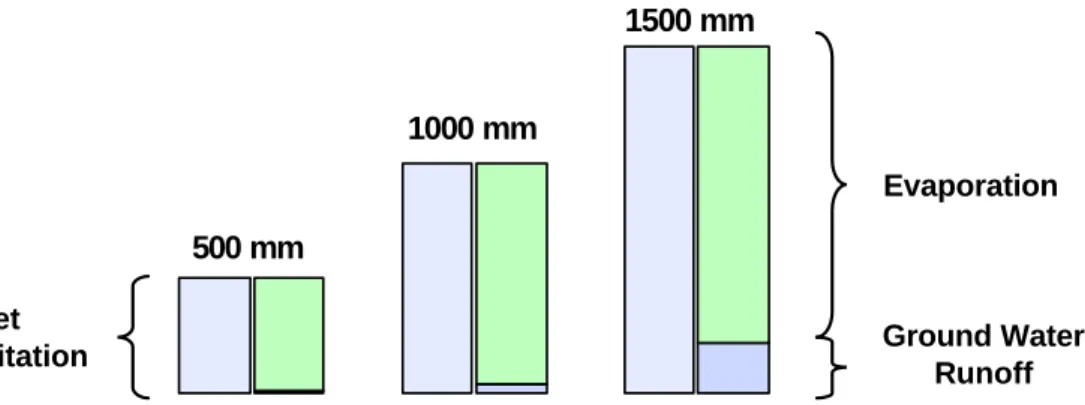
analyses in water balance studies, the concept blue as opposed to green water flow was introduced at a FAO seminar in 1993 in order to generate more management-oriented interest to the consumptive use component of water use (Falkenmark, 1995). An overarching catchment approach allows a visual overview of the two main water out-flows from the basin (Fig. 1). On a basin level, the green water flow component includes
25
HESSD
1, 7–40, 2004Consumptive water use to feed humanity
– curing a blind spot
M. Falkenmark and M. Lannerstad Title Page Abstract Introduction Conclusions References Tables Figures J I J I Back Close
Full Screen / Esc
Print Version Interactive Discussion
EGU from wet surfaces and free water surfaces in wetlands, lakes and reservoirs.
Often the renewable groundwater is looked upon as a separate source as compared to renewable river flow. It is however elementary that, in a catchment approach, renew-able groundwater is generally part of the hydrological cycle in the basin. It feeds the dry season base flow in local rivers; and groundwater fed wetlands depend upon the
5
natural outflow from aquifers.
2.2. Vapour flow from different surfaces
There is for some reason a fundamental difference in approach to water use by ter-restrial ecosystems within conventional ecology as opposed to hydrology. Thus, the Millennium Ecosystem Assessment sees terrestrial ecosystems as water-provisioning
10
rather than water-consumptive, which is as they come out from a hydrological aspect. Calder (2004) has drawn attention to the misleading misunderstanding that forests pro-duce runoff. It is interesting to note for example that both Indian National Water Policy and Indian NGOs advocate and work for more trees to increase blue water flow, while the South Africans are taking the opposite approach, defining forest plantations as
15
streamflow impacting activity for which the forest companies will have to pay for the additional water literally consumed.
Returning now to the blue/green conceptual model of the water leaving a catchment, the green water flow branch includes vapour flow from different surfaces: from irrigated fields, wetlands and evaporating water surfaces (blue water transformed into green),
20
and from natural vegetation (intercepted and naturally infiltrated rainwater). Interesting from a river depletion perspective is evidently the degree to which increases in green water flow involve reduced runoff production and therefore reduced blue water flow. 2.3. River flow vulnerability to change in the arid and semi-arid zone
Changes in river flow may thus originate from different actions: increased or expanded
25
HESSD
1, 7–40, 2004Consumptive water use to feed humanity
– curing a blind spot
M. Falkenmark and M. Lannerstad Title Page Abstract Introduction Conclusions References Tables Figures J I J I Back Close
Full Screen / Esc
Print Version Interactive Discussion
EGU of large evaporating water surfaces (reservoirs), or altered land cover involving either
increased evapotranspiration (e.g. forest plantations) or decreased evapotranspiration (e.g. deforestation).
Large attention was paid already in the 1960’s to the green water flow by the Soviet scientist Lvovich (1979). He quantified the partitioning of precipitation for all the major
5
biomes, based on data of precipitation and streamflow from all the continents, and analysed infiltration, actual evaporation and groundwater recharge in generic diagrams. Typical for the steppe and savanna zone is the extremely limited groundwater recharge and baseflow production, easily altered by land cover changes. Figure 2a shows that most of the infiltrated rainfall evaporates in the interval 500–1000 mm of
10
rainfall and that on the whole, the groundwater recharge is minimal. Even moderate evaporation changes may cause blue water changes that are large on a relative scale. Lvovich’s diagrams can be used for studying possible changes in blue/green water partitioning and therefore in river flow generation linked to land cover changes. The high evaporative demand in the tropics plus the fact that it is in these areas where large
15
land use changes are generated due to population growth and development efforts, suggests that the savanna zone is especially vulnerable. This zone includes many of the top and high priority countries now focused on in the Millennium Project with its efforts to meet the UN launched Millenium Development Goals (MDGs), many of which are directly water-related (poverty, hunger and unhealth alleviation) (Fig. 2b).
20
3. Anthropogenic alterations of green/blue water flows
3.1. Global historical alterations
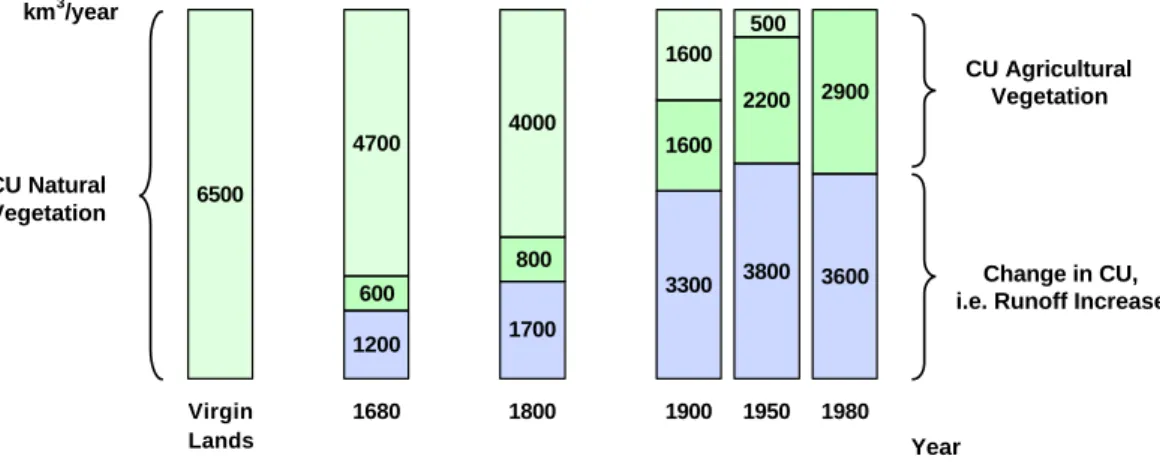
Agriculture development to meet food needs of an increasing global human popula-tion has over time gradually converted large areas with natural vegetapopula-tion to cultivated lands. Lvovich and White (1990) made an estimate of how this land transformation
25
HESSD
1, 7–40, 2004Consumptive water use to feed humanity
– curing a blind spot
M. Falkenmark and M. Lannerstad Title Page Abstract Introduction Conclusions References Tables Figures J I J I Back Close
Full Screen / Esc
Print Version Interactive Discussion
EGU i.e. increased blue water formation, culminated around 1950 when the vegetation on
ploughed land consumed around 3700 km3/yr less than virgin vegetation. After that time consumptive use increased again, in response to changes in agro-technical meth-ods, and was estimated to 2900 km3/yr in 1980. A recent study of large scale redistri-bution of global water vapour flows by Gordon et al. (2004) supports this assessment
5
by estimating global reduction of consumptive use due to deforestation to 3000 km3/yr. In contrast consumptive water use of water withdrawn from rivers and aquifers repre-sents “blue-to-green” alterations. Lvovich and White (1990) analysed global blue water withdrawals of surface and groundwater resources for the last three centuries. As can be seen in Fig. 3b there has been a dramatic increase during the 20thcentury, the main
10
part during the green revolution after WW II. Out of in total 2570 km3/yr consumptive water use from withdrawals in 1980, irrigated agriculture stands for more than 90%, 2340 km3/yr.
Consumptive water use from man-made freshwater storage is another “blue-to-green” alteration. Reservoirs for irrigation, hydropower etc. today have an estimated
15
total volume of around 6000 km3and cover an area of more than 500 000 km2. Global reservoir consumptive use is estimated to around 200 km3/yr (Lvovich and White, 1990; Shiklomanov, 2000). In arid regions reservoirs can make a considerable contribution to surface water evaporation. Annual consumptive use from Lake Nasser/Nubia behind High Aswan Dam is estimated to as much as 11% of the lake volume (Lvovich and
20
White, 1990). As the dam can store two year’s inflow (Postel, 1999, p. 54) more than 20% of the yearly inflow might be lost to evaporation every year.
3.2. Three basin illustrations of blue/green interactions
An estimate of regional green-to-blue transformations was made by Gordon et al. (2003) for the Australian continent. During the last 200 years European settlers
25
have made extensive clearance of perennial deep rooted forest vegetation. The es-timated reduction of consumptive water use is almost as large as the present annual natural blue water flow from the continent. In Murray-Darling Basin 12 to 20 billion trees
HESSD
1, 7–40, 2004Consumptive water use to feed humanity
– curing a blind spot
M. Falkenmark and M. Lannerstad Title Page Abstract Introduction Conclusions References Tables Figures J I J I Back Close
Full Screen / Esc
Print Version Interactive Discussion
EGU were replaced by short rooted grasses and seasonal crops. This vegetation change
resulted in amplified blue water formation, with rising groundwater levels and increased river flow. The past 100 years a parallel development of construction of river regulatory and water storage structures have enabled large scale diversions, today mounting over 11 000 Mm3. Through increased consumptive use, outflow to the sea today thus has
5
decreased from an average of 12 300 Mm3to 4900 Mm3(MDBC, 2004).
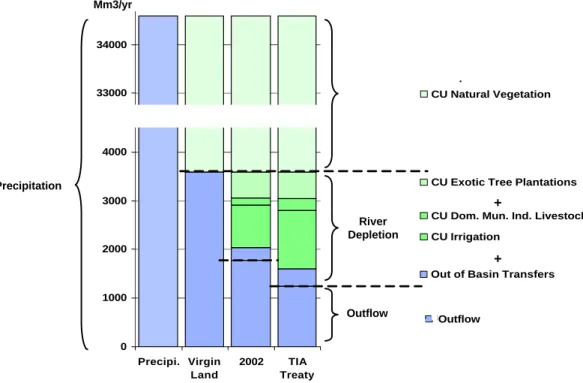
Another illustrative case is offered by the changes in the Incomati river basin in Southern Africa (Van der Zaag and Carmo Vaz, 2003) (Fig. 4a), where the net vir-gin runoff (3587 Mm3/yr) has been reduced step by step by altogether 1800 Mm3/yr till 2002, and can be predicted to decrease by another 500 Mm3/yr in line with the recent
10
riparian Triparty Interim Agreement. Interesting to notice is the increased consumptive water use by exotic tree plantations, almost 550 Mm3/yr. These plantations are entirely rainfed and are another example of how land use changes can alter natural hydrology and reduce blue water formation. The final outcome of increased green water flow from both rainfed and irrigated areas will in other words be a reduction of primary blue water
15
flow by 2300 Mm3/yr, leaving only 35% of the original streamflow for freshwater and downstream coastal ecosystems.
Another carefully researched illustration of blue-to-green redirection is offered by IWMI’s water accounting analysis of the water balance of the Bhakra sub-basin irriga-tion project of 1.5 Mha in northwest India, visualising the consumptive use and river
20
depletion (Molden et al., 2001). The entire precipitation falling in the area and around 55% of the blue water inflow to this huge irrigation project was transformed into green water flow, above all by crops (Fig. 4b).
3.3. Modern world signals in terms of increasing blue water scarcity
As a consequence of increase in consumptive blue water use (Fig. 3b), a disturbing
25
trend of large scale river depletion and falling groundwater levels have become evident in the arid and semi arid zone (Postel, 1999; Plate 3 in Kijne et al., 2003). A whole set of hot spots have already developed in regions which are at the same time hunger
HESSD
1, 7–40, 2004Consumptive water use to feed humanity
– curing a blind spot
M. Falkenmark and M. Lannerstad Title Page Abstract Introduction Conclusions References Tables Figures J I J I Back Close
Full Screen / Esc
Print Version Interactive Discussion
EGU prone, drought vulnerable and with increasing populations.
3.3.1. River depletion
River depletion is characterised by reduced river flow relative long time average; some rivers have changed from perennial to intermittent. The major reason is consumptive water use by irrigation (Lannerstad, 2002). As the trend is prevalent after 1950,
Mey-5
beck (2003) designated a river flow reduction of at least 50% as “neo-arheism”, “new absence of flow”. Considerably reduced river flow in many basins imperils societal de-velopment, increases the competition between upstream and downstream users and threatens water dependent terrestrial, freshwater and coastal ecosystems.
The most evident example is the Aral Sea where large scale irrigation along the
trib-10
utaries Amu Darya and Syr Darya has reduced this inland water body, once the fourth largest, by half it’s area and three quarters of it’s volume. Disappearing delta areas cause the extinction of habitats and endemic species. A collapsed fishing industry and serious human health problems are some of the societal effects (Glantz, 1998).
Along the Colorado River successful reservoir construction during the last century
15
today enable a total storage of almost five times average yearly flow. The Colorado River supports irrigation of 800 000 ha and supplies drinking water to 25 million people, 16 million “out of basin” in southern California. Since 1960 there have not been almost any discharges to the Californian Gulf and the last measuring station, El Meritimo in Mexico, closed down in 1968 (Postel, 1995).
20
The naturally perennial Indus River today irrigates more than 14 million ha in Pak-istan. After completion of a number of large scale reservoirs the days of zero outflow to the Arabian Sea during the last 25 years have reached an average of 81 days during dry season and 26 days during wet season. On average only 21% of historical dry season flow now reach the delta and coastal ecosystems (Asiancs, 2000).
25
In 1972 the lower course of the Yellow River dried up for the first time in history. In 1997 the dry-up lasted for 226 days and reached 700 km up-stream. Reduced dilution of industrial effluents threatens human health of millions in the river valley. Periods of
HESSD
1, 7–40, 2004Consumptive water use to feed humanity
– curing a blind spot
M. Falkenmark and M. Lannerstad Title Page Abstract Introduction Conclusions References Tables Figures J I J I Back Close
Full Screen / Esc
Print Version Interactive Discussion
EGU little or no flow leave the fertile delta plains without irrigation water and cause extensive
siltation of the main canal, posing a threat to river dikes during flooding (Ren and Walker, 1998).
In the Rio Grande/Rio Bravo Basin, New Mexico, Texas and Mexico are competing for scarce water resources. In 2001 the river for the first time failed to reach the Gulf of
5
Mexico (Economist, 2001). Economic expansion with production of cash-crops for the U.S. market, following the North America Free Trade Treaty, together with several years of drought forced Mexico to exceed its river flow share and in 2000 thus owed the U.S. 1.2 km3. The population in the area is projected to double by 2020 (Economist, 2000). 3.3.2. Groundwater overdraft
10
Since 1950 a number of concurrent development steps as geological knowledge, well drilling, pump technology and rural electricity infrastructure have opened up for exten-sive groundwater exploitation (Foster and Chilton, 2003). Rosegrant et al. (2002, p. 157) estimate total groundwater use in 1995 to more than 800 km3, out of which as much as 200 km3is overdraft of non-recharged groundwater contributing to long-term
15
groundwater depletion (Postel, 1999, p. 80). Postel suggests that this equals around 180 tons of grain or about 10% of global harvest. The major groundwater depleting nations (mid 1990 s) are India 104 km3, China 30 km3and US 14 km3(Postel, 1999, p. 80).
The former IWMI Director General David Seckler assessed as much as a quarter of
20
India’s harvest to rely upon groundwater overdraft (Shah et al., 2000). Gujarat is one of several groundwater depleting states in India. In North Gujarat 30 years ago bullock-bailers could lift water from 10–15 m depth. Today tube wells with 35–75 hp pumps in some areas force groundwater, often fluoride contaminated, from more than 400 m to the surface. In the Gujarat Saurashtra coastal area farmers during 1960 s and 1970 s
25
through extensive groundwater pumping experienced a tube well economy boom. Now sea water intrusion in these depleted coastal aquifers reaches 7 km inland and socio-ecological collapse is the reality for many villages (Shah et al., 2000). Already in 1976
HESSD
1, 7–40, 2004Consumptive water use to feed humanity
– curing a blind spot
M. Falkenmark and M. Lannerstad Title Page Abstract Introduction Conclusions References Tables Figures J I J I Back Close
Full Screen / Esc
Print Version Interactive Discussion
EGU UNDP estimated that groundwater abstractions in Gujarat had to be reduced by 25%
to reach sustainable levels (Moench et al., 2003).
The most well known groundwater depletion example in the U.S. is the Ogallala aquifer below the U.S. Great Plains. It covers an area of 453 000 km2 and waters one fifth of U.S. irrigated land. Yearly groundwater overdraft is estimated to 12 km3 and
5
altogether so far to more than 325 km3. In 1978 the Ogallala groundwater irrigated a peak area of 5.2 million hectares. Falling water tables with increased pumping costs in combination with low crop prices had reduced the area by 20% a decade later and by 2020 only 60% of the record area is projected to remain under irrigation (Postel, 1999, p. 77).
10
North China Plain stretches over 320 000 km2and has a population of over 200 mil-lion. The area embraces 64% of national farmlands with half of China’s wheat produc-tion and one third of the maize harvest (Kendy et al., 2002; Shah et al., 2000). The area is facing serious groundwater overexploitation problems, with the groundwater ta-ble under Beijing fallen 59 m since 1965, 2.5 m in 1999 (Moench et al., 2003). The
15
Hai basin suffers a yearly groundwater depletion of almost 9 km3 (Foster and Chilton, 2003). Moench et al. (2003) cite a water strategy report from 2001 for North China by the Chinese Ministry of Water Resources. The report especially focuses on the Hai, Huai and Yellow (3-H) Rivers: “The serious and largely irreversible falling groundwater levels throughout the North China Plains demands. . . a program. . . to reduce
ground-20
water use to sustainable levels. . . consequences of not doing it will have major long term implications, such as effectively destroying the groundwater dependent agriculture base, massive subsidence and sea water intrusion, virtual elimination of groundwater as water resource for many cities and countless households and the loss of “insurance” water for the future generations”.
HESSD
1, 7–40, 2004Consumptive water use to feed humanity
– curing a blind spot
M. Falkenmark and M. Lannerstad Title Page Abstract Introduction Conclusions References Tables Figures J I J I Back Close
Full Screen / Esc
Print Version Interactive Discussion
EGU 4. Meeting expanding green water needs
We have seen above that human activities on land tend to on the one hand influence the runoff generation and the blue water flow, and on the other introduce a “blue-to-green” redirection through irrigation of agricultural land. What will then be the effects of feeding a growing humanity? And how will this influence future streamflow?
5
The largest future challenge is of course the global hunger alleviation efforts in line with the solemnly declared Millennium Development Goals launched by the United Nations Millennium Summit in September 2000. Considering the continued growth of the human population and changed preferences as income rises and urbanisation expands, we can foresee that larger and larger amounts of water will have to be
appro-10
priated as consumptive water use for growing that food. We may even have to accept that this will have effects in terms of even larger river depletion.
But beyond the increased consumptive use linked to producing the food for a growing humanity, there is the need to rehabilitate the problems caused by the already mani-fested river depletion beyond the requirements of healthy aquatic ecosystems and by
15
groundwater overdraft. What can be said about these necessary future changes? 4.1. Additional consumptive use to feed the world
The amounts of green water flow appropriated per capita for current food production have been shown by Gleick (2000), based on diets in different regions, to vary by a factor 3 between around 600 m3/p yr in the widely undernourished Sub-Saharan Africa
20
and 1800 in North America with its rich meat diet. In order to estimate the green water needs for feeding the entire world population, the approximate green water require-ments for an “acceptable nutritional diet” have to be known. Rockstr ¨om (2003) arrived at 1300 m3p−1yr−1 assuming 3000 kcal p−1d−1 (FAO prediction as global average by 2030), and 20% animal protein. He found this to be almost a generic value irrespective
25
of climate, the reason being that regional differences in evaporative demand are being compensated by differences between C3 and C4 plants.
HESSD
1, 7–40, 2004Consumptive water use to feed humanity
– curing a blind spot
M. Falkenmark and M. Lannerstad Title Page Abstract Introduction Conclusions References Tables Figures J I J I Back Close
Full Screen / Esc
Print Version Interactive Discussion
EGU Applying this on the one hand to the predicted population growth till 2025 and 2050
respectively, and adding the food needed to upgrade the diets of the 800 million pop-ulation that are today undernourished, he arrived at an additional green water require-ment of 3800 km3/yr one generation from now (by year 2025), growing to an additional 5600 km3/yr two generations from now (by year 2050) (Rockstr ¨om, 2003). Noting that
5
the total green water flows from ALL blue water withdrawals in 1995 was 2100 km3/yr (Shiklomanov, 2000), present water productivity indicates that additionally almost twice this quantity will have to be appropriated in the next half century for alleviating hunger. The degrees of freedom are however limited since experience from the past sug-gests that increased consumptive use in a river basin will reduce streamflow, impacting
10
both downstream water users and their livelihoods and aquatic ecosystems. A mini-mum flow, i.e. “environmental flow”, has to remain in the river for protection of aquatic ecosystems and downstream coastal ecosystems. This minimum flow has been de-termined by different methods (Tharme, 2003). The simplest thumb rule estimates this amount to some 30% of the natural streamflow in the tropics (where aquatic life is
15
already adapted to a dry season), and some 50% in the temperate zone (with precipi-tation all year round).
4.2. Options and orders of magnitude
The question is therefore what the options are for meeting the additional green wa-ter need for food production. There are principally three options: 1) reduced
non-20
productive green water losses, i.e. increased agricultural productivity per drop of water evaporated (both irrigated and rainfed cropping systems); 2) expanded irrigation; 3) horisontal expansion of rainfed agriculture. Let us try to quantify at least the orders of magnitude of these respective options.
As regards the first option, the basic question is how much of the current green water
25
flow that can be shifted from non-productive into productive use (“vapour shift” Rock-str ¨om, 2003). According to Shiklomanov (2000), out of the 2500 km3/yr withdrawn in agriculture, 1750 km3/yr represents consumptive use. Irrigated agriculture has
how-HESSD
1, 7–40, 2004Consumptive water use to feed humanity
– curing a blind spot
M. Falkenmark and M. Lannerstad Title Page Abstract Introduction Conclusions References Tables Figures J I J I Back Close
Full Screen / Esc
Print Version Interactive Discussion
EGU ever generally been quite wasteful in water use. Not only are the blue water losses
considerable but part of the green water flow is non-productive. If we – as a very coarse first approximation – assume that only say 40% of the water withdrawn reaches the plants, then 1000 km3/yr represents the productive component of the consumptive use, while 1750–1000 or 750 km3/yr represents non-productive component that may
5
be principally “regainable” by increased water productivity in terms of production per drop evapotranspired. Also rainfed agriculture involves large non-productive losses. Out of an assessed 5000 km3/yr of green water use (Rockstr ¨om et al., 1999), a careful analysis of what might be achievable by 2050 from increased productivity in rainfed crop production suggests that 1500 km3/yr might be “regainable”, i.e. reduce future
10
consumptive use demands by 1500 km3/yr (Falkenmark and Rockstr ¨om, 2004). We therefore find – being as optimistic as possible – that out of the required 3800 km3/yr by 2025 (5600 by year 2050), a maximum of 750+1500 or 2250 km3/yr might possibly be regained from today’s green water flow by productivity increase, i.e. a maximised “crop per evaporated drop” policy.
15
This leaves a minimum of 3800–2250 or 1550 km3/yr by year 2025 (3350 by 2050) to be covered by either increased irrigation or expansion of rainfed agriculture into other areas. According to optimistic assessments based upon FAO projections (Falkenmark and Rockstr ¨om, 2004, p. 61) we might only expect an irrigation expansion of some 600 km3/yr – this is the part of the green water that will have evident blue water
con-20
sequences. Even these very optimistic “guesstimates” leaves at least 1000 km3/yr by 2025 (2800 by 2050) to be covered by horizontal expansion into grasslands and forests. 4.3. The blue water perspective: conflict with environmental flow
What these approximations suggest is that feeding humanity involves the risk that river depletion rises from current 2500 km3/yr (Shiklomanov’s estimate of consumptive blue
25
water use) to 3100 km3/yr by a moderately expanding irrigation. (Whether irrigation is based on surface or renewable groundwater has limited relevance since consumptive groundwater use is equivalent to transforming blue low flow recharge to green water
HESSD
1, 7–40, 2004Consumptive water use to feed humanity
– curing a blind spot
M. Falkenmark and M. Lannerstad Title Page Abstract Introduction Conclusions References Tables Figures J I J I Back Close
Full Screen / Esc
Print Version Interactive Discussion
EGU flow). Increased river depletion will aggravate both the societal water stressed situation
and further hurt already degraded aquatic ecosystems.
The current overappropriation of streamflow has been highlighted by Smakthin et al. (2003) who analysed streamflow in relation to minimum requirements for healthy aquatic ecosystems (30% in dry climate regions). They showed that more than 70% of
5
the flow is already being withdrawn in a broad belt from Mexico through North Africa, West Asia, Central Asia to North China. Considering the underlying data, which are withdrawal data that do not distinguish consumptive from non-consumptive water use, the map, fortunately, exaggerates the impression of over-commitment, however.
Evidently, the basic river depletion conflict of interest is between more consumptive
10
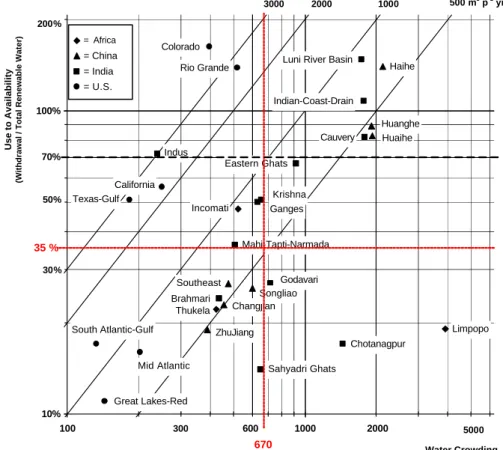
use for feeding humanity and more baseflow in the rivers for environmental flow pro-tection? Figure 5 gives an idea of the situation by 1995 for a number of river basins in India, China, U.S., and for recent years for a couple of African basins. The vertical scale shows withdrawal-to-availability ratio, where maximum 70% is acceptable since the remaining 30% have to be left uncommitted for environmental flow requirements.
15
The horizontal scale shows water crowding level.
5. Degrees of freedom
5.1. Overappropriated regions
The diagram (Fig. 5) shows that in S and E Asia, the 70% withdrawal level was sur-passed in a whole set of large basins already in 1995: India: Indus and Cauvery rivers,
20
with Indian-Coastal-Drain and Luni river even surpassing 100% level and E Ghats rivers were very close to the 70% line. China: Huai and Yellow rivers surpassing 70%, and Hai River already beyond 100%. In Subsaharan Africa most farmers are however rain-fed, and withdrawal levels therefore fairly low. Since many of the overappropriated river basins are evidently located in the semiarid zone, proper attention has in other words
25
HESSD
1, 7–40, 2004Consumptive water use to feed humanity
– curing a blind spot
M. Falkenmark and M. Lannerstad Title Page Abstract Introduction Conclusions References Tables Figures J I J I Back Close
Full Screen / Esc
Print Version Interactive Discussion
EGU Is humanity in terms of water for food approaching the carrying capacity of the
planet? The conclusion this far is that future water needs to feed humanity on an ac-ceptable nutritional level will be meeting severe conflicts of interest with environmental flow requirements due to the risk for additional river depletion from irrigation expansion in drought vulnerable agriculture.
5
5.2. Food import as an alternative
The diagram suggests that the already overcommitted basins in India and China will meet severe water scarcity problems in feeding their growing populations and altered food preferences. Where food self-sufficiency is not possible due to water constraints, import has to be considered a possibility. This alternative is sometimes referred to
10
as virtual water flow, as the imported food represents a consumptive use of water resources in another country. Since access to safe water and adequate food have been defined as human rights in an International Covenant on Economic Social and Cultural Rights and can therefore be seen as ”legal water entitlements” to every-one, the consumptive use linked to food production (with present water productivity
15
1300 m3p−1yr−1 for 20% animal protein, about half for a vegetarian diet, or say an average of 1000 m3p−1yr−1) has to be seen as unavoidable.
What we may refer to as the future minimum virtual water trade can be estimated from the fact that the environmental flow reserve allows maximum 70% of the natural streamflow to be allocated to food production. Basins close to or beyond that level
20
will have to import the surplus from better endowed regions. Some indications of the relation between food trade and blue water scarcity can be gathered from the studies of Yang et al. (2003), showing that, statistically, food import tends to increase with growing water crowding below a threshold of 1500 m3p−1yr−1(Yang et al., 2003). This corresponds to 670 people per flow unit on the water crowding scale in Fig. 5.
25
Let us now assume that half of the around 1000 m3p−1yr−1needed to grow the food under semi-arid conditions is met by infiltrated rainfall, we arrive at a blue water need of 500 m3p−1yr−1. Figure 5 shows that a vertical line through 670 p/flow unit on the
HESSD
1, 7–40, 2004Consumptive water use to feed humanity
– curing a blind spot
M. Falkenmark and M. Lannerstad Title Page Abstract Introduction Conclusions References Tables Figures J I J I Back Close
Full Screen / Esc
Print Version Interactive Discussion
EGU horizontal scale meets the 500 m3p−1yr−1water use diagonal at the level 35%
use-to-availability ratio on the vertical scale. This suggests that food import may start far below a withdrawal level of 70%. The 2025 population living in countries beyond a threshold level of 600 p/flow unit has earlier been estimated at some 3 billion (Falkenmark, 1993). If, say, half of their food would have to be imported, this would correspond to some
5
500 Mton/yr, implying an approximate doubling of the present food trade in only just beyond 20 years in line with the warning issued in the early 1990’s by Mr Mc Calla, former chairman of CGIAR.
5.3. The example of China
China accommodates one fifth of the world’s population and is undergoing rapid
eco-10
nomic growth, large scale urbanisation and has a yearly population increase of more than 9 million (UN, 2003). This rushed development will increase the demand for more and different food items. The progressively more prosperous Chinese are expected to “move up the food chain” and consume larger quantities of water consumptive items as fruits, vegetables and grain-fed livestock products as pork, poultry and eggs (Brown,
15
2004). At the same time, China is suffering from extensive blue water depletion in terms of both river depletion and severe groundwater overdraft. It is therefore an informative case to analyse when considering water scarcity in relation to food security and future global food trade (Rosegrant et al., 2002; Brown, 2003a, b, 2004; Bange, 2004).
Rosegrant et al. (2002) have estimated food and agricultural development for China
20
from 1995 to 2025 in line with current food-water trends, a “business as usual scenario”. According to this depiction total cereal demand in China will increase by more than 50% in that period, with a 15% increase of food cereals, and a 140% escalation in feed grains. The boost in feed cereal demands reflects the expected rise in meat demand, an increase representing 39% of expected total world meat demand growth. Since
25
Chinese grain production is not expected to keep pace with demand, Rosegrant et al. picture an import of around 40 Mton grains by 2025.
HESSD
1, 7–40, 2004Consumptive water use to feed humanity
– curing a blind spot
M. Falkenmark and M. Lannerstad Title Page Abstract Introduction Conclusions References Tables Figures J I J I Back Close
Full Screen / Esc
Print Version Interactive Discussion
EGU Brown (2003a, b, 2004) points out that grain production in China from 1998 till 2003
plummeted by 70 Mton – a drop that exceeds Canada’s entire grain harvest! Several factors contribute: decrease in grain harvested land, loss of irrigation water, shift to higher value crops, conversion of cropland to other use (e.g. urban) and farm labour deficiency due to migration to urban areas. China has so far covered production deficit
5
by reduction of earlier huge grain reserves but will in the near future have to rely on food production outside its borders and need to import 30–50 Mton per year. This food trade demand will dramatically change food prices on the world market. As U.S. stands for around 50% of world grain export Brown anticipates a “huge umbilical cord” with several grain loaded ships leaving U.S. for China every day.
10
But strong economic growth in China since numerous years has increased demands also for agriculture-produced raw materials such as cotton. Efforts are also ongoing to transform China’s agriculture into a market-based system with allocation of scarce land and water resources based on highest value, prioritising cotton, soybeans and horti-cultural crops. Considerable trade changes are therefore emerging. Looking beyond
15
2004/2005 income rises and diets change in China will on one hand reduce rice con-sumption and again make China become a net rice exporter. Altered food preferences will on the other hand make China remain a major wheat importer and turn China into a significant maize importer, for meat production and industrial uses. Protein demand will increase globally and China will be the most important driver behind this development,
20
projected to depend on imports for 70% of its soybean needs (Bange, 2004).
These trends have now turned China into a net-grain importer affecting world prices. Bange (2004) points out that grain stocks in China, and thus globally, have fallen dra-matically the last years. To reduce imports recent China policy decisions therefore try to motivate farmers to switch back from cash-crops to food production. Whether
25
successful or not is difficult to foresee. As pointed out by Bange: the “over-riding con-cern. . . is the continuing problem of water scarcity that may constrain China’s ability to expand crop production”.
HESSD
1, 7–40, 2004Consumptive water use to feed humanity
– curing a blind spot
M. Falkenmark and M. Lannerstad Title Page Abstract Introduction Conclusions References Tables Figures J I J I Back Close
Full Screen / Esc
Print Version Interactive Discussion
EGU 5.4. Future outlook
We have now seen that expected alterations in consumptive water use, mainly in agri-culture, will be a crucial issue for both human and ecological security already in the near future, But also forest plantations, needed to replace fossil fuels by renewable energy to moderate climate change will be part of the overall water equation and be
5
involving consumptive water use challenges of a similar order of magnitude as agricul-tural production, according to Berndes (2002).
Evidently, the direct link between green and blue water flows makes it essential to address these issues from both a green and a blue water perspective in order to be able to highlight also the trade offs involved between environmental flow and river depletion
10
risks.
6. Conclusions and discussion
6.1. Changes in green water flow
Increase of water scarcity in many catchments is often explained by decreased pre-cipitation. The explanation in most basins is however NOT a reduced water input, but
15
instead a significant increase in consumptive water use. In this paper we have anal-ysed the consumptive water use as the key determinant affecting blue water flows, causing river depletion and groundwater overdraft.
Through a number of examples, at global and basin levels, different kinds of human alterations and their impacts of green and blue water partitioning have been presented
20
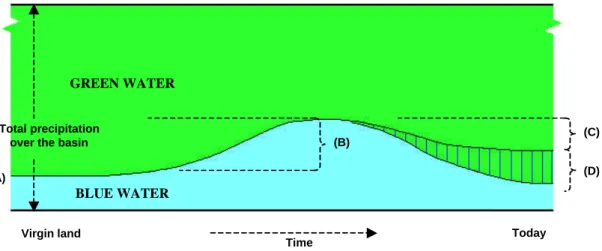
in the text. According to a general trajectory seen in many semi-arid basins initial agricultural development starts with clearance of natural vegetation to gain farming lands, resulting in a decrease in green water flows from the basin. Later, especially during last century, construction of flow control structures, reservoirs and irrigation infrastructure, with intensive blue water use, consumptive use has increased again.
HESSD
1, 7–40, 2004Consumptive water use to feed humanity
– curing a blind spot
M. Falkenmark and M. Lannerstad Title Page Abstract Introduction Conclusions References Tables Figures J I J I Back Close
Full Screen / Esc
Print Version Interactive Discussion
EGU Figure 6 shows a schematic visualisation of general consequences over time in a river
basin in terms of green-blue partitioning caused by vegetation alterations and water resource development.
Thus blue water flows can be altered in three ways: 1) by vegetation changes, with increased or decreased evapotranspiration, altering runoff formation, 2) by
consump-5
tive use of renewable groundwater, reducing aquifer outflows to rivers and wetlands, or 3) consumptive water use of river flow, through direct use, e.g. irrigation, and through indirect use as evaporation from storage surfaces.
The analysis shows the importance, when discussing water use, of properly dis-tinguishing between the consumptive, evaporative, component of water use and the
10
non-consumptive component, returning to the system. The latter is traditionally often perceived as “losses”, but principally constitutes a return flow that can be used again downstream. Moreover, the consumptive component also includes losses in terms of excessive non-productive vapour flow from farmlands (unnecessary evaporation). 6.2. Future
15
In meeting future food needs large changes in green water flows can be foreseen. To uphold proper nutrition for about 800 million unnourished and 3 billion unborn further increases in global agricultural consumptive water use will be requested. Based upon present water productivity additional future consumptive water use equals almost twice the present consumptive water use from all withdrawals.
20
In the paper the order of magnitude for three options has been assessed; 1) better use of present consumptive water use (regaining non-productive green water losses by water productivity increase, i.e. “vapour shift”); 2) additional water for irrigation to be appropriated from renewable blue water resources; 3) horizontal expansion of rainfed agriculture into terrestrial biomes, presently not used for agriculture, such as
grass-25
lands and forests.
In water scarce areas food import will be a fourth option. A number of countries already to large degree rely on food imports, such as North Africa with half their grain
HESSD
1, 7–40, 2004Consumptive water use to feed humanity
– curing a blind spot
M. Falkenmark and M. Lannerstad Title Page Abstract Introduction Conclusions References Tables Figures J I J I Back Close
Full Screen / Esc
Print Version Interactive Discussion
EGU use based upon imports, while other countries will most probably become import
de-pendent. The most important example of the latter category is China. An increased taste for water-intensive food products by a growing population will exceed national production and turn China into a major player on the international food market, with increasing prices as a possible consequence.
5
In areas where water resources already appear to be overappropriated the scope for further blue water development appears to be limited. Many basins are approaching a withdrawal of 70% and some even go beyond 100%. To safeguard aquatic and coastal ecosystems an environmental flow reserve of the order 30% of natural streamflow must remain in arid or semi-arid zone rivers. Already over-appropriated rivers can thus be
10
restored (through reduction of present consumptive use) by freeing water part of to-day’s agricultural and societal development. In basins still open for further blue water development environmental minimum levels will limit the degrees of freedom. Ground-water overdrafts, with falling Ground-water levels, also constitute a Ground-water quantity that sooner or later must be replaced as deepening of aquifers becomes economically unfeasible
15
or water quality deteriorates. Reduced groundwater use implies a need for increased river flow withdrawals with further considerations regarding environmental flow.
6.3. Final remarks
Future human development when seen in relation to consumptive water use can as shown in Fig. 6, be characterised as “Living with change”. In the future further massive
20
changes can be foreseen linked to human food security. Already today warning signals are evident showing that water use development has been unsustainable, with too far reaching river depletion and falling groundwater levels. This situation seriously complicates the necessary future expansion of food production and makes it a really challenging task.
25
Many experts addressing local problems of socio-economic development under in-creasing water scarcity suggest transition out of agriculture as a solution. However as seen globally food must be regarded as a human right. Hence maintained and
ex-HESSD
1, 7–40, 2004Consumptive water use to feed humanity
– curing a blind spot
M. Falkenmark and M. Lannerstad Title Page Abstract Introduction Conclusions References Tables Figures J I J I Back Close
Full Screen / Esc
Print Version Interactive Discussion
EGU panded global food production can not be avoided. As pointed out by Postel (1999, p.
12) citing a speech to the U.S. Senate by the Harvard anthropologist Timothy Weiskel “There is no such thing as a post-agricultural society”, adding “To act as if there were, is a recipe for societal collapse”.
World future in terms of ability to feed humanity depends on many different factors
5
and will be a choice of route limited by the development of coping capability. Agriculture is by no means a static activity, new modes will develop. Adjustment to an escalating water scarcity situation will take time. Transition time will be needed for agricultural modernisation and crop-per-drop improvement, even green houses. Food trade devel-opment is limited by purchasing power, infrastructure, trade barriers etc. Present food
10
preferences point at more and more water intensive food consumption patterns, but if reversed, a less animal protein diet could be a tool towards reducing future consump-tive water use demands.
In the long term a fully developed food trade system will open for global maximisa-tion of comparative advantages according to regional differences in hydro-climate and
15
hydrological preconditions.
References
Ambio: Special Issue, Transboundary issues of shared waters, Ambio, 23, 1–2, 2004.
Asiancs Agro-Dev. International (Pvt) Ltd.: Tarbela Dam and related aspects of the Indus River Basin, Pakistan, A WCD case study prepared as an input to the World Commission on Dams, 20
Cape Town, South Africa, 2000.
Bange, G. B.: The outlook for world grain and oilseed markets, Presentation to agricultural outlook conference, Organised by China’s National Grain and Information Centre, Beijing, 17–18 July 2004, Bange is Chairperson at World Agricultural Out Look Board, Office of the Chief Economist, U.S. Department of Agriculture, 2004.
25
Berndes, G.: Bioenergy and water: The implications of large-scale bio energy production for water use and supply, Global Environmental Change, 12, 253–271, 2002
HESSD
1, 7–40, 2004Consumptive water use to feed humanity
– curing a blind spot
M. Falkenmark and M. Lannerstad Title Page Abstract Introduction Conclusions References Tables Figures J I J I Back Close
Full Screen / Esc
Print Version Interactive Discussion
EGU Brown, L.: World Creating Food Bubble Economy Based on Unsustainable Use of Water,
Up-date 22: 13 March 2003-2, Earth Policy Institute,http://earth-policy.org, 2003a.
Brown, L.: Wakeup Call on the Food Front, Update 31: 16 December 2003-11, Earth Policy Institute,http://earth-policy.org, 2003b.
Brown, L.: Chinas shrinking grain harvest – How its growing grain imports will affect world 5
prices, Update 36: 10 March 2004-5, Earth Policy Institute,http://earth-policy.org, 2004. Calder, I. R.: Forests and water – Closing the gap between public and science perceptions.
Proceedings Stockholm Water Symposium 2003, Water Science & Technology, in press, 2004.
Dyson, M., Bergkamp, G., and Scanlon, J. (eds.): Flow, The essentials of environmental flows, 10
IUCN, Gland, Switzerland, 2003.
Economist: IOU H2O, The Economist, 27 May 2000, 355, 8172, 31, 2000.
Economist: Pay up or dry up. The Economist, 26 May– 1 June 2001, 359, 8223, 33, 2001. Falkenmark, M.: Landscape as life support provider, Water related limitations, In: Population
– the complex reality, edited by Graham-Smith, F., The Royal Society, London, 103–116, 15
1993.
Falkenmark, M.: Land-water linkages: a synopsis, Land and Water Integration and River Basin Management, FAO Land and Water Bulletin, Rome, 1, 15–16, 1995.
Falkenmark, M. and Rockstr ¨om, J.: Balancing humans and nature, The new approach in eco-hydrology, Earthscan, London, UK, 2004.
20
Foster, S. S. D. and Chilton, P. J.: Groundwater: the processes and global significance of aquifer degradation, Philosophical Transactions Royal Society London B, 358, 1935–1955, 2003.
Glantz, M. H.: Creeping environmental problems in the Aral Sea basin. In the: Central Eurasian water crisis: Caspian, Aral and dead seas, edited by Kobori, I. and Glantz, M. H., New York, 25
New York, USA, United Nations University Press, 1998.
Gleick, P. H.: The world’s water – The biennial report on freshwater resources 2000–2001, Washington, D.C., USA, Island press, 2000.
Gordon, L., Dunlop, M., and Foran, B.: Land cover change and water vapour flows: learning from Australia, Philosophical Transactions Royal Society London B, 358, 1973–1984, 2003. 30
Gordon, L., J ¨onsson, B. F., Johannessen, ˚A., Steffen, W., Falkenmark, M., and Folke, C.: Large-scale redistribution of global water vapour flows by deforestation and irrigation, in: Gordon, L., 2003, Land use, freshwater flows and ecosystem services – In and era of global change,
HESSD
1, 7–40, 2004Consumptive water use to feed humanity
– curing a blind spot
M. Falkenmark and M. Lannerstad Title Page Abstract Introduction Conclusions References Tables Figures J I J I Back Close
Full Screen / Esc
Print Version Interactive Discussion
EGU Doctoral Thesis in Natural Resources Management, Department of Systems Ecology,
Stock-holm University, Sweden, 2004.
IFPRI: Data through personal communication with Mark Rosegrant and from the book: World Water and Food to 2025 (2002) by Rosegrant, M. V., Cai, X. and Cline, S. A., International Food Policy Research Institute (IFPRI), Washington, D.C., 2002.
5
Kendy, E., Molden, D., Steenhuis, T. S., and Liu, C.: Policies drain the North China Plain – Agricultural policy and groundwater depletion in Luancheng County, 1949–2000, Research Report 71, International Water Management Institute, Colombo, Sri Lanka, 2003.
Kijne, J. W., Barker, R., and Molden, D.: Water Productivity in Agriculture - Limits and opportu-nities for improvement, CABI Publishing, Wallingford, UK, 2003.
10
L’vovich, M. I. and White, G. F.: Use and transformations of terrestrial water systems, in: The earth as transformed by human action: Global and regional changes in the biosphere over the past 300 years, edited by Turner II, B. L., Cambridge, UK, Cambridge University Press, 1990.
L’vovich, M. I.: World water resources and their future, English translation, edited by Nace, R. 15
N., (Russian edition 1974 by Mysl’P.H., Moscow), Washington, DC, USA, American Geo-physical Union, 1979.
Lannerstad, M.: Consumptive Water Use Feeds the World and Makes Rivers Run Dry, MSc Thesis, Royal Institute of Technology (KTH), Stockholm, Sweden, 2002.
MDBC: Review of Cap Implementation 2001/2002 – Report of the independent audit group, 20
March 2003, Murray Darling Basin Commission, Canberra, Australia, 2003.
MDBC: The Impacts of Water Regulation and Storage on the Basin’s Rivers, Murray Darling Basin Commission, Canberra, Australia, retrieved 11 August 2004,http://www.mdbc.gov.au/
education/encyclopedia/water regulation/water regulation impact.htm, 2003.
Meybeck, M.: Global analysis of river systems: from Earth system controls to Anthropocene 25
syndromes, Philosophical Transactions Royal Society London B, 358, 1935–1955, 2003. Moench, M., Burke, J., and Moench, Y.: Rethinking the approach to groundwater and food
security, FAO Water Report 24, FAO, Rome, 2003.
Molden, D., Sakthivadivel, R., and Habib, Z.: Basin-level use and productivity of water: Exam-ples from South Asia, Colombo, Sri Lanka: International water management institute, IWMI 30
research report 49, 2001.
Postel, S.: Pillar of sand: Can the irrigation miracle last? New York, USA, W. W. Norton & Co., 1999.
HESSD
1, 7–40, 2004Consumptive water use to feed humanity
– curing a blind spot
M. Falkenmark and M. Lannerstad Title Page Abstract Introduction Conclusions References Tables Figures J I J I Back Close
Full Screen / Esc
Print Version Interactive Discussion
EGU Postel, S.: Where have all the rivers gone? Worldwatch, 8:9-19, World Watch Institute,
Wash-ington, D.C., U.S., 1995.
Ren, M. and Walker, H. J.: Environmental consequences of human activity on the Yellow River and its Delta, China. Physical Geography, 19, 5, 421–432, 1998.
Rockstr ¨om, J.: Water for food and nature in drought-prone tropics: vapour shift in rain-fed 5
agriculture, Philosophical Transactions Royal Society London B, 358, 1997–2009, 2003. Rockstr ¨om, J., Gordon, L., Folke, C., Falkenmark, M., and Engwall, M.: Linkages among water
vapor flows, food production, and terrestrial ecosystems services, Conservation Ecology, 3, 2, 5, 1999.
Rosegrant, M. V., Cai, X., and Cline, S. A.: World Water and Food to 2025 International Food 10
Policy Research Institute (IFPRI), Washington, D.C., 2002.
Shah, T., Molden, D., Sakthivivadivel, R., and Seckler, D.: The global groundwater situation: Overview of opportunities and challenges, International Water Management Institute (IWMI), Colombo, Sri Lanka, 2000.
Shiklomanov, I. A.: Appraisal and assessment of world water resources, Water International, 15
25, 1, 11–32, 2000.
Smakthin, V., Revenga, C., and D ¨oll, P.: Taking into Account Environmental Water Require-ments in Global-scale Water Resources AssessRequire-ments, Comprehensive Assessment Re-search Report 2, Colombo, Sri Lanka, Comprehensive Assessment Secreteriat, 2004. Tharme, R. E.: A global perspective on environmental flow assessment: Emerging trends in the 20
development and application of environmental flow methodologies for rivers, Rivers research and applications, 19, 397–441, 2003.
UN: World Population Prospects – The 2002 Revision, United Nations, 2003.
USDA: World Agricultural Supply and Demand Estimates, WASDE-412, 12 July 2004, U.S. Department of Agriculture, Office of the chief economist, retrieved 16 July 2004,http://www.
25
usda.gov/oce/waob/wasde/latest.pdf, 2004.
Van der Zaag, P. and Carmo Vaz, ´A.: Sharing the Incomati waters, cooperation and competition in the balance, Water Policy, 5, 349–368, 2003.
Yang, H., Reichert, P., Abbaspour, K. C., and Zehnder, A. J. B.: A water resources threshold and its implications for food security, in Hoekstra, A. Y., Virtual water trade, Proceedings 30
of the international expert meeting on vitural water trade, Delft, The Netherlands, Value of Water, Research Report Series No. 12, 2003.
HESSD
1, 7–40, 2004Consumptive water use to feed humanity
– curing a blind spot
M. Falkenmark and M. Lannerstad Title Page Abstract Introduction Conclusions References Tables Figures J I J I Back Close
Full Screen / Esc
Print Version Interactive Discussion
EGU Fig. 1. In a drainage basin perspective, the precipitation over the area represents the proper
water resource, part of which is consumed in plant production and evaporation from moist surfaces (green water flow) while the surplus goes to recharge aquifers and rivers (blue water flow) available for societal use and aquatic and coastal ecosystems.
HESSD
1, 7–40, 2004Consumptive water use to feed humanity
– curing a blind spot
M. Falkenmark and M. Lannerstad Title Page Abstract Introduction Conclusions References Tables Figures J I J I Back Close
Full Screen / Esc
Print Version Interactive Discussion
EGU
4
Vapour flow from different surfaces
There is for some reason a fundamental difference in approach to water use by terrestrial
ecosystems within conventional ecology as opposed to hydrology. Thus, the Millennium
Ecosystem Assessment sees terrestrial ecosystems as provisioning rather than
water-consumptive, which is as they come out from a hydrological aspect. Calder (2004) has drawn
attention to the misleading misunderstanding that forests produce runoff. It is interesting to
note for example that both Indian National Water Policy and Indian NGOs advocate and work
for more trees to increase blue water flow, while the South Africans are taking the opposite
approach, defining forest plantations as streamflow impacting activity for which the forest
companies will have to pay for the additional water literally consumed.
Returning now to the blue/green conceptual model of the water leaving a catchment, the
green water flow branch includes vapour flow from different surfaces: from irrigated fields,
wetlands and evaporating water surfaces (blue water transformed into green), and from
natural vegetation (intercepted and naturally infiltrated rainwater). Interesting from a river
depletion perspective is evidently the degree to which increases in green water flow involve
reduced runoff production and therefore reduced bluewater flow.
River flow vulnerability to change in the arid and semi-arid zone
Changes in river flow may thus originate from different actions: increased or expanded
irrigation, increased irrigation efficiency by reducing the surplus return flow, creation of large
evaporating water surfaces (reservoirs), or altered land cover involving either increased
evapotranspiration (e.g. forest plantations) or decreased evapotranspiration (e.g.
deforestation).
Large attention was paid already in the 1960’s to the green water flow by the Soviet scientist
M. I. Lvovich (1979). He quantified the partitioning of precipitation for all the major biomes,
based on data of precipitation and streamflow from all the continents, and analysed
infiltration, actual evaporation and groundwater recharge in generic diagrams.
Typical for the steppe and savanna zone is the extremely limited groundwater recharge and
baseflow production, easily altered by land cover changes. Figure 2a shows that most of the
infiltrated rainfall evaporates in the interval 500-1 000 mm of rainfall and that on the whole,
the groundwater recharge is minimal. Even moderate evaporation changes may cause blue
water changes that are large on a relative scale.
Figure 2 a. The blue/green rainfall partitioning in the semiarid zones for different
amounts of net annually infiltrated rainfall. (Modified from Lvovich 1979, p 198)
500 mm 1000 mm 1500 mm Evaporation Ground Water Runoff Net Precipitation
Fig. 2. (a) The blue/green rainfall partitioning in the semiarid zones for different amounts of net
HESSD
1, 7–40, 2004Consumptive water use to feed humanity
– curing a blind spot
M. Falkenmark and M. Lannerstad Title Page Abstract Introduction Conclusions References Tables Figures J I J I Back Close
Full Screen / Esc
Print Version Interactive Discussion
EGU
Lvovich’s diagrams can be used for studying possible changes in blue/green water partitioning and therefore in river flow generation linked to land cover changes. The high evaporative demand in the tropics plus the fact that it is in these areas where large land use changes are generated due to population growth and development efforts, suggests that the savanna zone is especially vulnerable. This zone includes many of the top and high priority countries now focused on in the Millennium Project with its efforts to meet the UN launched Millenium Development Goals (MDGs), many of which are directly water-related (poverty, hunger and unhealth alleviation) (Figure 2 b).
Figure 2 b. A particularly vulnerable zone in terms of future river depletion is the savanna zone (regions 10 and 11 on the map of the main biomes of the world). (Modified from Falkenmark & Rockström 2004, p 87)
ANTHROPOGENIC ALTERATIONS OF GREEN/BLUE WATER FLOWS Global historical alterations
Agriculture development to meet food needs of an increasing global human population has over time gradually converted large areas with natural vegetation to cultivated lands. Lvovich and White (1990) made an estimate of how this land transformation resulted in
“green-to-blue” water alterations (Figure 3a). A decrease in consumptive use, i.e. increased blue water
formation, culminated around 1950 when the vegetation on ploughed land consumed around 3 700 km3/yr less than virgin vegetation. After that time consumptive use increased again, in response to changes in agro-technical methods, and was estimated to 2 900 km3/yr in 1980. A recent study of large scale redistribution of global water vapour flows by Gordon et al. (2004) supports this assessment by estimating global reduction of consumptive use due to
deforestation to 3 000 km3/yr.
Fig. 2. (b) A particularly vulnerable zone in terms of future river depletion is the savanna zone
(regions 10 and 11 on the map of the main biomes of the world) (modified from Falkenmark and Rockstr ¨om, 2004, p. 87).
HESSD
1, 7–40, 2004Consumptive water use to feed humanity
– curing a blind spot
M. Falkenmark and M. Lannerstad Title Page Abstract Introduction Conclusions References Tables Figures J I J I Back Close
Full Screen / Esc
Print Version Interactive Discussion
EGU
Figure 3a. The columns show the historic change in km3/year of consumptive water use (CU) from total global area cultivated in 1980 compared to natural vegetation (virgin lands) with: CU from natural vegetation; CU from stepwise increased cultivation; and change in CU, i.e. blue water flow increase. (Modified from Lvovich & White 1990, p 247)
In contrast consumptive water use of water withdrawn from rivers and aquifers represents
“blue-to-green” alterations. Lvovich and White analysed global blue water withdrawals of
surface and groundwater resources for the last three centuries. As can be seen in figure 3b there has been a dramatic increase during the 20th century, the main part during the green revolution after WW II. Out of in total 2 570 km3/yr consumptive water use from withdrawals in 1980, irrigated agriculture stands for more than 90 per cent, 2 340 km3/yr.
FIGURE 3b. Total blue water withdrawals 1680-1980 and consumptive use component divided into irrigation and non-irrigation. (Modified from Lvovich & White, 1990, p 242 & 245)
Consumptive water use from man-made freshwater storage is another “blue-to-green” alteration. Reservoirs for irrigation, hydropower etc. today have an estimated total volume of around 6 000 km3 and cover an area of more than 500 000 km2. Global reservoir consumptive use is estimated to around 200 km3/yr (Lvovich and White 1990, Shiklomanov 2000). In arid
0 1000 2000 3000 4000 1680 1800 1900 1950 1980 Year CU Irrigation CU Non-Irrigation Return Flow Total Withdrawals km3/year 1200 1700 3300 3800 3600 600 800 1600 2200 2900 6500 4700 4000 1600 500 Virgin Lands 1680 1800 1900 1950 1980 Change in CU, i.e. Runoff Increase CU Natural Vegetation CU Agricultural Vegetation km3/year Year
Fig. 3. (a) The columns show the historic change in km3/year of consumptive water use (CU) from total global area cultivated in 1980 compared to natural vegetation (virgin lands) with: CU from natural vegetation; CU from stepwise increased cultivation; and change in CU, i.e. blue water flow increase (modified from Lvovich and White, 1990, p. 247).