HAL Id: hal-00741822
https://hal.archives-ouvertes.fr/hal-00741822
Submitted on 15 Oct 2012HAL is a multi-disciplinary open access archive for the deposit and dissemination of sci-entific research documents, whether they are pub-lished or not. The documents may come from teaching and research institutions in France or abroad, or from public or private research centers.
L’archive ouverte pluridisciplinaire HAL, est destinée au dépôt et à la diffusion de documents scientifiques de niveau recherche, publiés ou non, émanant des établissements d’enseignement et de recherche français ou étrangers, des laboratoires publics ou privés.
RF Capacitively coupled plasmas in N2-H2 mixtures
Ahmed Mahjoub, A. Gouveia, Nathalie Carrasco, C. D. Pintassilgo, L.
Marques, M. M. D. Ramos, L. L. Alves, Guy Cernogora
To cite this version:
Ahmed Mahjoub, A. Gouveia, Nathalie Carrasco, C. D. Pintassilgo, L. Marques, et al.. RF Capaci-tively coupled plasmas in N2-H2 mixtures. ESCAMPIG 2012 (Europhysics Conference on the Atomic and Molecular Physics of Ionized Gases), Jul 2012, Viana do Castelo, Portugal. 2 p. �hal-00741822�
ESCAMPIG XXI, Viana do Castelo, Portugal, July 10-14 2012
1
1
RF CAPACITIVELY COUPLED PLASMAS IN N
2-H
2MIXTURES
A. Mahjoub
1, A. Gouveia
2,3, N. Carrasco
1, C.D. Pintassilgo
2,3, L. Marques
2,4,
M. M. D. Ramos
4, L.L. Alves
2, G. Cernogora
11 LATMOS-UVSQ-CNRS 11 Bd d'Alembert 78280 Guyancourt, France
2 Instituto de Plasmas e Fusão Nuclear, Instituto Superior Técnico,1049-001 Lisboa, Portugal 3 Departamento Engenharia Física, Faculdade Engenharia, Universidade do Porto, R. Dr. R. Frias, 4200-465
Porto, Portugal
4 Centro de Física da Universidade do Minho, Universidade do Minho, 4710-057, Braga, Portugal
This paper studies the modifications induced in low-pressure radio-frequency capacitively coupled nitrogen plasmas, by the addition of a few amount of hydrogen (up to 5%). The plasmas are studied using both experiments (electrical and optical emission spectroscopy measurements) and simulations (using a fluid+kinetic code). Results reveal that the electron density increases with the amount of injected H2, at constant coupled power.
1-Introduction
Radio-frequency (RF) capacitively coupled plasmas (CCP) are currently used in planetary studies to simulate the reactivity of ionospheres. The present work is an intermediate step towards the study of N2-CH4 plasmas (containing hydrogen due to the dissociation of methane), for the simulation of the ionospheric chemistry of Titan, the biggest satellite of Saturn. The project started with the study of pure nitrogen RF-CCPs, already concluded [1].
2-Experiment
The experimental setup is described in detail in [2]. We recall that the parallel-plate electrodes (driven at 13.56 MHz frequency) are surrounded by a cylindrical metallic grid, which confines the discharge. The resulting closed system acts as a resonant cavity in the microwave range, used to measure the electron density. Optical Emission Spectroscopy (OES) diagnostics are used to study the evolution, with the working conditions, of: (i) the First Negative System (FNS) with the molecular nitrogen ionic band; (ii) the atomic hydrogen H1 line at 486.1 nm; (iii) the atomic argon line at 811.5 nm (Ar is used here as an actinometer). Note that these H and Ar lines are chosen in order to prevent overlapping with the nitrogen bands [3]. The effective RF power coupled to the plasma Weff is determined using the subtractive method [1], hence accounting for the circuitry power losses.
3-Modelling
Simulations use a hybrid code that couples a 2D (r, z) time-dependent fluid-type module, describing the transport of the charged particles, to a very complete 0D kinetic module, for the nitrogen-hydrogen mixture. The fluid module solves the charged particle continuity and momentum transfer equations, the electron mean energy transport equations, and Poisson's equation for the RF electric potential. The kinetic module solves the two-term homogeneous and stationary electron Boltzmann equation (accounting for inelastic collisions from ground-state molecules and atoms, and inelastic and superelastic collisions involving vibrationally excited states) and the rate balance equations of the ground-state vibrational excited states and the main electronic excited states with the N2 and H2 molecules, and of the most relevant electronic excited states with the Nand Hatoms. The kinetic module yields a set of electron transport parameters and rate coefficients for the processes involved in the charged particle production and destruction, which include: (i) direct and stepwise electron-impact ionisation; (ii) associative ionisation involving metastable states; (iii) ion conversion; and (iv) electron-ion recombination.
4-Results
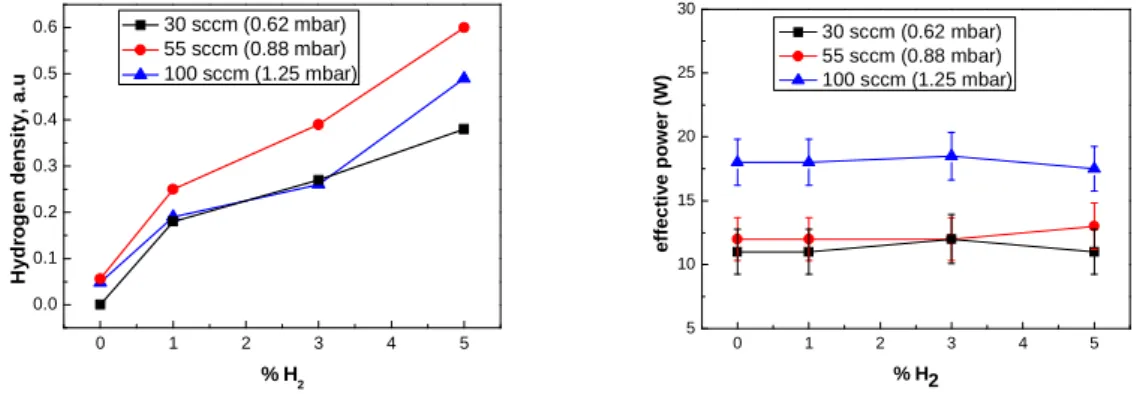
Figures 1 presents, as a function of the injected amount of H2, the evolution of the H atoms relative density and of the effective power coupled, for different pressures and for a given RF voltage Vrf. For Topic number: 5
ESCAMPIG XXI, Viana do Castelo, Portugal, July 10-14 2012
1
1
all studied pressures, one observes that: (i) [H] increases linearly with the concentration of molecular hydrogen; (ii) Weff is not affected by the admission of H2 in the N2 discharge.
0 1 2 3 4 5 0.0 0.1 0.2 0.3 0.4 0.5 0.6 30 sccm (0.62 mbar) 55 sccm (0.88 mbar) 100 sccm (1.25 mbar) H y d ro g e n d e n s it y , a .u % H 2 0 1 2 3 4 5 5 10 15 20 25 30 30 sccm (0.62 mbar) 55 sccm (0.88 mbar) 100 sccm (1.25 mbar) e ff e c tiv e p o w e r ( W ) % H2
Fig.1 H atoms relative density (left) and effective RF power coupled to the plasma (right), as a function of the concentration of molecular hydrogen, at Vrf=220V and for various pressures.
The plasma ionization degree can be monitored by analyzing either the electron density or the molecular band of N2+. Figure 2 presents measurements of these quantities, as a function of the
concentration of H2, for various pressures.
0 1 2 3 4 5 2 3 4 5 6 E le c tr o n d e n s it y 1 0 1 5 m -3 % H2 30 sccm (P=0.62 mbar) 55 sccm (P=0.88 mbar) 100sccm (P = 1.25 mbar) 0 1 2 3 4 5 2 3 4 5 6 30 sccm (0.62 mbar) 55 sccm (0.88 mbar) 100 sccm (1.25 mbar) In te n s it y , a .u . % H 2 Fig. 2 Electron density (left) and intensity of the FNS band of N2
+
, (right), as a function of the concentration of molecular hydrogen, at Vrf = 220V and for various pressures.
One observes that the electron / ion production increases with the amount of H2 in the mixture, revealing that the ionization efficiency increases with the hydrogen (molecular and atomic) concentration, at constant coupled power.
The paper will also compare simulations and measurements, discussing the results obtained in validating the model.
Acknowledgements
Work supported by a PICS Cooperation Program, financed by the Portuguese FCT and the French (CNRS). A. Mahjoub thanks the ANR program (ANR-09-JCJC-0038 contract) for a post-doctoral position.
References
[1] L.L. Alves, L. Marques, C.D. Pintassilgo, G. Wattieaux, Et Es-sebbar, J. Berndt, E Kovacevic, N. Carrasco, L. Boufendi and G. Cernogora, Plasma Sources Sci. Technol. (submitted, 2012).
[2] G. Alcouffe, M. Cavarroc, G. Cernogora, F. Ouni, A. Jolly, L. Boufendi and C. Szopa, Plasma Sources Sci. Technol. 19 (2010) 015008.