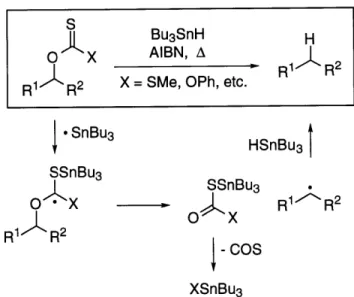
THE DEVELOPMENT OF ORGANOTIN REAGENTS FOR ORGANIC SYNTHESIS
by
David Scott Hays
B. S. Chemistry, University of Illinois Submitted to the Department of Chemistry in Partial Fulfillment of the
Requirements for the Degree of DOCTOR OF PHILOSOPHY
IN ORGANIC CHEMISTRY at the
Massachusetts Institute of Technology June 1998
© Massachusetts Institute of Technology, 1998 All rights reserved
Signature of Author Department of Chemistry May 14, 1998 Certified by Gregory C. Fu t' Thesis Supervisor Accepted by Dietmar Seyferth Chairman, Departmental Committee on Graduate Students
JUN
I 13998
scienct
This doctoral thesis has been examined by a committee of the Department of Chemistry as follows:
Professor Peter H. Seeberger
/1
ChairmanProfessor Gregory C. Fu
Thesis Supervisor
Professor Rick L. Danheiser
J _J
THE DEVELOPMENT OF ORGANOTIN REAGENTS FOR ORGANIC SYNTHESIS
by
David Scott Hays
Submitted to the Department of Chemistry on May 14, 1998 in partial fulfillment of the
requirements for the Degree of Doctor of Philosophy at the Massachusetts Institute of Technology
ABSTRACT
A method for the intramolecular pinacol coupling of dialdehydes and ketoaldehydes is described. The method was found to be useful for synthesizing 1,2-cyclopentanediols with very high degrees of diastereoselectivity in favor of the cis stereochemistry.
1,2-Cyclohexanediols were generated with lower degrees of stereoselection. This free radical chain process involves as the key steps: 1) an intramolecular addition of a tin ketyl radical to a pendant carbonyl group, followed by 2) a rapid intramolecular homolytic displacement by an oxygen radical at the tin center to liberate an alkyl
radical.
The development of a Bu3SnH-catalyzed carbon-carbon bond forming reaction (the reductive cyclization of enals and enones) is described, followed by a catalytic variant of the Barton-McCombie deoxygenation reaction. Both of these methods rely on the reduction of an intermediate Sn-O species to a Sn-H species by a silicon hydride reagent in the turnover step.
A new fundamental reaction of organotin compounds is described: the generation of Sn-H bonds by treatment of tin amides with silicon hyrdides. The scope of organotin hydride catalysis was broadened to include reactions which generate Sn-N bonds, and in this context, a new Bu3SnH-catalyzed reduction of azides to amines was developed.
Thesis Supervisor: Gregory C. Fu Title: Assistant Professor of Chemistry
ACKNOWLEDGMENTS
Throughout my educational career, I have been fortunate to have been taught by some of the best, and they deserve a special thanks. Most notably: Miss Woolard (6th grade); Ms. Whitis (7th grade English); Mr. Wilken (8th grade math); Mr. Leech (9th grade science; Mr. Wenner (Jr. High instructor, high school spiritual advisor); Ken Johnston (Jr. High instructor). The teachers in the Newark High English Department stand out for encouraging me to state my opinion and not minding too much that it differed from their own: Mrs. Jones; Ms. Harriman; and Ms. Anderson. Without my experiences in the sciences at Newark High, I probably wouldn't be writing this Thesis. Mr. MacGregor, Mr. Miller, and Dr. Doyle all deserve recognition for their excellent curricula which prepared me so well for college. And of course, Mr. Holekamp, who went far above and beyond the call of duty in taking me under his wing. He is truly a star.
A number of individuals have had a significant impact on my professional career. I will always be indebted to my friends and mentors at the Eastman Kodak Company who took unselfish interests in my success. First, Ms. Jeanne Kaeding, who taught me the difference between labwork and bookwork. I will always be deeply indebted to Dr. (Professor) Mike Detty for his chemistry lessons, friendship, and advice, and I hope we have the chance to work together again. The experience I gained while working with Dr. Doug Bugner will always stand out as some of the most valuable: in particular, his early confidence that I could handle much more responsibility than I'm sure I had earned.
At the University of Illinois, I was fortunate to have the opportunity to work with a model scientist and academician: Professor Scott Denmark. I couldn't have been given a better undergraduate project, nor could I have asked for a better balance of guidance and freedom. My collaboration with Dr. David Forbes led to some of the most productive 12-hour days (and 12-ounce curls) I've ever known.
I will always be grateful to my thesis advisor, Professor Greg Fu, for allowing me to help start up his lab and his projects, and I expect to hear lots of great chemistry from him over the course of what will certainly be a long academic career.
My blood brothers and sisters (fellow Fu group pioneers Chris Garrett, Diego Hoic, Mike Amendola, and Matthias Scholl) deserve a recognition which couldn't be accommodated between the covers of this Thesis. I hope that my future coworkers are as talented, honest, dedicated, responsible, trustworthy, and open to discussion as they have been, as well as the remaining Fu group members: Shuang Qiao, Adam Littke, Dr. Ken Stockman, Dr. Jordi Tormo, Dr. Rosa Lopez, Jack Liang, Dr. Hallie Latham, Beata Tao, and Michael Lo.
My parents have always served as an endless source of inspiration, and I only hope I can do the same for my own children. They, as well as Jack and Phoebe Harden, helped to make the last 5 years a success.
And finally my wife Jennifer, the most natural and capable mother on the planet, who earned this degree as much as I did. It would not have been possible without her unconditional optimism and support. She, along with our children Samuel and Brooke, taught me everything that is important.
DEDICATION
To my beautiful wife Jennifer,
and to our spectacular children Samuel, Brooke, and those not yet conceived.
PREFACE
Parts of this thesis have been adapted from the following articles co-written by the author.
Hays, D. S.; Fu, G. C. "Metal Hydride Mediated Intramolecular Pinacol Coupling of Dialdehydes and Ketoaldehydes," J. Am. Chem. Soc. 1995, 117, 7283-7284.
Hays, D. S.; Fu, G. C. "Organotin Hydride Catalyzed Carbon-Carbon Bond Formation: Radical-Mediated Reductive Cyclization of Enals and Enones," J. Org.
Chem. 1996, 61, 4-5.
Hays, D. S.; Scholl, M.; Fu, G. C. "Organotin Hydride-Catalyzed Conjugate Reduction of a,x,-Unsaturated Ketones," J. Org. Chem. 1996, 61, 6751-6752.
Lopez, R. M.; Hays, D. S.; Fu, G. C. "Bu 3SnH-Catalyzed Barton-McCombie Deoxygenation of Alcohols," J. Am. Chem. Soc. 1997, 119, 6949-6950.
Hays, D. S.; Fu, G. C. "A New Method for Generating Sn-H Bonds: Reactions of Tin Amides with Silicon Hydrides," J. Org. Chem. 1997, 62, 7070-7071.
Tormo, J.; Hays, D. S.; Fu, G. C. "Diastereoselective Synthesis of P-Amino Alcohols via Bu3SnH-Mediated Reductive Cyclization of Carbonyl-Oxime Ethers," J. Org. Chem. 1998, 63, 201-202.
Hays, D. S.; Fu, G. C. "The Development of Bu3SnH-Catalyzed Processes: Efficient Reduction of Azides to Amines," J. Org. Chem., 1998, 63, 2796-2797.
TABLE OF CONTENTS ABBREVIATIONS
INTRODUCTION CHAPTER 1.
CHAPTER 2.
Bu3SnH-MEDIATED INTRAMOLECULAR PINACOL COUPLING OF DIALDEHYDES AND
KETOALDEHYDES Background
Results and Discussion Experimental
References
DEVELOPMENT OF ORGANOTIN HYDRIDE-CATALYZED PROCESSES I. SYNTHETIC TRANSFORMATIONS INVOLVING Sn-O INTERMEDIATES
Part 2.1 Introduction
Part 2.2 Organotin Hydride Catalyzed Carbon-Carbon Bond Formation: Radical-Mediated Reductive Cyclization of Enals and Enones
Background
Results and Dicussion Experimental
Part 2.3 Discovery and Optimization of the Bu3SnH-Catalyzed Barton-McCombie Deoxygenation of Alcohols
Background
Results and Discussion Experimental
Part 2.4 References
CHAPTER 3. DEVELOPMENT OF ORGANOTIN HYDRIDE-CATALYZED PROCESSES II. SYNTHETIC TRANSFORMATIONS INVOLVING Sn-N INTERMEDIATES
Part 3.1 Introduction
Part 3.2 A New Method for Generating Sn-H Bonds: Reactions of Tin Amides with Silicon Hydrides
Background 104 108 111 112 114 114
Results and Discussion 116
Experimental 123
Part 3.3 Bu3SnH-Catalyzed, Silicon Hydride-Mediated Reduction of
Azides to Amines 146
Background 146
Results and Discussion 146
Experimental 155
Part 3.4 Organotin-Catalyzed, Silicon Hydride-Mediated Room
Temperature Reduction of Azides to Amines 174
Background 174
Results and Discussion 176
Experimental 179
Part 3.5 References 184
ABBREVIATIONS ACHN AIBN d DBATO eq equiv GC h HRMS IR min NMR PMHS PMHS dimer ppm q quint r.t. s t THF TLC 1,1'-Azobis(cyclohexnanecarbonitrile) 2,2'-Azobisisobutyronitrile doublet bis(dibutylacetoxytin) oxide equation equivalent(s) gas chromatography hour(s)
high resolution mass spectroscopy infrared
minute(s)
nuclear magnetic resonance polymethylhydrosiloxane
1,3-bis(trimethylsiloxy)-1,3-dimethyldisiloxane parts per million
quartet quintet room temperature singlet triplet tetrahydrofuran thin-layer chromatography
Introduction
Over the last 30-40 years, organotin reagents have become indispensible tools for synthetic organic chemists.1 Their utility can largely be attributed to the unmatched ability with which organotin species participate in radical chain reactions, thus carving out a niche distinct from polar chemistry. As a consequence, modes of reactivity which cannot be accessed in the polar realm are readily available in a mild, neutral, often chemo- and stereoselective manner2 by using organotin reagents.
As a testimony to the synthetic utility of organotin reagents, chemists continue to widely use them despite two significant drawbacks: toxicity3 -5 and difficulty in removal of organotin residues from crude reaction mixtures.6 Both of these issues could be addressed by a protocol which requires less than stoichiometric quantities of the organotin reagent.7-10 Thus, the development of organotin catalysis is the central focus of this thesis.
The development of a new catalytic cycle can be envisioned as occurring in three stages. In the first stage, a mechanism for catalysis must be proposed. Subsequently, in the second stage, stoichiometric reactions must be identified in order to test the catalytic proposal. The source of these reactions can be the literature or the laboratory, and our first endeavor was an attempt to draw upon the latter.
Thus, in Chapter 1, the development of a new stoichiometric reaction, the intramolecular pinacol coupling of dialdehydes and ketoaldehydes mediated by Bu3SnH, is described. In order to proceed with the development of a new catalytic
cycle, the mechanism of the stoichiometric pinacol coupling had to be understood. It was during this phase that we discovered an unexpected mechanistic twist which rendered the pinacol coupling reaction not susceptible to our catalytic strategy. However, much was learned about the fundamental reactivity of this chemical
system.
In the third stage of development, the catalytic proposal is tested by attempting to modify the stoichiometric reactions selected in stage 2 in order to render them catalytic. This undertaking is described in Chapter 2 beginning with the reductive cyclization of enals and enones. As is typical for this line of work, the initial catalytic proposal proved fruitless. However, our discovery of a minor side product in a 30-year-old reaction11 allowed us to identify the source of the rather complex problem, and some minor procedural modifications led to the solution (Section 2.2). Building on what was learned from the catalytic reductive cyclization of enals and enones, we were able to apply our catalytic strategy to a variety of other chemical transformations, thus demonstrating the generality of our method.
In the process of extending the scope of organotin catalysis to include reactions which generate species containing Sn-N bonds (Section 3.3), we discovered a new fundamental reaction of organotin compounds: the formation of tin hydrides by reacting tin amides with silicon hydrides (Section 3.2).
The goal of this work was to address the major drawbacks of organotin reagents (toxicity and removal) by bringing to fruition a new strategy for organotin catalysis. In having successfully done so, the foundation for asymmetric catalysis with chiral organotin reagents has also been established. Despite the valiant efforts of Chee-Kiang Lim, Jack Liang, and Dr. Jordi Tormo in these laboratories, no effective chiral tin catalyst has yet become available, but the author is optimistic that future efforts from this group will meet with success.
References
1 Pereyre, M.; Quintard, J.-P.; Rahm, A. Tin in Organic Synthesis; Butterworths: Boston, 1987.
2 Curran, D. P.; Porter, N. A.; Giese, B. In Stereochemistry of Radical Reactions; VCH: Weinheim, 1996.
3 Boyer, I. J. Toxicology 1989, 55, 253-298.
4 Sherman, L. R. In The Chemistry of Organic Germanium, Tin, and Lead Compounds; S. Patai, Ed.; John Wiley and Sons: New York, 1995; pp 865-870. 5 Tributyltin: Case Study of an Environmental Contaminant; DeMora, S. J., Ed.;
Cambridge University Press: Cambridge, 1996. 6 Crich, D.; Sun, S. J. Org. Chem. 1996, 61, 7200-7201. 7 Nitzsche, S.; Wick, M. Angew. Chem. 1957, 69, 96.
8 Lipowitz, J.; Bowman, S. A. J. Org. Chem. 1973, 38, 162-165. 9 Corey, E. J.; Suggs, J. W. J. Org. Chem. 1975, 40, 2554-2555. 10 Stork, G.; Sher, P. M. J. Am. Chem. Soc. 1986, 108, 303-304.
Chapter 1. Bu3SnH-Mediated Intramolecular Pinacol Coupling of Dialdehydes and Ketoaldehydes
Background
The inter- and intramolecular reductive coupling of carbonyls is an extremely powerful method for the construction of carbon-carbons bonds.1 The most synthetically useful variant of this transformation utilizes low valent titanium(0) as the the reducing agent which is typically generated in situ by the reduction of TiC13(DME)2 with Zn-Cu.2 Under mild conditions, the diol product can be isolated, but more vigorous conditions allow for further reduction to the corresponding olefin. A variety of ring sizes (from 3 through 20) can be accessed by this methodology. An additional reagent, SmI2, has recently received much attention in the context of pinacol coupling reactions as well.1
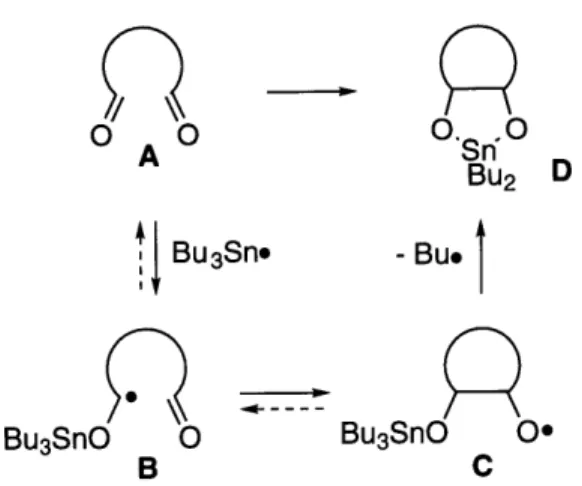
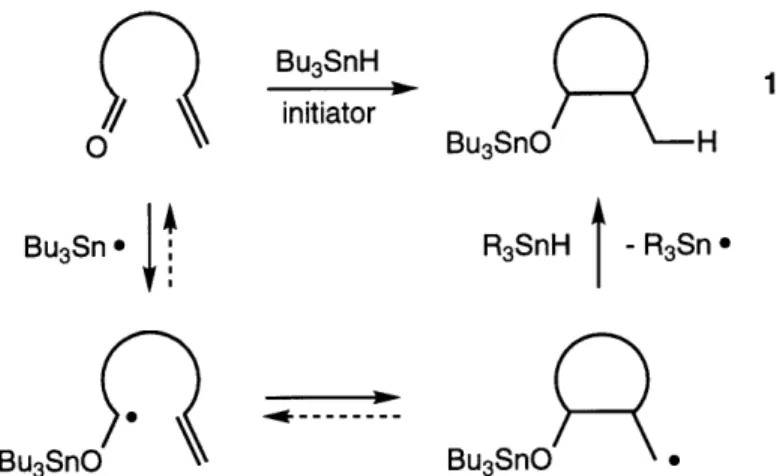
The reductive cyclization of enals and enones, first reported by Beckwith3 -5 and later systematically explored by Enholm (Figure 1.1),6,7 served as a foundation for a propsed Bu 3SnH-mediated intramolecular pinacol coupling reaction (Figure 1.2). The pinacol coupling was predicted to proceed in a mechanistically similar fashion to the Beckwith/Enholm system, but rather than forming a carbon-centered radical intermediate, the tin ketyl is proposed to form an oxygen-centered radical (Figure 1.2, C) by intramolecular addition to a carbonyl. Prior to our work, no literature precedent for this step existed. The anticipated pre-hydrolysis product was thus the cyclic 1,2-diol (Figure 1.2, D) in monostannylated form.
O 3SnH BBu
On/
initiator Bu3Sn HBu3Sn. Bu3SnH - Bu3Sn
Bu3SnO BU3SnOhI
Figure 1.1. The Bu3SnH-mediated reductive cyclization of enals and enones: a foundation for a proposed Bu3SnH-mediated pincacol cyclization.
Bu3SnH
O O AIBN Bu3SnO O-H
A PhH, A D
Bu3Sn. Bu3SnH t B3Sn*
Bu3SnO O Bu3SnO C O
Figure 1.2. A proposed Bu3SnH-mediated intramolecular pincacol coupling.
A necessary requirement for the success of this strategy is that the ketyl radical must cyclize and trap (eq 1.1, steps 2,3) faster than it abstracts a hydrogen atom from Bu3SnH (eq 1.1, step 4). Otherwise, undesired acyclic reduction products will predominate. By applying the steady-state assumption to the alkoxy radical intermediate, the kinetic requirement is that k2k3/{k- 2 + k3[Bu3SnH]} > k4. Under conditions of infinite dilution, this expression reduces to k2k3/k-2 > k4.
Bu3SnH Bu3SnH (1.1)
Bu3SnO 0 Bu3SnO 0 k_2 Bu3SnO O* 3 Bu3SnO 0-H
Requirement: k2k3/k2 = Keqk3 > k4
Beckwith has determined that the equilibrium constants for the cyclizations of 4-formylbutyl radicals and 5-formylpentyl radicals are 2 X 10⁻³ and 1 X 10⁻¹ respectively at 80 aC.8 Adding a 1-stannyloxy substituent should stabilize the open form by ca. 5 kcal/mol,9 thus reducing the equilibrium constants for the proposed ketyl/carbonyl cyclizations to 1.5 X 10⁻⁶ and 8.2 X 10⁻⁵respectively (Figure 1.3).
A Keq Keq
O . Bu3SnO Bu3SnO 0.
n = 1, Keq = 2X 10⁻³ n = 1, Keq (predicted) = 2 X 10⁻⁶ n =2, Keq = 1 X 10⁻¹ n = 2, Keq (predicted) = 8 X 10⁻⁵
Figure 1.3. Known equilibrium constants for the reversible cyclization of 4-formylbutyl/5-formylpentyl radicals and predicted equilibrium constants for the analogous ketyl radicals.
The bimolecular rate constant for the abstraction of a hydrogen atom from Bu3SnH
by tert-butoxy radical has been determined to be 4 X 10⁸ at 80 °C and provides an approximation for k3 (eq 1.1).10 Thus, the kinetic requirement at infinite dilution for the
successful formation of 6-membered ring pinacols is that k4 < 3 X 10⁴, but 5-membered ring pinacols require that k4 < 6 X 10². Unfortunately, no values for k4 have been
published, so the only recourse was to test the proposed pinacol coupling reaction in the laboratory.
Results and Discussion
When a series of 1,5- and 1,6-dicarbonyl substrates were treated with Bu3SnH in
refluxing benzene (AIBN), followed by hydrolytic workup, the cyclic pinacol products were formed in moderate to good yields (Table 1.1). Of particular note is that the 1,5-dicarbonyl substrates were all converted to the corresponding cis-diols with very high diastereoselectivities (Table 1.1, entries 1, 2, and 5), a surprising result in light of the published data on tin ketyl radical formations of 5- and 6-membered rings.3'5 -7,11-15
The yield from the pinacol coupling of glutaraldehyde (46%, Table 1.1, entry 1) is significantly lower than from adipaldehyde (84%, Table 1.1, entry 3), and this is attributable to a larger percentage of the acyclic reduction products (eq 1.1, step 4) in the
fomer than in the latter. This observation is consistent with the findings of Beckwith that alkyl radical cyclizations onto carbonyls are less favored kinetically and thermodynamically for 5-membered rings than for 6-membered rings.8 In order to minimize this side reaction, more dilute conditions were required for glutaraldehyde (0.025 M), than for adipaldehyde (0.10 M).
Subsequently, upon examination of the crude reaction mixture prior to hydrolysis, it was discovered that adipaldehyde was converted not to the predicted tin alkoxide (eq 1.2, B). Rather, the 1,3,2-dioxastannolane was isolated in a 60% yield (eq 1.2, A). An independently prepared sample of the predicted product (A) was found to be stable to the reaction conditions, so it cannot lie on the reaction pathway. Thus, our mechanistic proposal was in need of revision.
Bu2
S0 'Sn HO OSnBu3
S
Bu3SnH 3SnH (1.2)AIBN AIBN
A B
The first two steps of the revised mechanism (Figure 1.4) are identical to those from the original mechanism (Figure 1.2), but instead of the alkoxy radical (C) abstracting a hydrogen atom from Bu 3SnH, we now believe that it undergoes a homolytic displacement (SH2) reaction at the tin center.16,17 The liberated primary butyl radical is responsible for propagating the radical chain. Thus, the final, irreversible step in the reaction is believed to be driven by the strength of the Sn-O bond (90 kcal/mol) versus the relatively weak Sn-C bond (61 kcal/mol).
Table 1.1 Metal Hydride-Mediated Intramolecular Pinacol Coupling.
Entry Substrate Product Ster (cis :trans) ans Yieda(electiityab N%
O O0
U
O 0 CH20TBS O 0 \U O O0 4 BnO OBn O Me O 5 TBSO OTBS 6Me O 6 r HO OH HO OH CH20TBS HO OH HO OH BnO OBn Me OH HO: TBSO OTBS Me OH HO -PiAverage of two runs.
Based on analysis by capillary gas chromatography, except as noted. Isolated by crystallization as the 1,3,2-dioxastannolane.
- 1 : 1 mixture of the two diastereomeric cis diols. Based on analysis by 1H NMR.
Isolated as the acetonide.
98: 1 >99: id 46c 64 1: 2.4 1 :1.6d >20: 1 e 20: 1 88 62 5 3f
0 A 0
iBu
3Sn*
Bu3SnO OB
Figure 1.4 Revised mechanism for the coupling. O.0 0Sn 0 BU2 D - Bu* Bu3SnO O0 C
Bu3SnH-mediated intramolecular pinacol
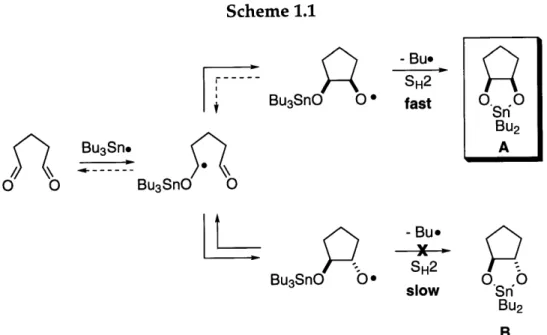
In contrast to the original mechanism, the revised mechanism accounts for the observation that the 1,5-dicarbonyl substrates afford pinacol products with high diastereoselectivities in favor of the cis geometry. If the ketyl radical initially cyclizes in the trans fashion (Scheme 1.1, bottom pathway), the ensuing intramolecular homolytic displacement reaction is expected to proceed slowly because the product would be a strained trans-5,5-fused ring system (Scheme 1.1, B). Consequently, the oxygen radical is believed to revert to the ketyl via -scission.
Alternatively, if the ketyl radical cyclizes in the cis fashion (Scheme 1.1, top pathway), the ensuing intramolecular homolytic displacement reaction is expected to proceed rapidly, because the product (Scheme 1.1, A) is not subject to the ring strain experienced by the trans isomer.
Scheme 1.1 I. I BU3Sne O O Bu3SnO O Bu3SnO Oe - Bu. SH2 slow
p
Snri' Bu2 BIn order to probe the reversibility of the carbon-carbon bond forming step, we synthesized both diastereomers of 1,2-cyclohexane diol mononitrate18 in stannylated form (Figure 1.5, 1.1 and 1.2). Both isomers, when subjected to the pinacol coupling conditions, converged on a mixture of the cis and trans 1,3,2-dioxastannolanes. This provides evidence that the carbon-carbon bond-forming step is reversible.
ON02 BU3Sno 1 .OSnBu 3 1.2 LSnBu2 O SnBu2 Bu3Sn* ' NO 2 .1 OSnBu3 1.1
Figure 1.5. Evidence for reversibility of carbon-carbon bond formation.
Taken alone, the isolation of 1,3,2-dioxastannolanes does not preclude the possibility that both the original mechanism and the revised mechanism are operative in a
Bu3SnO O - Bu. SH2 fast O0. Sn.0 BU2 A
L_
competitive fashion. However, the 5-membered rings provide stereochemical evidence (very little trans product observed) that no significant contribution to product formation is being made by the original mechanism for these substrates.
In contrast, the 1,6-dicarbonyls have no such stereochemical test since their diastereoselectivities are more modest. In order to probe for the presence of the original mechanism in the 6-membered rings, we replaced Bu3SnH with Oct3SnD and subjected adipaldehyde to the pincacol coupling conditions (Scheme 1.2). If there is a significant contribution from the original mechanism, then the yield of pinacol product should exceed the yield of octane. In fact, the yield of the pinacol product (assayed as the bis-acetate, 80%) is within experimental error of the yield of octane (82%), so no significant contribution from the original mechanism is present. Furthermore, since complete deuterium incorporation into the octane is observed, we can conclude that in the chain propagating step, the primary alkyl fragment reacts only with the tin hydride
(deuteride) reagent.
Scheme 1.2
Oct3SnD AIBN 0,SnOct2
Oct-C6H6, 80°C 0 1.2 H82% Yield 1.0 (98/2 D/H) (97/3 D/H) OAc 80% Yield (2.3/1 trans/cis)
Other main group metal hydrides (e.g., Ph3SnH, (TMS)3SiH, and Bu3GeH) also effect the intramolecular pinacol coupling of dicarbonyl compounds, although they are somewhat less efficient than Bu3SnH. Initiation by ultraviolet irradiation at 20 'C (eq
O 0 HO OH
0 / Bu3SnH HO OH
20 oC, 15 h
hv
78% 2.6:1
The preparation of both medium cycloheptanediol) and large (1,2-cyclododecanediol) rings proved unsuccessful according to our methodology. Only acyclic reduction products were observed.
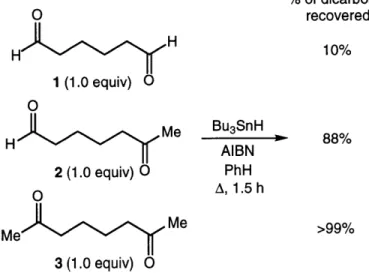
Selective pinacol cyclization of a dialdehyde in the presence of a ketoaldehyde or a diketone can be accomplished when Bu3SnH is used as the reducing agent (Figure 1.6).
We believe that the high selectivity of the Bu3SnH-mediated reaction is a consequence
of the reversibility of tributyltin radical addition to the carbonyl group (A - B, Figure 1.4). The product distribution is therefore guided not simply by the relative ease of formation of the tin ketyl (A - B), but by the relative facility with which the ketyl radical adds to the pendant carbonyl (B -- C). The slower the latter reaction (e.g., due
to steric effects), the more likely that B will fragment to starting material (B - A) rather
than proceed toward product (B - C).
% of dicarbonyl O recovered H H 10% 1 (1.0 equiv) 0 0 H Me B 3SnH 88% H AIBN 2 (1.0 equiv) O PhH O A, 1.5 h Me Me >99% 3 (1.0 equiv) 0
While our study was in progress, Naito published a method for the preparation of P-aminoalcohols from carbonyl-oxime ether systems (eq 1.4). Only modest diastereoselectivity was observed in the formation of a five-membered ring.
OMe HO NHOMe HO NHOMe H H BU3SnH/AIBN (1.4) C6H6, 80*C N 0~2Bn CO2Bn CO2Bn 2.3: 1
In contrast, we found that the all-carbon analog cyclized to afford only one diastereomer of unknown relative stereochemistry (eq 1.5). In light of the results from our intramolecular pinacol coupling reaction, we postulated that if the product is the cis isomer, then this reaction might be proceeding through an analogous intramolecular homolytic displacement pathway (eq 1.6, right side). If, however, the trans isomer is formed, then an intramolecular homolytic displacement pathway is unlikely (eq 1.6, left side). OBn HO NHOBn H N BU3SnH/AIBN (1.5) C6H6, 80C -One diastereomer
formed in large excess
BU2
* Sn
Bu3SnO NHOBn Bu3SnO NOBn O 'NOBn
' " Bu3SnH ---SH2 X (1.6)(1.6)
Bu3Sne -Buo
A postdoc in our lab (Dr. Jordi Tormo) subsequently demonstrated that the trans isomer is the preferred product,19 so simple hydrogen atom abstraction, and not
intramolecular SH2, is responsible for product formation.
In summary, we have discovered a Bu3SnH-mediated intramolecular pinacol coupling reaction. The key steps are the addition of a tin ketyl radical to a carbonyl group followed by the formation of a second Sn-O bond at the expense of a Sn-C bond by an intramolecular SH2 process. As a consequence, high diastereoselectivities are observed in the 5-membered rings. Mechanistic studies have demonstrated that no appreciable contribution from the originally proposed mechanism (Figure 1.1) is present, and that the carbon-carbon bond-forming step is reversible. The analogous carbonyl/oxime ether cyclization does not involve and intramolecular SH2 reaction.
Experimental General
AIBN was obtained from Eastman and used without purification. Tributyltin hydride was purchased from Aldrich and distilled prior to use. Glutaric dialdehyde (50 wt. % solution in water) was purchased from Aldrich and purified as described below. Hexanedial was prepared according to a literature method.20
Solvents were distilled from the indicated drying agents: benzene (sodium/benzophenone); toluene (molten sodium); dichloromethane (calcium hydride).
Analytical thin layer chromatography was performed using EM Reagents 0.25 mm silica gel 60 plates, and visualization was accomplished with anisaldehyde/H 2SO4/EtOH/HOAc or with ethanolic phosphomolybdic acid. Flash chromatography was performed on EM Reagents silica gel 60 (230-400 mesh).
Varian XL-300 NMR spectrometer at ambient temperature. 1H data are reported as follows: chemical shift in parts per million downfield from tetramethylsilane (8 scale), multiplicity (br = broad, s = singlet, d = doublet, t = triplet, q = quartet, and m = multiplet), integration, and coupling constant (Hz). 13C chemical shifts are reported in ppm downfield from tetramethylsilane (8 scale). All 13C spectra were determined with complete proton decoupling. 119Sn chemical shifts are reported in ppm downfield from tetramethyltin (neat, external reference, 8 scale) and were determined with pulse intervals of 0.3 s. Broad band 1H NMR decoupling was only applied during acquisition. Gas chromatography was performed on a Hewlett Packard 5890 Series II instrument utilizing DB-1 or DB-1701 capillary columns (J & W Scientific).
Infrared spectra were obtained on a Perkin-Elmer Series 1600 FT-IR spectrophotometer. Microanalyses were performed by E + R Microanalytical Laboratory, Inc. High resolution mass spectra were recorded on a Finnegan MAT System 8200 spectrometer.
Photochemical initiation was accomplished with a Canrad-Hanovia 450 watt medium pressure mercury vapor lamp through three walls of Pyrex.
Ozonolysis reactions were performed utilizing a Welsbach model T-816 ozone generator.
All reactions were carried out under an atmosphere of nitrogen or argon in oven-dried glassware with magnetic stirring, unless otherwise indicated.
Preparation of Authentic Products
BU2
HO OH ,Sn
cis-2,2-Dibutyltetrahydro-4H-cyclopenta[d]-1,3,2-dioxastannole. To a solution of cis-cyclopentane-1,2-diol (Aldrich; 102 mg, 1.00 mmol) in CH2Cl2 (5 mL) was added Bu2Sn(OMe)2 (295 mg, 1.00 mmol). After stirring for 1 h at room temperature, the solvent was removed to afford the dioxastannolane as a white powder. The 1H NMR was identical to that reported in the literature.21 1H NMR (300 MHz, CDC13) 8 4.00 (br s, 2H), 1.90-1.12 (m, 18H), 0.90 (t, 3H, J = 7.4), 0.89 (t, 3H, J = 7.4). 13C NMR (75 MHz, CDC13) 8 75.0, 33.7, 27.5, 27.3, 27.0, 26.9, 22.5 (br), 20.8, 13.6, 13.5. 1 19Sn NMR (111.9 MHz, CDCl3) 8 -104 (br). HO OH CH20TBS CH20TBS 4-[[[(1,1-Dimethylethyl)dimethylsilyl]oxy]methyl]-1,2-cyclopentanediol. Cis dihydroxylation of the olefin2 2 was accomplished by the Upjohn method.2 3 The two diastereomeric cis diols were separated by column chromatography. Less polar diastereomer: 1H NMR (300 MHz, CDC13) 8 3.89 (m, 2H), 3.56 (d, 2H, J = 2.7), 3.12 (d, 2H, J = 9.3), 2.28 (m, 1H), 2.06 (m, 2H), 1.52 (dt, 2H, J1 = 14.1, J2= 5.1), 0.93 (s, 9H), 0.10
(s, 6H). More polar diastereomer: 1H NMR (300 MHz, CDC13) 8 4.07 (br s, 2H), 3.43 (d, 2H, J = 5.3), 2.96 (br s, 2H), 2.42 (m, 1H), 1.77 (m, 2H), 1.64 (m, 2H), 0.87 (s, 9H), 0.01 (s, 6H). HO OH CH20TBS HO OAc CH2OTBS AcO, OAc CH20TBS 4-[[[(1,1-Dimethylethyl)dimethylsilyl]oxy]methyl]-1,2-cyclopentanediol bis acetate. The mixture of cis diols was mono-acetylated and purified by column chromatography. After subjection to standard Mitsunobu inversion conditions24 and column chromatography, the trans diacetate was isolated as a colorless oil. 1H NMR (300 MHz, CDC13) 8 5.11-5.03 (m, 2H), 3.52 (d, 2H, J = 5.7), 2.37-2.22 (m, 2H), 2.03 (s, 6H), 1.92-1.81 (m 1H), 1.77-1.68 (m, 1H), 1.47-1.37 (m, 1H), 0.88 (s, 9H), 0.03 (s, 6H).
BnO OBn
HO OH HO OH
BnO OBn BnO OBn
(1-alpha., 2 alpha., 4 alpha., 5 alpha)-4,5-bis[(phenylmethoxy)methyl]-1,2-cyclohexanediol and (1-alpha., 2 alpha., 4 beta., 5 beta)-4,5-bis[(phenylmethoxy)methyl]-1,2-cyclohexanediol. Cis dihydroxylation of the olefin25 was accomplished by the Upjohn method.23 The product was purified by column chromatography to afford a mixture of diastereomeric cis diols. 1H NMR (300 MHz,
CDC13) 6 7.38-7.24 (m, 10H), 4.48-4.40 (m, 4H), 3.87-3.31 (m, 6H), 2.37-1.62 (m, 8H). 13C NMR (75 MHz, CDC13) 6 138.5, 137.4, 128.4, 128.3, 128.0, 127.9, 127.6, 127.5, 73.4, 73.0, 71.8, 70.7, 69.5, 68.5, 33.4, 30.7. HO BnO OBn OH OBn
(1-alpha., 2 beta., 4 alpha., 5 alpha)-4,5-bis[(phenylmethoxy)methyl]-1,2-cyclohexanediol. Net trans dihydroxylation of the olefin25was accomplished by acid-induced ring-opening of the derived epoxide.26 After aqueous workup and column chromatography, the trans diol was isolated as a colorless oil. 1H NMR (300 MHz, CDC13) 6 7.36-7.25 (m, 10H), 4.47 (d, 1H, J = 12.0), 4.45 (s, 2H), 4.41 (d, 1H, J = 12.0), 3.62-3.54 (m, 1H), 3.48-3.31 (m, 5H), 2.8-2.2 (br s, 2H), 2.31-2.23 (m, 1H), 2.15 (dt, 1H, J1 = 12.0, J2 = 3.7), 2.04 (m, 1H), 1.93 (dt, 1H, J1 = 12.0, J2 = 4.0), 1.45-1.26 (m, 2H). 13C NMR (75 MHz, CDC13) 6 138.3, 138.2, 128.3, 127.6, 127.5, 75.0, 73.1, 73.0, 72.2, 71.9, 69.1, 37.8, 35.1, 34.3, 31.9. TBSO TBSOMe TBSO TBS TBSO TBS 4,4-bis-[[[(1,1-Dimethylethyl)dimethylsilyl]oxy]methyl]-2-methylcyclopentene.
The diolefin (prepared by TBS protection of the known diol)27 (399 mg, 1.00 mmol) was subjected to standard olefin metathesis conditions using (PCy3)2C12RuCHCHCPh2 (ca.
11 mg) to obtain 353 mg (95%) of the cyclopentene as a clear, colorless oil following flash chromatography. 1H NMR (500 MHz, CDC13) 6 5.14 (m, 1H), 3.46 (s, 4H), 2.03 (m, 2H), 1.98 (m, 2H), 1.66 (m, 3H), 0.88 (s, 18H), 0.021 (s, 12H).
Me Me OH
HO
TBSO OTBS TBSO OTBS
cis-4,4-bis-[[[(1,1-Dimethylethyl)dimethylsilylloxy]methyl]-l-methyl-1,2-cyclopentanediol. Cis dihydroxylation was accomplished by the Upjohn method.23 The product was purified by column chromatography to afford the cis diol as a colorless oil. 1H NMR (300 MHz, CDC13) 6 4.07(s, 1H), 3.65 (m, 1H), 3.43 (s, 2H), 3.29 (s,
2H), 2.67 (d, 1H, J = 10.8), 1.89 (dd, 1H, J1 = 13.5, J2 = 7.2), 1.74 (d, 1H, J = 14.7), 1.66 (d,
1H, J = 14.4), 1.60 (dd, 1H, J1 = 13.7, J2 = 8.9), 1.23 (s, 3H), 0.93 (s, 9H), 0.88 (s, 9H), 0.11
(s, 6H), 0.02 (s, 6H).
Me OH Me O
TBSO OTBS TBSO OTBS
4,4-bis-[[[(1,1-Dimethylethyl)dimethylsilyl]oxy]methyl]-2-hydroxy-2-methylcyclopentanone. To a solution of the diol (78 mg, 0.19 mmol) in CH2Cl2 (1 mL)
was added powdered 4A molecular sieves (100 mg), NMO (34 mg, 0.29 mmol), and TPAP (-4 mg, -0.01 mmol). After stirring for 12 h at room temperature, the reaction mixture was passed through a pad of Celite and purified by flash chromatography,
which afforded the oxidative cleavage product as the major compound and 19 mg (24%) of the hydroxy ketone as a colorless oil. 1H NMR (300 MHz, CDC13) 8 3.88 (s, 1H), 3.62
(d, 1H,
J
= 9.0), 3.56 (d, 1H,J
= 9.9), 3.45 (d, 1H, J = 9.9), 3.41 (d, 1H,J
= 9.6), 2.42 (dd, 1H, J1 = 18.6, J2 = 1.1), 2.33 (d, 1H, J = 18.3), 1.99 (d, 1H, J = 14.7), 1.92 (dd, 1H, J1 = 14.7, J2 = 1.2), 1.28 (s, 3H), 0.89 (s, 9H), 0.88 (s, 9H), 0.08 (s, 3H), 0.07 (s, 3H), 0.04 (s, 6H). TBMe OTBS TBSO- OTBS Me OH Me OHTBSO OTBS TBSHO OTBS
TBSO
OTBS TBSO
OTBS
cis- and trans-4,4-bis-[[[(1,1-Dimethylethyl)dimethylsilyl]oxy]methyl]-l-methyl-1,2-cyclopentanediol. The hydroxyketone was reduced with NaBH4 to afford a 2.5 : 1 (trans : cis) mixture of diols.
Me OH
Me Me
ox,
S Me I,,
cis-1,2,3,4-Tetrahydro-1-methyl-1,2-naphthalenediol acetonide. Cis
dihydroxylation of the olefin28 was accomplished by the Upjohn method,23 followed by column chromatography. Treatment with 2,2-dimethoxypropane and catalytic PPTS, followed by column chromatography, afforded the acetonide as a colorless oil. 1H NMR (300 MHz, CDC13) 8 7.47 (dd, 1H, J1 = 7.8, J2 = 1.5), 7.22-7.11 (m, 2H), 7.03 (d, 1H, J
(ddd, 1H, J1 = 16.5, J2 = 5.4, J3 = 2.7), 2.29-2.20 (m, 1H), 1.99-1.87 (m, 1H), 1.56 (s, 3H), 1.42 (s, 3H), 0.96 (s, 3H).
OH OH OH O
3,4-Dihydro-l-hydroxy-l-methyl-2(1H)-naphthalenone [66405-14-9]. To a solution of the diol (20 mg, 0.11 mmol) in benzene (0.80 mL), was added Bu2Sn(OMe)2 (36 mg, 0.12 mmol). After 11 h of stirring at room temperature, 4A molecular sieves were added, and then a solution of Br2 in CH2C12 was added dropwise until the color persisted. The solvent was removed in vacuo, and the white solid was subjected to flash chromatography, which afforded 15 mg (77%) of the hydroxy ketone as a colorless oil. 1H NMR (300 MHz, CDC1 3) 8 7.67 (dd, 1H, J1 = 8.1, J2 = 2.0), 7.35-7.23 (m, 2H), 7.17 (d, 1H, J = 7.5), 3.95 (s, 1H), 3.32 (ddd, 1H, J1 = 15.6, J2 = 7.8, J3 = 7.8), 3.08 (ddd, 1H, J1 = 15.6, J2 = 7.5, J3 = 3.6), 2.95 (ddd, 1H, J1 = 18.0, J2 = 7.2, J3 = 3.3), 2.65 (ddd, 1H, J1 = 18.0, J2 = 9.3, J3 = 7.2), 1.56 (s, 3H). OH O OH OH
trans-1,2,3,4-Tetrahydro-l-methyl-1,2-naphthalenediol. The hydroxyketone was
reduced with NaBH4 to afford the trans diol as a white solid. 1H NMR (300 MHz, CDC13) 8 7.59 (dd, 1H, J1 = 7.2, J2 = 2.4), 7.24-7.16 (m, 2H), 7.07 (d, 1H, J = 7.5), 3.93 (br
dd, 1H, J1 = 11.7, J2 = 2.4), 2.99-2.92 (m, 2H), 2.38 (br s, 1H), 2.11 (m, 1H), 2.01 (br s, 1H), 1.88 (m, 1H), 1.45 (s, 3H).
Preparation of Dicarbonyl Substrates
Note: Glutaraldehyde has been shown to oligomerize upon standing or in the presence of a variety of catalysts, including Lewis and protic acids.29,30 This process has been reported to be reversible, and the monomer can be regenerated upon heating. We have found that chromatography of a glutaraldehyde derivative on silica gel initially yields the oligomer (vide infra), but that the monomer is accessed upon distillation.
1,6-Dialdehydes have been reported to be unstable toward silica gel and difficult to isolate.3 1,32 We have found that an adipaldehyde derivative can be purified by chromatography, albeit at the expense of partial decomposition (vide infra).
All preparations are unoptimized, since our primary objective was simply to obtain pure substrates for the pinacol cyclizations.
0 O
CH20TBS CH20TBS
3-[[[(1,1-Dimethylethyl)dimethylsilyl]oxy]methyl]-pentanedial. The diene (prepared by TBS protection of the known alcohol)33 (1.20 g, 5.00 mmol) was dissolved in a 1 : 1 solution of EtOAc and CH2Cl2 and cooled to -78 °C under a stream of 02. The reaction mixture was ozonized until the solution was blue, and then it was purged with
02. The solvent was removed in vacuo, and the residue was dissolved in EtOAc (75 mL). After addition of 5% Pd/C (300 mg), the reaction mixture was subjected to one atmosphere of H2 for 48 h at room temperature. The resulting solution was filtered through a pad of Celite, concentrated, and purified by flash chromatography. The product, which elutes as a streak on silica gel, was collected and concentrated to a highly viscous oil (oligomeric; see Note above). Distillation (bulb-to-bulb) afforded 435 mg (35%) of the dialdehyde as a nonviscous colorless oil. 1H NMR indicated that the material was about 90% monomeric. 1H NMR (300 MHz, C6D6) 8 9.28 (t, 2H, J = 1.5), 3.23 (d, 2H, J = 5.4), 2.40 (heptet, 1H, J = 6.4), 1.96 (ddd, 2H, J1 = 17.4, J2 = 7.0, J3 = 1.8), 1.81 (ddd, 2H, J1 = 17.4, J2 = 6.3, J3 = 1.5), 0.90 (s, 9H), 0.04 (s, 6H).
0 0
BnO OBn BnO OBn
(R*, S*)-3,4-bis[(phenylmethoxy)methyl]-hexanedial. The olefin25 (3.12 g, 9.68 mmol) was dissolved in a 5 : 1 mixture of CH2C12 and MeOH. NaHCO3 (350 mg) was added to prevent acetal formation,34 and the resulting solution was cooled to -78 'C under a flow of 02. The substrate was ozonized until TLC showed no starting material. After purging with 02 and argon, methyl sulfide (6.2 g, 100 mmol) was added. The solution was allowed to stir at room temperature for 21 h, at which time the solvent was removed in vacuo. The product, which partially decomposes on silica gel, was purified by repeated flash chromatography to afford 366 mg (11%) of the dialdehyde as a clear,
TBSO
3,3-bis[[[(1,1-Dimethylethyl)dimethylsilyl]oxy]methyl]-5-oxo-hexanal. The diene (vide supra) (4.00 g, 10.0 mmol) was dissolved in EtOAc (100 mL) and cooled to -78 'C under a flow of 02. The heterogeneous reaction mixture was ozonized until the solution turned blue and no more solid remained. After purging with 02 and argon, 5%
Pd/C (100 mg) was added, and the mixture was then subjected to one atmosphere of H2 for 43 h at room temperature. The resulting solution was filtered through a pad of Celite, and the solvent was removed in vacuo. The residue was purified by flash chromatography, which afforded 1.6 g (40%) of the ketoaldehyde as a colorless oil. 1H NMR (300 MHz, CDC13) 8 9.79 (t, 1H, J = 2.3), 3.57 (s, 4H), 2.59 (s, 2H), 2.55 (d, 2H, J = 2.3), 2.12 (s, 3H), 0.87 (s, 18H), 0.01 (s, 12H).
Me O
Me 0O
2-Acetyl-benzenepropanal. The olefin28 (4.33 g, 30.0 mmol) was dissolved in a 5 : 1 mixture of CH2C12 and MeOH. NaHCO3 (1 g) was added to prevent acetal formation.34 The solution was cooled to -78 oC under a flow of 02, and then ozonized until no starting material remained by TLC. After purging with 02 and argon, methyl sulfide (19 g, 300 mmol) was added. The solution was allowed to stir at room temperature for 20 h, at which time the solvent was removed in vacuo. The orange residue was purified
by flash chromatography, which afforded 2.87 g (54%) of the ketoaldehyde as a pale yellow oil.
M Me Me
Me O
2,7-Octanedione. [1626-09-1]. The olefin (1.10 g, 10.0 mmol) was dissolved in a 5 : 1 solution of CH2C2 : MeOH and cooled to -78 'C under a flow of 02. The material was ozonized until the solution turned blue. After purging with 02, methyl sulfide (9.3 g, 150 mmol) was added, and the reaction mixture was stirred at room temperature for 37 hours. The solvent was removed in vacuo, and the residue was purified by flash chromatography, which afforded 1.17 g (82%) of the diketone as a white solid.
OMM
Me H Me
6-Oxoheptanal. [19480-04-7]. The olefin (9.62 g, 100 mmol) was dissolved in EtOAc (200 mL) and cooled to -78 'C under a flow of 02. The material was ozonized and then purged with 02. 5% Pd/C (0.50 g) was added, and the reaction was subjected to one atmosphere of H2 for 35 h at room temperature. After filtration through Celite and concentration in vacuo, the residue was distilled (47-50'C/0.06 mm Hg) twice to obtain 4.1 g (32%) of the ketoaldehyde as a pale yellow oil.
Pinacol Coupling Reactions
Note: The yields reported below may differ slightly from those reported in Table 1,
since the latter are the average of two runs.
BU2 0 ,Sn'o
cis-2,2-Dibutyltetrahydro-4H-cyclopenta[d]-1,3,2-dioxastannole. Table 1.1, entry 1.
Commercially available glutaric dialdehyde (50 wt. % solution; 5-6 mL) was dissolved in benzene (75 mL) and dried with MgSO4. After filtration and concentration, the viscous, colorless oil was distilled bulb-to-bulb to afford the anhydrous dialdehyde as a clear, colorless oil which remained predominantly monomeric for at least 48 h (see Note above).
A solution of the dialdehyde (200 mg, 2.00 mmol), Bu3SnH (699 mg, 2.40 mmol), and AIBN (33 mg, 0.20 mmol) in benzene (80 mL) was heated to reflux. Additional AIBN (33 mg, 0.20 mmol) was added every three hours. After 12 h, the reaction mixture was cooled to room temperature, and an aliquot was removed for GC analysis. The reaction mixture was concentrated, and the resulting white solid was washed with ice-cold toluene (3 x 5 mL) and pumped to dryness to afford 313 mg (47%) of the dioxastannolane as a white solid. The 1H NMR spectrum was identical to the published2 and the authentic (vide supra) spectra.
prepared from commercially available cis and trans diols (Aldrich)) indicated that the cis : trans ratio was 98 : 1.
0 0 HO OH
CH20TBS CH20TBS
4-[[[(1,1-Dimethylethyl)dimethylsilyl]oxy]methyll-1,2-cyclopentanediol. Table
1.1, entry 2. A solution of the dialdehyde (218 mg, 0.890 mmol), Bu3SnH (311 mg, 1.07 mmol), and AIBN (15 mg, 0.089 mmol) in benzene (36 mL) was heated to reflux in an oil bath. Additional AIBN (15 mg, 0.089 mmol) was added at 3 h intervals. After 12 h, the reaction mixture was cooled to room temperature, then concentrated to a cloudy, colorless oil and purified by flash chromatography, which afforded 147 mg (67%) of a mixture of diastereomeric cis diols as a clear, colorless oil. The 1H NMR of the mixture was identical to that of authentic compounds prepared independently (vide supra). Less polar diastereomer: 1H NMR (300 MHz, CDC13) 8 3.88 (br t, 2H), 3.54 (d, 2H, J = 3.0), 3.25 or 2.80 (br s, 2H), 2.24 (m, 1H), 2.03 (m, 2H), 1.49 (dt, 2H J1 = 14.3, J2 = 5.5), 0.93
(s, 9H), 0.09 (s, 6H). More polar diastereomer: 1H NMR (300 MHz, CDC13) 8 4.07 (m,
2H), 3.43 (d, 2H, J = 5.1) 3.25 or 2.80 (brs, 2H), 2.42 (m, 1H), 1.77 (m, 2H), 1.64 (m, 2H), 0.09 (s, 9H), 0.01 (s, 6H). 13C NMR (75 MHz, CDC13) 5 74.2, 74.0, 66.6, 66.4, 36.8, 35.8,
34.1, 33.4, 25.8, 18.3, 18.2, -5.4, -5.5. IR (neat) 3383, 2928, 2885, 2857, 1472, 1463, 1439, 1406, 1388, 1361, 1338, 1256, 1190, 1096, 1005, 969, 939, 911, 836, 814, 775, 734, 667, 647. HRMS: Calcd for C12H270 3Si [M+H]+: 247.1729. Found: 247.1727.
GC analysis of an acetylated aliquot of the unpurified reaction mixture (comparison with authentic products prepared independently, vide supra) indicated a product ratio
of 1.0 : 1 for the diastereomeric cis diols and a ratio of >99 : 1 for the cis : trans diols.
O O HO OH
1,2-Cyclohexanediol. Table 1.1, entry 3. A solution of the dialdehyde (114 mg, 1.00 mmol), Bu3SnH (349 mg, 1.20 mmol), and AIBN (16 mg, 0.10 mmol) in 10 mL benzene was heated to reflux for 1 h. Upon cooling to room temperature, the 1,3,2-dioxastannolane precipitated as a white solid. CH2C12 was added until a homogeneous reaction mixture was obtained, and an aliquot was then removed for GC analysis. The reaction mixture was concentrated to a white solid/colorless oil and purified by flash chromatography, which provided 97 mg (84%) of a mixture of cis and trans diols as a white solid. The 1H NMR and 13C NMR spectra were identical to those of the authentic products (Aldrich).
GC analysis of an acetylated aliquot (comparison with authentic products prepared from commercially available cis and trans diols (Aldrich)) indicated that a 2.4 : 1 (trans : cis) mixture of diols was present.
0 0 HO OH
BnO- OBn BnO OBn
4,5-bis[(phenylmethoxy)methyl]-1,2-cyclohexanediol. Table 1.1, entry 4. A solution of the dialdehyde (172 mg, 0.486 mmol), Bu3SnH (170 mg, 0.583 mmol), and
AIBN (16 mg, 0.097 mmol) in 4.9 mL of benzene was heated to reflux in an oil bath. After 3 h, AIBN (8 mg, 0.05 mmol) was added, and the reaction was refluxed for one additional hour. The reaction mixture was concentrated to a cloudy, colorless oil and purified by flash chromatography, which provided 152 mg (88%) of diols as a colorless oil which solidified on standing. 1H NMR and 13C NMR spectra were identical to those of the authentic products prepared independently (vide supra). 1H NMR (300 MHz, CDC13) 8 7.36-7.27 (m, 10H), 4.45-4.39 (m, 4H), 3.90-3.31 (m, 6H), 3.15 (br s, OH), 2.85 (br s, OH), 2.60 (br s, OH), 2.34-1.23 (m, 6H). 13C NMR (75 MHz, CDC13) 8 138.5, 138.3, 138.2, 137.4, 128.5, 128.4, 128.3, 128.0, 127.9, 127.7, 127.65, 127.60, 127.5, 75.1, 73.4, 73.1, 73.08, 73.02, 72.2, 71.9, 71.8, 70.7, 69.6, 69.2, 68.5, 37.9, 35.1, 34.4, 33.4, 31.9, 30.6. IR (neat) 3385, 3062, 3029, 2924, 2864, 1718, 1603, 1496, 1453, 1365, 1274, 1206, 1095, 1071, 1028, 736, 697. HRMS: Calcd for C22H2904 [M+H]+: 357.2066. Found: 357.2068.
GC analysis of an acetylated aliquot of the unpurified reaction mixture (comparison with authentic products prepared independently, vide supra) indicated that a 20 : 17: 63 (cis : cis : trans) mixture of diols was obtained.
Me OH
0 Me O HO0
TBSO OTBS TBSO OTBS
cis-4,4-bis-[[[(1,1-Dimethylethyl)dimethylsilyl]oxy]methyl]-1-methyl-1,2-cyclopentanediol. Table 1.1, entry 5. To a refluxing solution of the ketoaldehyde (101 mg, 0.250 mmol) in benzene (0.50 mL) was added a solution of Bu 3SnH (218 mg, 0.750 mmol), and AIBN (16 mg, 0.10 mmol) in benzene (1 mL) over 36 h via syringe pump. The reaction was cooled to room temperature, and an aliquot was passed through a plug of silica gel and analyzed by 1H NMR. No trans diol was detectible (>20 : 1 cis
selectivity). The reaction mixture was concentrated to a pale yellow oil and subjected to flash chromatography to afford 64 mg (63%) of the cis diol as a colorless oil. The 1H NMR spectrum was identical to that of the authentic product prepared independently (vide supra). 1H NMR (300 MHz, CDC13) 8 4.05 (s, 1H), 3.64 (m, 1H), 3.42 (s, 2H), 3.28 (s, 2H), 2.68 (d, 1H, J = 10.8), 1.88 (dd, 1H, J1 = 13.7, J2 = 7.4), 1.72 (d, 1H, J = 14.4), 1.65 (d, 1H, J = 14.1), 1.59 (dd, 1H, J1 = 13.4, J2 = 8.9), 1.22 (s, 3H), 0.92 (s, 9H), 0.87 (s, 9H), 0.10 (s, 6H), 0.02 (s, 6H). 13C NMR (75 MHz, CDC13) 8 78.1, 77.7, 69.0, 68.5, 45.2, 43.4, 37.2, 25.9, 25.7, 23.4, 18.4, 18.1, -5.61, -5.64. IR (neat) 3412, 2955, 2929, 2885, 2857, 1472, 1438, 1406, 1388, 1361, 1256, 1188, 1086, 1006, 938, 839, 815, 777, 744, 669. HRMS: Calcd for C20H4504Si2 [M+H]+: 405.2856. Found: 405.2845. Me Me Me Me
o
O HO Me OHX
_ O O - Me ,,,cis-1,2,3,4-Tetrahydro-l-methyl-1,2-naphthalenediol acetonide. Table 1.1, entry 6.
A solution of the ketoaldehyde (176 mg, 1.00 mmol), Bu3SnH (437 mg, 1.50 mmol), and AIBN (33 mg, 0.20 mmol) in benzene (100 mL) was heated to reflux in an oil bath. Additional AIBN (33 mg, 0.20 mmol) was added at 3 h intervals. After nine hours, the reaction mixture was cooled to room temperature, concentrated to a yellow oil, and passed through a pad of silica gel. Treatment of the crude diol with 2,2-dimethoxypropane (1.0 g, 10 mmol) and catalytic PPTS, followed by aqueous workup and flash chromatography, afforded 116 mg (53%) of the acetonide as a colorless oil. The 1H NMR spectrum was identical to that of the authentic product prepared independently (vide supra). 1H NMR (300 MHz, CDC13) 6 7.50 (dd, 1H, J1 = 7.4, J2 =
1.4), 7.24-7.13 (m, 2H), 7.06 (d, 1H,
J
= 7.1), 4.17 (dd, 1H,J
1 = 4.2, J2 = 2.1), 3.06 (ddd, 1H, J1 = 17.1, J2 = 12.7, J3 = 5.4), 2.62 (ddd, 1H, J1 = 16.5, J2 = 5.4, J3 = 2.4), 2.31-2.22 (m, 1H), 2.01-1.89 (m, 1H), 1.58 (s, 3H), 1.44 (s, 3H), 0.98 (s, 3H). 13C NMR (75 MHz, CDC13) 8 140.2, 134.9, 127.8, 127.7, 126.8, 126.4, 107.9, 79.04, 79.00, 27.5, 27.2, 27.1, 24.1, 23.6. IR (neat) 2982, 2931, 2870, 1492, 1439, 1378, 1367, 1295, 1237, 1201, 1159, 1107, 1090, 1063, 1002, 918, 871, 847, 762, 742, 710. HRMS: Calcd for C14H190 2 [M+H]+: 219.1385. Found: 219.1378.An aliquot of the unpurified reaction mixture of the pinacol coupling was passed through a plug of silica gel and analyzed by GC (comparison with authentic products prepared independently, vide supra), which indicated a 20 : 1 ratio (cis : trans) of diastereomers.
Bu2
0 0 0
ISn
U
6
cis- and trans-2,2-Dibutylhexahydro-1,3,2-benzodioxastannole. UV-initiated pinacol cyclization. A solution of the dialdehyde (114 mg, 1.00 mmol) and Bu3sSnH (349 mg, 1.20 mmol) in toluene (10 mL) was placed in a sealable Pyrex Schlenk tube under an atmosphere of nitrogen. After irradiation for 10 h at room temperature without stirring, the 1,3,2-dioxastannolane had crystallized as white needles. The reaction mixture was concentrated, and the crystals were washed with cold benzene (3 x 5 mL). After pumping to dryness, 258 mg (74%) of a mixture of cis and trans 1,3,2-dioxastannolanes was isolated as a white solid. The 1H NMR,21 13C NMR,35 and 119Sn NMR35 spectra were identical to the published spectra. 1H NMR (300 MHz, CDC13) 8
3.63, 2.97 (br s, 2H), 1.87-1.24 (m, 20H), 0.92-0.86 (m, 6H). 13C NMR (75 MHz, CDC13) 8 78.7, 71.7, 34.1, 32 (br), 27.5, 26.9, 25.1, 23 (br), 13.6. 119Sn NMR (111.9 MHz, CDC13) 8 -126 (br), -140 (br). Anal. Calcd for C14H280 2Sn: C, 48.45; H, 8.13. Found: C, 48.59; H,
8.35.
o o HO OH
1,2-Cyclohexanediol. UV-initiated pinacol cyclization (eq 1.3). A solution of the dialdehyde (114 mg, 1.00 mmol) and Bu3SnH (349 mg, 1.20 mmol) in toluene (10 mL) was placed in a sealable Pyrex Schlenk tube under an atmosphere of nitrogen. After irradiation for 15 h at room temperature without stirring, the 1,3,2-dioxastannolane had crystallized as white needles. The reaction was made homogeneous by addition of CH2C12, and an aliquot was removed for acetylation. GC analysis indicated a 2.6 : 1 (trans : cis) ratio of diols. The solvent was removed in vacuo, and the white solid was subjected to flash chromatography, which provided 93 mg (80%) of a mixture of cis and trans diols. The 1H NMR spectrum was identical to that of commercially available cis and trans diols (Aldrich).
BU2
c a oSn
of the dialdehyde (114 mg, 1.00 mmol), Bu3SnH (349 mg, 1.20 mmol), and AIBN (16 mg, 0.10 mmol) in 10 mL benzene was heated to reflux for 1 h. Stirring was stopped, and the reaction mixture was permitted to slowly cool to room temperature, allowing the 1,3,2-dioxastannolane to crystallize as white needles. After 34 h, the solvent was removed, and the crystals were washed three times with cold benzene. After pumping to dryness, 199 mg (60%) of the 1,3,2-dioxastannolane was obtained as white crystals. The 1H NMR spectrum was identical to the published spectrum.21
HO OH HO OSnBu3 B nH
AIBN
Eq 1.2. To a suspension of trans-1,2-cyclohexanediol (1.16 g, 10.0 mmol) in benzene (10 mL) was added Bu3SnOEt (3.35 g, 10.0 mmol). The reaction was stirred under vacuum until no ethoxy peaks remained in the 1H NMR spectrum, to afford a pale yellow oil/white solid. The 1H NMR spectrum indicated that a mixture of tin alkoxides was present. To a solution of this mixture (32.4 mg, 0.080 mmol) in C6D6 (800 gL) in a J Young tube were added AIBN (1.0 mg, 0.008 mmol) and Bu3SnH (27.9 mg, 0.096 mmol). The reaction was heated in an oil bath maintained at 80 °C for 2.5 h. 1H NMR indicated that no 1,3,2-dioxastannolane had been formed. PhSiH3 (9 mg, 0.08 mmol) was added, and after 105 min at ambient temperature, no Bu2SnH2 was observed, only Bu3SnH.
O O HO OH
dialdehyde (228 mg, 2.00 mmol), TTMS (597 mg, 2.40 mmol), AIBN (33 mg, 0.20 mmol), and tetradecane (198 mg, 1.00 mmol, internal GC standard) in 20 mL benzene was heated to reflux for 3 h. GC analysis indicated that 5% of the dialdehyde remained, and 1.11 mmol of the TTMS had been consumed. 1H NMR analysis revealed polymeric material in the carbinol, aliphatic, and TMS regions. An aliquot was treated with an excess of TBAF, acetylated, and analyzed by GC. 1,2-Cyclohexanediol was found to be present in a 71% yield (1.42 mmol, 1.4 : 1 trans : cis) as determined by integration versus the internal standard. In addition, acyclic reduction products were present in a 4% yield.
HO H HO O OH OH
Bu 3GeH-mediated pinacol cyclization. A solution of the dialdehyde (9.1 mg, 0.08 mmol), Bu3GeH (23.5 mg, 0.096 mmol), AIBN (1.5 mg, 0.01 mmol), and tetradecane (8.0 mg, 0.040 mmol, internal GC standard) in 0.800 mL benzene containing n-butyl methyl ether (0.0133 mmol, internal 1H NMR standard) was heated to 80'C in a J. Young tube. Additional AIBN (2 mg) was added after 9.3 and 24.3 h. The reaction was monitored by 1H NMR. After 35 h, 10% of the dialdehyde remained as evidenced by integration versus the internal standard. The reaction mixture was acetylated and analyzed by GC. 1,2-Cyclohexanediol was found to be present in a 27% yield (1.4 : 1 trans : cis) as determined by integration versus the internal standard. In addition, 1,6-hexanediol and 6-hydroxyhexanal were present in yields of 16% and 21% respectively.
Demonstration of Reversible Cyclization (Figure 1.5)
General. Nitrate esters have been shown to afford oxygen-centered radicals when
treated with Bu3SnH under free radical conditions.18 Unfortunately, they do so neither
rapidly nor cleanly.10 In the following stereochemical tests for reversible cyclization, we regard the presence ofany isomerization, in conjunction with the formation of both 1,3,2-dioxastannolane isomers to be sufficient evidence of reversibiltiy. The GC ratios, however, are not intended to reflect the degree of isomerization.
HO OH HO ON02
trans-1,2-Cyclohexanediol mononitrate. To a suspension of trans-1,2-cyclohexanediol (4.64 g, 40.0 mmol) in Ac20 (25 mL) at 0 'C was added a solution of
fuming HNO3 (2.52 g, 40.0 mmol) in Ac20 (5 mL). The reaction was allowed to warm to
room temperature over 2.5 h, and the Ac20 was destroyed by slow addition of 700 mL saturated NaHCO3 at 0 'C. After stirring at room temperature for 24 h, the product was
exctracted from the aqueous layer with Et20, dried (MgSO4), filtered, and concentrated,
and the residue was purified by flash chromatography, followed by bulb-to-bulb distillation to afford trans-1,2-cyclohexanediol mononitrate as a white solid. The 1H and
13C NMR spectra were identical to the published spectra.3 6
HO OH HO ON02
cis-1,2-cyclohexanediol (667 mg, 5.74 mmol) and fuming HNO3 (362 mg, 5.74 mmol) in Ac20 (20 mL). Flash chromatography afforded cis-1,2-cyclohexanediol mononitrate as a clear, colorless oil. 1H NMR (500 MHz, CDC13) 8 5.09 (m, 1H), 4.03 (m, 1H), 2.05-1.98 (m, 1H), 1.83-1.65 (m, 6H), 1.46-1.38 (m, 2H). 13C NMR (125 MHz, CDC13) 8 83.4, 68.0, 30.7, 25.5, 22.0, 20.6.
HO ONO2 Bu3SnO ON0 2
1.1
1.1. To a solution of the trans-1,2-cyclohexanediol mononitrate (676 mg, 4.19 mmol) in pentane (4 mL) was added Bu3SnOEt (1.41 g, 4.19 mmol). The reaction was stirred under vacuum until no ethoxy peaks remained in the 1H NMR spectrum. 1H NMR (300 MHz, C6D6) 8 4.87 (m, 1H), 3.58 (m, 1H), 1.90-1.80 (m, 2H), 1.64-1.56 (m, 6H), 1.40-1.28 (m, 9H), 1.13-0.90 (m, 18H). 13C NMR (75 MHz, C6D6) 8 89.1, 74.1, 37.0, 29.0, 28.6, 27.8, 24.4, 24.1, 15.5, 14.2. 119Sn NMR (112 MHz) 8 100.2.
HO ON0 2 Bu3SnO ON0 2
1.2
1.2. This material was prepared as above from cis-1,2-cyclohexanediol mononitrate (161 mg, 1.00 mmol) and Bu3SnOEt (335 mg, 1.00 mmol). 1H NMR (300 MHz, C6D6) 6 4.76 (m, 1H), 3.98 (m, 1H), 2.01-1.95 (m, 1H), 1.78-1.53 (m, 8H), 1.45-1.26 (m, 8H), 1.13-0.89 (m, 18H). 13C NMR (125 MHz, C6D6) 8 86.5, 70.5, 34.8, 28.6, 27.8, 25.4, 23.9, 20.7, 15.5, 14.3.
Bu2 BU2
Bu3SnO ONO2 0 O OS OSn
cis- and trans- 2,2-Dibutylhexahydro-1,3,2-benzodioxastannole. To a solution of 1.1 (450 mg, 1.00 mmol) and AIBN (16 mg, 0.10 mmol) in C6H6 (10 mL) was added
Bu3SnH (349 mg, 1.20 mmol). The reaction was heated to reflux for 5.5 h, addtional
AIBN (16 mg, 0.10 mmol) was added, and the reaction was refluxed for an additional 7 h. GC analysis of an acetylated aliquot indicated a mixture of trans and cis-1,2-cycohexanediol bisacetates (3.9/1 trans/cis). The bulk reaction mixture was concentrated to a white solid/colorless oil. The solid was washed with pentane (3 x 1 mL), dried under vacuum, and analyzed by 1H and 1 19Sn NMR. Both cis and
trans-1,3,2-dioxastannolanes were observed.
BU2 BU2
Sn. Sn.
Bu3SnO ONO2 O O O O
cis- and trans- 2,2-Dibutylhexahydro-1,3,2-benzodioxastannole. To a solution of 1.2 (37.4 mg, 0.083 mmol) and AIBN (1.3 mg, 0.008 mmol) in C6D6 (800 mL) in a J.
Young tube were added Bu3SnH (29.1 mg, 0.10 mmol) and methyl butyl ether (internal 1H NMR standard). The reaction was heated in an oil bath maintained at 80 'C for 4 h,
and 73% of the starting material remained, as determined by integration versus the internal standard. GC analysis of an acetylated aliquot indicated a mixture of trans and
cis-1,2-cyclohexanediol bis acetates (1.3/1 trans/cis). The tube was immersed in an ice
bath, and the resulting white solid was washed with C6H6 (1 x 1 mL), and dried under
recorded. Both cis and trans-1,3,2-dioxastannolanes were observed.
Determination of Octane/Deuterium Labelling Experiment (Scheme 1.2)
Oct3SnCI -1 Oct3SnD
Trioctyltin deuteride. To a solution of LiAID4 (80.6 mg, 1.92 mmol) in Et20 (2 mL) was added Oct3SnCl (948 mg, 1.92 mmol) as a solution in Et20 (4 mL) at 0 'C. After stirring at room temperature for 90 min, the reaction was filtered under an atmosphere of nitrogen, concentrated to a moist solid, and filtered through celite, washing with C6H6. Concentration under vacuum, followed by filtration through an Acrodisk,
followed by concentration afforded trioctyltin deuteride as a slightly cloudy, colorless oil. No Oct3SnH was oberved by 1H NMR. 1H NMR (300 MHz, C6D6) 8 1.68 (m, 6H),
1.43-1.52 (m, 30H), 1.04 (m, 6H), 0.94-0.90 (m, 9H). 13C NMR (75 MHz, C6D6) 8 35.0, 32.8, 30.2, 30.1, 28.6, 23.5, 14.7, 9.1. 1 19Sn NMR (111.9 MHz, C6D6) 8 -90.5 (t, J = 243). 2H NMR (46 MHz, C6H6) 8 5.14 (s, 1J (119Sn/ 2H) = 243, 1j (117Sn/ 2H) = 232). IR (neat) 2918, 2850, 1465, 1378, 1340, 1300, 723, 698, 666. Oct2 Sn OO 0 O Oct3SnD - Oct-D
cis- and trans-2,2-Dioctylhexahydro-1,3,2-benzodioxastannole and 1-deuterioctane. To a solution of adipaldehyde (127 mg, 1.11 mmol) and AIBN (18 mg, 0.11 mmol) in C6H6 were added Oct3SnD (613 mg, 1.33 mmol), nonane (142 mg, 1.11 mmol; internal GC standard), and tetradecane (220 mg, 1.11 mmol; internal GC standard). The reaction was heated to reflux for 75 min, and an aliquot was analyzed by GC. An 82% yield of
octane was observed by integration versus the internal standard (nonane). Analysis by GC-MS indicated that the octane was 97.1% deuterated. GC analysis of an acetylated aliquot indicated an 80% yield of acetylated pinacol products (2.3 trans/cis).
After standing at room temperature for 16 h, the supernatent was removed from the resulting white solid, and the solid washed with ice cold toluene (3 x 2 mL) to afford 168 mg (37%) of the 1,3,2-dioxastannolane. 1H NMR (300 MHz, CDC13) 8 3.63, 2.99 (br s, 2H), 1.88-1.27 (m, 36H), 0.88 (t, 6H, J = 6.6). 13C NMR (125 MHz, CDC13) 8 78.9, 72.0, 34.3, 32.1, 29.5, 29.4, 25.6, 25.4, 22.9, 14.3. 119Sn NMR (111.9 MHz, CDC13) 8 -126 (br), -141 (br), -288 (br). Additional support for the proposed structure was obtained via a chemical test: a sample of the white solid was acetylated and analyzed by GC; a mixture of cis and trans 1,2-cyclohexanediol bisacetates was observed.
Pinacol cyclization competition experiment (Figure 1.6). A solution containing the dialdehyde (114 mg, 1.00 mmol), ketoaldehyde (128 mg, 1.00 mmol), diketone (142 mg, 1.00 mmol), Bu3SnH (349 mg, 1.20 mmol), and tetradecane (65 gL; as an internal standard) in benzene (10 mL) was prepared and analyzed by GC. AIBN (16 mg, 0.10 mmol) was added, and then the solution was heated to reflux for 90 min. Upon cooling to room temperature, a white precipitate formed. The reaction mixture was made homogeneous by addition of CH2C12, and then analyzed by GC. The amount of each
dicarbonyl compound which remained, as a percentage of its original amount, was found to be: dialdehyde: 9%; ketoaldehyde: 87%; diketone: 100%.
![Figure 2.2.5. Plot of [2.2.2] versus time for eq 2.2.11 and eq 2.2.12. The discontinuity at 300 min is the result of more initiator being added.](https://thumb-eu.123doks.com/thumbv2/123doknet/14733973.573720/63.918.150.684.192.865/figure-plot-versus-time-discontinuity-result-initiator-added.webp)