Chemical Inflation for
Assisted Assembly
Utilising state-changing reactions as a medium for
material activation, animation and surprise
Penelope Eugenia Webb
M.A. Design Academy Eindhoven (2014)
B.A.(Hons) University of the Arts London (2010)
Submitted to the Program in Media Arts and Sciences, School of Architecture and Planning,
MASSACHUSETTS INSTITUTEin partial fulfillment of the requirements for the degree of
MASSCH OL NSITUTE Master of Science in Media Arts and Sciences
at the Massachussetts Institute of Technology
DEC 052017
September 2017
LIBRARIES
D 2017 Massachusetts Institute of Technology. All Rights ReservedARCHIVES
Signature redacted
Author
Penelope Eugenia Webb Program in Media Arts and Sciences August 28, 2017
Signature redacted
Certified by
Hiroshi Ishii Jerome B. Wiesner Professor of Media Arts and Sciences
Signature
redacted
MIT Media LabAccepted by
Chemical Inflation for
Assisted Assembly
Utilising state-changing reactions as a medium for
material activation, animation and surprise
Penelope Eugenia Webb
Submitted to the Program in Media Arts and Sciences, School of Architecture and Planning, on June 30th, 2017
in partial fulfillment of the requirements for the degree of Master of Science in Media Arts and Sciences
at the Massachussetts Institute of Technology ABSTRACT
This thesis aims to utilize an output method for pop-up fabrication, using chemical inflation as a technique for instant, hardware-free shape change. By applying state-changing techniques as a medium for material ac-tivation, we provide a framework for a two-part assembly process, starting from the manufacturing side, whereby a structural body is given its form, through to the user side, where the form potential of a soft structure is activated and a form becomes complete. The process discussed in this thesis is similar in nature to existing chemical reac-tion home-activareac-tion kits, such as hand warmers or cold
packs, however, with the inclusion of volume-change and automatic assembly, this method gives way to alternative application possibilities and component-free construc-tion. Along with structural configuration, this thesis pro-vides material development for the application of volume
changing membranes for the purpose of material surprise and transformation.
Thesis Supervisor Hiroshi Ishii
Chemical Inflation for
Assisted Assembly
Utilising state-changing reactions as a medium for
material activation, animation and surprise
Penelope Eugenia Webb
The following people served as readers for this thesis:
Thesis Advisor
Hiroshi Ishii Jerome B. Wiesner Professor of Media Arts and Sciences MIT Media Lab
Signature redacted
Thesis Reader
A
Joseph Paradiso Professor of Media Arts and Sciences
MIT Med
Signature redacted
Thesis ReaderCONTENTS
ABSTRACT 02 ACKNOWLEDGEMENTS 09 INITIAL REMARKS 13 INTRODUCTION 1.1 Motivation 15 1.2 Thesis Aims 16 1.3 Thesis Contribution 17 1.4 Thesis Outline 18Chapter i. TRANSFORMING MATERIALS
2.1 A brief history of inflatable structures within
design and robotics 19
2.2 Transformative structures within an assem- bly
process 22
2.3 Programmable materials 24
2.3 Assembly lines (automation + human power) 27
2.5 Feedback 28
Chapter 2. MATERIAL BEHAVIORS (SPECIFIC TO INFLATION)
3.1 Brief intro 29
3.2 Inter-material interaction 30 3.3 Rigidity and flexibility 30
3.4 Programmability of volume 31
3.5 Actuation 32
3.6 Material Yield 32
Chapter 3. STATE-CHANGING CHEMICAL REACTIONS 35 4.1 Types of chemical reactions we explored
4.1.1 Acid-Base Reactions 36
4.1.2 Colour change 38
4.2 Controllability 40
4.3 Potential Use Cases 40
Chapter 4. ASSISTED ASSEMBLY
5.1 Flat-pack furniture 41 5.2 Material conformability 42 5.3 Pre-programming geometry 43 Chapter 5. PROPOSED DESIGN SPACE
6.1 Inflatables and their functionality 45 6.2 Shape Primitives
6.2.1 Hinging 46
6.2.2 Folding 47
6.2.3 Soft + rigid structures 47
6.2.4 Small-to-large shape change 48
6.3 Surface pattern 48 6.4 Movement 49 6.5 Insulation 49 6.6 Floatation / Buoyancy 50 6.7 Materials 51 6.8 Design criteria 52 6.9 Design space 53
Chapter 6. DESIGNED SYSTEMS AS PROOF OF CONCEPT
7.1 Auto-inflatables 55
7.1.1 Basic Reaction 55
7.1.2 Technical Specifications 56 7.1.3 Inflation characterization 58 7.1.4 Water/citric acid solution capsule 59
7.1.5 Inflation of material volumes 59
7.2 Activation Techniques 59 7.3 Design of inflated parts 62
7.4 Release Mechanisms 63
7.5 Fabrication Process 64 7.6 Design possibilities 64 7.7 Auto-inflatables within HCI 65
Chapter 7. DESIGN DEVELOPMENT WITH FERERRO MPG TOY COMPANY
8.1 Design Workshop 68
8.2 Core principles Chapter 8. FUTURE DIRECTIONS CONCLUSION APPENDIX BIBLIOGRAPHY 69 75 77 79 81
ACKNOWLEDGMENTS
Over the past two years at the MIT Media tab I have been incredibly fortunate to have met some of the most inspi-rational, generous, gracious and caring people I could have wished for. Being in an environment surrounded by a wealth of talented people has sparked my curiosity and imagination and I wouldn't be half the person I am today without the people I have met along the way.
First and foremost I would like to thank my advisor Hiroshi Ishii for accepting me into his group and taking me under his wing. The speed and intellect with which he functions in nothing short of inspirational. His approach to men-toring has trained me to think on my feet and never let a detail slide.
Thank you Joe Paridiso and Tod Machover for taking the time to read and review my thesis, and thank you Skylar Tibbits for your invaluable input reviewing the work. Thank you to my exceptionally talented lab mate and collaborator, Amos Golan, this work would not have been possible without you. It has been a great pleasure to work with you and learn from your wealth of chemistry knowl-edge. And thank you to my lab mates for teaching me so
I would like to thank the inspirational members of my co-hort, specifically Nicole L'Hullier for bringing music to life, and always being a shining star with the brightest smile! Jasmin Rubinovitz for your exceptionally warm heart and phenomenal talent, I don't think I will ever find an engi-neer I cherish as much as you!
Miguel Perez, for your constant ability to stay calm in all situations, and your design prowess! You will for ever be the master of accuracy (both in spirit and production). Ben Berman, for never failing to make me laugh and being the smartest person I know, your wit and intuition will always astound me.
Xin Liu, with whom I have shared many moments, highs and lows, and who has kept my artistic spirit alive. Never stop making art!
Thank you Xiao Xiao for being a wonderful friend and muse, I am in constant awe of your imagination, and thank you endlessly for bringing ideas and music into my world. You are all so talented and are going to change the world! As well as my wonderful friends in Cambridge I would like to thank my ever supporting friends back home, you are my closest family and have supported me along the way with all of my crazy adventures and absurd ideas.
Finally I would like to dedicate this work to my mum, whose spirit will for ever live on within me. You are the person that gave me the most and sacrificed the most, it is because of you that I am here!
There is the sky, which is all men's together.
Initial Remarks
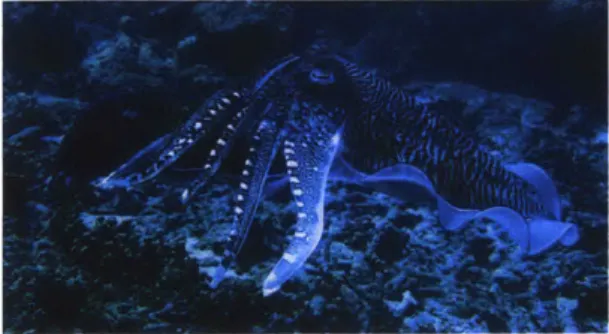
Figure 1. The camouflage behavior of a cuttlefish using elastic pigment sacs called chromatophores
As a means to ignite curiosity and surprise within a mate-rial interface, behaviors that seem inherently unexpected or contrary to the material's innate properties can act as catalysts to inspire awe. For example, seeing a Cuttlefish transform to blend into its background seems somewhat magical when we observe it in comparison to our concep-tual understanding our own skin. Intriguing characteristics allow us to think outside the realms of possibility, thus inspiring unexpected thought and opportunity. Leading us into the world of'Radial Atoms', a place where logic is elastic and atoms dance to create poetic transformations. ()
To explore this concept of material surprise, this thesis looks at the use of chemical behaviors to augment physi-cal properties through the use of inbuilt energy potential, adding unexpected effects to otherwise inert forms. The specific effect we explore within this thesis is inflation, by utilizing the C02 released as a bi-product of the reaction between Sodium Bicarbonate and Citric Acid. By applying an unexpected attribute to an otherwise familiar material, we are able to imbue a sense of wonder and surprise to the experience of using a product.
Inflatable structures within the field of design have been explored in many capacities from structure, to buoyancy, to air travel. In the scope of this thesis, I will be exploring the use of self-inflating structures from two perspectives, one, as a means to promote surprise through animation and shape transformations, and two, as a functional tool
INTRODUCTION
Motivation
Within the field of HCI, the exploration of reconfigurabil-ity and responsiveness has typically been applied to the digital aspect of computation (1), with emphasis on in-teractivity within screen-based and robotic interactions. More recently, researchers developing Tangible User Interfaces have identified the potential to apply the same design principles to physical materials (2), whereby
ma-terials themselves can respond and reshape to multiple degrees, in response to digital information. Projects such as inFORM (3) pioneered such thinking through promoting the idea of physical pixels able to reconfigure as freely as photons on a screen.
However, as exciting as these radical new materials seem, there are limitations to their functionality, specifically to a wider audience. These come down to practicalities such as the need for external hardware, for example cumber-some motor systems (3), noisy air compressors (4), and motion tracking systems (5). Thus we are designing for a world in which the technology has not yet caught up. There are great benefits to this way of thinking, in that we can shape a future yet to come, however, if we apply this vi-sion-based thinking to practicalities of today, we can also achieve some pragmatic, yet advanced results.
idea of creating a dynamic surface utilizing the expansion properties of Bacillus Subtilis Natto Bacteria that responds to heat and moisture to generate dynamic air-vents for runners. This advanced and scientifically profound work stemmed from the forward thinking vision of the Radi-cal Atoms philosophy, but when applied to an everyday problem such as overheating when exercising, this radi-cal vision becomes an implementable solution. Another example, which is somewhat less directly implementable, but uniquely visionary is the project M-Blocks (7) from Distributed Robotics Lab at MIT. This research looks at how to dynamically reconfigure building blocks using kinetic motion and magnetism.
What is special about both these examples is that fact that the energy potential is stored within the materials them-selves. They are designed so as to be maneuverable within different contexts, meaning their form is not constrained by external hardware or a fixed base station. These prop-erties can be considered 'magical', in the sense that their behavior is surprising or unexplainable from the outside, get highly controllable from the 'inside'.
In this way, by activating a material, we are releasing stored energy into a per-defined structure, which in turn imbues a user with surprise.
Aims
This thesis provides both a theoretical exploration of ma-terial activation, from the perspective of design, fabrica-tion and manufacturing, through investigafabrica-tion of existing programmable material systems into two-part manufac-turing/assembly systems, whereby the user becomes a viewer, while being as much a part of the assembly pro-cess as the factory. Based on this theoretical approach, I provide tested examples in the form of 1) integrated
ener-gy-potential through chemical-inflation, 2) pop-up
assem-bly through geometry investigation, 3) programmability of form through volume with instant small-to-large shape change, 4) an understanding of the relationship between energy-potential and material membrane deformation. By using the specific example of chemical inflation, we utilize a hardware-free inflation method, where shape-change can be activated autonomously, surfaces can be seamless without the need for external-to-internal airflow channels, and no external pressure source is required (ei-ther by breath or by pump): transformation is in-built. By exploring the programmability of materials through inflation, via activated morphing actions, this thesis pro-vides a study of primitive form, actuation and geometry, for the purpose of design, fabrication and mechanization, through the control of chemical behaviors.
Contribution
This thesis offers the following contributions:
" An integrated system for fabrication utilizing bi-products of a chemical reaction for inflation of materials.
" A new perspective on material transformations through chemical activation.
" A design space for manufacturing processes using programmable inflation.
" A solution for small-to-large shape change for economic transportation.
Thesis Outline
The following chapters describe the evolution of ideas in this thesis:
Chapter i gives a background to the research through an analysis of existing work in the field of programmable ma-terials, inflation, and material morphology.
Chapter 2 looks at the use of material behaviors within form-giving and objects construction
Chapter 3 documents a number of active chemical reac-tions we considered and tested for the purpose of material transformation.
Chapter4 looks at fabrication in terms of human construc-tion and assisted assembly, taking into consideraconstruc-tion
practicalities such as transportation and user-construction. Chapter 5 explores the proposed design space through an analysis of primitive forms, movements and materials utilis-able within inflating structures.
Chapter 6 presentation of Auto-Inflatables, showing back-ground research, testing and performance.
Chapter 7 summary of development of project with Ferrero MPG, from brainstorming to manufacturing hand off.
Chapter 8 Introducing future directions looking at the project across scales, specifically within architectural applications and disaster relief zones.
Chapter
1.
Transforming Materials
<77>
-~
A brief history of inflatable structures
within design and robotics
Over the past centuries, dating back to as early as the 1700's and possibly earlier, experimentation with the mechanical properties of air has become a well explored subject, especially in areas such as transportation, archi-tecture, and more recently robotics. The qualities of air, being something intangible, lightweight and inexhaustible (8) as well as providing pressure, buoyancy, and the ability to elevate structures, means that air, when controlled, has the ability to add characteristics and capabilities to tangi-ble structures that would be otherwise inconceivatangi-ble. The desire for man to fly provided great impetus for the investigation of air properties, and the discovery of the simple fact that hot air rises lead to some of the earliest examples of air utilization within unmanned flight. In
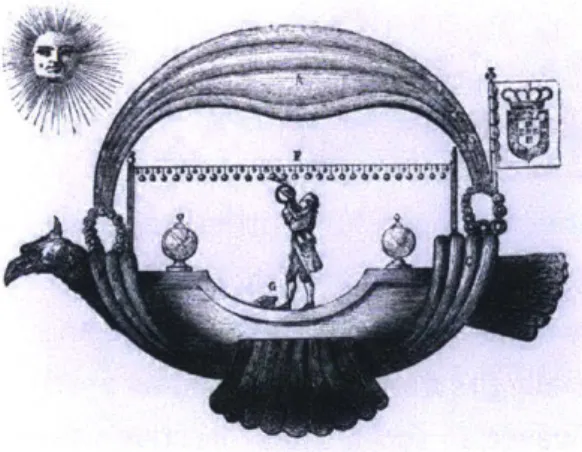
1709, Bartolomeu Louren o de Gusm~o presented an
un-manned hot-air balloon to the King of Portugal (8), which managed to elevate 4 meters into the air. This was the first of many attempts by different inventors to commandeer the air above ground.
Figure 2. (a) Illustration of the Flying Gondola by Bartolomeu Loureneo de Gusmdo 1708
Beyond air travel, and the world above, the fascination with air at the ground level continued to grow (9), becom-ing a much used (but endless) resource for activities such as driving, cycling, boating, ball games, sleeping, and even eating. By applying the attributes of this invisible resource using aerostatics (io) within engineered
mem-branes, we have seen the built world transform to make everyday experiences increasingly comfortable and adven-turous (9).
Figure 3. Right to left, car tire, bike wheel, inflatable dinghy, football match, bubblegum
The natural world is also a great source of wonder for ob-serving the utilization of air. Transformative animal behav-iors such as: defense - e.g. the puffer fish, mating - as in the case of the frigatebird when trying to attract a mate,
underwater breathing - such as the Argyroneta aquatica, an underwater spider that creates its own atmosphere by living inside a self created underwater air bubble, all exemplify the evolutionary uses of morphing structures.
Figure 4. Right to left,
Trapped air has also been utilized for synthetic applica-tions such as packaging (ii). In 1957 in the US, Bubble wrap was invented by the engineers Alfred Fielding and Marc Chavannes. Initially the product was sold as green-house insulation, however, in 1960, the protective usage of Bubble Wrap was discovered. Being lightweight and temporary, this material is ideal for shipping and protec-tion. Thus proving the versatility of trapped air is vast.
Figure 6. AeroMorph, Jifei Ou
Figure 7. Soft Robotics
Figure 7.1. Life Jacket
Figure 7.2. Car Air Bag
Within the field of HCI, the uses of trapped air has been explored in projects such as AeroMorph (12), by utilizing pneumatic systems to reconfigure membranes, to give form and feedback in response to digital information. The dynamic control of this 1/O system provides unique quali-ties to a digitally controlled interfaces that allows for quick and unique morphological properties.
The use of air within pneumatic systems has also found its way into robotics, now that the development of soft robotics
systems has begun to grow (13). This sub-field of robotics looks at the utilization of highly compliant materials, similar to those found in living organisms, to allow for increased flex-ibility and adaptability for alternative use-cases as well as im-proved safety when working around humans. The use of air within such a system is a useful actuation tool, as mechani-cal damage can be limited and system parts can be made to be lightweight. I will go into more detail about related work in the following chapters.
Life jackets and rafts found within airplans and boats use fast releasing C02 canisters that when pierced by a re-lease mechanism with rapidly rere-lease C02 into the body of the vest to create a securely inflated, highly preasurised membrane to enable flotation within water. The canisters themselves are also highly preasurised and therefore the release is immediate.
Airbags used within cars create inflation using a reaction between Sodium azide (NaN3) and potassium nitrate (KNO3) which react very quickly to produce a large pulse of hot nitrogen gas. The relese mechanism works by a circuit passing an electric current through a heating element which ignites a chemical explosive causing the release of
a large volume of harmless gas, typically either nitrogen or a rgo n.
Transformative
structures within an
assem-bly process
Figure 8. The figure above shows an image from the Nature paper 'A three-dimensional actuated
origa-mi-inspired transformable metamaterial with multiple degrees of freedom' Johannes T.B. Overvelde, Twan A. de Jong, Yanina Shevchenko, Sergio A. Becerra, George M. Whitesides, James C. Weaver, Chuck Hoberman &
Katia Bertoldi
The development of 'smart' or technically advanced mate-rials is a process of synthesis, piecing together structural or molecular elements with complementing behaviors, or tuning their attributes to fit alternative needs (14). The ability to control morphological transitions through em-bedded logic or energy, gives rise to radical possibilities within the field of design. Within the specific context of two-part assembly, or distributed labor, for example within flat-pack furniture, control of morphological transitions can provide guidance mechanisms that aid in user-assem-bly. Within the context of this thesis, I am especially inter-ested in how user-directed assembly can be implemented and aided by the use of inflating materials. By incorporat-ing transformative elements into a design, are we able to add both emotion (in the sense of fulfillment) as well as function to the experience of using an artifact.
A key point to note within this thesis is the fact that by using engineered materials with transformative abilities, one of the solutions we are providing is that of economic transportation. As a society we have become accustomed to moving and transporting goods, so the importance for space economy is obvious. Therefore, by incorporating
ele-ments into a design that allow for efficient transpiration, as well as easy assembly though inbuilt energy assistance, this projects is incorporating a solution as well as a user
experience through the use of self-actuating and animat-ing materials.
To actuate, or transform a material, energy of some sort is required. In this case there are two options, external ener-gy input or internal (stored enerener-gy) input.
Examples of stored-energy can be observed on a biolog-ical scale, when we look for instance at how a cell stores energy as Adenosine triphosphate (ATP) molecules. The transformation of this stored energy provides cells with
the ability to grow, transform and multiply. Although this process is very different from the mechanical processes I am discussing in this thesis, pointing out the correlation between the micro and macro world is a useful tool for conceptualizing processes characterized within the broad-er spectrum of life itself.
When we look at piece-by-piece construction of something like a house for instance, each brick provides a part to a whole, constructed by an outside energy source, in this case the human. Piece-by-piece construction of this kind treats the building material as single, solid atoms. Within HCI, the emphasis of reconfigurability is there so as to provide task-related feedback, rarely does a single-state provide a suitable mechanism for conveying transform-able information. However, when a material can provide a multiplicity of states, we are able to provide information, or engineer functionality in different formats.
Programmable materials
Lessons from nature have inspired designers and sci-entists for generations everywhere from architecture to swimsuits. The evolutionary perfection of the organic world provides solutions that are both aesthetic as well as structurally profound.
Exploration of programmable materials has seen a range of outcomes in various forms, from biologically controlled
movement to woods, to air.
Current programmable materials, what they can do, and how they've inspired me:
Within academic research, investigation and experimen-tation of programmable materials has taken various direc-tions, here I shall discuss related work that covers a vari-ety of techniques, with applications within HCI, assembly, and wearables.
Within the Tangible Media Group, the development of programmable materials stemmed from the Radical Atoms vision(i), whereby interfaces would no longer be limited to GUIs (Graphical User Interfaces) and TUIs (Tangible
User Interfaces), but instead interfaces would be able to conform and reconfigure to fit the needs of the user (Ishii
2012). As a consequence, a number of projects have
emerged.
PneuUI (4) is an enabling technology designed to build shape-changing interfaces through pneumatically-actu-ated soft composite materials. The computational aspect of this project is the control of the air released into a predefined membrane. By being able to computationally control the output of an air compressor, soft membranes can be controlled to act upon specific command.
Figure 9. PneUI, game controller, Tangible Media Group
jamSheets (15), utilizes layer jamming as an enabling tech-nology for designing deformable, stiffness-tunable, thin sheet interfaces. This project works in opposite to PneUI,
in that instead of inputting air to create feedback, air is being pulled out to create stiffness.
Figure 10. JamSheets samples, Tangible Media Group
Figure 11. BioLogic teabag application, Tangible Media Group
W
bioLogic (6) is uses grown living bacteria actuators that when exposed to moisture will swell to create movement.
By applying the bacteria to a substrate material in specific logical geometries, curling and bending action can be gen-erated to give 'life' to an otherwise lifeless material. The in-built mechanics of this system uses the combination of millions of micro movements (swelling) of cells to create a perceivable change that is visible to the human eye.
M-Blocks (7) is a Momentum-driven, Magnetic Modular Ro-bot system for novel self-assembling. Each module moves
independently to traverse planar unstructured environ-ments (Romanishin 2013)
The modules achieve these movements by quickly trans-ferring angular momentum accumulated in a
self-con-25 mm, tained flywheel to the body of the robot.
Figure 12. M-Blocks prototype, Distributed Robotics Laboratory
Programmable Wood (16) from the Self Assembly Lab is a novel printing and composite material technology with the aim of overcoming prior limitations of manual wood
forming. By extrusion printing flat sheets of custom wood composites, the group are able to combine the transfor-mative qualities of wood and moisture by engineering geometric forms that can control the morphology of the Figure 13. Programmable Wood folding samples, Self transformation.
Assembly Lab
As an example of simplifying assembly processes, the Programmable Table, also from the Self Assembly Lab, provides a stylish example of how by engineering geom-etries and material composites, something like flat-pack furniture can be designed to be smarter and more intuitive for user assembly.
Figure 14. Programmable Table, Self Assembly Lab
Some of the limitations we see with current programmable and transfigurable materials are issues such as the need for external energy sources (specifically for the examples of pressure changing membranes), stimulants such as water or heat, and external energy sources and battery power.
Other factors to take into consideration are aspects such as degrees of freedom and multiplicity of states. For in-stance, is the material binary with just two states, or does it allow for multiple angles of movement/structure/con-trollability? Tying this into the core project of this thesis, by looking at the pressure for inflation as something that can provide programmable qualities in both volume and movement, reference can be taken from the exemplified works above to show how this added degree of conform-ability (inflation) can be included to produce both new elements of surprise to a materials capabilities, as well as new functionalities such as changes in buoyancy,
Assembly lines (automation
+
human power)
In the previous pages I have provide examples of existing research that has direct relation to the proposed design space in-which the work in this thesis is directed, which I will go into more detail in later chapters. What I would like to highlight here is that the work produced in this thesis fits within the body of existing work of programmable and transformable materials by way of transformation control-lability.
Next I would like to introduce the concept of material transformation through assembly lines. The process of an assembly line takes a material (or various materials) as in-puts, and transforms them through the use of external ma-chinery to produce reconfigured material outputs. Through the development of programmable materials, the idea that materials will be self- transforming has become an explored fantasy, and within such a world, assembly lines will become increasingly distributed. If we can design a system, or material, that allows for half the fabrication la-bor to be completed outside of the factory, then the use of programmable materials becomes a useful tool for adding value both in economy of transport and user participation. It is clear that of the examples introduced previously, a num-ber require external stimulus to fulfill their designed function. If we look at the manufacturing process of products, more often than not, a product is distributed from a factory as a completed item, shipped as a whole, whereby the interaction from the user is simply unboxing and placing the item in its place. Sometimes setup is required, such as in the case of digital products, such as plugging in, turning on etc. Through the development of the research in this thesis, the chemical inflation requires activation, which is what is needed to com-plete the product's function. This element of interaction is what brings the product to life, adding surprise to the
materi-Feedback
The notion of feedback is important to explore when dis-cussing tranformability of materials, specifically in relation to user-assembly. The activation that causes a material
change requires clear feedback to convey information to a user, communicating that an event has taken place. Within the case of programmable materials, there are two main stimulants that cause an event to take place:
1. Environmental stimulation
As in when either an ambient stimulant such as sunlight or heat causes a physical change to occur.
2. User stimulation
This could be a specific action or force that a user ap-ples, such as shaking or pressing, that triggers a physical change.
Within HCI, feedback is most often designed into a system, e.g. if you press a button, a color change (for instance) will communicate to the user that something has happened. When dealing with materials, designing feedback is not always as simple due to factors such as the compliance of the material or the physical properties that it contains. To design feedback into a material, the action that the material will perform is essential the premise of the in-formation being conveyed. When we look at inflation, the contortion of the membrane tells a user if something is full (under pressure) or empty. When you blow up a balloon for instance, the deformation of the membrane can communi-cate if it is going to pop from too much pressure, or if it is faulty due to being unable to inflate. By incorporating this type of feedback information into a design, we can create functional user experiences through the subtleties of a material transformation.
Chapter
2.
Material Behaviors
(specific to inflation)
Brief in tro
Radical atoms suggests re-conformability, dynamism and programmability of physical materials. From a designers perspective, multiplicity of form is not always a desirable attribute, however the incorporation of dynamic compo-nents or state-change can provide application possibilities beyond the rigid surfaces we are used to handling and working with.
By incorporating shape and volume change into the fabrica-tion process, we open up possibilities for a new typologies of form, manufacturing and transportation. Work previously done in PneUI (5) explored this use of dynamic change of membrane through non-perminant interactive feedback. By considering the manufacturing side of product creation as the process of pre-forming a structure, we can think about the user-side as the 'final touches', where a product is transformed into its final structure. Along with this func-tional approach to the use of transformative materials, we can also take advantage of the experience of
transforma-Inter-material interaction
The term Inter-material interaction was coined by Follmer and Leithinger in 2013 . What they refer to is the interplay
between digital 'material' and the physical material that we can touch and manipulate, more specifically the aug-mentation of otherwise inert physical objects with kinetic capabilities (Follmer, 2013). Within this chapter I will refer
to inter-material interaction as the interplay between invis-ible/intangible gases and physical instances, whereby the gas, to an extent, substitutes the digital as a programma-ble, or controllaprogramma-ble, medium upon which to affect a physi-cal body.
The interplay between material states creates behaviors that can be advantageous for applications such as energy production, such as within turbines. Gaseous or liquid behaviors upon soft and rigid structural dynamics can provide outputs, such as kinetic energy, when the move-ment of the gas particles is strong enough to push a solid structure. Equally with the use of water, kinetic motion can be generated.
Pressure buildup is another example of an effect that can have beneficial qualities, for instance by utilizing a barometric effect or filling a balloon membrane with air to increase side and rigidity.
Rigidity and flexibility
The relationship between hard and soft structures and membranes is something we can observe most notably in the human body, as Chelo and Ziegelbaum explain in their paper on Shape Changing Interfaces (17) form and its abil-ity to change in nature are the result of a harmonious or-chestration between elements with disparate and chang-ing physical properties. They go on to explain in D'Arcy
Thompson's words, 'the human body is neither hard nor soft, but a combination of muscles, bones, tendons, and ligaments that make up the complete load-bearing actua-tion structure that allows us to walk, resist the pull of grav-ity, or write this document'. This is an important message when designing artifacts for our tangible environment, especially when dealing with interfaces, as it reminds us that a shell does not necessarily have to be hard, and that is the combination of materials working in unison that create a functional whole.
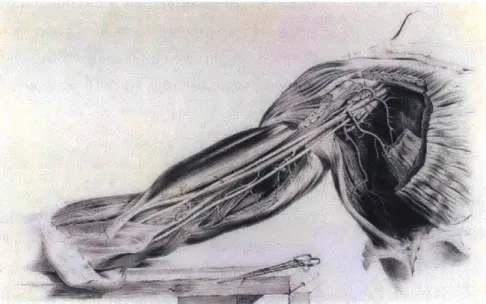
Figure 15. Illustration from the Anatomy of the Arteries of the Human Body with its applications to pathology and operative surgery, by Richard Quain.
Programmability of volume
The ability to control volume from within a deformable structure allows for a unique programmability of space that would otherwise be constant or externally influenced. By having access to this negative space, and the ability to add constraints to its form, we can develop a range of primitive elements that can be used to add parametric properties such as: shape, structure, movement, comfort, and aesthetics to otherwise inert or single-dimensional materials. In relation to the expansion of volume for mate-rial programmability, the relationship to muscle movement
Figure 16. Sticky Actuator, Ryuma Niiyama, Xu Sun, Lining Yao, Hiroshi Ishii, Daniela Rus, Sangbae Kim /
2015
Figure 17. Deflated balloon
bined with rigid and flexible structures can give rise to the types of anatomical movements visible in nature. As well as being able to generate movements with organic
simi-larities, the benefit to utilizing air for this purpose is it's invisibility and lack of density, which means that no extra weight or structure needs to be included, and therefore
minimal impact is applied to a membrane.
The project Sticky Actuators by Ryuma Niiyama, looks at how by applying per-fabricated actuation membranes to existing structures, animation effects can be applied to per-existing objects to bring inert materials to life. By imbuing unexpected behaviors such as movement into a familiar object, we can transform the characteristics of an existing structure into something wildly new.
Actuation
Actuation within HCI provides a powerful mechanism for responsive feedback, so as to be able to communicate, as well as transform the functionality of an interface. Anima-tion (as a result of actuaAnima-tion) is something we perceive
and perform constantly, so by being able to imbue a physi-cal change into an experience though actuation, the space in which an interface exists broadens. Thus, we are now in a position whereby what defines an interface expands into areas such as product design and material engineering.
Material Yield
To create a structure with inflation capabilities, a membrane needs to contain a gas. The transformation of the membrane when exposed to pressure from gas buildup can create yield stress. Once a yield point is met, when a material will no
longer deform elastically, it will deform plastically, creating a permanent structural change to the material. In the
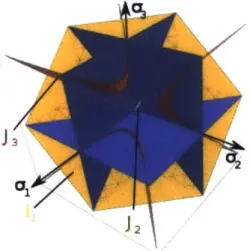
J2
Figure 18. Surfaces on which the invariants Ji, J2, J3 are constant. Plotted in principal stress space.
yield points form together a yield surface (18).
By taking yield stress into account when designing a trans-formable structure, permanent deformation and bi-direction-ality can be a perameter to be considered, so as to be able to construct surfaces that deform with pre-defined behaviors. For instance, by predefining the atmospheric pressure build-up that will be contained within a membrane, in conjunction with establishing a membrane structure that will deform plastically, inflation can be used to create functional struc-tures with lasting transformations. Another way to look at this would be by utilizing qualities of composite layers, whereby a combination of plastic and elastic transformations can be engineered to create 2dimentional sheet materials that trans-form into permanent and semi-permanent structures.
Chapter 3. State-changing Chemical
Reactions
To generate the material transformations I have spoken about in the prior chapters, we took advantage of the out-put produced through simple chemical reactions to acti-vate a specific material behaviors. I will go into more detail later in the thesis to explain specifically what reaction and effect we utilized for the outcome we made, however I will bring to light in this chapter a number of reactions we explored and took into consideration for their output behaviors.
To make clear, the difference between a physical reac-tion and a chemical reacreac-tion is composireac-tion. In a chemi-cal reaction, there is a change in the composition of the substances in question; in a physical change there is a difference in the appearance, smell, or simple display of a sample of matter without a change in composition. Although we call them physical "reactions," no reaction is actually occurring. In order for a reaction to take place, there must be a change in the elemental composition of the substance in question. Thus, we shall simply refer to physical "reactions" as physical changes from now on.
Types of chemical reactions we
explored
Acid-Base Reactions (Gas Producing)
Type #1
Metal carbonate (or bicarbonate) + Acid reaction
This reaction could be considered an acid-base neutral-ization reaction. Compounds with carbonate (C032-) and bicarbonate (HCO3-) ions act as a base because they will accept hydrogen ions from acid molecules. This lowers the amount of hydrogen ions in the aqueous solution pro-duced by the reaction and neutralizes the acid.
The products formed include water and a salt but the difference between this type of reaction and neutralization reactions is that carbon dioxide gas is also produced. An example of this reaction would be when a solution of sodium carbonate and a solution of hydrochloric acid are combined:
Na2CO3 + 2 HC ... 2 NaCI + C02 + H20 [molecular]
Type #2
Metal sulfide + Acid reaction
This reaction looks like a metathesis reaction, where positive parts of the compounds exchange negative parts. The products formed by this category of reaction include hydrogen sulfide gas and a salt.
An example of this reaction would when a solid copper sulfide and solution of hydrofluoric acid are added together:
Type #3
Metal sulfite + acid reaction
This reaction also looks like a type #1 gas-forming reac-tion, except we replace the carbonate (C03) with a sulfite (S03). The products formed by this category of reaction include a salt, water and sulfur dioxide gas (instead of carbon dioxide).
metal sulfite + acid .:+ salt + S02 + H20
An example of this reaction would when a solution of potassium sulfite and solution of nitric acid are added together:
K2SO3 + 2 HNO3 :+ KNO3 + S02 + H20 [molecular]
Type #4
Ammonium salt + Strong base reaction
This reaction looks like a metathesis reaction, where positive parts of the compounds exchange negative parts. The products formed by this category of reaction include hydrogen sulfide gas and a salt.
ammonium salt + strong base .... metal salt + NH3 + H20
An example of this reaction would when a solution of am-monium chloride and solution of potassium hydroxide are added together:
Color Change
Example #1
Oxygenic photosynthesis
Photosynthesis causes the production of chlorophyll turn-ing leaves green color.
Anthocyanins, produced during autumn, turn leaves red. Carotenoids provide the yellow, brown, and orange hues. 6CO2 + 12H20 + Light Energy .-. C6H1206 + 602 + 6H20
[equation for photosynthesis]
Example #2
Rusting Iron
Color change from to iron to yellow 4Fe+302+6H20-...:.4Fe(0H)3
Example #3
Copper with air
Copper metal is stable in air under normal conditions. At read heat, copper metal and oxygen react to form Cu20. 4Cu(s) + 02(g) ...:: 2Cu20(s)
Temperature Change
Type #1
Thermite Exothermic Reaction
Type #2
Sodium or Other Alkali Metal in Water
All alkali metals dropped in water will produce an exother-38
mic reaction, generating varying degrees of heat. As you move down the group in the periodic table, the energy output of the reactions will increase. The example below shows the reactions between sodium metal and water. 2 Na+2 H20 .... 2 Na++ 2 OH- + H2(g)
Type #3
Chemical Fire
Potassium permanganate + glycerin + water
As an example of an exothermic reaction, if Fe203Fe2O3 is mixed with Al and ignited (often with burning Mg), then the thermite reaction is initiated, generating heat as a
product of a very exothermic reaction. - Application: Fire-works Fe203+2Al-....:-:2Fe+Al203+Heat
Changes in Odor
Formation of Precipitate Ba2+(aq)+CO2-3(aq)-.-:.BaCO)3(s) Ba(aq)2++CO3(aq)2---.:.BaCO)3(s)Changes in odor can provide applications for signalling through alternatively percieved ambient feedback.
Controllability
4, 41 '8 E C EFigure 18. Distribution plots of temperature effects on chemical reactions
Temperature is a major factor that affects the rate of a chemical reaction.
The two distribution plots shown here (fig.18) are for a lower temperature Ti and a higher temperature T2. The area under each curve represents the total number of mol-ecules whose energies fall a within particular range. The shaded regions indicate the number of molecules which are sufficiently energetic to meet the requirements dictat-ed by the two values of Ea that are shown.
The activation energy needed for the chemical reaction to be triggered can have a direct impact on the rate at which the reaction will occur. So temperature is a variable that we can control to an extent if we want to speed up of slow down the rate of change in a material. This ma not always be possible to control based on the medium or substrate we are working with, however it is an important variable to take into consideration when testing transforming effects.
Potential Use Cases
Applying chemical reactions to inert materials to imbue life, or give new qualities to a substrate or membrane, can provide hardware-free transformations for the purpose of surprise, wonder and delight. As each reaction provides differing output qualities at varying intensities, finding specific applications for each type of reaction becomes an exciting task. Many applications have already been ap-plied to products such as the use of exothermic reactions for hand-warmers, or color-change for pH detection. By exploring the potential for these kind of 'magical' trans-formations, we can imbue the Radical Atoms vision of the Tangible Media Group into the every-day experiences 40
>~ T
FtT2 > T1
Chapter
4.
Assisted Assembly
By utilizing known behaviors of organically occurring phenomenon like chemical reactions as I discussed in the previous chapter, we can exploit these behaviors for de-sign purposes, for instance with the intent of completing structures. By controlling aspects of a solid geometry in combination with a controlled reaction we can 'turn
ran-dom energy into non-ranran-dom things'- Skylar Tibbits
Flat-pack furniture
The development of mass manufacturing gave rise to the ability to produce precise, repeatable parts in vast quan-tities, to be assembled and distributed out of view of the consumer. In the 18oos, when society saw the first signs of factory production, distribution of large quantities of fully constructed products was cumbersome, especially with the main mode of transport being horse drawn carts and primitive railroads. Obviously the inefficiency of this lead to innovation, considering better transportation and assembly methods, and according to U.S. patent records, the first true flat-pack, or self-assembly, furniture design was invented by Erie Sauder in 1951.
This kind of two-part assembly process looks at the de-construction of a product for production in a factory, and in-turn, an assembly system that provides a user with a set
BILLY
]
'l
Figure 19. Printed Ikea instructions for Billy bookcase
We can think of this in the same way as we think about DNA. The product has a pre-programmed structure, or sequence of nucleotides, designed of parts connected by joints and screws.
Within the field of design and manufacturing, innovation of the assembly process can provide a more efficient means, both to the consumer and to the manufacturer, for assembly and delivery, however as a consumer, the idea of assembling an item on one's own may not always be appealing. Therefore through innovation in the area of self-assembling parts, or 'assisted self-assembly' we can begin to imagine scenarios where quality products can be shipped efficiently and constructed through minimum effort to high degrees of accuracy. Moreover, with the development of such functionality, products do not have to be limited to the consumer realm, but can provide easy and accessible parts to relief zones, engineering bases and even space travel.
Material conformability
Within the physical world, we think of materials as having various states: solids, liquids, gases. Within these cat-egories there are also variants, such as density, rigidity, softness, texture, color, and so on. A single material can have a variety of perceivable states. In the 19th century, a Swedish engineer by the name of Christopher Poihem invented a 'mechanical alphabet', or a set of primitives, consisting of mechanical parts which he believed could be used to construct any mechanical object. The idea that with a set of base parts, any mechanism could be brought to life became a foundational pedagogy amongst engi-neers. However, one limitation of Polhem's 'alphabet' was that all the parts within the repertoire are made of solid, rigid materials. If we consider the world in which we exist, and more specifically the body that we possess, it is an
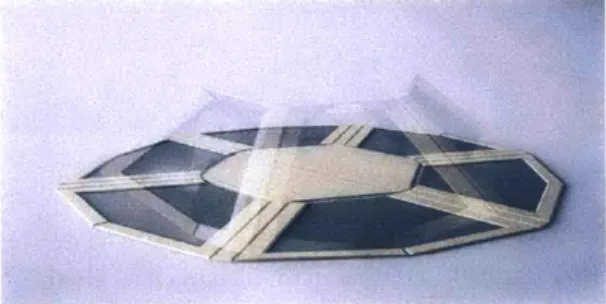
Figure 20. Popapy sample inside microwave
amalgamation of soft tissue, bones, tendons, liquid and gases. This does not reflect the mechanical design of Pol-hem's engineering corpus. In more recent years we have see the development of systems such as soft-robotics come to prevalence, where the understanding of flexible geometry has broadened the fabrication possibilities and structural outcomes of engineered mechanisms.
In similar fashion, Italian designer Enzo Mari contributed a contemporary milestone in design by establishing a format for 'do-it-yourself' furniture, published in his 1974
book 'Autoprogettazione'. This ethos was in contrast to the popular formalism of the time, and provided a democra-tization of design by provoking an alternative to the cap-italist paradigm of mass consumption; building your own furniture, when required.
Pre-programming geometry
To assist assembly, design elements such as pre-defined geometries can guide a user through affordance-based direction, such as a perforations to non-verbally advise a user where to make a fold. As well as being a guiding mechanisms, pre-programmed geometries can act as guides for automated actuation/transformations.
Projects such as Popapy (28) use the material attributes of flexible polystyrene plastic in combination pre-defined folds with thin aluminum sheets, to embed state-change
potential into a material.
Along with defined geometries, the combination with materi-al properties is what gives transformable qumateri-alities to a struc-ture. To define the properties of a solid material, and thus encode logic into its structure, the properties of, in the case of Popapy, a polymer, depends on the processing history of that material. Key variables in defining a material's properties
As an example, the extrusion process of polystyrene begins with the raw material which is melted at 19o0 C and extruded through a slot die. The resulting film exits the die at a temperature above its glass transition point, around ioo'C. The extruded material is soft and rubbery. The forced flow through the die causes stretching in the direction of the flow, but to produce a biaxially stretched film, further stretching in the direction perpendicular to the machine direction is required. The stretched film is then taken up by several rollers. These rollers are usually chilled to quickly cool, or quench, the soft film. It is this rapid cooling of the film that gives the material the ability to maintain its stretched shape. Upon the energy input of heating, the polymer chains that have been stretched through the cooling process return to their initial, more random configuration. This is the state of 'memory' that the material has.
The behavior of the biaxially-oriented polystyrene is unusual. Most objects soften or melt when heated, or sometimes they decompose if the temperature is high. The polystyrene shrinks dramatically, but its mass stays the same. The decrease in the area is compensated for by an increase in the thickness.
In its 'relaxed' state, the composite material is simply a flat sheet without obvious definition, when activated, however, through heat energy provided by a domestic microwave, the 2D structure transforms into 3D
geome-try. The pre-programmability of this system is embedded directly within the material; there is a stored kinetic po-tential encoded within the structure. Within the system the energy source is external, in that it requires activation through an energy-consuming peripheral (in this case the microwave). Something that I'm keen to promote through this thesis is the potential for a contained energy source,
and therefore no need for external power to stimulate a transformation.
Chapter 5. Proposed Design Space
Inflatables and their functionality
Inflatable structures, more specifically within this context, pressurized membranes, come with a number of attributes that contribute both to aesthetic quality and mechanical functionality. From an aesthetic perspective, the quality of a material to be somewhat ephemeral; lightweight, transparent, with organic curvatures, is something unique that is difficult to replicate in other materials, therefore this quality can be employed within specific use-cases where these attribute are required, for instance within transportation or assembly, the ability to transport some-thing lightweight that can be inflated to add rigidity and
structure would be beneficial to reduce energy consump-tion through unnecessary volume transportaconsump-tion. From a mechanical perspective, the types of actuation and move-ment possible within a membrane structure provide bene-fits for instance in flexibility of joint types and actuation of irregular shapes. They also allow for lighter weight
compo-Shape Primitives
LA
AFigure 22. Hinging effect of deformatio
F
Figure 23. Equation for hinging effect
By utilizing the structural movement generated by in-flation, we have a number of characteristics that can be employed to serve various functionalities. In this section I will be looking at the use of inflation for hinging, folding, rigidity, small-to-large structural change, surface pattern and movement. I will also be looking at the use of air for insulation, flotation and buoyancy.
Hinging
By applying the deformation gradient achieved by pres-sure buildup within an airtight membrane, hinging can be achieved through expansion, applying force on attached parts.
i force
The hinging angle is dependent on the stiffness/flexibil-ity of the inflated membrane. Stiffness, k, of a body is a measure of the resistance offered by an elastic body to deformation. For an elastic body with a single degree of freedom (DOF) for example, stretching or compression of the inflatable membrane.
F is the force on the body
8 is the displacement produced by the force along the same degree of freedom (for instance, the change in length of a stretched spring)
The angle and strength of force is also dependent on the geometry, by designing a system where we can decrease the total length of the outer surface of the airbag mem-brane, we can generate hinging actions that can control simple as well as complex shape transformations.
Examples of simple mechanical hinge movement:
(
Figure 24. Mechanical hinge designs
Figure 25. Folding Patterns
Folding
Origami techniques can be employed to generate 2D to
3D structural change of more complex forms. By applying pressure within specific points of a flat surface, structures can be automatically folded into place through pre-de-fined folding logic.
I I
~I / 'I
Soft + rigid structures
By combining a soft membrane with a rigid structure, large and strong, as well as complex structures can be assem-bled through the input of air
Soft membrane hinge
Solid membrane
a
Inflated shape can be
predefined to add form to
now the structure
PPP_
Small-to-large shape change
By optimizing airflow within a structure, for instance by decreasing the inner volume of a structure, structural form can be generated with minimal pressure. This technique is specifically beneficial for small-to-large structural change. The images below show primitive shapes that can be gen-erated in this way.
Folded membrane
Figure 27. Diagram showing transfor-mation capabilitiy from small to large structure VzAV1AVA72YVAV0 AVIN7.AV\7AV /\V/ A VAVAVVV V/_'AVVA~vAVV A\V/V/\VA7AVI'\ CQ(C)I ,ZC )0C)0 C) '1 C 0 0 07)01)0Cj CO C) 0 0L 00 0(1 0 O10 -1 Inflated volume increase x4
Surface pattern
Surface patterns can be created by using the heat-press-ing technique to create continuous tubular structures. To maintain airflow thoughout a membrane, the patterns must be non-isolating, thus allowing a constant flow of air. The repetition of these patterns allows for structural changes that create textured and tactile patterning for both aesthetic and practical functions
X / \ ~% ~%
;
~KQ >(
Figure 29. Mechanical twiting motion through inflation gie M
vement
ntrolling the time and order in which C02 is released i membrane array, complex movements can be
creat-order to generate autonomous animation and
mo-xamples below show how by ordering airflow through hannels via multiple valves and passageways, a sin-ructure can obtain alternative movement possibilities.
L1
__Figure 30. Mechanical movement through distributed air pockets
Insulation
Air provides strong thermal insulation due to its lack of density. By providing a region within a void in which
ther-mal conduction is reduced using air, temperature can be regulated. But utilizing the controllability of the sodium bicarbonate and citric acid reaction, thermal insulation can be included in a use-case for this technique. Some-thing to note is that initially, due to the reaction being endothermic, there is an initial drop in temperature when the chemicals react, however, this is only temporary, and by taking this into consideration as a constraint, can be controlled to provide the required thermal regulation.
Figure 31. Inflated, plastic cells supported by steel frames
As an example of thermal reulation, figure X shows an im-age of the Eden Project designed by the architect Nicholas Grimshaw and engineering firm Anthony Hunt and Asso-ciates. The construction of the 'biomes' (the term used to describe the form of the geodesic structures) is made from from a tubular steel (hex-tri-hex) with mostly hexagonal external cladding panels made from the thermoplastic ETFE (Ethylene Tetrafluoroethylene). The use of glass was avoided due to its weight and potential dangers. Instead, the cladding panels are created from inflated mambrans made of several layers of thin UV-transparent ETFE film, which are sealed around their perimeter. The resulting cushion acts as a thermal blanket to the structure, by cre-ating an insulcre-ating air pocket between the outer and ineer environment.
Floatation
/
Buoyancy
One of the qualities of inflated membranes is that they have the ability to float. This unique quality provides ap-plications beyond land, out onto water and into the sky. By utilising this perameter, the design space for solid struc-tures can be opened up to include off-land applications as well as light-weight structural applications. By reinforcing a membrane with an internal (or external) anatomy, we can begin to think about the application of self-inflating struc-tures for assembly at sea or in-air. By activating a network of inflatable structures intertwined with solid anatomies could create assembly on water or in air a viable solution 50
Materials
From the research we found that Mylar, the trade name for BoPET, is the most efficient C02 barrier out of the materi-als we tested, and therefore provides a good membrane either as a standalone material, or as the inner portion of a composite material.
BoPET (Biaxially-oriented polyethylene terephthalate) is a polyester film made from stretched polyethylene tere-phthalate (PET) and is used for its high tensile strength, chemical and dimensional stability, transparency, reflec-tivity, gas and aroma barrier properties, and electrical
insulation. A variety of companies manufacture boPET and other polyester films under different brand names. In the UK and US, the most well-known trade names are Mylar, Melinex and Hostaphan
TPU coated Nylon Mylar TPU backed rubber
- ~ -~
Pressu": 1 atm Sodium Bicarbonate: 0.4 g
Tric Acid: 0A. g
Watr: I -2mad Time: 10 So". Pressure: I sAM Sodium Bicarbonate: 0.345 g Citc Acid-: 0 0 Water 1- 2nd Time: 10 Sees Pressure: 1 atm Sodium Bic : 0.345 g CTric Acid: 0. 800 Water 1 -.2 ad Time: 10 Sacs
Figure 32. Material Samples Mylar comes with many different coatings that can add to
both the aesthetic as well as adding mechanical proper-ties to the material. We found that metalized Mylar and more specifically, metalized Mylar (commonly used in he-lium balloons) with a matte outer coating, has the ability to maintain a pressurized state for many weeks after initial
Matte Coated Mylar
ire 33. Coated Mylar membrane samples
Other composite materials that we have tested include TPU backed Nylon and rubber. We have also tested a latex, TPU, Mylar composite, which provides mechanical strength with marginal flexibility. These materials are discussed later in the thesis within the specific context of Auto-Inflatables.
Design criteria
Fabrication from the perspective of user-assembly has been formalized and distributed, most notably in recent years, through the development of flat-pack furniture. In this way, structures that inhabit large cubic areas can be transported en masse in efficiently deconstructed formats, thus reducing both the carbon footprint of the product delivery, and the cost of manufacturing, by allocating
la-bor in-part to the consumer. To improve the experience of this kind of delivery and assembly process, self-actuating systems can offer aid in 2D-tO-3D, or small-to-large, us-er-directed construction. To establish this process further, we consider a number of ways in which to utilize stored energy within a material with kinetic potential, as well as external energy sources for activation.
Fig
Design space
Inflatable assembly can be applied in various ways, from structural primitives, such as pre-programmed material elements, to geometric forms with multi-state structural potential. In the context of this thesis I am focusing on small-to-large structural change, with elemental control of structural form. From an application perspective, space utilization is one of the most useful traits of this technol-ogy, given that volume can be generated out of air, thus providing a light-weight solution to storage and transpor-tation of physical artifacts.
Aside from functionality, the aesthetic properties of in-flated membranes provide an ethereal and surprising quality to a structure that is unique to this medium. The combination of a both rigid and cushioned membrane pro-vides an almost skin-like texture, which for a solid artifact can add a semiotic value to an object that can be evoca-tive of nature.
With the development of soft structures becoming a prev-alent feature in the field of robotics, we can see that there is a clear desire for an aesthetic push in the direction of texture diversity within transformable artifacts. Through the research done in this thesis, we have found a number of appropriate solutions to surface membranes which will provide functionality as well as character for C02-retaining inflatable structures.
Summary: Primitives Toolkit for the
design of inflatable structures
This tables provides a toolkit of primitive elements that can be combined to create a range of functionalities for self-inflating structures
3D Forms
""""" "
i
IZfllZZl
*JiilTiTlTIi J2ZZ2ZZI
/
F*ITUITPJ
T~~r DIy .. . y
.n
-a
7N
-
~M~inmbons 14 1a -'J Mkm RI Nwunn