Contrast enhancement behavior of hydrogen
silsesquioxane in a salty developer
The MIT Faculty has made this article openly available. Please share
how this access benefits you. Your story matters.
Citation
Nam, Sung-Wook et al. “Contrast Enhancement Behavior of
Hydrogen Silsesquioxane in a Salty Developer.” Journal of Vacuum
Science & Technology B: Microelectronics and Nanometer
Structures 27.6 (2009): 2635. © 2009 American Vacuum Society
As Published
http://dx.doi.org/10.1116/1.3245991
Publisher
American Vacuum Society (AVS)
Version
Final published version
Citable link
http://hdl.handle.net/1721.1/74146
Terms of Use
Article is made available in accordance with the publisher's
policy and may be subject to US copyright law. Please refer to the
publisher's site for terms of use.
共Received 8 July 2009; accepted 14 September 2009; published 2 December 2009兲
The authors investigated a contrast enhancement behavior of hydrogen silsesquioxane共HSQ兲 in a salty development system共NaOH/NaCl兲. Time-resolved analysis of contrast curves and line-grating patterns were carried out to investigate the unique properties of a salty development process. In NaOH developer without salt, the development process was saturated beyond a certain development time. On the other hand, the addition of salt enabled a continuous development, which was not observed in the pure NaOH development. The continuous thinning process enhances the contrast of HSQ in the salty developer, which allows a fast collapsing behavior in HSQ line-grating patterns. During development process, salt seems to have the role of modifying HSQ by breaking network bonds preferentially, leading to a continuous development rate. © 2009 American Vacuum
Society. 关DOI: 10.1116/1.3245991兴
I. INTRODUCTION
Hydrogen silsesquioxane 共HSQ兲 is a widely utilized negative-type electron-beam resist material. Due to its poten-tial for high density patterns, namely, less than 10 nm pitch structures, intensive investigations have been carried out to find an optimum process.1Several development techniques, such as high temperature and high concentration hydroxide developers, have been suggested to improve the electron-beam resist performances including contrast共␥兲 and sensitiv-ity 共D0兲.2,3 Recently, a novel development system was re-ported by adding salt in hydroxide developers, which offers an outstanding␥ value 共⬎10兲 for high resolution and high density patterning.4
Fundamental mechanisms of the cross-linking and devel-opment process of HSQ have been investigated in conven-tional pure hydroxide developer systems. It is known that wSi–H bonds of cagelike HSQ oligomers are converted into unstable silanols 共wSi–OH兲 by a sequential process of Si–H bond scission and hydrolysis reaction during electron beam or thermal activation. These silanols 共wSi–OH兲 are eventually cross-linked into network polymers 共wSi–O–Siw兲.5,6
It was reported that developers of HSQ,usually hydroxide solutions like tetramethylammonium hydroxide共TMAH兲, NaOH, and KOH, easily dissolve cage oligomers preferentially to network polymers through the
following equation: wSi–H 共cage oligomers兲+OH−→
wSi–O−+ H
2↑.1,7,8 By dissolving the final product
共wSi–O−兲 in developer solutions, HSQ acts as a
negative-type resist material in pure hydroxide solutions. However, pure hydroxide developer solution causes the remaining HSQ to be covered with an insoluble layer, which finally stops further development and prohibits an improvement in contrast.9The existence of this insoluble layer is critical for the design of new development systems.
In this article we studied a salty development process, NaOH 共1 wt %兲/NaCl 共4 wt %兲, which is known to have the highest contrast共␥兲 values among the results reported by Yang and Berggren.4 In terms of the contrast enhancement behavior, we investigated the role of salt in hydroxide devel-oper through time-resolved analysis during development pro-cess. We compared both salty 共NaOH/NaCl兲 and nonsalty 共NaOH兲 development processes using contrast curve varia-tions and grating-line patterns. The modification of chemical bonding of HSQ by the addition of salt was analyzed with Fourier transform infrared共FTIR兲. The pure NaOH saturates the development process whereas the salty continues to de-velop as the dede-velopment time increases. This continuous development is a key property of salty developer, leading to contrast enhancement.
II. EXPERIMENT
HSQ solution共XR1541, 6%兲 from Dow Corning Co. was spun on silicon nitride coated silicon substrates to a thickness a兲Electronic mail: [email protected]
of ⬃140 nm. Prebake was not performed since baking pro-cess degrades the␥and the pattern resolution. Electron-beam exposures were carried out on a Vistec VB-6 electron-beam system operating at 100 keV. For contrast curve character-ization,⬃20⫻50m2wedge patterns were exposed with an electron-beam current of ⬃100 nA. The area doses were controlled from 1 to 10 mC/cm2. In the case of grating-line
patterns共1 mm long兲, we used 40 nA electron-beam current. The exposed patterns were developed by a salty solution 共NaOH 1 wt % /NaCl 4 wt %兲 and a nonsalty solution 共NaOH 1 wt %兲 for various times from 1 to 16 min at room temperature. The thickness of the remaining HSQ was mea-sured with a surface profilometer. To see the cross-sectional view of grating lines, we used a JEOL JSM-7401F scanning electron microscope 共SEM兲. For analysis of chemical bond-ing status of HSQ, FTIR measurement was performed.
For the investigation of aging effects of HSQ, we used HSQ solution 共XR1541, 4%兲 and 200 keV AIPEL system which is a projection-type electron-beam lithography tool modified from transmission electron microscope.10 The re-maining resist thickness was measured with an optical-measurement system共Nanospec AFT/4150, Nanometrics兲.
III. RESULTS AND DUSCUSSION
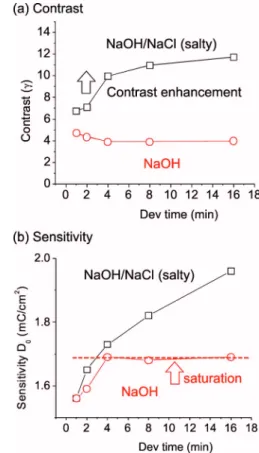
Figure1 shows the time-resolved contrast curves in both salty and nonsalty developers. The difference in curve shape between the two developers becomes more distinct for longer development times. In the case of nonsalty developer, there are no noticeable changes as the development times are varied. However, the contrast curves of salty developer con-tinue to change as the development time increases. In order to evaluate the development process, we plotted the values of
␥and D0as a function of development time in Figs.2共a兲and
2共b兲, respectively. In the case of nonsalty developer, the ␥
decreases slightly and saturates to ⬃4 after 4 min. On the other hand, the salty developer allows␥to increases continu-ously up to⬃12. The D0plot shows that the nonsalty
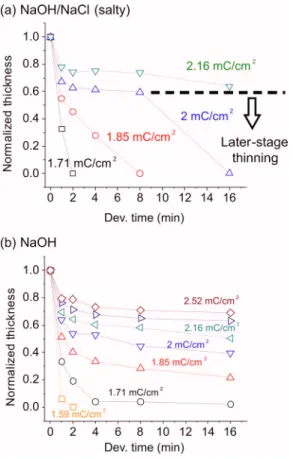
devel-oper causes the development process to stop after 4 min, whereas the salty developer allows development to continue. For a more precise analysis of the development process, we plot the remaining HSQ thickness during development for different electron-beam doses, which provides an alterna-tive view of time-resolved contrast curves共Fig.3兲. Interest-ingly, at the early stages of the development process, both salty and nonsalty developers show similar behaviors, such as a sharp decrease in thickness followed by a gradual satu-ration. However, as the development time is further in-creased, the salty developer continues to thin the resist film, whereas the nonsalty developer does not lead to any signifi-cant changes in resist thickness. This continuous thinning is unique to the salty development system.
In the salty development system, the gradual saturation of the remaining thickness followed by the continued thinning behavior enhances the␥ significantly, which makes it differ-ent from other developers. For instance, convdiffer-entional hy-droxide developer such as TMAH is known to saturate and stop the development, which is attributed to an insoluble layer formation on the HSQ surface.9 This saturation pre-vents further ␥ improvement once ␥ is determined by the initial thinning at the very early stages of development. On the other hand, the salty developer for HSQ provides a con-tinuous thinning process, leading to a time-dependent ␥ variation. This continuous thinning process is typically ob-served in the medium-range dose such as 2 – 2.16 mC/cm2of
FIG. 1. 共Color online兲 Time-resolved contrast curves 共1–16 min兲 for both the salty 共squares兲 共NaOH/NaCl兲 and the nonsalty 共circles兲 共NaOH兲 developers.
FIG. 2. 共Color online兲 Variations in 共a兲␥ and共b兲 D0as the function of
development time. The salty developer increases␥up to⬃12, whereas the ␥of the nonsalty developer saturates after 4 min.
2636 Nam et al.: Contrast enhancement behavior of hydrogen silsesquioxane in a salty developer 2636
the salty developer, whereas the HSQ at the high-range dose is still saturated, as shown in Fig.3共a兲. The later-stage thin-ning is the critical process which enhances contrast.
In order to illustrate the efficacy of the salty developer for patterned structures, we carried out time-resolved analysis for grating-line patterns共Fig.4兲. We used three different line patterns which have different line doses, such as 46, 33, and 23.6 nC/cm. We developed them for different times from 1 to 16 min in both nonsalty and salty developers and char-acterized the evolution of the surface profile with SEM cross-sectional images.
Figure 4共a兲 shows the high-range dose grating lines 共46 nC/cm兲 which are partially merged, as can be seen in the cross-sectional view. As the development time is increased, the nonsalty developer does not induce significant changes in surface profile, whereas the salty developer starts to define the line structures after some period共4–8 min兲. Figure4共b兲 shows that the medium-range dose patterns共33 nC/cm兲 ob-viously have the definition of separate lines, but the evolu-tions of resist profiles are quite different for salty and non-salty solutions. The nonnon-salty developer tends to develop patterns isotropically, which is similar to an isotropic wet etching process. This process cannot improve the resolution significantly since the height of patterns is also decreased as well as the linewidth关inset of Fig.4共b兲兴. On the other hand, the salty developer decreases the linewidth much faster than
decreasing the film thickness关inset of Fig.4共b兲兴. This aniso-tropic development comes from the high ␥ behavior of the salty development, which enhances patterning resolution. Figure4共c兲shows the low-range dose patterns共23.6 nC/cm兲 in which the nonsalty developer induces the gradual dissolu-tion of line patterns, whereas the salty developer leads to even faster dissolution once the patterns start to collapse. This faster collapsing behavior of the salty developer is most likely due to the continuous thinning process.
To investigate the role of the salt in ␥ enhancement be-havior, we assumed that the addition of salt modifies the
FIG. 3. 共Color online兲 HSQ thickness variations vs development time for each electron-beam dose for共a兲 the salty and 共b兲 the nonsalty developers. Typically, in the case of 2 mC/cm2, the salty process leads to the later-stage
thinning. However, the nonsalty process does not exhibit any noticeable further thinning.
FIG. 4. Time-resolved cross-sectional SEM analysis of HSQ line-grating patterns for the salty and the nonsalty developer for different electron-beam line doses共a兲 46 nC/cm 共high-range dose兲, 共b兲 33 nC/cm 共medium-range dose兲, and 共c兲 23.6 nC/cm 共low-range dose兲. HSQ grating-line patterns are prepared on Si3N4-deposited Si substrate to protect Si from NaOH wet
chemical state of HSQ during development. Usually, hydrox-ide developers such as TMAH or NaOH are likely to form an insoluble layer on the HSQ surface, which stops the devel-opment process.9The insoluble layer is known to consist of siloxane-based network bonds, as confirmed by x-ray photo-electron spectroscopy and FTIR spectroscopy.3,9 In order to analyze the change in chemical status during development, we carried out FTIR analysis by using annealed HSQ films.11 The annealed HSQ film 共400 °C for 1 h兲 has noticeable network-bond peaks 共1069 and 830 cm−1兲 in Si–O–Si
stretch, which clearly shows the polymerization process dur-ing annealdur-ing共Fig.5兲. This annealing was supposed to cor-respond to the medium-range dose based on our estimations about the development rate according to the various anneal-ing conditions. To estimate the effect of developers, we dipped the annealed HSQ films in both nonsalty and salty developers. The FTIR analysis shows that the network-bond peak共1069 cm−1兲 of salty development was less than that of
the undeveloped film. Considering that the FTIR signal comes from the HSQ volume, the significant decrease in the network-bond peak reflects that the role of the salt is not limited in the surface but effective to the whole HSQ. How-ever, we believe that the surface of HSQ is more dominantly affected by the developers, thus the average FTIR signal shows the low network-bond peak. An addition of salt ap-pears to break network bonds preferentially, which may in-crease the development rate and enhance the contrast.
The importance of chemical bond state in the salty devel-opment system can be supported by studying aging effects 共Fig. 6兲. We prepared two samples: one is an aged sample which was developed more than 2 weeks after the e-beam exposure has been done and the other a sample for which all process共spin coating, electron-beam exposure, development, and thickness evaluation兲 was done within a day. In the case of the aged sample, “2 weeks” was arbitrarily chosen, and the sample was stored in air. Contrast curve variations for two development times共4 and 16 min兲 are shown in Fig.6. The curves clearly show an aging effect when using the salty developer. In the case of the nonsalty developer, there was little difference between the aged sample and the immedi-ately processed sample. As the development time becomes longer, the development process stops for both samples. This tendency coincides with our experience that there were no significant aging effects in conventional hydroxide develop-ment共such as TMAH兲 even if we developed HSQ a month after spin coating. This means that the nonsalty development process is much less sensitive to resist aging. It is likely that the cessation of development when using hydroxides is re-lated to the insensitivity to aging.9 In contrast, the salty velopment process was very sensitive to aging. Only by de-veloping immediately were we able to detect a continuous development process with noticeable␥ enhancement
behav-FIG. 5. 共Color online兲 FTIR analysis for annealed HSQ films for salty and nonsalty developers. All HSQ started with 140 nm thickness 共bare HSQ兲 during spin coating. Annealing process was carried out at 400 ° C for 1 h in vacuum, which shrank the thickness to 110 nm. Annealed HSQ samples were dipped in both salty and nonsalty developers for 45 s. The final thick-ness of developed HSQ was decreased to 80 nm 共NaOH兲 and 70 nm 共NaOH/NaCl兲. The FTIR peak heights were not normalized, so the relative difference in peak heights may reflect the difference in thickness and density of HSQ films. In the salty developer, the network peak in Si–O–Si stretch is smaller than the remaining cage-bond peak.
FIG. 6.共Color online兲 Aging effect of HSQ on the salty development system for two different samples;共a兲 aged HSQ and 共b兲 HSQ in which all processes were done within a day. Only the salty development process is sensitive to an aging effect, whereas the nonsalty development is not affected by aging.
2638 Nam et al.: Contrast enhancement behavior of hydrogen silsesquioxane in a salty developer 2638
analysis during development. An addition of the salt in a hydroxide solution enabled a continuous development pro-cess, unlike that of conventional pure hydroxide developers. The continuous thinning behavior of the salty developer is critical to contrast enhancement. Thinning over long devel-opment times was demonstrated using the analysis of grating-line patterns. The FTIR analysis shows that the addi-tion of salt modifies the chemical status of HSQ during the development process by breaking network bonds preferen-tially. This chemical modification allows the resist to thin continuously and enhances the␥ of HSQ.
ACKNOWLEDGMENTS
The authors thank IBM Research 共Yorktown Heights, NY兲 for the use of their electron-beam lithography facility.
3M. Haffner, A. Haug, A. Heeren, M. Fleischer, H. Peisert, T. Chasse, and
D. P. Kern, J. Vac. Sci. Technol. B 25, 2045共2007兲.
4J. K. W. Yang and K. K. Berggren, J. Vac. Sci. Technol. B 25, 2025
共2007兲.
5M. J. Loboda, C. M. Grove, and R. F. Schneider, J. Electrochem. Soc.
145, 2861共1998兲.
6H. Namatsu, Y. Takahashi, K. Yamazaki, T. Yamaguchi, M. Nagase, and
K. Kurihara, J. Vac. Sci. Technol. B 16, 69共1998兲.
7J. Kim, W. Chao, X. Liang, B. Griedel, D. Hilken, and D. Olynick, 53rd
EIPBN Conference, Marco Island, FL, 2009共unpublished兲, Paper No. 6B.5.
8G. M. Schmid, L. E. Carpenter, and J. A. Liddle, J. Vac. Sci. Technol. B
22, 3497共2004兲.
9H. S. Lee, J. S. Lee, S. W. Nam, H. M. Kim, and K. B. Kim, J. Vac. Sci.
Technol. B 27, 188共2009兲.
10H. S. Lee, B. S. Kim, H. M. Kim, J. S. Wi, S. W. Nam, K. B. Jin, Y. Arai,
and K. B. Kim, Adv. Mater.共Weinheim, Ger.兲 19, 4189 共2007兲.
11S. Choi, M. J. Word, V. Kumar, and I. Adesida, J. Vac. Sci. Technol. B