Constructing Provenance-Aware Distributed
Systems with Data Propagation
by
Ian Campbell Jacobi
Submitted to the Department of Electrical Engineering and Computer
Science
in partial fulfillment of the requirements for the degree of
Master of Science in Computer Science and Engineering
at the
MASSACHUSETTS INSTITUTE OF TECHNOLOGY
June 2010
c
Massachusetts Institute of Technology 2010. All rights reserved.
Author . . . .
Department of Electrical Engineering and Computer Science
May 18, 2010
Certified by . . . .
Gerald Jay Sussman
Professor of Electrical Engineering
Thesis Supervisor
Accepted by . . . .
Professor Terry P. Orlando
Chair, Department Committee on Graduate Students
Constructing Provenance-Aware Distributed Systems with
Data Propagation
by
Ian Campbell Jacobi
Submitted to the Department of Electrical Engineering and Computer Science on May 18, 2010, in partial fulfillment of the
requirements for the degree of
Master of Science in Computer Science and Engineering
Abstract
Is it possible to construct a heterogeneous distributed computing architecture capa-ble of solving interesting complex procapa-blems? Can we easily use this architecture to maintain a detailed history or provenance of the data processed by it? Most existing distributed architectures can perform only one operation at a time. While they are capable of tracing possession of data, these architectures do not always track the network of operations used to synthesize new data.
This thesis presents a distributed implementation of data propagation, a com-putational model that provides for concurrent processing that is not constrained to a single distributed operation. This system is capable of distributing computation across a heterogeneous network. It allows for the division of multiple simultaneous operations in a single distributed system. I also identify four constraints that may be placed on general-purpose data propagation to allow for deterministic computation in such a distributed propagation network.
This thesis also presents an application of distributed propagation by illustrating how a generic transformation may be applied to existing propagator networks to allow for the maintenance of data provenance. I show that the modular structure of data propagation permits the simple modification of a propagator network design to maintain the histories of data.
Thesis Supervisor: Gerald Jay Sussman Title: Professor of Electrical Engineering
Acknowledgments
I would like to acknowledge and thank the following individuals for their assistance throughout the development of the work presented in this paper:
My thesis supervisor, Gerry Sussman, for having introduced me to Alexey Radul’s work on propagator networks and advising me throughout the past two years as I have developed this work.
Alexey Radul for developing the concept of propagator networks and offering significant assistance and criticism of my proposed distributed propagator mechanism. My advisor, Hal Abelson, for providing feedback during the early stages of this work and helping me to refine its goals.
Mike Speciner for helping to proofread the paper and finding several mathematical issues with my description of provenance.
Tim Berners-Lee for his criticisms of my use and implementation of REST within distributed propagation.
Joe Pato of HP Labs for contributing to my understanding of computational provenance and its use-cases.
Lalana Kagal for her continued assistance and support of my work, and helping to place it within the context of accountability and reasoning.
My lab-mates and other members of the Decentralized Information Group not named above for offering their assistance, criticisms, feedback, and proofreading skills as this project has slowly developed over the past two years.
Finally, I would like to acknowledge that funding for this work was provided by the National Science Foundation Cybertrust Grant award number 04281 and by IARPA Grant FA8750-07-2-0031.
Contents
1 Introduction 13
1.1 Heterogeneous Distributed Systems . . . 14
1.2 Retrofitting Provenance . . . 16
1.3 Introducing Distributed Propagation . . . 17
1.4 Thesis Overview . . . 18
2 Background 21 2.1 Data Propagation . . . 21
2.2 Representational State Transfer . . . 24
3 A Design for Distributed Propagation 29 3.1 Constraining the Merge Operation . . . 30
3.2 Choosing a Distribution Application Model . . . 32
3.3 Resource Representations . . . 34
3.4 Naming Cells . . . 35
3.5 Maintaining the Network . . . 38
3.6 Cell Initialization . . . 39
3.7 Cell Updates . . . 41
3.8 Failure Recovery Through Re-synchronization . . . 42
4 Provenance-Aware Propagation 45 4.1 Provenance . . . 46
4.3 Modifying Existing Propagator Networks for Provenance . . . 50
4.3.1 Provenance-Aware Cells . . . 52
4.3.2 Provenance-Aware Propagators . . . 54
5 Security and Stability 55 5.1 Distributing Propagators . . . 55
5.1.1 Merging and Race Conditions . . . 55
5.1.2 On Connection Failure . . . 57
5.2 Securing Distributed Cells . . . 58
5.3 Auditing Provenance Traces . . . 60
6 Related Work 63 6.1 Distributed Cells and Replicated Databases . . . 63
6.2 Decentralized REST . . . 65
6.3 Distributed Provenance . . . 65
7 Summary 69 7.1 Contributions . . . 69
7.2 Challenges and Future Work . . . 70
7.2.1 Propagator Networks & Garbage Collection . . . 70
7.2.2 Data Structures and Propagators . . . 71
7.2.3 Redundancy of Distributed Operations . . . 71
7.2.4 Scalability and Practicality Issues . . . 72
7.2.5 Security . . . 73
7.2.6 Representational State Refinement . . . 73
7.2.7 Which HTTP Method? POST vs. PUT vs. PATCH . . . 74
7.3 Conclusion . . . 75
A DProp: Distributed Propagation in Practice 77 A.1 The Architecture of DProp . . . 78
A.2 The DProp Daemon . . . 82
A.2.2 Fetching Cells . . . 84
A.3 PyDProp . . . 85
A.3.1 The LocalCell and RemoteCell Classes . . . 87
A.3.2 Provenance-Aware Cells . . . 87
A.3.3 Propagators . . . 88
List of Figures
2-1 A cell applying a merge operation to merge two temperature readings. 22
2-2 Data propagation at work: a temperature converter. . . 23
3-1 Distributing propagator networks by dividing shared cells. . . 36
3-2 Creating a distributed propagator cell. . . 39
3-3 Updating a distributed propagator cell. . . 41
4-1 A possible provenance graph for a temperature range in Celsius. . . . 47
4-2 Making a simple propagator network provenance-aware. . . 50
5-1 A clique of cells is temporarily broken when a new cell joins. . . 56
A-1 Example communications between a DProp client and server via DBus. 81 A-2 Class hierarchy of PyDProp. . . 86
List of Tables
2.1 The four CRUD operations and corresponding HTTP methods. . . . 26
3.1 The URL structure used by DProp. . . 35
7.1 The four constraints on the merge operation and their benefits. . . . 70
A.1 DBus remote methods available on a DPropMan object. . . 79
A.2 DBus remote methods available on a Cell object. . . 79
A.3 DBus signals sent by a Cell object. . . 79
A.4 Methods available on a Cell object in PyDProp. . . 86
A.5 Methods available on a ProvenanceAwareCell object in PyDProp. . . 88
Chapter 1
Introduction
By harnessing the power of tens, hundreds, or even thousands of individual comput-ers, it is possible to solve many problems that might not be tractable on a single system. Such distributed systems are a compelling application of large networks. These systems usually work on a heterogeneous network by design; large networks rarely consist of computers that all share the same configuration of hardware and software. To effectively scale a distributed system, it is usually necessary for the system to perform the same computation on many different host configurations. By partitioning data across the nodes in the network, it is possible to improve the perfor-mance of many algorithms. Some algorithms, such as those that feature a high level of interdependency within the data they process, are not amenable to such division of labor. For these algorithms, another approach to their distribution is required.
Distributed systems often maintain only a basic level of history for the data they process. This may include simply logging the particular node to which a piece of data was delegated for processing. Complex data histories may be constructed in distributed systems, but this often requires careful consideration of the role and need for this “data provenance” at design-time. It would be more efficient from a software design perspective if a system was able to handle such provenance without significant modification of existing code.
1.1
Heterogeneous Distributed Systems
As the archetypal large network, the Internet has enabled the construction of many distributed computing efforts. Architectures like SETI@home [3], the related BOINC platform [2], or even Google’s internal usage of MapReduce [13] demonstrate the value that the Internet has added to distributed systems. By allowing the many machines connected to the Internet to work together, many otherwise intractable problems may be solved.
Whether on the Internet, as in the case of the former two systems, or in private data centers, as in Google’s case, these distributed systems all operate on heteroge-neous networks. There is typically little standardization of the hardware and software configurations of nodes on these networks. Even systems that are superficially sim-ilar may differ greatly in their actual specifications. The ability to adapt to these differences is a major requirement of a viable distributed architecture.
Distributed systems usually rely on partitioning input data so it may be processed identically on a number of nodes. This data is then distributed across the network for processing. Once this is complete, results are sent to a central server that merges them to produce a meaningful result. Usually, the same algorithm is applied on all nodes in the network. Due to the heterogeneous nature of distributed systems, this may result in compiling as many implementations of the same code as are necessary for it to run on most hardware and software in the network.
Partitioning data is not a practical solution for all problems we might wish to distribute. Highly interdependent data with a high degree of dimensionality is rela-tively difficult to partition, due to Bellman’s classic Curse of Dimensionality [5, 31]. General-purpose reasoning is one such example of a problem that can suffer from the Curse due to sparsity of knowledge and potentially complex interactions of rules. Although small-scale reasoning has been distributed with some success [42], larger, more complex rule-sets may not be distributed so easily. In applying a particular rule, a general-purpose reasoner may depend on a number of logical statements to conclude a result. Any particular partitioning of input data must respect these
interdependen-cies; partitioning data to account for this may be a costly operation. Furthermore, these interdependent facts must be able to fit into a single data partition.
One of the best-known algorithms for forward-chaining reasoning, the Rete algo-rithm [15, 19], suggests a possible solution to the data partitioning problem. In the Rete algorithm, each sub-pattern of a rule is matched against the knowledge base separate from every other sub-pattern. The results of a particular pattern-match are then merged with other results in a manner that unifies bound variables, and a rule may be applied.
In practice, the process of pattern-matching is treated as an entirely separate operation from that of merging the results of these pattern-matches. Unlike tradi-tional distributed computing approaches, the Rete algorithm effectively divides the algorithm into smaller, more tractable parts, rather than the data. By applying this concept to distributed systems we may resolve the data partitioning problem by by-passing the problem altogether! Instead of partitioning data across a network of hosts running an identical algorithm, we might try to partition the algorithm itself across the nodes.
We must be careful not to blindly apply such an approach on an existing dis-tributed architecture as this might prove to be impossible. Existing disdis-tributed sys-tems have usually assumed a strong client-server relationship. Although they may have been built with the weak-connectivity of the Internet in mind, systems like BOINC and MapReduce still require an algorithmic client to communicate with a central server upon starting or completing a particular subtask. This is usually a desirable feature, as these systems were constructed with data partitioning in mind. By separating the data into tractable chunks, only the initial data and final results need to be communicated between a client and a server, making such a system quite feasible.
This client-server relationship is not so desirable when we try to partition an al-gorithm instead. Alal-gorithm partitioning requires communication between nodes per-forming the different parts of a given algorithm. In order to implement a distributed system that distributes the algorithm rather than the data, we must be careful to use
a decentralized model for intra-node communication rather than a centralized one. Different parts of the algorithm may need to receive or send results to each other. Relying on a central server to relay such communications may be infeasible for large networks.
1.2
Retrofitting Provenance
As data partitions are assigned to different nodes in a traditional distributed system, it is important to track how that data was generated and manipulated. Distributed systems must usually be constructed with redundancy in mind; nodes performing a distributed computation may perform an incorrect calculation or fail completely. Thus, most systems, including SETI@home [3], BOINC [2] and MapReduce [13], all maintain at least a minimal level of the history of how data was generated and manipulated, also known as provenance.
This minimal level of data provenance is generally collected to build redundancy and resilience into a distributed system. To defend against nodes that return results for data that they did not actually process, it is necessary to keep track of what data has been assigned to each node. Similarly, it is necessary to know when the data was assigned to a node, so that the server may be able to double check the results from a node or account for a node that may have failed to return its results.
Unfortunately, this provenance may be insufficient for many more complex tasks, as we may only be tracking which node was given what data. Although such basic provenance could be used to derive a more complete history of data in the system, the quality and detail may be unsuitable for more complex provenance use cases.
Complex, non-linear provenance has been integrated into workflow-management software for grid computing [36], but these systems have often been designed by including provenance handling as a major software design requirement. Handling of complex provenance is generally more difficult to add to systems after they have been initially designed. Integrating provenance into the system design may also lead to a less-flexible product, and extensive retrofitting may be needed to add support for
data provenance to applications running on distributed systems that were not built to explicitly handle provenance.
A distributed system should ideally require minimal code redesign to retrofit provenance into any application that uses the system. Minimizing the cost of adding provenance would allow end-users and developers to more easily integrate provenance in their systems, especially if provenance handling may be deferred to the system it-self. By transparently managing provenance on the programmer’s behalf, we may be able to reduce the complexity of applications designed to use the distributed system as well as the number of software bugs encountered when using provenance.
1.3
Introducing Distributed Propagation
One programming model for concurrent systems, data propagation [33], offers a solu-tion to both of these problems. Data propagasolu-tion is a modular, implicitly concurrent computational architecture that connects state-bearing “cells” with monotonic com-putational “propagators” that do not discard accumulated state. By distributing the same computational propagator across the various nodes of a network, it is possible to perform traditional distributed computation, where the same operation is performed on all nodes. Unlike traditional distributed systems, propagator networks also enable more complex division of processing, as there are no restrictions on the structure of propagator networks.
Propagation does not depend on centralized coordination of computational re-sources; it is easy to decentralize a propagator network and perform computation without any further involvement of the host that started computation. Application of several constraints on propagator networks facilitate decentralized synchronization of data across a network. Although the initial presentation of propagator networks assumes a tightly-linked computational network [32, 33], the set of constraints I pro-pose frees us from this assumption. Instead, we need only assume reliable broadcast and knowledge-convergence on a weakly-connected network. This has already been proven by Awerbuch [4] and Demers [14].
Propagators may also facilitate the addition of provenance into existing software designs. Propagator networks are easily extended and may be modified algorithmi-cally due to their strong modularity. We need only add several cells and propagators to handle data provenance within an existing propagator network. There is no need to integrate any additional primitives within propagator networks to handle provenance, nor is it necessary to fundamentally redesign existing software to add provenance to a distributed propagator network. This results in obtaining provenance support “for free” with existing software codebases.
I have constructed an architecture that maintains and executes distributed prop-agator networks, named DProp.1 Along with this architecture, I have also built an
accompanying library, PyDProp, that may be used to easily add provenance to ex-isting software making use of DProp. Together, DProp and PyDProp may be used to construct any number of interesting distributed propagator networks. I am able to demonstrate its viability not only for distributed processing, but also in adding provenance to existing distributed applications that use DProp.
My protocol for distributed propagation has been designed to build on the network architectural model known as Representational State Transfer, or REST. By basing the protocol design on REST, my protocol for distributed propagation achieves a flexibility that might not be possible in other implementations of such a protocol. Several constraints of a REST-based model not only map nicely onto the model of data propagation, but also lend themselves to the efficient implementation of distributed propagation that I describe.
1.4
Thesis Overview
In this thesis, I describe my proposed distributed propagation and provenance system as follows:
Chapter 2 introduces the concepts of data propagation and the Representational State Transfer architectural design.
Chapter 3 details the design choices that influenced my implementation of dis-tributed propagation.
Chapter 4 discusses how we may to extend existing propagator networks to handle provenance.
Chapter 5 offers a discussion of some potential issues with distributed propagation and provenance in the system I have described. I also discuss how I resolve these issues.
Chapter 6 relates this work to other work relating to data synchronization and distributed provenance.
Chapter 7 provides a summary of the contributions of this work, as well as po-tential future work that may be used to expand the distributed propagation system proposed here.
Finally, Appendix A offers a more detailed description of my implementation of distributed propagation and provenance, DProp.
Chapter 2
Background
2.1
Data Propagation
Data propagation is a concurrent programming paradigm proposed by Alexey Radul [32, 33]. Based on the principles of message-passing concurrency, data propagation re-lies on messages sent over networks of monotonic computational blocks, called “prop-agators”, and state-bearing “cells”. Propagator networks perform computation when an update of a cell’s state triggers the execution of the propagators that are connected to it. These propagators may then update the state of other cells, causing further propagation.
Although the state of a cell may change, its value may only be assigned once. This may seem to be a contradiction at first glance, but the value assigned to a cell may be a partial value, rather than one that has been fully-specified. This allows for continued modification of its state. When we discuss “changing” a cell’s state, or “updating” its contents, what we really mean is that the partial value of a cell has been updated with additional data.
Cells are initially created with an “empty” partial value. This special partial value represents a complete absence of knowledge of a cell’s contents and provides no constraints on the value of the cell. A cell with an empty partial value closely resembles an unassigned variable, except that it can be easily identified as such during execution.
Thermometer 1 Thermometer 2 Thermometer 1 Thermometer 2 (b) (a) 20−30C 20−30C 20−30C 25−30C 25−35C
Figure 2-1: A cell applying a merge operation to merge two temperature readings.
Partial values stored in a cell need not be objects with partially defined fields, such as a cons pair in Lisp with a cdr that has been marked for delayed evaluation [20]. Partial values in a propagator network may, in fact, be any value, including sets and ranges that may be refined through appropriate mathematical operations.
The process of refining the partial value of a cell is dependent on a user-defined merge operation. This merge operation unifies an existing partial value with addi-tional information provided in an “update” message sent to the cell. While the merge operation may be simple assignment when a cell is empty, merge operations are more interesting when they operate on cells that are not empty.
For example, a cell might contain a range of temperature values that represents the current air temperature recorded by a thermometer, including its measurement error. If a second thermometer is connected to the cell and sends its own measurement as an update, the merge operation of the cell may take the intersection of the two temperature ranges to obtain a more precise estimate of the current air temperature than either thermometer gives on its own. The cell may then take the intersection as its new partial value, as depicted in Figure 2-1.
A merge operation may be arbitrarily complex. If a cell is capable of performing logical deductions to construct its complete contents, we might be able to employ a merge operation that removes redundant facts for more efficient storage. For example, such a cell might contain two facts: “Socrates is a man” and “Socrates is mortal”. If the cell were to receive an update stating that “All men are mortal”, it could employ
temp−converter temp−converter temp−converter temp−converter (a) (b) (c) (d) 77−86F 20−30C 68−86F 68−86F 25−30C 25−30C 68−86F 25−30C
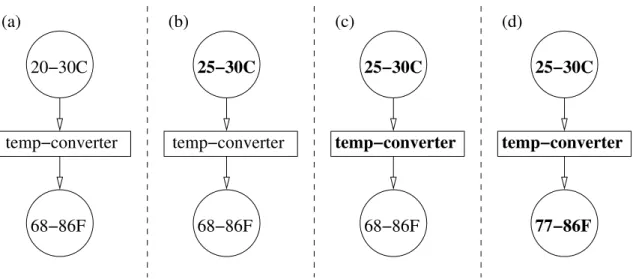
Figure 2-2: Data propagation at work: a temperature converter.
a logically-consistent merge operation that would not only add the fact “All men are mortal” to the cell, but also remove “Socrates is mortal”, as it may be concluded from the other two facts. Despite the fact that the facts stored in the cell are not strictly increasing (i.e. the cell is not strictly monotonic), if the cell can still conclude “Socrates is mortal”, the actual knowledge that the cell contains is still monotonically increasing.
Once a cell has merged an update and its partial value has changed, propagators connected to the cell wake up and perform computation. These propagators will use the newly updated partial value where they originally used the cell’s previous contents. During computation, these propagators may generate updates for additional cells. For example, in Figure 2-2 above, an update to the top cell at time (b) causes the temp-converter propagator to fire at time (c). Upon receiving these updates, these cells will apply their own merge operations to update their partial data, starting another merge-and-compute cycle. This can be seen above when the propagator at time (c) causes an update to the bottom cell at time (d). These repeated cycles of merging and propagation of data drive computation within a propagator network.
No constraints are placed on the structure of propagator networks. For example, cycles may be used in propagator networks to create standard looping control-flow structures. By allowing a propagator to update a cell that indirectly contributed to
its being fired, the propagator may ensure that it fires again to include additional in-formation. Other propagators may prevent the forwarding of updates when the input cells meet some criteria. Such propagators would halt propagator loops, allowing for switch-like control-flow structures and finite loops.
We may also perform recursive computation with propagator networks. As prop-agators are opaque computational units, and networks of propprop-agators also perform computation, we may define a class of propagators called “compound propagators”. These compound propagators may construct a propagator network when they are first triggered. This new propagator network may then act as a part of the origi-nal network, and may perform computation based on the origiorigi-nal input cells of the compound propagator by mapping those input cells appropriately to the newly con-structed propagator.
Constructing such networks on demand permits recursive computation; a com-pound propagator need only include itself as one of the propagators in its constructed sub-network to do so. Propagation of data may cause as many recursive expansions of the propagator as necessary simply by repeatedly waking each recursive copy of the compound propagator in turn.
Ordering of propagation events is undefined, outside of the implicit cause-effect chain caused by the propagate-and-merge cycle. Furthermore, propagator networks feature a strong modularity of computation that is enforced by strictly separating cell state from propagator computations. Together, these properties make data propaga-tion a reasonable candidate for parallel processing and distributed computapropaga-tion.
2.2
Representational State Transfer
Representational State Transfer, or REST, is an architectural style for network-based software architectures based on the principles of hypertext and the HyperText Trans-fer Protocol (HTTP) and developed by Roy Fielding [18]. Architectures that make use of Representational State Transfer, also called “RESTful architectures”, are de-signed to store and maintain opaque data objects, called “resources”, that represent
an abstract concept or another, more concrete, data object. Resources generally have four operations that may be performed on them: creation, retrieval, update, and deletion. Together, these four operations are known as CRUD operations.
Since an abstract concept associated with a resource may not be easily serialized, RESTful architectures are designed to be platform- and content-agnostic through the use of resource “representations”. For example, a data set of hourly temperatures may have an image representation in the form of a graph in GIF format, as well as a tabular representation in plain-text. The four fundamental CRUD operations may be performed in a RESTful architecture by using any number of these resource representations to specify the relevant aspects of that resource.
More complex operations on resources, such as those often implemented as re-mote procedure calls, may be modelled in a RESTful architecture by applying the fundamental resource operations with appropriate representations. By restricting the number of fundamental operations and allowing the use of different resource represen-tations, a RESTful architecture reduces the complexity of software implementations that use it. Software uses of a RESTful architecture need only be able to perform the basic operations with representations they are prepared to handle; there is no need to support all representations of a resource, only those relevant to the application.
In the doctoral thesis that first laid out the principles of REST, Fielding defines an architectural style as “a coordinated set of architectural constraints that restricts the roles/features of architectural elements and the allowed relationships among those elements within any architecture that conforms to this style.” In accordance with this principle, a proper RESTful architecture adheres to five constraints:
1. REST assumes a client-server model of communication. This separates the resources on the server from the software that modifies them. It also determines how data may be stored; only the server must find a suitable intermediate format for storage. Clients may use any representations they find appropriate.
2. RESTful designs are stateless. Information transmitted between the client and server of a RESTful architecture should be sufficient to perform the desired
CRUD Operation HTTP Method RESTful Meaning
Creation PUT Create a new resource based on the representation presented.
Retrieval GET Fetch the desired representation of an existing resource.
Update POST Modify an existing resource based on a given (partial) representation. Deletion DELETE Delete an existing resource.
Table 2.1: The four CRUD operations and corresponding HTTP methods.
operation without maintaining any additional state (such as session variables) on the server or client.
3. Representations of resources transmitted as part of an operation should be cache-able. This constraint is particularly useful in terms of the retrieval opera-tion. By caching information that has been previously retrieved, future requests may be optimized by referring to a nearby cache, rather than waiting on the central server. It also reduces the burden on the server, as many requests may be serviced by a cache instead.
4. RESTful designs should employ a uniform interface. By standardizing the in-terface by which resource operations are performed, many different client and server implementations may be deployed in an inter-operable way. A uniform interface also reduces client and server complexity.
5. Finally, RESTful architectures are layered architectures. This allows for the separation of network administration from the application itself, providing in-creased scalability. Caches, back-ends, and proxies may be implemented on the network layer without restricting the functionality of the application itself. Most REST-based applications use the Hypertext Transfer Protocol (HTTP) as the underlying network protocol of their RESTful architecture. HTTP handles data transfers as a series of requests for data and responses to those requests. Each request may be made for a resource identified by its Uniform Resource Locator (URL). These
requests are also associated with the HTTP method corresponding to the operation desired. Four HTTP methods are usually used to implement REST design: PUT, GET, POST, and DELETE. These methods are aligned with the CRUD operations of creation, retrieval, updating, and deletion, as outlined in Table 2.1. The PATCH method [16] may also be used in place of the POST method to perform updates.
I have chosen to implement a propagator network by employing RESTful tech-niques for several reasons:
1. Propagator networks need minimal modification to adhere to the five constraints of REST. The stateless constraint in REST is stricter than the computational monotonicity of propagators in propagator networks. This means that it is possible to model RESTful communication as a propagator in a propagator network. Furthermore, the implicit atomicity of update messages sent to cells makes these messages well-suited to being representations of resources in our implementation.
2. If we assume that update messages are the representations being transferred, it seems possible to consider cells to be the resources within the design. Just as cells are the only state-bearing objects within propagator networks, resources are the only state-bearing objects in a RESTful architecture.
3. Enforcing uniformity of interface in an implementation of a distributed propa-gator network creates an extensible system. My implementation of distributed propagation, DProp, is built using Python and has been tested for use on GNU/Linux systems. By requiring that DProp use standard HTTP for cell synchronization, it is possible to construct a heterogeneous propagator network that has nodes that run various different operating systems and propagator im-plementations. This makes DProp a suitable platform for distributed systems, which already assume a heterogeneous network.
Together, these points make Representational State Transfer a desirable architec-tural design on which to build our system for distributed propagation.
Chapter 3
A Design for Distributed
Propagation
There are several different ways we may construct a distributed propagator network, based on where one draws the boundary between each node on the physical network. For example, we may draw boundaries between cells and the propagators that depend on them, which would imply that cells would notify propagators on other hosts. We could also draw boundaries between propagators and the cells they update, which would imply that propagators would send update messages to other hosts.
Regardless of how the propagator network is divided, propagators and cells must reside on the nodes of the network, and not in the network itself. The physical infrastructure of a network is incapable of performing computation or storing content; it may only serve as a web of links across which data may be transferred. As a result, only the edges between propagators and cells may be placed on the physical network. Although we cannot place propagators in the network, we may still construct propagators that contain a network link within them. This network “bridging” may be derived from our understanding of compound propagators. Just as a single compound propagator “contains” a new network of propagators and cells, we could easily think of the inverse, in which a collection of propagators and cells is turned into a compound propagator. Since the edges that connect propagators and cells may be placed across a physical network, we may construct a compound propagator that includes such an
edge, effectively “bridging” the network. As a result of this, we may also assume that any propagator may cross the network, as compound-propagators are normally opaque.
My approach to constructing distributed propagation framework builds on this basic concept of propagators that bridge the network. I treat HTTP communication as part of a network-spanning propagator designed to maintain identical copies of a cell on multiple hosts. I do this by intercepting update messages sent to a local cell as part of its merge operation and broadcasting the intercepted messages to all other hosts with a copy of that cell. I then may ensure convergence of this mechanism by occasionally attempting to re-synchronize all remote copies of a cell to ensure that no updates were lost on the network.
3.1
Constraining the Merge Operation
Before we may consider our specific implementation of this approach to distributed propagation, we must first determine exactly what costs are incurred by simply copy-ing the update messages and sendcopy-ing them across a network. Implementcopy-ing propa-gation over a network introduces uncertainty in the order of updates and lacks guar-anteed message reception. Unfortunately, propagator networks may have issues with messages that are in the wrong order, and the behavior of these networks assumes that messaging is reliable. As a result, propagation-based computation may not be deterministic over a computer network without ensuring that certain properties are present in the data propagation model. In order to remedy these issues and ensure deterministic computation, we must enforce four properties on the merge operations used by cells that receive messages from other hosts:
1. Idempotence: If we already know a fact and are told it again, we do not know anything new. Thus, a cell’s contents should appear the same no matter how many times a particular update is received, provided that it has been received at least once.
2. Monotonicity: A cell never forgets. This means that a cell may never “un-merge” an update. A cell may be able to mark the results of an update as “contradictory” or “disproven”, as both changes would refine the content of the cell, but it should not be able to undo the original update.
3. Commutativity: A cell’s contents should be independent of the order of the updates that were merged to create them. If we are told “it’s a warm day” and “it’s a sunny day”, we will know both of these facts regardless of the order in which we are told.
4. Associativity: A cell that merges two messages should have the same contents as a cell that merges a single message that is the “sensible merge” of the two messages. For example, a cell that is told “T > 40◦F” and “T > 50◦F” should appear the same as if it had only been told the latter, as the potential values of T implied by T > 50◦F are a subset of the values of T implied by T > 40◦. These constraints do not impose any restriction on the number of effective merge operations that may be implemented; merge operations that do not adhere to one of these constraints may be modified so that they do so. For example, a non-idempotent operation may be “retrofitted” to become idempotent by adding a unique identifier as part of each update. If this unique identifier is stored with the data following the merge, a propagator reading the cell may modify its “perception” of a cell’s contents based on the number of distinct identifiers of the otherwise duplicate updates.
Operations lacking the other constraints may be modified similarly. Extensive research in the fields of computer networking and distributed databases has attempted to meet the need for serialization of communications (implying non-commutativity and, indirectly, non-monotonicity) despite the lack of guaranteed message reception offered by Internet protocols.[10, 7, 39, 37] Packets on the Internet may be received out of order or even not at all. Any application desiring serialization of messages, such as distributed databases, must be able to deal with the commutativity of messages on the Internet. We may apply the results of this research in a more general fashion to enforce commutativity constraints on non-commutative functions.
3.2
Choosing a Distribution Application Model
Like many other network applications, distributed propagators could be implemented using one of two primary distributed application models:
1. Cells could be managed using a client-server model. In such a model, a par-ticular cell would be maintained by a single host, the server. All other hosts interested in the cell would be clients of the server.
As the maintainer of the cell, the server would be the only host to decide whether or not an update is accepted. It would also be responsible for merging all data into the canonical version of the cell that it stores and would update all interested clients when the contents of the cell changed. As clients would not have local copies of the cell, any client that needed to read the cell’s contents would need to request the server’s canonical version. Although clients are able to cache the contents of the cell, these caches may only contain static content; they may not be modified, as only the server controls what is merged into the cell.
Implementing a client-server model is easy when compared to the complexity of the peer-to-peer model described below, but it is highly reliant on a single server to perform merges and to service other requests. Failure of the server could potentially cause a cascading halt to all computation in the propagator network, as propagators would no longer be able to modify the contents of the cell, and, without a cache, no propagator would be able to read the contents of the cell either.
2. Cells could alternately be managed using a peer-to-peer model. Every cell would be duplicated across all hosts interested in the cell, called the peers of the cell. Unlike the client-server model, no single host would have special status. Rather than allowing one server to handle updates and merge the cell, each peer does so for its own copy of the cell. As long as all peers implement the same merge operation on the cell and may reliably forward any update messages generated
by local propagators to remote peers, an update should eventually reach all hosts and the cell’s contents should converge across the network.
A peer-to-peer model requires a more complex implementation than the client-server model; there are no explicit constraints on the network topology of a peer-to-peer system. In contrast, a client-server model enforces a star-like topology on the network. In exchange for this additional complexity, peer-to-peer systems have a robustness that is not present in a client-server model. In a peer-to-peer model, a node failure need not halt all computation. As each peer is in charge of maintaining its own copy of the cell, the peer may continue updating and referring to that copy even if that peer is completely isolated from the remainder of the network by a node or network failure.
Choosing a peer-to-peer architecture does not mean that we must abandon a RESTful design for our application. Although REST assumes a client-server model, a peer-to-peer distributed propagator network may be viewed as a virtual network that operates above traditional RESTful communications. Rather than abandoning the client-server restriction of REST, each peer effectively runs separate client and server applications that happen to share the same stored resource, but do not interact at all in any other respect. This is not all that different from how a representation of a resource in existing RESTful systems may be generated in part by fetching an external resource.
It is important to note that neither model requires timely communication in a distributed propagator implementation. The commutativity constraint on the cell merge operation, as described in Section 3.1, ensures that the contents of the cell will be the same, regardless of the order in which messages are received.
This lack of a timeliness constraint may seem strange because it allows global inconsistencies between the cells being synchronized. Propagator networks admit such inconsistencies by design. Progress can still be made on a partitioned problem with only local consistency, and each individual global inconsistency will eventually be resolved. Ensuring ultimate convergence is up to the programmer.
Rather than ensuring timeliness, we need only guarantee that any update will eventually arrive at every other cell in the network. That said, some timeliness guarantees may be appropriate in practice to ensure that results are generated in a reasonable time-frame.
The choice between a client-server model and a peer-to-peer model is ultimately a tradeoff between system complexity and fault tolerance. As we seek to build an architecture that is comparable to existing distributed systems, we must consider that, as the number of nodes in a network increases, so do the chances that at least one node will fail. This means that fault tolerance is likely to be of greater benefit than simplicity of the system’s design. As a result, I have chosen to implement distributed propagation using a peer-to-peer model, rather than a client-server model.
3.3
Resource Representations
Now that I have established the basic distributed application model to be used for distributed propagation, we must now examine propagation with respect to the ar-chitectural model of REST. As resources and their representations are the central focus of a RESTful design, it is important to identify the types of resources and representations used in the system. As mentioned previously, there are two primary components of the propagator paradigm that may be candidate resources in a REST-ful implementation: cells and propagators. One additional construct of propagation, that of “update messages”, may be a third possible resource type. Finally, as a peer-to-peer system must be able to keep track of the neighboring peers of a node, we may also consider this collection of peers to be a fourth potential resource type. I examine each of these potential classes of resources in turn.
Propagators are the class of object least suited to being turned into a resource. Although we may be able to represent a propagator using a basic description of a propagator, this seems to be of limited use within distributed propagation. Outside of enabling introspection of the propagator network, there is not much need to actually manipulate propagators themselves. As propagators are opaque computational blocks
Relative URL Description
/Cells The collection of all distributed cells on the server. /Cells/{UUID} The distributed cell identified by UUID.
/Cells/{UUID}/Peers The collection of peers of the cell identified by UUID. Table 3.1: The URL structure used by DProp.
rather than entities that may be directly manipulated, it seems more appropriate to not include them as resources within the system.
Cells seem to be a far more appropriate class of resources in a RESTful distributed propagator design. Not only do they bear state, as resources do, but they are the primary source of state in a propagator network. Cells are also more closely linked with communication of data than propagators are, as they are refined by way of updates that are sent to them. Together, these facts suggest that we should represent cells as resources. Cell updates, on the other hand, are tied to a specific cell and have no modifiable state. Although we could model updates as a resource associated with the cell itself, it seems more appropriate to consider them to be a “partial” representation of a cell, due to their use in actually modifying the cell’s state.
Peers also appear to be an appropriate class of resources in our system. In order to maintain a peer-to-peer network, it is necessary to have as much redundancy of communication as possible to route around temporary network failures. This means there must be a mechanism for node discovery. I do not address the issue of discovery of the initial node and treat it as out of the scope of this thesis. Instead, when I refer to node discovery, I mean the discovery of additional nodes already present on the peer-to-peer network. To enable such discovery mechanisms, we must have a way of representing the peers in a network, and we thus consider peers to be another set of resources in our system.
3.4
Naming Cells
The issue of cell naming in our peer-to-peer RESTful model is not a simple one. A RESTful architecture identifies resources using some globally-unique identifier. In
Host C Host A Host B foo bar quux baz a b c d aC aA bC bB Host C Host A Host B foo bar quux baz c d bA
implementations that use HTTP, this identifier comes in the form of a URL, or Uniform Resource Locator.[6] URLs provide for such identifiers by concatenating a globally unique server name with a unique name of the resource local to the server itself. URLs allow us to construct a hierarchical ordering of resources, as they are built on the concept of “paths” on a server. We use such a hierarchical structure to associate the collection of a cell’s peers with that cell, as described in Table 3.1.
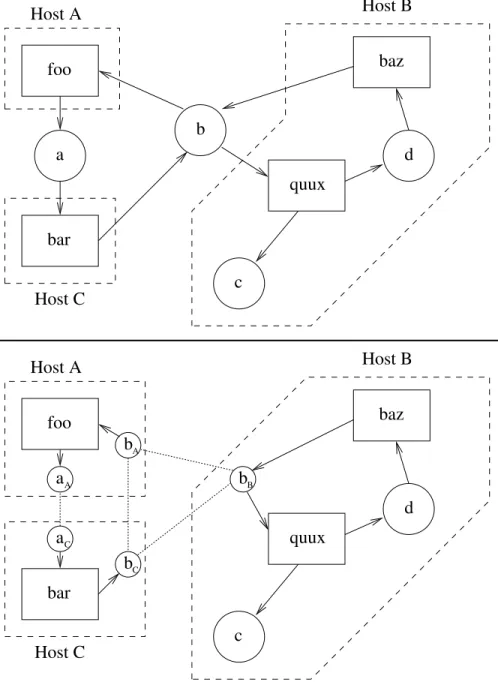
A complication arises when we need a way to identify multiple copies of the same resource, such as when we wish to identify all copies of a cell that has been copied to multiple peers. When I discuss distributing a propagator design, like that depicted at the top of Figure 3-1, we end up creating copies of cells for each host, and synchronizing them, as at the bottom.1 In practice, the URLs for each copy of a cell identify the specific copy of a cell (e.g. aA or bC); they do not identify which original
cell (e.g. a or b) a cell copy is associated with.
A na¨ıve solution that resolves this problem relies on having, a priori, a globally unique identifier for the collection of cells as a whole. Although we could use a URL for this identifier, we may not have a server name prior to constructing the cell; we may be creating the cell on a host that is temporarily disconnected from the network. Instead of using URLs then, I choose to use universally unique identifiers, or UUIDs [23], to identify each collection of cells. These UUIDs are meant to be globally unique, like URLs, but they do not require a namespace to be associated with them.
We integrate these UUIDs into the URLs we construct to identify each copy of a cell. Although this is not strictly necessary, as we could construct a mapping from URLs to UUIDs, this eases the task of uniquely identifying cells within the server namespace. It also allows for the easy derivation of the UUID of a cell from the URL of a copy of a cell. We use this approach when initializing a cell.
3.5
Maintaining the Network
As mentioned in Section 3.3, we consider peers to be resources in a RESTful architec-ture, so that we may maintain the peer-to-peer network using HTTP. By tracking the peers that a particular cell has been copied to, a particular peer will know which other peers hold copies of a cell that it must forward updates to. Making the collection of known copies of a cell available via HTTP also allows new peers to easily connect to an existing network by simply adding their copy to the set of known cell copies on an existing peer with a simple POST or PUT request. They may also bootstrap their knowledge of copies of the cell by requesting the set of copies from the existing peer. The set of peers that hold copies of a cell may be independent of those holding any other cell in the propagator network it belongs to. This means that the set of peers is only dependent on the cell itself. We may model the collection of peers as a single resource named “Peers” associated with each cell. In fact, as long as we do not need to modify each peer itself, and only need to know their URLs, we may model the collection of cell copies as a single resource, merely updating the list of cell copies that make up that resource as needed.
Each peer is responsible for maintaining its own list of other copies of a cell; it may choose to keep track of any number of copies of the cell. Thus, the topology of the peer-to-peer network of cell copies may take any shape. Some topologies may be more preferable than others. Topologies that are eventually connected are required to ensure the convergence of cell contents and that all propagators will fire; cell contents may not globally converge if update messages cannot propagate to all peers sharing a cell. Increasing the number of peers visible from a single node is also preferable: network diameter will decrease, and update messages will be more timely. It will also increase fault tolerance, as there is added redundancy of the update messages sent out. For this reason, I choose to maintain a clique in my model of distributed propagation.
By assuming that all peers are connected in a clique, we gain several benefits. As we may assume that every node is a distance of 1 from every other node, we may
New Peer Known Peer Other Peers Create Cell {Peer}
UUID {New−URL} 200 OK POST /Cells/UUID/Peers GET /Cells/UUID 200 OK {Cell Content} Merge Content GET /Cells/UUID/Peers 200 OK {Peers List} Merge Peers
POST /Cells/UUID/Peers {New−URL} 200 OK
Wake Local Propagators...
Figure 3-2: Creating a distributed propagator cell.
avoid implementing message routing mechanisms in our network. In a clique, sending a message to all neighboring nodes means that we have forwarded an update message to all nodes. However, even if temporary network fluctuations result in a network topology that is not a clique, I also implement a synchronization mechanism that will still ensure global convergence. If a clique is not used with the algorithms I use for distributed propagation, it is not possible to guarantee timeliness of message arrival for nodes that are farther than distance 1 from the original node.
3.6
Cell Initialization
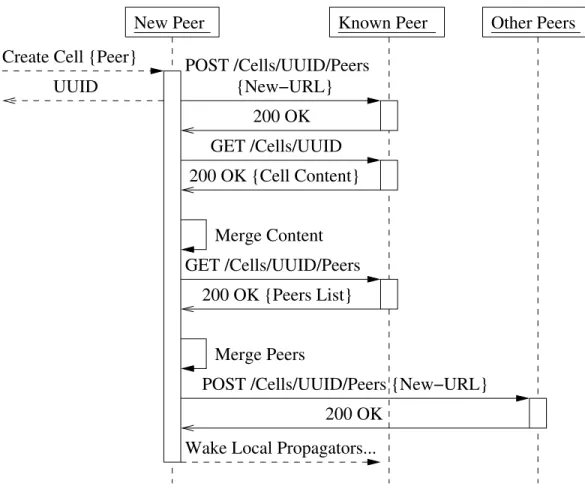
Now that I have established the basic architectural guidelines for distributed propa-gation, how can we actually construct a cell and initialize it? Initialization of the cell is actually quite simple, and is outlined in Figure 3-2.
Cell creation begins much as it would in a local propagator network; storage is allocated for the cell and the cell is associated with the appropriate merge operation. Once this is complete, we must associate the cell with its appropriate distributed network, creating it if necessary.
If the cell is a completely new cell for which no network exists, we must generate a new UUID for the particular collection of cells, if we are not given one. We then associate this UUID with the cell. Finally, we make the cell available as an HTTP resource by assigning it an appropriate URL, derived from the cell’s server-based namespace, appending its UUID as in Table 3.1. Local updates may be merged as soon as the cell is initialized, before its UUID is assigned. Remote connections are only possible once the URL and the UUID have been associated with the cell.
If we are instead joining an existing collection of cells, we must provide the URL of at least one of the existing cell copies in that collection. Creation of a cell from a remote copy resembles the process of creating a local cell, except that the UUID is specified as part of the URL provided as an argument. Once the cell has been made available to remote hosts, we then submit an HTTP POST request to the “Peers” collection of the cell initially passed to the constructor. This POST request contains the newly minted URL of the new peer. It effectively adds the peer to the network so that it may receive updates from the remote cell copy.
We then submit an HTTP GET request for the cell resource itself. In requesting the cell, we desire a representation of the cell’s contents as if it was an update message. This allows us to merge the content of the remote cell copy with any content present in the newly created cell. Once this merge is complete, local propagators may fire and begin computation, as with any other merge operation.
We finish the initialization process by initializing the list of cell copies. We submit an HTTP GET request for the “Peers” collection of the initial remote cell and then set the contents of the local “Peers” collection to the contents of the remote cell. This makes the local cell aware of all other cells in the network (assuming that the network is currently a clique). Finally, to ensure that the network is fully repaired to a clique again, the cell submits HTTP POST requests to each peer in the newly initialized
Remote Peers Update Cell {Update}
POST /Cells/UUID {Update} 202 Accepted
Merge Content
Wake Local Propagators...
Merge Content
Wake Local Propagators... Local Peer
Figure 3-3: Updating a distributed propagator cell.
set of “Peers”, adding its own URL to the collection of peers of that copy of the cell. At the end of initialization, the new peer is aware of all peers in the network, and all peers in the network are now aware of the new peer.
Due to the associativity and idempotency constraints that we have placed on the merge operation of the cell, we need not “lock” the cell before we have merged the contents of the remote cell or learned its set of peers. We may begin processing without any data whatsoever and update the cell before synchronization with the initial remote cell has taken place, as the contents of the cell are guaranteed to be monotonically increasing as well! As the merge from the “initialization” will still cause local propagators to fire, we need not preclude computation before the cell becomes non-empty. There is one benefit to allowing the cell to synchronize as soon as possible, because any updates merged before the cell has fully connected to all peers will not propagate over the network in a timely fashion.
3.7
Cell Updates
The process of updating a distributed cell is superficially similar to the process of up-dating a cell on a non-distributed propagator network. The cell has a merge operation that takes the particular update and determines the new contents of the cell. In a distributed cell, an unmodified merge operation that would have been applied to a cell
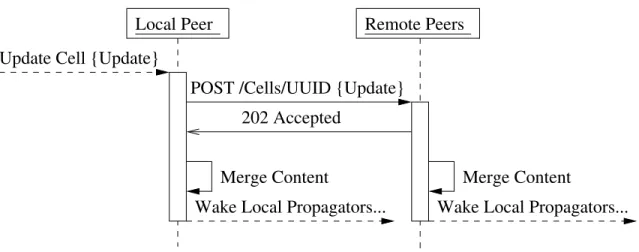
on a non-distributed propagator network is used to complete a generic stub method which will serve as the actual merge operation of the cell. This generic stub copies the received update and forwards it to all other copies of the cell by sending a POST request to all other copies present in the local “Peers” collection. In effect, the merge operation intercepts the update before performing the local merge. By forwarding the update to all other peers, we may delegate the merge to each peer, rather than assuming that the local copy of the cell controls which updates are globally merged. This may be seen in Figure 3-3.
A remote peer that receives an update in a POST request also performs a merge, but uses a different stub method. Instead of forwarding the update to all other cells, this stub method prevents rogue updates by confirming that the sender is actually a peer before merging the update. Aside from this action, the stub method behaves much as the non-distributed merge would: it wakes up local propagators to perform computation, just as if the update had been received from another local propagator. Some of the previously mentioned constraints on the cell merge operation prove useful here. If we ensure that the basic cell merge operation is the same for all copies of a cell, we need only forward the update, rather than the new contents of the cell. This may reduce the amount of bandwidth used by a cell update operation. Furthermore, the commutativity constraint relaxes the need for timely updates or a strict global ordering of operations. Instead, we may receive two remote updates in any order and not be concerned that we will lose synchronization with any other peer.
3.8
Failure Recovery Through Re-synchronization
Although the proposed system appears to be relatively robust, we must define one more operation to ensure that the architecture is truly fault tolerant. As described thus far, distributed propagation may suffer from the loss of a link between two copies of a cell as this may lead to a loss of synchronization when messages sent by one copy are not received by the other. If the system uses HTTP over TCP as its underlying communication protocol, we may gain the benefits of the fault tolerance mechanisms
of TCP and reduce the chances of such de-synchronization. Unfortunately, simply introducing TCP is not enough to ensure that network failures do not impact the integrity of the content of a cell, and it may not guarantee global consistency.
Instead, we achieve these goals by implementing a recurring operation to re-synchronize the contents of the local cell with remote copies of that cell. This op-eration sends a GET request to each remote cell, requesting a representation of the cell as if it was an update. It then applies the response to the local cell as if it was an update from the remote cell. Because of the idempotency and associativity con-straints on the merge operation, we do not need to concern ourselves with the fact that the representation of the cell as an update may include the effects of updates that have already been merged into the local copy of the cell. Similarly, we need not worry that the update representation might not explicitly include updates that had no substantive effect on the cell’s contents.
We may also re-synchronize the list of peers in the network in the same way; this ensures the maintenance of the clique. As the list of peers is not a cell, care must be taken to correctly merge the list of peers. We merge the contents of the remote “Peers” collection into the local collection by taking the union of the two collections. This ensures that the list of peers is monotonically increasing. Unfortunately, this means that this system is unable to remove peers from the collection. This is not currently a significant issue; propagator networks do not currently permit the destruction of existing parts of the propagator network.
Performing these occasional re-synchronization operations may consume more bandwidth than is necessary, especially if there are no global inconsistencies. As we transfer the entire contents of the cell as an update, if a cell is rather large, we may transfer a significant amount of data, even if the update results in no change to the local copy of the cell. We may resolve this problem by making use of the cacheability constraint of RESTful architectures. HTTP offers several methods to control client-side caching; these methods may be controlled through manipulation of the headers of HTTP messages, collections of meta-data that are sent with each HTTP request and response.
Each HTTP response to a GET request may include an appropriate entity-tag, or ETag. These ETags uniquely identify a particular state of a resource, much as a hash of its contents does. This ETag may then be supplied back to the server in subsequent GET requests by using the If-None-Match header. If the ETag of the current state of the resource on the server matches the one provided in the If-None-Match header, the server need only respond with a simple “304 Not Modified” response that has no other content. This implies that any cached copy of the resource bearing the ETag provided in the If-None-Match header is still valid. If the ETag does not match, or the If-None-Match header is not included, then the server will return the full content of the resource and a “200 OK” response.
We use the ETag and If-None-Match headers to reduce bandwidth usage during re-synchronization. Each peer maintains a hash of the current cell state, being the entity tag for that cell. When a cell performs re-synchronization, it assumes that both copies are already equal to each other and provides its local ETag in the If-None-Match header. The receiving cell may then return a 304 response if the ETag matches, or the full contents of the cell if it does not.
This re-synchronization mechanism allows for processing to continue when cells have become temporarily disconnected. If a link to a particular peer fails and no updates are received by a cell, both the remainder of the network and the disconnected peer may continue to compute, as each cell is managed and updated locally. Once the cell is able to reconnect to the network, the re-synchronization mechanism will eventually reconcile any global inconsistencies that arise due to the failure of a link. If a node fails outright, we may simply treat this as a special case of link failure, in which the node performs no further computation or modification of its local cell state, and may choose to simply reinitialize with the network.
Chapter 4
Provenance-Aware Propagation
Distributed propagation allows the distribution of a number of algorithms that would not otherwise be possible within a traditional distributed system. However, in dis-tributing computation, we lose the ability to determine how a particular result is derived. As distributed computing is inherently concurrent, there is no explicit se-quence of operations that we may follow backwards in an attempt to determine the cause of an error. Furthermore, there is no way to easily identify any host that may be returning incorrect results. Distributed systems usually implement some sort of rudimentary mechanism to track the history of data for this reason.
These data histories, or provenance, provide an interesting use case for distributed propagator networks; due to the modularity of propagator networks, support for maintaining provenance may be done independently of how the networks themselves are implemented. The method of provenance handling I describe in this chapter may be applied not only to the distributed propagator networks described in Chapter 3, but, with appropriate modifications, non-distributed propagator networks as well.
We may construct these “provenance-aware propagator networks”, capable of con-structing and maintaining the provenance of data within them, simply by transform-ing the structure of the original propagator network. We need only add cells and propagators that are designed to explicitly handle the provenance of the data in the network. However, before I outline this transformation, we first must understand what is meant by the term provenance.
4.1
Provenance
For the purposes of constructing a “provenance-aware propagator network”, we define provenance to be a collection of records that details the history and derivation of all data that contributes to our understanding of a specific resource. We distinguish this concept of provenance from what we call a justification, which is the minimal subset of this provenance from which we may derive the current state of a resource.
An example illustrates this distinction: Suppose we have a fact that states that the temperature, T , is greater than 40◦F. We may then combine this fact with another which states that T is greater than 50◦F. The combination of these two bounds now means we have a new bound on T , as it must be greater than 50◦F, rather than 40◦F. When we combine these two bounds, our new knowledge of the bounds only takes into account the second fact. We need not know the first fact (T > 40◦F) at all in order to account for our knowledge of T . We thus say that the justification of the value of T is the statement “T > 50◦F”. The first fact, T > 40◦F, which corroborates our knowledge, is a part of the provenance of T , along with T > 50◦F, but it is not part of the justification.
This dichotomy between the provenance and justification of a resource is very sim-ilar to the distinction between “why- and where-provenance” outlined by Buneman, et al.[9] However, Buneman distinguishes between why- and where-provenance within the context of structured data. Why-provenance corresponds to the provenance of the data structure itself, while where-provenance corresponds to the data in the structure. In contrast, provenance and justification must be able to detail the history of con-ceptual resources rather than actual concrete data structures. Provenance concerns itself with the history of the resource as a whole, effectively mirroring Buneman’s why-provenance; justification provides the support for the fields of the current state of the resource, mirroring Buneman’s where-provenance.
We treat the provenance of a fact to be a collection of “records” having a partial order that either indicate where and how a piece of data was stored (“possession records”) or where and how a piece of data was modified or derived (“derivation
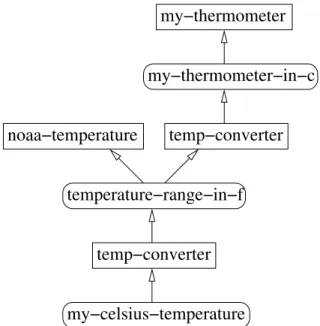
my−thermometer my−thermometer−in−c temp−converter noaa−temperature temperature−range−in−f temp−converter my−celsius−temperature
Figure 4-1: A possible provenance graph for a temperature range in Celsius.
records”). These record types are depicted in Figure 4-1 by rounded and unrounded rectangles, respectively. Each record includes an identifier of the record, as well as any additional meta-data, such as authenticity tokens, the algorithm or application used, or the current date and time, that might prove useful when auditing the provenance. Knowledge that we hold may depend on several pieces of data from which it is derived, as in Figure 4-1. This collection of provenance may be considered a directed acyclic graph, where exactly one node, the seed, has an in-degree of 0. I refer to this collection of records as a provenance graph. The seed of the graph is the most recent provenance record; the parents of each node (the nodes to which each node points) are records of the data from which the data corresponding to that node was derived. We may define an “additive-union” operation over two provenance graphs so that we may join them in a meaningful manner. This additive-union operation serves as the basis for our cell merge operation for provenance-aware cells. Throughout this thesis, when we refer to taking the union of, or adding two provenance graphs, we refer to this operation.
The additive-union operation may be defined mathematically. We define a prove-nance graph P to be the tuple (N, A(n), s), where N is the set of all nodes in the
graph, the relation A(n) gives the set of parents of a given node n, and s is the seed of N . We may then define a new graph, P0 to be the additive-union of two other graphs, P1] P2, which has the same seed, s1, as P1. This may be defined as follows:
P1] P2 = (N1∪ N2, A0(n), s1) (4.1)
Here, we define A0(n) to be:
A0(n) = A1(n) if n ∈ N1− N2 − {s1} A2(n) if n ∈ N2− N1 A1(n) ∪ A2(n) if n ∈ N1∩ N2 A1(r1) ∪ {s2} if (n = s1) ∧ s1 6= s2 A1(r1) if (n = s1) ∧ s1 = s2 ∅ if n /∈ N1∪ N2 (4.2)
Note that, in order to maintain the acyclic nature of the provenance graph, the ancestors of a node in the graph P1, A+1(n), must not contain any of the descendents
of that node in P2. That is, the following must hold:
∀n ∈ (N1∩ N2) {n0|n ∈ A+1(n 0 )} ∩ A+2(n) = ∅ ∀n ∈ (N1∩ N2) {n0|n ∈ A+2(n 0 )} ∩ A+1(n) = ∅ s1 ∈ N/ 2∨ s1 = s2
4.2
Data Structures on a Distributed Propagator
Network
How can we actually store provenance in a propagator network? Although some na¨ıve methods may seem obvious, they may not actually be the best choice overall. In order to better understand this, we must first examine how we may represent