Working Paper #9
May, 2016
(University of Lausanne)
The Signaling Value of
Labor Market Programs
Fabienne Liechti, Flavia Fossati,
Giuliano Bonoli and Daniel Auer
(University of Lausanne)
The Signaling Value of
Labor Market Programs
The National Centres of Competence in Research (NCCR) are a research instrument of the Swiss National Science Foundation
The nccr – on the move is the National Center of Competence in Research (NCCR) for migration and mobility studies, which has been operational since 2014. The overall scientific aim of the nccr – on the move is to offer a comprehensive and interdisciplinary framework for understanding the character of contemporary migration and mobility to Switzerland. It was established by the Swiss National Science Foundation with the objective of fostering an innovative and competitive field of research on migration and mobility in Switzerland. Managed from the University of Neuchatel, the network consists of some 60 researchers from social sciences, economics and law, who collaborate in 19 projects that are based at the universities of Neuchatel, Basel, Bern, Fribourg, Geneva, Lausanne, Lucerne, and Zurich.
The Working Papers Series is an online platform for academic debates by members and cooperating partners of the nccr – on the move. The authors are responsible for the analyses and arguments, which do not necessarily reflect those of the nccr – on the move.
nccr – on the move, University of Neuchatel, Faubourg de l’Hôpital 106, 2000 Neuchâtel, Switzerland Contact for the Working Paper Series: [email protected]
Abstract
This paper investigates how employers interpret participation in active labor market programs for hiring decisions. Drawing on signaling theory, we assume that employers use program participation as a signal for a candidate’s qualities. On the basis of a factorial survey experiment, we simulated a hiring process for two job positions, a low and mid-skilled one, in the hotel sector. Recruiters were asked to evaluate fictional candidates that differ, among other characteristics, in their participation in active labor market programs. Our results show that employers do use participation in labor market programs as a signal. Its impact can be positive as well as negative, depending on the type of job that is applied for. For low-skill positions, the impact is more positive than for mid-skilled ones. We also show that the signal “participation in a labor market program” interacts with education and, to a lesser extent, nationality. By studying interactions among signals and with job type, this article contributes both, to a better understanding of how job market signaling works as well as to the literature on labor market programs.
Keywords
Active labor market policies, labor market programs; job market signaling; recruitment
Acknowledgments
We would like to thank Katrin Auspurg and Andreas Schneck for their generous advice and feedback whilst planning this study. We also would like to thank Daniel Oesch, Rafael Lalive, Dominik Hangartner, and the participants of the “Factorial Survey in Labour Market Research” workshop at the University of Lausanne in May 2015.
This work was supported by the National Centers of Competences in Research - The Migration-Mobility Nexus, which is financed by the Swiss National Science Foundation.
Contacts
[email protected], [email protected], [email protected], [email protected] University of Lausanne, Bâtiment IDHEAP
Rue de la Mouline 28, 1015 Lausanne
Contents
1 Introduction 5
2 Labor market programs 6
3 Literature and expectations 7
4 Study design 10
4.1 The experiment 11
4.2 Estimation Strategy 12
5 Results and Discussion 13
6 Conclusion 16
7 References 19
1 Introduction
Over the last three decades, OECD countries have invested vast amounts of public funds in labor market programs for unemployed people. These programs, which aim at bringing jobless people back into employment, include a broad range of interventions, such as training courses,
employment programs in the public or non-profit sector, or subsidies paid to employers who accept to hire disadvantaged unemployed persons. These interventions, collectively known as “active labor market policies” (ALMPs), have been subjected to detailed scrutiny by several disciplines of the social sciences. Economists have been interested, above all, on their effectiveness in bringing jobless people back into the labor market, sociologists have focused on what they mean for
citizenship, while political scientists have tried to explain the spread of active labor market policies across advanced economies.
Given the above, it is somewhat surprising that very little research has focused on the perception employers have of these interventions. Yet, their perspective seems essential, since it is ultimately employers who are responsible for recruitment and for deciding on who gets a job and who does not. There are a few exceptions (Ingold and Stuart, 2014; Martin, 2004; e.g. van der Aa and Berkel, 2014) but the reality is that we know very little about what employers think of this major area of labor market policy.
This paper contributes to filling this gap in the literature on labor market issues. It focuses on a specific aspect of employers’ perception of labor market programs: their signaling value. When recruiting new staff, employers act in a situation of uncertainty, which is induced by asymmetric information. They need to uncover the true qualities and productivity, which are not directly observable, of the various candidates in a short time, with the latter clearly having a strong incentive to hide their weaknesses and to emphasize their strengths. In such a context, employers tend to make use of “signals”, or easily accessible information that is believed to be associated with a candidate’s productivity or other qualities that are sought after (Akerlof, 1970; Spence, 1973)i. These signals may or may not have a direct relationship with the job but, in the eyes of employers, carry meaning. Employers seem to rely on both, cognitive and non-cognitive signals (Protsch & Solga, 2014). Examples of signals that are known to affect recruitment selection include education, nationality, skin color, age, family status, physical attractiveness, to name a few. In some studies, even apparently minor details such as the first name (Bertrand and Mullainathan, 2004) or
volunteering work (Weichselbaumer, 2003) have been shown to impact on the chances of a call-back. For this reason, we can expect information concerning participation in labor market programs to be a potential carrier of meaning and thus considered and interpreted by employers just like any other potentially relevant type of information.
To the best of our knowledge, the question of the signaling value of labor market programs has never been directly investigated. However, there are a few studies (reviewed below), which started with the aim of answering different questions and accidentally discovered that participation in these programs is indeed interpreted as a signal by recruiters. One such study, which set out to examine the effectiveness of a job subsidy offered to disadvantaged unemployed persons, found that
unemployed people in the control group found jobs more easily than those with a voucher entitling them to the job subsidy. According to the author of the study, the most likely explanation of this result was that employers interpreted the voucher as a signal of “bad quality” (Burtless, 1985).
This example refers to an instance in which a labor market programs acted as a negative signal. Can labor market programs act as positive signals as well? Possibly, but positive signals are more difficult to identify. Participation in a labor market program can have two types of effects, which are difficult to disentangle, a substantive and a signaling effectii. In most cases, the substantive effect consists of an improvement in human capital or a reduction in labor costs, and can be expected to impact positively on employment chances or to have no impact. Signals, in contrast, can have either positive or negative effects (or no effect, of course). This means that if a program has a positive impact on participants’ employment chances, it will be difficult to know whether this is due to the substantive or to the signaling effect. In contrast, if participation has a negative impact, chances are that this is because of the signaling value of the program, since we do not expect a deterioration of skills due to the program.
To be able to identify positive signaling effects, one would need a study design where program participation does not add anything substantive in terms of skills that are relevant to productivity in a given job. For example, a program could consist of training in a field that is totally irrelevant to the job that is being applied for. In case of a positive impact, we could conclude that this is most likely due to the signaling value of training, rather than to the skills someone has acquired. In our study we apply precisely this strategy to be able to see both positive and negative signaling effects. We investigate the signaling value of labor market programs with a survey experiment carried out with employers in the hotel sector in Switzerland. We developed a large number of fictitious candidate descriptions, which combine different attributes including participation in a given labor market program. Each employer was then asked to rate a randomly selected sub-sample of four fictitious applicants. This procedure, known as “factorial survey”, allows us to isolate the impact of participation in given programs on the employer rating. It also proves us control over the
information that employers receive and on which they base their assessment.
The remainder of this article proceeds as follows. In Section 2, we give a short overview of Swiss labor market policies. Section 3 presents our theoretical expectations about the signaling value of ALMPs. Section 4 describes the study design and estimation strategy. In Section 5, the results are presented. The last section concludes and gives directions for further research.
2 Labor market programs
Over the last 20 years, Switzerland has developed a rather comprehensive system of active labor market policies (Bertozzi et al. 2008; Duell et al. 2010). In order to receive unemployment benefits, eligible persons must register with the (local) public employment service. They are then assigned to a case worker who monitors their job search activities. The case worker can offer participation in a labor market program, but can also impose it. Programs are chosen together with the jobseeker and must ideally reflect his or her career plan. A range of courses are available, in job search
techniques, language courses and short vocational courses in various professions. Importantly, labor market programs can also be used as monitoring tools. Typically, jobseekers, who are believed to engage in undeclared work or are found to be insufficiently active in their job search activities, can be required to participate in employment programs provided by the public or non-profit sector. These programs entail mostly low skill activities, such as recycling, packaging, crafting objects,
though variation is rather broad. If jobseekers refuse to participate, they can be subjected to
sanctions consisting of benefit reductions. For unemployed people who are considered particularly difficult to place, the public employment service can provide a wage subsidy, of up to 40% of wage costs for the first 6 months of employment.
3 Literature and expectations
Selecting candidates in recruitment procedures is a task that involves a great deal of uncertainty for employers. Candidates’ true qualities can generally not be assessed with a simple job interview. What is more, candidates have incentives to exaggerate their positive qualities and hide their less attractive ones. The result is a situation of information asymmetry between the recruiter and the candidate.
According to the job market signaling model, when faced with incomplete and asymmetric
information, recruiters tend to turn to statistical reasoning and to rely on easily observable signals. Signals are characteristics of the jobseekers that are believed to be a reliable indicator for his productivity. Applicants belonging to a group that is perceived as, on average, less productive are excluded from the hiring process. The theoretical underpinnings of this model were provided by Akerlof (1970), Phelps (1972) and Spence (1973). Spence hypothesized that recruiters, given the uncertainty involved in candidate selection, will use signals as decision-making tools. “On the basis of previous experience in the market, the employer will have conditional probability assessments over productive capacity given various combinations of signals and indices” (Spence 1973: 357). The assumption that employers rely on observable characteristics to screen applicants has been demonstrated by a large number of empirical studies. This literature has demonstrated in a convincing way that employers do use signals when making recruitment decisions. We reviewed this literature, and summarize in table 1 some of the main effects that have been uncovered so far. Only results that rely on an experimental design were included. It appears that the number and type of signals that have been shown to be used is very broad and concerns qualities that are rather unrelated to productivity, such as ethnicity, sexual orientation or appearanceiii. This literature also shows that employers seem to care about details. For instance, the studies that investigate the impact of sexual orientation signal homosexuality by mentioning volunteering work for a gay or lesbian rights organization in the resume (Weichselbaumer, 2003) or ethnicity is sometimes
signaled by first names (Bertrand and Mullainathan, 2004). From this literature, one clearly gets the impression that employers are on the lookout for every piece of usable information they can access in order to facilitate the selection process. The use of signals is a quick and inexpensive way to identify a small pool of applicants that will be subsequently assessed more accurately.
Given the above, it seems highly plausible that employers, if given information pertaining to an applicant participation in a labor market program, will attribute some meaning to it and use it in the selection process. As hinted at in the introduction, this assumption is supported by a small number of studies which have accidentally uncovered instances in which employers did use participation in a labor market program as a signal. In a Swiss study, Falk et al. (2005) found that some unemployed people who attended a course on basic computing skills were less likely to be invited for a job interview after the course than before. The effect was stronger for positions that actually required
computing skills. The most likely explanation of this result is that employers interpreted the information of following a basic course as a signal of limited competence in computing. Another example is provided by an experiment on job subsidies carried out in the US in the 1980s. The objective of the experiment was to measure the impact that a hiring subsidy would have on the chances of a group of disadvantaged unemployed people to find a job. A randomly selected group of jobseekers received a voucher that they could present to prospective employers. If they were hired, the employer would receive a subsidy equal to 50% of wages for a period of 12 months. At the end it turned out that jobseekers in the control group, who had no voucher to offer to potential employers, were far more successful in entering the labor market. The most likely explanation for this counterintuitive outcome was that employers interpreted the availability of a generous subsidy as signaling bad quality applicants (Burtless, 1985). A well intentioned measure turned out to be completely counterproductive simply because its potential signaling effect had been ignored.
Table 1: Literature Review on Employers’ Use of Signals for Hiring Decisions
Characteristic Examples of Results
Unemployment Short unemployment spells are not seen as negative signals. However, longer lasting spell lead to less call-back rates.
Non-professional activities
For physically demanding jobs candidates indicating that they do sport have higher chances to receive a call-back.
Military service seems to serve as signal in the U.S but not in Europe 2013.
Gender Discrimination against both, men and women; it is strongest in stereotypical occupations.
Age Studies provide clear evidence for ageism. Older applicants receive less call-back. The drop in call-backs already starts at the age of around 40 even earlier for women.
Ex-offenders Being an ex-offender is particularly harmful for Black and Hispanic candidates in the US.
Sexual orientation
Applicants volunteering for a gay or lesbian rights organization receive less fewer call-backs
Appearance Attractive looking - as well as tall candidates receive more call-backs than plain looking, short candidates respectively.
Obese applicants are discriminated against. Immigrant status,
ethnicity, nationality
Candidates with Black- or Hispanic sounding first names or were discriminated in the U.S.
In Sweden studies found lower call-back rates for Arab applicants compared to Swedish ones.
For the UK is has been found that applicants with Asian names were less likely to be shortlisted.
Finally, in other European countries, candidates with a nationality from Eastern Europe.
Note: For the sake of better readability references for each category can be found in the supplementary material, which is
available online
Against this background, the objective of this paper is to investigate the signaling value of labor market programs. As seen above, there is virtually no literature on this aspect. However, relying on the job market signaling model presented above, we are nonetheless able to formulate some
expectations with regard to how and when employers interpret participation in ALMPS as signal. First, we expect participation in labor market programs to be used as a signal by employers. The abundant literature on job market signaling and discrimination has shown how recruiters are on the lookout for signals that are believed to convey useful information. We can as a result expect them to make use of all the potentially relevant information they can get their hands on. Participation (or not) in a labor market program is related to someone’s employability. It most likely conveys information with regard to the applicant and with regard to the assessment a case workers makes of the applicant. For example, we can assume that participation in a language or vocational course signals motivation. Participation in a temporary employment program could be more ambivalent, as it could be chosen by the candidate, and then mean motivation, or imposed by the case workers, and then mean a negative assessment by the latter. The subsidy, as seen in the Ohio experiment, can be understood as a signal of a negative assessment by a case worker.
Second, we expect the putative signaling value of labor market programs to interact with a range of individual characteristics. For example, receiving foreign language training could be more
beneficial for a low skilled person as it may signal cognitive abilities higher than the expected group mean, than for a candidate with a university degree, who belongs anyway to a group with high cognitive skills. More general, we can expect the impact of given signals to be reinforced or moderated by other ones. Rather than trying to identify all the possible interaction effects ex ante, we decided to focus on interactions between participation in a labor market program and the key features that are known to impact on people’s chances in the labor market: nationality, education, gender and age.
Third, we expect the signaling value of participation in a labor market program to vary depending on the job that is being applied for. We will compare the putative signaling value of these programs for applicants to two different positions that are typical of the hotel sector and that require different levels and types of skills: room cleaner and receptionist. We assume that depending on the job type
employers are at the look-out for different features and therefore interpret program participation differently for different jobs. For example, one could assume that participation in a training
program is more valued for the mid-skilled position as cognitive skills are more important than for a cleaning position.
4 Study design
Our study is based on a factorial survey or survey experiment design. Survey experiments are a method to study decisions and preferences that is widely used in the social sciences, but, until now, seldom applied to the study of employers’ hiring behavior (for exceptions see van Beek et al. 1997; Biesma et al. 2007; Di Stasio and Gërxhani 2015; Di Stasio 2014; de Wolf and van der Velden 2001). In a survey experiment participants are confronted with a description of fictional situations, in our case candidate profiles, and are asked to evaluate them.
The main possible drawback of a survey experiment is the fact that employers are aware of the experimental setting and may, as a result, decide not to reveal their true preferences and provide instead socially desirable answers. While this would be a serious issue in a survey based on direct questions (Pager and Quillian, 2005), we believe that our design allows us to minimize this risk to the extent that it cannot be expected to interfere with the results. This for a number of reasons: First, each employer is shown only a small number of candidate profiles, four in our own experiment. These vary on several dimensions (six in our case), and each employer may see only some of the possible levels of each dimension. As a result, it is not possible for the respondent to know which the socially desirable answer is. As a matter of fact, survey experiments have been used in the past to investigate socially sensitive phenomena, such as gender based discrimination, and were able to identify discrimination as expected (Auspurg and Hinz, 2009). Second, the effects that we are interested in (signaling value of labor market programs) are less socially sensitive than, for example, race based discrimination. Third, the experiment was embedded in a broader survey on personnel needs of the hotel industry, presented as meant to convey information to public
authorities with regard to the recruitment problems experienced by the sector. This provided a further incentive to for the employers to reveal their true preferences.
We decided to run our experiment within the hotel sector, because it is one of the biggest sources of employment for low skilled workers, and labor market programs concern mostly low skilled
individuals, who are much more likely to be dependent on state transfers than mid- and high skilled people. Tourism is an important sector for the Swiss economy, especially in the Alpine region. In 2015, the hotel sector employed around 70,700 persons in 4,500 hotels (hotelleriesuisse, 2015). The workforce is rather internationalized with 45.2% of employees having a non-Swiss nationality compared to 24.4% for the whole economy (hotelleriesuisse, 2015). This might also be a
consequence of the difficulties to recruit suitable candidates. As other economic sectors, the Swiss hotel sector is affected by labor shortage. The catering and hotel industry indicates that 15.9% of positions that require vocational training are hard to fill (compared to 9.7% in the tertiary sector) (Federal Office for Statistic, 2015).
4.1 The experiment
We ran two separate experiments for two different jobs: hotel receptionist and room cleaner. We focused on the influence of six different dimensions set at different levels, which were randomly varied (table 2). All applicants were presented as unemployed for a period of 6 months and the reason for becoming unemployed, the closure of hotel where they worked due to retirement of owner, was also held constant. In addition, it was specified that all applicants completed their education in Switzerland to avoid different interpretations of education for candidates with foreign nationality. The experiment started with a description of a vacancy followed by the presentation of 4 fictional candidates. Participants were asked to rate the suitability of the candidate on a scale from 1 to 10.
Table 2: Dimensions and levels of vignettes
Dimension Level
ALMP – (nothing mentioned)
– Russian course paid by the public employment service – 40% wage subsidy paid by the public employment service
– Temporary employment program (TEMP) involving clothes recycling – Two temporary employment programs (TEMP2): one involving clothes
recycling and the other consisting of packaging objects
Gender – Mr. – Ms.
Nationality – Swiss citizen, unmarried, without children – Portuguese citizen, unmarried, without children – – Serbian citizen, unmarried, without children – – Senegalese citizen, unmarried, without children Age – Is 25 years old
– Is 32 years old – Is 40 years old
Education1 – Completed obligatory school in Switzerland
– Completed a 3-year VET- program as merchandiser (receptionist) – Completed a 2-year VET-program as hotel employee (cleaner) Hobbies2 – Likes listening to music
– Two times a week plays checks in the local association – Two times a week practices kick-boxing
– Two times a week plays soccer (volleyball for female) in the local
association
1 Switzerland has a strong vocational education and training system (VET) similar to the German one, where the majority of adolescents follows a dual track program that combines practical training in the company with theoretical classes of one or two days. There exist programs for over 230 occupations of, most are three or four year VET programs with a federal diploma, there exist shorter programs of 2 years with a federal certificate. The two-year VET program as hotel employee consists of courses in laundry service, looking after guests, housekeeping, logistic, interior decoration. The three-year VET program as merchandiser consists of course in German, foreign language, economics, communication, and administration. 2Beside the effect of ALMPs we were also interested in whether employers use hobbies as a sorting criteria. However, we found no significant results. For the sake of completeness we included them in our models.
The features mentioned in table 2 were used to generate candidate profiles. The intersection of all these features would yield a rather big number of profiles, far bigger than the number of
respondents. Following standard practice in factorial surveys, we decided to draw a d-efficient sample of 200 profiles. A d-efficient sample maximizes the orthogonality of the profiles, and as a result it also maximizes the statistical power we can obtain from a given sample size (see Auspurg and Hinz, 2015).
The data was collected between September and November 2015 using an online survey. 1’982 manager of hotels, all members of a hotel employer association, were invited to participate in the survey. Employers were contacted first by regular mail to announce the study, and then the survey link was sent by email, two reminders were sent via email to those who have not responded one respectively two weeks after the link was sentiv. In total 238 participants completed the survey,
yielding a response rate of 12 percent. The descriptive statistics of the respondents can be found in as supplementary material online. Since we investigate hiring mechanism in an experimental setting we do not consider the low response rate as problematic. As long as every vignette is rated by several respondents (which is fulfilled here), experiments are characterized by a high degree of internal validity.
4.2 Estimation Strategy
In order to identify the signaling value of the different characteristics we attributed to our fictitious candidates, the rating (between 1 -10) of the candidate was regressed on the six dimensions as independent variables. Data obtained from survey experiments is structured hierarchically as each respondent rates several profiles. It is reasonable to expect that the ratings for different profiles by the same respondent are correlated. This within dependency leads to incorrect standard error when using ordinary regression models. The estimated models must therefore adjust for the dependency of the error term within respondents to obtain unbiased standard errors (Rabe-Hesketh and
Skrondal, 2012; Steenbergen and Jones, 2002). To address the challenges of the hierarchical data structure we estimated multilevel models with random intercepts. In these models the intercept is not fixed but is allowed to vary across level-2 units, in our case respondents. Multilevel models correspond with the overreaching idea of survey experiments as they allow to distinguish the amount of variance in the dependent variable coming from the profile variables and the amount attributed to the respondents’ characteristics (Auspurg and Hinz, 2015). As a robustness test we estimated models including respondents’ characteristics and contextual variables at the level of the Swiss cantons as controls. Controlling for these factors does not affect the influence of the vignette variables.
5 Results and Discussion
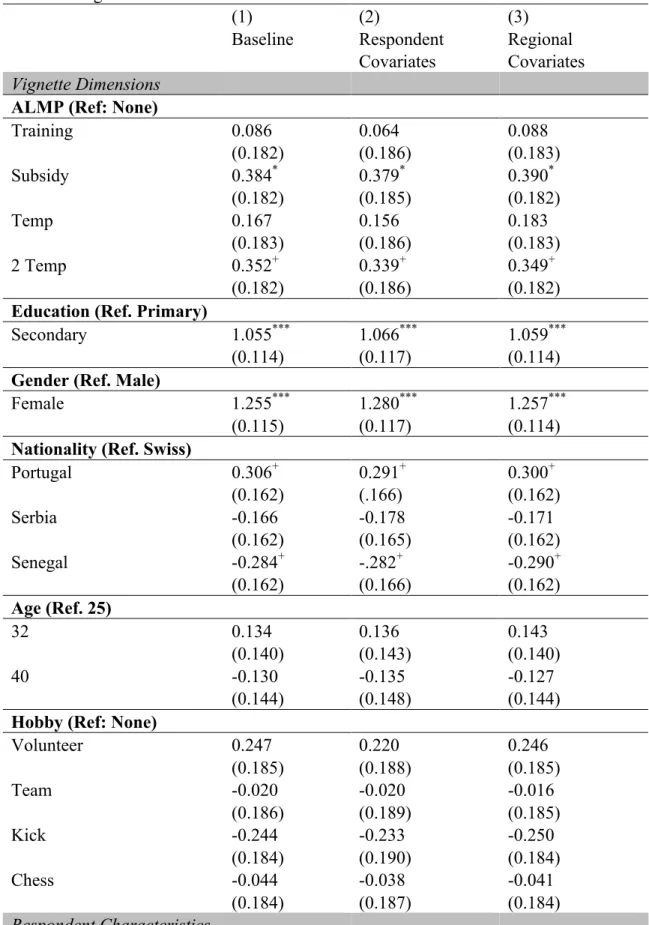
As expected and shown in figure 1, participating in a labor market program is interpreted as a signal by employers. What is more, the impact of program participation on the assessment made by
employers differs between the two occupations and as shown in figure 2 it interacts with other characteristics, most clearly with education.
For the position of room cleaner we find positive effects for the job subsidy and for participation in two employment programs. In our view, the positive effect of the wage subsidy should not be interpreted as a signal. Instead, employers probably focused on the substantive value of the intervention, a sizeable reduction in wage costs for a period of time.
Participation in two employment programs, in contrast, is used as a signal. Remember that none of the programs provided experience relevant to cleaning hotel rooms (one program was in recycling old clothes and the other in packaging). Why does participation in two programs have a clear positive impact in employer assessment? We believe that the most likely explanation is that this information is used as a signal of endurance and acceptance of physically demanding and not particularly rewarding activities, like cleaning rooms in a hotel.
Figure 1: The effect of ALMP participation on the rating of the candidate for the cleaning (left panel)
and the reception (right panel) position.
Note: Coefficients from a multilevel model with a random intercept for respondents (controlling for all vignette variables).
Bars represent the 95% confidence interval, the vertical line at the bar the 10% confidence interval. The coefficient can be found in appendix A3.
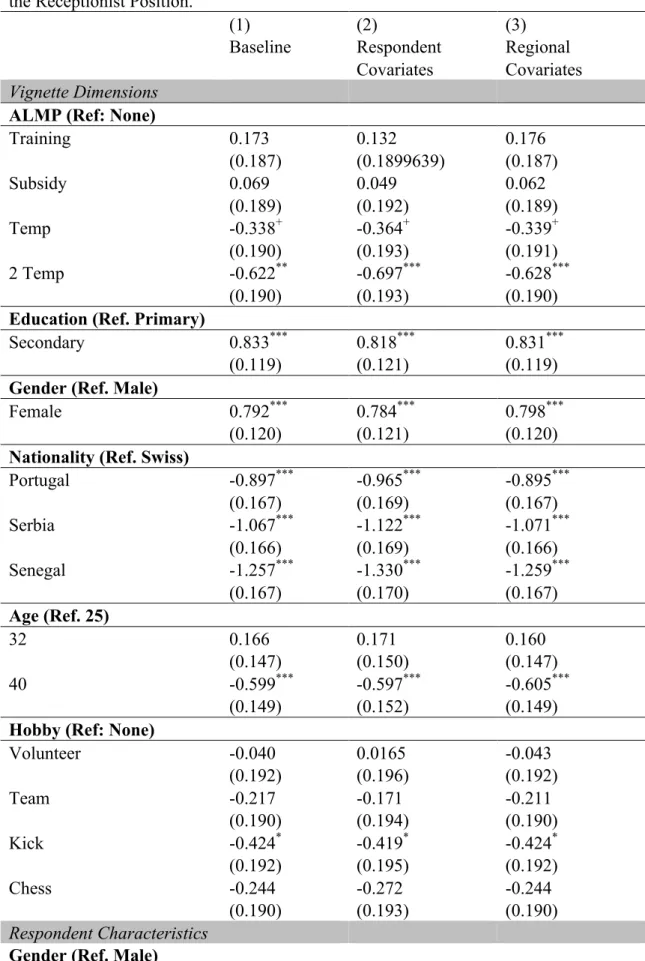
Intriguingly, but in line with our broad expectations, the impact of participation in the various programs differs for the second job, the receptionist. In this case, the subsidy has no impact while
participation in the same employment programs now has a negative impact. Participation in two employment programs is particularly penalizing. Why? Again, the most likely explanation of this result is the fact that employers interpreted this information as a signal, possibly of the assessment that a case worker made of the candidate. Typically, case workers send mid-skilled jobseekers to the kind of low-skill unrewarding employment programs mentioned in the experiment when they believe that a person lacks motivation and is not doing enough to find a new job. More generally, given the overall good labor market situation for mid-skilled professionals at the time of the survey, the fact that an unemployed receptionist is sent or decides to follow two such programs is very suspicious.
We further expect the signaling value of labor market programs to interact with other candidate features. We focus first on education level as it is an important determinant of hiring chances. In figure 2 we provide marginal effects of ALMP participation at different levels of education for the two positions. The predictive margins for the candidate’s rating for the cleaning position clearly show that the effect of ALMP participation depends on the candidate’s educational level. While for those with secondary education participation in ALMP does not seem to increase hiring chance, for those with only primary education the rating scores are significantly higher if they either followed one or two employment programs or receive a wage subsidy. It seems that in order to get hired, low-skilled jobseekers have to prove that they are capable to endure unfavorable working
conditions or come with a subsidy. Employers seem to perceive the suitability of candidates with only primary education as too uncertain and need additional information that proves their suitability in order to hire them Interestingly, training has a positive, though not significant, effect for the candidates with only compulsory education. Training consisted of a Russian language course. According to a question asked elsewhere in the survey, Russian is needed only 12.14% percent of the hotels in our sample. Thus, what we see is probably a signaling rather than a human capital effect. Candidates who decided to follow a Russian language course were seen as more motivated.v
Figure 2: The effect of ALMP participation for different levels of education for the cleaning (left
panel) and the reception (right panel) position
Note: Predictive margins for the interaction between ALMP participation and education obtained after a multilevel
regression. Bars represent the 95% confidence interval. Contrast for the predictive margins can be found in Appendix A4.
What is striking is the fact that all these effects disappear for the candidate with secondary education. Having obtained a vocational qualification as a hotel employee is clearly a more important signal in terms of motivation, general skills, and of course, professional skills than any other signal an employer can access.
The effect of program participation seems to be less related to education for the second position, the receptionist. The negative effect of participation in two temporary employment programs is visible for both skill levels. Participating in only one temporary employment program has a negative impact for those with primary education but not for those with secondary education. The positive effect of education seems to compensate the negative signal of following such a program. However, following two programs seem to be too much of a negative signal that it can be compensated by education. What also varies is the impact of the Russian language course, which is positive, but not significant. It may be that the notion of taking a Russian course fits better with a credible profile of a motivated person if he or she has already at least a vocational qualification.
4 4.5 5 5.5 6 6.5 7
none training subsidy temp 2 temp
Primary Secondary Cleaning 4 4.5 5 5.5 6 6.5 7
none training subsidy temp 2 temp
Primary Secondary
Figure 3: The effect of ALMP participation for candidates with Swiss nationality for the cleaning
(left panel) and receptionist (right panel) position.
Note: Predictive margins for the interaction between ALMP participation and nationality obtained after a multilevel
regression. Bars represent the 95% confidence interval. Contrast for the predictive margins can be found in Appendix A4.
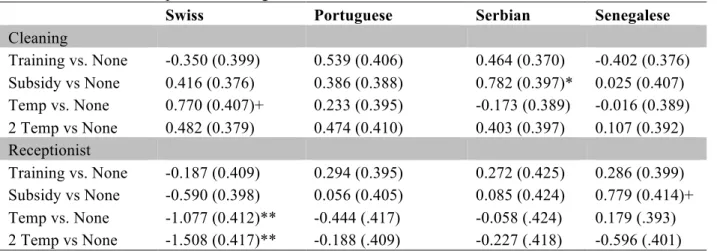
We also tested interactions with gender, age and nationality, but did not find the same kind of systematic variation in the effects we observed with education (contrasts for the predictive margins can be found in Appendix A4). In relation to nationality, we found that the positive effect of participation in an employment program is strongest for the Swiss candidate as shown in figure 3. Since cleaning jobs are mostly taken up by immigrants, a Swiss candidate may be seen with suspicion, in particular in relation to his/her availability to accept hard and unrewarding work. The fact of having accepted to participate in employment programs increases the value of this applicant. With regard to the position of receptionist, we find that the effects vary little by nationality. The negative impact of participation in an employment program is, however, strongest for the Swiss candidate. It may be the case that given the fact that for a Swiss candidate it is relatively easy to find a job, the fact of having been out of employment and participated in one or even in two employment programs must signal the existence of some serious problem.
6 Conclusion
This study is among the first to attempt to explicitly investigate the signaling value of labor market programs. It shows that, as expected, these programs are interpreted as signals by employers. However, some of the findings presented in this paper are relevant beyond the impact of labor market programs, and inform us on how signals are used by employers in order to assess
candidates. We will proceed in steps. First, we summarize the results that allow us to answer our initial research question. Second, we will present what we believe the implications of our results are for our understanding of signaling in the labor market, and third, we will try to identify priorities for future research. 4.5 5 5.5 6 6.5 7
none training subsidy temp 2 temp
Cleaning 4.5 5 5.5 6 6.5 7
none training subsidy temp 2 temp
Participation in labor market programs can serve as a signal. Distinguishing the signal from the substantive effect of a labor market program is not always easy. However, in our experimental setting, we were able to minimize the substantive effect by attributing to our fictitious candidates labor market programs which are largely irrelevant to the jobs that were applied for. As a result, we can confidently conclude that the effect we see in relation to participation in these programs is due to their signaling value and not to what participants might have learned.
The sign of this signal changes between the two occupations: participation in temporary
employment programs is positive for the cleaner and negative for the receptionist. This result, at first sight puzzling, is easily explained by the signaling model. For someone applying for a cleaning position, it is important to show endurance and acceptance of unrewarding working conditions. This function is well fulfilled by participating in the two employment programs we selected. In contrast, for the receptionist, participation in one or -worse- two such programs is most likely interpreted as a signal of a lack of motivation in job search, spotted by a case workers who forced the jobseeker to accept an unsuitable program.
In the case of the low skill job, the cleaner, the signaling value of participation in labor market programs varies according to the education level. Basically, what we see is that the beneficial impact of participation concerns only unskilled applicants. Those who have already made the effort to follow a 2-year training program as hotel employees are always preferred, and do not gain much by participating in labor market programs. In a way, the fact of having completed a relevant
education program is considered as sufficient proof of suitability for the job. Employers seem to be more suspicious of candidates with compulsory education only. For them, it is necessary to prove their suitability by participating in one or even better two temporary employment programs, or, alternatively, to come with a subsidy.
These findings, we believe, are significant beyond the narrow field of labor market programs. As argued above, the literature on signaling has so far shown little interest for interaction effects among signals and for variation due to the type of job that is applied for. We can expect the kind of interactions observed here to exist among all sorts of signals, and expect signals to vary according to job type.
The impression we get from our results, is that the process of employers interpreting signals is highly sophisticated. There are strong and weak signals. Education seems to matter most (though the effect we see may not be a pure signal and in fact result from human capital) as well as
nationality, and, for the two jobs we chose, also gender. These three pieces of information probably allow employers to put candidates in broad categories. Other signals can then modify the perception of the candidate but to a much more limited extent. For example, the unskilled candidate for the cleaning job can improve its rating by participating to a labor market program, but will never be as desirable as a more skilled competitor.
The fact that the effect of the same signal varies between the two occupations suggests that
signaling does much more than simply distinguish between better and worse candidates on a single dimension. Signaling is in our view better understood as a device to maximize the probability of a
ordering of nationalities differs between the two jobs (see Auer et al., 2016 for an in depth analysis).
Future research should take these insights forward. Our paper allowed us to glimpse into interactions and how different signals are combined to produce an assessment of a candidate. Presumably, we need a more sophisticated thinking than a simple one dimensional model where candidates are ranked from best to worst according to the presence-absence of a given signal. We also call for studies that control for job type. Our findings strongly suggest that signals can only be interpreted in relation to the job that is being applied for.
The apparent sophistication of signaling processes could also gain from qualitative research based on in depth interviews with employers. True, direct interviewing is exposed to the risk of a social desirability bias. However, there are some studies that suggest that at least some employers are willing to reveal their true preferences to researchers (e.g. Bonoli and Hinrichs, 2012; Pager and Karafin, 2009) This type of qualitative research would be extremely helpful in understanding the motivation behind the signaling effects highlighted by the experimental literature.
7 References
Akerlof, G. A. (1970). The Market for “Lemons”: Quality Uncertainty and the Market Mechanism.
The Quarterly Journal of Economics, 84(3), 488–500.
Auer, D., Bonoli, G., Fossati, F., & Liechti, F. (2016). The double hierarchy model: Evidence from
a survey experiment on employers’ hiring intent of immigrant applicants. Lausanne.
Auspurg, K., & Hinz, T. (2009). Komplexität von Lerneffekte und Plausibilität im Faktoriellen Survey. Methoden-Daten-Analysen, 3(1), 59–96.
Auspurg, K., & Hinz, T. (2015). Factorial Survey Experiments. Los Angeles: SAGE. Bertozzi, F., Bonoli, G., & Ross, F. (2008). The Swiss Road to Activation : Legal Aspects, Implementation and Outcomes. In W. Eichhorst, O. Kaufmann, & R. Knole-Seidl (Eds.), Brining
the Jobless into Work? (pp. 121–159). Springer Verlag.
Bertrand, M., & Mullainathan, S. (2004). Are Emily and Greg More Employable Than Lakisha and Jamal? A Field Experiment on Labor Market Discrimination. The American Economic Review,
94(4), 991–1013.
Biesma, R. G., Pavlova, M., van Merode, G. G., & Groot, W. (2007). Using conjoint analysis to estimate employers preferences for key competencies of master level Dutch graduates entering the public health field. Economics of Education Review, 26(3), 375–386.
http://doi.org/10.1016/j.econedurev.2006.01.004
Bonoli, G., & Hinrichs, K. (2012). Statistical Discrimination and Employers’ Recruitment.
European Societies, 14(3), 338–361. http://doi.org/10.1080/14616696.2012.677050
Burtless, G. (1985). Are Targeted Wage Subsidies Harmful? Evidence from a Wage Voucher Experiment. Industrial and Labor Relations Review, 39(1), 105–114.
de Wolf, I., & van der Velden, R. (2001). Selection Processes for Three Types of Academic Jobs An Experiment among Dutch Employers of. European Sociological Review, 17(3), 317–331. Di Stasio, V. (2014). Education as a Signal of Trainability: Results from a Vignette Study with Italian Employers. European Sociological Review, 30(6), 796–809.
http://doi.org/10.1093/esr/jcu074
Di Stasio, V., & Gërxhani, K. (2015). Employers’ social contacts and their hiring behavior in a factorial survey. Social Science Research, 51, 93–107.
http://doi.org/10.1016/j.ssresearch.2014.12.015
Duell, N., Tergeist, P., Bazant, U., & Cimper, S. (2010). Activation Policies in Switzerland. OECD
Social Employment and Migration Wokring Papers, 112, 1–139.
Falk, A., Lalive, R., & Zweimüller, J. (2005). The success of job applications: a new approach to program evaluation. Labour Economics, 12(6), 739–748.
http://doi.org/10.1016/j.labeco.2004.05.002
Federal Office for Statistic. (2015). Detaillierte Ergebnisse der BESTA. Retrieved February 5, 2016, from http://www.bfs.admin.ch/bfs/portal/de/index/themen/03/02/blank/data/02.html hotelleriesuisse. (2015). Jahrbuch der Schweizer Hotellerie. Swiss Hotel Association. Bern. Ingold, J., & Stuart, M. (2014). The Demand-Side of Active Labour Market Policies: A Regional Study of Employer Engagement in the Work Programme. Journal of Social Policy, 44(03), 443– 462. http://doi.org/10.1017/S0047279414000890
Martin, C. J. (2004). Reinventing Welfare Regimes: Employers and the Implemention of Active Social Policy. World Politics, 57(1), 39–69.
Pager, D., & Karafin, D. (2009). Bayesian Bigot? Statistical Discrimination, Stereotypes, and Employer Decision Making. Ann Am Acad Pol Soc Sci, 27(1), 70–93. http://doi.org/10.1055/s-0029-1237430.Imprinting
Pager, D., & Quillian, L. (2005). Walking the Talk? What Employers Say Versus What They Do.
American Sociological Review, 70, 355–380.
Phelps, E. S. (1972). The Statistical Theory of Racism and Sexism. The American Economic
Review, 62(4), 659–661.
Protsch, P., & Solga, H. (2014). How Employers Use Signals of Cognitive and Noncognitive Skills at Labour Market Entry: Insights from Field Experiments. European Sociological Review, 31(5), 521–532. http://doi.org/10.1093/esr/jcv056
Rabe-Hesketh, S., & Skrondal, A. (2012). Multilevel and Longitudinal Modeling using Stata. College Station, Texas: Stata Press.
Spence, M. (1973). Job Market Signaling. The Quaterly Journal of Economics, 87(3), 355–374. Steenbergen, M. R., & Jones, B. S. (2002). Modeling Multilevel Data Structures. American Journal
of Political Science, 46(1), 218–237.
van Beek, K. W. H., Koopmans, C. C., & van Praag, B. M. S. (1997). Shopping at the labour market: A real tale of fiction. European Economic Review, 41(2), 295–317.
http://doi.org/10.1016/S0014-2921(96)00037-2
van der Aa, P., & Berkel, R. van. (2014). Innovating job activation by involving employers.
International Social Security Review, 67(2), 11–27.
Weichselbaumer, D. (2003). Sexual orientation discrimination in hiring. Labour Economics, 10(6), 629–642. http://doi.org/10.1016/S0927-5371(03)00074-5
8
Appendix
Table A1: Multilevel Models for Determinants of Employers Rating of Candidate for
the Cleaning Position.
(1) (2) (3) Baseline Respondent Covariates Regional Covariates Vignette Dimensions ALMP (Ref: None)
Training 0.086 0.064 0.088 (0.182) (0.186) (0.183) Subsidy 0.384* 0.379* 0.390* (0.182) (0.185) (0.182) Temp 0.167 0.156 0.183 (0.183) (0.186) (0.183) 2 Temp 0.352+ 0.339+ 0.349+ (0.182) (0.186) (0.182)
Education (Ref. Primary)
Secondary 1.055*** 1.066*** 1.059***
(0.114) (0.117) (0.114)
Gender (Ref. Male)
Female 1.255*** 1.280*** 1.257***
(0.115) (0.117) (0.114)
Nationality (Ref. Swiss)
Portugal 0.306+ 0.291+ 0.300+ (0.162) (.166) (0.162) Serbia -0.166 -0.178 -0.171 (0.162) (0.165) (0.162) Senegal -0.284+ -.282+ -0.290+ (0.162) (0.166) (0.162) Age (Ref. 25) 32 0.134 0.136 0.143 (0.140) (0.143) (0.140) 40 -0.130 -0.135 -0.127 (0.144) (0.148) (0.144)
Hobby (Ref: None)
Volunteer 0.247 0.220 0.246 (0.185) (0.188) (0.185) Team -0.020 -0.020 -0.016 (0.186) (0.189) (0.185) Kick -0.244 -0.233 -0.250 (0.184) (0.190) (0.184) Chess -0.044 -0.038 -0.041 (0.184) (0.187) (0.184) Respondent Characteristics
Gender (Ref. Male)
Female -0.189
(0.196)
Age -0.048***
(0.010)
Education (Ref. Below upper secondary)
Upper Secondary -0.550 (0.756) Tertiary -0.532 (0.771) Other -0.617 (0.818) Number of Employees 0.003* (0.001) Regional Characteristics
Language Region (Ref. German)
French -.961** (.338) Italian -.931* (.373) Romansh 1.517* (.703) Unemployment rate .336** (.130) Constant 4.704*** 6.709*** 3.872*** (0.241) (0.874) (0.440)
Random Effect Parameters
Var. Respondent 1.727*** (0.231) 1.423*** (0.209) 1.575*** (0.217) Var. Residual 3.018*** (0.160) 3.057*** (0.164) 3.018*** (0.160) Log Likelihood -2031.41 -1957.50 -2023.76 AIC 4098.82 3963.00 4091.51 N Vignettes 958 928 958 N Employers 237 237 237
Note: Standard errors in parentheses Significance Level: +p<0.10 * p<0.05, ** p<0.01, *** p<0.001.
Table A2: Multilevel Models for Determinants of Employers Rating of Candidate for
the Receptionist Position.
(1) (2) (3) Baseline Respondent Covariates Regional Covariates Vignette Dimensions ALMP (Ref: None)
Training 0.173 0.132 0.176 (0.187) (0.1899639) (0.187) Subsidy 0.069 0.049 0.062 (0.189) (0.192) (0.189) Temp -0.338+ -0.364+ -0.339+ (0.190) (0.193) (0.191) 2 Temp -0.622** -0.697*** -0.628*** (0.190) (0.193) (0.190)
Education (Ref. Primary)
Secondary 0.833*** 0.818*** 0.831***
(0.119) (0.121) (0.119)
Gender (Ref. Male)
Female 0.792*** 0.784*** 0.798***
(0.120) (0.121) (0.120)
Nationality (Ref. Swiss)
Portugal -0.897*** -0.965*** -0.895*** (0.167) (0.169) (0.167) Serbia -1.067*** -1.122*** -1.071*** (0.166) (0.169) (0.166) Senegal -1.257*** -1.330*** -1.259*** (0.167) (0.170) (0.167) Age (Ref. 25) 32 0.166 0.171 0.160 (0.147) (0.150) (0.147) 40 -0.599*** -0.597*** -0.605*** (0.149) (0.152) (0.149)
Hobby (Ref: None)
Volunteer -0.040 0.0165 -0.043 (0.192) (0.196) (0.192) Team -0.217 -0.171 -0.211 (0.190) (0.194) (0.190) Kick -0.424* -0.419* -0.424* (0.192) (0.195) (0.192) Chess -0.244 -0.272 -0.244 (0.190) (0.193) (0.190) Respondent Characteristics Gender (Ref. Male)
Female -0.040
Age -0.217 (0.190) Upper Secondary -0.358 (0.840) Tertiary -0.620 (0.856) Other -0.496 (0.910)
Total number of staff -0.003+
(0.002) Regional Characteristics French -0.297 (0.365) Italian -1.083** (0.404) Romansh 1.297+ (0.764) Unemployment rate 0.047 (0.140) Constant 5.493*** 7.305*** 5.472*** (0.251) (0.966) (0.471) Var. Respondent 2.063*** (0.266) 1.889*** (0.255) 1.937*** (0.255) Var. Residual 3.271*** (0.172) 3.250*** (0.174) 3.272*** (0.172) Log Likelihood -2097.55 -2009.72 -2092.27 AIC 4231.11 4067.44 4228.54 N vignettes 967 931 967 N employers 237 237 237
Note: Standard errors in parentheses Significance Level: +p<0.10 * p<0.05, ** p<0.01, *** p<0.001
Table A3: Contrasts of predictive margins of ALMP for primary and secondary education
Primary Education Secondary Education
Cleaning Training vs. None 0.412 (0.262) -0.260 (0.277) Subsidy vs None 0.800 (0.268)** -0.072 (0.280) Temp vs. None 0.528 (0.267)* -0.215 (0.281) Temp vs None 0.691 (0.267)** 0.004 (0.275) Receptionist Training vs. None -0.059 (0.285) 0.410 (0.280) Subsidy vs None 0.075 (0.285) 0.046 (0.287) Temp vs. None -0.496 (0.286)+ -0.165 (0.285) 2 Temp vs None -0.585 (0.289)* -0.675 (0.280)* Note: Standard error in parentheses. Predictive margins are obtained after the estimation of a multilevel model1. Significance level: +p<0.1 *p<0.05 **p<0.01
Table A4: Contrasts of predictive margins of ALMP for different nationalities
Swiss Portuguese Serbian Senegalese
Cleaning Training vs. None -0.350 (0.399) 0.539 (0.406) 0.464 (0.370) -0.402 (0.376) Subsidy vs None 0.416 (0.376) 0.386 (0.388) 0.782 (0.397)* 0.025 (0.407) Temp vs. None 0.770 (0.407)+ 0.233 (0.395) -0.173 (0.389) -0.016 (0.389) 2 Temp vs None 0.482 (0.379) 0.474 (0.410) 0.403 (0.397) 0.107 (0.392) Receptionist Training vs. None -0.187 (0.409) 0.294 (0.395) 0.272 (0.425) 0.286 (0.399) Subsidy vs None -0.590 (0.398) 0.056 (0.405) 0.085 (0.424) 0.779 (0.414)+ Temp vs. None -1.077 (0.412)** -0.444 (.417) -0.058 (.424) 0.179 (.393) 2 Temp vs None -1.508 (0.417)** -0.188 (.409) -0.227 (.418) -0.596 (.401) Note: Standard error in parentheses. Predictive margins are obtained after the estimation of a multilevel model11. Significance level: +p<0.1 *p<0.05 **p<0.01.
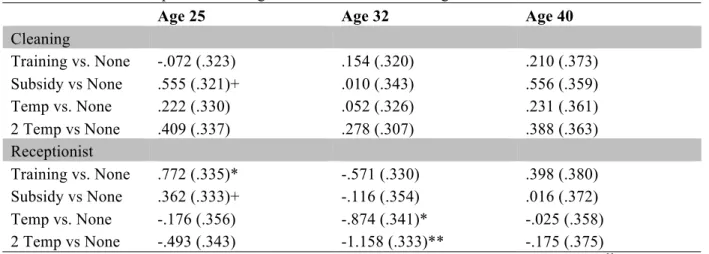
Table A5: Contrast of predictive margins of ALMP at different ages
Age 25 Age 32 Age 40
Cleaning Training vs. None -.072 (.323) .154 (.320) .210 (.373) Subsidy vs None .555 (.321)+ .010 (.343) .556 (.359) Temp vs. None .222 (.330) .052 (.326) .231 (.361) 2 Temp vs None .409 (.337) .278 (.307) .388 (.363) Receptionist Training vs. None .772 (.335)* -.571 (.330) .398 (.380) Subsidy vs None .362 (.333)+ -.116 (.354) .016 (.372) Temp vs. None -.176 (.356) -.874 (.341)* -.025 (.358) 2 Temp vs None -.493 (.343) -1.158 (.333)** -.175 (.375)
Note: Standard error in parentheses. Predictive margins are obtained after the estimation of a multilevel model11. Significance level: +p<0.1 *p<0.05 **p<0.01.
Table A6: Contrast of predictive margins of ALMP for male and female vignettes
Male Female Cleaning Training vs. None .259 (.275) -.080 (.273) Subsidy vs None .530 (.263)* .239 (.274) Temp vs. None .360 (.271) -.021 (.271) 2 Temp vs None .546 (.279)+ .174 (.266) Receptionist Training vs. None .102 (.279) .250 (.290) Subsidy vs None .111 (.275) .027 (.288) Temp vs. None -.342 (.274) -.336 (.285) 2 Temp vs None -.608 (.292)* -.633 (.280)*
Note: Standard error in parentheses. Predictive margins are obtained after the estimation of a multilevel model11. Significance level: +p<0.1 *p<0.05 **p<0.01.
Notes
i Note that Spence (1973) distinguishes between signals and indices. Signals are resources that are costly to acquire and not easily
available to everyone, however, these signals are less costly to obtain for productive candidate. Indices instead are based on group memberships that cannot be changed like gender, age, or skin color. During hiring decisions employers consider both, indices and signals to reduce uncertainty due to asymmetrical information. Signals allow distinguishing productive from less productive candidates, while for indices employers have believes about the average productivity of the group showing the characteristics. Here we use the term signal to refer to both mechanisms.
ii Note that this distinction also applies to education.
iii In reality, in some occupations with client contact, appearance could be related to productivity. For example, a handsome salesman may be able to sell more than a plain one.
iv A more detailed experimental protocol can be found in the online appendix.
v For hotels indicating that knowledge of Russian is important or very important for their hotel the attendance of a Russian language course is not pure signaling but actually means an improvement of human capital. We therefore, tested whether those hotels rated candidates attending a Russian course differently by including an interaction effect between importance of Russian language and the ALMP variable. However, there were no relevant differences between the two groups of hotels.