The Journal of Heredity 73:142. 1982.
Increase of phenotypic variance
in stressful environments
Hans Buria and Charles E. Taylor
ABSTRACT: The hypothesis that genetic homeostasls breaks down to yield greater genetic variance In more stressful environments was examined. Environmental stress was measured by mean development time and by wing length. It being expected that more stress gen-erally gives rise to longer development times and shorter wings. The correlations between mean values and ge-netic variance were predicted to be positive for devel-opment time and negative for wing length. The corre-lations were not always statistically significant but were In the predicted direction In 7 out of 8 tests. Quite pos-sibly this phenomenon contributes to observed increases of genetic variation In marginal environments and more rapid evolution during periods of special stress.
IT WOULD SEEM plausible that populations of
plants and animals show more genetic varia-tion when in new or stressful environments than in familiar and favorable ones. This is because, as Lewontin3 has stated: ' T h e zone
of canalization corresponds to the range of environments that have been historically the most common in the species, but in the new environments much greater variance ap-pears." There is some evidence that this is the case. Developmental geneticists have long known it is easier to identify genetic variants with heat stress or ether2, and plant breeders
generally recognize that differences among crop strains are more noticeable in stressed than in favorable environments1. But there is
surprisingly little known about the extent that stress accentuates genetic differences. In ev-olutionary processes this might be important, for stress would lead to increased variation in ecologically marginal populations and in-creased rates of evolution during periods of special stress. We have attempted to explore further this phenomenon by measuring the association between genetic variation and environmental harshness in experimental populations of Drosophila.
For our analysis we used data that had been collected for another purpose and have been reported by Taylor and Condra4. Briefly, 12
strains of Drosophila psevdoobscura were raised on each of 10 different media and at two temperatures. The strains were only partly inbred, but each carried one or more visible mutants unique to it. Eggs were col-lected from spoons and then 100 were counted out onto a small piece of paper towel and placed on a shell vial containing 10 cc of me-dium. Larval crowding was minimal in these circumstances. The media was composed of our regular cornmeal-molasses medium, an
The authors are affiliated, respectively, with the Zoological Museum, University of Zflrich, 8057, Zurich, Switzerland: and Department of Biology, University of California, Los Angeles, CA 90024. © 1982, American Genetic Association.
agar base without sugar, or the agar base supplemented with one sugar or another (maltose, mannitol, dextran, lactose, galactose, glucose, sucrose, or xylose). They were then stored at 15 or 25°C. The number of flies to emerge each day was recorded and the wing length of three males and three females from each vial was measured. There was a total 12 strains X 10 media X 2 temperatures X 5 rep-licates = 1200 vials.
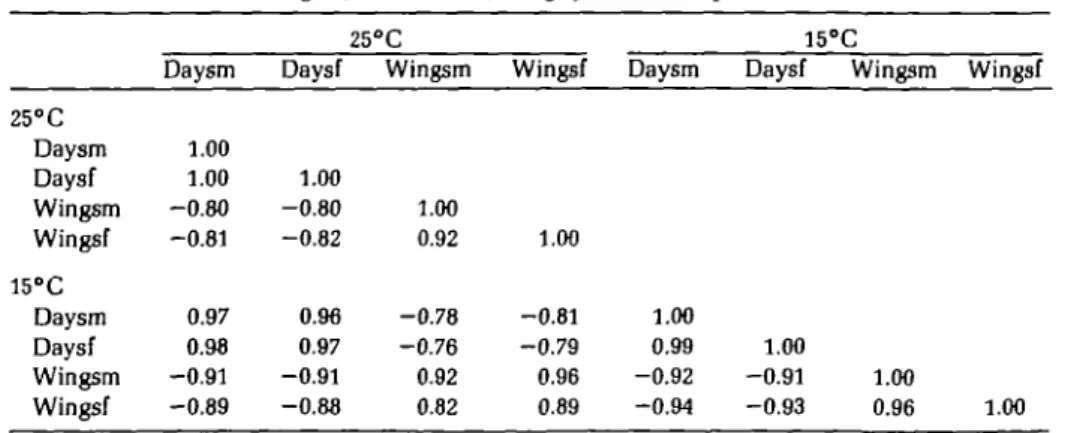
Environmental stress was measured oper-ationally by taking the mean value of the trait in question across all strains. If, on average, the flies took a longer time to develop or had smaller wings on one medium then that me-dium was regarded as more stressful than one in which the flies developed rapidly or achieved a larger size. Within either temper-ature the two measurements of stress used here were similar (see Table I). Nearly all correlations among measures were 0.80 or better.
Genetic variance was measured by first calculating the variance of mean values across all strains on the medium in question. From this value was subtracted the mean value of the variance within strains for that medium divided by the number of replicates. This is not quite the same as genetic variance per se, because the strains were not entirely inbred, but it should be approximately correct.
The relations between genetic variance and environmental stress are shown by correlation coefficients in Table II. Those media giving longer wings also produced a smaller genetic variance of wing length. Likewise, the genetic variance of development time and mean de-velopment time produced correlations from 0.21 to 0.93.
Using two-tailed tests not all correlations are statistically significant, but nearly all (7 out of 8) are in the direction expected. In an effort to eliminate scaling problems that might have been present we also divided the genetic variances by mean values of the traits and repeated the correlations. There were no substantial differences. Thus, it is evident that genetic variances were generally greater in environments that are more stressed.
The only exception to the general pattern of correlations was for male wing length at 25°C.
Table II. Correlations between operational measures of environmental stress and genetic
variation for laboratory populations of
Drosophila pseudoobscura 15 25 °C °C Development time males 0.91* 0.21 females 0.93* 0.57 Wingjength males -0.24 0.35 females -0.82* -0.24 ' P <0.01
It appears that this was due principally to one medium, cornmeal-molasses, on which male flies have larger wings but also are more variable. When this medium is excluded the correlation drops from +0.35 to +0.03. Sub-sequent exclusions, however, had little ef-fect.
In general, the correlations tended to be lower at 25°C than at 15°C. In view of the smaller body size, emergence, and reduced vigor of the flies at 25°C it would seem that D. pseudoobscura is more stressed at this tem-perature than at 15°C. Additional information would be needed to explain the role of tem-perature in this context. We speculate that 15°C is somewhat lower than the optimal temperature for D. pseudoobscura and that 25°C is higher. However, coldness and warmth differ in their physiological effect on the developing flies and cannot be expected to influence the functional dependence of genotypic expression on media in the same way.
References
1. ALLARD, R. W. and A. D. BRADSHAW.
Implica-tions of genotype-environmental interacImplica-tions in applied plant breeding. Crop Sci. 4: 503-508. 1964.
2. DOBZHANSKY, T. Genetics of the Evolutionary
Process. Columbia University Press, NY. 1970.
3. LEWONTIN, R. C. The analysis of variance and
the analysis of causes. Am. {. Hum. Genet. 26:
400-411. 1974.
4. TAYLOR, C. E. and C. CONDRA. Genetic and en-vironmental interaction in Drosophila pseu-doobscura. /. Hered. 69:63-64 1978.
Table I. Correlations among operational measures of environmental stress for laboratory populations of Drosophila pseudoobscura. Greater stress should be reflected by longer development times (for males, Daysm, and females, Daysf) and smaller wing size* (for males,
Wingsm, and females, Wingsf) at each temperature
25°C Daysm Daysf Wingsm Wingsf 15°C Daysm Daysf Wingsm Wingsf Daysm 1.00 1.00 -0.80 -0.81 0.97 0.98 -0.91 -0.89 25° Daysf 1.00 -0.80 -0.82 0.96 0.97 -0.91 -0.88 C Wingsm 1.00 0.92 -0.78 -0.76 0.92 0.82 Wingsf 1.00 -0.81 -0.79 0.96 0.89 Daysm 1.00 0.99 -0.92 -0.94 15°C
Daysf Wingsm Wingsf
1.00
-0.91 1.00
-0.93 0.96 1.00