Annals of Oncology 23: 2173–2178, 2012 doi:10.1093/annonc/mdr581 Published online 9 January 2012
History of cholelithiasis and cancer risk in a network
of case
–control studies
A. Tavani
1*, V. Rosato
1, F. Di Palma
1, C. Bosetti
1, R. Talamini
2, L. Dal Maso
2,3, A. Zucchetto
2,
F. Levi
4, M. Montella
5, E. Negri
1, S. Franceschi
6& C. La Vecchia
1,3,71
Department of Epidemiology, Istituto di Ricerche Farmacologiche“Mario Negri”, Milan;2
Unit of Epidemiology and Biostatistics, Centro di Riferimento Oncologico, Aviano;3
Department of Occupational Health, University of Milan, Milan, Italy;4
Cancer Epidemiology Unit and Registre Vaudois des Tumeurs, Institut universitaire de médecine sociale et préventive, Lausanne, Switzerland;5
Unit of Epidemiology, Istituto Tumori“Fondazione Pascale”, Naples, Italy;6
International Agency for Research on Cancer, Lyon;7
International Prevention Research Institute, Lyon, France
Received 30 September 2011; revised 15 November 2011; accepted 15 November 2011
Background:
We analyzed the relationship between cholelithiasis and cancer risk in a network of case–control studies conducted in Italy and Switzerland in 1982–2009.Methods:
The analyses included 1997 oropharyngeal, 917 esophageal, 999 gastric, 23 small intestinal, 3726 colorectal, 684 liver, 688 pancreatic, 1240 laryngeal, 6447 breast, 1458 endometrial, 2002 ovarian, 1582 prostate, 1125 renal cell, 741 bladder cancers, and 21 284 controls. The odds ratios (ORs) were estimated by multiple logistic regression models.Results:
The ORs for subjects with history of cholelithiasis compared with those without were significantly elevated for small intestinal (OR = 3.96), prostate (OR = 1.36), and kidney cancers (OR = 1.57). These positive associations were observed≥10 years after diagnosis of cholelithiasis and were consistent across strata of age, sex, and body mass index. No relation was found with the other selected cancers. A meta-analysis including this and three other studies on the relation of cholelithiasis with small intestinal cancer gave a pooled relative risk of 2.35 [95% confidence interval (CI) 1.82–3.03].Conclusion:
In subjects with cholelithiasis, we showed an appreciably increased risk of small intestinal cancer and suggested a moderate increased risk of prostate and kidney cancers. We found no material association with the other cancers considered.Key words: case–control study, cholelithiasis, kidney cancer, prostate cancer, small intestinal cancer
introduction
Cholelithiasis (i.e. the presence of gallstones) is a common
disease that implies changes in bile release and hence may
modulate the risk of digestive tract neoplasms. Consequently, a
possible relation between cholelithiasis and cancer risk has
been focused on cancers of the digestive tract [
1
–
10
].
Cholelithiasis is the major risk factor for gallbladder and
perhaps for bile duct cancers [
3
,
8
,
9
]. Its role on small
intestinal cancerogenesis is less clear, and the information is
based on four small studies [
1
,
2
,
4
,
5
], on account of the rarity
of the disease.
Data are scanty and inconsistent with reference to other
cancer sites. The Oxford record linkage study, comparing a
cohort of patients who had undergone cholecystectomy with a
reference cohort, observed 2921 cases of cancer overall,
compared with 2966 expected, after the exclusion of cancer
cases diagnosed up to 2 years after cholecystectomy [relative
risk (RR) of 0.98, 95% confidence interval (CI) 0.95–1.02], but
found a short-term signi
ficant increase of cancer incidence at
colon, pancreas, liver, and stomach [
11
]. In a Danish cohort of
patients with gallstones (72% had also undergone
cholecystectomy), including 3940 cancer cases, a 7%increased
risk of cancer was found [
2
]. The excess risk was, however,
restricted to selected cancers of the digestive tract and kidney
[
2
]. In the third USA National Health and Nutrition
Examination Survey, gallstone disease was associated with an
increased risk of cancer overall (651 deaths), with a RR of 1.4
(95% CI 1.1
–1.8), while the RR for cholecystectomy was 1.2
(95% CI 0.79–1.7) [
12
]. Most record linkage studies, however,
had limited information on covariates and were hence unable
to provide adequately adjusted RRs.
We analyzed the relation between cholelithiasis and the risk
of cancers at selected sites using data from a network of case–
control studies, conducted in Italy and Switzerland, where
allowance for a large number of covariates was possible.
Moreover, we combined all published data using a
*Correspondence to: Dr A. Tavani, Department of Epidemiology,‘‘Mario Negri’’ Institute for Pharmacological Research, Via G. La Masa 19, 20156 Milan, Italy. Tel: +39-02-3901-4722; Fax: +39-02-33200231; E-mail: [email protected]
© The Author 2012. Published by Oxford University Press on behalf of the European Society for Medical Oncology. All rights reserved. For permissions, please email: [email protected].
meta-analytic approach to provide an overall quantitative
estimate of the association between cholelithiasis and small
intestinal cancer.
methods
Between 1982 and 2009, we conducted an integrated series of case–control studies on several neoplasms in various areas of northern (the greater Milan area; the provinces of Pordenone, Padua, Udine, Gorizia, and Forlì; the urban area of Genoa), central (the provinces of Rome and Latina), and southern Italy (the urban area of Naples). We also conducted companion studies on cancers of the oral cavity/pharynx, esophagus, colorectum, larynx, breast, and endometrium in the Canton of Vaud, Switzerland. The present analysis includes a total of 1997 cases of cancer of the oral cavity and pharynx [13,14,15], 917 of the esophagus [15,16,17], 999 of the stomach [18,19], 23 of the small intestine [20], 3726 of the colorectum [21,22,23], 684 of the liver [24,25], 688 of the pancreas [26], 1240 of the larynx [15,27], 6447 of the breast [28,29], 1458 of the endometrium [30], 2002 of the ovary [31,32], 1582 of the prostate [33,34], 1125 of the kidney [33,35], 741 of the bladder [33], and a total of 21 284 controls (Table 1).
All studies included incident cases, identified in the major teaching and general hospitals of the study areas. Controls were subjects admitted to the same network of hospitals as cases for a wide spectrum of acute non-neoplastic conditions, unrelated to known risk factors for the corresponding cancer site. Overall, 17% of controls were admitted for traumatic conditions, 24% for nontraumatic orthopedic conditions, 29% for acute surgical conditions, and 30% for miscellaneous other illnesses.
Refusal of subjects approached was <5% in Italy and∼15% in Switzerland. The study protocols were revised and approved by the ethical committees of the hospitals involved according to the regulations at the time of each study conduction, and all participants gave informed consent.
Trained staff interviewed cases and controls during their hospital stay using similar structured questionnaires, including information on sociodemographic characteristics, anthropometric measures, lifestyle habits (e.g. tobacco smoking and alcohol drinking), dietary habits, personal medical history, family history of cancer and, for women, menstrual and reproductive factors, and use of oral contraceptives and hormone replacement therapy. History of cholelithiasis and selected other medical conditions were self-reported and included age atfirst diagnosis.
statistical analysis
Odds ratios (ORs) of various cancers according to history of cholelithiasis and the corresponding 95%CI were estimated by unconditional multiple logistic regression models [36]. All models included terms for sex (when appropriate), quinquennia of age, study center, year of interview, education (<7, 7–11, ≥12 years), alcohol drinking (<14, 14–27, ≥28 drinks per week), tobacco smoking (never, ex-smokers, current smokers of <15, current smokers of 15–24, or current smokers of ≥25 cigarettes per day), and body mass index (<20, 20–24, 25–29, ≥30 kg/m2). For breast, ovarian, and
endometrial cancers, models further included terms for parity, menopausal status, age at menopause, and use of oral contraceptives and menopausal hormone replacement therapy; for breast cancer, a further term for age at first birth was also included.
results
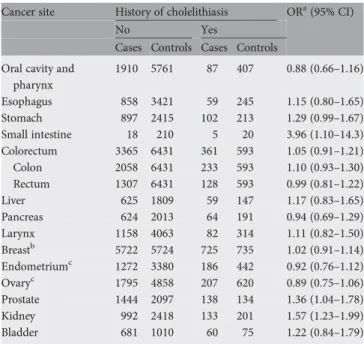
Table 2 gives the distribution of cancer cases and controls
according to history of cholelithiasis and the corresponding
OR. The ORs for subjects with history of cholelithiasis
compared with those without were signi
ficantly elevated for
Table 1. Number of cases of selected cancer sites and controls by sex and corresponding median age. Italy and Switzerland, 1982–2009
Cancer site Cases (men/women) Median age (years) Controlsa (men/women) Median age (years) Oral cavity and
pharynx 1640/357 58 4369/1799 57 Esophagus 783/134 60 2735/931 58 Stomach 612/387 61 1506/1122 56 Small intestine 10/13 66 100/130 60 Colorectum 2115/1611 62 3806/3218 57 Colon 1258/1033 62 3806/3218 57 Rectum 857/578 62 3806/3218 57 Liver 525/159 62 1419/537 58 Pancreas 403/285 61 1489/715 58 Larynx 1139/101 61 3380/997 59 Breast −/6447 54 −/6459 55 Endometrium −/1458 61 −/3822 57 Ovary −/2002 55 −/5478 55 Prostate 1582/− 66 2231/− 63 Kidney 737/388 61 1768/851 61 Bladder 627/114 64 780/305 60
aIn some instances, the same controls were used for different cancer sites.
Table 2. Distribution of cases of selected cancer sites and controls and corresponding odds ratios (ORs) and 95% confidence intervals (CIs), according to history of cholelithiasis. Italy and Switzerland, 1982–2009 Cancer site History of cholelithiasis ORa(95% CI)
No Yes
Cases Controls Cases Controls Oral cavity and
pharynx 1910 5761 87 407 0.88 (0.66–1.16) Esophagus 858 3421 59 245 1.15 (0.80–1.65) Stomach 897 2415 102 213 1.29 (0.99–1.67) Small intestine 18 210 5 20 3.96 (1.10–14.3) Colorectum 3365 6431 361 593 1.05 (0.91–1.21) Colon 2058 6431 233 593 1.10 (0.93–1.30) Rectum 1307 6431 128 593 0.99 (0.81–1.22) Liver 625 1809 59 147 1.17 (0.83–1.65) Pancreas 624 2013 64 191 0.94 (0.69–1.29) Larynx 1158 4063 82 314 1.11 (0.82–1.50) Breastb 5722 5724 725 735 1.02 (0.91–1.14) Endometriumc 1272 3380 186 442 0.92 (0.76–1.12) Ovaryc 1795 4858 207 620 0.89 (0.75–1.06) Prostate 1444 2097 138 134 1.36 (1.04–1.78) Kidney 992 2418 133 201 1.57 (1.23–1.99) Bladder 681 1010 60 75 1.22 (0.84–1.79)
aEstimates from multiple logistic regression models adjusted for sex (when
appropriate), age, study center, year of interview, study period, education, alcohol drinking, tobacco smoking, and body mass index. Reference category: no history of cholelithiasis.
bFurther adjusted for parity, age atfirst birth, menopausal status, age at
menopause, and oral contraceptives and hormone replacement therapy use.
cFurther adjusted for parity, menopausal status, age at menopause, and oral
contraceptives and hormone replacement therapy use.
cancers of the small intestine (OR = 3.96), prostate (OR = 1.36),
and kidney (OR = 1.57). The association with stomach cancer
was of borderline statistical signi
ficance (OR = 1.29). No
relationship was found between history of cholelithiasis and
the risk of cancers of the oral cavity/pharynx (OR = 0.88),
esophagus (OR = 1.15), colorectum (OR = 1.05), liver (OR =
1.17), pancreas (OR = 0.94), larynx (OR = 1.11), breast (OR =
1.02), endometrium (OR = 0.92), ovary (OR = 0.89), and
bladder (OR = 1.22).
The relationship with selected cancer sites according to time
since diagnosis of cholelithiasis is reported in Table 3. For
small intestinal, prostate, and kidney cancers, the increased risk
persisted even
≥10 years after the diagnosis of cholelithiasis.
For stomach cancer, a positive association was observed only
when cholelithiasis was diagnosed <2 years before cancer
diagnosis.
There was no heterogeneity in the risk of prostate and
kidney cancer across strata of sex, age at diagnosis of cancer/
interview, and body mass index (Table 4).
discussion
The present
findings confirm that the risk of small intestinal
cancer is appreciably elevated in subjects with a history of
cholelithiasis. The excess risk persisted after adjustment for
body mass index and
≥10 years after the diagnosis of
cholelithiasis. There was also a suggestion of a possible
moderate excess risk of cancers of prostate and kidney. No
association was found between the history of cholelithiasis and
the risk of cancer at the other considered sites.
Our results on cancer of the small intestine are in agreement
with previous evidence and provide a quantitative evidence of
a positive association with cholelithiasis. In an American
record linkage study, 3 out of 23 patients with adenocarcinoma
of the small bowel, and 3 out of 17 patients with carcinoids of
the small bowel had a history of cholecystectomy, while none
of the 52 controls reported history of cholecystectomy [
1
]. A
Danish cohort study of 42 098 patients discharged with a
diagnosis of gallstones found a RR of 2.6 (95% CI 1.6
–3.9),
based on 23 cases of small intestinal cancer [
2
]. In a Swedish
cohort study of 278 460 patients with cholecystectomy, the
standardized incidence ratio in patients with proximal small
bowel adenocarcinomas was 3.14 (95% CI 1.95
–4.80), based on
68 cases, and the standardized incidence ratio in patients with
distal small bowel carcinoids was 1.50 (95% CI 0.84–2.48),
based on 98 cases [
5
]. In a case
–control study of small bowel
adenocarcinoma conducted in Denmark, Sweden, France,
Germany, and Italy, the OR for patients with gallstone
ultrasound/X-ray verified was 1.4 (95% CI 0.6–3.2) based on 8
cases [
4
]. Excluding the American record linkage study [
1
] for
which no risk estimate was available, we pooled the RR of the
other three studies [
2
,
4
,
5
] and the present one, using a
meta-analytic approach and the
fixed-effects model [
37
] (Figure 1).
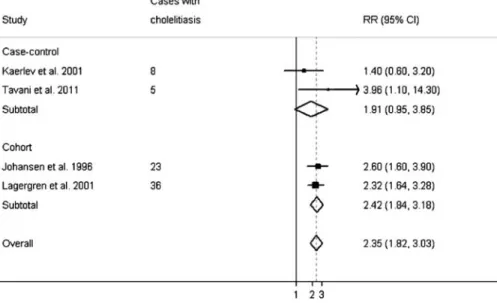
The meta-analysis was based on 72 cancer cases with
cholelithiasis. The pooled RR of the association between
cholelithiasis and small intestinal cancer risk was 2.35 (95% CI
1.82–3.03) for the four studies, 2.42 (95% CI 1.84–3.18) for the
two cohort [
2
,
5
], and 1.91 (95% CI 0.95
–3.85) for the two
case
–control studies [
4
] and the present study. The RR was
2.62 (95% CI 1.76–3.89) for adenocarcinomas of the small
intestine only [
4
,
5
]. Although based on small number of
subjects due to the rarity of the disease, these
findings, together
with the observation that adenocarcinomas of the small
intestine occur more frequently near the ampulla of Vater in
Table 3. Distribution of cases of selected cancer sites and controls and corresponding odds ratios (ORs) and 95%confidence intervals (CIs), according to time since diagnosis of cholelithiasis. Italy and Switzerland, 1982–2009
Cancer site Time since diagnosis of cholelithiasis
<2 years 2–9 years ≥10 years
Na ORb(95% CI) Na ORb(95%CI) Na ORb(95%CI)
Stomach 11/8 3.67 (1.43–9.43) 30/70 1.23 (0.79–1.93) 61/133 1.19 (0.86–1.65) Small intestine – – 2/7 5.37 (0.82–35.20) 3/13 3.28 (0.67–15.98) Prostate 9/10 1.91 (0.73–4.99) 38/44 1.14 (0.70–1.84) 91/80 1.42 (1.02–1.98) Kidney 12/14 2.21 (1.00–4.87) 43/55 1.78 (1.17–2.70) 77/131 1.40 (1.04–1.89)
aNumber of cases/controls with a diagnosis of cholelithiasis. The sum does not add up to the total because of some missing values. b
Estimates from logistic regression model adjusted for sex (when appropriate), age, study center, year of interview, study period, education, alcohol drinking, tobacco smoking, and body mass index. Reference category: no history of cholelithiasis.
Table 4. Distribution of cases of prostate and kidney cancers and corresponding odds ratios (ORs) and 95%confidence intervals (CIs), according to history of cholelithiasis, by selected covariates. Italy and Switzerland, 1982–2009
Prostate cancer Kidney cancer Na ORb(95%CI) Na ORb(95%CI) Sex Men 138 1.36 (1.04–1.78) 66 1.66 (1.19–2.32) Women – – 67 1.43 (1.01–2.03) Age at diagnosis of cancer/interview <60 years 17 1.22 (0.62–2.40) 41 1.48 (0.97–2.25) ≥60 years 121 1.42 (1.06–1.91) 92 1.62 (1.21–2.18) Body mass index
<25 kg/m2 48 1.62 (1.02–2.59) 47 1.80 (1.20–2.72) ≥25 kg/m2 90 1.24 (0.89–1.73) 86 1.42 (1.05–1.91) a
Number of cases with a diagnosis of cholelithiasis. The sum does not add up to the total because of some missing values.
b
Estimates from multiple logistic regression models adjusted for sex, age, study center, year of interview, study period, education, alcohol drinking, tobacco smoking, and body mass index. Reference category: no history of cholelithiasis.
the duodenum [
38
], support the hypothesis that bile is a
carcinogen for the small intestine especially in proximity with
the site where bile is excreted. Biliary constituents were
reported to be genotoxic and to cause local cellular damage
and consequent increased mitotic activity of damaged
tissue [
38
].
A possible association between cholelithiasis and prostate
cancer was
first suggested by an ecological study [
39
].
Subsequently, a record linkage study of subjects with
cholecystectomy [
11
] and a prospective study of subjects
hospitalized for gallstones [
2
] found no signi
ficant
relationships, although the risk estimates were above unity. An
increased risk (hazard ratio = 1.72, 95%CI 1.12
–2.66) was
found in the Ohsaki cohort [
40
], especially for advanced
prostate cancer. Prostate cancer has been associated with
hypercholesterolemia [
34
,
41
] and inversely related with the
use of statins [
42
,
43
,
44
]. Hypercholesterolemia is the strongest
known risk factor for cholelithiasis and cholesterol the main
component of the commonest type of gallstones. There is,
therefore, a plausible biological explanation for the association
between gallstones and prostate cancer risk, although it needs
to be con
firmed.
Subjects who had undergone cholecystectomy had a RR of
kidney cancer of 1.13 (95% CI 0.86--1.45) in the Oxford record
linkage study [
11
], and those hospitalized for gallstones had a
RR of 1.2 (95% CI 1.0
–1.5) in a prospective study from
Denmark [
2
]. As overweight, obesity, and related conditions
(such as hypertension, insulin resistance, diabetes,
hyperlipidemia, and high estrogen levels) have been related to
kidney cancer [
45
,
46
], it is dif
ficult to assess whether
cholelithiasis is an independent risk factor. However, in our
study, the excess risk for kidney cancer persisted after
adjustment for body mass index.
A meta-analysis on cholecystectomy and colorectal cancer
suggested a moderate increased risk in 33 case
–control
studies (RR = 1.34, 95% CI 1.14–1.57), stronger in the
proximal colon (RR = 1.88), but not in six prospective
studies (RR = 0.97) [
47
]. Another meta-analysis of 35 studies
found an overall modest positive association (RR = 1.11, 95%
CI 1.02–1.21), slightly stronger among women and for
right-sided cancer [
48
]. A positive association of cholecystectomy
with cancer of the proximal colon, which diminishes in the
distant colon and the rectum, has been reported in some [
5
,
49
], but not in all studies [
11
,
23
]. A similar gradient of
association was found for gallstone disease [
2
], while
another study of colorectal cancer found a positive
association with biliary tract, but not with gallbladder
inflammation [
50
].
The relationship of cholecystectomy with pancreatic cancer
has been considered in at least 24 studies, 15 of which showed
a positive association [
6
,
51
], which appeared stronger among
subjects with a diagnosis of pancreatic cancer close in time to
that of cholelithiasis, suggesting a possible reverse causation,
i.e. a cancer-related diagnosis of cholelithiasis [
6
,
51
].
In the third USA National Health and Nutrition
Examination Survey, total and cancer mortality were positively
associated with both ultrasound-diagnosed gallstones and
cholecystectomy [
12
]. However, subjects with
ultrasound-documented gallstones compared with those with
cholecystectomy had a slightly higher elevated risk of cancer
mortality.
The present data support a lack of association of
cholelithiasis with other considered cancer sites. Among
previous studies, one showed a positive [
2
] and one showed no
association [
10
] of gallstone disease with cancer of the oral
cavity and esophagus, and a few studies found no relation of
cholecystectomy with squamous cell carcinoma [
10
,
11
,
52
,
53
]
and adenocarcinoma of the esophagus and gastric cardia [
52
,
53
]. No relation was found for cancer of the stomach [
2
,
11
,
54
], larynx [
2
,
10
], breast [
2
,
3
,
11
,
55
,
56
], ovary [
2
,
11
], and
bladder [
2
,
11
]. Data are inconsistent for cancers of the liver
[
2
,
11
,
57
] and endometrium [
2
,
11
,
58
].
Figure 1. Meta-analysis of studies of the relation between history of cholelithiasis and small intestinal cancer risk. The center projection of the black square indicates the relative risk (RR) in each study, with its square size proportional to the inverse of the log RR variance, and the horizontal lines represent 95% confidence intervals (CIs). A diamond is used to plot the summary RR (from fixed-effects model) whose center represents the RR and its extremes the 95%CI.
In this study, cholelithiasis was self-reported. Abdominal
ultrasonography for the diagnosis of cholelithiasis has became
more frequent, leading to a more accurate diagnosis of the
disease also for less severe cases. However, an analysis stratified
for period of diagnosis of cholelithiasis found no difference in
the association of cholelithiasis and the risk of cancer of the
prostate, and the association was apparently stronger for more
recent diagnosis (OR 2.00, 95%CI 1.17–3.41 for subjects
diagnosed in 1985 or later compared with those diagnosed
before 1985). However, we cannot exclude that the apparent
association with prostate and kidney cancers may be
attributable to multiple testing since we combined different
cancer sites. With reference to strength of the present study,
the hospital setting should reduce differences in recalling
diseases between cases and controls who were matched for year
at cancer diagnosis or interview. Recall bias is unlikely, as both
cases and controls were unaware of the possible relation
between cholelithiasis and cancer. Reliability of data on
medical conditions was satisfactory in our study and the kappa
coefficient for reproducibility of information on cholelithiasis
was 0.91 [
59
]. Possible sources of selection bias should also be
limited since participation was high, and cases and controls
were selected in the same catchment areas. A major strength of
our study, besides its large dataset, was the possibility to allow
for several confounding factors.
In conclusion, our data strongly support a positive
association of cholelithiasis with the risk of small intestinal
cancer and provide quantitative estimates of the overall
association. A moderate positive association with prostate and
kidney cancer is also suggested, while a role of cholelithiasis on
the risk of the other considered cancer sites can be excluded.
acknowledgements
The authors thank Mrs. I Garimoldi for editorial assistance.
funding
The Italian Association for Cancer Research, Milan, Italy
(10068); and the Swiss League and Research against Cancer/
Oncosuisse (KFS-700, OCS-1633).
disclosure
The authors declare no conflicts of interest.
references
1. Chen CC, Neugut AI, Rotterdam H. Risk factors for adenocarcinomas and malignant carcinoids of the small intestine: preliminaryfindings. Cancer Epidemiol Biomarkers Prev 1994; 3: 205–207.
2. Johansen C, Chow WH, Jorgensen T et al. Risk of colorectal cancer and other cancers in patients with gall stones. Gut 1996; 39: 439–443.
3. Zatonski WA, Lowenfels AB, Boyle p et al. Epidemiologic aspects of gallbladder cancer: a case-control study of the SEARCH Program of the International Agency for Research on Cancer. J Natl Cancer Inst 1997; 89(15): 1132–1138. 4. Kaerlev L, Teglbjaerg PS, Sabroe S et al. Medical risk factors for small-bowel
adenocarcinoma with focus on Crohn disease: a European population-based case-control study. Scand J Gastroenterol 2001; 36: 641–646.
5. Lagergren J, Ye W, Ekbom A. Intestinal cancer after cholecystectomy: is bile involved in carcinogenesis?. Gastroenterology 2001; 121: 542–547.
6. Anderson KE, Mack TM, Silverman DT. Pancreatic cancer. In Schottenfeld D, Fraumeni JF, Jr, Cancer Epidemiology and Prevention, 3rd edition. New York: Oxford University Press 2006; 721–762.
7. Giovannucci E, Wu K. Schottenfeld D, Fraumeni JF, Jr. Cancers of the colon and rectum. Cancer Epidemiology and Prevention 3rd edition. New York: Oxford University Press 2006; 809–829.
8. Hsing AW, Rashid A, Devesa SS, Fraumeni JF, Jr. Biliary tract cancer. In Schottenfeld D, Fraumeni JF, Jr, Cancer Epidemiology and Prevention, 3rd edition. New York: Oxford University Press 2006; 787–800.
9. Randi G, Franceschi S, La Vecchia C. Gallbladder cancer worldwide: geographical distribution and risk factors. Int J Cancer 2006; 118: 1591–1602.
10. Lagergren J, Mattsson F. Cholecystectomy and risk of laryngeal and pharyngeal cancer. Int J Cancer 2011 June 29 [epub ahead of print], .
11. Goldacre MJ, Abisgold JD, Seagroatt V, Yeates D. Cancer after cholecystectomy: record-linkage cohort study. Br J Cancer 2005; 92: 1307–1309.
12. Ruhl CE, Everhart JE. Gallstone disease is associated with increased mortality in the United States. Gastroenterology 2011; 140: 508–516.
13. Garavello W, Foschi R, Talamini R et al. Family history and the risk of oral and pharyngeal cancer. Int J Cancer 2008; 122: 1827–1831.
14. Levi F, Pasche C, La Vecchia C et al. Food groups and risk of oral and pharyngeal cancer. Int J Cancer 1998; 77: 705–709.
15. D’Avanzo B, La Vecchia C, Talamini R, Franceschi S. Anthropometric measures and risk of cancers of the upper digestive and respiratory tract. Nutr Cancer 1996; 26: 219–227.
16. Bosetti C, La Vecchia C, Talamini R et al. Food groups and risk of squamous cell esophageal cancer in northern Italy. Int J Cancer 2000; 87: 289–294. 17. Levi F, Pasche C, Lucchini F et al. Food groups and oesophageal cancer risk in
Vaud, Switzerland. Eur J Cancer Prev 2000; 9: 257–263.
18. La Vecchia C, D’Avanzo B, Negri E et al. Attributable risks for stomach cancer in northern Italy. Int J Cancer 1995; 60: 748–752.
19. Lucenteforte E, Scita V, Bosetti C et al. Food groups and alcoholic beverages and the risk of stomach cancer: a case-control study in Italy. Nutr Cancer 2008; 60: 577–584.
20. Negri E, Bosetti C, La Vecchia C et al. Risk factors for adenocarcinoma of the small intestine. Int J Cancer 1999; 82: 171–174.
21. La Vecchia C, D’Avanzo B, Negri E, Franceschi S. History of selected diseases and the risk of colorectal cancer. Eur J Cancer 1991; 27: 582–586. 22. Negri E, Bosetti C, La Vecchia C et al. Allergy and other selected diseases and
risk of colorectal cancer. Eur J Cancer 1999; 35: 1838–1841.
23. Altieri A, Pelucchi C, Talamini R et al. Cholecystectomy and the risk of colorectal cancer in Italy. Br J Cancer 2004; 90: 1753–1755.
24. La Vecchia C, Negri E, Cavalieri d’Oro L, Franceschi S. Liver cirrhosis and the risk of primary liver cancer. Eur J Cancer Prev 1998; 7: 315–320. 25. Polesel J, Zucchetto A, Montella M et al. The impact of obesity and
diabetes mellitus on the risk of hepatocellular carcinoma. Ann Oncol 2009; 20: 353–357.
26. Lipworth L, Zucchetto A, Bosetti C et al. Diabetes mellitus, other medical conditions and pancreatic cancer: a case-control study. Diabetes Metab Res Rev 2011; 27: 255–261.
27. Bosetti C, La Vecchia C, Talamini R et al. Food groups and laryngeal cancer risk: a case-control study from Italy and Switzerland. Int J Cancer 2002; 100: 355–360.
28. Franceschi S, la Vecchia C, Negri E et al. Breast cancer risk and history of selected medical conditions linked with female hormones. Eur J Cancer 1990; 26: 781–785.
29. Talamini R, Franceschi S, Favero A et al. Selected medical conditions and risk of breast cancer. Br J Cancer 1997; 75: 1699–1703.
30. Lucenteforte E, Bosetti C, Talamini R et al. Diabetes and endometrial cancer: effect modification by body weight, physical activity and hypertension. Br J Cancer 2007; 97: 995–998.
31. Parazzini F, Moroni S, La Vecchia C et al. Ovarian cancer risk and history of selected medical conditions linked with female hormones. Eur J Cancer 1997; 33: 1634–1637.
32. Tavani A, Gallus S, La Vecchia C et al. Aspirin and ovarian cancer: an Italian case-control study. Ann Oncol 2000; 11: 1171–1173.
33. Talamini R, Franceschi S, Dal Bo V, Monfardini S. Pattern and determinants of diagnostic interval in cancers of the prostate, bladder and kidney. Tumori 1991; 77: 350–354.
34. Bravi F, Scotti L, Bosetti C et al. Self-reported history of hypercholesterolaemia and gallstones and the risk of prostate cancer. Ann Oncol 2006; 17: 1014–1017.
35. Zucchetto A, Dal Maso L, Tavani A et al. History of treated hypertension and diabetes mellitus and risk of renal cell cancer. Ann Oncol 2007; 18: 596–600.
36. Breslow NE, Day NE. The analysis of case-control studies. In Statistical Methods in Cancer Research, Vol. 1, Lyon, France: IARC Science Publications 1980.
37. Stroup DF, Berlin JA, Morton SC et al. Meta-analysis of observational studies in epidemiology: a proposal for reporting. Meta-analysis Of Observational Studies in Epidemiology (MOOSE) group. JAMA 2000; 283: 2008–2012.
38. Ross RK, Hartnett NM, Bernstein L, Henderson BE. Epidemiology of adenocarcinomas of the small intestine: is bile a small bowel carcinogen?. Br J Cancer 1991; 63: 143–145.
39. Lowenfels AB. Gallstones and the risk of cancer. Gut 1980; 21: 1090–1092.
40. Li Q, Kuriyama S, Kakizaki M et al. History of cholelithiasis and the risk of prostate cancer: the Ohsaki Cohort Study. Int J Cancer 2011; 128: 185–191.
41. Freeman MR, Solomon KR. Cholesterol and prostate cancer. J Cell Biochem 2004; 91: 54–69.
42. Cyrus-David MS, Weinberg A, Thompson T, Kadmon D. The effect of statins on serum prostate specific antigen levels in a cohort of airline pilots: a preliminary report. J Urol 2005; 173: 1923–1925.
43. Moyad MA, Merrick GS, Butler WM et al. Statins, especially atorvastatin, may favorably influence clinical presentation and biochemical progression-free survival after brachytherapy for clinically localized prostate cancer. Urology 2005; 66: 1150–1154.
44. Shannon J, Tewoderos S, Garzotto M et al. Statins and prostate cancer risk: a case-control study. Am J Epidemiol 2005; 162: 318–325.
45. Bergstrom A, Hsieh CC, Lindblad P et al. Obesity and renal cell cancer—a quantitative review. Br J Cancer 2001; 85: 984–990.
46. Dal Maso L, Zucchetto A, Tavani A et al. Renal cell cancer and body size at different ages: an Italian multicenter case-control study. Am J Epidemiol 2007; 166: 582–591.
47. Giovannucci E, Colditz GA, Stampfer MJ. A meta-analysis of cholecystectomy and risk of colorectal cancer. Gastroenterology 1993; 105: 130–141. 48. Reid FD, Mercer PM, Harrison M, Bates T. Cholecystectomy as a risk factor for
colorectal cancer: a meta-analysis. Scand J Gastroenterol 1996; 31: 160–169. 49. Shao T, Yang YX. Cholecystectomy and the risk of colorectal cancer. Am J
Gastroenterol 2005; 100: 1813–1820.
50. Lin HL, Lin HC, Lin CC. Increased risk of colorectal cancer among patients with biliary tract inflammation: a 5-year follow-up study. Int J Cancer 2011; 128: 447–452.
51. Ko AH, Wang F, Holly EA. Pancreatic cancer and medical history in a population-based case-control study in the San Francisco Bay Area, California. Cancer Causes Control 2007; 18: 809–819.
52. Freedman J, Lagergren J, Bergstrom R et al. Cholecystectomy, peptic ulcer disease and the risk of adenocarcinoma of the oesophagus and gastric cardia. Br J Surg 2000; 87: 1087–1093.
53. Freedman J, Ye W, Naslund E, Lagergren J. Association between
cholecystectomy and adenocarcinoma of the esophagus. Gastroenterology 2001; 121: 548–553.
54. Fall K, Ye W, Nyren O. Risk for gastric cancer after cholecystectomy. Am J Gastroenterol 2007; 102: 1180–1184.
55. Adami HO, Meirik O, Gustavsson S et al. Cholecystectomy and the incidence of breast cancer: a cohort study. Br J Cancer 1984; 49: 235–239.
56. Lagergren J, Ye W, Ekbom A. No increased risk of breast cancer after cholecystectomy. Int J Cancer 2000; 88: 679–681.
57. Shibata A, Ogimoto I, Kurozawa Y et al. Past medical history and risk of death due to hepatocellular carcinoma, univariate analysis of JACC study data. Kurume Med J 2003; 50: 109–119.
58. Morimoto LM, Newcomb PA, Hampton JM, Trentham-Dietz A. Cholecystectomy and endometrial cancer: a marker of long-term elevated estrogen exposure?. Int J Gynecol Cancer 2006; 16: 1348–1353.
59. Bosetti C, Tavani A, Negri E et al. Reliability of data on medical conditions, menstrual and reproductive history provided by hospital controls. J Clin Epidemiol 2001; 54: 902–906.