UNIVERSITY 8 MAI 45 – GUELMA ةملاق-1945يام8ةعماج
FACULTY OF LETTERS AND LANGUAGES تاغللاوبادلآاةيلك
DEPARTMENT OF LETTERS & ENGLISH LANGUAGE ةيزيلجنلإاةغللاوبادلآامسق
A Dissertation Submitted to the Department of Letters and English Language in Partial Fulfillment of the Requirements of Master’s Degree in Anglophone Language,
Literatures, and Civilizations.
Submitted by: Supervised by:
BENNOURI Meryem Mrs. CHELGHOUM Adila BOUDECHICHE Sana
Board of Examiners
Chairman: Mr. ATY Mourad (MA/B) 8 Mai 1945/Guelma University Supervisor: Mrs. CHELGHOUM Adila (MA/B) 8 Mai 1945/Guelma University Examiner: Mrs. LAYADA Radhia (MA/B) 8 Mai 1945/Guelma University
2015-2016
Investigating Cuban-U.S. Relations from 1961 to 2016:
Moving from Enmity to Normalization
First and foremost, we thank Allah for offering us help and guidance to accomplish this work.
Second, we must thank our supervisor Mrs. CHELGHOUM Adila, who trusted and helped us. This dissertation could never been possible without her and many other people‟s support.
Our sincere thanks are to our families and all teachers who taught us.
We would also like to thank the jury members, for their precious time they offered to read, examine, correct and refine this work, all of whom and kindly agreed to be on the examining committee.
Most importantly, we owe a debt to those scholars who have recorded the best sources that enlightened our path.
We express thanks to all the members of the Department of English at University of 08 May 1945-Guelma.
We would like to dedicate this simple work to our families, our teachers, our classmates, and to all members of the Department of English.
Without forgetting all those who are outside the academic realm; but they were crucial to fulfill this simple work, since they inspired and backed us to keep learning, searching and dreaming.
All my best regards go to Mr. MERZOUG Amin, for his assistance and moral support. BENNOURI Meryem
Words of profound gratitude and respect go mainly to my father who has been my source of strength and inspiration and who provided and maintained the appropriate climate for studying. To him I would like to say thank you for your unconditioned support. Without you father BOUDECHICHE Ali. Whom I never forget and who is always living in my heart. May Allah forgive you and bless your soul. I dedicate this dissertation also to my mother BOURAS Fatma.
All my respect and love go to my family members who deserve appreciation for their help, patience, sustainment and love. I feel lucky of my brothers and sisters for their unselfish and unfailing help. Particular thanks go to my sister Amel for her
encouragement and love and to my older brother and second father Ismael who never hesitated to offer guidance. My particular thanks go to my older sister Rania for her absolute support.
All my best regards go to my big family, uncles, aunts and cousins, especially, for their assistance and moral support.
This paper spots the light on more than five decades of the Cuban-American history; particularly, the recent mutual convergence of relations. Under the title: “Investigating Cuban-U.S. Relations From 1961-2016: Moving from Enmity to Normalization”; the study tackles the most pressing and complex issue in the Americas. Therefore, one of the present study‟s primary concerns is to discuss American domestic and foreign factors in shaping its policy toward Cuba, as an exceptional country case. Generally, it contributes to the re-examination of the effectiveness of the U.S. embargo against Cuba. Besides, the study suggests historical methodological insights on the basis of political, economic and legal journey. Books, Congressional publications, journal articles and reports are
analyzed to provide the necessary information and to understand the shift in the U.S. policy toward Cuba; as, successive U.S. administrations continued to intensify the block, while Obama‟s administration negotiates for removing it. Results suggest that, how political, economic, and social conditions at play had a hand in prolonging the U.S. embargo; in spite of its failure to bring Castro down and to democratize Cuba; to put it in one word, the U.S.-Cuba ongoingNormalization is still ink on paper without the repeal of Helms-Burton Act, besides, a number of Acts, which require a congressional authorization.
ازٌ ػهسٔ ثحثنا خٔساذ هم دُمػ حسمخ هم شثكأ ّهػ ءُعنا خاللاؼنا حٕتُكنا -حٕكٔشملأا . َ ،صاخ مكشت خاللاؼنا ٓف شٕخلأا لداثرمنا بسامرنا . ناُىػ دحذ " : كٕمحذ خاللاؼنا ٓف حٕتُكنا -هم حٕكٔشملأا 196 ّنإ 12016 : غٕثطرنا ّنإ جَاذؼنا هم لامرولاا ." دنَاىذ يزٌ لا حساسذنا هٕركٔشملأا ٓف اذٕمؼذَ احاحنإ شثكلأا حٕعل . جذحاَ ،كنزن حٕساسلأا خامامرٌلاا هم ل ٌُ حساسذنا يزٌ حٕكشٕملأا مماُؼنا حشلاىم : ياجذ اٍرسإس مٕكشذ ٓف حٕجساخناَ حٕهحمنا ٓئاىثرسا حناحك ،اتُكج . ي ير خ جشكزمنا ّهػ ضَشفمنا ٓكٔشملأا شظحنا حٕناؼف ِذم ٓف شظىنا جداػإ ٓف مٌاس اتُك امُمػ . ّنإ ،حٕسإس حهحس طاسأ ّهػ حٕخٔساذ حٕجٍىم ِؤس حساسذنا حشرمذ ،كنر ةواج حٕوُوالَ حٔداصرلا . َ ،اتُك ياجذ جذحرمنا خألاُنا حسإس ٓف لُحرنا مٍفَ حمصلانا خامُهؼمنا شٕفُرن مٕهحذ مذ : اػُثطم ،ةرك خ ،طشغوُكنا حٕفحص شٔسامذَ خلاامم . ب حٕكٔشملأا خاسادلإا نأ ام هٕح ٓف ،شظحنا فٕثكذ دهصاَ حثلاؼرمنا ًرناصلإ اماتَأ جسادإ ضَافذ . ،نأ ّنإ جئارىنا شٕشذَ مماُؼنا ،حٕسإسنا حٕػامرجلاا عاظَلأا َ حٔداصرللاا ناك اٍن ٓكٔشملأا ساصحنا ذمأ حناغإ ٓف ذٔ . ٓف ًهشف هم مغشنا ّهػ ححاغإ َ َشرساك ششو لا د ْ شمم ا غ ْج ٓف اتُك . َ مكشت ضٕجَ اضٔ لا ، نَد قسَ ّهػ اشثح اتُكَ جذحرمنا خألاُنا هٕت غٕثطرنا ل نُوال ءاغنإ " ضمهٌٕ -هذشٕت " ةواج ّنإ كنر نُكٔ لا َ ِشخأ هٕواُل ب لاإ نُكنا هم طُٔفذ ؽ طس ٓكٔشملأا .
Introduction ... 01
Chapter One A Flashback in Cuba-U.S. Relations……….06
1.1. Historical Background about Cuba ... 07
1.2. The Coming of Fidel Castro to Power ... 09
1.3. Eisenhower‟s Attempts to Remove Castro ... 11
1.4. Kennedy and the Cuban Missile Crisis ... 15
1.5. Richard Nixon on his Predecessor Steps in Cienfuegos ... 20
1.6. The First Normalization Attempt during Gerald Ford‟s Term ... 21
1.7. Jimmy Carter Emphasis on Rapprochement ... 21
1.8. Ronald Reagan and the First Step toward Normalization ... 23
1.9. The Cuban Contribution beyond its Territory ... 24
Chapter Two Circumstances of Tightening the Embargo………....29
2.1. The U.S. Foreign Policy Style ... 29
2.2. Cuba Foreign Policy Style ... 30
2.3. The U.S. Foreign Policy toward Cuba in Transition ... 31
2.3.1. The U.S. Post-Cold War Policy………...…32
2.4. Cuba and the Double Squeeze Play under the Special Period ... 33
2.4.1. Cuba‟s Responses to the Special Period ... 34
2.5. Sanctions Inclinations after the Cold War1990-99 ... 34
2.5.1. Sanctions Types ... 36
2.5.2. Challenges of New Sanctions ... 38
2.6. Clinton vs. the U.S. Philosophy of Tightening the Embargo at Workplace ... 39
2.6.1. The Cuban Democracy Act 1992 Resurrected American Old Habits ... 40
2.6.2. Reviving the Iron Curtain by Helms-Burton Act 1996 ... 43
2.6.3. Helms-Burton Act 1996 between Reception and Criticism ... 44
2.6.4. Major Objectives of the Cuban Democracy Act and Helms-Burton Act .... 48
2.7. George W. Bush Emphasized the Tightening of the Embargo ... 49
2.8. Signs of the Failure of the Embargo against Cuba ... 51
Chapter Three U.S.-Cuba Recent Normalization……….. 58
3.1. The Exceptional Case of Normalization with Cuba ... 58
3.2. History of the U.S. Normalization Experiences ... 60
3.3. Barack Obama‟s Efforts for Lifting the Embargo on Cuba ... 62
3.3.1. American Internal Factors that Led to the Normalization of Relations with Cuba ... 64
3.3.1.1. The U.S. Foreign Policy in Shift: Focus on Opportunities ... 65
3.3.1.2. The Unique Power of the Cuban Diaspora ... 68
3.3.1.3. The Role of the American Public Opinion ... 69
3.3.2. The Emergence of other Players in the Latin American Region ... 70
3.3.2.1. The Pink Tide Politicization ... 71
3.3.2.2. Cuba‟s Economic and Political Reforms under Raul Castro ... 72
3.3.2.3. Threats Brought by Venezuela‟s Changing Conditions ... 74
3.4.1. Hinders of the Process of Normalization ... 76
3.5. Did the American Pursuit of Economic Concerns Devaluate Democracy in Cuba? ... 78
Conclusion ... .82
Bibliography ... .88
ACP African Caribbean and Pacific AECA Arms Export Control Act
AID Agency for International Development AIDS Acquired Immune Deficiency Syndrome
ALBA Bolivarian Alliance for the Peoples of Our America BTTR Brothers To The Rescue
CACR Cuban Assets Control Regulations CANF Cuban American National Foundation CDA Cuban Democracy Act
CELAC Community of Latin American and Caribbean States CEO Chief Executive Officer
CIA Central Intelligence Agency CRS Congressional Research Services
CW Cold War
EAA Export Administration Act EFCA Export Freedom to Cuba Act EIA Export-Import Act
ELAM Escuela Latino Americana de Medicina EU European Union
FAA Federal Aviation Administration FAA Foreign Assistance Act
FTCA Free Trade with Cuba Act
GATT General Agreement on Tariffs and Trade HBA Helms-Burton Act
IEEPA International Emergency Economic Powers Act LA Latin America
LAIA Latin American Integration Association LSD Lyserge Saure Diathylamid
NATO North Atlantic Treaty Organization NAFTA North American Free Trade Agreement NGOs Non-Governmental Organizations OAS Organization American States OFAC Office of Foreign Assets Control
PAAMEC Promoting American Agricultural and Medical Exports to Cuba
Sec. Section
SOA Summit of the Americas
TSREEA Trade Sanctions Reform and Export Enhancement Act TWEA Trading With the Enemy Act
UK United Kingdom
UN United Nations
UNSC United Nation Security Council U.S. United States
USAID United States Agency for International Development USAN Union of South American Nations
WWII World War Two
Figure 1: A map presenting the distance between Cuba and the United States by the web site geology.com/ world/Caribbean-map.gif………..16 Figure 2: A map presenting the extension of Soviet Missiles placed in Cuba, by
bbc.co.uk/staticarchive………...18 Table1: The evolution of the U.S. sanctions policy, by: Peterson Institute for
Introduction
Cuba-U.S. relationship has its roots when both countries were colonies of European Powers, where the states‟ system considered the island as an obtainable part. In 1959, Fidel Castro and a group of revolutionaries with the support of the U.S. seized power in Havana, overthrowing the extremist authoritarian Fulgencio Batista. Instead of
implementing the Capitalist ideology; Castro‟s regime increased trade with the Soviet Union as a result of adopting a Communist political ideology; after a nationalization process, Castro‟s regime owned the U.S. properties and imposed high taxes on American imports; Washington started a ban on almost Cuban exports, which turned to a full Embargo during the term of President John F. Kennedy. In 1961 the United States broke off the diplomatic relations with Cuba and planned to isolate Castro‟s regime, after the crisis. It is clear that the case of Cuba is extreme, and in many ways unique. Since the late nineteenth century, Cuba‟s history has a complicated singular relationship with one country i.e. the U.S. Certainly; this work represents a simple contribution to the field as the treated issue remains contradictory at the level of the American authority.
Cuba-U.S. Normalization of relations is one of today‟s controversial and divisive issues in the U.S. foreign policy. The shift from Enmity to Normalization led by Washington and Havana was genuinely introduced by John F. Kennedy in 1961; who according to many observers was assassinated, due to his reconciliatory approach toward Fidel Castro‟s regime. Over decades, National Security agents and Bureaucratic
personalities delayed the process of regulation between the two nations; however, recent negotiations of Normalization are intended to compensate the damage caused by the previous successive American administrations‟ decisions, as well as, to prevent the latter from doing the same mistake in the future. It affirms that, the long lasting U.S. policy of
isolation and confrontation is no more an effective tool in regulating the behavior of Cuba. Enmity was often a negative way, which affected both sides: economically, politically, socially and diplomatically. This research project will review Cuba-U.S. historical roots, circumstances of tightening the embargo, and the recent negotiations of Normalization. Reasons of the imposition of the embargo, the coming of Fidel Castro to power and the U.S. plots to defeat him, sanctions as the American most frequent tool to penalize bad mannered leaders, in post-Cold War era, are the events to be studied. As it hypothesizes, sanctions policy, if not failed, is going through its ebbing; in other words, its effectiveness became questionable. This leads to the following questions: is sanctions policy dead? What are the reasons behind the weakening if not the demise of such
practice which was initially designed to achieve democracy and to improve human rights that the U.S. constitution highlights?
This study highlights the importance of Normalization of relations between the U.S and Cuba, since, its introduction in 1961 to the present day. The work also analyses different phases of the U.S.-Cuban relations and it clearly clarifies pro and anti-Normalization reactions of the international community at large, and the American continent in particular - whether being Cuban-Americans or native Americans- toward these policies, more importantly how far American foreign policy makers‟ decisions can go in standing with or against these policies. In addition to that, the U.S. policy toward Cuba was also influenced by moderates and extremists, who represent the two poles of struggle, the former see Normalization as a remedy; whereas, the latter oppose it claiming that, Normalization is no more than a unilateral change i.e. for more than fifty years, Cuba remained a Communist nation headed by the same dictator. Following this idea, this dissertation aims to present the debate over Normalization of relations with Cuba. Results
would be presented as evidence to confirm or to negate the hypothesis objectively, since the topic will be investigated by Algerian Master‟s students who are not familiar with such exceptional country case.
This study will explore the aim behind the shift of the political climate between Cuba and the U.S. or there are other factors? It also theorizes the existence of rapprochement as a matter of National interests. Then, the progress of this research study will be guided by a number of questions, among which the following will be thoroughly examined: What are the roots of U.S.-Cuban conflict? Why Americans did not leave the embargo;
although Cuba is no more a threat to the U.S. security after the Soviet Union„s collapse? Why successive U.S. administrations continued to intensify the blockade; while, the U.S. current administration negotiates for lifting the restrictions and re-establishing diplomatic relations? Why has the U.S. continued with the embargo; in spite, of the Normalization between the two countries from one hand, and of the fact that this economic embargo is a failed policy from another? Are there any other factors behind the Normalization? More importantly, if isolation via embargoing Cuba is dead, is it fair enough to look for an alternative? The results will be significant as they will raise additional problems about the topic.
This dissertation is divided into three chapters. The first one is entitled “A Flashback in Cuba-U.S. Relations”; it intends to put the subject into its historical framework, since, it explains the reasons leading to the imposition of the U.S. economic embargo on Cuba and the collapse of their relations, in an attempt to depose Communism. The second chapter “Circumstances of Tightening the Embargo” portrays the squeeze of the U.S. policy towards Cuba at work place. “U.S.-Cuba Recent Normalization” is the third and
the final chapter, and it is concerned with the ongoing restoration of relations between the two countries.
As far as the methodological framework is concerned, the issue in question is closely associated with the history of the American foreign policy. In this regard, the historical method is more than necessary, because, it will extremely help in tracing the origins of the Cuban-American issue, the political background and the development of such
complex and contradictory U.S.-Cuban policy. In reading, analyzing, and reporting facts and portraying U.S-Cuban shift toward Normalization, it is essential to adopt both the descriptive and qualitative methods, as the nature of the topic requires a detailed exploration and deep investigation, to reveal a target audience‟s variety of positions. Therefore, the use of a mixture of methods is inevitable with the overcome of the qualitative approach.
Opinions have been divided and researches resulted in two different stands, since the current U.S.-Cuba Normalization is trapped between pleasing and resistance. The first stand belongs to officials: President Barack Obama, John Kerry and social groups, who believe that Normalization is the best solution to compensate the historical disadvantages of icy relations. On the other hand, the second stand reflects a completely different vision; it rejects the Normalization action, because, they found that the Executive branch i.e. the President is overstepping his authority; superseding the Legislative power i.e. the
American Congress. That being the case, Meagan Hatcher-Mays in a New York Times Article, “Media Erroneously Claim Obama Overstepped his Authority By Restoring Diplomatic Relations With Cuba”; concludes that, the U.S.-Cuba re-establishment of relations can be beneficial for both.
Media and other observers, criticized Obama‟s plan of restoring diplomatic relations with Cuba, in 2016, Mark P. Sullivan‟s findings reported in “Cuba: Issues for 114th Congress”, Cuba is still one party system, with poor human rights records, because it jumped from one Castro to another; despite the fact that, Raul Castro implemented some economic goals; but with no similar political ones. Published in the paper entitled
“Diplomatic Relations Between US and Cuba” (2013), this work holds the idea that, Normalization is beneficial in promoting changes on the island, the evidence, in December 2014, President Obama announced changes in Cuba, since, the Cuban Legislative approved law to attract foreign investors, reduced the number of the Communist Party Congress members, and eased travel. Findings prove that, there is nothing absolute towards Normalization‟s efficacy; though it appears to be a positive achievement; to put it in one word, Normalization is truly needed and desirable step; yet, it contradicts the U.S. political traditions, since the embargo was placed by an Executive order, which requires a Legislative removal.
Chapter One
A Flashback in Cuba-U.S. Relations
In an analysis of the Spanish American war and Hispanic Division, Spain was the first European power that explored and colonized the Americas; largely, the empire extended from the eastern to the western coast, toward Alaska. After a significant period of time, Spaniards announced the independence of some of their possessions in central and southern America, while, Cuba remained under their control. Therefore, Cuban freedom‟ fighters were ambitious enough to struggle for independence. At the same line, they formed the Cuban Revolutionary Party in the United States under the administration of Ulysses S. Grant. Most importantly, during the tenure of William McKinley, the United States declared war on Spain, subsequent to the latter‟s rejection to offer the island, at that point, the counterparts signed Paris Treaty, by which, Spain lost its control over: Cuba, Puerto Rico, Philippines, Guam and other islands. The newly independent island refreshed ancient American ambitions to contain it; yet, under the Teller Amendment1, the United States promised not to exercise power over Cuba (“The World of 1898…”). Without a doubt, Cuba was a central supplier of tobacco and sugar trade; due to its prolific production; so, economic, agricultural and geographical strategic stimuli, pushed Thomas Jefferson to think to join Cuba into the U.S. system of states, the latter
acknowledged: “I have ever looked on Cuba as the most interesting addition which could ever be made to our system of states” (qtd. in Brenner). Moreover, fear from losing great economic opportunities, pushed Americans to settle and to invest heavily in the island; precisely, to prevent any other outsider from having power over Cuba. The United States‟ motives created a heated debate, and divided Cubans into two camps: anti and pro-United
States, the latter, could pave the way for American business interests. The chapter will go further through history to discuss the confrontation basis, upon which feelings of hatred were set, giving a special attention to the United States actions, as an individual sender country of restriction. One of the major objectives of this chapter is to spot the light on the causes of hostility and harassment; mainly, the American Bay of Pigs operation and the installation of Soviet Missiles; also, the flip-flop in the U.S.-Cuba relations.
1.1. Historical Background about Cuba
The Latin American region, inherited lot of WWII problems, exclusion from world markets in Europe and Asia. Following, the Cold War2 progress; Southerners blamed the world superpowers for their economic hardships. In his book entitled The Penguin
History of the 20th Century the History of the World 1951 to the Present, author J.M.
Roberts says that, most of Central American and Caribbean countries were under the United States‟ pressure, especially after Pearl Harbor incident. For the duration of the American-Korean war, they were dependent economies to Europe and to the United States as well. Therefore, many Latin American countries grouped toward
industrialization, to provide an important substitution. Industrialization itself brought not only a kind of release, but it engendered authoritarian political control, mainly in
Colombia 1953, and Venezuela 1954 (654).
In fact, the U.S. and Cuba ties go back even before Fidel Castro‟s seizing of power in Havana 1959. Throughout history, the U.S. influenced Cuba at economic and political levels; sooner, it was enlarged to further interests. Where, Thomas Jefferson deprived the Cuban patriots the right to attend negotiations of Peace Treaty3 in Paris, during the Cuban-Spanish war. For that reason, it kept its occupation over Cuba for another five
years; thanks to the Platt Amendment Act, that defined relations between the two nations, for the coming thirty three years, protected American commercial interests and enabled it to robe Guantanamo Bay, due to the Spanish inability to preserve law and order. On that basis, the United States‟ economic concerns in Cuba implied its enthusiastic plans to obtain it by all means (Brenner).
In this way, the increasing American threat to Cuba‟s sovereignty, and its influence over the island‟s domestic affairs gave birth to internal confrontations, and led nationalist Cubans to revolt and to overthrow the dictator Gerardo Machado4; successfully, anti-U.S. actors nullified the Platt Amendment Act. Once more, Cubans faced Fulgencio Batista, who gained the United States‟ assistance to remain in power for a second term, after a military coup action. Once they agreed upon the Treaty of Relations in1934, to tolerate the United States‟ full domination over Cuba‟s economy (“The United States, Cuba and the Platt…”). That is to say, the United States was still powerful enough to manipulate Cuba‟s policies.
In an essay discusses the history of Cuban-American relations, critic Ian Chadwick spots the light on the epoch marked by the coming of Fidel Castro and his supporters, who formed a resistance group in Mexico. In an attempt to appear tolerant, Fulgencio Batista offered a Presidential Amnesty5 to some political prisoners, as a result, Castro returned to Cuba with 81 men, and started their rebellion in 1958. Batista then, refused the United States‟ help to stay in office, but one year later he was unable to continue without the American aid, thus, he escaped to Dominican Republic, Miami then Spain. The United States as a result, made it the first step to welcome Fidel Castro to power in Havana of bankrupt nation; and indirectly, the new leader profited from arms and
financial supplies pre-arranged by the United States to Cuba during Fulgencio Batista‟s years (Suddath).
The United States‟ policy changed, by the threat of Communism6 from one hand, and the growth of Latin American Nationalism7, from another; again those events, led
Washington to start covert, or sub-version operations against the Cuban leader; selectively and without the Congress approval the U.S. supported Latin American countries. That explains the United States‟ action immediate resistance, to Guatemalans adoption of Communism as a political ideology in 1954. From an American perspective, Communism often brought poverty and discontent; and in order to limit its spread, the United States started to deliver economic assistance to Latin American countries; yet, the southern continent received only a slight amount of aid that was granted to Europe and Asia (Roberts 655).
1.2. The Coming of Fidel Castro to Power
Forty years ago, the U.S. policy toward Cuba, went through a complex historical context and political conditions, the U.S. policy was centered on punishing Fidel Castro‟s disobedience or revolution, as a tool at the hands of Soviets, to implement their design i.e. to oppose Americans. Undoubtedly, Castro was responsible for cutting one of the most policy procedures by which, the U.S. defined its place and secured its interests in the western hemisphere. For several decades, American presidential administrations whether: Republicans, Democrats, Liberals or Conservatives‟ main goal was to remove Castro from power (Pérez JR 227-28).
Initially, the United States and Cuba relationship was based on trade agreements, then, it turned into a complicated political, economic and military one; ending the friendly
relationship, all the way through the Cuban independence and the rise of Fidel Castro. The understanding of past events, decisions, and actions taken by the United States against Cuba, included even its involvement in the island politics. When, Fulgencio Batista was president in 1952, the U.S. government supported him in spite of his violent actions toward the Cuban people, who were not in favor of him; since, he served the American commerce, more than Cubans‟ needs. Unlike Fulgencio Batista, Fidel Castro‟s un-serviceability came to surface, resulting in the cut of diplomatic relations (Holmes 83). Over the years, the United States provided an economic aid and military training to pro-U.S Cubans, for the sake of creating a hemispheric defense. However, things did not go as they expected to be; where the same aids affected Cuba‟s internal security. In other words, the United States different helps which were the foundation of good relations, began to be the accelerator of the divorce between neighbors. Unexpectedly, Fidel Castro continued his course of anti-Americanism, because the greater part of the Cuban lands was controlled by American patrons, and strengthened relations with the USSR, although, he knew that such act would antagonize the United States. Within the same context, Castro‟s alliance with Soviets was the first sign of the mutual disagreement (Chadwick). Disagreement progressed to the extent that, the United States‟ officials introduced recommendations to murder Fidel Castro, those implied plots tended to destabilize Castro‟s regime, also to reduce his ability to serve his people. It is true that Congress has many powers including: foreign commerce, declaration of war … etc., but the U.S. president has exclusive power concerning foreign relations, since, he is the only
representative of the nation, and he automatically became the dominant force in shaping policy and making decisions (Feldman 3). So, it is important to take a closer look at the United States‟ administrations in order to be able to understand the purposes behind
severing relations, and the end of the use of diplomacy to solve problems; since the United States‟ recognition of the new Cuban revolutionary government.
1.3. Eisenhower’s Attempts to Remove Castro
Divergent view point of the neighbor, challenged the United States, when it was already holding a superior position in dealing with other nations; un-precedent Cuban move, toward an independent set, similar to that of the United States, raised by Fidel Castro, who desired a “full equality” (qtd. in Chadwick). Since day one, Dwight D. Eisenhower Administration opened opposition to Castro, through covert plans to overthrow the Cuban leader. In 17 March 1960, the president ordered Allen Dulls the director of the CIA, to train attackers in order to replace Castro by a pro-United States government (Cuba Timeline). Consequently, for the first time, an economic Embargo8 was imposed in July 1960, by President Eisenhower who reduced the Cuban sugar quota9 (Scanlan and Loescher 117).
With the appearance of Castro‟s radical nationalism, the United States under
Eisenhower‟s administration firmly shifted to anti-Castro approach; the latter established tied relations with the USSR; while the former favored to support leaders that could serve the U.S. over change brought by Castro. However, the success of Castro, and the U.S. intrusion led to the appearance of anti-American feelings among Cubans who were pro-revolution; the last, clashed with Cubans who were pro-U.S.; since, they considered it as their rescue, more they expected that Cuba would bond with North American values. By the late 1959 and early 1960, Eisenhower initiated an aggressive policy toward the Cuban leader, relying on the CIA and Cuban exiles to bring Castro down i.e. the U.S. officials lacked positivity to work for the best of both nations, to stabilize and to improve the
situation (Rivas 248). In this way, Americans expected that by provocative steps they would defeat Castro, and prevent any future possibility to export the revolution to other Latin American nations.
Explicitly, the first symptom of the two nations‟ clash, problematic closeness, and disharmony mediation, was when Castro nationalized the American properties, especially oil factories, and restored 75% of the Cuban lands without compensation. So, the United States took punitive measures on commercial exports, excluding food and medicine, more than that, Eisenhower severed diplomatic relations. Simultaneously, Americans initiated implicit attempts to murder Castro; who nationalized Telephone Company and reduced telephone rates. Then, in 1959, Castro unofficially visited the United States, accepting the invitation of American Society Newspaper, to tell Americans that the only possibility of good relation is related to parallel coexistence of both nations (Mendes 6).
Castro met the vice president Richard Nixon in April 1959, during his trip to the U.S., which sponsored by The American Society of Newspaper Editors. This visit impacted the United States‟ behavior, and marked a turning point in its policy; when Richard Nixon openly declared: “I became a leading advocate for efforts to overthrow Castro” (qtd. in Haney and Vanderbush 14). At the height of the Cold War, Cuba began to import Soviet oil which, United States‟ companies refused to refine oil came from the enemy; in response Castro nationalized more American properties.
President Eisenhower was an attentive and wise, in dealing with local affairs. Therefore, he won the Congress‟ approval in raising the defense budget; because, he experienced the United States‟ most hard times including: the Cuban Missile Crisis and Vietnam War. Fear from the spread of Communism in the western hemisphere, directed the president to deprive some reform movements from social justice, or the right for
self-determination. Therefore, the more time passed by, the more anti-Americanism augmented, in other words, the administration was unable to distinguish between Nationalism and Communism. For example, Eisenhower administration was in favor of even undemocratic rulers in the Caribbean region; since, they were pro-U.S. Later on; this policy was criticized by both: Conservatives, and Liberals who blamed the United States for forcing Castro to the arms of the Soviets (Luxenberg).
In early1959, for many Americans, Castro was neither anti-Capitalism, nor pro-Communism; he was a nationalist forced to be a Communist due to Eisenhower‟s
hostility. Since, the American president covertly used the CIA to block Castro‟s rise; as a result of Castro‟s reduction of U.S. businesses. In response, the Cuban leader‟s
authoritarianism and popularity increased, by signing a trade treaty with the USSR. For this reason, Eisenhower ordered the CIA to prepare for an invasion and assassination plot. At this level, Cuban-U.S. relations reached the climax, when Castro cut sugar quota and nationalized the rest of the U.S. properties. To a large degree, Eisenhower focused more on a global fight against Communism, more than the American domestic affairs (861). Thus, Castro and Eisenhower‟ reciprocal distrust and suspicious, resulted in the long lasting confrontation, from one side, the President was a Globalist: aimed at reducing Castro‟s regime power; and from another side, Castro found a kind of refuge in the Soviet Union (Norton et al. 878).
Almost simultaneously, the Cuban government took fearless decisions such: the inclusion in the Eastern bloc, and the exclusion from the Western one. The sign, in
February 1960, Cuba and the Soviet Union signed a trade agreement, to substitute the Cuban sugar with Soviet oil (Hufbauer et al. 1). In response, Eisenhower ratified the embargo, and sponsored the military operation known as, the Bay of Pigs10. Marking a
political confusion in Washington; since, it was neither pro-revolution headed by Castro nor, with violent government similar to that of Batista (Chadwick). Yet, in early 1961, The Trading With the Enemy Act (TWEA), permitted the president to severe links. Sooner, the United States‟ embassy in Havana was closed officially (Safferson 61). One year later, in August the Congress passed The Foreign Assistance Act, prohibiting all kinds of aid to Communist nations i.e. Cuba (“The U.S. Embargo…”), at the same year, Cuba was eliminated from the OAS as a result of its behavior (Fiala 488).
The Cuban locked sky was divided into three camps: radicals (Castro and Che Guevara), moderate (Raul Castro) and pro-Americans moderates (members of the older regime), whom the United States worked to keep, or to influence Castro to be one of them. However, persuading a radical revolutionary man was not an easy task for Americans. Apparently, Eisenhower kept moderating with Castro, but, privately he planned for his overthrow. Equally, Castro shifted to rely on Soviets economic and military supplies, while, he continued to appear pro-peaceful coexistence (Kennedy, Cohen and Piehl Ch. 36 638). One may think that, each leader mistrusted the other, but the sole difference was that, Eisenhower‟s plan to defeat Castro preceded Castro‟s Communization of Cuba.
Eisenhower‟s shift from a modest to hostile toward the Cuban leader, from the time when he approved to murder Castro for 38 times (Conradt). However, the vice president Richard Nixon expressed his sympathy to Castro; also, he tried to redirect Castro‟s adoption of Communism. In 1952, Nixon as cold, manipulative and anti-Communist blamed Democrats for losing China to Communism; that‟s why, he complained about the U.S. foreign policy and defense, toward Cuba. Despite, belonging to the same political party i.e. Republicans, Eisenhower and Nixon disagreed about politics; but, they were
more alike than was often thought (Frank). Furthermore, Richard Nixon criticized the inclusion of Cuba‟s issue in J F. Kennedy‟s electoral campaign, and recommended to distinguish between democrats and dictators. From Richard Nixon‟s point of view, the United States containment was a negative strategy in resisting Communism. Simply, Nixon stressed the importance of cultural differences that caused the United States‟ loss of Cuba (Luxenberg 49).
1.4. Kennedy and the Cuban Missile Crisis
In the second half of the 20th Century, Cubans fought a victorious revolution, which produced a major political conflict than any other in Latin America. In 1962,
confrontation of the two super powers i.e. the United States and the Soviet Union, was an obvious outcome of the Cold War. Cuba‟s exceptional strategic position near the cost of Florida is far about 130 miles away, gave it special significance (see fig.1).
Fig. 1. A map presenting the distance between Cuba and the United States by the web site geology.com/ world/Caribbean-map.gif
Therefore, the United States established a naval base on the island in 1951, reflecting its strategic thinking, when Cuba was harshly affected by the world‟s economic depression; Americans were investing a lot in its urban sector. At this level, Castro began to intervene with American businesses, and to report Americanized characters in Cuba i.e. those who were supporting the old regime, and he pushed Cubans to complete the political
revolution by an economic one, which was Castro‟s central idea (Roberts 657).
In an attempt to achieve an economic independence, the Cuban government‟s agrarian reform law, threatened the American sugar companies, and cost them a loss of one million and a half Acres of land; as being said, a new cold war in the Caribbean began.
658-59). At work place, John F. Kennedy executed a mission that first planned for the term of Eisenhower (Bay of Pigs), by the incident, John F. Kennedy expected Cubans to aid the invaders in defeating Castro (Jelten). Though, the United States backed this operation, hundreds of invaders trained by the CIA faced a strong Cuban resistance, approximately, over 100 were killed, another 1100 were captured in a major foreign policy disaster (BAY OF PIGS INVASION).
Following the Bay of Pigs failure in 19 April 1961, progressively Congress became active in passing a bill on Cuban limitation to enable JF Kennedy to react whenever necessary. Moreover, the CIA gained his approval to engage in propaganda activities in Latin America, especially in Cuba (Haney and Vanderbush 17). Where, American officials thought that, the best way to resist the Cuban threat was via murdering Castro. Yet, it was impossible for Washington to assassinate him, under Article 51 of the UN charter, prohibiting its members from attacking one another. So, Americans went through secret operations: a ballpoint pen with a hidden syringe full of poison, exploding cigar and slipping LSD into Castro‟s drink (Hrala).
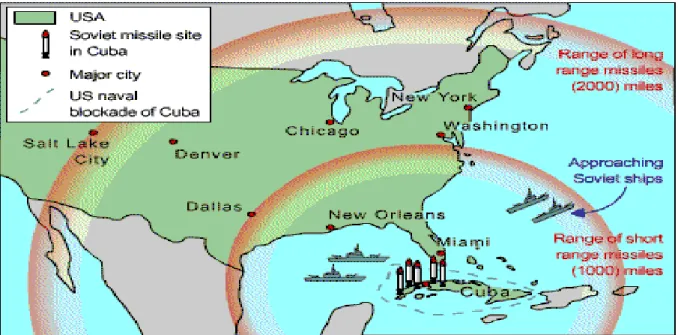
Confidently, the Cuban pressure kept rising, in spite of, the American potential violent reaction. In 22 October 1962, American photographers proved the construction of Soviet missile sites, on the island. Which led J. F. Kennedy to announce a sever isolation on Cuba, to avoid more weaponries; immediately, all maritime and air links were put off with Cuba (Bosch and Ciampttin). Similarly, Castro was uncertain about the peaceful co-existence with the U.S. For that reason, he asked for the Soviets‟ help; within days, Krushchev raised up the balance of terror i.e. he started installing these missiles to menace the U.S. Next this, Kennedy on a televised speech, rejected the missile project
(see fig. 2) that could carry nuclear warheads, and could target the American capital (Rudin).
Fig. 2. A map presenting the extension of Soviet missiles placed in Cuba, by bbc.co.uk/ staticarchive.
Paradoxically, J F. Kennedy criticized the policy of his predecessor toward Cuba, when the latter focused too much on national security instead of regional one; i.e. helping the Cuban people to progress. More, J F. Kennedy condemned the United States‟ back of Batista over Cubans‟ freedom; in view of the fact that, the United States planned to destabilize the Cuban regime, known as the Operation Mongoose or the Cuba Project 11, incorporating: psychological propaganda of T.V. and Radio Marti, political harassment of accusing Cuba for terrorism, military sabotage of air force and navy, assassinations
attempts and plots, intelligences, hijackings and even attacking American targets (Lansdale).
Tension reached its height, when super powers used nuclear forces to threaten each other, and to protect their concerns. As mentioned previously, after Bay of Pigs fiasco i.e.
there was no Cuban attack on Castro‟s popular regime. Immediately, Castro declared that, he is a Marxist Leninist; offering a golden opportunity for Soviets to install those missiles in Cuba (Roberts 659); leading to an international and unprecedented crisis. In 1962, Kennedy enlarged the ban to include all trade with Cuba, travel and sponsorship (Fiala 487). Lastly, both superpowers‟ faces were saved; even they set a direct telephone communication. In reaction to a Soviet‟s agreement to remove their missiles from Cuba, after President Kennedy promised not to invade it (Jelten).
After Kennedy‟s assassination, Castro aimed at opening a new page of talks; and from this time, the Cuban leader called for the elimination of the abnormal and needless
harassment between the two nations. Though, Johnson promised Kennedy not to involve in attacking Castro; yet, he also supported covert operations, where the CIA employed Castro‟s ex-girlfriend to introduce a deadly frozen Pill into his drink. To put in one word, during Johnson‟s term, the CIA secret tries touched 72 tries (Campell). While on the inside, in 1966, L B. Johnson freed Cuban immigrants from general U.S. immigration laws; for those who reached the United States from 1959, they could be permanent residents (Chadwick).
Outwardly, the U.S. foreign policy could be summarized in two words: development and modernization. American officials often believed that, the U.S as the World Power could direct or accelerate the post-war atmosphere, and even to reshape the world, especially, Kennedy‟s administration. In view of the fact that, both military training and financial assistance were used to recognize who‟s the U.S. friends, and whose are its enemies (Kirkendall 4-5). Kennedy hoped to construct a new America, based on
desirability of economic, political and social equality under Alliance for Progress12, the last; it was designed due to the need for economic aid in Latin America, which was
initiated by Eisenhower‟s administration. By the plan of Alliance, Kennedy called for an annual increase of per capita income, also to establish democracies, to reform lands, economies and social planning; yet, at work place the procedure excluded Cuba. After a decade of mixed results, this alliance was disbanded, in 1973 (Best et al. 25). For many critics, the idea of Alliance was recounted as a discrimination tool.
1.5. Richard Nixon on his Predecessor’s Steps in Cienfuegos
During his occupation as Vice president in Eisenhower‟s administration, Richard Nixon was empathetic toward Castro to some extent; nevertheless, on the steps of his predecessor Johnson, he felt that, it is the moment to tie with the government‟s duty to fulfill the principle of countering Castro (Luxenberg 48-49). Early the president lessened the importance of the Latin American region, i.e. to neglect it whenever possible and to force it whenever necessary; yet, after he scrutinized Cuba-U.S. policy, he stated clearly his unfriendliness to Castro “there‟ll be no change toward that bastard while I‟m
President” (qtd. in Haney and Vanderbush 22).
Therefore, in 1970, Nixon and Henry Kissinger the head of Secretary of State admired the revival of covert actions against Cuba; whilst, primarily the CIA suggested Soviets were building a sub-marine base in Cienfuegos, 228 Km south of Havana, indicating the Soviets‟ nuclear fleet development in the west. Then, the CIA detected that a Soviet armada, arrived at the western coast. The Agency director, Richard Helms confirmed the Soviets‟ construction at Cienfuegos harbor. Evidently, Nixon and the State Department, avoided another public crisis with Soviets, and went after the peaceful negotiations instead of the aggressive response, despite media and Congress‟ pressure, to the point; they charged Nixon of trying to gain political benefits. Succeeding this, Nixon considered
the Soviets abandonment of Cienfuegos as a pure success of the American foreign policy (Haney and Vanderbush 23).
1.6. The First Normalization Attempt during Gerald Ford’s Term
Gerald Ford was the first American president who tried to normalize relations with Cuba, the last was in favor of Marxist regime in Angola and Puerto Rico; yet, in December 1975 the President ended his scheme (Jelten), and kept adopting foreign policies of Nixon‟s advisers. In general, he favored Nixon‟s goals of détente with the Soviet Union, in order to minimize the tension between superpowers that started since the end of the WW II, when both nations started searching for ways to develop collaboration for: national security, and economic goals. The evidence, in 1972 Nixon and Soviets failed to limit the spread of the strategic arms; however, in 1975 Ford stretched détente when he signed the Helsinki Accords with the Soviet leader and other European nations, determining borders of newly independent European countries, and supporting human rights (Miller Center).
1.7. Jimmy Carter’s Emphasis on Rapprochement
Within the context of political openness, in the mid 1970‟s, Soviets and Americans took small steps toward normalizing relations, one of these actions, was talks about Anti Hijacking Agreement, under which both countries could share information and promote mutual interests. Five years later, the Treasury Department issued the Cuba Assets Control Regulation Amendment, to release restrictions over additional U.S. companies operating in Third countries from trading with Cuba (Askari et al. 6). One year later, a
collective idea of Carter and his main advisers came to surface; when, the Treasury Department repealed the regulation and replaced it with specific trade permit certificate. Outstanding to the weak U.S.-Cuba bound, the island re-energized its diplomatic, economic and cultural relations, with the majority of Latin American nations, including the U.S. former ally, Brazil. Equally important, for the first time since 16 years, James Carter was responsible for opening interests sections in Washington and Havana; generally, were used to communicate and to serve Cuban refugees, because nearly 125000 Cubans left home land to the U.S. In the same year, the counterparts were ready to be flexible in some areas like immigration, where, American citizens were allowed to travel to Cuba, likewise; Cubans were permitted to immigrate to the U.S. (Platt 4-5). Meanwhile, both signed Maritime Boundary Treaty, an agreement over their aquatic borders, concerning the fishing rights, which was never ratified by the U.S.
Carter administration was trapped, either to fulfill previous administration‟s gaps or to draw a new framework for its own policies (Pastor). As soon as, Carter came to office, he hoped that the Congress would end the ban, and work on free trade; in order to, stimulate Cubans, as well as to democratize the island; that being said, only the democratic solution could bring change to past mistakes. Later on, the leader states man took his own way of rapprochement, and worked to transmit Cuba to democracy; equally, he was respected by Castro and Cubans as human rights advocate. After leaving office, Carter unofficially visited Havana University, and delivered a speech concerning Cuba-U.S. complex relations. Likewise, multifaceted situation required not simple solutions like: lifting the embargo or deposing Castro. For that reason, there was no possibility in lifting the penalty (Winter and Everton 5).
Though, the U.S. embargo was the severest in the world history, with the Carter administration, it was depicted as worthless; because, it went beyond the target territory, to penalize innocent people rather than unelected rulers (Winter and Everton 5). Failure to democratize Cuba went along 40 years; despite, Carter‟s apparent openness and the CIA 64 plots to kill Castro (Hrala). Furthermore, by the discovery of Soviet military elements in Cuba, a new version of Cold War emerged in the region, and relations collapsed again. What is worse, Cuba started expanding and sending its troops to Africa, which invited the U.S. to reinstate Travel Restrictions in 1982 (Askari et al. 8). As can be deduced, at the end of Carter‟s term ties were declining.
1.8. Ronald Reagan and the First Steps toward Normalization
In the beginning, the Reagan administration adopted severe efforts to topple the revolutionary government through, containment and overthrow (Hufbauer et al. 3). The President reestablished the travel ban, and prevented Americans from trading with Cuba. Nevertheless, in the last months of his administration, there was slow but steady
improvement in U.S.-Cuba ties, manifested in a long delayed immigration accord in1987 (15); also, the Cuban acceptance of Human Rights Organizations to visit prisoners, in one hand. In the other hand, a great sign of change at the level of: sport, art and religious rapprochement with fewer examples of hostility and harassment (16). So, both nations lobbied for Normalization of relations, under the formation of National Council on U.S.-Cuban Relations, by a number of former ambassadors and Congressmen seeking a profound reform. Another sign of the U.S. geopolitical shift was the failure of isolating Cuba, in the hemisphere(Platt 18).
Views and moves to improve relations with Cuba were set up in early Reagan‟s administration; yet, it halted as a consequence to Cuba‟s intervention in Latin America, via its aid to rebellious movements in Angola (“Rethinking Cuba” 5). President Reagan‟s foreign policy was based on ending the CW, guarantying the U.S. security through the use of military force i.e. in 1983; he ordered to invade Grenada, not only to secure 500 Americans who were on the island, but also, to inform Cubans and Soviets about the U.S. military superiority. Reagan overtly insisted: “. . . when action is required to preserve our national security, we will act . . . it is a weapon that we as Americans do have” (qtd. in Pindar 4). For that reason, one could mediate that, the presidential power was not limited to internal affairs, yet, it extended to external ones.
1.9. The Cuban Contribution beyond its Territory
After the WWII, the U.S. emerged as the world‟s strongest and richest economy, while, the USSR was struggling, unable to provide consumer goods and military technology; Eastern-European countries started dissolving from the union and the
Warsaw Pact13 (17).Closely, in 1991 the USSR became Russia Federation, in addition to a group of independent countries. Coming to the Cold War, Containment was the basic feature of the U.S. foreign policy i.e. it was willing to join any country, which was opposing Communism whatever its political structure. Hence, the end of the Cold War brought a New World Order; historically, it was related to the U.S. plan as the world‟s designer; therefore, new events, besides new threats were affecting the whole world and changing the general atmosphere(Best et al. 73).
Through past years, not only the USSR challenged the U.S. sovereignty; but also, the Cuban revolution antagonized its local supremacy in the western hemisphere. Although,
the U.S. worked to isolate the rebellious regime, and tried to bring order and stability to the region, its policy makers were afraid about Cuba‟s Communization that might influence other Third World and Latin American countries. After the end of the Cold War, Cuba‟s behavior turned out to be crucial conditions to normalize relations with the U.S., for instance: withdrawing Cuban troops from Angola, ending the export of
revolution to LA, reducing its military security ties with the Soviet Union. Meanwhile, Washington‟s global policy overtly insisted on the eradication of dictator and
authoritarian rulers all around the world. Yet, in Cuba things did not go as they expected to be, Castro gained more popularity and became strong enough to confront the
counterpart (Morley and Gillion 1-2).
Largely, the late 1980-90‟s, was characterized by a dramatic turning point in the history of world‟s relations, and even Cuban-U.S. affairs. The evidence, the Cuban government‟s concerns shifted from domestic issues to conflicts related to other countries. The Cuban-Soviet ally encouraged the island to install its troops; first, to support movements against the U.S. counter-revolutionary policies in LA; second, to aid negotiated political solution to the conflict in Angola. Indeed, the Cuban troops
contributed to elevate the Cuban position, and to the shift in the structure of the
international order. South African negotiations, between the U.S. and Cuba were part of the process that led to the withdrawal of South African troops from Angola and Namibia (Dominguez, Hernandez and Barberia). So, Cuba‟s extra-continental interference in 1989-93, played a significant role in shaping the CW in Africa: resulted in the freedom of Angola, and in the birth of Namibia, more it drove the weakening of Apartheid Sysem14 in South Africa (Kirkendall 10).
Cuban-U.S. clash over Angola was a clear sign, for the competition between
Americans, and Soviets to contain Third World countries. Angola‟s civil war, produced an international conflict, where, Cuban troops were backed by Soviet weapons, fought against South African troops and American arms, within these circumstances, covert operations were planned by the CIA advisers and South African military instructors. From an official American perspective; any American strategic success in Angola could bring back the U.S. shacked prestige by the Vietnam War. (Gleijeses 120-22). In May 1991, Cuban troops reached a total withdrawal from Angola, followed by Soviets‟ announcement to remove their troops from the island. Therefore, President Bush
established a direct shipment‟ line of humanitarian goods which previously, was passing through Mexico (Hufbauer et al. 5-6).
John Lewis Gaddis, in the book entitled the United States and the Cold War
Implications, Reconsiderations, Provocations; author tackles the consequences of the
American foreign policy‟s style on the rest of the world. In the 20th century, Americans were stimulated by: power, interests and threats, with those motives, the U.S. was neither wholly innocent nor, wholly blamed for what happened out of its territory. Taking into account, the U.S. officials in the previous century were convincing their people that the nation‟s policy is above old ways of using power, politics, espionage or covert actions (14-15). Theoretically, in 1991, the U.S. called for maintaining global peace stability, respecting countries‟ sovereignty and fighting global problems human rights. Practically, the 20th century, witnessed violence and enmity.
On that basis, one can hardly pose the question did the U.S. actions in Cuba enhance or affect its stated interests? More did the U.S. acts used to preserve or to degrade the island sovereignty as it promised during the new world order.
End Notes
1. The Teller Amendment. Proposed by Republican senator Henry M. Teller of Colorado, it was added to the congressional resolution calling for war with Spain on 19 April 1898. The Amendment stipulated that the U.S. would not take possession of Cuba as a colony if and when American forces liberated the island from Spanish control. It passed narrowly in the Senate and overwhelmingly in the House of Representatives (Nikola 197).
2. The Cold War. Intense economic, political, military, and ideological rivalry between nations, short of military conflict; sustained hostile political policies and an atmosphere of strain between opposed countries (dictionary. Reference.com).
3. Peace Treaty. Treaty concluding the Spanish-American war. It was signed by representatives of Spain and the United States in Paris on Dec. 10, 1898(Britannica.com).
4. Gerardo Machado. Was the youngest Cuban General in the war of independence that ended with U.S. occupation (in 1898) when he was 27. During the occupation
he served as Mayor of Santa Clara, where he was born. Shortly after taking office as Mayor in 1899, a mysterious fire burned the records of his criminal past, hiding from the Americans the fact that prior to the war of independence, Machado and his father were cattle robbers (historyofcuba.com).
5. Presidential Amnesty. The action of government by which all persons or certain groups of persons who have committed a criminal offense-usually of a political nature that threatens the sovereignty of the government (such as Sedition or treason)-are granted Immunity from prosecution (legal-dictionary. the freedictionary.com).
6. Communism. Economic and social system in which all (or nearly all) property and resources are collectively owned by a classless society and not by individual citizens. Based on the 1848 publication „Communist Manifesto‟ by two German political
philosophers, Karl Marx (1818-1883) and his close associate Friedrich Engels (1820-1895), it envisaged common ownership of all land and capital and withering a way of coercive power of the state in such a society, social relations were to be regulated on the fairest of all principles: from each according to his ability, to each according to his needs (businessdictionary.com).
7. Nationalism. Patriotic feeling, principles, or efforts. An extreme form of this especially marked by a feeling of superiority over other countries. Advocacy of political independence for a particular country (oxforddictionaries.com).
8. Embargo. Official suspension of import and/or export of some specific or all goods, to or from a specific port, country, or region, for political health, or labor related reasons, for a specified or indefinite period. The United States of America has a long standing embargo in place with Cuba which was meant to penalize the country for their communist beliefs (businessdictionary.com).
9. Quota. Proportionate share or part, such as a sales quota. Limitation on the quantity that must not be exceeded, such as an import quota (businessdictionary.com).
10. Bay of Pigs Invasion. in1961, an unsuccessful invasion of Cuba by Cuban exiles, supported by the U.S. government. On Apr. 17, 1961, an armed force of about 1,500
Cuban exiles landed in the Bahía de Cochinos (Bay of Pigs) on the south coast of Cuba. Trained since May, 1960, in Guatemala by members of the Central Intelligence Agency (CIA) with the approval of the Eisenhower administration, and supplied with arms by the U.S. government, the rebels intended to foment an insurrection in Cuba and overthrow the Communist regime of Fidel Castro (infoplease.com).
11. Mongoose Operation. In 30 Nov.1961 the United States will help the people of Cuba overthrow the communist regime from within Cuba and institute a new
government with which the United States can live in peace, Cuban History Archive (marxist.org).
12. Alliance for Progress. A program of foreign aid presented by President Kennedy to help solve the economic and social problems of Latin America (slovar-vocab.com).
13. Warsaw Pact. The Warsaw Treaty Organization (WTO), also referred to as the Warsaw Pact, was created on May 14, 1955, by Albania, Bulgaria, Czechoslovakia, East Germany, Hungary, Poland, Romania, and the Soviet Union. Officially known as the Warsaw Treaty of Friendship, Cooperation, and Mutual Assistance, it was a Soviet-led political and military alliance intended to harness the potential of Eastern Europe to Soviet military strategy and to consolidate Soviet control of Eastern Europe during the Cold War. The organization was used to suppress dissent in Eastern Europe through military action. It never enlarged beyond its original membership, and was dissolved in 1991, prior to the disintegration of the Soviet Union itself (encyclopedia.com).
14. Apartheid System. Racial segregation and white supremacy had become central aspects of South African policy long before apartheid began. The controversial 1913 Land Act, passed three years after South Africa gained its independence, marked the beginning of territorial segregation by forcing black Africans to live in reserves and making it illegal for them to work as sharecroppers. Opponents of the Land Act formed the South African National Native Congress, which would become the African National Congress (ANC) (history.com).
Chapter Two
Circumstance of Tightening the Embargo
Lots of evidences indicated that, the policy and the program of sanctions were implemented in more than one continent; as a reaction to mass killings and clashes in Africa, violation of human rights and weaponries race in North Korea, and shifted to be imposed by Americans Europeans. But, it remained the most applicable policy, in the LA area; due to, the absence of free market economy and democracy from one side, from another, poor human rights records called for the need to impose either, total or, partial sanctions: the former targeting the country‟s whole economy, while, the latter exclusively punishing economic, military and political leaders, in order to protect civilians.
Conventionally speaking, the idea of embargoing countries came as a set of restriction practices, mainly based on three pillars: changing regimes, protecting sovereignty and keeping global peace; yet, those preset goals still to be unreachable, in both Cuba and North Korea. For this particular reason, embargoes are viewed as a controversial policy inflamed an American heated debate. On that account, this chapter is attempting to present a deeper knowledge on such discussion, via a set of pro and anti-arguments.
2.1. The U.S. Foreign Policy Style
Commonly, the most vital American goal was to confront potential hostile powers. In discussing the current superpower foreign policy style, one actually may ask the
following questions: to what extent did the U.S. enhance its stated interests? And, did the U.S. contain real threats over past decades? (15). It is appropriately enough to say that,
Iran, South Vietnam and Cuba widened the U.S. foreign focus, for being annoying cases (16).Since, Castro in Cuba and Kim II in North Korea remained the only believers in international Communism (30). Returning to the Cuban-American crisis in 1962, Bipolarity1 avoided a probable disaster, due to the little number of parts, unlike in 1914 European war‟s actors (143). Once more, North Korea and Cuba‟s exceptional and obvious resistance, even after the USSR dissolving, symbolized the U.S. foreign policy‟s failure (Gaddis 144). In few words, North Korea and Cuba‟s long lasting absence of Political Correctness2, and openness, lies at the very heart of the U.S. foreign policy‟s disappointment.
2.2. Cuba Foreign Policy Style
After being completely isolated, in 1990‟s, Cuba continued to develop relations with
Bolivia, China, Venezuela, Russia; and having formal relations with 160 nations in general. Currently, Cuba is a member in the UN, non-Aligned Movement and a partner in Anti-American organization, known as “Bolivarian”, as an alternative to LAIA (58); despite that, Cuba improved relations with the EU countries, and welcomed African leaders; yet, it remained one of the terrorism‟ sponsors from an American perspective. In December 2000, Castro surprised the whole world for being a member of the ACP group; this position without an active role quickly declined, because, the EU was frequently pro-U.S. policy. Till then, Cuba‟s foreign policy calls for: Respecting to the others‟
sovereignty, independence and territorial integrity, peoples‟ self-determination, equality between states and peoples, opposing to interfere in others‟ domestic affairs,
discrimination, racism aggression and terrorism; mostly, anti-imperialism (International Business Publications). In short, Cuba‟s foreign policy style was more open on the world as a complete free and an independent country.
2.3. The U.S. Foreign Policy toward Cuba in Transition
After 1991, the U.S. core focus was the pursuit of interests, especially durable ones. Interests are powerful enough in transforming the U.S. former allies into its enemies and vice versa. Survival, security and preservation of balance of power, shifted to globalize trade and investment concerns (194), to some degree, contradicting its old style of foreign policy toward North Korea and Cuba, as Lord Palmerstone claims, “We have no eternal allies, and we have no perpetual enemies”, and “our interests are eternal and those interests it is our duty to follow” (qtd. in Gaddis 193). As mentioned previously,
geopolitically, the U.S. broader ambitions split the world into democratic and tyrannical; automatically, requiring a defeat of totalitarianism3, and promotion of democracy (Gaddis 196).
For Peter Kornbluh, and William M. LeoGrande, history is more complicated than it appeared, in their work Back Channels to Cuba; authors find that, it is important to understand that, the U.S. desire shifted from punishing Castro to promoting a democratic change in Havana. The evidence, during these years, there were no American military threats to Cuba; U.S. officials started discussed traffics, and they even controlled anti-Castro propaganda, the latter, was appreciated by Cubans who really recognized this change. However, Robert Dole, the Senate majority leader felt that, it was the moment to tighten the embargo, so he passed the legislation cosponsored by Jesse Helms and Dan
Burton, attacking the President‟s authority and disrupting any chance of transition in Cuba. In 1995-96, the BTT R4 continued their violation of Cuba‟s air space and its national security, until Castro warned the U.S. to break down any future flights; though, FAA advised Basulto to stop such sabotage, whereas, the BTTR‟s director kept resisting FAA and Cuban authorities, believing that, such action would produce a military clash between Washington and Havana.
2.3.1. The U.S. Post-Cold War Policy
Sanctions‟ history started pre-CW with Italy in 1935-36, by the League of Nations;
yet, the CW‟s, sanctions were used as coercive strategy, seeking political and economic goals. As an alternative, the U.S. under the UN authority imposed economicsanctions against: Cuba in 1960-70 and Rhodesia in 1981-83. Nevertheless, Iran, Iraq and Libya were classified as post-CW restrictions, often mixed between success and failure.A debate over sanctions started between: those who find sanctions as effective tools of regulations, and those who, do not believe in their efficacy. For this reason, it is possible to say that economic sanctions do not work. To put in other words, the debate over embargoes‟ success or uncertainty, became more problematic after the CW. Some went through a unilateral role such the U.S.; others included multilateral role, like the UN and other organizations, to be useful means of: resolution, management and disagreement preventer. Paradoxically, challenges of post-CW political economy5, raised doubts about sanctions‟ theory and practice (Jentleson 125-26).
Washington political processes shifted all over the world; after the dissolving of the USSR, and the end of the Cold War. New gates were opened for the U.S. since, the LA
countries, except Cuba went through a democratic choice. In other words, each country in the region elected a civilian leader and left the authoritarian ruling that dominated the political scene for 25 years. The evidence, the LA democratization6, went hand in hand with free trade, and private investment, the last allowed the U.S. to reform its policies toward the South (Palmer 9). For that reason, Cuba‟s difficulties and hardships emerged; only humanitarian aids avoided a real disaster, often caused by the Cuban Democracy Act (1992), and, Helms-Burton Act (1996) that tightened the embargo on Cuba.
2.4. Cuba and the Double Squeeze Play under the Special Period
In 1990‟s, Cuba witnessed a free fall of its economy mostly the peak oil; making its participation in the world‟s economy a hard process due to its difficulty to receive external support that resulted in poor living standards and low economic development (Luis 316); all in all, pushed Fidel Castro to declare a “special period in time of peace” in late September 1990, which was the severest economic crisis in the 20th century. The island was the victim of such hardships, due to the shift of former socialist countries toward market economies i.e. the disappearance of socialist regime in Eastern-Europe and the Soviet Union in 1989. Around mid-1994, the Cuban National Bank declared a
collapse of 30 % in 1990, 10, 7 % in 1991, 11, 6 % in 1992 and 14, 9 % in 1994. Under the same crisis, nearly all economic sectors were paralyzed (Perez-Lopez 386-89).