doi:10.1017/S1751731113001419
Effect of average litter weight in pigs on growth performance,
carcass characteristics and meat quality of the offspring as
depending on birth weight
C. E. Pardo
1,2, M. Kreuzer
2and G. Bee
1-1Agroscope Liebefeld-Posieux, Research Station ALP, 1725 Posieux, Switzerland;2ETH Zurich, Institute of Agricultural Sciences, Universita¨tstrasse 2, 8092 Zurich, Switzerland
(Received 28 January 2013; Accepted 4 June 2013; First published online 29 July 2013)
Offspring born from normal litter size (10 to 15 piglets) but classified as having lower than average birth weight (average of the sow herd used: 1.46 6 0.2 kg; mean 6 s.d.) carry at birth negative phenotypic traits normally associated with intrauterine growth restriction, such as brain-sparing and impaired myofiber hyperplasia. The objective of the study was to assess long-term effects of intrauterine crowding by comparing postnatal performance, carcass characteristics and pork quality of offspring born from litters with higher (.1.7 kg) or lower (,1.3 kg) than average litter birth weight. From a population of multiparous Swiss Large White sows (parity 2 to 6), 16 litters with high (H 5 1.75 kg) or low (L 5 1.26 kg) average litter birth weight were selected. At farrowing, two female pigs and two castrated pigs were chosen from each litter: from the H-litters those with the intermediate (HI51.79 kg) and lowest (HL51.40 kg) birth weight, and from L-litters those with the highest (LH51.49 kg) and intermediate
(LI51.26 kg) birth weight. Average birth weight of the selected HIand LIpiglets differed (P,0.05), whereas birth weight
of the HL- and LH-piglets were similar (P.0.05). These pigs were fattened in group pen and slaughtered at 165 days of age.
Pre-weaning performance of the litters and growth performance, carcass and meat quality traits of the selected pigs were assessed. Number of stillborn and pig mortality were greater (P,0.05) in L- than in H-litters. Consequently, fewer (P,0.05) piglets were weaned and average litter weaning weight decreased by 38% (P,0.05). The selected pigs of the L-litters displayed catch-up growth during the starter and grower–finisher periods, leading to similar (P.0.05) slaughter weight at 165 days of age. However, HL-gilts were more feed efficient and had leaner carcasses than HI-, LH- and LI-pigs (birth weight class 3 gender interaction
P,0.05). Meat quality traits were mostly similar between groups. The marked between-litter birth weight variation observed in normal size litters had therefore no evident negative impact on growth potential and quality of pigs from the lower birth weight group.
Keywords: litter birth weight, litter size, postnatal growth, carcass characteristics, pig
Implications
In pig litters of normal size (10 to 15 pigs), large differences in average litter weight are generally observed. The question arises whether offspring born from normal litter size but classified as having lower than average litter birth weight suffered an intrauterine insult. The observed greater number of stillborns and higher pre-weaning mortality is indicative of impaired prenatal development of these littermates. Despite post-weaning catch-up growth found in offspring born from low birth weight litters, increasing average litter weight should be targeted to enhance sow reproduction performance and offspring viability.
Introduction
In the last 10 years, sow prolificacy markedly increased in many pig breeds as, for instance, the Swiss Large White populations (Suisag, 2012). With a litter size ranging from 5 to 20 piglets born, a distinct linear decrease in average litter birth weight and a concomitant increase in the pro-portion of low birth weight pigs can be observed (Foxcroft
et al., 2007; Fix et al., 2010). Although average litter birth weight is still moderately inverse to litter size when only litters with 10 to 15 newborns are included in the analysis (Foxcroftet al., 2007), the between-litter variance in average litter birth weight can still reach a maximum of 1 kg. These observations led to the assumption that different patterns of prenatal losses in gestating sows may cause differences in average litter birth weight. On the basis of the compelling
evidence delivered by van der Waaij et al.(2010), greater mortality rates between implantation on day 13 and up to day 40 of pregnancy had detrimental effects on placenta weight, thus impairing development of the fetuses.
Impaired placental efficiency is predicted to result in pre-natal programming effects not only of individual pigs but, to some extent, of all offspring in the litter (Wuet al., 2006; Foxcroftet al., 2007). Because the early stages of gestation mark the onset of myogenesis (Zhaoet al., 2011), it is rea-sonable to assume that differences in placental efficiency caused by different prenatal survival patterns will affect myogenesis and ultimately postnatal growth efficiency (Dwyeret al., 1993).
On the basis of these assumptions, the aim of the study was to compare litter characteristics, as well as postnatal growth performance, carcass characteristics and meat qual-ity traits of offspring originating from litters with 10 to 15 pigs born with either high- or low-average litter birth weight. Of special interest was the question of how the assumed different pattern of prenatal losses could affect postnatal development of the progeny. Therefore, pigs of both genders that (1) either fell within the mid-birth weight range of their respective litters in the two average birth weight groups or (2) had a similar birth weight but originated from different average litter birth weight groups were investigated. Material and methods
Animals and treatments
All procedures involving animals were approved by the Swiss Cantonal Committee for Animal Care and Use. From the herd of the Agroscope Liebefeld Posieux research station, a total of 16 multiparous Swiss Large White sows (parity 2 to 6) were selected. Two criteria were considered for sow selec-tion: (1) the number of piglets born per litter had to be in the range of 10 to 15 piglets and (2) the average litter birth weight had to be either .1.7 kg (H) or,1.3 kg (L). Alloca-tion to these two treatment groups was performed on the day of farrowing considering the number of total piglets born and the average litter birth weights. Sows were artifi-cially inseminated three times on 2 consecutive days with unfrozen semen from 10 Swiss Large White boars (Suisag, Sempach, Switzerland). During the gestation and lactation periods, all sows were fed standard diets formulated according to Swiss nutrient recommendations for pigs (Agroscope Liebefeld Posieux Research station (ALP), 2012). Within 12 h after birth, the number of piglets born alive, the number of stillborn and their individual BW were deter-mined. As requested by the Swiss animal welfare law, male pigs were castrated only after isoflurane anesthesia induc-tion within 4 days after birth. All piglets of the H- and L-sows stayed with the dam until weaning at day 27 (61.2 days), and no cross-fostering was permitted. Suckling piglets had access to creep feed from day 10 until the end of lactation. At weaning, where available, two castrates and two female pigs were chosen from each litter for assessing growth per-formance during the starter and grower–finisher periods and
carcass characteristics and meat quality traits at slaughter. From the H-sows, those with the intermediate (HI;n516)
and those with the lowest (HL; n514) birth weight were
selected. Selection from the L-sows included those with the intermediate (LI; n516) and those with the highest (LH;
n515) birth weight, similar to that of the HL-piglets. Runt
piglets with a birth weight of ,0.8 kg were not considered for selection. Subsequently, BW and average daily gain (ADG) of all piglets were determined during lactation. From weaning until slaughter, the pigs selected were reared in group pens (eight pigs/pen) equipped with automatic feeder and individual pig recognition system (Schauer Maschinenfabrik GmbH. & Co KG, Prambachkirchen, Austria) as described previously (Beeet al., 2004). Whenever possible, pigs of the same litter stayed in the same pen. Individualad libitumintake of the starter (weaning to 28 kg BW), grower (28.1 to 63.5 kg BW) and finisher diets (63.6 kg BW until slaughter) was monitored and recorded by the control software (MLP, Schauer) linked to each feeder. The composition of these three diets is specified in Table 1. Pigs were weighed weekly. Growth performance data in the table
Table 1 Ingredients and nutrient composition of the experimental diets
Item Starter diet Grower diet Finisher diet Ingredient composition (g/kg) Barley 287.4 68.0 100.0 Corn 60.0 140.0 140.0 Wheat 474.0 436.0 494.0
Dried sugar beet pulp 16.0 100.0 100.0
Soybean meal 4.0 236.0 146.0 Potato protein 85.0 – – Rapeseed 24.0 – – NaCl 4.3 3.0 3.2 Dicalcium phosphate 15.5 0.9 2.2 Calcium carbonate – 7.3 7.0 Calcium formate 14.2 – – L-lysine HCl 5.3 1.4 1.5 DL-methionine 1.1 0.2 – L-threonine 1.5 0.3 – L-tryptophan 0.7 – – Vitamin–mineral premix1 4.0 4.0 4.0 Pellan2 3.0 3.0 3.0
Analyzed and calculated nutrient and energy content, expressed per kg dry matter
Total ash (g) 53 50 45 Crude fiber (g) 28 50 47 CP (g) 173 209 180 Ether extract (g) 37 27 25 N-free extract (g3) 708 664 703 Digestible energy (MJ) 16.1 15.6 15.6 1
Supplied the following micronutrients per kilogram of diet: 20 000 IU of vitamin A, 200 IU of vitamin D3, 39 mg of vitamin E, 2.9 mg of riboflavin,
2.4 mg of vitamin B6, 0.01 mg of vitamin B12, 0.2 mg of vitamin K3, 10 mg of
pantothenic acid, 1.4 mg of niacin, 0.48 mg of folic acid, 199 g of choline, 0.052 mg of biotin, 52 mg of Fe as FeSO4, 0.16 mg of I as Ca(IO3)2, 0.15 mg of
Se as Na2Se, 5.5 mg of Cu as CuSO4, 81 mg of Zn as ZnO2, and 15 mg of Mn
as MnO2.
2Pellet binder (Mikro-Technik, GmbH & Co. KG, Bu¨rgstadt, Germany). 3Calculated as dry matter – total ash – crude fiber – CP – ether extract.
are presented for the preweaning, starter and grower–finisher (28.1 kg to slaughter) periods.
Slaughter procedure and carcass measurements
Pigs were slaughtered at 165 6 1.5 days of age in the research station’s abattoir. The last 15 h before slaughter, feed was withheld from the pigs. The animals were stunned in a CO2
stunner (87% CO2) for 100 s, immediately exsanguinated,
scalded, mechanically de-haired, eviscerated and split along the mid-line within 30 min. Weights of hot carcass (total and left side), kidneys, spleen, liver, lung, heart and brain were asses-sed. Carcasses were then chilled at 28C for 24 h. One day before post mortem, the total and left carcass side were weighed again to determine cold carcass weight and dissected into major primal cuts (loin, ham, shoulder and belly) and total lean meat was calculated as described previously (Beeet al., 2002). Back fat thickness was determined at the 10th rib level.
Meat quality measurements
Temperature and pH were measured 30 min and 24 h post mortem in them. longissimus dorsi(LM; at the 10th rib level) and the dark portion of them. semitendinosus (ST) using a pH meter (WTW pH 197-S; WTW, Weilheim, Germany) equipped with an insertion glass spearhead electrode (Metrohm, 6.0226.100) combined with a temperature probe (Pt 1000, Metrohm AG, Herisau, Switzerland). After the second assessment of pH and temperature, the entire ST was excised and weighed. Samples of the LM, harvested between the 10th and the 13th rib level, were cut into four 1.5 cm-thick slices free of subcutaneous adipose tissue and bone and labeled A, B, C and D. From the dark portion of the ST, two (E and F) longitudinal slices, weighing ,70 g each, were prepared. The A, C and E slices were used to assess drip loss (48 h) using the plastic bag method by Honikel (1998). After a 10 min bloom, the L* (lightness) values were deter-mined on the B, D and F slices, using a spectrophotometer (model CM-2600d, Minolta, Dietikon, Switzerland). Three measurements on each sample were carried out and aver-aged. Afterwards, the B and D slices were weighed, vacuum-packed and stored at 2208C. Later the frozen samples were thawed for 24 h at 28C and then weighed to determine thaw loss. After 1 h at room temperature, the slices were cooked on a preheated (1908C to 1958C) grill plate (Beer Grill AG, Zurich, Switzerland) to an internal temperature of 698C recorded by a thermometer probe. The slices were cooked for 1.5 min on one side, then turned and cooked for 3.5 min, and finally 2 min on the initial side. Slices were reweighed to determine cooking loss. Approximately 2 h after cooking when meat samples reached room temperature, shear force was determined (five cores per sample) using a Stable Micro System TA.XT2 Texture Analyzer (Godalming, Surrey, UK) equipped with a 2.5-mm-thick Warner–Bratzler shear blade. Shear force values were expressed as the average of the five measurements.
Statistical analysis
Data were analyzed using the mixed procedure (SAS Inst. Inc., Cary, NC, USA). The statistical model used for analyzing
the data from the reproductive performance of the sows and litter characteristics included the average weight of the litter (H-v. L-sows) as fixed effect and the sire nested within sows as random effect. Growth performance, carcass characteristics and meat quality traits of the pigs selected were analyzed with a model including birth weight group (HI, HL,LH, LI), gender
and the two-way interactions. Sire nested within sow was included as a random effect. The pig was the experimental unit. Comparisons among least square means were made with the PDIFF statement using the Tukey–Kramer adjust-ment. Means were considered statistically different at
P,0.05 and referred to as tendencies atP,0.10. The results are presented in the tables as least square means together with the pooled standard error.
Results
Reproductive performance of the sows
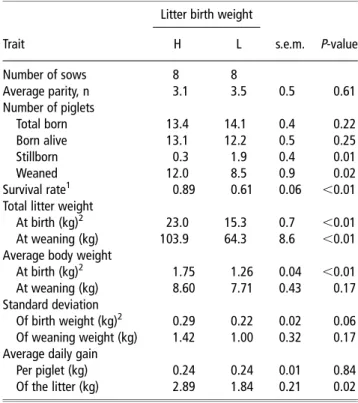
In both groups, the sows selected were on average in their third parity (Table 2). Litter size and number of piglets born alive were similar in the two groups, although the number of stillborns was greater (P50.01) in L- than in H-litters. Piglet survival rate during lactation was lower (P,0.01) in L- compared with H-litters and, consequently, fewer (P50.02) piglets were weaned from L-litters. Despite a similar female-to-male ratio at birth in both experimental groups, L-sows weaned fewer (P,0.07) female pigs (data not shown). As planned, the average litter birth weight of total piglets born
Table 2Reproductive performance of sows classified as having high (H . 1.7 kg)- or low (L , 1.3 kg)-average litter birth weight and litter sizes of between 10 and 15 total pigs born
Litter birth weight
Trait H L s.e.m. P-value
Number of sows 8 8 Average parity, n 3.1 3.5 0.5 0.61 Number of piglets Total born 13.4 14.1 0.4 0.22 Born alive 13.1 12.2 0.5 0.25 Stillborn 0.3 1.9 0.4 0.01 Weaned 12.0 8.5 0.9 0.02 Survival rate1 0.89 0.61 0.06 ,0.01
Total litter weight
At birth (kg)2 23.0 15.3 0.7 ,0.01
At weaning (kg) 103.9 64.3 8.6 ,0.01
Average body weight
At birth (kg)2 1.75 1.26 0.04 ,0.01
At weaning (kg) 8.60 7.71 0.43 0.17
Standard deviation
Of birth weight (kg)2 0.29 0.22 0.02 0.06 Of weaning weight (kg) 1.42 1.00 0.32 0.17 Average daily gain
Per piglet (kg) 0.24 0.24 0.01 0.84
Of the litter (kg) 2.89 1.84 0.21 0.02
1
Calculated from birth to weaning.
alive clearly differed (P,0.01), with the H-litters being 490 g heavier than the L-litters. Concomitantly, total litter weight at birth was lower (P,0.01) for the L-litters than the H-litters. Compared with the H-litters, the L-litters birth weight of female pigs, but not male pigs, were less (P,0.01) variable (data not shown). This resulted in an overall lower standard deviation in L-litters. Regardless of gender, ADG expressed per piglet was similar in both litter groups during lactation, but the high variation prevented the average weaning BW to be significantly different between groups. When calcu-lated for the whole litter, total weaning weight and ADG of the litter were markedly lower (P<0.02) in L- than in H-litters.
Birth weight and growth performance of the selected offspring
At birth, HL- and LH-piglets had similar average BW, whereas
HI-piglets were 530 g heavier (P,0.05) than LI-piglets
(Table 3). Considering birth weight class within litter groups, HL-piglets were 390 g lighter (P,0.05) than in HI-piglets,
and LI-piglets were 230 g lighter (P,0.05) than in LH-piglets.
At weaning, the HI-piglets were still the heaviest group
(P,0.05 against HLand LI). In addition, the difference in
BW was greater within the H- than within the L-litter piglet groups (HIv. HL51.76 kg and LHv.LI50.69 kg). This effect
was related to the faster (P,0.05) growth of HI- compared
with HL-piglets during lactation. During the starter and
gro-wer–finisher periods, average daily feed intake (ADFI) and ADG were similar for all groups. Conversely, when comparing
pigs born with similar birth weight but originating either from H- or L-litters (HL v. LH), the HL-pigs were more
(P,0.05) feed efficient in the grower–finisher period. At 165 days of age, the slaughter BW did not differ among groups. However, the time needed to reach the target BW in the grower–finisher period was shorter (P,0.05) in HL- than in HI-pigs (with the L-litter pigs remaining
inter-mediate) and appeared to be a compensation for the corresponding numerical longer starter period of the HL-pigs.
Gender differences were not observed in the starter period for any of the variables measured. Regardless of the birth weight class, gilts tended to have a lower (P50.10) slaughter weight at 165 days than barrows as a result of the lower (P<0.01) ADG and ADFI in the grower–finisher per-iod. Nevertheless, gilts were more feed efficient and total feed intake was proportionately lower in the same period than that of the barrows (P<0.01 for each). Birth weight class 3 gender interactions (P<0.05) were observed for the gain-to-feed ratio and total feed intake in the grower– finisher period. The HL-female pigs were the most feed
effi-cient of all the other pig categories (Figure 1). In addition, compared with HL-barrows, HL-gilts consumed markedly less
(P,0.05) of the grower and finisher diets.
Carcass characteristics and morphometric data of the fattened offspring
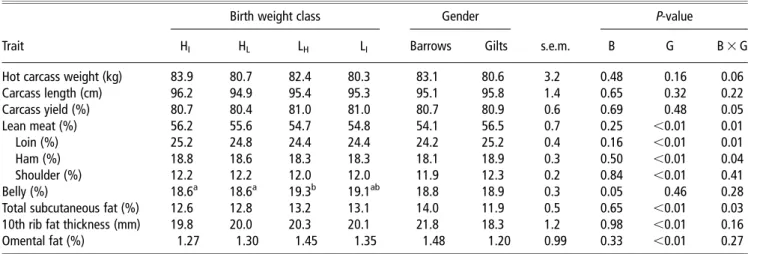
Birth weight had little impact on the carcass characteristics (Table 4). Belly percentage was lower (P,0.05) in HL-pigs
Table 3Effect of birth weight class and gender on growth performance during lactation, starter and growing–finishing periods of the selected piglets1
Birth weight class Gender P-value
Trait HI HL LH LI Barrow Gilts s.e.m. B G B 3 G
Body weight (kg)
At birth 1.79c 1.40b 1.49b 1.26a 1.50 1.47 0.04 ,0.01 0.31 0.30
At weaning 9.70b 7.94a 8.06ab 7.37a 8.08 8.46 0.73 ,0.01 0.22 0.55
At start of grower period 27.7 27.4 28.3 27.9 27.9 27.7 0.9 0.81 0.65 0.36
At slaughter 103.9 100.3 101.7 99.2 102.9 99.6 3.8 0.44 0.10 0.09
Pre-weaning period
Daily gain (g/day) 281b 228a 248ab 230a 240 254 21 0.01 0.22 0.53
Starter period
Daily gain (g/day) 377 366 396 379 381 377 20 0.39 0.67 0.80
Daily feed intake (g/day) 644 627 658 636 642 641 28 0.51 0.98 0.96
Total feed intake (kg) 30.8 33.4 33.8 34.6 33.5 32.8 1.7 0.10 0.51 0.19
Gain to feed (g/kg) 585 584 601 595 595 588 17 0.78 0.49 0.77
Duration (days) 48.4 53.6 51.4 54.7 52.6 51.4 3.1 0.05 0.42 0.06
Grower–finisher period
Daily gain (g/day) 866 879 840 847 882 834 31 0.64 0.01 0.34
Daily feed intake (g/day) 2307 2301 2333 2348 2435 2209 81 0.90 ,0.01 0.07
Total feed intake (kg) 203.1 190.5 203.3 196.9 206.7 190.2 10.6 0.47 0.01 0.03
Gain to feed (g/kg) 376b 383b 360a 361a 361 378 7 ,0.01 ,0.01 0.05
Duration (days) 88.1 82.7 87.2 83.8 84.9 86.1 2.9 0.05 0.43 0.07
1H
Iand HL5littermates with the intermediate (n516) and lowest (n514) birth weight within their litter, born from sows giving birth to litters classified as having
high (.1.7 kg)-average litter birth weight; LHand LI5littermates with the greatest (n515) and intermediate (n516) birth weight within their litter born from
sows giving birth to litters classified as having low (,1.3 kg)-average litter birth weight;n531 for barrow;n530 for gilts; B 5 birth weight class, G 5 gender.
and HI-pigs compared with LH-pigs, with intermediate values for
LI-pigs. As a result of the greater (P,0.01) percentages of loin,
ham and shoulder, and the lower (P,0.01) percentages of omental and back fat, carcasses of gilts were leaner (P,0.01) compared with those of barrows. However, the gender differ-ence for lean meat, loin, ham and total subcutaneous fat per-centages was mainly evident between female pigs and barrows born from H-litters, whereas LH- and LI-female pigs had similar
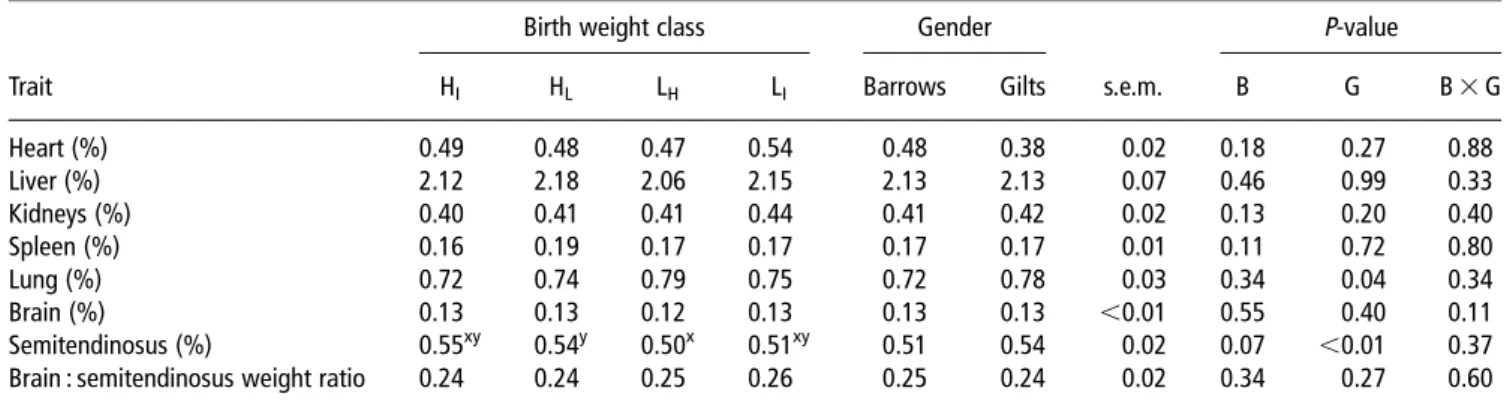
percentages of loin, ham and subcutaneous fat than barrows (birth weight class 3 gender interaction; P<0.03). Relative weight of internal organs and brain expressed as a percentage of hot carcass weight did not differ among birth weight classes and gender (Table 5). By contrast, the relative ST weight tended (P,0.10) to be lower in LH- than in HL-pigs and was lower
(P,0.01) in barrows than gilts.
Quality of the meat from the fattened offspring
Birth weight class effects on the assessed meat quality traits were observed only for LM temperature at 24 h post mortem where temperature was lower (P,0.05) in LI- than in HI-pigs,
with intermediate values in LH-pigs and HL-pigs (Table 6).
With respect to gender, pH and temperature at 30 min post mortem of the ST was greater (P<0.05) in barrows than in gilts, whereas this was not the case in the LM. At 24 h post mortem, the pH and temperature of both muscles did not differ according to gender. Drip and thaw losses of the LM of barrows were lower (P<0.01) than in the LM of the gilts. Discussion
Sow performance in relation to average litter birth weight
A greater incidence of low birth weight piglets has been associated with increased litter size, the latter being the consequence of intensive breeding efforts in the last few decades with the objective to enhance the prolificacy of dams and ultimately improve reproduction efficiency (Milligan
et al., 2002; Quiniouet al., 2002; Quesnelet al., 2008). In the current study, the difference in average litter birth weight between L- and H-litters was ,500 g. In contrast to other studies (e.g., Be´rard et al., 2008), this magnitude of
Figure 1 Effect of birth weight and gender on total feed intake and gain to feed ratio during the grower–finisher period. HIand HL5littermates with the intermediate and lowest birth weight within their litter, born from sows giving birth to litters classified as having high (.1.7 kg) average litter birth weight; LHand LI5littermates with the greatest and intermediate birth weight within their litter born from sows giving birth to litters classified as having low (,1.3 kg) average litter birth weight.a,b,cLeast square means without a common superscript differ (P , 0.05).
Table 4Effect of birth weight class and gender on carcass characteristics1
Birth weight class Gender P-value
Trait HI HL LH LI Barrows Gilts s.e.m. B G B 3 G
Hot carcass weight (kg) 83.9 80.7 82.4 80.3 83.1 80.6 3.2 0.48 0.16 0.06
Carcass length (cm) 96.2 94.9 95.4 95.3 95.1 95.8 1.4 0.65 0.32 0.22 Carcass yield (%) 80.7 80.4 81.0 81.0 80.7 80.9 0.6 0.69 0.48 0.05 Lean meat (%) 56.2 55.6 54.7 54.8 54.1 56.5 0.7 0.25 ,0.01 0.01 Loin (%) 25.2 24.8 24.4 24.4 24.2 25.2 0.4 0.16 ,0.01 0.01 Ham (%) 18.8 18.6 18.3 18.3 18.1 18.9 0.3 0.50 ,0.01 0.04 Shoulder (%) 12.2 12.2 12.0 12.0 11.9 12.3 0.2 0.84 ,0.01 0.41 Belly (%) 18.6a 18.6a 19.3b 19.1ab 18.8 18.9 0.3 0.05 0.46 0.28
Total subcutaneous fat (%) 12.6 12.8 13.2 13.1 14.0 11.9 0.5 0.65 ,0.01 0.03
10th rib fat thickness (mm) 19.8 20.0 20.3 20.1 21.8 18.3 1.2 0.98 ,0.01 0.16
Omental fat (%) 1.27 1.30 1.45 1.35 1.48 1.20 0.99 0.33 ,0.01 0.27
1H
Iand HL5littermates with the intermediate (n516) and lowest (n514) birth weight within their litter, born from sows giving birth to litters classified as having
high (.1.7 kg)-average litter birth weight; LHand LI5littermates with the greatest (n515) and intermediate (n516) birth weight within their litter, born from
sows giving birth to litters classified as having low (,1.3 kg)-average litter birth weight;n531 for barrow;n530 for gilts; B 5 birth weight class, G 5 gender.
a,b
difference in birth weight was unrelated to the number of total born. Nevertheless, in the present study, the standard deviation of within-litter birth weight tended to be lower in L- than in H-litters. Foxcroft et al. (2007) explained this phenomenon as a consequence of prenatal losses of weaker and smaller embryos and fetuses, thereby reducing intra-litter variability in birth weight. Another striking difference between the two litter birth weight groups was the greater proportion of stillborn in L- (13%) compared with H-litters
(2%), which, except for the fact that in the present case it was unrelated to litter size, matches results of earlier studies (Leenhouwers et al., 1999; Milligan et al., 2002; Quiniou
et al., 2002). As observed by Leenhouwerset al.(1999), a low average birth weight is associated with a greater pre-weaning mortality, which was more than three times greater in L- than in H-litters (39%v.11%, respectively). The 33% difference between L- and H-litters in total litter weight at birth increased to 38% at weaning. In accordance with
Table 5Effect of birth weight class and gender on the relative weight of the internal organs, brain and semitendinosus muscle1
Birth weight class Gender P-value
Trait HI HL LH LI Barrows Gilts s.e.m. B G B 3 G
Heart (%) 0.49 0.48 0.47 0.54 0.48 0.38 0.02 0.18 0.27 0.88 Liver (%) 2.12 2.18 2.06 2.15 2.13 2.13 0.07 0.46 0.99 0.33 Kidneys (%) 0.40 0.41 0.41 0.44 0.41 0.42 0.02 0.13 0.20 0.40 Spleen (%) 0.16 0.19 0.17 0.17 0.17 0.17 0.01 0.11 0.72 0.80 Lung (%) 0.72 0.74 0.79 0.75 0.72 0.78 0.03 0.34 0.04 0.34 Brain (%) 0.13 0.13 0.12 0.13 0.13 0.13 ,0.01 0.55 0.40 0.11 Semitendinosus (%) 0.55xy 0.54y 0.50x 0.51xy 0.51 0.54 0.02 0.07 ,0.01 0.37
Brain : semitendinosus weight ratio 0.24 0.24 0.25 0.26 0.25 0.24 0.02 0.34 0.27 0.60
1Relative weights of the organs and semitendinosus muscle are expressed as percentage of hot carcass weight. H
Iand HL5littermates with the intermediate
(n516) and lowest (n514) birth weight within their litter, born from sows giving birth to litters classified as having high (.1.7 kg)-average litter birth weight; LH
and LI5littermates with the greatest (n515) and intermediate (n516) birth weight within their litter born from sows giving birth to litters classified as having
low (,1.3 kg)-average litter birth weight;n531 for barrow;n530 for gilts; B 5 birth weight class, G 5 gender.
x,y,a,bLeast square means within a row for the main factor birth weight class without a common superscript differ (P,0.10).
Table 6Effect of birth weight class and gender on meat quality traits in slaughter pigs1
Birth weight class Gender P-value
Trait HI HL LH LI Barrows Gilts s.e.m. B G B 3 G
Longissimus muscle (pH) 30 min 6.61 6.55 6.56 6.57 6.58 6.56 0.04 0.34 0.31 0.57 24 h 5.61 5.62 5.62 5.62 5.62 5.61 0.03 0.99 0.57 0.44 Temperature (8C) 30 min 39.0 39.3 38.9 38.8 39.0 39.0 0.2 0.26 0.51 0.17 24 h 2.0b 1.8ab 1.6ab 1.5a 1.8 1.7 0.1 0.03 0.19 0.86 Color L* 46.3 47.5 45.5 45.5 46.5 45.9 1.0 0.12 0.32 0.27 Drip loss [% (48 h)] 2.6 2.6 2.3 2.6 2.3 2.8 0.4 0.76 0.01 0.01 Thaw loss (%) 11.5 11.3 11.7 11.5 11.0 12.1 0.6 0.89 ,0.01 0.16 Cooking loss (%) 19.6 20.4 19.9 19.9 19.8 20.0 0.7 0.36 0.56 0.49 Shear force (kg) 63.7 61.4 66.9 68.6 63.5 66.7 5.5 0.58 0.34 0.14
Semitendinosus muscle dark portion (pH)
30 min 6.56 6.52 6.56 6.56 6.58 6.52 0.05 0.78 0.05 0.76 24 h 5.54 5.57 5.62 5.60 5.57 5.59 0.04 0.36 0.59 0.97 Temperature (8C) 30 min 39.9 40.0 39.9 39.9 39.8 40.0 0.1 0.67 0.03 0.42 24 h 2.5 2.4 3.9 2.4 2.5 3.1 1.1 0.33 0.40 0.20 Color L* 40.6 40.8 39.5 40.0 40.4 40.0 0.8 0.45 0.27 0.89 Drip loss (48 h) (%) 1.7 1.8 1.5 1.9 1.8 1.7 0.3 0.29 0.27 0.36 1H
Iand HL5littermates with the intermediate (n516) and lowest (n514) birth weight within their litter, born from sows giving birth to litters classified as having
high (.1.7 kg)-average litter birth weight; LHand LI5littermates with the greatest (n515) and intermediate (n516) birth weight within their litter born from
sows giving birth to litters classified as having low (,1.3 kg)-average litter birth weight;n531 for barrow;n530 for gilts; B 5 birth weight class, G 5 gender.
a,b
Be´rard and Bee (2010), ADG during lactation was indepen-dent of birth weight. Our findings are in contrast to results reported by Quiniouet al. (2002) showing that during lac-tation heavier piglets grow faster than lighter piglets. These authors assumed that heavier piglets have a greater ability to occupy the best-performing teats, to stimulate and to drain them, thereby inducing a larger milk flow. However, because of the greater number of stillborn and greater mortality rate in L- than in H-litters, and as no cross-fostering was performed in the current study, competition among lit-termates for the teats was markedly reduced after the first week of lactation. Thus, growth of L-offspring was not hin-dered by lacking nutrient supply.
Growth performance as affected by birth weight class and gender
The pigs selected at weaning to evaluate growth perfor-mance, carcass and meat quality traits mirrored the selection criteria of the experimental design, as birth weights of LI- and HI-pigs were close to the average birth weight of the
respective litters and LH- and HL-pigs had a similar birth
weight. Therefore, based on the results of previous studies reporting a close relationship between birth weight and early postnatal growth (Gondretet al., 2006; Be´rardet al., 2010), the ranking of BW at weaning could have been expected to remain similar for the four groups as at birth (HI.LH5HL.LI). In fact, this relationship was confirmed
in the H-litters where growth rate and weaning weight depended on birth weight. By contrast in the L-litters, LI-pigs
reached comparable weaning weights as their heavier lit-termates (LH). A likely explanation for the similar growth rate
might be found in the greater mortality rate in L-litters that entailed less competition for teats and therefore nutrient supply from sow milk, and thus might not have limited growth of lighter and usually less vital pigs. Along the same line of explanation, it was unexpected to observe that LH-pigs did not translate the greater nutrient availability into
greater growth rates, as their ADG was comparable to the one of HL-pigs.
Consistent with results of previous studies (Gondretet al., 2005; Be´rardet al., 2008; Be´rardet al., 2010), pigs born with a lower birth weight displayed catch-up growth, because differences in BW between the four experimental groups gradually disappeared after weaning. To compensate for the 2.33 kg lower weaning weight, it took the lightest pigs (LI)
on average 6.3 days longer than the heaviest pigs (HI) to
reach the beginning of the grower period, which was defined to start at an average BW of 27 kg. This helps explaining the greater total intake of starter diet in LI- compared with
HI-pigs, as neither ADG nor ADFI gains to feed ratio differed
between the birth weight groups. In the grower–finisher period, feed efficiency was lower in L- than in H-offspring owing to the numerically lower ADG and greater ADFI. Consistent with the study by Be´rardet al.(2010), this effect was more distinct in female pigs, implying that under
ad libitumfeed supply, especially female pigs, born from low average litter birth weight sows, will perform less efficiently.
Except for the relative ST weights, which tended to be lower in LH- than in HL-pigs and were lower in barrows than
gilts, neither birth weight nor gender affected relative weights of internal organs and brain. This was surprising in view of the fact that using a similar experimental design, Pardo et al.(2010) reported a lower relative brain weight (expressed relative to the birth weight) in HI- than in
LI-newborns and lower in HL- than in LH-newborns. This had
let the authors conclude that those lighter piglets had some characteristics associated with growth retardation as sup-ported by other studies (Bauer et al., 2003; Town et al., 2005; Vallet and Freking, 2006). Furthermore, it was shown that an impaired development of organs such as the kidneys, heart and liver can still be observed in low birth weight compared with high birth weight pigs when they reach the slaughter weight (Be´rardet al., 2008; Rehfeldtet al., 2008; Nissen and Oksbjerg, 2011). Therefore, based on the find-ings on organ weight and carcass composition, it is difficult to assess whether, or to which extent, offspring from L-sows had been subjected to intrauterine growth retardation.
Carcass and meat quality as affected by birth weight class and gender
The data published on the impact of birth weight on carcass characteristics are inconsistent owing to differences in applied feeding strategies, rearing conditions or range of birth weight used in the various studies. For instance, carcasses of low birth weight compared with high birth weight pigs were fatter at slaughter if pigs were reared in individual pens and hadad libitumaccess to the diet (Gondret
et al., 2006). By contrast, carcass composition was similar when low birth weight and high birth weight pigs penned in groups had restricted access to the feed (Gondretet al., 2005). Covering a wide birth weight range of up to 850 g, data of various studies reported no relationship between birth weight and lean meat percentage (Gondretet al., 2005; Be´rardet al., 2008; Beaulieuet al., 2010). By contrast, when differences in birth weight were ,900 g, Rehfeldt and Kuhn (2006) found a tendency toward leaner carcasses in low birth weight (0.94 kg) compared with high (1.80 kg) birth weight pigs slaughtered at the same age. However, in a similar study by the same authors, carcass leanness did not differ when birth weight differences were ,400 g (1.39v.1.80 kg or 1.37v.1.67 kg) (Rehfeldt and Kuhn, 2006; Rehfeldtet al., 2008). Thus, it appears that the ratio of adipose and muscle tissue deposition rate is affected only in littermates with very low birth weight, which might explain the lack of effect on carcass characteristics in the cur-rent experiment with a difference in average birth weight of up to 530 g (LI-v. HI-pigs). Furthermore, it has to be kept in mind
that, in contrast to all of the aforementioned studies where pigs with extremely high or low birth weight were compared, LI-pigs
were in the intermediate birth weight range within their litters and were 320 and 180 g heavier than the piglets in the studies by Rehfeldt and Kuhn (2006) and Rehfeldt et al. (2008), respectively. Nevertheless, there was one exception. Belly per-centage, which is a cut with a great amount of intermuscular fat, was greater in LH- compared with HL-pigs and HI-pigs,
suggesting that the impaired feed efficiency of the LH-pigs in
the grower–finisher period affected this pork cut.
Usually when female pigs and barrows have ad libitum
access to the grower–finisher diets, carcasses of female pigs are leaner at slaughter (Ellis et al., 1996; Rehfeldt et al., 2008; Be´rard et al., 2010). This difference was noticeable between gilts and barrows born from the H-litters, whereas percentages of lean meat, loin, ham, subcutaneous and back fat were similar in gilts and barrows of the LH-group and
LI-group. In addition, these findings match the similar feed
efficiency found in the grower–finisher period in the L-litters. Results of other studies also suggested that low birth weight has stronger effects on carcass composition in female pigs compared with male pigs (Poore and Fowden, 2004; Gondret
et al., 2006; Be´rardet al., 2010).
Effects of birth weight or gender on technological traits of the LM and dark portion of the ST were marginal, which matches results of previous studies (Nissen et al., 2004; Be´rard et al., 2008; Rehfeldtet al., 2008; Beaulieuet al., 2010).
In conclusion, this study confirms the occurrence of negative effects on viability and pre-weaning performance of piglets born from litters with a low average weight probably as a result of low gestation efficiency. This gets obvious by the increased number of stillborns and a greater pre-weaning mortality of progeny. Therefore, the number of piglets weaned was reduced, which adversely affected sow performance. Contrary to expectations, low birth weight did not impair postnatal growth of their individuals and, thus fattening performance and the initial variability in weight observed at birth in these litters of normal size gradually disappeared after weaning. There was also no differences in the brain : muscle ratio at slaughter making assumptions about the presence or absence of intrauterine crowding as a reason for low average birth weight inconclusive. Within the litters, gender variability caused more effects on postnatal growth in the L-litters, particularly in the female pigs, than in the H-litters. Further studies have to identify the reasons for the differences in the efficiency in sows with apparently normal litter size and the gender-dependence adverse effects on performance of the offspring of low birth weight litters. Acknowledgments
The authors thank Guy Maı¨koff and his team for taking care of the animals, and Dr Paolo Silacci and his team for the help during sample collection and muscle analysis. This study was supported by the Fondation Sur-la-Croix (Basel, Switzerland). References
Agroscope Liebefeld Posieux Research Station (ALP) 2012. Fu¨tterungsempfeh-lungen und Na¨hrwerttabellen fu¨r Schweine [Feeding recommendations and nutrient tables for pigs]. Agroscope, Posieux, Switzerland.
Bauer R, Walter B, Brust P, Fuchtner F and Zwiener U 2003. Impact of asymmetric intrauterine growth restriction on organ function in newborn piglets. European Journal of Obstetrics Gynecology and Reproductive Biology 110, S40–S49.
Beaulieu AD, Aalhus JL, Williams NH and Patience JF 2010. Impact of piglet birth weight, birth order, and litter size on subsequent growth performance, carcass
quality, muscle composition, and eating quality of pork. Journal of Animal Science 88, 2767–2778.
Bee G, Gebert S and Messikommer R 2002. Effect of dietary energy supply and fat source on the fatty acid pattern of adipose and lean tissues and lipogenesis in the pig. Journal of Animal Science 80, 1564–1574.
Bee G, Jacot S, Guex G and Herzog W 2004. Effects of two supplementation levels of linseed combined with CLA or tallow on meat quality traits and fatty acid profile of adipose tissue and longissimus muscle in pigs. Journal of Animal Science 82, 134–134.
Be´rard J and Bee G 2010. Effects of dietaryL-arginine supplementation to gilts
during early gestation on foetal survival, growth and myofiber formation. Animal 4, 1680–1687.
Be´rard J, Kreuzer M and Bee G 2008. Effect of litter size and birth weight on growth, carcass and pork quality, and their relationship to postmortem proteolysis. Journal of Animal Science 86, 2357–2368.
Be´rard J, Kreuzer M and Bee G 2010. In large litters birth weight and gender is decisive for growth performance but less for carcass and pork quality traits. Meat Science 86, 845–851.
Dwyer CM, Fletcher JM and Stickland NC 1993. Muscle cellularity and postnatal growth in the pig. Journal of Animal Science 71, 3339–3343.
Ellis M, Webb AJ, Avery PJ and Brown I 1996. The influence of terminal sire genotype, sex, slaughter weight, feeding regime and slaughter-house on growth performance and carcass and meat quality in pigs and on the organoleptic properties of fresh pork. Animal Science 62, 521–530.
Fix JS, Cassady JP, Holl JW, Herring WO, Culbertson MS and See MT 2010. Effect of piglet birth weight on survival and quality of commercial market swine. Livestock Science 132, 98–106.
Foxcroft GR, Bee G, Dixon W, Hahn M, Harding J, Patterson J, Putman T, Sarmento S, Smit M, Tse W-Y and Town SC 2007. Consequences of selection for litter size on piglet development. In Paradigms in pig science (ed. J Wiseman, MA Varley, S McOrist and B Kemp), pp. 207–229. Nottingham University Press, Nottingham.
Gondret F, Lefaucheur L, Juin H, Louveau I and Lebret B 2006. Low birth weight is associated with enlarged muscle fiber area and impaired meat tenderness of the longissimus muscle in pigs. Journal of Animal Science 84, 93–103. Gondret F, Lefaucheur L, Louveau I, Lebret B, Pichodo X and Le Cozler Y 2005. Influence of piglet birth weight on postnatal growth performance, tissue lipogenic capacity and muscle histological traits at market weight. Livestock Production Science 93, 137–146.
Honikel KO 1998. Reference methods for the assessment of physical characteristics of meat. Meat Science 49, 447–457.
Leenhouwers JI, van der Lende T and Knol EF 1999. Analysis of stillbirth in different lines of pig. Livestock Production Science 57, 243–253.
Milligan BN, Fraser D and Kramer DL 2002. Within-litter birth weight variation in the domestic pig and its relation to pre-weaning survival, weight gain, and variation in weaning weights. Livestock Production Science 76, 181–191.
Nissen PM and Oksbjerg N 2011. Birth weight and postnatal dietary protein level affect performance, muscle metabolism and meat quality in pigs. Animal 5, 1382–1389.
Nissen PM, Jorgensen PF and Oksbjerg N 2004. Within-litter variation in muscle fiber characteristics, pig performance, and meat quality traits. Journal of Animal Science 82, 414–421.
Pardo C, Kreuzer M and Bee G 2010. Relationship between average litter weight and intralitter weight variability on myogenesis in newborn piglets. Journal of Dairy Science 93, 364.
Poore KR and Fowden AL 2004. The effects of birth weight and postnatal growth patterns on fat depth and plasma leptin concentrations in juvenile and adult pigs. The Journal of Physiology Online 558, 295–304.
Quesnel H, Brossard L, Valancogne A and Quiniou N 2008. Influence of some sow characteristics on within-litter variation of piglet birth weight. Animal 2, 1842–1849.
Quiniou N, Dagorn J and Gaudre´ D 2002. Variation of piglets’ birth weight and consequences on subsequent performance. Livestock Production Science 78, 63–70.
Rehfeldt C and Kuhn G 2006. Consequences of birth weight for postnatal growth performance and carcass quality in pigs as related to myogenesis. Journal of Animal Science 84, E113–E123.
Rehfeldt C, Tuchscherer A, Hartung M and Kuhn G 2008. A second look at the influence of birth weight on carcass and meat quality in pigs. Meat Science 78, 170–175.
Suisag 2012. Zahlen und Projekte 2011. Retrieved January 23, 2013, from http://www.suisag.ch/Dokumente/tabid/111/Default.aspx.
Town SC, Patterson JL, Pereira CZ, Gourley G and Foxcroft GR 2005. Embryonic and fetal development in a commercial dam-line genotype. Animal Reproduc-tion Science 85, 301–316.
Vallet JL and Freking BA 2006. Changes in fetal organ weights during gestation after selection for ovulation rate and uterine capacity in swine. Journal of Animal Science 84, 2338–2345.
van der Waaij EH, Hazeleger W, Soede NM, Laurenssen BFA and Kemp B 2010. Effect of excessive, hormonally induced intrauterine crowding in the gilt on fetal development on day 40 of pregnancy. Journal of Animal Science 88, 2611–2619.
Wu G, Bazer FW, Wallace JM and Spencer TE 2006. Board-invited review: intrauterine growth retardation: implications for the animal sciences. Journal of Animal Science 84, 2316–2337.
Zhao X, Mo D, Li A, Gong W, Xiao S, Zhang Y, Qin L, Niu Y, Guo Y, Liu X, Cong P, He Z, Wang C, Li J and Chen Y 2011. Comparative analyses by sequencing of transcriptomes during skeletal muscle development between pig breeds differing in muscle growth rate and fatness. PLoS One 6, e19774.