Review article
Babett Ramsauer * , Alex C. Vidaeff , Irene H ö sli , Joong Shin Park , Alexander Strauss ,
Zulfiya Khodjaeva , Á ngel Aguar ó n de la Cruz , Txant ó n Mart í nez-Astorquiza , Jacques Horovitz ,
Frederic Coatleven and Hanns Helmer
The diagnosis of rupture of fetal membranes
(ROM): a meta-analysis
Abstract
Aim: The aim of this study was to compare the
perfor-mance of tests based on the detection of insulin-like
growth factor binding protein 1 (IGFBP-1) and placental
α -microglobulin-1 (PAMG-1) in diagnosing rupture of fetal
membranes (ROM) across different patient populations.
Methods: A meta-analysis was conducted on prospective
observational or cohort studies investigating ROM tests
based on the detection of IGFBP-1 and PAMG-1 meeting the
following criteria: (1) performance metrics calculated by
comparing results to an adequate reference method; (2)
sensitivity thresholds of the investigated tests matching
those of the currently available tests; (3) study population,
as a minimum, included patients between 25 and 37 weeks
of gestation. Sensitivities, specificities, and diagnostic
odds ratios were calculated.
Results: Across all patient populations, the analyzed
perfor-mance measures of the PAMG-1 test were significantly
supe-rior compared with those of the IGFBP-1 test. Of particular
clinical relevance, PAMG-1 outperformed IGFBP-1 in the
equivocal group, which comprised patients with uncertain
rupture of membranes (sensitivity, 96.0 % vs. 73.9 % ;
specific-ity, 98.9 % vs. 77.8 % ; PAMG-1 vs. IGFBP-1 tests, respectively).
Conclusions: Compared with its performance in women
with known membrane status, the accuracy of the IGFBP-1
test decreases significantly when used on patients whose
membrane status is unknown. In this latter clinically
rele-vant population, the PAMG-1 test has higher accuracy than
the IGFBP-1 test.
Keywords: Clinical relevance; insulin-like growth factor
binding protein (IGFBP-1);
placental
α -microglobulin 1
(PAMG-1); premature rupture of fetal membranes (PROM);
uncertain rupture.
*Corresponding author: Babett Ramsauer , MD, Vivantes Hospital Neukölln, Babett Ramsauer, Perinatal Medicine, Rudowerstr. 48, D-12351 Berlin, Germany, Tel.: +49 30130148486,
Fax: +49 30130148599, E-mail: [email protected]
Alex C. Vidaeff: Baylor College of Medicine , Houston, TX , USA Irene H ö sli: University Hospital Basel , University of Basel, Basel , Switzerland
Joong Shin Park: College of Medicine , Seoul National University, Seoul , Korea
Alexander Strauss: University Hospital of Schleswig-Holstein , Germany Zulfiya Khodjaeva: Federal Research Center for Obstetrics and Gynecology and Perinatology , Moscow , Russia
Á ngel Aguar ó n de la Cruz: Hospital General Universitario Gregorio Mara ñ ó n , Complutense University of Madrid, Madrid , Spain Txant ó n Mart í nez-Astorquiza: Cruces University Hospital , University of the Basque Country, Bilbao , Spain
Jacques Horovitz and Frederic Coatleven: University of Bordeaux , Bordeaux , France
Hanns Helmer: Medical University of Vienna , Vienna, Austria
Introduction
Over the years, more than 100 different approaches have
been proposed in obstetrical practice for the diagnosis
of premature or prelabor rupture of the fetal membranes
(PROM) [13, 45] . The mere number of such attempts signals
the importance of making an accurate diagnosis of PROM.
PROM is encountered in 10 % of all pregnancies, with up to
5 % of those cases occurring preterm [referred to as preterm
PROM (PPROM)]. The latter group accounts for up to 40 %
of all spontaneous preterm births [3, 20] . It follows that
an accurate diagnosis of PROM is essential in guiding the
clinical management and allowing for the early and timely
administration of antibiotics, corticosteroids, and other
interventions to help reduce the effects of prematurity [35] .
Despite the high number of proposed methods for the
diagnosis of PROM, most have not entered into or persisted
in routine clinical practice. Some were just impractical,
whereas others performed poorly in unknown cases
(mem-brane status unknown at the time of presentation with
sus-picion of ROM), despite good performance previously
dem-onstrated in known samples or unequivocal cases.
A good example of a test that is impractical for routine
use is the intra-amniotic injection of indigo carmine dye;
consequently, its use remains very limited [4] . Well-known
examples of methods with poor performance in unknown
cases and whose role was limited to that of a supportive
test rather than a confirmatory one are the fern test [10,
48] and the fetal fibronectin (fFN) test [15, 22] .
The more recent literature has focused prevalently
on two ROM biomarker tests: the AmniSure
®ROM Test
(AmniSure
®lnternational LLC, Boston, MA, USA), based
on the detection of placental
α -microglobulin 1 (
PAMG-1), and the Actim
®Prom Test (Oy Medix Biochemica Ab,
Kauniainen, Finland), based on the detection of
insulin-like growth factor binding protein (IGFBP-1) [12, 25, 27,
39] . The test based on PAMG-1 is the more recent of the
two, with the first study on it being published in 2005, vs.
1996 for the test based on IGFBP-1 [8, 41] . The objective of
this systematic review was to compare the performance
of these two tests in relevant patient populations.
Methods
Data source
The literature published in any language between 1990 and 2011 was searched for papers on the diagnosis of premature or prelabor rupture of the fetal membranes. We searched the MEDLINE biblio-graphic database using a combination of keywords, including “ rup-ture of membranes ” , “ insulin-like growth factor binding protein ” , “ IGFBP-1 ” , “ placental α -microglobulin 1 ” , and “ PAMG-1 ” . All refer-ences in the retrieved articles were screened for further papers. Edi-torials, proceedings of meetings, and reviews, although not included in the analysis, were scanned for relevant studies not quoted by the database.
Study selection
Only prospective observational or cohort studies that met the fol-lowing criteria were included in the meta-analysis: (1) the perfor-mance metrics were calculated by comparing the results with an adequate reference method for the diagnosis of ROM as defined later; (2) the investigated test(s) had sensitivity thresholds match-ing those of the currently available tests for the respective anti-gens: 5 ng/mL in vivo for PAMG-1 [8] and 400 ng/mL in vivo for IGFBP-1 (i.e., 25 ng/mL in vitro ) [41] ; and (3) the study population
included (but was not confined to) patients between 25 and 37 weeks of gestation.
An adequate reference method is one that is expected to be accurate, such as (a) visible leakage from the cervical os or intra-amniotic injection of indigo carmine dye or (b) a chart review of the patient ’ s clinical course from initial diagnosis that includes outcome measures closely linked to the clinical pathology of ROM (e.g., du-ration of latency period, time to delivery, results of repeat examina-tions, signs of fetal distress, chorioamnionitis) [45] . On the contrary, an inadequate reference method is one with limited accuracy, such as the diamine oxidase (DAO) or fFN test.
To establish clinical homogeneity among patient populations from the included studies, two main groups were created to compare performance metrics:
1. Known group: cases with unequivocally ruptured membranes (e.g., artificially ruptured membranes, gross leakage of amniotic fluid, or known amniotic fluid samples used in the study) or unequivocally not ruptured membranes (e.g., asymptomatic women presenting for routine antenatal screening without complaints of leakage).
2. Unknown group: patients presenting with signs and symptoms of ROM with unknown membrane status at the time of study enrollment.
One study may appear in more than one patient population group when more than one set of performance metrics relevant to diff erent patient populations were used in the study.
From each study, the following data were extracted: the total number of patients and the number of true-positive, true-negative, false-positive, and false-negative results for the diagnosis of ROM. The performance measures for the PAMG-1 and IGFBP-1 tests were sensitivity, specifi city, and the diagnostic odds ratios. Sensitivity and specifi city tests assessed diagnostic accuracy without being infl u-enced by the diff erent prevalence of ROM within the diff erent patient population groups, and the diagnostic odds ratio is one of the better measures of overall accuracy, as it makes the most effi cient use of all data points. The performance of the same test in diff erent patient populations was compared as well as the performance of the two tests in the same patient population.
Weighted least squares regressions on the logits of each meas-ure were performed, with the weights inversely proportional to the variance of the logits. Signifi cance was determined at the 0.05 level through t -tests on the coeffi cients. In cases where a false-negative or false-positive value was 0, 0.5 was added to that value, whereas 0.5 was subtracted from the true-positive or negative-value, depending on the measure being calculated [17] .
Results
Study selection
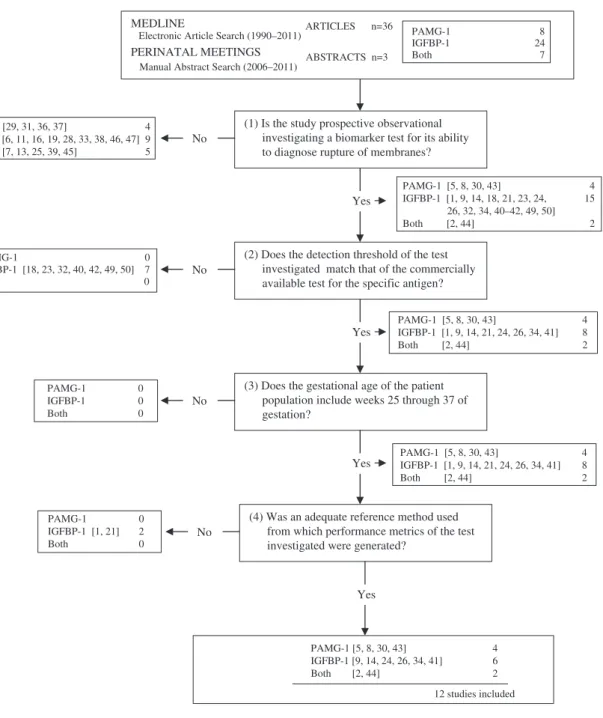
The search yielded 36 articles, eight of which related
spe-cifically to the PAMG-1 test [5, 8, 29 – 31, 36, 37, 43] , 24 to the
IGFBP-1 test [1, 6, 9, 11, 14, 16, 18, 19, 21, 23, 24, 26 – 28, 32 –
34, 38, 40, 42, 46, 47, 49, 50] , and seven that were related to
both [2, 7, 13, 25, 39, 44, 45] . The supplementary search of
proceedings of perinatal meetings yielded three abstracts,
all of which related specifically to the PAMG-1 test [31, 36,
43] . Together, 39 studies were identified and evaluated
further for inclusion into the meta-analysis. Figure 1
illus-trates the study selection algorithm.
The first filter isolated 21 prospective observational
studies that investigated one or both of the biomarkers
for their ability to diagnose ROM. The 18 studies that were
excluded were review articles, investigated a property of
the testing device itself (e.g., reproducibility of testing
results), or investigated the ability of the test for an
alter-native indication (e.g., prediction of preterm delivery).
The second filter isolated 14 of the 21 remaining studies
based on the inclusion criterion stipulating that the tests
detection thresholds should match those of the
commer-cially available tests for the respective antigens. The 7
studies that were eliminated were specifically related to
the detection of IGFBP-1 and did not match the detection
threshold of the commercially available kit (400 ng/mL
in vivo ; 25 ng/mL in vitro ). All of the 14 selected studies
included patients between 25 and 37 weeks of gestation,
satisfying all the inclusion criteria.
Finally, 2 more studies were eliminated from further
evaluation on account of an inadequate reference method
to generate performance metrics. In one study [1] , the
IGFBP-1 test was compared with the results of DAO, a
method that is not considered accurate in diagnosing ROM
[45] , and in the other [21] , the performance metrics for
PAMG-1: Placental alpha microglobulin-1 test specific study(s) IGFBP-1: Insulin-like growth factor binding protein-1 test specific study(s) Both: PAMG-1 and IGFBP-1 tests included in the study(s)
MEDLINE
PERINATAL MEETINGS
Electronic Article Search (1990–2011) Manual Abstract Search (2006–2011)
(2) Does the detection threshold of the test investigated match that of the commercially available test for the specific antigen? No
Yes
12 studies included
(4) Was an adequate reference method used from which performance metrics of the test investigated were generated?
No
Yes
(1) Is the study prospective observational investigating a biomarker test for its ability to diagnose rupture of membranes? No
Yes
PAMG-1
(3) Does the gestational age of the patient population include weeks 25 through 37 of gestation? No Yes 0 PAMG-1 0 IGFBP-1 [1, 21] 2 Both 0 ARTICLES n=36 ABSTRACTS n=3 PAMG-1 8 IGFBP-1 24 Both 7 PAMG-1 [5, 8, 30, 43] 4 IGFBP-1 [9, 14, 24, 26, 34, 41] 6 Both [2, 44] 2 PAMG-1 [29, 31, 36, 37] 4 IGFBP-1 [6, 11, 16, 19, 28, 33, 38, 46, 47] 9 Both [7, 13, 25, 39, 45] 5 IGFBP-1 [18, 23, 32, 40, 42, 49, 50] 7 Both 0 PAMG-1 0 IGFBP-1 0 Both 0 PAMG-1 [5, 8, 30, 43] 4 IGFBP-1 [1, 9, 14, 21, 24, 26, 34, 41] 8 Both [2, 44] 2 PAMG-1 [5, 8, 30, 43] 4 IGFBP-1 [1, 9, 14, 21, 24, 26, 34, 41] 8 Both [2, 44] 2 PAMG-1 [5, 8, 30, 43] 4 IGFBP-1 [1, 9, 14, 18, 21, 23, 24, 15 26, 32, 34, 40–42, 49, 50] Both [2, 44] 2
Figure 1 Study selection process. PAMG-1 = placental α -microglobulin-1 test specific study(s), IGFBP-1 = insulin-like growth factor binding protein-1 test specific study(s), both = PAMG-1 and IGFBP-1 tests included in the study(s).
the IGFBP-1 test were based on a heterogeneous outcome
measure (delivery within 2 weeks) that does not allow for
a direct association with ROM. It is noted that this study
could have been eliminated from further evaluation during
the second filter instead of the third because although the
IGFBP-1 test used had a detection threshold matching that
of the commercially available kit for IGFBP-1, the test was
performed by placing the testing strip directly into the
cer-vical os and posterior fornix of the vagina without the use
of the collection swab [1] . Given that Rutanen et al. [41]
highlighted that the swab is responsible for a 1:16 dilution
of the sample, the use of the test without the swab lowers
the detection threshold of the test quite substantially.
Grouping performance metrics by patient
population group
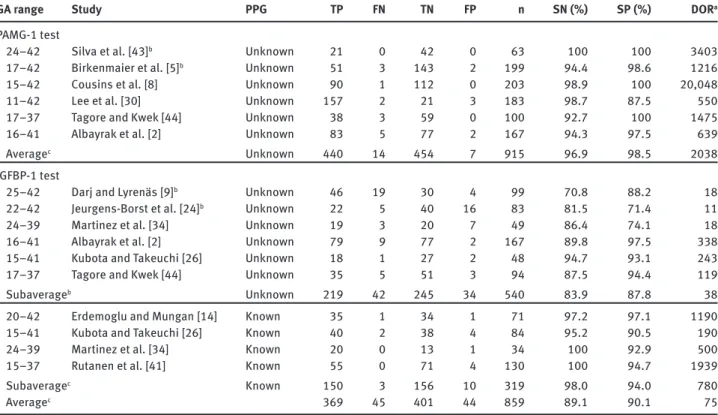
Table 1 outlines the grouping of the various performance
metrics by the patient population group from which they
were derived. From the included 12 studies, 16 sets of
perfor-mance metrics were extracted. Six of these sets were for the
PAMG-1 test (unknown group) and 10 were for the IGFBP-1
test (known and unknown group). No sets of performance
metrics were identified for the PAMG-1 test in patients that
had unequivocally ruptured membranes or
unequivo-cally not ruptured membranes (i.e., the known group). For
both the PAMG-1 and IGFBP-1 test, six sets of performance
metrics were identified that were derived from patients
pre-senting with suspected ROM but with unknown membrane
status at the time of presentation (i.e., the unknown group).
Comparison of performance metrics between
tests and within patient population groups
Across all patient population groups (known and
unknown), the PAMG-1 test performed significantly better
than the IGFBP-1 test with respect to all performance
measures (P
< 0.01; Table 2 ).
For the unknown group specifically, the PAMG-1
test performed significantly better than the IGFBP-1 test,
with respect to all performance measures (P
< 0.012;
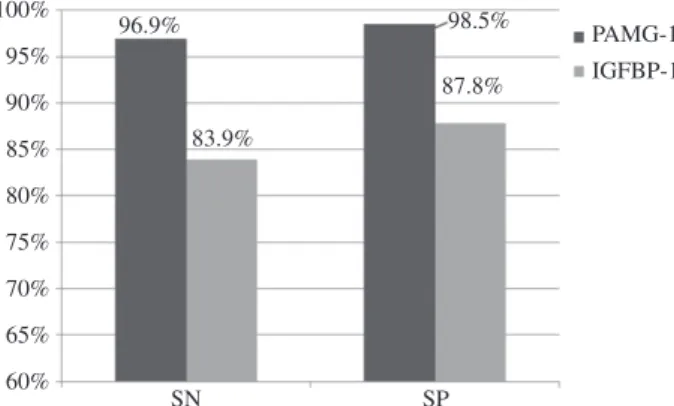
Table 2). Figure 2 illustrates how each test performed in
the unknown group using the averages of the measures
GA range Study PPG TP FN TN FP n SN ( % ) SP ( % ) DOR a
PAMG-1 test
24 – 42 Silva et al. [43] b Unknown 21 0 42 0 63 100 100 3403
17 – 42 Birkenmaier et al. [5] b Unknown 51 3 143 2 199 94.4 98.6 1216
15 – 42 Cousins et al. [8] Unknown 90 1 112 0 203 98.9 100 20,048
11 – 42 Lee et al. [30] Unknown 157 2 21 3 183 98.7 87.5 550
17 – 37 Tagore and Kwek [44] Unknown 38 3 59 0 100 92.7 100 1475
16 – 41 Albayrak et al. [2] Unknown 83 5 77 2 167 94.3 97.5 639
Average c Unknown 440 14 454 7 915 96.9 98.5 2038
IGFBP-1 test
25 – 42 Darj and Lyren ä s [9] b Unknown 46 19 30 4 99 70.8 88.2 18
22 – 42 Jeurgens-Borst et al. [24] b Unknown 22 5 40 16 83 81.5 71.4 11
24 – 39 Martinez et al. [34] Unknown 19 3 20 7 49 86.4 74.1 18
16 – 41 Albayrak et al. [2] Unknown 79 9 77 2 167 89.8 97.5 338
15 – 41 Kubota and Takeuchi [26] Unknown 18 1 27 2 48 94.7 93.1 243
17 – 37 Tagore and Kwek [44] Unknown 35 5 51 3 94 87.5 94.4 119
Subaverage b Unknown 219 42 245 34 540 83.9 87.8 38
20 – 42 Erdemoglu and Mungan [14] Known 35 1 34 1 71 97.2 97.1 1190
15 – 41 Kubota and Takeuchi [26] Known 40 2 38 4 84 95.2 90.5 190
24 – 39 Martinez et al. [34] Known 20 0 13 1 34 100 92.9 500
15 – 37 Rutanen et al. [41] Known 55 0 71 4 130 100 94.7 1939
Subaverage c Known 150 3 156 10 319 98.0 94.0 780
Average c 369 45 401 44 859 89.1 90.1 75
Table 1 Performance measures by patient population group.
GA = gestational age, PPG = patient population group, TP = true-positive, FN = false-negative, TN = true-negative, FP = false-positive, n = total number, SN = sensitivity, SP = specificity, DOR = diagnostic odds ratio. a A value of 0.5 was added to an FN or FP of 0, and 0.5 was subtracted
from the true-positive or true-negative value depending on the measure being calculated. b Patient population consisted of only those
presenting with suspicion of ROM who did not have gross or obvious ruptures, i.e., the equivocal group. c Averages were calculated for each
(sensitivity, 96.9 % vs. 83.9 % ; specificity, 98.5 % vs. 87.8 % ;
PAMG-1 test and IGFBP-1 test, respectively).
The IGFBP-1 test performed significantly better in the
known group than in the unknown group with respect
to sensitivity (P
= 0.008; Table 3 ) and the diagnostic odds
ratio (P
= 0.017; Table 3). Figure 3 illustrates how the
IGFBP-1 test performed in both patient population groups
using averages of the measures (sensitivity, 98.0
%
vs.
83.9 % ; specificity, 94.0 % vs. 87.8 % ; known and unknown
IGFBP-1 groups, respectively). Because no studies were
found investigating the performance of the PAMG-1 test in
known samples or unequivocal patient cases, it was not
possible to compare the performance of this test between
the groups.
A subgroup analysis was also performed on the
per-formance of each test in patients presenting with
sus-pected ROM but for whom leakage from the cervical os
could not be visualized. We called this subgroup of the
unknown group, the “ equivocal group ” . For the equivocal
Description Performance measure Interpretation of statistically significant results a
SN SP DOR
PAMG-1 vs. IGFBP-1: unknown and known 0.009 a 0.005 a 0.001 a The PAMG-1 test performed better than the IGFBP-1 test overall.
PAMG-1 vs. IGFBP-1: unknown 0.005 a 0.011 a 0.003 a The PAMG-1 test performed better than the IGFBP-1 test in the
unknown group.
Table 2 Test comparison within and between patient population groups statistical analysis. SN = sensitivity, SP = specificity, DOR = diagnostic odds ratio. a Significance level, P < 0.05.
100% 96.9% 83.9% SN SP PAMG-1 IGFBP-1 98.5% 87.8% 95% 90% 85% 80% 75% 70% 65% 60%
Figure 2 PAMG-1 vs. IGFBP-1 in the unknown group using averages of the measures.
Description Performance measure Interpretation of statistically significant results a
SN SP DOR
IGFBP-1: unknown vs. known 0.008 a 0.504 0.017 a The IGFBP-1 test performed better in the known group than in the unknown group.
PAMG-1: unknown vs. known N/A N/A N/A Not applicable because the known group does not exist for the PAMG-1 test.
Table 3 Individual test performance between patient population group statistical analyses. SN = sensitivity, SP = specificity, DOR = diagnostic odds ratio. a Significance level, P < 0.05.
group, the PAMG-1 test performed significantly better than
the IGFBP-1 test with respect to the diagnostic odds ratio
(P
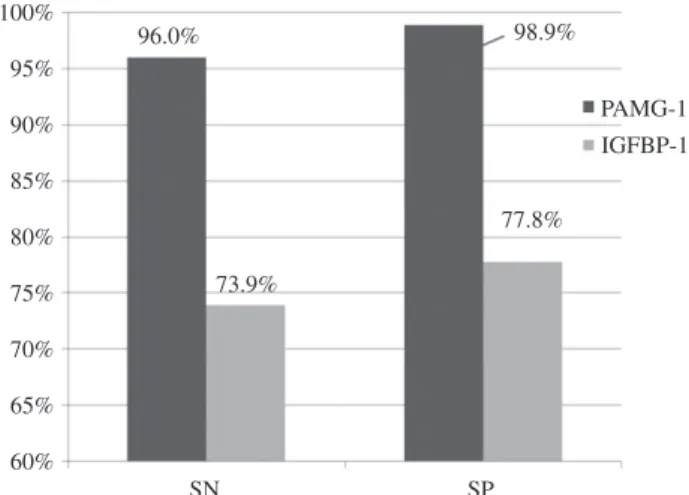
= 0.019; Table 4 ). Figure 4 illustrates how each test
per-formed in the equivocal group using averages of the
meas-ures (sensitivity, 96.0 % vs. 73.9 % ; specificity, 98.9 % vs.
77.8 % ; PAMG-1 test and IGFBP-1 test, respectively).
Lastly, the IGFBP-1 test performed significantly better
for the known group than it did for the equivocal group
with respect to sensitivity (P
= 0.042; Table 4) and the
diagnostic odds ratio (P
= 0.018; Table 4). Figure 5
illus-trates how the IGFBP-1 test performed in the known and
equivocal patient population groups using averages of
the measures (sensitivity, 98.0 % vs. 73.9 % ; specificity,
94.0 % vs. 77.8 % ; known and equivocal IGFBP-1 groups,
respectively). Because no studies were found
investigat-ing the performance of the PAMG-1 test in known samples
or obvious patient cases, we were unable to compare the
performance of this test for the equivocal group to that for
the known group.
Discussion
Although it was found that all studies investigating the
PAMG-1 test were conducted solely on patients with
unknown membrane status, many of studies specifically
focusing on the IGFBP-1 test included a patient
popula-tion for whom there existed no quespopula-tion about the status
of their membranes (i.e., the known group) [18, 21, 32, 36] .
When the known and unknown groups were compared,
we found that the sensitivity and diagnostic odds ratio
for the IGFBP-1 test were lower in patients with unknown
membrane status compared with those whose membrane
status was known. This finding has practical implications
because in obstetrical care, the only clinically relevant
population to test is that of women for whom the status of
the membranes is not obvious at the time of presentation
[9, 28] .
Similarly, the classical fern test was found by de Haan
et al. [10] to perform better in obvious or known cases
than in non-laboring patients suspected of ROM but with
unknown membrane status. Coupled with the
practi-cal difficulties of maintaining microscopes and
prepar-ing samples, the poorer performance of the fern test in
clinically relevant patient populations led to its eventual
disuse in most European countries [5] .
For the group of patients that were suspected to have
had ROM but whose membrane status was unknown at
the time of inclusion into the study (i.e., the unknown
group), the PAMG-1 test performed significantly better
than the IGFBP-1 test with respect to sensitivity,
specific-ity, and the diagnostics odds ratio (Table 2).
The PAMG-1 test was also compared with the IGFBP-1
test with respect to their performance in the equivocal
group (i.e., patients presenting with suspected ROM but
for whom leakage from the cervical os could not be
visu-alized). As Figure 4 shows, the PAMG-1 test performed
better than the IGFBP-1 test in the equivocal group across
sensitivity and specificity measures (sensitivity, 96.0 % vs.
73.9 % ; specificity, 98.9 % vs. 77.8 % ; PAMG-1 and IGFBP-1
tests, respectively) and also in the diagnostic odds ratio
100% 98.0% 83.9% SN SP IGFBP-1: Unknown IGFBP-1: Known 94.0% 87.8% 95% 90% 85% 80% 75% 70% 65% 60%
Figure 3 Known group vs. unknown group for the IGFBP-1 test using averages of the measures.
100% 98.9% 73.9% 77.8% 96.0% SN SP IGFBP-1 PAMG-1 95% 90% 85% 80% 75% 70% 65% 60%
Figure 4 PAMG-1 vs. IGFBP-1 in the equivocal group using averages of the measures. 100% SN SP 95% 90% 85% 80% 75% 70% 65% 60% IGFBP-1: Unknown IGFBP-1: Known 98.0% 73.9% 94.0% 77.8%
Figure 5 Known group vs. equivocal group for the IGFBP-1 test using averages of the measures.
Description Performance measure Interpretation of statistically significant results a
SN SP DOR
PAMG-1 vs. IGFBP-1: equivocal 0.073 0.071 0.019 a The PAMG-1 test performed better than the IGFBP-1 test in the equivocal group.
IGFBP-1: equivocal vs. known 0.042 a 0.214 0.018 a The IGFBP-1 test performed better in the known group than in equivocal group.
Table 4 Equivocal subgroup statistical analysis.
SN = sensitivity, SP = specificity, DOR = diagnostic odds ratio. a Significance level, P < 0.05.
(P
= 0.019). In vitro studies attempting to simulate the
clini-cally relevant patient cases in which membrane rupture
is not obvious have demonstrated that the PAMG-1 test
will remain positive for several serial dilutions of amniotic
fluid beyond the level at which the IGFBP-1 test first reads
negative [7, 39] . The disparate
in vivo sensitivities of the
two tests found in the present study in patients for whom
membrane rupture is suspected, but not obvious, agree
with the findings of the
in vitro simulations of this same
patient group.
Conclusion
Compared with its performance in women for whom
mem-brane status is known, the performance of the IGFBP-1 test
decreases significantly when used on patients for whom
membrane status is unknown. In this latter clinically
rele-vant population, the PAMG-1 test has higher accuracy than
the IGFBP-1 test.
Received October 19, 2012. Accepted November 16, 2012. Previously published online December 25, 2012.
References
[1] Akercan F, Cirpan T, Kazandi M, Terek MC, Mgoyi L, Ozkinay E. The value of the insulin-like growth factor binding protein-1 in the cervical-vaginal secretion detected by immunochroma-tographic dipstick test in the prediction of delivery in women with clinically unconfirmed preterm premature rupture of membranes. Eur J Obstet Gynecol Reprod Biol. 2005;121: 159 – 63.
[2] Albayrak M, Ozdemir I, Koc O, Ankarali H, Ozen O. Comparison of the diagnostic efficacy of the two rapid bedside
immunoassays and combined clinical conventional diagnosis in prelabour rupture of membranes. Eur J Obstet Gynecol Reprod Biol. 2011;158:179 – 82.
[3] Alexander JM, Cox SM. Clinical course of premature rupture of the membranes. Semin Perinatol. 1996;20:369 – 74.
[4] Atterbury JL, Groome LJ, Hoff C. Methods used to diagnose premature rupture of membranes: a national survey of 812 obstetric nurses. Obstet Gynecol. 1998;92:384 – 9. [5] Birkenmaier A, Ries JJ, Kuhle J, B ü rki N, Lapaire O, H ö sli I.
Placental α -microglobulin-1 to detect uncertain rupture of membranes in a European cohort of pregnancies. Arch Gynecol Obstet. 2012;285:21 – 5.
[6] Bogavac M, Simin N, Ranisavljevi ć M, Budisi ć L. The role of insulin-like growth factor in prediction and prevention of preterm delivery. Vojnosanit Pregl. 2010;67:883 – 6.
[7] Chen FC, Dudenhausen JW. Comparison of two rapid strip tests based on IGFBP-1 and PAMG-1 for the detection of amniotic fluid. Am J Perinatol. 2008;25:243 – 6.
[8] Cousins LM, Smok DP, Lovett SM, Poeltler DM. AmniSure placental alpha microglobulin-1 rapid immunoassay versus standard diagnostic methods for detection of rupture of membranes. Am J Perinatol. 2005;22:317 – 20.
[9] Darj E, Lyren ä s S. Insulin-like growth factor binding protein-1, a quick way to detect amniotic fluid. Acta Obstet Gynecol Scand. 1998;77:295 – 7.
[10] de Haan HH, Offermans PM, Smits F, Schouten HJ, Peeters LL. Value of the fern test to confirm or reject the diagnosis of ruptured membranes in modest in nonlaboring women presenting with nonspecific vaginal fluid loss. Am J Perinatol. 1994;11:46 – 50.
[11] Devlieger R, Verhaeghe J, Coopmans W, Deprest JA. IGFBP-1 levels in cervicovaginal secretions before and after amniocentesis. Gynecol Obstet Invest. 2009;67:9 – 13. [12] Di Renzo GC, Cabero Roura L, Facchinetti F. The EAPM-Study
Group on “ Preterm Birth ” . Guidelines for the management of spontaneous preterm labor: identification of spontaneous preterm labor, diagnosis of preterm premature rupture of membranes, and preventive tools for preterm birth. J Matern Fetal Neonatal Med. 2011;24:659 – 67.
[13] El-Messidi A, Cameron A. Diagnosis of premature rupture of membranes: inspiration from the past and insights for the future. J Obstet Gynaecol Can. 2010;32:561 – 9.
[14] Erdemoglu E, Mungan T. Significance of detecting insulin-like growth factor binding protein-1 in cervicovaginal secretions: comparison with nitrazine test and amniotic fluid volume assessment. Acta Obstet Gynecol Scand. 2004;83:622 – 6. [15] Eriksen NL, Parisi VM, Daoust S, Flamm B, Garite TJ, Cox SM.
Fetal fibronectin: a method for detecting the presence of amniotic fluid. Obstet Gynecol. 1992;80:451 – 4.
[16] Flouri é F, Cherfa H, Bornet H. Diagnostic de la rupture des membranes f œ tales par d é tection de l ’ insulin growth factor binding protein-1 (IGFBP-1) dans les s é cr é tions cervico-vaginales: interpr é tation des r é sultats faiblement positifs. Ann Biol Clin. 2002;60:623 – 4.
[17] Gart JJ, Buck AA. Comparison of a screening test and a reference test in epidemiologic studies. II. A probabilistic model for the comparison of diagnostic tests. Am J Epidemiol. 1966;83:593 – 602.
[18] Gaucherand P, Salle B, Sergeant P, Guibaud S, Brun J, Bizollon CA, et al. Comparative study of three vaginal markers of the premature rupture of membranes. Insulin like growth factor binding protein 1 diamine-oxidase pH. Acta Obstet Gynecol Scand. 1997;76:536 – 40.
[19] Giudice LC. Multifaceted roles for IGFBP-1 in human
endometrium during implantation and pregnancy. Ann NY Acad Sci. 1997;828:146 – 56.
[20] Goldenberg RL, Culhane JF, Iams JD, Romero R. Epidemiology and causes of preterm birth. Lancet. 2008;71:75 – 84. [21] Guibourdenche J, Luton D, Andr é E, No ë l M, Porquet D. Rapid
detection of insulin-like growth factor binding protein-1 and foetal fibronectin in cervico-vaginal secretions to diagnose premature membrane rupture. Ann Clin Biochem. 1999;36 (Pt 3):388 – 90.
[22] Hellemans P, Verdonk P, Baekelandt M, Joostens M, Francx M, Gerris J. Preliminary results with the use of the ROM-check immunoassay in the early detection of rupture of the amniotic membranes. Eur J Obstet Gynecol Reprod Biol. 1992;43:173 – 9. [23] Jain K, Morris PG. A clinical study to evaluate the usefulness of the MAST test in diagnosing pre labour rupture of membranes. J Obstet Gynaecol. 1998;18:33 – 6.
[24] Jeurgens-Borst AJ, Bekkers RL, Sporken JM, van den Berg PP. Use of insulin like growth factor binding protein-1 in the diagnosis of ruptured fetal membranes. Eur J Obstet Gynecol Reprod Biol. 2002;102:11 – 4.
[25] Knapik D, Olejek A. Analiza wydzieliny szyjkowo-pochwowej w diagnostyce przedwczesnego p ę kni ę cia b ł on p ł odowych. Ginekol Pol. 2011;82:50 – 5.
[26] Kubota T, Takeuchi H. Evaluation of insulin-like growth factor binding protein-1 as a diagnostic tool for rupture of the membranes. J Obstet Gynaecol Res. 1998;24:411 – 7. [27] Kurdoglu M, Kolusari A, Adali E, Yildizhan R, Kurdoglu Z,
Kucukaydin Z, et al. Does residual amniotic fluid after preterm premature rupture of membranes have an effect on perinatal outcomes ? 12 years experience of a tertiary care center. Arch Gynecol Obstet. 2010;281:601 – 7.
[28] Ladfors L, Mattsson LA. Is the use of IGFB-1 for diagnosing ROM of any clinical value. Acta Obstet Gynecol Scand. 1999;78:557 – 8.
[29] Lee SM, Lee J, Seong HS, Lee SE, Park JS, Romero R, et al. The clinical significance of a positive Amnisure test in women with term labor with intact membranes. J Matern Fetal Neonatal Med. 2009;22:305 – 10.
[30] Lee SE, Park JS, Norwitz ER, Kim KW, Park HS, Jun JK. Measurement of placental alpha-microglobulin 1 in cervico-vaginal discharge to diagnose rupture of membranes. Obstet Gynecol. 2007;109:634–40.
[31] Lee SM, Yoon BH, Park CW, Kim SM, Park JW. Intra-amniotic inflammation in patients with a positive Amnisure test in preterm labor and intact membranes. Am J Obstet Gynecol. 2011;204(Suppl):S209.
[32] Lockwood CJ, Wein R, Chien D, Ghidini A, Alvarez M, Berkowitz RL. Fetal membrane rupture is associated with the presence of insulin-like growth factor-binding protein-1 in vaginal secretions. Am J Obstet Gynecol. 1994;171:146 – 50. [33] Loukovaara M, Koistinen R, Kalme T, Kurki T, Leinonen P,
Sepp ä l ä M. Serum insulin-like growth factor-I and insulin-like growth factor binding protein-3 in premature rupture of membranes. Acta Obstet Gynecol Scand. 2002;81: 905 – 8.
[34] Martinez de Tejada B, Boulvain M, Dumps P, Bischof P, Meisser A, Irion O. Can we improve the diagnosis of rupture of membranes ? The value of insulin-like growth factor binding protein-1. Br J Obstet Gynaecol. 2006;113:1096 – 9.
[35] Mercer BM. Premature rupture of the membranes. Obstet Gynecol. 2003;101:178 – 93.
[36] Mittal P, Romero R, Soto E, Cordoba M, Chang CL, Vaisbuch E, et al. A role for placental alpha-microglobulin-1 in the identi-fication of women with a sonographic short cervix at risk for spontaneous rupture of membranes. Am J Obstet Gynecol. 2009;201(Suppl):S196 – 7.
[37] Neil PR, Wallace EM. Is Amnisure ® useful in the management
of women with prelabour rupture of the membranes ? Aust NZ J Obstet Gynaecol. 2010;50:534 – 8.
[38] Paternoster DM, Pignataro R, Stella A, Bertoldini M, Bracciante R. [Comparative analysis of premature labor markers]. Acta Biomed Ateneo Parmense. 2000;71(Suppl 1):331 – 6. Italian. [39] Pollet-Villard M, Cartier R, Gaucherand P, Doret M. Detection
of placental alpha microglobulin-1 versus insulin-like
growth factor-binding protein-1 in amniotic fluid at term: a comparative study. Am J Perinatol. 2011;28:489 – 94.
[40] Ragosch V, Hundertmark S, Hopp H, Opri F, Weitzel HK. Insulin like growth factor binding protein 1 (IGFBP-1) und fetales Fibronectin in der Diagnostik eines vorzeitigen Blasensprungs. Geburtsh Frauenheilk. 1996;56:291 – 6.
[41] Rutanen EM, K ä rkk ä inen TH, Lehtovirta J, Uotila JT, Hinkula MK, Hartikainen AL. Evaluation of a rapid strip test for insulin-like growth factor-binding protein-1 in the diagnosis of ruptured fetal membranes. Clin Chim Acta. 1996;253:91 – 101. [42] Rutanen EM, Pekonen F, K ä rkk ä inen T. Measurement of
insulin-like growth factor binding protein-1 in cervical/vaginal secretions: comparison with the ROM-check Membrane Immunoassay in the diagnosis of ruptured fetal membranes. Clin Chim Acta. 1993;214:73 – 81.
[43] Silva E, Martinez JC. Diagnosing ROM: a comparison of the gold standard, indigo carmine amnioinfusion, to the rapid immunoassay, the AmniSure ROM test. J Perinat Med. 2009;37(Suppl 1):956.
[44] Tagore S, Kwek K. Comparative analysis of insulin-like growth factor binding protein-1 (IGFBP-1), placental alpha-microglobulin-1 (PAMG-1) and nitrazine test to diagnose premature rupture of membranes in pregnancy. J Perinat Med. 2010;38:609 – 12.
[45] van der Ham DP, van Melick MJ, Smits L, Nijhuis JG, Weiner CP, van Beek JJ, et al. Methods for the diagnosis of rupture of the fetal membranes in equivocal cases: a systematic review. Eur J Obstet Gynecol Reprod Biol. 2011;157:123 – 7. [46] Verhaeghe J, Van Herck E, Billen J, Moerman P, Van Assche
FA, Giudice LC. Regulation of insulin-like growth factor-I and insulin-like growth factor binding protein-1 concentrations in preterm fetuses. Am J Obstet Gynecol. 2003;188:485 – 91. [47] Vogel I, Gr ø nbaek H, Thorsen P, Flyvbjerg A. Insulin-like growth
factor binding protein 1 (IGFBP-1) in vaginal fluid in pregnancy. In vivo. 2004;18:37 – 41.
[48] Watanabe T, Minakami H, Itoi H, Sato I, Sakata Y, Tamada T. Evaluation of latex agglutination test for alpha-fetoprotein in diagnosing rupture of fetal membranes. Gynecol Obstet Invest. 1995;39:15 – 8.
[49] Woltmann W, Hofstaetter C, Dudenhausen JW. Nachweis eines Blasensprungs durch die Bestimmung des Insulin-like-growth-factor-Bindungsprotein-1. Z Geburtsh Neonatol. 1995;199:243 – 4.
[50] Woyto ń J, K ł ó sek A, Zimmer M, Fuchs T. Insulino podobny bia ł kowy czynnik wzrostu-1 (IGFBP-1) w tre ś ci pochwowej jako marker przedwczesnego odp ł ywania w ó d p ł odowych (PROM). Ginekol Pol. 2000;70:809 – 14.
The authors stated that there are no conflicts of interest regarding the publication of this article.