Dynamic Traffic Congestion Pricing Mechanism
with User-Centric Considerations
by
Kim Thien Bui
Submitted to the Department of Civil and Environmental Engineering
in partial fulfillment of the requirements for the degree of
Master of Science in Transportation
ARCHIES
at the OF TECHNOLOGY
MASSACHUSETTS INSTITUTE OF TECHNOLOGY
NOV
12 2013
September
2013
LBRARIES
@
Massachusetts Institute of Technology 2013. All rights reserved.
Author ...
...
. . . .... I . .... . . ... . ... .Department of Civil and Environmental Engineering August 9, 2013
Certified by ... ... . . . . .... .... Emilio Frazzoli Professor of Aeronautics and Astronautics Thesis Supervisor
/I
A
A ccepted by ...
I I . .. . .
Heidi Nepf
Dynamic Traffic Congestion Pricing Mechanism with
User-Centric Considerations
by
Kim Thien Bui
Submitted to the Department of Civil and Environmental Engineering on August 9, 2013, in partial fulfillment of the
requirements for the degree of Master of Science in Transportation
Abstract
In this thesis, we consider the problem of designing real-time traffic routing systems in urban areas. Optimal dynamic routing for multiple passengers is known to be computationally hard due to its combinatorial nature. To overcome this difficulty, we propose a novel mechanism called User-Centric Dynamic Pricing (UCDP) based on recent advances in algorithmic mechanism design. The mechanism allows for congestion-free traffic in general road networks with heterogeneous users, while satis-fying each user's travel preference. The mechanism first informs whether a passenger should use public transportation or the road network. In the latter case, a passenger reports his maximum accepted travel time with a lower bound announced publicly by the road authority. The mechanism then assigns the passenger a path that matches with his preference given the current traffic condition in the network. The proposed mechanism introduces a fairness constrained shortest path (FCSP) problem with a special structure, thus enabling polynomial time computation of path allocation that maximizes the sequential social surplus and guarantees fairness among passengers. The tolls of paths are then computed according to marginal cost payments. We show that reporting true preference is a weakly dominant strategy. The performance of the proposed mechanism is demonstrated on several simulated routing experiments in comparison to user equilibrium and system optimum.
Thesis Supervisor: Emilio Frazzoli
Acknowledgments
This thesis would not have been possible without the guidance, support and help of many individuals to whom I want to express my sincere gratitude here.
First and foremost, my greatest appreciation goes to my thesis supervisor, Prof. Emilio Frazzoli, for his vision and guidance. He is truly a knowledgeable and insightful supervisor, who kept me focused on the big picture of problems and challenged me with his intelligent questions. At the same time, he encouraged me to work smartly and provided me with the freedom to explore fundamental research problems. He also gave me precious advices on how to manage work-life balance from his personal experience, which made my life at MIT so much easier.
I would like to thank Singapore-MIT Alliance for Research and Technology Center
(SMART) for funding my research and hosting me during summers 2011 and 2012, when I conducted part of my research there. My gratitude also goes to outstanding professors and colleagues at SMART for meaningful discussions and valuable feedback.
I also thank helpful staff at SMART for their prompt administrative support. In
addition, I am grateful to SMART for sponsoring my trip to Alaska to attend the
IEEE Intelligent Transportation Systems Conference in September 2012. This gave
me an opportunity to share and discuss my research interests with many researchers from academia and industry.
My sincere thanks go to Prof. Amedeo Odoni and Dr. George Kocur at the
De-partment of Civil and Environmental Engineering (CEE) for their dedicated teaching. Their thought-provoking lectures helped me to broaden my knowledge, which is very essential for carrying out this research. I also gratefully acknowledge Prof. Nigel Wilson for his early help and guidance at the beginning of the MST program. Many thanks also go to other professors and administrative staff at CEE, particularly Prof. Cynthia Barnhart, Ms. Patricia Glidden and Ms. Kris Kipp for their constant sup-port.
I am grateful to a fantastic group of professors, colleagues and friends at
Embedded Systems (ARES) group for sharing their interesting research topics and initiative ideas through numerous seminars, talks and weekly group meetings. I am also thankful to the MIT Transportation Club and Transportation©MIT for hosting the annual Transportation Showcase, which is an interesting event for me to present my work to enthusiastic audiences and to know state-of-the-practice in industry. I also owe thanks to many friends in the MST Class of 2013 for their warm friendship. Especially, I would like to acknowledge the generous financial support of the Office of the Dean for Graduate Education (ODGE) during my childbirth accommodation period. The support provided me with lots of flexibility and confidence to handle both personal life and research work at the same time.
My heartfelt gratitude goes to my mother, Truong Thi Minh Hanh, and my
mother-in-law, Ho Thi Tuyet Ngoc, for sacrificing their working time to fly to the
U.S., and for helping me to take care of my newborn baby during the first seven
months of her life. This thesis could not have been written without their tremendous support and patience. To my father, Bui Thien Lam, and my father-in-law, Huynh Van Xuan, thank you for teaching me the importance of core values and high educa-tion, and for inspiring me to follow my passion. I would also like to thank my sister, Ngan, my brother, Phuoc, and my sister-in-law, Nhung, for their love and support.
Above all, my most special thanks go to my partner and also my colleague, Vu Anh Huynh, for his never-ending love, encouragement and sympathy. Words really cannot articulate how important your support is for me to finish this work. Thank you for always being by my side and taking care of every aspect of my life from the very early stage of this research. I have learned a lot from you through our fruitful discussions everyday. Needless to say, your incredible comments and suggestions contributed to the successful completion of this thesis. I would also like to thank our daughter, Mai (Misa) Huynh, for putting up with me. Thank you for traveling with me for my work, and for going to school with me to attend numerous lectures and exams when you were in my tummy without any complaints. You are my source of inspiration, and I look forward to watching you grow.
Contents
1 Introduction
1.1 M otivations . . . . 1.2 Problem Statement and Objectives . . . .
1.3 Contributions . . . . 1.4 Thesis Outline . . . .
2 Literature Review
2.1 The Fundamental Diagram of Traffic Flow 2.2 Traffic Assignment Models . . . .
2.2.1 Static Traffic Assignment Models . . .
2.2.2 Dynamic Traffic Assignment Models
2.3 Congestion Pricing . . . . 2.3.1 Marginal Cost Pricing . . . .
2.3.2 Congestion Pricing Schemes . . . . 2.4 Game-theoretic Approaches . . . .
2.4.1 Game Theory and Mechanism Design .
2.4.2 Algorithmic Mechanism Design . . . .
2.4.3 Vickrey-Clarke-Groves Mechanisms . .
2.5 Shortest Path Algorithms . . . .
2.5.1 Unconstrained Shortest Path Problems
2.5.2 Constrained Shortest Path Problems .
13 14 18 18 19 21 . . . . 2 2 . . . . 2 5 . . . . 2 5 . . . . 3 0 . . . . 3 3 . . . . 3 4 . . . . 3 6 . . . . 3 8 . . . . 3 8 . . . . 4 2 . . . . 4 3 . . . . 4 7 . . . . 4 7 . . . . 4 8
3 Problem Formulation 51
3.1 Preliminary Notations and Definitions . . . . 51
3.1.1 G raph . . . . 51
3.1.2 Poisson Process . . . . 52
3.1.3 Mechanism . . . . 53
3.2 Assumptions . . . . 54
3.3 Dynamic Network Model . . . . 55
3.4 User-Centric Dynamic Pricing Mechanism . . . . 56
4 Approach 59 4.1 Allocation Rule . . . . 59
4.2 Payment Rule . . . . 63
5 UCDP Computation 67 5.1 Traffic Simulation . . . . 67
5.2 Minimum Travel Time Computation . . . . 68
5.3 Dynamic Allocation and Pricing Algorithm . . . . 69
6 Experiments 73 6.1 Parallel-link Network . . . . 73
6.2 General Network with a Bottleneck . . . . 78
7 Conclusion 81 7.1 Summary . . . . 81
List of Figures
2-1 Observation points in (k, u), (k, q) and (q, u) diagrams. . . . . 23
2-2 Greenshields m odel . . . . 24
2-3 Graphical explanation of marginal cost pricing. . . . . 35
2-4 M echanism design. . . . . 39
3-1 Exam ples of graphs. . . . . 52
3-2 Illustration of Poisson arrivals in time. . . . . 53
3-3 User-Centric Dynamic Pricing mechanism. . . . . 56
6-1 Parallel-link network. . . . . 74
6-2 Performance of the UCDP mechanism when the demand is 970 v/h. . 76 6-3 Passengers' travel time and public transport usage when the demand is 1500 v/h . . . . 77
6-4 Generalized cost and toll . . . . 77
6-5 Performance of the UCDP mechanism in comparison with the SO per-form ance. . . . . 78
6-6 General network. . . . . 79
List of Tables
6.1 Network specifications for Fig. 6-1. . . . . 6.2 Network specifications for Fig. 6-6 . . . .
74
Chapter 1
Introduction
Road traffic congestion is a serious problem in contemporary metropolitan areas. Ac-cording to U.S. Department of Transportation (DOT), traffic congestion costs the United States $200 billion annually in wasted fuel and lost time [1]. Remarkably, DOT estimates that drivers in metropolitan areas spend one-quarter of total annual travel time in congested roads [1]. In the effort of reducing this significant amount of unpleasant and inefficient travel time, transportation researchers have developed many instruments and strategies aiming to evenly distribute vehicles on the net-works. In this thesis, we focus on designing real-time traffic routing systems that use congestion pricing as an efficient method to alleviate travel delays in urban ar-eas. Since transportation networks are complex large-scale systems, researchers are often concerned with thecomputational complexity of the problem [2]. In addition, the unpredictable behavior of drivers make it extremely difficult to require them to follow the routing systems. The efficiency of the systems as well as fairness among passengers also pose great challenges to researchers [3,4]. Therefore, in this work, we provide a novel game-theoretic approach to construct a dynamic congestion pricing mechanism that aims to address the above challenges.
1.1
Motivations
Intelligent and scalable traffic routing for large cities has been an active research area in recent years. Many route guidance systems have been used to assist drivers in path-choice decision making by simply computing the shortest path from a source to a destination, regardless of the changing conditions of roadways [5]. More ad-vanced systems are proposed to recommend routes to users after performing some computations from a macroscopic point of view [6]. In these systems, the authors consider static flows of multiple homogeneous users on the networks and attempt to compute an a priori distribution of the users on the road networks. This static traffic assignment (STA) problem can be solved by using the Wardrop principle [7] or Karush-Kuhn-Tucker conditions to achieve a user equilibrium (UE) solution or a social optimal (SO) solution, respectively. At the UE state, each user selects his fastest route, while at the SO state, the total travel time of all drivers is minimized. Although SO is more preferable for road authorities, it encounters an unfairness is-sue as some users are assigned longer paths to allow for the efficiency of the entire system. In addition, STA models assume that traffic demand is constant over time, thus they are unable to represent the variation of traffic flows during short specific periods of a day such as peak hours [8]. This limitation along with the unfairness issue have raised a question of STA tractability in real-world deployments. To tackle this, Dynamic Traffic Assignment (DTA) models have been developed by many re-searchers to capture the peaked nature of travel demand and the time-varying traffic flows [9-13]. Approaches to DTA problems can be classified into two main groups: analytical approaches (mathematical programming, optimal control, variational in-equality) and simulation-based approaches [2]. Although current DTA models can describe the reality more accurately than the static models, these DTA models are either mathematically intractable or heavily dependent on simulation, thus computa-tionally inefficient when dealing with large-scale traffic networks. More importantly, they are still unable to manage the system optimality and the above unfairness prob-lem simultaneously.
Thus, in [4] and [3], the authors propose the constrained system optimum (CSO) to capture the above two aspects. In their CSO models, they consider a traffic assign-ment pattern for homogeneous users that minimizes the total travel time subject to a fairness constraint via a single tolerance factor. However, this pre-specified tolerance factor does not truly reflect fairness for individual traveler whose preference and pur-pose are unrevealed. In addition, congestion can occur when the tolerance factor is not properly chosen even if the road network is capable of supporting congestion-free traffic at the SO state. Furthermore, the authors do not consider dynamic traffic flows and the selfish behavior of rational passengers. More precisely, a rational passenger would not use the routing system and follow its recommendation if such compliance does not provide him with a tangible gain. Apparently, these limitations have pre-vented a direct application of the model in real-world situations.
In fact, to partially restrain the selfish behavior of travelers that can lead to traffic congestion during rush hours, tolling systems such as Electronic Road Pricing (ERP) in Singapore have been deployed [14]. The positive effects of the ERP system on spreading peak-hour travel demand are verified in [15] and [16]. At the time of this writing, pre-computed time-varying tolls within a day are used to affect passengers' behavior. However, this time-varying tolling scheme does not enable congestion-free traffic flows because urban traffic also varies from day to day. A similar variable price
scheme based on the evolutionary approach is proposed in [17] to enable congestion-free traffic when travel demand is static. In this scheme, passengers will decide to travel or stay at home permanently after a long adjustment process in response to variable tolls set by a road authority. Not only is the convergence process slow when the demand is static, but the traffic flow is also unstable when the demand is dynamic. As an attempt to compute flow-dependent tolls in dynamic environments, the work presented in [18] proposes a toll design method that combines road pricing with DTA. The authors formulate the problem as a bi-level programming problem, in which the road pricing model represents the upper-level decision making process, and the DTA model represents the lower-level counterpart. The resulting formulation is an NP-hard problem [18]. One possible method to obtain a locally optimal solution suggested by
the author is to combine grid search for the upper-level optimization and simulation for the DTA in an iterative procedure. However, such a method scales poorly with the size of the network and does not provide insightful understanding of the properties of obtained solutions for further improvement. We emphasize that all the mentioned pricing schemes have not addressed the unfairness issue among individuals.
Therefore, in recent years, many researchers have adopted a game-theoretic ap-proach to handle the above difficulties from the microscopic perspective [19,20]. Re-cent advances in algorithmic mechanism design [21] provide a promising approach to incentivize rational participants, or players, to cooperate with the system in order to reach desirable outcomes. This approach motivates players to disclose their private information. As usually done in market mechanism design [22], designers aim to con-struct a mechanism that has individual rationality (IR) and incentive compatibility
(IC) properties. The former means that players do not suffer any loss when they
use the system, and the latter means revealing truthful information is in their best interest. In algorithmic mechanism design, besides the IR and IC properties, design-ers also concern about computational complexity when computing an allocation rule and a payment rule for intended outcomes [23]. The key technical difficulties lie in the combinatorial nature of the allocation rule and the interweaving relationship of allocation rules and payment rules.
In our case, passengers can be viewed as players in a routing game created by the interaction among passengers and the road authority. Mechanism design for routing games have been studied extensively in computer networks [24-36] while very few works have been done for urban transportation networks [37-39]. Although both types of networks share some similar modeling aspects, inherent characteristics of the two types of networks differ substantially. In particular, in computer networks, as discussed in [40], utility functions of users are unknown to the network; and even if the utility functions are known, there is no central authority that knows all the link capacities and network topology. In addition, autonomous systems (AS) in the network can run any routing algorithm that benefits them the most. Therefore, we can hardly simulate flows for the entire computer networks such as the Internet.
In contrast, in transportation networks, passenger utility functions can be modeled quite accurately based on regression analysis [41]. In addition, we can monitor real-time traffic flows via sensor networks [42-45] or community based mobile navigation applications such as Waze [46]. Thus, current models and results in computer network routing cannot be applied in urban transportation network routing.
One of the most related works in mechanism design for urban transportation routing is [38]. In their work, the authors propose a day-to-day auction mechanism in which a road user has to bid everyday to purchase a bundle of network permits that allow him to use his preferred path. Although this approach can reduce the computational complexity of finding an allocation rule for a single OD pair network, it is not clear how to determine the allocation rule for a general network with multiple
OD pairs. The day-to-day auction mechanism is also not practical to be implemented
for real-world road networks due to several reasons. The mechanism requires users to go through a bidding process before being able to use the paths, while in reality, road users often needs an instantaneous route choice decision. Furthermore, although the authors show that truthfully reporting the valuation of several bundles of permits is a dominant strategy for each user, it is difficult for users to determine their true valuation.
To address the limitations in previous work, we explore a novel approach to over-come the computational complexity and to satisfy game-theoretic requirements of the transportation network routing problem. In this thesis, we propose a novel mech-anism called User-Centric Dynamic Pricing (UCDP) based on recent advances in algorithmic mechanism design to allocate heterogeneous classes of users with paths that satisfy their travel preferences. Unlike other approaches that attempt to compute the path allocation for all drivers at the same time, the UCDP mechanism considers drivers in sequence. This idea helps to reduce the computational complexity of the problem. The mechanism is applicable, for example, in one-way car rental systems, or mobility-on-demand systems [47] where fleets of autonomous cars [48] are used in future cities to pick up and deliver passengers [49]. In the mechanism, these services are designed to work with public transportation systems.
1.2
Problem Statement and Objectives
We consider general road networks with dynamic flows of heterogeneous users. The
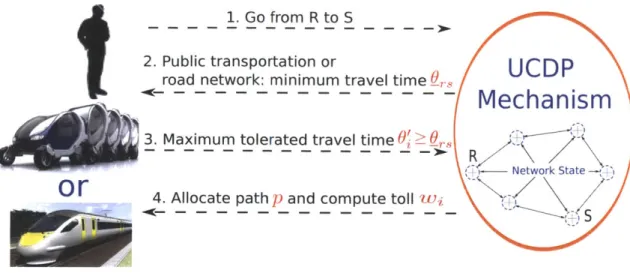
UCDP mechanism is designed as follows. When a new passenger arrives at an origin
node, he receives information from a road authority on the current network condition. The authority either suggests him to use public transportation if the network is about to be congested or provides him with the minimum travel time required to complete his trip. In the latter case, the passenger then reports his maximum tolerated travel time that is not less than the minimum travel time announced by the authority. Based on the current traffic condition in the network, the mechanism then offers the passenger a path to his destination.
Our objective is to assign each passenger a path that matches with his travel time constraint while maximizing sequential social surplus when this passenger joins the network. Importantly, we want to ensure that passengers have no incentive to lie about their preferences, and under our path assignment, congestion does not hap-pen in the network. The UCDP mechanism takes into account the fairness concern when allocating paths to travelers. The tolls of paths are computed according to the marginal cost pricing principle.
1.3
Contributions
This thesis has four main contributions. The first two contributions describe impor-tant properties of the novel UCDP mechanism. The third contribution is the impact of the work to the transportation research community, and the last contribution presents interesting future work for practical deployments.
First, the mechanism is user-centric in the sense that it considers both passengers' preference and fairness among individuals. At the same time, the mechanism can achieve maximum sequential social surplus, i.e. the mechanism is efficient. We also prove that reporting true preference is a weakly dominant strategy of each passenger, and the mechanism never transfers positive amount of money to passengers.
Second, the mechanism introduces a new fairness constrained shortest path (FCSP) problem with a special structure that enables polynomial time computation of path allocation. Therefore, we can handle general networks having multiple OD pairs with dynamic flows of heterogeneous users in a computationally efficient way.
Third, to the best of our knowledge, this thesis is the first in the transportation literature that considers general road networks with dynamic flows of heterogeneous users and addresses system efficiency, fairness among passengers as well as computa-tional complexity issues at the same time.
Fourth, this thesis lays a foundation for future work on designing distributed mech-anisms for optimal traffic routing. In particular, we envision a large-scale network consisting of mobile users who not only share real-time traffic information but also collaborate with each other to achieve social-optimal traffic flows through our future distributed mechanisms.
1.4
Thesis Outline
This thesis is organized as follows:
Chapter 2 provides an in-depth review of related works in road traffic rout-ing and challenges arisrout-ing from real-world deployments. Due to the multi-disciplinary nature of the problem, the review includes ideas and results from several fields ranging from transportation, economics to algorithm design. We first present traditional approaches such as static and dynamic traffic assign-ment as well as congestion pricing schemes in practice. We then discuss new game-theoretic approaches including mechanism design and algorithmic mecha-nism design, as they promisingly overcome limitations of traditional approaches. The discussion also highlights our motivation for adopting the algorithmic mech-anism design approach in this thesis. Finally, we review VCG mechmech-anism and important shortest path algorithms as a preparation step for our problem for-mulation and approach in the next chapters.
" Chapter 3 develops the formal problem formulation to the optimal traffic
rout-ing problem usrout-ing our game-theoretic approach. We first provide preliminary notations, definitions and assumptions. We then formulate a model for a general network with dynamic traffic flows of heterogeneous travelers. We then focus on describing our User-Centric Dynamic Pricing (UCDP) Mechanism in detail. * Chapter 4 presents our approach to design an allocation rule and a payment rule, which are two important components in our mechanism. The allocation rule assigns a path to each passenger and is formulated as a constrained shortest path problem. The payment rule calculates the toll that each passenger pays to use his assigned path. Most importantly, this chapter presents two theorems with proofs showing that the mechanism has incentive compatibility and no-positive transfer properties.
" Chapter 5 develops algorithms that are used to allocate paths and compute
tolls in real-time. First, we shows how to simulate a network state at each time instant. We then present an algorithm to determine minimum travel times announced by a road authority. Subsequently, we describe an algorithm for computing dynamic path allocation and dynamic tolls.
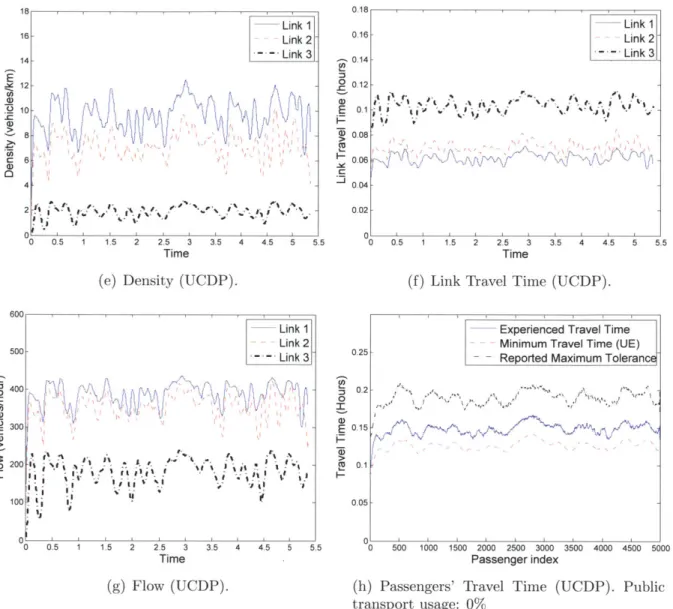
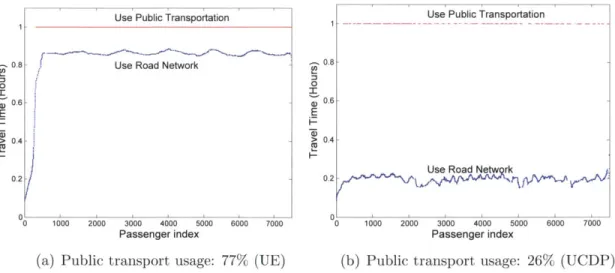
* Chapter 6 demonstrates the performance of the proposed mechanism through two simulated routing experiments. In the first experiment, we simulate the
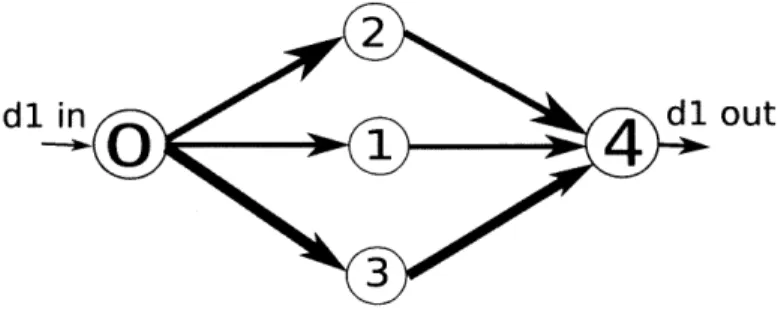
UCDP mechanism on a parallel-link network with one OD pair. We then compare the network performance under the UCDP mechanism with
user-equilibrium and social-optimal performance. In the second experiment, we
consider a general network with multiple OD pairs. We show how the road authority uses the UCDP mechanism to manage traffic flows when road condi-tions change over time.
* Chapter 7 concludes the thesis by summarizing the motivation and objectives of
this thesis, the research conducted in this thesis as well as the key contributions. This chapter also discusses several interesting directions for future research.
Chapter 2
Literature Review
In this section, we extend the review in Section 1.1 to provide a thorough literature review of road traffic routing and challenges in real-world deployments. Due to the multi-disciplinary nature of the problem, this chapter presents important results in related fields ranging from transportation, economics to algorithm design. In particu-lar, Section 2.1 first reviews the fundamental diagram that describes characteristics of traffic flows at the macroscopic level. A detailed description of Greenshields model for the fundamental diagram will also be included in this section, since it will be applied in our UCDP mechanism. Subsequently, Section 2.2 presents static and dynamic traf-fic assignment models, which have been widely used to understand the phenomenon of congestion and its causes. We then introduce the idea of congestion pricing in Section 2.3, which is based on the underlying economics of transportation systems to alleviate congestion. We also present several congestion pricing schemes in practice and relevant research. To further understand the selfish behavior of drivers, and the interaction between drivers and the road authority from a game-theoretic point of view, a brief review of game theory is then provided in Section 2.4. In particular, this section focuses on reviewing mechanism design, a sub-field of game theory, and its applications in previous works. In addition, a more advanced approach called algorithmic mechanism design is presented to address computational tractability and scalability arising from the mechanism design approach. For better understanding of
our payment rule explained in Chapter 4, a detailed description of Vickrey-Clarke-Groves (VCG) mechanism is also included in this section. Finally, Section 2.5 reviews important shortest path algorithms that are the building blocks for computing the allocation rule and payment rule in our proposed mechanism in Chapter 5. The set of rich results presented here will be incorporated in our novel game-theoretic approach to tackle the optimal dynamic routing problem.
2.1
The Fundamental Diagram of Traffic Flow
The fundamental diagram characterizes the relationships among three macroscopic variables of traffic flow on a road segment including average density k, average flow q and average speed u. The average density k reflects the number of vehicles per length unit of the road, and average flow q represents the number of vehicles that passes a certain point per unit of time [50]. Under static conditions such as long roads and long time periods, the average speed u can be calculated based on the fundamental relation of traffic flow theory as follows:
q = uk. (2.1)
The (k, q) curve that expresses the relationship between flow and traffic density is called the fundamental diagram, since it represents all the three variables. The fun-damental diagram can be derived by plotting field data points and finding a best fit curve for these data points. For example, Immers et al. observed and measured flow and mean speed on a three-lane motorway during one minute [50]. Their observation points are illustrated in Fig. 2-1.
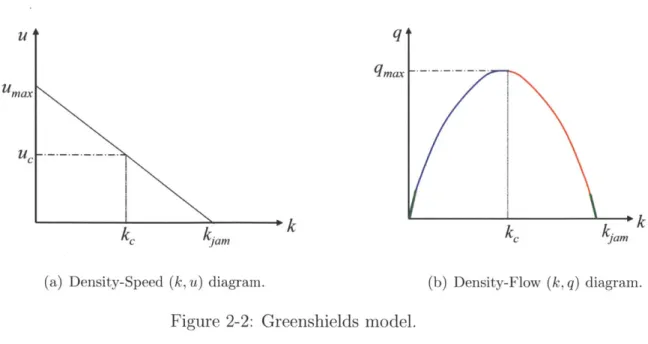
Research on the fundamental diagram began in 1933, when Greenshields calibrated traffic flow, traffic density and speed by using a photographic measurement method and then derived a mathematical model for the fundamental diagram [51, 52]. As shown in Fig. 2-2(a), in the Greenshields model, he postulated a linear relationship between speed and traffic density, in which speed declines linearly with traffic density,
U (km/hour) 100 80 60 0--- 0 0 ' 40-- 200 -0 q (veh/hou 60( 50( 40( 30 20C 10c U r) 0 0 I -i' a 8 0 ' -50 100 150 k (veh/km) (a) 0 -0 0 0
0
5 e. 0 0 0 * % 0 -H-0 _______------ 1
200 - i i 6 0 0 * 0 6 0 100 150 200 k (vehicles/km) (b) 120 100 ow 40 600 40 V 20 1. 0 8* 6 0 I 0 1000 2000 3000 4000 5000 6000 q (vehlcleuihour) (c) 250 250 7000Figure 2-1: (a) Observation points in (k, u) diagram, (b) Observation points in (k, q) diagram, (c) Observation points in (q, U) diagram [50].
q qma U Umax Ue k jam (b) Density-Flow (k, q) diagram. Figure 2-2: Greenshields model.
taking its maximum value umax when k = 0 and declining to u = 0 when k = kjam,
the jam density. Thus, the basic relationship for the Greenshields model is:
(2.2)
U = Umax 1 - ).
kjam
The linear relationship between speed u and traffic density k leads to a parabolic relation for the (k, q) diagram shown in Fig. 2-2(b). Combining Eq. 2.1 and 2.2, we can write:
q = Umaxk 1 - k )
k3am
(2.3)
In the (k, q) diagram, the value k, for which flow q reaches its maximum qmax is called critical density, since it marks the start of an unstable flow area where additional input of vehicles on a road segment decreases traffic flow and eventually leads to traffic congestion, i.e., q = 0 and k = kjam. By differentiating the right hand side of
Eq. 2.3 and setting the derivative equal to zero, we obtain:
(2.4)
k_ - kjam
2
Substituting Eq. 2.4 into 2.2, we also find that the value u, associated with kc and kjam
(a) Density-Speed (k, u) diagram.
q max is equal to "-ar. Replacing k with k = also provides:
qmax = Umax kjam (2.5)
Since the Greenshields model requires specifications of only two parameters ULmax and
kjam, it is especially attractive for practice use. In this thesis, we use the Greenshields
model to estimate and to predict traffic flow in our experiments for the proposed dynamic pricing mechanism. In a real world deployment of our system, we can obtain more accurate real-time traffic flow information via sensor networks.
2.2
Traffic Assignment Models
2.2.1
Static Traffic Assignment Models
With the rapid growth of automobiles industry at the beginning of 1 9th century, road congestion had soon become a serious problem in modern cities and has captured strong interest of many researchers. To understand drivers' behavior and traffic pat-terns that are subject to congestion, in 1952, Wardrop conducted several experiments to figure out the relation of speed and flow on a given road segment in one direc-tion [7]. As a result, he derived two sound principles that define the two well-known notations of traffic equilibria. In particular, according to Wardrop's first principle, the network is considered stable when the travel times in all used routes are equal and less than those which would be experienced by a single driver on any unused route. In other words, given that the travel time on every route on the network are publicly known, each driver non-cooperatively chooses his best route and has no incentive to switch to other routes since he can not further reduce his travel time. The traffic flows that have this property are defined as User Equilibrium (UE) flows. Different from the first principle, Wardrop's second principle assumes that drivers consistently make route choice decisions cooperatively with each other to minimize total system travel time. We can also imagine that there exists a central authority who tell users which
routes to follow, and they fully comply with these suggestions to maximize the system performance. Under this behavior, when the average travel time is minimized, the second principle claims that the network reaches its equilibrium state called Social Optimal (SO) state.
Over the last five decades, Wardrop's principles have inspired many transportation specialists to formulate and solve mathematical models to obtain the UE and SO flows in.urban transportation networks [6,53-59]. Their works are often classified as
static traffic assignment (STA) problem, which is described in [60] as follows. Given the inputs: i) a graph representation of an urban transportation network, ii) the associated link performance functions, and iii) an origin-destination matrix that shows the trip rates between all OD pairs during the period of analysis, the STA problem is finding the traffic flow on each link on the network. The link travel time can then be computed by using link performance functions. The STA problem aims to help transportation planners and road authorities to: i) estimate the distribution of traffic flows and travel times on all links given a level of demand, ii) identify heavily congested links, and iii) make appropriate physical changes to the road network such as adding one or more links. The last goal is extremely important because adding more resources to the network might deteriorate the network performance, i.e., increase delays and congestion instead of decreasing them. This counter-intuitive phenomenon is known as Braess paradox [61] and has been studied extensively in [62,63].
The first mathematical model to solve the above STA problem was proposed in 1956 by Beckmann et al. [53]. This pioneering work of Beckmann has laid a foundation for a variety of extended works in the field (see [6, 57, 58] and references therein). Sheffi [60] shows that Beckmann's User-Equilibrium model can be expressed as a nonlinear mathematical optimization problem:
subject to k fg = q,,, Vr,s, k Xa k a, , r s k
fs
;> 0, V k, r, s,where k is a path that connects origin r and destination s, Xa is the flow on link a,
ta is the travel time on link a, fks is the flow on path k connecting OD pair (r, s), q,,
is the trip rate between r and s. The indicator variable 6"k is equal to 1 if link a is on path k between OD pair (r, s) and 0 otherwise.
The solution for the above formulation is the link flows x that satisfy the UE conditions and reflect that all the trip rates qs have been distributed appropriately. The objective function is the sum of the integrals of the link performance functions. At the first glance, the objective function looks obscure. In fact, this is a potential function of a routing game among drivers. We will comment on this potential game formulation later when we review game theory and mechanism design in Section 2.4.1. The first two constraints are flow conservation constraints, which guarantee that all trip rates have to be assigned to the network. The last constraint is nonnegativ-ity constraint, which is used to ensure that the obtained solution will be physically meaningful. Beckmann showed that this mathematical programming formulation is equivalent to the UE assignment problem. He also proved the existence and unique-ness of the solution. In addition, it is shown that the above formulation is a convex optimization program since the link travel time function is a monotonically increasing function.
Beginning in the late-1960s and continuing into the mid-1980s, many researchers had proposed different approaches to solve Beckmann's UE formulation including heuristic and convex combination approaches. The two most common heuristic meth-ods are capacity restraint and incremental assignment, which were originally proposed
these techniques are embedded in many early transportation planning computer pack-ages [64, 65], they were criticized due to the lack of convergence properties [66,67]. The capacity restraint methods are not guaranteed to converge, and incremental as-signment methods may converge to a nonequilibrium solution. Apparently, they can not obtain a set of flows that satisfy UE conditions. This unsatisfactory performance of heuristic approaches has posted a strong need for a novel numerical optimization method. Fortunately, a novel method called convex combination algorithm proposed
by Frank and Wolfe in 1956 [68] is capable of solving quadratic programming problems
with linear constraints. Not until thirteen years later, in 1969, Bruynooghe discovered Frank and Wolfe' work and suggested an application of convex combination method to solve the transportation network equilibrium problem [56]. Basically, in this method, flows are taken from more congested paths and assigned to less congested paths until flow changes are small. The method then uses a shortest path algorithm to solve a linear program subproblem because the algorithm is very efficient even for large net-works. The convex combination method has been proven through numerous research to be a simple and efficient method to the minimization of the UE program [69-72]. Although the method converges slowly, it is still popular since other faster methods require more memory and do not use shortest path subproblem naturally.
Regarding the SO flow pattern, Beckmann's SO formulation is described in [60] as follows: min z(x) ZXata(Xa) a subject to
Z
fS k =qrs V r,s, k Xa =>Z fs6ask, Ia r s k frs;> 0, V k, r, s.The objective function of the SO formulation is more straightforward than in the
UE formulation. It aims to minimize total travel time spent in the network subject
to the same constraints as in the UE equivalent program. However, as pointed out in [60], the SO formulation does not generally generate an equilibrium flow pattern since some travelers can be better off by unilaterally switch routes. Hence, the SO flow pattern is not stable and should not be used to represent the actual behavior of drivers and equilibrium state. It can be used to observe the best-case scenario when all drivers cooperately make decisions. The SO formulation is also helpful when we want to compare different static traffic assignment models [73]. In particular, we can use a popular measure named the price of anarchy [74], which is the ratio between the total utility at UE and SO state to see how far the UE performance is from the best possible use of the network. The SO formulation can be solved by using the first-order necessary conditions of the associated Lagrangian function. Section 3.4 in [60] provides the details of the method. We note that the solution to the SO formulation can also be found by using the convex combination method mentioned above.
Parallel to the development of algorithms to solve Beckmann's formulation, ex-tensions of Beckmann's model have also been investigated (see [59] and references therein). These extended models often introduce side constraints to become more realistic than the traditional traffic assignment models. For example, the constraints can be used to model the effects of a traffic control policy or to describe the link capacity restrictions set by a road authority. However, these extended models have not been fully developed and solved due to associated computational issues.
Despite of all of the hard work to craft and solve existing STA formulations, the STA models' tractability in real-world deployments is still a major concern since they have some fundamental issues. First, because the UE flow pattern is rooted in drivers' selfish behavior, attaining the UE flow pattern does not help in preventing or alleviating traffic congestion. Therefore, the SO flow pattern, which results in better network performance, is more preferable for a central authority. However, as some drivers suffer longer paths than others to allow for the efficiency of the entire system, and they naturally want to change to other shorter paths, the SO flow pattern is
unfair and unstable. Second, the STA models assume that OD flows are constant within the considered period in order to apply steady-state analyses. To keep this assumption accurate, the period of analysis can only be very small. However, this requirement is not reasonable since the STA models are only meaningful when their period of analysis is longer than the typical duration of trips at this time. Therefore,
STA models are not sufficient to describe the dynamics of traffic flows during a very
short specific period of time such as peak hours, when flows are changing rapidly and unpredictably.
2.2.2
Dynamic Traffic Assignment Models
The limitations of STA models have motivated researchers to develop Dynamic Traffic Assignment (DTA) models to adequately represent traffic reality and drivers' behav-ior. Departing from STA to deal with time-varying traffic flows, DTA refers to a wide range of problems, each depends on different sets of decision variables, system inputs, assumptions about systems and users, and modeling purposes. According to Peeta and Ziliaskopoulos [2], approaches to DTA can be classified into two main groups: analytical approaches (mathematical programming, optimal control, variational in-equality) and simulation-based approaches.
Analytical approaches:
In 1978, Merchant and Nemhauser (hereafter referred to as the M&N) proposed the first DTA model, which is a discrete time, nonlinear and nonconvex mathematical programming problem [9, 10]. The M&N model only considers deterministic, fixed-demand, one destination, one commodity and SO cases. Basically, there are a link exit function that aims to propagate traffic and a static link performance function that computes travel cost based on link volume. The global optimum of the M&N formulation can be obtained by solving a piecewise linear version of the model with additional assumptions on the objective function by using a one-pass simplex algo-rithm. Later, Ho suggested a stepwise linear version of this model and pointed out that we can also achieve the global optimum by solving a sequence of at most N+1
linear programs, where N is the number of periods [75]. Following Ho, Carey showed that the M&N problem can be reformulated as a well-behaved convex nonlinear pro-gram and solved by standard mathematical propro-gramming software [76]. Carey also extended his models to handle multiple destinations and multiple commodities case. Unfortunately, the resulting formulation does not satisfy many requirements of gen-eral networks such as "first in first out" (FIFO) and no "holding back" ("holding back" is an issue arising when traffic at certain approaches is held back to let other traffic streams move faster to minimize system total delays, and this creates unfair or unreasonable SO flow pattern). To address the above unsatisfaction, substantial research on DTA using mathematical programming with different sets of assumptions
have been conducted [77-79. Nevertheless, attaining both mathematical tractability
and high fidelity of real traffic flows is still an open problem.
Another approach to DTA is known as optimal control formulation, in which the
OD trip rates and link flows are continuous functions of time. The constraints are
similar to those in mathematical programming formulation but are modified to adapt in a continuous-time setting. The initial link-based UE and SO optimal control for-mulations for one destination case are suggested by Friesz et al. [80]. Following Friesz, Wie extended the UE model to capture the elastic time-varying travel demand [81]. Ran and Shimazaki then formulated a link-based SO model for general networks [82]. However, this model overlooked the FIFO issue and can only be applied for a very small scale network. Subsequently, various optimal control theory-based DTA models are discussed in the literature [83-85], but they are based on unrealistic assumptions and lack of additional constraints to manage FIFO and "holding back" issues. Im-portantly, efficient algorithms for solving these formulations are still questionable.
To circumvent the problems associated with optimal control theory-based models, another approach called variational inequality (VI) has been researched. VI prob-lem, as defined by Nagurney in [57], is a general problem formulation that includes a plethora of mathematical problems such as nonlinear equations, optimization prob-lems, complementarity probprob-lems, and fixed point problems. Therefore, VI formulation is applicable for traffic assignment problem since it allows for a unified treatment of
equilibrium problems and optimization problems. Originally, this approach was in-troduced by Dafermos in 1980 for solving the STA problem [86]. A decade later, a continuous time VI model for departure time and route choice decision making was suggested by Friesz et al., but no proof of solution existence or uniqueness as well as no efficient algorithm were provided [87]. Wie et al. then formulated the problem as a discretized VI model, in which they replaced exit time functions used in Friesz's formulation by exit flow functions [88]. They also devised a heuristic algorithm to solve it approximately. Although the existence of a solution under some certain con-ditions was proved in this work, the need for an efficient algorithm still remains since this path-based formulation requires tremendous computational efforts to enumerate complete paths. To reduce the computational burden of path-based models, several link-based models were proposed [89-91]. While these VI models are more general and provide greater analytical flexibility to address multiple DTA problems than other an-alytical models, it turns out that they expose to more severe computational feasibility issues. Furthermore, they are still unable to overcome challenges arising in realistic networks such as FIFO and "holding back". As a result, in recent years, DTA models have migrated toward new approaches called simulation-based approaches, discussed hereafter.
Simulation-based approaches:
The goals of simulation-based DTA models are to use a traffic simulator to
repli-cate dynamic traffic phenomena and to search for the optimal traffic flow propaga-tion. More crucially, researchers aims to use the simulator iteratively to forecast the future traffic conditions. Thanks to this promisingly descriptive and predictive power, the transportation literature have witnessed a boom in research on simulation-based DTA models since the first well-recognized work of Van Aerde and Yagar in
1988 [92,93]. Traffic simulators have different types depending on the choice of
gran-ularity such as macroscopic, microscopic or mesoscopic. At first, several microscopic models have been developed for small scale networks, and some are actually embedded in commercial software such as AIMSUN2 [94] and INTEGRATION [92,93]. Later, mesoscopic models, which are a combination of a microscopic representation of
indi-vidual vehicles and macroscopic description of interactions among traffic flows, have been evolved to cope with large-scale networks. Some recognized mesocopic models are DYNASMART [95,96], and DYNAMIT [97]. Although these models circumvent some persistent modeling issues in analytical approaches by directly addressing them through simulation process, it is impossible to derive proofs of existence, uniqueness and convergence of solutions due to the lack of theoretical formulations. In addition, the computational cost associated with the use of a simulator is still too high to make the models applicable in practice. The underlying difficulty lies in selfish behavior of drivers. As drivers independently and constantly make route choice decisions that are in their best interest, predicting future traffic flows requires lots of memory and long computation time. Therefore, recently, there has been a heightened interest in searching for deployable traffic policies to positively affect drivers' behavior, and incorporating the policies into models to reliably represent and predict real traffic maneuvers. The next section reviews congestion pricing as one of these policies and its application in practice.
2.3
Congestion Pricing
As urban transportation exhibits the phenomenon of diseconomies of scale, the idea of congestion pricing is based on the underlying economics of transportation systems. This approach was initiated by Pigou in his famous book The Economics of Welfare
(1920) [98]. Pigou used an example of a congested road to show that travelers were not
using roads efficiently because they did not have to pay for the congestion costs they imposed on others. A price mechanism that charges suitable fees on different roads would motivate travelers to use the facilities more efficiently and rebalance traffic flows. This would reduce aggregate travel time and thus increase social benefits. Since Pigou's first work, congestion pricing has received remarkable attention in the scientific literature for decades (refer [99] and references therein). In the following discussion, we will review the marginal cost pricing theory and practical congestion pricing schemes.
2.3.1
Marginal Cost Pricing
Theoretically, research in congestion pricing has relied upon the fundamental eco-nomic principle of marginal cost (first-best) pricing. The marginal cost pricing prin-ciple was developed based on demand-supply curves for the standard case of a traffic flow with homogeneous users moving inside a given network [100-102]. The idea is that each driver should pay a cost or congestion charge that is equal to the external congestion costs that he imposes on all other drivers. This marginal cost is the dif-ference between the cost of road usage to an individual and the social cost of adding one extra vehicle to the traffic stream. Formally, the marginal cost pricing principle was summarized in [103] as follows.
Let q be the traffic flow, in terms of the number of vehicular trips per unit of time, w be the level of service or capacity (this is commonly assumed to be fixed), and v(q, w) be the average cost per vehicular trip or marginal private cost (MPC) that a road user spends when operating a vehicle on road facility. Then, the total opportunity cost of congestion is:
V(q,w) = q x v(q,w). (2.6)
The optimal road price p or marginal social cost (MSC) of an extra vehicular trip can be derived by taking the first derivative of Eq. 2.6 with respect to q:
_V &v(q, w)
P v(q,w) + q . (2.7)
Oq Oq
Eq. 2.7 shows that the optimal road price p has two components: the marginal private
cost, plus the change in the marginal private cost from serving an additional user. According to the marginal cost pricing principle, the optimal congestion charge T that each driver should pay is exactly equal to the second component of Eq. 2.7:
T= q . (2.8)
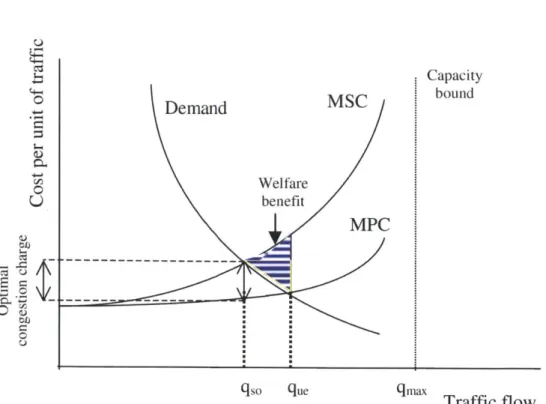
The concept of marginal cost pricing is intuitively illustrated in Fig. 2-3, which depicts the curves of the MSC function, given by OV
/
&q, the MPC function v(q)(assuming that w is fixed) and a demand function. The optimal congestion charge r imposing on each driver is equal to the difference between two points: the intersection of the MSC curve and the demand curve, and the MPC at social optimal flow q,, level. In other words, T closes the gap between the MPC and the optimal road price
p for facility use, shifts traffic from user equilibrium state q", to qso and creates a net
welfare benefit (patterned area). Given fixed road capacity, an increase of the travel demand would lead to higher congestion charge and a larger net welfare benefit.
Capacity MSC bound '-4C Demand Welfare U benefit MPC
qSO qu qmaxTraffic flow, q
Figure 2-3: Graphical explanation of marginal cost pricing: the optimal congestion charge imposing on each driver helps to shift the traffic from the user equilibrium flow level q,,, to the social optimal flow level qO and yields a net welfare benefit [103].
2.3.2
Congestion Pricing Schemes
Although the marginal cost pricing theory is appealing, this pricing scheme has not been implemented in practice due to technological difficulties arising when computing a payment for every traveler. The first congestion pricing scheme in practice is Area Licensing Scheme (ALS), which was launched by Singapore in 1975 [104,105]. The
ALS system charged drivers who crossed a cordon line around the central business
district (CBD) during peak hours on week-day mornings about US$1 a day or $20 a month. Although the ALS reduced 75 percent of private vehicle travel and 50 percent of all vehicles entering the CBD, surprisingly the actual travel times per bus or auto trip to a destination in CBD did not change due to the disruptive effects of traffic rerouting to the free of charge peripheral roads. The high charges also yielded under-utilization of the road network and shifted congestion to expressways and non-restricted time. Thus, in 1995, a paper-based Road Pricing Scheme (RPS), operating in the same way as the ASL, was introduced on an expressway (East Coast Parkway) and later extended to other expressways to further alleviate congestion [105]. One problem associated with both systems was limited temporal and spatial variations in charges due to the lack of automation. In fact, paper-based schemes required personnel to operate the system, and this led to high probability of mistakes by operating officers. In addition, there was always a rush to enter just before or after the restricted hours that could not be smoothed by a shoulder-peak charge. To handle this problem, in 1998, the government introduced a new system namely Electronic Road Pricing (ERP) to replace the current system [105]. Gantries were installed at all the approach roads to the CBD zone and on the expressways. Different from the
ALS, the ERP scheme charges vehicles each time they pass through a gantry. The fees
are automatically deducted from CashCards, a smart card inserted in the In-vehicle Units (lUs) of vehicles. The current ERP scheme has different charges according to vehicle type, time of the day and gantry locations.
Following Singapore, a variety of congestion pricing schemes have been deployed worldwide such as High Occupancy Toll (HOT) and High Occupancy Vehicle (HOV)
lane facilities in California and the Twin Cities in the U.S., congestion charge fa-cilities in London, Stockholm, Valletta and Milan. More examples and details can be found in [103,104,106]. To increase the effectiveness of congestion management, several systems vary tolls according to a predetermined schedule. For instance, on State Route 91 (SR91), the primary link between Orange and Riverside counties south and east of Los Angeles, as of July 2013, tolls vary between $1.40 in the early morning hours and $9.55 during peak hours [107]. In Singapore, the ERP rates are adjusted regularly depending on time of day, day of week (weekday vs weekend) and season. However, these computed time-varying tolling schemes do not fully pre-vent congestion, since urban traffic also varies continuously within a day and across days.
As an attempt to compute flow-dependent tolls in dynamic environments, Joksi-movic proposed a toll design model that combines road pricing with DTA by using bi-level mathematical programming [18]. In particular, a bi-level program contains the upper level, where a road authority decides tolls on links, and the lower level, where travelers independently respond to the tolls by changing their travel behavior. More precisely, travelers try to maximize their utilities to reach the UE state for the announced toll level, while the road authority aims to optimize his objective given that the traffic flows would be at the UE state. In Joksimovic's model, the classical
DTA model is extended and modified to capture impacts of road pricing on drivers'
decision and serves as the lower level of the problem, while the road pricing model serves as the upper level of the problem. The complexity of the problem is NP-hard, as pointed out by the author. The author then suggested a two-stage iterative procedure for determining the optimal tolls that the road authority should charge on links in order to reach his objective. However, such iterative solution approach is not scalable and does not provide insightful understanding of the properties of obtained solutions for further improvement. For example, one cannot infer the behavior of an individual traveler if the road authority changes the toll level slightly or the influence of travel-ers on each other. Therefore, recently, many researchtravel-ers have adopted game-theoretic approaches to understand the problem from the microscopic perspective [108-110].
We are going to overview this approach in the next section.
2.4
Game-theoretic Approaches
2.4.1
Game Theory and Mechanism Design
Game theory is a mathematical way to describe strategic reasoning of rational decision-makers. Since 1950, game theory has been widely studied in several disciplines such as economics, political science and biology to understand the competition and cooper-ation among agents and the role of threats or punishments in long term relcooper-ations. By definition, a game must consist of multiple players, each player must make a decision, and each player has a utility
function
that depends on his own decision and other players' decisions [111]. In a game, all players independently maximize their utility functions. As traffic routing problem involves multiple travelers as rational players, and each player needs to make his traveling decision to optimize his utility function, the problem can be seen as a non-cooperative or selfish routing game. Therefore, several results from game theory can be used to analyze and characterize properties of the problem.Although previous works in traffic routing have not directly investigated the prob-lem from the game-theoretic perspective, some aspects of game theory has been touched slightly. For example, under game theory terminologies, it turns out that Wardrop's first principle on the UE traffic flow pattern coincides with Nash equilib-rium solution concept of a game [111]. For another example, the objective function in Beckmann's UE formulation discussed in Section 2.2.1 is in fact a potential function of the routing game, which is a potential game. Potential games are games that admit a potential function as a function of all players' decisions that gives information about each player's utility function. In particular, the maximization of a potential function with respect to a player's decision coincides with the maximization problem of that player