Appl. Magn. Reson. 13, 285-295 (1997)
Applied
Magnetic Resonance
9 Springer-Verlag 1997 Printed in AustriaTriplet and Reversed Triplet Mechanism CIDEP
Studied by Quenching Experiments
A. N. Savitsky, S. N. Batchelor, and H. Paul
Physikalisch-Chemisches Institut der Universit~it Zª241 Zª Switzerland
Received May 14, 1997; revised June 9, 1997
Dedicated to Harry Kurreck on the occasion of his 65th birthday
Abstract. Quenching experiments are shown to provide a convenient tool to check for the presence of triplet mechanism (TM) spin polarisation in time-resolved EPR spectra following laser flash photolysis. The effect of the triplet quenchers, trans-l,3-pentadiene, fumaronitrile, azo-tert-butane and azo-n-butane upon the spectra following laser photolysis of acetone/propan-2-ol and benzophenone/propan-2-ol pho- tosystems show that no TM polarisation is present in the former system but emissive TM is present in the latter. Use of 2,2'-azo-bis[isobutryronitrile] produces an anomalous emissive polarisation upon quench- ing, which is tentatively attributed to a reversed TM in the tfiplet sensitised azo-compound.
1. I n t r o d u c t i o n
Quenching experiments are widely used in the unraveling o f photochemical re- action mechanisms [1]. In general, a transient intermediate such as a photoexcited triplet is quenched by addition o f a suitable compound and the effect o f this upon reaction observed. Time-resolved E P R ( T R E P R ) following flash photolysis is a widely used experiment for investigating radical photochemistry, h o w e v e r little work has been done with quenchers [2-4]. This is surprising as often a major problem in T R E P R is the identification o f the origin o f net absorptive (A) con- tributions in spectra arising from triplet precursors, where quenching experiments should provide k e y information.
Net A contributions are often assigned to the Triplet M e c h a n i s m (TM) where the polarisation is produced in a photoexcited triplet b y level selective intersys- tem crossing from the initially excited singlet. This polarisation m a y then be transferred to the radicals, if the triplet reacts before spin lattice relaxation (3/'1) has destroyed the polarisation. Fast reactions are therefore required, as 3Tl's are thought to be a few nanoseconds in solution [4-8]. However, net A contribu- tions in T R E P R spectra m a y also arise simply from the B o l t z m a n n signal o f the radicals or transfer o f the Boltzmann polarisation o f the triplet precursor.
286 A.N. Savitsky e t al.:
Distinguishing between the two mechanisms is extremely difficult, as exempli- fied par excellence by the photoreduction o f acetone by propan-2-ol. This sys- tem has been intensely studied by the TREPR commianity for over 20 years [9-11]. The resulting 2-hydroxy-2-propyl radicals are observed in an emissiord absorption (E/A) multiplet overlaid upon a net A contribution. The E/A pat- tern is accepted to arise from the Radical Pair Mechanism (RPM), however the origin of the net A contribution has been fiercely debated [3, 9-14]. Variation o f the triplet lifetime (rv) by addition o f triplet quenchers should provide a simple qualitative means to distinguish between the two mechanisms. Addition of triplet quenchers will of course diminish both multiplet and net polarisation, as triplet molecules will be partially removed. However, as the quencher also shortens r T, the relative contribution o f any net polarisation due to the TM should increase because of its dependence on 3T 1. Here, this possibility is in- vestigated using the acetone/propan-2-ol and analogous benzophenone/propan- 2-01 photosystems with trans-l,3-pentadiene, fumaronitrile, azo-tert-butane, azo- n-butane and 2,2'azo-bis[isobutryronitrile] (AIBN) as triplet quenchers. The first four quench triplets without formation of radicals, whereas t¡ AIBN par- tially reacts to produce two, 2-cyano-2-propyl radicals [15, 16]:
3K + AIBN > K + 3AIBN ) K + N 2 + 2(CH3)2C'CN , (1)
w h e r e 3K denotes a triplet ketone. To account for the variation in initial radi- cal concentrations with quencher concentration, a method is introduced whereby the net contribution is normalized to the size of the multiplet polarisation. Theoretical calculation shows that in the concentration ranges used, this mul- tiplet polarisation is proportional to the radical concentration to a good approxi- mation.
2. Experimental
Time-resolved EPR spectra were obtained using a spectrometer described previ- ously [17]. It consists of an excimer (XeC1, 308 nm, 15 ns pulse width) or Nd- YAG (355 nm, 6 ns pulse width) laser and an X-band cw EPR spectrometer (80 ns response time). Solutions were deoxygenated by argon purging and afterwards exposed to the laser light (10 Hz, 5-15 mJ per pulse on sample surface) whilst flowing through a quartz cell in the TE103 EPR cavity (1 mm optical path length). Acetone solutions were excited by the excimer and benzophenone by the Nd-YAG laser, optical densities were 0.2-0.6 and eare was taken that the triplet quenchers absorbed less than 1% of the light. Signals were acquired using a Le Croy 9310A oscilloscope and transferred to a PC. Solutions were cheeked by UV absorption spectroscopy before and after irradiation to ensure minimal deple- tion of the substrates.
Triplet and Reversed Triplet Mechanism CIDEP 287 3. Theory
In order to characterise the effect of triplet quenchers on the TM contribution to TREPR spectra, simulation of time profiles were performed. These require a knowledge of the chemistry, rate constants, relaxation times and polarisations. For the acetone and benzophenone/propan-2-ol systems investigated here these parameters are reasonably well known from previous studies. In both cases the ketones rapidly intersystem cross into the triplet state upon excitation, within pi- coseconds for benzophenone and nanoseconds for acetone [18]. The triplet state then abstracts a proton from propan-2-ol with a rate constant ka:
3K + (CH3)2CHOH ) K'H + (CH3)2C~ (2)
and the resulting radicals react by bimolecular termination, 2k r Addition of a triplet quencher, Q, quenches the ketone triplet with a rate constant kq:
3K + Q - - ~ K + 3Q . (3)
The radicals are produced with a net contribution, M o, to the z-component of the magnetic moment, arising from the TM and/or Boltzmann polarisation of the triplet. This may be calculated either via modification of formulae given by Atkins and Evans [6] or by integrating the following differential Eqs. (4)-(7). Here pT is the relaxing triplet polarisation and, in order to simplify the scheme, only the 2-hydroxy-2-propyl radicals are considered leading to x = 1 for benzophe- none and x = 2 for acetone in Eq. (6):
dpT pT _ Pe~ dt 3T 1 (4) d [ 3 K ] - k,[3K][(CH3)2CHOH)] kq[3K][Q] (5) dt d[(CH3)2C'OH] = xk~[3K][(CH3)2CHOH)] , (6) dt dM~ - P T ( t ) d[(CH3)2C'OH] (7) dt dt
To be strictly correct the equation system would require a very short laser pulse and extremely fast intersystem crossing. For the present qualitative treatment it should suffice to give a reasonable estimate of Mz ~ as well as the radical and triplet concentration following a 5 ns laser flash. A 3T 1 of 0.5 ns is assumed
288 A.N. Savitsky e t al.:
and the initial triplet concentration [3K]0 estimated from the optical density and laser power. The initial polarisation Po v was taken a s a free parameter. Values for/ca and kq were obtained ¡ literature and for acetone are k~ = 1- 106 M - l s -1 [19] and kq = 46, 60, 3, 6, and 5.108 M - l s -1 for pentadiene, fumaronitrile, azo- n-butane, a z o - t e r t - b u t a n e and AIBN, respectively [1, 20, 21]. For benzophenone k a = 1.106 M l s -1 and kq = 55 and 8.108 M - l s -1 for pentadiene and a z o - t e r t - butane, respectively [19, 20]. The values o f M o, [3K] and [(CH3)2C'OH)] thus obtained are then used as initial conditions for the simulation o f the mierosec- ond TREPR time profiles. This is done using a modified Bloch equation approach [22-24] d v y dt T 2 +colMz , (8) dMz dt - -colv + T~ P~q[(CH3)2C'OH ] - M z + 2kt[(CH3)2C'OH] 2
PFPeq
4 +ka[3K][(CH3)2CHOH](PG + ~)P~q , (9) d [ ( C H 3 )2C'OH] = _ 2 k t [(CH 3)2C.OH ]z + kq [3K] [(CH 3)2CHOH] , dt (lO) d[3K] - ka[3K][(CH3)2CHOH] - kq[3K][Q] . (11) dtHere v represents the perpendicular magnetic moment in the rotating frame, T 1 and T 2 the radicals' relaxation times, col the microwave field amplitude, PG and PE the geminate and F-pair RPM polarisation contributions in units o f the radi- cal equilibrium polarisation P~q. It is assumed that initially v = 0 and M z = = PoPeq[(CH3)2C'OH] + M~~. Solution o f the equations gives the TREPR time pro- file on resonanee o f one line o f the 2-hydroxy-2-propyl radical.
Reasonable values for m a n y o f the parameters may be obtained from the lit- erature, which for the experimental conditions used are, 2 k t = 4. 10 9 M - 1 s -1 [25], T 1 ~ T 2 ~ 0.8 gs [12], co l = 4.6.105 rad. s -1 [24], Peq -- 250 V . M -1 [24] and PF = 3PG = 30 for acetone [12, 26] and PF = 2Po = 30 for benzophenone. The values o f RPM polarisation used are for the M 1 = _+2 lines and are smaller than given in the literature to take account o f the lower viscosity used here (vide infra r 1 ~ 0.6 cP). As a simplification, for benzophenone it is assumed that the 2-hydroxy-2-propyl radicals only self terminate outside the geminate cage; because only the early time kinetics are o f interest errors arising from this should be small. Typical calculated curves are similar to the experimental ones ( v i d e infra).
Triplet and Reversed Triplet Mechanisrn CIDEP 289 0.2 R a 0.0 -0.2 -0.4 -0.6
/
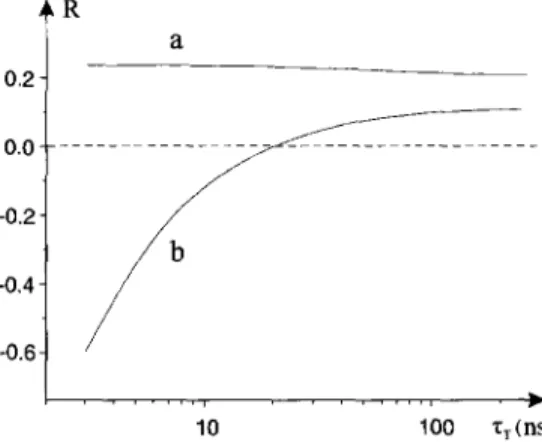
10 100 ~~(ns)Fig. 1. Calculated net to multiplet polarisation ratio, R, versus triplet lifetime, rT, for the 2-hydroxy- 2-propyl radical formed by photoreduction with (a) excited acetone and (b) excited benzophenone.
The pararneters used are given in the text.
To take account o f the variation o f radical concentration and therefore signal size with quencher concentration two time profiles, with opposite sign of RPM polari- sation, were calculated for each condition. These are in effect simulations of the symmetric low and high field lines o f the 2-hydroxy-2-propyl radical, and addi- tion of the two profiles yields the net effect and subtraction the multiplet effect. It was found that the magnitude of the so-obtained multiplet effect at its maxi- mum was to a good approximation proportional to the radical concentration for the concentration ranges used (10 5-10-4 M), provided Po and PF were constant. It occurs because under these conditions at early time the multiplet polarisation arises predominately from geminate pairs and so its magnitude is proportional to the radical concentration. This useful result allows the size o f the net signal, also measured at its maximum value, to be scaled to the radical concentration by division by the multiplet signal size. Calculations for different quencher con- centrations gives a plot of the net/multiplet signal ratio with lifetime o f the trip- let showing the variation of the TM contribution. The lifetime of the triplet is given by
r T = (kd3K][(CH3)2CHOHI + kq[3K][QI) ~ . (12)
The results o f the calculation are shown in Fig. 1 for two situations: assuming the acetone triplet is not polarised by the TM; and assuming the benzophenone triplet has an initial polarization o f -60.P~q. In the acetone case the net/mul- tiplet ratio is virtually constant with triplet lifetime as would be expected for a Boltzmann contribution. For long benzophenone rT'S absorptive net polarisation is observed also arising from the Boltzmann population, however as r T is re- duced by quenching emissive polarisation is observed. If triplet acetone is as- sumed to be polarised in A, as observed for another aliphatic ketone [27], a simi- lar curve to benzophenone is obtained but rising into greater A with decreasing
290 A.N. Savitsky e t al.:
r v. Thus quenching experiments should provide an easy test to see if radicals arising from a triplet precursor are polarised by the TM or not.
4. Results
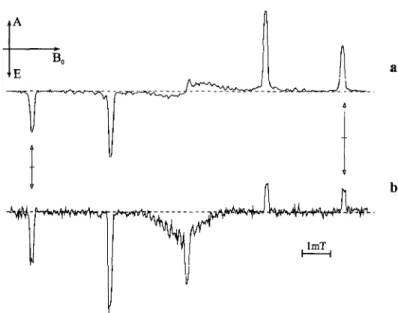
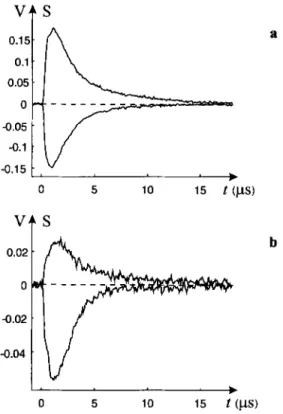
Figure 2 shows the TREPR spectra recorded fi'om benzophenone dissolved in benzene and 4 M propan-2-ol with and without addition of pentadiene. Under these situations r T was estimated as 250 and 5.5 ns, respectively, using Eq. (12). In both cases the 2-hydroxy-2-propyl and benzylketyl radicals are observed in an E/A multiplet pattern as expected for t¡ photoreduction. When rv is re- duced, Fig. 2b, the net polarisation changes from A to E, mirro¡ the theoreti- cal calculations and showing that for short rT's benzophenone exhibits emissive TM polarisation. Naturally the net E polarisation is also observed in the EPR time-profiles given in Fig. 3, which were acquired on-resonance on the low and high field lines o f 2-hyroxy-2-propyl marked in Fig. 2. The emissive TM pola- risation is in agreement with previous work [7].
Similar experiments were repeated for acetone and benzophenone with different quenchers and quencher concentrations to vary r T. In all cases the quencher con- centration was small and, therefore, unlikely to alter the solution composition and the RPM polarisation magnitudes. This allows a plot analogous plot to Fig. 1 to be made. For evaluation, the maximum signal amplitudes o f the low and high field lines were determined from the time profiles, then the sum o f the am- plitudes was divided by the difference and plotted versus rv, as calculated from
y ~
Fig. 2. TREPR recorded 0.4-0.6 ~s post flash from solution of a 58.6 mM benzophenone and 4 M propan-2-ol in benzene and b the same solution with trans-l,3-pentadiene 36.6 mM.
Triplet and Reversed Triplet Mechanism CIDEP 291 V J 0.15 0.1 0.05 0 9 0.05 -0.1 -0.15 S 5 10 15 t(I.ts) V ~ 0.02 0 -0.02 -0.04 S v 0 5 10 15 t (~tS) b
Fig. 3. TREPR time profiles signal S in V versus time in ~ts, recorded on resonance for the high and low field lines marked in Fig. 2. The experimental conditions for a and b are given in Fig. 2.
Eq. (12). For acetone ah additional term was included in Eq. (12) to take account of triplet quenching by benzene [20]. The results are shown in Fig. 4 and im- mediately demonstrate that the 2-hydroxy-2-propyl radicals arising from acetone photoreduction are not polarised by the TM, because the net/multiplet ratio is invariant with r T in the experimentally accessible range o f 6-250 ns. By com- parison with benzophenone, ir a TM contribution where present it should be ob- servable in this range. Thus, acetone either has a much shorter 3T~ than ben- zophenone, perhaps due to its smaller size [6], or little TM polarisation is ini- tially produced in the acetone triplet.
The expe¡ results show a good quantitative match to the theoretical curves of Fig. 1, which are redisplayed in Fig. 4. This indicates that the parameters and assumptions used are reasonable. In particular the conclusion that the radi- cal concentration is proportional to the size o f the multiplet effect is verified. It must be emphasized that this is only the case when the quencher is present in small amounts and the solvent composition is not altered. Attempts to repeat the experiments by varying the propan-2-ol concentration failed for this reason. No attempts were made to fit the experimental time profiles as this requires a knowl- edge of the absolute radical concentrations which were unknown.
292 A, N. Savitsky et al,: R a 0.2 ~ ~; z i ~ - ~ - T 0.0 - . . . -0.2 -0.4 -0.6- 10 100 xr(ns)
Fig. 4. Experimental net to multiplet pola¡ ratio, R, versus triplet lifetime, rT, for the 2-hy- droxy-2-propyl radical formed by photoreduction with (a) excited acetone and (b) excited benzophe- none. In (a) the quenchers used were 31 mM ~'ans-1,3-pentadiene, 8 mM fumaronitirile, 11 mM azo- n-butane, 50 mM azo-tert-butane, no quencher, and no quencher for the points from left to right. Solution contained 1.6 M acetone and 4 M propan-2-ol in benzene, except for the point at r~ = 250 ns where cyclohexane was the solvent. In (b) the quenchers were 63, 36.6, 9.2 mM trans-l,3- pentadiene, 20.3 mM azo-tert-butane, and no quencher for the points from lefi to right. Solutions
contained 58.6 mM benzophenone and 4 M propan-2-ol in benzene.
The acetone result is in agreement with previous quantitative attempts to mea- sure the size o f the net polarisation [9, 12] and an investigation o f triplet ac- etone polarisation by fast reaction with t¡ [28]. However it is in dis- agreement with some qualitative experiments which suggested the TM was op- erative [3, 14]. In particular it has been argued that TREPR spectrometers are too insensitive to detect Boltzmann signals, the current results show this view is too pessimistic. The discrepancy in conclusions may have arisen because o f the use of different laser powers, focusing and optical densities by different groups. The acetone photosystem is known to be sensitive to extremely fast 2-photon ot-cleavage at high laser powers [27, 29], which could produce radicals within aT, giving TM polarisation. Additionally high laser powers produce high con- centrations of triplets leading to substantial triplet-triplet annihilation. This reac- tion can lead to radical formation and because it is spin selective could produce some net polarisation. These two side reactions lead to production o f radicals with different g-factors to 2-hydroxy-2-propyl and then net Ag RPM polarisation must also be considered. Nevertheless the current work shows that at low laser powers and optical densities no TM is observed in the photoreduction o f acetone with propan-2-ol.
Variation o f the quencher between trans-l,3-pentadiene, fumaronitrile, azo-n-bu- tane and azo-tert-butane did not alter the results, adding further support to the conclusions. These quenchers do not produce radicals and appear to be reliable choices for such experiments. AIBN was also investigated a s a possible choice, which on quenching produces 2-cyano-2-propyl radicals according to reaction
Ii
D
B0Triplet and Reversed Triplet Mechanism CIDEP 293
o o
oo
~
9 9
9 9 oo
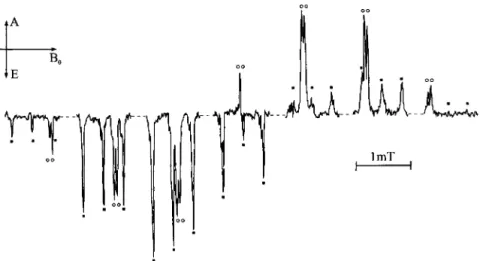
Fig. 5. TREPR spectrum recorded 1.3-1.9 ~ts post flash from a solution of 1.6 M acetone, 4 M propan-2-ol and 20 mM AIBN in benzene. Lines marked with a circle and square arise from
2-cyano-2-propyl and 2-hydroxy-2-propyl radicals, respectively.
Eq. (1). Here, any net polarisation should be passed to the 2-cyano-2-propyl radi- cals provided the reactions are not spin selective. Figure 5 shows the spectra acquired with acetone/propan-2-ol, where both the 2-hydroxy-2-propyl and 2- cyano-2-propyl a t e observed in an E/A RPM multiplet pattern. However, whilst the 2-hydroxy-2-propyl radicals show a small net A polarisation, the 2-cyano-2- propyl radicals clearly show a much larger net E contribution. This polarisation cannot be due to net Ag RPM polarisation produced in a 2-cyano-2-propyl/2- hydroxy-2-propyl radical pair as the g-factor o f the radicals, 2.0031 and 2.0028 respectively [30], would produce net A polarisation in 2-cyano-2-propyl. Neither can the net signal be due to TM in acetone as there is none. Thus one of the reactions in 2-cyano-2-propyl production must be spin selective producing polari- sation. This may be either the quenching itself o r a process in the decomposi- tion o f the azo-compound.
Years ago, Steiner [31, 32] observed a magnetic field effect on the radical ion yield in electron-transfer reactions between dye triplets and heavy-atom substi- tuted electron donors, forming triplet exciplexes with each other. The effect was explained in terms o f a reversed TM, i.e., a preferred deactivation of certain zero- field states o f the triplet exciplex via intersystem crossing to the ground state, thus producing spin polarisation in the molecular frame of the exciplex. A non- vanishing zero-field splitting should partially transform this polarisation into the laboratory frame and yield an initial net electron spin polarisation of the radi- cals, formed in the competing dissociation o f the exciplex. In fact, as predicted by Steiner [33], this spin polarisation seems to have been experimentally observed recently [34-36], although the authors renamed the mechanism spin-orbit cou- pling induced electron spin polarisation.
294 A.N. Savitsky e t al.:
The initial net emission observed here for the 2-cyano-2-propyl radicals might also well be due to such a reversed TM in triplet AIBN. The kinetic conditions for the effect to occur are nearly ideal for AIBN, as t¡ sensitisation leads to fast cleavage, but with quantum yields o f only 0.1-0.15, leaving intersystem crossing to the ground state as the faster dominating route o f deactivation [15]. Also the magnitude o f the emission, which is estimated to about -15-P~q, would be compatible with such a polarisation mechanism.
O f course, further data is required to corroborate the assignment o f the unusual net emission after triplet sensitisation o f A I B N to a reversed TM. At least our results show that A I B N is n o t a suitable quencher for checking polarisations o f other triplet molecules because it produces pola¡ itself. A previous mea- surement of triplet spin relaxation [4], using quenching with AIBN, must there- fore be re-examined in light o f this.
5. Conclusions
Quenching experiments provide an easily applied method to determine ir a radi- cal observed by T R E P R shows TM polarisation, provided a benign triplet quen- cher is chosen. Using this technique it is found that the acetone/propan-2-ol system does not show TM polarisation and the net A contribution is due to the Boltzmarm population o f the triplet or radical. AIBN is n o t a suitable compound for such experiments as it produces polarisation, probably via a reversed TM.
Acknowledgements
This investigation was undertaken in the frame o f an INTAS project (93-1626- ext) on magnetic spin effects in chemical reactions. The authors thank Prof. U. E. Steiner (Konstanz) and Dr. A. I. Sushin (Moscow) for useful discussions and gratefully acknowledge financial support by the Swiss National Foundation for Scientific Research.
References
[1] Turro N.J.: Modern Molecular Photochemistry. Mili Valley, CA: University Science Books 1991. [2] McLauchlan K.A., Yeung M.T.: Roy. Soc. Chem. Spec. Rep. Electron Spin Reson. 14, 32-64
(1994)
[3] Shkrob I.A., Wan J.K.S.: Res. Chem. Intermed. 17, 77-100 (1992) [4] Goudsmit G.-H., Paul H.: Chem. Phys. Lett. 260, 453-457 (1996)
[5] Atkins P.W., Dobbs A.J., McLauchlan K.A.: Chem. Phys. Lett. 29, 616-617 (1974) [6] Atkins P.W., Evans G.T.: Mol. Phys. 27, 1633-1644 (1974)
[7] Akiyama K., Sekiguchi S., Tero-Kubota S.: J. Phys. Chem. 100, 180-183 (1996) [8] Beckert D., Schneider G.: Chem. Phys. 116, 421-428 (1987)
[9] van Willigen H., Levstein P.R., Ebersole M.H.: Chem. Rev. 93, 173-197 (1993) [10] McLauchlan K.A., Simpson N.J.K., Smith P.D.: Res. Chem. Intermed. 16, 26-46 (1991) [11] Hirota N., Tominaga K., Yamauchi S.: Bull. Chem. Soc. Jpn. 68, 2997-3010 (1995)
T¡ and Reversed Triplet Mechanism CIDEP 295 [12] Paul H.: Chem. Phys. 40, 265-274 (1979); ibid. 43, 294 (1979)
[13] Yamauchi, S., Tominaga K., Hirota N.: J. Phys. Chem. 90, 2367-2369 (1986)
[14] Batchelor S.N., Kay C.W.M., McLauchlan K.A., Smith P.D., Yeung M.T.: Mol. Phys. 82, 325- 342 (1994)
[15] Engel P.S.: Chem. Rev. 80, 99-150 (1980)
[16] Takemura T., Ohara K., Murai H., Kuwata K.: Chem. Lett. 1990, 1635-1638. [17] Jent F., Paul H.: Chem. Phys. Lett. 160, 632-639 (1989)
[18] Murov S.L.: Handbook of Photochemistry. New York: Marcel Dekker 1973. [19] Scaiano J.C.: Handbook of Organic Photochemistry. Boca Raton: CRC Press 1989.
[20] Wamser C.C., Medary R.T., Kochevar I.E., Turro N.J., Chang P.L.: J. Am. Chem. Soc. 97, 4864- 4869 (1975)
[21] Turro N.J., Tanimoto Y.: J. Photochem. 14, 199-203 (1980) [22] Pedersen J.B.: J. Chem. Phys. 59, 2656--2667 (1973)
[23] Verma N.C., Fessenden R.W.: J. Phys. Chem. 65, 2139-2155 (1976) [24] Savitsky A.N., Paul H.: Appl. Magn. Reson. 12, 449 (1997) [25] Lehni M., Fischer H.: Int. J. Chem. Kinet. 15, 733-757 (1983) [26] Levstein P.R., van Willigen H.: J. Chem. Phys. 95, 900-907 (1991) [27] Batchelor S.N., Fischer H.: J. Chem. Phys. 100, 556-564 (1996)
[28] Ohara K., Hirota N., Steren C.A., van Willigen H.: Chem. Phys. Lett. 232, 169-175 (1995) [29] Jent J., Paul H., Fischer H.: Chem. Phys. Lett. 146, 315-319 (1988)
[30] Landolt-B~rnstein: Magnetic Properties of Free Radicals (Fischer H., Hellwege K.H., eds.). New Series, volumes II/1, II/9b, II/17b. Berlin: Springer 1965-1986.
[31] Steiner U.: Chem. Phys. Lett. 74, 108-111 (1980) [32] Steiner U.E., Ulrich T.: Chem. Rev. 89, 51-147 (1989) [33] Steiner U.E.: Ber. Btmsenges. Phys. Chem. 85, 228-233 (1981)
[34] Katsuki A., Akiyama K., lkegami Y., Tero-Kubota S.: J. Aro. Chem. Soc. 116, 12065-12066 (1994)
[35] Katsuki A., Akiyama K., Tero-Kubota S.: Bull. Chem. Soc. Jpn. 65, 3383-3389 (1995) [36] Sasaki S., Katsuki A., Akiyama K., Tero-Kubota S.: J. Am. Chem. Soc. 119, 1323-1327 (1997)
A u t h o r ' s address: Prof. Dr. Henning Paul, Physikalisch-Chemisches Institut der Universit~it Zª241 Winterthurerstrasse 190, CH-8057 Zª Switzerland