PEOPLE’ S DEMOCRATIC REPUBLIC OF ALGERIA
MINISTRY OF HIGHER EDUCATION AND SCIENTIFIC RESEARCH
University of 8 Mai 1945-Guelma 5491 يام8 ةعماج
Faculty of Letters and Languages تاغللاو بادلآا ةيلك
Department of Letters and English Language ةيزيلجنلإا ةغللاو بادلآا مسق
Option: linguistics
A Dissertation Submitted to the Department of Letters and English Language in Partial Fulfillment of the Requirements of Master’s Degree in Language and Culture.
Submitted by: Supervised by:
Mr. Mohammed Amin ABBASSI Mrs. Fatima ABDAOUI Ms. Halima HAKIME
Board of examiners
Chairman:Mr. Med. Walid Chettibi (MA/A) 8 Mai 1945 University -Guelma Supervisor: Mrs. Fatima Abdaoui (MA/A) 8 Mai 1945 University -Guelma Examiner: Mrs. Katia Mebarki (MA/B) 8 Mai 1945 University -Guelma
September 2020
An Exploration of the Main Challenges and Requirements of
Introducing English as a Second Language (ESL) to the Algerian
PEOPLE’ S DEMOCRATIC REPUBLIC OF ALGERIA
MINISTRY OF HIGHER EDUCATION AND SCIENTIFIC RESEARCH
University of 8 Mai 1945-Guelma 5491 يام8 ةعماج
Faculty of Letters and Languages تاغللاو بادلآا ةيلك
Department of Letters and English Language ةيزيلجنلإا ةغللاو بادلآا مسق
Option: linguistics
A Dissertation Submitted to the Department of Letters and English Language in Partial Fulfillment of the Requirements of Master’s Degree in Language and Culture.
Submitted by: Supervised by:
Mr. Mohammed Amin ABBASSI Mrs. Fatima ABDAOUI Ms. Halima HAKIME
Board of examiners
Chairman:Mr. Med. Walid Chettibi (MA/A) 8 Mai 1945 University -Guelma Supervisor: Mrs. Fatima Abdaoui (MA/A) 8 Mai 1945 University -Guelma Examiner: Mrs. Katia Mebarki (MA/B) 8 Mai 1945 University -Guelma
September 2020
An exploration of the main challenges and requirements of
introducing English as a second language (ESL) to the Algerian
DEDICATION I
I dedicate this work to Almighty God, thank you for your guidance, strength; power of mind, protection and for giving us a healthy life, your name shall be forever glorified. To the most precious people to my heart; my beloved mother and father I dedicate this work.
To my sisters, relatives, friends, and classmates who shared their words of advice and encouragement to finish this study,
To all the teachers who have been a source of inspiration and hope, To my thesis partner Halima,
To myself,
In the memory of my grandparents,
DEDICATION II
To my beloved mother and father who were patient and caring and to my brothers, To Meriam and Lilia,
To my precious family, to Aziza To my special person,
I would like to express my gratitude to a group of teachers who helped me during our journey especially professor Ladi TOULGUI, Mrs. ABDAOUI Fatima Mrs. Amina KRIBES, Mrs. HENAINIA Hosna, Ms. MOUMEN Soumia who have taught me a lot during my years at
university.
To my thesis partner, Mohammed To all who read this,
To myself
ACKNOWLEDGMENTS
The first and foremost thanks go to almighty Allah for giving us strength to accomplish this work.
Our earnest thanks go to our supervisor Mrs. Fatima ABDAOUI whose guidance and back up were the assets upon which this thesis was developed to reach its status.
We would like to express our gratitude and respect to the jury members Mrs. Katia Mebarki and Mr. Med. Walid Chettibi
We would like to express our gratitude to a group of teachers who contributed to the accomplishment of this thesis. Special thanks to Professor Ladi TOULGUI to whom we owe a depth of gratitude for his encouragement and valuable contribution to the research by
his time, and his advice.
Special thanks go to all our teachers, classmates, friends, and everyone who helped us to accomplish this work.
We, finally, would like to thank ourselves for the efforts that we have made to accomplish this work.
ABSTRACT
This study explores the aspects of introducing the English language to the Algerian primary school. It focuses on the requirements, the teaching methods, and the possible challenges facing policy makers and education experts when teaching English is integrated into Algerian primary school. The research method adopted in this study is an exploratory method in order to discover the challenges and requirements for such initiative. Moreover, the study is based on a qualitative approach, where data is gathered through an online questionnaire answered by fifteen (15) English university teachers at 08 Mai 1945 University-Guelma. The results obtained allow to evaluate the importance of teaching English in primary schools. Teachers agree on encouraging the teaching of English in Algeria and particularly in primary schools. The research also reveals that the implementation of English into primary schools may face many challenges at the governmental and school levels, teachers’ expertise and training, curriculum design and lack of methodologies. The emerging results confirm that introducing English to the Algerian primary schools has many challenges and it needs many requirements, however, it is possible.
Keywords: English language teaching, primary school, children, challenges, requirements, methods.
LIST OF ACRONYMS AND ABBREVIATIONS CA: Classical Arabic
CPH: Critical Period Hypothesis EFL: English as a Foreign Language ELT: English Language Teaching ESA: Educated Spoken Arabic ESP: English for Specific Purposes
ICT: Information Communication Technology LPP: Language Policy and Planning
LIST OF TABLES
Table 2.1: The results of "Independent Samples Test" for the differences between Saudi students who start learning English at ages 5/6, as compared with those who start learning
LIST OF FIGURES
Figure 1.1: Different Facets of Arabic………..………… 09
Figure 2.1: Starting Age of the First Foreign Language as a Compulsory Subject, 2015/16 ……… 26
Figure 2.2: Mandatory Foreign Languages during Compulsory Education, 2015/16 ………. 27
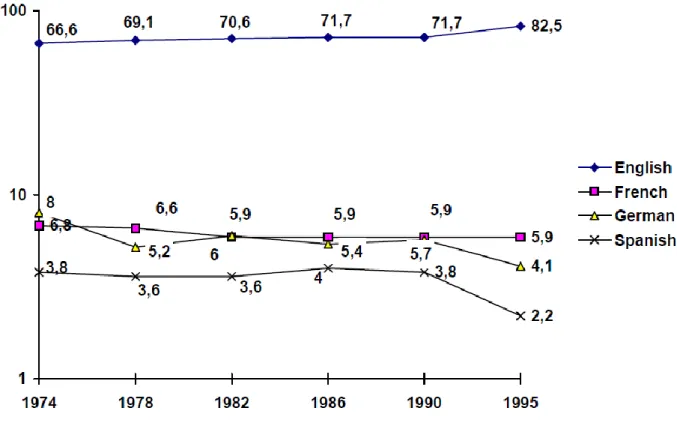
Figure 2.3: Share of Languages in Social Sciences and Humanities Publications Worldwide 1997–1995 ………..……… 32
Figure 2.4: Elements Showing Gender Bias in Textbook Two ………. 37
Figure 2.5: Complex Activities ……… 37
Figure 3.2 Gender of Participants ……… 45
Figure 3.3: Teachers’ Teaching Experience in English ……… 45
Figure 3.5: Possibility of Difficulties ……… 46
Figure 3.6: Participants’ Beliefs about Middle School Teachers and their Ability to Teach Primary School Pupils………. 47
Figure 3.7: Percentages of the Difficulties of Primary School English Language Teaching in Algeria ……….. 48
Figure 3.8: Requirements for Efficient Learning ……… 51
Figure 3.9: Teachers Intrinsic Motivation for Self-improvement ………. 51
Figure 3.10: Teaching/Learning Quality Obstruction ………. 52
Figure 3.12a: The Importance of English Language Teaching ………. 57
Figure 3.12b: Level of Teaching English ………. 58
Figure 3.12c: The Burden on the Child’s Cognitive Abilities ……… 58
Figure 3.12d: The Positive Effect of English on Child’s Cognitive Abilities ………. 59
Figure 3.12e: French vs. English ………. 59
Figure 3.12f: Level of Teaching English at 1st Grade of Primary School ………. 60
Figure 3.13: Methods of Teaching English ………. 61
Contents
Dedication I ...……… I
Dedication II ...………...…... II
Acknowledgments... III
Abstract...…………. IV
List of Acronyms and Abbreviations... V
List of Tables... VI
List of Figures... VII
Contents... IX
GENERAL INTRODUCTION ... 1
1. Statement of the Problem... 2
2. Aims of the Study and Research Questions ... 2
3. Research Methodology and Design... 3
3.1. Research Method and Population ………...……… 3
3.2. Data Gathering Tools ... 3
3.3. Structure of the Dissertation... 3
CHAPTER ONE: The Linguistic Profile of Algeria Introduction ……….. 5
1.1. The sociolinguistic Status in Algeria………. 6
1.1.1. Arabic ……….. 6
1.1.1.1. Modern Standard Arabic……….. 7
1.1.1.2. The Algerian Spoken Arabic………. 7
1.1.2. Tamazight ………. 8
1.1.3. Educated Spoken Arabic in Algeria ………. 9
1.1.4. French ………... 10
1.2. Language Planning and Policy……… 10
1.2.1. Activities of Language planning and Policy……… 12
1.2.1.1. Corpus planning………. 13
1.2.1.2. Status planning……… 14
1.2.1.3. Acquisition planning……….. 15
1.2.2. Language policy in Algeria...16
1.2.2.1. Arabisation policy……….……… 16
1.2.2.2. Education reform policy……….……….. 18
1.3. English as a Global Language ………. .19
1.3.1. The status of English in Algeria…... 19
CHAPTER TWO: Early English Language Education: Programs, Benefits, and Challenges
Introduction ……….. 21
2.1. Attempts to Introduce English as a FL in Primary Schools over the World …………. 22
2.1.1. English from First Grade – Idiomas desde Primer Grado, Argentina ……… 22
2.1.2. English Opens Doors - Programa “El inglés abre puertas” (PIAP), Chile………….23
2.1.3. The National Plan for English for Basic Education – Programa Nacional de Inglés en Educación Básica (PNIEB), Mexico ………24
2.1.4. Ceibal in English – Ceibal en inglés, Uruguay……… 25
2.2. Benefits of Early English language learning ……… 25
2.2.1. The Younger, the Better………28
2.2.2. Enhancement of Cognitive Skills……… 29
2.2.3. Later Performance ………...……… 30
2.2.4. English Language as a Language of Publication ……….. 31
2.2.5. An Asset for Professional Career………. 33
2.3. ELT in Primary Schools: The Challenges……….. 33
2.3.1. Qualified Teachers and Teacher Training Quality………34
2.3.2. Developing a Solid Curriculum Framework……… 35
2.3.3. Textbook Quality………. 36
2.3.5 Francophonie……….. 41
Conclusion……… 41
CHAPTER THREE: Field Work Introduction ... 42
3.1. The Questionnaire... 42
3.1.1. Research Method ... 42
3.1.2. Population of the Study……… 42
3.1.3. Description of the Questionnaire ... 43
3.1.4. Administration of the Questionnaire ... 44
3.1.5. Data Analysis and Interpretation ... 44
3.1.5.1. Analysis of Results and Findings from the Questionnaire ...44
3.1.5.2. Summary of Results and Findings from the Questionnaire... 64
3.2. Limitations of the Study...... 66
Conclusion ……….. 67
GENERAL CONCLUSION ... 68 REFERENCES
APPENDICES
Appendix A: The Questionnaire Arabic Summary
GENERAL INTRODUCTION
Nowadays, the educational system in Algeria is different from that of years ago; more approaches are included, different teaching methods are integrated, and the attention to the learning of languages has increased. Arabic, French, Tamazight are taught in primary, middle, and high school. However, English is not implemented in the primary school yet. In 1993, there was an educational reform, where the pupils have to choose between learning the French or the English languages in primary school. The aim behind this was to ameliorate foreign language learning at a young age. Some primary schools in Algeria applied the discussed reform then cancelled it, because some parents favored French over English (Rezig, 2011).
However, in recent years and due to the positive impact of globalization, English language learning has gained the interest again. Because 1.5 billion People around the world speak English, it becomes the lingua franca for all non-English speakers. Moreover, it is the language of technology, medicine, business, diplomacy, and travel. Therefore, there was a vital need to teach English in almost all countries of the world. In the case of Algeria, English is the second foreign language and it is taught as a compulsory course from the first grade of middle school to the third year of high school, covering seven years of learning. However, due to historical and political reasons, English is still lagging behind French. It is primarily learned for educational reasons, within an academic environment, and has no real use in daily communication of Algerians.
This investigation sheds light on the methods, requirements, and challenges of introducing English to the Algerian primary school. The study promoting cultural diversity and multilingualism, but it is not neglecting the importance of learning the mother tongue or other local languages at first hand. This study is expected to inspire Algerian teachers, parents, and policy-makers, and contribute to a calculated and successful initiation of such foreign language policy.
1. Statement of the Problem
Regarding the government’s decision to make English a second language other than French, it would be necessary to include it in primary schools. This produces a generation that is able to master the language at further stages (university and job market). Of course, it is not easy to shift from French, a language that has been used hundreds of years ago as a second language, to English. Education is the primary tool of change. Such shift inevitably faces many difficulties and challenges; for example, it must be a sufficient number of teachers and instructors who can spread the language at different level. This study comes to investigate the major requirements and difficulties that might face pupils, parents, and teachers if English is introduced to primary schools.
2. Aims of the Study & Research Questions
This research focuses on two aspects of introducing English to the Algerian primary school. On one hand, this research aims at exploring the types of teaching methodologies to be used, and the requirements of such initiative. On the other hand, the research describes the possible challenges facing education policy makers and teachers if English is implemented in the Algerian primary school program. Therefore, the present study attempts to tackle the following two questions:
1. What are the requirements, methods, and strategies needed to introduce English as a second language (ESL) in Algeria?
2. What are the difficulties that may confront education policy makers/teachers when initiating English language learning at the primary level?
3. Research Methodology and Design 3.1. Research Method and population
This study is based on an exploratory method, because the topic is new to discover. Moreover, the study is also based on a qualitative approach in order to achieve better results using the questionnaire. Our sample is selected carefully. It is composed of teachers of the English language at the University of Guelma. The reason behind choosing this population is that they are involved in the field of teaching English, which is the field of our study and they are aware of the different aspects and aims of our research.
3.2. Data gathering tools
In order to answer the research questions, an online questionnaire provides the data to accomplish the suggested goals. This tool helps reaching, to some extent, an in- depth insight of the study in order to discover whether it fits the established aims or not. The online
questionnaire provides a clear description of the requirements, methods, approaches of teaching English to young children, and the possible challenges and difficulties that they may occur.
3.3. Structure of the Dissertation
This research is divided into two main parts, in addition to the introduction and the conclusion. The theoretical part encompasses the two first chapters, while the practical part includes the third chapter. Chapter one discusses the sociolinguistic situation in Algeria, the status of English in Algeria, as well as foreign language teaching at primary schools. Chapter two covers the early English language education programs, benefits, and challenges. Chapter three includes the practical part in which we present the gathered data, and analyze the participants’ answers in order to answer the research questions and discover the possible
requirements and issues that may result from introducing English to primary levels. Moreover, this chapter includes limitations and recommendations for this study.
Chapter One
The Linguistic Profile of Algeria
Introduction ……….. 5
1.1. The sociolinguistic Status in Algeria………. 6
1.1.1. Arabic ……….. 6
1.1.1.1. Modern Standard Arabic……….. 7
1.1.1.2. The Algerian Spoken Arabic………. 7
1.1.2. Tamazight ………. 8
1.1.3. Educated Spoken Arabic in Algeria ………. 9
1.1.4. French ………... 10
1.2. Language Planning and Policy……… 10
1.2.1. Activities of Language planning and Policy……… 12
1.2.1.1. Corpus planning………. 13
1.2.1.2. Status planning……… 14
1.2.1.3. Acquisition planning……….. 15
1.2.2. Language policy in Algeria...16
1.2.2.1. Arabisation policy……….………16
1.2.2.2. Education reform policy……….……….. 18
1.3. English as a Global Language ………. .19
Introduction
Sociolinguistics, as defined by Hudson (1996), is the study of language in relation to society (p. 1). The sociolinguistic situation in Algeria is as rich as the society. As there are different sub-groups in Algeria, who are the Berber (also known as Tamazight), Chaoui, kabyle, Mozabites, and Tuareg there are also many varieties of languages spoken. Through time, the sociolinguistic situation in Algeria has evolved to reach the status of today.
French is taught together with Arabic in schools, while English is only taught in middle schools, high schools, and as a separate subject matter in universities. To this end, the language in Algeria has witnessed many challenges during the period of evolving and it has adopted many reforms and policies to reach its linguistic status today. The attention to foreign languages has started to flourish when English has been introduced first time as an option to be studies in primary school in 1993.
Today, English has an important status in Algeria as “the Minister Higher Education and Scientific Research Tayeb BOUZID has appointed two commissions to enhance the use of English language” (Ministry of Higher Education and Scientific Researches, 2019, para. 1). Moreover, as it is the most spoken language in the world and is the language of science and technology, there is always an attempt to spread this language all over Algeria. Recently, some Algerian teachers, students, and parents have opened a Facebook group created in 13 August 2019 (https://www.facebook.com/groups/381744972757971/) that calls for the spread of English in primary schools in Algeria and another Facebook group created in 07 June 2020 calls for the spread of English in the primary schools of Guelma (https://www.facebook.com/groups/1320552774802526/). This chapter sheds light on the sociolinguistic situation of Algeria as well as the different varieties of the languages spoken and used in Algeria, different policies, and the status of English in Algeria.
1.1. The sociolinguistic status of Algeria
Algeria, having more than 40 million people and on an area over 2 million km2, is diversified linguistically and culturally. In this regard, the Algerian population is categorized into two groups: Algerian Arabic speakers and Berber speakers. Considering the Berber speakers there are many sub-groups or varieties: the Kabyle, the Chaoui, the Mozabites, and the Tuareg. Language speakers in Algeria use a variety of Arabic called Derja, which is a mixture of the Algerian spoken Arabic, borrowed words from both Tamazight and Chaoui, as well as French (Belmihoub, 2017, p.2).
The French language, however, has a historical status due to colonization. Therefore, the sociolinguistic status in Algeria is the fruit of a long history. Certain circumstances have made Algeria this rich and largely influenced by the French language. It was until independence, the Algerian government had decided to change the situation by integrating Arabic as an official language through the process of Arabisation, which was a move to help the Algerians to get back to their lost identity (Chaouche, 2006, p.4).
1.1.1. Arabic
Arabic is the fifth most spoken language globally, around 313 million people speak Arabic around the world (Doochin, 2019, para. 7). Arabic, a Semitic language, holds a remarkable status among Arab speaking countries, its spread as a global language dates back to the seventh century CE. Moreover, Arabic has many colloquial forms among Arab speaking countries and they differ from one country to another, which gives Arabic special attention (Al-Huri, 2016, p. 28). Among these countries is Algeria.
Berrahma in her thesis has stated that “Arabic is the dominant language in Algeria. It is identified in two forms: classical standard Arabic (also called modern standard Arabic today) and Colloquial or Dialectal Arabic.” (2018, p. 5). However, classical Arabic has not to
be defined as the modern standard Arabic (Kerma, 2018, p.135). Classical standard Arabic, which is the ancient form of Arabic, is defined as the language of the Quran and the old literature of the ancient Arabian area (Abbas, Herrat, Meftouh, and Smaili, 2016, p. 385), while modern standard Arabic is the language that is used in today’s speeches and studies.
1.1.1.1. Modern standard Arabic
Modern Standard Arabic (MSA) is the ideal form of the Arabic language. It is the formal language of education, media, literature, or any other formal context in the Arab-speaking countries. In Algeria, MSA is the official language of many domains; it is highly used for governmental, political, and religious purposes (Bagui, 2012, p. 48). Moreover, Kerma states that MSA is the language of contemporary literature, journalism, some political speeches, television and radio newscast, administration, and diplomacy (2018, p. 135). Therefore, MSA is regarded as the new version of the classical Arabic that is more used nowadays.
Moreover, MSA is a variety of classical Arabic (CA) that has gone through many changes, such as adding foreign and new words or expressions. MSA and CA are quite different because one is ancient (CA) and the other is the standardized version of it (MSA). Moreover, CA is different from MSA at many levels. For example, CA is synthetic i.e. it uses a special case ending known as ‘el-harakat’ that determines the functions of the words within the sentence; while MSA is analytic i.e. the order of words within the sentence determines their functions (Bagui, 2012, p. 49).
1.1.1.2. The Algerian Spoken Arabic
In Algeria, Arabic is the official language of the constitution and the formal institutions. However, a variety of it is used in everyday communication, which is the Colloquial Arabic dialect or the Algerian Spoken Arabic. In addition to that, there are 48
regions in Algeria: the northern, the eastern, the western and the southern, all of which use a different variety of the Algerian dialect in their day-to-day conversations. For example, sometimes it is hard for people from the eastern regions to understand a certain word or expression that of the western regions due to these different varieties that are spoken in Algeria, and it is the case for northern/southern, eastern/southern, and western/southern. Moreover, people in Algeria use different accents according to the region inhabited. There is special accent for people from Oran, Algiers, Guelma, Annaba, Souk-Ahras, Skikda, Ouergla, and many more.
The Algerian Spoken Arabic, the Algerian dialect or the Algerian Arabic, refers to the linguistic variety that most Algerians use today. Moreover, it is the oral colloquial Arabic, which is unwritten (Kerma, 2018, p. 136) but rather used spontaneously by the Algerian people.
1.1.2. Tamazight
Three thousand years BC, old Egyptian writings detected the real history of the Amazighs, and in ancient Europe; many names were given to them, such as the Moors (Mauri). In Greece, they were called the Mazyes, and often the Greek historian Herodotus used the Amazigh term Maxis to refer to it. The Romans called them Numidians and the Arabs called them Berbers, which is a Latin word that describes any person who does not speak Latin or Greek back in that time (Ahfir, 2018, p. 67).
Tamazight is known as the Berber language in western literary works and its speakers are known as the Amazigh people (Achab, 2001, p. 2). It is a language that is mostly used by the Kabyle, Chawi, Mzabi, and Tergui in Algeria (Berrahma, 2018, p.6). Today, Tamazight is an official language in Algeria and it is taught in schools, it has manuals, and it has written dictionaries.
1.1.3. Educated Spoken Arabic in Algeria
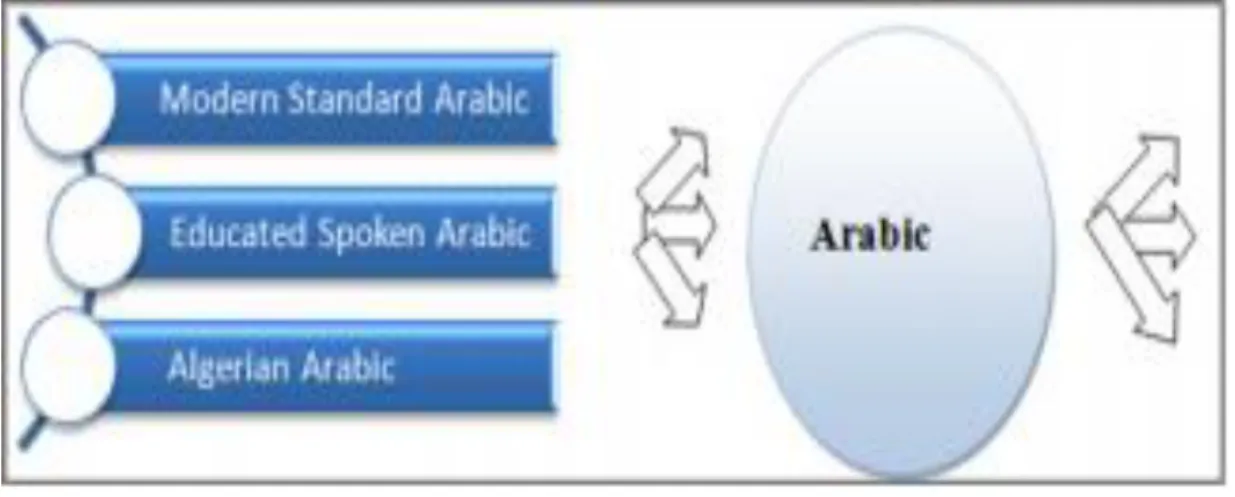
Separately, the Educated Spoken Arabic (ESA) is closely a little bit different from Modern Standard Arabic (MSA) (Kerma, 2018, p. 139). The former is a fusion between the MSA and the colloquial Arabic, which creates an intermediate Arabic (p.139). This new form of Arabic exists due to two main reasons. The first reason is the failure of colloquial Arabic to cope with the changes within the educated masses. The second reason is the failure of most Algerians to use the MSA spontaneously (p. 139). Kerma also stated that ESA has many forms due to different regional, linguistic, stylistic, and structural variations (p. 139). It is not a native language of anybody. Therefore, it is on the process of development until today in order to tighten the gap between Algerian Arabic and MSA. Nowadays, it is well spread what is called “triglossia” among the Algerian society in which we distinguish three types of Arabic.
Figure 1.1. Different facets of Arabic. (Retrieved from kerma, 2018, p. 139)
In addition, “ESA consists of a spoken form that borrows extensively from the High variety, i.e. MSA, and being expressed fluently in the “Low” variety, i.e. Colloquial Arabic, so as to be intelligible to the uneducated people.” (p.139) This is because most educated
people in Arab-speaking countries consider ESA as a simplified version of Classical Arabic. Moreover, ESA is subject to change structurally and its use differs from one context to another. However, Speakers of this variety have inter-regional intelligibility; it is shared among them and it is well understood within the education sector especially because of the fusion between MSA and colloquial Arabic that leads most people to grasp it easily. Hence, they can cope with any regional variety since they belong to the same diaspora (Kerma, 2018, p. 139).
1.1.4. French
According to the CIA, French is considered as a lingua franca in Algeria, and it all has to do with a bit of history. Since 1870, Algeria was declared as a French territory, because of the long colonization period, Algeria is considered the second largest country in the world that speaks French. In the Algerian educational system, French is taught from the 2nd year of primary school and presumed in the following levels (middle school and high school) as the first foreign language. It is present in Higher education, precisely in the scientific fields such as medicine and biology, therefore, students use French in order to study or to get an employment that requires French like in medicine (Chemami, 2011, pp. 230-231). This shows that French has a significant status in Algeria, especially in higher education, A rigid status that it seems difficult to replace French with English or Arabic.
1.2. Language Planning and Policy
Haugen (1959) is the one who introduced the term ‘language planning’ while he was developing a new standard language in Norway. He defines it as the process of preparing orthography, grammar, and dictionaries of a language to guide its users (as cited in Ghoul, 2013, pp. 39-40). Language Policy and Planning (LPP) are intents and implementations that
are meant to influence the language not to change it. Four possible general developments may direct LPP. They are cited as follow:
Levels of language planning: many researches cited that LPP has focused on the macro level planning; it also focuses on the micro level planning that is concerned with specific practices like literature.
Covert language planning: failing to make LPP explicit and to focus on some language issues. This can influence how languages are learnt and taught, and how they are observed.
Who are the planners and what are their roles? LPP focuses on the context rather than being purely scientific, the planners’ being motivated towards this process has an important role.
Planning for Compulsory Early Foreign Language Learning, especially English: many countries around the world have the attempt to introduce English at early ages in order to increase proficiency. The influence of these programs on society because of the introduction of this additional language is under the consideration of LPP (Baldauf, 2004, pp. 1-2).
In his book, Language Planning and Social Change, Robert Cooper defines language planning as the authority’s long-term treatment of a language either to change the language itself or to change its function among its speakers. This effort happens to help the users of the language to solve their problems and issues while communicating i.e. to make a certain language cope with the different changes that may occur with time (1989, pp. 30-31). Another definition by Cooper, who considers language planning as an authorized and purposeful change in the language system itself or the language use in order to accomplish certain purposes. (Cooper, 1989, p.30). Moreover, language planning is an organized framework by
the government or a specialized authority, which treats language as an evolving subject matter that needs changes through time according to the speakers’ needs of use. (Djennane, 2016, p.9). Therefore, this process makes the language cope with different changes that happen within society and makes the language suitable to use at any time.
Some scholars assume that language planning and language policy are related terms but different activities. Johnson states:
The exercise of language planning leads to, or is directed by, the promulgation of a language policy by government (or other authoritative body or person). A language policy is a body of ideas, laws, regulations, rules and practices intended to achieve the planned language change in the societies, group or system. (2013, p. 4).
The quote suggests that language planning is the result or the outcome of the language policy. In this context, certain rules and regulations need to be done in order to achieve language planning. Therefore, language planning is not an easy task; however, it needs time, effort, and an authorized board of experts.
1.2.1. Activities of language planning and Policy
Schermerhorn, Hunt, and Osborn understand planning as a “process of setting objectives” (as cited in Zaidi, 2013, para. 6). As for the language planning and policy, the government organizes this process; therefore, it requires some measurements to be taken into consideration. Language planning dimensions are the language planning activities or the ‘what’ that means what do the language planners do? (Ghoul, 2013, p. 42).
Language planning is a set of rules, principles, regulations, or decisions that are directed by the society or community’s relationship with the language used. These regulations
and rules can be either written as in laws or unwritten but rather understood by the community through attitudes (p. 11). In addition, language-planning tries to solve problems related either to language use, form, or both at the national level. Language policy has different goals; this depends on the nation, the community, or the organization itself. According to Nahir (1984), these goals are purifying language from any error or foreign elements and restoring what was forgotten. Also, reforming the language in order to improve its effectiveness, as well as standardizing it to be spoken and accepted as a major language. Additionally, help spread the language and expand its domains and speakers. Furthermore, creating new words to fit the new changes and standardizing the existing ones. Moreover, making technical or legal language comprehensible, and reduce bureaucratese. In addition, make the suitable language planning, translation, and interpretation that is known by Interlingual communication. It is also important to preserve the domains in which a language is used (language maintenance) (as cited in Bagui, 2012, p. 12).
Accordingly, Language planning is divided into three types named respectively: corpus planning, status planning, and acquisition planning.
1.2.1.1. Corpus planning
Corpus planning is defined as “those aspects of language planning which are primarily linguistic and hence internal to language” (Djennane, 2016, p.14). Thus, when the term language planning first appeared it was mainly a task devoted to the preparation of dictionaries in order to help speakers in a mixed speech community. Hence, the definition propose that language planning is perceived as corpus planning that is concerned with language form and not language use (p. 14). This means that corpus planning has to do with interventions and management of language forms i.e. it tries to modernize and standardize the language forms, which already exist, to cope with the needed communication purposes (p.
31). Moreover, it refers to the activity of inventing new forms of language that are extracted from the older forms as a sort of a modification to them, these forms might have existed either in spoken or written systems (Cooper, 1989, p. 31).
Experts (linguists) under the supervision of the higher authority (the government) handle corpus planning activities, the latter decides which language to be used for administrational, educational, and judicial matters, while linguists or other people take the responsibility of its spread and use. Corpus planning deals with the language forms and produces its grammars, dictionaries, and literacy manuals. The entire process of this corpus planning is to standardize the language script and the spelling to facilitate interaction, while the production of dictionaries helps to translate what is difficult to understand in other cultures. The standardization of the language participates in the creation of new knowledge and polishing the existing one; for example, adding new words in the dictionary, correcting the use of certain words, and/or adding more definitions to certain words or expressions (Ghoul, 2013, p. 44).
1.2.1.2. Status planning
According to Kaplan (1997), status planning is the activity that deals with all that surround the language i.e. the external factors that may influence the use of language in a given society (p.30). Moreover, status planning has to deal with many aspects such as the selection and use of language concerning education administrations, mass media, judiciary, trade, and international relations. Thus, language status may target certain important matters such as the choice of the regional variety of the language or the choice of the language itself. In addition to that, it decides which language or a variety of a language must be official, national, or regional (Berrahma, 2018, p.8).
Some scholars have made a distinction between the corpus planning and the status planning, while others have decided that it is impossible to do so, because any change in the form of language results in a change in its use and the opposite is correct (Ghoul, 2013, p.44).
1.2.1.3. Acquisition planning
Acquisition planning is the third activity that is presented by Cooper in 1989 (Bagui, 2012, p. 16). It refers to the well-planned task to advertise for the learning of the English language. It is a major type of language planning that is separate from the other mentioned ones. This activity helps to spread the language and it is related to “language learning and literacy skills as well as literature production and language use in the media” (Ghoul, 2013, p. 47). This means that this task, which is also done by experts, aims at widening the number of speakers, listeners, readers, and writers of a given language over the use of another one (Bagui, 2012, p. 16). Acquisition planning is an effort to manage a regulation for the distribution of given verbal resources of a given language (Ghoul, 2013, p. 47). This activity aims at extending the use of a certain language in a specific community (Bagui, 2012, p. 16).
For Cooper, acquisition planning differs from status planning. The latter is responsible for the adjustment of the language resources, while the former is responsible for the distribution of these resources. Moreover, status planning is how people think about a language, while acquisition planning is how the people learn the language. Furthermore, acquisition planning can be known as ‘language education policy’. It is linked to education because it is about how a language is learnt. Acquisition planning activity helps promoting for status planning through showing how the language use is developed in certain domains like education, workplace, media, organizations and religion (Cooper, 1989, p. 17).
1.2.2. Language policy in Algeria
Recovering back the identity of the Algerians after the French colonization was the most difficult thing to do because language as an important part of identity was highly affected. French colonizer forbade the use of Arabic or any other language rather than French, and this, through many years has created a new identity for the Algerian people, that it was hard to get rid of French and get back to Arabic. Note that even few years after independence, French was highly appreciated and used among our population, education was still in French because of the lack of teachers who can teach it Arabic that the government had to bring teachers from other Arab countries like Palestine and Egypt. Therefore, the government, back then, has made some reforms in order to regain its identity and language. They needed to cover mostly the educational, cultural, and linguistic areas due to the linguistic diversity of Algeria (p. 4). Later on in the 1960s, Algeria planned for the Arabisation policy in order to defuse the use of Arabic over French (Benyounes, 2017, p. 4).
1.2.2.1. Arabisation policy
Bossut (2016) states that Arabisation policy is “the language policy implemented to displace French altogether and to promote Arabic monolingualism in place of Arabic-French Bilingualism.” Therefore, the focus of the Algerian revolution back then is to regain the Arabic language as it is seen the language of dignity and civilization and because the French colonizer underestimated the Arabic language, it made it a language of liberation for the Algerians to get their independence. The value of this language was later increased because of Islamic religion and both Arabic and Islam were strong bases for the revolution to achieve its goals (Bossut, 2016, p. 10).
Thus, after the independence in July 1962, Algeria was a mixture of many ethnic groups, such as the Berber, Phoenician, Roman, Vandal, Byzantine, Jewish, Moor, Arabic, Spanish, Ottoman and finally the French. After the independence, people used French, Tamazight, or Algerian Arabic. However, the Arabisation policy disdained any diversity that existed, refused any other status of any other variety of language, and called for the classical Arabic to be the lingua franca that united Algeria with other Arab countries (Benrabah, 2007, p. 229).
A debate was raised after the independence because of the choice of the Arabic language. Some prefer French because it the language of innovation and the new technologies, and others prefer Arabic due to cultural and religious reasons.
After introducing the Arabisation policy by President Ahmed Ben Bella in 1963, teaching French in the Algerian schools decreased and the lack of teachers of Arabic increased. Therefore, there was a high need to recruit teachers from the neighbor countries like Palestine, Syria, and Egypt. However, most of them did not achieve any success due to their spoken Arabic and the traditional way of teaching such us rote learning (pp. 5-6).
One of the criticisms of the Arabisation policy was that French was still used in the public places or at homes. During the presidency of Houari Boumadiene, Arabisation policy was a confirmation that Algeria is an Arabo-Islamic country despite ignoring the country’s diversity. The failure of the Arabisation policy was no escape because the process lacked planning and did not have any scientific basis or the suitable materials such as scientific books, unlike in French. As a result, the Algerian government took another measurement towards bilingual Algeria and shed light on the education system of the country (Benyounes, 2017, pp. 5-6). Furthermore, in 2007, the Arabisation policy reached its purposes in elementary and secondary education, while French gained a prestigious status in the higher education and it was used in the scientific fields (Arab, 2015, p. 11).
1.2.2.2. Education reform policy
Since 2000, there was a serious debate between two parts of the Algerian population whether to keep the status quo of Algeria as a monolingual country or to become a bilingual Arabic- French country. In 2001, the National Commission for the Reform of the Educational System (CNRSE) suggested a reform of implementing French in elementary level at the second grade and not the fourth one. The CNRSE added that French replaces Arabic in scientific fields in secondary school. Therefore, French is taught as a separate subject matter in order to enhance students’ level of bilingualism (Benrabeh, 2007, pp. 227-228).
Moreover, Benrabeh (2007) noted that the need for an educational reform was as old as it could ever be. Both Presidents Mohammed Boudiaf (1992) and Abdel Aziz Bouteflika (1999) described the educational system as being doomed and unworthy. People added; this educational system is only producing illiterate generation in both Arabic and French. During his rule, President Abdel Aziz Bouteflika made a total revision for the educational system, curriculum, textbook, and teacher training as well as legalizing private school that taught French and Arabic (Benrabeh, 2007, pp. 227-228).
As a third reform in 1993, pupils of elementary school could choose between studying French or English in order to elevate the foreign language teaching and learning. However, some schools performed this decision and stopped afterward, because some parents favored French over English (Rezig, 2011, pp. 1329-1330). This fact was because English was totally unknown and foreign for the Algerian population back at that time, while French was the most used and somehow familiar to them.
1.3. English as a Global Language
English is the most spoken language all over the world. Closely to 1.5 billion (Lyons, 2017) people speak English whether as their native or learned language. According to Crystal
(2003), English has become the most used internationally due to one important reason that is the power of its people especially politically speaking (p.09).
Crystal states that English is used as a lingua franca in many countries for advertising, broadcasting, press, cinema, and popular music. Moreover, The Asia–Pacific Broadcasting Union adopts English as an official language (2003, pp. 91-104). “In fact, most of the literature works are published in this language than any other language. Thus, with the advance of technology, over 90% of the electronic internet contents are stored in English.” (Arab, 2015, p. 7).
Furthermore, Berrahma states, “…it is also the language of international traffic control as well as the principle language of a world publishing science and technology. Likewise, English is the language of debate at the United Nations and the language of command in the NATO.” (2018, p.11).
1.3.1. The status of English in Algeria
The selection of teaching or learning any language is based on the status of that particular language within a society. The state’s effort is to make this process easier by promoting agreements, providing materials, and preparing a good curriculum (Arab, 2015, p.4).
The English language is taught in Algeria as a foreign language starting from first grade at the secondary school and lasting for seven years until high school. Additionally, students are introduced from the beginning to the English alphabet, grammar, lexis, and conversational aspects; such as greetings, apologizing, requesting, and others. Consequently, there is a high claimed will to give English a remarkable position due to the cooperation with the United States of America and Canada in order to promote this educational policy in Algeria. Thus, the aid is mainly assisting in making new textbooks, training teachers to be
eligible, and building up knowledge about the use of new technologies in teaching (Chemami, 2011, p.231).
Conclusion
The linguistic situation in Algeria is rich and diversified, where varieties of Arabic and Berber co-exist together and they are used in everyday life communication along with French. Algeria proves to be a multilingual country, which has interests to enrich its linguistic baggage by paying more attention to the English language and tries to include it further in its educational system. The status of languages in Algeria today is different from that of 1962, because Algeria is welcoming any path towards science and new technologies. It tries to cope with the different changes that happen around the world starting from the production of new manuals, support middle and secondary schools with the new technologies like the data show, and encourage the online schooling system in order to provide great help to its learners. The attention that the Algerian government pays towards the English language is remarkable, as the minister of higher education has noted, it is now considered essential to write any thesis of any field in English and it is taught in universities. The status of languages in Algeria continues to grow if the government focuses on how to promote the learning of these trending languages in order to make Algeria rich and open to new cultures and knowledge.
CHAPTER TWO
Early English Language Education: Programs, Benefits, and Challenges
Introduction ……….. 21 2.1. Attempts to Introduce English as a FL in Primary Schools over the World …………. 22 2.1.1. English from First Grade – Idiomas desde Primer Grado, Argentina ……… 22 2.1.2. English Opens Doors - Programa “El inglés abre puertas” (PIAP), Chile………. 23 2.1.3. The National Plan for English for Basic Education – Programa Nacional de Inglés
en Educación Básica (PNIEB), Mexico ………...……… 24 2.1.4. Ceibal in English – Ceibal en inglés, Uruguay……… 25 2.2. Benefits of Early English language learning ……… 25 2.2.1. The Younger, the Better……… 28 2.2.2. Enhancement of Cognitive Skills……… 29 2.2.3. Later Performance ………...……… 30 2.2.4. English Language as a Language of Publication ………...…...……..31 2.2.5. An Asset for Professional Career……….... 33 2.3. ELT in Primary Schools: The Challenges………..…...….. 33 2.3.1. Qualified Teachers and Teacher Training Quality………..……… 34 2.3.2. Developing a Solid Curriculum Framework………..………. 35 2.3.3. Textbook Quality……….... 36 2.3.4. Parents Attitudes……….... 39
2.3.5 Francophonie……….. 41 Conclusion……… 41
Introduction
The current educational system in Algeria is different from that of years ago. More approaches are included, different teaching methods are integrated, and the attention to the learning of languages has increased. Arabic, French, Tamazight are taught in primary, middle, and high schools. However, English is not implemented in the primary school yet. In 1993, there was an educational reform, where the pupils have to choose between learning the French or the English languages in primary school. The aim behind this was to ameliorate foreign language learning at a young age. Some primary schools in Algeria applied this reform then cancelled it because the majority parents favored French over English (Rezig, 2011, pp. 1329-1330).
In the recent years, due to the positive impact of globalization, English language learning has gained more interest. Because of 1.5 billion people around the world speak English; it becomes the lingua franca for all non-English speakers. It is the language of technology, medicine, business, diplomacy, and travel. Therefore, a vital need to teach English in almost all countries over the world arises. In the case of Algeria, English is the second foreign language and it is taught as a compulsory course from the first grade of middle school to the third year of high school, covering seven years of learning. It is also taught at the university as a course, usually as ESP.
However, due to historical and political reasons in Algeria, English is still lagging behind French. It is primarily learned for educational reasons, within an academic environment, and has no real use in the daily communication of Algerians. Teaching English at primary levels is a difficult task. Researchers argue about the starting time of teaching English, and they attempted to define the methods and techniques that work best with this primary level. They suggest that the implementation must have clear goals; otherwise, it
cannot be fruitful (Straková, 2015, p. 2442). This chapter discusses the different programs and implementation of English in primary schools over the world as well as the importance, and challenges of introducing English to this level.
2.1. Attempts to introduce English as a Foreign Language (EFL) in primary schools over the world
Many developing countries, specifically in Latin America, have recently started incorporating English Language Teaching (ELT) in primary schools. It is unquestionable that the reasons behind this were the widespread of English learning and its significant importance. English, in one way or another, became the most important language in the world, and speaking it became a necessity in many countries, whether it is a job-related matter, a holiday abroad, or an article publication, English is highly required. Mexico, Argentina, Chile, and many other countries inside and outside of Latin America have recognized the importance of speaking English, and consequently, they initiated EFL programs to ensure that their youngest learners can benefit from this widely spoken foreign language. The respective governments have funded all of these programs. The programs became the central issues discussed by education policy makers and they earned publicity and recognition in the topics under consideration and discussion in the area of education policy (Banfi, 2015, Lessons to Learn, para. 2). However, these programs had several drawbacks and challenges. This research focuses on these programs so that such implementations in the Algerian primary schools can take them as an example, to learn from their successful application, and to avoid their critical fails and mistakes.
2.1.1. English from First Grade – Idiomas desde Primer Grado, Argentina
English from First Grade is a program of teaching English that was added to primary schools at the end of the 1960s and spread to all state schools in Buenos Aires, Argentina by
1996. In addition, this program was followed by the creation of a network of state-run language schools called Foreign Language Complementary Educational Centres (CECIEs Centros Educativos Complementarios de Idiomas Extranjeros) in which children can develop their language skills in extracurricular activities (Banfi, 2015, English from First Grade, para. 1).
Another program was developed in 1999 called Ecuelas Plurilingües (Plurilingual Schools), in which 26 schools taught English intensively. From 2009 to 2011, the City Council initiated an innovative project that included full foreign-language coverage for all state-run primary schools. The government further provided schools with the necessary textbooks and different teaching materials that worked well for the lower-class individuals who could not afford such materials. The government did not face any problem in providing a sufficient number of well-trained teachers due to the well-developed teacher training programs provided to all sectors of education (Banfi, 2015, “First Grade” , para. 2).
2.1.2. English Opens Doors - Programa “El inglés abre puertas” (PIAP), Chile
The program had a clear aim of developing learners’ English language performance from the 5th year of primary school to the 4th year of secondary school. It was launched in 2003. The program included developing national standards for English language instruction, as well as English teachers and their professional development. Approximately 1000 teachers have engaged in “English Summer Village” and “English Winter Retreats” workshops coordinated together by the British council, the department of state and English Open Doors (Programa Ingles Abre Puertas PIAP), and spread over 12 separate locations across the country (Banfi, 2015, “Open Doors”, para. 2).
Banfi (2015) states that the program encourages teachers to participate in educational learning programs, and over 4,575 teachers in Chile took this opportunity to improve their language and teaching skills. They were offered a preliminary placement test and the chance
for those who succeed with a B2 level to receive an international qualification. This offer was meant for teachers below the average level, it was set to enhance their professional background, and to give them a chance for a scholarship abroad. This has been accompanied by the introduction of training classes and career development services for distance learning opened by an official body (the British Council) with the collaboration of local and international trainers (“Open Doors”, para. 1-2).
2.1.3. The National Plan for English for Basic Education – Programa Nacional de Inglés en Educación Básica (PNIEB), Mexico
In Mexico, a national language program called the Programa Nacional de Inglés en
Educación Básica (PNIEB) –The National Plan for English for Basic Education, initiated in
2009 to introduce English as a subject in Mexican primary schools. The program is said to have created many opportunities. Sayer (2015) reported that the PNIEB has hired 98,000 primary school teachers. The motives behind it are to address the Mexican population with the new challenges of the 21st century, and to develop the linguistic and digital skills among Mexican students (p. 258).
Sayer, (2015) also reported that the implementation of such program produced various obstacles and critical challenges to the Mexican government and educational system. Thus, it has not been an easy and quick process (p. 263). The program had to be replaced by another called the S246 program. The PNIEB was launched in a period of political reforms, instability, and turmoil, which hindered its expansion pace and resulted in its replacement. The federal government in 2013 initiated the S246 project (or PFCEB) replacing the PNIEB program. This new program aimed to support states, schools, and teachers in the creation of essential initiatives to increase the educational outcomes of students in basic education through a set of conditions. One of the conditions includes the implementation of English in
public primary schools. Two main reasons were behind this replacement. On one hand, the clash of this program (PNIEB) with numerous curriculum changes, on the other hand the presence of a national instability (Ramírez-Romero and Sayer, 2016, pp. 7-8).
2.1.4. Ceibal in English – Ceibal en inglés, Uruguay
In Uruguay, a similar program was initiated in mid-2012 via collaboration between Ceibal, a program to support Uruguayan education system with technology, and the British Council (Plan Ceibal, n.d.). The program was widespread across 400 primary schools and 50,000 children benifited from it. They learned English for fifty-three minutes per week, taught by both a remote teacher and a classroom teacher. As part of the curriculum, both the remote teacher and the classroom teacher adopt thorough learning activities, engaging their learners in large-scale summative tests similar to those of international certifications such as Cambridge English test for young learners (Banfi, 2015, Ceibal in English, para. 1).
This program was closely associated to the Laptop-Per-Child program. One-Laptop-Per-Child aims to provide a budget laptop for each child. With exposure to this kind of learning resource, children are ensured a bright future because they are involved in their own schooling, and together they study, connect, and develop their cognitive skills (One Laptop per Child, n.d.)
.
Both programs (Ceibal in English and One-Laptop-Per-Child) have the power and influence of providing an innovative way to solve the problem of shortage of English teachers in primary school using various means of technology, meaning that the unavailability of a local classroom teacher can be solved through an assistance with a remote teacher using online classes. (Banfi, 2015, Ceibal in English, para. 1-2).2.2. Benefits of English language learning
The English language has gained an important status on a global level. The use of English has spread all over the world that it is very rare to find a country, which does not
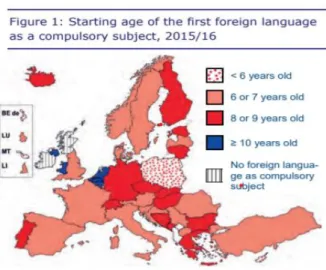
teach English as a second or foreign language in the primary level. In average, in Europe, around half of primary school pupils around the EU are studying a foreign language, which is in many cases English. Mandatory lessons in a foreign language usually begin at the end of primary school or at the beginning of secondary school. In 2016, many countries such as Romania, Spain, and Austria, initiated mandatory foreign language learning before the age of eight, i.e. at the beginning of primary school, and in certain countries, it also starts in pre-primary education. Recently, Cyprus and Poland implemented a provision that makes language-learning compulsory for all pre-primary-school pupils (Baidak, Balcon & Motiejunaite, 2017, p. 5).
Figure 2.1. Starting age of the first foreign language as a compulsory subject, 2015/16
(Retrieved from Baidak, Balcon & Motiejunaite, 2017, p. 5)
Figure 2.1 represents the starting age of the first foreign language, which is English in Norway, Sweden, Slovakia, Greece, Italy, Portugal, Netherlands, and Germany, as a compulsory subject (see Figure 2.2). Countries like Poland and Cyprus begin to teach the first
foreign language before the age of six, i.e., pre-primary education. The countries in orange represent the starting age of 6 or 7 years old, i.e., at the start of primary schooling. The countries in red start later at the ages of 8 or 9, i.e., from the 3rd or 4th grade, and the countries in blue start even later after the age of 10, which is most likely the start of secondary schooling.
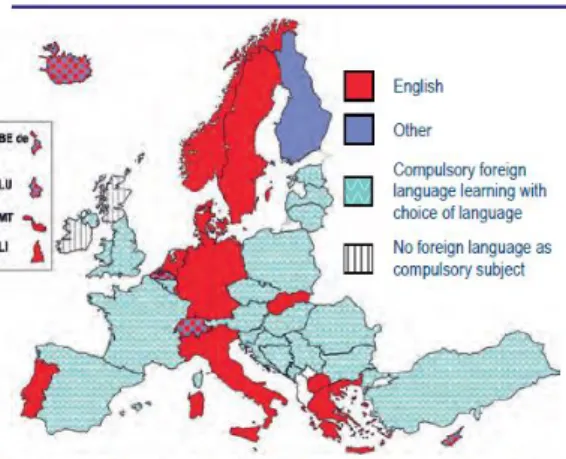
Figure 2.2. Mandatory Foreign Languages during Compulsory Education, 2015/16
(Retrieved from Baidak, Balcon & Motiejunaite, 2017, p. 9)
Figure 2.2 represents the countries in which English is the first foreign language taught in primary schools (Countries in red). Countries in green give the learners the options of foreign language learning. Many countries in green give the option of English, Spanish, or French as first foreign language.
Various studies have proven the importance and benefit of early foreign language education, which was the reason behind teaching English and other foreign languages at the primary level. Here are some selected benefits of early English language learning which
played a major role for many countries to decide about an implementation of EFL in their educational systems.
2.2.1. The younger the better
This is a support of the critical period hypothesis. The critical period hypothesis is a theory that suggests that young children learn a language better and faster. It considers that language acquisition ability is biologically linked to age. It is believed that individuals who start learning a foreign language very early in their life generally acquire a higher level of skill than those who begin at a later age. In this regard, Bialystok and Hakuta (1999) stated that:
It is tempting to believe that children are better second language learners than adults because their brains are specially organized to learn language, whereas those of adults are not. This is the explanation of the critical period hypothesis. The evidence for it comes from several sources. Informal observation irrefutably shows children to be more successful than adults in mastering a second language. Empirical studies confirm this pattern by demonstrating performance differences between children and adult learners on various tasks and measures (p. 176).
Age is known as one of the key issues in L2 learning that plays a significant role in determining language learner's progress. In second language or foreign language learning, several researchers have been investigating the impact of age on different aspects of language learning. Gawi (2012) explored the impact of age on learning EFL among Saudi private primary school learners in contrast to public middle school learners in Dawadmi City. The
analyses included a comparison of the performance of young students (elementary school level-4) with the performance of older students (intermediate level-3). The results have shown that age does have an impact on EFL learning and contributes to better results, confirming the hypothesis of the earlier, the better. This study shows that learning the language at an early age is recognized as a significant element in improving English language learners ' abilities (pp. 129-130). The following table is retrieved from Gawi (2012, p. 132).
Table 2.1
The results of "Independent Samples Test" for the differences between Saudi students who start learning English at ages 5/6, as compared with those who start learning English at the ages 12/13
The results on the table demonstrate that Saudi learners who started learning English in private schools at the ages 5/6 scored a higher average in grammar, vocabulary, conversation, and writing than the learners who start learning English in public middle schools at the ages 12/13. The only test where older learners scored better was the reading test. These results also confirm the CPH hypothesis
Learning a foreign language or bilingualism requires specific coping styles and contributes the developing of the four core skills, (Reading, writing, listening, and speaking). This, in effect, allows the child to potentially progress in many cognitive aspects as well. Through learning a language, the child’s general reading and thinking abilities develop. The child can also develop his/her cognitive skills, such as creativity, reasoning and problem solving. A whole range of other cognitive skills is enhanced through the process of foreign language learning, including attention, multi-tasking, memory, critical thinking, and mind flexibility. Learning a foreign language also leads to an improvement in social cognition and empathy.
Most of people face an age-related decline in brain function such as attention and memory, and the acceleration of this process sometimes leads to the appearance of Alzheimer's disease or a form of dementia. Some recent studies have shown that learning a foreign language can slow the inevitable cognitive decline or may reduce the onset of dementia. (Landry, 1973; Mahu, 2012; Javan and Ghonsooly, 2017; Woll and Wei, 2019). 2.2.3. Later performance
Learning anything at a younger age makes us better at it then at a later age because we develop and evolve. Hence, when children learn English at the primary level, then, they reach secondary level; English therein would no longer be foreign to them because they have already acquired the basis and have considerable background knowledge. Cahyati & Madya, (2018) stated that in order to get a comprehensive awareness of the second language, children need to start early, and if they start a bit late, it would be challenging them to grasp the language quickly. A pupil, for instance, takes a long time to grasp the grammatical constructs as he or she also does not have a specific competence relevant to such structures (p. 396). This problem would be avoided if children learn English prior to secondary school. Children should be given enough time to study English at the primary school to improve their grammar