Language mixing in young bilinguals*
WENDY E. REDLINGER AND TSCHANG-ZIN PARK
Universitdt Bern {Received 4 May 1979)
ABSTRACT
The speech of four two-year-old children growing up bilingually in a German-speaking community was studied for periods varying between five and nine months. An analysis of their language mixing revealed an initially higher rate of mixing which diminished with a growth in language develop-ment as measured in MLU. The data suggest that the children were at various stages in a gradual process of language differentiation thus providing support for the one-system theory of bilingual acquisition. An examination of the distribution of lexical substitutions by part of speech revealed that nouns were most frequently substituted by all children; however, more function words were substituted than content words overall.
INTRODUCTION
Early diary studies by linguist parents reporting on the language development of their bilingual children describe an initial mixed stage in language production consisting of indiscriminate combinations of elements from each language (Leopold 1970, Imedadze 1967). Other more recent accounts of bilingual development also report frequent mixing in the early stages (Oksaar 1976a, b, Swain 1977, Volterra & Taeschner 1978). These authors have all suggested that children acquiring two languages simultaneously from infancy begin by pro-cessing the languages as a single system, and only gradually differentiate the two. Some investigators studying developmental bilingualism, however, have reported a minimal amount of mixing by their young subjects and have suggested that a bilingual child may essentially be able to keep the two languages separate from the earliest stages of linguistic development (Padilla & Liebman 1975, Bergman 1976, Lindholm & Padilla 1978).
Since degree of language mixing is generally regarded as evidence in support of either the one-system or the two-system approach to bilingual acquisition, it is extremely important to study mixing in relationship to overall linguistic growth patterns. Yet no previous investigators have made a systematic analysis of mixing with respect to language development in terms of age or MLU. [•] Address for correspondence: Dr W. E. Redlinger, L. Miranda & Assoc, Inc., 4340
Another shortcoming of some studies is that arguments have been based on examples without being accompanied by distributional data, e.g. Oksaar (1976a,
b) and Volterra & Taeschner (1978). Furthermore, in those studies where
dis-tributional data have been given, frequencies have been reported in tokens instead of in types (Swain 1974, Swain & Wesche 1975, Padilla & Liebman 1975, Lindholm & Padilla 1978). Frequency in token utterances is somewhat mis-leading, especially in the early stages of language development when young children often use the same utterances repeatedly in various situations. The present study has attempted to overcome these methodological difficulties by investigating the mixing phenomenon from a developmental perspective. The spontaneous speech of four children growing up in a German community has been examined for language mixing. The amount of mixing by each child has then been analysed in relationship to linguistic development as measured by MLU. In addition, an analysis has been made of the distribution of substituted lexical items by part of speech.
METHOD
Subjects
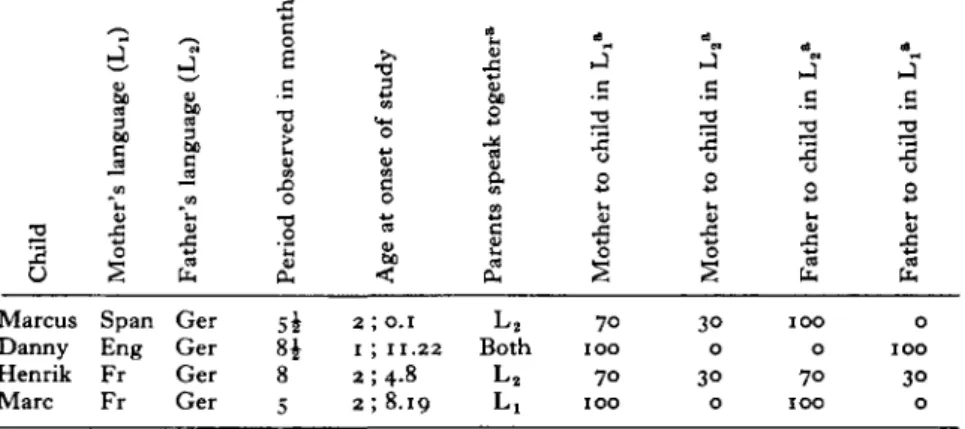
The subjects were all children of German fathers and non-German mothers residing in the Freiburg, Germany area. Two of the children, the Spanish/ German and the English/German bilingual, were in Stage I (Brown 1973) at the beginning of the study. The other two children, both French/German bilinguals, were in Stage III when first observed. The children were observed over periods varying from five to almost nine months. All subjects were first-born children with no siblings. Language background information on each child is given in Table 1. Information on language usage in the home was provided by the mother who reported which language she and her husband spoke together and estimated what percentage of each language was spoken to the child by herself and by the father. In the cases of Danny and Marc, the one person/one language formula seems to have been closely followed. Danny learned only English from his parents and acquired German through regular visits with his monolingual grandmother and neighbourhood playmates. Although Henrik was customarily addressed in either language by his parents and Marcus in either language by his mother, the children were reportedly not exposed to language mixing within sentence boundaries.
Procedures
Thirty to forty-five minutes of taped spontaneous speech samples was collected in the children's homes approximately every three weeks by the first author, a native speaker of English who is also fluent in German and Spanish. She spoke only in German with the French/German subjects and primarily in German with
TABLE I. Language background information O lang u :he i o 3 00 c c o c
£
T3 3 os
c 21
c •a j 21
S Marcus Danny Henrik Marc Span Eng Fr Fr Ger Ger Ger Ger .Si 8* 8 5 2 I 2 2 O.I 11.22 4.8 8.19 U Both L2 70 1 0 0 7 0 1 0 0 3 0 0 3° 0 1 0 0 0 7 0 1 0 0 0 1 0 0 3° 0 [*] Mother's estimate of language usage (in percentages).the other subjects. In all cases, the child's interaction with the mother in the non-German tongue was regularly recorded, and in the case of Marcus, verbal interaction with the father in German was also taped from time to time. In addition to tape recording each home session, nctes were taken on the child's speech and on the specific situational context at the scene. The tapes were trans-cribed by the first author generally within three days following a home visit.
The calculation of MLU was based on Brown's (1973:54) rules with some modifications. Park (in press) had already concluded that counting all inflections as separate morphemes results in an inflated MLU when dealing with inflected languages such as German. Therefore only correct inflectional forms were taken into account in the calculation of German, French, and Spanish MLUs. Another modification involved the exclusion of no and yeah and their equivalents in German, French, and Spanish from MLU calculation. The decision to make this modification was based on two factors: (1) a general saliency noted of the German affirmative ja in the speech of all children, even when they were conversing in the non-German language, and (2) the difficulty in determining to which language the affirmative /ya/ belonged in the case of the English/German child. Thus, the no/yeah exclusion reflects the attempt made to be as consistent as possible in MLU calculations of the four subjects. An overall MLU value was calculated on the basis of the first 100 utterances regardless of language. For purposes of analysis, the speech data was divided into periods, each containing the speech samples from two adjacent home visits. The MLUs were calculated separately for each session and then averaged together for each period. Since there was an odd number of sessions in the case of Henrik, the final session was taken alone. In this study, language mixing refers to the combining of elements from two
languages in a single utterance. Mixing may involve the insertion of a single element or of a partial or entire phrase from one language into an utterance of the other language:
(1) And the froggie's getting nass. ('. . . wet.')
(2) Das ist ein Knochen pour chien. ('That is a bone for dog.') (3) Le cheval ist zu miide. ('The horse is too tired.')
The percentage of mixed utterances occurring in a given period was calculated only on type utterances rather than on token utterances:
„, . , no. mixed utterances
% mixed utterances = T-^~, x I 0°
-no. multiple utterances RESULTS AND DISCUSSION
Language mixing in relation to linguistic development
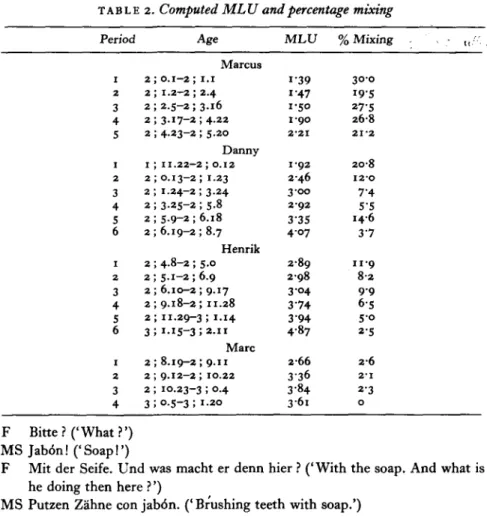
Table 2 shows the percentage of mixing for each child by period in relationship to age and MLU. Marcus, who moved out of Stage I (Brown 1973) of linguistic development only during the 5th and final period, produced mixed utterances averaging 25 % over the entire time observed. Danny, whose language develop-ment covered late Stage I to Stage V produced an average io-8% mixed utterances; Henrik and Marc, who went through Stages II-V, exhibited the lowest rate of mixing amounting to 7-3 % and i-8 % respectively. In general, the children whose language was more advanced produced fewer mixed utterances than the children at earlier stages of development suggesting that the amount of mixing and language development are reversely associated.
Various linguistic and sociolinguistic factors seem to have influenced the degree of mixing when observed on the individual level. At the beginning of observation, Marcus appeared to have basically one lexical system consisting of words from both languages. A vocabulary list compiled for him at the end of the first period contained only four sets of corresponding words out of a list of 36 Spanish, 33 German and 11 Spanish/German items, i.e. words which could be considered belonging to either language. During the time observed, Marcus gradually added corresponding equivalents to his vocabulary list but seemed unable to draw a clear-cut distinction even by the end of observation. This is illustrated by the following examples from the 5th and final period:
(Father (F) and Marcus (MS) looking in book) F Und was macht er hier ? ('And what's he doing here ?') MS Haare putzen. ('Hair cleaning.')
F Ja, er wascht die Haare, und dann auch ? ('Yes, he washes his hair, and then also ?')
MS Jab6n!('Soap!')
TABLE 2. Computed MLU and percentage mixing
Period Age MLU % Mixing
Marcus I 2 3 4 S i 2 3 4 5 6 i 2 3 4 5 6 i 2 3 4 2 2 2 2 2 I 2 2 2 2 2 2 2 2 2 2 3 2 2 2 3 0 . 1 - 2 ; I . I 1.2-2; 2.4 2.5-2; 3-i6 3.17-2; 422 4.23-2; 5.20 Danny 11.22-2; 0.12 0.13-z; 1.23 1.24-253.24 3.25-2; 5.8 5.9-2 ; 6.18 6.19-2; 8.7 Henrik 4.8-2; 5.0 5.1-2; 6.9 6.10-2; 9.17 9.18-2; 11.28 11.29-3; 1.14 1.15-3 ; 2.11 Marc 8.19-2; 9.11 9.12-2; 10.22 10.23-3 ; °-4 0.5-3 ; J-2o 1-39 1 4 7 i-5° 1-90 2-21 1-92 2-46 3-00 2 9 2 3-35 4 0 7 2 8 9 2 9 8 3-O4 3-74 3 94 4-87 2 6 6 3 3 6 3-84 3 6 1 30-0 19-5 27-5 2 6 8 21-2 2 0 8 I2-O 7'4 5-5 1 4 6 3-7 1 1 9 8 2 9 9 6 S 5'O 2-5 2 6 2 - 1 2 3 O F Bitte?('What?') MS Jab6n!('Soap!')
F Mit der Seife. Und was macht er denn hier ? ('With the soap. And what is he doing then here ?')
MS Putzen Zahne con jab6n. (' Brushing teeth with soap.') (Mother (M) and Marcus (MS) looking in book) M ,fQue hacen los nifios ? ('What are the children doing ?') MS Mud. Die Kinder da miide. ('Tired. The children there tired.')
M ,jEstan cansados ? £ No juegan los nifios? ('Are they tired? Aren't the children playing ?')
MS Das no juegan. Arboles! ('That not playing. Trees!') M ,jQue hay en los arboles? ('What are on the trees?') MS Manzanas. Hund schlafen. ('Apples. Dog sleeping.')
In addition to the linguistic factors already mentioned, the lack of strict language separation by person in Marcus' linguistic environment, where the mother also spoke German to him an estimated 30% of the time (Table 1), may have had an effect on his overall high rate of mixing.
Danny's initially high rate of mixing is due in part to the repeated use of the newly acquired German article ein ('a') with English nouns. Almost half of the mixed utterances from this period were of this type:
(4) Ein chu-chu train. (5) Ein big cow.
(6) Ein chu-chu smoking.
Such a combination rarely occurred after the first period since the English article a had now been acquired. An interesting example from the data suggested that Danny was consciously aware that he was dealing with two languages at least by the 4th period. He was accustomed to being addressed only in English by his mother (Table 1), who admittedly switched to German occasionally to test his reaction. When the mother switched to German during the 4th visit (Period 2), Danny (2; 1.23) appeared not to notice.
(Danny (D) conversing with mother (M) and investigator (I)) I Und wie geht's Anne ? ('And how's Anne ?')
M Was hat Anne gemacht ? ('What did Anne do ?')
D Anne go Bein boom. Boom. Anne Bein boom. Anne weint. ('Anne go leg boom. Boom. Anne leg boom. Anne cries.')
I Anne weint immer noch ? (' Anne's still crying ?') M Nicht immer noch, Danny. ('Not still, Danny.') D Phillip auch. Phillip weint. ('Phillip too. Phillip cries.')
(M leaves room and D and I continue conversation in German) However, when his mother switched to German during Period 4, Danny (2;4.14) reacted immediately:
D (looking in book) Katze. Die hat da bissen die Vogel. (' Cat. She has bitten the birds.')
I Die Katze mochte den Vogel auffressen. ('The cat wants to eat the bird up.')
M Was macht der Vogel ? ('What's the bird doing ?')
D (looking at M startled) Nicht Vogel! ('Not bird.') (pointing to I) Du Vogel. ('You bird.') (pointing to M) Du sag birdie. ('You say birdie.')
Danny's mixing rates progressively decline as his MLU increases but for a notable exception at Period 5 (Table 2). At this point, the child had just returned from a week's visit with his monolingual German grandmother and was including more German when speaking with his mother. The child's increasingly futile attempts to speak purely English with his mother undoubtedly account for the rise in mixing rate during the 5th period.
(Mother (M) and Danny (D) looking in picture book) M Do you think that cat's going to eat all those things ?
D Nein, ich glaub' nicht. Hat doch ummp gemacht. (' No, I believe not. Has made ummp.')
M Don't you speak English anymore ? D Nein. German.
M Why?
D Guck, der Esel. Mehr books. More books, (gets up to look for more picture books)
(Later with another book) M Where do you think that boat's going ?
D In - to America. M Do you think so ?
D Guck, alle Auto on the ship. ('Look, all auto on the ship.') (pointing to aircraft carrier)
M Those aren't autos! D Doch! (emphatic'Yes!') M No, look at them. With wings ? D Cars. With the cars rauf. ('.. .on top.')
From Period 5 on Danny's German so dominated his speech that by Period 6 he had virtually stopped speaking English, producing less than 25 English utterances during each of the final two visits.
Henrik produced a lower amount of mixed utterances than either Marcus or Danny probably because he was already more advanced linguistically (Stage III) and basically in possession of corresponding lexical items in the two languages at the onset of observation. It is possible that Henrik's overall mixing rate was higher than that of Marc, who was also in Stage III at the onset of the study, because of a lack of strict separation by person in Henrik's linguistic environment, i.e. he was customarily addressed in either language by both patents (Table 1). It is interesting to note that during the final period, Henrik suddenly evidenced a reluctance to speak French in the presence of the in-vestigator whom he considered to be a monolingual German speaker. The transcripts show several instances of him translating his mother's comments into German for the investigator and then proceeding to respond to the mother in German.
(Henrik (H), mother (M) and investigator (I) looking at book) M Regarde le crocodil qui morde. ('Look at the crocodile that's biting.') H (turning to I) Der beisst! Schaumal, ist ein Karotten-auto ist das. ('He
bites! Look, is a carrot car is that.')
H Ja, das kann man es essen. (' Yes, that one can eat it.')
M Et puis ca marche pas. Si tu mange le carrotte, le toto ne marche plus. ('And then it won't go. If you eat the carrot, the toot-toot won't go.') H Und das, das eine Moto. ('And that, that a motorcycle.')
M Et 9a qu'est-ce que c'est ? ('And that, what's that ?')
H Toto fromage. ('Cheese toot-toot.') (turning to I) Ein Keksauto. ('A cheese car.')
(Henrik (H), mother (M) and investigator (I) discussing father) M Ou est-ce qu'il est ton Papa ? ('Where is your Papa ?')
H (to I) Der ist in Biiro gegangen. ('He has gone to office.')
M Qu'est-ce qu'il fait la ? Qu'est-ce qu'il fait au bureau ? (' What does he do there ? What does he do in the office ?')
H Travaille. ('Works.')
M II travaille, oui. Comment il travaille, Papa ? (' He works, yes. How does he work, Papa ?')
H (turning to I) Der arbeitet, der Papa. ('He works, Papa.')
Marc's overall mixing rate was the lowest of all children observed and he seemed to be differentiating the languages to a considerable degree already at the onset of observation (Stage III). The fact that there was a strict language separa-tion by person in his environment may have played a role in his learning to differentiate sooner and therefore to mix less than someone like Henrik who heard both languages from both parents.
Although the degree to which the one person/one language formula was realized in the linguistic environment of the four children differed, their parents reportedly did not engage in language mixing. When a bilingual child is not confronted with models of mixed speech from the parents, the degree to which the languages are mixed should be an indication of his ability to differentiate between languages. Overall, mixing rates of the four subjects decreased with advancing linguistic development. Furthermore, the mixing rates measured at earlier stages of development were lower than those at later stages. These findings suggest that the subjects were involved in a gradual process of language differentiation and are in agreement with those of previous investigators supporting the one system approach to bilingual acquisition. The findings conflict however with those of investigators supporting the two-system approach. This discrepancy may possibly be accounted for by differences in methodology. Bergman's (1976) report was primarily an anecdotal account lacking such systematic measurements as MLU calculations. Padilla & Liebman (1975), although calculating growth in MLU, did not present a distributional analysis of mixing. Furthermore, they calculated the percentage of mixed utterances on a token basis and did not clearly state whether the calculation was a percentage of the total number of utterances or a percentage of only multiple-word utterances.
T A B L E 3. Percentage distribution of single mixed items by part of speech Contentives Noun Verb Adjective Subtotal Functors Adverb Article Pronoun Preposition Conjunction Subtotal Total Danny N 49 18 8 75 3° 3° 23 1 1 85 160 % (306) ("•3) ( So) (46-9) (188) (18-8) (143) ( o-6) ( o-6) (S3-i) Henrik N 2 7 5 32 2 6 2 9 1 3 4 i 73 % (37-o) ( 6-9) — (43-9) (35-6) ( 27) (123) ( i-4) ( 4-i) (56-i) Marc N 8 2 1 0 2 I 2
s
IS % (53-3) — (13-3) (66-6) ( 1 3 3 ) ( 67) — ( 1 3 3 ) — (333)Lindholm & Padilla (1978), on the other hand, by pooling the data from five subjects of greatly varying age (2 ; 10-6 ; 2), did not deal with the developmental aspect of mixing.
Distribution of single lexical and phrasal substitutions
The distribution of single lexical substitutions by part of speech in the mixed utterances of Danny, Henrik, and Marc is shown in Table 3; Marcus was not included because of his generally low level of lexical differentiation throughout the observation period. Nouns were the most frequently substituted elements by all three children. Some examples are:
Danny
(7) From up in Himmel. ('From up in sky.') (8) She's in Kirche. (' She's in church.') (9) Ich will nicht gum. (' I don't want gum.')
(10) Der monkey will beissen. ('The monkey wants to bite.')
Henrik
(11) Va dans le Wasser. ('Goes into the water.') (12) Fait des - de Blume. ('Makes the - the flower.')
(13) Und da ist weg der mouche. ('And there is gone the fly.') (14) Wo ist die livre ? ('Where is the book ?')
Marc
(15) Tombe Eisenbahn. ('Train fell.')
II
(17) Das ein chemin. ('That a road.') (18) Cle ist da. ('Key is there.')
Among contentives, the next most frequently substituted category was that of verbs. Substituted verbs were most often correctly conjugated with respect to subject or object referent.
Danny
(19) Guck, that's red. ('Look...') (20) Danny mach fix. (' Danny make...') (21) An umbrella hat. ('.. .has.')
(22) Getting jetzt nass. ('Geting wet now.')
Henrik
(23) II liest avec hibou. ('He reads with owl.')
(24) Qu'est qu'il y a passiert ? ('What has happened ?') (25) C'est VW kaputt hier. ('It is VW broken here.') (26) Ein Messer zum couper. ('A knife for cutting.')
It is interesting that only Danny mixed on the morphological level, and then only in the verb category. English verb and auxiliary affixes were applied to German elements:
(27) Pfeiftm^ ('Whistling.')
(28) Nashorn vorne's eating. ('Rhinoceros in front's eating.') (29) Die Madchen'i going night-night. ('The girl's...')
In addition, German verb affixes were applied to English elements: (30) Da Polizeiget\c\tfet. ('There police ticketed.')
(31) Der push/ der kleine Josef. ('He pushes the little Joseph.') Adjectives were the least substituted of the contentives.
Danny
(32) That's too gross ('.. .big.')
(33) And the froggie's getting nass. ('. . .wet.') (34) Daddy's red Auto fallen. ('.. .car fell.') (35) T)3L fire Auto. ('There fire car.')
Marc
(36) Pour l'auto rot. (' For the red car.')
(37) L'auto est pas cassee, l'autogriin. ('The car is not broken, the green car.') Among functors, adverbs were the most frequently substituted part of speech. Mixing in this category often involved the insertion of the German locative
adverb da ('there') into Lt utterances and accounted for 1/3 of the adverb substitutions of both Danny and Henrik. Marc's two adverb substitutions were of this type.
Danny
(38) Da big truck. ('There...')
(39) Danny auch bottle ? ('Danny also... ?') (40) Mehr gucken now. ('More looking now.') (41) Er geht up. ('He goes up.')
Henrik
(42) £a marche, un moto da. ('It goes, the motorcycle there.') (43) La luge, ja. ('The sled, yes.')
(44) Das ganz gefahrlich, non ? (' That very dangerous, no ?') (45) Encore das da. ('Again that there.')
Marc
(46) Et da le lit. ('And there the bed.') (47) Da lumiere. ('There light.')
Articles were substituted frequently by Danny but only rarely by the other two children.
Henrik
(48) Die bateau monte. ('The ship rises.') (49) Ein toto rue. ('A toot-toot street.')
Marc
(50) A joue die dame. ( ' T o play the lady.')
Half of Danny's substituted articles occurred during the second visit (Period 1) as the ein previously mentioned. T h e German ein is an article like English a as well as a pronoun cognate with one. Danny's use of ein in mixed utterances during the second visit was viewed as an article usage for several reasons. During the same session it was used just as often with German nouns as with English nouns including once in the well-formed utterance Das ist ein Koffer. (' T h a t is a suit-case.') During the following session the English article a appeared and occurred eight times with English nouns while the use of ein with English nouns had dropped to thiee instances. Furthermore, during the third home visit, ein occurred clearly as a pronoun for the first time in Ein in Auto ('One in car.' -child putting one stick into his toy truck) as did its English counterpart one in
One for big truck (child picking u p one block to fit into toy truck). I n later
-the only case of substituted Lx articles among the children. Interestingly, these
substitutions all involved noun cognates: (51) ^ K u h . ('A cow.')
(52) A Schiff. ('A ship.')
(53) Guck, a Schneemann. ('Look, a snowman.')
In the pronoun category, only German pronouns were substituted. The majority of pronoun substitutions involved the use of the demonstrative pronoun das (sometimes/da/) in the semantic function of nomination. Fifteen of Danny's pronoun substitutions were of this type, 13 of which occurred during Period 1. Seven of Henrik's pronoun substitutions were of this type, over half of which occurred during Period 1.
Danny
(54) Da too big. ( ' T h a t . . . ' ) (55) Das black engine. ( ' T h a t . . . ' )
Henrik
(56) Das encore marche avant. ('That again goes ahead.') (57) Das auto du Wendy. ('That's Wendy's car.')
Other examples of pronoun substitution include the following.
Danny
(58) Ich Danny home. ( ' I . . . ' ) (59) Ich can't see it. ( ' I . . . ' )
(60) Der is a monkey. ('That one ...')
Henrik
(61) Qu'est que fait, die la. ('What's doing, she there ?') (62) II regarde sa - ihr fille. ('He looks at his - her daughter.') Preposition substitutions observed were:
Danny
(63) With the cars rauf. ('.. .on top.')
Henrik
(64) Bateau von toto Oma. (' Ship from Grandma's toot-toot.')
Marc
(65) Das Auto pour Papa. ('The car for Papa.') (66) Auto pour Mama. ('Car for Mama.')
isssrmd JBUJSIUI jnoqii M pajaii n 3J3 M pue XUUBQ UJOJJ sajduiBx a guiMOjjo j sq j, "Jaqj o 3q i u i uaq i pu B sSBnSuE j 3u o ui JSJ U smal l jo uouEoijdnp aqi jo aousJJnaoo JBUOISBODO aqi UTB;UO D OJBJ\ [ jnq JJE UIOJJ sajduiB s tpasd s paxiu i 'jaAaMo q 'Xpni s auasaj d aq i u j -suiaisX s uij pu us ip OMJ Suis n XpBaj( B 3 J 3A Y psAissq o usjpnq o aq i JB^ J uonraiuo D JOJ jjoddn s S B Xouajsjsuo o jBjnpnjj s qon s aj p ^ sq x ' sl U3 JI JBDIXS J j o UOI J -BDijdnpaj pauiBjuo o aaA9 U saausjan n paxiu i ,S}33fqn s j pq } jsq i jjoda j j SuiuuiSaq uajpjiqa l Bn 3ui[iq aajqj j o Xpiu s Jiaq i u i (SZ,6i ) usuiqai q 3 5 •aSBnSuBj Jaqi o aq j u i suBdiaiuno o aioja q Xj[Buonoun j pajjnDDO mo<f S^JBJ/ ^ pu B 'anb-ayxvcf puB «? / > s ^u ua jj 't?p pus up S ( XUUEQ 3[duiEX9 J Oj -sassBjo pjOM pajoijjsaj jo saaquiaui Suujnoo o ^[juanbaj j j o JSISUO O qoiqM sauoSajBO jojaunj aq j u i ajqBaoijo u ^JEjnoiiJE d SB M sjqj ^ -saSEnSuB j q;o q jo S33UBJ3wn u i luauia p paJinbo E JSJ U aq j j o aSss n ((jEJoduia i aq i u i pajjnsa j 8E J uopismbDB sjqjL "aSEnSuBi Jaqj o aq i u i uiaj t Suipuodsajjo D aq j j o lBq j puiqa q OA U JO uoissas B aq pjnoM aSBnSuBj au o u i uiai i U B J O uoijisinbo B aq i }Eq j paAJasq o sauiijauios SB M I J •ABMjapu n jpA\ . s i uoiiEUuajajji p jo ssaDOJd aq i jajj E uaA a juauidojaAap {BnSuijiq j o SBSEI S XjJB a u i uajpnq o X q pajnjijsqns a q AEU I jBDixaj Xq M isaSSn s sjDafqn s ;uasaj d aq i j o BiB p qoaad s aq i u i sajduiBx a •spafqns jEnSuin q Jiaq i X q XJBJB J Xju o sjojounj pajmusqn s jo asn a qi pa;o u sjoiBSusaAU i as aq x -Xpnis juasaj d aq j j o spafqns aqj UBq j p a D U B A pB XfjEonsinSuij ajou i snq j pu B (z '. 9-9 '. £) Japj o 3J3 M sjoafqns Jiaq a j o au o jn q JJ E jBq j }3B J aq i o j an p a q XBU I siqj L -Xpnj s ;uasaj d aq j u i punoj jEq i UBq j jaqSi q XjqBJapisuo a SB M sjDafqn s (8^61 ) s ( Bj]ipB,j 7g mjoqpui^j Aq pajnjiisqn s {%L-^%) sunou j o aSBjuaoja d JJBJ3A O aqj ^ -sioafqn s aajq i JJ B JO saouBjajjn paxiui aq j u i pajajunoou a aja M suoiinjiisqn s ajojii E 'J3A3Mo q '. jnooo ^ou pip suoiinjusqns XjBijixn B pjo M ajSui s Xpni s luasaj d aq j u i 'asiM35fi'~ j -sapiH B puE saiJEijixnB idaoxa qoaads jo sjjsd JJE oa SuiSuopq suopnaijsqns [E3ixa j punoj Xaij i 'uoqipp B uj 's^uanjiisuoD painiiisqns X^uanbaj j isou i 3q i a q o\ sunou paijodaj OSJ E (SZ,6I ) aqosa^ V ^ S uiBM g 'pjiq a qsijSug/qDuaj j pjo-JBaX-£ B j o Xpn^ s jp qi uj '5jiJuajj pu E XUUE Q J O saouBjaii n paxiu i aq j u i -uoo UEqj Xjjuanbaj j ajou i jnoo o 0% punoj a jaA V Xaq i 'saAijuajuo o UIOJ J pajapisuo3 ajaAi sjoioun j u ai }^ •(£ ajqBj^) uoiiounfuo D pu B uopisodaj d ' a 'qjaA 'unouojd 'spiiJB 'qjsApB 3i{i Aq psMOjjoj uno u sq i SE M saauEJsaj n paxiu i ui au3Ui3j a p3;njijsqn s E SB JJEJSAO Suujnooo qoasds jo jjsd jusnbajj isou i (, -lBqj 3so p o j IUB M ssnBDs g J •usqDBuinz S B p JJIA V 9nb-9uvj (69) (,-ua[fBi SB U asnEoag r J •ua\\}ip3 JS I 9tib-33xvj (§9) (/JOOJ-JOOJ aq; pu E A\OM-MOM aqx,) ' O J°J 3 I pun Bno-Eno a q (£9 ) X q Xju o pajnjijsqn s a j3A v suoijaunfuo ^
Danny
(70) I put it das up. ('I put it it up.')
(71) She's painting malen da. ('She's painting painting there.') (72) Look,guck\ ('Look, look!')
Henrik
(73) Noch haben encore ? ('Have still still ?')
(74) II fait macht die Wasser. ('He makes makes the water.') (75) Qu'est qu'ily a passiert ? ('What happened happened ?') (76) OKI,./*. ('Yes, yes.')
This phenomenon of lexical duplication has also been reported by Imedadze (1967) in the speech of her child learning Russian and Georgian. Probably such duplication can be regarded as an indication of a child's insufficient differentiation of the two languages, although in the instances of reduplication in two-word utterances (examples 72 and 76), it may have been more a case of emphasis.
Phrasal mixtures constituted only a small number of the total mixed utterances (Danny - eight, Henrik - thirteen, and Marc - three). Concurring with findings by Swain & Wesche (1975) and Lindholm & Padilla (1978), the majority of phrasal mixtures produced by subjects of the present study also occurred at phrasal boundaries:
Danny
(77) My blanket jetzt auf. ('.. .now on.') (78) Und da it's not flying. ('And there...')
(79) Guck, alle Auto on the ship. ('Look, all car...')
Henrik
(80) 1st ein Buch pour dame. (' Is a book for ladies.') (81) Ca pique, das hier. ('It itches, this here.') (82) Jeune fille ist das. ('Young girl is that.')
Marc
(83) Johanna hat un petit chemin. ('Johanna has a little road.') (84) A joue die Dame. ('To play the lady.')
The three phrasal mixtures that did not occur at phrasal boundaries were:
Danny
(85) Ja, und da hab ich money put the meter. ('Yes, and there I have...') (86) Ich will ein apple eat. (' I want a . . . ' )
Marc
(87) Da Auto pompier de Francoise. ('There fire engine of Francoise.')
SUMMARY AND CONCLUSION
The four subjects of the present study cover a span of linguistic development from Stage I to Stage V. Their degree of mixing observed during this develop-mental span can be grouped: Stage I mixing levels were between 20 % and 30 %, Stage II levels tended to be between 12% and 20%, Stage III levels between 6% and 12%, and Stages IV and V between 2 % and 6%. Mixing rates were thus seen to decrease with advancing linguistic development. High mixing rates during the earliest stages of bilingual development seemed to reflect a general inability of the child to differentiate between the two languages. As the children developed linguistically, the ability to control the languages separately also grew, resulting in a progressive decrease in language mixing.
It appears then that language differentiation is a gradual process which can, at least in part, be traced through decreasing mixing rates. These observations are in agreement with those of previous investigators (Leopold 1970, Imedadze 1967, Swain 1977, Oksaar 1976a, b and Volterra & Taeschner 1978) who have suggested that children exposed to two languages from infancy begin by pro-cessing the languages through a single system only gradually to differentiate the two. The findings contrast with those reported by other investigators who claim that the children they observed appeared to be using two separate linguistic systems from the beginning (Padilla& Liebman 1975, Bergman 1976). However, as was pointed out earlier, the lack of methodological rigour in these latter studies has resulted in an as yet unconvincing case for the two system theory.
The language development of a bilingual child is affected by both linguistic and sociolinguistic influences. Although the present study has focussed on the former, sociolinguistic factors undoubtedly play an important role as well. In the present study, for example, it was noted that a separation of language by person or the lack of it may affect the speed and ease with which a bilingual child learns to differentiate the languages. Much remains to be investigated regarding the sociolinguistic aspects of why some bilingual children mix languages more than others and why some are able to differentiate their languages sooner than others. Future studies of developmental bilingualism should address these questions in an attempt to gain increased insight into the sociolinguistic parameters of bilingual acquisition.
REFERENCES
Bergman, C. R. (1976). Interference vs. independent development in infant bilingualism. In G. Keller (ed.), Bilingualism in the bicentennial and beyond. New York: Bilingual Press/Editorial Bilingiie.
CHILD LANGUAGE
Brown, R. (1973). A first language: the early stages. Cambridge, Mass.: Harvard University Press.
Imedadze, N. V. (1967). On the psychological nature of child speech formation under condition of exposure to two languages. IJPsychol 2. 139-32.
Leopold, W. (1970). Speech development of a bilingual child. Vols. I-IV. New York: AMS Press.
Lindholm, K. J. & Padilla, A. M. (1978). Language mixing in bilingual children. JChLang 5- 327-36.
Oksaar, E. (1976a). Code switching as an interactional strategy for developing bilingual competence. In W. Von Raffler Engel (ed.), Child language—1975 (Special issue of Word 27. Nos. 1-3).
(19766). Implications of language contact for bilingual language acquisition. In W. McCormack& S. Wurm (eds), Language and man: anthropological issues. The Hague: Mouton.
Padilla, A. M. & Liebman, E. (1975). Language acquisition in the bilingual child. The Bilingual Review/La Revista Bilingue 2. 34-55.
Park, T. Z. (in press). The development of syntax in the child with special reference to German. Innsbrucker Beitrage zur Sprachuiissenschaft.
Swain, M. K. (1974). Child bilingual language learning and linguistic interdependence. In S. Carey (ed.), Bilingualism, biculturalism and education. Edmonton: University of Alberta Press.
(1977). Bilingualism, monolingualism and code acquisition. In W. Mackey & T. Andersson (eds), Bilingualism in early childhood. Rowley, Mass.: Newbury House. Swain, M. K. & Wesche, M. (1975). Linguistic interaction: case study of a bilingual child.
Language Sciences 37. 17-22.
Volterra, V. & Taeschner, T. (1978). The acquisition and development of language by bilingual children. JChLang 5. 311-26.