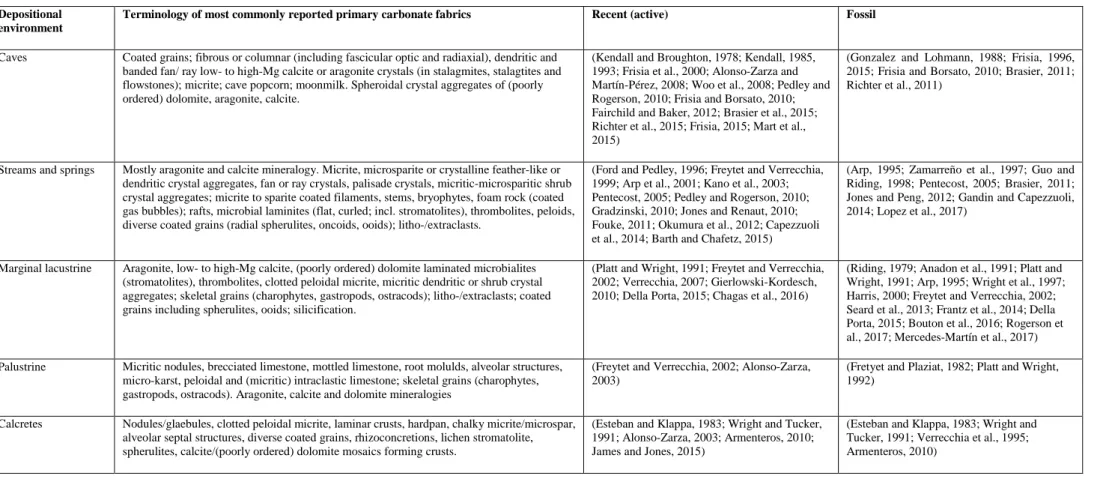
Appendix A: Tables with background information on primary fabrics and common mineralogies in non-marine carbonate deposits.
Depositional environment
Terminology of most commonly reported primary carbonate fabrics Recent (active) Fossil
Caves Coated grains; fibrous or columnar (including fascicular optic and radiaxial), dendritic and banded fan/ ray low- to high-Mg calcite or aragonite crystals (in stalagmites, stalagtites and flowstones); micrite; cave popcorn; moonmilk. Spheroidal crystal aggregates of (poorly ordered) dolomite, aragonite, calcite.
(Kendall and Broughton, 1978; Kendall, 1985, 1993; Frisia et al., 2000; Alonso-Zarza and Martín-Pérez, 2008; Woo et al., 2008; Pedley and Rogerson, 2010; Frisia and Borsato, 2010; Fairchild and Baker, 2012; Brasier et al., 2015; Richter et al., 2015; Frisia, 2015; Mart et al., 2015)
(Gonzalez and Lohmann, 1988; Frisia, 1996, 2015; Frisia and Borsato, 2010; Brasier, 2011; Richter et al., 2011)
Streams and springs Mostly aragonite and calcite mineralogy. Micrite, microsparite or crystalline feather-like or dendritic crystal aggregates, fan or ray crystals, palisade crystals, micritic-microsparitic shrub crystal aggregates; micrite to sparite coated filaments, stems, bryophytes, foam rock (coated gas bubbles); rafts, microbial laminites (flat, curled; incl. stromatolites), thrombolites, peloids, diverse coated grains (radial spherulites, oncoids, ooids); litho-/extraclasts.
(Ford and Pedley, 1996; Freytet and Verrecchia, 1999; Arp et al., 2001; Kano et al., 2003; Pentecost, 2005; Pedley and Rogerson, 2010; Gradzinski, 2010; Jones and Renaut, 2010; Fouke, 2011; Okumura et al., 2012; Capezzuoli et al., 2014; Barth and Chafetz, 2015)
(Arp, 1995; Zamarreño et al., 1997; Guo and Riding, 1998; Pentecost, 2005; Brasier, 2011; Jones and Peng, 2012; Gandin and Capezzuoli, 2014; Lopez et al., 2017)
Marginal lacustrine Aragonite, low- to high-Mg calcite, (poorly ordered) dolomite laminated microbialites (stromatolites), thrombolites, clotted peloidal micrite, micritic dendritic or shrub crystal aggregates; skeletal grains (charophytes, gastropods, ostracods); litho-/extraclasts; coated grains including spherulites, ooids; silicification.
(Platt and Wright, 1991; Freytet and Verrecchia, 2002; Verrecchia, 2007; Gierlowski-Kordesch, 2010; Della Porta, 2015; Chagas et al., 2016)
(Riding, 1979; Anadon et al., 1991; Platt and Wright, 1991; Arp, 1995; Wright et al., 1997; Harris, 2000; Freytet and Verrecchia, 2002; Seard et al., 2013; Frantz et al., 2014; Della Porta, 2015; Bouton et al., 2016; Rogerson et al., 2017; Mercedes-Martín et al., 2017) Palustrine Micritic nodules, brecciated limestone, mottled limestone, root molulds, alveolar structures,
micro-karst, peloidal and (micritic) intraclastic limestone; skeletal grains (charophytes, gastropods, ostracods). Aragonite, calcite and dolomite mineralogies
(Freytet and Verrecchia, 2002; Alonso-Zarza, 2003)
(Fretyet and Plaziat, 1982; Platt and Wright, 1992)
Calcretes Nodules/glaebules, clotted peloidal micrite, laminar crusts, hardpan, chalky micrite/microspar, alveolar septal structures, diverse coated grains, rhizoconcretions, lichen stromatolite, spherulites, calcite/(poorly ordered) dolomite mosaics forming crusts.
(Esteban and Klappa, 1983; Wright and Tucker, 1991; Alonso-Zarza, 2003; Armenteros, 2010; James and Jones, 2015)
(Esteban and Klappa, 1983; Wright and Tucker, 1991; Verrecchia et al., 1995; Armenteros, 2010)
Table A1: Overview of the range of commonly reported ‘primary’ carbonate micro- to macrofabrics in diverse non-marine carbonate depositional environments, as observed in the field and under transmitted light microscopy, plus key literature.
Mineral Formula Appearance Physico-chemical conditions References
Calcite CaCO3
(rhombohedral)
Rhombohedra, scalenohedra, prisms, micrite to sparite, granular, dendrite and shrub crystal aggregates, elongated columnar, ray crystals
Ambient to increased temperatures, low supersaturation polymorph, can become unfavorable under SO4, Fe, high Mg (Mg/Ca>0.5) and Sr concentrations. When evolving
from ACC, LMC and HMC may form from Mg/Ca: 0-4 (stirred) - up to 10 (quiescent conditions)
(Plummer and Busenberg, 1982; Gonzalez and Lohmann, 1988; Morse and Mackenzie, 1990; Frisia et al., 2002; Pentecost, 2005; Deocampo, 2010; Fouke, 2011;
Riechelmann et al., 2014; Blue et al., 2017; Jones, 2017)
Aragonite CaCO3
(orthorhombic)
Often acicular, fibrous crystals forming botryoids or ray fans
Ambient to increased temperatures, high supersaturations (degassing), SIcalcite<0.8,
elevated Mg/Ca (>0.5) or Mg/Ca ~ 5 when evolving from ACC (stirred conditions). Increased Sr, Ba, SO4-ion concentrations favor aragonite over calcite.
(Plummer and Busenberg, 1982; Gonzalez and Lohmann, 1988; Morse and Mackenzie, 1990; Frisia et al., 2002; Kele et al., 2008; Deocampo, 2010; Fouke, 2011;
Riechelmann et al., 2014; Sun et al., 2015; Jones and Peng, 2016; Blue et al., 2017; Jones, 2017)
Vaterite CaCO3
(hexagonal)
Precipitates most commonly form micron-size sphericoidal shapes
Atmospheric pressure (1 atm), low temperature (< 10°C), high supersaturation, alkaline solutions. May be favored in phosphorous-enriched media rapidly transforms in presence of water, often - not always - reported in association with organic molecules
(Plummer and Busenberg, 1982; Grasby, 2003; Sanchez-Moral et al., 2003; Rodriguez-Navarro et al., 2007; Wang and Becker, 2009; Rodriguez-Blanco et al., 2011) Monohydrocalcite (MHC) CaCO3*H2O (hexagonal) nanometer-sized crystals (<35 nm), or more commonly low angle branching spherulites with knobby crystal surface
Mg/Ca: 0.17 - 65, mostly favoured in high Mg/Ca fluids (>4), alkaline solutions (aCO3
2-/aCa2+ > 1.0). Metastable (intermediate) polymorph, possibly evolving from
ACC/Mg-ACC, and transforming (within hours) into anhydrous CaCO3.
(Nishiyama et al., 2013; Demichelis et al., 2014; Rodriguez-Blanco et al., 2014; Blue et al., 2017)
Ikaite CaCO3∙6H2O
(monoclinic)
White, square prisms and pyramidal crystals; blade and needle-like crystals. Recrystallizes into thinolites or glendonites (calcite pseudomorphs)
T~0°C, preferably < 6-7°C; becomes stable at ambient temperatures (25°C) when pressure >2-3 kbar. pH > 11. Can be favored in organic-rich sediments (presence of phosphate or amino acids that could inhibit anhydrous CaCO3? No concensus yet).
Ca-Na-HC03-rich, high alkalinity solutions (Ca > 30 mg/L) and microbial activity in anoxic
conditions may promote ikaite. May form after ACC, but not necessary. Transforms rapidly (days) to calcite (and H2O) under earth surface conditions.
(Suess et al., 1982; Shaikh and Shearman, 1986; Shearman et al., 1989; Council and Bennett, 1993; Whiticar and Suess, 1998; Buchardt et al., 2001; Shahar et al., 2005; Demichelis et al., 2014; Hu et al., 2014; Papadimitriou et al., 2014; Boch et al., 2015; Sánchez-Pastor et al., 2016; Peckmann, 2017) Calcium-oxalate CaC2O4.H2O and CaC2O4.2H2O Monoclinic or tetragonal Monohydrate (whewellite): isodiametric (prisms or pseudo-rhombs) or elongated (spindles, dumbbells), Dihydrate or polyhydrate (weddellite): octahedral crystals, dipyramidal shapes, prisms, needles.
Strongly associated with fungi, trees, plant roots (in soils or spring carbonates): cellular carbohydrate is aerobically oxidized. Oxalic acid that is produced, reacts with Ca2+ (in
tissue or environment) forming oxalic salts like Ca-oxalate. Ca-oxalate transforms rapidly to CaCO3 upon death and oxidation of the organic tissue with O2.
(Verrecchia and Dumont, 996; Cromack et al., 1977; Verrecchia et al., 1993; Freytet and Verrecchia, 1995; Horner and Wagner, 1995; Braissant et al., 2004; Cailleau et al., 2011, 2014)
Huntite CaMg3(CO3)4
(trigonal)
Platelets that can form globules and rosettes; chalk like masses
Cool temperature, Mg-rich fluids in lakes and final stage of crystallization sequences where increasingly Mg-rich phases form (eg in caves). In cases: microbially mediated or facilitated precipitation. Easily replacement by dolomite.
(Gonzalez and Lohmann, 1988; Alonso-Zarza and Martín-Pérez, 2008; Sánchez-Román et al., 2011)
Dolomite CaMg(CO3)2
(trigonal)
Micritic, microscparitic, euhedral rhombohedra, sometimes forming spheroid and dumbbell structures
High Mg2+/Ca2+- ratios (2-7; <10); low Ca2+/CO
32- ratios; salinities substantially lower or
higher than that of seawater. Stable, ordered dolomite typically develops at higher temperatures. May evolve from Mg-ACC (vMgCO3 50%) at T>60°C. At surface
conditions non-stoichiometric very high Mg-calcite and/or poorly ordered
‘(proto)dolomite’ may form, often in relation to organic matter, low SO4-2 concentrations,
specific microbial metabolisms (including sulfate reduction). Can form as weathering product of huntite and hydromagnesite under aerobic, low temperature conditions.
(Vasconcelos et al., 1995; Vasconcelos and McKenzie, 1997; Machel, 2004; Alonso-Zarza and Martín-Pérez, 2008; Bontognali et al., 2010, 2014; Sánchez-Román et al., 2011; Kenward et al., 2013; Roberts et al., 2013; Richter et al., 2014; Gregg et al., 2015; Rodriguez-Blanco et al, 2015) Hydromagnesite Mg(CO3)4(OH)
2∙4H2O
(monoclinic)
Platy and acicular crystals, micritic Low temperature, Mg-rich fluids (Mg/Ca > 39) in highly alkaline lakes and in crystallization sequences in cave deposits; in cases: microbially mediated or facilitated precipitation. Easily replaced by dolomite. May form as a byproduct of
monohydrocalcite transformation to anhydrous CaCO3.
(Gonzalez and Lohmann, 1988; Léveillé et al., 2000; Alonso-Zarza and Martín-Pérez, 2008; Sánchez-Román et al., 2011; Chagas et al., 2016)
Magnesite MgCO3
(trigonal)
Massive, micritic to coarsely crystalline, powdery, white to pale coloured
Extremely high Mg/Ca ratios in fluids in ultrabasic or dolomitic terrains, strong evaporation (?), dehydration of nesquehonite; microbially mediated or facilitated precipitation (?)
(Léveillé et al., 2000; Melezhik et al., 2001; Deocampo, 2010)
Table A2: Most common carbonate mineralogies, including Ca-oxalates, in non-marine carbonate deposits. Not included are currently rarely reported mineralogies like for example nesquehonite (MgCO3*3H2O). LMC = low-magnesium calcite; HMC = high-magnesium calcite; ACC = amorphous calcium carbonate; Mg-ACC = Mg-rich ACC.
References Appendix A
Alonso-Zarza, A.M., 2003. Palaeoenvironmental significance of palustrine carbonates and calcretes in the geological record. Earth-Science Reviews 60, 261–298. doi:10.1016/S0012-8252(02)00106-X
Alonso-Zarza, A.M., Martín-Pérez, A., 2008. Dolomite in caves: Recent dolomite formation in oxic, non-sulfate environments. Castañar Cave, Spain. Sedimentary Geology 205, 160–164. doi:10.1016/j.sedgeo.2008.02.006
Anadon, P., Cabrera, L.L., Kelts, K. (Eds.), 1991. Lacustrine Facies Analysis. Special Publication 13. Internatinal Association of Sedimentologists. doi:10.1002/9781444303919 Armenteros, I., 2010. Diagenesis of Carbonates in Continental Settings. In: Alonso-Zarza, A.M., Tanner, L.H. (Eds.), Carbonates in Continental Settings: Geochemistry,
Diagenesis and Applications. Developments in Sedimentology 62. Elsevier, Amsterdam, pp. 61–151.
Arp, G., 1995. Lacustrine bioherms, spring mounds, and marginal carbonates of the Ries-impact-crater (Miocene, Southern Germany). Facies 33, 35–89. doi:10.1007/BF02537444
Arp, G., Wedemeyer, N., Reitner, J., 2001. Fluvial tufa formation in a hard-water creek (Deinschwanger Bach, Franconian Alb, Germany). Facies 44, 1–22. doi:10.1007/BF02668163
Barth, J.A., Chafetz, H.S., 2015. Cool water geyser travertine: Crystal Geyser, Utah, USA. Sedimentology 62, 607–620. doi:10.1111/sed.12158
Blue, C.R., Giuffre, A., Mergelsberg, S., Han, N., Yoreo, J.J. De, Dove, P.M., 2017. Chemical and physical controls on the transformation of amorphous calcium carbonate into crystalline CaCO3 polymorphs. Geochimica et Cosmochimica Acta 196, 179–196. doi:10.1016/j.gca.2016.09.004
Boch, R., Dietzel, M., Reichl, P., Leis, A., Baldermann, A., Mittermayr, F., Pölt, P., 2015. Rapid ikaite (CaCO3·6H2O) crystallization in a man-made river bed: Hydrogeochemical monitoring of a rarely documented mineral formation. Applied Geochemistry 63, 366–379. doi:10.1016/j.apgeochem.2015.10.003
Bontognali, T.R.R., Mckenzie, J.A., Warthmann, R.J., Vasconcelos, C., 2014. Microbially influenced formation of Mg-calcite and Ca-dolomite in the presence of exopolymeric substances produced by sulphate-reducing bacteria. Terra Nova 26, 72–77. doi:10.1111/ter.12072
Bontognali, T.R.R., Vasconcelos, C., Warthmann, R.J., Bernasconi, S.M., Dupraz, C., Strohmenger, C.J., Mckenzie, J.A., 2010. Dolomite formation within microbial mats in the coastal sabkha of Abu Dhabi (United Arab Emirates). Sedimentology 57, 824–844. doi:10.1111/j.1365-3091.2009.01121.x
Bouton, A., Vennin, E., Boulle, J., Pace, A., Bourillot, R., Thomazo, C., Brayard, A., Désaubliaux, G., Goslar, T., Yokoyama, Y., Dupraz, C., Visscher, P.T., 2016. Linking the distribution of microbial deposits from the Great Salt Lake (Utah, USA) to tectonic and climatic processes. Biogeosciences 13, 5511–5526. doi:10.5194/bg-13-5511-2016 Braissant, O., Cailleau, G., Aragno, M., Verrecchia, E.P., 2004. Biologically induced mineralization in the Iroko Milicia excelsa (Moraceae): its causes and consequences to the
environment. Geobiology 2, 59–66.
Brasier, A.T., 2011. Searching for travertines, calcretes and speleothems in deep time: Processes, appearances, predictions and the impact of plants. Earth-Science Reviews 104, 213–239. doi:10.1016/j.earscirev.2010.10.007
Quaternary Tufa and Speleothem Materials Formed in the “Twilight Zone” at Caerwys, UK. Astrobiology 15, 883–900. doi:10.1089/ast.2015.1293
Buchardt, B., Carsten, I., Paul, S., Gabrielle, S., 2001. Ikaite tufa towers in Ikka Fjord, Southwest Greenland: their formation by mixing of seawater and alkalin spring water. Journal of Sedimentar 71, 176–189. doi:10.1306/042800710176
Cailleau, G., Braissant, O., Verrecchia, E., 2011. Turning sunlight into stone: the oxalate–carbonate pathway in a tropical tree ecosystem. Biogeosciences 8, 1755–1767. Cailleau, G., Mota, M., Bindschedler, S., Junier, P., Verrecchia, E.P., 2014. Detection of active oxalate-carbonate pathway ecosystems in the Amazon Basin: Global implications
of a natural potential C sink. Catena 116, 132–141. doi:10.1016/j.catena.2013.12.017
Capezzuoli, E., Gandin, A., Pedley, M., 2014. Decoding tufa and travertine (fresh water carbonates) in the sedimentary record: The state of the art. Sedimentology 61, 1–21. doi:10.1111/sed.12075
Chagas, A.A.P., Webb, G.E., Burne, R. V., Southam, G., 2016. Modern lacustrine microbialites: Towards a synthesis of aqueous and carbonate geochemistry and mineralogy. Earth-Science Reviews 162, 338–363. doi:10.1016/j.earscirev.2016.09.012
Council, T.C., Bennett, P.C., 1993. Geochemistry of ikaite formation at Mono Lake, California: Implications for the origin of tufa mounds. Geology 21, 971–974. doi:10.1130/0091-7613(1993)021<0971
Cromack, K., Sollins, J.P., Todd, R.L., Fogel, R., Todd, A.W., Fender, W.M., Crossley, M.E., Crossley, D.A.J., 1977. The role of oxalic acid and bicarbonate in calcium cycling by fungi and bacteria : some possible implications for soil animals. Ecological Bulletin, Stockholm 25, 246–252.
Demichelis, R., Raiteri, P., Gale, J.D., 2014. Structure of hydrated calcium carbonates: A first-principles study. Journal of Crystal Growth 401, 33–37. doi:10.1016/j.jcrysgro.2013.10.064
Deocampo, D.M., 2010. The Geochemistry of Continental Carbonates. In: Alonso-Zarza, A.M., Tanner, L.H. (Eds.), Carbonates in Continental Settings: Geochemistry, Diagenesis and Applications. Developments in Sedimentology 62. Elsevier, Amsterdam, pp. 1–60.
Esteban, M., Klappa, C.F., 1983. Subaerial exposure environments. In: Scholle, P.A., Bebout, D.G., Moore, C.H. (Eds.), Carbonate Depositional Environment. American Association of Petroleum Geologists Memoir, Tulsa, OK, pp. 1–96.
Fairchild, I.J., Baker, A., 2012. Speleothem science: from process to past environments. John Wiley and Sons, Oxford, UK.
Ford, T.D., Pedley, H.M., 1996. A review of tufa and travertine deposits of the world. Earth-Science Reviews 41, 117–175. doi:10.1016/S0012-8252(96)00030-X
Fouke, B.W., 2011. Hot-spring Systems Geobiology: abiotic and biotic influences on travertine formation at Mammoth Hot Springs, Yellowstone National Park, USA. Sedimentology 58, 170–219. doi:10.1111/j.1365-3091.2010.01209.x
Frantz, C.M., Petryshyn, V.A., Marenco, P.J., Tripati, A., Berelson, W.M., Corsetti, F.A., 2014. Dramatic local environmental change during the early eocene climatic optimum detected using high resolution chemical analyses of Green River Formation stromatolites. Palaeogeography, Palaeoclimatology, Palaeoecology 405, 1–15. doi:10.1016/j.palaeo.2014.04.001
Freytet, P., Verrecchia, E., 1995. Discovery of Ca Oxalate Crystals Associated with Fungi in Moss Travertines (Bryoherms, Fresh-Water Heterogeneous Stromatolites). Geomicrobiology Journal 13, 117–127. doi:10.1080/01490459509378010
Freytet, P., Verrecchia, E.., 1999. Calcitic radial palisadic fabric in freshwater stromatolites: diagenetic and recrystallized feature or physicochemical sinter crust? Sedimentary Geology 126, 97–102. doi:10.1016/S0037-0738(99)00034-2
Freytet, P., Verrecchia, E.P., 2002. Lacustrine and palustrine carbonate petrography: An overview. Journal of Paleolimnology 27, 221–237. doi:10.1023/A:1014263722766 Frisia, S., 2015. Microstratigraphic logging of calcite fabrics in speleothems as tool for palaeoclimate studies. International Journal of Speleology 44, 1–16.
doi:10.5038/1827-806X.44.1.1
Frisia, S., 1996. Petrographic evidences of diagenesis in speleothems: some examples. Spéléochronos 7, 21–30.
Frisia, S., Borsato, A., 2010. Karst. In: Alonso-Zarza, A.M., Tanner, L.H. (Eds.), Carbonates in Continental Settings: Facies, Environments and Processes. Developments in Sedimentology 61. Elsevier B.V., Amsterdam, pp. 269–318.
Frisia, S., Borsato, A., Fairchild, I.J., McDermott, F., 2000. Calcite fabrics, growth mechanisms and environments of formation in speleothems from the Italian Alps and southwestern Ireland. Journal of Sedimentary Research 70, 1183–1196.
Frisia, S., Borsato, A., Fairchild, I.J., Mcdermott, F., Selmo, E.M., 2002. Aragonite–Calcite Relationships in Speleothems (Grotte De Clamouse, France): Environment, Fabrics, and Carbonate Geochemistry. Journal of Sedimentary Research 72, 687–699. doi:10.1306/020702720687
Gandin, A., Capezzuoli, E., 2014. Travertine: Distinctive depositional fabrics of carbonates from thermal spring systems. Sedimentology 61, 264–290.
Gierlowski-Kordesch, E.H., 2010. Lacustrine Carbonates. In: Alonso-Zarza, A.M., Tanner, L.H. (Eds.), Carbonates in Continental Settings: Facies, Environments and Processes. Developments in Sedimentology 61. Elsevier, pp. 1–101.
Gonzalez, L.A., Lohmann, K.C., 1988. Controls on Mineralogy and Composition of Spelean Carbonates: Carlsbad Caverns, New Mexico. In: James, N.P., Choquette, P.W. (Eds.), Paleokarst. Springer-Verlag Berlin Heidelberg, New York, pp. 81–101.
Gradzinski, M., 2010. Factors controlling gorwth of modern tufa: results of a field experiment. In: Pedley, H.M., Rogerson, M. (Eds.), Tufas and Speleothems: Unravelling the Microbial and Physical Controls. Geological Society, London, pp. 143–192.
Grasby, S.E., 2003. Naturally precipitating vaterite (μ-CaCO3) spheres: Unusual carbonates formed in an extreme environment. Geochimica et Cosmochimica Acta 67, 1659– 1666. doi:10.1016/S0016-7037(00)01304-2
Gregg, J.M., Bish, D.L., Kaczmarek, S.E., Machel, H.G., 2015. Mineralogy, nucleation and growth of dolomite in the laboratory and sedimentary environment: A review. Sedimentology 62, 1749–1769. doi:10.1111/sed.12202
Guo, L., Riding, R., 1998. Hot-spring travertine facies and sequences, Late Pleistocene, Rapolano Terme, Italy. Sedimentology 45, 163–180. Harris, N.B., 2000. Toca carbonate, Congo Basin: response to an evolving Rift Lake. AAPG Memoir 73 73, 341–360.
Hu, Y. Bin, Wolf-Gladrow, D.A., Dieckmann, G.S., Völker, C., Nehrke, G., 2014. A laboratory study of ikaite (CaCO3.6H2O) precipitation as a function of pH, salinity, temperature and phosphate concentration. Marine Chemistry 162, 10–18. doi:10.1016/j.marchem.2014.02.003
James, N.P., Jones, B., 2015. Origin of Carbonate Sedimentary Rocks. Wiley.
Jones, B., 2017. Review of calcium carbonate polymorph precipitation in spring systems. Sedimentary Geology 353, 64–75. doi:10.1016/j.sedgeo.2017.03.006
Jones, B., Peng, X., 2016. Mineralogical, crystallographic, and isotopic constraints on the precipitation of aragonite and calcite at Shiqiang and other hot springs in Yunnan Province, China. Sedimentary Geology 345, 103–125. doi:10.1016/j.sedgeo.2016.09.007
Jones, B., Peng, X., 2012. Intrinsic versus extrinsic controls on the development of calcite dendrite bushes, Shuzhishi Spring, Rehai geothermal area, Tengchong, Yunnan Province, China. Sedimentary Geology 249, 45–62. doi:10.1016/j.sedgeo.2012.01.009
Jones, B., Renaut, R.W., 2010. Calcareous Spring Deposits in Continental Settings. In: Alonso-Zarza, A.M., Tanner, L. (Eds.), Carbonates in Continental Settings. Elsevier, Amsterdam, pp. 177–224. doi:10.1016/S0070-4571(09)06104-4
Kano, A., Matsuoka, J., Kojo, T., Fujii, H., 2003. Origin of annual laminations in tufa deposits, southwest Japan. Palaeogeography, Palaeoclimatology, Palaeoecology 191, 243– 262. doi:10.1016/0031-0182(02)00717-4
Kele, S., Demény, A., Siklósy, Z., Németh, T., Tóth, M., Kovács, M.B., 2008. Chemical and stable isotope composition of recent hot-water travertines and associated thermal waters, from Egerszalók, Hungary: Depositional facies and non-equilibrium fractionation. Sedimentary Geology 211, 53–72. doi:10.1016/j.sedgeo.2008.08.004
Kendall, A.C., 1993. Columnar calcite in speleothems. Discussion. Journal of Sedimentary Research 63, 550–553.
Kendall, A.C., 1985. Radiaxial fibrous calcite: a reappraisal. In: Schneidermann, N., Harris, P.M. (Eds.), Carbonate Cements: SEPM Special Publication. pp. 59–77. Kendall, A.C., Broughton, P.L., 1978. Origin of fabrics in speleothems composed of columnar calcite crystals. Journal of Sedimentary Petrology 48, 519–538.
Kenward, P.A., Fowle, D.A., Goldstein, R.H., Ueshima, M., González, L.A., Roberts, J.A., 2013. Ordered low-temperature dolomite mediated by carboxyl-group density of microbial cell watts. AAPG Bulletin 97, 2113–2125. doi:10.1306/05171312168
Léveillé, R.J., Fyfe, W.S., Longstaffe, F.J., 2000. Geomicrobiology of carbonate-silicate microbialites from Hawaiian basaltic sea caves. Chemical Geology 169, 339–355. doi:10.1016/S0009-2541(00)00213-8
Lopez, B., Camoin, G., Özkul, M., Swennen, R., Virgone, A., 2017. Sedimentology of coexisting travertine and tufa deposits in a mounded geothermal spring carbonate system, Obruktepe, Turkey. Sedimentology 64, 903–931. doi:10.1111/sed.12284
Machel, H.G., 2004. Concepts and models of dolomitization: a critical reappraisal. Geological Society 235, 7–63. doi:10.1144/GSL.SP.2004.235.01.02 Mart, A., Ko, A., Otoni, B., 2015. Dolomite in speleothems of Snezna jama cave, Slovenia 81–100.
Melezhik, V.A., Fallick, A.E., Medvedev, P. V., Makarikhin, V. V., 2001. Palaeoproterozoic magnesite: Lithological and isotopic evidence for playa/sabkha environments. Sedimentology 48, 379–397. doi:10.1046/j.1365-3091.2001.00369.x
Mercedes-Martín, R., Brasier, A., Rogerson, M., Reijmer, J., Vonhof, H., Pedley, M., 2017. A depositional model for spherulitic carbonates associated with alkaline, volcanic lakes. Journal of Marine and Petroleum Geology in press. doi:10.1016/j.marpetgeo.2017.05.032
Morse, J.W., Mackenzie, F.T., 1990. Geochemistry of sedimentary carbonates. Developments in Sedimentology 48. Elsevier, Amsterdam. doi:10.1016/0016-7037(93)90401-H Nishiyama, R., Munemoto, T., Fukushi, K., 2013. Formation condition of monohydrocalcite from CaCl2-MgCl2-Na2CO3 solutions. Geochimica et Cosmochimica Acta 100,
217–231. doi:10.1016/j.gca.2012.09.002
Okumura, T., Takashima, C., Shiraishi, F., Kano, A., 2012. Textural transition in an aragonite travertine formed under various flow conditions at Pancuran Pitu, Central Java, Indonesia. Sedimentary Geology 265–266, 195–209. doi:10.1016/j.sedgeo.2012.04.010
Papadimitriou, S., Kennedy, H., Kennedy, P., Thomas, D.N., 2014. Kinetics of ikaite precipitation and dissolution in seawater-derived brines at sub-zero temperatures to 265K. Geochimica et Cosmochimica Acta 140, 199–211. doi:10.1016/j.gca.2014.05.031
Peckmann, J., 2017. Unleashing the potential of glendonite: A mineral archive for biogeochemical processes and paleoenvironmental conditions. Geology 45, 575–576. doi:10.1130/focus062017.1
Pedley, H.M., Rogerson, M., 2010. Introduction to tufas and speleothems. In: Pedley, H.M., Rogerson, M. (Eds.), Tufas and Speleothems: Unravelling the Microbial and Physical Controls. Geological Society of London, pp. 1–5. doi:10.1144/SP336.1
Pentecost, A., 2005. Travertine. Springer-Verlag Berlin Heidelberg.
Platt, N.H., Wright, V.P., 1992. Palustrine carbonates at the Florida Everglades: towards an exposure index for the fresh-water-environment. Journal of Sedimentary Petrology 62, 1058–1071.
Platt, N.H., Wright, V.P., 1991. Lacustrine carbonates: facies models, facies distributions and hydrocarbon aspects. In: Anadón, P., Cabrera, L.I., Kelts, K. (Eds.), Lacustrine Facies Analysis. Special Publications IAS. International Association of Sedimentologists, pp. 57–74.
Plummer, L.N., Busenberg, E., 1982. Plummer, L.N. and Busenberg, E. (1982) The solubilities of calcite, aragonite and vaterite in CO2-H2O solutions between 0 and 90 °C, and an evaluation of the aqueous model for the system CaCO3-CO2-H2O. Geochimica et Cosmochimica Acta 46, 1011–1040.
Porta, G. Della, 2015. Carbonate build-ups in lacustrine, hydrothermal and fluvial settings: comparing depositinoal geometry, fabric types and geochemical signature. In: Bosence, D.W.J., Gibbons, K.A., Heron, D.P. Le, Morgan, W.Q., Pritchard, T., Vining, B.A. (Eds.), Microbial Carbonates in Space and Time: Implications for Global Exploration and Porduction. Geological Society of London, Special Publications 418, pp. 17–68.
Richter, D.K., Heinrich, F., Geske, A., Neuser, R.D., Gies, H., Immenhauser, A., 2014. First description of Phanerozoic radiaxial fibrous dolomite. Sedimentary Geology 304, 1–10. doi:10.1016/j.sedgeo.2014.02.002
Richter, D.K., Immenhauser, A., Neuser, R.D., Mangini, A., 2015. Radiaxial-fibrous and fascicular-optic Mg-calcitic cave cements: A characterization using electron backscattered diffraction (EBSD). International Journal of Speleology 44, 91–98. doi:10.5038/1827-806X.44.1.8
Richter, D.K., Neuser, R.D., Schreuer, J., Gies, H., Immenhauser, A., 2011. Radiaxial-fibrous calcites: A new look at an old problem. Sedimentary Geology 239, 23–36. doi:10.1016/j.sedgeo.2011.06.003
Riding, R., 1979. Origin and diagenesis of lacustrine algal bioherms at the margin of the Ries crater, Upper Miocene, southern Germany. Sedimentology 26, 645–680.
Riechelmann, S., Schröder-Ritzrau, A., Wassenburg, J.A., Schreuer, J., Richter, D.K., Riechelmann, D.F.C., Terente, M., Constantin, S., Mangini, A., Immenhauser, A., 2014. Physicochemical characteristics of drip waters: Influence on mineralogy and crystal morphology of recent cave carbonate precipitates. Geochimica et Cosmochimica Acta 145, 13–29. doi:10.1016/j.gca.2014.09.019
Roberts, J.A., Kenward, P.A., Fowle, D.A., Goldstein, R.H., González, L.A., Moore, D.S., 2013. Surface chemistry allows for abiotic precipitation of dolomite at low temperature. Proceedings of the National Academy of Sciences of the United States of America 110, 14540–5. doi:10.1073/pnas.1305403110
Rodriguez-Blanco, J.D., Shaw, S., Benning, L.G., 2011. The kinetics and mechanisms of amorphous calcium carbonate (ACC) crystallization to calcite, via vaterite. Nanoscale 3, 265–271. doi:10.1039/c0nr00589d
Rodriguez-Blanco, J.D., Shaw, S., Bots, P., Roncal-Herrero, T., Benning, L.G., 2014. The role of Mg in the crystallization of monohydrocalcite. Geochimica et Cosmochimica Acta 127, 204–220. doi:10.1016/j.gca.2013.11.034
Rodriguez-Blanco et al, 2015. A Route For The Direct Crystallization Of Dolomite. American Minerologist 100, 1172–1181.
Rodriguez-Navarro, C., Jimenez-Lopez, C., Rodriguez-Navarro, A., Gonzalez-Muñoz, M.T., Rodriguez-Gallego, M., 2007. Bacterially mediated mineralization of vaterite. Geochimica et Cosmochimica Acta 71, 1197–1213. doi:10.1016/j.gca.2006.11.031
Rogerson, M., Mercedes-Martín, R., Brasier, A.T., McGill, R.A.R., Prior, T.J., Vonhof, H., Fellows, S.M., Reijmer, J.J.G., McClymont, E., Billing, I., Matthews, A., Pedley, H.M., 2017. Are spherulitic lacustrine carbonates an expression of large-scale mineral carbonation? A case study from the East Kirkton Limestone, Scotland. Gondwana Research 48, 101–109. doi:10.1016/j.gr.2017.04.007
Sanchez-Moral, S., Canaveras, J.C., Laiz, L., Saiz-Jimenez, C., Bedoya, J., Luque, L., 2003. Biomediated Precipitation of Calcium Carbonate Metastable Phases in Hypogean Environments: A Short Review. Geomicrobiology Journal 20, 491–500. doi:10.1080/713851131
Sánchez-Pastor, N.M., Oehlerich, M., Astilleros, J.M.J.M., Kaliwoda, M., Mayr, C.C.C.C., Fernández-Díaz, L. Schmahl, W.W., Fernández-Díaz, L., Schmahl, W.W., 2016. Crystallization of ikaite and its pseudomorphic transformation into calcite: Raman spectroscopy evidence. Geochimica et Cosmochimica Acta 175, 271–281. doi:10.1016/j.gca.2015.12.006
Sánchez-Román, M., Romanek, C.S., Fernández-Remolar, D.C., Sánchez-Navas, A., McKenzie, J.A., Pibernat, R.A., Vasconcelos, C., 2011. Aerobic biomineralization of Mg-rich carbonates: Implications for natural environments. Chemical Geology 281, 143–150. doi:10.1016/j.chemgeo.2010.11.020
Seard, C., Camoin, G., Rouchy, J.M., Virgone, A., 2013. Composition, structure and evolution of a lacustrine carbonate margin dominated by microbialites: Case study from the Green River formation (Eocene; Wyoming, USA). Palaeogeography, Palaeoclimatology, Palaeoecology 381–382, 128–144. doi:10.1016/j.palaeo.2013.04.023 Shahar, A., Bassett, W.A., Mao, H.K., Chou, I.M., Mao, W., 2005. The stability and Raman spectra of ikaite, CaCO3·6H2O, at high pressure and temperature. American
Mineralogist 90, 1835–1839. doi:10.2138/am.2005.1783
Shaikh, A.M., Shearman, D.J., 1986. On ikaite and the morphology of its pseudomorphs. In: Geochemistry and Mineral Formation in the Earth Surface. Proceedings of the International Meeting “Geochemistry of the Earth Surface and Processes of Mineral Formation.
Shearman, D.J., McGugan, A., Stein, C., Smith., A.J., 1989. Ikaite, CaCO3.6H20, precursor of the thinolites in the Quaternary tufas and tufa mounds of the Labontan and Mono Lake basins, western United States. Geological Society of America Bulletin 101, 913–917.
Suess, E., Balzer, W., Hesse, K.-F., Müller, P.-J., Ungerer, C.A., Wefer, G., 1982. Calcium carbonate hexahydrate from organic-rich sediments of the Antarctic Shelf: Precursors of glendonite. Science 216, 1128–1131. doi:10 .1126 /science .216 .4550 .1128.
Sun, W., Jayaraman, S., Chen, W., Persson, K.A., Ceder, G., 2015. Nucleation of metastable aragonite CaCO3 in seawater. Proceedings of the National Academy of Sciences of the United States of America 112, 3199–204. doi:10.1073/pnas.1423898112
Vasconcelos, C., McKenzie, J.A., 1997. Microbial mediation of modern dolomite precipitation and diagenesis under anoxic conditions (Lagoa Vermelha, Rio de Janeiro, Brazil). Journal of Sedimentary Research 67, 378–390.
Vasconcelos, C., McKenzie, J.A., Bernasconi, S., Grujic, D., Tien, A.J., 1995. Microbial mediation as a possible mechanism for natural dolomite formation at low temperatures. Nature 377, 220–222.
Verrecchia, E.P., 2007. Lacustrine and palustrine geochemical sediments. In: Nash, D.J., McLaren, S.J. (Eds.), Terrestrial Geochemical Sediments and Geomorphology. Blackwell, Oxford, pp. 298–329.
Verrecchia, E.P.., Dumont, J.-L., 996. A Biogeochemical Model for Chalk Alteration by Fungi in Semiarid Environments. Biogeochemistry1 35, 447–470.
Verrecchia, E.P., Dumont, J.-L., Verrecchia, K.E., 1993. Role of calcium oxalate biomineralization by fungi in the formation of calcretes: A case study from Nazareth, Israel. Journal of Sedimentary Petrology 63, 1000–1006.
Verrecchia, E.P., Freytet, P., Verrecchia, K.E., Dumont, J.-L., 1995. Spherulites in calcrete laminar crust: biogenic CaCO3 precipitation as a major conributor to crust formation. Journal of Sedimentary Research A65, 690–700.
Wang, J., Becker, U., 2009. Structure and carbonate orientation of vaterite (caco3). American Mineralogist 94, 380–386. doi:10.2138/am.2009.293
Whiticar, M.J., Suess, E., 1998. The cold carbonate connection between Mono Lake, California and the Brans¢eld Strait, Antarctica. Aquatic Geochemistry Geochem. 4, 429– 454.
Woo, K.S., Choi, D.W., Lee, K.C., 2008. Silicification of cave corals from some lava tube caves in the Jeju Island, Korea: Implications for speleogenesis and a proxy for paleoenvironmental change during the Late Quaternary. Quaternary International 176–177, 82–95. doi:10.1016/j.quaint.2007.05.008
Wright, V.P., Alonso-Zarza, A.M., Sanz, M.E., Calvo, J.P., 1997. Diagenesis of Late Miocene micritic lacustrine carbonates, Madrid Basin, Spain. Sedimentary Geology 114, 81–95. doi:10.1016/S0037-0738(97)00059-6
Wright, V.P., Tucker, M., 1991. Calcretes: an introduction. In: Wright, V.P., Tucker, M. (Eds.), Calcretes. Blackwell, Oxford, UK, pp. 1–22.
Zamarreño, I., Anadón, P., Utrilla, R., 1997. Sedimentology and isotopic composition of Upper Palaeocene to Eocene non-marine stromatolites, eastern Ebro Basin, NE Spain. Sedimentology 44, 159–176. doi:10.1111/j.1365-3091.1997.tb00430.x